
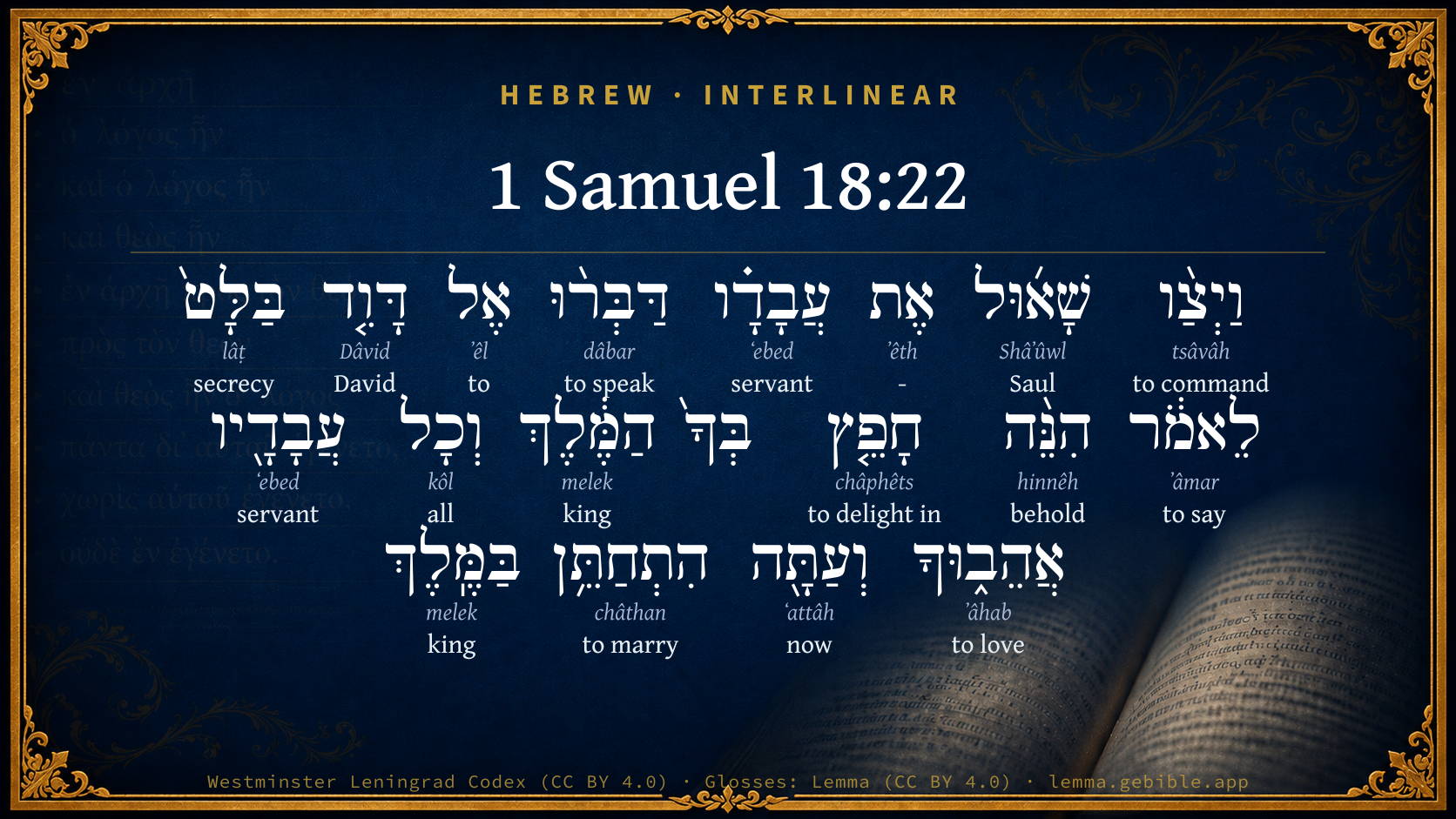
1 Samuel 18:22

Hebrew (Westminster Leningrad Codex) 1 Samuel 18:22 appears in the Hebrew Old Testament. The text above is from the Westminster Leningrad Codex. Each word links to its Strong’s number, a concise gloss, and parsing drawn from the Open Scriptures Hebrew Bible morphology. Click any word for its full Brown-Driver-Briggs (BDB) entry.
Download image
Cite this verse

1 Samuel 18:22 (World English Bible). Public Domain. Lemma interlinear Bible study tool, https://lemma.gebible.app/v/1-samuel/18/22.

Show BibTeX & RIS
BibTeX
RIS
English Translation
Saul commanded his servants, [saying], Commune with David secretly, and say, Behold, the king has delight in you, and all his servants love you: now therefore be the king's son-in-law.
World English Bible · Public Domain
Download a study sheet

One document with this verse’s original text, its word-by-word gloss line, the meaning frame, cross-references with their text, attributed commentary, and full source and license credits — printable, and it pastes into notes with its structure intact.

This verse Autodidact and up

Study sheet (.html) Plain text (.txt)

A passage Seminary Student

Up to 50 verses in one chapter. A passage sheet keeps up to 6 commentary sources and 12 cross-references per verse, in the order this page ranks them, and says so on the sheet whenever that leaves anything out. Ask for a single verse and you get the Autodidact verse sheet above.

Everything on this page stays free to read, with no account — the sheet is a download of what is already on screen, not access to it.

Want to remove ads? Support Godless Engineer
Compare translations 3

The same verse in 3 English versions, stacked beneath the original-language interlinear above. Click any original word for its lexicon entry.

Each is an independent rendering of the whole verse — the interlinear is not word-aligned to these translations.

Highlighted words mark where these versions differ — a whole-verse word diff, not a word-by-word alignment.

  • World English Bible Public Domain
    Saul commanded his servants, [saying], Commune with David secretly, and say, Behold, the king has delight in you, and all his servants love you: now therefore be the king's son-in-law.
  • King James Version Public Domain
    And Saul commanded his servants, saying, Commune with David secretly, and say, Behold, the king hath delight in thee, and all his servants love thee: now therefore be the king's son in law.
  • unfoldingWord Literal Text CC BY-SA 4.0
    And Saul commanded his servants, “Speak to David in secrecy, saying, ‘Behold, the king delights in you, and all of his servants love you. And now, make yourself a son-in-law of the king.’”

unfoldingWord Literal Text — © unfoldingWord, licensed CC BY-SA 4.0. Word-aligned USFM3 via Door43 (git.door43.org/unfoldingWord/en_ult).

Versions to compare (up to 4)

3 of 4 selected

Show all 18 translations

Every available English version of this verse, each an independent rendering of the whole verse.

  • World English Bible Public Domain
    Saul commanded his servants, [saying], Commune with David secretly, and say, Behold, the king has delight in you, and all his servants love you: now therefore be the king's son-in-law.
  • Berean Standard Bible Public Domain
    Then Saul ordered his servants, “Speak to David privately and tell him, ‘Behold, the king is pleased with you, and all his servants love you. Now therefore, become his son-in-law.’”
  • Majority Standard Bible Public Domain
    Then Saul ordered his servants, “Speak to David privately and tell him, ‘Behold, the king is pleased with you, and all his servants love you. Now therefore, become his son-in-law.’”
  • King James Version Public Domain
    And Saul commanded his servants, saying, Commune with David secretly, and say, Behold, the king hath delight in thee, and all his servants love thee: now therefore be the king's son in law.
  • American Standard Version (1901) Public Domain
    And Saul commanded his servants, `saying', Commune with David secretly, and say, Behold, the king hath delight in thee, and all his servants love thee: now therefore be the king's son-in-law.
  • Revised Version (1885) Public Domain
    And Saul commanded his servants, saying, Commune with David secretly, and say, Behold, the king hath delight in thee, and all his servants love thee: now therefore be the king’s son in law.
  • Geneva Bible (1599) Public Domain
    And Saul commanded his seruants, Speake with Dauid secretly, and say, Behold, ye King hath a fauour to thee, and all his seruants loue thee: be now therefore the Kings sonne in law.
  • Douay-Rheims (1899) Public Domain
    And Saul commanded his servants to speak to David privately, saying: Behold thou pleasest the king, and all his servants love thee. Now therefore be the king's son in law.
  • Young's Literal Translation Public Domain
    And Saul commandeth his servants, `Speak unto David gently, saying, Lo, the king hath delighted in thee, and all his servants have loved thee, and now, be son-in-law to the king.'
  • Literal Standard Version CC BY-SA 4.0
    And Saul commands his servants, “Speak to David gently, saying, Behold, the king has delighted in you, and all his servants have loved you, and now, be son-in-law of the king.”
  • Unlocked Literal Bible CC BY-SA 4.0
    Saul commanded his servants, “Speak with David in private, and say, 'See, the king takes pleasure in you, and all his servants love you. Now then, become the king's son-in-law.'”
  • unfoldingWord Literal Text CC BY-SA 4.0
    And Saul commanded his servants, “Speak to David in secrecy, saying, ‘Behold, the king delights in you, and all of his servants love you. And now, make yourself a son-in-law of the king.’”
  • Darby Bible Public Domain
    And Saul commanded his servants, Speak with David secretly, saying, Behold, the king has delight in thee, and all his servants love thee: now therefore be the king's son-in-law.
  • World Messianic Bible Public Domain
    Saul commanded his servants, “Talk with David secretly, and say, ‘Behold, the king has delight in you, and all his servants love you. Now therefore be the king’s son-in-law.’”
  • Webster's Bible Public Domain
    And Saul commanded his servants, saying, Commune with David secretly, and say, Behold, the king hath delight in thee, and all his servants love thee: now therefore be the king's son-in-law.
  • Free Bible Version CC BY-SA 4.0
    Saul gave these instructions to his servants, “Talk with David in private and tell him, ‘Look, the king is very happy with you, and all of us love you. Why not become the king's son-in-law?’”
  • Bible in Basic English Public Domain
    And Saul gave his servants orders saying, Have talk with David secretly and say to him, See how the king has delight in you, and how you are loved by all his servants: then be the king's son-in-law.
  • JPS Tanakh (1917) Public Domain
    And Saul commanded his servants: 'Speak with David secretly, and say: Behold, the king hath delight in thee, and all his servants love thee; now therefore be the king's son-in-law.'

Literal Standard Version (2020), Covenant Press — licensed CC BY-SA 4.0. Text via the HelloAO Bible API (eBible.org). Unlocked Literal Bible (unfoldingWord) — licensed CC BY-SA 4.0. Text via the HelloAO Bible API (eBible.org). unfoldingWord Literal Text — © unfoldingWord, licensed CC BY-SA 4.0. Word-aligned USFM3 via Door43 (git.door43.org/unfoldingWord/en_ult). Free Bible Version, Dr. Jonathan Gallagher — licensed CC BY-SA 4.0. Text via the HelloAO Bible API (eBible.org).

Word by word

More ways to search: Search by grammar → Find every occurrence → Compare this word →

Practice this passage: Drill this verse → Learn its vocabulary →

בַּלָּט֙
lâṭ
H3909
“in/at the · secrecy”
Preposition, Determined + Noun, Common, Masculine, Singular, Absolute
Part of Speech
Preposition + Noun
Type
Common
Gender
Masculine
Number
Singular
State
Absolute
Full BDB Definition

Origin: a form of H3814 or else participle from H3874

TWOT: 1092a

secrecy, mystery, enchantment - secrecy, secretly - mystery, enchantment
  1. וַיְצַ֨ו tsâvâh H6680 “and · to command” Conjunction + Verb, Piel, Sequential Imperfect, 3rd Person, Masculine, Singular
  2. שָׁא֜וּל Shâʼûwl H7586 “Saul” Noun, Proper
  3. אֶת ʼêth H853 “-” Particle, Direct Object
  4. עֲבָדָ֗ו ʻebed H5650 “servants · his” Noun, Common, Masculine, Plural, Construct + Suffix, Personal, 3rd Person, Masculine, Singular
  5. דַּבְּר֨וּ dâbar H1696 “speak” Verb, Piel, Imperative, 2nd Person, Masculine, Plural
  6. אֶל ʼêl H413 “to” Preposition
  7. דָּוִ֤ד Dâvid H1732 “David” Noun, Proper
  8. לֵאמֹ֔ר ʼâmar H559 “to say” Preposition + Verb, Qal, Infinitive Construct
  9. הִנֵּ֨ה hinnêh H2009 “behold” Particle, Demonstrative
  10. חָפֵ֤ץ châphêts H2654 “to delight in” Verb, Qal, Perfect, 3rd Person, Masculine, Singular
  11. הַמֶּ֔לֶךְ melek H4428 “the · king” Particle, Definite Article + Noun, Common, Masculine, Singular, Absolute
  12. וְכָל kôl H3605 “and · all of” Conjunction + Noun, Common, Masculine, Singular, Construct
  13. עֲבָדָ֖יו ʻebed H5650 “servants · his” Noun, Common, Masculine, Plural, Construct + Suffix, Personal, 3rd Person, Masculine, Singular
  14. אֲהֵב֑וּךָ ʼâhab H157 “to love · you” Verb, Qal, Perfect, 3rd Person, Common, Plural + Suffix, Personal, 2nd Person, Masculine, Singular
  15. וְעַתָּ֖ה ʻattâh H6258 “and · now” Conjunction + Adverb
  16. הִתְחַתֵּ֥ן châthan H2859 “marry” Verb, Hithpael, Imperative, 2nd Person, Masculine, Singular
  17. בַּמֶּֽלֶךְ melek H4428 “in/at the · king” Preposition, Determined + Noun, Common, Masculine, Singular, Absolute

About this verse

These counts appear in no published source. They are computed here, from the morphology-tagged text and Lemma’s own curated glosses. What Lemma adds →

19
words
16
distinct lemmas
Historical
section

Notable vocabulary

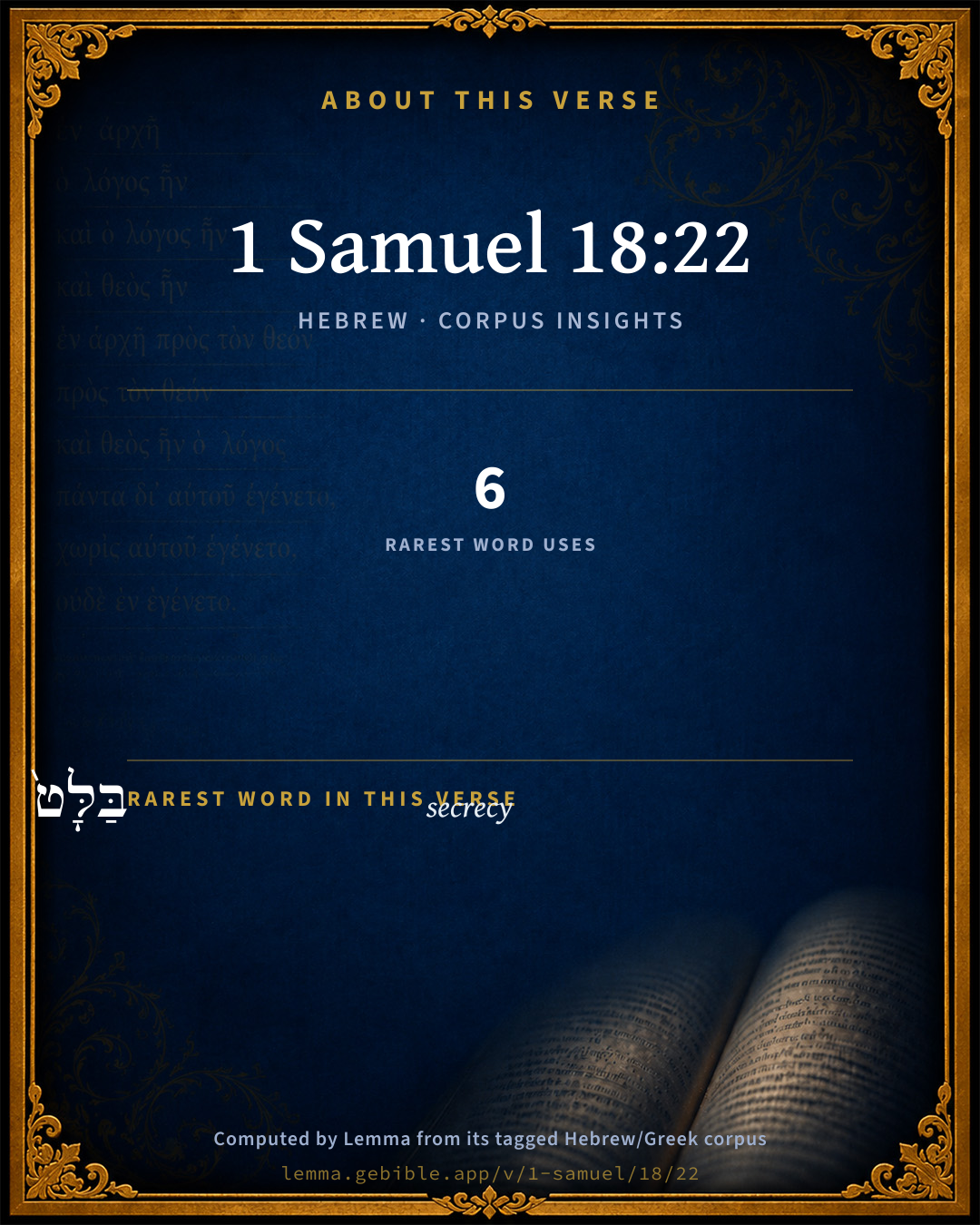
The rarest word here is בַּלָּט֙ secrecy H3909 — appearing just 6 times in the whole Hebrew Bible.

Shared distinctive vocabulary

בַּלָּט֙ secrecy H3909 occurs in 6 verses of the Hebrew Bible. Also found in:

Grammatical profile

  • 6 verbs
  • 8 nouns
  • 2 prepositions
  • 1 adverb
  • 2 particles

Verb forms

  • וַיְצַ֨ו Piel · Sequential Imperfect
  • דַּבְּר֨וּ Piel · Imperative
  • לֵאמֹ֔ר Qal · Infinitive Construct
  • חָפֵ֤ץ Qal · Perfect
  • אֲהֵב֑וּךָ Qal · Perfect
  • הִתְחַתֵּ֥ן Hithpael · Imperative

Repetition

Words recur within this verse — often emphatic in Hebrew:

  • עֲבָדָ֗ו servant H5650 ×2
  • הַמֶּ֔לֶךְ king H4428 ×2

Hebrew & Septuagint length

In English translation the verse runs 30 words from the Hebrew and 31 from the Septuagint (LXX English) — closely comparable.

A rough comparison of the two English renderings, which tokenize alike — not a word-level alignment.

Word counts can differ between the Hebrew and the Greek without any difference in meaning — e.g. the Hebrew direct-object marker אֵת has no separate Greek word, and Greek often adds the article ὁ.

Cross-references

4

Topical passages linked to 1 Samuel 18:22 in the Treasury of Scripture Knowledge — connected by theme and wording, ordered by reader-vote popularity; previews shown in the World English Bible.

  • 2 Samuel 13:28–29 Absalom commanded his servants, saying, Mark you now, when Amnon's heart is merry with wine; and when I tell you, Smite Amnon, then kill him; don't be afraid; haven't I commanded you? be courageous, and be valiant.
  • Psalms 36:1–3 An oracle is within my heart about the disobedience of the wicked: "There is no fear of God before his eyes."
  • Psalms 55:21 His mouth was smooth as butter, But his heart was war. His words were softer than oil, Yet they were drawn swords.
  • Proverbs 29:12 If a ruler listens to lies, All of his officials are wicked.

Cross-references courtesy of OpenBible.info (CC BY 4.0).

Hebrew and Greek witnesses Masoretic Hebrew ↔ Greek Septuagint

The same verse in the two great witnesses to the Old Testament, shown verse-for-verse.

These are two independent witnesses, not word-aligned to each other, and the Septuagint is shown in lemma (dictionary) form.

Hebrew 1 Samuel 18:22 Masoretic · Westminster Leningrad Codex

וַיְצַ֨ו שָׁא֜וּל אֶת עֲבָדָ֗ו דַּבְּר֨וּ אֶל דָּוִ֤ד בַּלָּט֙ לֵאמֹ֔ר הִנֵּ֨ה חָפֵ֤ץ בְּךָ֙ הַמֶּ֔לֶךְ וְכָל עֲבָדָ֖יו אֲהֵב֑וּךָ וְעַתָּ֖ה הִתְחַתֵּ֥ן בַּמֶּֽלֶךְ

Saul commanded his servants, [saying], Commune with David secretly, and say, Behold, the king has delight in you, and all his servants love you: now therefore be the king's son-in-law.

World English Bible · Public Domain

Greek LXX 1 Samuel 18:22 Septuagint · lemma form
And Saul charged his servants, saying, Speak you⌃ privately to David, saying, Behold, the king delights in you, and all his servants love you, and do you becomes the king's son-in-law.

LXX2012 (modern English Septuagint) · Public Domain

Hebrew: Westminster Leningrad Codex (CC BY 4.0). Greek: Septuagint (public domain); English from LXX2012 (modern English Septuagint) (Public Domain). How the Septuagint differs from the Hebrew →

Targum (Aramaic paraphrase)

1

The Targum is the ancient Jewish Aramaic paraphrase of the Hebrew Scriptures — an interpretive translation, not the Hebrew text itself. Onkelos (literal) and Pseudo-Jonathan (expansive) render the Torah, and Jonathan the Prophets. Coverage is partial: where no permissively-licensed English translation exists for a verse, only the Aramaic is shown. This is verse-level text, not a word-by-word alignment to the Hebrew.

  1. Targum Jonathan Prophets (Joshua–Malachi)
    וּפַקֵיד שָׁאוּל יַת עַבְדוֹהִי מַלִילוּ עִם דָוִד בְּרָז לְמֵימַר הָא אִתְרְעֵי בָּךְ מַלְכָּא וְכָל עַבְדוֹהִי רַחֲמוּךְ וּכְעַן אִתְחַתֵּן בְּמַלְכָּא:

    (no public-domain English translation for this verse)

    Targum Jonathan — Aramaic: “Mikraot Gedolot” (public domain). English: “Sefaria Community Translation” (CC0 1.0 (public-domain dedication)); “London "Chaldee Paraphrase," 1871” (public domain). Text via Sefaria.

Commentary

Notes on 1 Samuel 18:22 from classic Christian and Jewish commentators (each source and its license shown beneath its notes). The classic Christian expositions comment on the surrounding passage and are grouped to its opening verse, so a note may address several verses; the Jewish commentaries on the Tanakh (Rashi and others) are per-verse, so they appear only where the commentator wrote on this verse.

Lemma curates 59 commentaries, every one of them public domain or Creative Commons licensed, each selected and text-cleaned for this edition rather than reprinted as found. About our sources →

Trapp's Complete Commentary

John Trapp

1Sa 18:22 And Saul commanded his servants, [saying], Commune with David secretly, and say, Behold, the king hath delight in thee, and all his servants love thee: now therefore be the king’s son in law.

Ver. 22. Commune with David secretly,] i.e., Tanquam ex vobis, ne intelligat consilium ex me profectum esse, {a} speak it as from yourselves, and not as set on by me.

Behold, the king hath delight in thee.] Thus they must sprinkle him with court holy water, as they say; Fair words make fools fain. But David had learned the rule, Mεμνησο απιστειν.

{a} Junias.

John Trapp, A Commentary or Exposition upon All the Books of the Old and New Testament (1647–1656) — public domain. Text from a community e-Sword module.

Joseph Benson's Commentary

1Sa 18:22-23. Commune with David secretly — It seems David was not forward to embrace Saul’s offer, having been before so grossly abused. Therefore Saul ordered his courtiers, in private discourse, to take occasion to persuade him to it. Seeing that I am a poor man — Having no estate, and of small credit; and therefore unable to endow her according to her quality.

Joseph Benson's Commentary on the Old and New Testaments (1811–1818) — public domain. Text from a community e-Sword module.

Tyndale Open Study Notes

Tyndale Open Resources

18:22 really likes you: The same Hebrew word describes Jonathan’s love for David (18:3; 19:1-2, “strong affection”). Here, it was completely untrue.

Tyndale Open Study Notes — © Tyndale Open Resources, licensed CC BY-SA 4.0. Text via the HelloAO Bible API.

Ellicott's Commentary for English Readers

(22) Behold, the king hath delight in thee.—Lange quaintly sees in this fluent discourse of the courtiers “something of the flattering, conciliatory tone usual in such circles.”

A Bible Commentary for English Readers, edited by Charles John Ellicott (1878–1897) — public domain. Text from a community e-Sword module.

The Cambridge Bible for Schools and Colleges

gen. ed. J. J. S. Perowne

22. Commune] i.e. “converse.” The word is derived from Lat. communicare, through the old Fr. communier. It would seem that David mistrusted Saul and returned no answer, so Saul set his courtiers to work to persuade him.

The Cambridge Bible for Schools and Colleges (gen. ed. J. J. S. Perowne; Cambridge University Press, 1878–1918) — public domain. Text from a community e-Sword module.

John Gill's Exposition

And Saul's servants spake these words in the ears of David,.... Those before related, which Saul commanded them to speak, which they delivered exactly according to their orders, with an audible voice, clearly, plainly, and distinctly, so that David might hear and understand them:

and David said, seemeth it to you a light thing to be a king's son in law; a small a trifling matter, an easy thing to come into, every thing requisite to it:

seeing that I am a poor man; and not able to give a dowry suitable to the daughter of a king; it being usual in those times for a man to give a dowry to, and not receive a portion with a wife; and which also was the custom of the Germans, as Tacitus (x) relates; and this was to be according to the rank and quality of the person married, and which in this case David was not equal to:

and lightly esteemed? not by the people of Israel and Judah, who loved him, as he was loved even by the servants of Saul, at least in profession; but by Saul himself, who had slighted him in giving his elder daughter to another man, when he had promised her to him, which was discouraging to David, and resented by him.

(x) De Moribus German. c. 18.

John Gill's Exposition of the Whole Bible (1746–1763) — public domain (CC PDM 1.0). Text via the HelloAO Bible API.

Matthew Poole's English Annotations

Commune with David, whom having so lately and grossly deceived, he found backward to embrace his motion, and therefore sets others on work to persuade him.

Matthew Poole's English Annotations on the Holy Bible (1683–1685) — public domain. Text from a community e-Sword/MySword module.

Whedon's Commentary on the Bible

Daniel D. Whedon

22. Commune with David secretly — This intrigue of Saul by means of his servants indicates that David had paid little or no attention to the words of the king himself. He had maintained a most prudent reticence.

Daniel D. Whedon (gen. ed.), Commentary on the Old and New Testaments (1874–1909) — public domain. Text from a community e-Sword module.

The Pulpit Commentary

Vers. 22, 23. Commune, etc. This is a more full and exact account of what was said summarily in ver. 21. We cannot suppose that Saul first spoke to David himself, and then told his servants to coax him, as this would also require us to suppose that when offered her by Saul, David refused Michal in marriage. But we may well believe that he was displeased at having been deceived, and that the renewed proposal of marriage with one of the king"s daughters had to be made carefully, as he might naturally think that there was danger of his being cajoled a second time. David replies, in fact, very discreetly, saying that to be the king"s son-in-law was indeed a great honour, but that he was too poor to provide a sufficient dowry. Strictly the promises given in 1Sa_17:25 bound Saul to give her without dowry; but it appears quite plainly from David"s words that he had lost Merab because not able to purchase her as Adriel had done. For the custom of giving large sums to the bride"s father see Gen_34:12; Exo_22:16, Exo_22:17.

The Pulpit Commentary (1880–1919), ed. H.D.M. Spence-Jones & Joseph S. Exell — public domain. Text from a community e-Sword module.

unfoldingWord translationNotes

Door43 World Missions Community

all his servants love you

"all of his servants admire you"

Now then

"For these reasons you should"

translationWords

command

servant

king

unfoldingWord translationNotes — © Distant Shores Media and the Door43 World Missions Community, licensed CC BY-SA 4.0. Source: git.door43.org/Door43/en_tn.

Lesson kit

Teaching starters — assembled from the data on this page, not authored interpretation. Every prompt links to the verse data it draws on. Edit before teaching.

1 Samuel, in the Historical, opens this verse with 19 words (16 distinct Hebrew lemmas). Its most distinctive word is lâṭ (“secrecy”). A historical commentator’s framing appears above. Read the whole chapter for the surrounding context.

Discussion questions

  1. The word lâṭ carries the sense “secrecy.” How does it shape the verse?
  2. How does Exodus 7:22, which shares the word «secrecy», read alongside this verse?
  3. What does the repetition of “servant” (2× in this one verse) do in this verse?
  4. These translations render this verse differently. What is at stake in choosing one wording over another?
  5. «וַיְצַ֨ו» is a Piel Sequential Imperfect verb. How does that grammatical form shape the action described?
  6. Compare how Trapp's Complete Commentary and Joseph Benson's Commentary read this verse. Where do they agree or differ?

Things to notice

Reading settings

Reading text

Shown beneath each verse's original-language words.

Old Testament
Old Testament edition

Read the OT as the Masoretic Hebrew (MT) or the Greek Septuagint (LXX).

English shown for the Greek Septuagint (in the Hebrew ↔ Greek comparison).

Comparing translations? Open the Compare panel on any verse page to stack up to four side by side.