
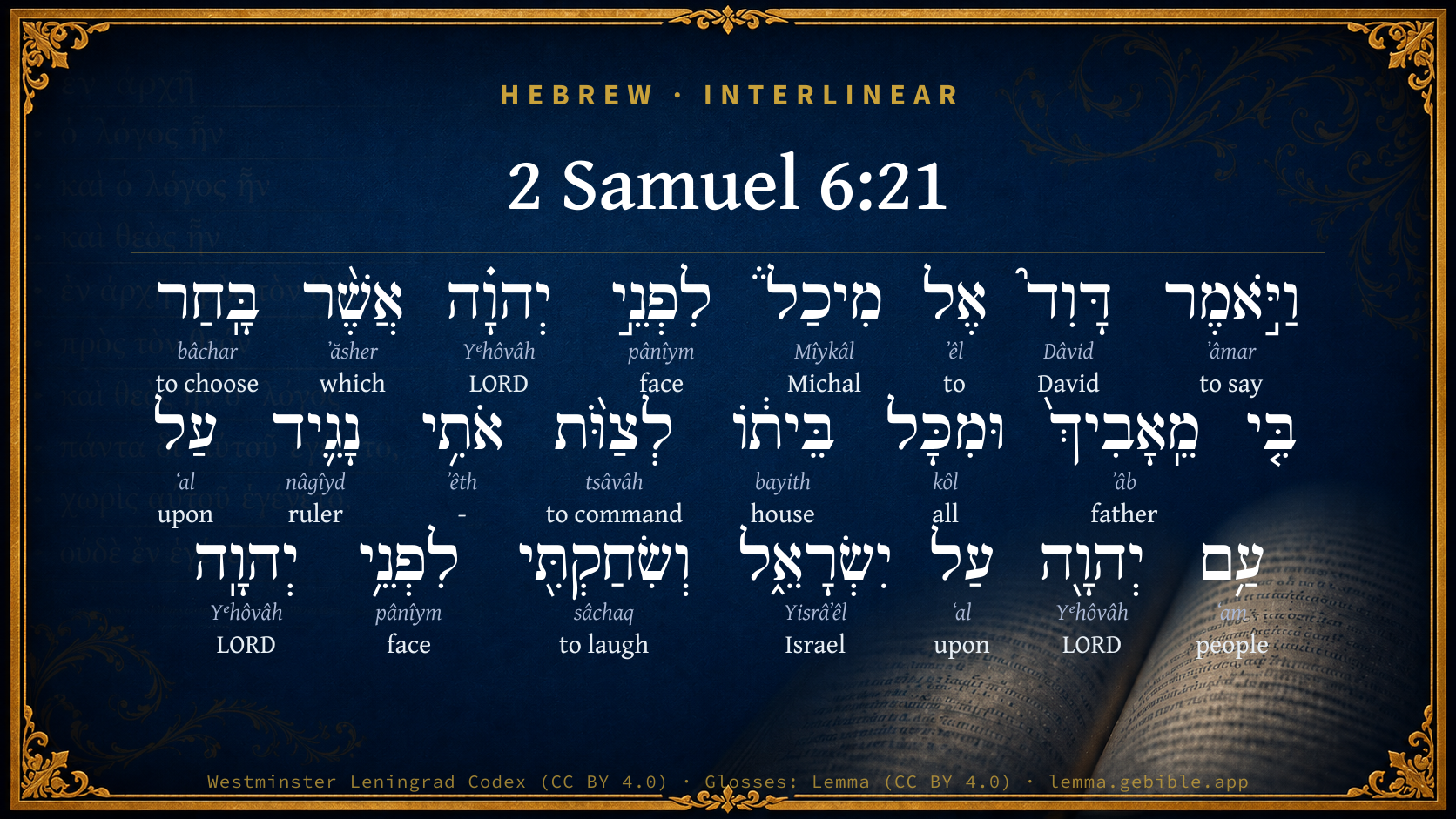
2 Samuel 6:21

Hebrew (Westminster Leningrad Codex) 2 Samuel 6:21 appears in the Hebrew Old Testament. The text above is from the Westminster Leningrad Codex. Each word links to its Strong’s number, a concise gloss, and parsing drawn from the Open Scriptures Hebrew Bible morphology. Click any word for its full Brown-Driver-Briggs (BDB) entry.
Download image
Cite this verse

2 Samuel 6:21 (World English Bible). Public Domain. Lemma interlinear Bible study tool, https://lemma.gebible.app/v/2-samuel/6/21.

Show BibTeX & RIS
BibTeX
RIS
English Translation
David said to Michal, [It was] before Yahweh, who chose me above your father, and above all his house, to appoint me prince over the people of Yahweh, over Israel: therefore will I play before Yahweh.
World English Bible · Public Domain
Download a study sheet

One document with this verse’s original text, its word-by-word gloss line, the meaning frame, cross-references with their text, attributed commentary, and full source and license credits — printable, and it pastes into notes with its structure intact.

This verse Autodidact and up

Study sheet (.html) Plain text (.txt)

A passage Seminary Student

Up to 50 verses in one chapter. A passage sheet keeps up to 6 commentary sources and 12 cross-references per verse, in the order this page ranks them, and says so on the sheet whenever that leaves anything out. Ask for a single verse and you get the Autodidact verse sheet above.

Everything on this page stays free to read, with no account — the sheet is a download of what is already on screen, not access to it.

Want to remove ads? Support Godless Engineer
Compare translations 3

The same verse in 3 English versions, stacked beneath the original-language interlinear above. Click any original word for its lexicon entry.

Each is an independent rendering of the whole verse — the interlinear is not word-aligned to these translations.

Highlighted words mark where these versions differ — a whole-verse word diff, not a word-by-word alignment.

  • World English Bible Public Domain
    David said to Michal, [It was] before Yahweh, who chose me above your father, and above all his house, to appoint me prince over the people of Yahweh, over Israel: therefore will I play before Yahweh.
  • King James Version Public Domain
    And David said unto Michal, It was before the LORD, which chose me before thy father, and before all his house, to appoint me ruler over the people of the LORD, over Israel: therefore will I play before the LORD.
  • unfoldingWord Literal Text CC BY-SA 4.0
    But David said to Michal, “To the face of Yahweh, who chose me instead of your father and instead of all of his house to appoint me leader over the people of Yahweh, over Israel, yes, I celebrated to the face of Yahweh!

unfoldingWord Literal Text — © unfoldingWord, licensed CC BY-SA 4.0. Word-aligned USFM3 via Door43 (git.door43.org/unfoldingWord/en_ult).

Versions to compare (up to 4)

3 of 4 selected

Show all 18 translations

Every available English version of this verse, each an independent rendering of the whole verse.

  • World English Bible Public Domain
    David said to Michal, [It was] before Yahweh, who chose me above your father, and above all his house, to appoint me prince over the people of Yahweh, over Israel: therefore will I play before Yahweh.
  • Berean Standard Bible Public Domain
    But David said to Michal, “I was dancing before the LORD, who chose me over your father and all his house when He appointed me ruler over the LORD’s people Israel. I will celebrate before the LORD,
  • Majority Standard Bible Public Domain
    But David said to Michal, “I was dancing before the LORD, who chose me over your father and all his house when He appointed me ruler over the LORD’s people Israel. I will celebrate before the LORD,
  • King James Version Public Domain
    And David said unto Michal, It was before the LORD, which chose me before thy father, and before all his house, to appoint me ruler over the people of the LORD, over Israel: therefore will I play before the LORD.
  • American Standard Version (1901) Public Domain
    And David said unto Michal, `It was' before Jehovah, who chose me above thy father, and above all his house, to appoint me prince over the people of Jehovah, over Israel: therefore will I play before Jehovah.
  • Revised Version (1885) Public Domain
    And David said unto Michal, It was before the LORD, which chose me above thy father, and above all his house, to appoint me prince over the people of the LORD, over Israel: therefore will I play before the LORD.
  • Geneva Bible (1599) Public Domain
    Then Dauid sayd vnto Michal, It was before the Lord, which chose me rather then thy father, and all his house, and commanded me to bee ruler ouer the people of the Lord, euen ouer Israel: and therefore will I play before the Lord,
  • Douay-Rheims (1899) Public Domain
    And David said to Michol: Before the Lord, who chose me rather than thy father, and than all his house, and commanded me to be ruler over the people of the Lord in Israel,
  • Young's Literal Translation Public Domain
    And David saith unto Michal, `-- Before Jehovah, who fixed on me above thy father, and above all his house, to appoint me leader over the people of Jehovah, and over Israel, -- yea, I played before Jehovah;
  • Literal Standard Version CC BY-SA 4.0
    And David says to Michal, “Before YHWH, who fixed on me above your father, and above all his house, to appoint me leader over the people of YHWH, and over Israel—indeed, I played before YHWH;
  • Unlocked Literal Bible CC BY-SA 4.0
    David responded to Michal, “I did that before Yahweh, who chose me above your father and above all his family, who appointed me leader over the people of Yahweh, over Israel. Before Yahweh I will be joyful!
  • unfoldingWord Literal Text CC BY-SA 4.0
    But David said to Michal, “To the face of Yahweh, who chose me instead of your father and instead of all of his house to appoint me leader over the people of Yahweh, over Israel, yes, I celebrated to the face of Yahweh!
  • Darby Bible Public Domain
    And David said to Michal, It was before Jehovah, who chose me rather than thy father, and than all his house, to appoint me ruler over the people of Jehovah, over Israel; and I played before Jehovah.
  • World Messianic Bible Public Domain
    David said to Michal, “It was before the LORD, who chose me above your father, and above all his house, to appoint me prince over the people of the LORD, over Israel. Therefore I will celebrate before the LORD.
  • Webster's Bible Public Domain
    And David said to Michal, It was before the LORD, who chose me before thy father, and before all his house, to appoint me ruler over the people of the LORD, over Israel: therefore will I play before the LORD.
  • Free Bible Version CC BY-SA 4.0
    David told Michal, “I was dancing before the Lord, who chose me instead of your father and all his family when he named me ruler over the Lord's people Israel. I will continue to celebrate before the Lord,
  • Bible in Basic English Public Domain
    And David said to Michal, I was dancing before the Lord, who put me over your father and all his sons, to make me a ruler over the people of the Lord, over his people Israel: and I will go on playing before the Lord;
  • JPS Tanakh (1917) Public Domain
    And David said unto Michal: 'Before the LORD, who chose me above thy father, and above all his house, to appoint me prince over the people of the LORD, over Israel, before the LORD will I make merry.

Literal Standard Version (2020), Covenant Press — licensed CC BY-SA 4.0. Text via the HelloAO Bible API (eBible.org). Unlocked Literal Bible (unfoldingWord) — licensed CC BY-SA 4.0. Text via the HelloAO Bible API (eBible.org). unfoldingWord Literal Text — © unfoldingWord, licensed CC BY-SA 4.0. Word-aligned USFM3 via Door43 (git.door43.org/unfoldingWord/en_ult). Free Bible Version, Dr. Jonathan Gallagher — licensed CC BY-SA 4.0. Text via the HelloAO Bible API (eBible.org).

Word by word

More ways to search: Search by grammar → Find every occurrence → Compare this word →

Practice this passage: Drill this verse → Learn its vocabulary →

מִיכַל֒
Mîykâl
H4324
“Michal”
Noun, Proper
Part of Speech
Noun
Type
Proper
Full BDB Definition

Origin: apparently the same as H4323

TWOT: None

Michal = "who is like God" - daughter of king Saul, sister of Jonathan, wife of king David, and mother of five; given to David as wife for the bride price of 100 Philistine foreskins; while still married to David, her father gave her in marriage to another, Phaltiel; at the death of Saul, David forced her to return
  1. וַיֹּ֣אמֶר ʼâmar H559 “and · to say” Conjunction + Verb, Qal, Sequential Imperfect, 3rd Person, Masculine, Singular
  2. דָּוִד֮ Dâvid H1732 “David” Noun, Proper
  3. אֶל ʼêl H413 “to” Preposition
  4. לִפְנֵ֣י pânîym H6440 “to/for · face(s) of” Preposition + Noun, Common, Both, Plural, Construct
  5. יְהוָ֗ה Yᵉhôvâh H3068 “LORD” Noun, Proper
  6. אֲשֶׁ֨ר ʼăsher H834 “which” Particle, Relative
  7. בָּֽחַר bâchar H977 “to choose” Verb, Qal, Perfect, 3rd Person, Masculine, Singular
  8. מֵֽאָבִיךְ֙ ʼâb H1 “from · father · your” Preposition + Noun, Common, Masculine, Singular, Construct + Suffix, Personal, 2nd Person, Feminine, Singular
  9. וּמִכָּל kôl H3605 “and · from · all of” Conjunction + Preposition + Noun, Common, Masculine, Singular, Construct
  10. בֵּית֔וֹ bayith H1004 “house · his” Noun, Common, Masculine, Singular, Construct + Suffix, Personal, 3rd Person, Masculine, Singular
  11. לְצַוֺּ֨ת tsâvâh H6680 “to command” Preposition + Verb, Piel, Infinitive Construct
  12. אֹתִ֥י ʼêth H853 “- · me” Particle, Direct Object + Suffix, Personal, 1st Person, Common, Singular
  13. נָגִ֛יד nâgîyd H5057 “ruler” Noun, Common, Masculine, Singular, Absolute
  14. עַל ʻal H5921 “upon” Preposition
  15. עַ֥ם ʻam H5971 “people of” Noun, Common, Masculine, Singular, Construct
  16. יְהוָ֖ה Yᵉhôvâh H3068 “LORD” Noun, Proper
  17. עַל ʻal H5921 “upon” Preposition
  18. יִשְׂרָאֵ֑ל Yisrâʼêl H3478 “Israel” Noun, Proper
  19. וְשִׂחַקְתִּ֖י sâchaq H7832 “and · to laugh” Conjunction + Verb, Piel, Sequential Perfect, 1st Person, Common, Singular
  20. לִפְנֵ֥י pânîym H6440 “to/for · face(s) of” Preposition + Noun, Common, Both, Plural, Construct
  21. יְהוָֽה Yᵉhôvâh H3068 “LORD” Noun, Proper

About this verse

These counts appear in no published source. They are computed here, from the morphology-tagged text and Lemma’s own curated glosses. What Lemma adds →

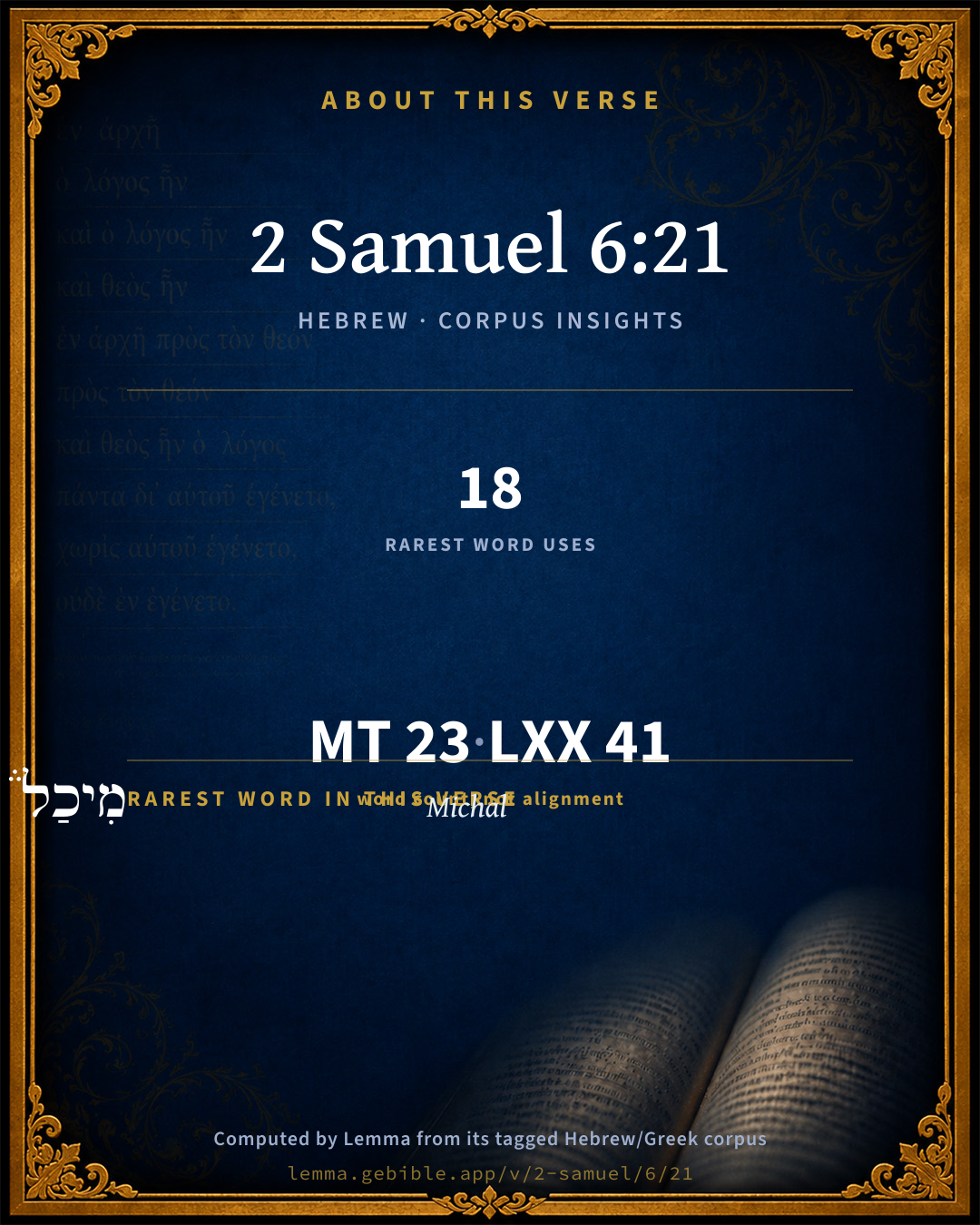
23
words
18
distinct lemmas
Historical
section

Notable vocabulary

The rarest word here is מִיכַל֒ Michal H4324 — appearing just 18 times in the whole Hebrew Bible.

Shared distinctive vocabulary

מִיכַל֒ Michal H4324 occurs in 17 verses of the Hebrew Bible. Also found in:

Grammatical profile

  • 4 verbs
  • 13 nouns
  • 4 prepositions
  • 2 particles

Verb forms

  • וַיֹּ֣אמֶר Qal · Sequential Imperfect
  • בָּֽחַר Qal · Perfect
  • לְצַוֺּ֨ת Piel · Infinitive Construct
  • וְשִׂחַקְתִּ֖י Piel · Sequential Perfect

Repetition

Words recur within this verse — often emphatic in Hebrew:

  • יְהוָ֗ה LORD H3068 ×3
  • לִפְנֵ֣י face H6440 ×2
  • עַל upon H5921 ×2

Hebrew & Septuagint length

In English translation the verse runs 36 words from the Hebrew and 45 from the Septuagint (LXX English) — closely comparable.

A rough comparison of the two English renderings, which tokenize alike — not a word-level alignment.

Word counts can differ between the Hebrew and the Greek without any difference in meaning — e.g. the Hebrew direct-object marker אֵת has no separate Greek word, and Greek often adds the article ὁ.

In the original languages it is 23 Hebrew tokens and 41 Greek tokens — but the two are counted differently (Hebrew bundles its prefixes and suffixes into one token; the Greek is in lemma form), so that isn’t a like-for-like length.

Cross-references

12

Topical passages linked to 2 Samuel 6:21 in the Treasury of Scripture Knowledge — connected by theme and wording, ordered by reader-vote popularity; previews shown in the World English Bible.

  • Acts 13:22 When he had removed him, he raised up David to be their king, to whom he also testified, 'I have found David the son of Jesse, a man after my heart, who will do all my will.'
  • 1 Samuel 13:14 But now your kingdom shall not continue: Yahweh has sought him a man after his own heart, and Yahweh has appointed him to be prince over his people, because you have not kept that which Yahweh commanded you.
  • 2 Samuel 6:16 It was so, as the ark of Yahweh came into the city of David, that Michal the daughter of Saul looked out at the window, and saw king David leaping and dancing before Yahweh; and she despised him in her heart.
  • Psalms 89:19–20 Then you spoke in vision to your saints, And said, "I have bestowed strength on the warrior. I have exalted a young man from the people.
  • 1 Samuel 15:28 Samuel said to him, Yahweh has torn the kingdom of Israel from you this day, and has given it to a neighbor of yours who is better than you.
  • Psalms 78:70–72 He also chose David his servant, And took him from the sheepfolds;
  • 1 Samuel 16:1 Yahweh said to Samuel, How long will you mourn for Saul, seeing I have rejected him from being king over Israel? fill your horn with oil, and go: I will send you to Jesse the Bethlehemite; for I have provided me a king among his sons.
  • 2 Samuel 6:5 David and all the house of Israel played before Yahweh with all manner of [instruments made of] fir-wood, and with harps, and with psalteries, and with tambourines, and with castanets, and with cymbals.
  • 2 Samuel 6:14 David danced before Yahweh with all his might; and David was girded with a linen ephod.
  • 1 Corinthians 10:31 Whether therefore you eat, or drink, or whatever you do, do all to the glory of God.
  • 1 Samuel 16:12 He sent, and brought him in. Now he was ruddy, and withal of a beautiful face, and goodly to look on. Yahweh said, Arise, anoint him; for this is he.
  • 1 Chronicles 15:29 It happened, as the ark of the covenant of Yahweh came to the city of David, that Michal the daughter of Saul looked out at the window, and saw king David dancing and playing; and she despised him in her heart.

Cross-references courtesy of OpenBible.info (CC BY 4.0).

Hebrew and Greek witnesses Masoretic Hebrew ↔ Greek Septuagint

The same verse in the two great witnesses to the Old Testament, shown verse-for-verse.

These are two independent witnesses, not word-aligned to each other, and the Septuagint is shown in lemma (dictionary) form.

Hebrew 2 Samuel 6:21 Masoretic · Westminster Leningrad Codex

וַיֹּ֣אמֶר דָּוִד֮ אֶל מִיכַל֒ לִפְנֵ֣י יְהוָ֗ה אֲשֶׁ֨ר בָּֽחַר בִּ֤י מֵֽאָבִיךְ֙ וּמִכָּל בֵּית֔וֹ לְצַוֺּ֨ת אֹתִ֥י נָגִ֛יד עַל עַ֥ם יְהוָ֖ה עַל יִשְׂרָאֵ֑ל וְשִׂחַקְתִּ֖י לִפְנֵ֥י יְהוָֽה

David said to Michal, [It was] before Yahweh, who chose me above your father, and above all his house, to appoint me prince over the people of Yahweh, over Israel: therefore will I play before Yahweh.

World English Bible · Public Domain

Greek LXX 2 Samuel 6:21 Septuagint · lemma form

καί εἶπον δαυίδ πρός μελχολ ἐνώριον κύριος ὀρχέομαι εὐλογητός κύριος ὅς ἐκλέγω ἐγώ ὑπέρ ὁ πατήρ σύ καί ὑπέρ πᾶς ὁ οἶκος αὐτός ὁ καταἵστημι ἐγώ εἰς ἡγέομαι ἐπί ὁ λαός αὐτός ἐπί ὁ ἰσραήλ καί παίζω καί ὀρχέομαι ἐνώπιον κύριος

And David said to Melchol, I will dance before the Lord. Blessed be the Lord who chose me before your father, and before all his house, to make me head over his people, even over Israel: therefore I will play, and dance before the Lord.

LXX2012 (modern English Septuagint) · Public Domain

Hebrew: Westminster Leningrad Codex (CC BY 4.0). Greek: Septuagint (public domain); English from LXX2012 (modern English Septuagint) (Public Domain). How the Septuagint differs from the Hebrew →

Targum (Aramaic paraphrase)

1

The Targum is the ancient Jewish Aramaic paraphrase of the Hebrew Scriptures — an interpretive translation, not the Hebrew text itself. Onkelos (literal) and Pseudo-Jonathan (expansive) render the Torah, and Jonathan the Prophets. Coverage is partial: where no permissively-licensed English translation exists for a verse, only the Aramaic is shown. This is verse-level text, not a word-by-word alignment to the Hebrew.

  1. Targum Jonathan Prophets (Joshua–Malachi)
    וַאֲמַר דָוִד לְמִיכַל קֳדָם יְיָ דִי אִיתְרְעֵי בִי מֵאֲבוּךְ וּמִכָּל בֵּיתֵיהּ לְפַקָדָא יָתִי לְמֶהֱוֵי מַלְכָּא עַל עַמָא דַייָ עַל יִשְׂרָאֵל וְשַׁבְּחִית קֳדָם יְיָ:

    (no public-domain English translation for this verse)

    Targum Jonathan — Aramaic: “Mikraot Gedolot” (public domain). English: “Sefaria Community Translation” (CC0 1.0 (public-domain dedication)); “London "Chaldee Paraphrase," 1871” (public domain). Text via Sefaria.

Commentary

Notes on 2 Samuel 6:21 from classic Christian and Jewish commentators (each source and its license shown beneath its notes). The classic Christian expositions comment on the surrounding passage and are grouped to its opening verse, so a note may address several verses; the Jewish commentaries on the Tanakh (Rashi and others) are per-verse, so they appear only where the commentator wrote on this verse.

Lemma curates 59 commentaries, every one of them public domain or Creative Commons licensed, each selected and text-cleaned for this edition rather than reprinted as found. About our sources →

Trapp's Complete Commentary

John Trapp

2Sa 6:21 And David said unto Michal, [It was] before the LORD, which chose me before thy father, and before all his house, to appoint me ruler over the people of the LORD, over Israel: therefore will I play before the LORD.

Ver. 21. Which chose me before thy father.] It is hard for the best men to recriminate without some tincture of tartness, and to keep quick the fire of zeal without all smoke of sin.

Therefore will I play.] Ludam ut illudar, as Bernard hath it.

John Trapp, A Commentary or Exposition upon All the Books of the Old and New Testament (1647–1656) — public domain. Text from a community e-Sword module.

The Biblical Illustrator

Joseph S. Exell

2Sa_6:21

David said unto Michal, It was before the Lord, which chose me before thy father.

David dancing before the ark because of his election

I What effect had this doctrine, this experience, this inward conviction upon David?

I. It made God the leading thought with David.

1. This was especially the case with David in his devotion. David that day worshipped God in spirit and in truth. The effect of this truth upon David was also that, as the Lord had become the great influence of his life, and the great object of his adoration, so he was to him his supreme Lord.

II. Secondly, it will create in us a proper disregard for human opinion.

1. In his worship David did not allow the opinions of men to weigh with him. He worshipped before the Lord, and there he left it.

2. He does not seek honour from the many. David sought not the honour which cometh from men.

3. David did not even consult the judgment of the few.

4. Beloved, the doctrines of grace put the very idea of honouring man out of court with us.

III. Then, thirdly, a sense of election causes a low opinion of self. David said, I will yet be more vile than thus, and will be base in mine own sight. David would more and more abase himself before the Lord. A sense of electing love will render you base in your own sight. I will tell you why.

1. First, you will never understand why the Lord has chosen you. Often will you sing:

What was there in me that could merit esteem,

Or give the Creator delight?

Twas even so, Father, I ever must sing,

Because it seemd good in thy sight.

2. I dare say David, in a few quick thoughts, reviewed his former estate.

3. Then the king recollected the dangers and troubles he had experienced.

4. Davids high position must have made him feel lowly when he knew to whom he owed it all. All the while David had a deep sense of his personal unworthiness. He did not know his own heart fully--no man does so. But he knew enough of himself to make him base in his own sight; for he could never think himself worthy of the choice of God, and all that it involved. Our heart adores and wonders as we think of the election of God. As we rise in the assurance of the Divine choice, we sink in our valuation of ourselves.

IV. A sense of Divine election fosters a feeling of holy brotherhood. It is wonderful how democratic the doctrines of grace are, and how aristocratic they are too. The chosen are all kings, and when we mix with the poorest of them we are kings with kings. Free grace strips the proud, but it adorns the humble. David honoured the humblest of the Lords chosen; for when Michal talked about what the handmaids of his servants would say, he answered, Of the maid-servants which thou hast spoken of, of them shall I be had in honour. To be esteemed by them was a cheer to him.

V. A sense of being chosen of God stirs a desire for the service of God.

1. Such service will be personal.

2. This personal service will be cheerful.

3. This service will be in connection with the great sacrifice.

4. This service should be thoughtful.

5. This service must be obedient.

6. This service should be practical.

7. This service must be seen at home.

If you are chosen of God you will, like David, bless your household. You will long to see your sons and daughters brought to God.

VI. A sense of Divine election will excite sacred enthusiasm.

1. David had an inward delight in God. God was his exceeding joy.

2. In Davids case his inward peace boiled over in holy excitement. Before the ark he was singing, he was harping, he was worshipping, and at last must show it by the joyful motion of his body.

3. David felt so exultant that he wished everybody to know of his joy in God. He told all the crowd around of his delight in God; and he sang that day, Declare His glory among the heathen, his wonders among all people. (C. H. Spurgeon.)

Irrepressible praisefulness

Once robbers besieged a monastery to rob it of its treasures. The monks carried the golden organ to a river near by, and sunk it in the water to keep it from the robbers hands. At certain periods, so the legend runs, the organ would rise out of the river and give forth such ravishing music as was never elsewhere heard by mortal ears. Such an instrument is a truly thankful heart--one in which is the joy of the Lord. The floods may go over it, but it ever rises out of them and sings its sweetest songs. Nothing can ever check its praise. It sings in the darkest night, its music rolling out into the gloom to cheer the weary pilgrim. A thankful heart always finds something good, even when all things seem evil.

When to shout Glory

Billy Bray, the Cornish preacher, was a constant visitor among the sick and dying. On one occasion he was sitting by the beside of a Christian brother who had been always very reticent, and afraid to confess joyously his faith in Christ. Now, however, he wast filled with gladness. Turning to Billy, whose beaming face and sunny words had done so much to produce this joy, he said, Oh, Mr. Bray, Im so happy that, if I had the power, Id shout Glory! Hae, mon, said Billy, what a pity it was thee didnt shout Glory! when thee hadst the power!

Reasonableness of religious zeal

In the Natural History Museum at Central Park, New York, a valuable butterfly may be seen. It is estimated that the insect cost its former owner, a Pennsylvanian doctor, at least £2,000. The butterfly is to be found only in a certain part of West Africa, and the gentleman fitted out an expedition and maintained it for more than two years, in order that the rare insect might be added to his entomological collection. If such zeal is shown by one who desires to secure a butterfly, is it to be wondered at that Christians at times display an unusual enthusiasm? Ought they not rather to do so more widely and frequently, when the glory of God and the salvation of never-dying souls are at stake?

The Biblical Illustrator, edited by Joseph S. Exell (c. 1880s–1900s) — public domain. Text from a community e-Sword module.

Joseph Benson's Commentary

2Sa 6:21-22. It was before the Lord — In his presence and service, which, though contemptible to thee, is and ever shall be honourable in my eyes. Who chose me before thy father — Who took away the honour from him and his, and transferred it unto me, whereby he hath obliged me to love and serve him with all my might. I will yet be more vile than thus — The more we are vilified for well-doing, the more resolute therein we should be, binding our religion the closer to us, for the endeavours of Satan’s agents to shame us out of it. And will be base — I will always be ready to abase myself before God, and think nothing too mean to stoop to for his honour. Of them I shall be had in honour — So far will they be from despising me on this account, that they will honour me the more.

Joseph Benson's Commentary on the Old and New Testaments (1811–1818) — public domain. Text from a community e-Sword module.

Tyndale Open Study Notes

Tyndale Open Resources

6:21 David’s response to Michal might hint at the real reason for her indignation—that she resented David’s success in light of the tragic decline of her father’s family.

Tyndale Open Study Notes — © Tyndale Open Resources, licensed CC BY-SA 4.0. Text via the HelloAO Bible API.

Geneva Bible (1599)

Geneva Bible translators

It was for no worldly affection, but only for that zeal that I bare to God’s glory.

Geneva Bible (1599) marginal notes — public domain. Text via Bolls.life.

Adam Clarke's Commentary

Verse 21. It was before the Lord, which chose me] David felt the reproach, and was strongly irritated, and seems to have spoken to Michal with sufficient asperity.

Adam Clarke's Commentary on the Bible (1810–1826) — public domain. Text from a community e-Sword/MySword module.

Ellicott's Commentary for English Readers

(21) Therefore will I play.—Rather, have I danced. (See 2Sa_6:5.)

Before the Lord.—David first gives the true and sufficient reason of his conduct—what he had done was before the Lord, in honouring whom no man can be really humbled; and then he turns with a reproof to Michal, which should have shown her the utter unworthiness of her objections. God had set aside her father and his house for this very spirit of pride in which she was now indulging, and had chosen him instead.

A Bible Commentary for English Readers, edited by Charles John Ellicott (1878–1897) — public domain. Text from a community e-Sword module.

The Cambridge Bible for Schools and Colleges

gen. ed. J. J. S. Perowne

21. It was before the Lord] Before the LORD, who chose me rather than thy father, &c. … yea I will play before the LORD. “Before the Lord” stands emphatically at the beginning of David’s answer. No service offered to the God to whom he owed all his advancement could be degrading. Thus he defends his own conduct, and at the same time he humbles Michal’s pride by alluding to Saul’s rejection.

The Sept. (B) reads, “Before the Lord will I dance: blessed be the Lord who chose, &c.”

It is related of Sir Thomas More that he used, even when Lord Chancellor, to put on a surplice and sing in his parish church at Chelsea. The Duke of Norfolk one day found him doing so, and expostulated with him: “A parish clarke, lord chancellour, a parish clarke! you dishonour the King and his office.” “Nay,” quoth Sir Thomas, smiling upon the duke, “your grace may not thinke that the King, your maister and myne, will be offended with men for serving of God his Maister; or by this my present behaviour account his office dishonoured.” Wordsworth’s Eccles. Biogr. II. p. 68.

ruler] See note on “captain” in ch. 2Sa_5:2.

The Cambridge Bible for Schools and Colleges (gen. ed. J. J. S. Perowne; Cambridge University Press, 1878–1918) — public domain. Text from a community e-Sword module.

John Gill's Exposition

And I will yet be more vile than thus,.... If this is to be vile, I will endeavour to be viler still; if to dance before the ark, and sing the praises of God, be reckoned a lessening of me, I will more and more be found in doing such things, or what is similar to them:

and will be base in mine own sight: humble himself, and lie low in his own eyes, admiring the grace and goodness of God to him, thinking he could never condescend too low to exalt the Lord, and magnify the riches of his goodness:

and of the maidservants which thou hast spoken of, of them shall I be had in honour; who the more humble I am, and the more I condescend, by laying aside all state in acts of devotion and religion, the more shall I be honoured and spoken well of by them.

John Gill's Exposition of the Whole Bible (1746–1763) — public domain (CC PDM 1.0). Text via the HelloAO Bible API.

Albert Barnes' Notes on the Bible

Play - See 2Sa 6:5 note. The speech might be paraphrased, Before the Lord which chose me, etc., yea, before the Lord have I danced. He humbles Michal’s pride by the allusion to her father’s rejection, and shows by Saul’s example how little pride contributes to the stability of greatness. Therefore, for his part, he will not think anything done for the glory of God too mean for him; and if he cannot have honor from Saul’s daughter, he will be content to be honored by the maid-servants.

Albert Barnes' Notes on the Bible (1834–1885) — public domain. Text from a community e-Sword/MySword module.

Matthew Poole's English Annotations

It was before the Lord; in his presence and service, which though contemptible to thee, is, and ever shall be, honourable in mine eyes.

Which chose me before thy father, and before all his house; which took away the honour from him and his, and transferred it upon me, whereby he hath obliged me to love and serve him with all my might.

Matthew Poole's English Annotations on the Holy Bible (1683–1685) — public domain. Text from a community e-Sword/MySword module.

Whedon's Commentary on the Bible

Daniel D. Whedon

21. Chose me before thy father — A remark calculated to humble Michal by reminding her of her father’s fall.

Daniel D. Whedon (gen. ed.), Commentary on the Old and New Testaments (1874–1909) — public domain. Text from a community e-Sword module.

The Pulpit Commentary

It was before the Lord. The Hebrew is much more forcible than the confused rendering of our version. "Before Jehovah, who chose me above thy father, and above all his house, to appoint me prince over Jehovah"s people, over Israel, yea, before Jehovah I have rejoiced" (Authorized Version, "played;" but see notes on ver. 5). The preference of David over Saul was proof that that king"s affectation of royal state, and his self-importance, were not pleasing in God"s eyes.

The Pulpit Commentary (1880–1919), ed. H.D.M. Spence-Jones & Joseph S. Exell — public domain. Text from a community e-Sword module.

John Wesley's Explanatory Notes

Before the Lord - In his presence and service, which though contemptible to thee, is, and ever shall be honourable in mine eyes. Who chose - Who took away the honour from him and his, and transferred it unto me, whereby he hath obliged me to love and serve him with all my might.

John Wesley, Explanatory Notes Upon the Whole Bible (1754–1765) — public domain. Text via the GEBible commentary corpus.

unfoldingWord translationNotes

Door43 World Missions Community

who chose me above your father

Here "your" refers to Michal. (See: Forms of You)

over the people of Yahweh, over Israel

Here "the people of Yahweh" and "Israel" mean the same thing. (See: Doublet)

I will be even more undignified than this

David is being ironic and means the opposite of what he said. He does not believe what he did was actually undignified or that his actions in the future will be undignified. (See: Irony)

I will be humiliated in my own eyes

Here "in my own eyes" represents what a person considers or thinks about something. AT: "I will consider myself humiliated" or "I will consider myself a fool" (See: Metonymy)

But by these slave girls you have spoken about, I will be honored

This can be stated in active form. AT: "But the slave girls of whom you have spoken will honor me" (See: Active or Passive)

had no children to the day of her death

"was never able to bear any children"

translationWords

Yahweh

ancestor

appoint

people of God

die

unfoldingWord translationNotes — © Distant Shores Media and the Door43 World Missions Community, licensed CC BY-SA 4.0. Source: git.door43.org/Door43/en_tn.

Lesson kit

Teaching starters — assembled from the data on this page, not authored interpretation. Every prompt links to the verse data it draws on. Edit before teaching.

2 Samuel, in the Historical, opens this verse with 23 words (18 distinct Hebrew lemmas). Its most distinctive word is Mîykâl (“Michal”). A historical commentator’s framing appears above. Read the whole chapter for the surrounding context.

Discussion questions

  1. The word Mîykâl carries the sense “Michal.” How does it shape the verse?
  2. 1 Samuel 14:49 shares the word «Michal» with this verse. How do the two illuminate each other?
  3. “LORD” occurs 3× in this one verse. What is the effect of the repetition?
  4. These translations render this verse differently. What is at stake in choosing one wording over another?
  5. The verb «וַיֹּ֣אמֶר» is Qal Sequential Imperfect. How does its form color the action?
  6. Reading how Trapp's Complete Commentary and The Biblical Illustrator read this verse, where do the two commentators agree and where do they part?

Things to notice

Reading settings

Reading text

Shown beneath each verse's original-language words.

Old Testament
Old Testament edition

Read the OT as the Masoretic Hebrew (MT) or the Greek Septuagint (LXX).

English shown for the Greek Septuagint (in the Hebrew ↔ Greek comparison).

Comparing translations? Open the Compare panel on any verse page to stack up to four side by side.