

2 Samuel 17:14

Hebrew (Westminster Leningrad Codex) 2 Samuel 17:14 appears in the Hebrew Old Testament. The text above is from the Westminster Leningrad Codex. Each word links to its Strong’s number, a concise gloss, and parsing drawn from the Open Scriptures Hebrew Bible morphology. Click any word for its full Brown-Driver-Briggs (BDB) entry.
Download image
Cite this verse

2 Samuel 17:14 (World English Bible). Public Domain. Lemma interlinear Bible study tool, https://lemma.gebible.app/v/2-samuel/17/14.

Show BibTeX & RIS
BibTeX
RIS
English Translation
Absalom and all the men of Israel said, The counsel of Hushai the Archite is better than the counsel of Ahithophel. For Yahweh had ordained to defeat the good counsel of Ahithophel, to the intent that Yahweh might bring evil on Absalom.
World English Bible · Public Domain
Download a study sheet

One document with this verse’s original text, its word-by-word gloss line, the meaning frame, cross-references with their text, attributed commentary, and full source and license credits — printable, and it pastes into notes with its structure intact.

This verse Autodidact and up

Study sheet (.html) Plain text (.txt)

A passage Seminary Student

Up to 50 verses in one chapter. A passage sheet keeps up to 6 commentary sources and 12 cross-references per verse, in the order this page ranks them, and says so on the sheet whenever that leaves anything out. Ask for a single verse and you get the Autodidact verse sheet above.

Everything on this page stays free to read, with no account — the sheet is a download of what is already on screen, not access to it.

Want to remove ads? Support Godless Engineer
Compare translations 3

The same verse in 3 English versions, stacked beneath the original-language interlinear above. Click any original word for its lexicon entry.

Each is an independent rendering of the whole verse — the interlinear is not word-aligned to these translations.

Highlighted words mark where these versions differ — a whole-verse word diff, not a word-by-word alignment.

  • World English Bible Public Domain
    Absalom and all the men of Israel said, The counsel of Hushai the Archite is better than the counsel of Ahithophel. For Yahweh had ordained to defeat the good counsel of Ahithophel, to the intent that Yahweh might bring evil on Absalom.
  • King James Version Public Domain
    And Absalom and all the men of Israel said, The counsel of Hushai the Archite is better than the counsel of Ahithophel. For the LORD had appointed to defeat the good counsel of Ahithophel, to the intent that the LORD might bring evil upon Absalom.
  • unfoldingWord Literal Text CC BY-SA 4.0
    And Absalom and all of the men of Israel said, “The counsel of Hushai the Archite better than the counsel of Ahithophel.” For Yahweh had appointed to break up the good counsel of Ahithophel for the sake of Yahweh bringing harm to Absalom.

unfoldingWord Literal Text — © unfoldingWord, licensed CC BY-SA 4.0. Word-aligned USFM3 via Door43 (git.door43.org/unfoldingWord/en_ult).

Versions to compare (up to 4)

3 of 4 selected

Show all 18 translations

Every available English version of this verse, each an independent rendering of the whole verse.

  • World English Bible Public Domain
    Absalom and all the men of Israel said, The counsel of Hushai the Archite is better than the counsel of Ahithophel. For Yahweh had ordained to defeat the good counsel of Ahithophel, to the intent that Yahweh might bring evil on Absalom.
  • Berean Standard Bible Public Domain
    Then Absalom and all the men of Israel said, “The advice of Hushai the Archite is better than that of Ahithophel.” For the LORD had purposed to thwart the good counsel of Ahithophel in order to bring disaster on Absalom.
  • Majority Standard Bible Public Domain
    Then Absalom and all the men of Israel said, “The advice of Hushai the Archite is better than that of Ahithophel.” For the LORD had purposed to thwart the good counsel of Ahithophel in order to bring disaster on Absalom.
  • King James Version Public Domain
    And Absalom and all the men of Israel said, The counsel of Hushai the Archite is better than the counsel of Ahithophel. For the LORD had appointed to defeat the good counsel of Ahithophel, to the intent that the LORD might bring evil upon Absalom.
  • American Standard Version (1901) Public Domain
    And Absalom and all the men of Israel said, The counsel of Hushai the Archite is better than the counsel of Ahithophel. For Jehovah had ordained to defeat the good counsel of Ahithophel, to the intent that Jehovah might bring evil upon Absalom.
  • Revised Version (1885) Public Domain
    And Absalom and all the men of Israel said, The counsel of Hushai the Archite is better than the counsel of Ahithophel. For the LORD had ordained to defeat the good counsel of Ahithophel, to the intent that the LORD might bring evil upon Absalom.
  • Geneva Bible (1599) Public Domain
    Then Absalom and all the men of Israel sayde, The counsel of Hushai the Archite is better, then the counsell of Ahithophel: for the Lord had determined to destroy the good counsell of Ahithophel, that the Lord might bring euill vpon Absalom.
  • Douay-Rheims (1899) Public Domain
    And Absalom, and all the men of Israel said: The counsel of Chusai the Arachite is better than the counsel of Achitophel: and by the will of the Lord the profitable counsel of Achitophel was defeated, that the Lord might bring evil upon Absalom.
  • Young's Literal Translation Public Domain
    And Absalom saith -- and all the men of Israel -- `Better `is' the counsel of Hushai the Archite than the counsel of Ahithophel;' and Jehovah willed to make void the good counsel of Ahithophel for the sake of Jehovah's bringing unto Absalom the evil.
  • Literal Standard Version CC BY-SA 4.0
    And Absalom says—and all the men of Israel, “The counsel of Hushai the Archite [is] better than the counsel of Ahithophel”; and YHWH willed to make void the good counsel of Ahithophel for the sake of YHWH’s bringing the calamity to Absalom.
  • Unlocked Literal Bible CC BY-SA 4.0
    Then Absalom and the men of Israel said, “Hushai the Arkite's advice is better than Ahithophel's.” Yahweh had ordained the rejection of Ahithophel's good advice in order to bring destruction on Absalom.
  • unfoldingWord Literal Text CC BY-SA 4.0
    And Absalom and all of the men of Israel said, “The counsel of Hushai the Archite better than the counsel of Ahithophel.” For Yahweh had appointed to break up the good counsel of Ahithophel for the sake of Yahweh bringing harm to Absalom.
  • Darby Bible Public Domain
    And Absalom and all the men of Israel said, The counsel of Hushai the Archite is better than the counsel of Ahithophel. And Jehovah had appointed to defeat the good counsel of Ahithophel, in order that Jehovah might bring evil upon Absalom.
  • World Messianic Bible Public Domain
    Absalom and all the men of Israel said, “The counsel of Hushai the Archite is better than the counsel of Ahithophel.” For the LORD had ordained to defeat the good counsel of Ahithophel, to the intent that the LORD might bring evil on Absalom.
  • Webster's Bible Public Domain
    And Absalom and all the men of Israel said, The counsel of Hushai the Archite is better than the counsel of Ahithophel. For the LORD had appointed to defeat the good counsel of Ahithophel, to the intent that the LORD might bring evil upon Absalom.
  • Free Bible Version CC BY-SA 4.0
    Absalom and all the Israelite leaders said, “Hushai the Archite's advice is better than Ahithophel's.” For the Lord had decided to block Ahithophel's good advice in order that he might bring disaster on Absalom.
  • Bible in Basic English Public Domain
    Then Absalom and all the men of Israel said, Hushai's suggestion is better than that of Ahithophel. For it was the purpose of the Lord to make the wise designs of Ahithophel without effect, so that the Lord might send evil on Absalom.
  • JPS Tanakh (1917) Public Domain
    And Absalom and all the men of Israel said: 'The counsel of Hushai the Archite is better than the counsel of Ahithophel.' — For the LORD had ordained to defeat the good counsel of Ahithophel, to the intent that the LORD might bring evil upon Absalom.

Literal Standard Version (2020), Covenant Press — licensed CC BY-SA 4.0. Text via the HelloAO Bible API (eBible.org). Unlocked Literal Bible (unfoldingWord) — licensed CC BY-SA 4.0. Text via the HelloAO Bible API (eBible.org). unfoldingWord Literal Text — © unfoldingWord, licensed CC BY-SA 4.0. Word-aligned USFM3 via Door43 (git.door43.org/unfoldingWord/en_ult). Free Bible Version, Dr. Jonathan Gallagher — licensed CC BY-SA 4.0. Text via the HelloAO Bible API (eBible.org).

Word by word

More ways to search: Search by grammar → Find every occurrence → Compare this word →

Practice this passage: Drill this verse → Learn its vocabulary →

הָאַרְכִּ֔י
ʼArkîy
H757
“the · Archite”
Particle, Definite Article + Noun, Gentilic, Masculine, Singular, Absolute
Part of Speech
Particle + Noun
Type
Gentilic
Gender
Masculine
Number
Singular
State
Absolute
Full BDB Definition

Origin: patrial from another place (in Palestine) of similar name with H751

TWOT: None

Archite or Archi = "lengthy" - referring to the home city of Hushai
  1. וַיֹּ֤אמֶר ʼâmar H559 “and · to say” Conjunction + Verb, Qal, Sequential Imperfect, 3rd Person, Masculine, Singular
  2. אַבְשָׁלוֹם֙ ʼĂbîyshâlôwm H53 “Absalom” Noun, Proper
  3. וְכָל kôl H3605 “and · all of” Conjunction + Noun, Common, Masculine, Singular, Construct
  4. אִ֣ישׁ ʼîysh H376 “man of” Noun, Common, Masculine, Singular, Construct
  5. יִשְׂרָאֵ֔ל Yisrâʼêl H3478 “Israel” Noun, Proper
  6. טוֹבָ֗ה ṭôwb H2896 “good” Adjective, Adjective, Feminine, Singular, Absolute
  7. עֲצַת֙ ʻêtsâh H6098 “counsel of” Noun, Common, Feminine, Singular, Construct
  8. חוּשַׁ֣י Chûwshay H2365 “Hushai” Noun, Proper
  9. מֵעֲצַ֖ת ʻêtsâh H6098 “from · counsel of” Preposition + Noun, Common, Feminine, Singular, Construct
  10. אֲחִיתֹ֑פֶל ʼĂchîythôphel H302 “Ahithophel” Noun, Proper
  11. וַיהוָ֣ה Yᵉhôvâh H3068 “and · LORD” Conjunction + Noun, Proper
  12. צִוָּ֗ה tsâvâh H6680 “to command” Verb, Piel, Perfect, 3rd Person, Masculine, Singular
  13. לְהָפֵ֞ר pârar H6565 “to break” Preposition + Verb, Hiphil, Infinitive Construct
  14. אֶת ʼêth H853 “-” Particle, Direct Object
  15. עֲצַ֤ת ʻêtsâh H6098 “counsel of” Noun, Common, Feminine, Singular, Construct
  16. אֲחִיתֹ֨פֶל֙ ʼĂchîythôphel H302 “Ahithophel” Noun, Proper
  17. הַטּוֹבָ֔ה ṭôwb H2896 “the · good” Particle, Definite Article + Adjective, Adjective, Feminine, Singular, Absolute
  18. לְבַעֲב֗וּר ʻâbûwr H5668 “to/for · in/at · because of” Preposition + Preposition + Conjunction
  19. הָבִ֧יא bôwʼ H935 “to enter” Verb, Hiphil, Infinitive Construct
  20. יְהוָ֛ה Yᵉhôvâh H3068 “LORD” Noun, Proper
  21. אֶל ʼêl H413 “to” Preposition
  22. אַבְשָׁל֖וֹם ʼĂbîyshâlôwm H53 “Absalom” Noun, Proper
  23. אֶת ʼêth H853 “-” Particle, Direct Object
  24. הָרָעָֽה raʻ H7451 “the · evil” Particle, Definite Article + Noun, Common, Feminine, Singular, Absolute

About this verse

These counts appear in no published source. They are computed here, from the morphology-tagged text and Lemma’s own curated glosses. What Lemma adds →

25
words
18
distinct lemmas
Historical
section

Notable vocabulary

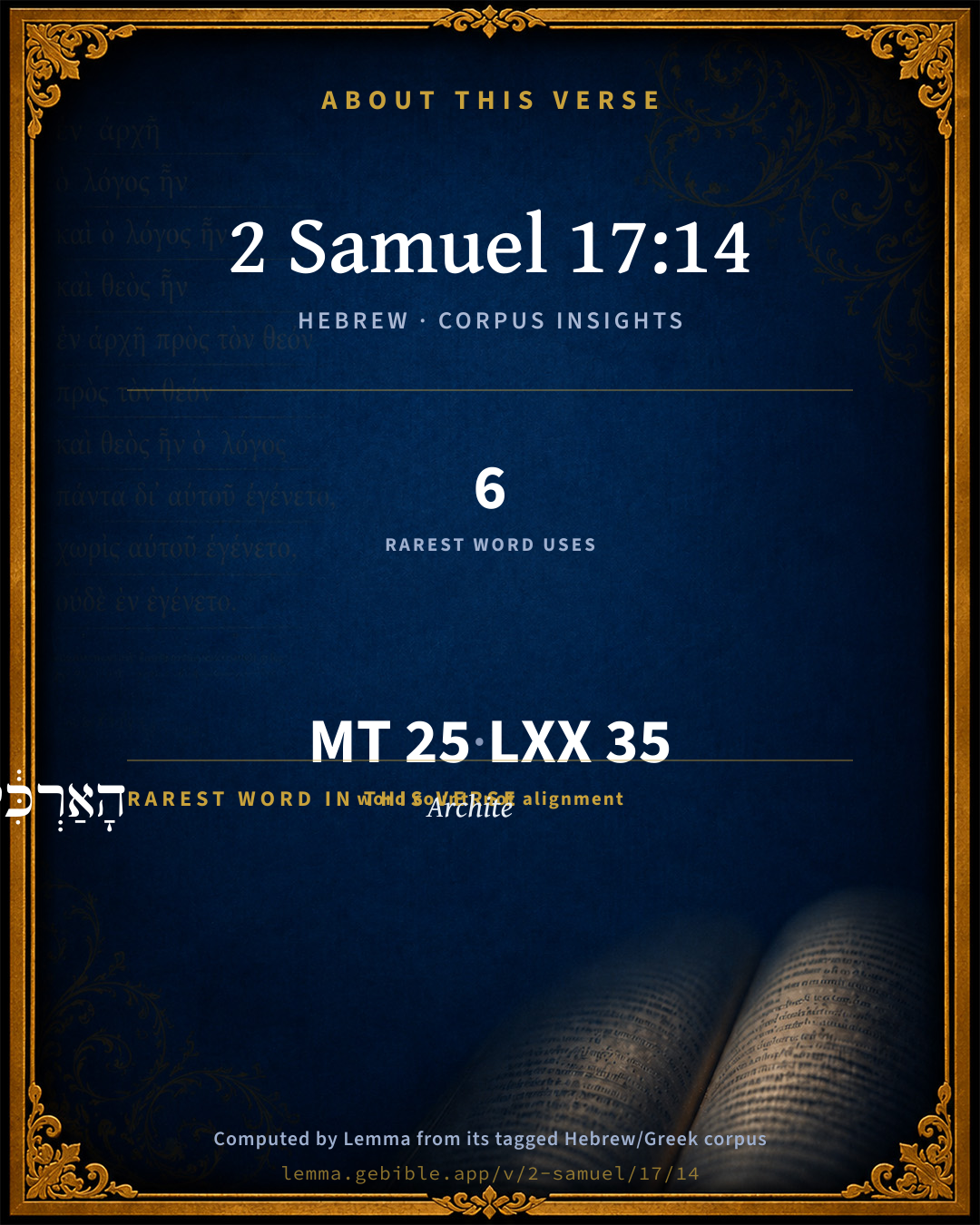
The rarest word here is הָאַרְכִּ֔י Archite H757 — appearing just 6 times in the whole Hebrew Bible.

Shared distinctive vocabulary

הָאַרְכִּ֔י Archite H757 occurs in 6 verses of the Hebrew Bible. Also found in:

Grammatical profile

  • 4 verbs
  • 15 nouns
  • 2 adjectives
  • 1 preposition
  • 1 conjunction
  • 2 particles

Verb forms

  • וַיֹּ֤אמֶר Qal · Sequential Imperfect
  • צִוָּ֗ה Piel · Perfect
  • לְהָפֵ֞ר Hiphil · Infinitive Construct
  • הָבִ֧יא Hiphil · Infinitive Construct

Repetition

Words recur within this verse — often emphatic in Hebrew:

  • עֲצַת֙ counsel H6098 ×3
  • אַבְשָׁלוֹם֙ Absalom H53 ×2
  • טוֹבָ֗ה good H2896 ×2
  • אֲחִיתֹ֑פֶל Ahithophel H302 ×2
  • וַיהוָ֣ה LORD H3068 ×2

Hebrew & Septuagint length

In English translation the verse runs 42 words from the Hebrew and 42 from the Septuagint (LXX English) — the same length.

A rough comparison of the two English renderings, which tokenize alike — not a word-level alignment.

Word counts can differ between the Hebrew and the Greek without any difference in meaning — e.g. the Hebrew direct-object marker אֵת has no separate Greek word, and Greek often adds the article ὁ.

In the original languages it is 25 Hebrew tokens and 35 Greek tokens — but the two are counted differently (Hebrew bundles its prefixes and suffixes into one token; the Greek is in lemma form), so that isn’t a like-for-like length.

Cross-references

19

Topical passages linked to 2 Samuel 17:14 in the Treasury of Scripture Knowledge — connected by theme and wording, ordered by reader-vote popularity; previews shown in the World English Bible.

  • 2 Samuel 15:34 but if you return to the city, and tell Absalom, I will be your servant, O king; as I have been your father's servant in time past, so will I now be your servant; then will you defeat for me the counsel of Ahithophel.
  • 1 Corinthians 1:19–20 For it is written, "I will destroy the wisdom of the wise, I will bring the discernment of the discerning to nothing."
  • Proverbs 19:21 There are many plans in a man's heart, But Yahweh's counsel will prevail.
  • Isaiah 8:10 Take counsel together, and it shall be brought to nothing; speak the word, and it shall not stand: for God is with us.
  • 2 Samuel 15:31 One told David, saying, Ahithophel is among the conspirators with Absalom. David said, Yahweh, please turn the counsel of Ahithophel into foolishness.
  • Job 5:12–14 He frustrates the devices of the crafty, So that their hands can't perform their enterprise.
  • Proverbs 21:30 There is no wisdom nor understanding Nor counsel against Yahweh.
  • 1 Corinthians 3:19 For the wisdom of this world is foolishness with God. For it is written, "He has taken the wise in their craftiness."
  • Genesis 32:28 He said, "Your name will no longer be called 'Jacob,' but, 'Israel,' for you have fought with God and with men, and have prevailed."
  • 2 Samuel 16:23 The counsel of Ahithophel, which he gave in those days, was as if a man inquired at the oracle of God: so was all the counsel of Ahithophel both with David and with Absalom.
  • Psalms 33:9–10 For he spoke, and it was done. He commanded, and it stood firm.
  • Lamentations 3:37 Who is he who says, and it comes to pass, when the Lord doesn't command it?
  • Luke 16:8 "His lord commended the dishonest manager because he had done wisely, for the children of this world are, in their own generation, wiser than the children of the light.
  • Exodus 9:16 but indeed for this cause I have made you stand: to show you my power, and that my name may be declared throughout all the earth;
  • Deuteronomy 2:30 But Sihon king of Heshbon would not let us pass by him; for Yahweh your God hardened his spirit, and made his heart obstinate, that he might deliver him into your hand, as at this day.
  • 2 Chronicles 25:16 It happened, as he talked with him, that [the king] said to him, Have we made you of the king's counsel? Stop! Why should you be struck down? Then the prophet stopped, and said, I know that God has determined to destroy you, because you have done this, and have not listened to my counsel.
  • 2 Chronicles 25:20 But Amaziah would not hear; for it was of God, that he might deliver them into the hand [of their enemies], because they had sought after the gods of Edom.
  • Psalms 9:16 Yahweh has made himself known. He has executed judgment. The wicked is snared by the work of his own hands. Meditation. Selah.
  • Amos 9:3 Though they hide themselves in the top of Carmel, I will search and take them out there; and though they be hid from my sight in the bottom of the sea, there I will command the serpent, and it will bite them.

Cross-references courtesy of OpenBible.info (CC BY 4.0).

Hebrew and Greek witnesses Masoretic Hebrew ↔ Greek Septuagint

The same verse in the two great witnesses to the Old Testament, shown verse-for-verse.

These are two independent witnesses, not word-aligned to each other, and the Septuagint is shown in lemma (dictionary) form.

Hebrew 2 Samuel 17:14 Masoretic · Westminster Leningrad Codex

וַיֹּ֤אמֶר אַבְשָׁלוֹם֙ וְכָל אִ֣ישׁ יִשְׂרָאֵ֔ל טוֹבָ֗ה עֲצַת֙ חוּשַׁ֣י הָאַרְכִּ֔י מֵעֲצַ֖ת אֲחִיתֹ֑פֶל וַיהוָ֣ה צִוָּ֗ה לְהָפֵ֞ר אֶת עֲצַ֤ת אֲחִיתֹ֨פֶל֙ הַטּוֹבָ֔ה לְבַעֲב֗וּר הָבִ֧יא יְהוָ֛ה אֶל אַבְשָׁל֖וֹם אֶת הָרָעָֽה

Absalom and all the men of Israel said, The counsel of Hushai the Archite is better than the counsel of Ahithophel. For Yahweh had ordained to defeat the good counsel of Ahithophel, to the intent that Yahweh might bring evil on Absalom.

World English Bible · Public Domain

Greek LXX 2 Samuel 17:14 Septuagint · lemma form

καί εἶπον αβεσσαλωμ καί πᾶς ἀνήρ ἰσραήλ ἀγαθός ὁ βουλή χουσι ὁ αραχι ὑπέρ ὁ βουλή αχιτοφελ καί κύριος ἐντέλλω διασκεδάζω ὁ βουλή αχιτοφελ ὁ ἀγαθός ὅπως ἄν ἐπιἄγω κύριος ἐπί αβεσσαλωμ ὁ κακός πᾶς

And Abessalom, and all the men of Israel said, The counsel of Chusi the Arachite is better than the counsel of Achitophel. For the Lord ordained to disconcert the good counsel of Achitophel, that the Lord might bring all evil upon Abessalom.

LXX2012 (modern English Septuagint) · Public Domain

Hebrew: Westminster Leningrad Codex (CC BY 4.0). Greek: Septuagint (public domain); English from LXX2012 (modern English Septuagint) (Public Domain). How the Septuagint differs from the Hebrew →

Targum (Aramaic paraphrase)

1

The Targum is the ancient Jewish Aramaic paraphrase of the Hebrew Scriptures — an interpretive translation, not the Hebrew text itself. Onkelos (literal) and Pseudo-Jonathan (expansive) render the Torah, and Jonathan the Prophets. Coverage is partial: where no permissively-licensed English translation exists for a verse, only the Aramaic is shown. This is verse-level text, not a word-by-word alignment to the Hebrew.

  1. Targum Jonathan Prophets (Joshua–Malachi)
    וַאֲמַר אַבְשָׁלוֹם וְכָל אֱנַשׁ יִשְׂרָאֵל תַּקִין מִלְכָּא דְחוּשַׁי אַרְכָּאָה מִמִלְכָּא דַאֲחִיתוֹפֶל וַיָי פָקַד לְקַלְקָלָא יַת מִלְכָּא דַאֲחִיתוֹפֶל תַּקְנָא בְּדִיל דְיַיתֵי יְיָ עַל אַבְשָׁלוֹם יַת בִּישְׁתָּא:

    (no public-domain English translation for this verse)

    Targum Jonathan — Aramaic: “Mikraot Gedolot” (public domain). English: “Sefaria Community Translation” (CC0 1.0 (public-domain dedication)); “London "Chaldee Paraphrase," 1871” (public domain). Text via Sefaria.

Commentary

Notes on 2 Samuel 17:14 from classic Christian and Jewish commentators (each source and its license shown beneath its notes). The classic Christian expositions comment on the surrounding passage and are grouped to its opening verse, so a note may address several verses; the Jewish commentaries on the Tanakh (Rashi and others) are per-verse, so they appear only where the commentator wrote on this verse.

Lemma curates 59 commentaries, every one of them public domain or Creative Commons licensed, each selected and text-cleaned for this edition rather than reprinted as found. About our sources →

Trapp's Complete Commentary

John Trapp

2Sa 17:14 And Absalom and all the men of Israel said, The counsel of Hushai the Archite [is] better than the counsel of Ahithophel. For the LORD had appointed to defeat the good counsel of Ahithophel, to the intent that the LORD might bring evil upon Absalom.

Ver. 14. For the Lord had appointed.] Heb., He commanded - viz., his angels, saith Vatablus - that they should defeat Ahithophel’s counsel.

The good counsel of Ahithophel.] The Vulgate Latin for bonum good, hath utile, profitable, the profitable counsel, sc., for the attaining of that end which Absalom aimed at: for otherwise, the counsel in itself was stark stinking nought.

John Trapp, A Commentary or Exposition upon All the Books of the Old and New Testament (1647–1656) — public domain. Text from a community e-Sword module.

The Biblical Illustrator

Joseph S. Exell

2Sa_17:14

The counsel of Hushai the Archite.

Hushais Counsel

Hushai saw that it was essential to gain time, in order, to quote the words of Tacitus, to give the disaffected time to repent, and the loyal time to unite: crimes gain by hasty action, better counsels by delay. His scheme was cleverly devised to appeal to Absaloms vanity and love of display. It seemed safe and easy: it was a far more attractive idea for Absalom to march in person against, David at the head of an immense army than for him to let Achithophel complete the revolution by a decisive action at once. His vanity proved his ruin. He forgot that s general levy would involve no slight delay: he forgot that the rising was by no means certain to be general, and that when the first surprise of the insurrection was over many would return their allegiance to David. But Absalom and his counsellors were blinded by a divinely-ordered infatuation. (A. F. Kirkpatrick, M. A.)

The Biblical Illustrator, edited by Joseph S. Exell (c. 1880s–1900s) — public domain. Text from a community e-Sword module.

Joseph Benson's Commentary

2Sa 17:14. Absalom and all the men of Israel said — Being infatuated by a divine power, and given up to believe a lie. The counsel of Hushai is better, &c. — His advice was much better suited to Absalom’s cruelty, as well as his vanity; and seemingly to the interest of his ambition, as well as the safety of his followers, (who did not care to put any thing to the hazard of a small party,) and therefore it easily prevailed. Such is the wonderful overruling providence of God in more cases than we are aware of! For the Lord had appointed to defeat the good counsel of Ahithophel — It was good politically considered; being the wisest and most effectual course to accomplish the end Absalom had in view. Be it observed here, to the comfort of all that fear God, he turns all men’s hearts as the rivers of water. He stands in the congregation of the mighty, has an overruling hand in all counsels, and a negative voice in all resolves, and laughs at men’s projects against his children.

Joseph Benson's Commentary on the Old and New Testaments (1811–1818) — public domain. Text from a community e-Sword module.

Keil & Delitzsch

C. F. Keil & F. Delitzsch

And he secured his end. Absalom and all Israel thought his advice better than that of Ahithophel; for it was intended to commend itself to Absalom and his supporters. "The counsel appeared safe; at the same time it was full of a certain kind of boasting, which pleased the younger men" (Clericus). All that Hushai had said about the bravery and heroism of David and his followers, was well founded. The deception lay in the assumption that all the people from Dan to Beersheba would crowd around Absalom as one man; whereas it might easily be foreseen, that after the first excitement of the revolution was over, and great calmness ensued, a large part of the nation and army would gather round David. But such a possibility as this never entered the minds of Absalom and his supporters. It was in this that the divine sentence referred to in Sa2 17:14 was seen: "The Lord had commanded (appointed) it, to defeat the good counsel of Ahithophel, that he might bring the evil (intended) upon Absalom."

Keil & Delitzsch — Biblical Commentary on the Old Testament (1861–1891) — public domain (CC PDM 1.0). Text via the HelloAO Bible API. (Old Testament only.)

Tyndale Open Study Notes

Tyndale Open Resources

17:14 Ahithophel’s strategy was actually better. However, Hushai had the psychological and rhetorical advantage as well as the Lord’s purpose, so he won Absalom’s favor. • the Lord had determined to defeat: Despite early advances, Absalom’s power grab was doomed from the start.

Tyndale Open Study Notes — © Tyndale Open Resources, licensed CC BY-SA 4.0. Text via the HelloAO Bible API.

Geneva Bible (1599)

Geneva Bible translators

That counsel which seemed good at the first to Absalom, verse 4.

Or, commanded.

For by the counsel of Hushai, he went to the battle, where he was destroyed.

Geneva Bible (1599) marginal notes — public domain. Text via Bolls.life.

Jamieson, Fausset & Brown

Robert Jamieson, A. R. Fausset & David Brown

The counsel of Hushai the Archite is better than the counsel of Ahithophel--The reasons specified being extremely plausible, and expressed in the strong hyperbolical language suited to dazzle an Oriental imagination, the council declared in favor of Hushai's advice; and their resolution was the immediate cause of the discomfiture of the rebellion, although the council itself was only a link in the chain of causation held by the controlling hand of the Lord.

Jamieson, Fausset & Brown — Commentary Critical and Explanatory on the Whole Bible (1871) — public domain (CC PDM 1.0). Text via the HelloAO Bible API.

The Cambridge Bible for Schools and Colleges

gen. ed. J. J. S. Perowne

14. Hushai saw that it was essential to gain time, “in order,” to quote the words of Tacitus, “to give the disaffected time to repent, and the loyal time to unite: crimes gain by hasty action, better counsels by delay.” (Tac. Hist. i. 32.) His scheme was cleverly devised to appeal to Absalom’s vanity and love of display. It seemed safe and easy: it was a far more attractive idea for Absalom to march in person against David at the head of an immense army, than for him to let Ahithophel complete the revolution by a decisive action at once. His vanity proved his ruin. He forgot that a general levy would involve no slight delay: he forgot that the rising was by no means certain to be general, and that when the first surprise of the insurrection was over, many would return to their allegiance to David. But Absalom and his counsellors were blinded by a divinely ordered infatuation. “Quern vult Deus deperdere, dementat prius.”

The Cambridge Bible for Schools and Colleges (gen. ed. J. J. S. Perowne; Cambridge University Press, 1878–1918) — public domain. Text from a community e-Sword module.

John Gill's Exposition

Then said Hushai unto Zadok and to Abiathar the priests,.... After he was returned from the council board, he immediately went to these priests, who he knew were in the interest of David, and to whom he was to communicate, and by them transmit, what passed at Jerusalem, Sa2 15:35,

thus and thus did Ahithophel counsel Absalom and the elders of Israel; relating to them in express words what he advised to:

and thus and thus have I counselled; telling them in what manner he had given his counsel.

John Gill's Exposition of the Whole Bible (1746–1763) — public domain (CC PDM 1.0). Text via the HelloAO Bible API.

Haydock's Catholic Bible Commentary

Profitable, to the cause of Absalom, more than that of Chusai, which was also very plausible. (Haydock) --- Lord. The Scripture always directs us to fix our thoughts on God, as the arbiter of all human affairs. (Calmet) --- Hebrew, "for the Lord had ordained to dissipate the good counsel," &c. (Haydock) --- "Plerumque qui fortunam mutaturus est consilia corrumpit, efficitque, quod miserrimum est, ut quod accidit, etiam merito accidisse videatur, et casus in culpam transeat," Peterc. ii.

George Leo Haydock (1774–1849), Haydock's Catholic Family Bible and Commentary, 1859 edition — public domain. Excludes Psalms (Douay-Rheims chapter numbering differs from Protestant) and Deuterocanonical books (Catholic canon only).

Matthew Poole's English Annotations

Absalom and all the men of Israel were infatuated by a Divine power, and given up to believe lies and mistakes.

The Lord had appointed to defeat the good counsel; so it was, politically considered; being the wisest and most effectual course to accomplish Absalom’s end.

Matthew Poole's English Annotations on the Holy Bible (1683–1685) — public domain. Text from a community e-Sword/MySword module.

The Pulpit Commentary

The counsel of Hushai is better. It seemed safer. Nothing in it was left to chance, and Absalom, already at the head of such numbers as to be able to select from them twelve thousand picked men, saw himself, in fancy, marching forward with all Israel at his feet. As a matter of fact, he did advance with so large an army that David was saved only by the skilful strategy of Joab. Like other king makers, Ahithophel had put himself too forward. He asked for twelve thousand men to be placed under his command, that he might smite David, and so be, not only Absalom"s counsellor, but also his commander-in-chief. Amasa and the other commanders would be displeased at this, and Absalom would feel that he was himself placed in a very secondary position. Ahithophel may have asked for the command solely because no one"s presence would so ensure success as his own, but he wounded the vanity beth of Absalom and Amasa, and made them ready to listen to any other advice that might be offered. The Lord had appointed; literally, and Jehovah had commanded to bring to nought, etc. So plain did it seem to the writer that Absalom"s success depended upon rapid action, that nothing less than the direct interference of the Divine providence could account for the infatuation of Absalom and his counsellors.

The Pulpit Commentary (1880–1919), ed. H.D.M. Spence-Jones & Joseph S. Exell — public domain. Text from a community e-Sword module.

John Wesley's Explanatory Notes

Absalom and all, &c. - Be it observed, to the comfort of all that fear God, he turns all mans hearts as the rivers of water. He stands in the congregation of the mighty, has an over-ruling hand in all counsels, and a negative voice in all resolves, and laughs at mens projects against his children.

John Wesley, Explanatory Notes Upon the Whole Bible (1754–1765) — public domain. Text via the GEBible commentary corpus.

Lesson kit

Teaching starters — assembled from the data on this page, not authored interpretation. Every prompt links to the verse data it draws on. Edit before teaching.

2 Samuel, in the Historical, opens this verse with 25 words (18 distinct Hebrew lemmas). Its most distinctive word is ʼArkîy (“Archite”). A historical commentator’s framing appears above. Read the whole chapter for the surrounding context.

Discussion questions

  1. What does “Archite” (ʼArkîy) contribute to the verse as a whole?
  2. Joshua 16:2 shares the word «Archite» with this verse. How do the two illuminate each other?
  3. “counsel” occurs 3× in this one verse. What is the effect of the repetition?
  4. The translations on this page render this verse differently — a whole-verse word diff, not a word-by-word alignment. What might account for the different wordings?
  5. The verb «וַיֹּ֤אמֶר» is Qal Sequential Imperfect. How does its form color the action?
  6. Reading how Trapp's Complete Commentary and The Biblical Illustrator read this verse, where do the two commentators agree and where do they part?

Things to notice

Reading settings

Reading text

Shown beneath each verse's original-language words.

Old Testament
Old Testament edition

Read the OT as the Masoretic Hebrew (MT) or the Greek Septuagint (LXX).

English shown for the Greek Septuagint (in the Hebrew ↔ Greek comparison).

Comparing translations? Open the Compare panel on any verse page to stack up to four side by side.