
1 Kings 22:31

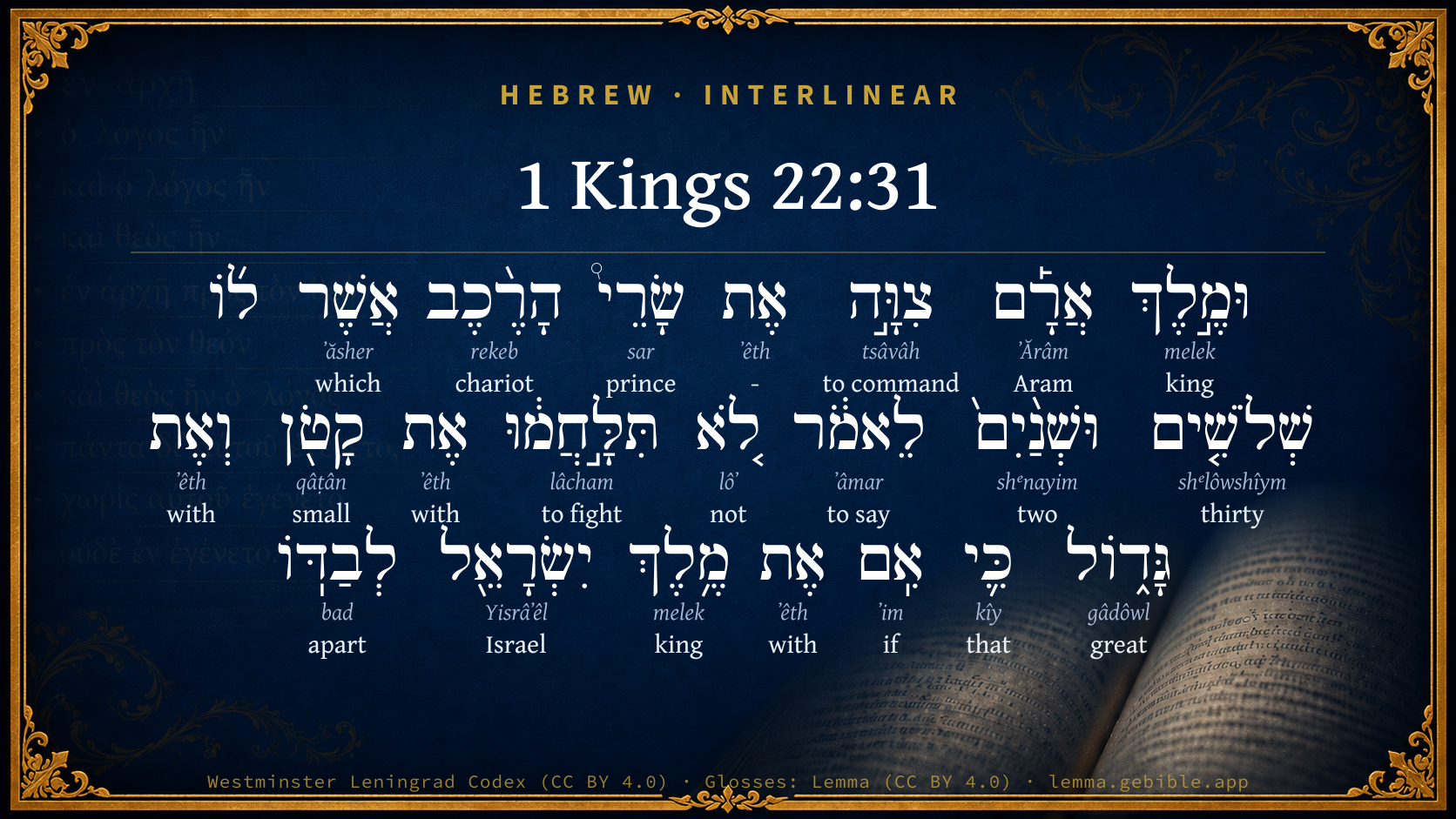
Hebrew (Westminster Leningrad Codex) 1 Kings 22:31 appears in the Hebrew Old Testament. The text above is from the Westminster Leningrad Codex. Each word links to its Strong’s number, a concise gloss, and parsing drawn from the Open Scriptures Hebrew Bible morphology. Click any word for its full Brown-Driver-Briggs (BDB) entry.
Download image
Cite this verse

1 Kings 22:31 (World English Bible). Public Domain. Lemma interlinear Bible study tool, https://lemma.gebible.app/v/1-kings/22/31.

Show BibTeX & RIS
BibTeX
RIS
English Translation
Now the king of Syria had commanded the thirty-two captains of his chariots, saying, Fight neither with small nor great, save only with the king of Israel.
World English Bible · Public Domain
Download a study sheet

One document with this verse’s original text, its word-by-word gloss line, the meaning frame, cross-references with their text, attributed commentary, and full source and license credits — printable, and it pastes into notes with its structure intact.

This verse Autodidact and up

Study sheet (.html) Plain text (.txt)

A passage Seminary Student

Up to 50 verses in one chapter. A passage sheet keeps up to 6 commentary sources and 12 cross-references per verse, in the order this page ranks them, and says so on the sheet whenever that leaves anything out. Ask for a single verse and you get the Autodidact verse sheet above.

Everything on this page stays free to read, with no account — the sheet is a download of what is already on screen, not access to it.

Want to remove ads? Support Godless Engineer
Compare translations 3

The same verse in 3 English versions, stacked beneath the original-language interlinear above. Click any original word for its lexicon entry.

Each is an independent rendering of the whole verse — the interlinear is not word-aligned to these translations.

Highlighted words mark where these versions differ — a whole-verse word diff, not a word-by-word alignment.

  • World English Bible Public Domain
    Now the king of Syria had commanded the thirty-two captains of his chariots, saying, Fight neither with small nor great, save only with the king of Israel.
  • King James Version Public Domain
    But the king of Syria commanded his thirty and two captains that had rule over his chariots, saying, Fight neither with small nor great, save only with the king of Israel.
  • unfoldingWord Literal Text CC BY-SA 4.0
    Now the king of Aram had commanded the 32 commanders of the chariotry that was to him, saying, “You shall not fight with small or with great except with the king of Israel alone.”

unfoldingWord Literal Text — © unfoldingWord, licensed CC BY-SA 4.0. Word-aligned USFM3 via Door43 (git.door43.org/unfoldingWord/en_ult).

Versions to compare (up to 4)

3 of 4 selected

Show all 18 translations

Every available English version of this verse, each an independent rendering of the whole verse.

  • World English Bible Public Domain
    Now the king of Syria had commanded the thirty-two captains of his chariots, saying, Fight neither with small nor great, save only with the king of Israel.
  • Berean Standard Bible Public Domain
    Now the king of Aram had ordered his thirty-two chariot commanders, “Do not fight with anyone, small or great, except the king of Israel.”
  • Majority Standard Bible Public Domain
    Now the king of Aram had ordered his thirty-two chariot commanders, “Do not fight with anyone, small or great, except the king of Israel.”
  • King James Version Public Domain
    But the king of Syria commanded his thirty and two captains that had rule over his chariots, saying, Fight neither with small nor great, save only with the king of Israel.
  • American Standard Version (1901) Public Domain
    Now the king of Syria had commanded the thirty and two captains of his chariots, saying, Fight neither with small nor great, save only with the king of Israel.
  • Revised Version (1885) Public Domain
    Now the king of Syria had commanded the thirty and two captains of his chariots, saying, Fight neither with small nor great, save only with the king of Israel.
  • Geneva Bible (1599) Public Domain
    And the King of Aram commanded his two and thirtie captaines ouer his charets, saying, Fight neither with small, nor great, saue onely against the King of Israel.
  • Douay-Rheims (1899) Public Domain
    And the king of Syria had commanded the two and thirty captains of the chariots, saying: You shall not fight against any, small or great, but against the king of Israel only.
  • Young's Literal Translation Public Domain
    And the king of Aram commanded the heads of the charioteers whom he hath -- thirty and two -- saying, `Ye do not fight with small or with great, but with the king of Israel by himself.'
  • Literal Standard Version CC BY-SA 4.0
    And the king of Aram commanded the thirty-two heads of the charioteers whom he has, saying, “You do not fight with small or with great, but with the king of Israel by himself.”
  • Unlocked Literal Bible CC BY-SA 4.0
    Now the king of Aram had commanded the thirty-two captains of his chariots, saying, “Do not attack unimportant or important soldiers. Instead, attack only the king of Israel.”
  • unfoldingWord Literal Text CC BY-SA 4.0
    Now the king of Aram had commanded the 32 commanders of the chariotry that was to him, saying, “You shall not fight with small or with great except with the king of Israel alone.”
  • Darby Bible Public Domain
    And the king of Syria commanded the thirty-two captains of his chariots saying, Fight neither with small nor great, but with the king of Israel only.
  • World Messianic Bible Public Domain
    Now the king of Syria had commanded the thirty-two captains of his chariots, saying, “Don’t fight with small nor great, except only with the king of Israel.”
  • Webster's Bible Public Domain
    But the king of Syria commanded his thirty and two captains that had rule over his chariots, saying, Fight neither with small nor great, save only with the king of Israel.
  • Free Bible Version CC BY-SA 4.0
    The king of Aram had already given these orders to his chariot commanders: “Head straight for the king of Israel alone. Don't fight with anyone else, whoever they are.”
  • Bible in Basic English Public Domain
    Now the king of Aram had given orders to the thirty-two captains of his war-carriages, saying, Make no attack on small or great, but only on the king of Israel.
  • JPS Tanakh (1917) Public Domain
    Now the king of Aram had commanded the thirty and two captains of his chariots, saying: 'Fight neither with small nor great, save only with the king of Israel.'

Literal Standard Version (2020), Covenant Press — licensed CC BY-SA 4.0. Text via the HelloAO Bible API (eBible.org). Unlocked Literal Bible (unfoldingWord) — licensed CC BY-SA 4.0. Text via the HelloAO Bible API (eBible.org). unfoldingWord Literal Text — © unfoldingWord, licensed CC BY-SA 4.0. Word-aligned USFM3 via Door43 (git.door43.org/unfoldingWord/en_ult). Free Bible Version, Dr. Jonathan Gallagher — licensed CC BY-SA 4.0. Text via the HelloAO Bible API (eBible.org).

Word by word

More ways to search: Search by grammar → Find every occurrence → Compare this word →

Practice this passage: Drill this verse → Learn its vocabulary →

קָטֹ֖ן
qâṭân
H6996
“small”
Adjective, Adjective, Masculine, Singular, Absolute
Part of Speech
Adjective
Type
Adjective
Gender
Masculine
Number
Singular
State
Absolute
Full BDB Definition

Origin: from H6962

TWOT: 2009a , 2009b

young, small, insignificant, unimportant - small - insignificant - young - unimportant
  1. וּמֶ֣לֶךְ melek H4428 “and · king of” Conjunction + Noun, Common, Masculine, Singular, Construct
  2. אֲרָ֡ם ʼĂrâm H758 “Aram” Noun, Proper
  3. צִוָּ֣ה tsâvâh H6680 “to command” Verb, Piel, Perfect, 3rd Person, Masculine, Singular
  4. אֶת ʼêth H853 “-” Particle, Direct Object
  5. שָׂרֵי֩ sar H8269 “princes of” Noun, Common, Masculine, Plural, Construct
  6. הָרֶ֨כֶב rekeb H7393 “the · chariot” Particle, Definite Article + Noun, Common, Masculine, Singular, Absolute
  7. אֲשֶׁר ʼăsher H834 “which” Particle, Relative
  8. שְׁלֹשִׁ֤ים shᵉlôwshîym H7970 “thirty” Adjective, Cardinal number, Both, Plural, Absolute
  9. וּשְׁנַ֨יִם֙ shᵉnayim H8147 “and · two” Conjunction + Adjective, Cardinal number, Masculine, Dual, Absolute
  10. לֵאמֹ֔ר ʼâmar H559 “to say” Preposition + Verb, Qal, Infinitive Construct
  11. לֹ֚א lôʼ H3808 “not” Particle, Negative
  12. תִּלָּ֣חֲמ֔וּ lâcham H3898 “to fight” Verb, Niphal, Imperfect, 2nd Person, Masculine, Plural
  13. אֶת ʼêth H854 “with” Preposition
  14. וְאֶת ʼêth H854 “and · with” Conjunction + Preposition
  15. גָּד֑וֹל gâdôwl H1419 “great” Adjective, Adjective, Masculine, Singular, Absolute
  16. כִּ֛י kîy H3588 “that” Conjunction
  17. אִֽם ʼim H518 “if” Conjunction
  18. אֶת ʼêth H854 “with” Preposition
  19. מֶ֥לֶךְ melek H4428 “king of” Noun, Common, Masculine, Singular, Construct
  20. יִשְׂרָאֵ֖ל Yisrâʼêl H3478 “Israel” Noun, Proper
  21. לְבַדּֽוֹ bad H905 “to/for · apart · his” Preposition + Noun, Common, Masculine, Singular, Construct + Suffix, Personal, 3rd Person, Masculine, Singular

About this verse

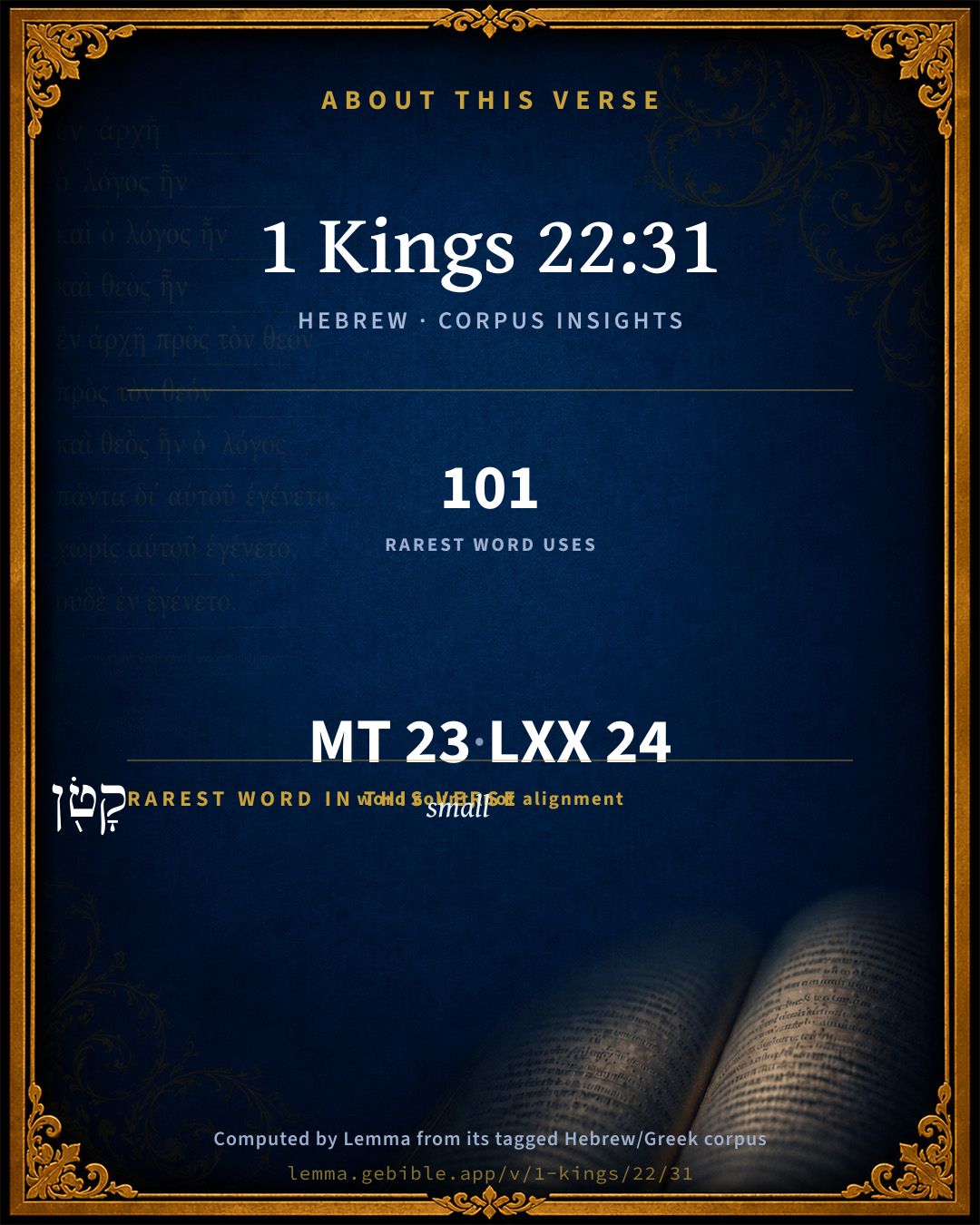
These counts appear in no published source. They are computed here, from the morphology-tagged text and Lemma’s own curated glosses. What Lemma adds →

23
words
19
distinct lemmas
Historical
section

Grammatical profile

  • 3 verbs
  • 7 nouns
  • 4 adjectives
  • 4 prepositions
  • 2 conjunctions
  • 3 particles

Verb forms

  • צִוָּ֣ה Piel · Perfect
  • לֵאמֹ֔ר Qal · Infinitive Construct
  • תִּלָּ֣חֲמ֔וּ Niphal · Imperfect

Repetition

Words recur within this verse — often emphatic in Hebrew:

  • וּמֶ֣לֶךְ king H4428 ×2
  • אֶת with H854 ×3

Hebrew & Septuagint length

In English translation the verse runs 27 words from the Hebrew and 27 from the Septuagint (LXX English) — the same length.

A rough comparison of the two English renderings, which tokenize alike — not a word-level alignment.

Word counts can differ between the Hebrew and the Greek without any difference in meaning — e.g. the Hebrew direct-object marker אֵת has no separate Greek word, and Greek often adds the article ὁ.

In the original languages it is 23 Hebrew tokens and 24 Greek tokens — but the two are counted differently (Hebrew bundles its prefixes and suffixes into one token; the Greek is in lemma form), so that isn’t a like-for-like length.

Cross-references

8

Topical passages linked to 1 Kings 22:31 in the Treasury of Scripture Knowledge — connected by theme and wording, ordered by reader-vote popularity; previews shown in the World English Bible.

  • 1 Kings 20:24 Do this thing: take the kings away, every man out of his place, and put captains in their room;
  • 2 Chronicles 18:30 Now the king of Syria had commanded the captains of his chariots, saying, Fight neither with small nor great, save only with the king of Israel.
  • Jeremiah 16:6 Both great and small shall die in this land; they shall not be buried, neither shall men lament for them, nor cut themselves, nor make themselves bald for them;
  • Genesis 19:11 They struck the men who were at the door of the house with blindness, both small and great, so that they wearied themselves to find the door.
  • 1 Samuel 30:2 and had taken captive the women [and all] who were therein, both small and great: they didn't kill any, but carried them off, and went their way.
  • 1 Kings 20:1 Ben Hadad the king of Syria gathered all his host together; and there were thirty-two kings with him, and horses and chariots: and he went up and besieged Samaria, and fought against it.
  • 1 Kings 20:16 They went out at noon. But Ben Hadad was drinking himself drunk in the pavilions, he and the kings, the thirty-two kings who helped him.
  • 1 Kings 20:33–42 Now the men observed diligently, and hurried to catch whether it were his mind; and they said, Your brother Ben Hadad. Then he said, Go you, bring him. Then Ben Hadad came forth to him; and he caused him to come up into the chariot.

Cross-references courtesy of OpenBible.info (CC BY 4.0).

Hebrew and Greek witnesses Masoretic Hebrew ↔ Greek Septuagint

The same verse in the two great witnesses to the Old Testament, shown verse-for-verse.

These are two independent witnesses, not word-aligned to each other, and the Septuagint is shown in lemma (dictionary) form.

Hebrew 1 Kings 22:31 Masoretic · Westminster Leningrad Codex

וּמֶ֣לֶךְ אֲרָ֡ם צִוָּ֣ה אֶת שָׂרֵי֩ הָרֶ֨כֶב אֲשֶׁר ל֜וֹ שְׁלֹשִׁ֤ים וּשְׁנַ֨יִם֙ לֵאמֹ֔ר לֹ֚א תִּלָּ֣חֲמ֔וּ אֶת קָטֹ֖ן וְאֶת גָּד֑וֹל כִּ֛י אִֽם אֶת מֶ֥לֶךְ יִשְׂרָאֵ֖ל לְבַדּֽוֹ

Now the king of Syria had commanded the thirty-two captains of his chariots, saying, Fight neither with small nor great, save only with the king of Israel.

World English Bible · Public Domain

Greek LXX 1 Kings 22:31 Septuagint · lemma form

καί βασιλεύς συρία ἐντέλλομαι ὁ ἄρχων ὁ ἅρμα αὐτός τριάκοντα καί δύο λέγω μή πολεμέω μικρός καί μέγας ἀλλά ἤ ὁ βασιλεύς ἰσραήλ μόνος

And the king of Syria had charged the thirty-two captains of his chariots, saying, Fight not against small or great, but against the king of Israel only.

LXX2012 (modern English Septuagint) · Public Domain

Hebrew: Westminster Leningrad Codex (CC BY 4.0). Greek: Septuagint (public domain); English from LXX2012 (modern English Septuagint) (Public Domain). How the Septuagint differs from the Hebrew →

Targum (Aramaic paraphrase)

1

The Targum is the ancient Jewish Aramaic paraphrase of the Hebrew Scriptures — an interpretive translation, not the Hebrew text itself. Onkelos (literal) and Pseudo-Jonathan (expansive) render the Torah, and Jonathan the Prophets. Coverage is partial: where no permissively-licensed English translation exists for a verse, only the Aramaic is shown. This is verse-level text, not a word-by-word alignment to the Hebrew.

  1. Targum Jonathan Prophets (Joshua–Malachi)
    וּמַלְכָּא דַאֲרָם פַּקֵיד יַת רַבָּנֵי רְתִיכָא דִילֵיהּ תְּלָתִין וּתְרֵין מַלְכְּוָן לְמֵימַר לָא תַגִיחוּן קְרָבָא עִם זְעֵירָא וְעִם רַבָּא אֱלָהֵין עִם מַלְכָּא דְיִשְׂרָאֵל בִּלְחוֹדוֹהִי:

    (no public-domain English translation for this verse)

    Targum Jonathan — Aramaic: “Mikraot Gedolot” (public domain). English: “Sefaria Community Translation” (CC0 1.0 (public-domain dedication)); “London "Chaldee Paraphrase," 1871” (public domain). Text via Sefaria.

Commentary

Notes on 1 Kings 22:31 from classic Christian and Jewish commentators (each source and its license shown beneath its notes). The classic Christian expositions comment on the surrounding passage and are grouped to its opening verse, so a note may address several verses; the Jewish commentaries on the Tanakh (Rashi and others) are per-verse, so they appear only where the commentator wrote on this verse.

Lemma curates 59 commentaries, every one of them public domain or Creative Commons licensed, each selected and text-cleaned for this edition rather than reprinted as found. About our sources →

Trapp's Complete Commentary

John Trapp

1Ki 22:31 But the king of Syria commanded his thirty and two captains that had rule over his chariots, saying, Fight neither with small nor great, save only with the king of Israel.

Ver. 31. But the king of Syria commanded.] This Ahab might haply have some inkling of, and therefore go disguised. Benhadad also might hear - for kings have their corycaei, their spies, in all places - that Micaiah had foretold Ahab of his death in this expedition.

Fight neither with small nor great, save only with the king.] Thus doth the unthankful infidel repay the mercy of his recent victor. Ill was the snake saved that requiteth the favour of his life with a bite. But God had a holy hand in it.

John Trapp, A Commentary or Exposition upon All the Books of the Old and New Testament (1647–1656) — public domain. Text from a community e-Sword module.

Joseph Benson's Commentary

1Ki 22:31. Fight only with the king of Israel — This he ordered, truly supposing this to be the best way to put an end to the war; and by the providence of God, which disposeth the hearts of kings as he pleaseth, and which inclined them to this course, that they might, though ignorantly, accomplish his counsel. Perhaps Ben-hadad only designed to have taken him prisoner, that he might now give him as honourable a treatment as he had formerly received from him.

Joseph Benson's Commentary on the Old and New Testaments (1811–1818) — public domain. Text from a community e-Sword module.

Ellicott's Commentary for English Readers

(31)His thirty and two captains.—See 1Ki_20:16; 1Ki_20:24. The power of Syria had already recovered itself, and is directed with singular virulence against the person of the king who had unwisely spared it. Ahab is represented as the mover of the whole war, and as fighting bravely to the death.

A Bible Commentary for English Readers, edited by Charles John Ellicott (1878–1897) — public domain. Text from a community e-Sword module.

The Cambridge Bible for Schools and Colleges

gen. ed. J. J. S. Perowne

31. But [R.V. Now] the king of Syria commanded [R.V. had commanded] his thirty and two captains]. The changes are as usual to conform to 2 Chronicles. These thirty-two captains were most likely those who had been chosen to supply the places of the thirty-two kings that were removed in the campaign of three years before (1Ki_20:24).

that had rule over his chariots] R.V. of his chariots. For one word is rendered twice over, first ‘captains’ and then ‘that had rule.’ The command was given to these officers because they were in the front of the battle, the cavalry taking lead of the infantry.

Fight neither with small nor great] The meaning of the order is, that they should let no engagement with other persons prevent them, any more than they could help, from singling out Ahab and attacking him. It was the single combat of chiefs, but there were 32, any one of whom might attack him. Josephus however says ‘though the battle lasted from day dawn till evening, they slew no one, according to the king’s command, seeking only to destroy Ahab, and not being able to find him.’

The Cambridge Bible for Schools and Colleges (gen. ed. J. J. S. Perowne; Cambridge University Press, 1878–1918) — public domain. Text from a community e-Sword module.

John Gill's Exposition

And the battle increased that day,.... It went on, and did not stop upon Ahab's going out of the host, but was very hot, and both sides fought furiously:

and the king was stayed up in his chariot against the Syrians: the Targum is,

"he strengthened himself, and stood;''

he exerted himself to the uttermost, and stood as long as he could, or could be supported, fighting against the Syrians, to animate his army, and that the Syrians might not have any notion of his being wounded:

and died at even: in his chariot:

and the blood ran out of the wound into the midst of the chariot; or "bosom" (t) of it, the hollow part of it.

(t) "ad sinum", Montanus; "in sinum", Vatablus.

John Gill's Exposition of the Whole Bible (1746–1763) — public domain (CC PDM 1.0). Text via the HelloAO Bible API.

Albert Barnes' Notes on the Bible

Commanded - “Had commanded.” Ben-hadad delivers his order in the hyperbolical style common in the East. His meaning is, “Make it your chief object to kill or take the king of Israel.” Apparently, his own defeat and captivity were still rankling in his mind, and he wished to retaliate on Ahab, the humiliation which he considered himself to have suffered. He shows small appreciation of the generosity which had spared his life and restored him to his kingdom.

Albert Barnes' Notes on the Bible (1834–1885) — public domain. Text from a community e-Sword/MySword module.

Haydock's Catholic Bible Commentary

Captains of, or mounted "on chariots." There would hardly be so many general officers over the chariots alone. The same number of kings had been in a former engagement, and they had been replaced by these captains, chap. xx. 24. (Calmet) --- Only. Not that the Syrians were to avoid hurting any body else, as they could not thus come at the king; (Salien) and we find one shot an arrow at the army of Israel; (ver. 34.; Haydock) but the main onset was to be directed against Achab, either to kill or to take him prisoner. (Menochius)

George Leo Haydock (1774–1849), Haydock's Catholic Family Bible and Commentary, 1859 edition — public domain. Excludes Psalms (Douay-Rheims chapter numbering differs from Protestant) and Deuterocanonical books (Catholic canon only).

Matthew Poole's English Annotations

His thirty and two captains that had rule over his chariots; and the men that fought from them, or with them, i.e. his whole army. Possibly the chariots and the whole army were distributed into thirty-two several parts, and each captain ruled those chariots and soldiers attending upon them, which fell to his share.

Save only with the king of Israel: this he ordered either in policy, truly supposing this to be the best way to put an end to the war; or with design to take him prisoner, that thereby he might wipe out the stain of his own captivity, and recover the honour and advantage which then he lost; or rather by the power and providence of God, which disposeth the hearts of kings as he pleaseth, and inclined them to this course, that they might, though ignorantly, accomplish his word and counsel.

Matthew Poole's English Annotations on the Holy Bible (1683–1685) — public domain. Text from a community e-Sword/MySword module.

Whedon's Commentary on the Bible

Daniel D. Whedon

31. His thirty and two captains — Whom he had appointed in the room of the thirty-two vassal kings. 1Ki_20:1; 1Ki_20:24.

Fight… only with the king of Israel — This is the return which Ahab gets for his kindness in sparing Ben-hadad’s life. 1Ki_20:32.

Daniel D. Whedon (gen. ed.), Commentary on the Old and New Testaments (1874–1909) — public domain. Text from a community e-Sword module.

The Pulpit Commentary

But the king of Syria commanded rather, had commanded. These words are of the nature of a parenthesis. "Now the king," etc. hW; xi is so rendered in 2Ch_18:30 his thirty and two captains mentioned in 1Ki_20:24. It does not follow, however (Wordsworth), that these very men had been spared by Ahab that had rule over his chariots Heb. chariotry. Another indication that the chariots were regarded as the most important arm of the Syrian service, saying, Fight neither with small nor great, save only with the king of Israel. This Orientalism, translated into Western ideas, means, "Direct your weapons against the king." What Ahab had done to provoke such resentment is not quite clear. Rawlinson supposes that Ben-hadad"s "defeat and captivity were still rankling in his mind, and he wished to retaliate on Ahab the humiliation which he considered himself to have suffered." But it is impossible to see in Ahab"s generous conduct towards him a sufficient reason for the fierce hatred which these words disclose. It is much more probable that some affront had subsequently been offered to the Syrian monarch, possibly in the shape of the reproaches which Ahab may have addressed to him on account of his retention of Ramoth-Gilead, and the gross violation of the treaty of. 1Ki_20:34. It is also possible that he hoped that the death of Ahab would terminate the war. (Bahr)

The Pulpit Commentary (1880–1919), ed. H.D.M. Spence-Jones & Joseph S. Exell — public domain. Text from a community e-Sword module.

John Wesley's Explanatory Notes

Save only - This he ordered, truly supposing this to be the best way to put an end to the war: and by the providence of God, which disposeth the hearts of kings as he pleaseth; and inclined them to this course, that they might, though ignorantly, accomplish his counsel. Perhaps Ben-hadad only designed to have taken him prisoner, that he might now give him as honourable a treatment, as he had formerly received from him.

John Wesley, Explanatory Notes Upon the Whole Bible (1754–1765) — public domain. Text via the GEBible commentary corpus.

unfoldingWord translationNotes

Door43 World Missions Community

thirty-two captains

"32 captains" (See: Numbers)

Do not attack unimportant or important soldiers

By mentioning both "unimportant" and "important soldiers," the king meant all soldiers. AT: "Do not attack any of the soldiers" (See: Merism)

It came about that

This phrase is used here to mark an important event in the story. If your language has a way for doing this, you could consider using it here.

translationWords

Aram

command

chariot

cry

unfoldingWord translationNotes — © Distant Shores Media and the Door43 World Missions Community, licensed CC BY-SA 4.0. Source: git.door43.org/Door43/en_tn.

Lesson kit

Teaching starters — assembled from the data on this page, not authored interpretation. Every prompt links to the verse data it draws on. Edit before teaching.

1 Kings, in the Historical, opens this verse with 23 words (19 distinct Hebrew lemmas). Its most distinctive word is qâṭân (“small”). A historical commentator’s framing appears above. Read the whole chapter for the surrounding context.

Discussion questions

  1. What does “small” (qâṭân) contribute to the verse as a whole?
  2. How does 1 Kings 20:24, which shares this passage’s theme, read alongside this verse?
  3. What does the repetition of “king” (2× in this one verse) do in this verse?
  4. The translations on this page render this verse differently — a whole-verse word diff, not a word-by-word alignment. What might account for the different wordings?
  5. «צִוָּ֣ה» is a Piel Perfect verb. How does that grammatical form shape the action described?
  6. Compare how Trapp's Complete Commentary and Joseph Benson's Commentary read this verse. Where do they agree or differ?

Things to notice

Reading settings

Reading text

Shown beneath each verse's original-language words.

Old Testament
Old Testament edition

Read the OT as the Masoretic Hebrew (MT) or the Greek Septuagint (LXX).

English shown for the Greek Septuagint (in the Hebrew ↔ Greek comparison).

Comparing translations? Open the Compare panel on any verse page to stack up to four side by side.