
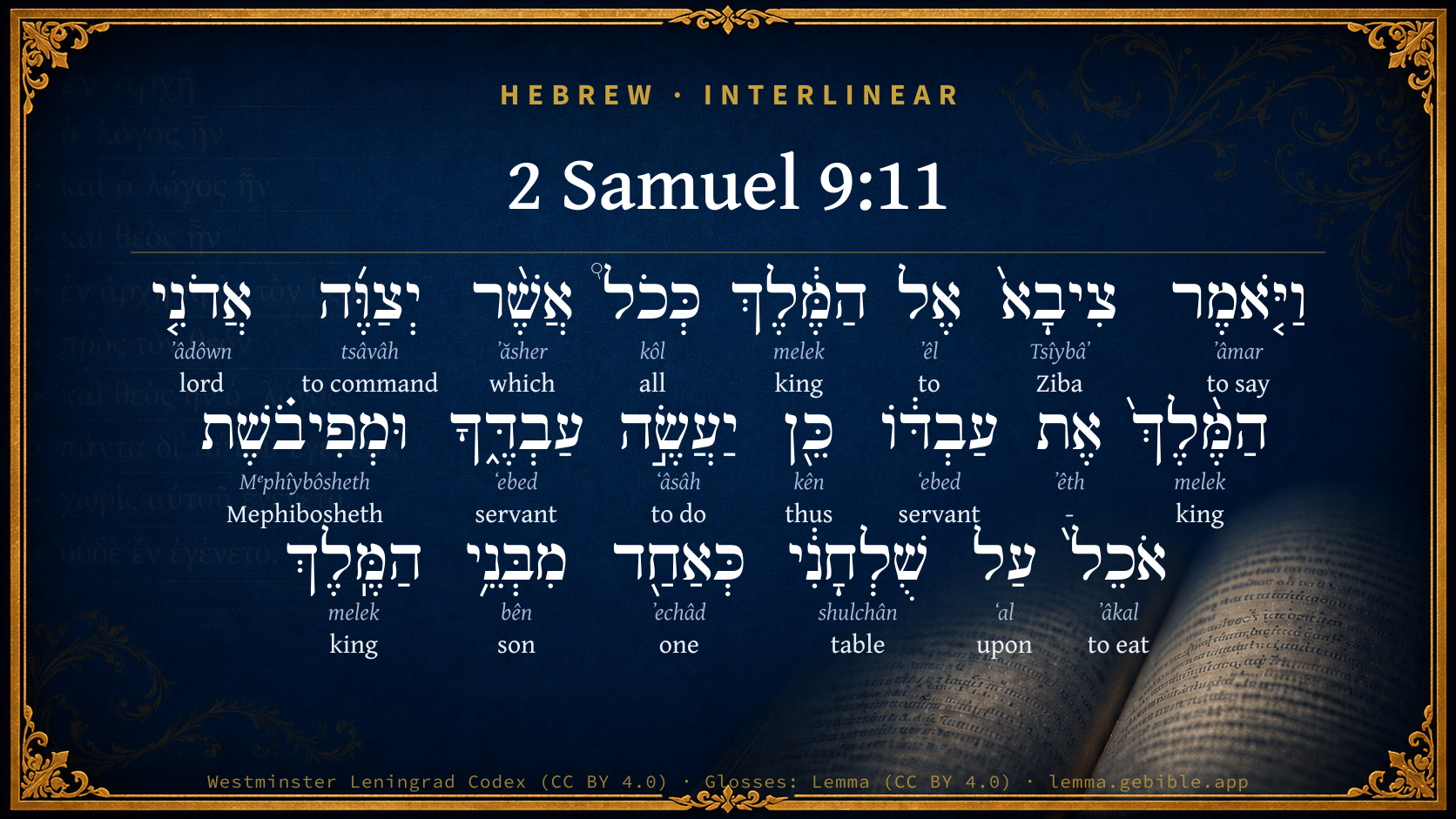
2 Samuel 9:11

Hebrew (Westminster Leningrad Codex) 2 Samuel 9:11 appears in the Hebrew Old Testament. The text above is from the Westminster Leningrad Codex. Each word links to its Strong’s number, a concise gloss, and parsing drawn from the Open Scriptures Hebrew Bible morphology. Click any word for its full Brown-Driver-Briggs (BDB) entry.
Download image
Cite this verse

2 Samuel 9:11 (World English Bible). Public Domain. Lemma interlinear Bible study tool, https://lemma.gebible.app/v/2-samuel/9/11.

Show BibTeX & RIS
BibTeX
RIS
English Translation
Then said Ziba to the king, According to all that my lord the king commands his servant, so shall your servant do. As for Mephibosheth, [said the king], he shall eat at my table, as one of the king's sons.
World English Bible · Public Domain
Download a study sheet

One document with this verse’s original text, its word-by-word gloss line, the meaning frame, cross-references with their text, attributed commentary, and full source and license credits — printable, and it pastes into notes with its structure intact.

This verse Autodidact and up

Study sheet (.html) Plain text (.txt)

A passage Seminary Student

Up to 50 verses in one chapter. A passage sheet keeps up to 6 commentary sources and 12 cross-references per verse, in the order this page ranks them, and says so on the sheet whenever that leaves anything out. Ask for a single verse and you get the Autodidact verse sheet above.

Everything on this page stays free to read, with no account — the sheet is a download of what is already on screen, not access to it.

Want to remove ads? Support Godless Engineer
Compare translations 3

The same verse in 3 English versions, stacked beneath the original-language interlinear above. Click any original word for its lexicon entry.

Each is an independent rendering of the whole verse — the interlinear is not word-aligned to these translations.

Highlighted words mark where these versions differ — a whole-verse word diff, not a word-by-word alignment.

  • World English Bible Public Domain
    Then said Ziba to the king, According to all that my lord the king commands his servant, so shall your servant do. As for Mephibosheth, [said the king], he shall eat at my table, as one of the king's sons.
  • King James Version Public Domain
    Then said Ziba unto the king, According to all that my lord the king hath commanded his servant, so shall thy servant do. As for Mephibosheth, said the king, he shall eat at my table, as one of the king's sons.
  • unfoldingWord Literal Text CC BY-SA 4.0
    And Ziba said to the king, “According to all that my lord the king commands his servant, thus shall your servant do.” And Mephibosheth was eating “at my table” like one from the sons of the king.

unfoldingWord Literal Text — © unfoldingWord, licensed CC BY-SA 4.0. Word-aligned USFM3 via Door43 (git.door43.org/unfoldingWord/en_ult).

Versions to compare (up to 4)

3 of 4 selected

Show all 18 translations

Every available English version of this verse, each an independent rendering of the whole verse.

  • World English Bible Public Domain
    Then said Ziba to the king, According to all that my lord the king commands his servant, so shall your servant do. As for Mephibosheth, [said the king], he shall eat at my table, as one of the king's sons.
  • Berean Standard Bible Public Domain
    And Ziba said to the king, “Your servant will do all that my lord the king has commanded.” So Mephibosheth ate at David’s table like one of the king’s own sons.
  • Majority Standard Bible Public Domain
    And Ziba said to the king, “Your servant will do all that my lord the king has commanded.” So Mephibosheth ate at David’s table like one of the king’s own sons.
  • King James Version Public Domain
    Then said Ziba unto the king, According to all that my lord the king hath commanded his servant, so shall thy servant do. As for Mephibosheth, said the king, he shall eat at my table, as one of the king's sons.
  • American Standard Version (1901) Public Domain
    Then said Ziba unto the king, According to all that my lord the king commandeth his servant, so shall thy servant do. As for Mephibosheth, `said the king', he shall eat at my table, as one of the king's sons.
  • Revised Version (1885) Public Domain
    Then said Ziba unto the king, According to all that my lord the king commandeth his servant, so shall thy servant do. As for Mephibosheth, said the king, he shall eat at my table, as one of the kings sons.
  • Geneva Bible (1599) Public Domain
    Then sayd Ziba vnto the King, According to all that my lord the King hath commaded his seruant, so shall thy seruat do, that Mephibosheth may eate at my table, as one of the Kings sonnes.
  • Douay-Rheims (1899) Public Domain
    And Siba said to the king: As thou my lord the king hast commanded thy servant, so will thy servant do: and Miphiboseth shall eat at my table, as one of the sons of the king.
  • Young's Literal Translation Public Domain
    And Ziba saith unto the king, `According to all that my lord the king commandeth his servant, so doth thy servant;' as to Mephibosheth, `he is eating at my table (`saith the king') as one of the sons of the king.'
  • Literal Standard Version CC BY-SA 4.0
    And Ziba says to the king, “According to all that my lord the king commands his servant, so your servant does.” “As for Mephibosheth,” [says the king,] “he is eating at my table as one of the sons of the king.”
  • Unlocked Literal Bible CC BY-SA 4.0
    Then Ziba said to the king, “Your servant will do all that my master the king commands his servant.” The king added, “As for Mephibosheth he will eat at my table, as one of the king's sons.”
  • unfoldingWord Literal Text CC BY-SA 4.0
    And Ziba said to the king, “According to all that my lord the king commands his servant, thus shall your servant do.” And Mephibosheth was eating “at my table” like one from the sons of the king.
  • Darby Bible Public Domain
    And Ziba said to the king, According to all that my lord the king has commanded his servant, so will thy servant do. And Mephibosheth [said David] shall eat at my table, as one of the king's sons.
  • World Messianic Bible Public Domain
    Then Ziba said to the king, “According to all that my lord the king commands his servant, so your servant will do.” So Mephibosheth ate at the king’s table like one of the king’s sons.
  • Webster's Bible Public Domain
    Then said Ziba to the king, According to all that my lord the king hath commanded his servant, so shall thy servant do. As for Mephibosheth, said the king, he shall eat at my table, as one of the king's sons.
  • Free Bible Version CC BY-SA 4.0
    Ziba replied to the king, “My lord the king, your servant will do everything that you have commanded.” So Mephibosheth ate at David's table like one of the king's sons.
  • Bible in Basic English Public Domain
    Then Ziba said to the king, Every order which you have given to your servant will be done. As for Mephibosheth, he had a place at David's table, like one of the king's sons.
  • JPS Tanakh (1917) Public Domain
    Then said Ziba unto the king: 'According to all that my lord the king commandeth his servant, so shall thy servant do; but Mephibosheth eateth at my table as one of the king's sons.'

Literal Standard Version (2020), Covenant Press — licensed CC BY-SA 4.0. Text via the HelloAO Bible API (eBible.org). Unlocked Literal Bible (unfoldingWord) — licensed CC BY-SA 4.0. Text via the HelloAO Bible API (eBible.org). unfoldingWord Literal Text — © unfoldingWord, licensed CC BY-SA 4.0. Word-aligned USFM3 via Door43 (git.door43.org/unfoldingWord/en_ult). Free Bible Version, Dr. Jonathan Gallagher — licensed CC BY-SA 4.0. Text via the HelloAO Bible API (eBible.org).

Word by word

More ways to search: Search by grammar → Find every occurrence → Compare this word →

Practice this passage: Drill this verse → Learn its vocabulary →

צִיבָא֙
Tsîybâʼ
H6717
“Ziba”
Noun, Proper
Part of Speech
Noun
Type
Proper
Full BDB Definition

Origin: from the same as H6678

TWOT: None

Ziba = "statue" - a servant of Saul whom David made steward of Jonathan's son Mephibosheth
  1. וַיֹּ֤אמֶר ʼâmar H559 “and · to say” Conjunction + Verb, Qal, Sequential Imperfect, 3rd Person, Masculine, Singular
  2. אֶל ʼêl H413 “to” Preposition
  3. הַמֶּ֔לֶךְ melek H4428 “the · king” Particle, Definite Article + Noun, Common, Masculine, Singular, Absolute
  4. כְּכֹל֩ kôl H3605 “like/as · all” Preposition + Noun, Common, Masculine, Singular, Absolute
  5. אֲשֶׁ֨ר ʼăsher H834 “which” Particle, Relative
  6. יְצַוֶּ֜ה tsâvâh H6680 “to command” Verb, Piel, Imperfect, 3rd Person, Masculine, Singular
  7. אֲדֹנִ֤י ʼâdôwn H113 “lord · my” Noun, Common, Masculine, Singular, Construct + Suffix, Personal, 1st Person, Common, Singular
  8. הַמֶּ֨לֶךְ֙ melek H4428 “the · king” Particle, Definite Article + Noun, Common, Masculine, Singular, Absolute
  9. אֶת ʼêth H853 “-” Particle, Direct Object
  10. עַבְדּ֔וֹ ʻebed H5650 “servant · his” Noun, Common, Masculine, Singular, Construct + Suffix, Personal, 3rd Person, Masculine, Singular
  11. כֵּ֖ן kên H3651 “thus” Particle, Demonstrative
  12. יַעֲשֶׂ֣ה ʻâsâh H6213 “to do” Verb, Qal, Imperfect, 3rd Person, Masculine, Singular
  13. עַבְדֶּ֑ךָ ʻebed H5650 “servant · your” Noun, Common, Masculine, Singular, Construct + Suffix, Personal, 2nd Person, Masculine, Singular
  14. וּמְפִיבֹ֗שֶׁת Mᵉphîybôsheth H4648 “and · Mephibosheth” Conjunction + Noun, Proper
  15. אֹכֵל֙ ʼâkal H398 “eating” Verb, Qal, Participle Active, Masculine, Singular, Absolute
  16. עַל ʻal H5921 “upon” Preposition
  17. שֻׁלְחָנִ֔י shulchân H7979 “table · my” Noun, Common, Masculine, Singular, Construct + Suffix, Personal, 1st Person, Common, Singular
  18. כְּאַחַ֖ד ʼechâd H259 “like/as · one” Preposition + Adjective, Cardinal number, Masculine, Singular, Construct
  19. מִבְּנֵ֥י bên H1121 “from · sons of” Preposition + Noun, Common, Masculine, Plural, Construct
  20. הַמֶּֽלֶךְ melek H4428 “the · king” Particle, Definite Article + Noun, Common, Masculine, Singular, Absolute

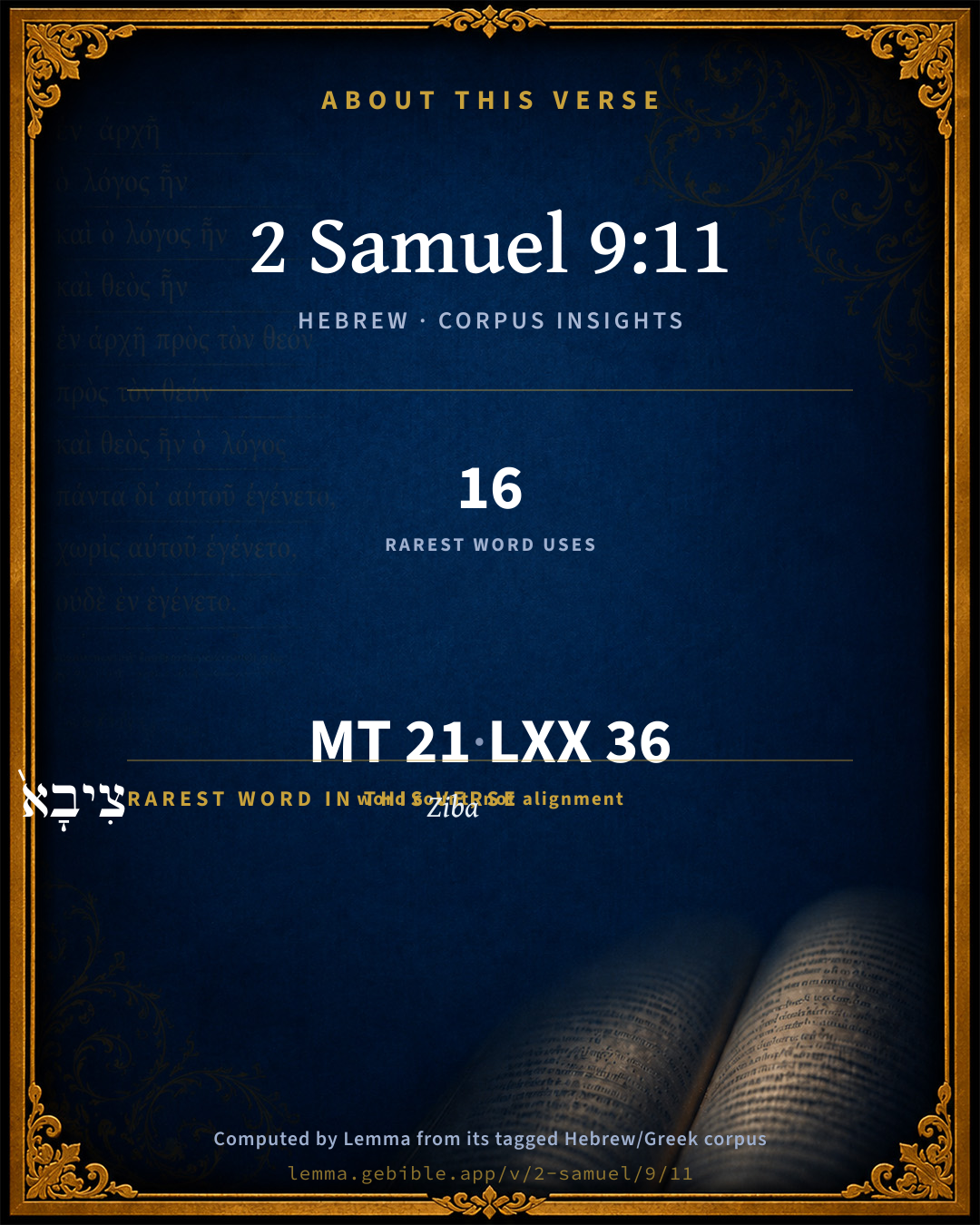
About this verse

These counts appear in no published source. They are computed here, from the morphology-tagged text and Lemma’s own curated glosses. What Lemma adds →

21
words
18
distinct lemmas
Historical
section

Notable vocabulary

The rarest word here is צִיבָא֙ Ziba H6717 — appearing just 16 times in the whole Hebrew Bible.

Shared distinctive vocabulary

צִיבָא֙ Ziba H6717 occurs in 13 verses of the Hebrew Bible. Also found in:

Grammatical profile

  • 4 verbs
  • 11 nouns
  • 1 adjective
  • 2 prepositions
  • 3 particles

Verb forms

  • וַיֹּ֤אמֶר Qal · Sequential Imperfect
  • יְצַוֶּ֜ה Piel · Imperfect
  • יַעֲשֶׂ֣ה Qal · Imperfect
  • אֹכֵל֙ Qal · Participle Active

Repetition

Words recur within this verse — often emphatic in Hebrew:

  • הַמֶּ֔לֶךְ king H4428 ×3
  • עַבְדּ֔וֹ servant H5650 ×2

Hebrew & Septuagint length

In English translation the verse runs 40 words from the Hebrew and 40 from the Septuagint (LXX English) — the same length.

A rough comparison of the two English renderings, which tokenize alike — not a word-level alignment.

Word counts can differ between the Hebrew and the Greek without any difference in meaning — e.g. the Hebrew direct-object marker אֵת has no separate Greek word, and Greek often adds the article ὁ.

In the original languages it is 21 Hebrew tokens and 36 Greek tokens — but the two are counted differently (Hebrew bundles its prefixes and suffixes into one token; the Greek is in lemma form), so that isn’t a like-for-like length.

Cross-references

3

Topical passages linked to 2 Samuel 9:11 in the Treasury of Scripture Knowledge — connected by theme and wording, ordered by reader-vote popularity; previews shown in the World English Bible.

  • 2 Samuel 16:1–4 When David was a little past the top [of the ascent], behold, Ziba the servant of Mephibosheth met him, with a couple of donkeys saddled, and on them two hundred loaves of bread, and one hundred clusters of raisins, and one hundred summer fruits, and a bottle of wine.
  • 2 Samuel 19:26 He answered, My lord, O king, my servant deceived me: for your servant said, I will saddle me a donkey, that I may ride thereon, and go with the king; because your servant is lame.
  • 2 Samuel 19:17 There were a thousand men of Benjamin with him, and Ziba the servant of the house of Saul, and his fifteen sons and his twenty servants with him; and they went through the Jordan in the presence of the king.

Cross-references courtesy of OpenBible.info (CC BY 4.0).

Hebrew and Greek witnesses Masoretic Hebrew ↔ Greek Septuagint

The same verse in the two great witnesses to the Old Testament, shown verse-for-verse.

These are two independent witnesses, not word-aligned to each other, and the Septuagint is shown in lemma (dictionary) form.

Hebrew 2 Samuel 9:11 Masoretic · Westminster Leningrad Codex

וַיֹּ֤אמֶר צִיבָא֙ אֶל הַמֶּ֔לֶךְ כְּכֹל֩ אֲשֶׁ֨ר יְצַוֶּ֜ה אֲדֹנִ֤י הַמֶּ֨לֶךְ֙ אֶת עַבְדּ֔וֹ כֵּ֖ן יַעֲשֶׂ֣ה עַבְדֶּ֑ךָ וּמְפִיבֹ֗שֶׁת אֹכֵל֙ עַל שֻׁלְחָנִ֔י כְּאַחַ֖ד מִבְּנֵ֥י הַמֶּֽלֶךְ

Then said Ziba to the king, According to all that my lord the king commands his servant, so shall your servant do. As for Mephibosheth, [said the king], he shall eat at my table, as one of the king's sons.

World English Bible · Public Domain

Greek LXX 2 Samuel 9:11 Septuagint · lemma form

καί εἶπον σιβα πρός ὁ βασιλεύς κατά πᾶς ὅσος ἐντέλλομαι ὁ κύριος ἐγώ ὁ βασιλεύς ὁ δοῦλος αὐτός οὕτως ποιέω ὁ δοῦλος σύ καί μεμφιβοσθε ἐσθίω ἐπί ὁ τράπεζα δαυίδ καθώς εἷς ὁ υἱός ὁ βασιλεύς

And Siba said to the king, According to all that my lord the king has commanded his servant, so will your servant do. And Memphibosthe did eat at the table of David, as one of the sons of the king.

LXX2012 (modern English Septuagint) · Public Domain

On this verse, The Cambridge Bible for Schools and Colleges discusses the Septuagint’s reading. Read the note in Commentary ↓

Hebrew: Westminster Leningrad Codex (CC BY 4.0). Greek: Septuagint (public domain); English from LXX2012 (modern English Septuagint) (Public Domain). How the Septuagint differs from the Hebrew →

Targum (Aramaic paraphrase)

1

The Targum is the ancient Jewish Aramaic paraphrase of the Hebrew Scriptures — an interpretive translation, not the Hebrew text itself. Onkelos (literal) and Pseudo-Jonathan (expansive) render the Torah, and Jonathan the Prophets. Coverage is partial: where no permissively-licensed English translation exists for a verse, only the Aramaic is shown. This is verse-level text, not a word-by-word alignment to the Hebrew.

  1. Targum Jonathan Prophets (Joshua–Malachi)
    וַאֲמַר צִיבָא לְמַלְכָּא כְּכֹל דִי פַקֵיד רִבּוֹנִי מַלְכָּא יַת עַבְדֵיהּ כֵּן יַעְבֵּד עַבְדָךְ וּמְפִיבֹשֶׁת אָכַל עַל פְּתוֹרִי כְּחַד מִבְּנֵי מַלְכָּא:

    (no public-domain English translation for this verse)

    Targum Jonathan — Aramaic: “Mikraot Gedolot” (public domain). English: “Sefaria Community Translation” (CC0 1.0 (public-domain dedication)); “London "Chaldee Paraphrase," 1871” (public domain). Text via Sefaria.

Commentary

Notes on 2 Samuel 9:11 from classic Christian and Jewish commentators (each source and its license shown beneath its notes). The classic Christian expositions comment on the surrounding passage and are grouped to its opening verse, so a note may address several verses; the Jewish commentaries on the Tanakh (Rashi and others) are per-verse, so they appear only where the commentator wrote on this verse.

Lemma curates 59 commentaries, every one of them public domain or Creative Commons licensed, each selected and text-cleaned for this edition rather than reprinted as found. About our sources →

Trapp's Complete Commentary

John Trapp

2Sa 9:11 Then said Ziba unto the king, According to all that my lord the king hath commanded his servant, so shall thy servant do. As for Mephibosheth, [said the king], he shall eat at my table, as one of the king’s sons.

Ver. 11. As for Mephibosheth, said the king.] These last words are not in the original: and some there are that make it Ziba’s speech; as if he had said, Do, O king, as thou thinkest fitting: howbeit Mephibosheth might have his meals with me, and should by me be royally entertained as a king’s son.

John Trapp, A Commentary or Exposition upon All the Books of the Old and New Testament (1647–1656) — public domain. Text from a community e-Sword module.

Tyndale Open Study Notes

Tyndale Open Resources

9:11 Both Ziba and Mephibosheth (9:6) used the phrase “I am your servant” when presenting themselves before King David. By referring to himself as David’s servant, Ziba showed that he was no longer loyal to Saul’s dynasty. The sincerity of both later came into question (16:1-4; 19:17-30).

Tyndale Open Study Notes — © Tyndale Open Resources, licensed CC BY-SA 4.0. Text via the HelloAO Bible API.

Geneva Bible (1599)

Geneva Bible translators

That Mephibosheth may have all things at commandment, as becometh a king’s son.

Geneva Bible (1599) marginal notes — public domain. Text via Bolls.life.

Adam Clarke's Commentary

Verse 11. So shall thy servant do.] The promises of Ziba were fair and specious, but he was a traitor in his heart, as we shall see in the rebellion of Absalom, and David's indulgence to this man is a blot in his character; at this time however he suspected no evil; circumstances alone can develope the human character. The internal villain can be known only when circumstances occur which can call his propensities into action; till then he may be reputed an honest man.

Adam Clarke's Commentary on the Bible (1810–1826) — public domain. Text from a community e-Sword/MySword module.

The Cambridge Bible for Schools and Colleges

gen. ed. J. J. S. Perowne

11. As for Mephibosheth, said the king] There is nothing to warrant the insertion of the words “said the king:” nor can the words be Ziba’s assertion that he would himself have entertained Mephibosheth royally. It remains to follow the LXX. in reading at David’s table for “at my table,” and to take the clause along with the next two verses as the narrator’s conclusion of the story, thus: “So Mephibosheth did eat at David’s table, as one of the king’s sons.”

The Cambridge Bible for Schools and Colleges (gen. ed. J. J. S. Perowne; Cambridge University Press, 1878–1918) — public domain. Text from a community e-Sword module.

John Gill's Exposition

Then said Ziba unto the king, according to all the king hath commanded his servant, so shall thy servant do,.... Till the land, and bring the fruits of it to Mephibosheth, for the support of his family; he promised very fair, had he been as faithful to his trust:

as for Mephibosheth, said the king, he shall eat at my table, as one of the king's sons; which is repeated, for the confirmation of it, and to show that he should be treated with equal respect, and fare as the king's sons themselves did; though the clause "said the king" is not in the original text, and the words are thought by Abarbinel and others to be the words of Ziba continued; who promised to do what the king had ordered, though Mephibosheth had eaten at his table, as one of the king's sons, and needed not anything, and needed not to eat at the king's table; and if it was his pleasure, he would maintain him out of this estate like the son of a king; but the phrase "my table" seems to be too arrogant for Ziba to say, and rather fits the mouth of David the king.

John Gill's Exposition of the Whole Bible (1746–1763) — public domain (CC PDM 1.0). Text via the HelloAO Bible API.

Albert Barnes' Notes on the Bible

Said the king - There is nothing in the Hebrew to warrant the insertion of these words. The words are: “So Mephibosheth ate at my table as one of the king’s sons.” Only it follows that the narrator is David himself.

Albert Barnes' Notes on the Bible (1834–1885) — public domain. Text from a community e-Sword/MySword module.

Haydock's Catholic Bible Commentary

My table, if the king was pleased so to order. (Sanchez) --- It would seem that Siba did not properly understand the king. (Calmet) --- The Septuagint, Syriac, and Arabic, read, perhaps more correctly u, "his," instead of i, "my table," in shulchani. "And Memphibosthai ate at David’s table, as one," &c. (Haydock) --- He did not merely eat of the king’s table, (ver. 13,) but at it, super mensam, as the Hebrew, Chaldean, and Septuagint express. (Menochius)

George Leo Haydock (1774–1849), Haydock's Catholic Family Bible and Commentary, 1859 edition — public domain. Excludes Psalms (Douay-Rheims chapter numbering differs from Protestant) and Deuterocanonical books (Catholic canon only).

Matthew Poole's English Annotations

These are the words, either, first, Of David; the words said he, or said the king, being supplied out of the former and following verses. Or, secondly, Of Ziba, being thus rendered and understood. Also Mephibosheth, if the king so please,

shall eat at my table, and shall be treated there according to his quality, as one of thy sons, as thou desirest; for the estate will suffice for that also.

Matthew Poole's English Annotations on the Holy Bible (1683–1685) — public domain. Text from a community e-Sword/MySword module.

The Pulpit Commentary

As for Mephibosheth, said the king, he, etc. These words are difficult, because they make David say the same thing thrice. The text is probably corrupt, as it requires the insertion of some such phrase as the "said the king" of the Authorized Version to make it intelligible. Of the many emendations proposed, the most probable is that of the LXX and Syriac, which make this clause an observation of the historian pointing out the high honour done to Mephibosheth in placing him on an equality with David"s own sons. It would then run as follows: So Mephibosheth ate at the king"s table as one of the king"s sons.

The Pulpit Commentary (1880–1919), ed. H.D.M. Spence-Jones & Joseph S. Exell — public domain. Text from a community e-Sword module.

Keil & Delitzsch

C. F. Keil & F. Delitzsch

Ziba promised to obey the king's command. The last clause of this verse is a circumstantial clause in form, with which the writer passes over to the conclusion of his account. But the words שׁלחני על שׁלחן, "at my table," do not tally with this, as they require that the words should be taken as David's own. This is precluded, however, not only by the omission of any intimation that David spoke again after Ziba, and repeated what he had said once already, and that without any occasion whatever, but also by the form of the sentence, more especially the participle אכל. There is no other course left, therefore, than to regard שׁלחני (my table) as written by mistake for דּוד שׁלחן: "but Mephibosheth ate at David's table as one of the king's sons." The further notices in Sa2 9:12 and Sa2 9:13 follow this in a very simple manner. בּית מושׁב כּל, "all the dwelling," i.e., all the inhabitants of Ziba's house, namely his sons and servants, were servants of Mephibosheth, i.e., worked for him and cultivated his land, whilst he himself took up his abode at Jerusalem, to eat daily at the king's table, although he was lamed in both his feet.

Keil & Delitzsch — Biblical Commentary on the Old Testament (1861–1891) — public domain (CC PDM 1.0). Text via the HelloAO Bible API. (Old Testament only.)

unfoldingWord translationNotes

Door43 World Missions Community

Your servant will do all that my master the king commands his servant

Ziba refers to himself as "your servant" and refers to David as "my master." AT: "I, your servant will do all that you, my king, command me to do" (See: First, Second, or Third Person)

Mika

This is the name of the son of Mephibosheth. (See: How to Translate Names)

All who lived in the house of Ziba

Here "house" represents Ziba's family. AT: "All of Ziba's family" (See: Metonymy)

he always ate at the king's table

Here "table" represents being together with David or in his presence. Eating with the king at his table was a great honor. AT: "he always ate with the king at his table" (See: Metonymy)

though he was lame in both his feet

"thouge both of his feet were damaged." Here "feet" represents the ability to walk. AT: "though he was unable to walk" (See: Metonymy)

translationWords

servant

lord

king

command

life

unfoldingWord translationNotes — © Distant Shores Media and the Door43 World Missions Community, licensed CC BY-SA 4.0. Source: git.door43.org/Door43/en_tn.

Rashi

Rabbi Shlomo Yitzchaki (Rashi)

So will your servant do. Mephivoshes will eat at my table. Tsivoh said, "So will your servant do." And Dovid responded, "Mephivoshes will eat at my table."

Rashi on the Tanakh — English translations: “The Judaica Press complete Tanach with Rashi, translated by A. J. Rosenberg” (CC BY 4.0); “Pentateuch with Rashi's commentary by M. Rosenbaum and A.M. Silbermann, 1929-1934” (public domain); “The Metsudah Tanach series, Lakewood, N.J” (CC BY 4.0); and “The Book of Joshua, Metsudah Publications, 1997” (CC BY 4.0). Text via Sefaria.

Lesson kit

Teaching starters — assembled from the data on this page, not authored interpretation. Every prompt links to the verse data it draws on. Edit before teaching.

2 Samuel, in the Historical, opens this verse with 21 words (18 distinct Hebrew lemmas). Its most distinctive word is Tsîybâʼ (“Ziba”). A historical commentator’s framing appears above. Read the whole chapter for the surrounding context.

Discussion questions

  1. The word Tsîybâʼ carries the sense “Ziba.” How does it shape the verse?
  2. 2 Samuel 9:2 shares the word «Ziba» with this verse. How do the two illuminate each other?
  3. “king” occurs 3× in this one verse. What is the effect of the repetition?
  4. These translations render this verse differently; the difference is in the English rendering, not the original. What questions does that raise?
  5. The verb «וַיֹּ֤אמֶר» is Qal Sequential Imperfect. How does its form color the action?
  6. Reading how Trapp's Complete Commentary and Tyndale Open Study Notes read this verse, where do the two commentators agree and where do they part?

Things to notice

Reading settings

Reading text

Shown beneath each verse's original-language words.

Old Testament
Old Testament edition

Read the OT as the Masoretic Hebrew (MT) or the Greek Septuagint (LXX).

English shown for the Greek Septuagint (in the Hebrew ↔ Greek comparison).

Comparing translations? Open the Compare panel on any verse page to stack up to four side by side.