
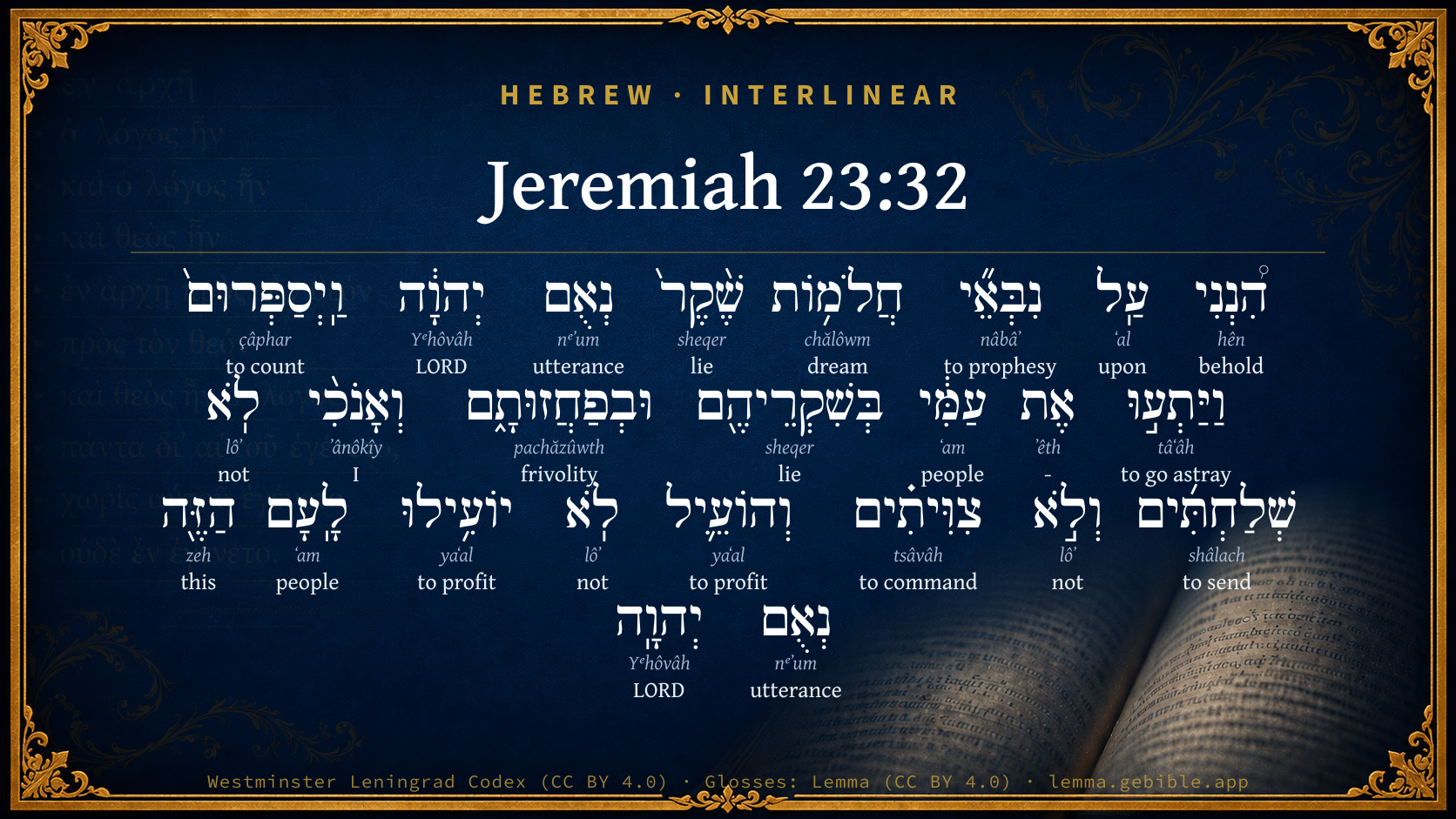
Jeremiah 23:32

Hebrew (Westminster Leningrad Codex) Jeremiah 23:32 appears in the Hebrew Old Testament. The text above is from the Westminster Leningrad Codex. Each word links to its Strong’s number, a concise gloss, and parsing drawn from the Open Scriptures Hebrew Bible morphology. Click any word for its full Brown-Driver-Briggs (BDB) entry.
Download image
Cite this verse

Jeremiah 23:32 (World English Bible). Public Domain. Lemma interlinear Bible study tool, https://lemma.gebible.app/v/jeremiah/23/32.

Show BibTeX & RIS
BibTeX
RIS
English Translation
Behold, I am against those who prophesy lying dreams, says Yahweh, and do tell them, and cause my people to err by their lies, and by their vain boasting: yet I didn't send them, nor commanded them; neither do they profit this people at all, says Yahweh.
World English Bible · Public Domain
Highlights
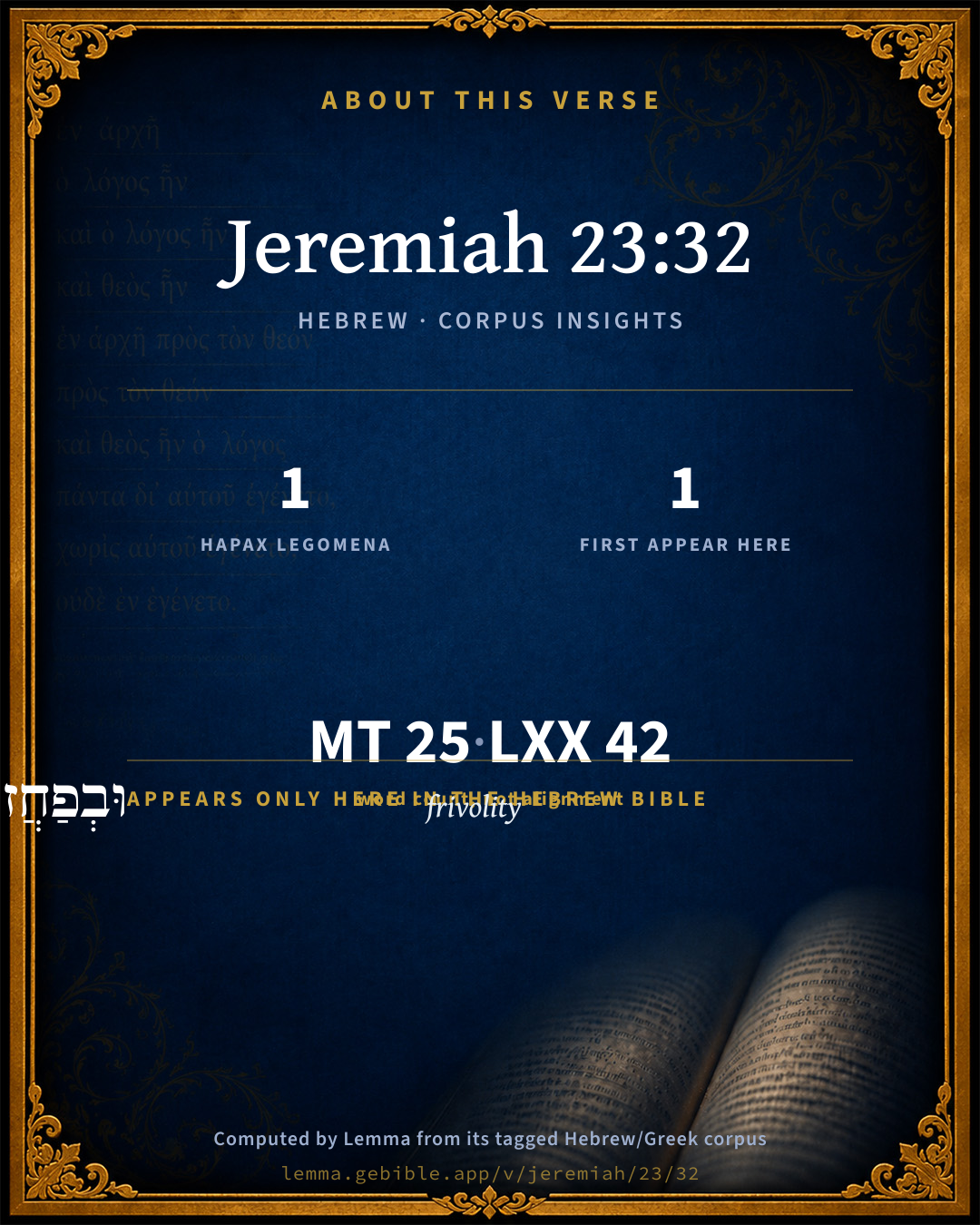
  • 1 hapax legomenon — only here in the Hebrew Bible
  • 1 first appearance in the Hebrew Bible
Full analysis ↓
Download a study sheet

One document with this verse’s original text, its word-by-word gloss line, the meaning frame, cross-references with their text, attributed commentary, and full source and license credits — printable, and it pastes into notes with its structure intact.

This verse Autodidact and up

Study sheet (.html) Plain text (.txt)

A passage Seminary Student

Up to 50 verses in one chapter. A passage sheet keeps up to 6 commentary sources and 12 cross-references per verse, in the order this page ranks them, and says so on the sheet whenever that leaves anything out. Ask for a single verse and you get the Autodidact verse sheet above.

Everything on this page stays free to read, with no account — the sheet is a download of what is already on screen, not access to it.

Want to remove ads? Support Godless Engineer
Compare translations 3

The same verse in 3 English versions, stacked beneath the original-language interlinear above. Click any original word for its lexicon entry.

Each is an independent rendering of the whole verse — the interlinear is not word-aligned to these translations.

Highlighted words mark where these versions differ — a whole-verse word diff, not a word-by-word alignment.

  • World English Bible Public Domain
    Behold, I am against those who prophesy lying dreams, says Yahweh, and do tell them, and cause my people to err by their lies, and by their vain boasting: yet I didn't send them, nor commanded them; neither do they profit this people at all, says Yahweh.
  • King James Version Public Domain
    Behold, I am against them that prophesy false dreams, saith the LORD, and do tell them, and cause my people to err by their lies, and by their lightness; yet I sent them not, nor commanded them: therefore they shall not profit this people at all, saith the LORD.
  • unfoldingWord Literal Text CC BY-SA 4.0
    Behold, I against the ones prophesying dreams of falsehood”—the declaration of Yahweh—“and they have recounted them and lead my people astray by their falsehoods and by their recklessness, yet I, I did not send them, and I did not command them. So benefiting, they will not benefit this people”—the declaration of Yahweh. p

unfoldingWord Literal Text — © unfoldingWord, licensed CC BY-SA 4.0. Word-aligned USFM3 via Door43 (git.door43.org/unfoldingWord/en_ult).

Versions to compare (up to 4)

3 of 4 selected

Show all 18 translations

Every available English version of this verse, each an independent rendering of the whole verse.

  • World English Bible Public Domain
    Behold, I am against those who prophesy lying dreams, says Yahweh, and do tell them, and cause my people to err by their lies, and by their vain boasting: yet I didn't send them, nor commanded them; neither do they profit this people at all, says Yahweh.
  • Berean Standard Bible Public Domain
    “Indeed,” declares the LORD, “I am against those who prophesy false dreams and retell them to lead My people astray with their reckless lies. It was not I who sent them or commanded them, and they are of no benefit at all to these people,” declares the LORD.
  • Majority Standard Bible Public Domain
    “Indeed,” declares the LORD, “I am against those who prophesy false dreams and retell them to lead My people astray with their reckless lies. It was not I who sent them or commanded them, and they are of no benefit at all to these people,” declares the LORD.
  • King James Version Public Domain
    Behold, I am against them that prophesy false dreams, saith the LORD, and do tell them, and cause my people to err by their lies, and by their lightness; yet I sent them not, nor commanded them: therefore they shall not profit this people at all, saith the LORD.
  • American Standard Version (1901) Public Domain
    Behold, I am against them that prophesy lying dreams, saith Jehovah, and do tell them, and cause my people to err by their lies, and by their vain boasting: yet I sent them not, nor commanded them; neither do they profit this people at all, saith Jehovah.
  • Revised Version (1885) Public Domain
    Behold, I am against them that prophesy lying dreams, saith the LORD, and do tell them, and cause my people to err by their lies, and by their vain boasting: yet I sent them not, nor commanded them; neither shall they profit this people at all, saith the LORD.
  • Geneva Bible (1599) Public Domain
    Beholde, I will come against them that prophecie false dreames, saith the Lord, and doe tell them, and cause my people to erre by their lies, and by their flatteries, and I sent them not, nor commanded them: therefore they bring no profite vnto this people, saith the Lord.
  • Douay-Rheims (1899) Public Domain
    Behold I am against the prophets that have lying dreams, saith the Lord: and tell them, and cause my people to err by their lying, and by their wonders: when I sent them not, nor commanded them, who have not profited this people at all, saith the Lord.
  • Young's Literal Translation Public Domain
    Lo, I `am' against the prophets of false dreams, An affirmation of Jehovah, And they recount them, and cause my people to err, By their falsehoods, and by their instability, And I -- I have not sent them, Nor have I commanded them, And they are not at all profitable to this people, An affirmation of Jehovah.
  • Literal Standard Version CC BY-SA 4.0
    Behold, I [am] against the prophets of false dreams,” || A declaration of YHWH, || “And they recount them, and cause My people to err, || By their falsehoods, and by their instability, || And I have not sent them, || Nor have I commanded them, || And they are not profitable to this people at all,” || A declaration of YHWH.
  • Unlocked Literal Bible CC BY-SA 4.0
    See, I am against the prophets who dream deceitfully—this is Yahweh's declaration—and then proclaim them and in this way mislead my people with their deceit and boasting. I am against them, for I have not sent them out nor given them commands. So they will certainly not help this people—this is Yahweh's declaration.
  • unfoldingWord Literal Text CC BY-SA 4.0
    Behold, I against the ones prophesying dreams of falsehood”—the declaration of Yahweh—“and they have recounted them and lead my people astray by their falsehoods and by their recklessness, yet I, I did not send them, and I did not command them. So benefiting, they will not benefit this people”—the declaration of Yahweh. p
  • Darby Bible Public Domain
    Behold, I am against them that prophesy false dreams, saith Jehovah, and that tell them, and cause my people to err by their lies and by their boasting; and I have not sent them, nor commanded them; and they profit not this people at all, saith Jehovah.
  • World Messianic Bible Public Domain
    Behold, I am against those who prophesy lying dreams,” says the LORD, “who tell them, and cause my people to err by their lies, and by their vain boasting; yet I didn’t send them or command them. They don’t profit this people at all,” says the LORD.
  • Webster's Bible Public Domain
    Behold, I am against them that prophesy false dreams, saith the LORD, and do tell them, and cause my people to err by their lies, and by their lightness; yet I sent them not, nor commanded them: therefore they shall not profit this people at all, saith the LORD.
  • Free Bible Version CC BY-SA 4.0
    Pay attention to this, declares the Lord, I'm opposed to those who prophesy fictional dreams. They tell them in order to lead my people into sin with their wild lies. I didn't send them or give them any instructions, and they don't do anybody any good, declares the Lord.
  • Bible in Basic English Public Domain
    See, I am against the prophets of false dreams, says the Lord, who give them out and make my people go out of the way by their deceit and their uncontrolled words: but I did not send them or give them orders; and they will be of no profit to this people, says the Lord.
  • JPS Tanakh (1917) Public Domain
    Behold, I am against them that prophesy lying dreams, saith the LORD, and do tell them, and cause My people to err by their lies, and by their wantonness; yet I sent them not, nor commanded them; neither can they profit this people at all, saith the LORD.

Literal Standard Version (2020), Covenant Press — licensed CC BY-SA 4.0. Text via the HelloAO Bible API (eBible.org). Unlocked Literal Bible (unfoldingWord) — licensed CC BY-SA 4.0. Text via the HelloAO Bible API (eBible.org). unfoldingWord Literal Text — © unfoldingWord, licensed CC BY-SA 4.0. Word-aligned USFM3 via Door43 (git.door43.org/unfoldingWord/en_ult). Free Bible Version, Dr. Jonathan Gallagher — licensed CC BY-SA 4.0. Text via the HelloAO Bible API (eBible.org).

Word by word

More ways to search: Search by grammar → Find every occurrence → Compare this word →

Practice this passage: Drill this verse → Learn its vocabulary →

וּבְפַחֲזוּתָ֑ם
pachăzûwth
H6350
“and · in/at · frivolity · their”
Conjunction + Preposition + Noun, Common, Feminine, Singular, Construct + Suffix, Personal, 3rd Person, Masculine, Plural
Part of Speech
Conjunction + Preposition + Noun
Type
Common
Gender
Feminine
Number
Singular
State
Construct
Full BDB Definition

Origin: from H6348

TWOT: 1758b

recklessness, extravagance, frivolity
  1. הִ֠נְנִי hên H2005 “behold · me” Particle, Demonstrative + Suffix, Personal, 1st Person, Common, Singular
  2. עַֽל ʻal H5921 “upon” Preposition
  3. נִבְּאֵ֞י nâbâʼ H5012 “prophesying” Verb, Niphal, Participle Active, Masculine, Plural, Construct
  4. חֲלֹמ֥וֹת chălôwm H2472 “dreams of” Noun, Common, Masculine, Plural, Construct
  5. שֶׁ֨קֶר֙ sheqer H8267 “lie” Noun, Common, Masculine, Singular, Absolute
  6. נְאֻם nᵉʼum H5002 “utterance of” Noun, Common, Masculine, Singular, Construct
  7. יְהוָ֔ה Yᵉhôvâh H3068 “LORD” Noun, Proper
  8. וַֽיְסַפְּרוּם֙ çâphar H5608 “and · to count · them” Conjunction + Verb, Piel, Sequential Imperfect, 3rd Person, Masculine, Plural + Suffix, Personal, 3rd Person, Masculine, Plural
  9. וַיַּתְע֣וּ tâʻâh H8582 “and · to go astray” Conjunction + Verb, Hiphil, Sequential Imperfect, 3rd Person, Masculine, Plural
  10. אֶת ʼêth H853 “-” Particle, Direct Object
  11. עַמִּ֔י ʻam H5971 “people · my” Noun, Common, Masculine, Singular, Construct + Suffix, Personal, 1st Person, Common, Singular
  12. בְּשִׁקְרֵיהֶ֖ם sheqer H8267 “in/at · lies · their” Preposition + Noun, Common, Masculine, Plural, Construct + Suffix, Personal, 3rd Person, Masculine, Plural
  13. וְאָנֹכִ֨י ʼânôkîy H595 “and · I” Conjunction + Pronoun, Personal, 1st Person, Common, Singular
  14. לֹֽא lôʼ H3808 “not” Particle, Negative
  15. שְׁלַחְתִּ֜ים shâlach H7971 “to send · them” Verb, Qal, Perfect, 1st Person, Common, Singular + Suffix, Personal, 3rd Person, Masculine, Plural
  16. וְלֹ֣א lôʼ H3808 “and · not” Conjunction + Particle, Negative
  17. צִוִּיתִ֗ים tsâvâh H6680 “to command · them” Verb, Piel, Perfect, 1st Person, Common, Singular + Suffix, Personal, 3rd Person, Masculine, Plural
  18. וְהוֹעֵ֛יל yaʻal H3276 “and · to profit” Conjunction + Verb, Hiphil, Infinitive Absolute
  19. לֹֽא lôʼ H3808 “not” Particle, Negative
  20. יוֹעִ֥ילוּ yaʻal H3276 “to profit” Verb, Hiphil, Imperfect, 3rd Person, Masculine, Plural
  21. לָֽעָם ʻam H5971 “to/for the · people” Preposition, Determined + Noun, Common, Masculine, Singular, Absolute
  22. הַזֶּ֖ה zeh H2088 “the · this” Particle, Definite Article + Pronoun, Demonstrative, Masculine, Singular
  23. נְאֻם nᵉʼum H5002 “utterance of” Noun, Common, Masculine, Singular, Construct
  24. יְהוָֽה Yᵉhôvâh H3068 “LORD” Noun, Proper

About this verse

These counts appear in no published source. They are computed here, from the morphology-tagged text and Lemma’s own curated glosses. What Lemma adds →

25
words
18
distinct lemmas
Prophets
section

Notable vocabulary

1 hapax legomenon — a word that appears only here in the entire Hebrew Bible:

  • וּבְפַחֲזוּתָ֑ם frivolity H6350

First appearance in Scripture

This word makes its first canonical appearance in the Hebrew Bible here:

  • וּבְפַחֲזוּתָ֑ם frivolity H6350

Shared distinctive vocabulary

וְהוֹעֵ֛יל to profit H3276 occurs in 21 verses of the Hebrew Bible. Also found in:

Grammatical profile

  • 7 verbs
  • 10 nouns
  • 2 pronouns
  • 1 preposition
  • 5 particles

Verb forms

  • נִבְּאֵ֞י Niphal · Participle Active
  • וַֽיְסַפְּרוּם֙ Piel · Sequential Imperfect
  • וַיַּתְע֣וּ Hiphil · Sequential Imperfect
  • שְׁלַחְתִּ֜ים Qal · Perfect
  • צִוִּיתִ֗ים Piel · Perfect
  • וְהוֹעֵ֛יל Hiphil · Infinitive Absolute
  • יוֹעִ֥ילוּ Hiphil · Imperfect

Repetition

Words recur within this verse — often emphatic in Hebrew:

  • שֶׁ֨קֶר֙ lie H8267 ×2
  • נְאֻם utterance H5002 ×2
  • יְהוָ֔ה LORD H3068 ×2
  • עַמִּ֔י people H5971 ×2
  • וְהוֹעֵ֛יל to profit H3276 ×2
  • לֹֽא not H3808 ×3

Hebrew & Septuagint length

In the original languages it is 25 Hebrew tokens and 42 Greek tokens — but the two are counted differently (Hebrew bundles its prefixes and suffixes into one token; the Greek is in lemma form), so that isn’t a like-for-like length.

Cross-references

18

Topical passages linked to Jeremiah 23:32 in the Treasury of Scripture Knowledge — connected by theme and wording, ordered by reader-vote popularity; previews shown in the World English Bible.

  • Lamentations 2:14 Your prophets have seen for you false and foolish visions; They have not uncovered your iniquity, to bring back your captivity, But have seen for you false oracles and causes of banishment.
  • Ezekiel 13:7–18 Haven't you seen a false vision, and haven't you spoken a lying divination, in that you say, Yahweh says; but I have not spoken?
  • Zephaniah 3:4 Her prophets are arrogant and treacherous people. Her priests have profaned the sanctuary. They have done violence to the law.
  • Jeremiah 7:8 Behold, you trust in lying words, that can't profit.
  • Jeremiah 29:31 Send to all them of the captivity, saying, Thus says Yahweh concerning Shemaiah the Nehelamite: Because Shemaiah has prophesied to you, and I didn't send him, and he has caused you to trust in a lie;
  • Zechariah 13:2–3 It will come to pass in that day, says Yahweh of Hosts, that I will cut off the names of the idols out of the land, and they will no more be remembered; and also I will cause the prophets and the spirit of impurity to pass out of the land.
  • Matthew 15:14 Leave them alone. They are blind guides of the blind. If the blind guide the blind, both will fall into a pit."
  • Deuteronomy 18:20 But the prophet, who shall speak a word presumptuously in my name, which I have not commanded him to speak, or who shall speak in the name of other gods, that same prophet shall die.
  • Isaiah 3:12 As for my people, children are their oppressors, And women rule over them. My people, those who lead you cause you to err, And destroy the way of your paths.
  • Jeremiah 23:16 Thus says Yahweh of Hosts, Don't listen to the words of the prophets who prophesy to you: they teach you vanity; they speak a vision of their own heart, and not out of the mouth of Yahweh.
  • Jeremiah 23:21–22 I sent not these prophets, yet they ran: I didn't speak to them, yet they prophesied.
  • Jeremiah 23:25 I have heard what the prophets have said, who prophesy lies in my name, saying, I have dreamed, I have dreamed.
  • Jeremiah 27:14–22 Don't listen to the words of the prophets who speak to you, saying, You shall not serve the king of Babylon; for they prophesy a lie to you.
  • Jeremiah 28:15–17 Then said the prophet Jeremiah to Hananiah the prophet, Hear now, Hananiah: Yahweh has not sent you; but you make this people to trust in a lie.
  • Jeremiah 29:21–23 Thus says Yahweh of Hosts, the God of Israel, concerning Ahab the son of Kolaiah, and concerning Zedekiah the son of Maaseiah, who prophesy a lie to you in my name: Behold, I will deliver them into the hand of Nebuchadrezzar king of Babylon; and he shall kill them before your eyes;
  • Revelation 19:20 The beast was taken, and with him the false prophet who worked the signs in his sight, with which he deceived those who had received the mark of the beast and those who worshiped his image. These two were thrown alive into the lake of fire that burns with sulfur.
  • Deuteronomy 13:1–18 If there arise in the midst of you a prophet, or a dreamer of dreams, and he give you a sign or a wonder,
  • 2 Corinthians 1:17 When I therefore was thus determined, did I show fickleness? Or the things that I purpose, do I purpose according to the flesh, that with me there should be the "Yes, yes" and the "No, no?"

Cross-references courtesy of OpenBible.info (CC BY 4.0).

Hebrew and Greek witnesses Masoretic Hebrew ↔ Greek Septuagint

The same verse in the two great witnesses to the Old Testament, shown verse-for-verse.

These are two independent witnesses, not word-aligned to each other, and the Septuagint is shown in lemma (dictionary) form.

Hebrew Jeremiah 23:32 Masoretic · Westminster Leningrad Codex

הִ֠נְנִי עַֽל נִבְּאֵ֞י חֲלֹמ֥וֹת שֶׁ֨קֶר֙ נְאֻם יְהוָ֔ה וַֽיְסַפְּרוּם֙ וַיַּתְע֣וּ אֶת עַמִּ֔י בְּשִׁקְרֵיהֶ֖ם וּבְפַחֲזוּתָ֑ם וְאָנֹכִ֨י לֹֽא שְׁלַחְתִּ֜ים וְלֹ֣א צִוִּיתִ֗ים וְהוֹעֵ֛יל לֹֽא יוֹעִ֥ילוּ לָֽעָם הַזֶּ֖ה נְאֻם יְהוָֽה

Behold, I am against those who prophesy lying dreams, says Yahweh, and do tell them, and cause my people to err by their lies, and by their vain boasting: yet I didn't send them, nor commanded them; neither do they profit this people at all, says Yahweh.

World English Bible · Public Domain

Greek LXX Structure differs

In the Septuagint, Jeremiah is about an eighth shorter than the Hebrew and arranges its material differently — the Oracles Against the Nations (Hebrew chapters 46–51) appear in the middle of the Greek book, after 25:13. Because the chapter and verse boundaries do not line up, a verse-for-verse comparison with the Hebrew is not shown.

A verse-for-verse comparison isn’t shown here because the chapters and verses don’t line up. Switch to the LXX edition with the MT / LXX toggle above to read the Greek directly.

On this verse, Haydock's Catholic Bible Commentary discusses the Septuagint’s reading. Read the note in Commentary ↓

Hebrew: Westminster Leningrad Codex (CC BY 4.0). Greek: Septuagint (public domain); English from a public-domain English Septuagint. How the Septuagint differs from the Hebrew →

Targum (Aramaic paraphrase)

1

The Targum is the ancient Jewish Aramaic paraphrase of the Hebrew Scriptures — an interpretive translation, not the Hebrew text itself. Onkelos (literal) and Pseudo-Jonathan (expansive) render the Torah, and Jonathan the Prophets. Coverage is partial: where no permissively-licensed English translation exists for a verse, only the Aramaic is shown. This is verse-level text, not a word-by-word alignment to the Hebrew.

  1. Targum Jonathan Prophets (Joshua–Malachi)
    הָאֲנָא שְׁלַח רוּגְזִי עַל דְמִתְנַבָּן חֶלְמָא דִשְׁקַר אֲמַר יְיָ וּמִשְׁתָּעֵן וּמַטְעַן יַת עַמִי בְּשִׁקְרֵיהוֹן וּבְבַקְרוּתְהוֹן וַאֲנָא לָא שְׁלַחְתִּינוּן וְלָא פַקֵדְתִּינוּן וַהֲנָאָה לָא יַהֲנוּן לְעַמָא הָדֵין אֲמַר יְיָ:

    (no public-domain English translation for this verse)

    Targum Jonathan — Aramaic: “Mikraot Gedolot” (public domain). English: “Sefaria Community Translation” (CC0 1.0 (public-domain dedication)); “London "Chaldee Paraphrase," 1871” (public domain). Text via Sefaria.

Commentary

Notes on Jeremiah 23:32 from classic Christian and Jewish commentators (each source and its license shown beneath its notes). The classic Christian expositions comment on the surrounding passage and are grouped to its opening verse, so a note may address several verses; the Jewish commentaries on the Tanakh (Rashi and others) are per-verse, so they appear only where the commentator wrote on this verse.

Lemma curates 59 commentaries, every one of them public domain or Creative Commons licensed, each selected and text-cleaned for this edition rather than reprinted as found. About our sources →

Trapp's Complete Commentary

John Trapp

Jer 23:32 Behold, I [am] against them that prophesy false dreams, saith the LORD, and do tell them, and cause my people to err by their lies, and by their lightness; yet I sent them not, nor commanded them: therefore they shall not profit this people at all, saith the LORD.

Ver. 32. That cause my people to err by their lies and by their lightness.] By their lying discourses and light or loose courses. So Zep 3:4 Jdg 9:4. If these false prophets had been of a sober, grave behaviour, the people might have been with better excuse deluded by them; as Aristotle noteth of Eudoxus (and the same is true of Epicurus himself, as Cicero telleth us) that he prevailed much in disputing for pleasure, because he was no voluptuous man himself. But these in the text were no less lewd than loud liars.

John Trapp, A Commentary or Exposition upon All the Books of the Old and New Testament (1647–1656) — public domain. Text from a community e-Sword module.

Jamieson, Fausset & Brown

Robert Jamieson, A. R. Fausset & David Brown

Third class: inventors of lies: the climax, and worst of the three.

lightness--wanton inventions (Zep 3:4).

not profit--that is, greatly injure.

Jamieson, Fausset & Brown — Commentary Critical and Explanatory on the Whole Bible (1871) — public domain (CC PDM 1.0). Text via the HelloAO Bible API.

John Calvin's Commentaries

He adds, thirdly, Behold, I am against those who prophesy dreams of falsehood It was indeed necessary to say here, that though the false teachers arrogated to themselves what alone belonged to the servants of God, they were yet mendacious. He afterwards adds, They narrate them, and cause my people to err by their falsehoods and their levity The meaning is, that however proudly they might, have pretended the name of prophets, they were yet impostors, who deceived the people by narrating to them their false dreams. The word dream is taken here in a good sense, but the word added to it, shews that they boasted of dreams which were only their own; and this is again confirmed when Jeremiah says, that they deceived the people by their falsehoods; and he adds, by their levity, which some render “flattery.” I doubt not but that it means their inventions, which were vain, because they proceeded only from vain presumption.

He adds, Though I sent them not nor commanded them This negation ought especially to be noticed; for God shews how we are to form a judgment, when a question is raised respecting true and false teachers. Whatever, therefore, is without God’s command is like the wind, and will of itself vanish away. There is, then, no solidity in anything but in God’s command. Hence it follows, that all those who speak according to their own fancies are mendacious, and that whatever they bring forward has no weight in it; for God sets these two things in opposition the one to the other; on the one side are falsehood and levity, and on the other, his command and his call. It hence follows, that no one, except he simply obeys God and faithfully declares what he has received from him, can be of any account; for his whole weight is lighter than a feather, and all his apparent wisdom is falsehood.

At last he says, that they would not profit his people In which words he warns the people to shun them as the plague. But we see how the world indulges itself in this respect; for they who are drowsy seek to absolve themselves on the plea of ignorance, and throw the blame on their pastors, as though they were themselves beyond the reach of danger. But the Lord here reminded the people, that the teachers whom they received were pestilent; though for another reason he testified that they were useless, and that in order that he might shake off the vain confidence of the Jews, who were wont to set up this shield against all God’s threatenings, that their false teachers promised them wonderful things. It follows, —

John Calvin's Commentaries (1540-1563) — public domain. Text from the Calvin Translation Society English edition (1840s-50s) via the Christian Classics Ethereal Library (ccel.org). Calvin's coverage is partial (roughly two-thirds of the Bible); uncommented books and verses are honest gaps, never fabricated. The 19th-century editor's footnotes and remarks are omitted so the notes are faithfully Calvin's own voice.

Ellicott's Commentary for English Readers

(32) False dreams.—The words may mean either actual dreams, which have nothing answering to them in the world of facts, or dreams which are not really such, but simply, as in Jer_23:31, the form in which the deceiver seeks to work out his plans.

By their lightness.—The Hebrew word is the same in meaning as the “unstable as water” of Gen_49:4, the “light persons” of Jdg_9:4; Zep_3:4, and points primarily to the gushing or spurting forth of water. Here it points to what we may call the “babbling” of the false prophets. We are almost reminded of the words in which an English poet describes a hollow and pretentious eloquence as poured out—

“In one weak, washy, everlasting flood.”

Therefore . . .—Better, simply, and they shall not profit.

A Bible Commentary for English Readers, edited by Charles John Ellicott (1878–1897) — public domain. Text from a community e-Sword module.

The Cambridge Bible for Schools and Colleges

gen. ed. J. J. S. Perowne

32. vain boasting] The Hebrew root, which is rather rare, denotes in the cognate languages impudent boldness.

The Cambridge Bible for Schools and Colleges (gen. ed. J. J. S. Perowne; Cambridge University Press, 1878–1918) — public domain. Text from a community e-Sword module.

John Gill's Exposition

Behold, I am against them that prophesy false dreams, saith the Lord,.... And not true ones, such as the Lord spoke in to his prophets, and which they communicated from him to his people; see Num 12:6;

and do tell them, and cause my people to err by their lies, and by their lightness; by the false doctrines and prophecies which they delivered, and by their loose and disorderly lives which they led; so that they debauched the principles of the people by the former, and their practices by the latter. Kimchi interprets the word translated "lightness" of lightness of their knowledge; as if it was through the shallowness of their judgments, and want of capacity in teaching, that the people were made to err by their false doctrines. The Targum interprets it of their temerity or rashness; and Schultens (s), from the use of the word in the Arabic language, explains it of their pride and false glorying;

yet I sent them not, nor commanded them; wherefore they lied, and acted a vainglorious part, when they pretended they were sent by him, and had their orders from him what they should say; see Jer 23:21;

therefore they shall not profit this people at all, saith the Lord; so far from it, that they did them a great deal of hurt by their lies and flatteries; seducing them from the ways and worship of God, and leading them on in such as would issue in their destruction, and did.

(s) Animadv. in Job. p. 144.

John Gill's Exposition of the Whole Bible (1746–1763) — public domain (CC PDM 1.0). Text via the HelloAO Bible API.

Albert Barnes' Notes on the Bible

The third characteristic. See Jer 23:25.

Lightness - Vain, empty, talk.

Albert Barnes' Notes on the Bible (1834–1885) — public domain. Text from a community e-Sword/MySword module.

Haydock's Catholic Bible Commentary

Wonders. Protestants, "lightness." Septuagint, "frauds," or pretended miracles. (Haydock) --- False prophets cannot work true miracles: but it is more difficult to distinguish these than the former mark of being lawfully sent, ver. 21. (Worthington)

George Leo Haydock (1774–1849), Haydock's Catholic Family Bible and Commentary, 1859 edition — public domain. Excludes Psalms (Douay-Rheims chapter numbering differs from Protestant) and Deuterocanonical books (Catholic canon only).

Matthew Poole's English Annotations

False dreams; that is, false things under the notion of things which I have revealed unto them in their sleep. By lightness here some understand volubility and smoothness of tongue and speech; others, lasciviousness; others, levity and inconstancy: the last seemeth most probably the sense.

I sent them not, ( saith God.) therefore they shall not profit. None can expect God’s blessing upon their ministry that are not called and sent of God into the ministry.

Matthew Poole's English Annotations on the Holy Bible (1683–1685) — public domain. Text from a community e-Sword/MySword module.

The Pulpit Commentary

That prophesy false dreams (see on ver. 25). By their lightness. The word is an uncommon one, and implies arrogance or boastfulness; (comp. Zep_3:4) the root means "to bubble over." Therefore they shall not profit; rather, and they cannot profit.

The Pulpit Commentary (1880–1919), ed. H.D.M. Spence-Jones & Joseph S. Exell — public domain. Text from a community e-Sword module.

Rashi

Rabbi Shlomo Yitzchaki (Rashi)

with their bewilderment an expression of wonder (estordisoun in O. F.).

Rashi on the Tanakh — English translations: “The Judaica Press complete Tanach with Rashi, translated by A. J. Rosenberg” (CC BY 4.0); “Pentateuch with Rashi's commentary by M. Rosenbaum and A.M. Silbermann, 1929-1934” (public domain); “The Metsudah Tanach series, Lakewood, N.J” (CC BY 4.0); and “The Book of Joshua, Metsudah Publications, 1997” (CC BY 4.0). Text via Sefaria.

Lesson kit

Teaching starters — assembled from the data on this page, not authored interpretation. Every prompt links to the verse data it draws on. Edit before teaching.

Jeremiah, in the Prophets, opens this verse with 25 words (18 distinct Hebrew lemmas). Its most distinctive word is pachăzûwth (“frivolity”). A historical commentator’s framing appears above. Read the whole chapter for the surrounding context.

Discussion questions

  1. How does “frivolity” (pachăzûwth) shape what this verse is saying?
  2. 1 word here appears nowhere else in the Hebrew Bible. Why might the author reach for such rare wording?
  3. This is the first place “frivolity” appears in Scripture (first appears here). What does its debut here establish?
  4. How does 1 Samuel 12:21, which shares the word «to profit», read alongside this verse?
  5. What does the repetition of “lie” (2× in this one verse) do in this verse?
  6. These translations render this verse differently; the difference is in the English rendering, not the original. What questions does that raise?
  7. «נִבְּאֵ֞י» is a Niphal Participle Active verb. How does that grammatical form shape the action described?
  8. Compare how Trapp's Complete Commentary and Jamieson, Fausset & Brown read this verse. Where do they agree or differ?

Things to notice

  • 1 word in this verse appears nowhere else in the Hebrew Bible.
  • 1 word makes its first canonical appearance in Scripture here.
  • This verse counts 25 Hebrew ↔ 42 Greek words.
  • These translations choose different wording for 43 words in this verse.
  • “lie” occurs 2× in this single verse.

Reading settings

Reading text

Shown beneath each verse's original-language words.

Old Testament
Old Testament edition

Read the OT as the Masoretic Hebrew (MT) or the Greek Septuagint (LXX).

English shown for the Greek Septuagint (in the Hebrew ↔ Greek comparison).

Comparing translations? Open the Compare panel on any verse page to stack up to four side by side.