
Deuteronomy 27:11

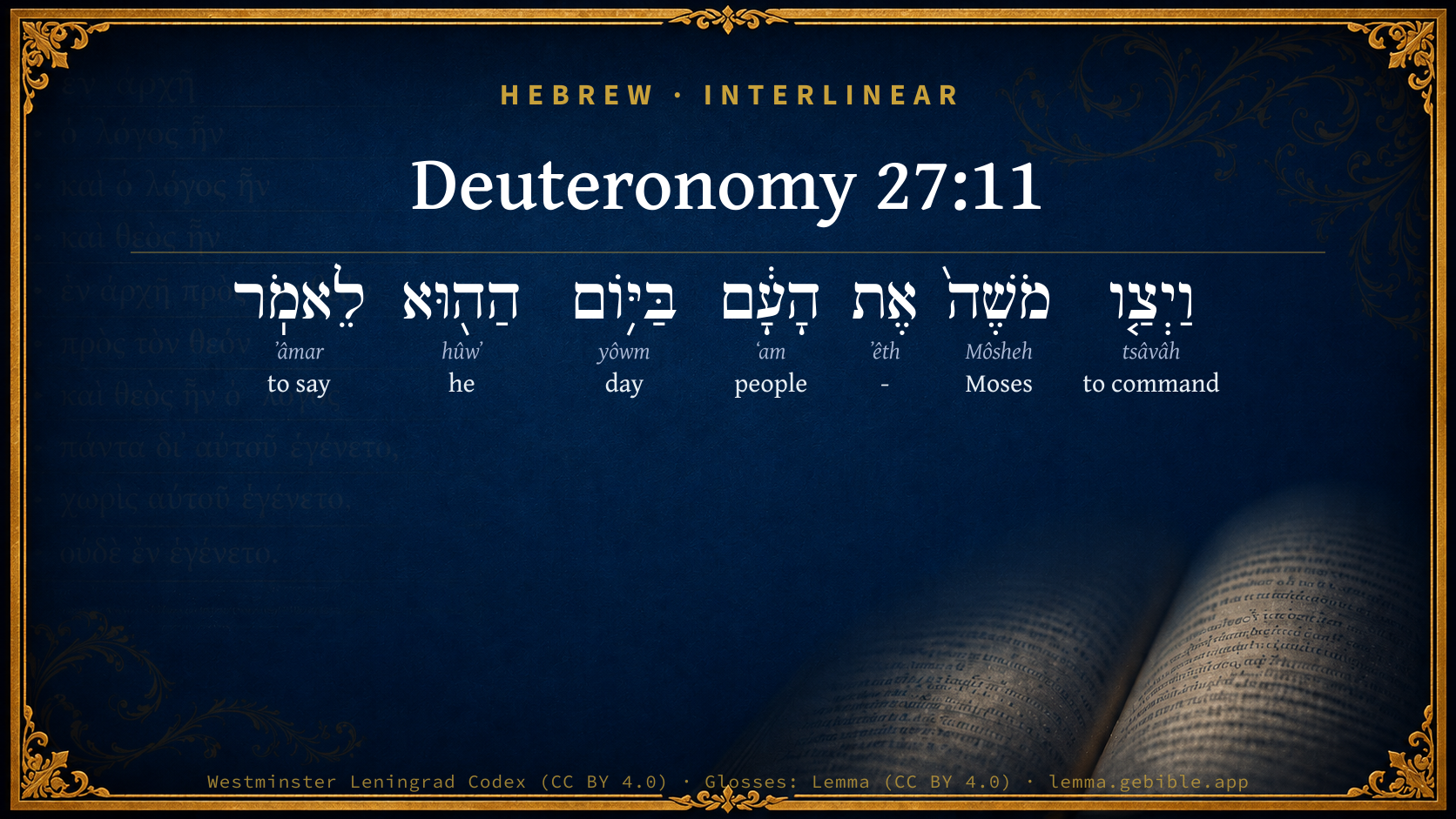
Hebrew (Westminster Leningrad Codex) Deuteronomy 27:11 appears in the Hebrew Old Testament. The text above is from the Westminster Leningrad Codex. Each word links to its Strong’s number, a concise gloss, and parsing drawn from the Open Scriptures Hebrew Bible morphology. Click any word for its full Brown-Driver-Briggs (BDB) entry.
Download image
Cite this verse

Deuteronomy 27:11 (World English Bible). Public Domain. Lemma interlinear Bible study tool, https://lemma.gebible.app/v/deuteronomy/27/11.

Show BibTeX & RIS
BibTeX
RIS
English Translation
Moses charged the people the same day, saying,
World English Bible · Public Domain
Download a study sheet

One document with this verse’s original text, its word-by-word gloss line, the meaning frame, cross-references with their text, attributed commentary, and full source and license credits — printable, and it pastes into notes with its structure intact.

This verse Autodidact and up

Study sheet (.html) Plain text (.txt)

A passage Seminary Student

Up to 50 verses in one chapter. A passage sheet keeps up to 6 commentary sources and 12 cross-references per verse, in the order this page ranks them, and says so on the sheet whenever that leaves anything out. Ask for a single verse and you get the Autodidact verse sheet above.

Everything on this page stays free to read, with no account — the sheet is a download of what is already on screen, not access to it.

Want to remove ads? Support Godless Engineer
Compare translations 3

The same verse in 3 English versions, stacked beneath the original-language interlinear above. Click any original word for its lexicon entry.

Each is an independent rendering of the whole verse — the interlinear is not word-aligned to these translations.

Highlighted words mark where these versions differ — a whole-verse word diff, not a word-by-word alignment.

  • World English Bible Public Domain
    Moses charged the people the same day, saying,
  • King James Version Public Domain
    And Moses charged the people the same day, saying,
  • unfoldingWord Literal Text CC BY-SA 4.0
    And Moses commanded the people on that day, saying,

unfoldingWord Literal Text — © unfoldingWord, licensed CC BY-SA 4.0. Word-aligned USFM3 via Door43 (git.door43.org/unfoldingWord/en_ult).

Versions to compare (up to 4)

3 of 4 selected

Show all 18 translations

Every available English version of this verse, each an independent rendering of the whole verse.

  • World English Bible Public Domain
    Moses charged the people the same day, saying,
  • Berean Standard Bible Public Domain
    On that day Moses commanded the people:
  • Majority Standard Bible Public Domain
    On that day Moses commanded the people:
  • King James Version Public Domain
    And Moses charged the people the same day, saying,
  • American Standard Version (1901) Public Domain
    And Moses charged the people the same day, saying,
  • Revised Version (1885) Public Domain
    And Moses charged the people the same day, saying,
  • Geneva Bible (1599) Public Domain
    And Moses charged the people the same day, saying,
  • Douay-Rheims (1899) Public Domain
    And Moses commanded the people in that day, saying:
  • Young's Literal Translation Public Domain
    And Moses commandeth the people on that day, saying,
  • Literal Standard Version CC BY-SA 4.0
    And Moses commands the people on that day, saying,
  • Unlocked Literal Bible CC BY-SA 4.0
    Moses commanded the people the same day and said,
  • unfoldingWord Literal Text CC BY-SA 4.0
    And Moses commanded the people on that day, saying,
  • Darby Bible Public Domain
    And Moses gave commandment to the people the same day, saying,
  • World Messianic Bible Public Domain
    Moses commanded the people the same day, saying,
  • Webster's Bible Public Domain
    And Moses charged the people the same day, saying,
  • Free Bible Version CC BY-SA 4.0
    That day Moses gave these orders to the people:
  • Bible in Basic English Public Domain
    That same day Moses said to the people,
  • JPS Tanakh (1917) Public Domain
    And Moses charged the people the same day, saying:

Literal Standard Version (2020), Covenant Press — licensed CC BY-SA 4.0. Text via the HelloAO Bible API (eBible.org). Unlocked Literal Bible (unfoldingWord) — licensed CC BY-SA 4.0. Text via the HelloAO Bible API (eBible.org). unfoldingWord Literal Text — © unfoldingWord, licensed CC BY-SA 4.0. Word-aligned USFM3 via Door43 (git.door43.org/unfoldingWord/en_ult). Free Bible Version, Dr. Jonathan Gallagher — licensed CC BY-SA 4.0. Text via the HelloAO Bible API (eBible.org).

Word by word

More ways to search: Search by grammar → Find every occurrence → Compare this word →

Practice this passage: Drill this verse → Learn its vocabulary →

וַיְצַ֤ו
tsâvâh
H6680
“and · to command”
Conjunction + Verb, Piel, Sequential Imperfect, 3rd Person, Masculine, Singular
Part of Speech
Conjunction + Verb
Stem
Piel
Form
Sequential Imperfect
Person
3rd Person
Gender
Masculine
Number
Singular
Full BDB Definition

Origin: a primitive root

TWOT: 1887

to command, charge, give orders, lay charge, give charge to, order - (Piel) - to lay charge upon - to give charge to, give command to - to give charge unto - to give charge over, appoint - to give charge, command - to charge, command - to charge, commission - to command, appoint, ordain (of divine act) - (Pual) to be commanded
  1. מֹשֶׁה֙ Môsheh H4872 “Moses” Noun, Proper
  2. אֶת ʼêth H853 “-” Particle, Direct Object
  3. הָעָ֔ם ʻam H5971 “the · people” Particle, Definite Article + Noun, Common, Masculine, Singular, Absolute
  4. בַּיּ֥וֹם yôwm H3117 “in/at the · day” Preposition, Determined + Noun, Common, Masculine, Singular, Absolute
  5. הַה֖וּא hûwʼ H1931 “the · he” Particle, Definite Article + Pronoun, Personal, 3rd Person, Masculine, Singular
  6. לֵאמֹֽר ʼâmar H559 “to say” Preposition + Verb, Qal, Infinitive Construct

About this verse

These counts appear in no published source. They are computed here, from the morphology-tagged text and Lemma’s own curated glosses. What Lemma adds →

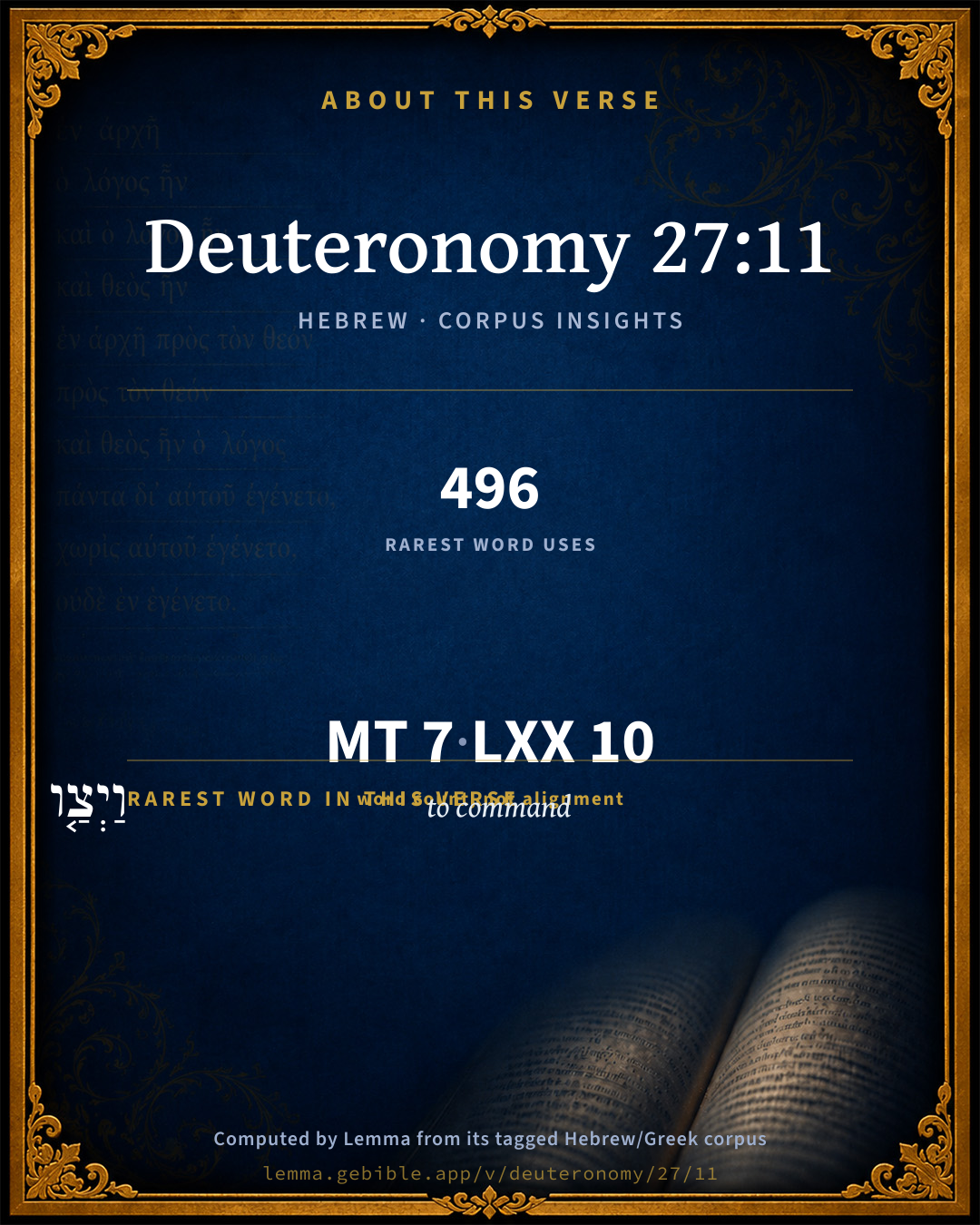
7
words
7
distinct lemmas
Pentateuch
section

Grammatical profile

  • 2 verbs
  • 3 nouns
  • 1 pronoun
  • 1 particle

Verb forms

  • וַיְצַ֤ו Piel · Sequential Imperfect
  • לֵאמֹֽר Qal · Infinitive Construct

Hebrew & Septuagint length

In English translation the verse runs 8 words from the Hebrew and 9 from the Septuagint (LXX English) — closely comparable.

A rough comparison of the two English renderings, which tokenize alike — not a word-level alignment.

Word counts can differ between the Hebrew and the Greek without any difference in meaning — e.g. the Hebrew direct-object marker אֵת has no separate Greek word, and Greek often adds the article ὁ.

In the original languages it is 7 Hebrew tokens and 10 Greek tokens — but the two are counted differently (Hebrew bundles its prefixes and suffixes into one token; the Greek is in lemma form), so that isn’t a like-for-like length.

Hebrew and Greek witnesses Masoretic Hebrew ↔ Greek Septuagint

The same verse in the two great witnesses to the Old Testament, shown verse-for-verse.

These are two independent witnesses, not word-aligned to each other, and the Septuagint is shown in lemma (dictionary) form.

Hebrew Deuteronomy 27:11 Masoretic · Westminster Leningrad Codex

וַיְצַ֤ו מֹשֶׁה֙ אֶת הָעָ֔ם בַּיּ֥וֹם הַה֖וּא לֵאמֹֽר

Moses charged the people the same day, saying,

World English Bible · Public Domain

Greek LXX Deuteronomy 27:11 Septuagint · lemma form

καί ἐντέλλομαι μωυσῆς ὁ λαός ἐν ὁ ἡμέρα ἐκεῖνος λέγω

And Moses charged the people on that day, saying,

LXX2012 (modern English Septuagint) · Public Domain

Hebrew: Westminster Leningrad Codex (CC BY 4.0). Greek: Septuagint (public domain); English from LXX2012 (modern English Septuagint) (Public Domain). How the Septuagint differs from the Hebrew →

Targum (Aramaic paraphrase)

2

The Targum is the ancient Jewish Aramaic paraphrase of the Hebrew Scriptures — an interpretive translation, not the Hebrew text itself. Onkelos (literal) and Pseudo-Jonathan (expansive) render the Torah, and Jonathan the Prophets. Coverage is partial: where no permissively-licensed English translation exists for a verse, only the Aramaic is shown. This is verse-level text, not a word-by-word alignment to the Hebrew.

  1. Targum Onkelos Torah (Genesis–Deuteronomy)
    וּפַקִיד מֹשֶׁה יָת עַמָא בְּיוֹמָא הַהוּא לְמֵימָר

    (no public-domain English translation for this verse)

    Targum Onkelos — Aramaic: “Onkelos Genesis” (public domain); “Onkelos Exodus” (public domain); “Onkelos Leviticus” (public domain); “Onkelos Numbers” (public domain); “Onkelos Deuteronomy” (public domain). English: “Sefaria Community Translation” (CC0 1.0 (public-domain dedication)); “J.W. Etheridge. The Targums of Onkelos and Jonathan Ben Uzziel on the Pentateuch. London: Longmans, Green, 1862” (public domain). Text via Sefaria.

  2. Targum Pseudo-Jonathan Torah (Genesis–Deuteronomy)
    וּפַקֵיד משֶׁה יַת עַמָא בְּיוֹמָא הַהוּא לְמֵימָר

    And Mosheh instructed the people that day, saying:

    Targum Pseudo-Jonathan — Aramaic: “Targum Jonathan on Genesis” (public domain); “Targum Jonathan on Exodus” (public domain); “Targum Jonathan on Leviticus” (public domain); “Targum Jonathan on Numbers” (public domain); “Targum Jonathan on Deuteronomy” (public domain). English: “The Targum of Jonathan ben Uzziel, trans. J. W. Etheridge, London, 1862” (public domain). Text via Sefaria.

Commentary

Notes on Deuteronomy 27:11 from classic Christian and Jewish commentators (each source and its license shown beneath its notes). The classic Christian expositions comment on the surrounding passage and are grouped to its opening verse, so a note may address several verses; the Jewish commentaries on the Tanakh (Rashi and others) are per-verse, so they appear only where the commentator wrote on this verse.

Lemma curates 59 commentaries, every one of them public domain or Creative Commons licensed, each selected and text-cleaned for this edition rather than reprinted as found. About our sources →

Jamieson, Fausset & Brown

Robert Jamieson, A. R. Fausset & David Brown

THE TRIBES DIVIDED ON GERIZIM AND EBAL. (Deu 27:11-13)

These shall stand upon mount Gerizim to bless the people . . . these shall stand upon mount Ebal to curse--Those long, rocky ridges lay in the province of Samaria, and the peaks referred to were near Shechem (Nablous), rising in steep precipices to the height of about eight hundred feet and separated by a green, well-watered valley of about five hundred yards wide. The people of Israel were here divided into two parts. On mount Gerizim (now Jebel-et-Tur) were stationed the descendants of Rachel and Leah, the two principal wives of Jacob, and to them was assigned the most pleasant and honorable office of pronouncing the benedictions; while on the twin hill of Ebal (now Imad-el-Deen) were placed the posterity of the two secondary wives, Zilpah and Bilhah, with those of Reuben, who had lost the primogeniture, and Zebulun, Leah's youngest son; to them was committed the necessary but painful duty of pronouncing the maledictions (see on Jdg 9:7). The ceremony might have taken place on the lower spurs of the mountains, where they approach more closely to each other; and the course observed was as follows: Amid the silent expectations of the solemn assembly, the priests standing round the ark in the valley below, said aloud, looking to Gerizim, "Blessed is the man that maketh not any graven image," when the people ranged on that hill responded in full simultaneous shouts of "Amen"; then turning round to Ebal, they cried, "Cursed is the man that maketh any graven image"; to which those that covered the ridge answered, "Amen." The same course at every pause was followed with all the blessings and curses (see on Jos 8:33-34). These curses attendant on disobedience to the divine will, which had been revealed as a law from heaven, be it observed, are given in the form of a declaration, not a wish, as the words should be rendered, "Cursed is he," and not, "Cursed be he."

Next: Deuteronomy Chapter 28

Jamieson, Fausset & Brown — Commentary Critical and Explanatory on the Whole Bible (1871) — public domain (CC PDM 1.0). Text via the HelloAO Bible API.

Matthew Henry's Commentary

When the law was written, to be seen and read by all men, the sanctions of it were to be published, which, to complete the solemnity of their covenanting with God, they were deliberately to declare their approbation of. This they were before directed to do (Deu 11:29, Deu 11:30), and therefore the appointment here begins somewhat abruptly, Deu 27:12. There were, it seems, in Canaan, that part of it which afterwards fell to the lot of Ephraim (Joshua's tribe), two mountains that lay near together, with a valley between, one called Gerizim and the other Ebal. On the sides of these two mountains, which faced one another, all the tribes were to be drawn up, six on one side and six on the other, so that in the valley, at the foot of each mountain, they came pretty near together, so near as that the priests standing betwixt them might be heard by those that were next them on both sides; then when silence was proclaimed, and attention commanded, one of the priests, or perhaps more at some distance from each other, pronounced with a loud voice one of the curses here following, and all the people that stood on the side and foot of Mount Ebal (those that stood further off taking the signal from those that stood nearer and within hearing) said Amen; then the contrary blessing was pronounced, "Blessed is he that doth not so or so," and then those that stood on the side, and at the foot, of Mount Gerizim, said Amen. This could not but affect them very much with the blessings and curses, the promises and threatenings, of the law, and not only acquaint all the people with them, but teach them to apply them to themselves.

I. Something is to be observed, in general, concerning this solemnity, which was to be done, but once and not repeated, but would be talked of to posterity,. 1. God appointed which tribes should stand upon Mount Gerizim and which on Mount Ebal (Deu 27:12, Deu 27:13), to prevent the disputes that might have arisen if they had been left to dispose of themselves. The six tribes that were appointed for blessing were all the children of the free women, for to such the promise belongs, Gal 4:31. Levi is here put among the rest, to teach ministers to apply to themselves the blessing and curse which they preach to others, and by faith to set their own Amen to it. 2. Of those tribes that were to say Amen to the blessings it is said, They stood to bless the people, but of the other, They stood to curse, not mentioning the people, as loth to suppose that any of this people whom God had taken for his own should lay themselves under the curse. Or, perhaps, the different mode of expression intimates that there was to be but one blessing pronounced in general upon the people of Israel, as a happy people, and that should ever be so, if they were obedient; and to this blessing the tribes on Mount Gerizim were to say Amen - "Happy art thou, O Israel, and mayest thou ever be so;" but then the curses come in as exceptions from the general rule, and we know exceptio firmat regulam - the exception confirms the rule. Israel is a blessed people, but, if there be any particular persons even among them that do such and such things as are mentioned, let them know that they have no part nor lot in the matter, but are under a curse. This shows how ready God is to bestow the blessing; if any fall under the curse, they may thank themselves, they bring it upon their own heads. 3. The Levites or priests, such of them as were appointed for that purpose, were to pronounce the curses as well as the blessings. They were ordained to bless (Deu 10:8), the priests did it daily, Num 6:23. But they must separate between the precious and the vile; they must not give that blessing promiscuously, but must declare it to whom it did not belong, lest those who had no right to it themselves should think to share in it by being in the crowd. Note, Ministers must preach the terrors of the law as well as the comforts of the gospel; must not only allure people to their duty with the promises of a blessing, but awe them to it with the threatenings of a curse. 4. The curses are here expressed, but not the blessings; for as many as were under the law were under the curse, but it was a honour reserved for Christ to bless us, and so to do that for us which the law could not do, in that it was weak. In Christ's sermon upon the mount, which was the true Mount Gerizim, we have blessings only, Mat 5:3, etc. 5. To each of the curses the people were to say Amen. It is easy to understand the meaning of Amen to the blessings. The Jews have a saying to encourage people to say Amen to the public prayers, Whosoever answereth Amen, after him that blesseth, he is as he that blesseth. But how could they say Amen to the curses? (1.) It was a profession of their faith in the truth of them, that these and the like curses were not bug-bears to frighten children and fools, but the real declarations of the wrath of God against the ungodliness and unrighteousness of men, not one iota of which shall fall to the ground. (2.) It was an acknowledgment of the equity of these curses; when they said Amen, they did in effect say, not only, It is certain it shall be so, but, It is just it should be so. Those who do such things deserve to fall and lie under the curse. (3.) It was such an imprecation upon themselves as strongly obliged them to have nothing to do with those evil practices upon which the curse is here entailed. "Let God's wrath fall upon us if ever we do such things." We read of those that entered into a curse (and with us that is the usual form of a solemn oath) to walk in God's law Neh 10:29. Nay, the Jews say (as the learned bishop Patrick quotes them), "All the people, by saying this Amen, became bound for one another, that they would observe God's laws, by which every man was obliged, as far as he could, to prevent his neighbour from breaking these laws, and to reprove those that had offended, lest they should bear sin and the curse for them."

II. Let us now observe what are the particular sins against which the curses are here denounced.

1. Sins against the second commandment. This flaming sword is set to keep that commandment first, Deu 27:15. Those are here cursed, not only that worship images, but that make them or keep them, if they be such (or like such) as idolaters used in the service of their gods. Whether it be a graven image or a molten image, it comes all to one, it is an abomination to the Lord, even though it be not set up in public, but in a secret place, - though it be not actually worshipped, nor is it said to be designed for worship, but reserved there with respect and a constant temptation. He that does this may perhaps escape punishment from men, but he cannot escape the curse of God.

2. Against the fifth commandment, Deu 27:16. The contempt of parents is a sin so heinous that it is put next to the contempt of God himself. If a man abused his parents, either in word or deed, he fell under the sentence of the magistrate, and must be put to death, Exo 21:15, Exo 21:17. But to set light by them in his heart was a thing which the magistrate could not take cognizance of, and therefore it is here laid under the curse of God, who knows the heart. Those are cursed children that carry themselves scornfully and insolently towards their parents.

3. Against the eighth commandment. The curse of God is here fastened, (1.) Upon an unjust neighbour that removes the land-marks, Deu 27:17. See Deu 19:14. Upon an unjust counsellor, who, when his advice is asked, maliciously directs his friend to that which he knows will be to his prejudice, which is making the blind to wander out of the way, under pretence of directing him in the way, than which nothing can be either more barbarous or more treacherous, Deu 27:18. Those that seduce others from the way of God's commandments, and entice them to sin, bring this curse upon themselves, which our Saviour has explained, Mat 15:14, The blind lead the blind, and both shall fall into the ditch. (3.) Upon an unjust judge, that perverteth the judgment of the stranger, fatherless, and widow, whom he should protect and vindicate, Deu 27:19. These are supposed to be poor and friendless (nothing to be got by doing them a kindness, nor any thing lost by disobliging them), and therefore judges may be tempted to side with their adversaries against right and equity; but cursed are such judges.

4. Against the seventh commandment. Incest is a cursed sin, with a sister, a father's wife, or a mother-in-law, Deu 27:20, Deu 27:22, Deu 27:23. These crimes not only exposed men to the sword of the magistrate (Lev 20:11), but, which is more dreadful, to the wrath of God; bestiality likewise, Deu 27:21.

5. Against the sixth commandment. Two of the worst kinds of murder are here specified: - (1.) Murder unseen, when a man does not set upon his neighbour as a fair adversary, giving him an opportunity to defend himself, but smites him secretly (Deu 27:24), as by poison or otherwise, when he sees not who hurts him. See Psa 10:8, Psa 10:9. Though such secret murders may go undiscovered and unpunished, yet the curse of God will follow them. (2.) Murder under colour of law, which is the greatest affront to God, for it makes an ordinance of his to patronise the worst of villains, and the greatest wrong to our neighbour, for it ruins his honour as well as his life: cursed therefore is he that will be hired, or bribed, to accuse, or to convict, or to condemn, and so to slay, an innocent person, Deu 27:25. See Psa 15:5.

6. The solemnity concludes with a general curse upon him that confirmeth not, or, as it might be read, that performeth not, all the words of this law to do them, Deu 27:26. By our obedience to the law we set our seal to it, and so confirm it, as by our disobedience we do what lies in us to disannul it, Psa 119:126. The apostle, following all the ancient versions, reads it, Cursed is every one that continues not, Gal 3:10. Lest those who were guilty of other sins, not mentioned in this commination, should think themselves safe from the curse, this last reaches all; not only those who do the evil which the law forbids, but those also who omit the good which the law requires: to this we must all say Amen, owning ourselves under the curse, justly to have deserved it, and that we must certainly have perished for ever under it, if Christ had not redeemed us from the curse of the law, by being made a curse for us.

Matthew Henry's Commentary on the Whole Bible (1708–1710) — public domain (CC PDM 1.0). Text via the HelloAO Bible API.

The Cambridge Bible for Schools and Colleges

gen. ed. J. J. S. Perowne

11–13. Appointment of Tribes to Bless and to Curse

Ch. Deu_11:29 (q.v.) commands that the blessing for obedience be set on Mt Gerizim, the curse for disobedience on Mt ‘Ebal. Set (lit. give) implies some solemn rite, and this is now defined. Six tribes shall stand on Gerizim to bless, and six on ‘Ebal for the curse. The former are all sons of Leah or Rachel, Jacob’s wives, the latter the sons of their maids, Gad, Asher, Dan and Naphtali, with Reuben, Leah’s eldest son, who lost his birthright, and Zebulun, her youngest. Again the former, appointed to the southern mount, are all (with the doubtful exception of Issachar) tribes established S. of Esdraelon; while those appointed to the northern mountain are the four tribes settled N. of Esdraelon, with the two from E. Palestine, Reuben and Gad.

On the whole, the genealogical explanation of the division (Dillm., Dri., Berth.) is more plausible than the geographical (Steuern.). The position of Levi, on a level with the other tribes, points to a source earlier than D, and as E emphasises the sanctity of Shechem, the fragment has been assigned to E (Berth., Marti). Note also the phrase, Moses charged the people, not elsewhere in D, while E most frequently uses the term the people to designate Israel (e.g. Exo_3:12; Exo_3:21; Exo_4:21; Exo_5:4; Exo_11:2 f, Exo_12:36, Exo_13:17 f., Exo_15:24, Exo_17:1 b, Exo_17:2; Exo_17:4-6, Exo_19:10; Exo_19:14-17, Exo_24:3; Num_11:1 f.).

The Cambridge Bible for Schools and Colleges (gen. ed. J. J. S. Perowne; Cambridge University Press, 1878–1918) — public domain. Text from a community e-Sword module.

John Gill's Exposition

And Moses charged the people the same,.... That he gave the above orders to set up stones, and plaster them, and write the law on them, and build an altar in the same place, and offer sacrifices when come into the land of Canaan:

saying; as follows.

John Gill's Exposition of the Whole Bible (1746–1763) — public domain (CC PDM 1.0). Text via the HelloAO Bible API.

Albert Barnes' Notes on the Bible

Compare Jos 8:32-35. The solemnity was apparently designed only for the single occasion on which it actually took place.

Deu 27:12, Deu 27:13

The tribes appointed to stand on Gerizim to bless the people all sprang from the two wives of Jacob, Leah and Rachel. All the four tribes which sprang from the handmaids Zilpah and Bilhah are located on Ebal. But in order, as it would seem, to effect an equal division, two tribes are added to the latter from the descendants of the wives, that of Reuben, probably because he forfeited his primogeniture Gen 49:4; and of Zebulun, apparently because he was the youngest son of Leah.

The transaction presents itself as a solemn renewal of the covenant made by God with Abraham and Isaac, but more especially with Jacob and his family. Accordingly the genealogical basis of the “twelve patriarchs” (compare Act 7:12; Rev 7:4 ff), the sons of Jacob, is here assumed. The tribes of Ephraim and Manasseh are merged in the name of Joseph, their father; and Levi regains on this occasion his place collaterally with the others. “The Levites” of Deu 27:14 are no doubt “the priests the Levites” (compare Jos 8:33), in whom the ministerial character attaching to the tribe was more particularly manifested. It is noteworthy that the group of tribes which stood on Gerizim far exceeded the other in numbers and in importance, thus perhaps indicating that even by the Law the blessing should at length prevail.

Deu 27:15

The “Amen” attested the conviction of the utterers that the sentences to which they responded were true, just, and certain; so in Num 5:22, and in our own Commination Office, which is modelled after this ordinance of Moses.

Deu 27:15-26

Twelve curses against transgressions of the covenant. The first eleven are directed against special sins which are selected by way of example, the last comprehensively sums up in general terms and condemns all and every offence against God’s Law. Compare the marginal references.

Albert Barnes' Notes on the Bible (1834–1885) — public domain. Text from a community e-Sword/MySword module.

The Pulpit Commentary

Vers. 11-14. Having set up the Law and renewed the covenant in Canaan, Israel was to proclaim upon the land the blessing and the curse of the Law, as already commanded. (see Deu_11:29) For this purpose six tribes were to station themselves on Mount Gerizim, and six on Mount Ebal, the former to pronounce the blessing, the latter the curse. (On the situation of these two mountains, see at eh. 11:29.) The six tribes by whom the blessing was to be pronounced were Simeon, Levi, Judah, Issachar, Joseph, and Benjamin, all descended from the two wives of Jacob Leah and Rachel. The tribes by whom the curse was to be uttered werethose descended from Zilpah, Leah"s maid, viz. Gad and Asher; those descended from Bilhah, Rachel"s maid, viz. Dan and Naphtali; with Zebulun and Reuben, both descended from Leah. As, in order to ob-rain a division of the tribes into two equal portions, two of the sons of Leah must be assigned to the second half, Zebulun and Reuben were chosen, probably because the former was the youngest of Leah"s sons, and the latter had by his sin forfeited his birthright. (Gen_49:4)

Vers. 11-26. A grand

It is more than possible that, with the strong disposition there is nowadays to look on Judaism as obsolete, the chapter before us may be very frequently passed over as if full of curses that no longer have any effect; especially as Paul, in Galatians 3., says, Christ hath redeemed us from the curse of the Law." But we are apt, perhaps, in dealing with the doctrinal aspect of these curses of the Law, in reference to the Atonement, to lose sight of their primary historical aspect in reference to Israel. But the significance of both altar and pillar, pillar and altar, should be taken into account. Here, in the valley between Gerizim and Ebal, the grandest assembly met that was ever convened. The Law was read in the people"s hearing, and the people were to declare themselves ready to brand sin with their curse, as God branded it with his. In a word, they were in a glorious league with the Great King of heaven and earth, that, whatever he disapproved, they would combine to brand with the infamy of eternal shame. As Israel was expected then to be in league with God in denouncing wrong, so are Christians expected by the holy cross to swear eternal war against sin. This may be worked out in seven consecutive lines of thought.

I God"s people now are a divinely chosen commonwealth.

II In subjection to God alone, this commonwealth is a self-governing body.

III The only law for life which they accept is that of righteousness righteousness, of course, all round, both as regards God and man.

IV It was for this very purpose Israel had been chosen out of the peoples that, for the world"s sake, there might be one nation in which righteousness was the supreme law.

V Side by side with the records of a Law which demands perfect righteousness, there is the altar and its sacrifice thereon, speaking to the people of a Divine provision for forgiving the penitent.

VI The penitent is set free from the curse of Law, that he may ever after co-operate with God in honoring the Law from whose curse he has been redeemed.

VII The passionate concern for holiness, and the delight in a holy Law, which are begotten in them who are of "the commonwealth of Israel," ensure their entire sympathy with God in the everlasting curse pronounced against all unrighteousness.

VIII Thus the pure and just Law of God may serve believers as an educatory force throughout their whole life. And in their incessant hatred and condemnation of evil is the saying true in the highest sense, Vex populi, vex Dei.

Vers. 11-26. Ebal and Gerizim.

This ceremony turns on the idea of the Law as primarily entailing a curse. Blessings and curses were both to be recited (vers. 12, 13). But the curse seems to have been first pronounced, and it only is given in the record. It has the lead in the transaction. The explanation is obvious. Ver. 26 shows that, in strictness, none can escape the curse. (Psa_130:3; Gal_3:10) A blessing is pronounced from Gerizim, but it is abortive, as depending on a condition which no sinner can fulfill.

Hence:

1. The stones are all placed on Ebal.

2. All the sons of the bondwomen are placed on that mount. (cf. Gal_4:21-31)

This is preferable to supposing that prominence is given to the curse, inasmuch as, under law, fear rather than love is the motive relied on to secure obedience. The appeal to fear is itself an evidence that "the law is not made for a righteous man". (1Ti_1:9) It brings strikingly to light the inherent weakness of the economy. (Rom_8:3) When a Law, the essence of which is love, requires to lean on curses to enforce it, the unlikelihood of getting it obeyed is tolerably manifest. As an actually working system, the Mosaic economy, while availing itself of the Law to awaken consciousness of sin and to keep men in the path of virtue, drew its strength for holiness, not from the Law, but from the revelations of love and grace which lay within and behind it. We learn

I THAT THE LAW IS COMPREHENSIVE OF EVERY PART OF OUR DUTY. A variety of sins are mentioned as examples. They relate to all departments of duty duty to God and duty to man. The list is avowedly representative (ver. 26).

Note:

1. That it covers a large part of the Decalogue. The first table is fairly represented by the second commandment, and a curse is pronounced on the making and worshipping of images (ver. 15). The precepts of the second table are involved in the other verses the fifth commandment in the curse on filial disrespect (ver. 16), the sixth in the curse on murder (ver. 24), the seventh in the curses on the grosser forms of uncleanness (vers. 20-23); the eighth in the curse on removing the landmark (ver. 17); the ninth in the, curse on slaying another for reward, which may include perjury (ver. 25); while vers. 19:19 may be viewed as forbidding breaches of the law of love generally.

2. That the sins against which the curses are directed are mostly secret sins. The Law searches the heart.

3. That the usual care is shown for the interests of the defenseless (vers. 18, 19). It is touching, in the heart of so awful a malediction, to find this tender love for the blind, the stranger, the fatherless, the widow. Wrath and love in God are close of kin.

II THAT A CURSE WAITS ON EVERY VIOLATION OF THE LAW"S PRECEPTS. The position of Scripture is that every sin, great and small, subjects the sinner to God"s wrath and curse. It derives this truth, not, as some have sought to derive it, from the metaphysical notion of sin"s infinite demerit, as committed against an infinite God; but from its own deep view of sin, as involving a change, a deflection, an alteration, in its effects of infinite moment, in the very center of man"s being. There is no sin of slight turpitude. A holy being, to become capable of sin, must admit a principle into his heart totally foreign to the holy condition, and subversive of it. In this sense, he that offends in one point is guilty of all. (Jam_2:10, Jam_2:11) Sin is in him, and on a being with sin in him the Law can pronounce but one sentence. His life is polluted, and, being polluted, is forfeited. The curse involves the cutting of the sinner off from life and favor, with subjection to the temporal, spiritual, and eternal penalties of transgression. The denial of this article leaves no single important doctrine of the gospel unaffected; the admission of it carries with it all the rest. It gives its complexion to a whole theology.

III THAT THE SINNER MUST ACKNOWLEDGE THE JUSTICE OF THE LAW"S CLAIMS AGAINST HIM. The people were required to say, "Amen." This Amen" was:

(1) An assent to the conditions of life proposed.

(2) A recognition of the righteousness of them.

The Law declares God"s judgment against sin. And this:

1. Is echoed by the conscience. Fitfully, reluctantly, intermittently, yet truly, even by the natural conscience. The "Amen" is implied in every pang of remorse, in every feeling of self-condemnation. Every time we do that we would not, we consent unto the Law that it is good. (Rom_3:16) The very heathen know the "judgment of God, that they which commit such things" as are here specified "are worthy of death". (Rom_1:32) But it needs the spiritually convinced heart to render this Amen" hearty and sincere. The true penitent justifies God and condemns himself. (Ps 51)

2. Was acknowledged by Christ as our Sin-bearer. In Christ"s atonement, it has been truly remarked, there "must have been a perfect Amenin humanity to the judgment of God on the sin of man. Such an "Amen" was due to the truth of things. He who was the Truth could not be in humanity and not utter it and it was necessarily a first step in dealing with the Father on our behalf" (J. McLeod Campbell).

3. Will yet be joined in by the whole universe. (Rev_15:2 Rev_17:1, Rev_17:2)

CONCLUSION. "Christ hath redeemed us from the curse of the Law, being made a curse for us". (Gal_3:13) In him no condemnation. J.O. (Rom_8:1)

Vers. 11-26. The Decalogue nationally reciprocated.

It is obvious that the same God who prescribed its Jewish Law is the Creator also of the human conscience; for, just as the sword fits its scabbard, or as cog corresponds with cog in the mechanical wheel, so accord Mosaic Law and human conscience. They are natural counterparts.

I MEN ARE RULED BY A SYSTEM OF REWARDS AND PUNISHMENTS. Notwithstanding the development of the human mind, and the progress of civilization since Moses" day, human nature is still in its minority, still in a state of childhood. We do not yet see into the interior nature of spiritual realities. We do not see the inherent excellence of righteousness. We do not see the native beauty of obedience. Hence we need to be attracted by rewards and awed by punishments. We perceive the glory or the shame of moral conduct chiefly by its fruits. As we grow in piety, we shall value virtue and holiness for their own sakes, and think less about remote effects and consequences. At present we need the attendant pleasure and pain, the promises and threatenings.

II FINAL SEPARATIONS OF MANKIND ARE HERE PREFIGURED. As the twelve tribes were here divided into two distinct groups, divided by the vale of Shechem; so all the tribes of men shall eventually be separated, and that by an impassable gulf. The principle of classification on Ebal and Gerizim was not personal merit or demerit (as it will be at the final assize), yet even this ultimate principle of separation seems to have been foreshadowed there. Only children of Jacob"s married wives were placed on the mount of blessing; but Reuben, the firstborn, had forfeited this privilege by reason of his sin. As yet, the evil could be averted the positions might be reversed; these dramatic proceedings were omens both of good and of evil, and were intended to arouse a torpid conscience. To heaven or to hell each man hourly gravitates.

III GOD"S BLESSING OR CURSE TAKES EFFECT FROM CENTER TO CIRCUMFERENCE. These mountains were situated almost central in the land. Soon this vast congregation would be scattered to their allotted homes, and thus the influence of this scene would be transmitted all over Canaan. Even this external transmission was typical. The blessing and the curse touched every interest and relationship of Jewish life religion, home, society, government. The curse was invoked upon idolatry, undutifulness, avarice, oppression, unchastity, insubordination. It began in the inner chamber of the heart, and extended to the outermost circle of the social system. It begins at once, follows the crime as the shadow does the object, until it reaches into the most distant cycles of eternity.

IV THE HUMAN CONSCIENCE IS THE RECIPROCAL OF THE MORAL LAW, THE ECHO OF ITS SANCTIONS AND ITS PENALTIES. Every healthy conscience utters its sincere "Amen" to every dictate of God"s Law. When free from the mists and storms of guilty passion, it reflects, with the fidelity of a mirror, the decisions of God"s royal will. Even when a man is the victim of judicial sentence, his conscience admits the justice of the doom. The culprit, in his calmer moods, is self-convicted and self-condemned. When God, by the lips of Moses, required all the tribes to affirm thus solemnly the curses due to disobedience, he knew that every man would heartily take his part in that august deed.

V MEN BECOME THE ADMINISTRATORS OF GOD"S LAW. We cannot doubt that one reason why God required this public assent to the sanctions of his Law, was that each man might feel more deeply his responsibility toward himself and toward his neigh-bouts. In proportion to our reverential regard for God becomes our concern for others" obedience. The Levites more than once had girded on their swords, and, fired with zeal for their God, had slain their own countrymen. No resistance was attempted, for conscience had made cowards of the culprits. To the same end, David prays, "Let the righteous smite me; it shall be a kindness." Moved by this impulse, men would seek "to please their neighbors for their good unto edification." Possessed with a pious disposition, they endeavor to make known on every side God"s will, to preserve its remembrance among those disposed to grow oblivious, and to exalt its authority on every hand. Self-consistency required that those who had publicly pronounced the curses of the Law should jealously watch their own conduct should tenderly caution others! D.

Vers. 11-26. Responses.

After the writing of the Law, and the sacrifices, there was to be a great congregation, and half of the people were to assemble on Mount Gerizim to bless, viz. Simeon, Levi, Judah, Issachar, Ephraim, Manasseh, and Benjamin; while the other half were to assemble on Mount Ebal to curse, viz. Reuben, Gad, Asher, Zebulun, Dan, and Naphtali. Now, we know from Numbers that the order of march was this: Judah, Issachar, Zebulun, Gershon and Merari with the tabernacle, Reuben, Simeon, Gad, Kohath with the sanctuary, Ephraim, Manasseh, Benjamin, Dan, Asher, and Naphtali. The order for the arrangement, therefore, was that the van, consisting of Judah and Issachar, marched to Gerizim; then Zebulun, the next tribe, marched to Ebal; then the Gershonites and Merarites marched to Gerizim; then Reuben to Ebal; Simeon to Gerizim; Gad to Ebal; the Kohathites to Gerizim; followed by Ephraim, Manasseh, and Benjamin, who were the followers of the ark; and lastly the rearguard, Dan, Asher, and Naphtali, to Ebal. No commander-in-chief ever disposed of his men more impartially than did Moses in this address beyond the Jordan. Now, we have one or two remarks arising out of this arrangement.

I THE TRIBE OF LEVI, WITH ALL THE APPOINTMENTS FOR SACRIFICE, PASSED TO GERIZIM TO BLESS. In the march Levi was divided into two parts the Gershonites and Merarites going fourth with the tabernacle furniture, while the Kohathites went eighth with the ark and sanctuary. But they unite at Mount Gerizim. Nothing could more clearly indicate the mercy and blessing embodied in the whole ceremonial law which the Levites represented. The Law in its judicial aspect might have its penalties and judgments, but it had its ceremonies of mercy to counterbalance these.

II THE WEIGHT OF THE NATION STOOD ON MOUNT GERIZIM. When we consider the tribes that defiled upon the mount of blessing, we see that they absorb the heroic in Israel. Reuben, Gad, Asher, Dan, Zebulun, and Naphtali were nobodies, so far as national heroism is concerned; whereas the other tribes became famous in the history of Palestine. It is surely significant that the weight of the nation is assigned to the mount of blessing.

III THE PEOPLE HAD TO SAY "AMEN" TO THE CURSES AS WELL AS TO THE BLESSINGS PRONOUNCED IN THE NAME OF GOD. Some are ready with their responses to the blessings; they cannot get too much of them. But they demur to any curses issuing from God. They think they are unworthy of him. It so happens, however, that, in the great congregation between the mountains, the curses of Ebal had precedence of the blessings of Gerizim. The emphasis chronologically was given to the curses. And our consciences must acknowledge that the Law of God must carry out its penalties punctually, or it will forfeit all respect.

IV A REVIEW OF THE CURSES HERE UTTERED SHOWS THAT THEY ALL REST UPON RIGHT. No one dare take up one of these curses and suggest its omission or alteration. It is absolute morality which assigns a malediction to such crimes as these. They have the hearty Amen" of every unbiased conscience. R.M.E.

The Pulpit Commentary (1880–1919), ed. H.D.M. Spence-Jones & Joseph S. Exell — public domain. Text from a community e-Sword module.

Keil & Delitzsch

C. F. Keil & F. Delitzsch

With the solemn erection of the stones with the law written upon them, Israel was to transfer to the land the blessing and curse of the law, as was already commanded in Deu 11:29; that is to say, according to the more minute explanation of the command which is given here, the people themselves were solemnly to give expression to the blessing and the curse: to the former upon Mount Gerizim, and to the latter upon Ebal. On the situation of these mountains, see at Deu 11:29. To this end six tribes were to station themselves upon the top or side of Gerizim, and six upon the top or side of Ebal. The blessing was to be uttered by the tribes of Simeon, Levi, Judah, Issachar, Joseph, and Benjamin, who sprang from the two wives of Jacob; and the curse by Reuben, with the two sons of Leah's maid Zilpah, and by Zebulun, with Dan and Naphtali, the sons of Rachel's maid Bilhah. It was natural that the utterance of the blessing should be assigned to the tribes which sprang from Jacob's proper wives, since the sons of the wives occupied a higher position than the sons of the maids - just as the blessing had pre-eminence over the curse. But in order to secure the division into two sixes, it was necessary that two of the eight sons of the wives should be associated with those who pronounced the curses. The choice fell upon Reuben, because he had forfeited his right of primogeniture by his incest (Gen 49:4), and upon Zebulun, as the youngest son of Leah. "They shall stand there upon the curse:" i.e., to pronounce the curse.

Keil & Delitzsch — Biblical Commentary on the Old Testament (1861–1891) — public domain (CC PDM 1.0). Text via the HelloAO Bible API. (Old Testament only.)

unfoldingWord translationNotes

Door43 World Missions Community

These tribes

Here the metonym "tribes" refers to the people from the tribes of Simeon, Levi, Judah, Issachar, Joseph, and Benjamin. AT: "The people from these tribes" (See: Metonymy)

Mount Gerizim

A small mountain north of Mount Ebal. See how you translated this in Deuteronomy 11:29.

Joseph

This combines the tribes of Ephraim and Manasseh, who were descendants of Joseph.

translationWords

tribe

bless

Jordan River

Simeon

Judah

Issachar

Joseph (OT)

Benjamin

unfoldingWord translationNotes — © Distant Shores Media and the Door43 World Missions Community, licensed CC BY-SA 4.0. Source: git.door43.org/Door43/en_tn.

Lesson kit

Teaching starters — assembled from the data on this page, not authored interpretation. Every prompt links to the verse data it draws on. Edit before teaching.

Deuteronomy, in the Pentateuch, opens this verse with 7 words (7 distinct Hebrew lemmas). Its most distinctive word is tsâvâh (“to command”). A historical commentator’s framing appears above. Read the whole chapter for the surrounding context.

Discussion questions

  1. How does “to command” (tsâvâh) shape what this verse is saying?
  2. These translations render this verse differently; the difference is in the English rendering, not the original. What questions does that raise?
  3. The verb «וַיְצַ֤ו» is Piel Sequential Imperfect. How does its form color the action?
  4. Reading how Jamieson, Fausset & Brown and Matthew Henry's Commentary read this verse, where do the two commentators agree and where do they part?

Things to notice

Reading settings

Reading text

Shown beneath each verse's original-language words.

Old Testament
Old Testament edition

Read the OT as the Masoretic Hebrew (MT) or the Greek Septuagint (LXX).

English shown for the Greek Septuagint (in the Hebrew ↔ Greek comparison).

Comparing translations? Open the Compare panel on any verse page to stack up to four side by side.