
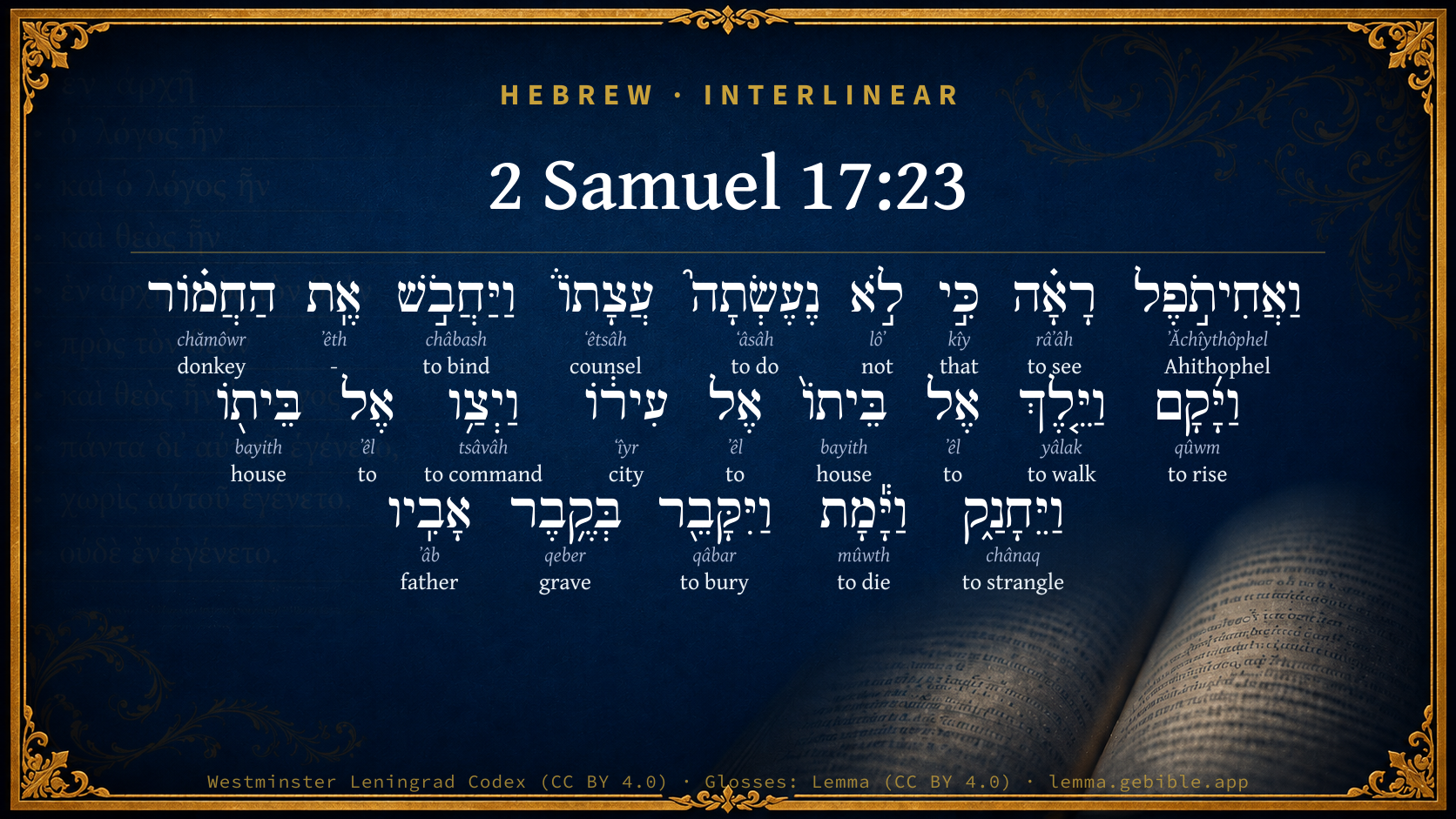
2 Samuel 17:23

Hebrew (Westminster Leningrad Codex) 2 Samuel 17:23 appears in the Hebrew Old Testament. The text above is from the Westminster Leningrad Codex. Each word links to its Strong’s number, a concise gloss, and parsing drawn from the Open Scriptures Hebrew Bible morphology. Click any word for its full Brown-Driver-Briggs (BDB) entry.
Download image
Cite this verse

2 Samuel 17:23 (World English Bible). Public Domain. Lemma interlinear Bible study tool, https://lemma.gebible.app/v/2-samuel/17/23.

Show BibTeX & RIS
BibTeX
RIS
English Translation
When Ahithophel saw that his counsel was not followed, he saddled his donkey, and arose, and got him home, to his city, and set his house in order, and hanged himself; and he died, and was buried in the tomb of his father.
World English Bible · Public Domain
Highlights
  • 1 first appearance in the Hebrew Bible
Full analysis ↓
Download a study sheet

One document with this verse’s original text, its word-by-word gloss line, the meaning frame, cross-references with their text, attributed commentary, and full source and license credits — printable, and it pastes into notes with its structure intact.

This verse Autodidact and up

Study sheet (.html) Plain text (.txt)

A passage Seminary Student

Up to 50 verses in one chapter. A passage sheet keeps up to 6 commentary sources and 12 cross-references per verse, in the order this page ranks them, and says so on the sheet whenever that leaves anything out. Ask for a single verse and you get the Autodidact verse sheet above.

Everything on this page stays free to read, with no account — the sheet is a download of what is already on screen, not access to it.

Want to remove ads? Support Godless Engineer
Compare translations 3

The same verse in 3 English versions, stacked beneath the original-language interlinear above. Click any original word for its lexicon entry.

Each is an independent rendering of the whole verse — the interlinear is not word-aligned to these translations.

Highlighted words mark where these versions differ — a whole-verse word diff, not a word-by-word alignment.

  • World English Bible Public Domain
    When Ahithophel saw that his counsel was not followed, he saddled his donkey, and arose, and got him home, to his city, and set his house in order, and hanged himself; and he died, and was buried in the tomb of his father.
  • King James Version Public Domain
    And when Ahithophel saw that his counsel was not followed, he saddled his ass, and arose, and gat him home to his house, to his city, and put his household in order, and hanged himself, and died, and was buried in the sepulchre of his father.
  • unfoldingWord Literal Text CC BY-SA 4.0
    And Ahithophel saw that his counsel was not done, and he saddled his donkey, and he arose and went to his house, to his city, and he commanded about his house, and he hanged himself, and he died. And he was buried in the grave of his father.

unfoldingWord Literal Text — © unfoldingWord, licensed CC BY-SA 4.0. Word-aligned USFM3 via Door43 (git.door43.org/unfoldingWord/en_ult).

Versions to compare (up to 4)

3 of 4 selected

Show all 18 translations

Every available English version of this verse, each an independent rendering of the whole verse.

  • World English Bible Public Domain
    When Ahithophel saw that his counsel was not followed, he saddled his donkey, and arose, and got him home, to his city, and set his house in order, and hanged himself; and he died, and was buried in the tomb of his father.
  • Berean Standard Bible Public Domain
    When Ahithophel saw that his advice had not been followed, he saddled his donkey and set out for his house in his hometown. He put his affairs in order and hanged himself. So he died and was buried in his father’s tomb.
  • Majority Standard Bible Public Domain
    When Ahithophel saw that his advice had not been followed, he saddled his donkey and set out for his house in his hometown. He put his affairs in order and hanged himself. So he died and was buried in his father’s tomb.
  • King James Version Public Domain
    And when Ahithophel saw that his counsel was not followed, he saddled his ass, and arose, and gat him home to his house, to his city, and put his household in order, and hanged himself, and died, and was buried in the sepulchre of his father.
  • American Standard Version (1901) Public Domain
    And when Ahithophel saw that his counsel was not followed, he saddled his ass, and arose, and gat him home, unto his city, and set his house in order, and hanged himself; and he died, and was buried in the sepulchre of his father.
  • Revised Version (1885) Public Domain
    And when Ahithophel saw that his counsel was not followed, he saddled his ass, and arose, and gat him home, unto his city, and set his house in order, and hanged himself; and he died, and was buried in the sepulchre of his father.
  • Geneva Bible (1599) Public Domain
    Nowe when Ahithophel sawe that his counsell was not followed, he sadled his asse, and arose, and he went home vnto his citie, and put his houshold in order, and hanged him selfe, and dyed, and was buryed in his fathers graue.
  • Douay-Rheims (1899) Public Domain
    But Achitophel seeing that his counsel was not followed, saddled his ass, and arose and went home to his house and to his city, and putting his house in order, hanged himself, and was buried in the sepulchre of his father.
  • Young's Literal Translation Public Domain
    And Ahithophel hath seen that his counsel was not done, and he saddleth the ass, and riseth and goeth unto his house, unto his city, and giveth charge unto his household, and strangleth himself, and dieth, and he is buried in the burying-place of his father.
  • Literal Standard Version CC BY-SA 4.0
    And Ahithophel has seen that his counsel was not done, and he saddles the donkey, and rises and goes to his house, to his city, and gives charge to his household, and strangles himself, and dies, and he is buried in the burying-place of his father.
  • Unlocked Literal Bible CC BY-SA 4.0
    When Ahithophel saw that his advice had not been followed, he saddled his donkey and left. He went home to his own city, set his affairs in order, and hanged himself. In this way he died and was buried in the tomb of his father.
  • unfoldingWord Literal Text CC BY-SA 4.0
    And Ahithophel saw that his counsel was not done, and he saddled his donkey, and he arose and went to his house, to his city, and he commanded about his house, and he hanged himself, and he died. And he was buried in the grave of his father.
  • Darby Bible Public Domain
    And when Ahithophel saw that his counsel was not followed, he saddled his ass, and arose and went to his house, to his city, and gave charge to his household, and hanged himself, and he died; and he was buried in the sepulchre of his father.
  • World Messianic Bible Public Domain
    When Ahithophel saw that his counsel was not followed, he saddled his donkey, arose, and went home to his city, set his house in order, and hanged himself; and he died, and was buried in the tomb of his father.
  • Webster's Bible Public Domain
    And when Ahithophel saw that his counsel was not followed, he saddled his ass, and arose, and went home to his house, to his city, and put his household in order, and hanged himself, and died. and was buried in the sepulcher of his father.
  • Free Bible Version CC BY-SA 4.0
    When Ahithophel realized that his advice had been ignored, he saddled up his donkey and left for his home in the town where he lived. He put his affairs in order and then he hanged himself. He died and was buried in his father's tomb.
  • Bible in Basic English Public Domain
    Now when Ahithophel saw that his suggestion was not acted on, he got his ass ready, and went back to his house, to the town where he came from, and having put his house in order, he put himself to death by hanging; so he came to his end and was put in the resting-place of his father.
  • JPS Tanakh (1917) Public Domain
    And when Ahithophel saw that his counsel was not followed, he saddled his ass, and arose, and got him home, unto his city, and set his house in order, and strangled himself; and he died, and was buried in the sepulchre of his father.

Literal Standard Version (2020), Covenant Press — licensed CC BY-SA 4.0. Text via the HelloAO Bible API (eBible.org). Unlocked Literal Bible (unfoldingWord) — licensed CC BY-SA 4.0. Text via the HelloAO Bible API (eBible.org). unfoldingWord Literal Text — © unfoldingWord, licensed CC BY-SA 4.0. Word-aligned USFM3 via Door43 (git.door43.org/unfoldingWord/en_ult). Free Bible Version, Dr. Jonathan Gallagher — licensed CC BY-SA 4.0. Text via the HelloAO Bible API (eBible.org).

Word by word

More ways to search: Search by grammar → Find every occurrence → Compare this word →

Practice this passage: Drill this verse → Learn its vocabulary →

וַיֵּחָנַ֑ק
chânaq
H2614
“and · to strangle”
Conjunction + Verb, Niphal, Sequential Imperfect, 3rd Person, Masculine, Singular
Part of Speech
Conjunction + Verb
Stem
Niphal
Form
Sequential Imperfect
Person
3rd Person
Gender
Masculine
Number
Singular
Full BDB Definition

Origin: a primitive root [compare H2596 ]

TWOT: 697

to strangle, strangle oneself - (Niphal) to strangle oneself - (Piel) to strangle
  1. וַאֲחִיתֹ֣פֶל ʼĂchîythôphel H302 “and · Ahithophel” Conjunction + Noun, Proper
  2. רָאָ֗ה râʼâh H7200 “to see” Verb, Qal, Perfect, 3rd Person, Masculine, Singular
  3. כִּ֣י kîy H3588 “that” Conjunction
  4. לֹ֣א lôʼ H3808 “not” Particle, Negative
  5. נֶעֶשְׂתָה֮ ʻâsâh H6213 “to do” Verb, Niphal, Perfect, 3rd Person, Feminine, Singular
  6. עֲצָתוֹ֒ ʻêtsâh H6098 “counsel · his” Noun, Common, Feminine, Singular, Construct + Suffix, Personal, 3rd Person, Masculine, Singular
  7. וַיַּחֲבֹ֣שׁ châbash H2280 “and · to bind” Conjunction + Verb, Qal, Sequential Imperfect, 3rd Person, Masculine, Singular
  8. אֶֽת ʼêth H853 “-” Particle, Direct Object
  9. הַחֲמ֗וֹר chămôwr H2543 “the · donkey” Particle, Definite Article + Noun, Common, Both, Singular, Absolute
  10. וַיָּ֜קָם qûwm H6965 “and · to rise” Conjunction + Verb, Qal, Sequential Imperfect, 3rd Person, Masculine, Singular
  11. וַיֵּ֤לֶךְ yâlak H3212 “and · to walk” Conjunction + Verb, Qal, Sequential Imperfect, 3rd Person, Masculine, Singular
  12. אֶל ʼêl H413 “to” Preposition
  13. בֵּיתוֹ֙ bayith H1004 “house · his” Noun, Common, Masculine, Singular, Construct + Suffix, Personal, 3rd Person, Masculine, Singular
  14. אֶל ʼêl H413 “to” Preposition
  15. עִיר֔וֹ ʻîyr H5892 “city · his” Noun, Common, Feminine, Singular, Construct + Suffix, Personal, 3rd Person, Masculine, Singular
  16. וַיְצַ֥ו tsâvâh H6680 “and · to command” Conjunction + Verb, Piel, Sequential Imperfect, 3rd Person, Masculine, Singular
  17. אֶל ʼêl H413 “to” Preposition
  18. בֵּית֖וֹ bayith H1004 “house · his” Noun, Common, Masculine, Singular, Construct + Suffix, Personal, 3rd Person, Masculine, Singular
  19. וַיָּ֕מָת mûwth H4191 “and · to die” Conjunction + Verb, Qal, Sequential Imperfect, 3rd Person, Masculine, Singular
  20. וַיִּקָּבֵ֖ר qâbar H6912 “and · to bury” Conjunction + Verb, Niphal, Sequential Imperfect, 3rd Person, Masculine, Singular
  21. בְּקֶ֥בֶר qeber H6913 “in/at · grave of” Preposition + Noun, Common, Masculine, Singular, Construct
  22. אָבִֽיו ʼâb H1 “father · his” Noun, Common, Masculine, Singular, Construct + Suffix, Personal, 3rd Person, Masculine, Singular

About this verse

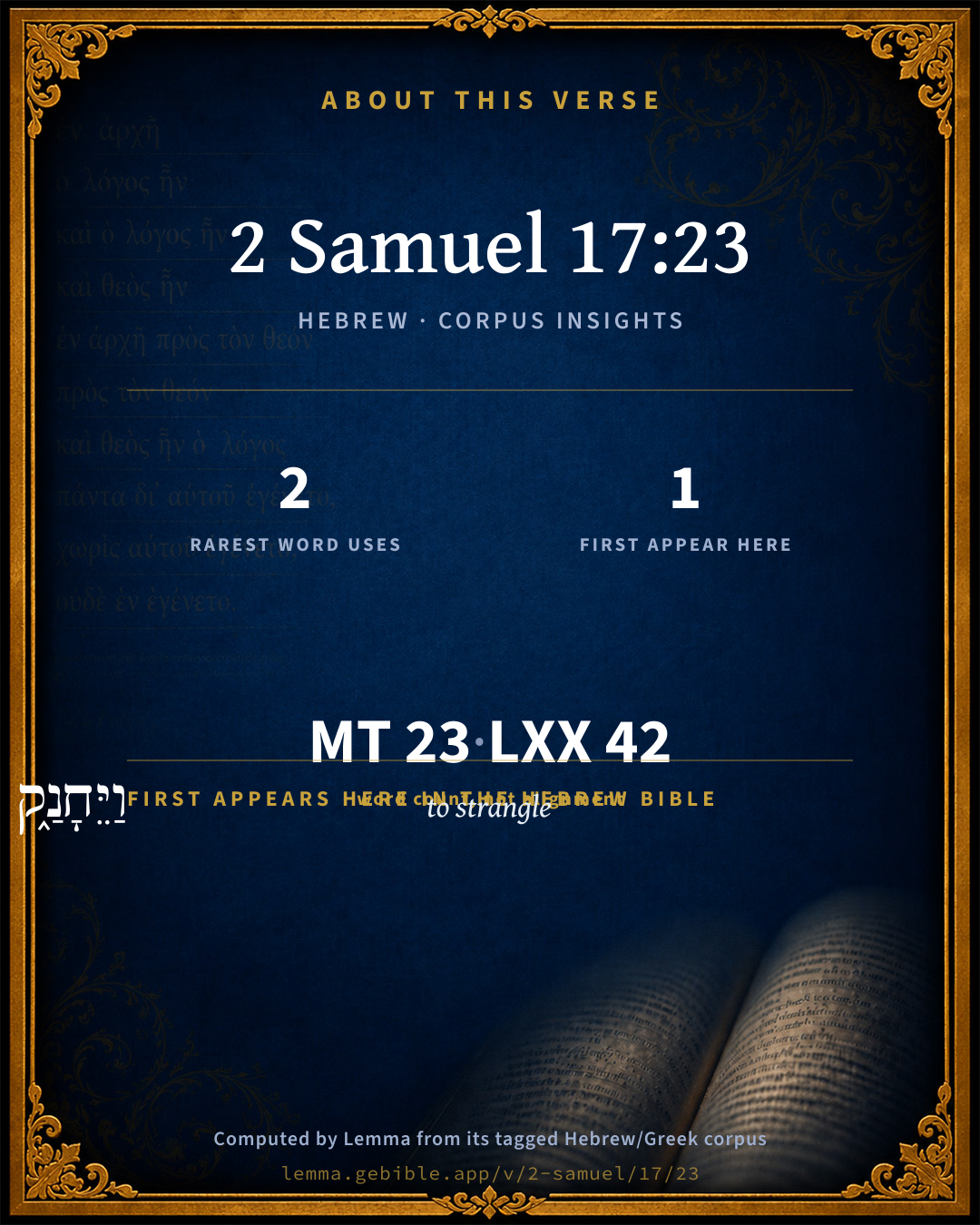
These counts appear in no published source. They are computed here, from the morphology-tagged text and Lemma’s own curated glosses. What Lemma adds →

23
words
20
distinct lemmas
Historical
section

Notable vocabulary

The rarest word here is וַיֵּחָנַ֑ק to strangle H2614 — appearing just 2 times in the whole Hebrew Bible.

First appearance in Scripture

This word makes its first canonical appearance in the Hebrew Bible here:

  • וַיֵּחָנַ֑ק to strangle H2614

Shared distinctive vocabulary

וַיֵּחָנַ֑ק to strangle H2614 occurs in 2 verses of the Hebrew Bible. Also found in:

Grammatical profile

  • 9 verbs
  • 8 nouns
  • 3 prepositions
  • 1 conjunction
  • 2 particles

Verb forms

  • רָאָ֗ה Qal · Perfect
  • נֶעֶשְׂתָה֮ Niphal · Perfect
  • וַיַּחֲבֹ֣שׁ Qal · Sequential Imperfect
  • וַיָּ֜קָם Qal · Sequential Imperfect
  • וַיֵּ֤לֶךְ Qal · Sequential Imperfect
  • וַיְצַ֥ו Piel · Sequential Imperfect
  • וַיֵּחָנַ֑ק Niphal · Sequential Imperfect
  • וַיָּ֕מָת Qal · Sequential Imperfect
  • וַיִּקָּבֵ֖ר Niphal · Sequential Imperfect

Repetition

Words recur within this verse — often emphatic in Hebrew:

  • בֵּיתוֹ֙ house H1004 ×2
  • אֶל to H413 ×3

Hebrew & Septuagint length

In English translation the verse runs 43 words from the Hebrew and 45 from the Septuagint (LXX English) — closely comparable.

A rough comparison of the two English renderings, which tokenize alike — not a word-level alignment.

Word counts can differ between the Hebrew and the Greek without any difference in meaning — e.g. the Hebrew direct-object marker אֵת has no separate Greek word, and Greek often adds the article ὁ.

In the original languages it is 23 Hebrew tokens and 42 Greek tokens — but the two are counted differently (Hebrew bundles its prefixes and suffixes into one token; the Greek is in lemma form), so that isn’t a like-for-like length.

Cross-references

11

Topical passages linked to 2 Samuel 17:23 in the Treasury of Scripture Knowledge — connected by theme and wording, ordered by reader-vote popularity; previews shown in the World English Bible.

  • Matthew 27:5 He threw down the pieces of silver in the sanctuary, and departed. He went away and hanged himself.
  • 2 Samuel 15:12 Absalom sent for Ahithophel the Gilonite, David's counselor, from his city, even from Giloh, while he was offering the sacrifices. The conspiracy was strong; for the people increased continually with Absalom.
  • 2 Kings 20:1 In those days was Hezekiah sick to death. Isaiah the prophet the son of Amoz came to him, and said to him, Thus says Yahweh, Set your house in order: for you shall die, and not live.
  • 1 Kings 16:18 It happened, when Zimri saw that the city was taken, that he went into the castle of the king's house, and burnt the king's house over him with fire, and died,
  • Psalms 5:10 Hold them guilty, God. Let them fall by their own counsels; Thrust them out in the multitude of their transgressions, For they have rebelled against you.
  • 2 Samuel 15:31 One told David, saying, Ahithophel is among the conspirators with Absalom. David said, Yahweh, please turn the counsel of Ahithophel into foolishness.
  • 1 Samuel 31:4–5 Then said Saul to his armor bearer, Draw your sword, and thrust me through therewith, lest these uncircumcised come and thrust me through, and abuse me. But his armor bearer would not; for he was sore afraid. Therefore Saul took his sword, and fell on it.
  • Job 31:3 Is it not calamity to the unrighteous, And disaster to the workers of iniquity?
  • Psalms 55:23 But you, God, will bring them down into the pit of destruction. Bloodthirsty and deceitful men shall not live out half their days, But I will trust in you.
  • Proverbs 16:18 Pride goes before destruction, And a haughty spirit before a fall.
  • Proverbs 19:3 The foolishness of man subverts his way; His heart rages against Yahweh.

Cross-references courtesy of OpenBible.info (CC BY 4.0).

Hebrew and Greek witnesses Masoretic Hebrew ↔ Greek Septuagint

The same verse in the two great witnesses to the Old Testament, shown verse-for-verse.

These are two independent witnesses, not word-aligned to each other, and the Septuagint is shown in lemma (dictionary) form.

Hebrew 2 Samuel 17:23 Masoretic · Westminster Leningrad Codex

וַאֲחִיתֹ֣פֶל רָאָ֗ה כִּ֣י לֹ֣א נֶעֶשְׂתָה֮ עֲצָתוֹ֒ וַיַּחֲבֹ֣שׁ אֶֽת הַחֲמ֗וֹר וַיָּ֜קָם וַיֵּ֤לֶךְ אֶל בֵּיתוֹ֙ אֶל עִיר֔וֹ וַיְצַ֥ו אֶל בֵּית֖וֹ וַיֵּחָנַ֑ק וַיָּ֕מָת וַיִּקָּבֵ֖ר בְּקֶ֥בֶר אָבִֽיו

When Ahithophel saw that his counsel was not followed, he saddled his donkey, and arose, and got him home, to his city, and set his house in order, and hanged himself; and he died, and was buried in the tomb of his father.

World English Bible · Public Domain

Greek LXX 2 Samuel 17:23 Septuagint · lemma form

καί αχιτοφελ ὁράω ὅτι οὐ γίγνομαι ὁ βουλή αὐτός καί ἐπισάττω ὁ ὄνος αὐτός καί ἀναἵστημι καί ἀποἔρχομαι εἰς ὁ οἶκος αὐτός εἰς ὁ πόλις αὐτός καί ἐντέλλω ὁ οἶκος αὐτός καί ἀποἄγχομαι καί ἀποθνήσκω καί ἐν ὁ τάφος ὁ πατήρ αὐτός

And Achitophel saw that his counsel was not followed, and he saddled his ass, and rose and departed to his house into his city; and he gave orders to his household, and hanged himself, and died, and was buried in the sepulchre of his father.

LXX2012 (modern English Septuagint) · Public Domain

Hebrew: Westminster Leningrad Codex (CC BY 4.0). Greek: Septuagint (public domain); English from LXX2012 (modern English Septuagint) (Public Domain). How the Septuagint differs from the Hebrew →

Targum (Aramaic paraphrase)

1

The Targum is the ancient Jewish Aramaic paraphrase of the Hebrew Scriptures — an interpretive translation, not the Hebrew text itself. Onkelos (literal) and Pseudo-Jonathan (expansive) render the Torah, and Jonathan the Prophets. Coverage is partial: where no permissively-licensed English translation exists for a verse, only the Aramaic is shown. This is verse-level text, not a word-by-word alignment to the Hebrew.

  1. Targum Jonathan Prophets (Joshua–Malachi)
    וַאֲחִיתוֹפֶל חֲזָא אֲרֵי לָא אִתְקַיָם מִלְכֵּיהּ וְזָרֵיז יַת חֲמָרָא וְקָם וַאֲזַל לְבֵיתֵיהּ וּלְקַרְתֵּיהּ וּפַקֵיד עַל אֱנַשׁ בֵּיתֵיהּ וְאִתְחַנַק וּמִית וְאִתְקְבַר בִּקְבְרָא דַאֲבוּהִי:

    (no public-domain English translation for this verse)

    Targum Jonathan — Aramaic: “Mikraot Gedolot” (public domain). English: “Sefaria Community Translation” (CC0 1.0 (public-domain dedication)); “London "Chaldee Paraphrase," 1871” (public domain). Text via Sefaria.

Commentary

Notes on 2 Samuel 17:23 from classic Christian and Jewish commentators (each source and its license shown beneath its notes). The classic Christian expositions comment on the surrounding passage and are grouped to its opening verse, so a note may address several verses; the Jewish commentaries on the Tanakh (Rashi and others) are per-verse, so they appear only where the commentator wrote on this verse.

Lemma curates 59 commentaries, every one of them public domain or Creative Commons licensed, each selected and text-cleaned for this edition rather than reprinted as found. About our sources →

Jamieson, Fausset & Brown

Robert Jamieson, A. R. Fausset & David Brown

AHITHOPHEL HANGS HIMSELF. (Sa2 17:23-29)

when Ahithophel saw that his counsel was not followed--His vanity was wounded, his pride mortified on finding that his ascendency was gone; but that chagrin was aggravated by other feelings--a painful conviction that through the delay which had been resolved on, the cause of Absalom was lost. Hastening home, therefore, he arranged his private affairs, and knowing that the storm of retributive vengeance would fall chiefly upon him as the instigator and prop of the rebellion, he hanged himself. It may be remarked that the Israelites did not, at that time, refuse the rites of sepulture even to those who died by their own hands. He had an imitator in Judas, who resembled him in his treason, as well as in his infamous end.

Jamieson, Fausset & Brown — Commentary Critical and Explanatory on the Whole Bible (1871) — public domain (CC PDM 1.0). Text via the HelloAO Bible API.

Trapp's Complete Commentary

John Trapp

2Sa 17:23 And when Ahithophel saw that his counsel was not followed, he saddled [his] ass, and arose, and gat him home to his house, to his city, and put his household in order, and hanged himself, and died, and was buried in the sepulchre of his father.

Ver. 23. And when Ahithophel saw that his counsel was not followed.] Discontent then was the ground of his suicide; like as it was also of Judas’, who could not brook it, that his counsel about the woman’s costly ointment to be sold rather, was rejected; but thereupon began to practise against his Master’s, and in fine against his own life. Principiis obsta; discontentedness paveth a way to desperation: it undid the devil.

He saddled his ass.] Being conscious to himself, that for conspiring against his sovereign, and giving such perilous and pernicious counsel, there wanted but a hurdle, a horse, and a halter - as Judge Belknap afterwards, for like cause, said of himself - to do him right. {a} Had Ahithophel bridled his anger, when he saddled his ass, he would not, saith a worthy divine, of an oraculous counsellor, have turned such a notorious fool or madman, as to put his house in order, and himself into such a desperate and irrecoverable confusion. But the world’s wizards must show themselves in their colours. {Rom 1:22} Cato first readeth Plato’s book of the immortality of the soul, and then stabbeth himself at Utica. Pliny thinketh that God never gave a man any greater happiness than this, that he may die when he pleaseth. Sensit idem et reipsa comprobavit Seneca. So Brutus, and many others, who, through pusillanimity or desperation, brake the lanthern of their body, and quench the light of their life. This was to be like Hercules Furens, or Ajax Flagellifer, who, restored to his right mind, slew himself; dementior quam cum demens, being therein more mad, than when he was stark mad. What if Ahithophel feared that Absalom following Hushai’s counsel would be ruined, David restored, and himself for his perfidy hanged, as he well deserved;

“ Hic rogo, non furor est, ne moriare, mori? ”

Gat him home to his house, to his city.] That is, saith Vatablus, To his house in the city of Giloh; {2Sa 15:12} for he had many houses elsewhere, having feathered his nest under David’s government; like as Judas the thief licked his fingers in our Saviour’s family.

And put his household in order.] Heb., Gave charge concerning his house; viz, what he would have done after his death. Josephus saith that he told his household that Absalom would be undone, and himself should be hanged: wherefore it was better for him to prevent it, and manfully to die with his own hands. He should first have set himself in order, and bethought him what would become of his precious soul. Then might he have hanged his house with tapestry, {Pro 7:16} and with broidered work of Egypt, {Eze 27:7} but this was the furthest end of his thoughts, as they say. Or if he had at his death any thoughts of eternity, they were, likely, not unlike those of Thomas Blaverus, chief counsellor sometime to the King of Scots, who believed not that there was God or devil, heaven or hell, till he came to die; and then cried out he was damned for ever. {b} Ahithophel was curious to provide for his family after his death; yet had no care to preserve himself from eternal death. Was not this a madness even to a miracle? saith one. {c}

And hanged himself.] Ipse sibi fauces strangulavit, quibus impium consilium dederat, et dominum suum Davidem prodiderat. {d} The like end to like counsellors, God send! saith Willet.

{a} Speed, 747.

{b} Theat. Hist., pp. 127,128.

{c} Bolton.

{d} A Lapide.

John Trapp, A Commentary or Exposition upon All the Books of the Old and New Testament (1647–1656) — public domain. Text from a community e-Sword module.

The Biblical Illustrator

Joseph S. Exell

2Sa_17:23

And when Ahithophel saw that his counsel was not followed.

God overthrows the evil wisdom of the worldly wise

As in Ahithophels ease, the most subtle counsels of evil men are often most unexpectedly overthrown. It was so with the men who plotted against Daniel, Jeremiah, and Mordecai. So the Armada was overthrown in the days of Queen Elizabeth, though it had been planned in the most deliberate and sagacious manner. So the invasion of England by Napoleon the First came to nought, though a most consummate tactician was directing it.

The Biblical Illustrator, edited by Joseph S. Exell (c. 1880s–1900s) — public domain. Text from a community e-Sword module.

Joseph Benson's Commentary

2Sa 17:23. And put his household in order — Disposed of his property by will. See Isa 38:1. And hanged himself — Partly because he could not bear to outlive his disgrace, and the rejection of his counsel; and partly because he saw that by this means, David would gain time and strength, and, in all probability, prove victorious; and that then the storm would fall most heavily upon his own head, as the main author and pillar of the rebellion, and the contriver of the pernicious counsels above mentioned. “See here,” says Henry, “contempt poured upon the wisdom of man! He that was more renowned for policy than ever any man was, played the fool with himself more than any man ever did. Let not the wise man glory in his wisdom, when he sees him that was so great an oracle dying as a fool dies!” See, likewise, honour done to the justice of God: the wicked is snared in the work of his own hands, and sunk in a pit of his own digging. “When he had contrived, inspired, diffused, and propagated evil, through an innumerable multitude, and loaded his soul with all the horrors of complicated guilt that hell could devise; treachery, rebellion, incest, parricide! he hurried it to all the vengeance due to it from eternal justice; to prevent all possibility of reparation and repentance, he died in the act of self-murder. So perished the great Machiavel of that age; the very wisest of the very wise!” — Delaney.

Joseph Benson's Commentary on the Old and New Testaments (1811–1818) — public domain. Text from a community e-Sword module.

Tyndale Open Study Notes

Tyndale Open Resources

17:23 hanged himself: Ahithophel foresaw David’s victory and Absalom’s undoing, and he preferred to die by his own hand rather than by David’s.

Tyndale Open Study Notes — © Tyndale Open Resources, licensed CC BY-SA 4.0. Text via the HelloAO Bible API.

Geneva Bible (1599)

Geneva Bible translators

God’s just vengeance even in this life is poured on them which are enemies, traitors, or persecutors of his Church.

Geneva Bible (1599) marginal notes — public domain. Text via Bolls.life.

Adam Clarke's Commentary

Verse 23. Put his household in order] This self-murder could not be called lunacy, as every step to it was deliberate. He foresaw Absalom's ruin; and he did not choose to witness it, and share in the disgrace: and he could expect no mercy at the hands of David. He was a very bad man, and died an unprepared and accursed death.

Adam Clarke's Commentary on the Bible (1810–1826) — public domain. Text from a community e-Sword/MySword module.

Ellicott's Commentary for English Readers

(23) And hanged himself.—Ahithophei was moved, not merely by chagrin at the rejection of his counsel, but was shrewd enough to see that, with this delay, Absalom’s rebellion would inevitably fail, and he himself be likely to come to a traitor’s death.

A Bible Commentary for English Readers, edited by Charles John Ellicott (1878–1897) — public domain. Text from a community e-Sword module.

The Cambridge Bible for Schools and Colleges

gen. ed. J. J. S. Perowne

23. The suicide of Ahithophel

23. to his city] Giloh. See ch. 2Sa_15:12.

put his household in order] Lit. gave charge concerning his house: arranged his affairs and made his will. Cp. 2Ki_20:1.

hanged himself] Like Judas (Mat_27:5). It is the first deliberate suicide on record, and was prompted by mortification at the rejection of his counsel; by the chagrin of baffled ambition; by the conviction that now the rebellion would inevitably fail, and that he would only live to suffer a traitor’s death.

The Cambridge Bible for Schools and Colleges (gen. ed. J. J. S. Perowne; Cambridge University Press, 1878–1918) — public domain. Text from a community e-Sword module.

John Gill's Exposition

Then David came to Mahanaim,.... A city on the other side Jordan in the tribe of Gad, Jos 13:26, famous for its being the place where the angels of God met Jacob, Gen 32:1; and was for some time the seat of Ishbosheth the son of Saul, Sa2 2:8;

and Absalom passed over Jordan, he, and all the men of Israel with him; not directly after David, but some time after, when, according to the counsel of Hushai, he had gathered all the warlike men of Israel to him that he could, and with this army pursued his father; not content to drive him to the other side Jordan, sought to seize his person, and take away his life, and so secure the crown and kingdom to him, of which he made no doubt, having such a numerous army, on which he relied.

John Gill's Exposition of the Whole Bible (1746–1763) — public domain (CC PDM 1.0). Text via the HelloAO Bible API.

Albert Barnes' Notes on the Bible

To his city - To Giloh (marginal reference). Ahithophel was probably influenced by deep mortification at the slight put upon him by rejecting his counsel. He is a memorable example of the impotence of worldly wisdom. Compare the marginal reference.

Albert Barnes' Notes on the Bible (1834–1885) — public domain. Text from a community e-Sword/MySword module.

Haydock's Catholic Bible Commentary

CHAPTER XVII.

Order, making his will. (Menochius) --- Hanged himself. Some Rabbins pretend that he died of quinsey, or suffocated with grief. But it is almost universally believed that he set a pattern to Judas, the traitor, in this mode of dying, as well as in perfidy. He was aware that Absalom was undone, and vexed that his counsel had been disregarded. The most prudent of this world are often blinded to their own welfare. The Jews had not yet begun to refuse the rites of sepulture to suicides. (Calmet)

George Leo Haydock (1774–1849), Haydock's Catholic Family Bible and Commentary, 1859 edition — public domain. Excludes Psalms (Douay-Rheims chapter numbering differs from Protestant) and Deuterocanonical books (Catholic canon only).

Matthew Poole's English Annotations

Put his household in order; disposed of his estate by will. Compare Isa 38:1.

Hanged himself; partly because he could not endure to outlive his disgrace, and the rejection of his counsel; and partly because he foresaw by this means David would gain time and strength, and in all probability be victorious, and then the storm would fall most heavily upon his head, as the main author and pillar of the rebellion, and the contriver of those two pernicious counsels above mentioned.

Matthew Poole's English Annotations on the Holy Bible (1683–1685) — public domain. Text from a community e-Sword/MySword module.

The Pulpit Commentary

Ahithophel...hanged himself. There is an old fancy, put down by Thenius as one of the curiosities of interpretation, that Ahithophel died of a quinsy; for the word might mean "was strangled or choked." But the act seems mentioned as a proof of Ahithophel"s unerring judgment. Indignation at Absalom"s folly, and at the slight. cast upon himself, is not a sufficient reason for so violent a deed. He must have foreseen the certain ruin of the conspiracy if David was allowed time; and he knew that upon its failure would follow his own punishment. It is proof also that he was a fierce and ill-tempered man, and animated for some reason or other with a malignant hatred of David. The parallel between Ahithophel and the traitor Judas must strike every one.

Ver. 23. (GILOH.)

The suicide of Ahithopel.

Displeased with the decision of the council (ver. 14), Ahithophel left the city and returned to his own house, whence he had been summoned the day before. (2Sa_15:12) While Ahimaaz and Jonathan hurried eastward toward the Jordan with their message (the decision of the council being as yet unknown publicly, or its reversal feared), the renowned counsellor rode southward toward Giloh, brooding over what might have been (ver. 2) and what would be; the shadows of night thickening around; (1Sa_28:1-10) and the same night (or soon afterwards) "his lamp was put out in darkness". (Pro_13:9) "With the deliberate cynicism of a man who had lost all faith, he committed that rare crime in Israel, suicide" (Edersheim). "He was probably not the first man who hanged himself, but he bears the unenviable distinction of being the first whose hanging himself is recorded; and society would have little reason to complain if all who have since sentenced themselves to this doom were as worthy of it as this father of self-suspenders." (Kitto). "So perished the great Machiavelli of that age, the very wisest of the very wise men of this world!" (Delany). We have here

I A DISAPPOINTED POLITICIAN. Like many other eminent politicians, he was destitute of religious principles; set his heart upon the world, and had "his portion in this life"; (Psa_17:14) was proud of his own wisdom, ambitious of wealth, fame, honour, and power, and hostile to godliness and godly men; the leading mind of the ungodly party in Israel. "He had no regard either to the ways of God or the laws of God. Providence made no part of his plan. He considered with great sagacity how he was to act; but he never considered how God would act; and therefore all his wise designs must have been very defective. The rich man said, "I shall want room for my stores," etc. But the Gospel calls him a fool, for not considering that God might call him out of the world that night, and that then all his schemes of happiness and prosperity would die with him. Such is he who is wise without God; and such was this Ahithophel" (Jones of Nayland). We now see him under the influence of:

1. Wounded pride, frustrated ambition, and, probably, ungratified malice (ver. 1). The rejection of his counsel was regarded by him as a personal affront, and a fatal blow to his position and prospects; for "he had been impelled by nothing else than a mad ambition, so that life itself became insupportable when the attainment of the position he had hankered after

2. proved insufficient to satisfy his desires" (Ewald). He would be revenged on Absalom himself, by leaving him to pursue his own course.

3. Unavoidable fear of the disgrace, infamy, and punishment that awaited him. For, by the adoption of Hushai"s counsel, he foresaw that all was lost, and that David would live and reign. Although he had the "Roman" courage (or rather, cowardice and impatience) to face death, he had not courage enough to face disaster.

He"s not valiant that dares die; But he that boldly bears calamity.

4. Bitter remorse, desperation, and despair. "Perhaps he now began to see for the first time that, as he had been against God, God was against him, and, according to the prayer of David, was turning his counsel into foolishness. Under this calamity, what had he to support him? Nothing but that policy of a wicked man which never supported anybody long. In the trouble of a righteous man there is hope; but in the trouble of the wicked there is none. And, for a man like him, there is no refuge but in despair". (Psa_7:15, Psa_7:16)

II A DELIBERATE CRIME. "And put his household in order," etc.; i.e. "he settled his affairs, he made his will, as a person of sound mind and memory; as he would have done if death had been coming upon him in a natural way." He did not commit the deed in an outburst of passion, but with deliberation and forethought. Suicide is often due to insanity, and without blame (except in so far as it is induced by previous misconduct); but in his case there is no indication of it; nor was there the same justification or the same extenuation of guilt as in other cases. (1Sa_31:4, 1Sa_31:5) Whatever may have been the measure of his culpability, suicide is a crime:

1. Against a man himself; a violation of the law of self-preservation written upon his nature.

2. Against society. "Nor can any case be put which is not concluded under sin by the peculiar injury or general mischief" (Paley, "Sermons").

3. Against God, who has "fixed his canon "gainst self-slaughter"; (Exo_20:13) who has committed life to men as a trust; and whose will in relation to it is intimated in various ways. "In every society where the Christian and old Pythagorean idea of life, as a talent and a trust, is unknown or forgotten, and where its value is measured by enjoyment, suicide will be likely to become common" (Thirlwall, "Letters to a Friend"). It is "a complication of ingratitude, contempt of the Lord"s gift of life, defiance, impatience, pride, rebellion, and infidelity" (Scott; Wardlaw, "Sys. Theol."). "What a mixture do we find here of wisdom and madness!" (Hall). "Thus he displayed the miserable infatuation of worldly policy" (Wordsworth). Under the light which the gospel sheds upon the present and the future, the act of the self-destroyer is rendered peculiarly criminal and awful.

III A DREADFUL RETRIBUTION. (2Sa_12:10-12) The course of sin on which he had entered was attended (as it ever is in others) by most baneful effects on himself, and ended in destruction; the culmination at once of his sin and of his punishment. He became:

1. His own tormentor; rushing against impassable barriers, and bringing upon himself irreparable misery.

2. His own tempter; being urged onward by inward impulses to further transgression.

3. His own executioner; inflicting with his own hand the extreme penalty of the law; a retribution more dreadful than when inflicted. by the direct stroke of Heaven (2Sa_6:6-8) or the hands of other men. (2Sa_4:12 2Sa_18:7, 2Sa_18:14) "The wages of sin is death". (Pro_14:32) "Thus it falleth out that wicked counsel doth chiefly redound to the hurt of the author thereof" (Wilier). Like Judas, Ahithophel went to "his own place". (Act_1:25)

IV AN ADMONITORY END; the consideration of which should lead to:

1. The conviction of the enormous evil of suicide; which may exert apreserving influence in an hour of temptation.

2. The abhorrence of the principles which induce its commission, and theavoiding of every sinful way. The sinner is a self-destroyer. (Hos_13:9)

3. The cherishing, with renewed earnestness, of the opposite principles ofhumility, faith, patience, godliness, uprightness, charity, etc. "If the affections are violently set upon anything in this world, whether fame, wealth, or pleasure, and are disappointed, then life becomes insupportable. Therefore, the moral is this: "Set your affection on things above, not on things on the earth. D.

HOMILIES BY G. WOOD Ver. 23.

Suicide.

Such was the end of the great counsellor of the age, who was regarded as an "oracle of God". (2Sa_16:23) Astute as he was, he was evidently unprincipled. His desertion of David for Absalom, and the advice he gave the latter, show this. His wisdom did not avail for his own good. He died "as a fool dieth," and by his own hand. Yet there was a thoughtfulness and deliberateness about the deed such as was in a certain keeping with his intellectual ability. It is not difficult to account for the desperate course he took. He was mortified that Absalom, for whom he had incurred so much guilt, and made so great sacrifices, and who knew and revered his wisdom, (2Sa_16:23) should have rejected his counsel for that of Hushai; and, because of his confidence in the wisdom of his own advice, he felt sure that David would be victorious, and he himself, not only disgraced and ruined, but executed as a traitor. Rather than face this prospect, he hanged himself. Self-murder is not an agreeable subject, yet it may be salutary occasionally to reflect upon it. Many do put an end to their own lives; and doubtless many others are more or less tempted to do so. It may be hoped that consideration of the matter may fortify the minds of some against the first approaches of such temptation.

I THE CAUSES OF SUICIDE.

1. Mental derangement is doubtless a common cause. Not so common as we might infer from the verdicts of coroners" juries, anxious to relieve

2. surviving relatives from the pains and penalties inflicted by antiquated civil and ecclesiastical laws; yet still the most common cause. It is virtually the same thing to say that disease of the brain is the common cause. This is often hereditary, or it may be induced by overwork, or by excessive indulgence of the appetites and passions, or by the pressure of worldly anxieties. Insanity relieves of the guilt of self-murder; nevertheless, where the insanity is the result of habits which are sinful, the guilt of these remains; and, if the probable issue of them was foreseen, the sinner cannot free himself altogether from the guilt which attaches to the act of self-destruction.

3. The pressure or dread of troubles often leads to this crime. Not only as they produce insanity, but as they operate on a sane mind. Intense pain, great misfortunes, disgrace, or the dread of it, fear of destitution, etc. Instances: Saul and his armour bearer; (1Sa_31:4, 1Sa_31:5) Zimri; (1Ki_16:18) Ahithophel; and the Philippian jailor. (Act_16:27)

4. Remorse and despair. Judas. (Mat_27:5)

II ITS SIN AND FOLLY.

1. It is contrary to nature. The love of life is one of the strongest principles implanted in us by our Creator. "Self-preservation is the first law of nature." The natural conscience, which teaches the criminality of taking the life of another, equally teaches that of taking our own. We may for adequate reasons, in serving God or men, expose our lives to peril; but we must not ourselves extinguish them, and thus cut short our opportunities of service.

2. It is daring impiety towards God. It is a cowardly abandonment of our trust; an act of rebellion against him who has assigned us our post and work; a contemptuous casting away as worthless, or worse, of God"s precious gift. It springs from distrust of God, discontent with his appointments, a proud refusal to serve him unless under such conditions as are agreeable to ourselves.

3. It is a serious injustice to our friends and society. Our life is given us for the sake of others as well as ourselves. To abandon it is to rob and injure them. It is vain to say we can no longer be of service to them. Under the worst circumstances a man can set an example of patience and submission such as is much needed in this world of suffering. And if he have become a burden to others, in bearing the burden they may be enriched and blessed.

4. It is in direct opposition to the revealed will of God. No distinct prohibition can, indeed, be quoted, unless it is included in the command, "Thou shalt do no murder;" which is doubtful. But it is entirely opposed to all the precepts of Scripture which enjoin patient endurance of trials, and that to the end; and to the examples of such endurance which are set before us, especially that of our Lord Jesus Christ. The instances in Holy Writ of fleeing from suffering by rushing out of the world, are all those of either wicked or deranged persons.

5. It is a desperate plunge into worse miseries than can be experienced in this life. The self-murderer rushes red handed into the presence of the awful Judge, depriving himself of all possibility of repentance.

III PRESERVATIVES AGAINST THIS DREADFUL SIN. In this case emphatically "prevention is better than cure preservation, that is, from that condition of mind from which suicide springs. And this is to be found in vital godliness in all its branches. In particular:

1. Constant faith in God. Confidence that he is, and that he is the Rewarder of those who seek him, however he may try them. Unbounded trust in his goodness and wisdom, as exercised in respect to ourselves. Earnest and cheerful service of him under whatever conditions he may place us. Profound submission to his will. Dread of his displeasure.

2. Moderation in respect to worldly things. In our estimates of their worth, and of the evil of being deprived of them; in the pursuit of them; in their enjoyment; in sorrow at their departure. Habitual self-control. Intemperance partakes of the guilt of suicide.

3. Prayer. Habitual. Special when cares and temptations press with special weight. "Casting all your care upon him; for he careth for you" (1Pe_5:7; comp. (Psa_55:22) "In nothing be anxious, but in everything by prayer," etc.. (Php_4:6, 7, Revised Version) "The peace of God" thus obtained will best "guard" the heart and the thoughts against all that tends to despondency.

4. The communion of saints. Christian society; social worship; visitation of the Christian poor, whose privations and sufferings will often make our own seem small, whose cheerfulness and resignation will shame our discontent and impatience, and assist us to a better mind.

5. Prompt and resolute rejection, with loathing, of every thought of this as a possible way out of trouble. Probably many persons of a nervous and desponding temper are visited with such thoughts. Let them be instantly dismissed, lest they grow in frequency and power, and in a weak moment produce the corresponding deed.

In conclusion, all sin is of the nature of suicide. He who impenitently persists in it destroys the life of his own soul. All they that hate the Divine wisdom and forsake its ways "love death". G.W. (Pro_8:36)

The Pulpit Commentary (1880–1919), ed. H.D.M. Spence-Jones & Joseph S. Exell — public domain. Text from a community e-Sword module.

John Wesley's Explanatory Notes

Hanged himself - See here contempt poured upon the wisdom of man! He that was more renowned for policy than ever any man was, played the fool with himself more than ever any man did. See likewise honour done to the justice of God! The wicked is snared in the work of his own hands.

John Wesley, Explanatory Notes Upon the Whole Bible (1754–1765) — public domain. Text via the GEBible commentary corpus.

Keil & Delitzsch

C. F. Keil & F. Delitzsch

It is still further stated in conclusion, that when Ahithophel saw that his advice was not carried out, he saddled his ass and returned to his home, and there set his house in order and hanged himself, because he could foresee that Absalom would lose his cause through not taking his advice, and it would then be all over with himself. Thus was David's prayer (Sa2 15:31) fulfilled.

Keil & Delitzsch — Biblical Commentary on the Old Testament (1861–1891) — public domain (CC PDM 1.0). Text via the HelloAO Bible API. (Old Testament only.)

unfoldingWord translationNotes

Door43 World Missions Community

Ahithophel saw

"Ahithophel knew" or "Ahithophel realized"

his advice had not been followed

This can be stated in active form. AT: "Absalom had not followed his advice" (See: Active or Passive)

saddled his donkey

placed a blanket or small leather seat on the donkey so he could sit on it

set his affairs in order

He prepared for his death by telling his family what to do after he died. AT: "he prepared for his death" (See: Idiom)

In this way

"And this is how"

was buried

This can be stated in active form. AT: "they buried him" (See: Active or Passive)

translationWords

advice

donkey

hang

die

bury

grave

unfoldingWord translationNotes — © Distant Shores Media and the Door43 World Missions Community, licensed CC BY-SA 4.0. Source: git.door43.org/Door43/en_tn.

Lesson kit

Teaching starters — assembled from the data on this page, not authored interpretation. Every prompt links to the verse data it draws on. Edit before teaching.

2 Samuel, in the Historical, opens this verse with 23 words (20 distinct Hebrew lemmas). Its most distinctive word is chânaq (“to strangle”). A historical commentator’s framing appears above. Read the whole chapter for the surrounding context.

Discussion questions

  1. The word chânaq carries the sense “to strangle.” How does it shape the verse?
  2. The word “to strangle” first appears here in Scripture. What is being introduced at this debut?
  3. Nahum 2:12 shares the word «to strangle» with this verse. How do the two illuminate each other?
  4. “house” occurs 2× in this one verse. What is the effect of the repetition?
  5. These translations render this verse differently; the difference is in the English rendering, not the original. What questions does that raise?
  6. The verb «רָאָ֗ה» is Qal Perfect. How does its form color the action?
  7. Reading how Jamieson, Fausset & Brown and Trapp's Complete Commentary read this verse, where do the two commentators agree and where do they part?

Things to notice

Reading settings

Reading text

Shown beneath each verse's original-language words.

Old Testament
Old Testament edition

Read the OT as the Masoretic Hebrew (MT) or the Greek Septuagint (LXX).

English shown for the Greek Septuagint (in the Hebrew ↔ Greek comparison).

Comparing translations? Open the Compare panel on any verse page to stack up to four side by side.