
Deuteronomy 33:4

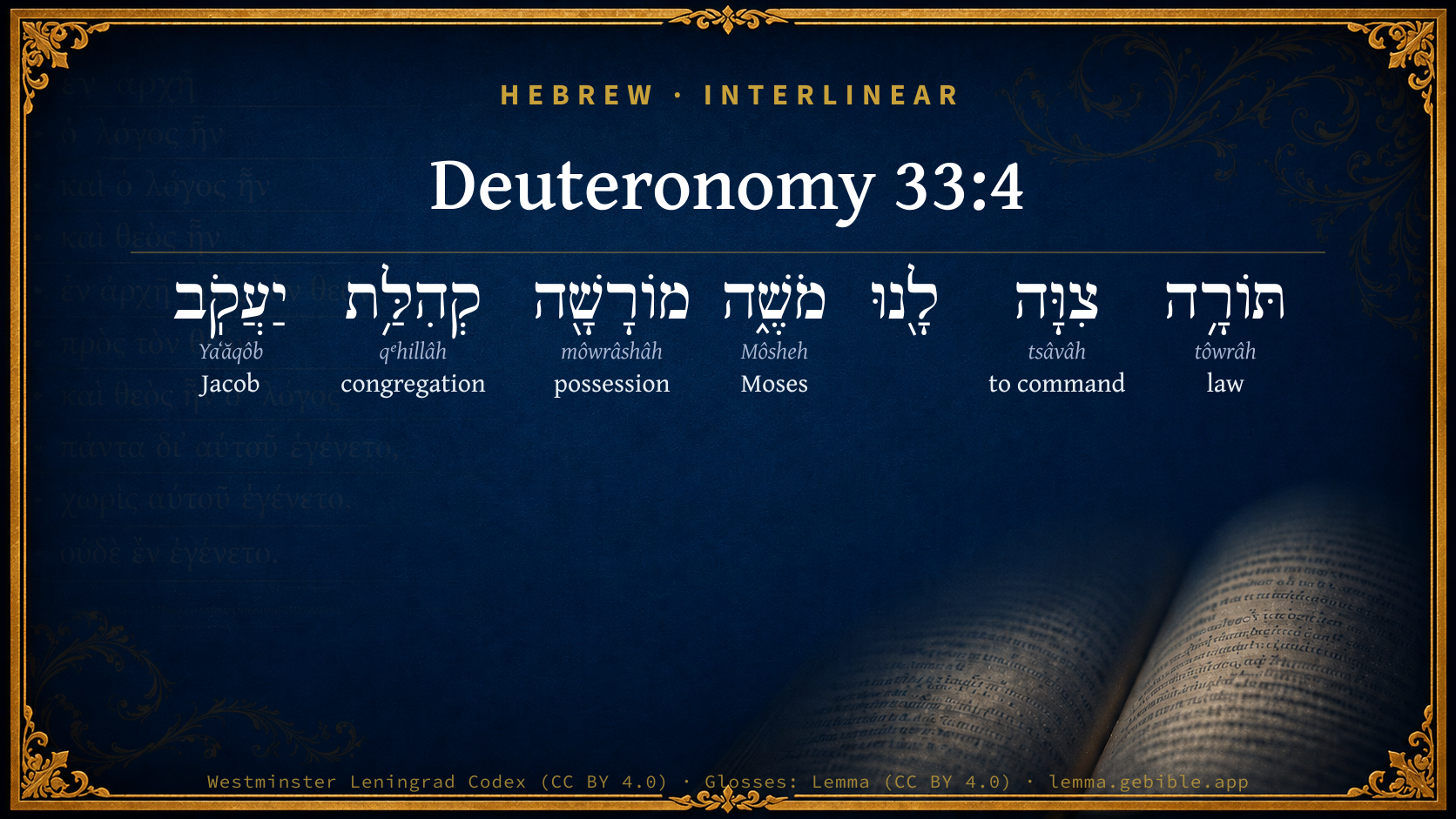
Hebrew (Westminster Leningrad Codex) Deuteronomy 33:4 appears in the Hebrew Old Testament. The text above is from the Westminster Leningrad Codex. Each word links to its Strong’s number, a concise gloss, and parsing drawn from the Open Scriptures Hebrew Bible morphology. Click any word for its full Brown-Driver-Briggs (BDB) entry.
Download image
Cite this verse

Deuteronomy 33:4 (World English Bible). Public Domain. Lemma interlinear Bible study tool, https://lemma.gebible.app/v/deuteronomy/33/4.

Show BibTeX & RIS
BibTeX
RIS
English Translation
Moses commanded us a law, An inheritance for the assembly of Jacob.
World English Bible · Public Domain
Highlights
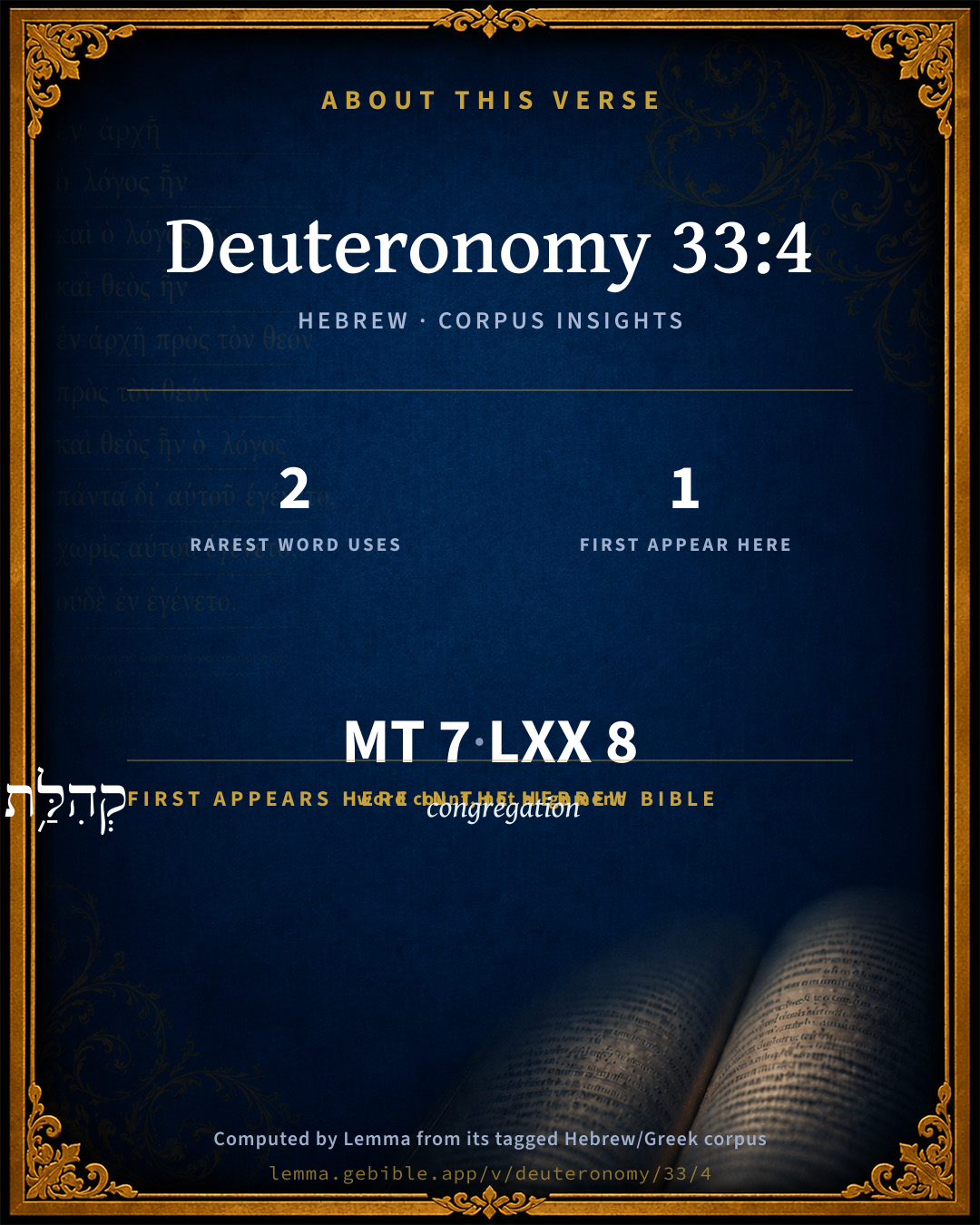
  • 1 first appearance in the Hebrew Bible
Full analysis ↓
Download a study sheet

One document with this verse’s original text, its word-by-word gloss line, the meaning frame, cross-references with their text, attributed commentary, and full source and license credits — printable, and it pastes into notes with its structure intact.

This verse Autodidact and up

Study sheet (.html) Plain text (.txt)

A passage Seminary Student

Up to 50 verses in one chapter. A passage sheet keeps up to 6 commentary sources and 12 cross-references per verse, in the order this page ranks them, and says so on the sheet whenever that leaves anything out. Ask for a single verse and you get the Autodidact verse sheet above.

Everything on this page stays free to read, with no account — the sheet is a download of what is already on screen, not access to it.

Want to remove ads? Support Godless Engineer
Compare translations 3

The same verse in 3 English versions, stacked beneath the original-language interlinear above. Click any original word for its lexicon entry.

Each is an independent rendering of the whole verse — the interlinear is not word-aligned to these translations.

Highlighted words mark where these versions differ — a whole-verse word diff, not a word-by-word alignment.

  • World English Bible Public Domain
    Moses commanded us a law, An inheritance for the assembly of Jacob.
  • King James Version Public Domain
    Moses commanded us a law, even the inheritance of the congregation of Jacob.
  • unfoldingWord Literal Text CC BY-SA 4.0
    A law Moses commanded to us, a possession for the assembly of Jacob.

unfoldingWord Literal Text — © unfoldingWord, licensed CC BY-SA 4.0. Word-aligned USFM3 via Door43 (git.door43.org/unfoldingWord/en_ult).

Versions to compare (up to 4)

3 of 4 selected

Show all 18 translations

Every available English version of this verse, each an independent rendering of the whole verse.

  • World English Bible Public Domain
    Moses commanded us a law, An inheritance for the assembly of Jacob.
  • Berean Standard Bible Public Domain
    the law that Moses gave us, the possession of the assembly of Jacob.
  • Majority Standard Bible Public Domain
    the law that Moses gave us, the possession of the assembly of Jacob.
  • King James Version Public Domain
    Moses commanded us a law, even the inheritance of the congregation of Jacob.
  • American Standard Version (1901) Public Domain
    Moses commanded us a law, An inheritance for the assembly of Jacob.
  • Revised Version (1885) Public Domain
    Moses commanded us a law, An inheritance for the assembly of Jacob.
  • Geneva Bible (1599) Public Domain
    Moses commanded vs a Lawe for an inheritance of the Congregation of Iaakob.
  • Douay-Rheims (1899) Public Domain
    Moses commanded us a law, the inheritance of the multitude of Jacob.
  • Young's Literal Translation Public Domain
    A law hath Moses commanded us, A possession of the assembly of Jacob.
  • Literal Standard Version CC BY-SA 4.0
    Moses has commanded a law for us, || A possession of the assembly of Jacob.
  • Unlocked Literal Bible CC BY-SA 4.0
    Moses commanded us a law, an inheritance for the assembly of Jacob.
  • unfoldingWord Literal Text CC BY-SA 4.0
    A law Moses commanded to us, a possession for the assembly of Jacob.
  • Darby Bible Public Domain
    Moses commanded us a law, The inheritance of the congregation of Jacob.
  • World Messianic Bible Public Domain
    Moses commanded us a law, an inheritance for the assembly of Jacob.
  • Webster's Bible Public Domain
    Moses commanded us a law; even the inheritance of the congregation of Jacob.
  • Free Bible Version CC BY-SA 4.0
    the law that Moses delivered to us that belongs to all the Israelites.
  • Bible in Basic English Public Domain
    Moses gave us a law, a heritage for the people of Jacob.
  • JPS Tanakh (1917) Public Domain
    Moses commanded us a law, an inheritance of the congregation of Jacob.

Literal Standard Version (2020), Covenant Press — licensed CC BY-SA 4.0. Text via the HelloAO Bible API (eBible.org). Unlocked Literal Bible (unfoldingWord) — licensed CC BY-SA 4.0. Text via the HelloAO Bible API (eBible.org). unfoldingWord Literal Text — © unfoldingWord, licensed CC BY-SA 4.0. Word-aligned USFM3 via Door43 (git.door43.org/unfoldingWord/en_ult). Free Bible Version, Dr. Jonathan Gallagher — licensed CC BY-SA 4.0. Text via the HelloAO Bible API (eBible.org).

Word by word

More ways to search: Search by grammar → Find every occurrence → Compare this word →

Practice this passage: Drill this verse → Learn its vocabulary →

About this verse

These counts appear in no published source. They are computed here, from the morphology-tagged text and Lemma’s own curated glosses. What Lemma adds →

7
words
6
distinct lemmas
Pentateuch
section

Notable vocabulary

The rarest word here is קְהִלַּ֥ת congregation H6952 — appearing just 2 times in the whole Hebrew Bible.

First appearance in Scripture

This word makes its first canonical appearance in the Hebrew Bible here:

  • קְהִלַּ֥ת congregation H6952

Shared distinctive vocabulary

קְהִלַּ֥ת congregation H6952 occurs in 2 verses of the Hebrew Bible. Also found in:

Grammatical profile

  • 1 verb
  • 5 nouns
  • 1 preposition

Verb forms

  • צִוָּה Piel · Perfect

Hebrew & Septuagint length

In English translation the verse runs 12 words from the Hebrew and 13 from the Septuagint (LXX English) — closely comparable.

A rough comparison of the two English renderings, which tokenize alike — not a word-level alignment.

Word counts can differ between the Hebrew and the Greek without any difference in meaning — e.g. the Hebrew direct-object marker אֵת has no separate Greek word, and Greek often adds the article ὁ.

In the original languages it is 7 Hebrew tokens and 8 Greek tokens — but the two are counted differently (Hebrew bundles its prefixes and suffixes into one token; the Greek is in lemma form), so that isn’t a like-for-like length.

Cross-references

5

Topical passages linked to Deuteronomy 33:4 in the Treasury of Scripture Knowledge — connected by theme and wording, ordered by reader-vote popularity; previews shown in the World English Bible.

  • Psalms 119:111 I have taken your testimonies as a heritage forever, For they are the joy of my heart.
  • John 1:17 For the law was given through Moses. Grace and truth came through Jesus Christ.
  • John 7:19 Didn't Moses give you the law, and yet none of you keeps the law? Why do you seek to kill me?"
  • Deuteronomy 9:26–29 I prayed to Yahweh, and said, Lord Yahweh, don't destroy your people and your inheritance, that you have redeemed through your greatness, that you have brought forth out of Egypt with a mighty hand.
  • Psalms 119:72 The law of your mouth is better to me than thousands of pieces of gold and silver.

Cross-references courtesy of OpenBible.info (CC BY 4.0).

Hebrew and Greek witnesses Masoretic Hebrew ↔ Greek Septuagint

The same verse in the two great witnesses to the Old Testament, shown verse-for-verse.

These are two independent witnesses, not word-aligned to each other, and the Septuagint is shown in lemma (dictionary) form.

Hebrew Deuteronomy 33:4 Masoretic · Westminster Leningrad Codex

תּוֹרָ֥ה צִוָּה לָ֖נוּ מֹשֶׁ֑ה מוֹרָשָׁ֖ה קְהִלַּ֥ת יַעֲקֹֽב

Moses commanded us a law, An inheritance for the assembly of Jacob.

World English Bible · Public Domain

Greek LXX Deuteronomy 33:4 Septuagint · lemma form

νόμος ὅς ἐντέλλομαι ἐγώ μωυσῆς κληρονομία συναγωγή ἰακώβ

the law which Moses charged us, an inheritance to the assemblies of Jacob.

LXX2012 (modern English Septuagint) · Public Domain

On this verse, The Cambridge Bible for Schools and Colleges discusses the Septuagint’s reading. Read the note in Commentary ↓

Hebrew: Westminster Leningrad Codex (CC BY 4.0). Greek: Septuagint (public domain); English from LXX2012 (modern English Septuagint) (Public Domain). How the Septuagint differs from the Hebrew →

Targum (Aramaic paraphrase)

2

The Targum is the ancient Jewish Aramaic paraphrase of the Hebrew Scriptures — an interpretive translation, not the Hebrew text itself. Onkelos (literal) and Pseudo-Jonathan (expansive) render the Torah, and Jonathan the Prophets. Coverage is partial: where no permissively-licensed English translation exists for a verse, only the Aramaic is shown. This is verse-level text, not a word-by-word alignment to the Hebrew.

  1. Targum Onkelos Torah (Genesis–Deuteronomy)
    אוֹרַיְתָא יְהַב לָנָא מֹשֶׁה מְסָרַהּ יְרֻתָּא לְכִנְשַׁת יַעֲקֹב

    (no public-domain English translation for this verse)

    Targum Onkelos — Aramaic: “Onkelos Genesis” (public domain); “Onkelos Exodus” (public domain); “Onkelos Leviticus” (public domain); “Onkelos Numbers” (public domain); “Onkelos Deuteronomy” (public domain). English: “Sefaria Community Translation” (CC0 1.0 (public-domain dedication)); “J.W. Etheridge. The Targums of Onkelos and Jonathan Ben Uzziel on the Pentateuch. London: Longmans, Green, 1862” (public domain). Text via Sefaria.

  2. Targum Pseudo-Jonathan Torah (Genesis–Deuteronomy)
    אָמְרִין בְּנֵי יִשְרָאֵל אוֹרַיְיתָא פַּקֵיד לָנָא משֶׁה יְהָבָהּ יַרְתוּ לִקְהַל שִׁבְטַיָא דְיַעֲקב

    The sons of Israel said, Mosheh commanded us the law, and gave it for an heritage to the tribes of Jakob.

    Targum Pseudo-Jonathan — Aramaic: “Targum Jonathan on Genesis” (public domain); “Targum Jonathan on Exodus” (public domain); “Targum Jonathan on Leviticus” (public domain); “Targum Jonathan on Numbers” (public domain); “Targum Jonathan on Deuteronomy” (public domain). English: “The Targum of Jonathan ben Uzziel, trans. J. W. Etheridge, London, 1862” (public domain). Text via Sefaria.

Commentary

Notes on Deuteronomy 33:4 from classic Christian and Jewish commentators (each source and its license shown beneath its notes). The classic Christian expositions comment on the surrounding passage and are grouped to its opening verse, so a note may address several verses; the Jewish commentaries on the Tanakh (Rashi and others) are per-verse, so they appear only where the commentator wrote on this verse.

Lemma curates 59 commentaries, every one of them public domain or Creative Commons licensed, each selected and text-cleaned for this edition rather than reprinted as found. About our sources →

The Cambridge Bible for Schools and Colleges

gen. ed. J. J. S. Perowne

4. Moses commanded us a law] The change to 1st pers. plur. (but LXX B you), the introduction of Moses’ name, and the fact that the line is an odd one, raise the suspicion that it is a gloss. Law, Heb. Tôrah, in its widest sense (see on Deu_1:5; Deu_1:31); omit a. If the line be retained, the next line is in apposition and we must render with Sam. (and LXX) a possession for the assembly of Jacob (cp. Psa_119:111). But without changing the consonants we may read, His possession, or dominion, is the assembly of Jacob; a parallel to the next line. Assembly, Heb. ḳehillah, only here and Neh_5:7, in D and elsewhere ḳahal (see on Deu_5:22 and Deu_23:1 (2)), the whole nation as a body politic. Possession elsewhere only in P, Exo_6:8, and Ezek. (6 times) mostly of the land.

4a. met you not, etc.] The appearance of the Pl. address marks a quotation as in Deu_9:7 f. According to Deu_2:29 Moab sold bread and water to Israel.

when ye came forth out of Egypt] Whoever wrote this clause (D or an editor) its perspective is that not of Moses in the land of Moab but of a time long after when the whole forty years’ passage from Egypt was foreshortened.

4b, 5. Probably another quotation from a different source: (1) because of the change from the Pl. to the Sg. address (confirmed by LXX), and (2) because Heb. and the versions have he hired (not they as in EVV.), suggesting that in the context from which it was extracted this vb had a sing. nominative (Balak?). On the substance of Deu_33:4 b, Deu_33:5, see JE, Num_22:2 ff.

The Cambridge Bible for Schools and Colleges (gen. ed. J. J. S. Perowne; Cambridge University Press, 1878–1918) — public domain. Text from a community e-Sword module.

Trapp's Complete Commentary

John Trapp

Deu 33:4 Moses commanded us a law, [even] the inheritance of the congregation of Jacob.

Ver. 4. Moses commanded us a law.] These are the words of those saints above mentioned, expressing their good affection to the law and to Moses, by whose mediation they received it.

Even the inheritance.] For perpetual use to us and our posterity. Indeed, the law lies not upon the righteous, {ου κειται, 1Ti 1:9} nor urgeth them, as it doth upon the wicked. To these the law is as chains and shackles; to those as belts and garters, which gird up their loins, and expedite their course the better. It confines them to live in that element where they would live, as if one should be confined to Paradise, where he would be, though there were no such law.

John Trapp, A Commentary or Exposition upon All the Books of the Old and New Testament (1647–1656) — public domain. Text from a community e-Sword module.

Joseph Benson's Commentary

Deu 33:4. Moses commanded us a law — Moses has been thought by some to speak this of himself, in the third person, because he intended the contents of this chapter, like the preceding song, to be learned by the Israelites, and repealed in their own persons. They are therefore supposed to say, Moses commanded us a law, &c. The inheritance of the congregation — The law is called their inheritance. because the obligation to observe it was hereditary, passing from parents to their children, and because this was the best part of their inheritance, the greatest of all those gifts which God bestowed upon them. So the psalmist thought, “Thy testimonies have I taken as a heritage for ever,” Psa 119:111.

Joseph Benson's Commentary on the Old and New Testaments (1811–1818) — public domain. Text from a community e-Sword module.

Tyndale Open Study Notes

Tyndale Open Resources

33:4 of Israel: Literally of Jacob. The Hebrew probably uses Jacob because the tribes descended from Jacob’s twelve sons are here listed by name as recipients of God’s blessing (33:6-25; cp. Gen 49:1-28).

Tyndale Open Study Notes — © Tyndale Open Resources, licensed CC BY-SA 4.0. Text via the HelloAO Bible API.

Geneva Bible (1599)

Geneva Bible translators

To us and our successors.

Geneva Bible (1599) marginal notes — public domain. Text via Bolls.life.

Ellicott's Commentary for English Readers

(4,5) “[Of] the law which Moses commanded us,

The inheritance of the congregation of Jacob,

When he (Moses) was king in Jeshurun,

In the gathering of the heads of the people,

The tribes of Israel together.”

This fourth verse, from its form, is evidently not what Moses said, but an explanatory parenthesis, inserted by the writer, who was probably Joshua. Upon “He was king in Jeshurun,” Rashi says, “The Holy One, blessed be He! the yoke of His kingdom is upon them for ever.” It may be so. “When the Lord your God was your king,” is Samuel’s description of the whole history of Israel previous to himself.

The certainty that the King of kings, the Messiah of Israel, was and is the Lawgiver and Teacher, and Keeper of all saints, and that there are none of that character who do not “sit at the feet of Jesus,” makes the real meaning of the passage perfectly plain, even though the exact grammatical relation of the clauses may be not beyond dispute.

A Bible Commentary for English Readers, edited by Charles John Ellicott (1878–1897) — public domain. Text from a community e-Sword module.

John Gill's Exposition

And he was king in Jeshurun,.... That is, in Israel, or over the people of Israel, of which name of theirs; see Gill on Deu 32:15; either God, as Jarchi; for the government of the Israelites was a theocracy, and their laws were immediately from God, and by him they were guided and directed in all things; wherefore, when they were so importunate for a change in their government, and to have a king over them, they are said to reject the Lord, that he should not reign over them, Sa1 8:7; or Moses, as Aben Ezra on the place, Maimonides (f), and others (g); who, under God, had the civil government of the Hebrews; both may be received, God was the supreme Governor, and Moses the chief magistrate under him:

when the heads of Israel and the tribes of the people were gathered together; at Mount Sinai, to hear the law there and then given, or to hear it repeated by Moses, as in this book of Deuteronomy, who were at different times convened together for that purpose, see Deu 1:1; next follow the particular blessings of the several tribes, beginning with Reuben the firstborn.

(f) In Misn. Shebuot, c. 2. sect. 2. (g) Philo de Vita Mosis, l. 3. p. 681.

John Gill's Exposition of the Whole Bible (1746–1763) — public domain (CC PDM 1.0). Text via the HelloAO Bible API.

Haydock's Catholic Bible Commentary

Moses. He expresses himself as if the people were speaking. The change of persons is very frequent in this discourse. --- Inheritance. So the psalmist (Psalm cxviii. 111,) says, I have purchased thy testimonies for an inheritance for ever. (Calmet)

George Leo Haydock (1774–1849), Haydock's Catholic Family Bible and Commentary, 1859 edition — public domain. Excludes Psalms (Douay-Rheims chapter numbering differs from Protestant) and Deuterocanonical books (Catholic canon only).

Matthew Poole's English Annotations

Moses speaks this of himself in the third person, which is very usual in the Hebrew language. The law is called their

inheritance, partly because the obligation of it was hereditary, passing from parents to their children, and partly because this was the best part of all their inheritance and possessions, the greatest of all those gifts and favours which God bestowed upon them.

Matthew Poole's English Annotations on the Holy Bible (1683–1685) — public domain. Text from a community e-Sword/MySword module.

Whedon's Commentary on the Bible

Daniel D. Whedon

4. Moses commanded us a law — The law was given by God through Moses, and was a possession for the people.

Daniel D. Whedon (gen. ed.), Commentary on the Old and New Testaments (1874–1909) — public domain. Text from a community e-Sword module.

The Pulpit Commentary

Moses here, identifying himself with the people, uses the third person, and includes himself among those to whom the Law was given; cf. Ps 20 Ps 21, where David not only speaks of himself in the third person, but addresses such prayers for himself as could only be offered by the people for their king. (cf. also Jud_1:5:12, 15; Hab_3:19) Even the inheritance of the congregation. The "even," which the translators of the Authorized Version have inserted here, were better omitted; the words are in apposition to "law." The Law which Moses communicated to Israel was to remain with them as the inheritance,f the congregation. The Bishops" Bible and the Geneva Version have, more correctly, "for an inheritance of the congregation."

The Pulpit Commentary (1880–1919), ed. H.D.M. Spence-Jones & Joseph S. Exell — public domain. Text from a community e-Sword module.

John Wesley's Explanatory Notes

Moses - He speaks this of himself in the third person, which is very usual in the Hebrew language. The law is called their inheritance, because the obligation of it was hereditary, passing from parents to their children, and because this was the best part of their inheritance, the greatest of all those gifts which God bestowed upon them.

John Wesley, Explanatory Notes Upon the Whole Bible (1754–1765) — public domain. Text via the GEBible commentary corpus.

Rashi

Rabbi Shlomo Yitzchaki (Rashi)

תורה THE LAW which צוה לנו משה MOSES COMMANDED US, מורשה is AN INHERITANCE to THE CONGREGATION OF JACOB: we have taken it and we will not abandon it.

Rashi on the Tanakh — English translations: “The Judaica Press complete Tanach with Rashi, translated by A. J. Rosenberg” (CC BY 4.0); “Pentateuch with Rashi's commentary by M. Rosenbaum and A.M. Silbermann, 1929-1934” (public domain); “The Metsudah Tanach series, Lakewood, N.J” (CC BY 4.0); and “The Book of Joshua, Metsudah Publications, 1997” (CC BY 4.0). Text via Sefaria.

Ramban (Nachmanides)

Rabbi Moshe ben Nachman (Ramban / Nachmanides)

MOSES COMMANDED US A LAW. The meaning thereof is that Israel will always “take” [receive His words] and say “Moses commanded us a Law and this will be an inheritance of the congregation of Jacob, for all the children of Jacob shall possess it forever and observe it, for it shall not be forgotten out of the mouths of their seed.” And our Rabbis interpreted 8. that he did not say “an inheritance of the house of Jacob” or “the seed of Jacob” — he stated of the congregation of Jacob in order to suggest that many [strangers] would join them and the Torah will always be an inheritance of Jacob and of all who congregate to him, these being the strangers that join themselves to the Eternal, to minister unto Him, and they shall cleave to the house of Jacob, 14:1. and they will all be called “His congregation.”

Ramban (Nachmanides) on the Tanakh — English translation: “Commentary on the Torah by Ramban (Nachmanides). Translated and annotated by Charles B. Chavel. New York, Shilo Pub. House, 1971-1976” (CC BY 4.0). Text via Sefaria.

Lesson kit

Teaching starters — assembled from the data on this page, not authored interpretation. Every prompt links to the verse data it draws on. Edit before teaching.

Deuteronomy, in the Pentateuch, opens this verse with 7 words (6 distinct Hebrew lemmas). Its most distinctive word is qᵉhillâh (“congregation”). A historical commentator’s framing appears above. Read the whole chapter for the surrounding context.

Discussion questions

  1. How does “congregation” (qᵉhillâh) shape what this verse is saying?
  2. This is the first place “congregation” appears in Scripture (first appears here). What does its debut here establish?
  3. How does Nehemiah 5:7, which shares the word «congregation», read alongside this verse?
  4. These translations render this verse differently. What is at stake in choosing one wording over another?
  5. «צִוָּה» is a Piel Perfect verb. How does that grammatical form shape the action described?
  6. Compare how The Cambridge Bible for Schools and Colleges and Trapp's Complete Commentary read this verse. Where do they agree or differ?

Things to notice

Reading settings

Reading text

Shown beneath each verse's original-language words.

Old Testament
Old Testament edition

Read the OT as the Masoretic Hebrew (MT) or the Greek Septuagint (LXX).

English shown for the Greek Septuagint (in the Hebrew ↔ Greek comparison).

Comparing translations? Open the Compare panel on any verse page to stack up to four side by side.