
Psalms 44:4

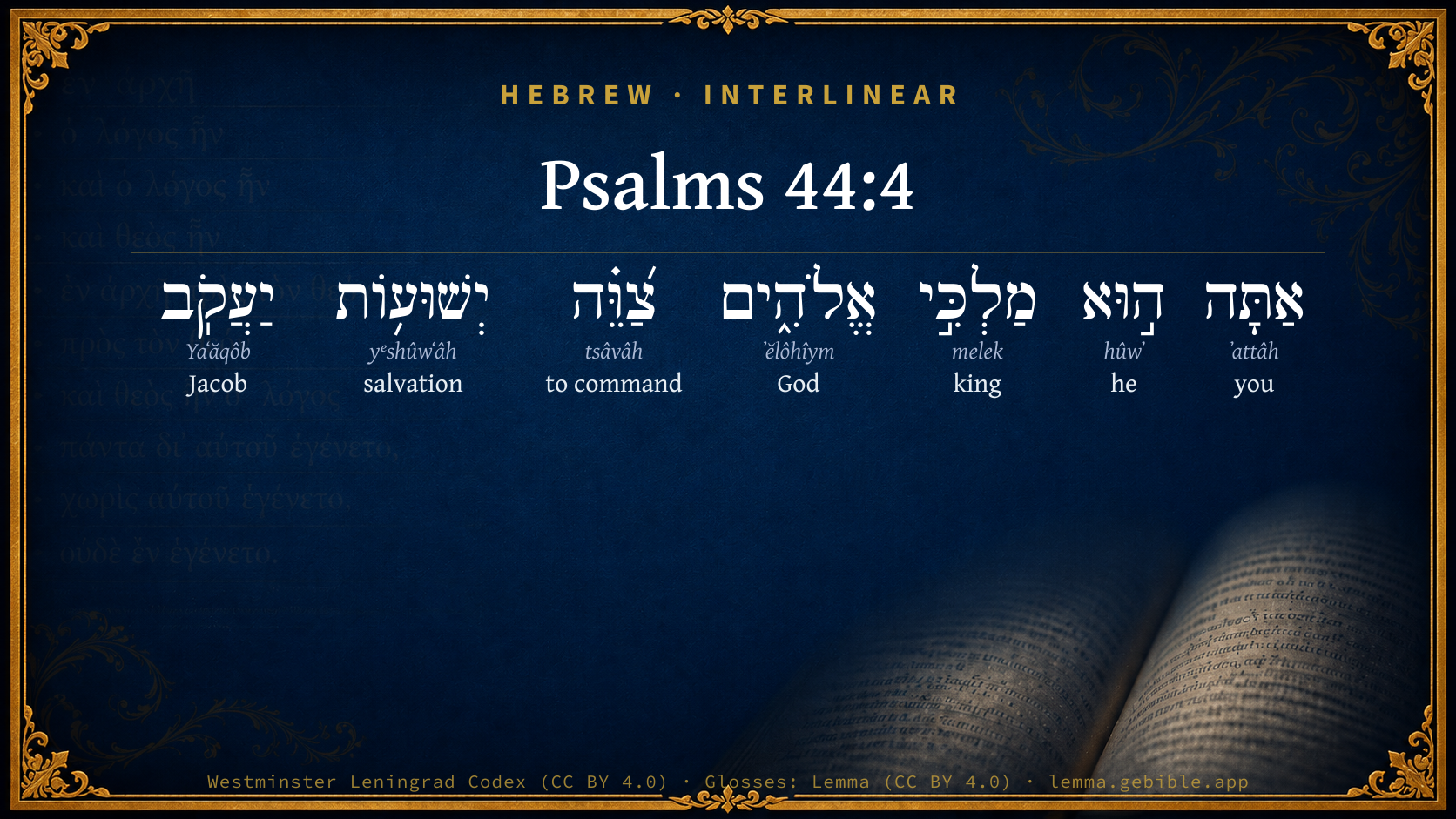
Hebrew (Westminster Leningrad Codex) Psalms 44:4 appears in the Hebrew Old Testament. The text above is from the Westminster Leningrad Codex. Each word links to its Strong’s number, a concise gloss, and parsing drawn from the Open Scriptures Hebrew Bible morphology. Click any word for its full Brown-Driver-Briggs (BDB) entry.
Download image
Cite this verse

Psalms 44:4 (World English Bible). Public Domain. Lemma interlinear Bible study tool, https://lemma.gebible.app/v/psalms/44/4.

Show BibTeX & RIS
BibTeX
RIS
English Translation
You are my King, God. Command victories for Jacob!
World English Bible · Public Domain
Download a study sheet

One document with this verse’s original text, its word-by-word gloss line, the meaning frame, cross-references with their text, attributed commentary, and full source and license credits — printable, and it pastes into notes with its structure intact.

This verse Autodidact and up

Study sheet (.html) Plain text (.txt)

A passage Seminary Student

Up to 50 verses in one chapter. A passage sheet keeps up to 6 commentary sources and 12 cross-references per verse, in the order this page ranks them, and says so on the sheet whenever that leaves anything out. Ask for a single verse and you get the Autodidact verse sheet above.

Everything on this page stays free to read, with no account — the sheet is a download of what is already on screen, not access to it.

Want to remove ads? Support Godless Engineer
Compare translations 3

The same verse in 3 English versions, stacked beneath the original-language interlinear above. Click any original word for its lexicon entry.

Each is an independent rendering of the whole verse — the interlinear is not word-aligned to these translations.

Highlighted words mark where these versions differ — a whole-verse word diff, not a word-by-word alignment.

  • World English Bible Public Domain
    You are my King, God. Command victories for Jacob!
  • King James Version Public Domain
    Thou art my King, O God: command deliverances for Jacob.
  • unfoldingWord Literal Text CC BY-SA 4.0
    You he, my king, God. Command the salvation of Jacob.

unfoldingWord Literal Text — © unfoldingWord, licensed CC BY-SA 4.0. Word-aligned USFM3 via Door43 (git.door43.org/unfoldingWord/en_ult).

Versions to compare (up to 4)

3 of 4 selected

Show all 18 translations

Every available English version of this verse, each an independent rendering of the whole verse.

  • World English Bible Public Domain
    You are my King, God. Command victories for Jacob!
  • Berean Standard Bible Public Domain
    You are my King, O God, who ordains victories for Jacob.
  • Majority Standard Bible Public Domain
    You are my King, O God, who ordains victories for Jacob.
  • King James Version Public Domain
    Thou art my King, O God: command deliverances for Jacob.
  • American Standard Version (1901) Public Domain
    Thou art my King, O God: Command deliverance for Jacob.
  • Revised Version (1885) Public Domain
    Thou art my King, O God: command deliverance for Jacob.
  • Geneva Bible (1599) Public Domain
    Thou art my King, O God: send helpe vnto Iaakob.
  • Douay-Rheims (1899) Public Domain
    For they got not the possession of the land by their own sword: neither did their own arm save them. But thy right hand and thy arm, and the light of thy countenance: because thou wast pleased with them.
  • Young's Literal Translation Public Domain
    Thou `art' He, my king, O God, Command the deliverances of Jacob.
  • Literal Standard Version CC BY-SA 4.0
    You [are] He, my King, O God, || Command the deliverances of Jacob.
  • Unlocked Literal Bible CC BY-SA 4.0
    God, You are my King; command victory for Jacob.
  • unfoldingWord Literal Text CC BY-SA 4.0
    You he, my king, God. Command the salvation of Jacob.
  • Darby Bible Public Domain
    Thou thyself art my king, O God: command deliverance for Jacob.
  • World Messianic Bible Public Domain
    God, you are my King. Command victories for Jacob!
  • Webster's Bible Public Domain
    \\44:3\\For they obtained not the land in possession by their own sword, neither did their own arm save them: but thy right hand, and thy arm, and the light of thy countenance, because thou hadst a favor to them.
  • Free Bible Version CC BY-SA 4.0
    God, you are my King; command victories for Jacob!
  • Bible in Basic English Public Domain
    You are my King and my God; ordering salvation for Jacob.
  • JPS Tanakh (1917) Public Domain
    (44-5) Thou art my King, O God; command the salvation of Jacob.

Literal Standard Version (2020), Covenant Press — licensed CC BY-SA 4.0. Text via the HelloAO Bible API (eBible.org). Unlocked Literal Bible (unfoldingWord) — licensed CC BY-SA 4.0. Text via the HelloAO Bible API (eBible.org). unfoldingWord Literal Text — © unfoldingWord, licensed CC BY-SA 4.0. Word-aligned USFM3 via Door43 (git.door43.org/unfoldingWord/en_ult). Free Bible Version, Dr. Jonathan Gallagher — licensed CC BY-SA 4.0. Text via the HelloAO Bible API (eBible.org).

Word by word

More ways to search: Search by grammar → Find every occurrence → Compare this word →

Practice this passage: Drill this verse → Learn its vocabulary →

About this verse

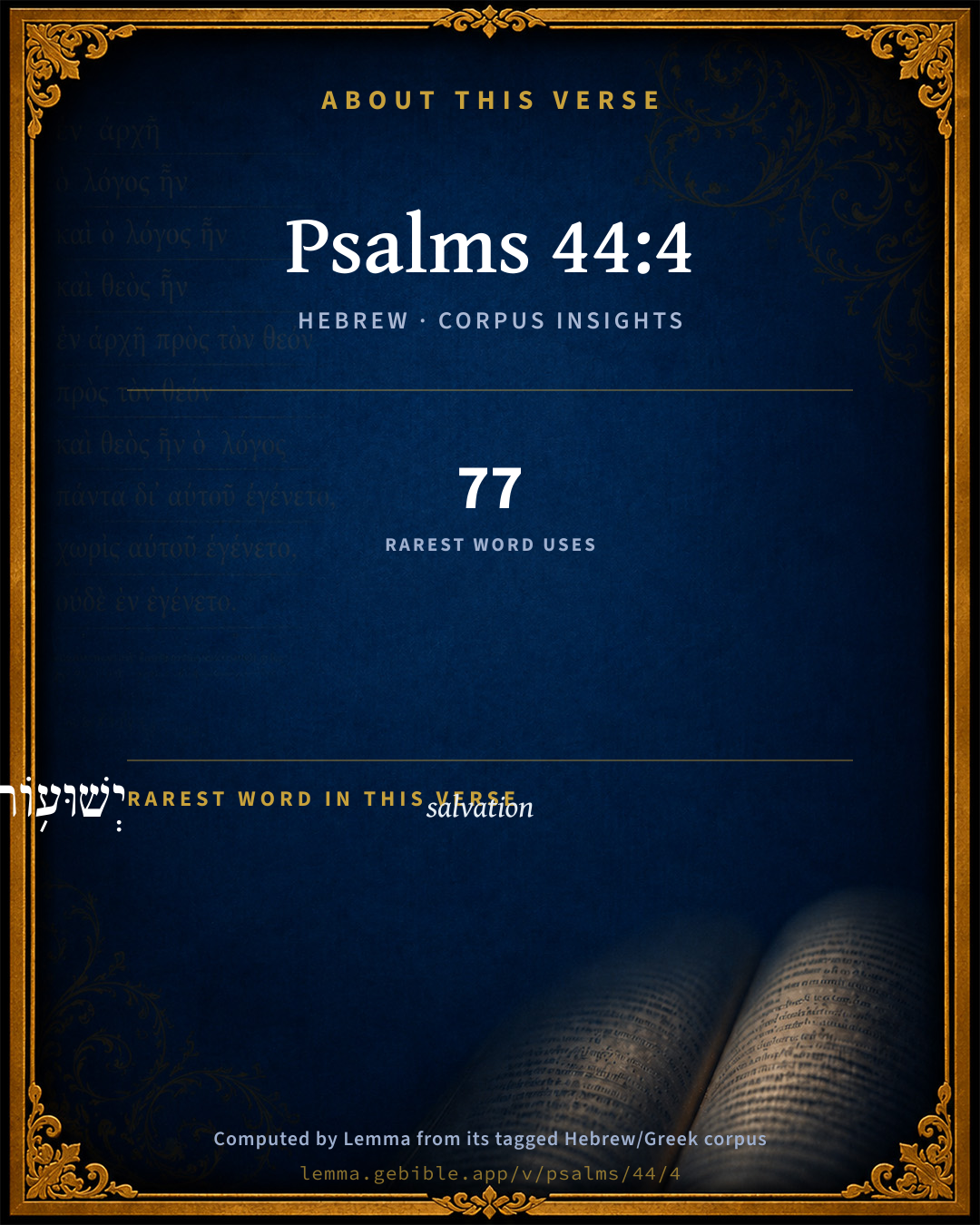
These counts appear in no published source. They are computed here, from the morphology-tagged text and Lemma’s own curated glosses. What Lemma adds →

7
words
7
distinct lemmas
Wisdom
section

Grammatical profile

  • 1 verb
  • 4 nouns
  • 2 pronouns

Verb forms

  • צַ֝וֵּ֗ה Piel · Imperative

Hebrew & Septuagint length

In English translation the verse runs 9 words from the Hebrew and 13 from the Septuagint (LXX English) — closely comparable.

A rough comparison of the two English renderings, which tokenize alike — not a word-level alignment.

Word counts can differ between the Hebrew and the Greek without any difference in meaning — e.g. the Hebrew direct-object marker אֵת has no separate Greek word, and Greek often adds the article ὁ.

Cross-references

9

Topical passages linked to Psalms 44:4 in the Treasury of Scripture Knowledge — connected by theme and wording, ordered by reader-vote popularity; previews shown in the World English Bible.

  • Psalms 42:8 Yahweh will command his loving kindness in the daytime. In the night his song shall be with me: A prayer to the God of my life.
  • Psalms 74:12 Yet God is my King of old, Working salvation in the midst of the earth.
  • Psalms 89:18 For our shield belongs to Yahweh; Our king to the Holy One of Israel.
  • Psalms 149:2 Let Israel rejoice in him who made them. Let the children of Zion be joyful in their King.
  • Mark 9:25 When Jesus saw that a multitude came running together, he rebuked the unclean spirit, saying to him, "You mute and deaf spirit, I command you, come out of him, and never enter him again!"
  • Isaiah 33:22 For Yahweh is our judge, Yahweh is our lawgiver, Yahweh is our king; he will save us.
  • Mark 1:25–26 Jesus rebuked him, saying, "Be quiet, and come out of him!"
  • Mark 1:31 He came and took her by the hand, and raised her up. The fever left her, and she served them.
  • Mark 1:41 Being moved with compassion, he stretched out his hand, and touched him, and said to him, "I want to. Be made clean."

Cross-references courtesy of OpenBible.info (CC BY 4.0).

Hebrew and Greek witnesses Masoretic Hebrew ↔ Greek Septuagint

The same verse in the two great witnesses to the Old Testament, shown verse-for-verse.

You’re reading Greek Psalm 43 (Hebrew Psalm 44). The Septuagint counts the superscription, so verse numbers can differ from the Hebrew — chapter-level alignment, not verse-by-verse. Numbering follows Rahlfs.

These are two independent witnesses, not word-aligned to each other, and the Septuagint is shown in lemma (dictionary) form.

Hebrew Psalms 44:4 Masoretic · Westminster Leningrad Codex

אַתָּה ה֣וּא מַלְכִּ֣י אֱלֹהִ֑ים צַ֝וֵּ֗ה יְשׁוּע֥וֹת יַעֲקֹֽב

You are my King, God. Command victories for Jacob!

World English Bible · Public Domain

Greek LXX Greek Psalm 43:4 Septuagint · lemma form

οὐ γάρ ἐν ὁ ῥομφαία αὐτός κληρονομέω γῆ καί ὁ βραχίων αὐτός οὐ σώζω αὐτός ἀλλά ὁ δεξιός σύ καί ὁ βραχίων σύ καί ὁ φωτισμός ὁ πρόσωπον σύ ὅτι εὐδοκέω ἐν αὐτός

You are indeed my King and my God, who command deliverances for Jacob.

LXX2012 (modern English Septuagint) · Public Domain

Hebrew: Westminster Leningrad Codex (CC BY 4.0). Greek: Septuagint (public domain); English from LXX2012 (modern English Septuagint) (Public Domain). How the Septuagint differs from the Hebrew →

Commentary

Notes on Psalms 44:4 from classic Christian and Jewish commentators (each source and its license shown beneath its notes). The classic Christian expositions comment on the surrounding passage and are grouped to its opening verse, so a note may address several verses; the Jewish commentaries on the Tanakh (Rashi and others) are per-verse, so they appear only where the commentator wrote on this verse.

Lemma curates 59 commentaries, every one of them public domain or Creative Commons licensed, each selected and text-cleaned for this edition rather than reprinted as found. About our sources →

Trapp's Complete Commentary

John Trapp

Psa 44:4 Thou art my King, O God: command deliverances for Jacob.

Ver. 4. Thou art my King, O God] Heb. Thou art he, my King; Or, Thou art the same, my King, i.e. the same that thou wast to those of old. Oh, see to thy subjects, as ever thou hast done.

Command deliverances for Jacob] A Mandamus from thee will do it; he spake the word, and it was done. Some read it, Command deliverances, O Jacob; that is, O God of Jacob, as Psa 24:6.

John Trapp, A Commentary or Exposition upon All the Books of the Old and New Testament (1647–1656) — public domain. Text from a community e-Sword module.

Joseph Benson's Commentary

Psa 44:4-8. Thou art my king, O God — And thou, O God, who didst such astonishing things for them, art still the very same almighty Being, whom I honour as my sovereign, my governor, and protector. The whole people speak as one man, being united together in one body. Command — That is, effectually procure by thy commanding word, deliverances for Jacob — For the posterity of Jacob, the Israelites. Through thee will we push down our enemies — Hebrew, ננגח, nenaggeeach, cornu feriemus, we will smite with the horn, that is, subdue and destroy them. The phrase is taken from Deu 33:17, and alludes to cattle pushing with their horns. As if he had said, If thou wouldst but appear for us, the most powerful enemies would not be able to stand before us. Through thy name will we tread them under — That is, by the help of thy power. I will not trust in my bow — I have no confidence in my arms, but in thee only, (as the next verse implies,) and therefore do not frustrate my hope and expectation, placed only on thee. In God we boast all the day — In this we glory continually, that we have such a King, such a mighty Saviour and Deliverer, who has wrought such wonderful things for us and our forefathers.

Joseph Benson's Commentary on the Old and New Testaments (1811–1818) — public domain. Text from a community e-Sword module.

Tyndale Open Study Notes

Tyndale Open Resources

44:4-8 God’s people feel confident about his mighty acts; he was with them in the past, and he is their king in the present.

Tyndale Open Study Notes — © Tyndale Open Resources, licensed CC BY-SA 4.0. Text via the HelloAO Bible API.

Geneva Bible (1599)

Geneva Bible translators

Because thou art our king, therefore deliver thy people from their misery.

Geneva Bible (1599) marginal notes — public domain. Text via Bolls.life.

Jamieson, Fausset & Brown

Robert Jamieson, A. R. Fausset & David Brown

Thou art my King--literally, "he who is my King," sustaining the same covenant relation as to the "fathers."

Jamieson, Fausset & Brown — Commentary Critical and Explanatory on the Whole Bible (1871) — public domain (CC PDM 1.0). Text via the HelloAO Bible API.

Adam Clarke's Commentary

Verse 4. Thou art my king] What thou wert to them, be to us. We believe in thee as they did; we have sinned and are in captivity, but we repent and turn unto thee; command, therefore, deliverances to Jacob, for we are the descendants of him in whose behalf thou hast wrought such wonders.

Adam Clarke's Commentary on the Bible (1810–1826) — public domain. Text from a community e-Sword/MySword module.

John Calvin's Commentaries

4. Thou, even thou, art my King, O God! In this verse the faithful express still more plainly what I have already alluded to a little before, namely, that the goodness of God was not only apparent in the deliverance of his people, but also flowed upon them in continued succession from age to age; and therefore it is said, Thou, even thou, art my King In my judgment, the demonstrative pronoun הוא, hu, imports as much as if the prophet had put together a long series of the benefits of God after the first deliverance; so that it might appear, that God, who had once been the deliverer of his people, did not show himself otherwise towards their posterity: unless, perhaps, it might be considered as emphatic, and employed for the purpose of asserting the thing stated the more strongly, namely, that the faithful praise God alone as the guardian of their welfare to the exclusion of all others, and the renunciation of aid from any other quarter. Hence they also present the prayer, that God would ordain and send forth new deliverances to his people; for, as he has in his power innumerable means of preservation and deliverance, he is said to appoint and send forth deliverances as his messengers wherever it seems good to him.

John Calvin's Commentaries (1540-1563) — public domain. Text from the Calvin Translation Society English edition (1840s-50s) via the Christian Classics Ethereal Library (ccel.org). Calvin's coverage is partial (roughly two-thirds of the Bible); uncommented books and verses are honest gaps, never fabricated. The 19th-century editor's footnotes and remarks are omitted so the notes are faithfully Calvin's own voice.

Ellicott's Commentary for English Readers

(4) Thou art my King.—Literally, Thou, He, my king, an idiomatic way of making a strong assertion, Thou, even thou, art my king, O God. (Comp. Isa_43:25.) What God has done in the past may be expected again, and for a moment the poet forgets the weight of actual trouble in the faith that has sprung from the grateful retrospect over the past.

A Bible Commentary for English Readers, edited by Charles John Ellicott (1878–1897) — public domain. Text from a community e-Sword module.

The Cambridge Bible for Schools and Colleges

gen. ed. J. J. S. Perowne

4. my King] Cp. Psa_47:6; Psa_74:12; 1Sa_12:12. The Psalmist speaks in the name of the nation. Cp. Psa_44:6.

command] Cp. Psa_42:8. It is the duty of a king to defend his people (1Sa_10:19); and the authority of the divine King is supreme. He has but to speak the word and it must needs be obeyed.

deliverances] R.V. deliverance, marg., victories (cp. Psa_44:3). The Heb. word is plural, denoting deliverance full and complete. Cp. Psa_18:50; Psa_42:5 (note).

4–8. The recollection of the past gives confidence for the present and the future. God’s strength must still avail for the deliverance of His people, and in Him alone do they trust.

The Cambridge Bible for Schools and Colleges (gen. ed. J. J. S. Perowne; Cambridge University Press, 1878–1918) — public domain. Text from a community e-Sword module.

John Gill's Exposition

Thou art my King, O God,.... Besides the favours God had done for his people in time past, the church takes notice of her interest in God as her King, who was able to protect and defend her, and to deliver her out of all her distresses, in order the more to strengthen her faith and hope in him; and, claiming her interest in him, she draws nigh to him with an holy boldness, and desires him as a King, that by a word of his (for where the word of a king is, there is power) he would

command deliverances for Jacob; not literally, but mystically understood; the spiritual Jacob, and people of God; all Israelites indeed, in whom there is no guile; meaning herself and members: the blessing desired is "deliverances", or "salvations"; so called, because the, deliverance or salvation the Lord commands grants, and works out for his people, is of different kinds, both spiritual and, temporal, and is a deliverance from various things; from sin, Satan, the present evil world, wrath to come, and all enemies; and out of various temptations and afflictions, and which follow successively one upon another; and at last it is complete and perfect.

John Gill's Exposition of the Whole Bible (1746–1763) — public domain (CC PDM 1.0). Text via the HelloAO Bible API.

Albert Barnes' Notes on the Bible

Thou art my King, O God - literally, “Thou art He, my King, O God;” that is, Thou art the same: the same King, and the same God, who didst interpose in the time of the fathers, and thou art he whom I recognize as King, as the Sovereign Ruler of thy people. The psalmist here uses the singular number, “my King,” as expressive of his own feelings, though he doubtless means also to speak in the name of the people. It would seem not improbable from this, that the author of the psalm was the reigning monarch in the time of the troubles referred to. If not, it was evidently one who personated him, and who meant to represent his feelings. The language shows the strong confidence of the author of the psalm in God, and perhaps also is designed to express his personal responsibility at the time, and his consciousness that his only refuge in conducting the troubled affairs of the nation was God.

Command deliverances for Jacob - As if all was under His command, and He had only to give direction, and salvation would come. The word “Jacob” here is used to denote the descendants of Jacob, or the people of God. See the notes at Psa 24:6.

Albert Barnes' Notes on the Bible (1834–1885) — public domain. Text from a community e-Sword/MySword module.

Matthew Poole's English Annotations

My King; Jacob’s or Israel’s King, in a peculiar manner. The whole people speak like one man, as being united together in one body.

Command, i.e. effectually procure by thy commanding word.

Matthew Poole's English Annotations on the Holy Bible (1683–1685) — public domain. Text from a community e-Sword/MySword module.

The Treasury of David

Charles H. Spurgeon

Ver. 4. Thou art my King, O God. Knowing right well thy power and grace my heart is glad to own thee for her sovereign prince. Who among the mighty are so illustrious as thou art? To whom, then, should I yield my homage or turn for aid? God of my fathers in the olden time, thou art my soul's monarch and liege Lord. Command deliverances for Jacob. To whom should a people look but to their king? he it is who, by virtue of his office, fights their battles for them. In the case of our King, how easy it is for him to scatter all our foes! O Lord, the King of kings, with what ease canst thou rescue thy people; a word of thine can do it, give but the command and thy persecuted people shall be free. Jacob's long life was crowded with trials and deliverances, and his descendants are here called by his name, as if to typify the similarity of their experience to that of their great forefather. He who would win the blessings of Israel must share the sorrows of Jacob. This verse contains a personal declaration and an intercessory prayer; those can pray best who make most sure of their personal interest in God, and those who have the fullest assurance that the Lord is their God should be the foremost to plead for the rest of the tried family of the faithful.

Ver. 4. My King; apparently with a personal application to himself, the poet individually claiming his own place in the covenant between God and his people. J. J. Stewart Perowne.

Ver. 4. Thou art my king, O God; command deliverances for Jacob. If there were no creature, no instrument in the world to help, yet would you not be at a loss in time of need, for he that is on the throne could do it alone. He can do all that ever you need, without any means or instruments. His bare word is sufficient, all sufficient, for it, whatever it be, how great, how difficult, how impossible soever it seems. Such a power there is even in the word of the great King. There needs no more to deliver you, to deliver his people anywhere, how deep soever plunged, but only the command of him that sits on the throne. If the gospel, the interests of Christ, in these parts of the world, and the dear concerns of our souls, and the souls of posterity, were all as dry bones, in a more forlorn and hopeless condition than they are, he could make all live with a word. He that is our King, that sits upon the throne, can command life into that which seems as far from living as a dry bone. While he keeps the throne, it is a senseless heart that fails through distrust of his power, even when all visible power and help fail. David Clarkson.

Ver. 4.

1. Divine royalty acknowledged.

2. Royal interposition entreated.

3. Divine covenant hinted at, Jacob; or, the loyal subject seeking royal aid for the royal seed.

Ver. 4. Personal allegiance and pleading intercession.

Ver. 4. My King. This intends

1. My Ruler.

2. My Honour.

3. My Leader.

4. My Defender.

Ver. 4. The deliverances of Jacob, illustrated by his eventful life.

Psalms 44:5*

Charles H. Spurgeon's The Treasury of David (1869–1885) — public domain. Psalms only. Text from a community e-Sword/MySword module.

Whedon's Commentary on the Bible

Daniel D. Whedon

4. Thou art my King—Literally, Thou art he, my King. This same God is still confessed to be Israel’s King. The retrospect emboldens faith.

Deliverances—Salvations; the plural used for fulness, completeness.

Daniel D. Whedon (gen. ed.), Commentary on the Old and New Testaments (1874–1909) — public domain. Text from a community e-Sword module.

The Pulpit Commentary

Thou art my King, O God; literally, thou art he that is my King, O God; i.e. I acknowledge no other king but thee, no other absolute lord and master. Command deliverances for Jacob. Being King, thou hast a right to command. We pray thee at this present time to command our deliverance.

The Pulpit Commentary (1880–1919), ed. H.D.M. Spence-Jones & Joseph S. Exell — public domain. Text from a community e-Sword module.

John Wesley's Explanatory Notes

My king - The whole people speak as one man, being united in one body.

John Wesley, Explanatory Notes Upon the Whole Bible (1754–1765) — public domain. Text via the GEBible commentary corpus.

Keil & Delitzsch

C. F. Keil & F. Delitzsch

(Heb.: 44:5-9) Out of the retrospective glance at the past, so rich in mercy springs up (Psa 44:5) the confident prayer concerning the present, based upon the fact of the theocratic relationship which began in the time of the deliverance wrought under Moses (Deu 33:5). In the substantival clause אתּה הוּא מלכּי, הוּא is neither logical copula nor predicate (as in Psa 102:28; Deu 32:39, there equivalent to אתּה הוּא אשׁר, cf. Ch1 21:17), but an expressive resumption of the subject, as in Isa 43:25; Jer 49:12; Neh 9:6., Ezr 5:11, and in the frequently recurring expression יהוה הוא האלהים; it is therefore to be rendered: Thou-He who (such an one) is my King. May He therefore, by virtue of His duty as king which He has voluntarily taken upon Himself, and of the kingly authority and power indwelling in Him, command the salvation of Jacob, full and entire (Ps 18:51; 53:7). צוּה as in Psa 42:9. Jacob is used for Israel just as Elohim is used instead of Jahve. If Elohim, Jacob's King, now turns graciously to His people, they will again be victorious and invincible, as Psa 44:6 affirms. נגּח with reference to קרן as a figure and emblem of strength, as in Psa 89:25 and frequently; קמינוּ equivalent to קמים עלינוּ. But only in the strength of God (בּך as in Psa 18:30); for not in my bow do I trust, etc., Psa 44:7. This teaching Israel has gathered from the history of the former times; there is no bidding defiance with the bow and sword and all the carnal weapons of attack, but Thou, etc., Psa 44:8. This "Thou" in הושׁעתּנוּ is the emphatic word; the preterites describe facts of experience belonging to history. It is not Israel's own might that gives them the supremacy, but God's gracious might in Israel's weakness. Elohim is, therefore, Israel's glory or pride: "In Elohim do we praise," i.e., we glory or make our boast in Him; cf. הלּל על, Psa 10:3. The music here joins in after the manner of a hymn. The Psalm here soars aloft to the more joyous height of praise, from which it now falls abruptly into bitter complaint.

Keil & Delitzsch — Biblical Commentary on the Old Testament (1861–1891) — public domain (CC PDM 1.0). Text via the HelloAO Bible API. (Old Testament only.)

Rashi

Rabbi Shlomo Yitzchaki (Rashi)

You favored them Heb. רציתם, an expression of favor.

Rashi on the Tanakh — English translations: “The Judaica Press complete Tanach with Rashi, translated by A. J. Rosenberg” (CC BY 4.0); “Pentateuch with Rashi's commentary by M. Rosenbaum and A.M. Silbermann, 1929-1934” (public domain); “The Metsudah Tanach series, Lakewood, N.J” (CC BY 4.0); and “The Book of Joshua, Metsudah Publications, 1997” (CC BY 4.0). Text via Sefaria.

Lesson kit

Teaching starters — assembled from the data on this page, not authored interpretation. Every prompt links to the verse data it draws on. Edit before teaching.

Psalms, in the Wisdom, opens this verse with 7 words (7 distinct Hebrew lemmas). Its most distinctive word is yᵉshûwʻâh (“salvation”). A historical commentator’s framing appears above. Read the whole chapter for the surrounding context.

Discussion questions

  1. What does “salvation” (yᵉshûwʻâh) contribute to the verse as a whole?
  2. Psalms 42:8 shares this passage’s theme. How do the two illuminate each other?
  3. The translations on this page render this verse differently — a whole-verse word diff, not a word-by-word alignment. What might account for the different wordings?
  4. The verb «צַ֝וֵּ֗ה» is Piel Imperative. How does its form color the action?
  5. Reading how Trapp's Complete Commentary and Joseph Benson's Commentary read this verse, where do the two commentators agree and where do they part?

Things to notice

Reading settings

Reading text

Shown beneath each verse's original-language words.

Old Testament
Old Testament edition

Read the OT as the Masoretic Hebrew (MT) or the Greek Septuagint (LXX).

English shown for the Greek Septuagint (in the Hebrew ↔ Greek comparison).

Comparing translations? Open the Compare panel on any verse page to stack up to four side by side.