
Jeremiah 13:6

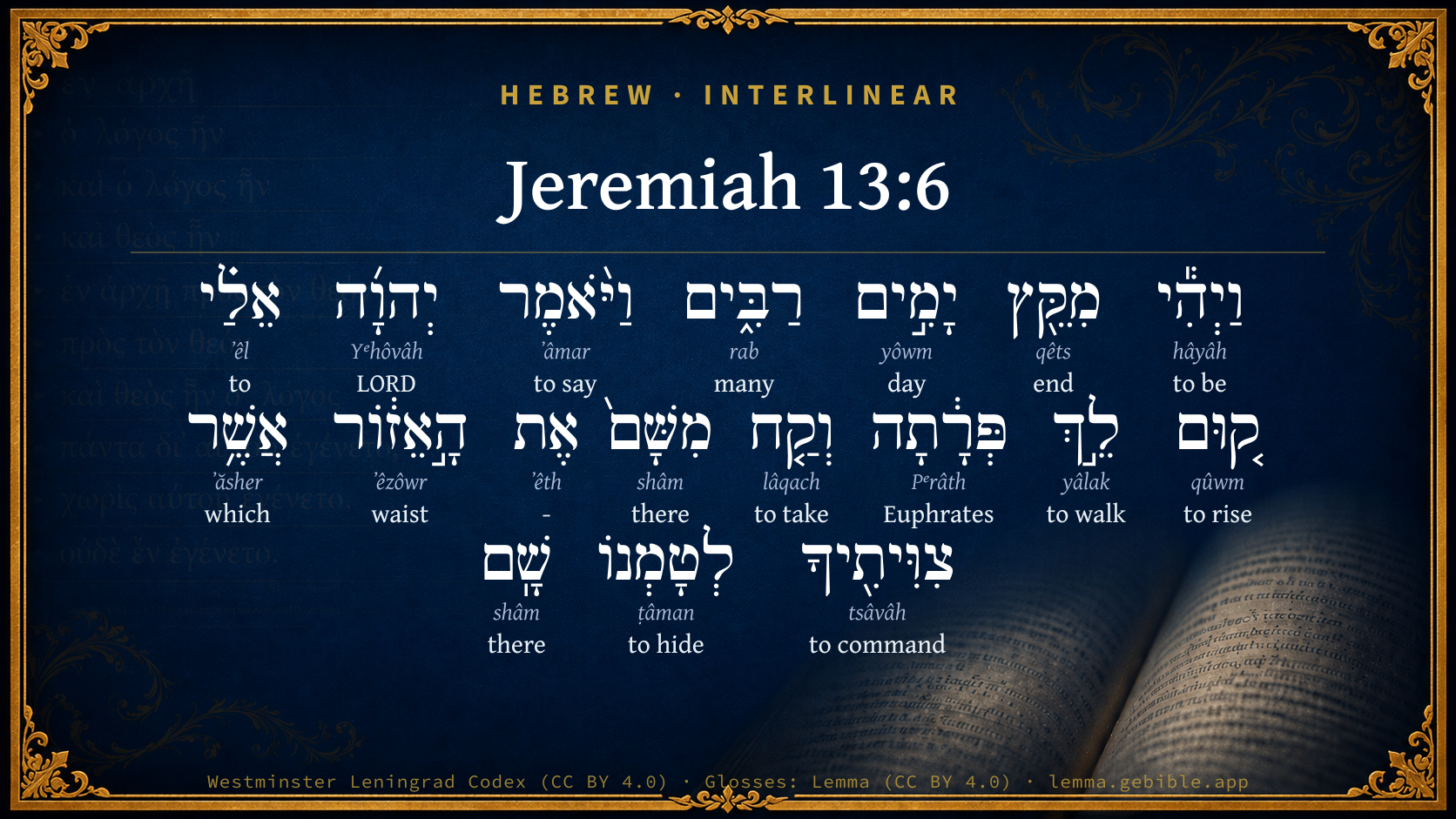
Hebrew (Westminster Leningrad Codex) Jeremiah 13:6 appears in the Hebrew Old Testament. The text above is from the Westminster Leningrad Codex. Each word links to its Strong’s number, a concise gloss, and parsing drawn from the Open Scriptures Hebrew Bible morphology. Click any word for its full Brown-Driver-Briggs (BDB) entry.
Download image
Cite this verse

Jeremiah 13:6 (World English Bible). Public Domain. Lemma interlinear Bible study tool, https://lemma.gebible.app/v/jeremiah/13/6.

Show BibTeX & RIS
BibTeX
RIS
English Translation
It happened after many days, that Yahweh said to me, Arise, go to the Euphrates, and take the belt from there, which I commanded you to hide there.
World English Bible · Public Domain
Download a study sheet

One document with this verse’s original text, its word-by-word gloss line, the meaning frame, cross-references with their text, attributed commentary, and full source and license credits — printable, and it pastes into notes with its structure intact.

This verse Autodidact and up

Study sheet (.html) Plain text (.txt)

A passage Seminary Student

Up to 50 verses in one chapter. A passage sheet keeps up to 6 commentary sources and 12 cross-references per verse, in the order this page ranks them, and says so on the sheet whenever that leaves anything out. Ask for a single verse and you get the Autodidact verse sheet above.

Everything on this page stays free to read, with no account — the sheet is a download of what is already on screen, not access to it.

Want to remove ads? Support Godless Engineer
Compare translations 3

The same verse in 3 English versions, stacked beneath the original-language interlinear above. Click any original word for its lexicon entry.

Each is an independent rendering of the whole verse — the interlinear is not word-aligned to these translations.

Highlighted words mark where these versions differ — a whole-verse word diff, not a word-by-word alignment.

  • World English Bible Public Domain
    It happened after many days, that Yahweh said to me, Arise, go to the Euphrates, and take the belt from there, which I commanded you to hide there.
  • King James Version Public Domain
    And it came to pass after many days, that the LORD said unto me, Arise, go to Euphrates, and take the girdle from thence, which I commanded thee to hide there.
  • unfoldingWord Literal Text CC BY-SA 4.0
    And it happened from the end of many days, that Yahweh said to me, “Arise, go to Perath, and take from there the loincloth that I commanded you to hide there.”

unfoldingWord Literal Text — © unfoldingWord, licensed CC BY-SA 4.0. Word-aligned USFM3 via Door43 (git.door43.org/unfoldingWord/en_ult).

Versions to compare (up to 4)

3 of 4 selected

Show all 18 translations

Every available English version of this verse, each an independent rendering of the whole verse.

  • World English Bible Public Domain
    It happened after many days, that Yahweh said to me, Arise, go to the Euphrates, and take the belt from there, which I commanded you to hide there.
  • Berean Standard Bible Public Domain
    Many days later the LORD said to me, “Arise, go to Perath, and get the loincloth that I commanded you to hide there.”
  • Majority Standard Bible Public Domain
    Many days later the LORD said to me, “Arise, go to Perath, and get the loincloth that I commanded you to hide there.”
  • King James Version Public Domain
    And it came to pass after many days, that the LORD said unto me, Arise, go to Euphrates, and take the girdle from thence, which I commanded thee to hide there.
  • American Standard Version (1901) Public Domain
    And it came to pass after many days, that Jehovah said unto me, Arise, go to the Euphrates, and take the girdle from thence, which I commanded thee to hide there.
  • Revised Version (1885) Public Domain
    And it came to pass after many days, that the LORD said unto me, Arise, go to Euphrates, and take the girdle from thence, which I commanded thee to hide there.
  • Geneva Bible (1599) Public Domain
    And after many dayes, the Lord sayde vnto mee, Arise, goe towarde Perath, and take the girdle from thence, which I commanded thee to hide there.
  • Douay-Rheims (1899) Public Domain
    And it came to pass after many days, that the Lord said to me: Arise, go to the Euphrates, and take from thence the girdle, which I commanded thee to hide there.
  • Young's Literal Translation Public Domain
    And it cometh to pass, at the end of many days, that Jehovah saith unto me, `Rise, go to Phrat, and take thence the girdle, that I commanded thee to hide there;'
  • Literal Standard Version CC BY-SA 4.0
    And it comes to pass, at the end of many days, that YHWH says to me, “Rise, go to the Euphrates, and take the girdle there, that I commanded you to hide there”;
  • Unlocked Literal Bible CC BY-SA 4.0
    After many days, Yahweh said to me, “Get up and go back to Perath. Take from there the undergarment that I had told you to hide.”
  • unfoldingWord Literal Text CC BY-SA 4.0
    And it happened from the end of many days, that Yahweh said to me, “Arise, go to Perath, and take from there the loincloth that I commanded you to hide there.”
  • Darby Bible Public Domain
    And it came to pass at the end of many days, that Jehovah said unto me, Arise, go to the Euphrates, and take the girdle from thence which I commanded thee to hide there.
  • World Messianic Bible Public Domain
    After many days, the LORD said to me, “Arise, go to the Euphrates, and take the belt from there, which I commanded you to hide there.”
  • Webster's Bible Public Domain
    And it came to pass after many days, that the LORD said to me, Arise, go to Euphrates, and take the girdle from thence, which I commanded thee to hide there.
  • Free Bible Version CC BY-SA 4.0
    A long time later the Lord told me, Go to Perath, and get the loincloth that I ordered you to hide there.
  • Bible in Basic English Public Domain
    Then after a long time, the Lord said to me, Up! go to Parah and get the band which I gave you orders to put there.
  • JPS Tanakh (1917) Public Domain
    And it came to pass after many days, that the LORD said unto me: 'Arise, go to Perath, and take the girdle from thence, which I commanded thee to hide there.'

Literal Standard Version (2020), Covenant Press — licensed CC BY-SA 4.0. Text via the HelloAO Bible API (eBible.org). Unlocked Literal Bible (unfoldingWord) — licensed CC BY-SA 4.0. Text via the HelloAO Bible API (eBible.org). unfoldingWord Literal Text — © unfoldingWord, licensed CC BY-SA 4.0. Word-aligned USFM3 via Door43 (git.door43.org/unfoldingWord/en_ult). Free Bible Version, Dr. Jonathan Gallagher — licensed CC BY-SA 4.0. Text via the HelloAO Bible API (eBible.org).

Word by word

More ways to search: Search by grammar → Find every occurrence → Compare this word →

Practice this passage: Drill this verse → Learn its vocabulary →

הָ֣אֵז֔וֹר
ʼêzôwr
H232
“the · waist”
Particle, Definite Article + Noun, Common, Masculine, Singular, Absolute
Part of Speech
Particle + Noun
Type
Common
Gender
Masculine
Number
Singular
State
Absolute
Full BDB Definition

Origin: from H246

TWOT: 59a

waist-cloth, the innermost piece of clothing - of God's power over kings (figuratively) - of faithfulness (metaphorically) - waistband
  1. וַיְהִ֕י hâyâh H1961 “and · to be” Conjunction + Verb, Qal, Sequential Imperfect, 3rd Person, Masculine, Singular
  2. מִקֵּ֖ץ qêts H7093 “from · end of” Preposition + Noun, Common, Masculine, Singular, Construct
  3. יָמִ֣ים yôwm H3117 “days” Noun, Common, Masculine, Plural, Absolute
  4. רַבִּ֑ים rab H7227 “many” Adjective, Adjective, Masculine, Plural, Absolute
  5. וַיֹּ֨אמֶר ʼâmar H559 “and · to say” Conjunction + Verb, Qal, Sequential Imperfect, 3rd Person, Masculine, Singular
  6. יְהוָ֜ה Yᵉhôvâh H3068 “LORD” Noun, Proper
  7. אֵלַ֗י ʼêl H413 “to · me” Preposition + Suffix, Personal, 1st Person, Common, Singular
  8. ק֚וּם qûwm H6965 “rise” Verb, Qal, Imperative, 2nd Person, Masculine, Singular
  9. לֵ֣ךְ yâlak H3212 “walk” Verb, Qal, Imperative, 2nd Person, Masculine, Singular
  10. פְּרָ֔תָה Pᵉrâth H6578 “Euphrates · toward” Noun, Proper + Suffix, Demonstrative
  11. וְקַ֤ח lâqach H3947 “and · take” Conjunction + Verb, Qal, Imperative, 2nd Person, Masculine, Singular
  12. מִשָּׁם֙ shâm H8033 “from · there” Preposition + Adverb
  13. אֶת ʼêth H853 “-” Particle, Direct Object
  14. אֲשֶׁ֥ר ʼăsher H834 “which” Particle, Relative
  15. צִוִּיתִ֖יךָ tsâvâh H6680 “to command · you” Verb, Piel, Perfect, 1st Person, Common, Singular + Suffix, Personal, 2nd Person, Masculine, Singular
  16. לְטָמְנוֹ ṭâman H2934 “to hide · him” Preposition + Verb, Qal, Infinitive Construct + Suffix, Personal, 3rd Person, Masculine, Singular
  17. שָֽׁם shâm H8033 “there” Adverb

About this verse

These counts appear in no published source. They are computed here, from the morphology-tagged text and Lemma’s own curated glosses. What Lemma adds →

18
words
17
distinct lemmas
Prophets
section

Notable vocabulary

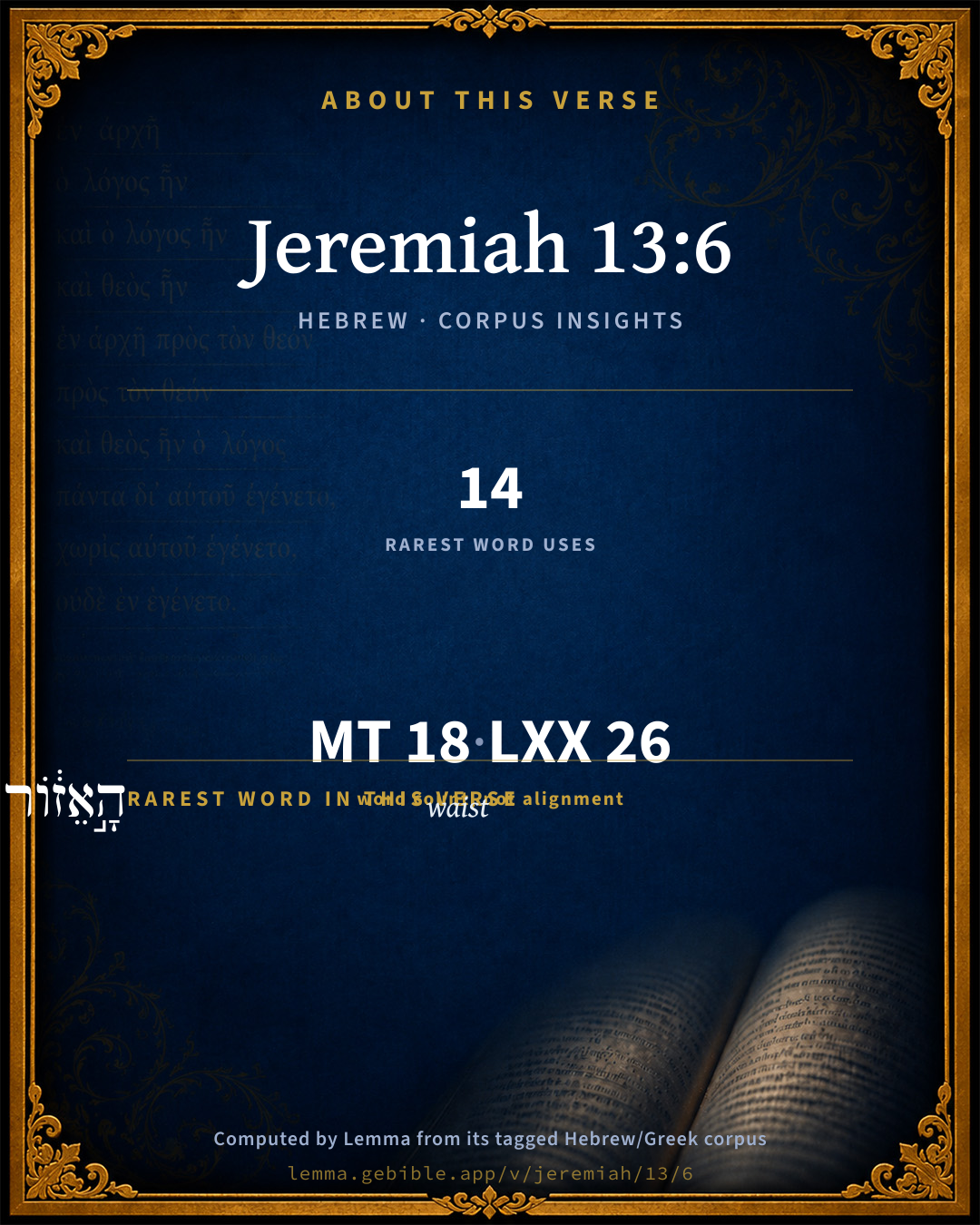
The rarest word here is הָ֣אֵז֔וֹר waist H232 — appearing just 14 times in the whole Hebrew Bible.

Shared distinctive vocabulary

הָ֣אֵז֔וֹר waist H232 occurs in 12 verses of the Hebrew Bible. Also found in:

Grammatical profile

  • 7 verbs
  • 5 nouns
  • 1 adjective
  • 1 preposition
  • 2 adverbs
  • 2 particles

Verb forms

  • וַיְהִ֕י Qal · Sequential Imperfect
  • וַיֹּ֨אמֶר Qal · Sequential Imperfect
  • ק֚וּם Qal · Imperative
  • לֵ֣ךְ Qal · Imperative
  • וְקַ֤ח Qal · Imperative
  • צִוִּיתִ֖יךָ Piel · Perfect
  • לְטָמְנוֹ Qal · Infinitive Construct

Repetition

A word recurs within this verse — often emphatic in Hebrew:

  • מִשָּׁם֙ there H8033 ×2

Hebrew & Septuagint length

In the original languages it is 18 Hebrew tokens and 26 Greek tokens — but the two are counted differently (Hebrew bundles its prefixes and suffixes into one token; the Greek is in lemma form), so that isn’t a like-for-like length.

Hebrew and Greek witnesses Masoretic Hebrew ↔ Greek Septuagint

The same verse in the two great witnesses to the Old Testament, shown verse-for-verse.

These are two independent witnesses, not word-aligned to each other, and the Septuagint is shown in lemma (dictionary) form.

Hebrew Jeremiah 13:6 Masoretic · Westminster Leningrad Codex

וַיְהִ֕י מִקֵּ֖ץ יָמִ֣ים רַבִּ֑ים וַיֹּ֨אמֶר יְהוָ֜ה אֵלַ֗י ק֚וּם לֵ֣ךְ פְּרָ֔תָה וְקַ֤ח מִשָּׁם֙ אֶת הָ֣אֵז֔וֹר אֲשֶׁ֥ר צִוִּיתִ֖יךָ לְטָמְנוֹ שָֽׁם

It happened after many days, that Yahweh said to me, Arise, go to the Euphrates, and take the belt from there, which I commanded you to hide there.

World English Bible · Public Domain

Greek LXX Structure differs

In the Septuagint, Jeremiah is about an eighth shorter than the Hebrew and arranges its material differently — the Oracles Against the Nations (Hebrew chapters 46–51) appear in the middle of the Greek book, after 25:13. Because the chapter and verse boundaries do not line up, a verse-for-verse comparison with the Hebrew is not shown.

A verse-for-verse comparison isn’t shown here because the chapters and verses don’t line up. Switch to the LXX edition with the MT / LXX toggle above to read the Greek directly.

Hebrew: Westminster Leningrad Codex (CC BY 4.0). Greek: Septuagint (public domain); English from a public-domain English Septuagint. How the Septuagint differs from the Hebrew →

Targum (Aramaic paraphrase)

1

The Targum is the ancient Jewish Aramaic paraphrase of the Hebrew Scriptures — an interpretive translation, not the Hebrew text itself. Onkelos (literal) and Pseudo-Jonathan (expansive) render the Torah, and Jonathan the Prophets. Coverage is partial: where no permissively-licensed English translation exists for a verse, only the Aramaic is shown. This is verse-level text, not a word-by-word alignment to the Hebrew.

  1. Targum Jonathan Prophets (Joshua–Malachi)
    וַהֲוָה מִסוֹף יוֹמִין סַגִיאִין וַאֲמַר יְיָ לִי קוּם אֱזֵיל לִפְרָת וְסַב מִתַמָן יַת זַרְזָא דִי פַקֵדְתָּךְ לְמִטַמְרֵיהּ תַמָן:

    (no public-domain English translation for this verse)

    Targum Jonathan — Aramaic: “Mikraot Gedolot” (public domain). English: “Sefaria Community Translation” (CC0 1.0 (public-domain dedication)); “London "Chaldee Paraphrase," 1871” (public domain). Text via Sefaria.

Commentary

Notes on Jeremiah 13:6 from classic Christian and Jewish commentators (each source and its license shown beneath its notes). The classic Christian expositions comment on the surrounding passage and are grouped to its opening verse, so a note may address several verses; the Jewish commentaries on the Tanakh (Rashi and others) are per-verse, so they appear only where the commentator wrote on this verse.

Lemma curates 59 commentaries, every one of them public domain or Creative Commons licensed, each selected and text-cleaned for this edition rather than reprinted as found. About our sources →

Trapp's Complete Commentary

John Trapp

Jer 13:6 And it came to pass after many days, that the LORD said unto me, Arise, go to Euphrates, and take the girdle from thence, which I commanded thee to hide there.

Ver. 6. And it came to pass after many days.] See on Jer 13:3.

John Trapp, A Commentary or Exposition upon All the Books of the Old and New Testament (1647–1656) — public domain. Text from a community e-Sword module.

Tyndale Open Study Notes

Tyndale Open Resources

13:6-7 The safest time to travel was during the dry season, from June to September. The most likely time for cloth to rot was during the wet season, October to May. • A long time afterward was probably between six and ten months.

Tyndale Open Study Notes — © Tyndale Open Resources, licensed CC BY-SA 4.0. Text via the HelloAO Bible API.

Jamieson, Fausset & Brown

Robert Jamieson, A. R. Fausset & David Brown

after many days--Time enough was given for the girdle to become unfit for use. So, in course of time, the Jews became corrupted by the heathen idolatries around, so as to cease to be witnesses of Jehovah; they must, therefore, be cast away as a "marred" or spoiled girdle.

Jamieson, Fausset & Brown — Commentary Critical and Explanatory on the Whole Bible (1871) — public domain (CC PDM 1.0). Text via the HelloAO Bible API.

Ellicott's Commentary for English Readers

(6) After many days.—Here again the interval is undefined, but it must have been long enough (we may conjecture, perhaps, seventy days) to be an adequate symbol of the seventy years’ exile which the act of placing the girdle by Euphrates represented. So in Hos_3:3 we have “many days” for the undefined duration of the exile of the Ten Tribes.

A Bible Commentary for English Readers, edited by Charles John Ellicott (1878–1897) — public domain. Text from a community e-Sword module.

John Gill's Exposition

And it came to pass after many days,.... When the girdle had lain long in the hole, by the side of Euphrates; this denotes the length of the Babylonish captivity, which was seventy years:

that the Lord said unto me, arise, go to Euphrates, and take the girdle from thence, which I commanded thee to hide there; which may denote the return of these people from captivity, according to the prophecy of Jeremiah; see Jer 25:11, though this seems to be visionally done, in order to express the wretched state and condition these people were in; either before the captivity, which was the cause of it; or at their return from it, when they were no better for it.

John Gill's Exposition of the Whole Bible (1746–1763) — public domain (CC PDM 1.0). Text via the HelloAO Bible API.

Albert Barnes' Notes on the Bible

Many days - The seventy years’ captivity.

Albert Barnes' Notes on the Bible (1834–1885) — public domain. Text from a community e-Sword/MySword module.

Matthew Poole's English Annotations

God, who had bidden the prophet go and hide the linen girdle, after some considerable time speaks again to him to go and take it away from the place where he had lodged it.

Matthew Poole's English Annotations on the Holy Bible (1683–1685) — public domain. Text from a community e-Sword/MySword module.

The Pulpit Commentary

After many days. To allow time for the apron to become rotten.

The Pulpit Commentary (1880–1919), ed. H.D.M. Spence-Jones & Joseph S. Exell — public domain. Text from a community e-Sword module.

unfoldingWord translationNotes

Door43 World Missions Community

translationWords

good

unfoldingWord translationNotes — © Distant Shores Media and the Door43 World Missions Community, licensed CC BY-SA 4.0. Source: git.door43.org/Door43/en_tn.

Lesson kit

Teaching starters — assembled from the data on this page, not authored interpretation. Every prompt links to the verse data it draws on. Edit before teaching.

Jeremiah, in the Prophets, opens this verse with 18 words (17 distinct Hebrew lemmas). Its most distinctive word is ʼêzôwr (“waist”). A historical commentator’s framing appears above. Read the whole chapter for the surrounding context.

Discussion questions

  1. What does “waist” (ʼêzôwr) contribute to the verse as a whole?
  2. How does 2 Kings 1:8, which shares the word «waist», read alongside this verse?
  3. What does the repetition of “there” (2× in this one verse) do in this verse?
  4. The translations on this page render this verse differently — a whole-verse word diff, not a word-by-word alignment. What might account for the different wordings?
  5. «וַיְהִ֕י» is a Qal Sequential Imperfect verb. How does that grammatical form shape the action described?
  6. Compare how Trapp's Complete Commentary and Tyndale Open Study Notes read this verse. Where do they agree or differ?

Things to notice

Reading settings

Reading text

Shown beneath each verse's original-language words.

Old Testament
Old Testament edition

Read the OT as the Masoretic Hebrew (MT) or the Greek Septuagint (LXX).

English shown for the Greek Septuagint (in the Hebrew ↔ Greek comparison).

Comparing translations? Open the Compare panel on any verse page to stack up to four side by side.