
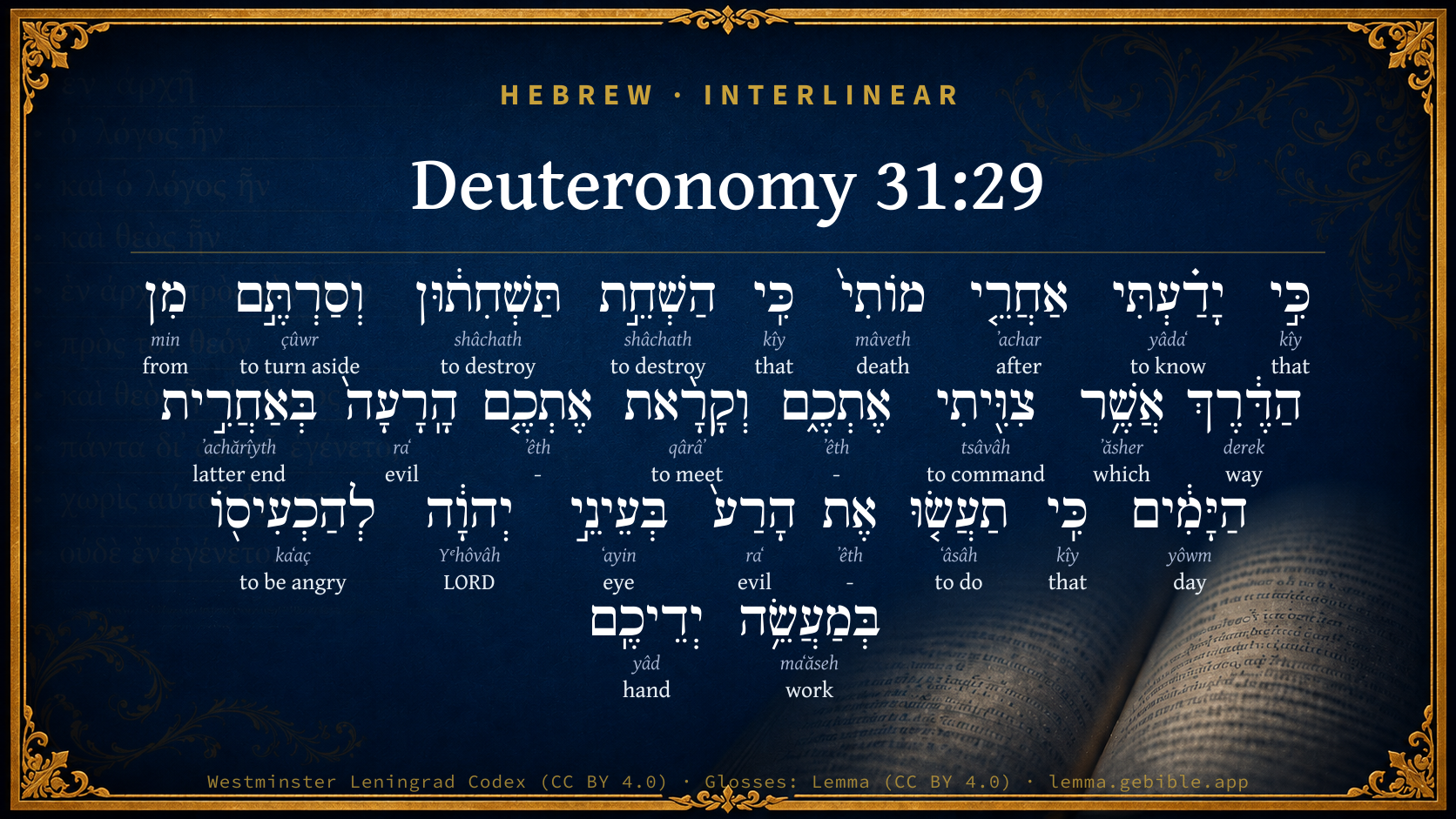
Deuteronomy 31:29

Hebrew (Westminster Leningrad Codex) Deuteronomy 31:29 appears in the Hebrew Old Testament. The text above is from the Westminster Leningrad Codex. Each word links to its Strong’s number, a concise gloss, and parsing drawn from the Open Scriptures Hebrew Bible morphology. Click any word for its full Brown-Driver-Briggs (BDB) entry.
Download image
Cite this verse

Deuteronomy 31:29 (World English Bible). Public Domain. Lemma interlinear Bible study tool, https://lemma.gebible.app/v/deuteronomy/31/29.

Show BibTeX & RIS
BibTeX
RIS
English Translation
For I know that after my death you will utterly corrupt yourselves, and turn aside from the way which I have commanded you; and evil will happen to you in the latter days; because you will do that which is evil in the sight of Yahweh, to provoke him to anger through the work of your hands.
World English Bible · Public Domain
Download a study sheet

One document with this verse’s original text, its word-by-word gloss line, the meaning frame, cross-references with their text, attributed commentary, and full source and license credits — printable, and it pastes into notes with its structure intact.

This verse Autodidact and up

Study sheet (.html) Plain text (.txt)

A passage Seminary Student

Up to 50 verses in one chapter. A passage sheet keeps up to 6 commentary sources and 12 cross-references per verse, in the order this page ranks them, and says so on the sheet whenever that leaves anything out. Ask for a single verse and you get the Autodidact verse sheet above.

Everything on this page stays free to read, with no account — the sheet is a download of what is already on screen, not access to it.

Want to remove ads? Support Godless Engineer
Compare translations 3

The same verse in 3 English versions, stacked beneath the original-language interlinear above. Click any original word for its lexicon entry.

Each is an independent rendering of the whole verse — the interlinear is not word-aligned to these translations.

Highlighted words mark where these versions differ — a whole-verse word diff, not a word-by-word alignment.

  • World English Bible Public Domain
    For I know that after my death you will utterly corrupt yourselves, and turn aside from the way which I have commanded you; and evil will happen to you in the latter days; because you will do that which is evil in the sight of Yahweh, to provoke him to anger through the work of your hands.
  • King James Version Public Domain
    For I know that after my death ye will utterly corrupt yourselves, and turn aside from the way which I have commanded you; and evil will befall you in the latter days; because ye will do evil in the sight of the LORD, to provoke him to anger through the work of your hands.
  • unfoldingWord Literal Text CC BY-SA 4.0
    For I know that, after my death, corrupting, you will corrupt yourselves and turn aside from the path that I have commanded you, and disaster will meet you in the following days, because you will do evil in the eyes of Yahweh, provoking him to anger through the work of your hands.”

unfoldingWord Literal Text — © unfoldingWord, licensed CC BY-SA 4.0. Word-aligned USFM3 via Door43 (git.door43.org/unfoldingWord/en_ult).

Versions to compare (up to 4)

3 of 4 selected

Show all 18 translations

Every available English version of this verse, each an independent rendering of the whole verse.

  • World English Bible Public Domain
    For I know that after my death you will utterly corrupt yourselves, and turn aside from the way which I have commanded you; and evil will happen to you in the latter days; because you will do that which is evil in the sight of Yahweh, to provoke him to anger through the work of your hands.
  • Berean Standard Bible Public Domain
    For I know that after my death you will become utterly corrupt and turn from the path I have commanded you. And in the days to come, disaster will befall you because you will do evil in the sight of the LORD to provoke Him to anger by the work of your hands.”
  • Majority Standard Bible Public Domain
    For I know that after my death you will become utterly corrupt and turn from the path I have commanded you. And in the days to come, disaster will befall you because you will do evil in the sight of the LORD to provoke Him to anger by the work of your hands.”
  • King James Version Public Domain
    For I know that after my death ye will utterly corrupt yourselves, and turn aside from the way which I have commanded you; and evil will befall you in the latter days; because ye will do evil in the sight of the LORD, to provoke him to anger through the work of your hands.
  • American Standard Version (1901) Public Domain
    For I know that after my death ye will utterly corrupt yourselves, and turn aside from the way which I have commanded you; and evil will befall you in the latter days; because ye will do that which is evil in the sight of Jehovah, to provoke him to anger through the work of your hands.
  • Revised Version (1885) Public Domain
    For I know that after my death ye will utterly corrupt yourselves, and turn aside from the way which I have commanded you; and evil will befall you in the latter days; because ye will do that which is evil in the sight of the LORD, to provoke him to anger through the work of your hands.
  • Geneva Bible (1599) Public Domain
    For I am sure that after my death ye will vtterly be corrupt and turne from the way, which I haue commanded you: therefore euill will come vpon you at the length, because ye will comit euill in the sight of the Lord, by prouoking him to anger through the worke of your hands.
  • Douay-Rheims (1899) Public Domain
    For I know that, after my death, you will do wickedly, and will quickly turn aside from the way that I have commanded you: and evils shall come upon you in the latter times, when you shall do evil in the sight of the Lord, to provoke him by the works of your hands.
  • Young's Literal Translation Public Domain
    for I have known that after my death ye do very corruptly, and have turned aside out of the way which I commanded you, and evil hath met you in the latter end of the days, because ye do the evil thing in the eyes of Jehovah, to make Him angry with the work of your hands.'
  • Literal Standard Version CC BY-SA 4.0
    for I have known that you act very corruptly after my death, and have turned aside from the way which I commanded you, and evil has met you in the latter end of the days, because you do evil in the eyes of YHWH, to make Him angry with the work of your hands.”
  • Unlocked Literal Bible CC BY-SA 4.0
    For I know that after my death you will utterly corrupt yourselves and turn aside out of the path that I have commanded you; disaster will come on you in the following days. This will happen because you will do what is evil in the sight of Yahweh, so as to provoke him to anger through the work of your hands.”
  • unfoldingWord Literal Text CC BY-SA 4.0
    For I know that, after my death, corrupting, you will corrupt yourselves and turn aside from the path that I have commanded you, and disaster will meet you in the following days, because you will do evil in the eyes of Yahweh, provoking him to anger through the work of your hands.”
  • Darby Bible Public Domain
    For I know that after my death ye will utterly corrupt yourselves, and will turn aside from the way which I have commanded you; and mischief will befall you at the end of days; because ye do evil in the sight of Jehovah, to provoke him to anger through the work of your hands.
  • World Messianic Bible Public Domain
    For I know that after my death you will utterly corrupt yourselves, and turn away from the way which I have commanded you; and evil will happen to you in the latter days, because you will do that which is evil in the LORD’s sight, to provoke him to anger through the work of your hands.”
  • Webster's Bible Public Domain
    For I know that after my death ye will utterly corrupt yourselves, and turn aside from the way which I have commanded you; and evil will befall you in the latter days; because ye will do evil in the sight of the LORD, to provoke him to anger through the work of your hands.
  • Free Bible Version CC BY-SA 4.0
    I know that after my death you will become completely immoral, leaving the path I have ordered you to follow. In the future, evil things will happen to you because of the evil sins you commit in the sight of the Lord, making him angry by what you do.”
  • Bible in Basic English Public Domain
    For I am certain that after my death you will give yourselves up to sin, wandering from the way which I have given you; and evil will overtake you in the end, because you will do evil in the eyes of the Lord, moving him to wrath by the work of your hands.
  • JPS Tanakh (1917) Public Domain
    For I know that after my death ye will in any wise deal corruptly, and turn aside from the way which I have commanded you; and evil will befall you in the end of days; because ye will do that which is evil in the sight of the LORD, to provoke Him through the work of your hands.'

Literal Standard Version (2020), Covenant Press — licensed CC BY-SA 4.0. Text via the HelloAO Bible API (eBible.org). Unlocked Literal Bible (unfoldingWord) — licensed CC BY-SA 4.0. Text via the HelloAO Bible API (eBible.org). unfoldingWord Literal Text — © unfoldingWord, licensed CC BY-SA 4.0. Word-aligned USFM3 via Door43 (git.door43.org/unfoldingWord/en_ult). Free Bible Version, Dr. Jonathan Gallagher — licensed CC BY-SA 4.0. Text via the HelloAO Bible API (eBible.org).

Word by word

More ways to search: Search by grammar → Find every occurrence → Compare this word →

Practice this passage: Drill this verse → Learn its vocabulary →

וְקָרָ֨את
qârâʼ
H7122
“and · to meet”
Conjunction + Verb, Qal, Sequential Perfect, 3rd Person, Feminine, Singular
Part of Speech
Conjunction + Verb
Stem
Qal
Form
Sequential Perfect
Person
3rd Person
Gender
Feminine
Number
Singular
Full BDB Definition

Origin: a primitive root, to encounter, whether accidentally or in a hostile manner

TWOT: 2064

to encounter, befall, meet - (Qal) - to meet, encounter - to befall (figuratively) - (Niphal) to meet, meet unexpectedly - (Hiphil) to cause to meet
  1. כִּ֣י kîy H3588 “that” Conjunction
  2. יָדַ֗עְתִּי yâdaʻ H3045 “to know” Verb, Qal, Perfect, 1st Person, Common, Singular
  3. אַחֲרֵ֤י ʼachar H310 “after” Preposition
  4. מוֹתִי֙ mâveth H4194 “death · my” Noun, Common, Masculine, Singular, Construct + Suffix, Personal, 1st Person, Common, Singular
  5. כִּֽי kîy H3588 “that” Conjunction
  6. הַשְׁחֵ֣ת shâchath H7843 “to destroy” Verb, Hiphil, Infinitive Absolute
  7. תַּשְׁחִת֔וּן shâchath H7843 “to destroy” Verb, Hiphil, Imperfect, 2nd Person, Masculine, Plural + Suffix, n
  8. וְסַרְתֶּ֣ם çûwr H5493 “and · to turn aside” Conjunction + Verb, Qal, Sequential Perfect, 2nd Person, Masculine, Plural
  9. מִן min H4480 “from” Preposition
  10. הַדֶּ֔רֶךְ derek H1870 “the · way” Particle, Definite Article + Noun, Common, Both, Singular, Absolute
  11. אֲשֶׁ֥ר ʼăsher H834 “which” Particle, Relative
  12. צִוִּ֖יתִי tsâvâh H6680 “to command” Verb, Piel, Perfect, 1st Person, Common, Singular
  13. אֶתְכֶ֑ם ʼêth H853 “- · you” Particle, Direct Object + Suffix, Personal, 2nd Person, Masculine, Plural
  14. אֶתְכֶ֤ם ʼêth H853 “- · you” Particle, Direct Object + Suffix, Personal, 2nd Person, Masculine, Plural
  15. הָֽרָעָה֙ raʻ H7451 “the · evil” Particle, Definite Article + Noun, Common, Feminine, Singular, Absolute
  16. בְּאַחֲרִ֣ית ʼachărîyth H319 “in/at · latter end of” Preposition + Noun, Common, Feminine, Singular, Construct
  17. הַיָּמִ֔ים yôwm H3117 “the · days” Particle, Definite Article + Noun, Common, Masculine, Plural, Absolute
  18. כִּֽי kîy H3588 “that” Conjunction
  19. תַעֲשׂ֤וּ ʻâsâh H6213 “to do” Verb, Qal, Imperfect, 2nd Person, Masculine, Plural
  20. אֶת ʼêth H853 “-” Particle, Direct Object
  21. הָרַע֙ raʻ H7451 “the · evil” Particle, Definite Article + Adjective, Adjective, Masculine, Singular, Absolute
  22. בְּעֵינֵ֣י ʻayin H5869 “in/at · eyes of” Preposition + Noun, Common, Both, Dual, Construct
  23. יְהוָ֔ה Yᵉhôvâh H3068 “LORD” Noun, Proper
  24. לְהַכְעִיס֖וֹ kaʻaç H3707 “to be angry · him” Preposition + Verb, Hiphil, Infinitive Construct + Suffix, Personal, 3rd Person, Masculine, Singular
  25. בְּמַעֲשֵׂ֥ה maʻăseh H4639 “in/at · work of” Preposition + Noun, Common, Masculine, Singular, Construct
  26. יְדֵיכֶֽם yâd H3027 “hands · your” Noun, Common, Both, Dual, Construct + Suffix, Personal, 2nd Person, Masculine, Plural

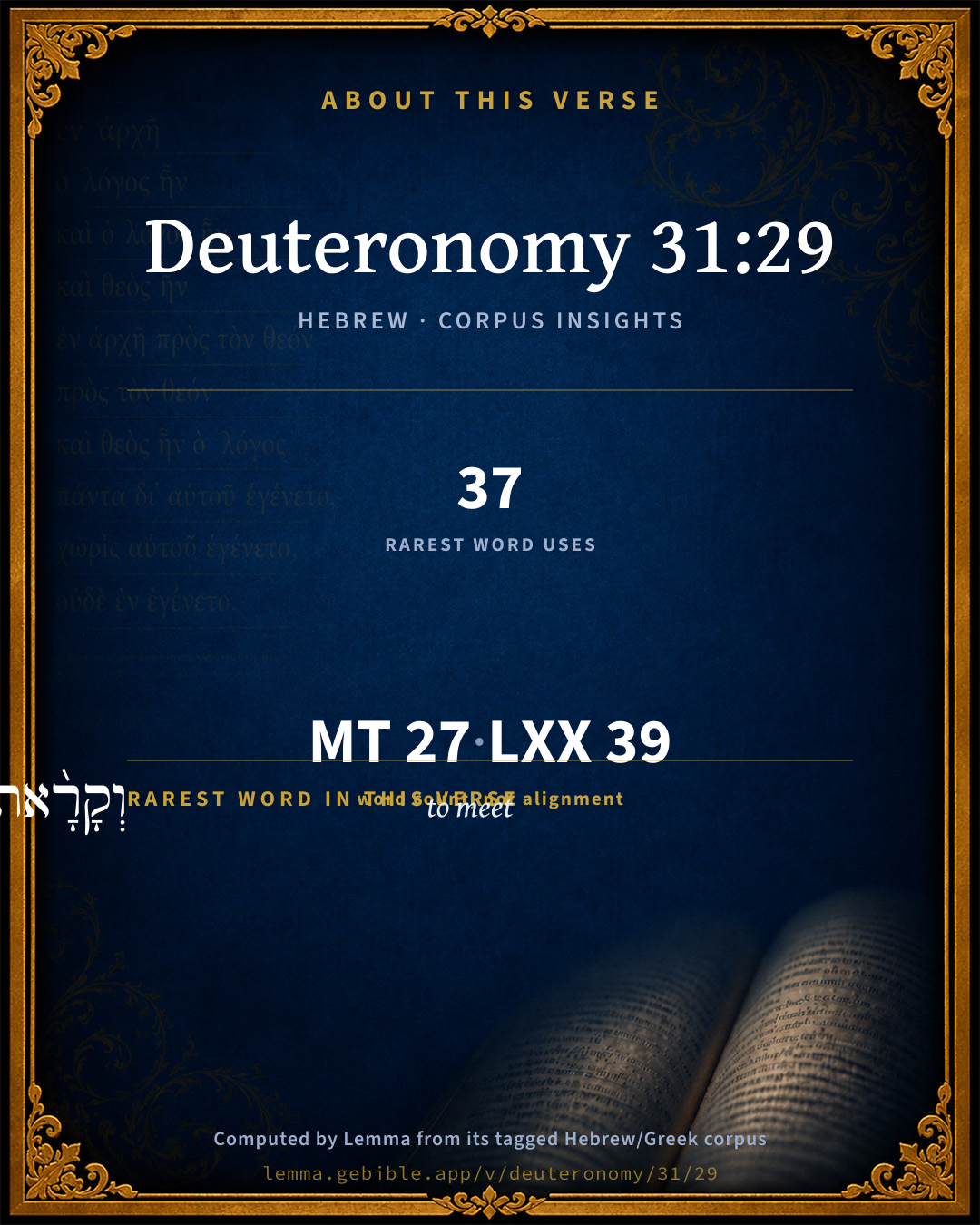
About this verse

These counts appear in no published source. They are computed here, from the morphology-tagged text and Lemma’s own curated glosses. What Lemma adds →

27
words
21
distinct lemmas
Pentateuch
section

Shared distinctive vocabulary

וְקָרָ֨את to meet H7122 occurs in 35 verses of the Hebrew Bible. Also found in:

Grammatical profile

  • 8 verbs
  • 9 nouns
  • 1 adjective
  • 2 prepositions
  • 3 conjunctions
  • 4 particles

Verb forms

  • יָדַ֗עְתִּי Qal · Perfect
  • הַשְׁחֵ֣ת Hiphil · Infinitive Absolute
  • תַּשְׁחִת֔וּן Hiphil · Imperfect
  • וְסַרְתֶּ֣ם Qal · Sequential Perfect
  • צִוִּ֖יתִי Piel · Perfect
  • וְקָרָ֨את Qal · Sequential Perfect
  • תַעֲשׂ֤וּ Qal · Imperfect
  • לְהַכְעִיס֖וֹ Hiphil · Infinitive Construct

Repetition

Words recur within this verse — often emphatic in Hebrew:

  • הַשְׁחֵ֣ת to destroy H7843 ×2
  • הָֽרָעָה֙ evil H7451 ×2
  • כִּ֣י that H3588 ×3

Hebrew & Septuagint length

In English translation the verse runs 57 words from the Hebrew and 72 from the Septuagint (LXX English) — closely comparable.

A rough comparison of the two English renderings, which tokenize alike — not a word-level alignment.

Word counts can differ between the Hebrew and the Greek without any difference in meaning — e.g. the Hebrew direct-object marker אֵת has no separate Greek word, and Greek often adds the article ὁ.

In the original languages it is 27 Hebrew tokens and 39 Greek tokens — but the two are counted differently (Hebrew bundles its prefixes and suffixes into one token; the Greek is in lemma form), so that isn’t a like-for-like length.

Cross-references

21

Topical passages linked to Deuteronomy 31:29 in the Treasury of Scripture Knowledge — connected by theme and wording, ordered by reader-vote popularity; previews shown in the World English Bible.

  • Deuteronomy 32:5 They have dealt corruptly with him, [they are] not his children, [it is] their blemish; [They are] a perverse and crooked generation.
  • Judges 2:19 But it happened, when the judge was dead, that they turned back, and dealt more corruptly than their fathers, in following other gods to serve them, and to bow down to them; they didn't cease from their doings, nor from their stubborn way.
  • Deuteronomy 4:30 When you are in oppression, and all these things are come on you, in the latter days you shall return to Yahweh your God, and listen to his voice:
  • Isaiah 1:4 Ah sinful nation, A people loaded with iniquity, A seed of evil-doers, Children who deal corruptly! They have forsaken Yahweh. They have despised the Holy One of Israel. They are estranged and backward.
  • Hosea 9:9 They have deeply corrupted themselves, As in the days of Gibeah. He will remember their iniquity. He will punish them for their sins.
  • Luke 19:42–44 saying, "If you, even you, had known today the things which belong to your peace! But now, they are hidden from your eyes.
  • Luke 21:24 They will fall by the edge of the sword, and will be led captive into all the nations. Jerusalem will be trampled down by the Gentiles, until the times of the Gentiles are fulfilled.
  • Genesis 49:1 Jacob called to his sons, and said: "Gather yourselves together, that I may tell you that which will happen to you in the days to come.
  • Leviticus 26:14–46 "'But if you will not listen to me, and will not do all these commandments;
  • Deuteronomy 28:15–68 But it shall come to pass, if you will not listen to the voice of Yahweh your God, to observe to do all his commandments and his statutes which I command you this day, that all these curses shall come on you, and overtake you.
  • Deuteronomy 29:18–28 lest there should be among you man, or woman, or family, or tribe, whose heart turns away this day from Yahweh our God, to go to serve the gods of those nations; lest there should be among you a root that bears gall and wormwood;
  • 2 Chronicles 34:24 Thus says Yahweh, Behold, I will bring evil on this place, and on the inhabitants of it, even all the curses that are written in the book which they have read before the king of Judah.
  • Job 19:25 But as for me, I know that my Redeemer lives. In the end, he will stand upon the earth.
  • Ezekiel 38:8 After many days you shall be visited: in the latter years you shall come into the land that is brought back from the sword, that is gathered out of many peoples, on the mountains of Israel, which have been a continual waste; but it is brought forth out of the peoples, and they shall dwell securely, all of them.
  • Acts 20:30 Men will arise from among your own selves, speaking perverse things, to draw away the disciples after them.
  • 1 Timothy 4:1 But the Spirit says expressly that in later times some will fall away from the faith, paying attention to seducing spirits and doctrines of demons,
  • 2 Timothy 3:1–6 But know this, that in the last days, grievous times will come.
  • Hebrews 1:2 has at the end of these days spoken to us by his Son, whom he appointed heir of all things, through whom also he made the worlds.
  • 2 Peter 1:14–15 knowing that the putting off of my tent comes swiftly, even as our Lord Jesus Christ made clear to me.
  • 2 Peter 2:1–2 But there also arose false prophets among the people, as among you also there will be false teachers, who will secretly bring in destructive heresies, denying even the Master who bought them, bringing on themselves swift destruction.
  • 2 Peter 3:3 knowing this first, that in the last days mockers will come, walking after their own lusts,

Cross-references courtesy of OpenBible.info (CC BY 4.0).

Hebrew and Greek witnesses Masoretic Hebrew ↔ Greek Septuagint

The same verse in the two great witnesses to the Old Testament, shown verse-for-verse.

These are two independent witnesses, not word-aligned to each other, and the Septuagint is shown in lemma (dictionary) form.

Hebrew Deuteronomy 31:29 Masoretic · Westminster Leningrad Codex

כִּ֣י יָדַ֗עְתִּי אַחֲרֵ֤י מוֹתִי֙ כִּֽי הַשְׁחֵ֣ת תַּשְׁחִת֔וּן וְסַרְתֶּ֣ם מִן הַדֶּ֔רֶךְ אֲשֶׁ֥ר צִוִּ֖יתִי אֶתְכֶ֑ם וְקָרָ֨את אֶתְכֶ֤ם הָֽרָעָה֙ בְּאַחֲרִ֣ית הַיָּמִ֔ים כִּֽי תַעֲשׂ֤וּ אֶת הָרַע֙ בְּעֵינֵ֣י יְהוָ֔ה לְהַכְעִיס֖וֹ בְּמַעֲשֵׂ֥ה יְדֵיכֶֽם

For I know that after my death you will utterly corrupt yourselves, and turn aside from the way which I have commanded you; and evil will happen to you in the latter days; because you will do that which is evil in the sight of Yahweh, to provoke him to anger through the work of your hands.

World English Bible · Public Domain

Greek LXX Deuteronomy 31:29 Septuagint · lemma form

οἶδα γάρ ὅτι ἔσχατος ὁ τελευτή ἐγώ ἀνομία ἀνομέω καί ἐκκλίνω ἐκ ὁ ὁδός ὅς ἐντέλλομαι σύ καί συνἀντάω σύ ὁ κακός ἔσχατος ὁ ἡμέρα ὅτι ποιέω ὁ πονηρός ἐναντίον κύριος παραὀργίζω αὐτός ἐν ὁ ἔργον ὁ χείρ σύ

For I know that after my death you⌃ will utterly transgress, and turn aside out of the way which I have commanded you; and evils shall come upon you in the latter days, because you⌃ will do evil before the Lord, to provoke him to anger by the works of your hands. And Moses spoke all the words of this song even to the end, in the ears of the whole assembly.

LXX2012 (modern English Septuagint) · Public Domain

Hebrew: Westminster Leningrad Codex (CC BY 4.0). Greek: Septuagint (public domain); English from LXX2012 (modern English Septuagint) (Public Domain). How the Septuagint differs from the Hebrew →

Targum (Aramaic paraphrase)

2

The Targum is the ancient Jewish Aramaic paraphrase of the Hebrew Scriptures — an interpretive translation, not the Hebrew text itself. Onkelos (literal) and Pseudo-Jonathan (expansive) render the Torah, and Jonathan the Prophets. Coverage is partial: where no permissively-licensed English translation exists for a verse, only the Aramaic is shown. This is verse-level text, not a word-by-word alignment to the Hebrew.

  1. Targum Onkelos Torah (Genesis–Deuteronomy)
    אֲרֵי יְדַעְנָא בָּתַר דְאֵמוּת אֲרֵי חֲבָּלָא תְחַבְּלוּן וְתִסְטוּן מִן אָרְחָא דִי פַקֵדִית יָתְכוֹן וּתְעָרַע יָתְכוֹן בִּשְׁתָּא בְּסוֹף יוֹמַיָא אֲרֵי תַעְבְּדוּן יָת דְבִישׁ קֳדָם יְיָ לְאַרְגָזָא קֳדָמוֹהִי בְּעוֹבָדֵי יְדֵיכוֹן

    (no public-domain English translation for this verse)

    Targum Onkelos — Aramaic: “Onkelos Genesis” (public domain); “Onkelos Exodus” (public domain); “Onkelos Leviticus” (public domain); “Onkelos Numbers” (public domain); “Onkelos Deuteronomy” (public domain). English: “Sefaria Community Translation” (CC0 1.0 (public-domain dedication)); “J.W. Etheridge. The Targums of Onkelos and Jonathan Ben Uzziel on the Pentateuch. London: Longmans, Green, 1862” (public domain). Text via Sefaria.

  2. Targum Pseudo-Jonathan Torah (Genesis–Deuteronomy)
    אֲרוּם חַכִּימַת דְמִן בָּתַר דְאֵמוּת אֲרוּם חַבָּלָא תְחַבְּלוּן עוֹבָדֵיכוֹן וְתִטְעוּן מִן אָרְחָא דְפַקֵידִית יַתְכוֹן וְתֶאֱרַע יַתְכוֹן בִּישְׁתָּא בְּסוֹף כָּל יוֹמַיָא אֲרוּם תַּעַבְדוּן דְבִישׁ קֳדָם יְיָ לְאַרְגָזָא קֳדָמוֹי

    For I know that after my death corrupting you will corrupt your works, and go astray from the way I have commanded you, and that evil will befall you in the end, because you will do what is wrong before the Lord in provoking Him to anger.

    Targum Pseudo-Jonathan — Aramaic: “Targum Jonathan on Genesis” (public domain); “Targum Jonathan on Exodus” (public domain); “Targum Jonathan on Leviticus” (public domain); “Targum Jonathan on Numbers” (public domain); “Targum Jonathan on Deuteronomy” (public domain). English: “The Targum of Jonathan ben Uzziel, trans. J. W. Etheridge, London, 1862” (public domain). Text via Sefaria.

Commentary

Notes on Deuteronomy 31:29 from classic Christian and Jewish commentators (each source and its license shown beneath its notes). The classic Christian expositions comment on the surrounding passage and are grouped to its opening verse, so a note may address several verses; the Jewish commentaries on the Tanakh (Rashi and others) are per-verse, so they appear only where the commentator wrote on this verse.

Lemma curates 59 commentaries, every one of them public domain or Creative Commons licensed, each selected and text-cleaned for this edition rather than reprinted as found. About our sources →

Trapp's Complete Commentary

John Trapp

Deu 31:29 For I know that after my death ye will utterly corrupt [yourselves], and turn aside from the way which I have commanded you; and evil will befall you in the latter days; because ye will do evil in the sight of the LORD, to provoke him to anger through the work of your hands.

Ver. 29. To provoke him to anger.] Which is the greatest folly that can be; for are we stronger than he? Can we imagine to make our party good with him? Surely as Ulysses’s companions told him, when he would needs provoke Polydamus,

Sχετλιε, πιπτ εθελεις ερεθιζεμεν αγριον ανδρα;

May not we much more say so to them that will needs provoke the Lord, It is good for men to meddle with their equals, and not contend with him that is mightier than they?

John Trapp, A Commentary or Exposition upon All the Books of the Old and New Testament (1647–1656) — public domain. Text from a community e-Sword module.

Geneva Bible (1599)

Geneva Bible translators

By idolatry, and worshipping images, which are the work of your hands.

Geneva Bible (1599) marginal notes — public domain. Text via Bolls.life.

Ellicott's Commentary for English Readers

(29) In the latter days.—A not uncommon prophetical expression, used with some considerable latitude. It occurs for the first time in Gen_49:1. (See also Num_24:14 and Deu_4:30. ) Some would refer it to the “days of the Messiah,” and make it almost a technical term. But a comparison of these few passages will show that it cannot be tied strictly to any one period.

A Bible Commentary for English Readers, edited by Charles John Ellicott (1878–1897) — public domain. Text from a community e-Sword module.

The Cambridge Bible for Schools and Colleges

gen. ed. J. J. S. Perowne

29. after my death] Readers of the Heb. text will compare with the position of this clause in the v. the construction in Deu_13:12 (13).

ye will surely corrupt yourselves] See on Deu_4:16; Deu_4:25, and for another form of the same vb. Deu_9:12, Deu_32:5.

turn aside, etc.] Deu_9:12; Deu_9:16, Deu_11:28.

evil will befall you] As in Jer_44:23; another vb. is used in Deu_31:17; Deu_31:21. For in the latter days see on Deu_4:30.

do that which is evil, etc.] See on Deu_4:25, where the phrase is also followed as here by to provoke him to anger. Cp. Deu_9:18.

work of your hands] That is idols, Jer_25:14. Contrast work of thy hand in a good sense, Deu_2:7.

The Cambridge Bible for Schools and Colleges (gen. ed. J. J. S. Perowne; Cambridge University Press, 1878–1918) — public domain. Text from a community e-Sword module.

John Gill's Exposition

And Moses spake in the ears of all the congregation of Israel,.... Not in the hearing of the whole body of the people, and every individual thereof; no man could be able to speak to such a numerous congregation, as that they should hear him; but in the hearing of their heads and representatives, the elders of their tribes and officers, ordered to be gathered together for this purpose, Deu 31:28,

the words of this song, until they were ended; which song is recorded in the following chapter, Deu 32:1.

Next: Deuteronomy Chapter 32

John Gill's Exposition of the Whole Bible (1746–1763) — public domain (CC PDM 1.0). Text via the HelloAO Bible API.

The Pulpit Commentary

Ye will utterly corrupt yourselves; literally, corrupting, ye will corrupt (Wtjivt tjvh, sc. i.e. your ways (cf. for the phrase. (Gen_6:12) The latter days; the after-time, the future, as in Deu_4:30; Num_24:14, etc. The work of your hands; the idols they might make. (cf. Deu_4:28) By some, however, the phrase is interpreted of evil deeds in general

The Pulpit Commentary (1880–1919), ed. H.D.M. Spence-Jones & Joseph S. Exell — public domain. Text from a community e-Sword module.

Rashi

Rabbi Shlomo Yitzchaki (Rashi)

אחרי מותי כי השחת תשחתון [FOR I KNOW THAT] AFTER MY DEATH YE WILL UTTERLY CORRUPT YOURSELVES — But, you see, as a matter of fact, that all the days of Joshua they did not corrupt themselves, for it states, (Judges 2:7) “And the people served the Lord all the days of Joshua”?! (How, then, could Moses say that they would corrupt themselves after his death, by which he evidently meant immediately after his death, cf. v. 16)? But we may derive from here that one’s pupil should be as dear to him as his own self: — it appeared to Moses that so long as Joshua would live it would be as though he himself would be living (he thus alluded by the words “after my death” to a period after Joshua’s death).

Rashi on the Tanakh — English translations: “The Judaica Press complete Tanach with Rashi, translated by A. J. Rosenberg” (CC BY 4.0); “Pentateuch with Rashi's commentary by M. Rosenbaum and A.M. Silbermann, 1929-1934” (public domain); “The Metsudah Tanach series, Lakewood, N.J” (CC BY 4.0); and “The Book of Joshua, Metsudah Publications, 1997” (CC BY 4.0). Text via Sefaria.

Lesson kit

Teaching starters — assembled from the data on this page, not authored interpretation. Every prompt links to the verse data it draws on. Edit before teaching.

Deuteronomy, in the Pentateuch, opens this verse with 27 words (21 distinct Hebrew lemmas). Its most distinctive word is qârâʼ (“to meet”). A historical commentator’s framing appears above. Read the whole chapter for the surrounding context.

Discussion questions

  1. The word qârâʼ carries the sense “to meet.” How does it shape the verse?
  2. Genesis 42:4 shares the word «to meet» with this verse. How do the two illuminate each other?
  3. “to destroy” occurs 2× in this one verse. What is the effect of the repetition?
  4. The translations on this page render this verse differently — a whole-verse word diff, not a word-by-word alignment. What might account for the different wordings?
  5. The verb «יָדַ֗עְתִּי» is Qal Perfect. How does its form color the action?
  6. Reading how Trapp's Complete Commentary and Geneva Bible (1599) read this verse, where do the two commentators agree and where do they part?

Things to notice

Reading settings

Reading text

Shown beneath each verse's original-language words.

Old Testament
Old Testament edition

Read the OT as the Masoretic Hebrew (MT) or the Greek Septuagint (LXX).

English shown for the Greek Septuagint (in the Hebrew ↔ Greek comparison).

Comparing translations? Open the Compare panel on any verse page to stack up to four side by side.