
Ezra 8:17

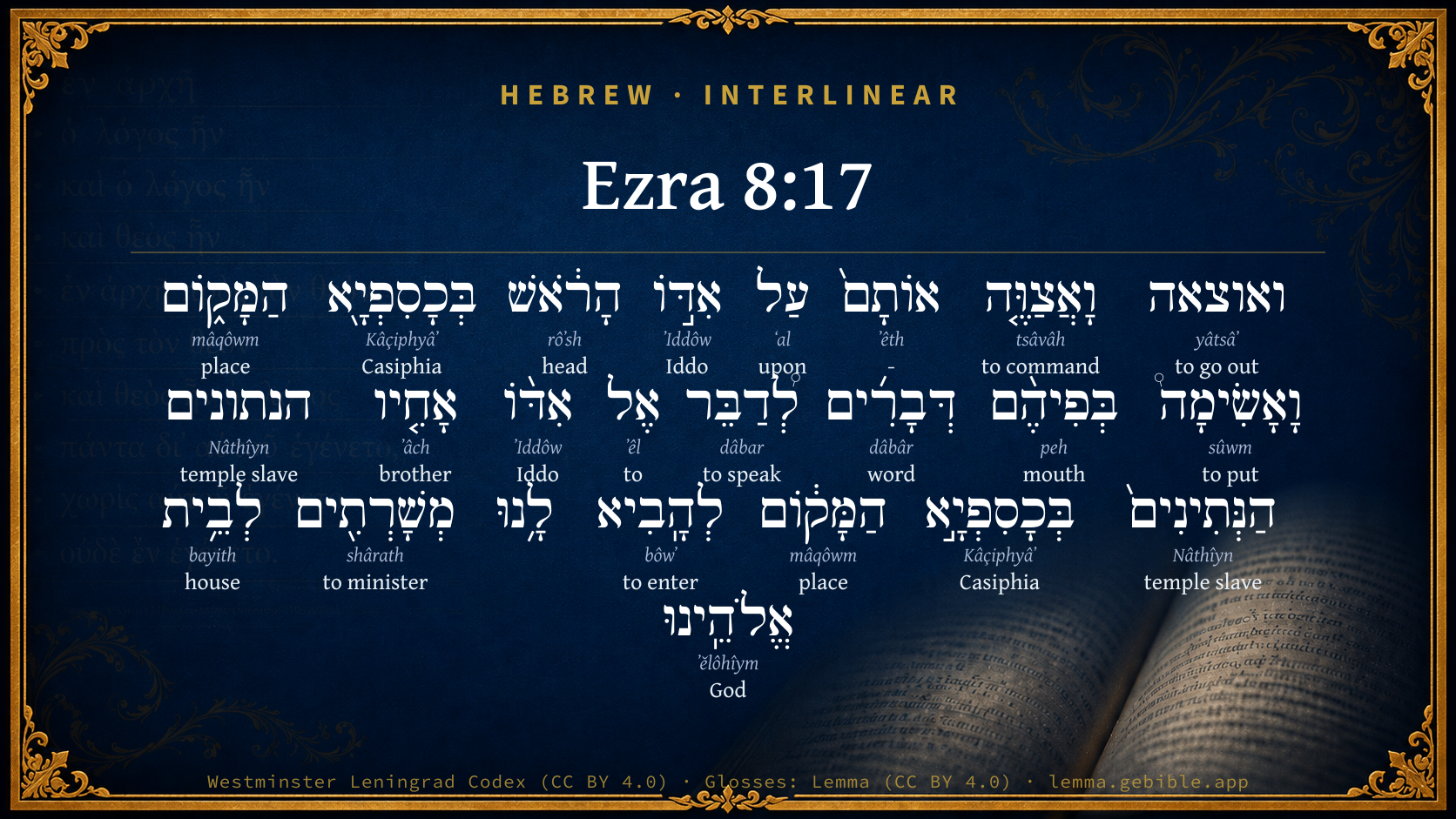
Hebrew (Westminster Leningrad Codex) Ezra 8:17 appears in the Hebrew Old Testament. The text above is from the Westminster Leningrad Codex. Each word links to its Strong’s number, a concise gloss, and parsing drawn from the Open Scriptures Hebrew Bible morphology. Click any word for its full Brown-Driver-Briggs (BDB) entry.
Download image
Cite this verse

Ezra 8:17 (World English Bible). Public Domain. Lemma interlinear Bible study tool, https://lemma.gebible.app/v/ezra/8/17.

Show BibTeX & RIS
BibTeX
RIS
English Translation
I sent them forth to Iddo the chief at the place Casiphia; and I told them what they should tell Iddo, [and] his brothers the Nethinim, at the place Casiphia, that they should bring to us ministers for the house of our God.
World English Bible · Public Domain
Highlights
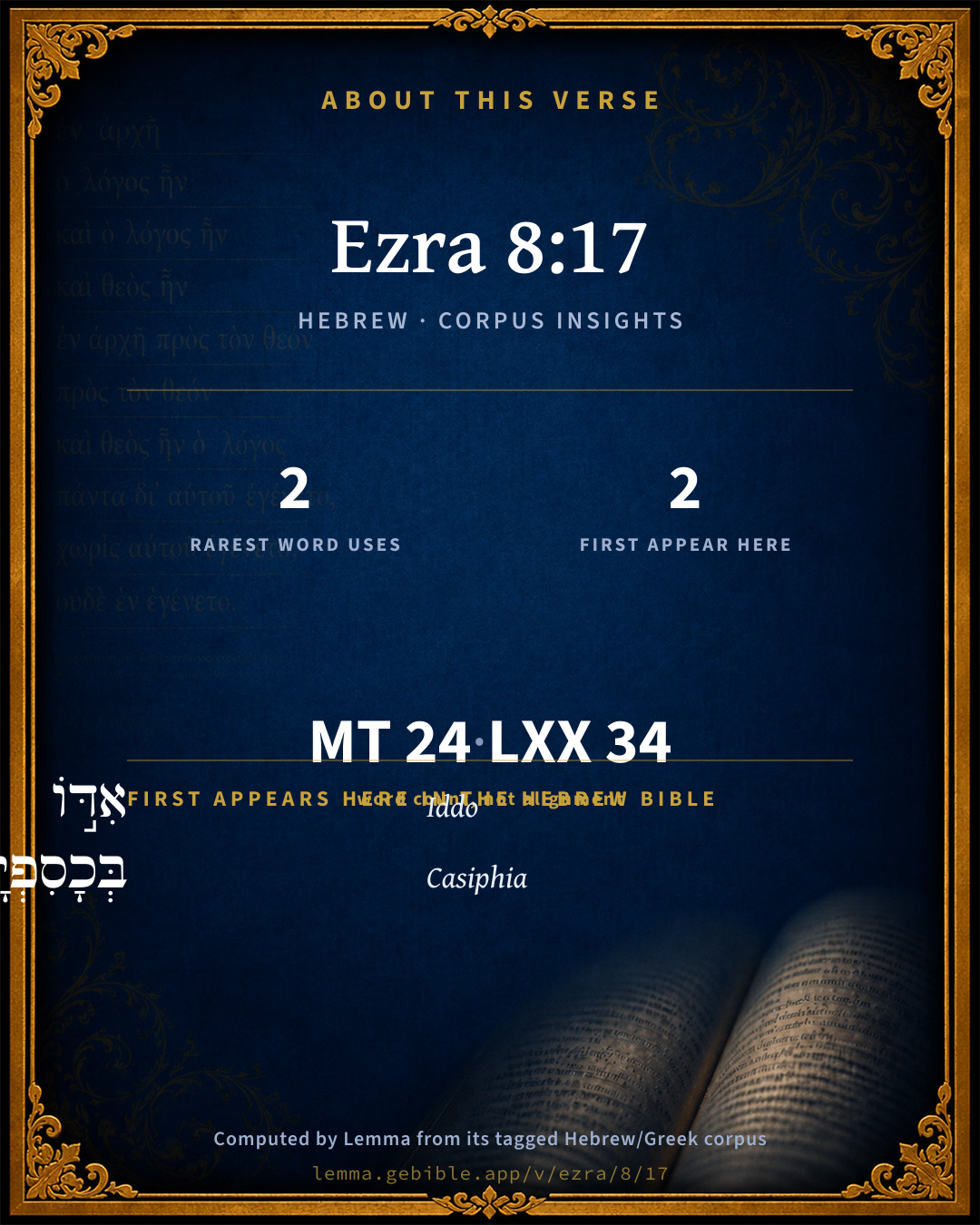
  • 2 first appearances in the Hebrew Bible
Full analysis ↓
Download a study sheet

One document with this verse’s original text, its word-by-word gloss line, the meaning frame, cross-references with their text, attributed commentary, and full source and license credits — printable, and it pastes into notes with its structure intact.

This verse Autodidact and up

Study sheet (.html) Plain text (.txt)

A passage Seminary Student

Up to 50 verses in one chapter. A passage sheet keeps up to 6 commentary sources and 12 cross-references per verse, in the order this page ranks them, and says so on the sheet whenever that leaves anything out. Ask for a single verse and you get the Autodidact verse sheet above.

Everything on this page stays free to read, with no account — the sheet is a download of what is already on screen, not access to it.

Want to remove ads? Support Godless Engineer
Compare translations 3

The same verse in 3 English versions, stacked beneath the original-language interlinear above. Click any original word for its lexicon entry.

Each is an independent rendering of the whole verse — the interlinear is not word-aligned to these translations.

Highlighted words mark where these versions differ — a whole-verse word diff, not a word-by-word alignment.

  • World English Bible Public Domain
    I sent them forth to Iddo the chief at the place Casiphia; and I told them what they should tell Iddo, [and] his brothers the Nethinim, at the place Casiphia, that they should bring to us ministers for the house of our God.
  • King James Version Public Domain
    And I sent them with commandment unto Iddo the chief at the place Casiphia, and I told them what they should say unto Iddo, and to his brethren the Nethinims, at the place Casiphia, that they should bring unto us ministers for the house of our God.
  • unfoldingWord Literal Text CC BY-SA 4.0
    And I commanded them to go to Iddo, the head at the place Kasiphia. And I put in their mouth words to speak to Iddo and his brothers, the temple servants in the place Kasiphia, to bring to us those who minister for the house of our God.

unfoldingWord Literal Text — © unfoldingWord, licensed CC BY-SA 4.0. Word-aligned USFM3 via Door43 (git.door43.org/unfoldingWord/en_ult).

Versions to compare (up to 4)

3 of 4 selected

Show all 18 translations

Every available English version of this verse, each an independent rendering of the whole verse.

  • World English Bible Public Domain
    I sent them forth to Iddo the chief at the place Casiphia; and I told them what they should tell Iddo, [and] his brothers the Nethinim, at the place Casiphia, that they should bring to us ministers for the house of our God.
  • Berean Standard Bible Public Domain
    And I sent them to Iddo, the leader at Casiphia, with a message for him and his kinsmen, the temple servants at Casiphia, that they should bring to us ministers for the house of our God.
  • Majority Standard Bible Public Domain
    And I sent them to Iddo, the leader at Casiphia, with a message for him and his kinsmen, the temple servants at Casiphia, that they should bring to us ministers for the house of our God.
  • King James Version Public Domain
    And I sent them with commandment unto Iddo the chief at the place Casiphia, and I told them what they should say unto Iddo, and to his brethren the Nethinims, at the place Casiphia, that they should bring unto us ministers for the house of our God.
  • American Standard Version (1901) Public Domain
    And I sent them forth unto Iddo the chief at the place Casiphia; and I told them what they should say unto Iddo, `and' his brethren the Nethinim, at the place Casiphia, that they should bring unto us ministers for the house of our God.
  • Revised Version (1885) Public Domain
    And I sent them forth unto Iddo the chief at the place Casiphia; and I told them what they should say unto Iddo, and his brethren the Nethinim, at the place Casiphia, that they should bring unto us ministers for the house of our God.
  • Geneva Bible (1599) Public Domain
    And I gaue them commandement, to Iddo the chiefest at the place of Casiphia, and I told them the words that they should speake to Iddo, and to his brethren the Nethinims at the place of Casiphia, that they should cause the ministers of the house of our God to come vnto vs.
  • Douay-Rheims (1899) Public Domain
    And I sent them to Eddo, who is chief in the place of Chasphia, and I put in their mouth the words that they should speak to Eddo, and his brethren the Nathinites in the place of Chasphia, that they should bring us ministers of the house of our God.
  • Young's Literal Translation Public Domain
    and I charge them for Iddo the head, in the place Casiphia, and put in their mouth words to speak unto Iddo, `and' his brethren the Nethinim, in the place Casiphia, to bring to us ministrants for the house of our God.
  • Literal Standard Version CC BY-SA 4.0
    and I charge them for Iddo the head, in the place Casiphia, and put in their mouth words to speak to Iddo, [and] his brothers the Nethinim, in the place Casiphia, to bring to us servants for the house of our God.
  • Unlocked Literal Bible CC BY-SA 4.0
    Next I sent them to Iddo, the leader in Kasiphia. I told them what to say to Iddo and his relatives, the temple servants living in Kasiphia, that is, to send to us servants for the house of God.
  • unfoldingWord Literal Text CC BY-SA 4.0
    And I commanded them to go to Iddo, the head at the place Kasiphia. And I put in their mouth words to speak to Iddo and his brothers, the temple servants in the place Kasiphia, to bring to us those who minister for the house of our God.
  • Darby Bible Public Domain
    And I gave them a commission to Iddo the chief, at the place Casiphia, and I put words in their mouths to say to Iddo [and] his brethren the Nethinim, at the place Casiphia, that they should bring to us ministers for the house of our God.
  • World Messianic Bible Public Domain
    I sent them out to Iddo the chief at the place Casiphia; and I told them what they should tell Iddo and his brothers the temple servants at the place Casiphia, that they should bring to us ministers for the house of our God.
  • Webster's Bible Public Domain
    And I sent them with commandment to Iddo the chief at the place Casiphia, and I told them what they should say to Iddo, and to his brethren the Nethinims, at the place Casiphia, that they should bring to us ministers for the house of our God.
  • Free Bible Version CC BY-SA 4.0
    I told them to go to Iddo, the leader of the Temple servants at Casiphia, asking him and his relatives to send us ministers for the Temple of our God.
  • Bible in Basic English Public Domain
    And I sent them to Iddo the chief at the place Casiphia, and gave them orders what to say to Iddo and his brothers the Nethinim at the place Casiphia, so that they might come back to us with men to do the work of the house of our God.
  • JPS Tanakh (1917) Public Domain
    And I gave them commandment unto Iddo the chief at the place Casiphia; and I told them what they should say unto Iddo and his brother, who were set over the place Casiphia, that they should bring unto us ministers for the house of our God.

Literal Standard Version (2020), Covenant Press — licensed CC BY-SA 4.0. Text via the HelloAO Bible API (eBible.org). Unlocked Literal Bible (unfoldingWord) — licensed CC BY-SA 4.0. Text via the HelloAO Bible API (eBible.org). unfoldingWord Literal Text — © unfoldingWord, licensed CC BY-SA 4.0. Word-aligned USFM3 via Door43 (git.door43.org/unfoldingWord/en_ult). Free Bible Version, Dr. Jonathan Gallagher — licensed CC BY-SA 4.0. Text via the HelloAO Bible API (eBible.org).

Word by word

More ways to search: Search by grammar → Find every occurrence → Compare this word →

Practice this passage: Drill this verse → Learn its vocabulary →

אִדּ֣וֹ
ʼIddôw
H112
“Iddo”
Noun, Proper
Part of Speech
Noun
Type
Proper
Full BDB Definition

Origin: of uncertain derivation

TWOT: 26e , 26f

Iddo = "I will praise him" - a chief Israelite during resettlement
  1. ואוצאה yâtsâʼ H3318 “and · to go out” Conjunction + Verb, Hiphil, Sequential Imperfect, 1st Person, Common, Singular + Suffix, h
  2. וָאֲצַוֶּ֤ה tsâvâh H6680 “and · to command” Conjunction + Verb, Piel, Sequential Imperfect, 1st Person, Common, Singular
  3. אוֹתָם֙ ʼêth H853 “- · them” Particle, Direct Object + Suffix, Personal, 3rd Person, Masculine, Plural
  4. עַל ʻal H5921 “upon” Preposition
  5. הָרֹ֔אשׁ rôʼsh H7218 “the · head” Particle, Definite Article + Noun, Common, Masculine, Singular, Absolute
  6. בְּכָסִפְיָ֖א Kâçiphyâʼ H3703 “in/at · Casiphia” Preposition + Noun, Proper
  7. הַמָּק֑וֹם mâqôwm H4725 “the · place” Particle, Definite Article + Noun, Common, Masculine, Singular, Absolute
  8. וָאָשִׂימָה֩ sûwm H7760 “and · to put” Conjunction + Verb, Qal, Sequential Imperfect, 1st Person, Common, Singular + Suffix, h
  9. בְּפִיהֶ֨ם peh H6310 “in/at · mouth · their” Preposition + Noun, Common, Masculine, Singular, Construct + Suffix, Personal, 3rd Person, Masculine, Plural
  10. דְּבָרִ֜ים dâbâr H1697 “words” Noun, Common, Masculine, Plural, Absolute
  11. לְ֠דַבֵּר dâbar H1696 “to speak” Preposition + Verb, Piel, Infinitive Construct
  12. אֶל ʼêl H413 “to” Preposition
  13. אִדּ֨וֹ ʼIddôw H112 “Iddo” Noun, Proper
  14. אָחִ֤יו ʼâch H251 “brother · his” Noun, Common, Masculine, Singular, Construct + Suffix, Personal, 3rd Person, Masculine, Singular
  15. הנתונים Nâthîyn H5411 “the · temple slave” Particle, Definite Article + Verb, Qal, Participle Passive, Masculine, Plural, Absolute
  16. הַנְּתִינִים֙ Nâthîyn H5411 “the · temple slaves” Particle, Definite Article + Noun, Common, Masculine, Plural, Absolute
  17. בְּכָסִפְיָ֣א Kâçiphyâʼ H3703 “in/at · Casiphia” Preposition + Noun, Proper
  18. הַמָּק֔וֹם mâqôwm H4725 “the · place” Particle, Definite Article + Noun, Common, Masculine, Singular, Absolute
  19. לְהָֽבִיא bôwʼ H935 “to enter” Preposition + Verb, Hiphil, Infinitive Construct
  20. מְשָׁרְתִ֖ים shârath H8334 “ministering” Verb, Piel, Participle Active, Masculine, Plural, Absolute
  21. לְבֵ֥ית bayith H1004 “to/for · house of” Preposition + Noun, Common, Masculine, Singular, Construct
  22. אֱלֹהֵֽינוּ ʼĕlôhîym H430 “God(s) · our” Noun, Common, Masculine, Plural, Construct + Suffix, Personal, 1st Person, Common, Plural

About this verse

These counts appear in no published source. They are computed here, from the morphology-tagged text and Lemma’s own curated glosses. What Lemma adds →

24
words
19
distinct lemmas
Historical
section

Notable vocabulary

The rarest word here is אִדּ֣וֹ Iddo H112 — appearing just 2 times in the whole Hebrew Bible.

First appearance in Scripture

These words make their first canonical appearance in the Hebrew Bible here:

  • אִדּ֣וֹ Iddo H112
  • בְּכָסִפְיָ֖א Casiphia H3703

Grammatical profile

  • 7 verbs
  • 13 nouns
  • 3 prepositions
  • 1 particle

Verb forms

  • ואוצאה Hiphil · Sequential Imperfect
  • וָאֲצַוֶּ֤ה Piel · Sequential Imperfect
  • וָאָשִׂימָה֩ Qal · Sequential Imperfect
  • לְ֠דַבֵּר Piel · Infinitive Construct
  • הנתונים Qal · Participle Passive
  • לְהָֽבִיא Hiphil · Infinitive Construct
  • מְשָׁרְתִ֖ים Piel · Participle Active

Repetition

Words recur within this verse — often emphatic in Hebrew:

  • אִדּ֣וֹ Iddo H112 ×2
  • בְּכָסִפְיָ֖א Casiphia H3703 ×2
  • הַמָּק֑וֹם place H4725 ×2
  • הנתונים temple slave H5411 ×2

Hebrew & Septuagint length

In English translation the verse runs 43 words from the Hebrew and 45 from the Septuagint (LXX English) — closely comparable.

A rough comparison of the two English renderings, which tokenize alike — not a word-level alignment.

Word counts can differ between the Hebrew and the Greek without any difference in meaning — e.g. the Hebrew direct-object marker אֵת has no separate Greek word, and Greek often adds the article ὁ.

In the original languages it is 24 Hebrew tokens and 34 Greek tokens — but the two are counted differently (Hebrew bundles its prefixes and suffixes into one token; the Greek is in lemma form), so that isn’t a like-for-like length.

Cross-references

14

Topical passages linked to Ezra 8:17 in the Treasury of Scripture Knowledge — connected by theme and wording, ordered by reader-vote popularity; previews shown in the World English Bible.

  • Ezra 2:43 The Nethinim: the children of Ziha, the children of Hasupha, the children of Tabbaoth,
  • Exodus 4:15 You shall speak to him, and put the words in his mouth. I will be with your mouth, and with his mouth, and will teach you what you shall do.
  • Numbers 8:22–26 After that, the Levites went in to do their service in the Tent of Meeting before Aaron, and before his sons: as Yahweh had commanded Moses concerning the Levites, so they did to them.
  • Numbers 18:6 I, behold, I have taken your brothers the Levites from among the children of Israel: to you they are a gift, given to Yahweh, to do the service of the tent of meeting.
  • Deuteronomy 18:18 I will raise them up a prophet from among their brothers, like you; and I will put my words in his mouth, and he shall speak to them all that I shall command him.
  • 2 Samuel 14:3 and go in to the king, and speak on this manner to him. So Joab put the words in her mouth.
  • 2 Samuel 14:19 The king said, Is the hand of Joab with you in all this? The woman answered, As your soul lives, my lord the king, none can turn to the right hand or to the left from anything that my lord the king has spoken; for your servant Joab, he bade me, and he put all these words in the mouth of your handmaid;
  • 1 Chronicles 23:3–6 The Levites were numbered from thirty years old and upward: and their number by their polls, man by man, was thirty-eight thousand.
  • 1 Chronicles 23:26–32 and also the Levites shall no more have need to carry the tent and all the vessels of it for the service of it.
  • Ezra 2:58 All the Nethinim, and the children of Solomon's servants, were three hundred ninety-two.
  • Ezra 7:7 There went up some of the children of Israel, and of the priests, and the Levites, and the singers, and the porters, and the Nethinim, to Jerusalem, in the seventh year of Artaxerxes the king.
  • Jeremiah 1:9 Then Yahweh put forth his hand, and touched my mouth; and Yahweh said to me, Behold, I have put my words in your mouth:
  • Jeremiah 15:19 Therefore thus says Yahweh, If you return, then will I bring you again, that you may stand before me; and if you take forth the precious from the vile, you shall be as my mouth: they shall return to you, but you shall not return to them.
  • Titus 1:5 I left you in Crete for this reason, that you would set in order the things that were lacking, and appoint elders in every city, as I directed you;

Cross-references courtesy of OpenBible.info (CC BY 4.0).

Hebrew and Greek witnesses Masoretic Hebrew ↔ Greek Septuagint

The same verse in the two great witnesses to the Old Testament, shown verse-for-verse.

These are two independent witnesses, not word-aligned to each other, and the Septuagint is shown in lemma (dictionary) form.

Hebrew Ezra 8:17 Masoretic · Westminster Leningrad Codex

ואוצאה וָאֲצַוֶּ֤ה אוֹתָם֙ עַל אִדּ֣וֹ הָרֹ֔אשׁ בְּכָסִפְיָ֖א הַמָּק֑וֹם וָאָשִׂימָה֩ בְּפִיהֶ֨ם דְּבָרִ֜ים לְ֠דַבֵּר אֶל אִדּ֨וֹ אָחִ֤יו הנתונים הַנְּתִינִים֙ בְּכָסִפְיָ֣א הַמָּק֔וֹם לְהָֽבִיא לָ֥נוּ מְשָׁרְתִ֖ים לְבֵ֥ית אֱלֹהֵֽינוּ

I sent them forth to Iddo the chief at the place Casiphia; and I told them what they should tell Iddo, [and] his brothers the Nethinim, at the place Casiphia, that they should bring to us ministers for the house of our God.

World English Bible · Public Domain

Greek LXX Ezra 8:17 Septuagint · lemma form

καί ἐκφέρω αὐτός ἐπί ἄρχων ἐν ἀργύριον ὁ τόπος καί τίθημι ἐν στόμα αὐτός λόγος λαλέω πρός ὁ ἀδελφός αὐτός ὁ ναθινιμ ἐν ἀργύριον ὁ τόπος ὁ φέρω ἐγώ ᾄδω εἰς οἶκος θεός ἐγώ

And I forwarded them to the rulers with the money of the place, and I put words in their mouth to speak to their brethren the Athinim with the money of the place, that they should bring us singers for the house of our God.

LXX2012 (modern English Septuagint) · Public Domain

In the Septuagint this is one book — Esdras B (2 Esdras): Ezra is chapters 1–10, Nehemiah 11–23.

On this verse, Joseph Benson's Commentary discusses the Septuagint’s reading. Read the note in Commentary ↓

Hebrew: Westminster Leningrad Codex (CC BY 4.0). Greek: Septuagint (public domain); English from LXX2012 (modern English Septuagint) (Public Domain). How the Septuagint differs from the Hebrew →

Commentary

Notes on Ezra 8:17 from classic Christian and Jewish commentators (each source and its license shown beneath its notes). The classic Christian expositions comment on the surrounding passage and are grouped to its opening verse, so a note may address several verses; the Jewish commentaries on the Tanakh (Rashi and others) are per-verse, so they appear only where the commentator wrote on this verse.

Lemma curates 59 commentaries, every one of them public domain or Creative Commons licensed, each selected and text-cleaned for this edition rather than reprinted as found. About our sources →

Trapp's Complete Commentary

John Trapp

Ezr 8:17 And I sent them with commandment unto Iddo the chief at the place Casiphia, and I told them what they should say unto Iddo, [and] to his brethren the Nethinims, at the place Casiphia, that they should bring unto us ministers for the house of our God.

Ver. 17. At the place Casiphia] Where it may seem that there was a college of Levites, and Iddo was their president.

And to his brethren the Nethinims] Who were now become men of mark, brethren to Iddo, and much sought for by Ezra, Ezr 2:43, for the service they did about God’s house.

John Trapp, A Commentary or Exposition upon All the Books of the Old and New Testament (1647–1656) — public domain. Text from a community e-Sword module.

Joseph Benson's Commentary

Ezr 8:17. And I sent them unto Iddo the chief — Chief among the Levites, who dwelt at the place here mentioned, and there had the free exercise of their religion, as this and many other passages in this book plainly enough prove. For we find the people resorting to Ezekiel in their captivity, and him preaching to them the word of God, in many places of his book, particularly Eze 33:30-31, &c. And Ezra, in all likelihood, was an instructer among them, as Joiarib and Elnathan also were, and Iddo, to whom these were sent. By which means many proselytes were made, who left their own country, and came with them to Jerusalem when they returned, Ezr 6:21. At the place Casiphia — It is not easy to guess what place this was. The text calls it Casiphia the place. Some have taken it for the Caspian mountains, situate between Media and Hyrcania. But certainly these must have been at too great a distance from the road he was taking. Perhaps it was in Parthia, where was a city called Caspi, known to the ancient geographers. The LXX. render it, a place of silver, for כסŠ, keseph, signifies silver. That they should bring us ministers for the house of our God — The furnishing of God’s house with good ministers is a good work, and which will redound to the comfort and credit of all that have any hand it.

Joseph Benson's Commentary on the Old and New Testaments (1811–1818) — public domain. Text from a community e-Sword module.

Geneva Bible (1599)

Geneva Bible translators

Hebrew, put words in their mouth.

He was the chiefest that taught there the Law of God unto the Levites.

Geneva Bible (1599) marginal notes — public domain. Text via Bolls.life.

Adam Clarke's Commentary

Verse 17. At the place Casiphia] The most judicious commentators are agreed that by Casiphia, the Caspian mountains, between Media and Hyrcania, are intended; where, probably, the Nethinim were employed in working silver mines: כסף keseph, from which the word comes, signifies silver.

Adam Clarke's Commentary on the Bible (1810–1826) — public domain. Text from a community e-Sword/MySword module.

Ellicott's Commentary for English Readers

(17) The place Casiphia.—Evidently near Ahavah, and a colony of Jews presided over by Iddo, one of the humble race of the Nethinims, but at present chief under the Persians. Ezra was aware of their existence in these parts.

Ministers.—A term obviously including Levites and Nethinims.

A Bible Commentary for English Readers, edited by Charles John Ellicott (1878–1897) — public domain. Text from a community e-Sword module.

The Cambridge Bible for Schools and Colleges

gen. ed. J. J. S. Perowne

17. And I sent them with commandment] R.V. And I sent them forth. Marg. another reading is I gave them commandment. The A.V. combines the two readings.

The variety of reading arises from the uncertainty felt as to the true rendering of the previous verse. The rendering ‘then sent I for’ in that verse requires in this verse the reading ‘And I sent them forth’ (C’thib). The rendering ‘then sent I’ could be followed by either ‘I sent them forth’ or ‘I gave them commandment’ (K’ri), the latter being less a repetition of the previous sentence.

Supposing that “I gave them commandment” was the original reading, we can see that, when the Hebrew idiom in Ezr_8:16 ‘then sent I’ (the object expressed by a preposition) dropped out of sight and the literal translation seemed to be “then sent I for”, a reason was given for the very slight alteration, by which “I gave them commandment” was altered to “I sent them forth” (LXX. ἐξήνεγκα). This accounts for the existence of the two readings, and for the prevalence of that accepted in the R.V. text. But the R.V. margin seems preferable. It gives a natural sense and agrees well with what precedes and follows. On the other hand the alternative reading “I sent them forth” represents a word of great frequency in the sense of ‘bring forth or out’ (e.g. Ezr_1:7, Ezr_10:3; Ezr_10:19; Neh_9:7; Neh_9:15): it denotes ‘deliverance’, ‘dismissal’, ‘removal’, ‘utterance’: but is not at all suited to the description of the mission. It occurs very often in the O.T., but it may be questioned whether it is ever elsewhere rendered “send forth”.

unto Iddo the chief at the place Casiphia] Lit. ‘Iddo the head’. Iddo clearly exercised some position of authority over the Jews, and particularly over the Levites and Nethinim settled at Casiphia. We may conjecture that Iddo was a Levite presiding over a college of young Levites and Nethinim, and who might be ready to send young men to Ezra’s aid.

Casiphia] which some of the older commentators used to identify with the ‘Caspian’, was probably some village in the neighbourhood of Babylon. The LXX. rendered the word from the similarity of the first part of the word to the Hebrew ‘ceseph’ (silver), ἐν ἀργυρίῳ τοῦ τόπου.

and I told them what they should say] Lit. ‘And I put words in their mouth to speak’. The general charge comprised verbatim instructions. On the phrase “put words … in mouth”, cf. Exo_4:15; Num_23:16; Deu_31:19.

unto Iddo, and to his brethren the Nethinims] R.V. unto Iddo and his brethren the Nethinim. Marg. ‘The text as pointed has, Iddo, his brother.’ The text is here corrupt. The uncertainty as to Iddo’s position, and the unlikelihood that a man of such influence would have been one of the Nethinim, has increased the doubtfulness of the true reading, (a) Adopting the pointed text, and supposing the letter Vaw (=and) to be accidentally dropped after the name of Iddo which ends with that letter, we could render ‘unto Iddo and his brother, the Nethinim’. (b) Altering the vowel-points and assuming the omission of the same letter, we obtain the rendering of the A.V. and R.V. “unto Iddo and his brethren the Nethinim” (cf. Ezr_3:2, Jeshua and his brethren the priests). (c) Supposing a second similar omission to have taken place, we have “unto Iddo and his brethren (i.e. Levites) and the Nethinim”.

Of these alternative renderings (c) appears to be the most probable. The appeal is made to Iddo and to his brethren the Levites. As the response (18–20) comes from Levites and Nethinim, we conclude that Iddo presided over the Nethinim as well as over the Levites. Just as a High-priest himself a priest, would preside over priests and Levites, so Iddo himself a Levite would preside over Levites and Nethinim. The Nethinim may have been more numerous and influential than the Levites. At any rate it is not likely that Iddo himself belonged to this inferior class.

ministers] A very general word in the original, to include Levites and Nethinim. Cf. 1Sa_2:11. The LXX., misreading a letter, renders “singers” (ᾄδοντας).

The Cambridge Bible for Schools and Colleges (gen. ed. J. J. S. Perowne; Cambridge University Press, 1878–1918) — public domain. Text from a community e-Sword module.

John Gill's Exposition

And by the good hand of our God upon us,.... Favouring their designs and orders, protecting those that were sent, and inclining those they were sent to use their interest and authority with those that were under them, and making them willing also to agree to what was proposed to them:

they brought us a man of understanding of the sons of Mahli, the son of Levi, the son of Israel; an Israelite, of the tribe of Levi, in the line of Mahli a son of Merari, the third son of Levi:

and Sherebiah; or rather "even Sherebiah"; so Aben Ezra; for he is the understanding man that is meant, and described by his pedigree:

with his sons and his brethren, eighteen; all together made this number.

John Gill's Exposition of the Whole Bible (1746–1763) — public domain (CC PDM 1.0). Text via the HelloAO Bible API.

Albert Barnes' Notes on the Bible

Casiphia - Its situation is wholly unknown; but it cannot have been far from Ahava.

Albert Barnes' Notes on the Bible (1834–1885) — public domain. Text from a community e-Sword/MySword module.

Haydock's Catholic Bible Commentary

Chasphia. The Caspian mountains, between Media and Hyrcania. Here the Nathinites were forced to labour, under Eddo. The service of the temple would be far more eligible. (Calmet)

George Leo Haydock (1774–1849), Haydock's Catholic Family Bible and Commentary, 1859 edition — public domain. Excludes Psalms (Douay-Rheims chapter numbering differs from Protestant) and Deuterocanonical books (Catholic canon only).

Matthew Poole's English Annotations

I sent them with commandment; which he might do, partly by virtue of that authority which he had over them by his priesthood; and partly by that authority which he either had received or could easily procure from the king to that purpose.

Iddo the chief; the head of the rest, either by ecclesiastical order or government, which the Persian kings allowed to the Jews; or by some grant or commission from the king.

At the place Casiphia; not a place near the Caspian Lake, as some guess from the likeness of the names; for that was at too great a distance for his present purpose; but some other place not far from Ahava, where he knew that there was a college or considerable company of Levites together.

Matthew Poole's English Annotations on the Holy Bible (1683–1685) — public domain. Text from a community e-Sword/MySword module.

Whedon's Commentary on the Bible

Daniel D. Whedon

17. Iddo the chief — This person was evidently the head man of a community of the Nethinim — descendants of the Gibeonites given to the service of the temple, (see 1Ch_9:2,) who were dwelling at the place Casiphia. This place is now unknown, but seems, from the short time occupied in obtaining men from there, to have been not very far from Ahava.

Daniel D. Whedon (gen. ed.), Commentary on the Old and New Testaments (1874–1909) — public domain. Text from a community e-Sword module.

The Pulpit Commentary

Iddo, the chief at the place Casiphia. Not "the Caspian" certainly; nor even "Casvin," which is at least 400 miles from Hit by the nearest route, but some Babylonian village in the vicinity of Ahava, not otherwise known to us. Unto Iddo, and to his brethren the Nethinims. The "and" here is rightly supplied. It has fallen out in consequence of the word Iddo ending with the same letter. Iddo, though the head man of the village under the Persians, belonged by descent to the comparatively low grade of the Nethinims.

The Pulpit Commentary (1880–1919), ed. H.D.M. Spence-Jones & Joseph S. Exell — public domain. Text from a community e-Sword module.

unfoldingWord translationNotes

Door43 World Missions Community

Iddo

This is a man's name. (See: How to Translate Names)

Next I sent them to Iddo

The word "them" refers to the nine leaders and two teachers written about in Esra 8:16. AT: "Next I sent those men to Iddo" (See: Assumed Knowledge and Implicit Information)

Kasiphia

This is the name of a place. (See: How to Translate Names)

I told them what to say to Iddo ... that is, to send to us servants for the house of God

The words "that is" introduces what he told them to say. AT: "I told them to tell Iddo ... to send us servants for the house of God"

translationWords

temple

servant

house of God

unfoldingWord translationNotes — © Distant Shores Media and the Door43 World Missions Community, licensed CC BY-SA 4.0. Source: git.door43.org/Door43/en_tn.

Rashi

Rabbi Shlomo Yitzchaki (Rashi)

And I commanded them, etc. I sent them and commanded them to speak to Iddo, who was the greatest and most esteemed in Casiphia.

to Iddo Heb. עַל אִדוֹ, lit. about Iddo.

and I put...into their mouth I put into their mouth words to speak as my emissary to Iddo and his brother, who were placed and settled in Casiphia, to bring us servants to serve in the Temple.

in Casiphia the name of a place in Babylon.

Ahiv the name of a man.

who were settled Heb. הַנְתִינִים, like הַנְתוּנִים, those who were settled. Therefore, it is written with a “vav.”

Rashi on the Tanakh — English translations: “The Judaica Press complete Tanach with Rashi, translated by A. J. Rosenberg” (CC BY 4.0); “Pentateuch with Rashi's commentary by M. Rosenbaum and A.M. Silbermann, 1929-1934” (public domain); “The Metsudah Tanach series, Lakewood, N.J” (CC BY 4.0); and “The Book of Joshua, Metsudah Publications, 1997” (CC BY 4.0). Text via Sefaria.

Lesson kit

Teaching starters — assembled from the data on this page, not authored interpretation. Every prompt links to the verse data it draws on. Edit before teaching.

Ezra, in the Historical, opens this verse with 24 words (19 distinct Hebrew lemmas). Its most distinctive word is ʼIddôw (“Iddo”). A historical commentator’s framing appears above. Read the whole chapter for the surrounding context.

Discussion questions

  1. What does “Iddo” (ʼIddôw) contribute to the verse as a whole?
  2. 2 words here appear for the first time in Scripture. What is being introduced at this debut?
  3. Ezra 2:43 shares this passage’s theme. How do the two illuminate each other?
  4. “Iddo” occurs 2× in this one verse. What is the effect of the repetition?
  5. The translations on this page render this verse differently — a whole-verse word diff, not a word-by-word alignment. What might account for the different wordings?
  6. The verb «ואוצאה» is Hiphil Sequential Imperfect. How does its form color the action?
  7. Reading how Trapp's Complete Commentary and Joseph Benson's Commentary read this verse, where do the two commentators agree and where do they part?

Things to notice

Reading settings

Reading text

Shown beneath each verse's original-language words.

Old Testament
Old Testament edition

Read the OT as the Masoretic Hebrew (MT) or the Greek Septuagint (LXX).

English shown for the Greek Septuagint (in the Hebrew ↔ Greek comparison).

Comparing translations? Open the Compare panel on any verse page to stack up to four side by side.