Exodus 1:22

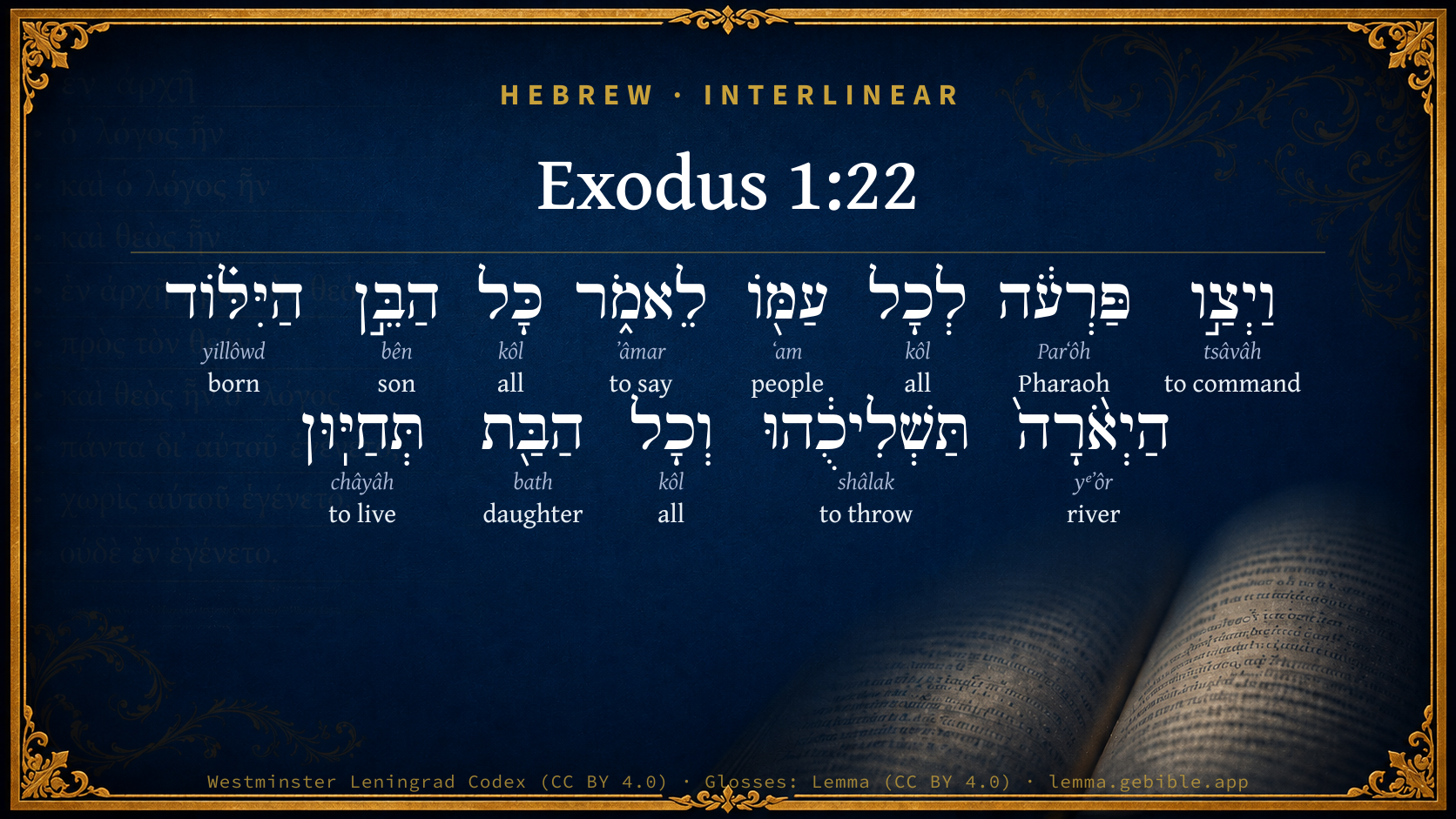
Hebrew (Westminster Leningrad Codex) Exodus 1:22 appears in the Hebrew Old Testament. The text above is from the Westminster Leningrad Codex. Each word links to its Strong’s number, a concise gloss, and parsing drawn from the Open Scriptures Hebrew Bible morphology. Click any word for its full Brown-Driver-Briggs (BDB) entry.
Download image
Cite this verse

Exodus 1:22 (World English Bible). Public Domain. Lemma interlinear Bible study tool, https://lemma.gebible.app/v/exodus/1/22.

Show BibTeX & RIS
BibTeX
RIS
English Translation
Pharaoh charged all his people, saying, "You shall cast every son who is born into the river, and every daughter you shall save alive."
World English Bible · Public Domain
Highlights
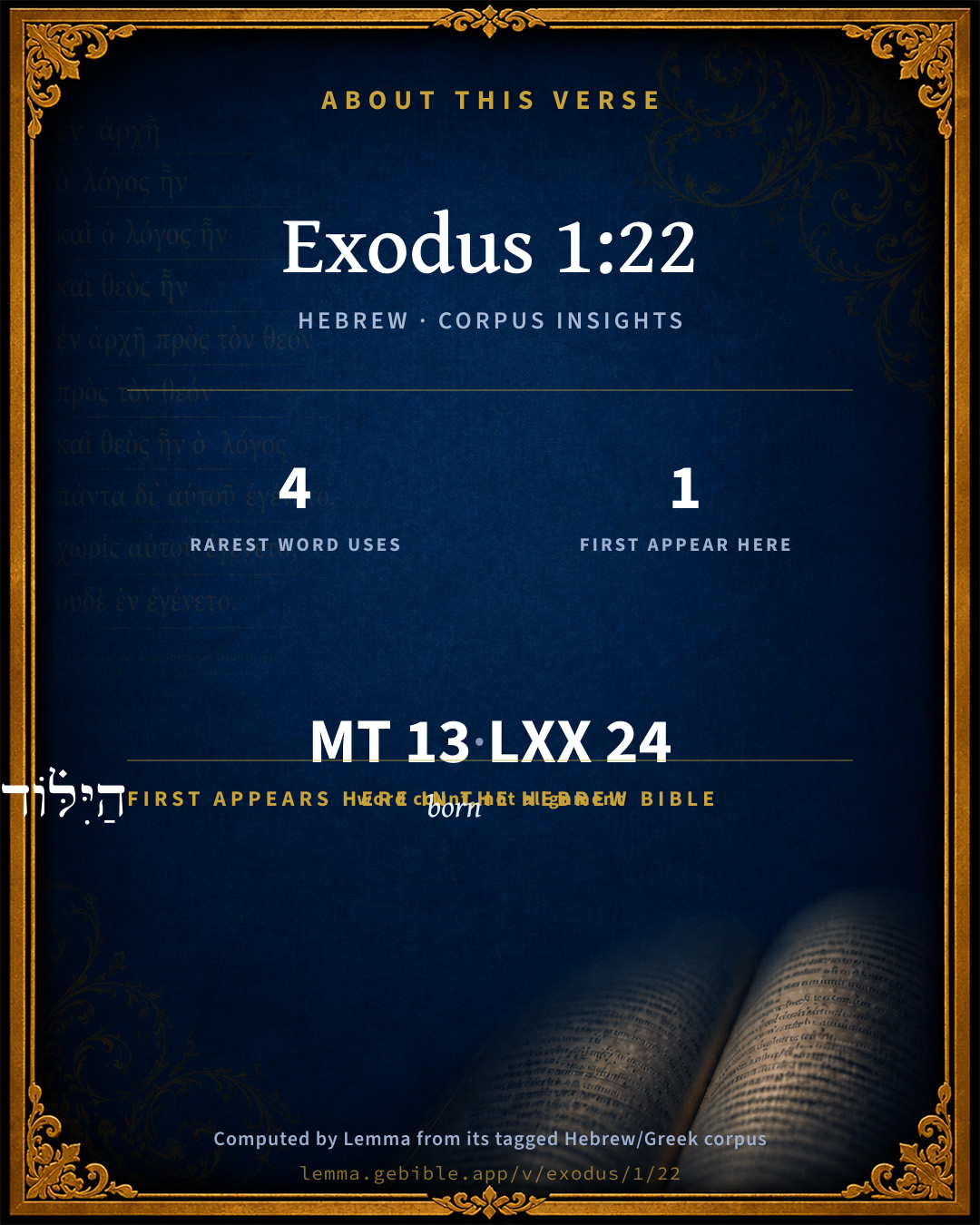
  • 1 first appearance in the Hebrew Bible
Full analysis ↓
Download a study sheet

One document with this verse’s original text, its word-by-word gloss line, the meaning frame, cross-references with their text, attributed commentary, and full source and license credits — printable, and it pastes into notes with its structure intact.

This verse Autodidact and up

Study sheet (.html) Plain text (.txt)

A passage Seminary Student

Up to 50 verses in one chapter. A passage sheet keeps up to 6 commentary sources and 12 cross-references per verse, in the order this page ranks them, and says so on the sheet whenever that leaves anything out. Ask for a single verse and you get the Autodidact verse sheet above.

Everything on this page stays free to read, with no account — the sheet is a download of what is already on screen, not access to it.

Want to remove ads? Support Godless Engineer
Compare translations 3

The same verse in 3 English versions, stacked beneath the original-language interlinear above. Click any original word for its lexicon entry.

Each is an independent rendering of the whole verse — the interlinear is not word-aligned to these translations.

Highlighted words mark where these versions differ — a whole-verse word diff, not a word-by-word alignment.

  • World English Bible Public Domain
    Pharaoh charged all his people, saying, "You shall cast every son who is born into the river, and every daughter you shall save alive."
  • King James Version Public Domain
    And Pharaoh charged all his people, saying, Every son that is born ye shall cast into the river, and every daughter ye shall save alive.
  • unfoldingWord Literal Text CC BY-SA 4.0
    And Pharaoh commanded to all of his people, saying, “You shall throw every newborn son into the river, but every daughter you shall let live.”

unfoldingWord Literal Text — © unfoldingWord, licensed CC BY-SA 4.0. Word-aligned USFM3 via Door43 (git.door43.org/unfoldingWord/en_ult).

Versions to compare (up to 4)

3 of 4 selected

Show all 18 translations

Every available English version of this verse, each an independent rendering of the whole verse.

  • World English Bible Public Domain
    Pharaoh charged all his people, saying, "You shall cast every son who is born into the river, and every daughter you shall save alive."
  • Berean Standard Bible Public Domain
    Then Pharaoh commanded all his people: “Every son born to the Hebrews you must throw into the Nile, but every daughter you may allow to live.”
  • Majority Standard Bible Public Domain
    Then Pharaoh commanded all his people: “Every son born to the Hebrews you must throw into the Nile, but every daughter you may allow to live.”
  • King James Version Public Domain
    And Pharaoh charged all his people, saying, Every son that is born ye shall cast into the river, and every daughter ye shall save alive.
  • American Standard Version (1901) Public Domain
    And Pharaoh charged all his people, saying, Every son that is born ye shall cast into the river, and every daughter ye shall save alive.
  • Revised Version (1885) Public Domain
    And Pharaoh charged all his people, saying, Every son that is born ye shall cast into the river, and every daughter ye shall save alive.
  • Geneva Bible (1599) Public Domain
    Then Pharaoh charged all his people, saying, Euery man childe that is borne, cast yee into the riuer, but reserue euery maide childe aliue.
  • Douay-Rheims (1899) Public Domain
    Pharao therefore charged all his people, saying: Whatsoever shall be born of the male sex, ye shall cast into the river: whatsoever of the female, ye shall save alive.
  • Young's Literal Translation Public Domain
    and Pharaoh layeth a charge on all his people, saying, `Every son who is born -- into the River ye do cast him, and every daughter ye do keep alive.'
  • Literal Standard Version CC BY-SA 4.0
    and Pharaoh lays a charge on all his people, saying, “Every son who is born—you cast him into the River, and every daughter you keep alive.”
  • Unlocked Literal Bible CC BY-SA 4.0
    Pharaoh ordered all his people, “You must throw every son that is born into the river, but every daughter you will let live.”
  • unfoldingWord Literal Text CC BY-SA 4.0
    And Pharaoh commanded to all of his people, saying, “You shall throw every newborn son into the river, but every daughter you shall let live.”
  • Darby Bible Public Domain
    Then Pharaoh charged all his people, saying, Every son that is born ye shall cast into the river, but every daughter ye shall save alive.
  • World Messianic Bible Public Domain
    Pharaoh commanded all his people, saying, “You shall cast every son who is born into the river, and every daughter you shall save alive.”
  • Webster's Bible Public Domain
    And Pharaoh charged all his people, saying, Every son that is born ye shall cast into the river, and every daughter ye shall save alive.
  • Free Bible Version CC BY-SA 4.0
    Then Pharaoh issued this order to all his people: “Throw every Hebrew boy that's born into the Nile, but let every girl live.”
  • Bible in Basic English Public Domain
    And Pharaoh gave orders to all his people, saying, Every son who comes to birth is to be put into the river, but every daughter may go on living.
  • JPS Tanakh (1917) Public Domain
    And Pharaoh charged all his people, saying: 'Every son that is born ye shall cast into the river, and every daughter ye shall save alive.'

Literal Standard Version (2020), Covenant Press — licensed CC BY-SA 4.0. Text via the HelloAO Bible API (eBible.org). Unlocked Literal Bible (unfoldingWord) — licensed CC BY-SA 4.0. Text via the HelloAO Bible API (eBible.org). unfoldingWord Literal Text — © unfoldingWord, licensed CC BY-SA 4.0. Word-aligned USFM3 via Door43 (git.door43.org/unfoldingWord/en_ult). Free Bible Version, Dr. Jonathan Gallagher — licensed CC BY-SA 4.0. Text via the HelloAO Bible API (eBible.org).

Word by word

More ways to search: Search by grammar → Find every occurrence → Compare this word →

Practice this passage: Drill this verse → Learn its vocabulary →

הַיִּלּ֗וֹד
yillôwd
H3209
“the · born”
Particle, Definite Article + Adjective, Adjective, Masculine, Singular, Absolute
Part of Speech
Particle + Adjective
Type
Adjective
Gender
Masculine
Number
Singular
State
Absolute
Full BDB Definition

Origin: passive from H3205

TWOT: 867d

born
  1. וַיְצַ֣ו tsâvâh H6680 “and · to command” Conjunction + Verb, Piel, Sequential Imperfect, 3rd Person, Masculine, Singular
  2. פַּרְעֹ֔ה Parʻôh H6547 “Pharaoh” Noun, Proper
  3. לְכָל kôl H3605 “to/for · all of” Preposition + Noun, Common, Masculine, Singular, Construct
  4. עַמּ֖וֹ ʻam H5971 “people · his” Noun, Common, Masculine, Singular, Construct + Suffix, Personal, 3rd Person, Masculine, Singular
  5. לֵאמֹ֑ר ʼâmar H559 “to say” Preposition + Verb, Qal, Infinitive Construct
  6. כָּל kôl H3605 “all of” Noun, Common, Masculine, Singular, Construct
  7. הַבֵּ֣ן bên H1121 “the · son” Particle, Definite Article + Noun, Common, Masculine, Singular, Absolute
  8. הַיְאֹ֨רָה֙ yᵉʼôr H2975 “the · river · toward” Particle, Definite Article + Noun, Proper + Suffix, Demonstrative
  9. תַּשְׁלִיכֻ֔הוּ shâlak H7993 “to throw · him” Verb, Hiphil, Imperfect, 2nd Person, Masculine, Plural + Suffix, Personal, 3rd Person, Masculine, Singular
  10. וְכָל kôl H3605 “and · all of” Conjunction + Noun, Common, Masculine, Singular, Construct
  11. הַבַּ֖ת bath H1323 “the · daughter” Particle, Definite Article + Noun, Common, Feminine, Singular, Absolute
  12. תְּחַיּֽוּן châyâh H2421 “to live” Verb, Piel, Imperfect, 2nd Person, Masculine, Plural + Suffix, n

About this verse

These counts appear in no published source. They are computed here, from the morphology-tagged text and Lemma’s own curated glosses. What Lemma adds →

13
words
11
distinct lemmas
Pentateuch
section

Notable vocabulary

The rarest word here is הַיִּלּ֗וֹד born H3209 — appearing just 4 times in the whole Hebrew Bible.

First appearance in Scripture

This word makes its first canonical appearance in the Hebrew Bible here:

  • הַיִּלּ֗וֹד born H3209

Shared distinctive vocabulary

הַיִּלּ֗וֹד born H3209 occurs in 4 verses of the Hebrew Bible. Also found in:

Grammatical profile

  • 4 verbs
  • 8 nouns
  • 1 adjective

Verb forms

  • וַיְצַ֣ו Piel · Sequential Imperfect
  • לֵאמֹ֑ר Qal · Infinitive Construct
  • תַּשְׁלִיכֻ֔הוּ Hiphil · Imperfect
  • תְּחַיּֽוּן Piel · Imperfect

Repetition

A word recurs within this verse — often emphatic in Hebrew:

  • לְכָל all H3605 ×3

Hebrew & Septuagint length

In English translation the verse runs 24 words from the Hebrew and 26 from the Septuagint (LXX English) — closely comparable.

A rough comparison of the two English renderings, which tokenize alike — not a word-level alignment.

Word counts can differ between the Hebrew and the Greek without any difference in meaning — e.g. the Hebrew direct-object marker אֵת has no separate Greek word, and Greek often adds the article ὁ.

In the original languages it is 13 Hebrew tokens and 24 Greek tokens — but the two are counted differently (Hebrew bundles its prefixes and suffixes into one token; the Greek is in lemma form), so that isn’t a like-for-like length.

Cross-references

9

Topical passages linked to Exodus 1:22 in the Treasury of Scripture Knowledge — connected by theme and wording, ordered by reader-vote popularity; previews shown in the World English Bible.

  • Acts 7:19 The same took advantage of our race, and mistreated our fathers, and forced them to throw out their babies, so that they wouldn't stay alive.
  • Proverbs 1:16 For their feet run to evil. They hurry to shed blood.
  • Exodus 1:16 and he said, "When you perform the duty of a midwife to the Hebrew women, and see them on the birth stool; if it is a son, then you shall kill him; but if it is a daughter, then she shall live."
  • Psalms 105:25 He turned their heart to hate his people, To conspire against his servants.
  • Proverbs 4:16 For they don't sleep, unless they do evil. Their sleep is taken away, unless they make someone fall.
  • Revelation 16:4–6 The third poured out his bowl into the rivers and springs of water, and they became blood.
  • Genesis 41:1 It happened at the end of two full years, that Pharaoh dreamed: and, behold, he stood by the river.
  • Exodus 7:19–21 Yahweh said to Moses, "Tell Aaron, 'Take your rod, and stretch out your hand over the waters of Egypt, over their rivers, over their streams, and over their pools, and over all their ponds of water, that they may become blood; and there shall be blood throughout all the land of Egypt, both in vessels of wood and in vessels of stone.'"
  • Proverbs 27:4 Wrath is cruel, And anger is overwhelming; But who is able to stand before jealousy?

Cross-references courtesy of OpenBible.info (CC BY 4.0).

Hebrew and Greek witnesses Masoretic Hebrew ↔ Greek Septuagint

The same verse in the two great witnesses to the Old Testament, shown verse-for-verse.

These are two independent witnesses, not word-aligned to each other, and the Septuagint is shown in lemma (dictionary) form.

Hebrew Exodus 1:22 Masoretic · Westminster Leningrad Codex

וַיְצַ֣ו פַּרְעֹ֔ה לְכָל עַמּ֖וֹ לֵאמֹ֑ר כָּל הַבֵּ֣ן הַיִּלּ֗וֹד הַיְאֹ֨רָה֙ תַּשְׁלִיכֻ֔הוּ וְכָל הַבַּ֖ת תְּחַיּֽוּן

Pharaoh charged all his people, saying, "You shall cast every son who is born into the river, and every daughter you shall save alive."

World English Bible · Public Domain

Greek LXX Exodus 1:22 Septuagint · lemma form

συντάσσω δέ φαραώ πᾶς ὁ λαός αὐτός λέγω πᾶς ἄρσην ὅς ἐάν τίκτω ὁ εβραῖος εἰς ὁ ποταμός ῥίπτω καί πᾶς θῆλυς ζωογονέω αὐτός

And Pharao charged all his people, saying, Whatever male child shall be born to the Hebrews, cast into the river; and every female, save it alive.

LXX2012 (modern English Septuagint) · Public Domain

On this verse, Ellicott's Commentary for English Readers discusses the Septuagint’s reading. Read the note in Commentary ↓

Hebrew: Westminster Leningrad Codex (CC BY 4.0). Greek: Septuagint (public domain); English from LXX2012 (modern English Septuagint) (Public Domain). How the Septuagint differs from the Hebrew →

Targum (Aramaic paraphrase)

2

The Targum is the ancient Jewish Aramaic paraphrase of the Hebrew Scriptures — an interpretive translation, not the Hebrew text itself. Onkelos (literal) and Pseudo-Jonathan (expansive) render the Torah, and Jonathan the Prophets. Coverage is partial: where no permissively-licensed English translation exists for a verse, only the Aramaic is shown. This is verse-level text, not a word-by-word alignment to the Hebrew.

  1. Targum Onkelos Torah (Genesis–Deuteronomy)
    וּפַקִיד פַּרְעֹה לְכָל עַמֵהּ לְמֵימָר כָּל בְּרָא דְיִתְיְלִּיד לִיהוּדָאֵי בְּנַהֲרָא תִּרְמֻנֵהּ וְכָל בְּרַתָּא תְּקַיְמוּן:

    (no public-domain English translation for this verse)

    Targum Onkelos — Aramaic: “Onkelos Genesis” (public domain); “Onkelos Exodus” (public domain); “Onkelos Leviticus” (public domain); “Onkelos Numbers” (public domain); “Onkelos Deuteronomy” (public domain). English: “Sefaria Community Translation” (CC0 1.0 (public-domain dedication)); “J.W. Etheridge. The Targums of Onkelos and Jonathan Ben Uzziel on the Pentateuch. London: Longmans, Green, 1862” (public domain). Text via Sefaria.

  2. Targum Pseudo-Jonathan Torah (Genesis–Deuteronomy)
    וְכַד חָמָא פַּרְעה כְּדֵין פַּקֵיד לְכָל עַמֵיהּ לְמֵימָר כָּל בִּיר דְכַר דְאִתְלִיד לִיהוּדָאֵי בְּנַהֲרָא תִּטְלוֹקְנֵיהּ וְכָל בְּרַתָּא תְּקַיְימוּן

    But when Pharoh saw this, he commanded all his people, saying, Every male child that is born to the Jehudaee you shall cast into the river; but every daughter you may spare.

    Targum Pseudo-Jonathan — Aramaic: “Targum Jonathan on Genesis” (public domain); “Targum Jonathan on Exodus” (public domain); “Targum Jonathan on Leviticus” (public domain); “Targum Jonathan on Numbers” (public domain); “Targum Jonathan on Deuteronomy” (public domain). English: “The Targum of Jonathan ben Uzziel, trans. J. W. Etheridge, London, 1862” (public domain). Text via Sefaria.

Commentary

Notes on Exodus 1:22 from classic Christian and Jewish commentators (each source and its license shown beneath its notes). The classic Christian expositions comment on the surrounding passage and are grouped to its opening verse, so a note may address several verses; the Jewish commentaries on the Tanakh (Rashi and others) are per-verse, so they appear only where the commentator wrote on this verse.

Lemma curates 59 commentaries, every one of them public domain or Creative Commons licensed, each selected and text-cleaned for this edition rather than reprinted as found. About our sources →

Trapp's Complete Commentary

John Trapp

Exo 1:22 And Pharaoh charged all his people, saying, Every son that is born ye shall cast into the river, and every daughter ye shall save alive.

Ver. 22. And Pharaoh charged.] Imperio non tam duro quam diro. This was a most bloody edict: therefore, when God came to make inquisition for blood, he gave them blood again to drink, for they were worthy. The like he did to Nero - qui orientem fidem primus Romae cruentavit - to {a} Julian, Valens, Valerian, Attilas, Girzerichus, Charles IX of France, and many other bloody persecutors. {See Trapp on "Rev 16:6"}

{a} Tertullian.

John Trapp, A Commentary or Exposition upon All the Books of the Old and New Testament (1647–1656) — public domain. Text from a community e-Sword module.

The Preacher's Complete Homiletical Commentary

Joseph S. Exell (gen. ed.)

MAIN HOMILETICS OF THE PARAGRAPH.—Exo_1:22

THE LAST EDICT OF A TYRANT KING

I. It was public in its proclamation.

1. How men advance from one degree of sin to another. The last murderous intention was only made known to two midwives; it was private—it was subtle. This is public; this is unconcealed; he fearlessly and untremblingly announces himself as the murderer of all the males of Israel.

II. It was cruel in its requirements.

1. It was an edict requiring the death of the young. Why should a tyrant king fear the infant sons of Israel?—He knew that they would be his enemies of the future if spared. There is a power in young life—it is the hope of the Church—the terror of despots. If the world only gets hold of the young, the Church will soon cease its growth.

SUGGESTIVE COMMENTS ON THE VERSE

Exo_1:22. A very easy plan, was it not? Whom you fear, destroy; that is a brief and easy creed, surely. This was turning the river to good account; it was a ready-made grave. Pharaoh did not charge the people to cut the sod, and lay the murdered children in the ground; the sight would have been unpleasant, the reminders would have been too numerous; he said, “Throw the intruders into the river: there will be but a splash, and the whole thing will be over. The river will carry no marks—will tell no stories—will sustain no loadstone—it will roll on as if its waters had never been divided by the hand of the murderer!” All bad kings have feared the rise of manhood. Nothing better than murder occurred to the mind of this short-sighted king. He never thought of culture, of kindness, of social and political development; his one idea of power was the shallow and vulgar idea of oppression [City Temple].

An unkingly argument used for an unkingly purpose.

Bloody powers desire to make executioners enough to destroy the Church.

Persecuting kings do not entreat, but command their people to be instruments of cruelty.

God suffers persecutors to go to the utmost of their appointed bounds.

The Preacher's Complete Homiletical Commentary (gen. ed. Joseph S. Exell; Funk & Wagnalls, c. 1892) — public domain (pre-1929). A full-Bible homiletical/sermon-outline anthology covering 65 of 66 books (2 John is absent from the source module). Text from a community e-Sword module.

Geneva Bible (1599)

Geneva Bible translators

When tyrants cannot prevail by craft, they burst forth into open rage.

Geneva Bible (1599) marginal notes — public domain. Text via Bolls.life.

Adam Clarke's Commentary

Verse 22. Ye shall cast into the river] As the Nile, which is here intended, was a sacred river among the Egyptians, it is not unlikely that Pharaoh intended the young Hebrews as an offering to his god, having two objects in view:

1. To increase the fertility of the country by thus procuring, as he might suppose, a proper and sufficient annual inundation; and

2. To prevent an increase of population among the Israelites, and in process of time procure their entire extermination.

It is conjectured, with a great show of probability, that the edict mentioned in this verse was not made till after the birth of Aaron, and that it was revoked soon after the birth of Moses; as, if it had subsisted in its rigour during the eighty-six years which elapsed between this and the deliverance of the Israelites, it is not at all likely that their males would have amounted to six hundred thousand, and those all effective men.

IN the general preface to this work reference has been made to ORIGEN'S method of interpreting the Scriptures, and some specimens promised. On the plain account of a simple matter of fact, related in the preceding chapter, this very eminent man, in his 2d Homily on Exodus, imposes an interpretation of which the following is the substance.

"Pharaoh, king of Egypt, represents the devil; the male and female children of the Hebrews represent the animal and rational faculties of the soul. Pharaoh, the devil, wishes to destroy all the males, i.e., the seeds of rationality and spiritual science through which the soul tends to and seeks heavenly things; but he wishes to preserve the females alive, i.e., all those animal propensities of man, through which he becomes carnal and devilish.

Hence," says he, "when you see a man living in luxury, banquetings, pleasures, and sensual gratifications, know that there the king of Egypt has slain all the males, and preserved all the females alive. The midwives represent the Old and New Testaments: the one is called Sephora, which signifies a sparrow, and means that sort of instruction by which the soul is led to soar aloft, and contemplate heavenly things; the other is called Phua, which signifies ruddy or bashful, and points out the Gospel, which is ruddy with the blood of Christ, spreading the doctrine of his passion over the earth. By these, as midwives, the souls that are born into the Church, are healed, for the reading of the Scriptures corrects and heals what is amiss in the mind. Pharaoh, the devil, wishes to corrupt those midwives, that all the males - the spiritual propensities, may be destroyed; and this he endeavours to do by bringing in heresies and corrupt opinions. But the foundation of God standeth sure. The midwives feared God, therefore he builded them houses. If this be taken literally, it has little or no meaning, and is of no importance; but it points out that the midwives - the law and the Gospel, by teaching the fear of God, build the houses of the Church, and fill the whole earth with houses of prayer. Therefore these midwives, because they feared God, and taught the fear of God, did not fulfil the command of the king of Egypt - they did not kill the males, and I dare confidently affirm that they did not preserve the females alive; for they do not teach vicious doctrines in the Church, nor preach up luxury, nor foster sin, which are what Pharaoh wishes in keeping the females alive; for by these virtue alone is cultivated and nourished. By Pharaoh's daughter I suppose the Church to be intended, which is gathered from among the Gentiles; and although she has an impious and iniquitous father, yet the prophet says unto her, Hearken, O daughter, and consider, incline thine ear; forget also thine own people, and thy father's house, so shall the king greatly desire thy beauty, Ps 45:10-11. This therefore is she who is come to the waters to bathe, i.e., to the baptismal font, that she may be washed from the sins which she has contracted in her father's house. Immediately she receives bowels of commiseration, and pities the infant; that is, the Church, coming from among the Gentiles, finds Moses - the law, lying in the pool, cast out, and exposed by his own people in an ark of bulrushes, daubed over with pitch - deformed and obscured by the carnal and absurd glosses of the Jews, who are ignorant of its spiritual sense; and while it continues with them is as a helpless and destitute infant; but as soon as it enters the doors of the Christian Church it becomes strong and vigorous; and thus Moses - the law, grows up, and becomes, through means of the Christian Church, more respectable even in the eyes of the Jews themselves, according to his own prophecy: I will move them to jealousy with those which are not a people; I will provoke them to anger with a foolish nation, De 32:21. Thus taught by the Christian Church, the synagogue forsakes idolatry; for when it sees the Gentiles worshipping the true God, it is ashamed of its idols, and worships them no more. In like manner, though we have had Pharaoh for our father - though the prince of this world has begotten us by wicked works, yet when we come unto the waters of baptism we take unto us Moses - the law of God, in its true and spiritual meaning; what is low or weak in it we leave, what is strong and perfect we take and place in the royal palace of our heart. Then we have Moses grown up - we no longer consider the law as little or mean; all is magnificent, excellent, elegant, for all is spiritually understood. Let us beseech the Lord Jesus Christ that he may reveal himself to us more and more and show us how great and sublime Moses is; for he by his Holy Spirit reveals these things to whomsoever he will. To him be glory and dominion for ever and ever! Amen.

Neither the praise of piety nor the merit of ingenuity can be denied to this eminent man in such interpretations as these. But who at the same time does not see that if such a mode of exposition were to be allowed, the trumpet could no longer give a certain sound? Every passage and fact might then be obliged to say something, any thing, every thing, or nothing, according to the fancy, peculiar creed, or caprice of the interpreter.

I have given this large specimen from one of the ancients, merely to save the moderns, from whose works on the sacred writings I could produce many specimens equally singular and more absurd. Reader, it is possible to trifle with the testimonies of God, and all the while speak serious things; but if all be not done according to the pattern shown in the mount, much evil may be produced, and many stumbling blocks thrown in the way of others, which may turn them totally out of the way of understanding; and then what a dreadful account must such interpreters have to give to that God who has pronounced a curse, not only on those who take away from his word, but also on those who add to it.

Adam Clarke's Commentary on the Bible (1810–1826) — public domain. Text from a community e-Sword/MySword module.

Ellicott's Commentary for English Readers

(22) Every son that is born.—The LXX. add “to the Hebrews,” but without any necessity, since the context shows that only Hebrew children are meant.

Ye shall cast into the river.—Infanticide, so shocking to Christians, has prevailed widely at different times and places, and been regarded as a trivial matter. In Sparta, the State decided which children should live and which should die. At Athens a law of Solon left the decision to the parent. At Rome, the rule was that infants were made away with, unless the father interposed, and declared it to be his wish that a particular child should be brought up. The Syrians offered unwelcome children in sacrifice to Moloch; the Carthaginians to Melkarth. In China infanticide is said to be a common practice at the present day. Heathen nations do not generally regard human life as sacred. On the contrary, they hold that considerations of expediency justify the sweeping away of any life that inconveniences the State. Hence infanticide is introduced by Plato into his model republic (Rep. v. 9). Almost all ancient nations viewed the massacre of prisoners taken in war as allowable. The Spartan crypteia was a system of licensed murder. The condemnation to death of all male Hebrew children by Pharaoh is thus in no respect improbable. On the other hand, the mode of the death presents difficulties. For, first, the Nile was viewed as a god; and to fill it with corpses would, one might have supposed, have been regarded as a pollution. Secondly, the Nile water was the only water drunk; and sanitary considerations might thus have been expected to have prevented the edict. Perhaps, however, the children were viewed as offerings to the Nile, or to Savak, the crocodile headed god, of whom each crocodile was an emblem. At any rate, as the Nile swarmed with crocodiles throughout its whole course, the bodies were tolerably sure to be devoured before they became putrescent.

A Bible Commentary for English Readers, edited by Charles John Ellicott (1878–1897) — public domain. Text from a community e-Sword module.

The Cambridge Bible for Schools and Colleges

gen. ed. J. J. S. Perowne

22. The third measure. As the midwives refused to carry out the Pharaoh’s wishes, a command to the same effect is issued to the whole people: the Egyptians themselves are to throw every male infant of the Hebrews into the Nile. The command, if fully carried out, would have resulted obviously in the extermination of the Hebrews; it is thus inconsistent with the intention expressed by the Pharaoh in v. 10 to retain them as his subjects. Perhaps the thwarted and angry king did not heed the inconsistency: perhaps inconsistent traditions have been combined by the compiler. However that may be, the measure seems calculated for a people numbering far fewer than 2,000,000 souls (among whom the birth-rate would be something like 80,000 a year1[97], i.e. more than 100 males a day), and also all living within near distance of the Nile. It is intimately connected with the narrative following (ch. 2), and indeed supplies the conditions necessary for it.

[97] The birth-rate in Cairo in 1900 was 41 per 1000 of the population.

that is born] Sam. LXX. add, to the Hebrews: in any case, a correct explanation, and perhaps part of the original text.

the river (Nile)] Heb. yĕ’ôr, from the Egyptian yoor, ‘river,’ often used of the Nile, yĕ’ôr is the regular name of the ‘Nile’ in Hebrew.

The Cambridge Bible for Schools and Colleges (gen. ed. J. J. S. Perowne; Cambridge University Press, 1878–1918) — public domain. Text from a community e-Sword module.

John Gill's Exposition

And Pharaoh charged all his people,.... Finding he could not carry his point with the midwives, he gave a general order to all his people everywhere:

saying, every son that is born ye shall cast into the river; the river Nile; not every son born in his kingdom, for this would have ruined it in time; but that was born to the Jews, as the Targums of Onkelos and Jonathan; and it is added in the Septuagint version, to the Hebrews:

and every daughter ye shall save alive; for the reasons given See Gill on Exo 1:16.

Next: Exodus Chapter 2

John Gill's Exposition of the Whole Bible (1746–1763) — public domain (CC PDM 1.0). Text via the HelloAO Bible API.

Albert Barnes' Notes on the Bible

The extreme cruelty of the measure does not involve improbability. Hatred of strangers was always a characteristic of the Egyptians (see Gen 43:32), and was likely to be stronger than ever after the expulsion of an alien race.

Albert Barnes' Notes on the Bible (1834–1885) — public domain. Text from a community e-Sword/MySword module.

Haydock's Catholic Bible Commentary

The river Nile, where the persecuting successor of this king found his end. (Haydock) --- It seems this inhuman decree was not published till after Aaron was born, and it was probably revoked soon after the birth of Moses; for if it had been rigorously put in execution, there would have been nothing but old men 80 years after, when Moses led the people out of Egypt. (Calmet) --- But perhaps even the Egyptians abhorred and refused to execute this edict. (Menochius)

George Leo Haydock (1774–1849), Haydock's Catholic Family Bible and Commentary, 1859 edition — public domain. Excludes Psalms (Douay-Rheims chapter numbering differs from Protestant) and Deuterocanonical books (Catholic canon only).

Whedon's Commentary on the Bible

Daniel D. Whedon

22. Every son… ye shall cast into the river — The Nile. This third and most sweeping edict is now promulgated, by which all Pharaoh’s subjects are commanded to become executioners of the Hebrew children. The command was so inhuman, and so contrary to the interests of the Egyptians themselves, that it is not likely that it was ever enforced for any length of time; but it gave legal opportunity to any who desired to destroy the children of Hebrew families who seemed for any reason specially dangerous. Hence the fears of the mother of Moses. This massacre has, moreover, historic parallels. When the servile class in Sparta became formidable from numbers, the Spartan youth were sent out with daggers to murder a sufficient number to remove apprehension. Diodorus relates that before the time of Psammetichus — that is, all through the Old Testament period — simple jealousy often led the Egyptian kings to put foreigners to death. And this cruel edict opened the schools and the palace of the City of the Sun to the saviour of Israel! And how we glance from the massacre of Goshen to that of Beth-lehem; from the bulrush ark to the manger; from prostrate Ra to Satan falling like lightning from heaven; from the saviour of a nation to the Saviour of a world! CONCLUDING NOTES (see book comments) Chronology of the Exodus. (1.) The period of the Israelitish sojourn in Egypt is expressly declared in Exo_12:40 to have been 430 years. This harmonizes with the prediction made to Abraham, Gen_15:13 : “Thy seed shall be a stranger in a land that is not theirs, and shall serve them; and they shall afflict them 400 years;” which language is also quoted by Stephen in his discourse in Act_7:6. But the Samaritan and Septuagint text of Exo_12:40, give a different reading, which makes the 430 years cover the whole “sojourn” of the three patriarchs, Abraham, Isaac, and Jacob, in Canaan, as well as that of the Israelites in Egypt, extending thus from the arrival of Abraham in Haran to the Exode. This would make the Egyptian sojourn only two hundred and fifteen years.

Paul follows this Sept. chronology in Gal_3:17. We have, then, what are called a long and a short chronology of the Exodus. The short period is adopted in our chronology, (Usher’s) which sets the Exode at B.C. 1491, two hundred and fifteen years after Jacob went down into Egypt. As yet we have not data for deciding with certainty between the two periods, but the census of the Israelites at the Exode is usually deemed to favour four rather than two centuries of Egyptian sojourn. To balance up authorities on this matter gives little light, and the question would seem to have been doubtful in the time of Josephus, since he expressly commits himself to both sides in the same treatise. Compare Antiq., 2:15 with Exo_2:9. See notes on Exo_12:40.

Egyptian chronology is at present so wholly unsettled that it is rash to dogmatize, and wise to wait patiently till more light comes from the monuments. The most famous Egyptologists differ from each other by centuries in regard to the date of the Exodus. As mentioned above, Usher’s date, B.C. 1491, stands in our English Bible; Poole fixes it at 1652, (Smith’s Bib. Dict., art. Chronology;) Rawlinson at 1650, (Ancient Hist., p. 61;) Wilkinson at first made Thothmes III. the Pharaoh of the Exode, about 1460, (Anc. Egypt, vol. i, pages 76-81, English Edition,) but has since decided for Pthahmen, (Meneptah I.,) of the nineteenth dynasty, who came to the throne about B.C. 1250, (Rawl., Her. App. to book ii, chap. viii;) and so Brugsch, (Hist. de l’Egypt, 1:156,) who makes Rameses II., the father of Pthahmen, to be the Pharaoh of Exodus 1. This is the view of Stanley and many others. Lepsius and Bunsen make the Exode to have taken place under the nineteenth dynasty, and Bunsen fixes about 1320 as its date. Ewald, Winer, and Knobel identify the Pharaoh of Exodus i, with Amosis of the eighteenth dynasty, as in our note. This view is learnedly defended by Canon Cook in the Speaker’s Commentary.

The whole story of the Hyksos, or Shepherd Kings, though so generally accepted, rests solely on the confused and contradictory account of the priest Manetho, who lived more than a thousand years after the alleged events, and fragments of whose work have been handed to us by Josephus and Syncellus, and hopelessly confused with fragments from another Manetho of uncertain date and authority. No trace of the Hyksos is found in the monuments so far, in Herodotus, Diodorus, or the books of Moses. Hengstenberg, Havernik, and many others, consider the whole story as a confused Egyptian legend of the Exode. Blackie, in his Homer, well sets forth this view. (Homer and the Iliad, 1:36.) (2.) חאבנים, (Exo_1:16.) The word occurs in only one other place, Jer_18:3, where it is rendered the (two) wheels, (of the potter,) in the margin, frames or seats. Five different interpretations are suggested, not noticing proposed alterations of the text, as by Furst, etc.

1. Gesenius, in Hebrews Lex., makes it the midwife’s chair, on which she sat before the woman in labour.

2. Gesenius elsewhere makes it the bath tub or trough (badewanne) in which the child was washed. So De Wette.

3. Smith’s Dict. quotes Lane’s Modern Egyptians to show that it means the chair used in aiding delivery, showing that the modern Egyptians have the same custom, and such a chair is said to be represented on the monuments of the eighteenth dynasty. Auf dem Geburts-stuhle, Van Ess. But neither of these interpretations explain the dual form.

4. Ewald interprets the word adverbially as meaning instantly, like the German, flugs; English, “on the fly.”

5. Fagius (Crit. Sacr.) follows the interpretation of J. Kimchi and others, who refer the word to the vagina, the labia uteri. Thus La Haye, (Bib. Max.,) who renders cum in ostiis vulvae prolem videritis. So Keil and Knobel, who seem to settle the question.

Daniel D. Whedon (gen. ed.), Commentary on the Old and New Testaments (1874–1909) — public domain. Text from a community e-Sword module.

The Pulpit Commentary

Every son that is born. The words are universal, and might seem to apply to the Egyptian, no less than the Hebrew, male children. But they are really limited by the context, which shows that there had never been any question as to taking the life of any Egyptian. With respect to the objection sometimes raised, that no Egyptian monarch would possibly have commanded such wholesale cold-blooded destruction of poor innocent harmless children, it is to be observed, first, that Egyptian monarchs had very little regard indeed for the lives of any persons who were not of their own nation. They constantly massacred prisoners taken in war they put to death or enslaved persons cast upon their coasts (Diod. Sic. 1:67) they cemented with the blood of their captives, as Lenormant says ("Manuel d"Hist. Anc.," vol. 1. p. 423), each stone of their edifices. The sacredness of human life was not a principle with them. Secondly, that tender and compassionate regard for children which seems to us Englishmen of the present day a universal instinct is in truth the fruit of Christianity, and was almost unknown in the ancient world. Children who were "not wanted" were constantly exposed to be devoured by wild beasts, or otherwise made away with (Dollinger, "Jew and Gentile," vol. it. p. 246); and such exposition was defended by philosophers (Plat. "Pep." 5. p. 460 c). In Syria and Carthage they were constantly offered to idols. At Rome, unless the father interposed to save it, every child was killed. It would probably not have cost an Egyptian Pharaoh a single pang to condemn to death a number of children, any more than a number of puppies. And the rule "Salus publica suprema lex," which, if not formulated, still practically prevailed, would have been held to justify anything. The river. Though, in the Delta, where the scene is laid throughout the early part of Exodus, there were many branches of the Nile, yet we hear constantly of "the river", (Exo_2:3, 5 7:20, 21 8:3, etc.) because one branch only, the Tanitic, was readily accessible. Tanks (Zoan) was situated on it.

The Pulpit Commentary (1880–1919), ed. H.D.M. Spence-Jones & Joseph S. Exell — public domain. Text from a community e-Sword module.

Keil & Delitzsch

C. F. Keil & F. Delitzsch

The failure of his second plan drove the king to acts of open violence. He issued commands to all his subjects to throw every Hebrew boy that was born into the river (i.e., the Nile). The fact, that this command, if carried out, would necessarily have resulted in the extermination of Israel, did not in the least concern the tyrant; and this cannot be adduced as forming any objection to the historical credibility of the narrative, since other cruelties of a similar kind are to be found recorded in the history of the world. Clericus has cited the conduct of the Spartans towards the helots. Nor can the numbers of the Israelites at the time of the exodus be adduced as a proof that no such murderous command can ever have been issued; for nothing more can be inferred from this, than that the command was neither fully executed nor long regarded, as the Egyptians were not all so hostile to the Israelites as to be very zealous in carrying it out, and the Israelites would certainly neglect no means of preventing its execution. Even Pharaoh's obstinate refusal to let the people go, though it certainly is inconsistent with the intention to destroy them, cannot shake the truth of the narrative, but may be accounted for on psychological grounds, from the very nature of pride and tyranny which often act in the most reckless manner without at all regarding the consequences, or on historical grounds, from the supposition not only that the king who refused the permission to depart was a different man from the one who issued the murderous edicts (cf. Exo 2:23), but that when the oppression had continued for some time the Egyptian government generally discovered the advantage they derived from the slave labour of the Israelites, and hoped through a continuance of that oppression so to crush and break their spirits, as to remove all ground for fearing either rebellion, or alliance with their foes.

Keil & Delitzsch — Biblical Commentary on the Old Testament (1861–1891) — public domain (CC PDM 1.0). Text via the HelloAO Bible API. (Old Testament only.)

Rashi

Rabbi Shlomo Yitzchaki (Rashi)

לכל עמו This may be translated AND PHARAOH GAVE COMMAND REGARDING ALL (לכל) HIS PEOPLE — Regarding them, too, he made a decree (Sotah 12a). For on the day when Moses was born his astrologers said to him, “To-day their deliverer has been born, but we know not whether he is born of an Egyptian father or of an Israelite; but we see by our astrological art that he will ultimately suffer misfortune through water”. Pharaoh therefore made a decree that day regarding the Egyptians also, as it is said here, “Every son that is born [ye shall cast into the river]”, and it is not stated “[every son] who is born to the Hebrews”. They (the astrologers), however, were not aware that Moses was ultimately to suffer misfortune through the waters of Meribah and not through the waters of the Nile (Exodus Rabbah 1:18; Sotah 12a; cf. also Rashi on Numbers 20:13).

Rashi on the Tanakh — English translations: “The Judaica Press complete Tanach with Rashi, translated by A. J. Rosenberg” (CC BY 4.0); “Pentateuch with Rashi's commentary by M. Rosenbaum and A.M. Silbermann, 1929-1934” (public domain); “The Metsudah Tanach series, Lakewood, N.J” (CC BY 4.0); and “The Book of Joshua, Metsudah Publications, 1997” (CC BY 4.0). Text via Sefaria.

Lesson kit

Teaching starters — assembled from the data on this page, not authored interpretation. Every prompt links to the verse data it draws on. Edit before teaching.

Exodus, in the Pentateuch, opens this verse with 13 words (11 distinct Hebrew lemmas). Its most distinctive word is yillôwd (“born”). A historical commentator’s framing appears above. Read the whole chapter for the surrounding context.

Discussion questions

  1. What does “born” (yillôwd) contribute to the verse as a whole?
  2. This is the first place “born” appears in Scripture (first appears here). What does its debut here establish?
  3. How does Joshua 5:5, which shares the word «born», read alongside this verse?
  4. What does the repetition of “all” (3× in this one verse) do in this verse?
  5. The translations on this page render this verse differently — a whole-verse word diff, not a word-by-word alignment. What might account for the different wordings?
  6. «וַיְצַ֣ו» is a Piel Sequential Imperfect verb. How does that grammatical form shape the action described?
  7. Compare how Trapp's Complete Commentary and The Preacher's Complete Homiletical Commentary read this verse. Where do they agree or differ?

Things to notice

Reading settings

Reading text

Shown beneath each verse's original-language words.

Old Testament
Old Testament edition

Read the OT as the Masoretic Hebrew (MT) or the Greek Septuagint (LXX).

English shown for the Greek Septuagint (in the Hebrew ↔ Greek comparison).

Comparing translations? Open the Compare panel on any verse page to stack up to four side by side.