
Joshua 8:35

Hebrew (Westminster Leningrad Codex) Joshua 8:35 appears in the Hebrew Old Testament. The text above is from the Westminster Leningrad Codex. Each word links to its Strong’s number, a concise gloss, and parsing drawn from the Open Scriptures Hebrew Bible morphology. Click any word for its full Brown-Driver-Briggs (BDB) entry.
Download image
Cite this verse

Joshua 8:35 (World English Bible). Public Domain. Lemma interlinear Bible study tool, https://lemma.gebible.app/v/joshua/8/35.

Show BibTeX & RIS
BibTeX
RIS
English Translation
There was not a word of all that Moses commanded, which Joshua didn't read before all the assembly of Israel, and the women, and the little ones, and the foreigners who were among them.
World English Bible · Public Domain
Download a study sheet

One document with this verse’s original text, its word-by-word gloss line, the meaning frame, cross-references with their text, attributed commentary, and full source and license credits — printable, and it pastes into notes with its structure intact.

This verse Autodidact and up

Study sheet (.html) Plain text (.txt)

A passage Seminary Student

Up to 50 verses in one chapter. A passage sheet keeps up to 6 commentary sources and 12 cross-references per verse, in the order this page ranks them, and says so on the sheet whenever that leaves anything out. Ask for a single verse and you get the Autodidact verse sheet above.

Everything on this page stays free to read, with no account — the sheet is a download of what is already on screen, not access to it.

Want to remove ads? Support Godless Engineer
Compare translations 3

The same verse in 3 English versions, stacked beneath the original-language interlinear above. Click any original word for its lexicon entry.

Each is an independent rendering of the whole verse — the interlinear is not word-aligned to these translations.

Highlighted words mark where these versions differ — a whole-verse word diff, not a word-by-word alignment.

  • World English Bible Public Domain
    There was not a word of all that Moses commanded, which Joshua didn't read before all the assembly of Israel, and the women, and the little ones, and the foreigners who were among them.
  • King James Version Public Domain
    There was not a word of all that Moses commanded, which Joshua read not before all the congregation of Israel, with the women, and the little ones, and the strangers that were conversant among them.
  • unfoldingWord Literal Text CC BY-SA 4.0
    There was not a word from all that Moses had commanded that Joshua did not read in front of all of the assembly of Israel, and the women, and the children, and the sojourners going in the midst of them.

unfoldingWord Literal Text — © unfoldingWord, licensed CC BY-SA 4.0. Word-aligned USFM3 via Door43 (git.door43.org/unfoldingWord/en_ult).

Versions to compare (up to 4)

3 of 4 selected

Show all 18 translations

Every available English version of this verse, each an independent rendering of the whole verse.

  • World English Bible Public Domain
    There was not a word of all that Moses commanded, which Joshua didn't read before all the assembly of Israel, and the women, and the little ones, and the foreigners who were among them.
  • Berean Standard Bible Public Domain
    There was not a word of all that Moses had commanded that Joshua failed to read before the whole assembly of Israel, including the women, the little ones, and the foreigners who lived among them.
  • Majority Standard Bible Public Domain
    There was not a word of all that Moses had commanded that Joshua failed to read before the whole assembly of Israel, including the women, the little ones, and the foreigners who lived among them.
  • King James Version Public Domain
    There was not a word of all that Moses commanded, which Joshua read not before all the congregation of Israel, with the women, and the little ones, and the strangers that were conversant among them.
  • American Standard Version (1901) Public Domain
    There was not a word of all that Moses commanded, which Joshua read not before all the assembly of Israel, and the women, and the little ones, and the sojourners that were among them.
  • Revised Version (1885) Public Domain
    There was not a word of all that Moses commanded, which Joshua read not before all the assembly of Israel, and the women, and the little ones, and the strangers that were conversant among them.
  • Geneva Bible (1599) Public Domain
    There was not a worde of all that Moses had commanded, which Ioshua read not before all the Congregation of Israel, as well before the women and the children, as the stranger that was conuersant among them.
  • Douay-Rheims (1899) Public Domain
    He left out nothing of those things which Moses had commanded, but he repeated all before all the people of Israel, with the women and children and strangers that dwelt among them.
  • Young's Literal Translation Public Domain
    there hath not been a thing of all that Moses commanded which Joshua hath not proclaimed before all the assembly of Israel, and the women, and the infants, and the sojourner who is going in their midst.
  • Literal Standard Version CC BY-SA 4.0
    there has not been a thing of all that Moses commanded which Joshua has not proclaimed before all the assembly of Israel, and the women, and the infants, and the sojourner who is going in their midst.
  • Unlocked Literal Bible CC BY-SA 4.0
    There was not one word from all that Moses commanded that Joshua did not read in front of the assembly of Israel, including the women, the little children, and the foreigners who lived among them.
  • unfoldingWord Literal Text CC BY-SA 4.0
    There was not a word from all that Moses had commanded that Joshua did not read in front of all of the assembly of Israel, and the women, and the children, and the sojourners going in the midst of them.
  • Darby Bible Public Domain
    There was not a word of all that Moses had commanded which Joshua read not before the whole congregation of Israel, and the women, and the children, and the strangers that lived among them.
  • World Messianic Bible Public Domain
    There was not a word of all that Moses commanded which Joshua didn’t read before all the assembly of Israel, with the women, the little ones, and the foreigners who were among them.
  • Webster's Bible Public Domain
    There was not a word of all that Moses commanded, which Joshua read not before all the congregation of Israel, with the women, and the little ones, and the strangers that were conversant among them.
  • Free Bible Version CC BY-SA 4.0
    Joshua read out every word of Moses' instruction to the whole Israelite assembly, including the women, the children, and the foreigners who lived among them.
  • Bible in Basic English Public Domain
    Reading to all the meeting of Israel, with the women and the children and the men from other lands who were living among them, every word of the orders which Moses had given.
  • JPS Tanakh (1917) Public Domain
    There was not a word of all that Moses commanded, which Joshua read not before all the assembly of Israel, and the women, and the little ones, and the strangers that walked among them.

Literal Standard Version (2020), Covenant Press — licensed CC BY-SA 4.0. Text via the HelloAO Bible API (eBible.org). Unlocked Literal Bible (unfoldingWord) — licensed CC BY-SA 4.0. Text via the HelloAO Bible API (eBible.org). unfoldingWord Literal Text — © unfoldingWord, licensed CC BY-SA 4.0. Word-aligned USFM3 via Door43 (git.door43.org/unfoldingWord/en_ult). Free Bible Version, Dr. Jonathan Gallagher — licensed CC BY-SA 4.0. Text via the HelloAO Bible API (eBible.org).

Word by word

More ways to search: Search by grammar → Find every occurrence → Compare this word →

Practice this passage: Drill this verse → Learn its vocabulary →

וְהַטַּ֔ף
ṭaph
H2945
“and · the · little children”
Conjunction + Particle, Definite Article + Noun, Common, Masculine, Singular, Absolute
Part of Speech
Conjunction + Particle + Noun
Type
Common
Gender
Masculine
Number
Singular
State
Absolute
Full BDB Definition

Origin: from H2952 (perhaps referring to the tripping gait of children)

TWOT: 821a

children, little children, little ones
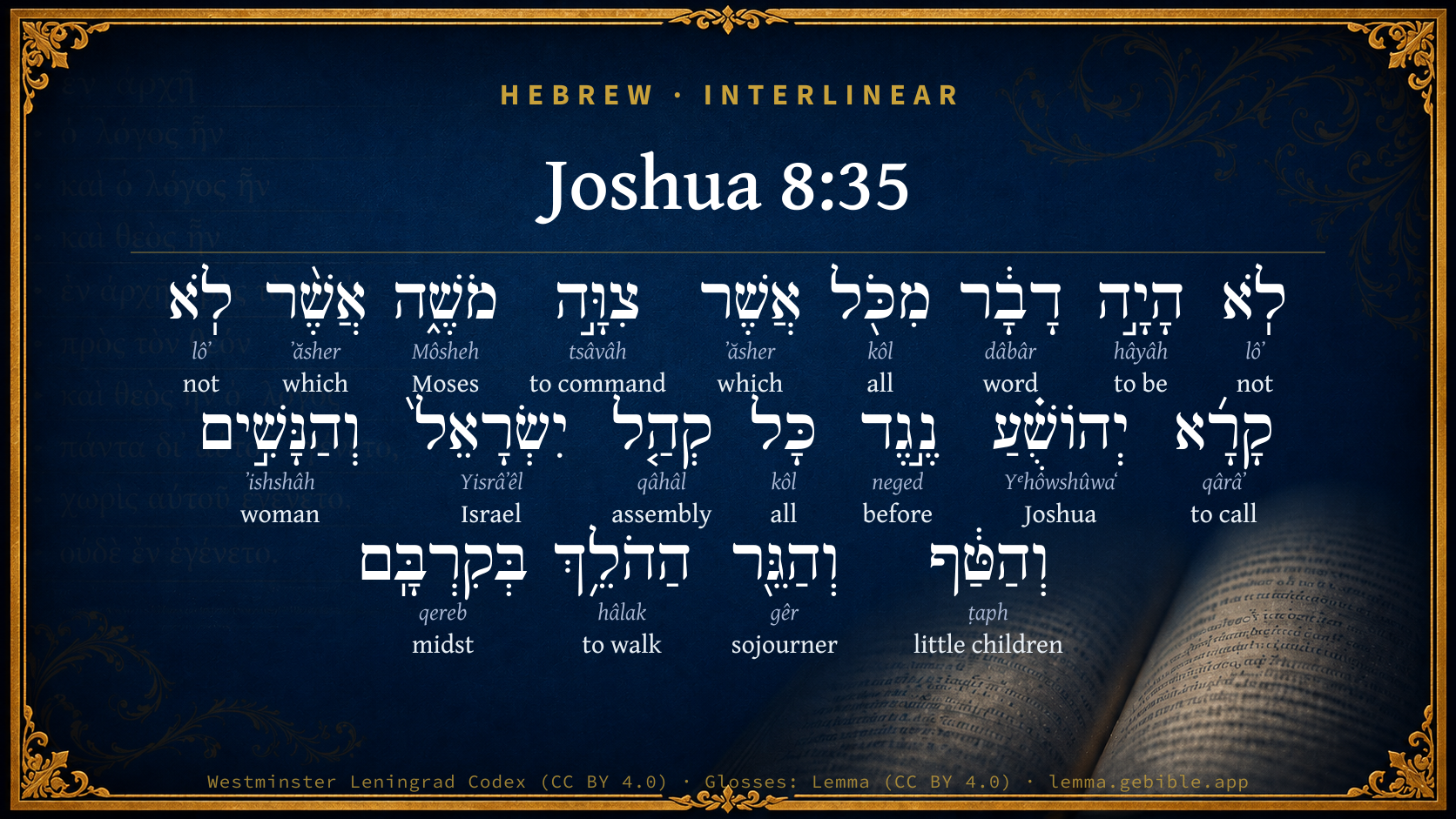
  1. לֹֽא lôʼ H3808 “not” Particle, Negative
  2. הָיָ֣ה hâyâh H1961 “to be” Verb, Qal, Perfect, 3rd Person, Masculine, Singular
  3. דָבָ֔ר dâbâr H1697 “word” Noun, Common, Masculine, Singular, Absolute
  4. מִכֹּ֖ל kôl H3605 “from · all” Preposition + Noun, Common, Masculine, Singular, Absolute
  5. אֲשֶׁר ʼăsher H834 “which” Particle, Relative
  6. צִוָּ֣ה tsâvâh H6680 “to command” Verb, Piel, Perfect, 3rd Person, Masculine, Singular
  7. מֹשֶׁ֑ה Môsheh H4872 “Moses” Noun, Proper
  8. אֲשֶׁ֨ר ʼăsher H834 “which” Particle, Relative
  9. לֹֽא lôʼ H3808 “not” Particle, Negative
  10. קָרָ֜א qârâʼ H7121 “to call” Verb, Qal, Perfect, 3rd Person, Masculine, Singular
  11. יְהוֹשֻׁ֗עַ Yᵉhôwshûwaʻ H3091 “Joshua” Noun, Proper
  12. נֶ֣גֶד neged H5048 “before” Preposition
  13. כָּל kôl H3605 “all of” Noun, Common, Masculine, Singular, Construct
  14. קְהַ֤ל qâhâl H6951 “assembly of” Noun, Common, Masculine, Singular, Construct
  15. יִשְׂרָאֵל֙ Yisrâʼêl H3478 “Israel” Noun, Proper
  16. וְהַנָּשִׁ֣ים ʼishshâh H802 “and · the · women” Conjunction + Particle, Definite Article + Noun, Common, Feminine, Plural, Absolute
  17. וְהַגֵּ֖ר gêr H1616 “and · the · sojourner” Conjunction + Particle, Definite Article + Noun, Common, Masculine, Singular, Absolute
  18. הַהֹלֵ֥ךְ hâlak H1980 “the · walking” Particle, Definite Article + Verb, Qal, Participle Active, Masculine, Singular, Absolute
  19. בְּקִרְבָּֽם qereb H7130 “in/at · midst · their” Preposition + Noun, Common, Masculine, Singular, Construct + Suffix, Personal, 3rd Person, Masculine, Plural

About this verse

These counts appear in no published source. They are computed here, from the morphology-tagged text and Lemma’s own curated glosses. What Lemma adds →

20
words
17
distinct lemmas
Historical
section

Shared distinctive vocabulary

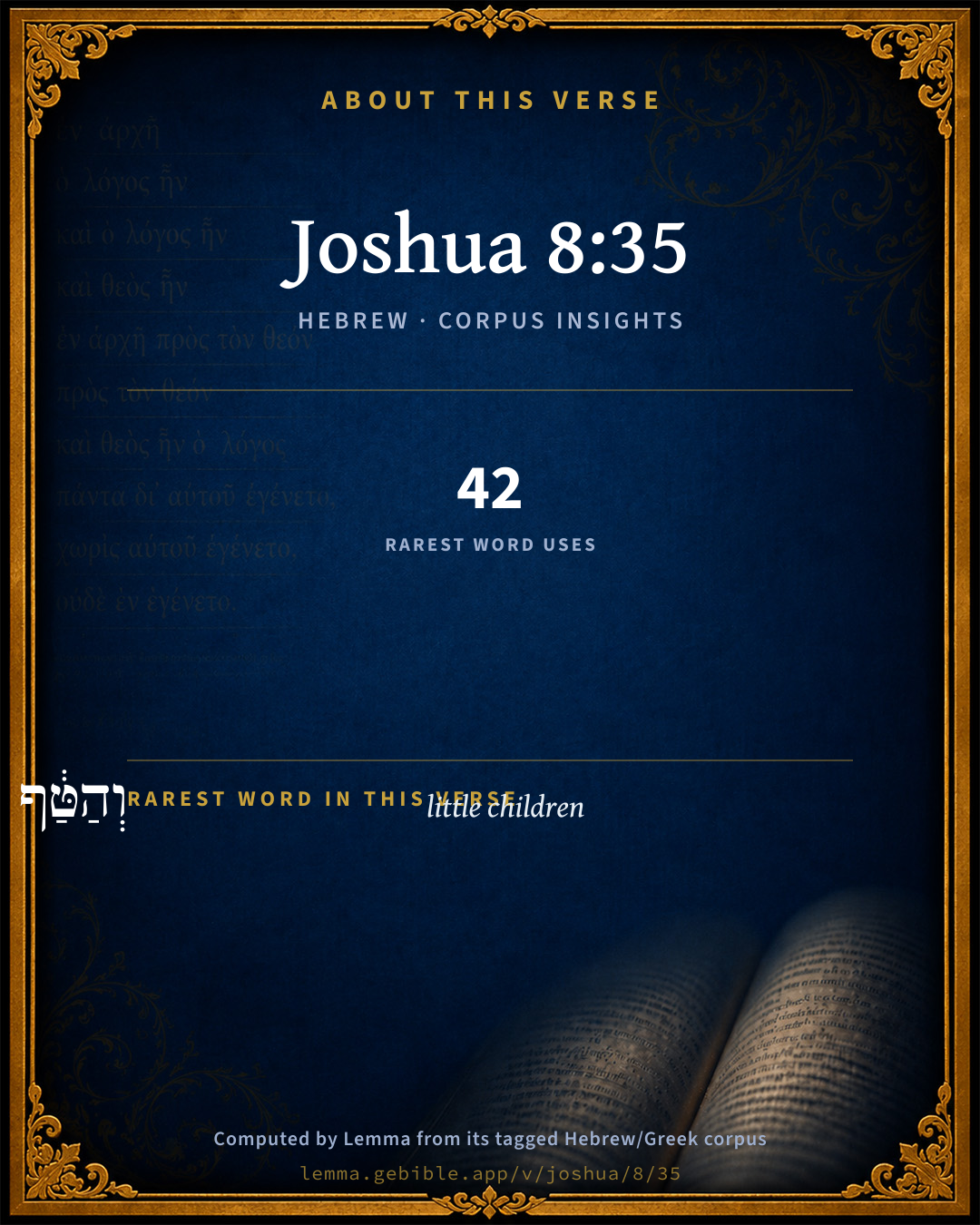
וְהַטַּ֔ף little children H2945 occurs in 42 verses of the Hebrew Bible. Also found in:

Grammatical profile

  • 4 verbs
  • 11 nouns
  • 1 preposition
  • 4 particles

Verb forms

  • הָיָ֣ה Qal · Perfect
  • צִוָּ֣ה Piel · Perfect
  • קָרָ֜א Qal · Perfect
  • הַהֹלֵ֥ךְ Qal · Participle Active

Repetition

Words recur within this verse — often emphatic in Hebrew:

  • מִכֹּ֖ל all H3605 ×2
  • לֹֽא not H3808 ×2
  • אֲשֶׁר which H834 ×2

Hebrew & Septuagint length

In English translation the verse runs 34 words from the Hebrew and 43 from the Septuagint (LXX English) — closely comparable.

A rough comparison of the two English renderings, which tokenize alike — not a word-level alignment.

Word counts can differ between the Hebrew and the Greek without any difference in meaning — e.g. the Hebrew direct-object marker אֵת has no separate Greek word, and Greek often adds the article ὁ.

Cross-references

11

Topical passages linked to Joshua 8:35 in the Treasury of Scripture Knowledge — connected by theme and wording, ordered by reader-vote popularity; previews shown in the World English Bible.

  • Deuteronomy 31:12 Assemble the people, the men and the women and the little ones, and your foreigner who is within your gates, that they may hear, and that they may learn, and fear Yahweh your God, and observe to do all the words of this law;
  • Nehemiah 8:2 Ezra the priest brought the law before the assembly, both men and women, and all who could hear with understanding, on the first day of the seventh month.
  • Jeremiah 26:2 Thus says Yahweh: Stand in the court of Yahweh's house, and speak to all the cities of Judah, which come to worship in Yahweh's house, all the words that I command you to speak to them; don't diminish a word.
  • Deuteronomy 29:11 your little ones, your wives, and your foreigner who is in the midst of your camps, from the one who cuts your wood to the one who draws your water;
  • Ezra 10:1 Now while Ezra prayed and made confession, weeping and casting himself down before the house of God, there was gathered together to him out of Israel a very great assembly of men and women and children; for the people wept very sore.
  • Joel 2:16 Gather the people. Sanctify the assembly. Assemble the elders. Gather the children, and those who suck the breasts. Let the bridegroom go forth from his room, And the bride out of her chamber.
  • Mark 10:14 But when Jesus saw it, he was moved with indignation, and said to them, "Allow the little children to come to me! Don't forbid them, for the Kingdom of God belongs to such as these.
  • Acts 21:5 When it happened that we had accomplished the days, we departed and went on our journey. They all, with wives and children, brought us on our way until we were out of the city. Kneeling down on the beach, we prayed.
  • Exodus 12:38 A mixed multitude went up also with them, with flocks, herds, and even very much cattle.
  • Deuteronomy 4:2 You shall not add to the word which I command you, neither shall you diminish from it, that you may keep the commandments of Yahweh your God which I command you.
  • Acts 20:27 for I didn't shrink from declaring to you the whole counsel of God.

Cross-references courtesy of OpenBible.info (CC BY 4.0).

Hebrew and Greek witnesses Masoretic Hebrew ↔ Greek Septuagint

The same verse in the two great witnesses to the Old Testament, shown verse-for-verse.

These are two independent witnesses, not word-aligned to each other, and the Septuagint is shown in lemma (dictionary) form.

Hebrew Joshua 8:35 Masoretic · Westminster Leningrad Codex

לֹֽא הָיָ֣ה דָבָ֔ר מִכֹּ֖ל אֲשֶׁר צִוָּ֣ה מֹשֶׁ֑ה אֲשֶׁ֨ר לֹֽא קָרָ֜א יְהוֹשֻׁ֗עַ נֶ֣גֶד כָּל קְהַ֤ל יִשְׂרָאֵל֙ וְהַנָּשִׁ֣ים וְהַטַּ֔ף וְהַגֵּ֖ר הַהֹלֵ֥ךְ בְּקִרְבָּֽם

There was not a word of all that Moses commanded, which Joshua didn't read before all the assembly of Israel, and the women, and the little ones, and the foreigners who were among them.

World English Bible · Public Domain

Greek LXX Joshua 8:35 Septuagint · lemma form
There was not a word of all that Moses charged Joshua, which Joshua read not in the ears of all the assembly of the children of Israel, the men, and the women, and the children, and the strangers that joined themselves to Israel.

LXX2012 (modern English Septuagint) · Public Domain

Hebrew: Westminster Leningrad Codex (CC BY 4.0). Greek: Septuagint (public domain); English from LXX2012 (modern English Septuagint) (Public Domain). How the Septuagint differs from the Hebrew →

Targum (Aramaic paraphrase)

1

The Targum is the ancient Jewish Aramaic paraphrase of the Hebrew Scriptures — an interpretive translation, not the Hebrew text itself. Onkelos (literal) and Pseudo-Jonathan (expansive) render the Torah, and Jonathan the Prophets. Coverage is partial: where no permissively-licensed English translation exists for a verse, only the Aramaic is shown. This is verse-level text, not a word-by-word alignment to the Hebrew.

  1. Targum Jonathan Prophets (Joshua–Malachi)
    לָא הֲוָה פִּתְגָמָא מִכָּל דִי פַקֵיד מֹשֶׁה דְלָא קְרָא יְהוֹשֻׁעַ קֳדָם כָּל קְהָלָא דְיִשְׂרָאֵל וּנְשַׁיָא וְטַפְלָא וְגִיוֹרַיָא דְאָזְלִין בֵּינֵיהוֹן:

    (no public-domain English translation for this verse)

    Targum Jonathan — Aramaic: “Mikraot Gedolot” (public domain). English: “Sefaria Community Translation” (CC0 1.0 (public-domain dedication)); “London "Chaldee Paraphrase," 1871” (public domain). Text via Sefaria.

Commentary

Notes on Joshua 8:35 from classic Christian and Jewish commentators (each source and its license shown beneath its notes). The classic Christian expositions comment on the surrounding passage and are grouped to its opening verse, so a note may address several verses; the Jewish commentaries on the Tanakh (Rashi and others) are per-verse, so they appear only where the commentator wrote on this verse.

Lemma curates 59 commentaries, every one of them public domain or Creative Commons licensed, each selected and text-cleaned for this edition rather than reprinted as found. About our sources →

Trapp's Complete Commentary

John Trapp

Jos 8:35 There was not a word of all that Moses commanded, which Joshua read not before all the congregation of Israel, with the women, and the little ones, and the strangers that were conversant among them.

Ver. 35. And the strangers.] The proselyted strangers that professed the true religion.

John Trapp, A Commentary or Exposition upon All the Books of the Old and New Testament (1647–1656) — public domain. Text from a community e-Sword module.

Tyndale Open Study Notes

Tyndale Open Resources

8:35 Old Testament religion was not just for the men of Israel; the entire assembly included the women and children. • The foreigners who lived among the Israelites included people who came out of Egypt with Israel in the Exodus (Exod 12:38, 48-49). These converts had accepted the Lord as their God and joined Israel when they saw the great things God had done for Israel.

Tyndale Open Study Notes — © Tyndale Open Resources, licensed CC BY-SA 4.0. Text via the HelloAO Bible API.

Geneva Bible (1599)

Geneva Bible translators

So neither young nor old, man nor woman, were exempted from hearing the word of the Lord.

Geneva Bible (1599) marginal notes — public domain. Text via Bolls.life.

Jamieson, Fausset & Brown

Robert Jamieson, A. R. Fausset & David Brown

There was not a word of all that Moses commanded, which Joshua read not--It appears that a much larger portion of the law was read on this occasion than the brief summary inscribed on the stones; and this must have been the essence of the law as contained in Deuteronomy (Deu 4:44; Deu 6:9; Deu 27:8). It was not written on the stones, but on the plaster. The immediate design of this rehearsal was attained by the performance of the act itself. It only related to posterity, in so far as the record of the event would be handed down in the Book of Joshua, or the documents which form the groundwork of it [HENGSTENBERG]. Thus faithfully did Joshua execute the instructions given by Moses. How awfully solemn must have been the assemblage and the occasion! The eye and the ear of the people being both addressed, it was calculated to leave an indelible impression; and with spirits elevated by their brilliant victories in the land of promise, memory would often revert to the striking scene on mounts Ebal and Gerizim, and in the vale of Sychar.

Next: Joshua Chapter 9

Jamieson, Fausset & Brown — Commentary Critical and Explanatory on the Whole Bible (1871) — public domain (CC PDM 1.0). Text via the HelloAO Bible API.

Adam Clarke's Commentary

Verse 35. With the women and the little ones] It was necessary that all should know that they were under the same obligations to obey; even the women are brought forward, not only because of their personal responsibility, but because to them was principally intrusted the education of the children. The children also witness this solemn transaction, that a salutary fear of offending God might be early, diligently, and deeply impressed upon their hearts. Thus every precaution is taken to ensure obedience to the Divine precepts, and consequently to promote the happiness of the people; for this every ordinance of God is remarkable, as he ever causes the interest and duty of his followers to go hand in hand.

1. IT may be asked, Seeing God promised to deliver Ai into the hands of the Israelites, why needed they to employ so many men and so many stratagems in order to its reduction? To this it may be answered, that God will have man to put forth the wisdom and power with which he has endued him, in every important purpose of life; that he endued him with those powers for this very end; and that it would be inconsistent with his gracious design so to help man at any time as to render the powers he had given him useless.

2. It is only in the use of lawful means that we have any reason to expect God's blessing and help. One of the ancients has remarked, "Though God has made man without himself he will not save him without himself;" and therefore man's own concurrence of will, and co-operation of power with God, are essentially necessary to his preservation and salvation. This co-operation is the grand condition, sine qua non, on which God will help or save. But is not this "endeavouring to merit salvation by our own works?" No: for this is impossible, unless we could prove that all the mental and corporeal powers which we possess came from and are of ourselves, and that we held them independently of the power and beneficence of our Creator, and that every act of these was of infinite value, to make it an equivalent for the heaven we wished to purchase. Putting forth the hand to receive the alms of a benevolent man, can never be considered a purchase-price for the bounty bestowed. For ever shall that word stand true in all its parts, Christ is the AUTHOR of eternal salvation to all them that OBEY him, Heb 5:9.

Adam Clarke's Commentary on the Bible (1810–1826) — public domain. Text from a community e-Sword/MySword module.

The Cambridge Bible for Schools and Colleges

gen. ed. J. J. S. Perowne

35. There was not a word] The acoustic properties of the valley between Ebal and Gerizim are interesting, the more so that several times they are incidentally brought before us. Comp. with this passage Jdg_9:7, “And when they told it to Jotham, he went and stood in the top of mount Gerizim, and lifted up his voice, and cried, Hearken unto me, ye men of Shechem, that God may hearken unto you.” “It is impossible to conceive a spot more admirably adapted for the purpose than this one, in the very centre of the newly acquired land, nor one which could more exactly fulfil all the required conditions. Let us imagine the chiefs and the priests gathered in the centre of the valley, the tribes stretching out as they stood in compact masses, the men of war and the heads of families, half on the north and half on the south, crowding the slopes on either side, the mixed multitude, the women and the children extending along in front till they spread into the plain beyond but still in sight: and there is no difficulty, much less impossibility in the problem. A single voice might be heard by many thousands, shut in and conveyed up and down by the enclosing hills. In the early morning we could not only see from Gerizim a man driving his ass down a path on Mount Ebal, but could hear every word he uttered, as he urged it; and in order to test the matter more certainly, on a subsequent occasion two of our party stationed themselves on opposite sides of the valley and with perfect ease recited the commandments antiphonally.” Tristram’s Land of Israel, pp. 149, 150. “The people in these mountainous countries are able, from long practice, so to pitch their voices as to be heard distinctly at distances almost incredible. They talk with persons across enormous wâdies, and give the most minute directions, which are perfectly understood; and in doing this they seem to speak very little louder than their usual tone of conversation.” Thomson’s Land and the Book, pp. 473, 474.

The Cambridge Bible for Schools and Colleges (gen. ed. J. J. S. Perowne; Cambridge University Press, 1878–1918) — public domain. Text from a community e-Sword module.

John Gill's Exposition

There was not a word of all that Moses commanded, which Joshua read not,.... So punctually, precisely, and exactly did he observe the instructions and commands that were given him by Moses; and this he did in the most public manner:

before all the congregation of Israel; who were on this occasion called together, and not before the men only, but

with the women, and little ones: who all had a concern in the things that were read to them: yea, even

and the strangers that were conversant among them; not the proselytes of righteousness only, but the proselytes of the gate, that dwelt, walked, and conversed with them.

Next: Joshua Chapter 9

John Gill's Exposition of the Whole Bible (1746–1763) — public domain (CC PDM 1.0). Text via the HelloAO Bible API.

Haydock's Catholic Bible Commentary

Repeated. Coverdale’s Bible has "Josua caused it to be proclaimed." "It is very common in Scripture to represent a person as doing that which is done by another, in his name and by his authority." (Kennicott) --- Josue might be in the midst to preside, (Calmet) or rather he would be along with the princes of the six tribes on Mount Garizim, ver. 30. (Haydock) --- Thus the covenant entered into between God and the Israelites, was solemnly ratified when the latter first entered the promised land. The greatest part of those who had been present at Horeb had perished in the wilderness. (Calmet)

George Leo Haydock (1774–1849), Haydock's Catholic Family Bible and Commentary, 1859 edition — public domain. Excludes Psalms (Douay-Rheims chapter numbering differs from Protestant) and Deuterocanonical books (Catholic canon only).

Matthew Poole's English Annotations

There was not a word which Joshua read not; therefore he read not the blessings and curses only, as some think, but the whole law, as the manner was when all Israel, men and women, were assembled together, as we read, Deu 31:10-12. That were conversant among them, i.e. who were proselytes, for no others can be supposed to be with them at this time.

Matthew Poole's English Annotations on the Holy Bible (1683–1685) — public domain. Text from a community e-Sword/MySword module.

The Pulpit Commentary

That were conversant with them. Literally, who were going in the midst of them; i.e., the strangers who had attached themselves to them, either at their departure from Egypt, or since their conquest of Eastern Palestine.

The Pulpit Commentary (1880–1919), ed. H.D.M. Spence-Jones & Joseph S. Exell — public domain. Text from a community e-Sword module.

John Wesley's Explanatory Notes

Read not - Therefore he read not the blessings and curses only, as some think, but the whole law, as the manner was when all Israel, men and women, were assembled together, or the ten commandments. Among them - Who were proselytes, for no others can be supposed to be with them at this time.

John Wesley, Explanatory Notes Upon the Whole Bible (1754–1765) — public domain. Text via the GEBible commentary corpus.

Lesson kit

Teaching starters — assembled from the data on this page, not authored interpretation. Every prompt links to the verse data it draws on. Edit before teaching.

Joshua, in the Historical, opens this verse with 20 words (17 distinct Hebrew lemmas). Its most distinctive word is ṭaph (“little children”). A historical commentator’s framing appears above. Read the whole chapter for the surrounding context.

Discussion questions

  1. How does “little children” (ṭaph) shape what this verse is saying?
  2. Genesis 34:29 shares the word «little children» with this verse. How do the two illuminate each other?
  3. “all” occurs 2× in this one verse. What is the effect of the repetition?
  4. These translations render this verse differently. What is at stake in choosing one wording over another?
  5. The verb «הָיָ֣ה» is Qal Perfect. How does its form color the action?
  6. Reading how Trapp's Complete Commentary and Tyndale Open Study Notes read this verse, where do the two commentators agree and where do they part?

Things to notice

Reading settings

Reading text

Shown beneath each verse's original-language words.

Old Testament
Old Testament edition

Read the OT as the Masoretic Hebrew (MT) or the Greek Septuagint (LXX).

English shown for the Greek Septuagint (in the Hebrew ↔ Greek comparison).

Comparing translations? Open the Compare panel on any verse page to stack up to four side by side.