
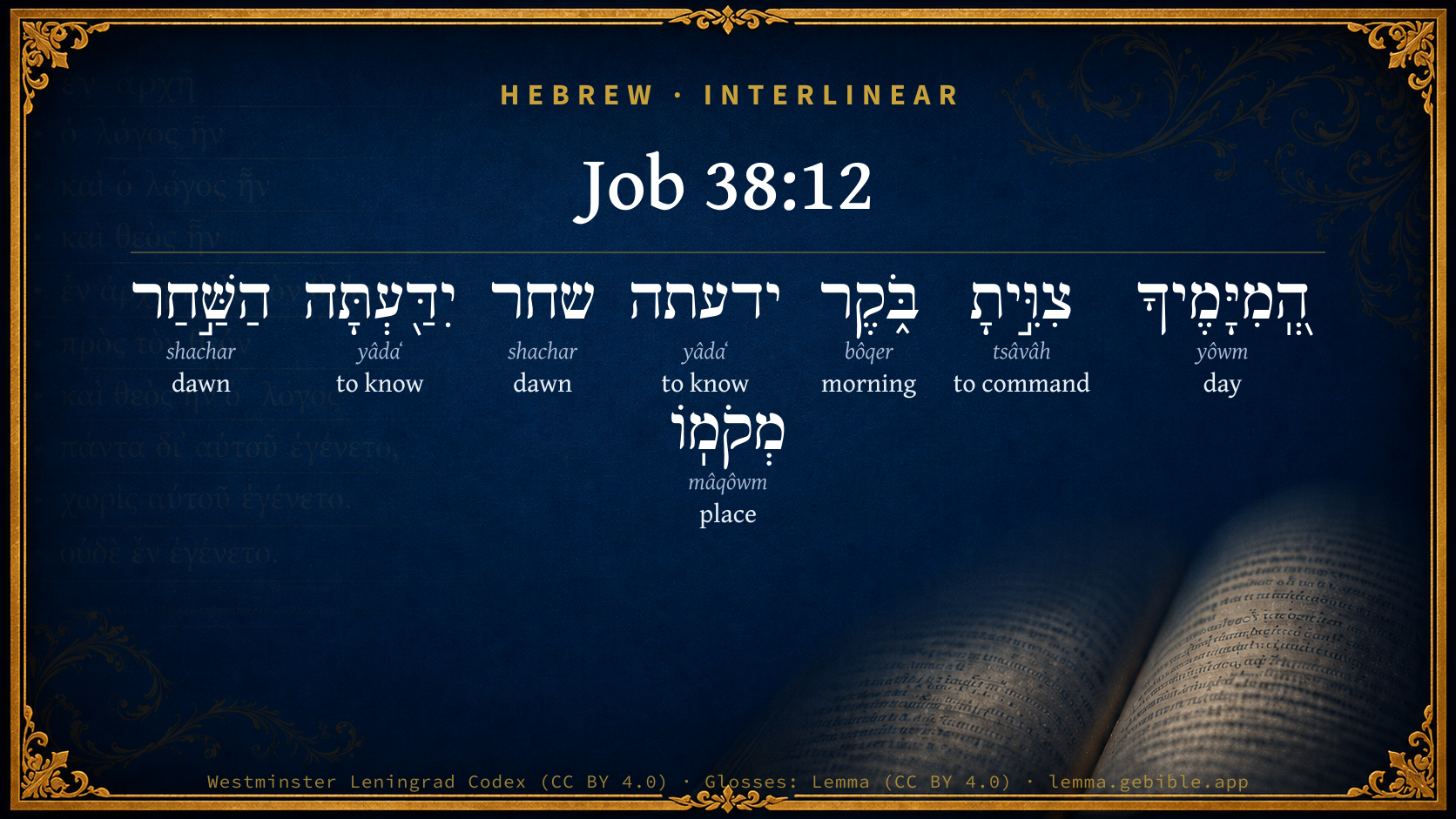
Job 38:12

Hebrew (Westminster Leningrad Codex) Job 38:12 appears in the Hebrew Old Testament. The text above is from the Westminster Leningrad Codex. Each word links to its Strong’s number, a concise gloss, and parsing drawn from the Open Scriptures Hebrew Bible morphology. Click any word for its full Brown-Driver-Briggs (BDB) entry.
Download image
Cite this verse

Job 38:12 (World English Bible). Public Domain. Lemma interlinear Bible study tool, https://lemma.gebible.app/v/job/38/12.

Show BibTeX & RIS
BibTeX
RIS
English Translation
"Have you commanded the morning in your days, And caused the dawn to know its place;
World English Bible · Public Domain
Download a study sheet

One document with this verse’s original text, its word-by-word gloss line, the meaning frame, cross-references with their text, attributed commentary, and full source and license credits — printable, and it pastes into notes with its structure intact.

This verse Autodidact and up

Study sheet (.html) Plain text (.txt)

A passage Seminary Student

Up to 50 verses in one chapter. A passage sheet keeps up to 6 commentary sources and 12 cross-references per verse, in the order this page ranks them, and says so on the sheet whenever that leaves anything out. Ask for a single verse and you get the Autodidact verse sheet above.

Everything on this page stays free to read, with no account — the sheet is a download of what is already on screen, not access to it.

Want to remove ads? Support Godless Engineer
Compare translations 3

The same verse in 3 English versions, stacked beneath the original-language interlinear above. Click any original word for its lexicon entry.

Each is an independent rendering of the whole verse — the interlinear is not word-aligned to these translations.

Highlighted words mark where these versions differ — a whole-verse word diff, not a word-by-word alignment.

  • World English Bible Public Domain
    "Have you commanded the morning in your days, And caused the dawn to know its place;
  • King James Version Public Domain
    Hast thou commanded the morning since thy days; and caused the dayspring to know his place;
  • unfoldingWord Literal Text CC BY-SA 4.0
    From your days, have you commanded the morning? Have you caused the dawn to know its place,

unfoldingWord Literal Text — © unfoldingWord, licensed CC BY-SA 4.0. Word-aligned USFM3 via Door43 (git.door43.org/unfoldingWord/en_ult).

Versions to compare (up to 4)

3 of 4 selected

Show all 18 translations

Every available English version of this verse, each an independent rendering of the whole verse.

  • World English Bible Public Domain
    "Have you commanded the morning in your days, And caused the dawn to know its place;
  • Berean Standard Bible Public Domain
    In your days, have you commanded the morning or assigned the dawn its place,
  • Majority Standard Bible Public Domain
    In your days, have you commanded the morning or assigned the dawn its place,
  • King James Version Public Domain
    Hast thou commanded the morning since thy days; and caused the dayspring to know his place;
  • American Standard Version (1901) Public Domain
    Hast thou commanded the morning since thy days `began', `And' caused the dayspring to know its place;
  • Revised Version (1885) Public Domain
    Hast thou commanded the morning since thy days began, and caused the dayspring to know its place;
  • Geneva Bible (1599) Public Domain
    Hast thou commanded the morning since thy dayes? hast thou caused the morning to knowe his place,
  • Douay-Rheims (1899) Public Domain
    Didst thou since thy birth command the morning, and shew the dawning of the day its place?
  • Young's Literal Translation Public Domain
    Hast thou commanded morning since thy days? Causest thou the dawn to know its place?
  • Literal Standard Version CC BY-SA 4.0
    Have you commanded morning since your days? Do you cause the dawn to know its place?
  • Unlocked Literal Bible CC BY-SA 4.0
    Have you given orders to the morning, or caused the dawn to know its place,
  • unfoldingWord Literal Text CC BY-SA 4.0
    From your days, have you commanded the morning? Have you caused the dawn to know its place,
  • Darby Bible Public Domain
    Hast thou since thy days commanded the morning? hast thou caused the dawn to know its place,
  • World Messianic Bible Public Domain
    “Have you commanded the morning in your days, and caused the dawn to know its place,
  • Webster's Bible Public Domain
    Hast thou commanded the morning since thy days; and caused the day-spring to know its place;
  • Free Bible Version CC BY-SA 4.0
    During your lifetime, have you ever ordered the morning to begin?
  • Bible in Basic English Public Domain
    Have you, from your earliest days, given orders to the morning, or made the dawn conscious of its place;
  • JPS Tanakh (1917) Public Domain
    Hast thou commanded the morning since thy days began, and caused the dayspring to know its place;

Literal Standard Version (2020), Covenant Press — licensed CC BY-SA 4.0. Text via the HelloAO Bible API (eBible.org). Unlocked Literal Bible (unfoldingWord) — licensed CC BY-SA 4.0. Text via the HelloAO Bible API (eBible.org). unfoldingWord Literal Text — © unfoldingWord, licensed CC BY-SA 4.0. Word-aligned USFM3 via Door43 (git.door43.org/unfoldingWord/en_ult). Free Bible Version, Dr. Jonathan Gallagher — licensed CC BY-SA 4.0. Text via the HelloAO Bible API (eBible.org).

Word by word

More ways to search: Search by grammar → Find every occurrence → Compare this word →

Practice this passage: Drill this verse → Learn its vocabulary →

About this verse

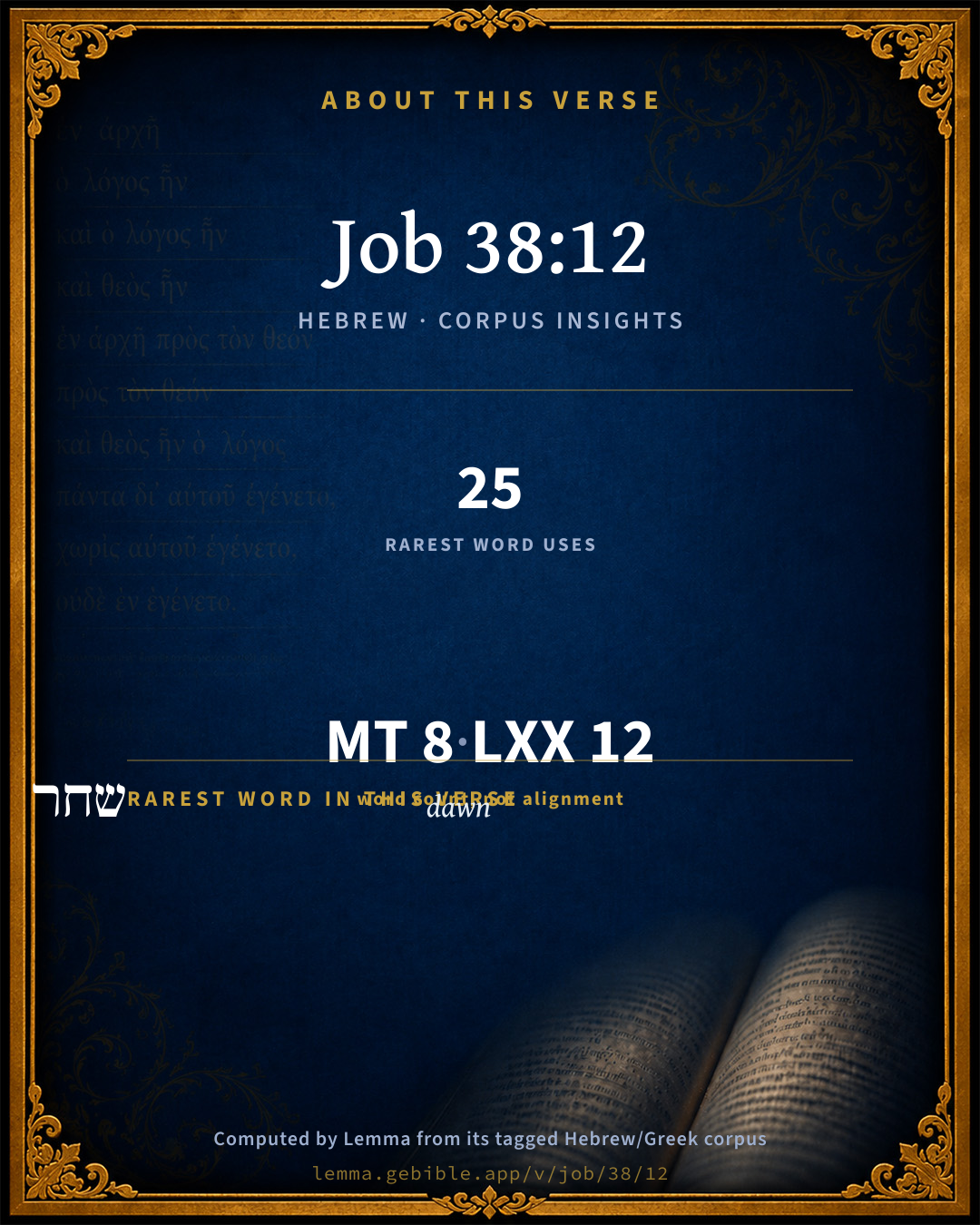
These counts appear in no published source. They are computed here, from the morphology-tagged text and Lemma’s own curated glosses. What Lemma adds →

8
words
6
distinct lemmas
Wisdom
section

Notable vocabulary

The rarest word here is שחר dawn H7837 — appearing just 25 times in the whole Hebrew Bible.

Shared distinctive vocabulary

שחר dawn H7837 occurs in 24 verses of the Hebrew Bible. Also found in:

Grammatical profile

  • 3 verbs
  • 5 nouns

Verb forms

  • צִוִּ֣יתָ Piel · Perfect
  • ידעתה Piel · Perfect
  • יִדַּ֖עְתָּה Piel · Perfect

Repetition

Words recur within this verse — often emphatic in Hebrew:

  • ידעתה to know H3045 ×2
  • שחר dawn H7837 ×2

Hebrew & Septuagint length

In English translation the verse runs 16 words from the Hebrew and 21 from the Septuagint (LXX English) — closely comparable.

A rough comparison of the two English renderings, which tokenize alike — not a word-level alignment.

Word counts can differ between the Hebrew and the Greek without any difference in meaning — e.g. the Hebrew direct-object marker אֵת has no separate Greek word, and Greek often adds the article ὁ.

In the original languages it is 8 Hebrew tokens and 12 Greek tokens — but the two are counted differently (Hebrew bundles its prefixes and suffixes into one token; the Greek is in lemma form), so that isn’t a like-for-like length.

Cross-references

10

Topical passages linked to Job 38:12 in the Treasury of Scripture Knowledge — connected by theme and wording, ordered by reader-vote popularity; previews shown in the World English Bible.

  • Psalms 74:16 The day is yours, the night is also yours. You have prepared the light and the sun.
  • Psalms 148:3–5 Praise him, sun and moon! Praise him, all you shining stars!
  • Genesis 1:5 God called the light Day, and the darkness he called Night. There was evening and there was morning, one day.
  • Job 8:9 (For we are but of yesterday, and know nothing, Because our days on earth are a shadow.)
  • Psalms 136:7–8 To him who made the great lights; For his loving kindness endures forever:
  • Luke 1:78 Because of the tender mercy of our God, Whereby the dawn from on high will visit us,
  • 2 Peter 1:19 We have the more sure word of prophecy; whereunto you do well that you take heed, as to a lamp shining in a dark place, until the day dawns, and the day star arises in your hearts:
  • Job 15:7 "Are you the first man who was born? Or were you brought forth before the hills?
  • Job 38:21 Surely you know, for you were born then, And the number of your days is great!
  • Job 38:4 "Where were you when I laid the foundations of the earth? Declare, if you have understanding.

Cross-references courtesy of OpenBible.info (CC BY 4.0).

Hebrew and Greek witnesses Masoretic Hebrew ↔ Greek Septuagint

The same verse in the two great witnesses to the Old Testament, shown verse-for-verse.

These are two independent witnesses, not word-aligned to each other, and the Septuagint is shown in lemma (dictionary) form.

Hebrew Job 38:12 Masoretic · Westminster Leningrad Codex

הְֽ֭מִיָּמֶיךָ צִוִּ֣יתָ בֹּ֑קֶר ידעתה שחר יִדַּ֖עְתָּה הַשַּׁ֣חַר מְקֹמֽוֹ

"Have you commanded the morning in your days, And caused the dawn to know its place;

World English Bible · Public Domain

Greek LXX Job 38:12 Septuagint · lemma form

ἦ ἐπί σύ συντάσσω φέγγος πρωινός ἑωσφόρος δέ ὁράω ὁ ἑαυτοῦ τάξις

Or did I order the morning light in your time; and did the morning star then first see his appointed place;

LXX2012 (modern English Septuagint) · Public Domain

Hebrew: Westminster Leningrad Codex (CC BY 4.0). Greek: Septuagint (public domain); English from LXX2012 (modern English Septuagint) (Public Domain). How the Septuagint differs from the Hebrew →

Commentary

Notes on Job 38:12 from classic Christian and Jewish commentators (each source and its license shown beneath its notes). The classic Christian expositions comment on the surrounding passage and are grouped to its opening verse, so a note may address several verses; the Jewish commentaries on the Tanakh (Rashi and others) are per-verse, so they appear only where the commentator wrote on this verse.

Lemma curates 59 commentaries, every one of them public domain or Creative Commons licensed, each selected and text-cleaned for this edition rather than reprinted as found. About our sources →

Matthew Henry's Commentary

The Lord here proceeds to ask Job many puzzling questions, to convince him of his ignorance, and so to shame him for his folly in prescribing to God. If we will but try ourselves with such interrogatories as these, we shall soon be brought to own that what we know is nothing in comparison with what we know not. Job is here challenged to give an account of six things: -

I. Of the springs of the morning, the day-spring from on high, Job 38:12-15. As there is no visible being of which we may be more firmly assured that it is, so there is none which we are more puzzled in describing, nor more doubtful in determining what it is, than the light. We welcome the morning, and are glad of the day-spring; but, 1. It is not commanded since our days, but what it is it was long before we were born, so that it was neither made by us nor designed primarily for us, but we take it as we find it and as the many generations had it that went before us. The day-spring knew its place before we knew ours, for we are but of yesterday. 2. It was not we, it was not any man that commanded the morning-light at first, or appointed the place of its springing up and shining forth, or the time of it. The constant and regular succession of day and night was no contrivance of ours; it is the glory of God that it shows, and his handy work, not ours, Psa 19:1, Psa 19:2. 3. It is quite out of our power to alter this course: "Hast thou countermanded the morning since thy days? Hast thou at any time raised the morning light sooner than its appointed time, to serve thy purpose when thou hast waited for the morning, or ordered the day-spring for thy convenience to any other place than its own? No, never. Why then wilt thou pretend to direct the divine counsels, or expect to have the methods of Providence altered in favour of thee?" We may as soon break the covenant of the day and of the night as any part of God's covenant with his people, and particularly this, I will chasten them with the rod of men. 4. It is God that has appointed the day-spring to visit the earth, and diffuses the morning light through the air, which receives it as readily as the clay does the seal (Job 38:14), immediately admitting the impressions of it, so as of a sudden to be all over enlightened by it, as the seal stamps its image on the wax; and they stand as a garment, or as if they were clothed with a garment. The earth puts on a new face every morning, and dresses itself as we do, puts on light as a garment, and is then to be seen. 5. This is made a terror to evil-doers. Nothing is more comfortable to mankind than the light of the morning; it is pleasant to the eyes, it is serviceable to life and the business of it, and the favour of it is universally extended, for it takes hold of the ends of the earth (Job 38:13), and we should dwell, in our hymns to the light, on its advantages to the earth. But God here observes how unwelcome it is to those that do evil, and therefore hate the light. God makes the light a minister of his justice as well as of his mercy. It is designed to shake the wicked out of the earth, and for that purpose it takes hold of the ends of it, as we take hold of the ends of a garment to shake the dust and moths out of it. Job had observed what a terror the morning light is to criminals, because it discovers them (Job 24:13, etc.), and God here seconds the observation, and asks him whether the world was indebted to him for that kindness? No, the great Judge of the world sends forth the beams of the morning light as his messengers to detect criminals, that they may not only be defeated in their purposes and put to shame, but that they may be brought to condign punishment (Job 38:15), that their light may be withholden from them (that is, that they may lose their comfort, their confidence, their liberties, their lives) and that their high arm, which they have lifted up against God and man, may be broken, and they deprived of their power to do mischief. Whether what is here said of the morning light was designed to represent, as in a figure, the light of the gospel of Christ, and to give a type of it, I will not say; but I am sure it may serve to put us in mind of the encomiums given to the gospel just at the rising of its morning-star by Zecharias in his Benedictus (Luk 1:78, By the tender mercy of our God the day-spring from on high has visited us, to give light to those that sit in darkness, whose hearts are turned to it as clay to the seal, Co2 4:6), and by the virgin Mary in her Magnificat (Luk 1:51), showing that God, in his gospel, has shown strength with his arm, scattered the proud, and put down the mighty, by that light by which he designed to shake the wicked, to shake wickedness itself out of the earth, and break its high arm.

II. Of the springs of the sea (Job 38:16): "Hast thou entered into them, or hast thou walked in the search of the depth? Knowest thou what lies in the bottom of the sea, the treasures there hidden in the sands? Or canst thou give an account of the rise and original of the waters of the sea? Vapours are continually exhaled out of the sea. Dost thou know how the recruits are raised by which it is continually supplied? Rivers are constantly poured into the sea. Dost thou know how they are continually discharged, so as not to overflow the earth? Art thou acquainted with the secret subterraneous passages by which the waters circulate?" God's way in the government of the world is said to be in the sea, and in the great waters (Psa 77:19), intimating that it is hidden from us and not to be pried into by us.

III. Of the gates of death: Have these been open to thee? Job 38:16. Death is a grand secret. 1. We know not beforehand when, and how, and by what means, we or others shall be brought to death, by what road we must go the way whence we shall not return, what disease or what disaster will be the door to let us into the house appointed for all living. Man knows not his time. 2. We cannot describe what death is, how the knot is untied between body and soul, nor how the spirit of a man goes upward (Ecc 3:21), to be we know not what and live we know not how, as Mr. Norris expresses; with what dreadful curiosity (says he) does the soul launch out into the vast ocean of eternity and resign to an untried abyss! Let us make it sure that the gates of heaven shall be opened to us on the other side death, and then we need not fear the opening of the gates of death, though it is a way we are to go but once. 3. We have no correspondence at all with separate souls, nor any acquaintance with their state. It is an unknown undiscovered region to which they are removed; we can neither hear from them nor send to them. While we are here, in a world of sense, we speak of the world of spirits as blind men do of colours, and when we remove thither we shall be amazed to find how much we are mistaken.

IV. Of the breadth of the earth (Job 38:18): Hast thou perceived that? The knowledge of this might seem most level to him and within his reach; yet he is challenged to declare this if he can. We have our residence on the earth, God has given it to the children of men. But who ever surveyed it, or could give an account of the number of its acres? It is but a point to the universe? yet, small as it is, we cannot be exact in declaring the dimensions of it. Job had never sailed round the world, nor any before him; so little did men know the breadth of the earth that it was but a few ages ago that the vast continent of America was discovered, which had, time out of mind, lain hidden. The divine perfection is longer than the earth and broader than the sea; it is therefore presumption for us, who perceive not the breadth of the earth, to dive into the depth of God's counsels.

V. Of the place and way of light and darkness. Of the day-spring he had spoken before (Job 38:12) and he returns to speak of it again (Job 38:19): Where is the way where light dwells? And again (Job 38:24): By what way is the light parted? He challenges him to describe, 1. How the light and darkness were at first made. When God, in the beginning, first spread darkness upon the face of the deep, and afterwards commanded the light to shine out of darkness, by that mighty word, Let there be light, was Job a witness to the order, to the operation? can he tell where the fountains of light and darkness are, and where those mighty princes keep their courts distance, while in one world they rule alternately? Though we long ever so much either for the shining forth of the morning or the shadows of the evening, we know not whither to send, or go, to fetch them, nor can tell the paths to the house thereof, Job 38:20. We were not then born, nor is the number of our days so great that we can describe the birth of that first-born of the visible creation, Job 38:21. Shall we then undertake to discourse of God's counsels, which were from eternity, or to find out the paths to the house thereof, to solicit for the alteration of them? God glories in it that he forms the light and creates the darkness; and if we must take those as we find them, take those as they come, and quarrel with neither, but make the best of both, then we must, in like manner, accommodate ourselves to the peace and the evil which God likewise created. Isa 45:7. 2. How they still keep their turns interchangeably. It is God that makes the outgoings of the morning and of the evening to rejoice (Psa 65:8); for it is his order, and no order of ours, that is executed by the outgoings of the morning light and the darkness of the night. We cannot so much as tell whence they come nor whither they go (Job 38:24): By what way is the light parted in the morning, when, in an instant, it shoots itself into all the parts of the air above the horizon, as if the morning light flew upon the wings of an east wind, so swiftly, so strongly, is it carried, scattering the darkness of the night, as the east wind does the clouds? Hence we read of the wings of the morning (Psa 139:9), on which the light is conveyed to the uttermost parts of the sea, and scattered like an east wind upon the earth. It is a marvellous change that passes over us every morning by the return of the light and every evening by the return of the darkness; but we expect them, and so they are no surprise nor uneasiness to us. If we would, in like manner, reckon upon changes in our outward condition, we should neither in the brightest noon expect perpetual day nor in the darkest midnight despair of the return of the morning. God has set the one over against the other, like the day and night; and so must we, Ecc 7:14.

VI. Of the treasures of the snow and hail (Job 38:22, Job 38:23): "Hast thou entered into these and taken a view of them?" In the clouds the snow and hail are generated, and thence they come in such abundance that one would think there were treasures of them laid up in store there, whereas indeed they are produced extempore - suddenly, as I may say, and pro re nata - for the occasion. Sometimes they come so opportunely, to serve the purposes of Providence, in God's fighting for his people and against his and their enemies, that one would think they were laid up as magazines, or stores of arms, ammunition, and provisions, against the time of trouble, the day of battle and war, when God will either contend with the world in general (as in the deluge, when the windows of heaven were opened, and the waters fetched out of these treasures to drown a wicked world, that waged war with Heaven) or with some particular persons or parties, as when God out of these treasures fetched great hail-stones wherewith to fight against the Canaanites, Jos 10:11. See what folly it is to strive against God, who is thus prepared for battle and war, and how much it is our interest to make our peace with him and to keep ourselves in his love. God can fight as effectually with snow and hail, if he please, as with thunder and lightning or the sword of an angel!

Matthew Henry's Commentary on the Whole Bible (1708–1710) — public domain (CC PDM 1.0). Text via the HelloAO Bible API.

Trapp's Complete Commentary

John Trapp

Job 38:12 Hast thou commanded the morning since thy days; [and] caused the dayspring to know his place;

Ver. 12. Hast thou commanded the morning since thy days] It may be thou wilt say, These are ancient things, done long before I was born; but ask me of things within my reach and remembrance. Well, then, what sayest thou to the sunrising? Hast thou either lengthened or hastened it at any time since thou wert born, causing it to rise at such or such an hour, in such or such a point of heaven, according to the various degrees and situations of the zodiac? No; this is more than ever any man could do. "The day is thine, the night also is thine," saith David: "thou hast prepared the light and the sun. Thou hast set all the borders of the earth: thou hast made summer and winter," Psa 74:16-17. If all the emperors and potentates of the earth should conjoin their threes to hinder or hasten the rising of the sun, they could never do it. Joshua did indeed stop the course of the sun; but that was by the power of God set awork by his faithful prayer; whence one crieth out, O admirabilem piarum precum vim ac poteutiam, quibus etiam coelestia cedunt! Oh the admirable power of prayer, force of faith, which is such as the visible heavens are sensible of, and giveth way to! how then should earth or hell stand before it?

And caused the dayspring to know his place] The word dayspriug comes from blackness; for it is not ηως ηνοδακτυλος, clear light at first; but κροκοπεπλος, rather dark than light, Aurora sic a nigrore dicta qui eam comitatur.

John Trapp, A Commentary or Exposition upon All the Books of the Old and New Testament (1647–1656) — public domain. Text from a community e-Sword module.

Joseph Benson's Commentary

Job 38:12-13. Hast thou commanded the morning? — That is, the morning light, or the sun, which is the cause of it. Didst thou create the sun, and appoint the order and succession of day and night. Since thy days — Since thou wast born: this work was done long before thou wast born. And caused the day-spring to know its place — To observe the punctual time when, and the point of the heavens where it should arise; which varies every day. That it might take hold of the ends of the earth — That this morning light should in a moment spread itself from one end of the hemisphere to the other. That the wicked might be shaken out of it — From the face of the earth. And this effect the morning light hath upon the wicked, because it discovers them, whereas darkness hides them; and because it brings them to condign punishment, the morning being the usual time for executing judgment.

Joseph Benson's Commentary on the Old and New Testaments (1811–1818) — public domain. Text from a community e-Sword module.

Whedon's Commentary on the Bible

Daniel D. Whedon

c. If so be Job was not in being when the foundations of the world were laid, perhaps he has, during his short life, shown his power and skill in carrying on the works of nature; has, at least once, spread forth upon the earth the light of the morn, causing the aurora to know its place; and thereby, to a certain extent, wielded the moral government of the world, Job_38:12-15.

12. Hast thou commanded the morning — “A morning,” בקר. Since the creation of the earth God has, uncounted times, commanded the morning to arise at its time; has Job since his birth (literally “from thy days”) commanded one morning to break (bakar) the darkness of the night.

Dayspring — This word (שׁחר) is rendered “day,” Job_3:9, on which see note.

To know his place — “This seems to refer to the different points in which daybreak appears during the course of the earth’s revolution in its orbit; and which variety of points of appearing depends on this annual revolution. For as the earth goes round the sun every year in the ecliptic, one half of which is on the north side of the equinoctial, and the other half on its south side, the sun appears to change its place every day.” (A. Clarke.) The aurora changes its place according to unerring law, in march and countermarch so exact, that like an intelligent being, it may be said from long association to “know its place.” See note on Job_7:10. Perhaps the so great knowledge of Job may have been by some means communicated to the fleeting, insubstantial, but beauteous, morn, (Shahhar, to shine,) so that, like him, it deviates not from the right, though it may constantly remove its place!! As respects processes of nature, the Semitic mind, from its earliest records, manifested implicit faith in their permanence, for the obvious reason that they are but the out-goings of the Divine Being, (Psa_65:8-11;) so much so that even the dawn stands as an abiding emblem of the divine faithfulness, for, “His rising is fixed [nakon,] like the morning dawn.” Hos_6:3. See note, Job_42:7. On the other hand, to the early Aryan mind everything in nature was fanciful and capricious. “The Titanic assurance with which we [Aryans, enlightened by a divine revelation] say the sun must rise, was unknown to the early worshippers of nature.… It seems to us childish when we read in the Veda such expressions as ‘Will the sun rise?’ ‘Will our old friend, the dawn, come back again?’ ‘Will the power of darkness be conquered by the God of light?’” MAX MULLER — Chips, etc., 2:93-100.

Daniel D. Whedon (gen. ed.), Commentary on the Old and New Testaments (1874–1909) — public domain. Text from a community e-Sword module.

Geneva Bible (1599)

Geneva Bible translators

To wit, to rise, since thou wast born?

Geneva Bible (1599) marginal notes — public domain. Text via Bolls.life.

Jamieson, Fausset & Brown

Robert Jamieson, A. R. Fausset & David Brown

Passing from creation to phenomena in the existing inanimate world.

Hast thou--as God daily does.

commanded the morning--to rise.

since thy days--since thou hast come into being.

his place--It varies in its place of rising from day to day, and yet it has its place each day according to fixed laws.

Jamieson, Fausset & Brown — Commentary Critical and Explanatory on the Whole Bible (1871) — public domain (CC PDM 1.0). Text via the HelloAO Bible API.

Adam Clarke's Commentary

Verse 12. Hast thou commanded the morning] This refers to dawn or morning twilight, occasioned by the refraction of the solar rays by means of the atmosphere; so that we receive the light by degrees, which would otherwise burst at once upon our eyes, and injure, if not destroy, our sight; and by which even the body of the sun himself becomes evident several minutes before he rises above the horizon.

Caused the dayspring to know his place] This seems to refer to the different points in which daybreak appears during the course of the earth's revolution in its orbit; and which variety of points of appearing depends on this annual revolution. For, as the earth goes round the sun every year in the ecliptic, one half of which is on the north side of the equinoctial, and the other half on its south side, the sun appears to change his place every day. These are matters which the wisdom of God alone could plan, and which his power alone could execute.

It may be just necessary to observe that the dawn does not appear, nor the sun rise exactly in the same point of the horizon, two successive days in the whole year, as he declines forty-three degrees north, and forty-three degrees south, of east; beginning on the 21st of March, and ending on the 22d of December; which variations not only produce the places of rising and setting, but also the length of day and night. And by this declination north and south, or approach to and recession from the tropics of Cancer and Capricorn, the solar light takes hold of the ends of the earth, Job 38:13, enlightens the arctic and antarctic circles in such a way as it would not do were it always on the equinoctial line; these tropics taking the sun twenty-three and a half degrees north, and as many south, of this line.

Adam Clarke's Commentary on the Bible (1810–1826) — public domain. Text from a community e-Sword/MySword module.

Ellicott's Commentary for English Readers

(12) And caused the dayspring to know his place.—Changing, as it does, from day to day with the changing seasons.

A Bible Commentary for English Readers, edited by Charles John Ellicott (1878–1897) — public domain. Text from a community e-Sword module.

The Cambridge Bible for Schools and Colleges

gen. ed. J. J. S. Perowne

12. since thy days] i. e. since thou wast born, all thy life. The question, naturally, implies the other query, whether Job be coeval with the dawn?

the dayspring] i. e. the dawn.

12–15. The dawn that daily overspreads the earth.

The Cambridge Bible for Schools and Colleges (gen. ed. J. J. S. Perowne; Cambridge University Press, 1878–1918) — public domain. Text from a community e-Sword module.

John Gill's Exposition

Hast thou commanded the morning since thy days;.... Job had lived to see many a morning, but it never was in his power to command one; he had been in such circumstances as to wish for morning light before it was, but was obliged to wait for it, could not hasten it, or cause it to spring before its time; see Job 7:3; one of the Targums is,

"wast thou in the days of the first creation, and commandedst the morning to be?''

he was not, God was; he was before the first morning, and commanded it into being, Gen 1:3;

and caused the dayspring to know his place; the first spring of light or dawn of day; which though it has a different place every day in the year, as the sun ascends or descends in the signs of the Zodiac, yet it knows and observes its exact place, being taught of God.

John Gill's Exposition of the Whole Bible (1746–1763) — public domain (CC PDM 1.0). Text via the HelloAO Bible API.

Albert Barnes' Notes on the Bible

Hast thou commanded the morning since thy days - That is, in thy lifetime hast thou ordered the light of the morning to shine, and directed its beams over the world? God appeals to this as one of the proofs of his majesty and power - and who can look upon the spreading light of the morning and be insensible to the force and beauty of the appeal? The transition from the ocean to the morning may have been partly because the light of the morning is one of the striking exhibitions of the power of God, and partly because in the creation of the world the light of the sun was made to dawn soon after the gathering together of the waters into seas; see Gen 1:10, Gen 1:14. The phrase “since thy days,” implies that the laws determining the rising of the sun were fixed long before the time of Job. It is asked whether this had been done since he had an existence, and whether he had an agency in effecting it - implying that it was an ancient and established ordinance long before he was born.

Caused the day-spring to know his place - The day-spring (שׁחר shachar) means the “aurora, the dawn, the morning.” The mention of its “place” here seems to be an allusion to the fact that it does not always occupy the same position. At one season of the year it appears on the equator, at another north, and at another south of it, and is constantly varying its position. Yet it always knows its place. It never fails to appear where by the long-observed laws it ought to appear. It is regular in its motions, and is evidently under the control of an intelligent Being, who has fixed the laws of its appearing.

Albert Barnes' Notes on the Bible (1834–1885) — public domain. Text from a community e-Sword/MySword module.

Haydock's Catholic Bible Commentary

Place. Thou art but as yesterday: where is thy power? (Calmet)

George Leo Haydock (1774–1849), Haydock's Catholic Family Bible and Commentary, 1859 edition — public domain. Excludes Psalms (Douay-Rheims chapter numbering differs from Protestant) and Deuterocanonical books (Catholic canon only).

Matthew Poole's English Annotations

The morning, i.e. the morning light, or the sun, which is the cause of it. Didst thou create the sun, and appoint the order and succession of day and night?

Since thy days; since thou wast born. This work was not done by thee, but by me, and that long before thou wast born.

To know his place; to observe the punctual time when, and the point of the heavens where, it should arise; which varies every day. Was this thy contrivance or mine?

Matthew Poole's English Annotations on the Holy Bible (1683–1685) — public domain. Text from a community e-Sword/MySword module.

The Pulpit Commentary

Hast thou commanded the morning since thy days? rather, by reason of ray length of days a similar irony to that observable in vers. 5, 21, etc. The third marvel of creation brought before us is the dawn, or daybreak that standing miracle of combined utility and beauty. Has Job authority to issue his orders to the dawn, and tell it when to make its appearance? Has he caused the dayspring to know his place? Job cannot possibly pretend to any such power.

Vers. 12-15. Jehovah to Job: the first answer the examination: 3. Concerning the light.

I THE LIGHT OF THE MORNING THE SERVANT OF GOD.

1. The light of the morning is a servant to some one. It is under the commandment of a Superior. Every movement that it makes proclaims it to be under law. Modern science is even able with much precision to formulate the laws to which it renders obedience. And these operate with such unfailing regularity and such irresistible potency, that even this subtlest, nimblest, and most powerful of creatures is unable to elude their grasp or repel their sway. Morning after morning does the dawn appear like a sentinel returning to his place. Day after day does the golden sun push his disc above the horizon, never mistaking the time when or the exact spot where he should first begin to tip the mountain-tops with roseate hues. From whatever source the laws emanate it is clear that the sun yields them submission.

2. The light of the morning is not the servant of man. "Hast thou commanded the morning since thy days? hast thou caused the day-spring to know its place?" inquires Jehovah of Job, as if he meant ironically to suggest that, although Job could have had no hand in either the first formation of the globe or the production of the sea, inasmuch as he was not then in existence, perhaps since he had arrived on earth he had been the lord paramount, to whom the powerful king of day did obeisance, and from whom the roseate dawn received its daily charge. At the same time, the interrogation is so phrased as to point to the appropriate reply that not only was Job not the director-general of the solar movements, but throughout the entire course of his career he had not been able to impose his authority on the morning light for so much as a single day. And, of course, what was true of Job is likewise true of all. The student of the heavens may contemplate the beauty and investigate the laws of the solar beam; but he cannot hinder it on its mission or turn it aside from its path. He can neither instruct nor direct it as to when, where, or how it is to shine. It may serve him in obedience to the Divine command which has made all creatures wait on man; but man cannot make of it his servant in the sense of subjecting it to his ordinances. Hence the inference that follows is inevitable.

3. The light of the morning is exclusively the servant of God. The voice it obeys is that which addressed Job from the whirlwind. The rule it follows is that prescribed for it by him who at the first said, "Let light be," and light was. The law it recognizes and fulfils is that of him who set the sun in the heavens to give light upon the earth.

II THE LIGHT OF THE MORNING THE ENEMY OF EVIL-DOERS.

1. The expressive metaphor. The light, personified as a powerful servant or minister of God, is represented as coming forth every morning from the chambers of the dawn, as seizing the broad and beautifully variegated carpet of the earth by the edges, as forcibly lifting it up, and as effectively shaking from it the evil-doers who, under cover of darkness, had laid themselves down to rest, or had gone forth on errands of wickedness, upon its surface.

2. The authorized interpretation. So completely does the dawn of day surprise the night-birds, or workers of iniquity, who prey upon society that their outstretched arms are broken, i.e. are arrested in the very act of perpetrating their nefarious deeds. When the darkness vanishes, the light in which they work is removed from them; and, shunning the dawn of day as if it were the shadow of death, (Job_24:17) they slink away into their dens, disappearing as effectually from the world of light as if they had been shaken violently from the surface of the earth.

III THE LIGHT OF THE MORNING THE BEAUTIFIER OF THE EARTH.

1. The imprinting seal. Analyzing the Divine metaphor, one may say that the spreading of the dawn is compared to the rolling of a cylindrical seal across the surface of a prepared sheet of clay. The figure indicates the gradual and progressive opening of the dawn, the silent and onward march of the light, the continually widening diffusion of day, the uprising of objects on the earth"s surface into clearness and distinctness of outline.

2. The printed clay. As the seal when it passes over the smooth clay leaves behind it an impression winch seems to start up from the clay, so the sweeping of the dawn across the plains of earth causes object after object, mountain, rock, tree, grass, flower, everything that earth supports on its bosom, to start up in succession into prominence of vision.

3. The radiant garment. The result is expressed by a change of figure. The illuminated earth is compared to a richly embroidered garment, whose variegated hues and deftly woven figures, concealed by the preceding darkness, are now brought to light by the effulgent day.

Learn:

1. That the constitution and course of nature in all its parts and details rest upon the command of God.

2. That apart from this Divine commandment the sons of men could not enjoy so much as a single day.

3. That the power of man can interfere with little things no more than with great things in nature.

4. That man has many servants who obey not his command.

5. That light plays an important part in the moral administration of earth.

6. That the main source of beauty in material things is the light of day.

7. That evil-doers generally and instinctively hate the light.

The Pulpit Commentary (1880–1919), ed. H.D.M. Spence-Jones & Joseph S. Exell — public domain. Text from a community e-Sword module.

John Wesley's Explanatory Notes

Morning - Didst thou create the sun, and appoint the order and succession of day and night. Since - Since thou wast born: this work was done long before thou wast born. To know - To observe the punctual time when, and the point of the heavens where it should arise; which varies every day.

John Wesley, Explanatory Notes Upon the Whole Bible (1754–1765) — public domain. Text via the GEBible commentary corpus.

Keil & Delitzsch

C. F. Keil & F. Delitzsch

12 Hast thou in thy life commanded a morning,

Caused the dawn to know its place,

13 That it may take hold of the ends of the earth,

So that the evil-doers are shaken under it?

14 That it changeth like the clay of a signet-ring,

And everything fashioneth itself as a garment.

15 Their light is removed from the evil-doers,

And the out-stretched arm is broken.

The dawn of the morning, spreading out from one point, takes hold of the carpet of the earth as it were by the edges, and shakes off from it the evil-doers, who had laid themselves to rest upon it the night before. נער, combining in itself the significations to thrust and to shake, has the latter here, as in the Arab. nâ‛ûra, a water-wheel, which fills its compartments below in the river, to empty them out above. Instead of ידּעתּה שׁחר with He otians, the Keri substitutes ידּעתּ השׁחר. The earth is the subj. to Job 38:14: the dawn is like the signet-ring, which stamps a definite impress on the earth as the clay, the forms which floated in the darkness of the night become visible and distinguishable. The subj. to Job 38:14 are not morning and dawn (Schult.), still less the ends of the earth (Ew. with the conjecture: יתיבצו, "they become dazzlingly white"), but the single objects on the earth: the light of morning gives to everything its peculiar garb of light, so that, hitherto overlaid by a uniform darkness, they now come forth independently, they gradually appear in their variegated diversity of form and hue. In כּמו לבוּשׁ, לבוש is conceived as accusative (Arab. kemâ libâsan, or thauban), while in כלבושׁ (Psa 104:6, instar vestis) it would be genitive. To the end of the strophe everything is under the logical government of the ל of purpose in Job 38:13. The light of the evil-doers is, according to Job 24:17, the darkness of the night, which is for them in connection with their works what the light of day is for other men. The sunrise deprives them, the enemies of light in the true sense (Job 24:13), of this light per antiphrasin, and the carrying out of their evil work, already prepared for, is frustrated. The ע of רשׁעים, Job 38:13 and Job 38:15, is תלויה עין [Ayin suspensum,] which is explained according to the Midrash thus: the רשׁעים, now עשׁירים (rich), become at a future time רשׁים (poor); or: God deprives them of the עין (light of the eye), by abandoning them to the darkness which they loved.

Keil & Delitzsch — Biblical Commentary on the Old Testament (1861–1891) — public domain (CC PDM 1.0). Text via the HelloAO Bible API. (Old Testament only.)

unfoldingWord translationNotes

Door43 World Missions Community

Connecting Statement:

Yahweh continues to challenge Job.

General Information:

Yahweh uses a question to emphasize that he created the light of day and Job did not. (See: Rhetorical Question)

Have you ... shake the wicked out of it?

This question expects a negative answer. It can be translated as a statement. AT: "You have never ... shaken the wicked out of it." (See: Rhetorical Question)

given orders to the morning

Yahweh describes the morning as being able to receive orders and know things like a person. (See: Personification)

caused the dawn to know its place

"caused the dawn to know where it belongs"

dawn

the daylight that appears in the morning sky before the sun rises

take hold of the edges of the earth

The light of dawn is spoken of as if it seizes the horizons of the earth. AT: "grasp the ends of the earth" (See: Metaphor and Personification)

shake the wicked out of it

The daylight is pictured as causing wicked people to leave like shaking something to remove unwanted things. AT: "shake wicked people out of the earth" (See: Metaphor)

translationWords

evil

unfoldingWord translationNotes — © Distant Shores Media and the Door43 World Missions Community, licensed CC BY-SA 4.0. Source: git.door43.org/Door43/en_tn.

Rashi

Rabbi Shlomo Yitzchaki (Rashi)

In [all] your days From the day you were born.

Rashi on the Tanakh — English translations: “The Judaica Press complete Tanach with Rashi, translated by A. J. Rosenberg” (CC BY 4.0); “Pentateuch with Rashi's commentary by M. Rosenbaum and A.M. Silbermann, 1929-1934” (public domain); “The Metsudah Tanach series, Lakewood, N.J” (CC BY 4.0); and “The Book of Joshua, Metsudah Publications, 1997” (CC BY 4.0). Text via Sefaria.

Lesson kit

Teaching starters — assembled from the data on this page, not authored interpretation. Every prompt links to the verse data it draws on. Edit before teaching.

Job, in the Wisdom, opens this verse with 8 words (6 distinct Hebrew lemmas). Its most distinctive word is shachar (“dawn”). A historical commentator’s framing appears above. Read the whole chapter for the surrounding context.

Discussion questions

  1. How does “dawn” (shachar) shape what this verse is saying?
  2. How does Genesis 19:15, which shares the word «dawn», read alongside this verse?
  3. What does the repetition of “to know” (2× in this one verse) do in this verse?
  4. These translations render this verse differently; the difference is in the English rendering, not the original. What questions does that raise?
  5. «צִוִּ֣יתָ» is a Piel Perfect verb. How does that grammatical form shape the action described?
  6. Compare how Matthew Henry's Commentary and Trapp's Complete Commentary read this verse. Where do they agree or differ?

Things to notice

Reading settings

Reading text

Shown beneath each verse's original-language words.

Old Testament
Old Testament edition

Read the OT as the Masoretic Hebrew (MT) or the Greek Septuagint (LXX).

English shown for the Greek Septuagint (in the Hebrew ↔ Greek comparison).

Comparing translations? Open the Compare panel on any verse page to stack up to four side by side.