
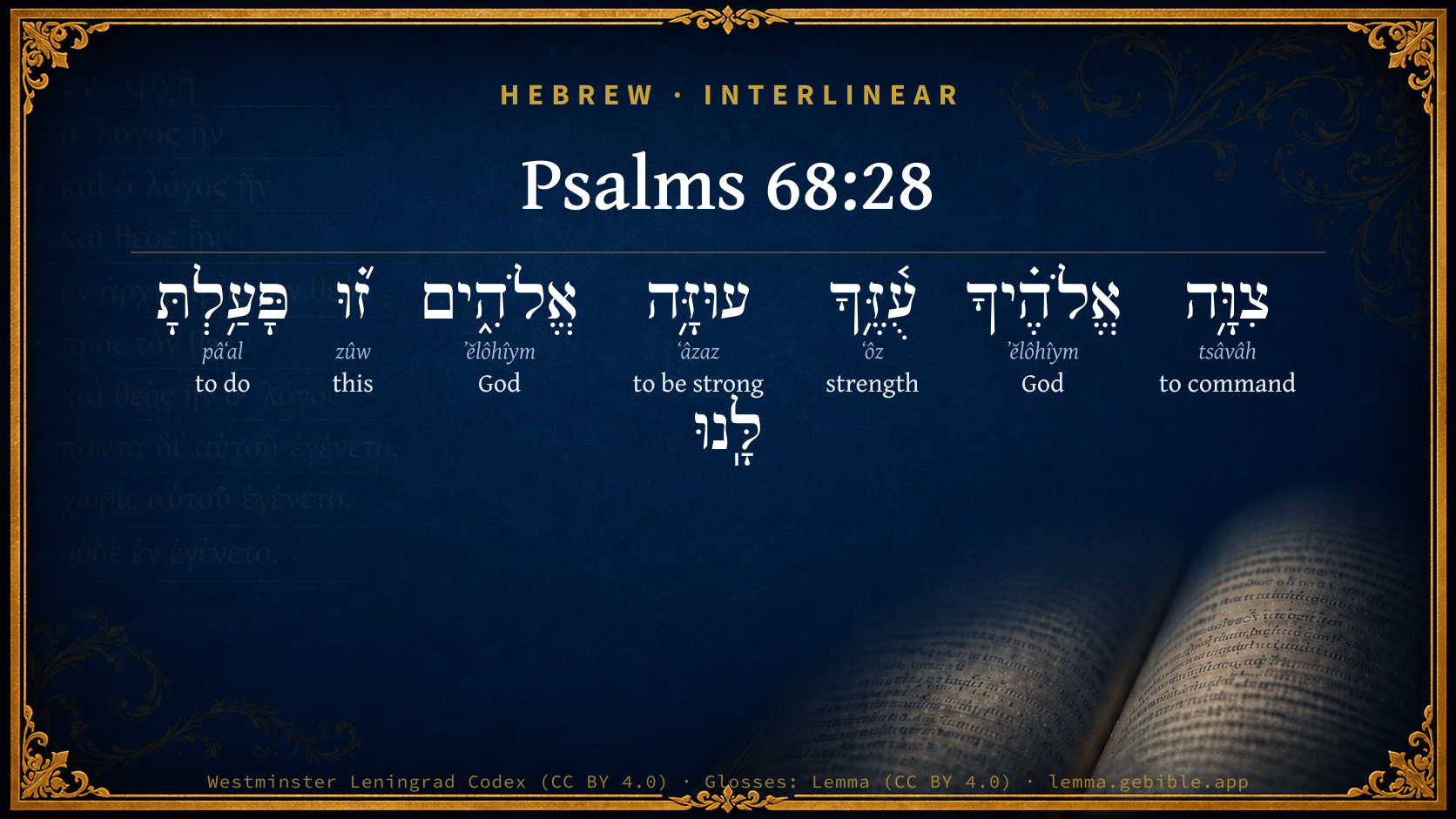
Psalms 68:28

Hebrew (Westminster Leningrad Codex) Psalms 68:28 appears in the Hebrew Old Testament. The text above is from the Westminster Leningrad Codex. Each word links to its Strong’s number, a concise gloss, and parsing drawn from the Open Scriptures Hebrew Bible morphology. Click any word for its full Brown-Driver-Briggs (BDB) entry.
Download image
Cite this verse

Psalms 68:28 (World English Bible). Public Domain. Lemma interlinear Bible study tool, https://lemma.gebible.app/v/psalms/68/28.

Show BibTeX & RIS
BibTeX
RIS
English Translation
Your God has commanded your strength. Strengthen, God, that which you have done for us.
World English Bible · Public Domain
Download a study sheet

One document with this verse’s original text, its word-by-word gloss line, the meaning frame, cross-references with their text, attributed commentary, and full source and license credits — printable, and it pastes into notes with its structure intact.

This verse Autodidact and up

Study sheet (.html) Plain text (.txt)

A passage Seminary Student

Up to 50 verses in one chapter. A passage sheet keeps up to 6 commentary sources and 12 cross-references per verse, in the order this page ranks them, and says so on the sheet whenever that leaves anything out. Ask for a single verse and you get the Autodidact verse sheet above.

Everything on this page stays free to read, with no account — the sheet is a download of what is already on screen, not access to it.

Want to remove ads? Support Godless Engineer
Compare translations 3

The same verse in 3 English versions, stacked beneath the original-language interlinear above. Click any original word for its lexicon entry.

Each is an independent rendering of the whole verse — the interlinear is not word-aligned to these translations.

Highlighted words mark where these versions differ — a whole-verse word diff, not a word-by-word alignment.

  • World English Bible Public Domain
    Your God has commanded your strength. Strengthen, God, that which you have done for us.
  • King James Version Public Domain
    Thy God hath commanded thy strength: strengthen, O God, that which thou hast wrought for us.
  • unfoldingWord Literal Text CC BY-SA 4.0
    Your God has commanded your strength. Be strong, God! You have done this for us.

unfoldingWord Literal Text — © unfoldingWord, licensed CC BY-SA 4.0. Word-aligned USFM3 via Door43 (git.door43.org/unfoldingWord/en_ult).

Versions to compare (up to 4)

3 of 4 selected

Show all 18 translations

Every available English version of this verse, each an independent rendering of the whole verse.

  • World English Bible Public Domain
    Your God has commanded your strength. Strengthen, God, that which you have done for us.
  • Berean Standard Bible Public Domain
    Summon Your power, O God; show Your strength, O God, which You have exerted on our behalf.
  • Majority Standard Bible Public Domain
    Summon Your power, O God; show Your strength, O God, which You have exerted on our behalf.
  • King James Version Public Domain
    Thy God hath commanded thy strength: strengthen, O God, that which thou hast wrought for us.
  • American Standard Version (1901) Public Domain
    Thy God hath commanded thy strength: Strengthen, O God, that which thou hast wrought for us.
  • Revised Version (1885) Public Domain
    Thy God hath commanded thy strength: strengthen, O God, that which thou hast wrought for us.
  • Geneva Bible (1599) Public Domain
    Thy God hath appointed thy strength: stablish, O God, that, which thou hast wrought in vs,
  • Douay-Rheims (1899) Public Domain
    There is Benjamin a youth, in ecstasy of mind. The princes of Juda are their leaders: the princes of Zabulon, the princes of Nephthali.
  • Young's Literal Translation Public Domain
    Thy God hath commanded thy strength, Be strong, O God, this Thou hast wrought for us.
  • Literal Standard Version CC BY-SA 4.0
    Your God has commanded your strength, || Be strong, O God, You have worked this for us.
  • Unlocked Literal Bible CC BY-SA 4.0
    Your God, Israel, has decreed your strength; reveal to us your power, God, as you have revealed it in times past.
  • unfoldingWord Literal Text CC BY-SA 4.0
    Your God has commanded your strength. Be strong, God! You have done this for us.
  • Darby Bible Public Domain
    Thy God hath commanded thy strength: strengthen, O God, that which thou hast wrought for us.
  • World Messianic Bible Public Domain
    Your God has commanded your strength. Strengthen, God, that which you have done for us.
  • Webster's Bible Public Domain
    \\68:27\\There is little Benjamin with their ruler, the princes of Judah and their counsel, the princes of Zebulun, and the princes of Naphtali.
  • Free Bible Version CC BY-SA 4.0
    Display your power, God! Reveal your strength, Lord, as you have done for us in the past.
  • Bible in Basic English Public Domain
    O God, send out your strength; the strength, O God, with which you have done great things for us,
  • JPS Tanakh (1917) Public Domain
    (68-29) Thy God hath commanded thy strength; be strong, O God, Thou that hast wrought for us

Literal Standard Version (2020), Covenant Press — licensed CC BY-SA 4.0. Text via the HelloAO Bible API (eBible.org). Unlocked Literal Bible (unfoldingWord) — licensed CC BY-SA 4.0. Text via the HelloAO Bible API (eBible.org). unfoldingWord Literal Text — © unfoldingWord, licensed CC BY-SA 4.0. Word-aligned USFM3 via Door43 (git.door43.org/unfoldingWord/en_ult). Free Bible Version, Dr. Jonathan Gallagher — licensed CC BY-SA 4.0. Text via the HelloAO Bible API (eBible.org).

Word by word

More ways to search: Search by grammar → Find every occurrence → Compare this word →

Practice this passage: Drill this verse → Learn its vocabulary →

About this verse

These counts appear in no published source. They are computed here, from the morphology-tagged text and Lemma’s own curated glosses. What Lemma adds →

8
words
6
distinct lemmas
Wisdom
section

Notable vocabulary

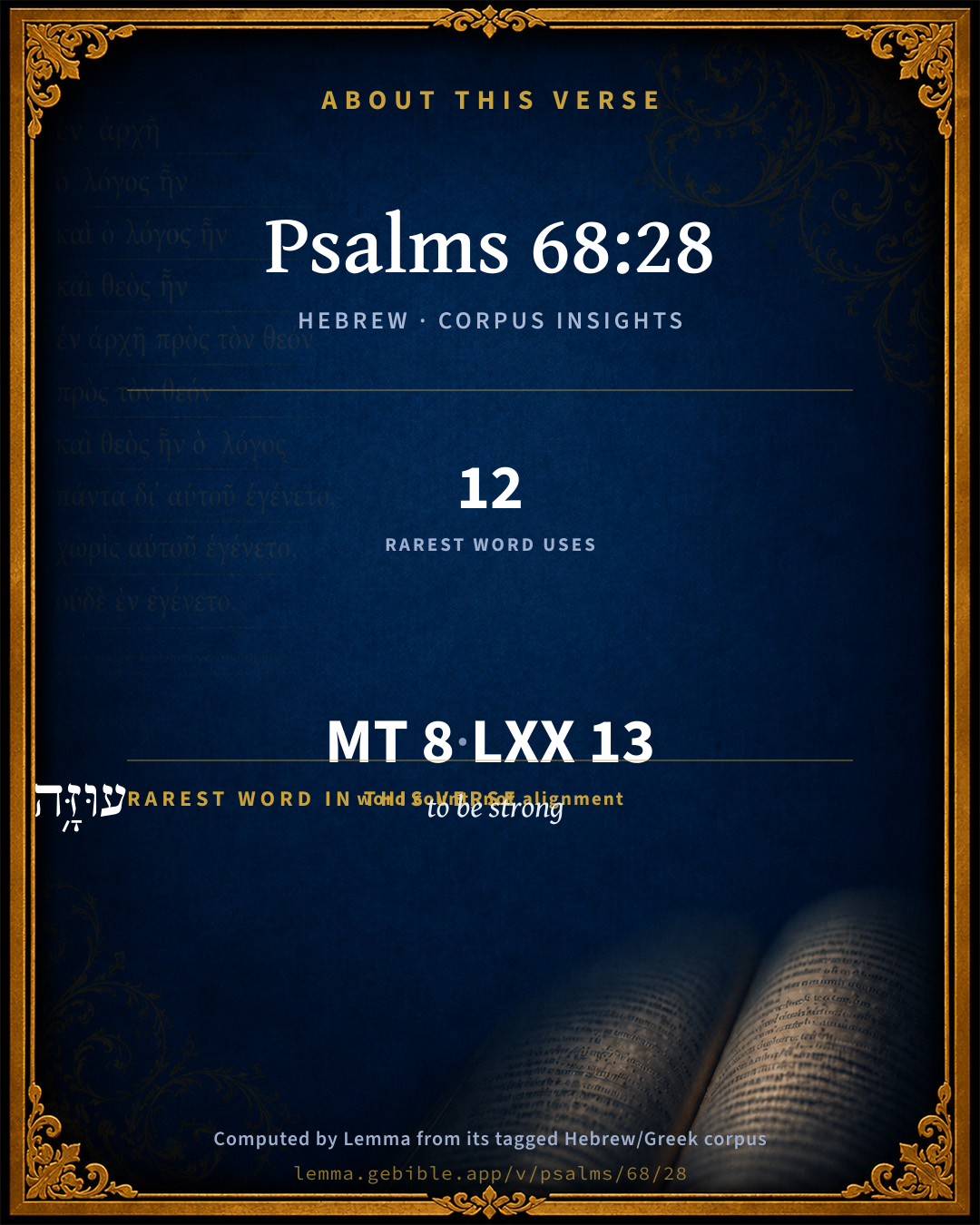
The rarest word here is עוּזָּ֥ה to be strong H5810 — appearing just 12 times in the whole Hebrew Bible.

Shared distinctive vocabulary

עוּזָּ֥ה to be strong H5810 occurs in 12 verses of the Hebrew Bible. Also found in:

Grammatical profile

  • 3 verbs
  • 3 nouns
  • 1 preposition
  • 1 particle

Verb forms

  • צִוָּ֥ה Piel · Perfect
  • עוּזָּ֥ה Qal · Imperative
  • פָּעַ֥לְתָּ Qal · Perfect

Repetition

A word recurs within this verse — often emphatic in Hebrew:

  • אֱלֹהֶ֗יךָ God H430 ×2

Hebrew & Septuagint length

In English translation the verse runs 15 words from the Hebrew and 16 from the Septuagint (LXX English) — closely comparable.

A rough comparison of the two English renderings, which tokenize alike — not a word-level alignment.

Word counts can differ between the Hebrew and the Greek without any difference in meaning — e.g. the Hebrew direct-object marker אֵת has no separate Greek word, and Greek often adds the article ὁ.

In the original languages it is 8 Hebrew tokens and 13 Greek tokens — but the two are counted differently (Hebrew bundles its prefixes and suffixes into one token; the Greek is in lemma form), so that isn’t a like-for-like length.

Cross-references

11

Topical passages linked to Psalms 68:28 in the Treasury of Scripture Knowledge — connected by theme and wording, ordered by reader-vote popularity; previews shown in the World English Bible.

  • Psalms 71:3 Be to me a rock of refuge to which I may always go. Give the command to save me, For you are my rock and my fortress.
  • Psalms 138:8 Yahweh will fulfill that which concerns me; Your loving kindness, Yahweh, endures forever. Don't forsake the works of your own hands.
  • Philippians 1:6 being confident of this very thing, that he who began a good work in you will complete it until the day of Jesus Christ.
  • Psalms 42:8 Yahweh will command his loving kindness in the daytime. In the night his song shall be with me: A prayer to the God of my life.
  • Isaiah 40:31 but those who wait for Yahweh shall renew their strength; they shall mount up with wings as eagles; they shall run, and not be weary; they shall walk, and not faint.
  • 2 Corinthians 12:9–10 He has said to me, "My grace is sufficient for you, for my power is made perfect in weakness." Most gladly therefore I will rather glory in my weaknesses, that the power of Christ may rest on me.
  • Ephesians 3:17–20 that Christ may dwell in your hearts through faith; to the end that you, being rooted and grounded in love,
  • Psalms 44:4 You are my King, God. Command victories for Jacob!
  • 2 Thessalonians 1:11 To this end we also pray always for you, that our God may count you worthy of your calling, and fulfill every desire of goodness and work of faith, with power;
  • John 5:8–9 Jesus said to him, "Arise, take up your mat, and walk."
  • Acts 3:6–8 But Peter said, "Silver and gold have I none, but what I have, that I give you. In the name of Jesus Christ of Nazareth, get up and walk!"

Cross-references courtesy of OpenBible.info (CC BY 4.0).

Hebrew and Greek witnesses Masoretic Hebrew ↔ Greek Septuagint

The same verse in the two great witnesses to the Old Testament, shown verse-for-verse.

You’re reading Greek Psalm 67 (Hebrew Psalm 68). The Septuagint counts the superscription, so verse numbers can differ from the Hebrew — chapter-level alignment, not verse-by-verse. Numbering follows Rahlfs.

These are two independent witnesses, not word-aligned to each other, and the Septuagint is shown in lemma (dictionary) form.

Hebrew Psalms 68:28 Masoretic · Westminster Leningrad Codex

צִוָּ֥ה אֱלֹהֶ֗יךָ עֻ֫זֶּ֥ךָ עוּזָּ֥ה אֱלֹהִ֑ים ז֝֗וּ פָּעַ֥לְתָּ לָּֽנוּ

Your God has commanded your strength. Strengthen, God, that which you have done for us.

World English Bible · Public Domain

Greek LXX Greek Psalm 67:28 Septuagint · lemma form

ἐκεῖ βενιαμίν νέος ἐν ἔκστασις ἄρχων ἰουδά ἡγεμών αὐτός ἄρχων ζαβουλων ἄρχων νεφθαλι

O God, command you your strength: strengthen, O God, this which you have wrought in us.

LXX2012 (modern English Septuagint) · Public Domain

On this verse, Keil & Delitzsch discusses the Septuagint’s reading. Read the note in Commentary ↓

Hebrew: Westminster Leningrad Codex (CC BY 4.0). Greek: Septuagint (public domain); English from LXX2012 (modern English Septuagint) (Public Domain). How the Septuagint differs from the Hebrew →

Commentary

Notes on Psalms 68:28 from classic Christian and Jewish commentators (each source and its license shown beneath its notes). The classic Christian expositions comment on the surrounding passage and are grouped to its opening verse, so a note may address several verses; the Jewish commentaries on the Tanakh (Rashi and others) are per-verse, so they appear only where the commentator wrote on this verse.

Lemma curates 59 commentaries, every one of them public domain or Creative Commons licensed, each selected and text-cleaned for this edition rather than reprinted as found. About our sources →

Trapp's Complete Commentary

John Trapp

Psa 68:28 Thy God hath commanded thy strength: strengthen, O God, that which thou hast wrought for us.

Ver. 28. Thy God hath commanded thy strength] A brave expression, admired by Longinus, a heathen rhetorician. See the like Deu 28:8; Psa 33:9; Psa 42:8; Psa 44:4. God both made and ruleth the world without tool or toil; he enableth his people to subsist and to resist their enemies by his will only, and by the efficacy of his word. Suppeditavit tibi Deus tantum robur, nequid superbias, saith Vatablus.

Strengthen, O God, that which thou hast wrought for us] Petamus ut det, quod ut habeamus iubet, Pray to the God of all grace to make us the same that he requireth us to be.

John Trapp, A Commentary or Exposition upon All the Books of the Old and New Testament (1647–1656) — public domain. Text from a community e-Sword module.

The Biblical Illustrator

Joseph S. Exell

Psa_68:28-35

Thy God hath commanded thy strength: strengthen, O God, that which Thou hast wrought for us.

The moral force of God

I. Subjugating men.

1. Commanding kings (Psa_68:29).

2. Subjugating enemies (Psa_68:30). What wonderful changes in man Gods moral force in Christ has wrought! Witness the changes in the Corinthians. Such were some of you, etc. What were our forefathers but beasts? The changes in the South Sea Islanders, etc. Those changes will become universal one day (Isa_11:6).

II. Attracting heathens (Psa_68:31). Gods moral force is magnetic. It is in the transcendent excellence of His character. When men come to see Him as He is in Christ, they shall stretch out their hands to Him. Such a God they want, a God whose character more than realizes their highest ideal, in whom they can centre their love and repose their utmost confidence.

III. Commanding universal worship.

1. His moral majesty is to be recognized (Psa_68:33). The real heart of humanity can bow to nothing else.

2. His moral strength is to be recognized (Psa_68:34), Why is not Gods moral strength more universally felt? His physical might is felt everywhere; but not His moral, and why? Because it is moral. Because it has to do with mind, which is free, irresponsible, and which is endowed with the faculty to resist, if it wills, all outward appeals. Oh that minds everywhere would open themselves to the influence of Gods character as revealed in Christi This is its power unto salvation. (Homilist.)

The strength of a saint

I. What is the strength of a saint?

1. It is that of a regenerated man. Not that of the body, for that is far inferior to what is found in many brutes. But there is a spirit in man, etc. (Job_32:8).

2. It consists in his likeness to God, in his being first made and then renewed in the image of God.

II. God has commanded this strength.

1. By what He is and by what He reveals Himself to be.

2. By the relation which God has established between every man and Himself (Job_9:19). We are all His offspring.

3. By a law of loyalty which He has written in the heart.

4. By verbal law, given in the Scriptures.

5. By the claims of the new kingdom of His grace (2Co_5:19; 1Co_6:19-20).

III. Let us consecrate it to Him. Say not that you have no strength. Christ gives that which is asked. It is treason to withhold it. A full blessing will attend the consecration. There is no valid excuse for refusing it. Then yield it in the worship you render and in all your service. (S. Martin, D. D.)

Some marks of Gods people

Many are seeking the Lord. We are glad, but let them make sure work of it. Now, our text describes the people of God, and thus we may discover whether we are of that number.

I. The Lord is their God. Thy God--so we read. They have got a God: they are not atheists. And they believe in God. Now, do we believe in Him and trust in Him? How does He become my God? I trust Him and receive pardon at His hands and He tells me of it, and then my love goes out to Him in return. The true child of God loves God. And we get to be as conscious of His presence as of the air we breathe: we hold converse with Him and we feel within our spirit that He is listening to us.

II. All their strength is at Gods disposal.

1. They heartily obey His commands,

2. They pray to Him fervently.

3. They praise Him energetically.

4. They labour for Him earnestly.

5. They live wholly to Him.

III. They ascribe to Him all that is good in them, and in their fellow-men. It is all of grace, from the first even to the last; and they are the true people of God who feel and know this.

IV. They pray to Him for their stability: Strengthen, O God, that which Thou hast wrought for us. Never trust in yourselves, even though your strength seems more than adequate for the occasion. When you are full of knowledge, and full of wisdom, and full of grace, yet still be nothing, and let the Lord your God be your All-in-all. Not unto us, O Lord, not unto us, but unto Thy name give glory, for Thy mercy, and for Thy truths sake. Let us begin to learn that song now, and let us sing it in life, and in death, and for ever, for our Lord Jesus Christs sake. (C. H. Spurgeon.)

The strength of life

God has His own wise and good purposes, which will never vary in themselves; but the fulfilment of these purposes in our behalf is conditional. That is to say, our own desire and will must meet Gods will, if we are to be truly blessed. For example, generally speaking, God wills our health; but only as we ourselves obey the laws of health shall we be healthy. Again, God would have us undertake successful work; but the success is conditional on our diligence. So, too, while God desires that we should conquer temptation, and that our nature should be regenerate and pure, on our part there must be the earnest resistance of sin, and an intense, a ceaseless craving for the righteousness of God.

I. Strength--this word has had very various meanings; indeed, we might almost say that the different ideals of strength that have been cherished among the nations have determined the complexion of the worlds history.

1. Sheer, naked force has been with some the familiar and favourite type of strength. The tremendous energy of tempest, earthquake, and fire has impressed mens minds with awe.

2. Later in the worlds history, a higher type of strength was developed, and chiefly, at first, among the Greeks, who, with their handful of disciplined troops, could put to rout the myriads of the vast horde of Xerxes. For they had learned that it is net sheer force that of itself accomplishes the greatest things, but rather force adapted and adjusted, with nice exactitude, to the required result. Thus discipline and strategy, to say nothing of courage, counted for far more than numbers; and as in war, so in ether things, mere force was not of so much account as means and methods which made for the wise direction, and therefore for the economy, of force.

3. Meanwhile the very highest type of strength was preparing in the world (Pro_24:5; Ecc_9:16; Ecc_9:18; Psa_37:31; Psa_81:13-14). The strength is the strength of righteousness, and the righteousness is the righteousness of God. In the Gospel of Christ we have this Old Testament teaching fulfilled and perfected. To be holy is to be truly strong; and this strength is to be, not for our own sakes alone, but for others--we are to be strong to serve, and save, and bless. And a new inspiration is now in the world for the effectuation of the true strength of life (1Co_1:22-24).

II. Our strength is commanded. This may be understood twofoldly.

1. It means, in part, that the invincible power of Gods will is on our side. In His ordainment of things, our victory is prepared. All the arrangements of His providence, and all the richer ministrations of His grace, are to be contributory to this results--that we shall conquer. If we remember this when the world is adverse, and when our own heart is weak; if we think of it when the forces of evil gather round our soul: that it is Gods irrefragable will that we shall conquer--oh, what mighty enthusiasm will be born of this very assurance, and how impotent will seem every opposition that sets itself against the purpose of the Most High! (1Jn_5:4).

2. The words are also a stimulus to our endeavour and devotion. God commands that all things shall subserve our strength, and contribute to our victory, if we are faithful; but He likewise commands our fidelity itself, anti the putting forth of our utmost effort, without which, indeed, His purpose in our behalf cannot be fulfilled. Some fourteen years ago our colony of Natal was threatened with great disaster. The Zulus had surprised and cut to pieces one of our regiments at Isandula, and, flushed with their victory, were about to pour into Natal, to devastate and destroy; when a handful of English soldiers, hastily fortifying themselves in their position at Rorkes Drift, set themselves to withstand the whole horde of savage, eager warriors. It was indeed a forlorn hope; but they felt that it was as though the eyes of all the world were upon them, watching whether they would do their duty, and be strong. If over men were commanded to be strong, by all the most sacred claims of country, kindred, and home, it was then; and right nobly did they respond to the call. And, while all the world wondered, these few dozens of men beat back at last the invading host. So it is with us, in our seasons of sore temptation; for-- Isa_59:19. And in like manner, when we are discouraged by the overwhelming difficulties of our work, asking in our dismay, Who is sufficient for these things? then it is that this same command of God stirs the soul like the sound of a trumpet. (T. F. Lockyer, B. A.)

The Biblical Illustrator, edited by Joseph S. Exell (c. 1880s–1900s) — public domain. Text from a community e-Sword module.

Joseph Benson's Commentary

Psa 68:28. Thy God, O Israel, hath commanded — Hath ordained, or effectually procured; thy strength — All that strength and power which thou hast effectually exerted at any time against thine enemies, and which is now greatly increased by the union of all the tribes under one head. In other words, the great power of the Israelites, and the height of glory and strength to which the kingdom of David had arisen, were the work of God. This naturally makes way for the petition following: Strengthen, O God, that which thou hast wrought in us — Let the foundation of our present happiness be firm and durable.

Joseph Benson's Commentary on the Old and New Testaments (1811–1818) — public domain. Text from a community e-Sword module.

Keil & Delitzsch

C. F. Keil & F. Delitzsch

The poet now looks forth beyond the domain of Israel, and describes the effects of Jahve's deed of judgment and deliverance in the Gentile world. The language of Psa 68:29 is addressed to Israel, or rather to its king (Psa 86:16; Psa 110:2): God, to whom everything is subject, has given Israel עז, victory and power over the world. Out of the consciousness that He alone can preserve Israel upon this height of power upon which it is placed, who has placed it thereon, grows the prayer: establish (עוּזּה with וּ for ŭ, as is frequently the case, and with the accent on the ultima on account of the following Aleph, vid., on Psa 6:5), Elohim, that which Thou hast wrought for us; עזז, roborare, as in Pro 8:28; Ecc 7:19, lxx δυνάμωσον, Symmachus ἐνίσχυσον. It might also be interpreted: show Thyself powerful (cf. רוּמה, 21:14), Thou who (Isa 42:24) hast wrought for us (פּעל as in Isa 43:13, with ל, like עשׂה ל, Isa 64:3); but in the other way of taking it the prayer attaches itself more sequentially to what precedes, and Psa 62:12 shows that זוּ can also represent the neuter. Hitzig has a still different rendering: the powerful divine help, which Thou hast given us; but although - instead of -ת in the stat. construct. is Ephraimitish style (vid., on Psa 45:5), yet עוּזּה for עז is an unknown word, and the expression "from Thy temple," which is manifestly addressed to Elohim, shows that פּעלתּ is not the language of address to the king (according to Hitzig, to Jehoshaphat). The language of prayerful address is retained in Psa 68:30. From the words מהיכלך על ירושׁלם there is nothing to be transported to Psa 68:29 (Hupfeld); for Psa 68:30 would thereby become stunted. The words together are the statement of the starting-point of the oblations belonging to יובילוּ: starting from Thy temple, which soars aloft over Jerusalem, may kings bring Thee, who sittest enthroned there in the Holy of holies, tributary gifts (שׁי as in Psa 76:12; Psa 18:7). In this connection (of prayer) it is the expression of the desire that the Temple may become the zenith or cynosure, and Jerusalem the metropolis, of the world. In this passage, where it introduces the seat of religious worship, the taking of מן as expressing the primary cause, "because or on account of Thy Temple" (Ewald), is not to be entertained.

In Psa 68:31 follows a summons, which in this instance is only the form in which the prediction clothes itself. The "beast of the reed" is not the lion, of which sojourn among the reeds is not a characteristic (although it makes its home inter arundineta Mesopotamiae, Ammianus, Psa 18:7, and in the thickets of the Jordan, Jer 49:19; Jer 50:44; Zac 11:3). The reed is in itself an emblem of Egypt (Isa 36:6, cf. Psa 19:6), and it is therefore either the crocodile, the usual emblem of Pharaoh and of the power of Egypt (Eze 29:3, cf. Psa 74:13.) that is meant, or even the hippopotamus (Egyptian p-ehe-môut), which also symbolizes Egypt in Isa 30:6 (which see), and according to Job 40:21 is more appropriately than the crocodile (התנין אשׁר בּיּם, Isa 27:1) called היּת קנה. Egypt appears here as the greatest and most dreaded worldly power. Elohim is to check the haughty ones who exalt themselves over Israel and Israel's God. אבּירים, strong ones, are bulls (Psa 22:13) as an emblem of the kings; and עגלי explains itself by the genit. epexeg. עמּים .gexep: together with (Beth of the accompaniment as in Psa 68:31, Psa 66:13, and beside the plur. humanus, Jer 41:15) the calves, viz., the peoples, over whom those bulls rule. With the one emblem of Egypt is combined the idea of defiant self-confidence, and with the other the idea of comfortable security (vid., Jer 46:20.). That which is brought prominently forward as the consequence of the menace is moulded in keeping with these emblems. מתרפּס, which has been explained by Flaminius substantially correctly: ut supplex veniat, is intended to be taken as a part. fut. (according to the Arabic grammar, ḥâl muqaddar, lit., a predisposed condition). It thus comprehensively in the singular (like עבר in Psa 8:9) with one stroke depicts thoroughly humbled pride; for רפס (cf. רמס) signifies to stamp, pound, or trample, to knock down, and the Hithpa. either to behave as a trampling one, Pro 6:3, or to trample upon one's self, i.e., to cast one's self violently upon the ground. Others explain it as conculcandum se praebere; but such a meaning cannot be shown to exist in the sphere of the Hebrew Hithpael; moreover this "suffering one's self to be trampled upon" does not so well suit the words, which require a more active sense, viz., בּרצּי־כסףcep, in which is expressed the idea that the riches which the Gentiles have hitherto employed in the service of God-opposed worldliness, are no offered to the God of Israel by those who both in outward circumstances and in heart are vanquished (cf. Isa 60; 9). רץ־כּסף (from רצץ, confringere) is a piece of uncoined silver, a bar, wedge, or ingot of silver. In בּזּר there is a wide leap from the call גּער to the language of description. This rapid change is also to be found in other instances, and more especially in this dithyrambic Psalm we may readily give up any idea of a change in the pointing, as בּזּר or בּזּר (lxx διασκόρπισον); בּזּר, as it stands, cannot be imperative (Hitzig), for the final vowel essential to the imperat. Piel is wanting. God hath scattered the peoples delighting in war; war is therefore at an end, and the peace of the world is realized.

In Psa 68:32, the contemplation of the future again takes a different turn: futures follow as the most natural expression of that which is future. The form יאתיוּ, more usually found in pause, here stands pathetically at the beginning, as in Job 12:6. השׁמנּים, compared with the Arabic chšm (whence Arab. chaššm, a nose, a word erroneously denied by Gesenius), would signify the supercilious, contemptuous (cf. Arab. âšammun, nasutus, as an appellation of a proud person who will put up with nothing). On the other hand, compared with Arab. ḥšm, it would mean the fat ones, inasmuch as this verbal stem (root Arab. ḥšš, cf. השׁרת, Sa2 22:12), starting from the primary signification "to be pressed together," also signifies "to be compressed, become compact," i.e., to regain one's plumpness, to make flesh and fat, applied, according to the usage of the language, to wasted men and animals. The commonly compared Arab. ḥšı̂m, vir magni famulitii, is not at all natural, - a usage which is brought about by the intransitive signification proper to the verb starting from its radical signification, "to become or be angry, to be zealous about any one or anything," inasmuch as the nomen verbale Arab. hạšamun signifies in the concrete sense a person, or collectively persons, for whose maintenance, safety, and honour one is keenly solicitous, such as the members of the family, household attendants, servants, neighbours, clients or protgs, guest-friends; also a thing which one ardently seeks, and over the preservation of which one keeps zealous watch (Fleischer). Here there does not appear to be any connecting link whatever in the Arabic which might furnish some hold for the Hebrew; hence it will be more advisable, by comparison of השׁמל and חשׁן, to understand by חשׁמנים, the resplendent, most distinguished ones, perillustres. The dignitaries of Egypt come to give glory to the God of Israel, and Aethiopia, disheartened by fear before Jahve (cf. Hab 3:7), causes his hands to run to Elohim, i.e., hastens to stretch them out. Thus it is interpreted by most expositors. But if it is ידיו, why is it not also יריץ? We reply, the Hebrew style, even in connection with words that stand close beside one another, does not seek to avoid either the enallage generis (e.g., Job 39:3, Job 39:16), or the enall. numeri (e.g., Psa 62:5). But "to cause the hands to run" is a far-fetched and easily misunderstood figure. We may avoid it, if, with Bttcher and Olshausen, we disregard the accentuation and interpret thus, "Cush - his hands cause to hasten, i.e., bring on in haste (Sa1 17:17; Ch2 35:13), to Elohim," viz., propitiating gifts; תּריץ being the predicate to ידיו, according to Ges. 146, 3.

Psa 68:32-34

The poet stands so completely in the midst of this glory of the end, that soaring onwards in faith over all the kingdoms of the world, he calls upon them to render praise to the God of Israel. לרכב attaches itself to the dominating notion of שׁירוּ in Psa 68:33. The heavens of heavens (Deu 10:14) are by קדם described as primeval (perhaps, following the order of their coming into existence, as extending back beyond the heavens that belong to our globe, of the second and fourth day of Creation). God is said to ride along in the primeval heavens of the heavens (Deu 33:26), when by means of the cherub (Psa 18:11) He extends His operations to all parts of these infinite distances and heights. The epithet "who rideth along in the heavens of heavens of the first beginning" denotes the exalted majesty of the superterrestrial One, who on account of His immanency in history is called "He who rideth along through the steppes" (רכב בּערבות, Psa 68:5). In יתּן בּקולו we have a repetition of the thought expressed above in Psa 68:12 by יתּן אמר; what is intended is God's voice of power, which thunders down everything that contends against Him. Since in the expression נתן בּקול (Psa 46:7; Jer 12:8) the voice, according to Ges. 138, rem. 3, note, is conceived of as the medium of the giving, i.e., of the giving forth from one's self, of the making one's self heard, we must take קול עז not as the object (as in the Latin phrase sonitum dare), but as an apposition:

(Note: The accentuation does not decide; it admits of our taking it in both ways. Cf. Psa 14:5; Psa 41:2; Psa 58:7; Psa 68:28; Pro 13:22; Pro 27:1.)

behold, He maketh Himself heard with His voice, a powerful voice. Thus let them then give God עז, i.e., render back to Him in praise that acknowledges His omnipotence, the omnipotence which He hath, and of which He gives abundant proof. His glory (גּאוה) rules over Israel, more particularly as its guard and defence; His power (עז), however, embraces all created things, not the earth merely, but also the loftiest regions of the sky. The kingdom of grace reveals the majesty and glory of His redemptive work (cf. Eph 1:6), the kingdom of nature the universal dominion of His omnipotence. To this call to the kingdoms of the earth they respond in v. 36: "Awful is Elohim out of thy sanctuaries." The words are addressed to Israel, consequently מקדּשׁים is not the heavenly and earthly sanctuary (Hitzig), but the one sanctuary in Jerusalem (Ezek. 21:72) in the manifold character of its holy places (Jer 51:51, cf. Amo 7:9). Commanding reverence - such is the confession of the Gentile world - doth Elohim rule from thy most holy places, O Israel, the God who hath chosen thee as His mediatorial people. The second part of the confession runs: the God of Israel giveth power and abundant strength to the people, viz., whose God He is, equivalent to לעמּו, Psa 29:11. Israel's might in the omnipotence of God it is which the Gentile world has experienced, and from which it has deduced the universal fact of experience, v. 36b. All peoples with their gods succumb at last to Israel and its God. This confession of the Gentile world closes with בּרוּך אלהים (which is preceded by Mugrash transformed out of Athnach). That which the psalmist said in the name of Israel in Psa 68:20, "Blessed be the Lord," now re-echoes from all the world, "Blessed be Elohim." The world is overcome by the church of Jahve, and that not merely in outward form, but spiritually. The taking up of all the kingdoms of the world into the kingdom of God, this the great theme of the Apocalypse, is also after all the theme of this Psalm. The first half closed with Jahve's triumphant ascension, the second closes with the results of His victory and triumph, which embrace the world of peoples.

Keil & Delitzsch — Biblical Commentary on the Old Testament (1861–1891) — public domain (CC PDM 1.0). Text via the HelloAO Bible API. (Old Testament only.)

J. A. Alexander on Psalms

Joseph Addison Alexander

29. (Psa 68:28). Thy God (O Israel) hath ordained thy strength; be thou strong, O God, who hast wrought (it) for us. Ordained, provided and secured by his omnipotence. Be strong, i.e. shew thy strength by exerting it in our behalf, hereafter as thou hast done heretofore. Wrought for us, indefinitely and in general, or wrought (it, for us, i. e. this deliverance which we have been celebrating. See above, on Psa 22:31, and compare Isa 26:12.

Joseph Addison Alexander, The Psalms Translated and Explained (1850) — public domain. Text from a community e-Sword module.

Tyndale Open Study Notes

Tyndale Open Resources

68:28-31 The people pray for God’s success and for victory over the enemy nations (68:1-3).

Tyndale Open Study Notes — © Tyndale Open Resources, licensed CC BY-SA 4.0. Text via the HelloAO Bible API.

Jamieson, Fausset & Brown

Robert Jamieson, A. R. Fausset & David Brown

Thanks for the past, and confident prayer for the future victories of Zion are mingled in a song of praise.

Jamieson, Fausset & Brown — Commentary Critical and Explanatory on the Whole Bible (1871) — public domain (CC PDM 1.0). Text via the HelloAO Bible API.

Adam Clarke's Commentary

Verse 28. Thy God hath commanded] This and the following verses is what they sung.

Adam Clarke's Commentary on the Bible (1810–1826) — public domain. Text from a community e-Sword/MySword module.

John Calvin's Commentaries

28. Thy God hath commanded thy strength Men are always disposed to arrogate to themselves the glory of what they may have done instead of tracing their success to God, and David reminds the people once more that they had not triumphed by their own strength, but by power communicated from above. If they had acquitted themselves with energy on the field, he would have them consider that it was God who inspired them with this valor, and would guard them against the pride which overlooks and disparages the Divine goodness. As a consideration which might farther tend to promote humility in their minds, he adverts to the dependence in which they stood of the future continuance of the same favor and protection; this being the great cause of presumptuous confidence, that we do not feel our own helplessness, and are not led under a sense of it to resort humbly to God for the supply of our wants. Another lesson which the passage teaches us is, that more is required than that God should visit us at first with his preventing grace; that we stand constantly in need of his assistance throughout our whole lives. If this be true in the literal warfare, where our conflict is with flesh and blood, it must be still more so in matters of the soul. It is impossible that we could stand one moment in the contest with such enemies as Satan, sin, and the world, did we not receive from God the grace which secures our perseverance.

What is said of the temple in the following verse is intended to carry out the same strain of sentiment which has been already expressed. It gives the reason why God had exerted his power in behalf of the Israelites rather than others; which was, that it might be displayed as coming forth from the sanctuary and the ark of the covenant. Hence the emphasis with which David calls him in a previous part of the psalm — the God of Israel. It was not in vain that God had erected his sanctuary, or promised his presence in connection with it; and his power is here represented as issuing from the temple, to denote that the only security for his favor was to be found in his gracious covenant and promises. Some read, From thy temple in Jerusalem — a frigid interpretation, and one which does not express the meaning of the Psalmist. His prayer is to the effect that the Divine power might be commanded from the sanctuary upon his chosen people, here denoted by a common figure of speech by Jerusalem. It may be asked how he speaks of the temple, when it had not been yet built. The word temple or palace may have been used to express the tabernacle. This, at least, I think more probable than that he should speak of the temple by anticipation, as some suppose; and there can be no doubt that the ark had already been placed in Zion. Having already traced all the honor of the recent victories to God, he next proceeds to vindicate his claim to reap the fruits of them, by asserting that the kings who had been subdued would acknowledge God to have been their conqueror, as well as yield themselves tributary to David and his successors, — a circumstance which should lay the people of God under an additional obligation to present him with their free-will offerings of praise.

John Calvin's Commentaries (1540-1563) — public domain. Text from the Calvin Translation Society English edition (1840s-50s) via the Christian Classics Ethereal Library (ccel.org). Calvin's coverage is partial (roughly two-thirds of the Bible); uncommented books and verses are honest gaps, never fabricated. The 19th-century editor's footnotes and remarks are omitted so the notes are faithfully Calvin's own voice.

Ellicott's Commentary for English Readers

(28) Thy God hath commanded.—Rather, with LXX. and the ancient versions generally, Ordain, O God, thy strength.

A Bible Commentary for English Readers, edited by Charles John Ellicott (1878–1897) — public domain. Text from a community e-Sword module.

The Cambridge Bible for Schools and Colleges

gen. ed. J. J. S. Perowne

28. Thy God &c.] Israel is addressed; the first line is a summary statement of past experience, introduced as the ground of the prayer which follows. In past times God has given Israel strength; therefore Israel can now pray with confidence for the renewal and continuance of His support. But the Ancient Versions (LXX, Vulg., Symm., Jer. (some mss.), Syr., Targ.) read (the difference in the verb is simply in the vowels), O God, command thy strength: i.e. give charge to Thy power, put it forth. Cp. Psa_42:8; Psa_44:4. This suits the parallelism better, and avoids the abrupt and isolated address to Israel.

Strengthen, O God &c.] This rendering is grammatically questionable, and the R.V. marg. is to be preferred: Be strong, O God, thou that hast wrought for us; i.e. shew Thyself strong as in time past. Cp. Isa_26:12.

28–31. The purpose and sequel of the restoration of Israel is the conversion of the world; and the Psalmist now prays that God will display His strength and subdue all opposition, and sees the noblest of the nations hastening to pay Him homage.

The Cambridge Bible for Schools and Colleges (gen. ed. J. J. S. Perowne; Cambridge University Press, 1878–1918) — public domain. Text from a community e-Sword module.

John Gill's Exposition

Thy God hath commanded thy strength,.... Which is either an apostrophe or an address to the Messiah, as in Psa 45:7; declaring, that as his God and Father had purposed and promised to send forth, so he had sent forth, the rod of his strength out of Zion, Psa 110:1; that is, his Gospel, both into the several cities of Judea, and into the Gentile world, where it was the power of God unto salvation, both to Jew and Gentile: or else these words are spoken to the churches and congregations, in whom the Lord's name was to be blessed; or to the princes, rulers, and governors of them before mentioned, showing that the Lord has made good his promise to them, that as their day was their strength should be; and it was owing to their being strengthened by him that they walked up and down in his name, doing his work, and preaching his Gospel, both to Jews and Gentiles: to which they reply by petition,

strengthen, O God, that which thou hast wrought for us; which, if understood of the apostles, princes, and rulers, refers to the work of preaching the Gospel, and the success of it, desiring it might be more and more confirmed; and to the settlement of Christianity in the Pagan world, and also to the work of the reformation from Popery in later times; compare with this Rev 3:2; if of the churches, and the members thereof, it may respect the carrying on and finishing the work of grace in them. It is rendered "in us" by the Septuagint and others; see Isa 26:12; for this work sometimes seems to be very low and weak, and needs strengthening, and it is God only that can do it, and he will do it, Pe1 5:10; and this shows that the grace of God is not only necessary at first conversion, but to be continued for the performing of the work of grace until the day of Christ.

John Gill's Exposition of the Whole Bible (1746–1763) — public domain (CC PDM 1.0). Text via the HelloAO Bible API.

Albert Barnes' Notes on the Bible

Thy God hath commanded thy strength - Has ordered thy strength to appear, or to be manifested. This is addressed, evidently, to the people of the land; and the idea is, that, on this occasion, God had called forth a full representation of the strength of the nation; or, as we should say, there had been a full “turn out.” It was an impressive sight, showing the real strength of the people.

Strengthen, O God, that which thou hast wrought for us - Increase the strength thus manifested. Let it be still greater. The scene is now impressive and grand; make it still more so, by adding to the number and the prosperity of thy people. This is an illustration of the desire in the heart of every pious man that, whatever prosperity God may have given to his people, he would give a still larger measure - that however greatly he may have increased their numbers, he would add to them manymore. This desire of the heart of piety will not be satisfied until the whole world shall be converted to God.

Albert Barnes' Notes on the Bible (1834–1885) — public domain. Text from a community e-Sword/MySword module.

Matthew Poole's English Annotations

Having spoken of Israel, and of their several tribes, Psa 68:26,27, he now directeth his speech to them.

Hath commanded, i.e. hath ordained or effectually procured, as this word is oft used, as Lev 25:21 Deu 28:8; Psa 42:8; 44:4.

Thy strength; all that strength and power which thou hast put forth at any time in fighting with thine enemies, and which is now greatly increased by the re-collection and union of all the tribes under one head, which is the work of God himself, without whom all the differences and animosities which had for many years been among them could never have been composed and quieted. Seeing therefore all our strength is in thee and from thee alone, we pray unto thee for the continuance and increase of our strength, and that thou wouldst proceed to finish that good work which thou hast begun among us, by preserving, and confirming, and perpetuating this blessed union, and by giving us a more full and universal deliverance from our enemies.

Matthew Poole's English Annotations on the Holy Bible (1683–1685) — public domain. Text from a community e-Sword/MySword module.

The Treasury of David

Charles H. Spurgeon

Ver. 28. Thy God hath commanded thy strength. His decree had ordained the nation strong, and his arm had made them so. As a commander in chief, the Lord made the valiant men pass in battle array, and bade them be strong in the day of conflict. This is a very rich though brief sentence, and, whether applied to an individual believer, or to the whole church, it is full of consolation.

Strengthen, O God, that which thou hast wrought for us. As all power comes from God at first, so its continual maintenance is also of him. We who have life should pray to have it more "abundantly; "if we have strength we should seek to be still more established. We expect God to bless his own work. He has never left any work unfinished yet, and he never will. "When we were without strength, in due time Christ died for the ungodly; "and now, being reconciled to God, we may look to him to perfect that which concerneth us, since he never forsakes the work of his own hands.

Ver. 28. Thy God hath commanded thy strength. Singularly appropriate to the occasion for which they were composed are these stimulating words. The ark of God had during several years been kept in private houses. David had pitched a tent for its reception, and intended providing a better shrine; he would deposit the ark in the temporary sanctuary, and he gathers thirty thousand chosen men of Israel, and with these and with a multitude of the people he proceeds to the house in which the ark had been kept. The people can render the service of song, so "David and all the house of Israel played before the Lord on all manner of instruments made of fir wood, even on harps, and on psalteries, and on timbrels, and on cornets, and on cymbals" (2Sa 6:5). The breach of Uzzah delayed the restoration of the ark three months; but David returned to the work, and with gladness, with burnt offerings and peace offerings, with feasting, dancing, and the sound of a trumpet, he brought in the ark of the Lord, and set it in its place in the tabernacle he had pitched for it. David can provide a sacred place for the ark of his God, and his "God has commanded his strength." Thirty thousand chosen men can attend on this occasion, and a multitude besides. Then, why should they tarry at home? The occasion is worthy of their presence, and their "God has commanded their strength." There are sweet singers and skilful players in Israel, and why should they be silent. The occasion calls for praise, and their "God has commanded their strength." There are cattle upon the thousand hills of Canaan, and shall no sacrifice be brought? The occasion demands oblations, and Israel's "God has commanded their strength." There is a mountain in Canaan, beautiful for situation, and rich in historic association. God's ark can be brought to this mountain, and if it can be, it ought to be, for Israel's God has commanded Israel's strength. There are twelve tribes in Israel which may unite in bringing up God's ark, then let none hold back, for their "God has commanded their strength." Thy strength is thy best--all that is within thee; all that thou canst do, and be, and become; and all that thou hast--the two mites, if these be all, and the alabaster box of spikenard, very costly, if this be thy possession... By that which God is in himself, by that which God is to us, by law on the heart, and by law oral and written, by the new kingdom of his love, and by all his benefits, Thy God commands thy strength. He speaks from the beginning, and from the end of time, from the midst of chaos, and from the new heavens and new earth, from Bethel and from Gethsemane, from Sinai and from Calvary, and he saith to us all, "My son, give me thine heart, " consecrate to me thy best, and devote to me thy strength. Samuel Martin.

None.

Psalms 68:29*

Charles H. Spurgeon's The Treasury of David (1869–1885) — public domain. Psalms only. Text from a community e-Sword/MySword module.

Whedon's Commentary on the Bible

Daniel D. Whedon

28. Thy God hath commanded thy strength—The great victories and dominion celebrated Psa_68:19-27 are all of God, who only can confirm and strengthen the nation in such honour. Isa_26:12. But the Messianic application must here prevail.

Daniel D. Whedon (gen. ed.), Commentary on the Old and New Testaments (1874–1909) — public domain. Text from a community e-Sword module.

The Pulpit Commentary

Vers. 28-35. The psalmist now turns to the future. First, he prays that God will complete the work which he has begun by continually strengthening Israel (ver. 28). Then he rises to prophecy. Kings and princes shall bring presents to Zion; empires shall prostrate themselves; Egypt and Ethiopia shall hasten to bow down; all the kingdoms of the earth shall ultimately "sing praises unto the Lord." Israel and the God of Israel will thus be glorified exceedingly.

Thy God hath commanded (or, ordained) thy strength. It is fixed in the Divine counsels that Israel shall be strong. This was determined long ago, and is in course of accomplishment. But more is needed. The psalmist therefore prays, Strengthen, O God, that which thou hast wrought for us. Complete thy work; "strengthen the weak hands, and confirm the feeble knees;" weaken also and bring down our enemies (ver. 30).

The Pulpit Commentary (1880–1919), ed. H.D.M. Spence-Jones & Joseph S. Exell — public domain. Text from a community e-Sword module.

John Wesley's Explanatory Notes

Thy God - Having spoken of Israel, he now directs his speech to them. Commanded - Hath ordained or effectually procured. Thy strength - all that strength and power which thou hast put forth at any time

John Wesley, Explanatory Notes Upon the Whole Bible (1754–1765) — public domain. Text via the GEBible commentary corpus.

unfoldingWord translationNotes

Door43 World Missions Community

Your God, Israel, has decreed your strength

Some versions understand the Hebrew text differently: "Summon your strength, God" or "Use your strength, God"

Your God, Israel, has decreed

"People of Israel, your God has decreed"

to us ... to us

The word "us" refers to the writer and the people of Israel, but not to Yahweh, to whom he is speaking. (See: Exclusive and Inclusive "We")

Reveal your power to us from your temple at Jerusalem

"When you are present in the temple at Jerusalem, show us your power"

Reveal your power

The abstract noun "power" can be stated as "strong." AT: "Show us that you are strong" (See: Abstract Nouns)

translationWords

God

Israel

decree

strength

reveal

time

power

temple

Jerusalem

gift

unfoldingWord translationNotes — © Distant Shores Media and the Door43 World Missions Community, licensed CC BY-SA 4.0. Source: git.door43.org/Door43/en_tn.

Rashi

Rabbi Shlomo Yitzchaki (Rashi)

There Benjamin the youngest became the ruler over them.

rules over them Heb. רֹדֵם, like רֹדָם, with a “kamatz.” From there, he merited to become king because he descended first into the sea, and so did Samuel say to Saul (I Sam. 15:17): “Even if you are small in your own eyes, are you not the head of the tribes of Israel?” which Jonathan paraphrases: The tribe of Benjamin crossed the sea at the head of all the other tribes.

the princes of Judah pelt them with stones They envy them and throw stones at them, and so do the princes of Zebulun and the princes of Naftali. So, he says to him, “Your God has commanded your strength.” Another explanation: רִגְמָתָם is the equivalent of רִקְמָתָם, their embroidery, their embroidered garments, an expression of purple (ארגמן). In this way Menachem associated it (p. 161).

Rashi on the Tanakh — English translations: “The Judaica Press complete Tanach with Rashi, translated by A. J. Rosenberg” (CC BY 4.0); “Pentateuch with Rashi's commentary by M. Rosenbaum and A.M. Silbermann, 1929-1934” (public domain); “The Metsudah Tanach series, Lakewood, N.J” (CC BY 4.0); and “The Book of Joshua, Metsudah Publications, 1997” (CC BY 4.0). Text via Sefaria.

Lesson kit

Teaching starters — assembled from the data on this page, not authored interpretation. Every prompt links to the verse data it draws on. Edit before teaching.

Psalms, in the Wisdom, opens this verse with 8 words (6 distinct Hebrew lemmas). Its most distinctive word is ʻâzaz (“to be strong”). A historical commentator’s framing appears above. Read the whole chapter for the surrounding context.

Discussion questions

  1. The word ʻâzaz carries the sense “to be strong.” How does it shape the verse?
  2. Judges 3:10 shares the word «to be strong» with this verse. How do the two illuminate each other?
  3. “God” occurs 2× in this one verse. What is the effect of the repetition?
  4. These translations render this verse differently; the difference is in the English rendering, not the original. What questions does that raise?
  5. The verb «צִוָּ֥ה» is Piel Perfect. How does its form color the action?
  6. Reading how Trapp's Complete Commentary and The Biblical Illustrator read this verse, where do the two commentators agree and where do they part?

Things to notice

Reading settings

Reading text

Shown beneath each verse's original-language words.

Old Testament
Old Testament edition

Read the OT as the Masoretic Hebrew (MT) or the Greek Septuagint (LXX).

English shown for the Greek Septuagint (in the Hebrew ↔ Greek comparison).

Comparing translations? Open the Compare panel on any verse page to stack up to four side by side.