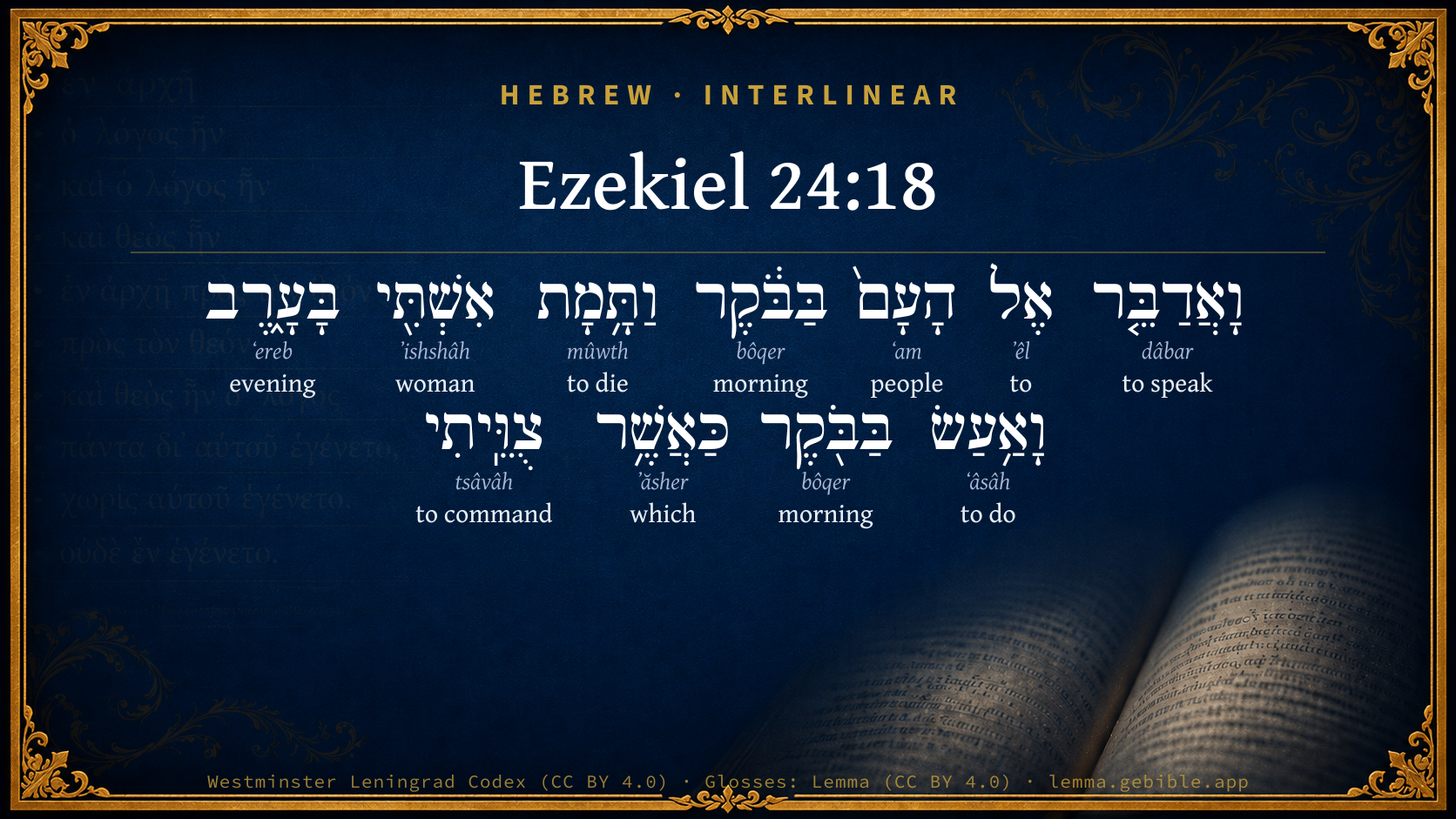
Ezekiel 24:18

Hebrew (Westminster Leningrad Codex) Ezekiel 24:18 appears in the Hebrew Old Testament. The text above is from the Westminster Leningrad Codex. Each word links to its Strong’s number, a concise gloss, and parsing drawn from the Open Scriptures Hebrew Bible morphology. Click any word for its full Brown-Driver-Briggs (BDB) entry.
Download image
Cite this verse

Ezekiel 24:18 (World English Bible). Public Domain. Lemma interlinear Bible study tool, https://lemma.gebible.app/v/ezekiel/24/18.

Show BibTeX & RIS
BibTeX
RIS
English Translation
So I spoke to the people in the morning; and at even my wife died; and I did in the morning as I was commanded.
World English Bible · Public Domain
Download a study sheet

One document with this verse’s original text, its word-by-word gloss line, the meaning frame, cross-references with their text, attributed commentary, and full source and license credits — printable, and it pastes into notes with its structure intact.

This verse Autodidact and up

Study sheet (.html) Plain text (.txt)

A passage Seminary Student

Up to 50 verses in one chapter. A passage sheet keeps up to 6 commentary sources and 12 cross-references per verse, in the order this page ranks them, and says so on the sheet whenever that leaves anything out. Ask for a single verse and you get the Autodidact verse sheet above.

Everything on this page stays free to read, with no account — the sheet is a download of what is already on screen, not access to it.

Want to remove ads? Support Godless Engineer
Compare translations 3

The same verse in 3 English versions, stacked beneath the original-language interlinear above. Click any original word for its lexicon entry.

Each is an independent rendering of the whole verse — the interlinear is not word-aligned to these translations.

Highlighted words mark where these versions differ — a whole-verse word diff, not a word-by-word alignment.

  • World English Bible Public Domain
    So I spoke to the people in the morning; and at even my wife died; and I did in the morning as I was commanded.
  • King James Version Public Domain
    So I spake unto the people in the morning: and at even my wife died; and I did in the morning as I was commanded.
  • unfoldingWord Literal Text CC BY-SA 4.0
    So I spoke to the people in the morning, and my wife died in the evening. In the morning I did what I had been commanded to do.

unfoldingWord Literal Text — © unfoldingWord, licensed CC BY-SA 4.0. Word-aligned USFM3 via Door43 (git.door43.org/unfoldingWord/en_ult).

Versions to compare (up to 4)

3 of 4 selected

Show all 18 translations

Every available English version of this verse, each an independent rendering of the whole verse.

  • World English Bible Public Domain
    So I spoke to the people in the morning; and at even my wife died; and I did in the morning as I was commanded.
  • Berean Standard Bible Public Domain
    So I spoke to the people in the morning, and in the evening my wife died. And the next morning I did as I had been commanded.
  • Majority Standard Bible Public Domain
    So I spoke to the people in the morning, and in the evening my wife died. And the next morning I did as I had been commanded.
  • King James Version Public Domain
    So I spake unto the people in the morning: and at even my wife died; and I did in the morning as I was commanded.
  • American Standard Version (1901) Public Domain
    So I spake unto the people in the morning; and at even my wife died; and I did in the morning as I was commanded.
  • Revised Version (1885) Public Domain
    So I spake unto the people in the morning; and at even my wife died: and I did in the morning as I was commanded.
  • Geneva Bible (1599) Public Domain
    So I spake vnto the people in the morning, and at euen my wife dyed: and I did in the morning, as I was commanded.
  • Douay-Rheims (1899) Public Domain
    So I spoke to the people in the morning, and my wife died in the evening: and I did in the morning as he had commanded me.
  • Young's Literal Translation Public Domain
    And I speak unto the people in the morning, and my wife dieth in the evening, and I do in the morning as I have been commanded.
  • Literal Standard Version CC BY-SA 4.0
    And I speak to the people in the morning, and my wife dies in the evening, and I do in the morning as I have been commanded.
  • Unlocked Literal Bible CC BY-SA 4.0
    So I spoke to the people in the morning, and my wife died in the evening. In the morning I did what I had been commanded to do.
  • unfoldingWord Literal Text CC BY-SA 4.0
    So I spoke to the people in the morning, and my wife died in the evening. In the morning I did what I had been commanded to do.
  • Darby Bible Public Domain
    -- And I spoke unto the people in the morning; and at even my wife died. And I did in the morning as I was commanded.
  • World Messianic Bible Public Domain
    So I spoke to the people in the morning, and at evening my wife died. So I did in the morning as I was commanded.
  • Webster's Bible Public Domain
    So I spoke to the people in the morning: and at evening my wife died; and I did in the morning as I was commanded.
  • Free Bible Version CC BY-SA 4.0
    I talked to the people in the morning, and my wife died in the evening. The next morning I did as I'd been told.
  • Bible in Basic English Public Domain
    So in the morning I was teaching the people and in the evening death took my wife; and in the morning I did what I had been ordered to do.
  • JPS Tanakh (1917) Public Domain
    So I spoke unto the people in the morning, and at even my wife died; and I did in the morning as I was commanded.

Literal Standard Version (2020), Covenant Press — licensed CC BY-SA 4.0. Text via the HelloAO Bible API (eBible.org). Unlocked Literal Bible (unfoldingWord) — licensed CC BY-SA 4.0. Text via the HelloAO Bible API (eBible.org). unfoldingWord Literal Text — © unfoldingWord, licensed CC BY-SA 4.0. Word-aligned USFM3 via Door43 (git.door43.org/unfoldingWord/en_ult). Free Bible Version, Dr. Jonathan Gallagher — licensed CC BY-SA 4.0. Text via the HelloAO Bible API (eBible.org).

Word by word

More ways to search: Search by grammar → Find every occurrence → Compare this word →

Practice this passage: Drill this verse → Learn its vocabulary →

בָּעָ֑רֶב
ʻereb
H6153
“in/at the · evening”
Preposition, Determined + Noun, Common, Masculine, Singular, Absolute
Part of Speech
Preposition + Noun
Type
Common
Gender
Masculine
Number
Singular
State
Absolute
Full BDB Definition

Origin: from H6150

TWOT: 1689a

evening, night, sunset - evening, sunset - night
  1. וָאֲדַבֵּ֤ר dâbar H1696 “and · to speak” Conjunction + Verb, Piel, Sequential Imperfect, 1st Person, Common, Singular
  2. אֶל ʼêl H413 “to” Preposition
  3. הָעָם֙ ʻam H5971 “the · people” Particle, Definite Article + Noun, Common, Masculine, Singular, Absolute
  4. בַּבֹּ֔קֶר bôqer H1242 “in/at the · morning” Preposition, Determined + Noun, Common, Masculine, Singular, Absolute
  5. וַתָּ֥מָת mûwth H4191 “and · to die” Conjunction + Verb, Qal, Sequential Imperfect, 3rd Person, Feminine, Singular
  6. אִשְׁתִּ֖י ʼishshâh H802 “woman · my” Noun, Common, Feminine, Singular, Construct + Suffix, Personal, 1st Person, Common, Singular
  7. וָאַ֥עַשׂ ʻâsâh H6213 “and · to do” Conjunction + Verb, Qal, Sequential Imperfect, 1st Person, Common, Singular
  8. בַּבֹּ֖קֶר bôqer H1242 “in/at the · morning” Preposition, Determined + Noun, Common, Masculine, Singular, Absolute
  9. כַּאֲשֶׁ֥ר ʼăsher H834 “like/as · which” Preposition + Particle, Relative
  10. צֻוֵּֽיתִי tsâvâh H6680 “to command” Verb, Pual, Perfect, 1st Person, Common, Singular

About this verse

These counts appear in no published source. They are computed here, from the morphology-tagged text and Lemma’s own curated glosses. What Lemma adds →

11
words
10
distinct lemmas
Prophets
section

Grammatical profile

  • 4 verbs
  • 5 nouns
  • 1 preposition
  • 1 particle

Verb forms

  • וָאֲדַבֵּ֤ר Piel · Sequential Imperfect
  • וַתָּ֥מָת Qal · Sequential Imperfect
  • וָאַ֥עַשׂ Qal · Sequential Imperfect
  • צֻוֵּֽיתִי Pual · Perfect

Repetition

A word recurs within this verse — often emphatic in Hebrew:

  • בַּבֹּ֔קֶר morning H1242 ×2

Hebrew & Septuagint length

In English translation the verse runs 25 words from the Hebrew and 27 from the Septuagint (LXX English) — closely comparable.

A rough comparison of the two English renderings, which tokenize alike — not a word-level alignment.

Word counts can differ between the Hebrew and the Greek without any difference in meaning — e.g. the Hebrew direct-object marker אֵת has no separate Greek word, and Greek often adds the article ὁ.

Cross-references

1

Topical passages linked to Ezekiel 24:18 in the Treasury of Scripture Knowledge — connected by theme and wording, ordered by reader-vote popularity; previews shown in the World English Bible.

  • 1 Corinthians 7:29–30 But I say this, brothers: the time is short, that from now on, both those who have wives may be as though they had none;

Cross-references courtesy of OpenBible.info (CC BY 4.0).

Hebrew and Greek witnesses Masoretic Hebrew ↔ Greek Septuagint

The same verse in the two great witnesses to the Old Testament, shown verse-for-verse.

These are two independent witnesses, not word-aligned to each other, and the Septuagint is shown in lemma (dictionary) form.

Hebrew Ezekiel 24:18 Masoretic · Westminster Leningrad Codex

וָאֲדַבֵּ֤ר אֶל הָעָם֙ בַּבֹּ֔קֶר וַתָּ֥מָת אִשְׁתִּ֖י בָּעָ֑רֶב וָאַ֥עַשׂ בַּבֹּ֖קֶר כַּאֲשֶׁ֥ר צֻוֵּֽיתִי

So I spoke to the people in the morning; and at even my wife died; and I did in the morning as I was commanded.

World English Bible · Public Domain

Greek LXX Ezekiel 24:18 Septuagint · lemma form

καί λαλέω πρός ὁ λαός ὁ πρωΐ ὅς τρόπος ἐντέλλομαι ἐγώ καί ἀποθνήσκω ὁ γυνή ἐγώ ἑσπέρα καί ποιέω ὁ πρωΐ ὅς τρόπος ἐπιτάσσω ἐγώ

And I spoke to the people in the morning, as he commanded me in the evening, and I did in the morning as it was commanded me.

LXX2012 (modern English Septuagint) · Public Domain

Hebrew: Westminster Leningrad Codex (CC BY 4.0). Greek: Septuagint (public domain); English from LXX2012 (modern English Septuagint) (Public Domain). How the Septuagint differs from the Hebrew →

Targum (Aramaic paraphrase)

1

The Targum is the ancient Jewish Aramaic paraphrase of the Hebrew Scriptures — an interpretive translation, not the Hebrew text itself. Onkelos (literal) and Pseudo-Jonathan (expansive) render the Torah, and Jonathan the Prophets. Coverage is partial: where no permissively-licensed English translation exists for a verse, only the Aramaic is shown. This is verse-level text, not a word-by-word alignment to the Hebrew.

  1. Targum Jonathan Prophets (Joshua–Malachi)
    וְאִתְנַבֵּיתִי לְעַמָא בְּצַפְרָא וּמִיתַת אִתְּתִי בְּרַמְשָׁא וַעֲבָדֵית בְּצַפְרָא כְמָא דְאִתְפַּקֵדִית:

    (no public-domain English translation for this verse)

    Targum Jonathan — Aramaic: “Mikraot Gedolot” (public domain). English: “Sefaria Community Translation” (CC0 1.0 (public-domain dedication)); “London "Chaldee Paraphrase," 1871” (public domain). Text via Sefaria.

Commentary

Notes on Ezekiel 24:18 from classic Christian and Jewish commentators (each source and its license shown beneath its notes). The classic Christian expositions comment on the surrounding passage and are grouped to its opening verse, so a note may address several verses; the Jewish commentaries on the Tanakh (Rashi and others) are per-verse, so they appear only where the commentator wrote on this verse.

Lemma curates 59 commentaries, every one of them public domain or Creative Commons licensed, each selected and text-cleaned for this edition rather than reprinted as found. About our sources →

Trapp's Complete Commentary

John Trapp

Eze 24:18 So I spake unto the people in the morning: and at even my wife died; and I did in the morning as I was commanded.

Ver. 18. And at even my wife died.] Though a good woman probably, and to the prophet a great comfort, the sweet companion of his life and miseries, yet she died suddenly, and by some extraordinary disease; all things come alike to all.

And I did in the morning as I was commanded.] Grievous though it were, and went much against the hair with me, yet I did it. Uxorem posthabuit praecepto Dei. Obedience must be yielded to God even in the most difficult duties, and conjugal love must give place to our love to him.

John Trapp, A Commentary or Exposition upon All the Books of the Old and New Testament (1647–1656) — public domain. Text from a community e-Sword module.

Geneva Bible (1599)

Geneva Bible translators

Meaning, the morning following.

Geneva Bible (1599) marginal notes — public domain. Text via Bolls.life.

Adam Clarke's Commentary

Verse 18. At even my wife died] The prophet's wife was a type of the city, which was to him exceedingly dear. The death of his wife represented the destruction of the city by the Chaldeans; see Eze 24:21, where the temple is represented to be the desire of his eyes, as his wife was, Eze 24:16.

Adam Clarke's Commentary on the Bible (1810–1826) — public domain. Text from a community e-Sword/MySword module.

Ellicott's Commentary for English Readers

(18) In the morning: and at even.—What the prophet “spake unto the people in the morning” was what he has recorded (Eze_24:3-14). Shortly after this the warning of Eze_24:15-17 must have come to him, and then his Wife died in the evening of the same day. Accordingly, on the following morning the strange conduct which had been commanded him was observed by the people; their curiosity is awakened, and, rightly surmising that there must be some especial significance in the strange doings of their prophet, they come to inquire the meaning of his actions. In reply (Eze_24:20-24), he announces again the destruction of the Temple, and that in the depth of sorrow and trouble at its fall there shall be no outward show of mourning.

A Bible Commentary for English Readers, edited by Charles John Ellicott (1878–1897) — public domain. Text from a community e-Sword module.

The Cambridge Bible for Schools and Colleges

gen. ed. J. J. S. Perowne

18. The death of the prophet’s wife was no doubt an actual occurrence. And there is nothing improbable in his demeanour after it, with the view of attracting the attention of his fellow-captives. At the same time his tendency to idealize occurrences precludes absolute certainty.

The Cambridge Bible for Schools and Colleges (gen. ed. J. J. S. Perowne; Cambridge University Press, 1878–1918) — public domain. Text from a community e-Sword module.

John Gill's Exposition

And the people said unto me,.... Either seriously, as being desirous of knowing what was meant by all this; since they had reason to believe that it was not out of want of affection in Ezekiel to his wife that he so behaved; and therefore there must be some hidden meaning in it, which they should be glad to be informed of: or in a ludicrous manner, deriding the prophet for his conduct, and despising what he meant to instruct them in hereby:

wilt thou not tell us what these things are to us, that thou doest so? for they suspected it vas not on his own account, but to signify something to them, that these things were done; and laughing at him, they say, to what purpose are these things done? if you do not tell us for what reason they are done, instruct us by words, and not by actions; these were his fellow captives in Babylon.

John Gill's Exposition of the Whole Bible (1746–1763) — public domain (CC PDM 1.0). Text via the HelloAO Bible API.

Matthew Poole's English Annotations

I spake unto the people; told them what God had told me, and which I expected would be.

In the morning; it is likely he had this revelation in the night, or evening before, and he tells them betimes in the morning, what God would do in taking away his wife, and what he must not do when she is dead, and to be buried. The next morning after her death he observed God’s command, and without any sign of sorrow or mourning for his great loss.

Matthew Poole's English Annotations on the Holy Bible (1683–1685) — public domain. Text from a community e-Sword/MySword module.

Whedon's Commentary on the Bible

Daniel D. Whedon

18. In the morning — “The next morning.”

Daniel D. Whedon (gen. ed.), Commentary on the Old and New Testaments (1874–1909) — public domain. Text from a community e-Sword module.

The Pulpit Commentary

So I spake unto the people in the morning, etc. In yet another way the calling of the prophet superseded the natural impulses of the man. He knew that his wife"s hours were numbered, yet the day was spent, not in ministering at her deathbed, but in one last effort to impress the teachings of the time upon the seared consciences and hardened hearts of his countrymen and neighbors. I cannot help referring to the poem "Ezekiel," by B.M., published in 1871, as expressing the meaning of the history better than any commentary.

The Pulpit Commentary (1880–1919), ed. H.D.M. Spence-Jones & Joseph S. Exell — public domain. Text from a community e-Sword module.

John Wesley's Explanatory Notes

I spake - Told them what I expected would be.

John Wesley, Explanatory Notes Upon the Whole Bible (1754–1765) — public domain. Text via the GEBible commentary corpus.

unfoldingWord translationNotes

Door43 World Missions Community

In the morning

"The next morning"

translationWords

die

command

unfoldingWord translationNotes — © Distant Shores Media and the Door43 World Missions Community, licensed CC BY-SA 4.0. Source: git.door43.org/Door43/en_tn.

Rashi

Rabbi Shlomo Yitzchaki (Rashi)

as I had been commanded not to observe mourning.

Rashi on the Tanakh — English translations: “The Judaica Press complete Tanach with Rashi, translated by A. J. Rosenberg” (CC BY 4.0); “Pentateuch with Rashi's commentary by M. Rosenbaum and A.M. Silbermann, 1929-1934” (public domain); “The Metsudah Tanach series, Lakewood, N.J” (CC BY 4.0); and “The Book of Joshua, Metsudah Publications, 1997” (CC BY 4.0). Text via Sefaria.

Lesson kit

Teaching starters — assembled from the data on this page, not authored interpretation. Every prompt links to the verse data it draws on. Edit before teaching.

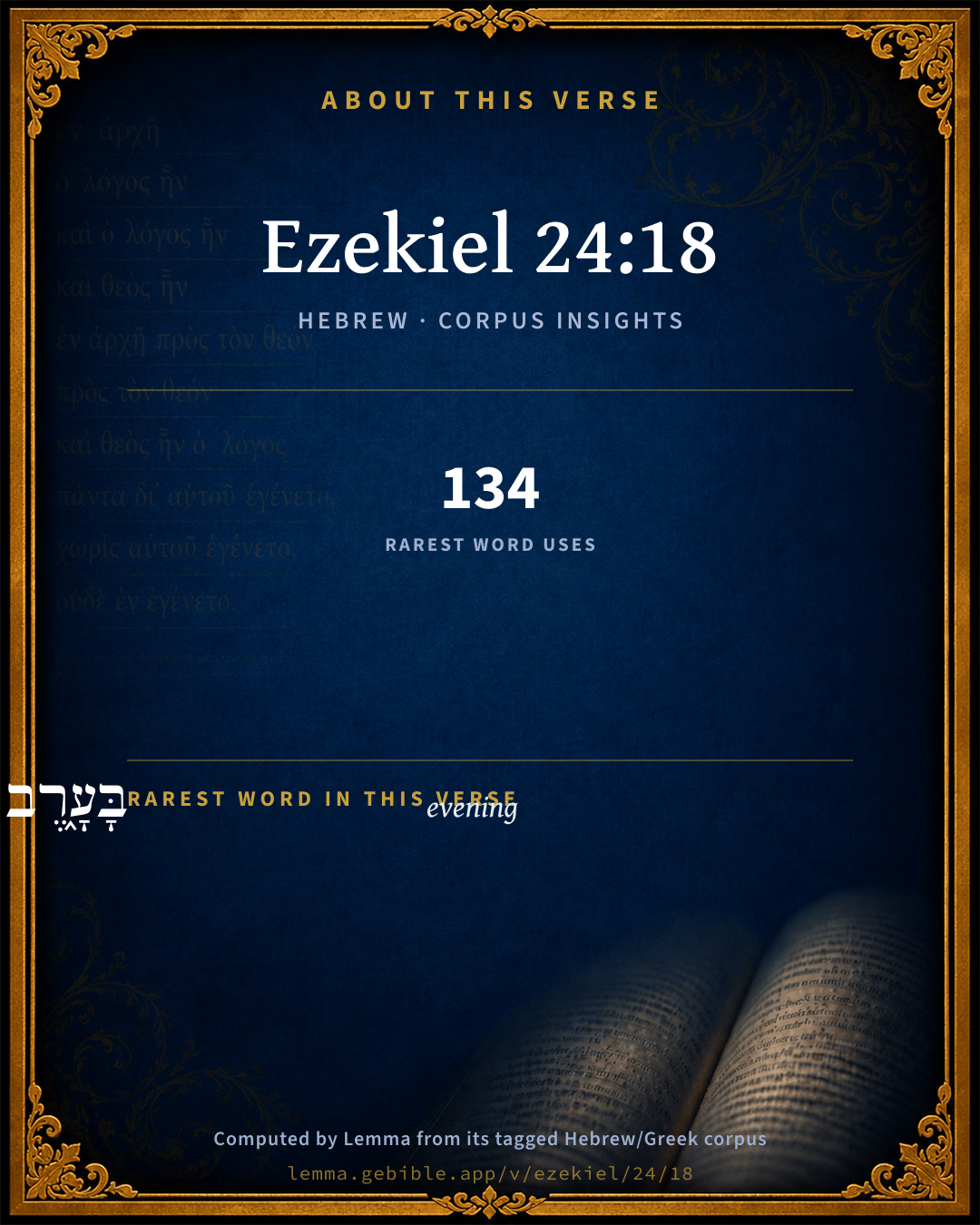
Ezekiel, in the Prophets, opens this verse with 11 words (10 distinct Hebrew lemmas). Its most distinctive word is ʻereb (“evening”). A historical commentator’s framing appears above. Read the whole chapter for the surrounding context.

Discussion questions

  1. The word ʻereb carries the sense “evening.” How does it shape the verse?
  2. 1 Corinthians 7:29–30 shares this passage’s theme. How do the two illuminate each other?
  3. “morning” occurs 2× in this one verse. What is the effect of the repetition?
  4. These translations render this verse differently. What is at stake in choosing one wording over another?
  5. The verb «וָאֲדַבֵּ֤ר» is Piel Sequential Imperfect. How does its form color the action?
  6. Reading how Trapp's Complete Commentary and Geneva Bible (1599) read this verse, where do the two commentators agree and where do they part?

Things to notice

Reading settings

Reading text

Shown beneath each verse's original-language words.

Old Testament
Old Testament edition

Read the OT as the Masoretic Hebrew (MT) or the Greek Septuagint (LXX).

English shown for the Greek Septuagint (in the Hebrew ↔ Greek comparison).

Comparing translations? Open the Compare panel on any verse page to stack up to four side by side.