
Joshua 1:18

Hebrew (Westminster Leningrad Codex) Joshua 1:18 appears in the Hebrew Old Testament. The text above is from the Westminster Leningrad Codex. Each word links to its Strong’s number, a concise gloss, and parsing drawn from the Open Scriptures Hebrew Bible morphology. Click any word for its full Brown-Driver-Briggs (BDB) entry.
Download image
Cite this verse

Joshua 1:18 (World English Bible). Public Domain. Lemma interlinear Bible study tool, https://lemma.gebible.app/v/joshua/1/18.

Show BibTeX & RIS
BibTeX
RIS
English Translation
Whoever he be who shall rebel against your commandment, and shall not listen to your words in all that you command him, he shall be put to death: only be strong and of good courage.
World English Bible · Public Domain
Download a study sheet

One document with this verse’s original text, its word-by-word gloss line, the meaning frame, cross-references with their text, attributed commentary, and full source and license credits — printable, and it pastes into notes with its structure intact.

This verse Autodidact and up

Study sheet (.html) Plain text (.txt)

A passage Seminary Student

Up to 50 verses in one chapter. A passage sheet keeps up to 6 commentary sources and 12 cross-references per verse, in the order this page ranks them, and says so on the sheet whenever that leaves anything out. Ask for a single verse and you get the Autodidact verse sheet above.

Everything on this page stays free to read, with no account — the sheet is a download of what is already on screen, not access to it.

Want to remove ads? Support Godless Engineer
Compare translations 3

The same verse in 3 English versions, stacked beneath the original-language interlinear above. Click any original word for its lexicon entry.

Each is an independent rendering of the whole verse — the interlinear is not word-aligned to these translations.

Highlighted words mark where these versions differ — a whole-verse word diff, not a word-by-word alignment.

  • World English Bible Public Domain
    Whoever he be who shall rebel against your commandment, and shall not listen to your words in all that you command him, he shall be put to death: only be strong and of good courage.
  • King James Version Public Domain
    Whosoever he be that doth rebel against thy commandment, and will not hearken unto thy words in all that thou commandest him, he shall be put to death: only be strong and of a good courage.
  • unfoldingWord Literal Text CC BY-SA 4.0
    Every man who disobeys your mouth and will not hear your words according to all of what you command him shall be put to death. Only be strong and be courageous.”

unfoldingWord Literal Text — © unfoldingWord, licensed CC BY-SA 4.0. Word-aligned USFM3 via Door43 (git.door43.org/unfoldingWord/en_ult).

Versions to compare (up to 4)

3 of 4 selected

Show all 18 translations

Every available English version of this verse, each an independent rendering of the whole verse.

  • World English Bible Public Domain
    Whoever he be who shall rebel against your commandment, and shall not listen to your words in all that you command him, he shall be put to death: only be strong and of good courage.
  • Berean Standard Bible Public Domain
    Anyone who rebels against your order and does not obey your words, all that you command him, will be put to death. Above all, be strong and courageous!”
  • Majority Standard Bible Public Domain
    Anyone who rebels against your order and does not obey your words, all that you command him, will be put to death. Above all, be strong and courageous!”
  • King James Version Public Domain
    Whosoever he be that doth rebel against thy commandment, and will not hearken unto thy words in all that thou commandest him, he shall be put to death: only be strong and of a good courage.
  • American Standard Version (1901) Public Domain
    Whosoever he be that shall rebel against thy commandment, and shall not hearken unto thy words in all that thou commandest him, he shall be put to death: only be strong and of good courage.
  • Revised Version (1885) Public Domain
    Whosoever he be that shall rebel against thy commandment, and shall not hearken unto thy words in all that thou commandest him, he shall be put to death: only be strong and of a good courage.
  • Geneva Bible (1599) Public Domain
    Whosoeuer shall rebell against thy commandement, and will not obey thy wordes in all that thou commaundest him, let him bee put to death: onely be strong and of good courage.
  • Douay-Rheims (1899) Public Domain
    He that shall gainsay thy mouth, and not obey all thy words, that thou shalt command him, let him die: only take thou courage, and do manfully.
  • Young's Literal Translation Public Domain
    Any man who doth provoke thy mouth, and doth not hear thy words, in all that thou dost command him, is put to death; only, be strong and courageous.'
  • Literal Standard Version CC BY-SA 4.0
    Any man who provokes your mouth, and does not hear your words, in all that you command him, is put to death; only, be strong and courageous.”
  • Unlocked Literal Bible CC BY-SA 4.0
    Whoever rebels against your commands and disobeys your words will be put to death. Only be strong and courageous.”
  • unfoldingWord Literal Text CC BY-SA 4.0
    Every man who disobeys your mouth and will not hear your words according to all of what you command him shall be put to death. Only be strong and be courageous.”
  • Darby Bible Public Domain
    Every one that is rebellious against thy commandment and hearkeneth not to thy words in everything that thou commandest us, shall be put to death. Only be strong and courageous.
  • World Messianic Bible Public Domain
    Whoever rebels against your commandment, and doesn’t listen to your words in all that you command him shall himself be put to death. Only be strong and courageous.”
  • Webster's Bible Public Domain
    Every one that doth rebel against thy commandment, and will not hearken to thy words in all that thou commandest him, shall be put to death: only be strong and of a good courage.
  • Free Bible Version CC BY-SA 4.0
    Anyone who rebels against what you say and doesn't follow your orders, who doesn't obey everything you command, will be put to death. So be strong! Be brave!”
  • Bible in Basic English Public Domain
    Whoever goes against your orders, and does not give attention to all your words, will be put to death: only take heart and be strong.
  • JPS Tanakh (1917) Public Domain
    Whosoever he be that shall rebel against thy commandment, and shall not hearken unto thy words in all that thou commandest him, he shall be put to death; only be strong and of good courage.'

Literal Standard Version (2020), Covenant Press — licensed CC BY-SA 4.0. Text via the HelloAO Bible API (eBible.org). Unlocked Literal Bible (unfoldingWord) — licensed CC BY-SA 4.0. Text via the HelloAO Bible API (eBible.org). unfoldingWord Literal Text — © unfoldingWord, licensed CC BY-SA 4.0. Word-aligned USFM3 via Door43 (git.door43.org/unfoldingWord/en_ult). Free Bible Version, Dr. Jonathan Gallagher — licensed CC BY-SA 4.0. Text via the HelloAO Bible API (eBible.org).

Word by word

More ways to search: Search by grammar → Find every occurrence → Compare this word →

Practice this passage: Drill this verse → Learn its vocabulary →

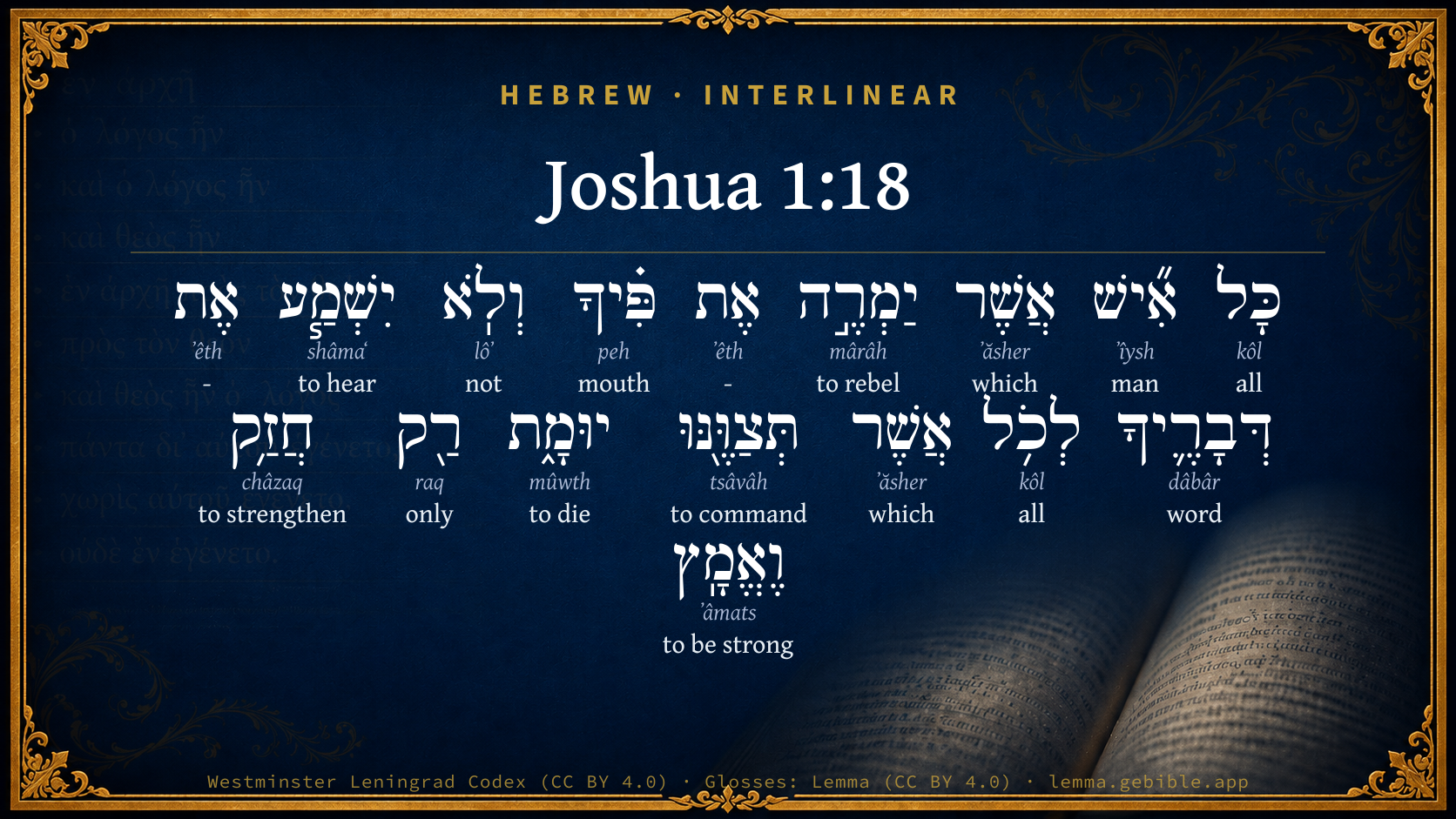
וֶאֱמָֽץ
ʼâmats
H553
“and · be strong”
Conjunction + Verb, Qal, Imperative, 2nd Person, Masculine, Singular
Part of Speech
Conjunction + Verb
Stem
Qal
Form
Imperative
Person
2nd Person
Gender
Masculine
Number
Singular
Full BDB Definition

Origin: a primitive root

TWOT: 117

to be strong, alert, courageous, brave, stout, bold, solid, hard - (Qal) to be strong, brave, bold - (Piel) to strengthen, secure (for oneself), harden (heart), make firm, make obstinate, assure - (Hithpael) to be determined, to make oneself alert, strengthen oneself, confirm oneself, persist in, prove superior to - (Hiphil) to exhibit strength, be strong, feel strong
  1. כָּל kôl H3605 “all of” Noun, Common, Masculine, Singular, Construct
  2. אִ֞ישׁ ʼîysh H376 “man” Noun, Common, Masculine, Singular, Absolute
  3. אֲשֶׁר ʼăsher H834 “which” Particle, Relative
  4. יַמְרֶ֣ה mârâh H4784 “to rebel” Verb, Hiphil, Imperfect, 3rd Person, Masculine, Singular
  5. אֶת ʼêth H853 “-” Particle, Direct Object
  6. פִּ֗יךָ peh H6310 “mouth · your” Noun, Common, Masculine, Singular, Construct + Suffix, Personal, 2nd Person, Masculine, Singular
  7. וְלֹֽא lôʼ H3808 “and · not” Conjunction + Particle, Negative
  8. יִשְׁמַ֧ע shâmaʻ H8085 “to hear” Verb, Qal, Imperfect, 3rd Person, Masculine, Singular
  9. אֶת ʼêth H853 “-” Particle, Direct Object
  10. דְּבָרֶ֛יךָ dâbâr H1697 “words · your” Noun, Common, Masculine, Plural, Construct + Suffix, Personal, 2nd Person, Masculine, Singular
  11. לְכֹ֥ל kôl H3605 “to/for · all” Preposition + Noun, Common, Masculine, Singular, Absolute
  12. אֲשֶׁר ʼăsher H834 “which” Particle, Relative
  13. תְּצַוֶּ֖נּוּ tsâvâh H6680 “to command · him” Verb, Piel, Imperfect, 2nd Person, Masculine, Singular + Suffix, Personal, 3rd Person, Masculine, Singular
  14. יוּמָ֑ת mûwth H4191 “to die” Verb, Hophal, Imperfect, 3rd Person, Masculine, Singular
  15. רַ֖ק raq H7535 “only” Particle, Accusative
  16. חֲזַ֥ק châzaq H2388 “strengthen” Verb, Qal, Imperative, 2nd Person, Masculine, Singular

About this verse

These counts appear in no published source. They are computed here, from the morphology-tagged text and Lemma’s own curated glosses. What Lemma adds →

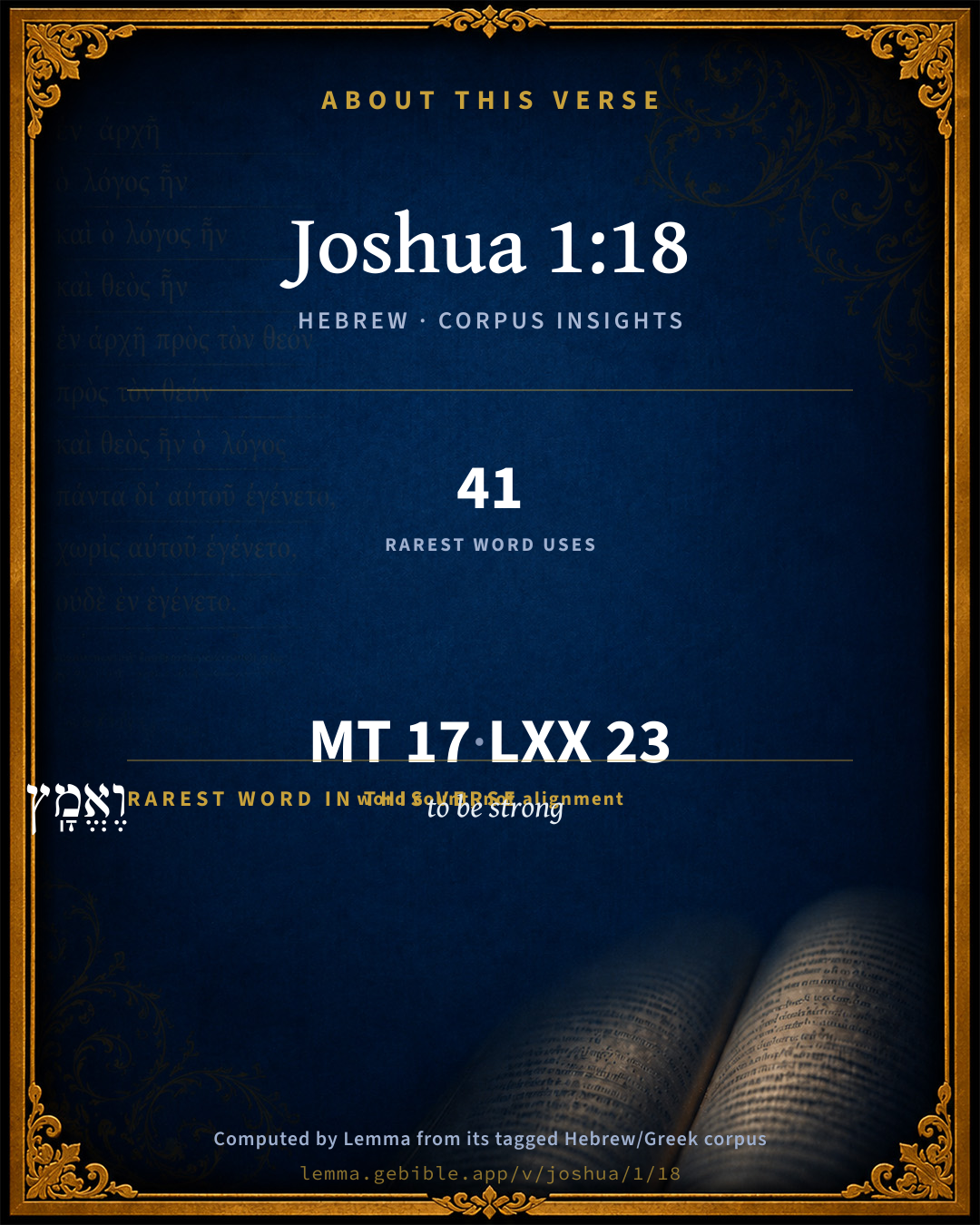
17
words
14
distinct lemmas
Historical
section

Shared distinctive vocabulary

וֶאֱמָֽץ to be strong H553 occurs in 41 verses of the Hebrew Bible. Also found in:

Grammatical profile

  • 6 verbs
  • 5 nouns
  • 6 particles

Verb forms

  • יַמְרֶ֣ה Hiphil · Imperfect
  • יִשְׁמַ֧ע Qal · Imperfect
  • תְּצַוֶּ֖נּוּ Piel · Imperfect
  • יוּמָ֑ת Hophal · Imperfect
  • חֲזַ֥ק Qal · Imperative
  • וֶאֱמָֽץ Qal · Imperative

Repetition

Words recur within this verse — often emphatic in Hebrew:

  • כָּל all H3605 ×2
  • אֲשֶׁר which H834 ×2

Hebrew & Septuagint length

In English translation the verse runs 35 words from the Hebrew and 27 from the Septuagint (LXX English) — closely comparable.

A rough comparison of the two English renderings, which tokenize alike — not a word-level alignment.

Word counts can differ between the Hebrew and the Greek without any difference in meaning — e.g. the Hebrew direct-object marker אֵת has no separate Greek word, and Greek often adds the article ὁ.

In the original languages it is 17 Hebrew tokens and 23 Greek tokens — but the two are counted differently (Hebrew bundles its prefixes and suffixes into one token; the Greek is in lemma form), so that isn’t a like-for-like length.

Cross-references

12

Topical passages linked to Joshua 1:18 in the Treasury of Scripture Knowledge — connected by theme and wording, ordered by reader-vote popularity; previews shown in the World English Bible.

  • Ephesians 6:10 Finally, be strong in the Lord, and in the strength of his might.
  • Joshua 1:9 Haven't I commanded you? Be strong and of good courage; don't be afraid, neither be dismayed: for Yahweh your God is with you wherever you go.
  • Ezra 10:4 Arise; for the matter belongs to you, and we are with you: be of good courage, and do it.
  • 1 Corinthians 16:13 Watch! Stand firm in the faith! Be courageous! Be strong!
  • 1 Samuel 11:12 The people said to Samuel, Who is he who said, Shall Saul reign over us? bring the men, that we may put them to death.
  • Hebrews 10:28–29 A man who disregards Moses' law dies without compassion on the word of two or three witnesses.
  • Hebrews 12:25 See that you don't refuse him who speaks. For if they didn't escape when they refused him who warned on the Earth, how much more will we not escape who turn away from him who warns from heaven,
  • Deuteronomy 17:12 The man who does presumptuously, in not listening to the priest who stands to minister there before Yahweh your God, or to the judge, even that man shall die: and you shall put away the evil from Israel.
  • Joshua 1:6–7 Be strong and of good courage; for you shall cause this people to inherit the land which I swore to their fathers to give them.
  • Psalms 2:1–6 Why do the nations rage, And the peoples plot a vain thing?
  • Luke 19:27 But bring those enemies of mine who didn't want me to reign over them here, and kill them before me.'"
  • Romans 13:1–5 Let every soul be in subjection to the higher authorities, for there is no authority except from God, and those who exist are ordained by God.

Cross-references courtesy of OpenBible.info (CC BY 4.0).

Hebrew and Greek witnesses Masoretic Hebrew ↔ Greek Septuagint

The same verse in the two great witnesses to the Old Testament, shown verse-for-verse.

These are two independent witnesses, not word-aligned to each other, and the Septuagint is shown in lemma (dictionary) form.

Hebrew Joshua 1:18 Masoretic · Westminster Leningrad Codex

כָּל אִ֞ישׁ אֲשֶׁר יַמְרֶ֣ה אֶת פִּ֗יךָ וְלֹֽא יִשְׁמַ֧ע אֶת דְּבָרֶ֛יךָ לְכֹ֥ל אֲשֶׁר תְּצַוֶּ֖נּוּ יוּמָ֑ת רַ֖ק חֲזַ֥ק וֶאֱמָֽץ

Whoever he be who shall rebel against your commandment, and shall not listen to your words in all that you command him, he shall be put to death: only be strong and of good courage.

World English Bible · Public Domain

Greek LXX Joshua 1:18 Septuagint · lemma form

ὁ δέ ἄνθρωπος ὅς ἐάν ἀπειθέω σύ καί ὅστις μή ἀκούω ὁ ῥῆμα σύ καθότι ἄν αὐτός ἐντέλλομαι ἀποθνήσκω ἀλλά ἰσχύω καί ἀνδρίζομαι

And whoever shall disobey you, and whoever shall not listen to your words as you shall command him, let him die; but be you strong and courageous.

LXX2012 (modern English Septuagint) · Public Domain

Hebrew: Westminster Leningrad Codex (CC BY 4.0). Greek: Septuagint (public domain); English from LXX2012 (modern English Septuagint) (Public Domain). How the Septuagint differs from the Hebrew →

Targum (Aramaic paraphrase)

1

The Targum is the ancient Jewish Aramaic paraphrase of the Hebrew Scriptures — an interpretive translation, not the Hebrew text itself. Onkelos (literal) and Pseudo-Jonathan (expansive) render the Torah, and Jonathan the Prophets. Coverage is partial: where no permissively-licensed English translation exists for a verse, only the Aramaic is shown. This is verse-level text, not a word-by-word alignment to the Hebrew.

  1. Targum Jonathan Prophets (Joshua–Malachi)
    כָּל גְבַר דִיסַרֵב עַל מֵימְרָךְ וְלָא יְקַבֵל יַת פִּתְגָמָךְ לְכֹל דְתַפְקְדִנֵיהּ יִתְקְטֵיל לְחוֹד תְּקֵף וֶעְלָם:

    (no public-domain English translation for this verse)

    Targum Jonathan — Aramaic: “Mikraot Gedolot” (public domain). English: “Sefaria Community Translation” (CC0 1.0 (public-domain dedication)); “London "Chaldee Paraphrase," 1871” (public domain). Text via Sefaria.

Commentary

Notes on Joshua 1:18 from classic Christian and Jewish commentators (each source and its license shown beneath its notes). The classic Christian expositions comment on the surrounding passage and are grouped to its opening verse, so a note may address several verses; the Jewish commentaries on the Tanakh (Rashi and others) are per-verse, so they appear only where the commentator wrote on this verse.

Lemma curates 59 commentaries, every one of them public domain or Creative Commons licensed, each selected and text-cleaned for this edition rather than reprinted as found. About our sources →

Trapp's Complete Commentary

John Trapp

Jos 1:18 Whosoever [he be] that doth rebel against thy commandment, and will not hearken unto thy words in all that thou commandest him, he shall be put to death: only be strong and of a good courage.

Ver. 18. Only be strong and of a good courage.] Here Vox populi accordeth Vox Dei: this was a further confirmation. See Jos 1:6.

John Trapp, A Commentary or Exposition upon All the Books of the Old and New Testament (1647–1656) — public domain. Text from a community e-Sword module.

Tyndale Open Study Notes

Tyndale Open Resources

1:18 Disobeying God’s chosen ruler was treason against God himself.

Tyndale Open Study Notes — © Tyndale Open Resources, licensed CC BY-SA 4.0. Text via the HelloAO Bible API.

Adam Clarke's Commentary

Verse 18. He shall be put to death] This was martial law; he who disobeyed the command of his general should be put to death. To this the people agreed, and it was essentially necessary in order that proper discipline should be kept up in this great army. By insubordination their fathers had suffered much in the wilderness; they rejected the authority of Moses, mutinied and made themselves a leader to conduct them back to Egypt. (See Nu 14:4.) And Joshua himself, for attempting to encourage them against their fears, was near being stoned to death. It was necessary, therefore, that they should give him the most positive assurance that they would not act as their fathers had done.

1. NOTWITHSTANDING the great honour God put on his servants Moses, Aaron, Phinehas, and Joshua, yet we find him using every means to induce the people to trust in himself alone. Hence he is ever showing them that even those great men had nothing but what they had received, and that they were as fully dependent upon himself as the meanest of the people. What was even Moses without his GOD?

2. Is it not strange that at the death of Moses utter despair had not overwhelmed the whole camp, as he whom they expected to give them rest had died before any conquest was made in Canaan? We find, however, that they are not discouraged; he who gave them Moses, has now given them Joshua in his place; and they had now fully learned that if God be for them, none could be successfully against them.

3. From all this we may learn, that when God has a great work to accomplish, he will provide himself suitable instruments; and though one which he has greatly honoured, appear to fail, we should know that he is not confined to work by that one alone. He has way every where, and all things serve the purposes of his will. He will as surely support his Church on earth, as he will support the earth itself; and while the sun and moon endure, the Church shall flourish: this is for his own honour, and he certainly is more concerned for his own glory in the administration of justice, judgment, and salvation in the earth, than any of the children of men can possibly be.

4. Though God had so implicitly promised them his help, yet he strongly insists on their own co-operation. He requires the use of every power and talent he has given; even Joshua himself must be strong and very courageous, and the people must obey him in all things, in order that they may go over the Jordan to possess the good land; and without this they had never got into the promised rest. Shall we suppose, then, that if we be not workers together with God we shall be saved? Vain expectation! He works in us to will and to do, i.e., he gives the principle of volition in things that are holy, and the principle of power to bring the acts of will into good practical effect; therefore, says the apostle, work out your own salvation with fear and trembling. Will, therefore, under the influence of the gracious principle of volition; act under the influence of the principle of power. Without the power you can neither will nor do; but having the power it is your duty to will and do. It is enough that God gives the power. It is our duty, when we receive these talents, to improve them. In a million of cases a man may be both able to will and to do, and yet do neither to the salvation of his soul.

Adam Clarke's Commentary on the Bible (1810–1826) — public domain. Text from a community e-Sword/MySword module.

John Gill's Exposition

Whosoever he be that doth rebel against thy commandment,.... Refuses to go over Jordan with his brethren the children of Israel, when commanded by Joshua so to do:

and will not hearken to thy words in all that thou commandest him; or, if he does go over, yet will not obey orders to take such a post, or go against such a city, or march into such a part of the country:

he shall be put to death; this part of military discipline they agree to, and hereby declare their entire submission to him as their general; some understand this as spoken by all Israel, and of their promise of obedience to Joshua, as their governor, in all things:

only be strong, and of a good courage; which also is not to be understood as a condition of their submission and obedience, but as a hearty wish and prayer for him, that he might have strength and courage necessary to the great work he was engaging in, and which to see would be no small encouragement to follow and obey him.

Next: Joshua Chapter 2

John Gill's Exposition of the Whole Bible (1746–1763) — public domain (CC PDM 1.0). Text via the HelloAO Bible API.

Haydock's Catholic Bible Commentary

Die, as guilty of high treason. The person’s goods were confiscated, and became the property of the king. Thus David disposed of the effects of Saul, (2 Kings xvi. 4.) and Achab seized the vineyard of Naboth, 3 Kings xxi. 15. (Calmet)

George Leo Haydock (1774–1849), Haydock's Catholic Family Bible and Commentary, 1859 edition — public domain. Excludes Psalms (Douay-Rheims chapter numbering differs from Protestant) and Deuterocanonical books (Catholic canon only).

Matthew Poole's English Annotations

In all that thou commandest him, not repugnant to God’s commands; for none can be so foolish to think, that if he had commanded the people to blaspheme God, or worship idols, the people were obliged to obey him therein.

Matthew Poole's English Annotations on the Holy Bible (1683–1685) — public domain. Text from a community e-Sword/MySword module.

Whedon's Commentary on the Bible

Daniel D. Whedon

18. Against thy commandment — Literally, Every man who rebels against thy mouth; that is, who shows contempt for thy commands.

Shall be put to death — A righteous verdict against the rebel, and in accordance with the law of the Most High. Deu_17:12. Resistance to His chosen representative is a crime no less heinous than avowed rebellion against His sovereignty. So long as a government is subserving its ends in administering justice and conserving human society, the attempt to subvert it by violence is a crime of the greatest enormity, striking at the very foundation of all the earthly interests of mankind, and opening wide the floodgates of civil war. Notes Rom_13:1-7.

Daniel D. Whedon (gen. ed.), Commentary on the Old and New Testaments (1874–1909) — public domain. Text from a community e-Sword module.

The Pulpit Commentary

Whosoever he be that doth rebel against thy commandment. A striking fulfilment of this promise appears in the case of Achan, who was put to death by the act of the whole congregation. (see Jos_7:25; and cf. Deu_17:12) Only be strong and of a good courage. The task of a leader in Israel is easy when he is sustained by the prayers of his people, and when their exhortations are an echo of the words of God (see vers. 6, 9).

The Pulpit Commentary (1880–1919), ed. H.D.M. Spence-Jones & Joseph S. Exell — public domain. Text from a community e-Sword module.

Rashi

Rabbi Shlomo Yitzchaki (Rashi)

Rebels—who challenge your words.

Rashi on the Tanakh — English translations: “The Judaica Press complete Tanach with Rashi, translated by A. J. Rosenberg” (CC BY 4.0); “Pentateuch with Rashi's commentary by M. Rosenbaum and A.M. Silbermann, 1929-1934” (public domain); “The Metsudah Tanach series, Lakewood, N.J” (CC BY 4.0); and “The Book of Joshua, Metsudah Publications, 1997” (CC BY 4.0). Text via Sefaria.

Lesson kit

Teaching starters — assembled from the data on this page, not authored interpretation. Every prompt links to the verse data it draws on. Edit before teaching.

Joshua, in the Historical, opens this verse with 17 words (14 distinct Hebrew lemmas). Its most distinctive word is ʼâmats (“to be strong”). A historical commentator’s framing appears above. Read the whole chapter for the surrounding context.

Discussion questions

  1. The word ʼâmats carries the sense “to be strong.” How does it shape the verse?
  2. Genesis 25:23 shares the word «to be strong» with this verse. How do the two illuminate each other?
  3. “all” occurs 2× in this one verse. What is the effect of the repetition?
  4. These translations render this verse differently; the difference is in the English rendering, not the original. What questions does that raise?
  5. The verb «יַמְרֶ֣ה» is Hiphil Imperfect. How does its form color the action?
  6. Reading how Trapp's Complete Commentary and Tyndale Open Study Notes read this verse, where do the two commentators agree and where do they part?

Things to notice

Reading settings

Reading text

Shown beneath each verse's original-language words.

Old Testament
Old Testament edition

Read the OT as the Masoretic Hebrew (MT) or the Greek Septuagint (LXX).

English shown for the Greek Septuagint (in the Hebrew ↔ Greek comparison).

Comparing translations? Open the Compare panel on any verse page to stack up to four side by side.