
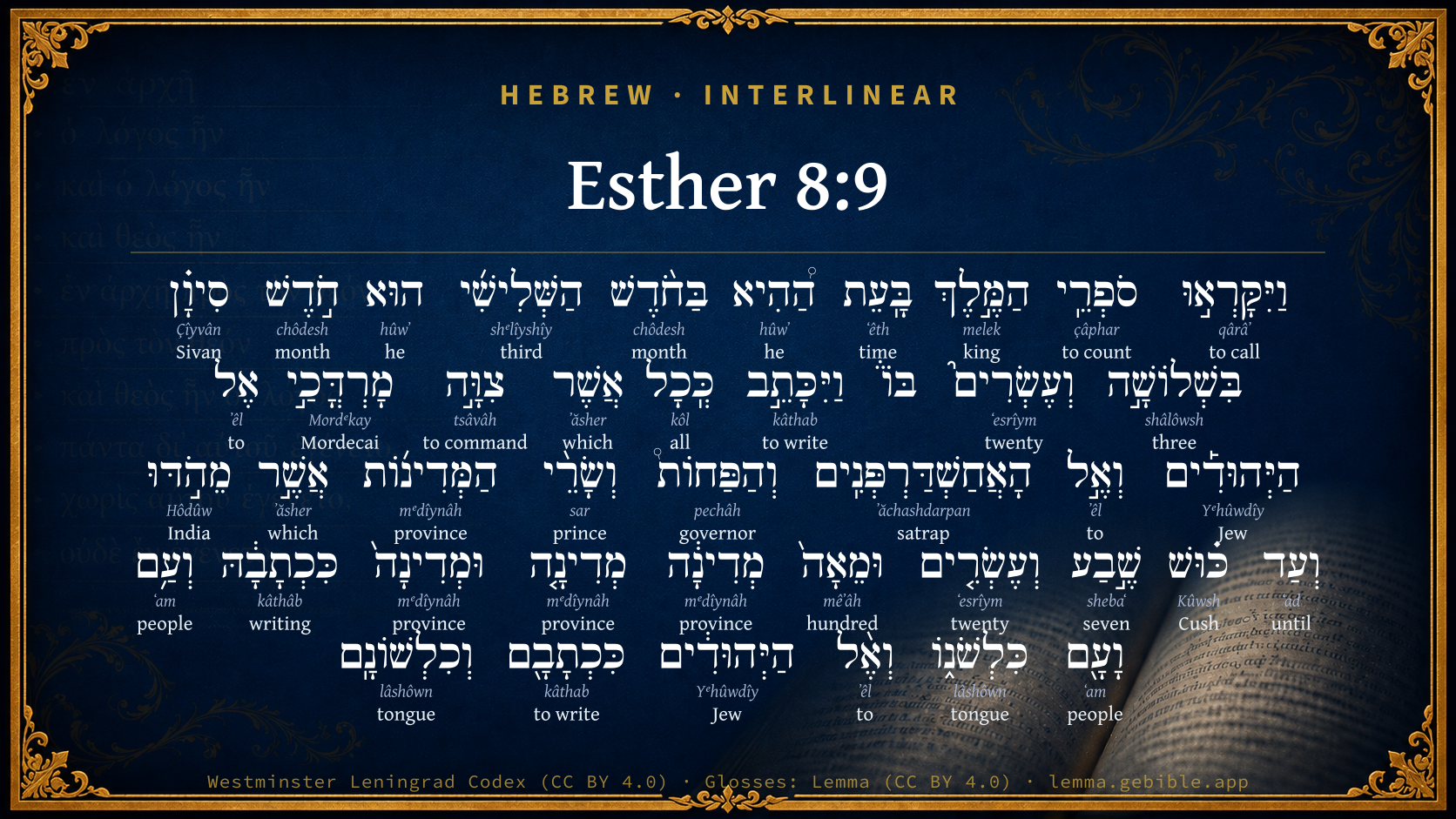
Esther 8:9

Hebrew (Westminster Leningrad Codex) Esther 8:9 appears in the Hebrew Old Testament. The text above is from the Westminster Leningrad Codex. Each word links to its Strong’s number, a concise gloss, and parsing drawn from the Open Scriptures Hebrew Bible morphology. Click any word for its full Brown-Driver-Briggs (BDB) entry.
Download image
Cite this verse

Esther 8:9 (World English Bible). Public Domain. Lemma interlinear Bible study tool, https://lemma.gebible.app/v/esther/8/9.

Show BibTeX & RIS
BibTeX
RIS
English Translation
Then were the king's scribes called at that time, in the third month Sivan, on the three and twentieth [day] of it; and it was written according to all that Mordecai commanded to the Jews, and to the satraps, and the governors and princes of the provinces which are from India to Ethiopia, one hundred twenty-seven provinces, to every province according to the writing of it, and to every people after their language, and to the Jews according to their writing, and according to their language.
World English Bible · Public Domain
Highlights
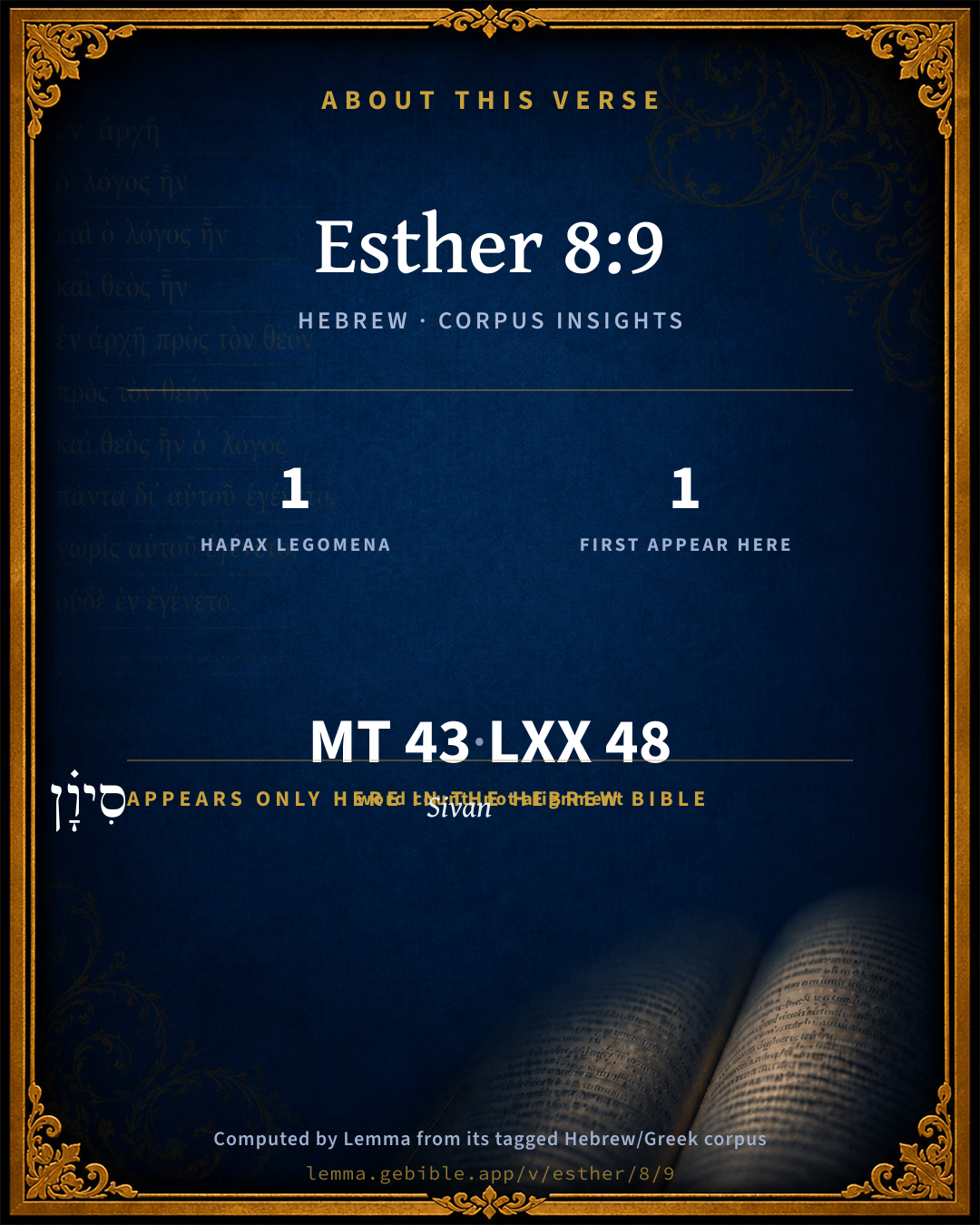
  • 1 hapax legomenon — only here in the Hebrew Bible
  • 1 first appearance in the Hebrew Bible
Full analysis ↓
Download a study sheet

One document with this verse’s original text, its word-by-word gloss line, the meaning frame, cross-references with their text, attributed commentary, and full source and license credits — printable, and it pastes into notes with its structure intact.

This verse Autodidact and up

Study sheet (.html) Plain text (.txt)

A passage Seminary Student

Up to 50 verses in one chapter. A passage sheet keeps up to 6 commentary sources and 12 cross-references per verse, in the order this page ranks them, and says so on the sheet whenever that leaves anything out. Ask for a single verse and you get the Autodidact verse sheet above.

Everything on this page stays free to read, with no account — the sheet is a download of what is already on screen, not access to it.

Want to remove ads? Support Godless Engineer
Compare translations 3

The same verse in 3 English versions, stacked beneath the original-language interlinear above. Click any original word for its lexicon entry.

Each is an independent rendering of the whole verse — the interlinear is not word-aligned to these translations.

Highlighted words mark where these versions differ — a whole-verse word diff, not a word-by-word alignment.

  • World English Bible Public Domain
    Then were the king's scribes called at that time, in the third month Sivan, on the three and twentieth [day] of it; and it was written according to all that Mordecai commanded to the Jews, and to the satraps, and the governors and princes of the provinces which are from India to Ethiopia, one hundred twenty-seven provinces, to every province according to the writing of it, and to every people after their language, and to the Jews according to their writing, and according to their language.
  • King James Version Public Domain
    Then were the king's scribes called at that time in the third month, that is, the month Sivan, on the three and twentieth day thereof; and it was written according to all that Mordecai commanded unto the Jews, and to the lieutenants, and the deputies and rulers of the provinces which are from India unto Ethiopia, an hundred twenty and seven provinces, unto every province according to the writing thereof, and unto every people after their language, and to the Jews according to their writing, and according to their language.
  • unfoldingWord Literal Text CC BY-SA 4.0
    And the scribes of the king were called at that time, in the third month, which is the month of Sivan, on the twenty-third of it. And according to all that Mordecai commanded, it was written to the Jews, and to the satraps, and the governors and officials of the provinces that were from India even as far as Ethiopia: 127 provinces, province by province according to its writing, and people by people according to its tongue, and to the Jews according to their writing and according to their tongue.

unfoldingWord Literal Text — © unfoldingWord, licensed CC BY-SA 4.0. Word-aligned USFM3 via Door43 (git.door43.org/unfoldingWord/en_ult).

Versions to compare (up to 4)

3 of 4 selected

Show all 18 translations

Every available English version of this verse, each an independent rendering of the whole verse.

  • World English Bible Public Domain
    Then were the king's scribes called at that time, in the third month Sivan, on the three and twentieth [day] of it; and it was written according to all that Mordecai commanded to the Jews, and to the satraps, and the governors and princes of the provinces which are from India to Ethiopia, one hundred twenty-seven provinces, to every province according to the writing of it, and to every people after their language, and to the Jews according to their writing, and according to their language.
  • Berean Standard Bible Public Domain
    At once the royal scribes were summoned, and on the twenty-third day of the third month (the month of Sivan), they recorded all of Mordecai’s orders to the Jews and to the satraps, governors, and princes of the 127 provinces from India to Cush—writing to each province in its own script, to every people in their own language, and to the Jews in their own script and language.
  • Majority Standard Bible Public Domain
    At once the royal scribes were summoned, and on the twenty-third day of the third month (the month of Sivan), they recorded all of Mordecai’s orders to the Jews and to the satraps, governors, and princes of the 127 provinces from India to Cush—writing to each province in its own script, to every people in their own language, and to the Jews in their own script and language.
  • King James Version Public Domain
    Then were the king's scribes called at that time in the third month, that is, the month Sivan, on the three and twentieth day thereof; and it was written according to all that Mordecai commanded unto the Jews, and to the lieutenants, and the deputies and rulers of the provinces which are from India unto Ethiopia, an hundred twenty and seven provinces, unto every province according to the writing thereof, and unto every people after their language, and to the Jews according to their writing, and according to their language.
  • American Standard Version (1901) Public Domain
    Then were the king's scribes called at that time, in the third month Sivan, on the three and twentieth `day' thereof; and it was written according to all that Mordecai commanded unto the Jews, and to the satraps, and the governors and princes of the provinces which are from India unto Ethiopia, a hundred twenty and seven provinces, unto every province according to the writing thereof, and unto every people after their language, and to the Jews according to their writing, and according to their language.
  • Revised Version (1885) Public Domain
    Then were the king’s scribes called at that time, in the third month, which is the month, Sivan, on the three and twentieth day thereof; and it was written according to all that Mordecai commanded unto the Jews, and to the satraps, and the governors and princes of the provinces which are from India unto Ethiopia, an hundred twenty and seven provinces, unto every province according to the writing thereof, and unto every people after their language, and to the Jews according to their writing, and according to their language.
  • Geneva Bible (1599) Public Domain
    Then were the Kings Scribes called at the same time, euen in the thirde moneth, that is the moneth Siuan, on the three and twentieth day thereof: and it was written, according to all as Mordecai commanded, vnto the Iewes and to the princes, and captaines, and rulers of the prouinces, which were from India euen vnto Ethiopia, an hundreth and seuen and twentie prouinces, vnto euery prouince, according to the writing thereof, and to euery people after their speache, and to the Iewes, according to their writing, and according to their language.
  • Douay-Rheims (1899) Public Domain
    Then the king's scribes and secretaries were called for (now it was the time of the third month which is called Siban) the three and twentieth day of the month, and letters were written, as Mardochai had a mind, to the Jews, and to the governors, and to the deputies, and to the judges, who were rulers over the hundred and twenty-seven provinces, from India even to Ethiopia: to province and province, to people and people, according to their languages and characters, and to the Jews, according as they could read and hear.
  • Young's Literal Translation Public Domain
    And the scribes of the king are called, at that time, in the third month -- it `is' the month of Sivan -- in the three and twentieth of it, and it is written, according to all that Mordecai hath commanded, unto the Jews, and unto the lieutenants, and the governors, and the heads of the provinces, that `are' from Hodu even unto Cush, seven and twenty and a hundred provinces -- province and province according to its writing, and people and people according to its tongue, and unto the Jews according to their writing, and according to their tongue.
  • Literal Standard Version CC BY-SA 4.0
    And the scribes of the king are called, at that time, in the third month—it [is] the month of Sivan—in the twenty-third [day] of it, and it is written, according to all that Mordecai has commanded, to the Jews, and to the lieutenants, and the governors, and the heads of the provinces, that [are] from Hodu even to Cush, one hundred twenty-seven provinces—province and province according to its writing, and people and people according to its tongue, and to the Jews according to their writing, and according to their tongue.
  • Unlocked Literal Bible CC BY-SA 4.0
    Then the king's scribes were called at that time, in the third month, which is the month of Sivan, on the twenty-third day of the month. A decree was written containing all that Mordecai was commanding concerning the Jews. It was written to the provincial governors, the governors and officials of the provinces that were located from India to Cush, 127 provinces, to every province written in their own writing, and to every people in their language, and to the Jews in their writing and language.
  • unfoldingWord Literal Text CC BY-SA 4.0
    And the scribes of the king were called at that time, in the third month, which is the month of Sivan, on the twenty-third of it. And according to all that Mordecai commanded, it was written to the Jews, and to the satraps, and the governors and officials of the provinces that were from India even as far as Ethiopia: 127 provinces, province by province according to its writing, and people by people according to its tongue, and to the Jews according to their writing and according to their tongue.
  • Darby Bible Public Domain
    Then were the king's scribes called at that time, in the third month, that is, the month Sivan, on the three and twentieth [day] thereof; and it was written according to all that Mordecai commanded, to the Jews, and to the satraps, and the governors, and the princes of the provinces which are from India even to Ethiopia, a hundred and twenty-seven provinces, to every province according to the writing thereof, and to every people according to their language, and to the Jews according to their writing and according to their language.
  • World Messianic Bible Public Domain
    Then the king’s scribes were called at that time, in the third month, which is the month Sivan, on the twenty-third day of the month; and it was written according to all that Mordecai commanded to the Jews, and to the local governors, and the governors and princes of the provinces which are from India to Ethiopia, one hundred twenty-seven provinces, to every province according to its writing, and to every people in their language, and to the Jews in their writing, and in their language.
  • Webster's Bible Public Domain
    Then were the king's scribes called at that time in the third month, that is, the month Sivan, on the three and twentieth day of it; and it was written, according to all that Mordecai commanded, to the Jews, and to the lieutenants, and the deputies and rulers of the provinces which are from India to Cush, a hundred twenty and seven provinces, to every province according to the writing of it, and to every people after their language, and to the Jews according to their writing, and according to their language.
  • Free Bible Version CC BY-SA 4.0
    The king's secretaries were summoned, and on the twenty-third day of the third month, the month of Sivan, they wrote a decree of all of Mordecai's orders to the Jews and to the king's chief officers, the governors, and the nobles of the 127 provinces from India to Ethiopia. They wrote to every province in its own script, to every people in their own language, and to the Jews in their own script and language.
  • Bible in Basic English Public Domain
    Then at that time, on the twenty-third day of the third month, which is the month Sivan, the king's scribes were sent for; and everything ordered by Mordecai was put in writing and sent to the Jews and the captains and the rulers and the chiefs of all the divisions of the kingdom from India to Ethiopia, a hundred and twenty-seven divisions, to every division in the writing commonly used there, and to every people in their language, and to the Jews in their writing and their language.
  • JPS Tanakh (1917) Public Domain
    Then were the king's scribes called at that time, in the third month, which is the month Sivan, on the three and twentieth day thereof; and it was written according to all that Mordecai commanded concerning the Jews, even to the satraps, and the governors and princes of the provinces which are from India unto Ethiopia, a hundred twenty and seven provinces, unto every province according to the writing thereof, and unto every people after their language, and to the Jews according to their writing, and according to their language.

Literal Standard Version (2020), Covenant Press — licensed CC BY-SA 4.0. Text via the HelloAO Bible API (eBible.org). Unlocked Literal Bible (unfoldingWord) — licensed CC BY-SA 4.0. Text via the HelloAO Bible API (eBible.org). unfoldingWord Literal Text — © unfoldingWord, licensed CC BY-SA 4.0. Word-aligned USFM3 via Door43 (git.door43.org/unfoldingWord/en_ult). Free Bible Version, Dr. Jonathan Gallagher — licensed CC BY-SA 4.0. Text via the HelloAO Bible API (eBible.org).

Word by word

More ways to search: Search by grammar → Find every occurrence → Compare this word →

Practice this passage: Drill this verse → Learn its vocabulary →

סִיוָ֗ן
Çîyvân
H5510
“Sivan”
Noun, Proper
Part of Speech
Noun
Type
Proper
Full BDB Definition

Origin: probably of Persian origin

TWOT: 1487

Sivan = "their covering" - the 3rd month in the Jewish calendar corresponding to May-Jun
  1. וַיִּקָּרְא֣וּ qârâʼ H7121 “and · to call” Conjunction + Verb, Niphal, Sequential Imperfect, 3rd Person, Masculine, Plural
  2. סֹפְרֵֽי çâphar H5608 “scribes of” Noun, Common, Masculine, Plural, Construct
  3. הַמֶּ֣לֶךְ melek H4428 “the · king” Particle, Definite Article + Noun, Common, Masculine, Singular, Absolute
  4. בָּֽעֵת ʻêth H6256 “in/at the · time” Preposition, Determined + Noun, Common, Both, Singular, Absolute
  5. הַ֠הִיא hûwʼ H1931 “the · he” Particle, Definite Article + Pronoun, Personal, 3rd Person, Feminine, Singular
  6. בַּחֹ֨דֶשׁ chôdesh H2320 “in/at the · month” Preposition, Determined + Noun, Common, Masculine, Singular, Absolute
  7. הַשְּׁלִישִׁ֜י shᵉlîyshîy H7992 “the · third” Particle, Definite Article + Adjective, Ordinal number, Masculine, Singular, Absolute
  8. הוּא hûwʼ H1931 “he” Pronoun, Personal, 3rd Person, Masculine, Singular
  9. חֹ֣דֶשׁ chôdesh H2320 “month of” Noun, Common, Masculine, Singular, Construct
  10. בִּשְׁלוֹשָׁ֣ה shâlôwsh H7969 “in/at · three” Preposition + Adjective, Cardinal number, Masculine, Singular, Absolute
  11. וְעֶשְׂרִים֮ ʻesrîym H6242 “and · twenty” Conjunction + Adjective, Cardinal number, Both, Plural, Absolute
  12. וַיִּכָּתֵ֣ב kâthab H3789 “and · to write” Conjunction + Verb, Niphal, Sequential Imperfect, 3rd Person, Masculine, Singular
  13. כְּֽכָל kôl H3605 “like/as · all of” Preposition + Noun, Common, Masculine, Singular, Construct
  14. אֲשֶׁר ʼăsher H834 “which” Particle, Relative
  15. צִוָּ֣ה tsâvâh H6680 “to command” Verb, Piel, Perfect, 3rd Person, Masculine, Singular
  16. מָרְדֳּכַ֣י Mordᵉkay H4782 “Mordecai” Noun, Proper
  17. אֶל ʼêl H413 “to” Preposition
  18. הַיְּהוּדִ֡ים Yᵉhûwdîy H3064 “the · Jews” Particle, Definite Article + Noun, Gentilic, Masculine, Plural, Absolute
  19. וְאֶ֣ל ʼêl H413 “and · to” Conjunction + Preposition
  20. הָאֲחַשְׁדַּרְפְּנִֽים ʼăchashdarpan H323 “the · satraps” Particle, Definite Article + Noun, Common, Masculine, Plural, Absolute
  21. וְהַפַּחוֹת֩ pechâh H6346 “and · the · governors” Conjunction + Particle, Definite Article + Noun, Common, Masculine, Plural, Absolute
  22. וְשָׂרֵ֨י sar H8269 “and · princes of” Conjunction + Noun, Common, Masculine, Plural, Construct
  23. הַמְּדִינ֜וֹת mᵉdîynâh H4082 “the · provinces” Particle, Definite Article + Noun, Common, Feminine, Plural, Absolute
  24. אֲשֶׁ֣ר ʼăsher H834 “which” Particle, Relative
  25. מֵהֹ֣דּוּ Hôdûw H1912 “from · India” Preposition + Noun, Proper
  26. וְעַד ʻad H5704 “and · until” Conjunction + Preposition
  27. כּ֗וּשׁ Kûwsh H3568 “Cush” Noun, Proper
  28. שֶׁ֣בַע shebaʻ H7651 “seven” Adjective, Cardinal number, Feminine, Singular, Absolute
  29. וְעֶשְׂרִ֤ים ʻesrîym H6242 “and · twenty” Conjunction + Adjective, Cardinal number, Both, Plural, Absolute
  30. וּמֵאָה֙ mêʼâh H3967 “and · hundred” Conjunction + Adjective, Cardinal number, Both, Singular, Absolute
  31. מְדִינָ֔ה mᵉdîynâh H4082 “province” Noun, Common, Feminine, Singular, Absolute
  32. מְדִינָ֤ה mᵉdîynâh H4082 “province” Noun, Common, Feminine, Singular, Absolute
  33. וּמְדִינָה֙ mᵉdîynâh H4082 “and · province” Conjunction + Noun, Common, Feminine, Singular, Absolute
  34. כִּכְתָבָ֔הּ kâthâb H3791 “like/as · writing · her” Preposition + Noun, Common, Masculine, Singular, Construct + Suffix, Personal, 3rd Person, Feminine, Singular
  35. וְעַ֥ם ʻam H5971 “and · people” Conjunction + Noun, Common, Masculine, Singular, Absolute
  36. וָעָ֖ם ʻam H5971 “and · people” Conjunction + Noun, Common, Masculine, Singular, Absolute
  37. כִּלְשֹׁנ֑וֹ lâshôwn H3956 “like/as · tongue · his” Preposition + Noun, Common, Both, Singular, Construct + Suffix, Personal, 3rd Person, Masculine, Singular
  38. וְאֶ֨ל ʼêl H413 “and · to” Conjunction + Preposition
  39. הַיְּהוּדִ֔ים Yᵉhûwdîy H3064 “the · Jews” Particle, Definite Article + Noun, Gentilic, Masculine, Plural, Absolute
  40. כִּכְתָבָ֖ם kâthab H3789 “like/as · writing · their” Preposition + Noun, Common, Masculine, Singular, Construct + Suffix, Personal, 3rd Person, Masculine, Plural
  41. וְכִלְשׁוֹנָֽם lâshôwn H3956 “and · like/as · tongue · their” Conjunction + Preposition + Noun, Common, Both, Singular, Construct + Suffix, Personal, 3rd Person, Masculine, Plural

About this verse

These counts appear in no published source. They are computed here, from the morphology-tagged text and Lemma’s own curated glosses. What Lemma adds →

43
words
29
distinct lemmas
Historical
section

Notable vocabulary

1 hapax legomenon — a word that appears only here in the entire Hebrew Bible:

  • סִיוָ֗ן Sivan H5510

First appearance in Scripture

This word makes its first canonical appearance in the Hebrew Bible here:

  • סִיוָ֗ן Sivan H5510

Shared distinctive vocabulary

מֵהֹ֣דּוּ India H1912 occurs in 2 verses of the Hebrew Bible. Also found in:

Grammatical profile

  • 3 verbs
  • 25 nouns
  • 6 adjectives
  • 2 pronouns
  • 5 prepositions
  • 2 particles

Verb forms

  • וַיִּקָּרְא֣וּ Niphal · Sequential Imperfect
  • וַיִּכָּתֵ֣ב Niphal · Sequential Imperfect
  • צִוָּ֣ה Piel · Perfect

Repetition

Words recur within this verse — often emphatic in Hebrew:

  • הַמְּדִינ֜וֹת province H4082 ×4
  • בַּחֹ֨דֶשׁ month H2320 ×2
  • וְעֶשְׂרִים֮ twenty H6242 ×2
  • וַיִּכָּתֵ֣ב to write H3789 ×2
  • הַיְּהוּדִ֡ים Jew H3064 ×2
  • וְעַ֥ם people H5971 ×2
  • כִּלְשֹׁנ֑וֹ tongue H3956 ×2
  • אֶל to H413 ×3
  • הַ֠הִיא he H1931 ×2
  • אֲשֶׁר which H834 ×2

Hebrew & Septuagint length

In English translation the verse runs 86 words from the Hebrew and 62 from the Septuagint (LXX English) — closely comparable.

A rough comparison of the two English renderings, which tokenize alike — not a word-level alignment.

Word counts can differ between the Hebrew and the Greek without any difference in meaning — e.g. the Hebrew direct-object marker אֵת has no separate Greek word, and Greek often adds the article ὁ.

In the original languages it is 43 Hebrew tokens and 48 Greek tokens — but the two are counted differently (Hebrew bundles its prefixes and suffixes into one token; the Greek is in lemma form), so that isn’t a like-for-like length.

Cross-references

7

Topical passages linked to Esther 8:9 in the Treasury of Scripture Knowledge — connected by theme and wording, ordered by reader-vote popularity; previews shown in the World English Bible.

  • Esther 1:22 for he sent letters into all the king's provinces, into every province according to the writing of it, and to every people after their language, that every man should bear rule in his own house, and should speak according to the language of his people.
  • Esther 1:1 Now it happened in the days of Ahasuerus (this is Ahasuerus who reigned from India even to Ethiopia, over one hundred twenty-seven provinces),
  • 2 Kings 18:26 Then said Eliakim the son of Hilkiah, and Shebnah, and Joah, to Rabshakeh, Please speak to your servants in the Syrian language; for we understand it: and don't speak with us in the Jews' language, in the ears of the people who are on the wall.
  • Esther 3:12–13 Then were the king's scribes called in the first month, on the thirteenth day of it; and there was written according to all that Haman commanded to the king's satraps, and to the governors who were over every province, and to the princes of every people, to every province according to the writing of it, and to every people after their language; in the name of king Ahasuerus was it written, and it was sealed with the king's ring.
  • Daniel 4:1 Nebuchadnezzar the king, to all the peoples, nations, and languages, who dwell in all the earth: Peace be multiplied to you.
  • Daniel 6:1 It pleased Darius to set over the kingdom one hundred twenty satraps, who should be throughout the whole kingdom;
  • 1 Corinthians 14:9–11 So also you, unless you uttered by the tongue words easy to understand, how would it be known what is spoken? For you would be speaking into the air.

Cross-references courtesy of OpenBible.info (CC BY 4.0).

Hebrew and Greek witnesses Masoretic Hebrew ↔ Greek Septuagint

The same verse in the two great witnesses to the Old Testament, shown verse-for-verse.

These are two independent witnesses, not word-aligned to each other, and the Septuagint is shown in lemma (dictionary) form.

Hebrew Esther 8:9 Masoretic · Westminster Leningrad Codex

וַיִּקָּרְא֣וּ סֹפְרֵֽי הַמֶּ֣לֶךְ בָּֽעֵת הַ֠הִיא בַּחֹ֨דֶשׁ הַשְּׁלִישִׁ֜י הוּא חֹ֣דֶשׁ סִיוָ֗ן בִּשְׁלוֹשָׁ֣ה וְעֶשְׂרִים֮ בּוֹ֒ וַיִּכָּתֵ֣ב כְּֽכָל אֲשֶׁר צִוָּ֣ה מָרְדֳּכַ֣י אֶל הַיְּהוּדִ֡ים וְאֶ֣ל הָאֲחַשְׁדַּרְפְּנִֽים וְהַפַּחוֹת֩ וְשָׂרֵ֨י הַמְּדִינ֜וֹת אֲשֶׁ֣ר מֵהֹ֣דּוּ וְעַד כּ֗וּשׁ שֶׁ֣בַע וְעֶשְׂרִ֤ים וּמֵאָה֙ מְדִינָ֔ה מְדִינָ֤ה וּמְדִינָה֙ כִּכְתָבָ֔הּ וְעַ֥ם וָעָ֖ם כִּלְשֹׁנ֑וֹ וְאֶ֨ל הַיְּהוּדִ֔ים כִּכְתָבָ֖ם וְכִלְשׁוֹנָֽם

Then were the king's scribes called at that time, in the third month Sivan, on the three and twentieth [day] of it; and it was written according to all that Mordecai commanded to the Jews, and to the satraps, and the governors and princes of the provinces which are from India to Ethiopia, one hundred twenty-seven provinces, to every province according to the writing of it, and to every people after their language, and to the Jews according to their writing, and according to their language.

World English Bible · Public Domain

Greek LXX Esther 8:9 Septuagint · lemma form

καλέω δέ ὁ γραμματεύς ἐν ὁ πρῶτος μήν ὅς εἰμί νισα τρίτος καί εἰκάς ὁ αὐτός ἔτος καί γράφω ὁ ἰουδαῖος ὅσος ἐντέλλω ὁ οἰκονόμος καί ὁ ἄρχων ὁ σατράπης ἀπό ὁ ἰνδική ἕως ὁ αἰθιοπία ἑκατόν εἴκοσι ἑπτά σατραπεία κατά χώρα καί χώρα κατά ὁ ἑαυτοῦ λέξις

So the scribes were called in the first month, which is Nisan, on the three and twentieth day of the same year; and orders were written to the Jews, whatever the king had commanded to the local governors and chiefs of the satraps, from India even to Ethiopia, one hundred and twenty-seven satraps, according to the several provinces, according to their dialects.

LXX2012 (modern English Septuagint) · Public Domain

On this verse, Haydock's Catholic Bible Commentary discusses the Septuagint’s reading. Read the note in Commentary ↓

Hebrew: Westminster Leningrad Codex (CC BY 4.0). Greek: Septuagint (public domain); English from LXX2012 (modern English Septuagint) (Public Domain). How the Septuagint differs from the Hebrew →

Commentary

Notes on Esther 8:9 from classic Christian and Jewish commentators (each source and its license shown beneath its notes). The classic Christian expositions comment on the surrounding passage and are grouped to its opening verse, so a note may address several verses; the Jewish commentaries on the Tanakh (Rashi and others) are per-verse, so they appear only where the commentator wrote on this verse.

Lemma curates 59 commentaries, every one of them public domain or Creative Commons licensed, each selected and text-cleaned for this edition rather than reprinted as found. About our sources →

Trapp's Complete Commentary

John Trapp

Est 8:9 Then were the king’s scribes called at that time in the third month, that [is], the month Sivan, on the three and twentieth [day] thereof; and it was written according to all that Mordecai commanded unto the Jews, and to the lieutenants, and the deputies and rulers of the provinces which [are] from India unto Ethiopia, an hundred twenty and seven provinces, unto every province according to the writing thereof, and unto every people after their language, and to the Jews according to their writing, and according to their language.

Ver. 9. Then were the king’s scribes called] This verse is noted to be the longest in all the Bible. It was Robert Stevens, the printer (I think), that first distinguished the chapters by verses; and this he hath done not so well in some places as were to be wished. These scribes were as ready at Mordecai’s call as before they had been at Haman’s, Est 3:12, neither cared they much what they wrote, so that they might be sure it was the king’s pleasure they should do it. As for their religion, it may seem to be the same with that of Gallio, the proconsul, Act 18:17, a mere irreligion, their motto, Mihi placet quicquid Regi placet, Whatsoever pleaseth the king shall please me; and if their hearts could be ripped up, there would be found written therein, The god of this present world.

At that time] As soon as the word was out of the king’s mouth; delay might have bred danger. Habent aulae suum cito, cito. Courtiers are quick of despatch, as they carefully observe their mollissima fandi tempera, so when once they have got a grant they lose no time, they know that opportunities are headlong, and once lost irrecoverable. Hannibal, when he could have taken Rome, would not; when he would, could not. Vincere scis Hannibal victoria uti nescis, said one to him (Plutarch). Mordecai made use of the present, the nick of time. Esther could tell him, by experience, that a well chosen season is the greatest advantage of an action, which, as it is seldom found in haste, so it is too often lost in delay. It is not for Mordecai to drive off any longer, the whole Church was in heaviness, and needed comfort; and some might be slain ere notice came to the contrary. Ad opera brevis hora ferendam est (Ovid. Metam. 1. 4).

In the third month] Two months and more the poor Jews lay under the sentence of death, in a forlorn condition. God loves to help such as are forsaken from their hopes, to help at a dead lift, to comfort the abject, 2Co 7:6. Though Jacob be a worm, yet God will not crush him, but cherish him. And "I will re store health unto thee, and I will heal thee of thy wounds, saith the Lord; because they called thee an outcast, saying, This is Zion whom no man seeketh after," Jer 30:17. The seasonableness of God’s mercies doth much commend them. These poor wretches cried, and the Lord heard them, and saved them out of all their troubles, Psa 34:6.

This is the month Sivan] That is, May, when all things are in their prime and pride, and the earth checkered and entrailed with variety, of flowers, and God is seen to be Magnus in minimis, great in the smallest creatures. Then did the Sun of righteousness arise to these afflicted exiles, with healing in his wings, Mal 4:2 like as the sunbeams did to the dry and cold earth, calling out the herbs and flowers, and healing those deformities that winter had brought upon it.

On the three and twentieth day thereof] The precise time is thus noted, not only to set forth the certainty and truth of the history, but also to let us see what was the present state of the Church, and what is God’s usual dispensation and dealing with his people. For two months and more they were in a very low, and as it might seem, a lost condition. Now they have eight months’ opertunity to breath and prepare themselves to their just and lawful defence yet they are not without various difficulties and discouragements, until God had given them a full and final victory over their enemies. The saints’ prosperity here, like checker-work, is interwoven with fears and crosses. They must not look for a perpetual serenity till they come to heaven. I shall die in my nest, said Job; I shall never be moved, saith David. How apt are the holiest to be proud and secure, to settle upon their lees, unless God pour them from vessel to vessel! This the wise God well knoweth, and therefore exerciseth them with interchanges. See the circle that he goeth in with his Davids, Psa 30:5-10, and reckon upon this, that if our sorrows be long, they are light, if sharper, the shorter; as thunder, the more violent, the less permanent.

Flebile principium melior fortuna sequetur.

Tears first followed by better fortune.

And it was written according to all that Moredecai commanded] Had he not been a man of singular parts he had not been fit for such a service. It could not otherwise be, but that many eyes were upon him, and some evil eyes, that would more curiously pry into his proceedings than Laban once did into Jacob’s stuff. It behoved him, therefore, to look to his behaviour, and to weigh well his words in dictating such a ticklish edict as this to the king’s secretaries. But God, who had called him to this high employment, did likewise gift him for it. He was with his mouth (as once with Moses, Exo 4:11), and taught him what he should say. There is no mouth into which God cannot put fit words: and how oft doth he choose the weak and unwise to confound the learned and mighty, as he did Balaam’s ass to convince his master!

Unto the Jews] To them first, because they were in their deepest dumps, and stood in need of comfort. Go, tell my disciples and Peter; let him know with the first that I am risen, for he is in greatest heaviness.

And to the lieutenants, and the deputies, &c.] That they might know that the king’s mind was altered, and that the Jews were now to be favoured and furthered in their just and necessary defence. The equity of this edict, so opposite to the former, they were not to dispute but to despatch. To argue or debate the business were presumption, proud curiosity; to search the reason thereof, to detract or disobey, high offence, equal to rebellion.

Unto every province according to the writing thereof] In their several characters, and manner of writing. The China and Japan writing is from the right hand to the left, but with the lines down the leaf, not crossing, &c.

And unto every people after their language] The whole earth was once of one language, lip, and speech, Gen 11:1. This was the Hebrew tongue, called the Jews’ language here, and more plainly, Isa 36:11 (though some fond men have given the seniority to other languages, many ages younger than the Hebrew). Ever since the building of Babel languages were confounded, and thereby a great labour laid upon the sons of men. The Hebrew doctors say, that thenceforth for one tongue there were seventy-two languages. Others think there were as many tongues as several kindreds and families; and these have multiplied also since that time exceedingly. It was Mordecai’s care here, that all nations under the Persian dominion might have the king’s edict in their various dialects, that so none might plead ignorance. It should be the magistrate’s care that their people have the law of God, the Holy Scriptures, in a known language, since the ignorance thereof is destructive to the soul. This the pope denieth to those misled and muzzled souls, that are fast locked up in his dark dungeon; and giveth this bald reason, Ne sacra verba vilescerent, lest those holy words should be undervalued, and become too cheap. This is good Turkism; the Mahometans read their Koran (which is their Bible) in the Arabic (which is their learned) tongue, lest, if translated, it should be profaned by the vulgar.

John Trapp, A Commentary or Exposition upon All the Books of the Old and New Testament (1647–1656) — public domain. Text from a community e-Sword module.

Joseph Benson's Commentary

Est 8:9. On the three and twentieth day thereof — Which was above two months after the former decree. All which time God suffered the Jews to lie under the terror of this dreadful day, that they might be more thoroughly humbled for, and purged from, those many and great sins under which they lay, that they might be convinced of their great sin and folly, in neglecting the many offers and opportunities they had had of returning to their native country, and to the free and public exercise of the true religion, which could be had nowhere but in Jerusalem, by which means they, being now dispersed in the several parts of this vast dominion, must be a very easy prey to their enemies, whereas their brethren in Judea were in a better capacity to preserve themselves; that their most malicious and inveterate enemies might have an opportunity of discovering themselves to their ruin, as the event showed; and for the greater illustration of God’s glorious power, and wisdom, and goodness, in giving his people such an admirable and unexpected deliverance. And God so ordered things, that this letter should be sent in due time, before it was too late; for there were yet near nine months to come before that appointed day. And it was written unto the Jews — That they might understand their liberty, and be encouraged to use it for their own defence. And to the rulers of the provinces — That they should publish and disperse it into all parts, that both themselves and others might take notice of the king’s pleasure, and kindness to the Jews.

Joseph Benson's Commentary on the Old and New Testaments (1811–1818) — public domain. Text from a community e-Sword module.

The Preacher's Complete Homiletical Commentary

Joseph S. Exell (gen. ed.)

CRITICAL NOTES.]

Est_8:10.] Posts on horseback. On horseback, on coursers, government coursers, the sons of the stud.—Keil. Sent letters by posts] This is one of many intimations in this book calculated to engage the attention of those who take interest in studying the progress of society in the arts of convenience and civilization. The testimony of the Greek writers coincides with this, in directing our attention to Persia for the origin of posts and couriers. It is said, that, when the empire became so vast, as in the time of Cyrus, that monarch thought of a plan for facilitating the exchange of communicating between the court and provincial governments. After having ascertained how far a good horse might go in a day with ease and expedition, he caused stables to be erected at the determined distances throughout his dominions, each with a suitable establishment of horses, and men to take care of them. There was also a post-master at each of these stages, whose duty it was to receive the packets as they arrived, and immediately despatch them with fresh horses and couriers. Thus the posts travelled night and day, without intermission; and hence it was proverbially said that they flew faster than cranes. The expedition with which the king was enabled by this process to obtain intelligence from, and forward edicts to, the remotest parts of his empire, astonished the ancient world. Their admiration resembled that with which European travellers regarded the posting establishments of the Mongol empire, which seems to have been similar to that of the ancient Persians. There is a full and interesting description of it in ‘Marco Polo’ (ii. 90), a few particulars of which may serve to complete the idea of Oriental establishments of this class. From the capital (Kambalu) roads extended to every part of the empire, having post-houses, with suitable furniture, at every twenty-five or thirty miles. There were altogether ten thousand of these stations, with two hundred thousand horses. The post rode two hundred, and sometimes two hundred and fifty, miles in a day, on occasions of rebellion in the provinces, or other urgent matters. There were other stations, consisting of a few dwellings, three or four miles asunder, occupied by runners or foot-posts, who, being girded, ran as fast as horses (see the note on 1Sa_8:11). These, in dark nights, ran before the horsemen with links to light them along; they also carried letters, mandates, and parcels, to or from the khan, who thus received news or fruit in two days from places ten stages distant, as from Kambalu to Shangtu. Similar establishments are still kept up in China and Japan.—Kitto.

Est_8:11.] But would not the Jews have defended themselves without any such order from the king? They could expect nothing but death in any case, and, therefore, would have fought with the energy of despair. True, but this edict allowed them to arm and prepare for self-defence. But for this edict, any movement towards self-defence would have been crushed at the very outset. A spasmodic defence with empty hands would have accomplished nothing; but the king’s decree enabled the Jews to arm and gather into companies.—Whedon (abridged).

Est_8:14. Being hastened] There were still eight months; but the messengers were hastened that the enemies might be warned not to make any attack, and that the Jews might everywhere have ample time to prepare themselves for self-defence.—Whedon.

MAIN HOMILETICS OF THE PARAGRAPH. Est_8:9-14

EVIL COUNTERACTED

IN the conduct of life wisdom is often as necessary as virtue; hence our Lord commands his followers to be wise as serpents, while they are harmless as doves. Indeed folly will ruin an earthly career as effectually as vice. Thus to have a good cause, and to fight manfully for it, are not sufficient in any conflict: the general needs skill in the arrangement of his troops, and also a sharp eye to discern his enemy’s mistakes. Equally in the battle of life we need the open eye, as well as the strong hand, or the brave heart. It is only folly which says, that, as God is righteous, and must therefore be on the side of the righteous, righteousness alone is necessary for success. This may be true on that large scale which takes eternity into the account, but here upon earth it is not true. As our supreme Judge requires at our hands the cultivation of the intellectual as well as of the moral attributes of our nature, he wisely makes much of our earthly success dependent on our skill. Thus a righteous imbecile will often fail, where a skilful scoundrel succeeds. In the case of nations this principle is even more conspicuous. Nations have no hereafter. They are judged here and now. An individual may be righteous and miserable; but a nation must be exalted by virtue. So manifestly is this principle written on the pages of history, that one of the leading philosophers of our century does not scruple to write, “The cause which succeeds is that which has deserved to succeed.” It follows, that in matters of legislation wisdom and righteousness are almost synonymous; but if we could imagine a ruler who was himself utterly immoral, while yet his large intellect guided him wisely in national affairs, such a monster would yet prove a blessing to his country. At times, however, the folly and wickedness of the legislature are equally conspicuous. When most European nations oppressed the Jews; when Spain so cruelly drove out the industrious Moors; or when France expelled those Huguenots who were the very brain and heart of her middle classes, it seems wonderful that no one propagated the maxim, that “What is morally wrong can never be politically expedient.” In times like these a statesman who is both wise and righteous finds a noble opportunity. It is for him to resist the passions of the mob, to devise means whereby the oppressed may be relieved, and to open a highway leading to the fair fields of national greatness. Such was the work now committed to Mordecai. It was his part to undo the folly of the monarch and the wickedness of the minister. Ahasuerus committed to him the task of reversing the mischief devised by Haman the Agagite.

I. A sudden decree. The right of self-defence, which in some aspects of it may be called a sacred inheritance, is generally held in abeyance in civilized states. If every man defended himself from attack, and was the avenger of his own wrongs, society would become impossible. This right is usually yielded up to the government; yet there are always extreme cases, in which this right reverts back to the original owner. So the laws allow of homicide when a burglar, within the house at night, threatens the life of a peaceful inhabitant; or if a traveller, assailed by a garotter, with the first weapon which comes to hand inflicts a fatal wound, he would usually be held guiltless. In England homicide is said to be justifiable: (α) To prevent the commission of a crime which, when committed, would be punishable with death; and also (β) In necessary endeavours to carry the law into execution, as in suppressing riots, or apprehending malefactors. Probably, also, the defence of chastity, which approaches nearest to the preservation of life, would be held to justify the same extremities. Now with men of a western race, at least with men of the brave Teutonic stock, there would be no need to say to those whose lives were assailed that they might defend their right to live. Possibly, however, with sleepy Orientals, oppressed with a sense of the magnitude of the empire, there might be some occasion for a stirring decree. Remembering how cheaply men will sell their lives in China, it seems not improbable that the sentence of Haman would strike the Jews into a dull stupor, from which they needed to be aroused. Yet the decree granted much more than this. It gave first the right of association. When the Jews banded together in armed companies, no heathen ruler of a province could compel them to disarm. Hence, when the fatal day arrived they were ready for their foes. History records, that after the Huguenots had met their foes in battle on many a hard-fought field, they fell a prey to secret and solitary assassination: thus the grand old Coligni, who had no equal on the field, was ruthlessly murdered in his own chamber. From this danger the Jews were delivered. Thanks to the decree, on the thirteenth day of Adar the Jews were able to say to their foes, the motto of the Napiers, “Ready, ay, Ready.” Then, secondly, the decree was an act of indemnification. No Jew, who slew his foe in self-defence, need fear that he would have to give an account in the courts of justice. Those who were killed were beforehand pronounced justly killed. There was also a third result doubtless contemplated by Mordecai. No one would die who did not deserve to die, because, after this decree, no one would attack the Jews who was not madly animated with the love of blood and plunder. Orderly citizens would keep the peace; but the sequel shows how terribly Haman had aroused the passions of the mob. No foe so terrible as an excited mob; it resembles that herd of swine possessed by the unclean spirit. One passion, one soul, one wild spirit seems to animate the mass; and the vile mobs of Persia rushed violently upon their own ruin.

II. A royal sanction. Even in the records of Oriental imbecility, it may be doubted whether ever monarch betrayed more besotted folly. How different the records of the East, where one benevolent imbecile succeeds to another bloated sensualist, from the picture painted by our poet Laureate. He tells how statesmen knew how to make the bounds of freedom wider yet, by shaping some august decree, and how freedom widened slowly down from precedent to precedent. Oriental despotism is a pyramid on its apex. As if the monarch were some Epicurean deity, who was wrapt up in selfishness, but could curse all mankind, the whole multitude of the nation living for his glory or for his luxury. In a lively apologue, a domestic bird moralizes on his own importance. For him suns rise and set; for him tides ebb and flow; to provide for his comfort the race of men exist; and thus the whole universe is employed catering for the happiness of one exalted goose So Oriental monarchs fancy that they are the world. But the theory that the world is governed by kings and statesmen begins to fade away. The country belongs to the people who have made it, and not to the monarch who has been accidentally uplifted above his fellows. Every child has a right to happiness; has a right to an education; has a right to that career which suits his talents; and has a right to a voice in the affairs of state. The state is the private property, the exclusive manor, of no class of men whatever; and the world will not be at rest till this principle is everywhere confessed. Again, also, we must raise our cry against the folly which will not confess a mistake. Not to sin is the noblest lot; and next to that, whether for a nation or a man, is the bold virtue which dares to make restitution. Having taken a wrong position, Christianity demands that we retreat from it as soon as the mistake is discovered.

III. Swift messengers. Bad news proverbially travels fast; and so it is related that, after the Indian Mutiny, long before the tidings could possibly have reached England, strange rumours were current in London—rumours, alas, far surpassed by the real truth. Here good news travels fast, being hastened by the king’s commandment. The haste was demanded (α) in order to relieve the suspense of the Jews. Suspense paralyzes all exertion, and indeed a stunning defeat may be less injurious than long-continued anxiety. To the Jews these tidings would come like cold waters to the thirsty soul. When a vessel has been long becalmed beneath a sultry sky, when the slimy ocean has grown stagnant, and when no evening dews moisten the cracking timbers; or when the travellers of the desert have long been lost, when the cheeks are sunken, and the lips blackened by the continued thirst; let a cloud arise, and streams of rain descend, then men realize the sweetness of good news from a far country. Now, over all that mighty empire the Jew would see that God had not forgotten his covenant, but that he was still mindful of his chosen people Israel. From the banks of India’s mighty rivers, away across the deserts as far as the mountains of Rasselas, the cry would be heard, When the Lord turned again the captivity of Israel, we were like them that dream. Then said they among the heathen, The Lord hath done great things for them, whereof they are glad. (β) This haste was required in order that the Jews might have full time to prepare. Lest the first decree should take effect, the people must have opportunity to concert schemes of self-defence. In the presence of so overwhelming a disaster as that with which they were threatened, solitary effort availed nothing. Union alone was strength. (γ) This haste also was a merciful warning to all the heathen. Before they were fairly aroused by the messengers of Haman they were admonished by the decree of Mordecai. To the more distant provinces we can fancy the messengers of mercy speeding onward, if haply they may overtake and pass by the messengers of death. So England to-day in her right hand carries to China the deadly opium, and then sends afterward swift messengers of mercy to preach the Gospel. Possibly, in the eyes of the all-wise God the folly of Ahasuerus, perched on his infallibility, is no greater than the folly of Britain murdering a whole empire for the sake of revenue. At least we may pray that the messengers of the modern Mordecai may undo the evil devised by the modern Haman.

SUGGESTIVE COMMENTS ON Est_8:9-14

Now in the change wrought in Providence on the condition of the Jews, as well as in the work which was yet imposed upon them before they could deliver themselves from their enemies and establish themselves in the enjoyment of their own liberties and privileges, we have an illustration of God’s working in grace. He accomplishes for us in his grace what we could not do for ourselves. The Jews scattered throughout the Persian empire had no part in securing this second decree of the king. Though they had loudly protested against the cruel wrong which was being done to themselves and their families, yet would it all have gone for nothing; and had not the second decree been passed, apart altogether from their interference, they should all have perished when the day fixed had arrived. It came to them not as an achievement of their own, but simply as a gift. Whilst, however, it threw around them the favour and protection of the king, and did for them what they could not have done for themselves, yet had they to confront and beat down all the enemies who should rise up against them, and virtually gain a victory for themselves. They had to fight in the king’s name, and with the king’s weapons, and under the king’s mandate. The conquest was sure, but the battle might yet be severe. In like manner has God done for us, in Christ, what we could never have done for ourselves. We have in him pardon, reconciliation, and unmerited grace. We have in him the victory. But still have we to “fight the good fight of faith,” and to battle against every enemy who should seek our soul’s ruin. If it had not been for our deed of emancipation and salvation accomplished for us by Christ, when we were ignorant of it, and could have done nothing to forward or finish it, we should never have striven against our enemies, or had only struggled in vain. But on account of what has been done for us we have to be ready against our evil day, to be equipped in the armour of God, and to contend against our enemies in the King’s name and by his authority. There is not an evil passion or lust against which we are not called upon to do battle, not a temptation which we are not commanded to resist, not a spiritual adversary which we are not required to put forth all our energies to overcome. In our “evil day” we are summoned by our King to “stand for our lives,” and be prepared to war against our enemies as though the victory lay with ourselves. God helping us, we will do it! The issues are tremendous. The contention is not simply for the life of the body, but of the soul. Against our immortal life is every fiery dart levelled. The spoil which they would take from us is nothing short of our faith and hope in God, our security in Christ and preparedness for heaven. Let the people of God be always apprehensive of the “evil day,” and be ready on the instant to “stand for their lives.” The victory is theirs if they will only earnestly contend for it. Yield not an inch of ground. “No mercy!” is the war-cry of the foe. Man, woman, little ones, and spoil, must all be taken. “No surrender!” be our war-cry in reply. Everything saved, nothing lost. “Wherefore take unto you the whole armour of God, that ye may be able to withstand in the evil day, and having done all, to stand.”—McEwen.

“The posts were hastened by the king’s commandment.”—He was now made sensible of the great wrong he had done to the Jews, and made all possible haste to undo, as far as he could undo, what he had done. Are you sensible you have done wrong? Make haste, and delay not to repair the wrong, if it is in your power. How can you say that you repent of the evil that you have done, if you hold it fast? The light of nature teaches men that they ought, with the first opportunity, to put away the evil of their doings, and to redress the injuries done by their hands, or their tongues, or their pens. As soon as Jesus brought salvation to the house of Zaccheus, he said, “Lord, if I have wronged any man by false accusation, I restore him four-fold.” Is it your intention, in some future part of your life, to compensate the wrongs you have done in the former part of it? But are you sure that you shall see another week, or even another day? Boast not thyself of to-morrow, unless a prophet of as much credit as Isaiah has brought a message from God, that some more years of life are allotted you.—Lawson.

The decree was given in the month Sevan, “the month of May,” says an old author, “when all things are in their prime and pride, and the earth chequered and entrailed with variety of flowers, and God is seen to be magnus in minimis—great in the smallest creatures. Then did the Sun of righteousness arise to these afflicted exiles with healing in his wings, like as the sunbeams did to the dry and cold earth, calling out the herbs and flowers, and healing those deformities that winter had brought upon it.”—Quoted by Dr. Raleigh.

If such anxiety was manifested for this newly-enacted law to be known throughout the empire, how much more anxious should we be to circulate the word of God throughout the world? If it was deemed so important that the Jews should know that they were allowed to withstand their enemies, how much more so is it that mankind should be informed of the strength and craftiness of their spiritual adversaries, of the armour with which they are to be clothed, and of the great Captain of salvation, under whose banners they shall crush them all, and enjoy the fruits of victory in the kingdom of heaven for ever! And if it was deemed of such moment that the decree should be “written unto every people, after their language,” how should we rejoice that the great charter of salvation has been translated into so many of the languages of the earth, and that a copy of the Scriptures goeth forth into distant parts of the world for every moment that passeth away! May these Divine writings be blessed to the hastening of the reign of Christ, “from the rising of the sun to the going down of the same!”—Hughes.

ILLUSTRATIONS TO CHAPTER 8

Est_8:10. Sealing letters. The authenticity of a merchant’s letters, as of his bills, depends entirely upon the seal. It is not usual to sign either; and they are not often written in the hand of the person who sends them; so that it is the seal which is of importance. Engraven upon it is the name and title, if he has one, of the person it belongs to, and the date when it was cut. The occupation of seal-cutter is one of much trust and some danger: he keeps a register of every seal he makes, and if one is stolen or lost by the party to whom he sold it, his life would answer for the crime of making another exactly the same. The person to whom it belongs, if in business, is obliged to take the two most respectable witnesses of the occurrence, and to write to his correspondents, declaring all accounts and business with his former seal null from the day upon which it was lost.—Biblical Museum.

Cheerful and beautiful for Christ. While your religion is impressive by its consistency, let it be attractive by its amiableness. Therefore, think upon and pursue whatsoever things are lovely and of good report. In excuse for the disagreeable tempers and the repulsive manners of some Christians, it is said that grace may be grafted on a crab-stock. Be it so. But instead of excusing the improprieties, the metaphor condemns. When a tree is grafted, it is always expected to bear fruit according to the scion, and not according to the stock: and “the fruit of the Spirit is love, joy, peace, long-suffering, gentleness, goodness, faith, meekness, temperance: against such there is no law.” Nothing commends godliness more than cheerfulness. All men desire happiness; and if, while every other candidate for the prize fails, you succeed, your success may determine others to follow your envied course. Hence it is not very desirable that religion should be so often expressed by the word “seriousness.” Among many people, as soon as ever a man has become religious, it is said he is becoming “serious.” But does not religion also make him humble, and benevolent, and hopeful, and blessed? Why, then, should we select so exclusively for the designation of its influence an attribute or an effect which is common with many others, but yet the least inviting, and most liable to an injurious construction? I never use it; and if I were obliged to use any other term than religion itself, I would rather say the man was becoming happy.—Wm. Jay.

The Jews here had joy and honour. The Christian should always be in this condition.

The Preacher's Complete Homiletical Commentary (gen. ed. Joseph S. Exell; Funk & Wagnalls, c. 1892) — public domain (pre-1929). A full-Bible homiletical/sermon-outline anthology covering 65 of 66 books (2 John is absent from the source module). Text from a community e-Sword module.

Tyndale Open Study Notes

Tyndale Open Resources

8:9 on June 25: The details of writing and sending the new decree purposely match the account of sending out the original decree in 3:12.

Tyndale Open Study Notes — © Tyndale Open Resources, licensed CC BY-SA 4.0. Text via the HelloAO Bible API.

Geneva Bible (1599)

Geneva Bible translators

Which containeth part of May and part of June.

That is, in such letters and language, as was usual in every province.

Geneva Bible (1599) marginal notes — public domain. Text via Bolls.life.

Adam Clarke's Commentary

Verse 9. The month Sivan] This answers to a part of our May and June.

Adam Clarke's Commentary on the Bible (1810–1826) — public domain. Text from a community e-Sword/MySword module.

Ellicott's Commentary for English Readers

(9) The month Sivan.—This name also occurs in Bar_1:8. Sivan began with the new moon in May. Rather more than two months had thus passed since the first edict had been sent out.

Lieutenants.—Satraps. (See Note on Est_3:12.)

A Bible Commentary for English Readers, edited by Charles John Ellicott (1878–1897) — public domain. Text from a community e-Sword module.

The Cambridge Bible for Schools and Colleges

gen. ed. J. J. S. Perowne

9. In the Hebrew this is the longest verse in the Hagiographa, consisting of 43 words and 192 letters. It may be added that the longest in the Prophets is Jer_21:7, consisting of 42 words and 160 letters. (See the critical notes on these passages in Baer’s Massoretic Text of the O.T.)

in the third month, which is the month Sivan] the Babylonian siman(n)u. The derivation is uncertain. It corresponded to the last half of May and the first half of June.

on the three and twentieth day thereof] Haman’s letters had been sent out on the thirteenth day of the first month (Est_3:12 f.), and thus had had two months and ten days start.

the satraps, and the governors and princes] See on Est_3:12.

an hundred twenty and seven provinces etc.] See on Est_1:1.

The Cambridge Bible for Schools and Colleges (gen. ed. J. J. S. Perowne; Cambridge University Press, 1878–1918) — public domain. Text from a community e-Sword module.

John Gill's Exposition

And he wrote in the King Ahasuerus' name, and sealed it with the king's ring,.... Which gave the letters authority, and made them irreversible, and for this Mordecai had the king's order, Est 8:8

and sent letters by post; by runners or couriers:

on horseback; that rode on horses that were racers, that ran swiftly:

and riders on mules, camels, and young dromedaries; which were all different creatures, and swift ones, according to our version, especially the latter; see Jer 2:23 which were a kind of camels, but swifter, and would go more than one hundred miles a day (a); and, as Diodorus Siculus says (b), not less than 1500 furlongs or about two hundred miles: though it may be only one sort are meant, namely, "mules", for the next word, "ahashteranim", in the Persian language signifies mules (c), and so Aben Ezra interprets it, and likewise Kimchi and Ben Melech; and the last words may be rendered "sons of mares", so David de Pomis; that is, such mules as are gendered by he asses and mares: and so the same writer observes, that the word in the Arabic language signifies "mares"; and such mules that come from them he says are stronger than those that come from she asses; so that the whole may be rendered to this sense, "riders on mules", (which in the Persian language are called "ahashteranim",) namely, such as are "sons of mares"; and which according to Aelianus (d) and Pliny (e) are the swiftest; though the Persians had camels swifter than are common elsewhere, called "revatrie", the "goer", which trot as fast as an horse can gallop (f).

(a) Isidor. Origin. l. 12. c. 1. Vid. Strabo Geograph. l. 15. p. 498. (b) Bibliothec. l. 19. p. 683. (c) Castell. Dictionar. Persic. col. 29. Hottinger. Smegma Oriental l. 1. c. 5. p. 75. (d) De Animal. l. 16. c. 9. (e) Nat. Hist. l. 8. c. 44. (f) Universal History, vol. 5. p. 88.

John Gill's Exposition of the Whole Bible (1746–1763) — public domain (CC PDM 1.0). Text via the HelloAO Bible API.

Albert Barnes' Notes on the Bible

Sivan corresponds nearly to our June; it was the second month from the issue of the first edict Est 3:12.

Albert Barnes' Notes on the Bible (1834–1885) — public domain. Text from a community e-Sword/MySword module.

Haydock's Catholic Bible Commentary

CHAPTER VIII.

Third. Roman Septuagint, "first....Nisan," ten days after Aman’s decree, who seems to have been presently brought to judgment. Yet two whole months might easily elapse, (Calmet) and ten days more, before this contrary edict was dispatched. (Haydock) --- The day of slaughter was still remote. (Menochius)

George Leo Haydock (1774–1849), Haydock's Catholic Family Bible and Commentary, 1859 edition — public domain. Excludes Psalms (Douay-Rheims chapter numbering differs from Protestant) and Deuterocanonical books (Catholic canon only).

Matthew Poole's English Annotations

In the third month, on the three and twentieth day thereof; which was above two months after the former decree; all which time God suffered the Jews to lie under the terror of this dreadful day partly, that they might be more thoroughly humbled for and purged from those many and great sins under which they lay; partly, and particularly, that they might be convinced of their great sin and folly in neglecting the many offers and opportunities they had of returning to their native country, and to the free and full exercise of the true religion, which could be had no where but in Jerusalem; by which means they being now dispersed in the several parts of this vast dominion, were like to be a very easy prey to their enemies, whereas their brethren in Judea were in a better capacity to preserve themselves; partly, that their most malicious and inveterate enemies might have an opportunity of discovering themselves to their ruin, as the event showed; and partly, for the greater illustration of God’s glorious power, and wisdom, and goodness, in giving his people such an admirable and unexpected deliverance. Yet God so ordered things, that this letter should be sent in due time before it was too late; for there were yet near nine months to come before that appointed day.

It was written unto the Jews; that they might understand their liberty, and be encouraged to use it for their own defence.

And to the lieutenants, and the deputies and rulers of the provinces; that they should publish and disperse them into all parts, that both themselves and others might take notice of the king’s pleasure and kindness to the Jews.

Matthew Poole's English Annotations on the Holy Bible (1683–1685) — public domain. Text from a community e-Sword/MySword module.

Whedon's Commentary on the Bible

Daniel D. Whedon

9. The third month… Sivan — Corresponding with our June: about two months after Haman’s letters had been sent.

It was written according to all that Mordecai commanded — How signally has Mordecai risen to the power so recently wielded against himself and his kindred. Compare the language of Est_3:12.

Deputies — Prefects or governors.

Daniel D. Whedon (gen. ed.), Commentary on the Old and New Testaments (1874–1909) — public domain. Text from a community e-Sword module.

The Pulpit Commentary

Then were the king"s scribes called. The king had said enough. Mordecai saw a means of reconciling the king"s scruple with the safety or if not with the absolute safety, yet with the escape and triumph of his people. The Jews should be allowed to stand on their defence, should be encouraged to do so, when the time came should be supported in their resistance by the whole power of the government. (Est_9:3) A new decree must issue at once giving the requisite permission, and copies must be at once distributed, that there might be no mistake or misunderstanding. So the "king"s scribes" were summoned and set to work. In the third month, the month Sivan. This is another Babylonian name. The month was sacred to the moon-god, Sin, and its name may be connected with his. It corresponded with the latter part of our May and the early part of June. To the lieutenants, and the deputies and rulers. Compare Est_3:12, where the same three classes of rulers are mentioned. A hundred twenty and seven. See the comment on Est_1:1. And to the Jews. Copies of the former edict had not been sent especially to the Jews. They had been left to learn their danger indirectly from the people among whom they dwelt; but Mordecai took care that they should be informed directly of their right of defence.

The Pulpit Commentary (1880–1919), ed. H.D.M. Spence-Jones & Joseph S. Exell — public domain. Text from a community e-Sword module.

John Wesley's Explanatory Notes

Then - Which was above two months after the former decree. All which time God suffered the Jews to lie under the error of this dreadful day, that they might be more throughly humbled for, and purged from those many and great sins under which they lay; that they might be convinced of their great sin and folly in the many offers they had had of returning to their native country, by which means being dispersed in the several parts of this vast dominion, they were like to be a very easy prey to their enemies, whereas their brethren in Judea were in a better capacity to preserve themselves: and for the greater illustration of God's glorious power, and wisdom, and goodness, in giving his people such an admirable and unexpected deliverance.

John Wesley, Explanatory Notes Upon the Whole Bible (1754–1765) — public domain. Text via the GEBible commentary corpus.

Keil & Delitzsch

C. F. Keil & F. Delitzsch

These letters were prepared in the same manner as those of Haman (Est 3:12-15), on the 23rd day of the third month, the month Sivan, and sent into all the provinces. "And it was written according to all that Mordochai commanded." They were sent to the Jews and to the satraps, etc., of the whole wide realm from India to Ethiopia (see Est 1:1), while those of Haman had been issued only to the satraps, etc. The rest coincides with Est 3:12. ויּכתּב, and he (Mordochai) wrote. To show the speed with which the letters were despatched, (messengers) "on horseback, on coursers, government coursers, the sons of the stud," is added to הרצים בּיד. רכשׁ is a collective, meaning swift horses, coursers; comp. Kg1 5:8. אחשׁתּרנים (Est 8:11 and Est 8:14) answers to the Old-Persian kschatrana, from kschatra, government, king, and means government, royal, or court studs. So Haug in Ewald's bibl. Jahrb. v. p. 154. The older explanation, mules, on the other hand, is founded on the modern Persian estar, which, to judge from the Sanscrit avatara, must in ancient Persian have been apatara. רמּכים, ἁπ. λεγ. from רמּך, answering to the Syriac remakaa', herd, especially a herd of horses, and to the Arabic ramaka, stud, is explained by Bertheau as a superlative form for the animal who excels the rest of the herd of stud in activity, perhaps the breeding stallion, while others understand it of the stud in general. The contents of the edict follow in Est 8:11 and Est 8:12 : "that the king allows the Jews in every city to assemble and to stand for their life (i.e., to fight for their lives, comp. Dan 12:1), to destroy, to slay, and to cause to perish all the power (חיל, military power) of the people and province that should assault them, children and women, and to plunder their property, upon a certain day," etc. The appointed time is thus stated as in Est 3:13. The Jews were thus authorized to attack and destroy all enemies who should assault them on the day appointed for their extermination. Est 8:13 coincides with Est 3:14, with this difference, that the Jews are to be ready on this day to avenge themselves on their enemies. Est 8:14 also is similar to Est 3:15, except that the expression is strengthened by an addition to הרצים as in Est 8:10, and by that of דּחוּפים, urged on, to מבהלים, hastened, to point out the utmost despatch possible.

Keil & Delitzsch — Biblical Commentary on the Old Testament (1861–1891) — public domain (CC PDM 1.0). Text via the HelloAO Bible API. (Old Testament only.)

Scofield Reference Notes

C. I. Scofield

third month

i.e. June.

The Scofield Reference Bible (1917 edition), notes by C. I. Scofield — public domain. Text from a community e-Sword module.

unfoldingWord translationNotes

Door43 World Missions Community

the king's scribes were called

This can be stated in active form. AT: "the king called his scribes." The reader should understand that the king probably told an official to go and bring the scribes back with him. The king probably did not call out with a loud voice to get them to come. (See: Active or Passive and Assumed Knowledge and Implicit Information)

the third month, which is the month of Sivan, on the twenty-third day of the month

"Sivan" is the name of the third month of the Hebrew calendar. The twenty-third day is near the middle of June on Western calendars. (See: Hebrew Months and Ordinal Numbers and How to Translate Names)

A decree was written

This can be stated in active form. AT: "They wrote a decree" (See: Active or Passive)

127 provinces

"one hundred and twenty-seven provinces" (See: Numbers)

provinces

A province is a large area into which some countries are divided for the purposes of government. See how you translated this in in Esther 1:1.

written in their own writing

"written in their own script." There are different writing systems around the world.

translationWords

scribe

call

month

decree

Mordecai

province

govern

Ethiopia

people group

unfoldingWord translationNotes — © Distant Shores Media and the Door43 World Missions Community, licensed CC BY-SA 4.0. Source: git.door43.org/Door43/en_tn.

Rashi

Rabbi Shlomo Yitzchaki (Rashi)

according to its script with its characters.

according to its tongue the spoken language.

Rashi on the Tanakh — English translations: “The Judaica Press complete Tanach with Rashi, translated by A. J. Rosenberg” (CC BY 4.0); “Pentateuch with Rashi's commentary by M. Rosenbaum and A.M. Silbermann, 1929-1934” (public domain); “The Metsudah Tanach series, Lakewood, N.J” (CC BY 4.0); and “The Book of Joshua, Metsudah Publications, 1997” (CC BY 4.0). Text via Sefaria.

Lesson kit

Teaching starters — assembled from the data on this page, not authored interpretation. Every prompt links to the verse data it draws on. Edit before teaching.

Esther, in the Historical, opens this verse with 43 words (29 distinct Hebrew lemmas). Its most distinctive word is Çîyvân (“Sivan”). A historical commentator’s framing appears above. Read the whole chapter for the surrounding context.

Discussion questions

  1. What does “Sivan” (Çîyvân) contribute to the verse as a whole?
  2. This verse holds 1 word here found nowhere else in the Hebrew Bible. What might the rare word draw attention to?
  3. The word “Sivan” first appears here in Scripture. What is being introduced at this debut?
  4. Esther 1:1 shares the word «India» with this verse. How do the two illuminate each other?
  5. “province” occurs 4× in this one verse. What is the effect of the repetition?
  6. These translations render this verse differently. What is at stake in choosing one wording over another?
  7. The verb «וַיִּקָּרְא֣וּ» is Niphal Sequential Imperfect. How does its form color the action?
  8. Reading how Trapp's Complete Commentary and Joseph Benson's Commentary read this verse, where do the two commentators agree and where do they part?

Things to notice

  • 1 word in this verse appears nowhere else in the Hebrew Bible.
  • 1 word makes its first canonical appearance in Scripture here.
  • This verse counts 43 Hebrew ↔ 48 Greek words.
  • These translations choose different wording for 26 words in this verse.
  • “province” occurs 4× in this single verse.

Reading settings

Reading text

Shown beneath each verse's original-language words.

Old Testament
Old Testament edition

Read the OT as the Masoretic Hebrew (MT) or the Greek Septuagint (LXX).

English shown for the Greek Septuagint (in the Hebrew ↔ Greek comparison).

Comparing translations? Open the Compare panel on any verse page to stack up to four side by side.