Isaiah 45:12

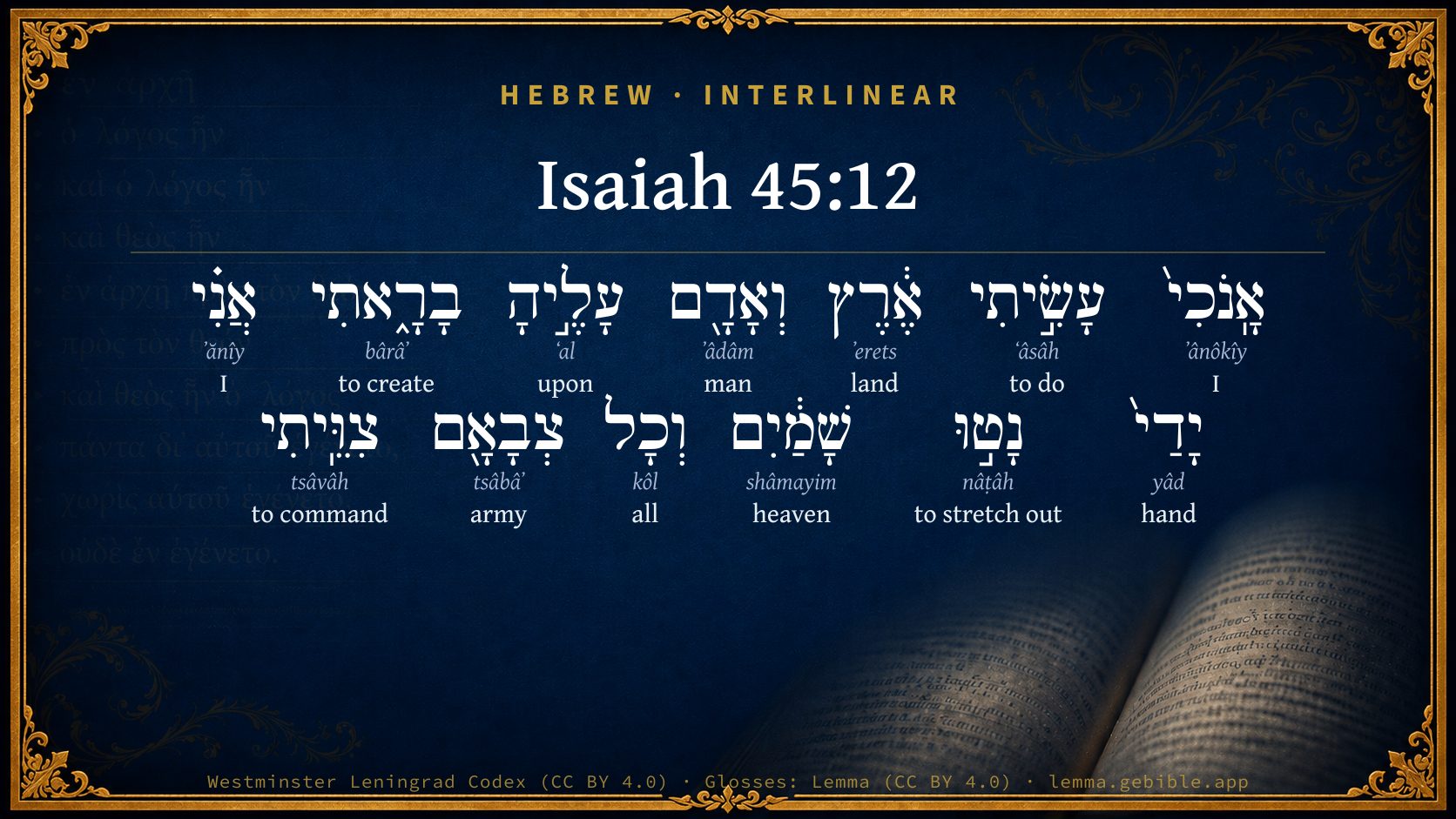
Hebrew (Westminster Leningrad Codex) Isaiah 45:12 appears in the Hebrew Old Testament. The text above is from the Westminster Leningrad Codex. Each word links to its Strong’s number, a concise gloss, and parsing drawn from the Open Scriptures Hebrew Bible morphology. Click any word for its full Brown-Driver-Briggs (BDB) entry.
Download image
Cite this verse

Isaiah 45:12 (World English Bible). Public Domain. Lemma interlinear Bible study tool, https://lemma.gebible.app/v/isaiah/45/12.

Show BibTeX & RIS
BibTeX
RIS
English Translation
I have made the earth, and created man on it: I, even my hands, have stretched out the heavens; and all their host have I commanded.
World English Bible · Public Domain
Download a study sheet

One document with this verse’s original text, its word-by-word gloss line, the meaning frame, cross-references with their text, attributed commentary, and full source and license credits — printable, and it pastes into notes with its structure intact.

This verse Autodidact and up

Study sheet (.html) Plain text (.txt)

A passage Seminary Student

Up to 50 verses in one chapter. A passage sheet keeps up to 6 commentary sources and 12 cross-references per verse, in the order this page ranks them, and says so on the sheet whenever that leaves anything out. Ask for a single verse and you get the Autodidact verse sheet above.

Everything on this page stays free to read, with no account — the sheet is a download of what is already on screen, not access to it.

Want to remove ads? Support Godless Engineer
Compare translations 3

The same verse in 3 English versions, stacked beneath the original-language interlinear above. Click any original word for its lexicon entry.

Each is an independent rendering of the whole verse — the interlinear is not word-aligned to these translations.

Highlighted words mark where these versions differ — a whole-verse word diff, not a word-by-word alignment.

  • World English Bible Public Domain
    I have made the earth, and created man on it: I, even my hands, have stretched out the heavens; and all their host have I commanded.
  • King James Version Public Domain
    I have made the earth, and created man upon it: I, even my hands, have stretched out the heavens, and all their host have I commanded.
  • unfoldingWord Literal Text CC BY-SA 4.0
    I, I made the earth, and I created man upon it. I, my hands stretched out the heavens, and I commanded all of their army.

unfoldingWord Literal Text — © unfoldingWord, licensed CC BY-SA 4.0. Word-aligned USFM3 via Door43 (git.door43.org/unfoldingWord/en_ult).

Versions to compare (up to 4)

3 of 4 selected

Show all 18 translations

Every available English version of this verse, each an independent rendering of the whole verse.

  • World English Bible Public Domain
    I have made the earth, and created man on it: I, even my hands, have stretched out the heavens; and all their host have I commanded.
  • Berean Standard Bible Public Domain
    It is I who made the earth and created man upon it. It was My hands that stretched out the heavens, and I ordained all their host.
  • Majority Standard Bible Public Domain
    It is I who made the earth and created man upon it. It was My hands that stretched out the heavens, and I ordained all their host.
  • King James Version Public Domain
    I have made the earth, and created man upon it: I, even my hands, have stretched out the heavens, and all their host have I commanded.
  • American Standard Version (1901) Public Domain
    I have made the earth, and created man upon it: I, even my hands, have stretched out the heavens; and all their host have I commanded.
  • Revised Version (1885) Public Domain
    I have made the earth, and created man upon it: I, even my hands, have stretched out the heavens, and all their host have I commanded.
  • Geneva Bible (1599) Public Domain
    I haue made the earth, and created man vpon it: I, whose hands haue spred out the heauens, I haue euen commanded all their armie.
  • Douay-Rheims (1899) Public Domain
    I made the earth: and I created man upon it: my hand stretched forth the heavens, and I have commanded all their host.
  • Young's Literal Translation Public Domain
    I made earth, and man on it prepared, I -- My hands stretched out the heavens, And all their host I have commanded.
  • Literal Standard Version CC BY-SA 4.0
    I made earth, and created man on it, || My hands stretched out the heavens, || And I have commanded all their host.
  • Unlocked Literal Bible CC BY-SA 4.0
    'I made the earth and created man on it. It was my hands that stretched out the heavens, and I commanded all the stars to appear.
  • unfoldingWord Literal Text CC BY-SA 4.0
    I, I made the earth, and I created man upon it. I, my hands stretched out the heavens, and I commanded all of their army.
  • Darby Bible Public Domain
    It is I that have made the earth, and created man upon it; it is I, my hands, that have stretched out the heavens, and all their host have I commanded.
  • World Messianic Bible Public Domain
    I have made the earth, and created man on it. I, even my hands, have stretched out the heavens. I have commanded all their army.
  • Webster's Bible Public Domain
    I have made the earth, and created man upon it: I, even my hands, have stretched out the heavens, and all their host have I commanded.
  • Free Bible Version CC BY-SA 4.0
    I'm the one who made the earth, and I created human beings to live there. It was my hands that stretched out the heavens, and I ordered all the stars to come into being.
  • Bible in Basic English Public Domain
    I have made the earth, forming man on it: by my hands the heavens have been stretched out, and all the stars put in their ordered places.
  • JPS Tanakh (1917) Public Domain
    I, even I, have made the earth, and created man upon it; I, even My hands, have stretched out the heavens, and all their host have I commanded.

Literal Standard Version (2020), Covenant Press — licensed CC BY-SA 4.0. Text via the HelloAO Bible API (eBible.org). Unlocked Literal Bible (unfoldingWord) — licensed CC BY-SA 4.0. Text via the HelloAO Bible API (eBible.org). unfoldingWord Literal Text — © unfoldingWord, licensed CC BY-SA 4.0. Word-aligned USFM3 via Door43 (git.door43.org/unfoldingWord/en_ult). Free Bible Version, Dr. Jonathan Gallagher — licensed CC BY-SA 4.0. Text via the HelloAO Bible API (eBible.org).

Word by word

More ways to search: Search by grammar → Find every occurrence → Compare this word →

Practice this passage: Drill this verse → Learn its vocabulary →

בָרָ֑אתִי
bârâʼ
H1254
“to create”
Verb, Qal, Perfect, 1st Person, Common, Singular
Part of Speech
Verb
Stem
Qal
Form
Perfect
Person
1st Person
Gender
Common
Number
Singular
Full BDB Definition

Origin: a primitive root

TWOT: 278

to create, shape, form - (Qal) to shape, fashion, create (always with God as subject) - of heaven and earth - of individual man - of new conditions and circumstances - of transformations - (Niphal) to be created - of heaven and earth - of birth - of something new - of miracles - (Piel) - to cut down - to cut out - to be fat - (Hiphil) to make yourselves fat
  1. אָֽנֹכִי֙ ʼânôkîy H595 “I” Pronoun, Personal, 1st Person, Common, Singular
  2. עָשִׂ֣יתִי ʻâsâh H6213 “to do” Verb, Qal, Perfect, 1st Person, Common, Singular
  3. אֶ֔רֶץ ʼerets H776 “land” Noun, Common, Both, Singular, Absolute
  4. וְאָדָ֖ם ʼâdâm H120 “and · man” Conjunction + Noun, Common, Masculine, Singular, Absolute
  5. עָלֶ֣יהָ ʻal H5921 “upon · her” Preposition + Suffix, Personal, 3rd Person, Feminine, Singular
  6. אֲנִ֗י ʼănîy H589 “I” Pronoun, Personal, 1st Person, Common, Singular
  7. יָדַי֙ yâd H3027 “hands · my” Noun, Common, Both, Dual, Construct + Suffix, Personal, 1st Person, Common, Singular
  8. נָט֣וּ nâṭâh H5186 “to stretch out” Verb, Qal, Perfect, 3rd Person, Common, Plural
  9. שָׁמַ֔יִם shâmayim H8064 “heaven(s)” Noun, Common, Masculine, Plural, Absolute
  10. וְכָל kôl H3605 “and · all of” Conjunction + Noun, Common, Masculine, Singular, Construct
  11. צְבָאָ֖ם tsâbâʼ H6635 “army · their” Noun, Common, Both, Singular, Construct + Suffix, Personal, 3rd Person, Masculine, Plural
  12. צִוֵּֽיתִי tsâvâh H6680 “to command” Verb, Piel, Perfect, 1st Person, Common, Singular

About this verse

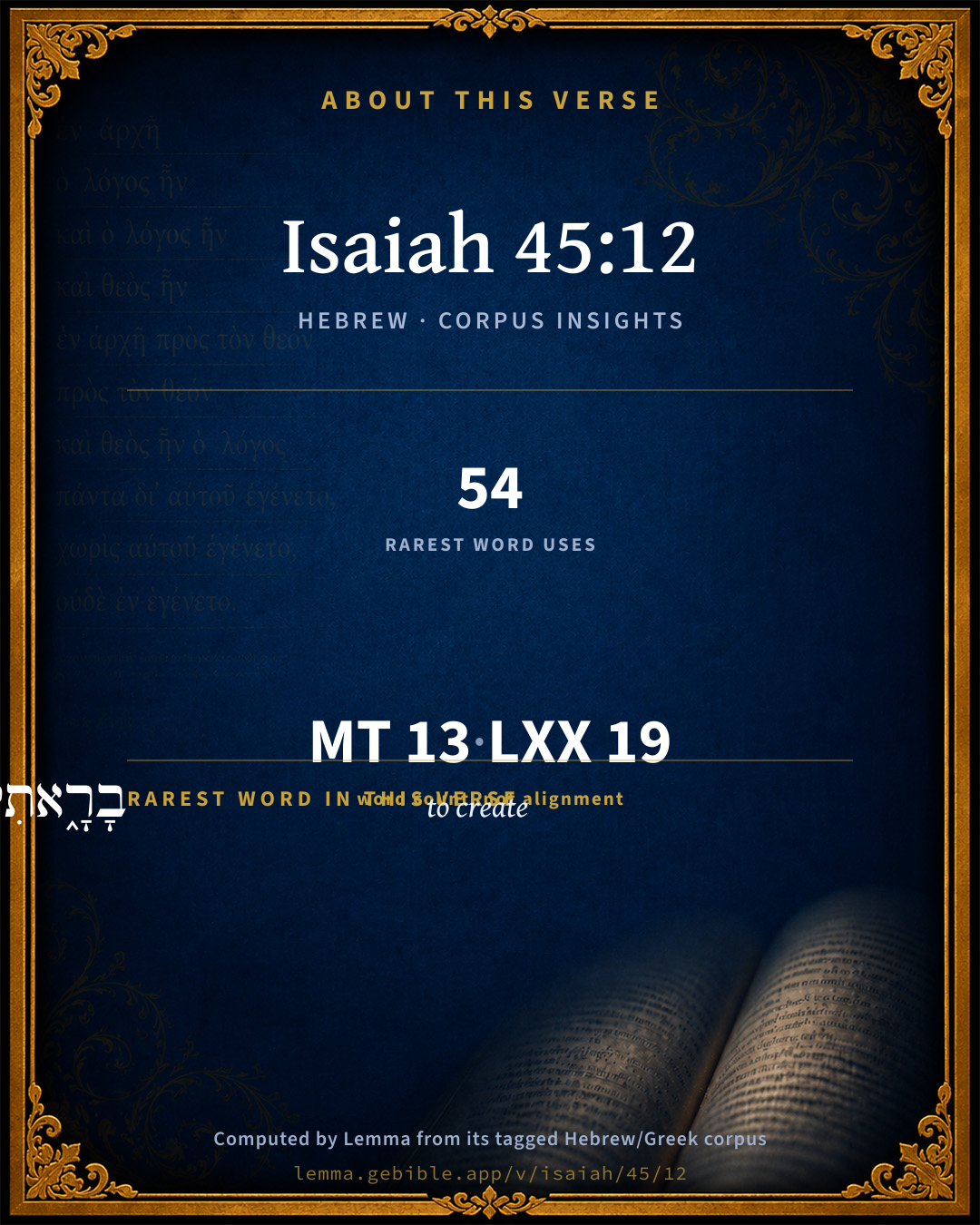
These counts appear in no published source. They are computed here, from the morphology-tagged text and Lemma’s own curated glosses. What Lemma adds →

13
words
13
distinct lemmas
Prophets
section

Shared distinctive vocabulary

בָרָ֑אתִי to create H1254 occurs in 46 verses of the Hebrew Bible. Also found in:

Grammatical profile

  • 4 verbs
  • 6 nouns
  • 2 pronouns
  • 1 preposition

Verb forms

  • עָשִׂ֣יתִי Qal · Perfect
  • בָרָ֑אתִי Qal · Perfect
  • נָט֣וּ Qal · Perfect
  • צִוֵּֽיתִי Piel · Perfect

Hebrew & Septuagint length

In English translation the verse runs 26 words from the Hebrew and 25 from the Septuagint (LXX English) — closely comparable.

A rough comparison of the two English renderings, which tokenize alike — not a word-level alignment.

Word counts can differ between the Hebrew and the Greek without any difference in meaning — e.g. the Hebrew direct-object marker אֵת has no separate Greek word, and Greek often adds the article ὁ.

In the original languages it is 13 Hebrew tokens and 19 Greek tokens — but the two are counted differently (Hebrew bundles its prefixes and suffixes into one token; the Greek is in lemma form), so that isn’t a like-for-like length.

Cross-references

14

Topical passages linked to Isaiah 45:12 in the Treasury of Scripture Knowledge — connected by theme and wording, ordered by reader-vote popularity; previews shown in the World English Bible.

  • Isaiah 42:5 Thus says God Yahweh, he who created the heavens, and stretched them forth; he who spread abroad the earth and that which comes out of it; he who gives breath to the people on it, and spirit to those who walk therein:
  • Isaiah 44:24 Thus says Yahweh, your Redeemer, and he who formed you from the womb: I am Yahweh, who makes all things; who stretches forth the heavens alone; who spreads abroad the earth (who is with me?);
  • Jeremiah 27:5 I have made the earth, the men and the animals that are on the surface of the earth, by my great power and by my outstretched arm; and I give it to whom it seems right to me.
  • Genesis 2:1 The heavens and the earth were finished, and all the host of them.
  • Nehemiah 9:6 You are Yahweh, even you alone; you have made heaven, the heaven of heavens, with all their host, the earth and all things that are thereon, the seas and all that is in them, and you preserve them all; and the host of heaven worships you.
  • Isaiah 45:18 For thus says Yahweh who created the heavens, the God who formed the earth and made it, who established it and didn't create it a waste, who formed it to be inhabited: I am Yahweh; and there is no one else.
  • Jeremiah 32:17 Ah Lord Yahweh! behold, you have made the heavens and the earth by your great power and by your outstretched arm; there is nothing too hard for you,
  • Isaiah 40:28 Have you not known? have you not heard? The everlasting God, Yahweh, the Creator of the ends of the earth, doesn't faint, neither is weary; there is no searching of his understanding.
  • Hebrews 11:3 By faith, we understand that the universe has been framed by the word of God, so that what is seen has not been made out of things which are visible.
  • Zechariah 12:1 An oracle. The word of Yahweh concerning Israel. Yahweh, who stretches out the heavens, and lays the foundation of the earth, and forms the spirit of man within him says:
  • Genesis 1:26–27 God said, "Let us make man in our image, after our likeness: and let them have dominion over the fish of the sea, and over the birds of the sky, and over the cattle, and over all the earth, and over every creeping thing that creeps on the earth."
  • Psalms 102:25 Of old, you laid the foundation of the earth. The heavens are the work of your hands.
  • Isaiah 40:12 Who has measured the waters in the hollow of his hand, and meted out the sky with the span, and comprehended the dust of the earth in a measure, and weighed the mountains in scales, and the hills in a balance?
  • Isaiah 40:22 [It is] he who sits above the circle of the earth, and the inhabitants of it are as grasshoppers; who stretches out the heavens as a curtain, and spreads them out as a tent to dwell in;

Cross-references courtesy of OpenBible.info (CC BY 4.0).

Hebrew and Greek witnesses Masoretic Hebrew ↔ Greek Septuagint

The same verse in the two great witnesses to the Old Testament, shown verse-for-verse.

These are two independent witnesses, not word-aligned to each other, and the Septuagint is shown in lemma (dictionary) form.

Hebrew Isaiah 45:12 Masoretic · Westminster Leningrad Codex

אָֽנֹכִי֙ עָשִׂ֣יתִי אֶ֔רֶץ וְאָדָ֖ם עָלֶ֣יהָ בָרָ֑אתִי אֲנִ֗י יָדַי֙ נָט֣וּ שָׁמַ֔יִם וְכָל צְבָאָ֖ם צִוֵּֽיתִי

I have made the earth, and created man on it: I, even my hands, have stretched out the heavens; and all their host have I commanded.

World English Bible · Public Domain

Greek LXX Isaiah 45:12 Septuagint · lemma form

ἐγώ ποιέω γῆ καί ἄνθρωπος ἐπί αὐτός ἐγώ ὁ χείρ ἐγώ στερεόω ὁ οὐρανός ἐγώ πᾶς ὁ ἄστρον ἐντέλλομαι

I have made the earth, and man upon it: I with my hand have established the heaven; I have given commandment to all the stars.

LXX2012 (modern English Septuagint) · Public Domain

Hebrew: Westminster Leningrad Codex (CC BY 4.0). Greek: Septuagint (public domain); English from LXX2012 (modern English Septuagint) (Public Domain). How the Septuagint differs from the Hebrew →

Targum (Aramaic paraphrase)

1

The Targum is the ancient Jewish Aramaic paraphrase of the Hebrew Scriptures — an interpretive translation, not the Hebrew text itself. Onkelos (literal) and Pseudo-Jonathan (expansive) render the Torah, and Jonathan the Prophets. Coverage is partial: where no permissively-licensed English translation exists for a verse, only the Aramaic is shown. This is verse-level text, not a word-by-word alignment to the Hebrew.

  1. Targum Jonathan Prophets (Joshua–Malachi)
    אֲנָא בְּמֵימְרִי עֲבַדֵת אַרְעָא וֶאֱנָשָׁא עֲלָהּ בְּרִיתִי אֲנָא בִּגְבוּרְתִּי תְּלֵית שְׁמַיָא וְכָל חֵילֵיהוֹן שֵׁכְלֵילִית:

    It is I who have made the earth by my WORD, and I have created man upon it; it is I who have suspended the heavens by my power, and I have laid the foundation of all the hosts of them.

    Targum Jonathan — Aramaic: “Mikraot Gedolot” (public domain). English: “Sefaria Community Translation” (CC0 1.0 (public-domain dedication)); “London "Chaldee Paraphrase," 1871” (public domain). Text via Sefaria.

Commentary

Notes on Isaiah 45:12 from classic Christian and Jewish commentators (each source and its license shown beneath its notes). The classic Christian expositions comment on the surrounding passage and are grouped to its opening verse, so a note may address several verses; the Jewish commentaries on the Tanakh (Rashi and others) are per-verse, so they appear only where the commentator wrote on this verse.

Lemma curates 59 commentaries, every one of them public domain or Creative Commons licensed, each selected and text-cleaned for this edition rather than reprinted as found. About our sources →

Trapp's Complete Commentary

John Trapp

Isa 45:12 I have made the earth, and created man upon it: I, [even] my hands, have stretched out the heavens, and all their host have I commanded.

Ver. 12. I have made the earth,] q.d., I am the mighty maker and monarch of the world; therefore pray on, and patiently wait for a gracious answer, "he that believeth maketh not haste."

John Trapp, A Commentary or Exposition upon All the Books of the Old and New Testament (1647–1656) — public domain. Text from a community e-Sword module.

The Biblical Illustrator

Joseph S. Exell

Isa_45:12

I have made the earth

Nature and Scripture

(with Isa_45:22):--The study of Nature reveals a Creator.

This is the order: God, creation, fishes, animals, men, women, the human race, the culture of the soil, the building of cities, the navigation of the sea, and, in course of ages, the formation of society as we know it. But man as a moral agent required moral laws; having also a capacity for religion, he needed spiritual light. This made revelation from above necessary. Mankind have had both vocal and written messages from God.

Creation tells of His power, and the Scripture tells of His salvation--the two books together revealing His perfect glory.

I. A careful study of nature and man will bring vividly before you THE LAW OF DEPENDENCE. The man who would attempt to be independent of Nature would soon die of hunger and thirst, and the soul that is arrogant enough to deem itself independent of Christ will soon find that saying true, He that hath not the Son of God, hath not life.

II. In nature you see also THE LAW OF CULTIVATION. Every living thing needs cultivation, and is improved, beautified, and perpetuated by it. Man, the living soul, is under the same law. In a higher sense the soul of man is subject to this law of cultivation. The fruits and flowers found in a cultivated soul are faith, prayer, virtue, knowledge, temperance, patience, godliness, brotherly kindness, and charity.

III. Nature conspicuously displays and relentlessly enforces THE LAW OF DEPRIVATION. In the great eaves of Kentucky there are dark waters where the light never comes. Eyeless fishes swim there. Their ancestors had eyes that could see; but their descendants, choosing to dwell in lightless waters, have only rims and specks in their heads v, here eyes might have been. Use well a sense, a faculty, a power, and you increase it; neglect it, and it will die. That is the law of Nature. Scripture teaches you the same lesson as to the spiritual world.

IV. Nature does also undoubtedly embrace THE LAW OF TERMINATION. The grass withereth and the flower fadeth. The bones of leviathan whiten the deep places of the sea. And what of man? To him also the law of termination applies. Shall nature, man, life as we know it, continue as they are for ever? No, for both Nature and Scripture proclaim the law of termination (2Pe_3:10).

V. But both Scripture and Nature point us to another law--THAT OF CONTINUITY. And this eternal law of continuity will be in existence after the present world is left behind. Consider, then, these natural and spiritual truths. Let Nature teach you how great the Creator is: let Scripture teach you that His salvation and love and righteousness are for ever and ever. (G. W.MCree.)

The Biblical Illustrator, edited by Joseph S. Exell (c. 1880s–1900s) — public domain. Text from a community e-Sword module.

Geneva Bible (1599)

Geneva Bible translators

That is, the stars.

Geneva Bible (1599) marginal notes — public domain. Text via Bolls.life.

Jamieson, Fausset & Brown

Robert Jamieson, A. R. Fausset & David Brown

The same argument for prayer, drawn from God's omnipotence and consequent power, to grant any request, occurs in Isa 40:26-31.

I, even my hands--so Hebrew (Psa 41:2), "Thou . . . thy hand" (both nominatives, in apposition).

Jamieson, Fausset & Brown — Commentary Critical and Explanatory on the Whole Bible (1871) — public domain (CC PDM 1.0). Text via the HelloAO Bible API.

Ellicott's Commentary for English Readers

(12) I have made . . .—The Creator is also the Ruler, supreme in history as in nature.

A Bible Commentary for English Readers, edited by Charles John Ellicott (1878–1897) — public domain. Text from a community e-Sword module.

The Cambridge Bible for Schools and Colleges

gen. ed. J. J. S. Perowne

12. Is introductory to Isa_45:13; it is the Creator of all things who has destined Cyrus to be the emancipator of Israel.

I, even my hands] The “I” merely lends emphasis to the possessive: “my hands, and not another’s.”

all their host (the stars, not the angels, Isa_40:26) have I commanded] or, “ordained.”

The Cambridge Bible for Schools and Colleges (gen. ed. J. J. S. Perowne; Cambridge University Press, 1878–1918) — public domain. Text from a community e-Sword module.

John Gill's Exposition

I have made the earth,.... The Targum adds, "by my Word"; the essential Word, the Lord Jesus Christ; see Heb 11:3, this, with what follows, is said to show that the Lord was able to bring to pass things to come, concerning his children, and the works of his hands, which he allowed his people to inquire of him concerning, and to insist upon the performance of them; since he was the Creator of all things, and had made the earth out of nothing, in the beginning of time, by the word of his power:

and created man upon it; the last and chief of the creation, for the sake of whom the earth was made; and man was made to dwell upon it, manure, and cultivate it:

I, even my hands, have stretched out the heavens; as a canopy over the earth, as a curtain and tent to dwell in; a phrase often used to express the greatness and majesty of God; see Isa 40:22,

and all their host have I commanded; into being, and to perform their offices regularly and constantly, the sun, moon, and stars, as well as the heavenly host of angels; see Psa 33:9, what is it that such a God cannot do? he is able to do more than his people can ask of him, or think to receive from him, Eph 3:20.

John Gill's Exposition of the Whole Bible (1746–1763) — public domain (CC PDM 1.0). Text via the HelloAO Bible API.

Albert Barnes' Notes on the Bible

I have made the earth - God here asserts that he had made all things, doubtless with a view to show that he was able to hear their cry, and to grant an answer to their requests. His agency was visible everywhere, alike in forming and sustaining all things, and in raising up for them a deliverer. They might, therefore, go before him with confidence, and spread out all their needs.

Have stretched out the heavens - (See the notes at Isa 40:26).

And all their host - The stars (see the notes at Isa 40:26).

Have I commanded - All are under my direction and control. What more can be needed by his people than the friendship and protection of him who made the heavens and the earth, and who leads on the stars!

Albert Barnes' Notes on the Bible (1834–1885) — public domain. Text from a community e-Sword/MySword module.

Matthew Poole's English Annotations

I have made the earth, and created man upon it; they are wholly and solely my creatures, and therefore absolutely at my disposal.

All their host have I commanded; I have commanded them to be, or made them by my command, or the word of my power: compare Psa 148:5.

Matthew Poole's English Annotations on the Holy Bible (1683–1685) — public domain. Text from a community e-Sword/MySword module.

The Pulpit Commentary

I, even my hands; literally, I, my hands; i.e. "my hands, and my hands alone." All their host. The "host of heaven" is sometimes put for the stars, and may be so understood here; but "commands" are laid on intelligent rather than on unintelligent beings. (The object of the verb tsavah in Hebrew is almost always personal.)

The Pulpit Commentary (1880–1919), ed. H.D.M. Spence-Jones & Joseph S. Exell — public domain. Text from a community e-Sword module.

J. A. Alexander on Isaiah

Joseph Addison Alexander

“I made the earth, and man upon it I created; I, my hands, spread the heavens, and all their host commanded.” This is a justification of the claim in the last clause of the foregoing verse, or a statement of the reason why He could be trusted to protect His people, namely, because He was almighty, and had proved Himself to be so in creation. The personal pronoun is emphatic in both clauses, as if he had said, it is I who made, or, I (and no other) made etc. The construction of the second of these pronouns with my hands has been variously explained. Some regard the latter as equivalent to an ablative of instrument in Latin: I with my hands have spread etc. Others consider it an instance of the idiom which adds the personal pronoun to the suffix for the sake of emphasis: I; my hands, spread, (i.e., my own hands spread). In such constructions the personal pronoun commonly stands last. A third supposition is that the pronoun is in apposition with the noun itself, and not so much emphatic as explanatory. I (that is to say, my hands) have spread. (Compare Psa 3:5; Psa 17:13-14; Psa 44:3; Psa 60:7). The last words of the verse admit of two explanations. We may understand the figure as a military one, and give the verb the military sense of commanding. Or we may take host as a common expression for contents or inhabitants, and understand the verb as meaning called into existence. (Compare Psa 33:9). In itself, the former explanation seems entitled to the preference; but it requires the verb to be construed as an indefinite preterit or a present, whereas all the other verbs, though similar in form, relate to a determinate past time, viz. the time of the creation.

Joseph Addison Alexander, The Prophecies of Isaiah (1846–1847; New York: Scribner, 1870–1878) — public domain. Text from a community e-Sword module.

unfoldingWord translationNotes

Door43 World Missions Community

General Information:

Yahweh continues speaking.

It was my hands that

Here the word "hands" represents Yahweh. AT: "It was I who" (See: Synecdoche)

stretched out the heavens

Yahweh speaks of creating the heavens as if they were fabric that he stretched out. See how you translated a similar phrase in Isaiah 42:5.

translationWords

earth

hand

heaven

command

unfoldingWord translationNotes — © Distant Shores Media and the Door43 World Missions Community, licensed CC BY-SA 4.0. Source: git.door43.org/Door43/en_tn.

Rashi

Rabbi Shlomo Yitzchaki (Rashi)

I made the earth and gave it to whoever pleased Me [lit. was straight in My eyes].

Rashi on the Tanakh — English translations: “The Judaica Press complete Tanach with Rashi, translated by A. J. Rosenberg” (CC BY 4.0); “Pentateuch with Rashi's commentary by M. Rosenbaum and A.M. Silbermann, 1929-1934” (public domain); “The Metsudah Tanach series, Lakewood, N.J” (CC BY 4.0); and “The Book of Joshua, Metsudah Publications, 1997” (CC BY 4.0). Text via Sefaria.

Ibn Ezra

Rabbi Abraham ibn Ezra

I have made the earth, etc. How will you command me concerning my children, when the whole universe belongs to me? I have created earth and man upon it; my hands have stretched out the heavens, and all their hosts have I commanded, and consequently they were created. I commanded is poetically said for I spoke as in the verse He commanded and they were created (Ps. 148:5)

Ibn Ezra on the Tanakh — English translations: “Sefaria Community Translation” (CC0 1.0 (public-domain dedication)); “Yalkut, Sifsei Chachomim Chumash, Metsudah Publications, 2009” (CC BY 4.0); and “Commentary of Ibn Ezra on Isaiah - trans. by M. Friedlander, 1873” (public domain). Text via Sefaria.

Lesson kit

Teaching starters — assembled from the data on this page, not authored interpretation. Every prompt links to the verse data it draws on. Edit before teaching.

Isaiah, in the Prophets, opens this verse with 13 words (13 distinct Hebrew lemmas). Its most distinctive word is bârâʼ (“to create”). A historical commentator’s framing appears above. Read the whole chapter for the surrounding context.

Discussion questions

  1. What does “to create” (bârâʼ) contribute to the verse as a whole?
  2. How does Genesis 1:1, which shares the word «to create», read alongside this verse?
  3. The translations on this page render this verse differently — a whole-verse word diff, not a word-by-word alignment. What might account for the different wordings?
  4. «עָשִׂ֣יתִי» is a Qal Perfect verb. How does that grammatical form shape the action described?
  5. Compare how Trapp's Complete Commentary and The Biblical Illustrator read this verse. Where do they agree or differ?

Things to notice

Reading settings

Reading text

Shown beneath each verse's original-language words.

Old Testament
Old Testament edition

Read the OT as the Masoretic Hebrew (MT) or the Greek Septuagint (LXX).

English shown for the Greek Septuagint (in the Hebrew ↔ Greek comparison).

Comparing translations? Open the Compare panel on any verse page to stack up to four side by side.