
Joshua 7:11

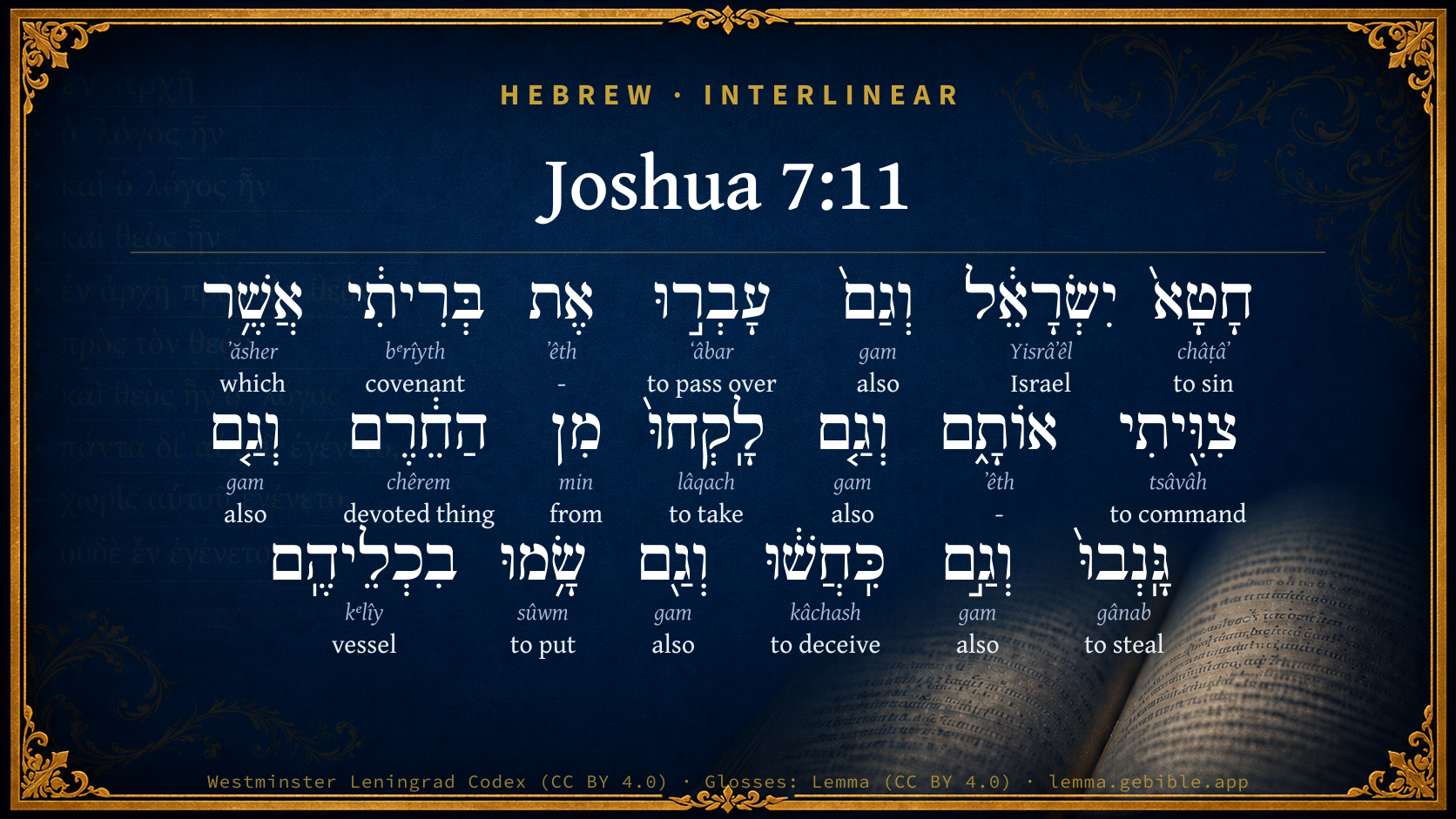
Hebrew (Westminster Leningrad Codex) Joshua 7:11 appears in the Hebrew Old Testament. The text above is from the Westminster Leningrad Codex. Each word links to its Strong’s number, a concise gloss, and parsing drawn from the Open Scriptures Hebrew Bible morphology. Click any word for its full Brown-Driver-Briggs (BDB) entry.
Download image
Cite this verse

Joshua 7:11 (World English Bible). Public Domain. Lemma interlinear Bible study tool, https://lemma.gebible.app/v/joshua/7/11.

Show BibTeX & RIS
BibTeX
RIS
English Translation
Israel has sinned; yes, they have even transgressed my covenant which I commanded them: yes, they have even taken of the devoted thing, and have also stolen, and dissembled also; and they have even put it among their own stuff.
World English Bible · Public Domain
Download a study sheet

One document with this verse’s original text, its word-by-word gloss line, the meaning frame, cross-references with their text, attributed commentary, and full source and license credits — printable, and it pastes into notes with its structure intact.

This verse Autodidact and up

Study sheet (.html) Plain text (.txt)

A passage Seminary Student

Up to 50 verses in one chapter. A passage sheet keeps up to 6 commentary sources and 12 cross-references per verse, in the order this page ranks them, and says so on the sheet whenever that leaves anything out. Ask for a single verse and you get the Autodidact verse sheet above.

Everything on this page stays free to read, with no account — the sheet is a download of what is already on screen, not access to it.

Want to remove ads? Support Godless Engineer
Compare translations 3

The same verse in 3 English versions, stacked beneath the original-language interlinear above. Click any original word for its lexicon entry.

Each is an independent rendering of the whole verse — the interlinear is not word-aligned to these translations.

Highlighted words mark where these versions differ — a whole-verse word diff, not a word-by-word alignment.

  • World English Bible Public Domain
    Israel has sinned; yes, they have even transgressed my covenant which I commanded them: yes, they have even taken of the devoted thing, and have also stolen, and dissembled also; and they have even put it among their own stuff.
  • King James Version Public Domain
    Israel hath sinned, and they have also transgressed my covenant which I commanded them: for they have even taken of the accursed thing, and have also stolen, and dissembled also, and they have put it even among their own stuff.
  • unfoldingWord Literal Text CC BY-SA 4.0
    Israel has sinned and indeed transgressed my covenant, which I commanded them, and has indeed taken from the devoted thing and has indeed stolen and also deceived and also placed among their things.

unfoldingWord Literal Text — © unfoldingWord, licensed CC BY-SA 4.0. Word-aligned USFM3 via Door43 (git.door43.org/unfoldingWord/en_ult).

Versions to compare (up to 4)

3 of 4 selected

Show all 18 translations

Every available English version of this verse, each an independent rendering of the whole verse.

  • World English Bible Public Domain
    Israel has sinned; yes, they have even transgressed my covenant which I commanded them: yes, they have even taken of the devoted thing, and have also stolen, and dissembled also; and they have even put it among their own stuff.
  • Berean Standard Bible Public Domain
    Israel has sinned; they have transgressed My covenant that I commanded them, and they have taken some of what was devoted to destruction. Indeed, they have stolen and lied, and they have put these things with their own possessions.
  • Majority Standard Bible Public Domain
    Israel has sinned; they have transgressed My covenant that I commanded them, and they have taken some of what was devoted to destruction. Indeed, they have stolen and lied, and they have put these things with their own possessions.
  • King James Version Public Domain
    Israel hath sinned, and they have also transgressed my covenant which I commanded them: for they have even taken of the accursed thing, and have also stolen, and dissembled also, and they have put it even among their own stuff.
  • American Standard Version (1901) Public Domain
    Israel hath sinned; yea, they have even transgressed my covenant which I commanded them: yea, they have even taken of the devoted thing, and have also stolen, and dissembled also; and they have even put it among their own stuff.
  • Revised Version (1885) Public Domain
    Israel hath sinned; yea, they have even transgressed my covenant which I commanded them: yea, they have even taken of the devoted thing; and have also stolen, and dissembled also, and they have even put it among their own stuff.
  • Geneva Bible (1599) Public Domain
    Israel hath sinned, and they haue transgressed my couenant, which I commanded them: for they haue euen taken of the excommunicate thing, and haue also stollen, and dissembled also, and haue put it euen with their owne stuffe.
  • Douay-Rheims (1899) Public Domain
    Israel hath sinned, and transgressed my covenant: and they have taken of the anathema, and have stolen and lied, and have hidden it among their goods.
  • Young's Literal Translation Public Domain
    Israel hath sinned, and also they have transgressed My covenant which I commanded them, and also taken of the devoted thing, and also stolen, and also deceived, and also put `it' among their vessels,
  • Literal Standard Version CC BY-SA 4.0
    Israel has sinned, and they have also transgressed My covenant which I commanded them, and also taken of the devoted thing, and also stolen, and also deceived, and also put [it] among their vessels,
  • Unlocked Literal Bible CC BY-SA 4.0
    Israel has sinned. They have broken my covenant which I commanded them. They have stolen some of the things that were set apart. They have stolen and then also hidden their sin by putting what they have taken among their own belongings.
  • unfoldingWord Literal Text CC BY-SA 4.0
    Israel has sinned and indeed transgressed my covenant, which I commanded them, and has indeed taken from the devoted thing and has indeed stolen and also deceived and also placed among their things.
  • Darby Bible Public Domain
    Israel hath sinned, and they have also transgressed my covenant which I commanded them, and they have even taken of the accursed thing, and have also stolen, and dissembled also, and they have put it among their stuff.
  • World Messianic Bible Public Domain
    Israel has sinned. Yes, they have even transgressed my covenant which I commanded them. Yes, they have even taken some of the devoted things, and have also stolen, and also deceived. They have even put it among their own stuff.
  • Webster's Bible Public Domain
    Israel hath sinned, and they have also transgressed my covenant which I commanded them: for they have even taken of the accursed thing, and have also stolen, and dissembled also, and they have put it even among their own goods.
  • Free Bible Version CC BY-SA 4.0
    Israel has sinned and has broken my agreement that I ordered them to keep. They have taken some of the things set apart for me; they have acted dishonestly; they have hidden the stolen items with their own belongings.
  • Bible in Basic English Public Domain
    Israel has done wrong, sinning against the agreement which I made with them: they have even taken of the cursed thing; acting falsely like thieves they have put it among their goods.
  • JPS Tanakh (1917) Public Domain
    Israel hath sinned; yea, they have even transgressed My covenant which I commanded them; yea, they have even taken of the devoted thing; and have also stolen, and dissembled also, and they have even put it among their own stuff.

Literal Standard Version (2020), Covenant Press — licensed CC BY-SA 4.0. Text via the HelloAO Bible API (eBible.org). Unlocked Literal Bible (unfoldingWord) — licensed CC BY-SA 4.0. Text via the HelloAO Bible API (eBible.org). unfoldingWord Literal Text — © unfoldingWord, licensed CC BY-SA 4.0. Word-aligned USFM3 via Door43 (git.door43.org/unfoldingWord/en_ult). Free Bible Version, Dr. Jonathan Gallagher — licensed CC BY-SA 4.0. Text via the HelloAO Bible API (eBible.org).

Word by word

More ways to search: Search by grammar → Find every occurrence → Compare this word →

Practice this passage: Drill this verse → Learn its vocabulary →

כִּֽחֲשׁ֔וּ
kâchash
H3584
“to deceive”
Verb, Piel, Perfect, 3rd Person, Common, Plural
Part of Speech
Verb
Stem
Piel
Form
Perfect
Person
3rd Person
Gender
Common
Number
Plural
Full BDB Definition

Origin: a primitive root

TWOT: 975

to deceive, lie, fail, grow lean, be disappointing, be untrue, be insufficient, be found liars, belie, deny, dissemble, deal falsely - (Qal) to become lean - (Niphal) to cringe, feign obedience - (Piel) - to deceive, deny falsely - to act deceptively - to cringe - to disappoint, fail - (Hithpael) to cringe, feign obedience
  1. חָטָא֙ châṭâʼ H2398 “to sin” Verb, Qal, Perfect, 3rd Person, Masculine, Singular
  2. יִשְׂרָאֵ֔ל Yisrâʼêl H3478 “Israel” Noun, Proper
  3. וְגַם֙ gam H1571 “and · also” Conjunction + Particle, Accusative
  4. עָבְר֣וּ ʻâbar H5674 “to pass over” Verb, Qal, Perfect, 3rd Person, Common, Plural
  5. אֶת ʼêth H853 “-” Particle, Direct Object
  6. בְּרִיתִ֔י bᵉrîyth H1285 “covenant · my” Noun, Common, Feminine, Singular, Construct + Suffix, Personal, 1st Person, Common, Singular
  7. אֲשֶׁ֥ר ʼăsher H834 “which” Particle, Relative
  8. צִוִּ֖יתִי tsâvâh H6680 “to command” Verb, Piel, Perfect, 1st Person, Common, Singular
  9. אוֹתָ֑ם ʼêth H853 “- · them” Particle, Direct Object + Suffix, Personal, 3rd Person, Masculine, Plural
  10. וְגַ֤ם gam H1571 “and · also” Conjunction + Particle, Accusative
  11. לָֽקְחוּ֙ lâqach H3947 “to take” Verb, Qal, Perfect, 3rd Person, Common, Plural
  12. מִן min H4480 “from” Preposition
  13. הַחֵ֔רֶם chêrem H2764 “the · devoted thing” Particle, Definite Article + Noun, Common, Masculine, Singular, Absolute
  14. וְגַ֤ם gam H1571 “and · also” Conjunction + Particle, Accusative
  15. גָּֽנְבוּ֙ gânab H1589 “to steal” Verb, Qal, Perfect, 3rd Person, Common, Plural
  16. וְגַ֣ם gam H1571 “and · also” Conjunction + Particle, Accusative
  17. וְגַ֖ם gam H1571 “and · also” Conjunction + Particle, Accusative
  18. שָׂ֥מוּ sûwm H7760 “to put” Verb, Qal, Perfect, 3rd Person, Common, Plural
  19. בִכְלֵיהֶֽם kᵉlîy H3627 “in/at · vessels · their” Preposition + Noun, Common, Masculine, Plural, Construct + Suffix, Personal, 3rd Person, Masculine, Plural

About this verse

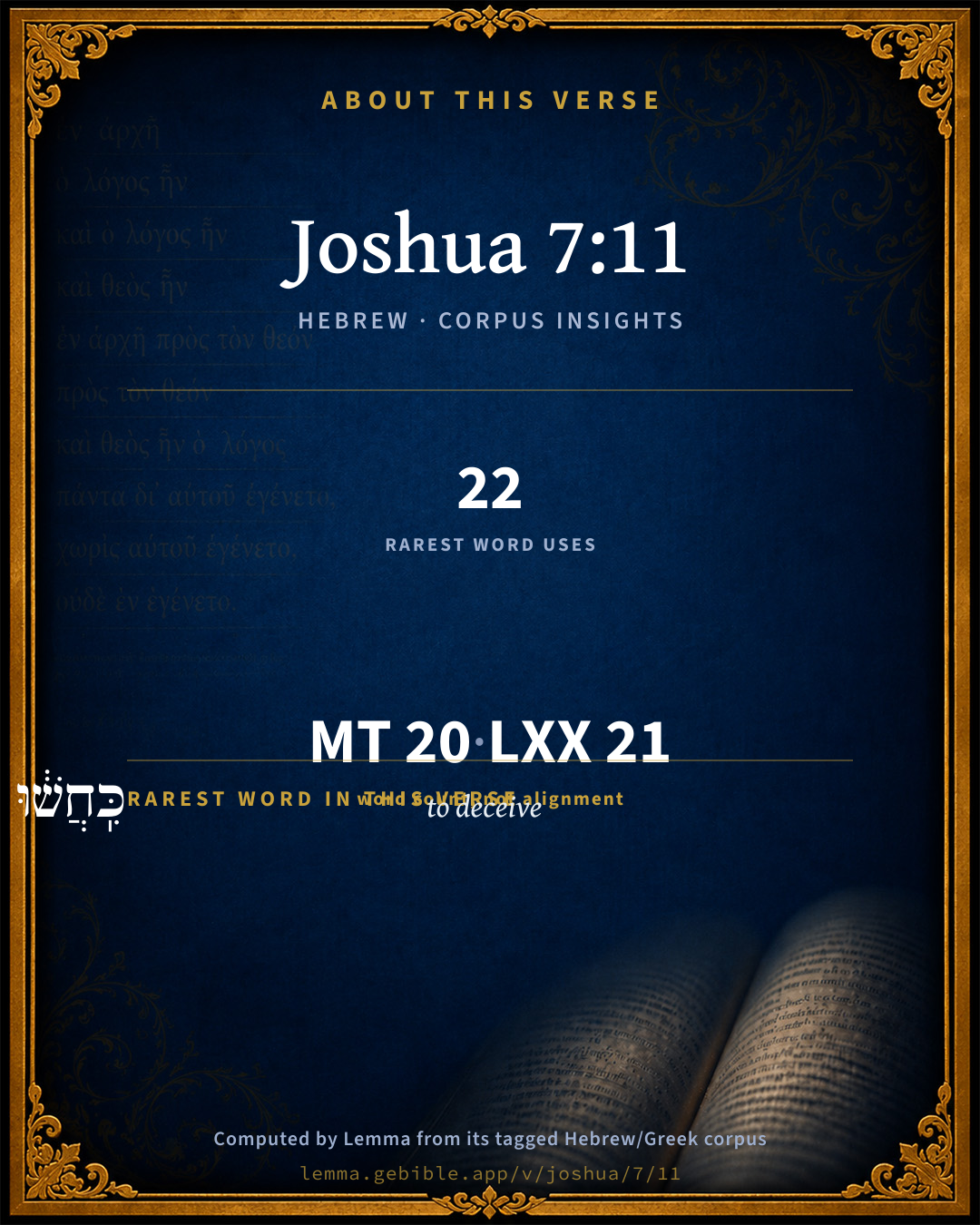
These counts appear in no published source. They are computed here, from the morphology-tagged text and Lemma’s own curated glosses. What Lemma adds →

20
words
15
distinct lemmas
Historical
section

Notable vocabulary

The rarest word here is כִּֽחֲשׁ֔וּ to deceive H3584 — appearing just 22 times in the whole Hebrew Bible.

Shared distinctive vocabulary

כִּֽחֲשׁ֔וּ to deceive H3584 occurs in 22 verses of the Hebrew Bible. Also found in:

Grammatical profile

  • 7 verbs
  • 4 nouns
  • 1 preposition
  • 8 particles

Verb forms

  • חָטָא֙ Qal · Perfect
  • עָבְר֣וּ Qal · Perfect
  • צִוִּ֖יתִי Piel · Perfect
  • לָֽקְחוּ֙ Qal · Perfect
  • גָּֽנְבוּ֙ Qal · Perfect
  • כִּֽחֲשׁ֔וּ Piel · Perfect
  • שָׂ֥מוּ Qal · Perfect

Repetition

A word recurs within this verse — often emphatic in Hebrew:

  • וְגַם֙ also H1571 ×5

Hebrew & Septuagint length

In English translation the verse runs 40 words from the Hebrew and 26 from the Septuagint (LXX English) — the Septuagint runs noticeably shorter here. See the side-by-side →

A rough comparison of the two English renderings, which tokenize alike — not a word-level alignment.

Word counts can differ between the Hebrew and the Greek without any difference in meaning — e.g. the Hebrew direct-object marker אֵת has no separate Greek word, and Greek often adds the article ὁ.

In the original languages it is 20 Hebrew tokens and 21 Greek tokens — but the two are counted differently (Hebrew bundles its prefixes and suffixes into one token; the Greek is in lemma form), so that isn’t a like-for-like length.

Cross-references

21

Topical passages linked to Joshua 7:11 in the Treasury of Scripture Knowledge — connected by theme and wording, ordered by reader-vote popularity; previews shown in the World English Bible.

  • Acts 5:1–2 But a certain man named Ananias, with Sapphira, his wife, sold a possession,
  • Joshua 6:17–19 The city shall be devoted, even it and all that is therein, to Yahweh: only Rahab the prostitute shall live, she and all who are with her in the house, because she hid the messengers that we sent.
  • Hebrews 4:13 There is no creature that is hidden from his sight, but all things are naked and laid open before the eyes of him with whom we have to do.
  • Acts 5:9 But Peter asked her, "How is it that you have agreed together to tempt the Spirit of the Lord? Behold, the feet of those who have buried your husband are at the door, and they will carry you out."
  • Joshua 7:20–21 Achan answered Joshua, and said, Of a truth I have sinned against Yahweh, the God of Israel, and thus and thus have I done:
  • Leviticus 5:15 "If anyone commits a trespass, and sins unwittingly, in the holy things of Yahweh; then he shall bring his trespass offering to Yahweh, a ram without blemish from the flock, according to your estimation in silver by shekels, after the shekel of the sanctuary, for a trespass offering.
  • Deuteronomy 17:2 If there be found in the midst of you, within any of your gates which Yahweh your God gives you, man or woman, who does that which is evil in the sight of Yahweh your God, in transgressing his covenant,
  • Joshua 7:1 But the children of Israel committed a trespass in the devoted thing; for Achan, the son of Carmi, the son of Zabdi, the son of Zerah, of the tribe of Judah, took of the devoted thing: and the anger of Yahweh was kindled against the children of Israel.
  • Joshua 23:16 When you disobey the covenant of Yahweh your God, which he commanded you, and go and serve other gods, and bow down yourselves to them; then will the anger of Yahweh be kindled against you, and you shall perish quickly from off the good land which he has given to you.
  • Judges 2:20 The anger of Yahweh was kindled against Israel; and he said, Because this nation have transgressed my covenant which I commanded their fathers, and have not listened to my voice;
  • 2 Kings 5:25–26 But he went in, and stood before his master. Elisha said to him, Whence come you, Gehazi? He said, Your servant went no where.
  • 2 Kings 18:12 because they didn't obey the voice of Yahweh their God, but transgressed his covenant, even all that Moses the servant of Yahweh commanded, and would not hear it, nor do it.
  • Isaiah 24:5 The earth also is polluted under the inhabitants of it; because they have transgressed the laws, violated the statutes, broken the everlasting covenant.
  • Isaiah 50:1–2 Thus says Yahweh, Where is the bill of your mother's divorce, with which I have put her away? or which of my creditors is it to whom I have sold you? Behold, for your iniquities were you sold, and for your transgressions was your mother put away.
  • Jeremiah 31:32 not according to the covenant that I made with their fathers in the day that I took them by the hand to bring them out of the land of Egypt; which my covenant they broke, although I was a husband to them, says Yahweh.
  • Hosea 6:7 But they, like Adam, have broken the covenant. They were unfaithful to me, there.
  • Habakkuk 2:6 Won't all these take up a parable against him, and a taunting proverb against him, and say, 'Woe to him who increases that which is not his, and who enriches himself by extortion! How long?'
  • Zechariah 5:4 I will cause it to go out," says Yahweh of Hosts, "and it will enter into the house of the thief, and into the house of him who swears falsely by my name; and it will remain in the midst of his house, and will destroy it with its timber and its stones."
  • Malachi 3:8–9 Will a man rob God? Yet you rob me! But you say, 'How have we robbed you?' In tithes and offerings.
  • Matthew 22:21 They said to him, "Caesar's." Then he said to them, "Give therefore to Caesar the things that are Caesar's, and to God the things that are God's."
  • John 12:5–6 "Why wasn't this ointment sold for three hundred denarii, and given to the poor?"

Cross-references courtesy of OpenBible.info (CC BY 4.0).

Hebrew and Greek witnesses Masoretic Hebrew ↔ Greek Septuagint

The same verse in the two great witnesses to the Old Testament, shown verse-for-verse.

Here the Septuagint runs noticeably shorter than the Hebrew — LXX2012 (modern English Septuagint) 26 words vs World English Bible 40. A rough length comparison of the two English translations, not a word-level alignment — read both below.

These are two independent witnesses, not word-aligned to each other, and the Septuagint is shown in lemma (dictionary) form.

Hebrew Joshua 7:11 Masoretic · Westminster Leningrad Codex

חָטָא֙ יִשְׂרָאֵ֔ל וְגַם֙ עָבְר֣וּ אֶת בְּרִיתִ֔י אֲשֶׁ֥ר צִוִּ֖יתִי אוֹתָ֑ם וְגַ֤ם לָֽקְחוּ֙ מִן הַחֵ֔רֶם וְגַ֤ם גָּֽנְבוּ֙ וְגַ֣ם כִּֽחֲשׁ֔וּ וְגַ֖ם שָׂ֥מוּ בִכְלֵיהֶֽם

Israel has sinned; yes, they have even transgressed my covenant which I commanded them: yes, they have even taken of the devoted thing, and have also stolen, and dissembled also; and they have even put it among their own stuff.

World English Bible · Public Domain

Greek LXX Joshua 7:11 Septuagint · lemma form

ἁμαρτάνω ὁ λαός καί παραβαίνω ὁ διαθήκη ὅς διατίθημι πρός αὐτός καί κλέπτω ἀπό ὁ ἀνάθεμα ἐνβάλλω εἰς ὁ σκεῦος αὐτός

The people has sinned, and transgressed the covenant which I made with them; they have stolen from the cursed thing, and put it into their store.

LXX2012 (modern English Septuagint) · Public Domain

Hebrew: Westminster Leningrad Codex (CC BY 4.0). Greek: Septuagint (public domain); English from LXX2012 (modern English Septuagint) (Public Domain). How the Septuagint differs from the Hebrew →

Targum (Aramaic paraphrase)

1

The Targum is the ancient Jewish Aramaic paraphrase of the Hebrew Scriptures — an interpretive translation, not the Hebrew text itself. Onkelos (literal) and Pseudo-Jonathan (expansive) render the Torah, and Jonathan the Prophets. Coverage is partial: where no permissively-licensed English translation exists for a verse, only the Aramaic is shown. This is verse-level text, not a word-by-word alignment to the Hebrew.

  1. Targum Jonathan Prophets (Joshua–Malachi)
    חֲטָא יִשְׂרָאֵל וְאַף עֲבָרוּ עַל קְיָמִי דְפַקְדֵית יַתְהוֹן וְאַף נְסִיבוּ מִן חֶרְמָא וְאַף גְנָבוּ וְאַף כַּדִיבוּ וְאַף שַׁוִיאוּ בְּמָנֵיהוֹן:

    (no public-domain English translation for this verse)

    Targum Jonathan — Aramaic: “Mikraot Gedolot” (public domain). English: “Sefaria Community Translation” (CC0 1.0 (public-domain dedication)); “London "Chaldee Paraphrase," 1871” (public domain). Text via Sefaria.

Commentary

Notes on Joshua 7:11 from classic Christian and Jewish commentators (each source and its license shown beneath its notes). The classic Christian expositions comment on the surrounding passage and are grouped to its opening verse, so a note may address several verses; the Jewish commentaries on the Tanakh (Rashi and others) are per-verse, so they appear only where the commentator wrote on this verse.

Lemma curates 59 commentaries, every one of them public domain or Creative Commons licensed, each selected and text-cleaned for this edition rather than reprinted as found. About our sources →

Trapp's Complete Commentary

John Trapp

Jos 7:11 Israel hath sinned, and they have also transgressed my covenant which I commanded them: for they have even taken of the accursed thing, and have also stolen, and dissembled also, and they have put [it] even among their own stuff.

Ver. 11. Israel hath sinned.] See Jos 7:1.

For they have even taken of the accursed thing, &c.] God aggravateth Achan’s sin by the several circumstances, laying open how many transgressions were wrapped up in that sin of his, as Lev 16:21. This Achan himself should have done, and so prevented the Lord; {1Co 11:31} which because he did not, God did it for him: as because the scholar will not parse his lesson, scan his verses, the master will do it for him to his cost.

John Trapp, A Commentary or Exposition upon All the Books of the Old and New Testament (1647–1656) — public domain. Text from a community e-Sword module.

Scofield Reference Notes

C. I. Scofield

Israel

The sin of Achan and its results teach the great truth of the oneness of the people of God, Jos 7:11. "Israel hath sinned." See in illustration; 1Co 5:1-7; 1Co 12:12-14; 1Co 12:26. The whole cause of Christ is injured by the sin, neglect, or unspirituality of one believer.

The Scofield Reference Bible (1917 edition), notes by C. I. Scofield — public domain. Text from a community e-Sword module.

Adam Clarke's Commentary

Verse 11. Israel hath sinned] It is impossible that God should turn against his people, if they had not turned away from him. They have taken of the accursed thing, notwithstanding my severe prohibition. They have also stolen, supposing, if not seen by their brethren, I should either not see or not regard it. They have dissembled - pretended to have kept strictly the command I gave them; and have put it among their own stuff - considered it now as a part of their own property.

Adam Clarke's Commentary on the Bible (1810–1826) — public domain. Text from a community e-Sword/MySword module.

Ellicott's Commentary for English Readers

(11) They have also transgressed my covenant.—The law is again brought prominently forward in this scene. “The words of the covenant, the ten commandments,” are first of all a pledge that Jehovah is the God of Israel. “I am Jehovah, thy God, who brought thee out of the land of Egypt.” And He brought them out that He might bring them in—and He made them the executioners of His wrath against the idolaters. They must have no other gods but Him, and they must not treat the things that had been defiled by association with idolatry as their own spoil. The words which specially apply to this case are to be found in Deu_7:25-26 : “The graven images of their gods shall ye burn with fire: thou shalt not desire (see Jos_7:21) the silver or gold that is on them. . . . Neither shalt thou bring an abomination into thine house, lest thou be a cursed thing like it.”

The whole spoil of Canaan was not so treated; but concerning that of Jericho there had been express orders, possibly because the city was especially defiled with idolatry. God had proclaimed it abomination. It was ahêrem—devoted or accursed—and no Israelite was to appropriate any of it, under penalty of becoming chêrem himself, and making his household chêrem. This Achan had done.

A Bible Commentary for English Readers, edited by Charles John Ellicott (1878–1897) — public domain. Text from a community e-Sword module.

John Gill's Exposition

Israel hath sinned,.... For though one only had committed the sin, others might have known of it, and connived at it; however, there was sin committed among them, and it must be discovered, the guilt charged, and punishment inflicted:

and they have also transgressed my covenant which I commanded them; not the law given on Mount Sinai, called the covenant, though in general that was now broken, inasmuch as they then promised to hear and obey all that the Lord should say unto them, Exo 24:7; but it particularly means the command given, Jos 6:18; that they should take nothing of that which was devoted the Lord, and thereby make the camp of Israel a curse, and trouble it; and which shows that that was not a command given by Joshua of himself, but what he had from the Lord:

for they have even taken of the accursed thing; somewhat of that which was devoted to sacred uses:

and have also stolen; taken it away, not openly, but by stealth, as being conscious they ought not to have done what they did, and so sinned both against God and their own consciences:

and dissembled also; or "lied" (u); pretended they had not taken any of the accursed thing when they had; and it is probable that the people in general, each of the tribes, families, and houses, were examined by proper officers, whether they had taken any of the spoil, or not, to themselves, and they all denied they had, and he that had taken it among the rest; and perhaps was particularly asked the question, which he answered in the negative:

and they have put it even amongst their own stuff; their household stuff, mixed them with their own goods that they might not be known; or put them "in their own vessels" (w), for their own use and service.

(u) "mentiti sunt", Pagninus, Junius & Tremellius, Piscator. (w) "in vasis suis", Montanus.

John Gill's Exposition of the Whole Bible (1746–1763) — public domain (CC PDM 1.0). Text via the HelloAO Bible API.

Albert Barnes' Notes on the Bible

Also stolen, and dissembled also - The anger of God and the heinousness of Israel’s sin are marked by the accumulation of clause upon clause. As a climax they had even appropriated to their own use the consecrated property purloined from God.

Albert Barnes' Notes on the Bible (1834–1885) — public domain. Text from a community e-Sword/MySword module.

Haydock's Catholic Bible Commentary

Lied. Each one, on delivering up what he had taken, made profession, at least by his behaviour, (Haydock) that he retained nothing. Achan did like the rest, but he kept back of the plunder. (Calmet) --- He lied, and did not comply with the promise made by all Israel, which he was bound to observe, as much as if he had made it with his own mouth.

George Leo Haydock (1774–1849), Haydock's Catholic Family Bible and Commentary, 1859 edition — public domain. Excludes Psalms (Douay-Rheims chapter numbering differs from Protestant) and Deuterocanonical books (Catholic canon only).

Matthew Poole's English Annotations

Israel; some or one of them, as before See Poole "Jos 7:1".

Transgressed my covenant, i.e. broken the conditions of my covenant which I have commanded them, and they have promised to perform, viz. obedience to all my commands, Exo 19:8; 24:7, whereof this was one, not to meddle with the accursed thing.

Of the accursed thing, which I charged them not to meddle with.

And have also stolen, i.e. taken my portion which I had reserved, Jos 6:19.

Dissembled; covered the fact with deep dissimulation, and a real, if not verbal, profession of their innocency. Possibly Achan might be suspected; and being accused, had denied it, or was resolved to deny it.

Put it even among their own stuff; converted it to their own use, and added obstinacy and resolvedness to the crime; thus he loads this sin with divers aggravations.

Matthew Poole's English Annotations on the Holy Bible (1683–1685) — public domain. Text from a community e-Sword/MySword module.

Whedon's Commentary on the Bible

Daniel D. Whedon

11. Israel hath sinned — For the sense in which the sin of an individual is that of a nation, see note on Jos_7:1. Jehovah then rehearses the aggravated character of that sin. It was a treacherous violation of covenant obligations into which they had entered, (Exo_19:8; Exo_24:7;) it was a sacrilege, inasmuch as a consecrated thing had been put to a private use; it was theft, because the appropriation had been made clandestinely; it was a lie, acted if not spoken. “The first three clauses describe the sin in its relation to God; the following three refer to the actual nature of the sin itself, as theft, concealment, and misappropriation to their own use of the stolen goods.” — Keil.

Daniel D. Whedon (gen. ed.), Commentary on the Old and New Testaments (1874–1909) — public domain. Text from a community e-Sword module.

The Pulpit Commentary

Israel hath sinned. A simple but satisfactory explanation. It is not God who changes. It is we who frustrate His counsels of love and protection against our enemies. We have here another assertion of the principle that if one member suffer all the members suffer with it. Achan"s sin was the sin of all Israel. So the sin of one man is still the sin of the whole Church. And have also stolen. The accusation is cumulative. Israel, which was all involved in the sin of one among their number, had

(1) broken a solemn vow;

(2) had stolen what was not theirs;

(3) had acted deceitfully (vjK); and

(4) had appropriated to themselves what belonged to God, which, as Keil remarks, was the last and gravest feature of their crime.

This is strongly brought out by the fivefold repetition of in the original.

The Pulpit Commentary (1880–1919), ed. H.D.M. Spence-Jones & Joseph S. Exell — public domain. Text from a community e-Sword module.

John Wesley's Explanatory Notes

Israel - Some or one of them. Transgressed my covenant - That is, broken the conditions of my covenant which they have promised to perform, whereof this was one, not to meddle with the accursed thing. Stolen - That is, taken my portion which I had reserved, chap. vi, 19. Dissembled - Covered the fact with deep dissimulation. Possibly Achan might be suspected, and being accused, had denied it. Among their own stuff - Converted it to their own use, and added obstinacy to the crime.

John Wesley, Explanatory Notes Upon the Whole Bible (1754–1765) — public domain. Text via the GEBible commentary corpus.

Lesson kit

Teaching starters — assembled from the data on this page, not authored interpretation. Every prompt links to the verse data it draws on. Edit before teaching.

Joshua, in the Historical, opens this verse with 20 words (15 distinct Hebrew lemmas). Its most distinctive word is kâchash (“to deceive”). The Greek Septuagint runs shorter here. A historical commentator’s framing appears above. Read the whole chapter for the surrounding context.

Discussion questions

  1. The word kâchash carries the sense “to deceive.” How does it shape the verse?
  2. How does Genesis 18:15, which shares the word «to deceive», read alongside this verse?
  3. What does the repetition of “also” (5× in this one verse) do in this verse?
  4. The Septuagint runs shorter here than the Hebrew. What might account for the difference?
  5. These translations render this verse differently; the difference is in the English rendering, not the original. What questions does that raise?
  6. «חָטָא֙» is a Qal Perfect verb. How does that grammatical form shape the action described?
  7. Compare how Trapp's Complete Commentary and Scofield Reference Notes read this verse. Where do they agree or differ?

Things to notice

Reading settings

Reading text

Shown beneath each verse's original-language words.

Old Testament
Old Testament edition

Read the OT as the Masoretic Hebrew (MT) or the Greek Septuagint (LXX).

English shown for the Greek Septuagint (in the Hebrew ↔ Greek comparison).

Comparing translations? Open the Compare panel on any verse page to stack up to four side by side.