2 Samuel 5:25

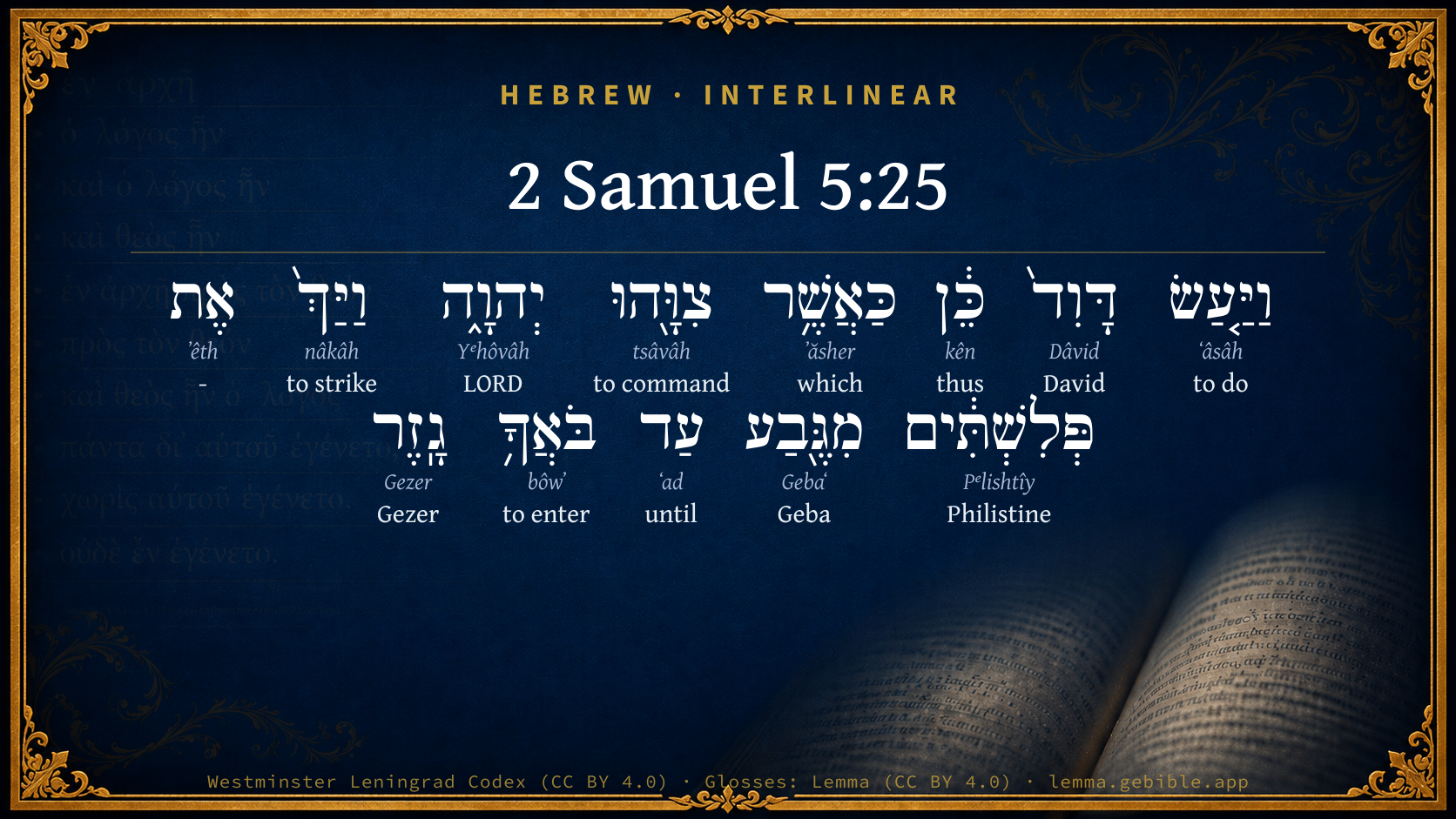
Hebrew (Westminster Leningrad Codex) 2 Samuel 5:25 appears in the Hebrew Old Testament. The text above is from the Westminster Leningrad Codex. Each word links to its Strong’s number, a concise gloss, and parsing drawn from the Open Scriptures Hebrew Bible morphology. Click any word for its full Brown-Driver-Briggs (BDB) entry.
Download image
Cite this verse

2 Samuel 5:25 (World English Bible). Public Domain. Lemma interlinear Bible study tool, https://lemma.gebible.app/v/2-samuel/5/25.

Show BibTeX & RIS
BibTeX
RIS
English Translation
David did so, as Yahweh commanded him, and struck the Philistines from Geba until you come to Gezer.
World English Bible · Public Domain
Download a study sheet

One document with this verse’s original text, its word-by-word gloss line, the meaning frame, cross-references with their text, attributed commentary, and full source and license credits — printable, and it pastes into notes with its structure intact.

This verse Autodidact and up

Study sheet (.html) Plain text (.txt)

A passage Seminary Student

Up to 50 verses in one chapter. A passage sheet keeps up to 6 commentary sources and 12 cross-references per verse, in the order this page ranks them, and says so on the sheet whenever that leaves anything out. Ask for a single verse and you get the Autodidact verse sheet above.

Everything on this page stays free to read, with no account — the sheet is a download of what is already on screen, not access to it.

Want to remove ads? Support Godless Engineer
Compare translations 3

The same verse in 3 English versions, stacked beneath the original-language interlinear above. Click any original word for its lexicon entry.

Each is an independent rendering of the whole verse — the interlinear is not word-aligned to these translations.

Highlighted words mark where these versions differ — a whole-verse word diff, not a word-by-word alignment.

  • World English Bible Public Domain
    David did so, as Yahweh commanded him, and struck the Philistines from Geba until you come to Gezer.
  • King James Version Public Domain
    And David did so, as the LORD had commanded him; and smote the Philistines from Geba until thou come to Gazer.
  • unfoldingWord Literal Text CC BY-SA 4.0
    And David did thus, just as Yahweh commanded him. And he struck the Philistines from Geba to your coming Gezer.

unfoldingWord Literal Text — © unfoldingWord, licensed CC BY-SA 4.0. Word-aligned USFM3 via Door43 (git.door43.org/unfoldingWord/en_ult).

Versions to compare (up to 4)

3 of 4 selected

Show all 18 translations

Every available English version of this verse, each an independent rendering of the whole verse.

  • World English Bible Public Domain
    David did so, as Yahweh commanded him, and struck the Philistines from Geba until you come to Gezer.
  • Berean Standard Bible Public Domain
    So David did as the LORD had commanded him, and he struck down the Philistines all the way from Gibeon to Gezer.
  • Majority Standard Bible Public Domain
    So David did as the LORD had commanded him, and he struck down the Philistines all the way from Gibeon to Gezer.
  • King James Version Public Domain
    And David did so, as the LORD had commanded him; and smote the Philistines from Geba until thou come to Gazer.
  • American Standard Version (1901) Public Domain
    And David did so, as Jehovah commanded him, and smote the Philistines from Geba until thou come to Gezer.
  • Revised Version (1885) Public Domain
    And David did so, as the LORD commanded him; and smote the Philistines from Geba until thou come to Gezer.
  • Geneva Bible (1599) Public Domain
    Then Dauid did so as the Lord had commanded him, and smote the Philistims from Geba, vntil thou come to Gazer.
  • Douay-Rheims (1899) Public Domain
    And when thou shalt hear the sound of one going in the tops of the pear trees, then shalt thou join battle: for then will the Lord go out before thy face to strike the army of the Philistines.
  • Young's Literal Translation Public Domain
    And David doth so, as Jehovah commanded him, and smiteth the Philistines from Geba unto thy coming to Gazer.
  • Literal Standard Version CC BY-SA 4.0
    And David does so, as YHWH commanded him, and strikes the Philistines from Geba to your coming to Gazer.
  • Unlocked Literal Bible CC BY-SA 4.0
    So David did as Yahweh had commanded him. He killed Philistines from Geba all the way to Gezer.
  • unfoldingWord Literal Text CC BY-SA 4.0
    And David did thus, just as Yahweh commanded him. And he struck the Philistines from Geba to your coming Gezer.
  • Darby Bible Public Domain
    And David did so, as Jehovah had commanded him; and smote the Philistines from Geba until thou comest to Gezer.
  • World Messianic Bible Public Domain
    David did so, as the LORD commanded him, and struck the Philistines all the way from Geba to Gezer.
  • Webster's Bible Public Domain
    And David did so as the LORD had commanded him; and smote the Philistines from Geba until thou comest to Gazer.
  • Free Bible Version CC BY-SA 4.0
    David followed the Lord's orders, and he slaughtered the Philistines from Geba all the way to Gezer.
  • Bible in Basic English Public Domain
    And David did as the Lord had said; and he overcame the Philistines, attacking them from Gibeon to near Gezer.
  • JPS Tanakh (1917) Public Domain
    And David did so, as the LORD commanded him, and smote the Philistines from Geba until thou come to Gezer.

Literal Standard Version (2020), Covenant Press — licensed CC BY-SA 4.0. Text via the HelloAO Bible API (eBible.org). Unlocked Literal Bible (unfoldingWord) — licensed CC BY-SA 4.0. Text via the HelloAO Bible API (eBible.org). unfoldingWord Literal Text — © unfoldingWord, licensed CC BY-SA 4.0. Word-aligned USFM3 via Door43 (git.door43.org/unfoldingWord/en_ult). Free Bible Version, Dr. Jonathan Gallagher — licensed CC BY-SA 4.0. Text via the HelloAO Bible API (eBible.org).

Word by word

More ways to search: Search by grammar → Find every occurrence → Compare this word →

Practice this passage: Drill this verse → Learn its vocabulary →

גָֽזֶר
Gezer
H1507
“Gezer”
Noun, Proper
Part of Speech
Noun
Type
Proper
Full BDB Definition

Origin: the same as H1506

TWOT: None

Gazer or Gezer = "portion" - a Levitical city on the border of Ephraim
  1. וַיַּ֤עַשׂ ʻâsâh H6213 “and · to do” Conjunction + Verb, Qal, Sequential Imperfect, 3rd Person, Masculine, Singular
  2. דָּוִד֙ Dâvid H1732 “David” Noun, Proper
  3. כֵּ֔ן kên H3651 “thus” Particle, Demonstrative
  4. כַּאֲשֶׁ֥ר ʼăsher H834 “like/as · which” Preposition + Particle, Relative
  5. צִוָּ֖הוּ tsâvâh H6680 “to command · him” Verb, Piel, Perfect, 3rd Person, Masculine, Singular + Suffix, Personal, 3rd Person, Masculine, Singular
  6. יְהוָ֑ה Yᵉhôvâh H3068 “LORD” Noun, Proper
  7. וַיַּךְ֙ nâkâh H5221 “and · to strike” Conjunction + Verb, Hiphil, Sequential Imperfect, 3rd Person, Masculine, Singular
  8. אֶת ʼêth H853 “-” Particle, Direct Object
  9. פְּלִשְׁתִּ֔ים Pᵉlishtîy H6430 “Philistines” Noun, Gentilic, Masculine, Plural, Absolute
  10. מִגֶּ֖בַע Gebaʻ H1387 “from · Geba” Preposition + Noun, Proper
  11. עַד ʻad H5704 “until” Preposition
  12. בֹּאֲךָ֥ bôwʼ H935 “to enter · you” Verb, Qal, Infinitive Construct + Suffix, Personal, 2nd Person, Masculine, Singular

About this verse

These counts appear in no published source. They are computed here, from the morphology-tagged text and Lemma’s own curated glosses. What Lemma adds →

13
words
13
distinct lemmas
Historical
section

Notable vocabulary

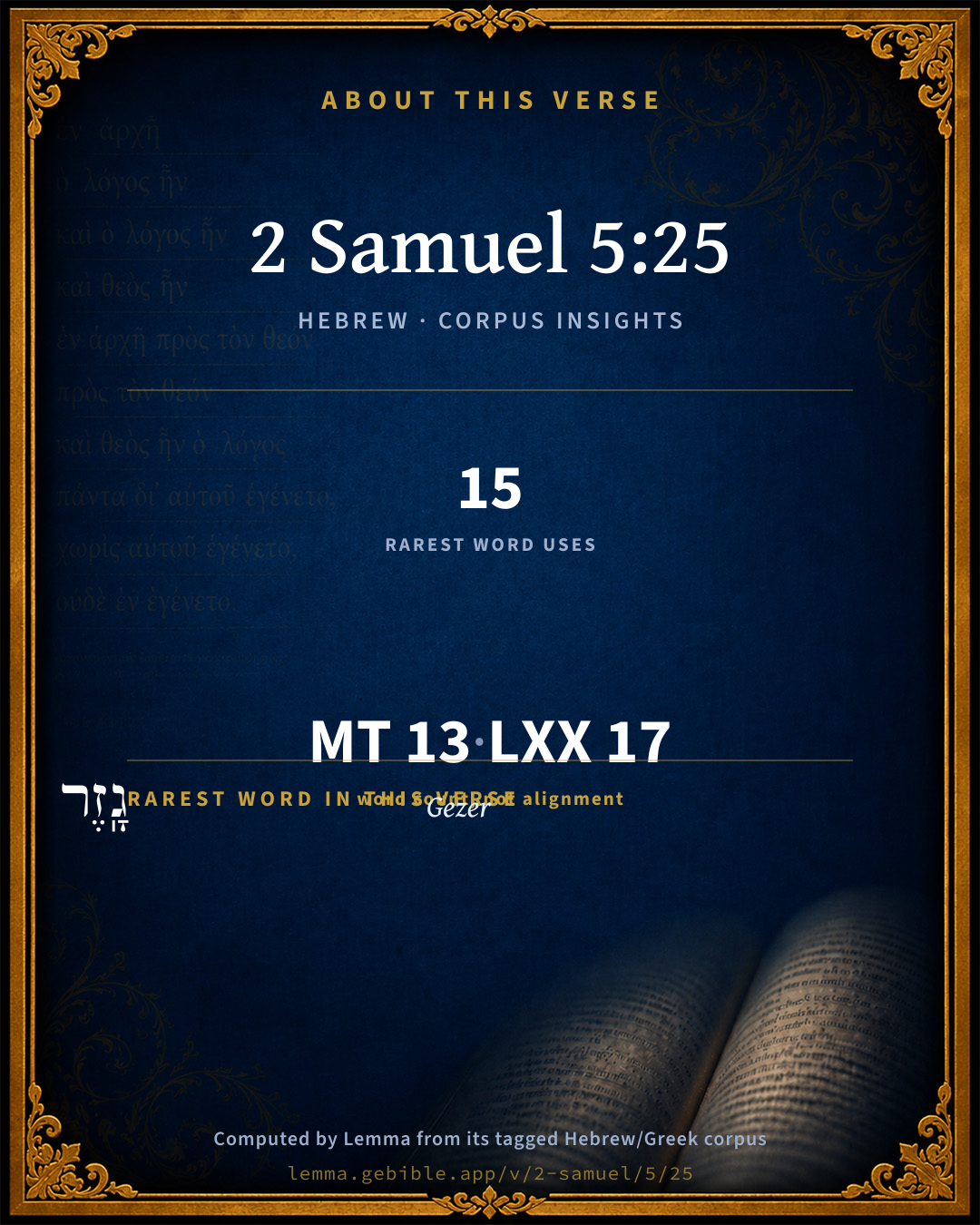
The rarest word here is גָֽזֶר Gezer H1507 — appearing just 15 times in the whole Hebrew Bible.

Shared distinctive vocabulary

גָֽזֶר Gezer H1507 occurs in 14 verses of the Hebrew Bible. Also found in:

Grammatical profile

  • 4 verbs
  • 5 nouns
  • 1 preposition
  • 3 particles

Verb forms

  • וַיַּ֤עַשׂ Qal · Sequential Imperfect
  • צִוָּ֖הוּ Piel · Perfect
  • וַיַּךְ֙ Hiphil · Sequential Imperfect
  • בֹּאֲךָ֥ Qal · Infinitive Construct

Hebrew & Septuagint length

In English translation the verse runs 18 words from the Hebrew and 21 from the Septuagint (LXX English) — closely comparable.

A rough comparison of the two English renderings, which tokenize alike — not a word-level alignment.

Word counts can differ between the Hebrew and the Greek without any difference in meaning — e.g. the Hebrew direct-object marker אֵת has no separate Greek word, and Greek often adds the article ὁ.

In the original languages it is 13 Hebrew tokens and 17 Greek tokens — but the two are counted differently (Hebrew bundles its prefixes and suffixes into one token; the Greek is in lemma form), so that isn’t a like-for-like length.

Cross-references

3

Topical passages linked to 2 Samuel 5:25 in the Treasury of Scripture Knowledge — connected by theme and wording, ordered by reader-vote popularity; previews shown in the World English Bible.

  • 1 Chronicles 14:16 David did as God commanded him: and they struck the host of the Philistines from Gibeon even to Gezer.
  • Joshua 16:10 They didn't drive out the Canaanites who lived in Gezer: but the Canaanites dwell in the midst of Ephraim to this day, and are become servants to do forced labor.
  • Isaiah 28:21 For Yahweh will rise up as on Mount Perazim, he will be angry as in the valley of Gibeon; that he may do his work, his strange work, and bring to pass his act, his strange act.

Cross-references courtesy of OpenBible.info (CC BY 4.0).

Hebrew and Greek witnesses Masoretic Hebrew ↔ Greek Septuagint

The same verse in the two great witnesses to the Old Testament, shown verse-for-verse.

These are two independent witnesses, not word-aligned to each other, and the Septuagint is shown in lemma (dictionary) form.

Hebrew 2 Samuel 5:25 Masoretic · Westminster Leningrad Codex

וַיַּ֤עַשׂ דָּוִד֙ כֵּ֔ן כַּאֲשֶׁ֥ר צִוָּ֖הוּ יְהוָ֑ה וַיַּךְ֙ אֶת פְּלִשְׁתִּ֔ים מִגֶּ֖בַע עַד בֹּאֲךָ֥ גָֽזֶר

David did so, as Yahweh commanded him, and struck the Philistines from Geba until you come to Gezer.

World English Bible · Public Domain

Greek LXX 2 Samuel 5:25 Septuagint · lemma form

καί ποιέω δαυίδ καθώς ἐντέλλω αὐτός κύριος καί πατάσσω ὁ ἀλλόφυλος ἀπό γαβαων ἕως ὁ γῆ γαζηρα

And David did as the Lord commanded him, and struck the Philistines from Gabaon as far as the land of Gazera.

LXX2012 (modern English Septuagint) · Public Domain

On this verse, Haydock's Catholic Bible Commentary discusses the Septuagint’s reading. Read the note in Commentary ↓

Hebrew: Westminster Leningrad Codex (CC BY 4.0). Greek: Septuagint (public domain); English from LXX2012 (modern English Septuagint) (Public Domain). How the Septuagint differs from the Hebrew →

Targum (Aramaic paraphrase)

1

The Targum is the ancient Jewish Aramaic paraphrase of the Hebrew Scriptures — an interpretive translation, not the Hebrew text itself. Onkelos (literal) and Pseudo-Jonathan (expansive) render the Torah, and Jonathan the Prophets. Coverage is partial: where no permissively-licensed English translation exists for a verse, only the Aramaic is shown. This is verse-level text, not a word-by-word alignment to the Hebrew.

  1. Targum Jonathan Prophets (Joshua–Malachi)
    וַעֲבַד דָוִד כֵּן כְּמָא דִי פַקְדֵיהּ יְיָ וּקְטַל יַת פְּלִשְׁתָּאֵי מִגֶבַע עַד מַעֲלָנָא דְגָזַר:

    (no public-domain English translation for this verse)

    Targum Jonathan — Aramaic: “Mikraot Gedolot” (public domain). English: “Sefaria Community Translation” (CC0 1.0 (public-domain dedication)); “London "Chaldee Paraphrase," 1871” (public domain). Text via Sefaria.

Commentary

Notes on 2 Samuel 5:25 from classic Christian and Jewish commentators (each source and its license shown beneath its notes). The classic Christian expositions comment on the surrounding passage and are grouped to its opening verse, so a note may address several verses; the Jewish commentaries on the Tanakh (Rashi and others) are per-verse, so they appear only where the commentator wrote on this verse.

Lemma curates 59 commentaries, every one of them public domain or Creative Commons licensed, each selected and text-cleaned for this edition rather than reprinted as found. About our sources →

Trapp's Complete Commentary

John Trapp

2Sa 5:25 And David did so, as the LORD had commanded him; and smote the Philistines from Geba until thou come to Gazer.

Ver. 25. To Gazer.] Which was a city of the Philistines, saith Josephus.

John Trapp, A Commentary or Exposition upon All the Books of the Old and New Testament (1647–1656) — public domain. Text from a community e-Sword module.

The Biblical Illustrator

Joseph S. Exell

2Sa_5:25

And David did so.

Marching orders

Each day read your chapter or passage with the idea that you are receiving your marching orders; that there is some new service to render, some new duty to perform, some new virtue to acquire. Let the attitude of your soul be indicated by Samuels words, Speak, Lord, for Thy servant heareth. When you hear, do! (F. B. Meyer.)

Do present duty

Procrastination is reckoned among the most venial of our faults, and sits so lightly on our minds that we scarcely apologise for it. But who can assure us that had not the assistance we had resolved to give to one friend in distress, or the advice to another under temptation to-day been delayed, and from mere sloth and indolence put off till to-morrow, it might not have preserved the fortune of the one, or saved the soul of the other? It is not enough that we perform duties; we must perform them at the right time. We must do the duty of every day in its own season. Every day has its own imperious duties; we must not depend upon to-day for fulfilling those Which we neglected yesterday, for to-day might not have been granted to us. Tomorrow will be equally peremptory in its demands, and the succeeding day, if we live to see it, will be ready with its proper duties. (Hannah More.)

The grasp of opportunity

Writing an article on Social Economy especially in reference to wages and industrial progress, Professor Atkinson says: The man who had the shrewdness and capacity to seize the opportunity afforded by recent science and invention had made progress, wealth, success. While from him who had not the foresight or mental aptitude to adjust himself to the new conditions, had been taken away even the opportunity for common labour which he enjoyed before.

Individual activity

Whatever noble work on earth is to be done you must do it yourself. If you leave it to others it will never be done. Do it yourself. Put away that poorest of poor spirits which would treat good wishes or benedictions, or even prayers, as substitutes for personal service. (Bishop Welldon.)

Doing your duty

There is one lesson which all agree that the Duke of Wellington taught, and which we are specially desirous of pointing out, viz., that throughout life, he made it a rule to do whatever he saw to be his duty at the time--a more rare and valuable quality than many suppose, unless they remember that it was a rule which he applied to small things as well as great, to the answering of a letter, and to the movement of an entire army. While he notoriously confined himself strictly to his own duties, anything and everything was regarded as a duty when laid upon him by legitimate and competent authority. It was no question for him whether the thing were too small for his powers or his dignity; he was required to do it, he could do it, and he did it--did it with all his might, whatever it was. Great as he was, he has in this left an example to the least, as well as to the greatest--to the young as well as to the old. (Great Thoughts.)

.

The Biblical Illustrator, edited by Joseph S. Exell (c. 1880s–1900s) — public domain. Text from a community e-Sword module.

Tyndale Open Study Notes

Tyndale Open Resources

5:25 Gibeon: David cleared the Philistines from the central hill country of Israel between Gibeon in the east (in Benjamin, north of Jerusalem) to Gezer in the west.

Tyndale Open Study Notes — © Tyndale Open Resources, licensed CC BY-SA 4.0. Text via the HelloAO Bible API.

Geneva Bible (1599)

Geneva Bible translators

Which was in the tribe of Benjamin, but the Philistines did possess it.

Geneva Bible (1599) marginal notes — public domain. Text via Bolls.life.

Adam Clarke's Commentary

Verse 25. And David did so] He punctually obeyed the directions of the Lord, and then every thing succeeded to his wish.

How is it that such supernatural directions and assistances are not communicated now? Because they are not asked for; and they are not asked for because they are not expected; and they are not expected because men have not faith; and they have not faith because they are under a refined spirit of atheism, and have no spiritual intercourse with their Maker. Who believes that God sees all things and is everywhere? Who supposes that he concerns himself with the affairs of his creatures? Who acknowledges him in all his ways? Who puts not his own wisdom, prudence, and strength, in the place of God Almighty? Reader, hast thou faith in God? Then exercise it, cultivate it, and thou mayest remove mountains.

It is worthy of remark that David was, by the appointment of God, to feed the people. As he had formerly the care of a flock of sheep, which he was to watch over, defend, lead in and out, and for which he was to find pasture; now he is to watch over, defend, lead in and out, feed, and protect, the Israelites. He is to be the shepherd of the people, not the tyrant or oppressor.

In ancient times, among the Greeks, kings were denominated ποιμενες λαου, shepherds of the people; and all good kings were really such: but, in process of time, this pleasing title was changed for βασιλευς and τυραννος, sovereign and tyrant; in neither of which names does any thing of the original title exist. And such are the different political constitutions of the kingdoms of the earth, that it is impossible that in any of them, the British excepted, the king can be the shepherd and father of his people. All the other regal constitutions under the sun permit the sovereign to be despotic, and consequently oppressive and tyrannical if he please. The British alone gives no power of this kind to the prince; by the constitution he is a patriotic king, and by the influence of those maxims of state which are continually presented to his view, and according to which all acts of government are formed, he becomes habitually the father of his people, and in this light alone do the British people behold the British king.

David, by his own authority, without any form of law, could slay the Amalekite who said he had killed Saul; and could cut off the heads of Rechab and Baanah, who murdered Ish-bosheth; but, in the government of Britain, the culprit is to be heard in his vindication, witnesses are to be examined, the facts viewed by an upright judge in the light of the law; and then the alleged criminality is left to the decision of twelve honest men, the equals of the accused, who are bound by a solemn oath to decide according to the evidence brought before them. The Israelitish constitution was radically good, but the British constitution is much better. In the former, while the king ruled according to the spirit of the constitution, he could do no wrong, because he was only the vicegerent of the Almighty; in the latter, the king can do no wrong, because he is bound both by the spirit and letter of the law, to do nothing but what is according to the rules of eternal justice and equity laid down in that law; nothing is left to mere regal power or authority, and nothing trusted to human fickleness or caprice. In all his acts he is directed by his nobles and commons; who, being the representatives of all classes of the people, are always supposed to speak their mind. Well may it be said, Blessed are the people who are in such a case!

Adam Clarke's Commentary on the Bible (1810–1826) — public domain. Text from a community e-Sword/MySword module.

Ellicott's Commentary for English Readers

(25) From Geba . . . to Gazer.—In the parallel passage (1Ch_14:16) it is “from Gibeon to Gazer.” One or the other is a slip of the scribe, and there can be little question that Gibeon is the true reading, since it lies about five and a half miles northwest of Jerusalem, while Geba (Gibeah) is about seven and a half miles north-east. The site of Gazer (or Gezer) has not been exactly identified, but it was certainly just on the edge of the Philistine plain. The distance of the pursuit from Gibeon was about twelve miles, and six miles more must already have been passed over before reaching Gibeon from the valley of Rephaim. The flight of the Philistines was determined in this north-westerly direction at first, from the fact that David had “fetched a compass,” and attacked them from the south. In 1Ch_14:8-17, these battles are placed between the unsuccessful (2Sa_13:5-14) and the successful (2 Samuel 15) attempts to bring up the ark to Jerusalem. It is impossible now to determine the exact details of the chronology.

A Bible Commentary for English Readers, edited by Charles John Ellicott (1878–1897) — public domain. Text from a community e-Sword module.

The Cambridge Bible for Schools and Colleges

gen. ed. J. J. S. Perowne

25. from Geba] The Sept. and Chron., as well as Isa_28:21, which almost certainly refers to this miraculous defeat of the Philistines, all read Gibeon. This seems to be the true reading. Geba (see note on 1Sa_10:5) was too far to the east: Gibeon (see note on ch. 2Sa_2:12) was on the natural line of retreat northwards from the valley of Rephaim to Gezer.

Gazer] Rather, Gezer, a royal city of the Canaanites (Jos_12:12), belonging to the tribe of Ephraim, and assigned to the Kohathite Levites (Jos_21:21). Its Canaanite inhabitants retained possession of it until the time of Solomon, when Pharaoh took it and presented it to his daughter, Solomon’s queen (1Ki_9:16). It lay between the lower Beth-horon and the sea (Jos_16:3), and the name appears to survive in Tell Jezar, a hill about 10 miles W.S.W. of Beth-horon, and six miles E. of Akir (Ekron). M. Clermont Ganneau found there two inscriptions in Hebrew character, which he reads “Boundary of Gezer.” Conder’s Tent Work, I. 13. The Philistines were thus driven right back into their own lowland plain.

The Chronicler concludes the account of these victories with the words: “And the fame of David went out into all lands; and the Lord brought the fear of him upon all nations.”

The Cambridge Bible for Schools and Colleges (gen. ed. J. J. S. Perowne; Cambridge University Press, 1878–1918) — public domain. Text from a community e-Sword module.

Albert Barnes' Notes on the Bible

Geba - Better, as in marginal reference “Gibeon.” Gazer should be “Gezer” (Jos 10:33, etc.); it lay between the nether Bethhoron and the sea; on the direct route therefore which the Philistines, fleeing from Gibeon, would take. The exact site has now been identified (1Ki 9:16).

Albert Barnes' Notes on the Bible (1834–1885) — public domain. Text from a community e-Sword/MySword module.

Haydock's Catholic Bible Commentary

Gabaa, which some would understand of "the hills" of Bochim. (Calmet) --- But in Septuagint (Alexandrian) and in Paralipomenon, we read Gabaon, a city near the birth-place of Saul. (Haydock) --- David pursued the enemy by Gabaa, and took from them all the cities of which they had taken possession, after their victory. (Calmet) --- Gezer was in the tribe of Ephraim, (Menochius) on the confines of the Philistines. (Calmet)

George Leo Haydock (1774–1849), Haydock's Catholic Family Bible and Commentary, 1859 edition — public domain. Excludes Psalms (Douay-Rheims chapter numbering differs from Protestant) and Deuterocanonical books (Catholic canon only).

Matthew Poole's English Annotations

They followed their victory, and pursued them to their own borders, in which Gazer was, as Josephus relates.

Matthew Poole's English Annotations on the Holy Bible (1683–1685) — public domain. Text from a community e-Sword/MySword module.

Whedon's Commentary on the Bible

Daniel D. Whedon

25. From Geba — Rather, from Gibeon, as in 1Ch_14:16, for Geba (see note on 1Sa_13:3) lay to the northeast of Jerusalem, and it is not supposable that the Philistines would have passed near it in their flight. For the site of Gibeon see on Jos_9:3.

Gazer — The same as Gezer, whose exact site has not been identified with any modern town, but must be sought somewhere between the Lower Beth-horon and the Sea. See on Jos_10:33.

Daniel D. Whedon (gen. ed.), Commentary on the Old and New Testaments (1874–1909) — public domain. Text from a community e-Sword module.

The Pulpit Commentary

From Geba until thou some to Gazer. In 1Ch_14:16 "Gibson" is substituted for "Geba," and it is one of those corrections which a commentator is inclined to adopt, because it makes all things easy. For Gibeon lay directly on the road from the Rephaim valley towards Gazer, and the armies must have passed it in the fight. But if "Geba" be the right reading here, then the battle must have been most sternly contested. For it is the "Gibeah of Benjamin," Hebrew, "Geba of Benjamin," described in 1Sa_13:16. The Philistines had a garrison there in Saul"s time, (1Sa_13:3) and had probably again occupied it as a military post after their victory at Gilboa. To reach it the line of retreat would go nine miles northward over difficult ground; but this was not disadvantageous to a retreating army as long as it remained unbroken, and the Philistines would expect to be able to make a successful defense at a strong citadel like Geba, held by a garrison of their own troops. But when driven by David"s "mighty men" from this fortified hill, being hemmed in by the defile of Michmash on the east, they would have no choice but to hurry down the valleys to the west, and, still passing by Gibson, so flee to Gazer. Thus the reading "Geba" implies a stout and long resistance ending in a most complete victory. And confessedly this was a decisive battle, fought with larger forces, and causing far larger loss to the Philistines than that at Baal-Perazim, where, attacked by only a few men, they were seized with panic, and saved themselves by a headlong flight. Gazer lay upon the border of Ephraim, and was one of the royal cities of the Canaanites, and so strong that it was left in the hands of its old possessors. (Jos_16:3; Jud_1:19) Subsequently Solomon fortified it, (1Ki_9:17) as being the key of the defiles which led from Ekron and the plain of Philistia up to Jerusalem. We also find it mentioned as an important military post in the days of the Maccabees. (RAPC 1Ma 9:52) The pursuit would naturally stop here, as the fugitives would now be in their own country, and succour would be close at hand. Probably, too, the Canaanites who held the fortress were friendly to them, and gave them shelter.

The Pulpit Commentary (1880–1919), ed. H.D.M. Spence-Jones & Joseph S. Exell — public domain. Text from a community e-Sword module.

Lesson kit

Teaching starters — assembled from the data on this page, not authored interpretation. Every prompt links to the verse data it draws on. Edit before teaching.

2 Samuel, in the Historical, opens this verse with 13 words (13 distinct Hebrew lemmas). Its most distinctive word is Gezer (“Gezer”). A historical commentator’s framing appears above. Read the whole chapter for the surrounding context.

Discussion questions

  1. What does “Gezer” (Gezer) contribute to the verse as a whole?
  2. How does Joshua 10:33, which shares the word «Gezer», read alongside this verse?
  3. These translations render this verse differently. What is at stake in choosing one wording over another?
  4. «וַיַּ֤עַשׂ» is a Qal Sequential Imperfect verb. How does that grammatical form shape the action described?
  5. Compare how Trapp's Complete Commentary and The Biblical Illustrator read this verse. Where do they agree or differ?

Things to notice

Reading settings

Reading text

Shown beneath each verse's original-language words.

Old Testament
Old Testament edition

Read the OT as the Masoretic Hebrew (MT) or the Greek Septuagint (LXX).

English shown for the Greek Septuagint (in the Hebrew ↔ Greek comparison).

Comparing translations? Open the Compare panel on any verse page to stack up to four side by side.