
Exodus 16:34

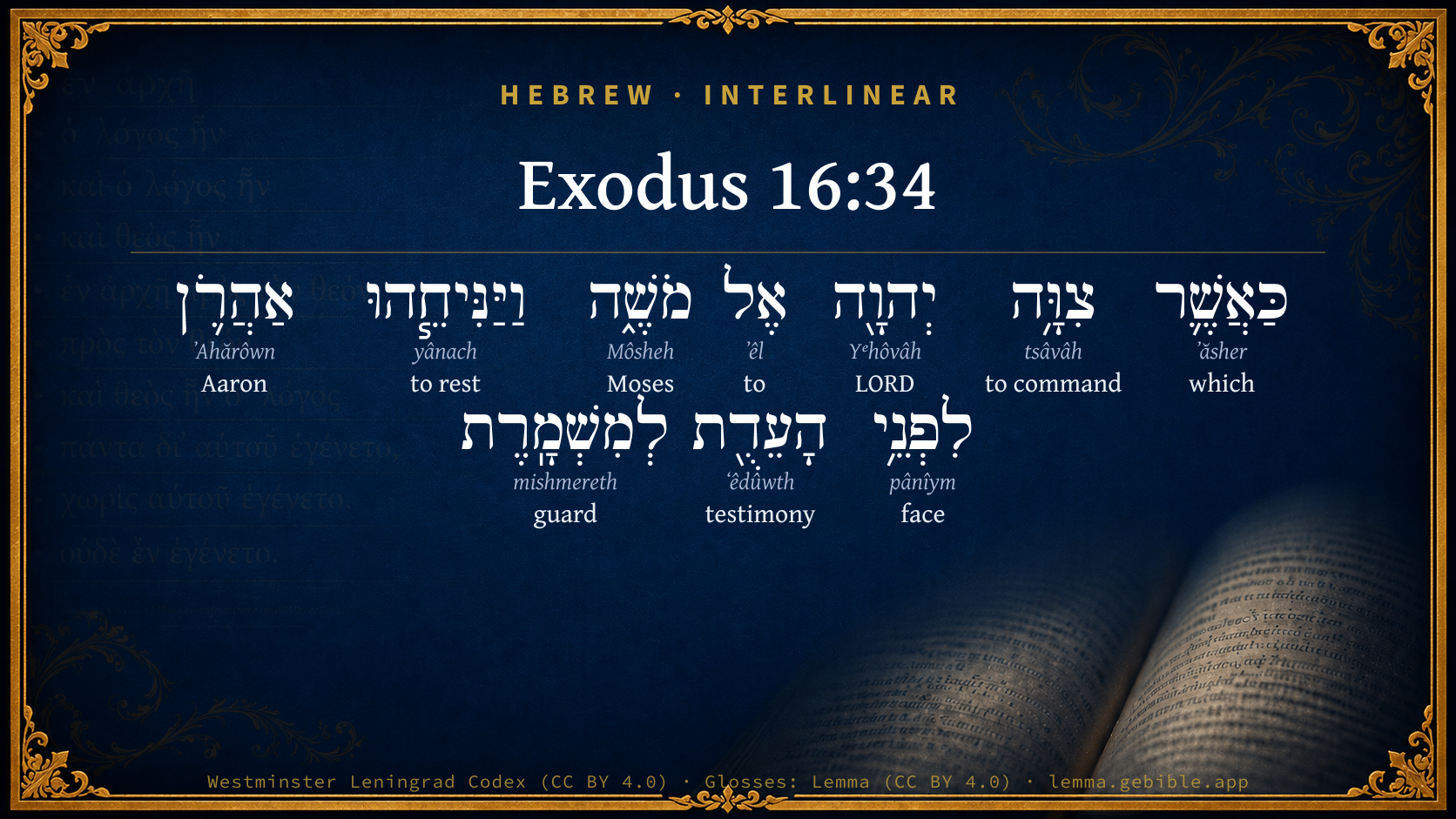
Hebrew (Westminster Leningrad Codex) Exodus 16:34 appears in the Hebrew Old Testament. The text above is from the Westminster Leningrad Codex. Each word links to its Strong’s number, a concise gloss, and parsing drawn from the Open Scriptures Hebrew Bible morphology. Click any word for its full Brown-Driver-Briggs (BDB) entry.
Download image
Cite this verse

Exodus 16:34 (World English Bible). Public Domain. Lemma interlinear Bible study tool, https://lemma.gebible.app/v/exodus/16/34.

Show BibTeX & RIS
BibTeX
RIS
English Translation
As Yahweh commanded Moses, so Aaron laid it up before the Testimony, to be kept.
World English Bible · Public Domain
Highlights
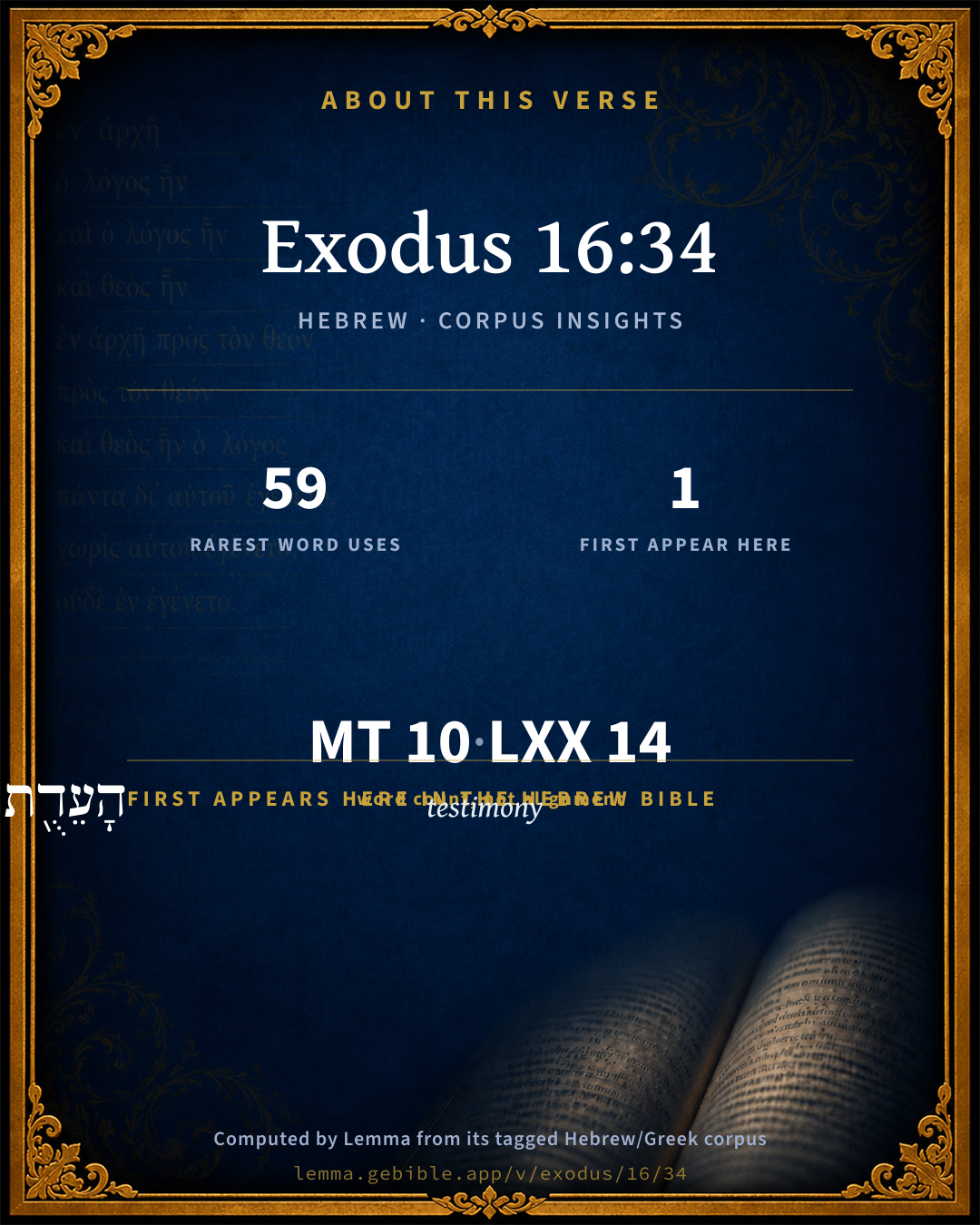
  • 1 first appearance in the Hebrew Bible
Full analysis ↓
Download a study sheet

One document with this verse’s original text, its word-by-word gloss line, the meaning frame, cross-references with their text, attributed commentary, and full source and license credits — printable, and it pastes into notes with its structure intact.

This verse Autodidact and up

Study sheet (.html) Plain text (.txt)

A passage Seminary Student

Up to 50 verses in one chapter. A passage sheet keeps up to 6 commentary sources and 12 cross-references per verse, in the order this page ranks them, and says so on the sheet whenever that leaves anything out. Ask for a single verse and you get the Autodidact verse sheet above.

Everything on this page stays free to read, with no account — the sheet is a download of what is already on screen, not access to it.

Want to remove ads? Support Godless Engineer
Compare translations 3

The same verse in 3 English versions, stacked beneath the original-language interlinear above. Click any original word for its lexicon entry.

Each is an independent rendering of the whole verse — the interlinear is not word-aligned to these translations.

Highlighted words mark where these versions differ — a whole-verse word diff, not a word-by-word alignment.

  • World English Bible Public Domain
    As Yahweh commanded Moses, so Aaron laid it up before the Testimony, to be kept.
  • King James Version Public Domain
    As the LORD commanded Moses, so Aaron laid it up before the Testimony, to be kept.
  • unfoldingWord Literal Text CC BY-SA 4.0
    Just as Yahweh commanded to Moses, so Aaron put it before the face of the Covenant, for preservation.

unfoldingWord Literal Text — © unfoldingWord, licensed CC BY-SA 4.0. Word-aligned USFM3 via Door43 (git.door43.org/unfoldingWord/en_ult).

Versions to compare (up to 4)

3 of 4 selected

Show all 18 translations

Every available English version of this verse, each an independent rendering of the whole verse.

  • World English Bible Public Domain
    As Yahweh commanded Moses, so Aaron laid it up before the Testimony, to be kept.
  • Berean Standard Bible Public Domain
    And Aaron placed it in front of the Testimony, to be preserved just as the LORD had commanded Moses.
  • Majority Standard Bible Public Domain
    And Aaron placed it in front of the Testimony, to be preserved just as the LORD had commanded Moses.
  • King James Version Public Domain
    As the LORD commanded Moses, so Aaron laid it up before the Testimony, to be kept.
  • American Standard Version (1901) Public Domain
    As Jehovah commanded Moses, so Aaron laid it up before the Testimony, to be kept.
  • Revised Version (1885) Public Domain
    As the LORD commanded Moses, so Aaron laid it up before the Testimony, to be kept.
  • Geneva Bible (1599) Public Domain
    As the Lord commanded Moses, so Aaron laied it vp before the Testimonie to be kept.
  • Douay-Rheims (1899) Public Domain
    As the Lord commanded Moses. And Aaron put it in the tabernacle to be kept.
  • Young's Literal Translation Public Domain
    as Jehovah hath given commandment unto Moses, so doth Aaron let it rest before the Testimony, for a charge.
  • Literal Standard Version CC BY-SA 4.0
    as YHWH has given command to Moses, so Aaron lets it rest before the Testimony, for a charge.
  • Unlocked Literal Bible CC BY-SA 4.0
    As Yahweh commanded Moses, Aaron stored it beside the covenant decrees in the ark.
  • unfoldingWord Literal Text CC BY-SA 4.0
    Just as Yahweh commanded to Moses, so Aaron put it before the face of the Covenant, for preservation.
  • Darby Bible Public Domain
    As Jehovah had commanded Moses, so Aaron deposited it before the Testimony, to be kept.
  • World Messianic Bible Public Domain
    As the LORD commanded Moses, so Aaron laid it up before the Testimony, to be kept.
  • Webster's Bible Public Domain
    As the LORD commanded Moses, so Aaron laid it up before the Testimony, to be kept.
  • Free Bible Version CC BY-SA 4.0
    Aaron did so and placed the jar in front of the Testimony, to be preserved just as the Lord had ordered Moses.
  • Bible in Basic English Public Domain
    So Aaron put it away in front of the holy chest to be kept, as the Lord gave orders to Moses.
  • JPS Tanakh (1917) Public Domain
    As the LORD commanded Moses, so Aaron laid it up before the Testimony, to be kept.

Literal Standard Version (2020), Covenant Press — licensed CC BY-SA 4.0. Text via the HelloAO Bible API (eBible.org). Unlocked Literal Bible (unfoldingWord) — licensed CC BY-SA 4.0. Text via the HelloAO Bible API (eBible.org). unfoldingWord Literal Text — © unfoldingWord, licensed CC BY-SA 4.0. Word-aligned USFM3 via Door43 (git.door43.org/unfoldingWord/en_ult). Free Bible Version, Dr. Jonathan Gallagher — licensed CC BY-SA 4.0. Text via the HelloAO Bible API (eBible.org).

Word by word

More ways to search: Search by grammar → Find every occurrence → Compare this word →

Practice this passage: Drill this verse → Learn its vocabulary →

הָעֵדֻ֖ת
ʻêdûwth
H5715
“the · testimony”
Particle, Definite Article + Noun, Common, Feminine, Singular, Absolute
Part of Speech
Particle + Noun
Type
Common
Gender
Feminine
Number
Singular
State
Absolute
Full BDB Definition

Origin: from H5707

TWOT: 1576f

testimony
  1. כַּאֲשֶׁ֛ר ʼăsher H834 “like/as · which” Preposition + Particle, Relative
  2. צִוָּ֥ה tsâvâh H6680 “to command” Verb, Piel, Perfect, 3rd Person, Masculine, Singular
  3. יְהוָ֖ה Yᵉhôvâh H3068 “LORD” Noun, Proper
  4. אֶל ʼêl H413 “to” Preposition
  5. מֹשֶׁ֑ה Môsheh H4872 “Moses” Noun, Proper
  6. וַיַּנִּיחֵ֧הוּ yânach H3240 “and · to rest · him” Conjunction + Verb, Hiphil, Sequential Imperfect, 3rd Person, Masculine, Singular + Suffix, Personal, 3rd Person, Masculine, Singular
  7. אַהֲרֹ֛ן ʼAhărôwn H175 “Aaron” Noun, Proper
  8. לִפְנֵ֥י pânîym H6440 “to/for · face(s) of” Preposition + Noun, Common, Both, Plural, Construct
  9. לְמִשְׁמָֽרֶת mishmereth H4931 “to/for · guard” Preposition + Noun, Common, Feminine, Singular, Absolute

About this verse

These counts appear in no published source. They are computed here, from the morphology-tagged text and Lemma’s own curated glosses. What Lemma adds →

10
words
10
distinct lemmas
Pentateuch
section

First appearance in Scripture

This word makes its first canonical appearance in the Hebrew Bible here:

  • הָעֵדֻ֖ת testimony H5715

Shared distinctive vocabulary

הָעֵדֻ֖ת testimony H5715 occurs in 57 verses of the Hebrew Bible. Also found in:

Grammatical profile

  • 2 verbs
  • 6 nouns
  • 1 preposition
  • 1 particle

Verb forms

  • צִוָּ֥ה Piel · Perfect
  • וַיַּנִּיחֵ֧הוּ Hiphil · Sequential Imperfect

Hebrew & Septuagint length

In English translation the verse runs 15 words from the Hebrew and 16 from the Septuagint (LXX English) — closely comparable.

A rough comparison of the two English renderings, which tokenize alike — not a word-level alignment.

Word counts can differ between the Hebrew and the Greek without any difference in meaning — e.g. the Hebrew direct-object marker אֵת has no separate Greek word, and Greek often adds the article ὁ.

In the original languages it is 10 Hebrew tokens and 14 Greek tokens — but the two are counted differently (Hebrew bundles its prefixes and suffixes into one token; the Greek is in lemma form), so that isn’t a like-for-like length.

Cross-references

13

Topical passages linked to Exodus 16:34 in the Treasury of Scripture Knowledge — connected by theme and wording, ordered by reader-vote popularity; previews shown in the World English Bible.

  • Exodus 25:16 You shall put the testimony which I shall give you into the ark.
  • Exodus 25:21 You shall put the mercy seat on top of the ark, and in the ark you shall put the testimony that I will give you.
  • Exodus 27:21 In the tent of meeting, outside the veil which is before the testimony, Aaron and his sons shall keep it in order from evening to morning before Yahweh: it shall be a statute forever throughout their generations on the behalf of the children of Israel.
  • Exodus 40:20 He took and put the testimony into the ark, and set the poles on the ark, and put the mercy seat above on the ark.
  • Numbers 17:10 Yahweh said to Moses, Put back the rod of Aaron before the testimony, to be kept for a token against the children of rebellion; that you may make an end of their murmurings against me, that they not die.
  • Exodus 30:6 You shall put it before the veil that is by the ark of the testimony, before the mercy seat that is over the testimony, where I will meet with you.
  • Exodus 30:36 and you shall beat some of it very small, and put some of it before the testimony in the tent of meeting, where I will meet with you. It shall be to you most holy.
  • Exodus 31:18 He gave to Moses, when he finished speaking with him on Mount Sinai, the two tablets of the testimony, stone tablets, written with God's finger.
  • Deuteronomy 10:5 I turned and came down from the mountain, and put the tables in the ark which I had made; and there they are as Yahweh commanded me.
  • Exodus 38:21 This is the amount of material used for the tent, even the Tent of the Testimony, as they were counted, according to the commandment of Moses, for the service of the Levites, by the hand of Ithamar, the son of Aaron the priest.
  • Numbers 1:50 but appoint the Levites over the Tabernacle of the Testimony, and over all its furnishings, and over all that belongs to it. They shall carry the tabernacle, and all its furnishings; and they shall take care of it, and shall encamp around it.
  • Numbers 1:53 But the Levites shall encamp around the Tabernacle of the Testimony, that there may be no wrath on the congregation of the children of Israel: and the Levites shall be responsible for the Tabernacle of the Testimony."
  • 1 Kings 8:9 There was nothing in the ark save the two tables of stone which Moses put there at Horeb, when Yahweh made a covenant with the children of Israel, when they came out of the land of Egypt.

Cross-references courtesy of OpenBible.info (CC BY 4.0).

Hebrew and Greek witnesses Masoretic Hebrew ↔ Greek Septuagint

The same verse in the two great witnesses to the Old Testament, shown verse-for-verse.

These are two independent witnesses, not word-aligned to each other, and the Septuagint is shown in lemma (dictionary) form.

Hebrew Exodus 16:34 Masoretic · Westminster Leningrad Codex

כַּאֲשֶׁ֛ר צִוָּ֥ה יְהוָ֖ה אֶל מֹשֶׁ֑ה וַיַּנִּיחֵ֧הוּ אַהֲרֹ֛ן לִפְנֵ֥י הָעֵדֻ֖ת לְמִשְׁמָֽרֶת

As Yahweh commanded Moses, so Aaron laid it up before the Testimony, to be kept.

World English Bible · Public Domain

Greek LXX Exodus 16:34 Septuagint · lemma form

ὅς τρόπος συντάσσω κύριος ὁ μωυσῆς καί ἀποτίθημι ααρων ἐναντίον ὁ μαρτύριον εἰς διατήρησις

as the Lord commanded Moses: and Aaron laid it up before the testimony to be kept.

LXX2012 (modern English Septuagint) · Public Domain

Hebrew: Westminster Leningrad Codex (CC BY 4.0). Greek: Septuagint (public domain); English from LXX2012 (modern English Septuagint) (Public Domain). How the Septuagint differs from the Hebrew →

Targum (Aramaic paraphrase)

2

The Targum is the ancient Jewish Aramaic paraphrase of the Hebrew Scriptures — an interpretive translation, not the Hebrew text itself. Onkelos (literal) and Pseudo-Jonathan (expansive) render the Torah, and Jonathan the Prophets. Coverage is partial: where no permissively-licensed English translation exists for a verse, only the Aramaic is shown. This is verse-level text, not a word-by-word alignment to the Hebrew.

  1. Targum Onkelos Torah (Genesis–Deuteronomy)
    כְּמָא דִי פַקִיד יְיָ לְמשֶׁה וְאַצְנְעֵהּ אַהֲרֹן קֳדָם סַהֲדוּתָא לְמַטְרָא:

    (no public-domain English translation for this verse)

    Targum Onkelos — Aramaic: “Onkelos Genesis” (public domain); “Onkelos Exodus” (public domain); “Onkelos Leviticus” (public domain); “Onkelos Numbers” (public domain); “Onkelos Deuteronomy” (public domain). English: “Sefaria Community Translation” (CC0 1.0 (public-domain dedication)); “J.W. Etheridge. The Targums of Onkelos and Jonathan Ben Uzziel on the Pentateuch. London: Longmans, Green, 1862” (public domain). Text via Sefaria.

  2. Targum Pseudo-Jonathan Torah (Genesis–Deuteronomy)
    הֵיכְמָא דְּפַקֵּיד יְיָ יַת משֶׁה וְאַצְנְעֵיהּ אַהֲרן קֳדָם סַהֲדוּתָא לְמַטְרָא

    As the Lord commanded Mosheh, so did Aharon, lay it up before the testimony to be kept.

    Targum Pseudo-Jonathan — Aramaic: “Targum Jonathan on Genesis” (public domain); “Targum Jonathan on Exodus” (public domain); “Targum Jonathan on Leviticus” (public domain); “Targum Jonathan on Numbers” (public domain); “Targum Jonathan on Deuteronomy” (public domain). English: “The Targum of Jonathan ben Uzziel, trans. J. W. Etheridge, London, 1862” (public domain). Text via Sefaria.

Commentary

Notes on Exodus 16:34 from classic Christian and Jewish commentators (each source and its license shown beneath its notes). The classic Christian expositions comment on the surrounding passage and are grouped to its opening verse, so a note may address several verses; the Jewish commentaries on the Tanakh (Rashi and others) are per-verse, so they appear only where the commentator wrote on this verse.

Lemma curates 59 commentaries, every one of them public domain or Creative Commons licensed, each selected and text-cleaned for this edition rather than reprinted as found. About our sources →

Trapp's Complete Commentary

John Trapp

Exo 16:34 As the LORD commanded Moses, so Aaron laid it up before the Testimony, to be kept.

Ver. 34. To be kept.] For the use of succeeding ages in the most holy places. So Christ, glorified in his humanity, abides for ever. {Heb 7:24}

John Trapp, A Commentary or Exposition upon All the Books of the Old and New Testament (1647–1656) — public domain. Text from a community e-Sword module.

Geneva Bible (1599)

Geneva Bible translators

That is, the Ark of the covenant, to wit, after that the Ark was made.

Geneva Bible (1599) marginal notes — public domain. Text via Bolls.life.

Adam Clarke's Commentary

Verse 34. Laid it up before the testimony] The עדות eduth or testimony belonged properly to the tabernacle, but that was not yet built. Some are of opinion that the tabernacle, built under the direction of Moses, was only a renewal of one that had existed in the patriarchal times. See Clarke on Ex 16:9. The word signifies reference to something beyond itself; thus the tabernacle, the manna, the tables of stone, Aaron's rod, &c., all bore reference and testimony to that spiritual good which was yet to come, viz., JESUS CHRIST and his salvation.

Adam Clarke's Commentary on the Bible (1810–1826) — public domain. Text from a community e-Sword/MySword module.

The Cambridge Bible for Schools and Colleges

gen. ed. J. J. S. Perowne

34. before the Testimony] i.e. before the Ark, which contained the ‘Testimony,’ P’s standing expression for the Decalogue (see on Exo_25:16): cf. Exo_30:36, Num_17:4; Num_17:10. Cf. Heb_9:4.

The Cambridge Bible for Schools and Colleges (gen. ed. J. J. S. Perowne; Cambridge University Press, 1878–1918) — public domain. Text from a community e-Sword module.

Albert Barnes' Notes on the Bible

The Testimony - See the marginal references.

Albert Barnes' Notes on the Bible (1834–1885) — public domain. Text from a community e-Sword/MySword module.

Matthew Poole's English Annotations

i.e. Before the ark, which is called the ark of the testimony, Exo 25:16; and here, by way of abbreviation,

the testimony, or witness, because in it were the tables of the covenant, or the law of God, which was a testimony of God’s authority and will, and of man’s subjection and duty, or of the covenant made between God and man. See Deu 10:5; 31:26.

Quest. How could this be laid up before the ark, when the ark was not yet built?

Answ. This text only tells us that Aaron did lay it up, but it doth not determine the time, nor affirm that it was done at this instant, but rather intimates the contrary, and that it was done afterwards when the testimony, i.e. the ark, was built. As the next verse also speaks of what was done in the following forty years.

Matthew Poole's English Annotations on the Holy Bible (1683–1685) — public domain. Text from a community e-Sword/MySword module.

Whedon's Commentary on the Bible

Daniel D. Whedon

34. Before the Testimony — The two stone tablets of the law, afterwards particularly described, (Exo_34:1, etc.,) which were kept in the sacred ark, covered by the mercy-seat. This law was called a Testimony against the sins of Israel.

Daniel D. Whedon (gen. ed.), Commentary on the Old and New Testaments (1874–1909) — public domain. Text from a community e-Sword module.

The Pulpit Commentary

Aaron laid it up before the testimony. "The testimony" is not the Ark of the Covenant, which is never so called, but the Covenant itself, or the two tables of stone engraved by the finger of God, which are termed "the testimony" in Exo_25:16-21 Exo_40:20; etc. The pot of manna was laid up inside the ark (Heb_9:4) in front of the two tables.

The Pulpit Commentary (1880–1919), ed. H.D.M. Spence-Jones & Joseph S. Exell — public domain. Text from a community e-Sword module.

John Wesley's Explanatory Notes

An omer of this manna was laid up in a golden pot as we are told, Heb. ix, 4, and kept before the testimony, or the ark, when it was afterwards made, The preservation of this manna from waste and corruption, was a standing miracle; and therefore the more proper memorial of this miraculous food. The manna is called spiritual meat, 1 Cor. x, 3, because it was typical of spiritual blessings. Christ himself is the true manna, the bread of life, of which that was a figure, John vi, 49-51. The word of God is the manna by which our souls are nourished, Matt. iv, 4. The comforts of the Spirit are hidden manna, Rev. ii, 17. These comforts from heaven as the manna did, are the support of the divine life in the soul while we are in the wilderness of this world: it is food for Israelites, for those only that follow the pillar of cloud and fire: it is to be gathered; Christ in the word is to be applied to the soul, and the means of grace used: we must every one of us gather for ourselves. There was manna enough for all, enough for each, and none had too much; so in Christ there is a compleat sufficiency, and no superfluity. But they that did eat manna hungered again, died at last, and with many of them God was not well pleased: whereas they that feed on Christ by faith shall never hunger, and shall die no more, and with them God will be forever well pleased. The Lord evermore give us this bread!

John Wesley, Explanatory Notes Upon the Whole Bible (1754–1765) — public domain. Text via the GEBible commentary corpus.

Lesson kit

Teaching starters — assembled from the data on this page, not authored interpretation. Every prompt links to the verse data it draws on. Edit before teaching.

Exodus, in the Pentateuch, opens this verse with 10 words (10 distinct Hebrew lemmas). Its most distinctive word is ʻêdûwth (“testimony”). A historical commentator’s framing appears above. Read the whole chapter for the surrounding context.

Discussion questions

  1. What does “testimony” (ʻêdûwth) contribute to the verse as a whole?
  2. The word “testimony” first appears here in Scripture. What is being introduced at this debut?
  3. Exodus 25:16 shares the word «testimony» with this verse. How do the two illuminate each other?
  4. The translations on this page render this verse differently — a whole-verse word diff, not a word-by-word alignment. What might account for the different wordings?
  5. The verb «צִוָּ֥ה» is Piel Perfect. How does its form color the action?
  6. Reading how Trapp's Complete Commentary and Geneva Bible (1599) read this verse, where do the two commentators agree and where do they part?

Things to notice

Reading settings

Reading text

Shown beneath each verse's original-language words.

Old Testament
Old Testament edition

Read the OT as the Masoretic Hebrew (MT) or the Greek Septuagint (LXX).

English shown for the Greek Septuagint (in the Hebrew ↔ Greek comparison).

Comparing translations? Open the Compare panel on any verse page to stack up to four side by side.