
Deuteronomy 18:20

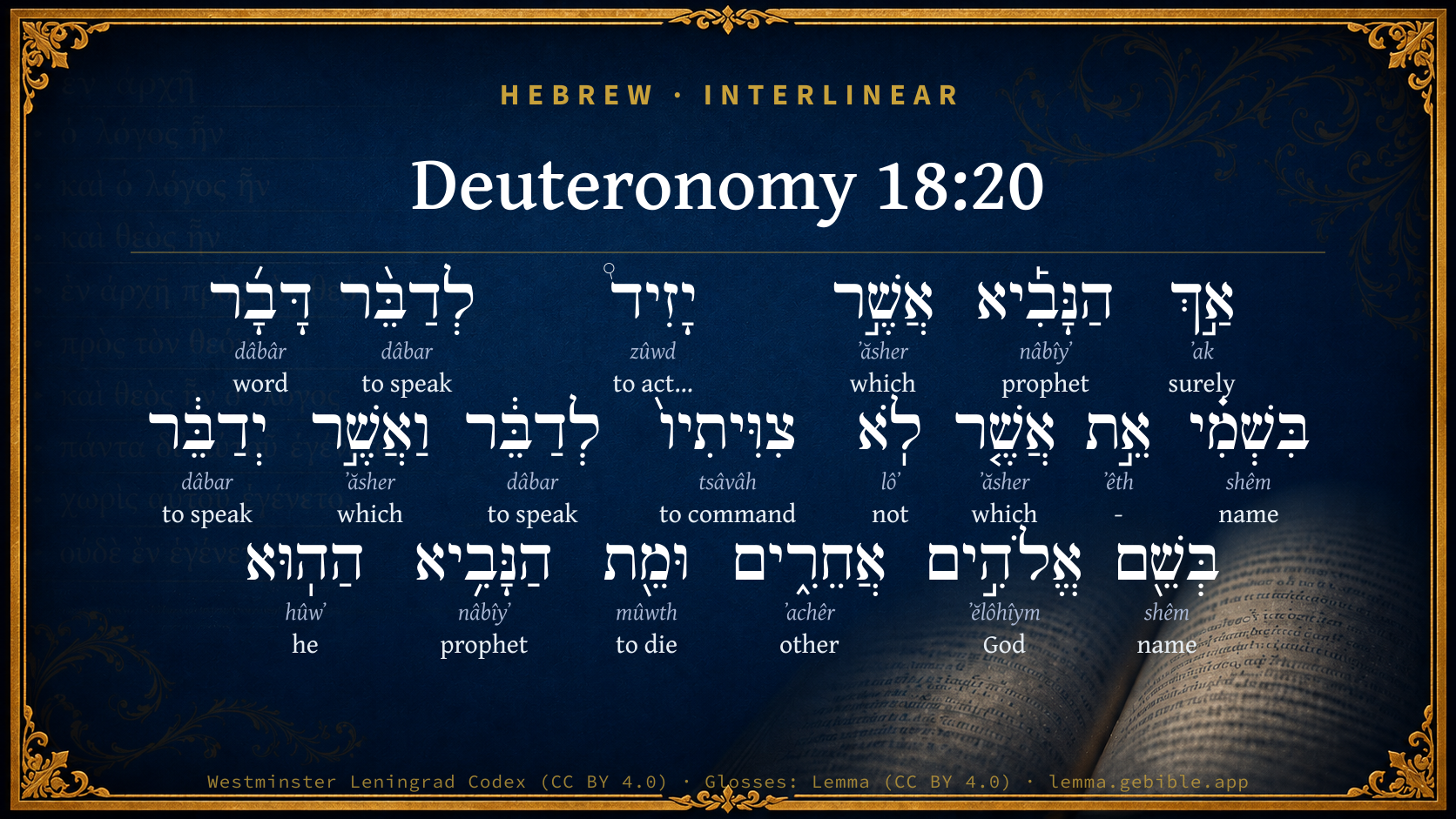
Hebrew (Westminster Leningrad Codex) Deuteronomy 18:20 appears in the Hebrew Old Testament. The text above is from the Westminster Leningrad Codex. Each word links to its Strong’s number, a concise gloss, and parsing drawn from the Open Scriptures Hebrew Bible morphology. Click any word for its full Brown-Driver-Briggs (BDB) entry.
Download image
Cite this verse

Deuteronomy 18:20 (World English Bible). Public Domain. Lemma interlinear Bible study tool, https://lemma.gebible.app/v/deuteronomy/18/20.

Show BibTeX & RIS
BibTeX
RIS
English Translation
But the prophet, who shall speak a word presumptuously in my name, which I have not commanded him to speak, or who shall speak in the name of other gods, that same prophet shall die.
World English Bible · Public Domain
Download a study sheet

One document with this verse’s original text, its word-by-word gloss line, the meaning frame, cross-references with their text, attributed commentary, and full source and license credits — printable, and it pastes into notes with its structure intact.

This verse Autodidact and up

Study sheet (.html) Plain text (.txt)

A passage Seminary Student

Up to 50 verses in one chapter. A passage sheet keeps up to 6 commentary sources and 12 cross-references per verse, in the order this page ranks them, and says so on the sheet whenever that leaves anything out. Ask for a single verse and you get the Autodidact verse sheet above.

Everything on this page stays free to read, with no account — the sheet is a download of what is already on screen, not access to it.

Want to remove ads? Support Godless Engineer
Compare translations 3

The same verse in 3 English versions, stacked beneath the original-language interlinear above. Click any original word for its lexicon entry.

Each is an independent rendering of the whole verse — the interlinear is not word-aligned to these translations.

Highlighted words mark where these versions differ — a whole-verse word diff, not a word-by-word alignment.

  • World English Bible Public Domain
    But the prophet, who shall speak a word presumptuously in my name, which I have not commanded him to speak, or who shall speak in the name of other gods, that same prophet shall die.
  • King James Version Public Domain
    But the prophet, which shall presume to speak a word in my name, which I have not commanded him to speak, or that shall speak in the name of other gods, even that prophet shall die.
  • unfoldingWord Literal Text CC BY-SA 4.0
    But the prophet who presumes to speak a word in my name, which I have not commanded him to speak or who speaks in the name of other gods, then that prophet shall die.’

unfoldingWord Literal Text — © unfoldingWord, licensed CC BY-SA 4.0. Word-aligned USFM3 via Door43 (git.door43.org/unfoldingWord/en_ult).

Versions to compare (up to 4)

3 of 4 selected

Show all 18 translations

Every available English version of this verse, each an independent rendering of the whole verse.

  • World English Bible Public Domain
    But the prophet, who shall speak a word presumptuously in my name, which I have not commanded him to speak, or who shall speak in the name of other gods, that same prophet shall die.
  • Berean Standard Bible Public Domain
    But if any prophet dares to speak a message in My name that I have not commanded him to speak, or to speak in the name of other gods, that prophet must be put to death.”
  • Majority Standard Bible Public Domain
    But if any prophet dares to speak a message in My name that I have not commanded him to speak, or to speak in the name of other gods, that prophet must be put to death.”
  • King James Version Public Domain
    But the prophet, which shall presume to speak a word in my name, which I have not commanded him to speak, or that shall speak in the name of other gods, even that prophet shall die.
  • American Standard Version (1901) Public Domain
    But the prophet, that shall speak a word presumptuously in my name, which I have not commanded him to speak, or that shall speak in the name of other gods, that same prophet shall die.
  • Revised Version (1885) Public Domain
    But the prophet, which shall speak a word presumptuously in my name, which I have not commanded him to speak, or that shall speak in the name of other gods, that same prophet shall die.
  • Geneva Bible (1599) Public Domain
    But the prophet that shall presume to speake a worde in my name, which I haue not commanded him to speake, or that speaketh in the name of other gods, euen the same prophet shall die.
  • Douay-Rheims (1899) Public Domain
    But the prophet, who being corrupted with pride, shall speak in my name things that I did not command him to say, or in the name of strange gods, shall be slain.
  • Young's Literal Translation Public Domain
    `Only, the prophet who presumeth to speak a word in My name -- that which I have not commanded him to speak -- and who speaketh in the name of other gods -- even that prophet hath died.
  • Literal Standard Version CC BY-SA 4.0
    Only, the prophet who presumes to speak a word in My Name, which I have not commanded him to speak, and who speaks in the name of other gods, indeed, that prophet has died.
  • Unlocked Literal Bible CC BY-SA 4.0
    But the prophet who speaks a word arrogantly in my name, a word that I have not commanded him to speak, or who speaks in the name of other gods, that very prophet must die.'
  • unfoldingWord Literal Text CC BY-SA 4.0
    But the prophet who presumes to speak a word in my name, which I have not commanded him to speak or who speaks in the name of other gods, then that prophet shall die.’
  • Darby Bible Public Domain
    But the prophet who shall presume to speak a word in my name that I have not commanded him to speak, or that shall speak in the name of other gods, that prophet shall die.
  • World Messianic Bible Public Domain
    But the prophet who speaks a word presumptuously in my name, which I have not commanded him to speak, or who speaks in the name of other gods, that same prophet shall die.”
  • Webster's Bible Public Domain
    But the prophet, who shall presume to speak a word in my name, which I have not commanded him to speak, or that shall speak in the name of other gods, even that prophet shall die.
  • Free Bible Version CC BY-SA 4.0
    However, if any prophet claims to be delivering a message in my name that I have not ordered him to give, or speaks in the name of other gods, that prophet must be executed.”
  • Bible in Basic English Public Domain
    But the prophet who takes it on himself to say words in my name which I have not given him orders to say, or who says anything in the name of other gods, will come to his death.
  • JPS Tanakh (1917) Public Domain
    But the prophet, that shall speak a word presumptuously in My name, which I have not commanded him to speak, or that shall speak in the name of other gods, that same prophet shall die.'

Literal Standard Version (2020), Covenant Press — licensed CC BY-SA 4.0. Text via the HelloAO Bible API (eBible.org). Unlocked Literal Bible (unfoldingWord) — licensed CC BY-SA 4.0. Text via the HelloAO Bible API (eBible.org). unfoldingWord Literal Text — © unfoldingWord, licensed CC BY-SA 4.0. Word-aligned USFM3 via Door43 (git.door43.org/unfoldingWord/en_ult). Free Bible Version, Dr. Jonathan Gallagher — licensed CC BY-SA 4.0. Text via the HelloAO Bible API (eBible.org).

Word by word

More ways to search: Search by grammar → Find every occurrence → Compare this word →

Practice this passage: Drill this verse → Learn its vocabulary →

יָזִיד֩
zûwd
H2102
“to act presumptuously”
Verb, Hiphil, Imperfect, 3rd Person, Masculine, Singular
Part of Speech
Verb
Stem
Hiphil
Form
Imperfect
Person
3rd Person
Gender
Masculine
Number
Singular
Full BDB Definition

Origin: a primitive root

TWOT: 547

to boil, boil up, seethe, act proudly, act presumptuously, act rebelliously, be presumptuous, be arrogant, be rebelliously proud - (Qal) - to act presumptuously - to deal arrogantly (with 'al') - to defy proudly (with 'el') - (Hiphil) - to boil, seethe, act proudly - to act presumptuously, act insolently
  1. אַ֣ךְ ʼak H389 “surely” Particle, Accusative
  2. הַנָּבִ֡יא nâbîyʼ H5030 “the · prophet” Particle, Definite Article + Noun, Common, Masculine, Singular, Absolute
  3. אֲשֶׁ֣ר ʼăsher H834 “which” Particle, Relative
  4. לְדַבֵּ֨ר dâbar H1696 “to speak” Preposition + Verb, Piel, Infinitive Construct
  5. דָּבָ֜ר dâbâr H1697 “word” Noun, Common, Masculine, Singular, Absolute
  6. בִּשְׁמִ֗י shêm H8034 “in/at · name · my” Preposition + Noun, Common, Masculine, Singular, Construct + Suffix, Personal, 1st Person, Common, Singular
  7. אֵ֣ת ʼêth H853 “-” Particle, Direct Object
  8. אֲשֶׁ֤ר ʼăsher H834 “which” Particle, Relative
  9. לֹֽא lôʼ H3808 “not” Particle, Negative
  10. צִוִּיתִיו֙ tsâvâh H6680 “to command · him” Verb, Piel, Perfect, 1st Person, Common, Singular + Suffix, Personal, 3rd Person, Masculine, Singular
  11. לְדַבֵּ֔ר dâbar H1696 “to speak” Preposition + Verb, Piel, Infinitive Construct
  12. וַאֲשֶׁ֣ר ʼăsher H834 “and · which” Conjunction + Particle, Relative
  13. יְדַבֵּ֔ר dâbar H1696 “to speak” Verb, Piel, Imperfect, 3rd Person, Masculine, Singular
  14. בְּשֵׁ֖ם shêm H8034 “in/at · name of” Preposition + Noun, Common, Masculine, Singular, Construct
  15. אֱלֹהִ֣ים ʼĕlôhîym H430 “God(s)” Noun, Common, Masculine, Plural, Absolute
  16. אֲחֵרִ֑ים ʼachêr H312 “other” Adjective, Adjective, Masculine, Plural, Absolute
  17. וּמֵ֖ת mûwth H4191 “and · to die” Conjunction + Verb, Qal, Sequential Perfect, 3rd Person, Masculine, Singular
  18. הַנָּבִ֥יא nâbîyʼ H5030 “the · prophet” Particle, Definite Article + Noun, Common, Masculine, Singular, Absolute
  19. הַהֽוּא hûwʼ H1931 “the · he” Particle, Definite Article + Pronoun, Personal, 3rd Person, Masculine, Singular

About this verse

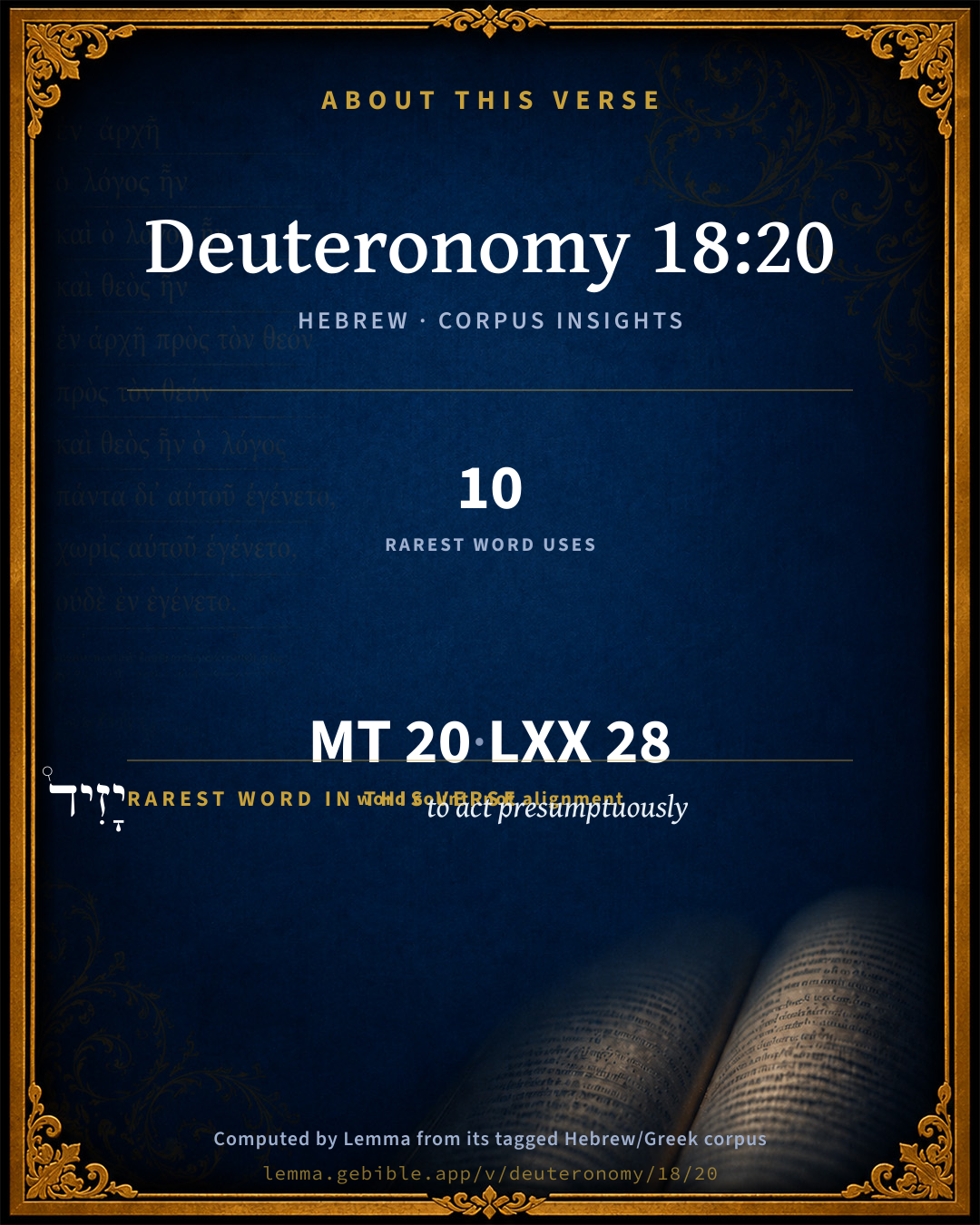
These counts appear in no published source. They are computed here, from the morphology-tagged text and Lemma’s own curated glosses. What Lemma adds →

20
words
14
distinct lemmas
Pentateuch
section

Notable vocabulary

The rarest word here is יָזִיד֩ to act presumptuously H2102 — appearing just 10 times in the whole Hebrew Bible.

Shared distinctive vocabulary

יָזִיד֩ to act presumptuously H2102 occurs in 10 verses of the Hebrew Bible. Also found in:

Grammatical profile

  • 6 verbs
  • 6 nouns
  • 1 adjective
  • 1 pronoun
  • 6 particles

Verb forms

  • יָזִיד֩ Hiphil · Imperfect
  • לְדַבֵּ֨ר Piel · Infinitive Construct
  • צִוִּיתִיו֙ Piel · Perfect
  • לְדַבֵּ֔ר Piel · Infinitive Construct
  • יְדַבֵּ֔ר Piel · Imperfect
  • וּמֵ֖ת Qal · Sequential Perfect

Repetition

Words recur within this verse — often emphatic in Hebrew:

  • לְדַבֵּ֨ר to speak H1696 ×3
  • הַנָּבִ֡יא prophet H5030 ×2
  • בִּשְׁמִ֗י name H8034 ×2
  • אֲשֶׁ֣ר which H834 ×3

Hebrew & Septuagint length

In English translation the verse runs 35 words from the Hebrew and 34 from the Septuagint (LXX English) — closely comparable.

A rough comparison of the two English renderings, which tokenize alike — not a word-level alignment.

Word counts can differ between the Hebrew and the Greek without any difference in meaning — e.g. the Hebrew direct-object marker אֵת has no separate Greek word, and Greek often adds the article ὁ.

In the original languages it is 20 Hebrew tokens and 28 Greek tokens — but the two are counted differently (Hebrew bundles its prefixes and suffixes into one token; the Greek is in lemma form), so that isn’t a like-for-like length.

Cross-references

15

Topical passages linked to Deuteronomy 18:20 in the Treasury of Scripture Knowledge — connected by theme and wording, ordered by reader-vote popularity; previews shown in the World English Bible.

  • Deuteronomy 13:1–5 If there arise in the midst of you a prophet, or a dreamer of dreams, and he give you a sign or a wonder,
  • Jeremiah 27:15 For I have not sent them, says Yahweh, but they prophesy falsely in my name; that I may drive you out, and that you may perish, you, and the prophets who prophesy to you.
  • Jeremiah 23:13–15 I have seen folly in the prophets of Samaria; they prophesied by Baal, and caused my people Israel to err.
  • Jeremiah 23:31 Behold, I am against the prophets, says Yahweh, who use their tongues, and say, He says.
  • Jeremiah 28:15–17 Then said the prophet Jeremiah to Hananiah the prophet, Hear now, Hananiah: Yahweh has not sent you; but you make this people to trust in a lie.
  • Ezekiel 13:6 They have seen falsehood and lying divination, who say, Yahweh says; but Yahweh has not sent them: and they have made men to hope that the word would be confirmed.
  • Zechariah 13:3 It will happen that, when anyone still prophesies, then his father and his mother who bore him will tell him, 'You must die, because you speak lies in the name of Yahweh;' and his father and his mother who bore him will stab him when he prophesies.
  • Matthew 7:15 "Beware of false prophets, who come to you in sheep's clothing, but inwardly are ravening wolves.
  • Jeremiah 14:14–15 Then Yahweh said to me, The prophets prophesy lies in my name; I didn't send them, neither have I commanded them, neither spoke I to them: they prophesy to you a lying vision, and divination, and a thing of nothing, and the deceit of their own heart.
  • 1 Kings 18:27 It happened at noon, that Elijah mocked them, and said, Cry aloud; for he is a god: either he is musing, or he is gone aside, or he is on a journey, or peradventure he sleeps and must be awakened.
  • Jeremiah 2:8 The priests didn't say, Where is Yahweh? and those who handle the law didn't know me: the rulers also transgressed against me, and the prophets prophesied by Baal, and walked after things that do not profit.
  • 1 Kings 18:40 and Elijah said to them, Take the prophets of Baal; don't let one of them escape. They took them; and Elijah brought them down to the brook Kishon, and killed them there.
  • 2 Peter 2:12 But these, as unreasoning creatures, born natural animals to be taken and destroyed, speaking evil in matters about which they are ignorant, will in their destroying surely be destroyed,
  • Revelation 19:20 The beast was taken, and with him the false prophet who worked the signs in his sight, with which he deceived those who had received the mark of the beast and those who worshiped his image. These two were thrown alive into the lake of fire that burns with sulfur.
  • 1 Kings 18:19 Now therefore send, and gather to me all Israel to Mount Carmel, and the prophets of Baal four hundred fifty, and the prophets of the Asherah four hundred, who eat at Jezebel's table.

Cross-references courtesy of OpenBible.info (CC BY 4.0).

Hebrew and Greek witnesses Masoretic Hebrew ↔ Greek Septuagint

The same verse in the two great witnesses to the Old Testament, shown verse-for-verse.

These are two independent witnesses, not word-aligned to each other, and the Septuagint is shown in lemma (dictionary) form.

Hebrew Deuteronomy 18:20 Masoretic · Westminster Leningrad Codex

אַ֣ךְ הַנָּבִ֡יא אֲשֶׁ֣ר יָזִיד֩ לְדַבֵּ֨ר דָּבָ֜ר בִּשְׁמִ֗י אֵ֣ת אֲשֶׁ֤ר לֹֽא צִוִּיתִיו֙ לְדַבֵּ֔ר וַאֲשֶׁ֣ר יְדַבֵּ֔ר בְּשֵׁ֖ם אֱלֹהִ֣ים אֲחֵרִ֑ים וּמֵ֖ת הַנָּבִ֥יא הַהֽוּא

But the prophet, who shall speak a word presumptuously in my name, which I have not commanded him to speak, or who shall speak in the name of other gods, that same prophet shall die.

World English Bible · Public Domain

Greek LXX Deuteronomy 18:20 Septuagint · lemma form

πλήν ὁ προφήτης ὅς ἄν ἀσεβέω λαλέω ἐπί ὁ ὄνομα ἐγώ ῥῆμα ὅς οὐ προςτάσσω λαλέω καί ὅς ἄν λαλέω ἐπί ὄνομα θεός ἕτερος ἀποθνήσκω ὁ προφήτης ἐκεῖνος

But the prophet whoever shall impiously speak in my name a word which I have not commanded him to speak, and whoever shall speak in the name of other gods, that prophet shall die.

LXX2012 (modern English Septuagint) · Public Domain

Hebrew: Westminster Leningrad Codex (CC BY 4.0). Greek: Septuagint (public domain); English from LXX2012 (modern English Septuagint) (Public Domain). How the Septuagint differs from the Hebrew →

Targum (Aramaic paraphrase)

2

The Targum is the ancient Jewish Aramaic paraphrase of the Hebrew Scriptures — an interpretive translation, not the Hebrew text itself. Onkelos (literal) and Pseudo-Jonathan (expansive) render the Torah, and Jonathan the Prophets. Coverage is partial: where no permissively-licensed English translation exists for a verse, only the Aramaic is shown. This is verse-level text, not a word-by-word alignment to the Hebrew.

  1. Targum Onkelos Torah (Genesis–Deuteronomy)
    בְּרַם נְבִיָא דִי יַרְשַׁע לְמַלָלָא פִתְגָמָא בִּשְׁמִי יָת דִי לָא פַקֵדִתֵּה לְמַלָלָא וְדִי יְמַלֵיל בְּשׁוּם טַעֲוַת עַמְמַיָא וְיִתְקְטֵל נְבִיָא הַהוּא

    (no public-domain English translation for this verse)

    Targum Onkelos — Aramaic: “Onkelos Genesis” (public domain); “Onkelos Exodus” (public domain); “Onkelos Leviticus” (public domain); “Onkelos Numbers” (public domain); “Onkelos Deuteronomy” (public domain). English: “Sefaria Community Translation” (CC0 1.0 (public-domain dedication)); “J.W. Etheridge. The Targums of Onkelos and Jonathan Ben Uzziel on the Pentateuch. London: Longmans, Green, 1862” (public domain). Text via Sefaria.

  2. Targum Pseudo-Jonathan Torah (Genesis–Deuteronomy)
    בְּרַם נְבִי שִׁקְרָא דְיִרְשַׁע לְמַלָלָא פִּתְגָמָא בִּשְׁמִי יַת דְּלָא פַקִידְתֵּיהּ לְמַלָּלָא וְדִי יְמַלֵּל בְּשׁוּם טַעֲוַות עַמְמַיָא וְיִתְקְטֵיל נְבִיָא הַהוּא בְּסַיְיפָא

    But the false prophet who doeth wickedly in speaking a thing in My Name, when I have not commanded him to speak, or who shall speak in the name of the gods of the Gentiles., that prophet shall be slain with the sword.

    Targum Pseudo-Jonathan — Aramaic: “Targum Jonathan on Genesis” (public domain); “Targum Jonathan on Exodus” (public domain); “Targum Jonathan on Leviticus” (public domain); “Targum Jonathan on Numbers” (public domain); “Targum Jonathan on Deuteronomy” (public domain). English: “The Targum of Jonathan ben Uzziel, trans. J. W. Etheridge, London, 1862” (public domain). Text via Sefaria.

Commentary

Notes on Deuteronomy 18:20 from classic Christian and Jewish commentators (each source and its license shown beneath its notes). The classic Christian expositions comment on the surrounding passage and are grouped to its opening verse, so a note may address several verses; the Jewish commentaries on the Tanakh (Rashi and others) are per-verse, so they appear only where the commentator wrote on this verse.

Lemma curates 59 commentaries, every one of them public domain or Creative Commons licensed, each selected and text-cleaned for this edition rather than reprinted as found. About our sources →

The Cambridge Bible for Schools and Colleges

gen. ed. J. J. S. Perowne

20. the prophet, etc.] These special cases prove that throughout this passage no single prophet but a succession of prophets is meant.

which shall speak presumptuously, etc.] Heb. who shall be presumptuous (Deu_17:12, see on Deu_1:43) to speak a word, etc. It is notorious how many such ‘prophets’ appeared in Israel both before and during the seventh century (see Jeremiah passim). On the rest of the v. see on Deu_13:1-5.

The Cambridge Bible for Schools and Colleges (gen. ed. J. J. S. Perowne; Cambridge University Press, 1878–1918) — public domain. Text from a community e-Sword module.

John Gill's Exposition

And if thou say in thine heart, &c. Such a thought arises in the mind, and it appears to be a difficulty, and a query is made upon it:

how shall we know the word which the Lord hath not spoken? What marks, signs, and criterions are those by which it may be known that it is not a word that comes from the Lord?

John Gill's Exposition of the Whole Bible (1746–1763) — public domain (CC PDM 1.0). Text via the HelloAO Bible API.

Albert Barnes' Notes on the Bible

Compare the marginal references.

Albert Barnes' Notes on the Bible (1834–1885) — public domain. Text from a community e-Sword/MySword module.

Haydock's Catholic Bible Commentary

CHAPTER XVIII.

To say. These denote heretics, as the following point out apostates. (Worthington)

George Leo Haydock (1774–1849), Haydock's Catholic Family Bible and Commentary, 1859 edition — public domain. Excludes Psalms (Douay-Rheims chapter numbering differs from Protestant) and Deuterocanonical books (Catholic canon only).

Whedon's Commentary on the Bible

Daniel D. Whedon

20. But the prophet, which shall presume to speak a word in my name, which I have not commanded him to speak — Deu_13:5.

Daniel D. Whedon (gen. ed.), Commentary on the Old and New Testaments (1874–1909) — public domain. Text from a community e-Sword module.

The Pulpit Commentary

If, however, a prophet should presume to speak in the Name of the Lord what the Lord had not commanded him to speak, or if he should speak in the name of other gods, not only was no regard to be paid to his words, but he was himself to be treated as a blasphemer, and to be put to death.

Vers. 20-22. The false prophet.

The failure of the word of a prophet was decisive proof that he had not spoken by Divine inspiration. Had his word not failed, it would not have followed that he was a true prophet, but it showed conclusively that he was a false one when his word did fail.

I CERTAINTY OF FULFILLMENT IS A CHARACTERISTIC OF GOD"S WORDS. If e.g. the prophecies of the Scriptures could be shown to have been falsified by events, it would, by the rule laid down in this fundamental prophetic charter, conclusively disprove their claims to inspiration. It is vain to think of defending the inspiration of the prophets, while conceding, with rationalistic writers, occasional failures in their predictions. The prophets themselves do not shrink from this test, but confidently appeal to it. (Isa_34:16) This shows how different their inspiration was from the ordinary inspiration of genius, both in their estimation of it and in fact. No man of genius, however wide his range of vision, be he a Bacon, a Shakespeare, a Goethe, or a Carlyle, would like to rest his reputation on the absolute unfailingness of his words. While prophecy affords conspicuous instances of the certainty of fulfillment characteristic of God"s words, it is to be remembered that this certainty inheres in all God"s words alike. No word of God or of Christ will fall to the ground unfulfilled. (Mat_24:35) The thought should comfort God"s people, and make his enemies tremble. Applies to promises and threatenings equally with predictions and doctrines.

II THE PREDICTIONS OF SCRIPTURE ABIDE THIS TEST OF TRUE PROPHECY. The force of the evidence from prophecy can only be properly felt by those who have been at pains to examine the Bible predictions in detail. But it does not need more than an examination of the principal instances to convince us that here we have no chance guess-work, no mere forecasting of natural sagacity. We might point to the predictions in Deuteronomy respecting the future of the Jewish nation, and the punishment which would overtake them for their sins; (Deu_4:25-29 Deu_28:45-68) or to the Messianic prophecies; (e.g. Isa 53) or to particular predictions delivered long before the events predicted occurred, or could have been foreseen, as when Amos (B.C. 787) predicts of Israel at a time when the king and nobles were lying on beds of ivory, and indulging in every species of dissipation and amusement will I cause you to go into captivity beyond Damascus, saith the Lord, whose Name is The God of hosts", (Amo_5:27) or when Micah (B.C. 710), a hundred, years before the Captivity, foretells of Judah, Zion for your sake shall be plowed as a field, and Jerusalem shall become heaps"; (Mic_3:12) "Be in pain, and labor to bring forth, O daughter of Zion, like a woman in travail: for now shalt thou go forth out of the city, and thou shalt dwell in the field, and thou shalt go even to Babylon; there shalt thou be delivered; there shall the Lord redeem thee from the hand of thine enemies". (Mic_4:10) Discovery has not tended to discredit, but in several striking instances has confirmed the truth of prophecy, as in regard to Ezekiel"s prediction of the conquest of Egypt by Nebuchadnezzar, (Deu_29:8-16) a prediction pronounced by Kueuen and skeptical critics to be a mere guess, falsified by the event, but now strikingly confirmed from a contemporary hieroglyphic inscription (see Expositor, vol. 10.). And while it is true that an isolated sign and wonder is not proof sufficient of Divine inspiration, (De 13) it is certain that, taking into account the character of the prophets, the kind and number of their predictions, the holiness of their message, and the coherence of what they taught with earlier revelations, the evidence of their Divine commission is as strong as could be wished is, in fact, decisive. J.O.

The Pulpit Commentary (1880–1919), ed. H.D.M. Spence-Jones & Joseph S. Exell — public domain. Text from a community e-Sword module.

Kretzmann's Popular Commentary

Paul E. Kretzmann

Of False Prophets

v. 20. But the prophet which shall presume to speak a word in My name, with insolent haughtiness, which I have not commanded him to speak, whose message therefore is altogether false, or that shall speak in the name of other gods, even that prophet shall die, be put to death for promulgating falsehoods which took away the honor of the Lord.

v. 21. And if thou say in thine heart, how shall we know the word which the Lord hath spoken? How may any one be sure of the truth, since all the false teachers claim a divine call, a divine mission? The Lord gives the answer.

v. 22. When a prophet speaketh in the name of the Lord, if the thing follow not, nor come to pass, that is the thing which the Lord hath not spoken, the fact that the prophecy is not fulfilled proves it to have been a falsehood, as so many predictions of modern sects regarding the date of the Day of Judgment have been found to be lies, but the prophet hath spoken it presumptuously; thou shalt not be afraid of him. If, in addition to this, a person compares the teaching of the false prophets with the plain statements of Holy Writ, he will have an infallible guide to keep him from error, Deu 13:2 ff. We Christians have our refuge and our salvation in Christ alone, who as the Prophet of God speaks to us in His Word.

Paul E. Kretzmann, Popular Commentary of the Bible (1921–1924) — public domain. Text from a community e-Sword module.

unfoldingWord translationNotes

Door43 World Missions Community

General Information:

Yahweh continues speaking.

who speaks a word arrogantly

"who dares to speak a message" or "who is arrogant enough to speak a message"

in my name

Here "my name" refers to Yahweh himself and his authority. AT: "for me" or "with my authority" (See: Metonymy)

a word

"a message"

who speaks in the name of other gods

Here "name" represents the gods themselves or their authority. This means the prophet claims that false gods told him to speak a certain message. (See: Metonymy)

This is what you must say in your heart

Here "heart" represents the thoughts of a person. AT: "You ask yourself" or "You must say to yourself" (See: Metonymy)

How will we recognize a message that Yahweh has not spoken?

"How will we know if the message that the prophet speaks is from Yahweh?" Here "we" refers to the people of Israel.

translationWords

arrogant

name

command

false god

heart

unfoldingWord translationNotes — © Distant Shores Media and the Door43 World Missions Community, licensed CC BY-SA 4.0. Source: git.door43.org/Door43/en_tn.

Rashi

Rabbi Shlomo Yitzchaki (Rashi)

אשר לא צויתיו לדבר [BUT THE PROPHET WHO SHALL PRESUME TO SPEAK A WORD …] WHICH I HAVE NOT COMMANDED HIM TO SPEAK — but which I may have commanded his fellow-prophet to speak (Sanhedrin 89a),

ואשר ידבר בשם אלהים אחרים OR THAT SHALL SPEAK IN THE NAME OF OTHER GODS — even though he be in exact agreement with the Halacha, — that he forbids what is forbidden, or permits what is permitted, [but does so in the name of other gods] (Sanhedrin 89a),

ומת HE SHALL DIE — by strangulation. — There are three false prophets who must be put to death by man (by the court): one who prophesies something which he has not heard (was not commanded to prophesy); one who prophesies something that was not spoken unto him but was spoken unto his fellow-prophet, and finally one who prophesies in the name of an idol. But he who suppresses his prophecy (does not utter it as commanded to do), and he who transgresses the words of a prophet, or, being himself a prophet, transgresses his own words — their death is by the Heavenly Judge, for it is said, (v. 19) “I” will require it from him” (Sanhedrin 89a).

Rashi on the Tanakh — English translations: “The Judaica Press complete Tanach with Rashi, translated by A. J. Rosenberg” (CC BY 4.0); “Pentateuch with Rashi's commentary by M. Rosenbaum and A.M. Silbermann, 1929-1934” (public domain); “The Metsudah Tanach series, Lakewood, N.J” (CC BY 4.0); and “The Book of Joshua, Metsudah Publications, 1997” (CC BY 4.0). Text via Sefaria.

Ramban (Nachmanides)

Rabbi Moshe ben Nachman (Ramban / Nachmanides)

AND HE THAT SHALL SPEAK IN THE NAME OF OTHER GODS — “even if [his false prophecy] corresponded to the law, prohibiting what is forbidden, and permitting what is permitted. HE SHALL DIE — by strangulation.” This is Rashi’s language from the Sifre. 177-178. Now the intent thereof is not to state that if a person came and said, “In my dream I saw that Peor said to me that you should be heedful in observing the commandment of the palm-branch,” that he be liable to the death penalty — rather, in that case he is innocent. And if he said that you should do it [the commandment] in order to worship that abomination, then he is a false prophet who prophesies to worship an idol, and even if he were to say it in the name of G-d his punishment is stoning. But the case here is that he said “I saw Peor for he is god and he commanded not to eat the flesh of the swine.” Similarly, if he were to tell in its name that such-and-such [an event] is to happen, since he says that it is that worshipped object that speaks and does, decrees and fulfills, he is to be put to death by strangulation. Therefore, the Rabbis have said in the Gemara: “‘He who prophesies in the name of an idol,’ means such as the prophets of Baal.” They are the ones who would say that Baal is god, just as it is written, If the Eternal be G-d, follow Him; but if Baal, follow him. They used to prophesy in his name, Go up [to Ramoth-gilead], and prosper, for the Eternal will deliver it into the hand of the king, 22:12. their intent being to say that Baal is the lord who has this glorified name, and it is he who will give Ramoth-gilead into the hand of [king] Ahab.

Ramban (Nachmanides) on the Tanakh — English translation: “Commentary on the Torah by Ramban (Nachmanides). Translated and annotated by Charles B. Chavel. New York, Shilo Pub. House, 1971-1976” (CC BY 4.0). Text via Sefaria.

Lesson kit

Teaching starters — assembled from the data on this page, not authored interpretation. Every prompt links to the verse data it draws on. Edit before teaching.

Deuteronomy, in the Pentateuch, opens this verse with 20 words (14 distinct Hebrew lemmas). Its most distinctive word is zûwd (“to act presumptuously”). A historical commentator’s framing appears above. Read the whole chapter for the surrounding context.

Discussion questions

  1. What does “to act presumptuously” (zûwd) contribute to the verse as a whole?
  2. Genesis 25:29 shares the word «to act presumptuously» with this verse. How do the two illuminate each other?
  3. “to speak” occurs 3× in this one verse. What is the effect of the repetition?
  4. These translations render this verse differently; the difference is in the English rendering, not the original. What questions does that raise?
  5. The verb «יָזִיד֩» is Hiphil Imperfect. How does its form color the action?
  6. Reading how The Cambridge Bible for Schools and Colleges and John Gill's Exposition read this verse, where do the two commentators agree and where do they part?

Things to notice

Reading settings

Reading text

Shown beneath each verse's original-language words.

Old Testament
Old Testament edition

Read the OT as the Masoretic Hebrew (MT) or the Greek Septuagint (LXX).

English shown for the Greek Septuagint (in the Hebrew ↔ Greek comparison).

Comparing translations? Open the Compare panel on any verse page to stack up to four side by side.