
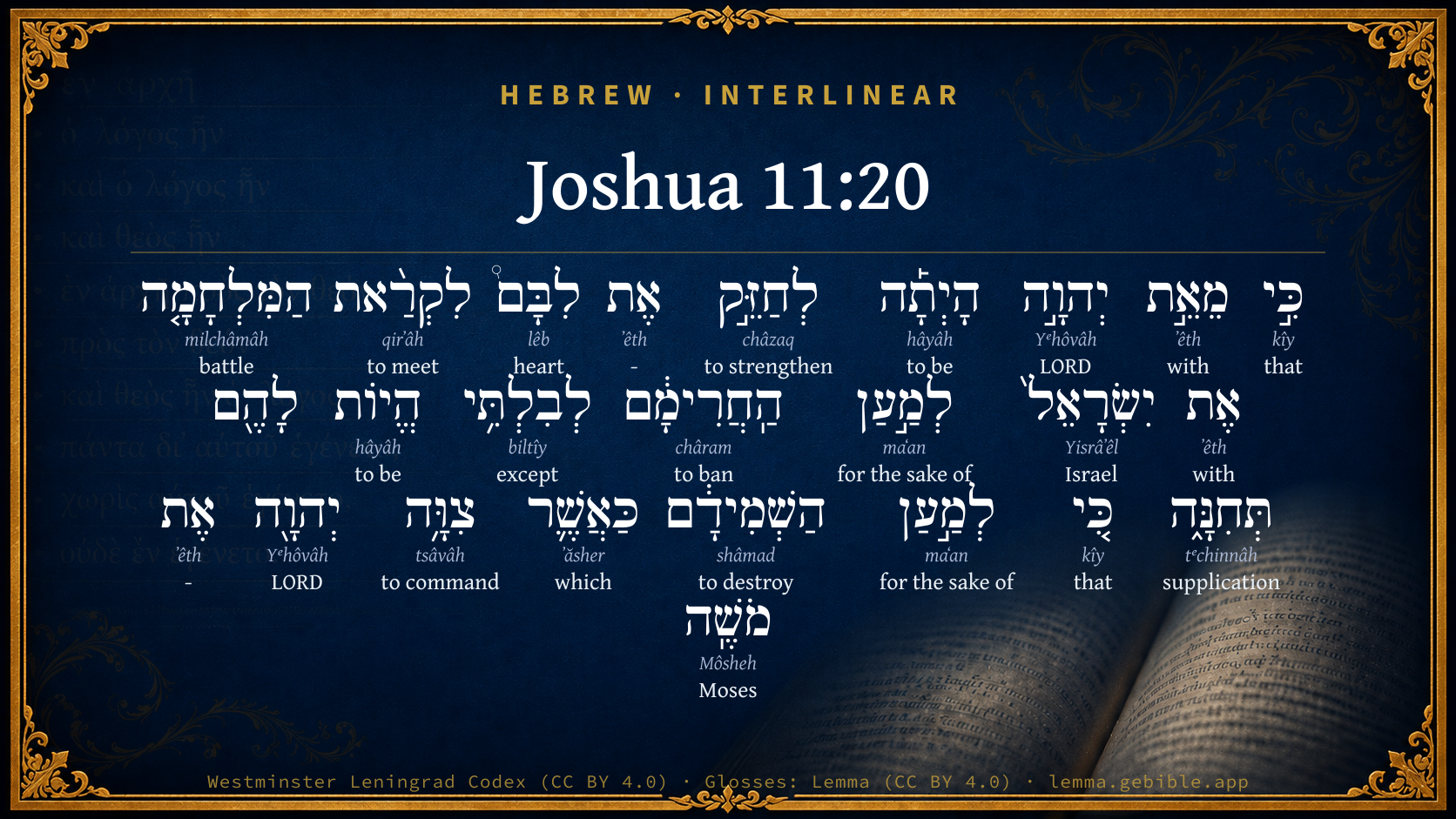
Joshua 11:20

Hebrew (Westminster Leningrad Codex) Joshua 11:20 appears in the Hebrew Old Testament. The text above is from the Westminster Leningrad Codex. Each word links to its Strong’s number, a concise gloss, and parsing drawn from the Open Scriptures Hebrew Bible morphology. Click any word for its full Brown-Driver-Briggs (BDB) entry.
Download image
Cite this verse

Joshua 11:20 (World English Bible). Public Domain. Lemma interlinear Bible study tool, https://lemma.gebible.app/v/joshua/11/20.

Show BibTeX & RIS
BibTeX
RIS
English Translation
For it was of Yahweh to harden their hearts, to come against Israel in battle, that he might utterly destroy them, that they might have no favor, but that he might destroy them, as Yahweh commanded Moses.
World English Bible · Public Domain
Highlights
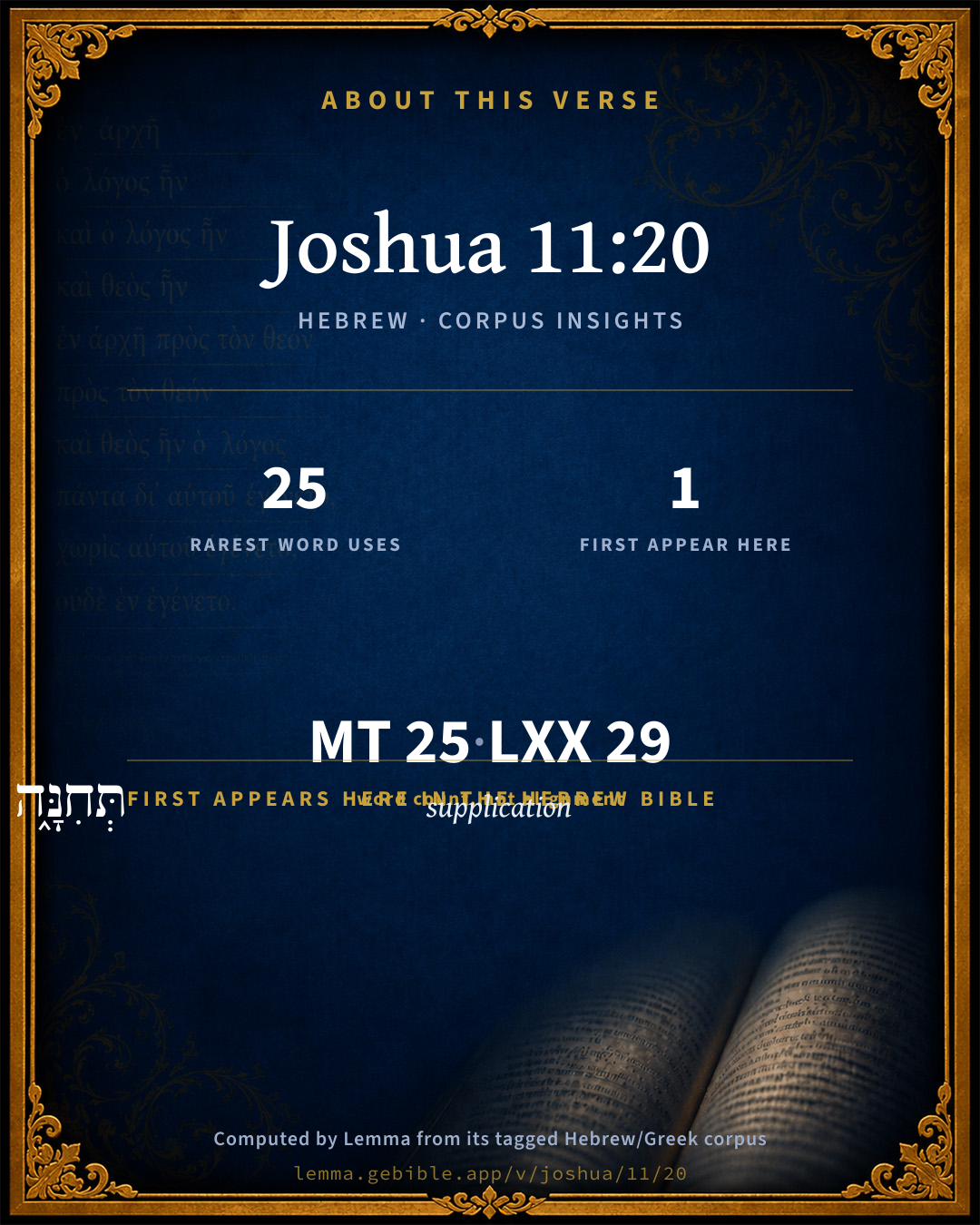
  • 1 first appearance in the Hebrew Bible
Full analysis ↓
Download a study sheet

One document with this verse’s original text, its word-by-word gloss line, the meaning frame, cross-references with their text, attributed commentary, and full source and license credits — printable, and it pastes into notes with its structure intact.

This verse Autodidact and up

Study sheet (.html) Plain text (.txt)

A passage Seminary Student

Up to 50 verses in one chapter. A passage sheet keeps up to 6 commentary sources and 12 cross-references per verse, in the order this page ranks them, and says so on the sheet whenever that leaves anything out. Ask for a single verse and you get the Autodidact verse sheet above.

Everything on this page stays free to read, with no account — the sheet is a download of what is already on screen, not access to it.

Want to remove ads? Support Godless Engineer
Compare translations 3

The same verse in 3 English versions, stacked beneath the original-language interlinear above. Click any original word for its lexicon entry.

Each is an independent rendering of the whole verse — the interlinear is not word-aligned to these translations.

Highlighted words mark where these versions differ — a whole-verse word diff, not a word-by-word alignment.

  • World English Bible Public Domain
    For it was of Yahweh to harden their hearts, to come against Israel in battle, that he might utterly destroy them, that they might have no favor, but that he might destroy them, as Yahweh commanded Moses.
  • King James Version Public Domain
    For it was of the LORD to harden their hearts, that they should come against Israel in battle, that he might destroy them utterly, and that they might have no favor, but that he might destroy them, as the LORD commanded Moses.
  • unfoldingWord Literal Text CC BY-SA 4.0
    For it was from Yahweh to harden their hearts to meet Israel battle in order to devote them, so that there would not be favor for them, but in order to destroy them, just as Yahweh had commanded Moses.

unfoldingWord Literal Text — © unfoldingWord, licensed CC BY-SA 4.0. Word-aligned USFM3 via Door43 (git.door43.org/unfoldingWord/en_ult).

Versions to compare (up to 4)

3 of 4 selected

Show all 18 translations

Every available English version of this verse, each an independent rendering of the whole verse.

  • World English Bible Public Domain
    For it was of Yahweh to harden their hearts, to come against Israel in battle, that he might utterly destroy them, that they might have no favor, but that he might destroy them, as Yahweh commanded Moses.
  • Berean Standard Bible Public Domain
    For it was of the LORD to harden their hearts to engage Israel in battle, so that they would be set apart for destruction and would receive no mercy, being annihilated as the LORD had commanded Moses.
  • Majority Standard Bible Public Domain
    For it was of the LORD to harden their hearts to engage Israel in battle, so that they would be set apart for destruction and would receive no mercy, being annihilated as the LORD had commanded Moses.
  • King James Version Public Domain
    For it was of the LORD to harden their hearts, that they should come against Israel in battle, that he might destroy them utterly, and that they might have no favor, but that he might destroy them, as the LORD commanded Moses.
  • American Standard Version (1901) Public Domain
    For it was of Jehovah to harden their hearts, to come against Israel in battle, that he might utterly destroy them, that they might have no favor, but that he might destroy them, as Jehovah commanded Moses.
  • Revised Version (1885) Public Domain
    For it was of the LORD to harden their hearts, to come against Israel in battle, that he might utterly destroy them, that they might have no favour, but that he might destroy them, as the LORD commanded Moses.
  • Geneva Bible (1599) Public Domain
    For it came of the Lord, to harden their heartes that they shoulde come against Israel in battell to the intent that they shoulde destroye them vtterly, and shewe them no mercie, but that they shoulde bring them to nought: as the Lord had commanded Moses.
  • Douay-Rheims (1899) Public Domain
    For it was the sentence of the Lord, that their hearts should be hardened, and they should fight against Israel, and fall, and should not deserve any clemency, and should be destroyed as the Lord had commanded Moses.
  • Young's Literal Translation Public Domain
    for from Jehovah it hath been to strengthen their heart, to meet in battle with Israel, in order to devote them, so that they have no grace, but in order to destroy them, as Jehovah commanded Moses.
  • Literal Standard Version CC BY-SA 4.0
    for it has been from YHWH to strengthen their heart, to meet in battle with Israel, in order to devote them, so that they have no grace, but in order to destroy them, as YHWH commanded Moses.
  • Unlocked Literal Bible CC BY-SA 4.0
    For it was Yahweh who hardened their hearts so they would wage war against Israel, so that he might completely destroy them without mercy, just as he had instructed Moses.
  • unfoldingWord Literal Text CC BY-SA 4.0
    For it was from Yahweh to harden their hearts to meet Israel battle in order to devote them, so that there would not be favor for them, but in order to destroy them, just as Yahweh had commanded Moses.
  • Darby Bible Public Domain
    For it was of Jehovah that their heart was hardened, to meet Israel in battle, that they might be utterly destroyed, and that there might be no favour shewn to them, but that they might be destroyed, as Jehovah had commanded Moses.
  • World Messianic Bible Public Domain
    For it was of the LORD to harden their hearts, to come against Israel in battle, that he might utterly destroy them, that they might have no favor, but that he might destroy them, as the LORD commanded Moses.
  • Webster's Bible Public Domain
    For it was of the LORD to harden their hearts, that they should come against Israel in battle, that he might destroy them utterly, and that they might have no favor, but that he might destroy them, as the LORD commanded Moses.
  • Free Bible Version CC BY-SA 4.0
    For the Lord made them stubborn, wanting to fight the Israelites so that they might be set apart and completely destroyed, wiped out without mercy, as the Lord had instructed Moses.
  • Bible in Basic English Public Domain
    For the Lord made them strong in heart to go to war against Israel, so that he might give them up to the curse without mercy, and that destruction might come on them, as the Lord had given orders to Moses.
  • JPS Tanakh (1917) Public Domain
    For it was of the LORD to harden their hearts, to come against Israel in battle, that they might be utterly destroyed, that they might have no favour, but that they might be destroyed, as the LORD commanded Moses.

Literal Standard Version (2020), Covenant Press — licensed CC BY-SA 4.0. Text via the HelloAO Bible API (eBible.org). Unlocked Literal Bible (unfoldingWord) — licensed CC BY-SA 4.0. Text via the HelloAO Bible API (eBible.org). unfoldingWord Literal Text — © unfoldingWord, licensed CC BY-SA 4.0. Word-aligned USFM3 via Door43 (git.door43.org/unfoldingWord/en_ult). Free Bible Version, Dr. Jonathan Gallagher — licensed CC BY-SA 4.0. Text via the HelloAO Bible API (eBible.org).

Word by word

More ways to search: Search by grammar → Find every occurrence → Compare this word →

Practice this passage: Drill this verse → Learn its vocabulary →

תְּחִנָּ֑ה
tᵉchinnâh
H8467
“supplication”
Noun, Common, Feminine, Singular, Absolute
Part of Speech
Noun
Type
Common
Gender
Feminine
Number
Singular
State
Absolute
Full BDB Definition

Origin: from H2603

TWOT: 694f

favour, supplication, supplication for favour - favour - supplication for favour
  1. כִּ֣י kîy H3588 “that” Conjunction
  2. מֵאֵ֣ת ʼêth H854 “from · with” Preposition + Preposition
  3. יְהוָ֣ה Yᵉhôvâh H3068 “LORD” Noun, Proper
  4. הָיְתָ֡ה hâyâh H1961 “to be” Verb, Qal, Perfect, 3rd Person, Feminine, Singular
  5. לְחַזֵּ֣ק châzaq H2388 “to strengthen” Preposition + Verb, Piel, Infinitive Construct
  6. אֶת ʼêth H853 “-” Particle, Direct Object
  7. לִבָּם֩ lêb H3820 “heart · their” Noun, Common, Masculine, Singular, Construct + Suffix, Personal, 3rd Person, Masculine, Plural
  8. לִקְרַ֨את qirʼâh H7125 “to meet” Preposition + Verb, Qal, Infinitive Construct
  9. הַמִּלְחָמָ֤ה milchâmâh H4421 “the · battle” Particle, Definite Article + Noun, Common, Feminine, Singular, Absolute
  10. אֶת ʼêth H854 “with” Preposition
  11. יִשְׂרָאֵל֙ Yisrâʼêl H3478 “Israel” Noun, Proper
  12. לְמַ֣עַן maʻan H4616 “for the sake of” Preposition
  13. הַֽחֲרִימָ֔ם châram H2763 “to ban · them” Verb, Hiphil, Infinitive Construct + Suffix, Personal, 3rd Person, Masculine, Plural
  14. לְבִלְתִּ֥י biltîy H1115 “to/for · except” Preposition + Conjunction
  15. הֱיוֹת hâyâh H1961 “to be” Verb, Qal, Infinitive Construct
  16. כִּ֚י kîy H3588 “that” Conjunction
  17. לְמַ֣עַן maʻan H4616 “for the sake of” Preposition
  18. הַשְׁמִידָ֔ם shâmad H8045 “to destroy · them” Verb, Hiphil, Infinitive Construct + Suffix, Personal, 3rd Person, Masculine, Plural
  19. כַּאֲשֶׁ֛ר ʼăsher H834 “like/as · which” Preposition + Particle, Relative
  20. צִוָּ֥ה tsâvâh H6680 “to command” Verb, Piel, Perfect, 3rd Person, Masculine, Singular
  21. יְהוָ֖ה Yᵉhôvâh H3068 “LORD” Noun, Proper
  22. אֶת ʼêth H853 “-” Particle, Direct Object
  23. מֹשֶֽׁה Môsheh H4872 “Moses” Noun, Proper

About this verse

These counts appear in no published source. They are computed here, from the morphology-tagged text and Lemma’s own curated glosses. What Lemma adds →

25
words
18
distinct lemmas
Historical
section

Notable vocabulary

The rarest word here is תְּחִנָּ֑ה supplication H8467 — appearing just 25 times in the whole Hebrew Bible.

First appearance in Scripture

This word makes its first canonical appearance in the Hebrew Bible here:

  • תְּחִנָּ֑ה supplication H8467

Shared distinctive vocabulary

תְּחִנָּ֑ה supplication H8467 occurs in 24 verses of the Hebrew Bible. Also found in:

Grammatical profile

  • 7 verbs
  • 7 nouns
  • 5 prepositions
  • 3 conjunctions
  • 3 particles

Verb forms

  • הָיְתָ֡ה Qal · Perfect
  • לְחַזֵּ֣ק Piel · Infinitive Construct
  • לִקְרַ֨את Qal · Infinitive Construct
  • הַֽחֲרִימָ֔ם Hiphil · Infinitive Construct
  • הֱיוֹת Qal · Infinitive Construct
  • הַשְׁמִידָ֔ם Hiphil · Infinitive Construct
  • צִוָּ֥ה Piel · Perfect

Repetition

Words recur within this verse — often emphatic in Hebrew:

  • יְהוָ֣ה LORD H3068 ×2
  • הָיְתָ֡ה to be H1961 ×2
  • לְמַ֣עַן for the sake of H4616 ×2
  • כִּ֣י that H3588 ×2
  • מֵאֵ֣ת with H854 ×2

Hebrew & Septuagint length

In English translation the verse runs 37 words from the Hebrew and 44 from the Septuagint (LXX English) — closely comparable.

A rough comparison of the two English renderings, which tokenize alike — not a word-level alignment.

Word counts can differ between the Hebrew and the Greek without any difference in meaning — e.g. the Hebrew direct-object marker אֵת has no separate Greek word, and Greek often adds the article ὁ.

In the original languages it is 25 Hebrew tokens and 29 Greek tokens — but the two are counted differently (Hebrew bundles its prefixes and suffixes into one token; the Greek is in lemma form), so that isn’t a like-for-like length.

Cross-references

15

Topical passages linked to Joshua 11:20 in the Treasury of Scripture Knowledge — connected by theme and wording, ordered by reader-vote popularity; previews shown in the World English Bible.

  • Romans 9:18 So then, he has mercy on whom he desires, and he hardens whom he desires.
  • Deuteronomy 20:16–17 But of the cities of these peoples, that Yahweh your God gives you for an inheritance, you shall save alive nothing that breathes;
  • Exodus 4:21 Yahweh said to Moses, "When you go back into Egypt, see that you do before Pharaoh all the wonders which I have put in your hand, but I will harden his heart and he will not let the people go.
  • Deuteronomy 2:30 But Sihon king of Heshbon would not let us pass by him; for Yahweh your God hardened his spirit, and made his heart obstinate, that he might deliver him into your hand, as at this day.
  • Deuteronomy 7:16 You shall consume all the peoples who Yahweh your God shall deliver to you; your eye shall not pity them: neither shall you serve their gods; for that will be a snare to you.
  • Exodus 9:16 but indeed for this cause I have made you stand: to show you my power, and that my name may be declared throughout all the earth;
  • Exodus 14:17 I, behold, I will harden the hearts of the Egyptians, and they shall go in after them: and I will get myself honor over Pharaoh, and over all his host, over his chariots, and over his horsemen.
  • Joshua 11:12–15 All the cities of those kings, and all the kings of them, did Joshua take, and he struck them with the edge of the sword, and utterly destroyed them; as Moses the servant of Yahweh commanded.
  • Judges 14:4 But his father and his mother didn't know that it was of Yahweh; for he sought an occasion against the Philistines. Now at that time the Philistines had rule over Israel.
  • 1 Samuel 2:25 If one man sin against another, God shall judge him; but if a man sin against Yahweh, who shall entreat for him? Notwithstanding, they didn't listen to the voice of their father, because Yahweh was minded to kill them.
  • 1 Kings 12:15 So the king didn't listen to the people; for it was a thing brought about of Yahweh, that he might establish his word, which Yahweh spoke by Ahijah the Shilonite to Jeroboam the son of Nebat.
  • 1 Kings 22:20–23 Yahweh said, Who shall entice Ahab, that he may go up and fall at Ramoth-gilead? One said on this manner; and another said on that manner.
  • 2 Chronicles 25:16 It happened, as he talked with him, that [the king] said to him, Have we made you of the king's counsel? Stop! Why should you be struck down? Then the prophet stopped, and said, I know that God has determined to destroy you, because you have done this, and have not listened to my counsel.
  • Isaiah 6:9–10 He said, "Go, and tell this people, 'You hear indeed, But don't understand; And you see indeed, But don't perceive.'
  • Romans 9:22–23 What if God, willing to show his wrath, and to make his power known, endured with much patience vessels of wrath made for destruction,

Cross-references courtesy of OpenBible.info (CC BY 4.0).

Hebrew and Greek witnesses Masoretic Hebrew ↔ Greek Septuagint

The same verse in the two great witnesses to the Old Testament, shown verse-for-verse.

These are two independent witnesses, not word-aligned to each other, and the Septuagint is shown in lemma (dictionary) form.

Hebrew Joshua 11:20 Masoretic · Westminster Leningrad Codex

כִּ֣י מֵאֵ֣ת יְהוָ֣ה הָיְתָ֡ה לְחַזֵּ֣ק אֶת לִבָּם֩ לִקְרַ֨את הַמִּלְחָמָ֤ה אֶת יִשְׂרָאֵל֙ לְמַ֣עַן הַֽחֲרִימָ֔ם לְבִלְתִּ֥י הֱיוֹת לָהֶ֖ם תְּחִנָּ֑ה כִּ֚י לְמַ֣עַן הַשְׁמִידָ֔ם כַּאֲשֶׁ֛ר צִוָּ֥ה יְהוָ֖ה אֶת מֹשֶֽׁה

For it was of Yahweh to harden their hearts, to come against Israel in battle, that he might utterly destroy them, that they might have no favor, but that he might destroy them, as Yahweh commanded Moses.

World English Bible · Public Domain

Greek LXX Joshua 11:20 Septuagint · lemma form

ὅτι διά κύριος γίγνομαι καταἰσχύω αὐτός ὁ καρδία συνἀντάω εἰς πόλεμος πρός ἰσραήλ ἵνα ἐκὀλεθρεύω ὅπως μή δίδωμι αὐτός ἔλεος ἀλλά ἵνα ἐκὀλεθρεύω ὅς τρόπος εἶπον κύριος πρός μωυσῆς

For it was of the Lord to harden their hearts to go forth to war against Israel, that they might be utterly destroyed, that mercy should not be granted to them, but that they should be utterly destroyed, as the Lord said to Moses.

LXX2012 (modern English Septuagint) · Public Domain

Hebrew: Westminster Leningrad Codex (CC BY 4.0). Greek: Septuagint (public domain); English from LXX2012 (modern English Septuagint) (Public Domain). How the Septuagint differs from the Hebrew →

Targum (Aramaic paraphrase)

1

The Targum is the ancient Jewish Aramaic paraphrase of the Hebrew Scriptures — an interpretive translation, not the Hebrew text itself. Onkelos (literal) and Pseudo-Jonathan (expansive) render the Torah, and Jonathan the Prophets. Coverage is partial: where no permissively-licensed English translation exists for a verse, only the Aramaic is shown. This is verse-level text, not a word-by-word alignment to the Hebrew.

  1. Targum Jonathan Prophets (Joshua–Malachi)
    אֲרֵי מִן קֳדָם יְיָ הֲוַת לְתַקָפָא יַת לִבְּהוֹן לְסַדָרָא קְרָבָא עִם יִשְׂרָאֵל בְּדִיל לְגַמָרוּתְהוֹן בְּדִיל דְלָא לְמֶהֱוֵי לְהוֹן רַחֲמִין אֲרֵי בְּדִיל לְשֵׁצָיוּתְהוֹן כְּמָא דְפַקֵד יְיָ יַת מֹשֶׁה:

    (no public-domain English translation for this verse)

    Targum Jonathan — Aramaic: “Mikraot Gedolot” (public domain). English: “Sefaria Community Translation” (CC0 1.0 (public-domain dedication)); “London "Chaldee Paraphrase," 1871” (public domain). Text via Sefaria.

Commentary

Notes on Joshua 11:20 from classic Christian and Jewish commentators (each source and its license shown beneath its notes). The classic Christian expositions comment on the surrounding passage and are grouped to its opening verse, so a note may address several verses; the Jewish commentaries on the Tanakh (Rashi and others) are per-verse, so they appear only where the commentator wrote on this verse.

Lemma curates 59 commentaries, every one of them public domain or Creative Commons licensed, each selected and text-cleaned for this edition rather than reprinted as found. About our sources →

Trapp's Complete Commentary

John Trapp

Jos 11:20 For it was of the LORD to harden their hearts, that they should come against Israel in battle, that he might destroy them utterly, [and] that they might have no favour, but that he might destroy them, as the LORD commanded Moses.

Ver. 20. For it was of the Lord.] Punishing them with a judiciary hardness, who were before hardened by the deceitfulness of sin and malice of Satan.

John Trapp, A Commentary or Exposition upon All the Books of the Old and New Testament (1647–1656) — public domain. Text from a community e-Sword module.

Geneva Bible (1599)

Geneva Bible translators

That is, to give them over to themselves: and therefore they could not but rebel against God and seek their own destruction.

Geneva Bible (1599) marginal notes — public domain. Text via Bolls.life.

Adam Clarke's Commentary

Verse 20. It was of the Lord to harden their hearts] They had sinned against all the light they had received, and God left them justly to the hardness, obstinacy, and pride of their own hearts; for as they chose to retain their idolatry, God was determined that they should be cut off. For as no city made peace with the Israelites but Gibeon and some others of the Hivites, Jos 11:19, it became therefore necessary to destroy them; for their refusal to make peace was the proof that they wilfully persisted in their idolatry.

Adam Clarke's Commentary on the Bible (1810–1826) — public domain. Text from a community e-Sword/MySword module.

Ellicott's Commentary for English Readers

(20) It was of the Lord to harden their hearts . . . that he might destroy them.—Or rather to strengthen their heart—i.e., render them obstinate. These words go to prove what has been said elsewhere, that the conquest of Canaan was not intended to be a massacre of the unresisting inhabitants.

A Bible Commentary for English Readers, edited by Charles John Ellicott (1878–1897) — public domain. Text from a community e-Sword module.

The Cambridge Bible for Schools and Colleges

gen. ed. J. J. S. Perowne

20. For it was of the Lord] “Forsothe the sentence of the Lord it was,” Wyclif. Compare Exo_4:21, “When thou goest to return into Egypt, see that thou do all those wonders before Pharaoh, which I have put in thine hand: but I will harden his heart, that he shall not let the people go;” and Exo_7:3, “And I will harden Pharaoh’s heart, and multiply my signs and my wonders in the land of Egypt;” Jos_14:4; Rom_9:17. Here, as everywhere in Scripture where such hardening is spoken of, it is to be carefully borne in mind, that it is always inflicted as a judgment on those who had previously acted contrary to the Divine will. This is true of

(a) Pharaoh, who had grievously and cruelly oppressed the Israelites for his own selfish ends;

(b) The Canaanites, who had persisted in the lowest and most degrading idolatry and sensuality;

(c) The Israelites, who in spite of warning and example fell away into idolatry in like manner, and forgat the Lord, Who had done such great things for them (Isa_6:10; Mat_13:12-15).

The same is in a measure said of Sihon king of the Amorites (Deu_2:30); of Samson (Jdg_14:4); of the sons of Eli (1Sa_2:25); of Solomon (1Ki_12:15); of Ahaziah (2Ch_22:7); of Amaziah (2Ch_25:16; 2Ch_25:20). It is expressed also in the Latin proverb, “Quem Deus vult perdere, prius dementat.”

The Cambridge Bible for Schools and Colleges (gen. ed. J. J. S. Perowne; Cambridge University Press, 1878–1918) — public domain. Text from a community e-Sword module.

John Gill's Exposition

For it was of the Lord to harden their hearts,.... As he hardened the hearts of Pharaoh and the Egyptians, that his power might be displayed in their destruction:

that they should come against Israel battle; and so fall in it:

that he might destroy them utterly; for their abominable wickedness, idolatry, incest, &c. they had been guilty of:

and that they might have no favour; which they would have had, had they made peace as the Gibeonites did; or that they might not pray and make supplication, the Lord not giving them a spirit of supplication, but an hard heart, as Gussetius (f) observes the words may be interpreted, though he seems to prefer the former, sense:

but that he might destroy them, as the Lord commanded Moses; Deu 7:1.

(f) Comment. Ebr. p. 272.

John Gill's Exposition of the Whole Bible (1746–1763) — public domain (CC PDM 1.0). Text via the HelloAO Bible API.

Albert Barnes' Notes on the Bible

See the marginal references.

Albert Barnes' Notes on the Bible (1834–1885) — public domain. Text from a community e-Sword/MySword module.

Haydock's Catholic Bible Commentary

Hardened. This hardening of their hearts, was their having no thought of yielding or submitting: which was a sentence or judgment of God upon them, in punishment of their enormous crimes. (Challoner) --- God might indeed by his all-powerful grace have changed their hearts, but their crimes caused him to withhold that grace; and thus they were suffered to shut their eyes to their true interest. (Calmet) --- They alone therefore were the cause of their own obduracy, which God only did not prevent, Exodus vii. (Worthington)

George Leo Haydock (1774–1849), Haydock's Catholic Family Bible and Commentary, 1859 edition — public domain. Excludes Psalms (Douay-Rheims chapter numbering differs from Protestant) and Deuterocanonical books (Catholic canon only).

Matthew Poole's English Annotations

It was the design of God’s providence not to soften their hearts to a compliance with the Israelites, but to give them up to their own animosity, pride, confidence, and stubbornness; that so both their abominable and incorrigible wickedness might be severely punished and that the Israelites might not be mixed with them, but be entire among themselves in the possession of the land. Compare Deu 2:30, and for the phrase, Exo 7:13; 9:12; 14:17.

Matthew Poole's English Annotations on the Holy Bible (1683–1685) — public domain. Text from a community e-Sword/MySword module.

Whedon's Commentary on the Bible

Daniel D. Whedon

20. It was of the Lord to harden their hearts — It is a Hebraism to ascribe to direct divine agency the results of human perverseness, as in the case of Pharaoh. These nations had filled the cup of their iniquity, (Gen_15:16,) and their idolatry and crimes demanded punishment. God therefore leaves them to judicial blindness and infatuation, and uses Israel as the rod of his anger to destroy them utterly. So their hardened hearts and consequent destruction were but the certain outcome, according to Divine arrangement, of their own, as of every sinner’s, free and wilful sinning. But we are not to understand, with Calvin, a miraculous operation of God, urging them on to blind fury. Their own self-induced perversity was a sufficient power for this.

Daniel D. Whedon (gen. ed.), Commentary on the Old and New Testaments (1874–1909) — public domain. Text from a community e-Sword module.

The Pulpit Commentary

To harden their hearts. (cf. Exo_4:21 Exo_7:23) Muller, "Christian Doctrine of Sin," 2:412, says that "Scripture never speaks of God"s hardening men"s hearts, save in connection with His revelations through Moses or Christ." This passage evidently had not occurred to him when writing. His explanation of the difficulty is hardly satisfactory. We are not to suppose that the free will of the Canaanites was in any way interfered with. God no doubt left them to themselves as the due punishment of their iniquities. Sin in general, by God"s own appointment, and especially the sensual sins in which the Canaanites were steeped, has a tendency to produce insensibility to moral or even prudential considerations, and to beget a recklessness which urges on the sinner to his ruin. Some have argued that had they all come, like the Gibeonites, as suppliants, they must all have been massacred in cold blood. But this is not likely. Rather we must imagine that God foresaw that they would not believe the signs He would give in favour of the Israelites, and that by meeting them in battle they brought a swift and speedy destruction on themselves.

Hearts hardened by God.

I WHEN GOD HARDENS A MAN"S HEART IT IS BECAUSE HIS CHARACTER IS SUCH AS TO TURN GOD"S RIGHTEOUS ACTION TO THIS RESULT. The same act of Providence which hardens one heart softens another. Prosperity will harden one in selfish, worldly satisfaction, and soften another to grateful devotion and active benevolence. Adversity will harden one in discontent and unbelief, while it softens another to penitence and trust. The experience of life will deaden the spiritual insights of one, and quicken that of another. The effects of God"s work with us is thus largely determined by the condition of our own minds. God never hardens a man"s heart except through his own abuse of providential actions and spiritual influences which are kindly and wholesome in themselves, and prove themselves so to these who receive them aright. (Mat_13:11-15)

II GOD HARDENS I MAN"S HEART NOT BEFORE, BUT AFTER, HE HAS SINNED. The Canaanites had hardened their hearts in sin before God hardened them for judgment. God never predisposes a man to sin, nor does He harden a man in sin against any desire for amendment. The Divine hardening of the heart is not a cause of sin but a fruit of it.

III GOD DOES NOT HARDEN A MAN"S HEART SO MUCH BY MAKING THE WILL STUBBORN AS BY BLINDING THE EYES TO PRESENT DANGER AND FUTURE CALAMITY. The Canaanites were not made more wicked, they were only rendered blind to their danger and doom, so that they resisted where resistance was hopeless, and attempted to make no terms with the invader. When a man will not repent in obedience to conscience, it may be best that lie should not find a means of escaping punishment through the exercise of prudence. So long as conscience is blind it is better for all moral purposes that prudence also should be blind. Note, however, as a warning, while sin tends to blind us to its approaching punishment, we are not the less in danger because we feel a sense of security.

IV WHEN THE CONSCIENCE IS DEAD TO GOD"S LAW IT MAY BE WELL THAT THE INTELLECT SHOULD BE BLIND TO HIS TRUTH. It is better not to receive the truth into the intellect than to hold it with a disobedient heart. Otherwise

(1) we shall misunderstand, abuse, and misapply it;

(2) we shall deceive ourselves by supposing we are the better for knowing what is good although we do not practise it; and

(3) we shall be less susceptible to the influence of truth when it comes at the right moment to reveal our guilt and direct the way to redemption. Christ expressly said that He spoke in parables that they who were in a wrong condition of heart to benefit by His teaching might not receive it to their hurt and its dishonour. W.F.A. (Mat_13:13)

HOMILIES BY J. WAITE Ver. 20. Doomed to destruction.

The evil men do often appears to be attributed in Scripture to the Divine will and agency. (Exo_4:21 Jud_1:14:4 1Ki_12:15 Rom_9:17, Rom_9:18) Reason and conscience, indeed, confirm the view St. James gives of the history of all transgression. (Jam_1:13-15) Every man"s sin is emphatically his own born of his own inward impulse, nourished by influences to which he freely and wilfully yields himself, and its deadly issue is his just and natural recompense. God has nothing to do with it but to condemn and punish. How, then, can it be said of any form of evil that it is "of the Lord," or that a man does it because the Lord "has hardened his heart"? Is it so that the wrongdoer is after all but the passive instrument of a Divine purpose, and his life the working out of a Divine decree? The perfect solution of this difficult problem may be beyond us; but there are considerations that will shed much interpreting light upon it, and under the guidance of which we may "assert eternal Providence, And justify the ways of God to man.

I THE HARDENING OF MEN"S HEARTS IN EVIL COURSES IS THE RESULT OF CERTAIN LAWS OF WHICH GOD IS THE AUTHOR. A suggestive analogy is found in the realm of material things. Nature has its stern impartial laws, its latent dangers, destructive powers, deadly poisons, etc. If a man deals wantonly and recklessly with these, he arms them all against himself; but the blame of the mischief thus done cannot be laid on Him who made or ordained them. What is man"s business in this world but just to utilise for good ends to "use and not abuse the laws and resources of the sphere in which the Creator has placed him? So, morally, the circumstances of our existence upon earth work out good or evil results according as we are voluntarily disposed to use them. The very influences that in one case tend to nourish the principles of a true and noble life, in another case harden the heart in sin. God"s part in this is simply to determine the conditions under which the process shall go on. The evil men do is their own; the powers they prostitute to their base purposes, the place they occupy among their fellow men, the advantages that favour the working out of their designs, the laws that govern the development of their sin to its fatal issues, are "of the Lord.

II WHEN MEN SHOW THAT THEY ARE RESOLUTELY BENT ON EVIL COURSES, GOD MAY SEE FIT TO LEAVE THEM TO THEMSELVES. There is in morals, as in mechanics, a law of inertia by virtue of which we remain in a chosen state, or continue to move in a chosen direction, unless some stronger force is brought to bear upon us. Will and habit rivet the chain of iniquity. When a man"s heart is thoroughly "set in him to do evil," God sometimes abandons him to his own choice, leaves him to become the prey of his own wayward and wicked infatuation. (Pro_1:31) In such a case the law of sin is simply left to take its course. The Divine act is negative rather than positive. It lies in the withholding of restraining or delivering grace. And there is no injustice in this nothing unrighteous in God thus allowing the heart to harden itself. Moreover, it is by the operation of a law of our nature that he who will net turn from his evil way shall at length come to a point at which he cannot. (Jer_13:23) "Sins lead to greater sins, and link so straight, What first was accident, at last is fate.

And God, who established that law, is often said in Scripture to do that which takes place by virtue of it, or which results from it. He has framed the whole constitution of things under which it comes to pass that the impenitent sinner gradually becomes obdurate and closes against himself the door of hope. In this sense only can it be true that "it is of the Lord to harden men"s hearts.

III GOD OFTEN WORKS OUT, THROUGH THE WORST FORMS OF HUMAN EVIL, HIS GRANDEST ISSUES OF GOOD. In tracing the course of earthly affairs, we have to draw a very distinct line of separation in our minds between the wicked will and purpose of man, and the overmastering will and purpose of God. The sovereignty of the latter is most triumphantly asserted when the former has been suffered to reach its utmost limits, and work its deadliest work. The utter destruction of these Canaanites, aggravated by their own mad resistance, was essential to a full display of the majesty of the God of Israel, and the vindication of eternal righteousness. How important a part it has played in the general progress of humanity, who shall say? The triumph of redeeming mercy was brought about through the most heinous of all human crimes. "Him being delivered by the determinate counsel and foreknowledge of God," etc. (Act_2:23) The "hands" were none the less "wicked" because through them God accomplished His holy and loving will. The Son of man was born into the world to be betrayed and crucified and slain; but that does not lighten the curse that falls on the betrayer and the murderer. Across the dark thunder cloud of man"s evil, God casts the bright and beautiful rainbow of hope. The darkness is man"s the hope is from Him "who is light, and in whom is no darkness at all. W.

HOMILIES BY E. DE PRESSENSE Ver. 20. The extermination of the Canaanites.

The terrible extermination of the Canaanitish nations remains a mystery too hard for us to understand. "It was of the Lord," we read (ver. 20). The history of Israel is designed to bring out in an impressive manner, by outward and visible facts, the constant intervention of God in human destinies. The history of our race is a fearful drama of blood and tears, in which ruin and devastation meet us on every hand. The Old Testament teaches us that in this history the purposes of Divine justice are carried out. It shows us the great Justiciary perpetually working. We might almost say that the veil which usually conceals His operation is lifted, so that we see that "our God is a consuming fire". (Heb_12:29) If we look into the causes of this extermination of the Canaanites, we see that it was brought about by the excessive corruptness of the life of these people, under the influence of their impure idolatries. The same conditions are found today at the root of all the woes that afflict humanity. The sin is always greater than the suffering. The just God is also the God of love. His justice paves the way for His mercy. The triumph of Israel is to be turned to the account of the human race, since the establishment of the sons of Abraham in the land of promise is a necessary condition and antecedent of the universal salvation. We do net for a moment deny that an awful mystery rests upon these dark records of the Old Testament. It is impossible to think without shuddering of these myriads of human beings, swept away in a deluge of blood. But surely we may believe that even in this there was some hidden secret of love Divine, and may cling with the early Church to the "larger hope," that redemption may have come to them in that mysterious abode of spirits in prison to which Jesus Christ went to preach. (1Pe_3:17) We do not see why the victims of the first deluge should have been the only ones thus privileged. Alike in public and private misfortunes, let us ever recognise the justice of the Holy God. Let us bow beneath His mighty hand, remembering that it is at the same time the hand of our Father, and that "all things work together for good to them that love Him. E.DE P.

The Pulpit Commentary (1880–1919), ed. H.D.M. Spence-Jones & Joseph S. Exell — public domain. Text from a community e-Sword module.

John Wesley's Explanatory Notes

To harden their hearts - It was the design of God's providence not to soften their hearts to a compliance with the Israelites, but to give them up to their own animosity, pride, confidence and stubbornness; that so their abominable and incorrigible wickedness might be punished, and that the Israelites might not be mixed with them, but be entire among themselves in the possession of the land.

John Wesley, Explanatory Notes Upon the Whole Bible (1754–1765) — public domain. Text via the GEBible commentary corpus.

Lesson kit

Teaching starters — assembled from the data on this page, not authored interpretation. Every prompt links to the verse data it draws on. Edit before teaching.

Joshua, in the Historical, opens this verse with 25 words (18 distinct Hebrew lemmas). Its most distinctive word is tᵉchinnâh (“supplication”). A historical commentator’s framing appears above. Read the whole chapter for the surrounding context.

Discussion questions

  1. How does “supplication” (tᵉchinnâh) shape what this verse is saying?
  2. The word “supplication” first appears here in Scripture. What is being introduced at this debut?
  3. 1 Kings 8:28 shares the word «supplication» with this verse. How do the two illuminate each other?
  4. “LORD” occurs 2× in this one verse. What is the effect of the repetition?
  5. These translations render this verse differently; the difference is in the English rendering, not the original. What questions does that raise?
  6. The verb «הָיְתָ֡ה» is Qal Perfect. How does its form color the action?
  7. Reading how Trapp's Complete Commentary and Geneva Bible (1599) read this verse, where do the two commentators agree and where do they part?

Things to notice

Reading settings

Reading text

Shown beneath each verse's original-language words.

Old Testament
Old Testament edition

Read the OT as the Masoretic Hebrew (MT) or the Greek Septuagint (LXX).

English shown for the Greek Septuagint (in the Hebrew ↔ Greek comparison).

Comparing translations? Open the Compare panel on any verse page to stack up to four side by side.