
Joshua 18:8

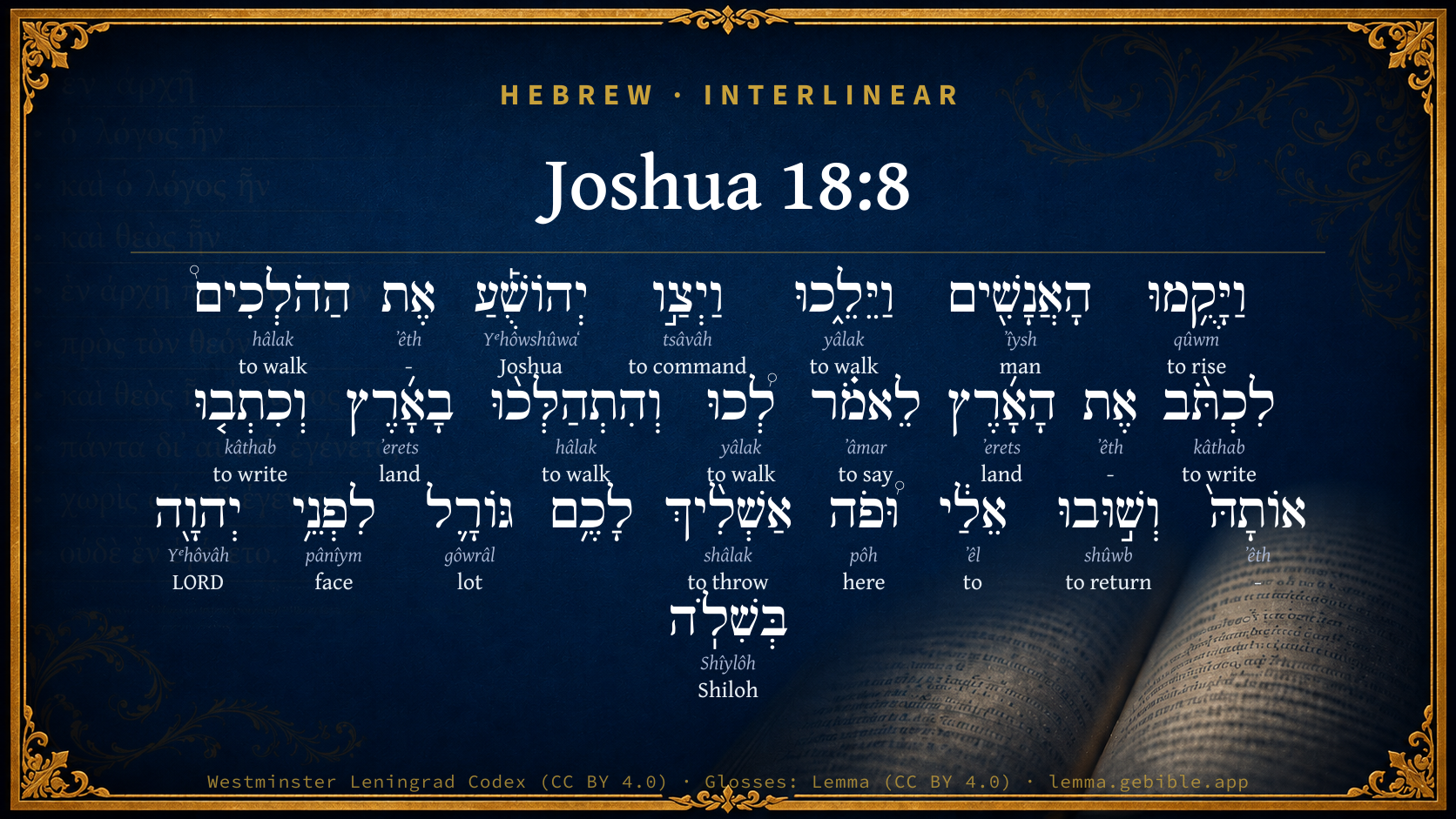
Hebrew (Westminster Leningrad Codex) Joshua 18:8 appears in the Hebrew Old Testament. The text above is from the Westminster Leningrad Codex. Each word links to its Strong’s number, a concise gloss, and parsing drawn from the Open Scriptures Hebrew Bible morphology. Click any word for its full Brown-Driver-Briggs (BDB) entry.
Download image
Cite this verse

Joshua 18:8 (World English Bible). Public Domain. Lemma interlinear Bible study tool, https://lemma.gebible.app/v/joshua/18/8.

Show BibTeX & RIS
BibTeX
RIS
English Translation
The men arose, and went: and Joshua charged those who went to describe the land, saying, Go and walk through the land, and describe it, and come again to me; and I will cast lots for you here before Yahweh in Shiloh.
World English Bible · Public Domain
Download a study sheet

One document with this verse’s original text, its word-by-word gloss line, the meaning frame, cross-references with their text, attributed commentary, and full source and license credits — printable, and it pastes into notes with its structure intact.

This verse Autodidact and up

Study sheet (.html) Plain text (.txt)

A passage Seminary Student

Up to 50 verses in one chapter. A passage sheet keeps up to 6 commentary sources and 12 cross-references per verse, in the order this page ranks them, and says so on the sheet whenever that leaves anything out. Ask for a single verse and you get the Autodidact verse sheet above.

Everything on this page stays free to read, with no account — the sheet is a download of what is already on screen, not access to it.

Want to remove ads? Support Godless Engineer
Compare translations 3

The same verse in 3 English versions, stacked beneath the original-language interlinear above. Click any original word for its lexicon entry.

Each is an independent rendering of the whole verse — the interlinear is not word-aligned to these translations.

Highlighted words mark where these versions differ — a whole-verse word diff, not a word-by-word alignment.

  • World English Bible Public Domain
    The men arose, and went: and Joshua charged those who went to describe the land, saying, Go and walk through the land, and describe it, and come again to me; and I will cast lots for you here before Yahweh in Shiloh.
  • King James Version Public Domain
    And the men arose, and went away: and Joshua charged them that went to describe the land, saying, Go and walk through the land, and describe it, and come again to me, that I may here cast lots for you before the LORD in Shiloh.
  • unfoldingWord Literal Text CC BY-SA 4.0
    And the men arose and went. And Joshua commanded the going ones to write down the land, saying, “Go and walk about in the land and write it down and return to me. And here I will throw a lot for you to the face of Yahweh in Shiloh.”

unfoldingWord Literal Text — © unfoldingWord, licensed CC BY-SA 4.0. Word-aligned USFM3 via Door43 (git.door43.org/unfoldingWord/en_ult).

Versions to compare (up to 4)

3 of 4 selected

Show all 18 translations

Every available English version of this verse, each an independent rendering of the whole verse.

  • World English Bible Public Domain
    The men arose, and went: and Joshua charged those who went to describe the land, saying, Go and walk through the land, and describe it, and come again to me; and I will cast lots for you here before Yahweh in Shiloh.
  • Berean Standard Bible Public Domain
    As the men got up to go out, Joshua commanded them to map out the land, saying, “Go and survey the land, map it out, and return to me. Then I will cast lots for you here in Shiloh in the presence of the LORD.”
  • Majority Standard Bible Public Domain
    As the men got up to go out, Joshua commanded them to map out the land, saying, “Go and survey the land, map it out, and return to me. Then I will cast lots for you here in Shiloh in the presence of the LORD.”
  • King James Version Public Domain
    And the men arose, and went away: and Joshua charged them that went to describe the land, saying, Go and walk through the land, and describe it, and come again to me, that I may here cast lots for you before the LORD in Shiloh.
  • American Standard Version (1901) Public Domain
    And the men arose, and went: and Joshua charged them that went to describe the land, saying, Go and walk through the land, and describe it, and come again to me; and I will cast lots for you here before Jehovah in Shiloh.
  • Revised Version (1885) Public Domain
    And the men arose, and went: and Joshua charged them that went to describe the land, saying, Go and walk through the land, and describe it, and come again to me, and I will cast lots for you here before the LORD in Shiloh.
  • Geneva Bible (1599) Public Domain
    Then the men arose, and went their way: and Ioshua charged them that went to describe the land, saying, Depart, and goe through the land, and describe it, and returne to me, that I may here cast lottes for you before the Lord in Shiloh.
  • Douay-Rheims (1899) Public Domain
    For the Levites have no part among you, but the priesthood of the Lord is their inheritance. And Gad and Ruben, and the half tribe of Manasses have already received their possessions beyond the Jordan eastward: which Moses the servant of the Lord gave them.
  • Young's Literal Translation Public Domain
    And the men rise and go; and Joshua commandeth those who are going to describe the land, saying, `Go, and walk up and down through the land, and describe it, and turn back unto me, and here I cast for you a lot before Jehovah in Shiloh.'
  • Literal Standard Version CC BY-SA 4.0
    And the men rise and go; and Joshua commands those who are going to describe the land, saying, “Go, and walk up and down through the land, and describe it, and return to me, and here I cast a lot for you before YHWH in Shiloh.”
  • Unlocked Literal Bible CC BY-SA 4.0
    So the men got up and went. Joshua commanded those who went to write the description of the land, saying, “Go up and down in the land and write a description of it and return to me. I will cast lots for you here before Yahweh at Shiloh.”
  • unfoldingWord Literal Text CC BY-SA 4.0
    And the men arose and went. And Joshua commanded the going ones to write down the land, saying, “Go and walk about in the land and write it down and return to me. And here I will throw a lot for you to the face of Yahweh in Shiloh.”
  • Darby Bible Public Domain
    And the men arose and went away. And Joshua charged them that went to describe the land, saying, Go and walk through the land, and describe it, and come again to me, and I will cast lots for you here before Jehovah in Shiloh.
  • World Messianic Bible Public Domain
    The men arose and went. Joshua commanded those who went to survey the land, saying, “Go walk through the land, survey it, and come again to me. I will cast lots for you here before the LORD in Shiloh.”
  • Webster's Bible Public Domain
    And the men arose, and departed: and Joshua charged them that went to describe the land, saying, Go, and walk through the land, and describe it, and come again to me, that I may here cast lots for you before the LORD in Shiloh.
  • Free Bible Version CC BY-SA 4.0
    As the men started out on their way to explore the land. Joshua told them, “Go throughout the land and write a description of what you find. Then return to me and I will cast lots for you in the presence of the Lord here in Shiloh.”
  • Bible in Basic English Public Domain
    So the men got up and went; and Joshua gave orders to those who went, to make a record of the land, saying, Go up and down through the land, and make a record of it and come back here to me, and I will make the distribution for you here by the decision of the Lord in Shiloh.
  • JPS Tanakh (1917) Public Domain
    And the men arose, and went; and Joshua charged them that went to describe the land, saying: 'Go and walk through the land, and describe it, and come back to me, and I will cast lots for you here before the LORD in Shiloh.'

Literal Standard Version (2020), Covenant Press — licensed CC BY-SA 4.0. Text via the HelloAO Bible API (eBible.org). Unlocked Literal Bible (unfoldingWord) — licensed CC BY-SA 4.0. Text via the HelloAO Bible API (eBible.org). unfoldingWord Literal Text — © unfoldingWord, licensed CC BY-SA 4.0. Word-aligned USFM3 via Door43 (git.door43.org/unfoldingWord/en_ult). Free Bible Version, Dr. Jonathan Gallagher — licensed CC BY-SA 4.0. Text via the HelloAO Bible API (eBible.org).

Word by word

More ways to search: Search by grammar → Find every occurrence → Compare this word →

Practice this passage: Drill this verse → Learn its vocabulary →

בְּשִׁלֹֽה
Shîylôh
H7887
“in/at · Shiloh”
Preposition + Noun, Proper
Part of Speech
Preposition + Noun
Type
Proper
Full BDB Definition

Origin: from the same as H7886

TWOT: 2376

Shiloh = "place of rest" - a city in Ephraim and temporary home of the Ark of the Covenant and the Tabernacle, the place where Samuel grew up
  1. וַיָּקֻ֥מוּ qûwm H6965 “and · to rise” Conjunction + Verb, Qal, Sequential Imperfect, 3rd Person, Masculine, Plural
  2. הָאֲנָשִׁ֖ים ʼîysh H376 “the · men” Particle, Definite Article + Noun, Common, Masculine, Plural, Absolute
  3. וַיֵּלֵ֑כוּ yâlak H3212 “and · to walk” Conjunction + Verb, Qal, Sequential Imperfect, 3rd Person, Masculine, Plural
  4. וַיְצַ֣ו tsâvâh H6680 “and · to command” Conjunction + Verb, Piel, Sequential Imperfect, 3rd Person, Masculine, Singular
  5. יְהוֹשֻׁ֡עַ Yᵉhôwshûwaʻ H3091 “Joshua” Noun, Proper
  6. אֶת ʼêth H853 “-” Particle, Direct Object
  7. הַהֹלְכִים֩ hâlak H1980 “the · walking” Particle, Definite Article + Verb, Qal, Participle Active, Masculine, Plural, Absolute
  8. לִכְתֹּ֨ב kâthab H3789 “to write” Preposition + Verb, Qal, Infinitive Construct
  9. אֶת ʼêth H853 “-” Particle, Direct Object
  10. הָאָ֜רֶץ ʼerets H776 “the · land” Particle, Definite Article + Noun, Common, Both, Singular, Absolute
  11. לֵאמֹ֗ר ʼâmar H559 “to say” Preposition + Verb, Qal, Infinitive Construct
  12. לְ֠כוּ yâlak H3212 “walk” Verb, Qal, Imperative, 2nd Person, Masculine, Plural
  13. וְהִתְהַלְּכ֨וּ hâlak H1980 “and · walk” Conjunction + Verb, Hithpael, Imperative, 2nd Person, Masculine, Plural
  14. בָאָ֜רֶץ ʼerets H776 “in/at the · land” Preposition, Determined + Noun, Common, Both, Singular, Absolute
  15. וְכִתְב֤וּ kâthab H3789 “and · write” Conjunction + Verb, Qal, Imperative, 2nd Person, Masculine, Plural
  16. אוֹתָהּ֙ ʼêth H853 “- · her” Particle, Direct Object + Suffix, Personal, 3rd Person, Feminine, Singular
  17. וְשׁ֣וּבוּ shûwb H7725 “and · return” Conjunction + Verb, Qal, Imperative, 2nd Person, Masculine, Plural
  18. אֵלַ֔י ʼêl H413 “to · me” Preposition + Suffix, Personal, 1st Person, Common, Singular
  19. וּ֠פֹה pôh H6311 “and · here” Conjunction + Adverb
  20. אַשְׁלִ֨יךְ shâlak H7993 “to throw” Verb, Hiphil, Imperfect, 1st Person, Common, Singular
  21. גּוֹרָ֛ל gôwrâl H1486 “lot” Noun, Common, Masculine, Singular, Absolute
  22. לִפְנֵ֥י pânîym H6440 “to/for · face(s) of” Preposition + Noun, Common, Both, Plural, Construct
  23. יְהוָ֖ה Yᵉhôvâh H3068 “LORD” Noun, Proper

About this verse

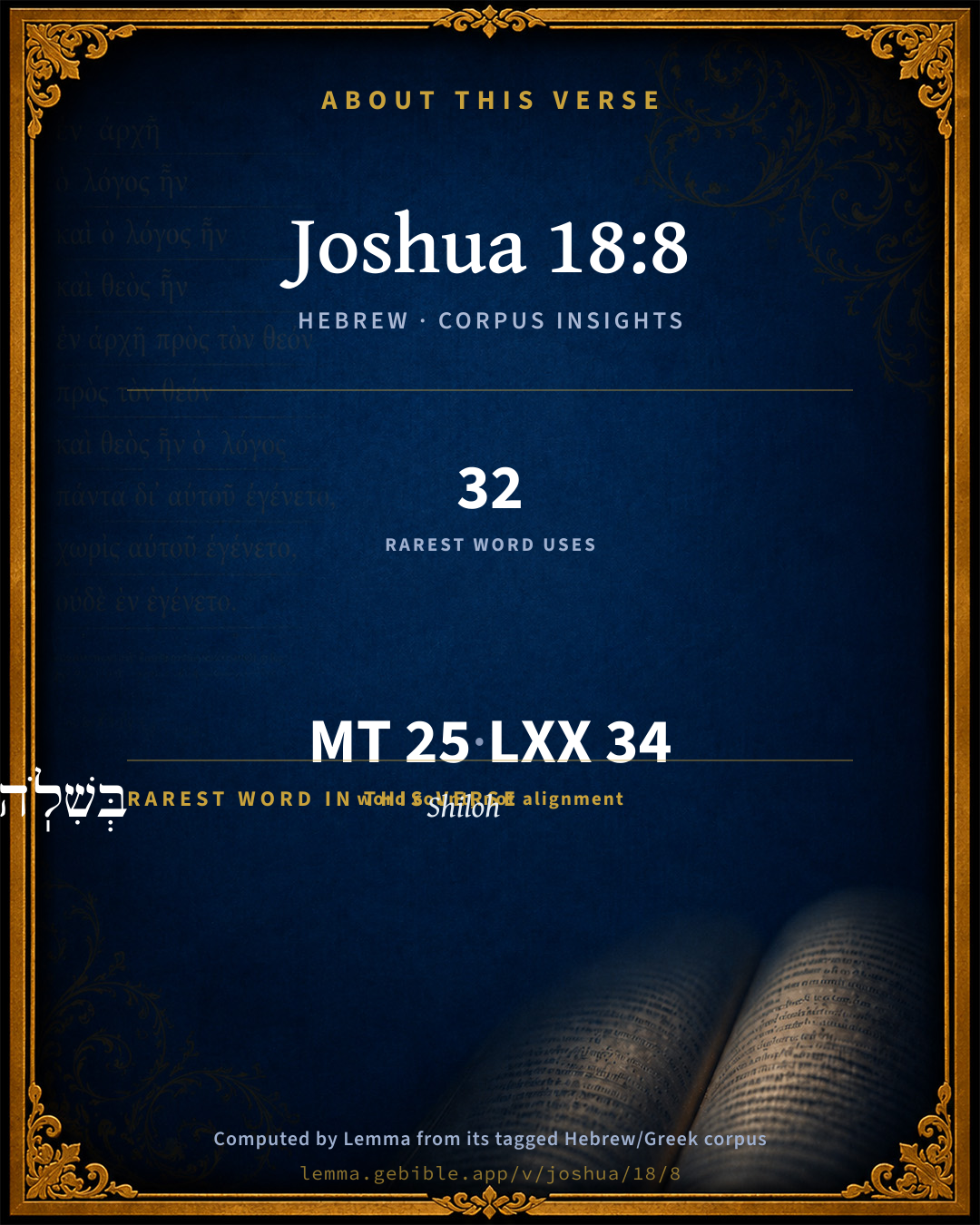
These counts appear in no published source. They are computed here, from the morphology-tagged text and Lemma’s own curated glosses. What Lemma adds →

25
words
18
distinct lemmas
Historical
section

Shared distinctive vocabulary

בְּשִׁלֹֽה Shiloh H7887 occurs in 30 verses of the Hebrew Bible. Also found in:

Grammatical profile

  • 11 verbs
  • 8 nouns
  • 2 prepositions
  • 1 adverb
  • 3 particles

Verb forms

  • וַיָּקֻ֥מוּ Qal · Sequential Imperfect
  • וַיֵּלֵ֑כוּ Qal · Sequential Imperfect
  • וַיְצַ֣ו Piel · Sequential Imperfect
  • הַהֹלְכִים֩ Qal · Participle Active
  • לִכְתֹּ֨ב Qal · Infinitive Construct
  • לֵאמֹ֗ר Qal · Infinitive Construct
  • לְ֠כוּ Qal · Imperative
  • וְהִתְהַלְּכ֨וּ Hithpael · Imperative
  • וְכִתְב֤וּ Qal · Imperative
  • וְשׁ֣וּבוּ Qal · Imperative
  • אַשְׁלִ֨יךְ Hiphil · Imperfect

Repetition

Words recur within this verse — often emphatic in Hebrew:

  • וַיֵּלֵ֑כוּ to walk H3212 ×2
  • הַהֹלְכִים֩ to walk H1980 ×2
  • לִכְתֹּ֨ב to write H3789 ×2
  • הָאָ֜רֶץ land H776 ×2

Hebrew & Septuagint length

In English translation the verse runs 42 words from the Hebrew and 42 from the Septuagint (LXX English) — the same length.

A rough comparison of the two English renderings, which tokenize alike — not a word-level alignment.

Word counts can differ between the Hebrew and the Greek without any difference in meaning — e.g. the Hebrew direct-object marker אֵת has no separate Greek word, and Greek often adds the article ὁ.

In the original languages it is 25 Hebrew tokens and 34 Greek tokens — but the two are counted differently (Hebrew bundles its prefixes and suffixes into one token; the Greek is in lemma form), so that isn’t a like-for-like length.

Cross-references

11

Topical passages linked to Joshua 18:8 in the Treasury of Scripture Knowledge — connected by theme and wording, ordered by reader-vote popularity; previews shown in the World English Bible.

  • Joshua 18:10 Joshua cast lots for them in Shiloh before Yahweh: and there Joshua divided the land to the children of Israel according to their divisions.
  • Acts 1:24–26 They prayed, and said, "You, Lord, who know the hearts of all men, show which one of these two you have chosen
  • Romans 14:19 So then, let us follow after things which make for peace, and things by which we may build one another up.
  • Genesis 13:17 Arise, walk through the land in the length of it and in the breadth of it; for I will give it to you."
  • Joshua 7:16–18 So Joshua rose up early in the morning, and brought Israel near by their tribes; and the tribe of Judah was taken:
  • Joshua 13:7 Now therefore divide this land for an inheritance to the nine tribes, and the half-tribe of Manasseh.
  • Joshua 14:1–2 These are the inheritances which the children of Israel took in the land of Canaan, which Eleazar the priest, and Joshua the son of Nun, and the heads of the fathers' [houses] of the tribes of the children of Israel, distributed to them,
  • Joshua 15:1 The lot for the tribe of the children of Judah according to their families was to the border of Edom, even to the wilderness of Zin southward, at the uttermost part of the south.
  • Joshua 18:1 The whole congregation of the children of Israel assembled themselves together at Shiloh, and set up the tent of meeting there: and the land was subdued before them.
  • Joshua 18:6 You shall describe the land into seven portions, and bring [the description] here to me; and I will cast lots for you here before Yahweh our God.
  • 1 Samuel 14:41 Therefore Saul said to Yahweh, the God of Israel, Show the right. Jonathan and Saul were taken [by lot]; but the people escaped.

Cross-references courtesy of OpenBible.info (CC BY 4.0).

Hebrew and Greek witnesses Masoretic Hebrew ↔ Greek Septuagint

The same verse in the two great witnesses to the Old Testament, shown verse-for-verse.

These are two independent witnesses, not word-aligned to each other, and the Septuagint is shown in lemma (dictionary) form.

Hebrew Joshua 18:8 Masoretic · Westminster Leningrad Codex

וַיָּקֻ֥מוּ הָאֲנָשִׁ֖ים וַיֵּלֵ֑כוּ וַיְצַ֣ו יְהוֹשֻׁ֡עַ אֶת הַהֹלְכִים֩ לִכְתֹּ֨ב אֶת הָאָ֜רֶץ לֵאמֹ֗ר לְ֠כוּ וְהִתְהַלְּכ֨וּ בָאָ֜רֶץ וְכִתְב֤וּ אוֹתָהּ֙ וְשׁ֣וּבוּ אֵלַ֔י וּ֠פֹה אַשְׁלִ֨יךְ לָכֶ֥ם גּוֹרָ֛ל לִפְנֵ֥י יְהוָ֖ה בְּשִׁלֹֽה

The men arose, and went: and Joshua charged those who went to describe the land, saying, Go and walk through the land, and describe it, and come again to me; and I will cast lots for you here before Yahweh in Shiloh.

World English Bible · Public Domain

Greek LXX Joshua 18:8 Septuagint · lemma form

καί ἀναἵστημι ὁ ἀνήρ πορεύομαι καί ἐντέλλομαι ἰησοῦς ὁ ἀνήρ ὁ πορεύομαι χωροβατέω ὁ γῆ λέγω πορεύομαι καί χωροβατέω ὁ γῆ καί παραγίγνομαι πρός ἐγώ καί ὧδε ἐκφέρω σύ κλῆρος ἔναντι κύριος ἐν σηλω

And the men rose up and went; and Joshua charged the men who went to explore the land, saying, Go and explore the land, and come to me, and I will bring you forth a lot here before the Lord in Selo.

LXX2012 (modern English Septuagint) · Public Domain

Hebrew: Westminster Leningrad Codex (CC BY 4.0). Greek: Septuagint (public domain); English from LXX2012 (modern English Septuagint) (Public Domain). How the Septuagint differs from the Hebrew →

Targum (Aramaic paraphrase)

1

The Targum is the ancient Jewish Aramaic paraphrase of the Hebrew Scriptures — an interpretive translation, not the Hebrew text itself. Onkelos (literal) and Pseudo-Jonathan (expansive) render the Torah, and Jonathan the Prophets. Coverage is partial: where no permissively-licensed English translation exists for a verse, only the Aramaic is shown. This is verse-level text, not a word-by-word alignment to the Hebrew.

  1. Targum Jonathan Prophets (Joshua–Malachi)
    וְקָמוּ גַבְרַיָא וַאֲזַלוּ וּפַקֵיד יְהוֹשֻׁעַ יַת דַאֲזַלוּ לְמִכְתַּב יַת אַרְעָא לְמֵימָר אֱזִילוּ וְהַלִיכוּ בְאַרְעָא וּכְתוּבוּ יָתָהּ וְתוּבוּ לְוָתִי וְהָכָא אֶרְמֵי לְכוֹן עַדְבִין קֳדָם יְיָ בְּשִׁלֹה:

    (no public-domain English translation for this verse)

    Targum Jonathan — Aramaic: “Mikraot Gedolot” (public domain). English: “Sefaria Community Translation” (CC0 1.0 (public-domain dedication)); “London "Chaldee Paraphrase," 1871” (public domain). Text via Sefaria.

Commentary

Notes on Joshua 18:8 from classic Christian and Jewish commentators (each source and its license shown beneath its notes). The classic Christian expositions comment on the surrounding passage and are grouped to its opening verse, so a note may address several verses; the Jewish commentaries on the Tanakh (Rashi and others) are per-verse, so they appear only where the commentator wrote on this verse.

Lemma curates 59 commentaries, every one of them public domain or Creative Commons licensed, each selected and text-cleaned for this edition rather than reprinted as found. About our sources →

Trapp's Complete Commentary

John Trapp

Jos 18:8 And the men arose, and went away: and Joshua charged them that went to describe the land, saying, Go and walk through the land, and describe it, and come again to me, that I may here cast lots for you before the LORD in Shiloh.

Ver. 8. And the men arose and went away.] Without debates or delays, as if they had had wings and "wind in their wings," as Zec 5:9. God, saith Luther, loveth curristas, not quaeristas: such as will run and not reason, despatch and not dispute his commands.

John Trapp, A Commentary or Exposition upon All the Books of the Old and New Testament (1647–1656) — public domain. Text from a community e-Sword module.

Geneva Bible (1599)

Geneva Bible translators

By writing the names of every country and city.

Geneva Bible (1599) marginal notes — public domain. Text via Bolls.life.

John Gill's Exposition

And the men arose, and went away,.... The seven tribes took the advice of Joshua, chose three men out of each tribe, and presented them to him, who gave them their commission and instruction to go and describe the land of Canaan, not yet disposed of, and whether subdued, or not subdued; upon which they prepared for their journey, and took it, after he had given them the following charge:

and Joshua charged them that went to describe the land; before they departed from him:

saying, go and walk through the land; and take particular notice, and an exact survey of it, both of the quality and the quantity of it:

and describe it; its cities and towns, hills and dales, the goodness and badness of the soil, and put it down in a book, or lay it out in a map, that it may be discerned by the eye what number of cities, and what space of ground it contains, and what parts are hilly and woody, and what otherwise:

and come again to me; to make a report of it:

that I may cast lots for you before the Lord in Shiloh; that is, for the several tribes which they belonged to, and by whom they were chosen for this purpose.

John Gill's Exposition of the Whole Bible (1746–1763) — public domain (CC PDM 1.0). Text via the HelloAO Bible API.

Matthew Poole's English Annotations

The Levites have no part among you; therefore it shall be divided only into seven parts, as I have said.

Matthew Poole's English Annotations on the Holy Bible (1683–1685) — public domain. Text from a community e-Sword/MySword module.

The Pulpit Commentary

Shiloh. (see note on ver. 1 and Jos_24:1) The seat of the tabernacle became, for the present at least, the headquarters of the Israelites.

The Pulpit Commentary (1880–1919), ed. H.D.M. Spence-Jones & Joseph S. Exell — public domain. Text from a community e-Sword module.

Kretzmann's Popular Commentary

Paul E. Kretzmann

The Lot of Benjamin

v. 8. And the men, the twenty-one chosen from the tribes, arose and went away; and Joshua charged them that went to describe the land, saying, Go and walk through the land, and describe it, and come again to me, that I may here cast lots for you before the Lord in Shiloh.

v. 9. And the men went and passed through the land, and described it by cities, with special reference to the cities found throughout the unclaimed sections, into seven parts in a book, and came again to Joshua, to the host at Shiloh.

v. 10. And Joshua cast lots for them in Shiloh before the Lord; and there Joshua divided the land unto the children of Israel according to their divisions.

v. 11. And the lot of the tribe of the children of Benjamin came up, namely, when it was drawn from the urn, according to their families; and the coast of their lot, the territory allotted to them, came forth between the children of Judah and the children of Joseph, north of Judah and south of Ephraim.

v. 12. And their border on the north side was from Jordan, beginning at the river; and the border went up to the side of Jericho on the north side, the site of this city thus being included in the territory of Benjamin, and went up through the mountains westward, west and northwest of this city, Jos 16:1; and the goings out thereof, the continuation of the boundary line, were at the wilderness of Bethaven, the bare and rocky heights east of Bethel.

v. 13. And the border went over from thence toward Luz, to the side of Luz, which is Bethel, southward, the city itself thus being included in this territory; and the border descended to Atarothadar, near the hill that lieth on the south side of the nether Bethhoron, Jos 16:2.

v. 14. And the border was drawn thence, and compassed the corner of the sea southward, it turned southward on the western boundary of Benjamin, from the hill that lieth before Bethhoron southward; and the goings out thereof were at Kirjathbaal, which is Kirjathjearim, a city of the children of Judah, Jos 15:9; this was the west quarter.

v. 15. And the south quarter was from the end of Kirjathjearim, from the boundaries of this city, and the border went out on the west, westward, and went out to the well of the waters of Nephtoah, Jos 15:9;

v. 16. and the border came down to the end of the mountain that lieth before the valley of the son of Hinnom, and which is in the Valley of the Giants on the north, and descended to the Valley of Hinnom, to the side of Jebusi, Jerusalem, on the south, and descended to Enrogel,

v. 17. and was drawn from the north, northward, and went forth to Enshemesh, and went forth to Geliloth, toward the west, which is over against the going up of Adummim, and descended to the stone of Bohan, the son of Reuben,

v. 18. and passed along. toward the side over against Arabah, the eastern plain, northward, and went down unto Arabah, the plain in which Jericho is situated;

v. 19. and the border passed along to the side of Bethhoglah northward; and the outgoings of the border were at the north bay of the Salt Sea at the south end, the mouth, of Jordan; this was the south coast. This description coincides with that of the north border of Judah, Jos 15:5-9, only the southeast corner being determined a little more exactly.

v. 20. And Jordan was the border of it, Benjamin’s territory, on the east side. This was the inheritance of the children of Benjamin, by their coasts thereof round about, according to their families.

v. 21. Now the cities of the tribe of the children of Benjamin according to their families were Jericho, and Bethhoglah, and the valley of Keziz, Emekkeziz, between Jerusalem and Jericho,

v. 22. and Betharabah, and Zemaraim, and Bethel,

v. 23. and Avim, probably the same as Ai, and Parah, and Ophrah,

v. 24. and Chepharhaamonai, and Ophni, and Gaba, some ten miles north of Jerusalem: twelve cities with their villages, those of the eastern half of the territory of Benjamin.

v. 25. Gibeon, Jos 10:1-15, and Ramah, and Beeroth,

v. 26. and Mizpeh, 1Sa 7:5-15, and Chephirah, near Gibeon, and Mozah,

v. 27. and Rekem, and Irpeel, and Taralah,

v. 28. and Zeiah, Eleph, and Jebusi, which is Jerusalem, Gibeath, later known as Gibeah of Saul, 1Sa 10:26; 1Sa 11:4; 1Sa 15:34, and Kirjath: fourteen cities with their villages, all of them in the western part of Benjamin’s territory. This is the inheritance of the children of Benjamin according to their families.

Paul E. Kretzmann, Popular Commentary of the Bible (1921–1924) — public domain. Text from a community e-Sword module.

unfoldingWord translationNotes

Door43 World Missions Community

General Information:

Joshua speaks to the twenty-one men who were to go look at the land.

up and down in the land

The words "up and down" mean in every direction. See how you translated this in Joshua 18:4. AT: "in every direction in the land" or "throughout the land" (See: Idiom)

translationWords

command

lots

Shiloh

scroll

unfoldingWord translationNotes — © Distant Shores Media and the Door43 World Missions Community, licensed CC BY-SA 4.0. Source: git.door43.org/Door43/en_tn.

Lesson kit

Teaching starters — assembled from the data on this page, not authored interpretation. Every prompt links to the verse data it draws on. Edit before teaching.

Joshua, in the Historical, opens this verse with 25 words (18 distinct Hebrew lemmas). Its most distinctive word is Shîylôh (“Shiloh”). A historical commentator’s framing appears above. Read the whole chapter for the surrounding context.

Discussion questions

  1. The word Shîylôh carries the sense “Shiloh.” How does it shape the verse?
  2. How does Joshua 18:1, which shares the word «Shiloh», read alongside this verse?
  3. What does the repetition of “to walk” (2× in this one verse) do in this verse?
  4. These translations render this verse differently. What is at stake in choosing one wording over another?
  5. «וַיָּקֻ֥מוּ» is a Qal Sequential Imperfect verb. How does that grammatical form shape the action described?
  6. Compare how Trapp's Complete Commentary and Geneva Bible (1599) read this verse. Where do they agree or differ?

Things to notice

Reading settings

Reading text

Shown beneath each verse's original-language words.

Old Testament
Old Testament edition

Read the OT as the Masoretic Hebrew (MT) or the Greek Septuagint (LXX).

English shown for the Greek Septuagint (in the Hebrew ↔ Greek comparison).

Comparing translations? Open the Compare panel on any verse page to stack up to four side by side.