
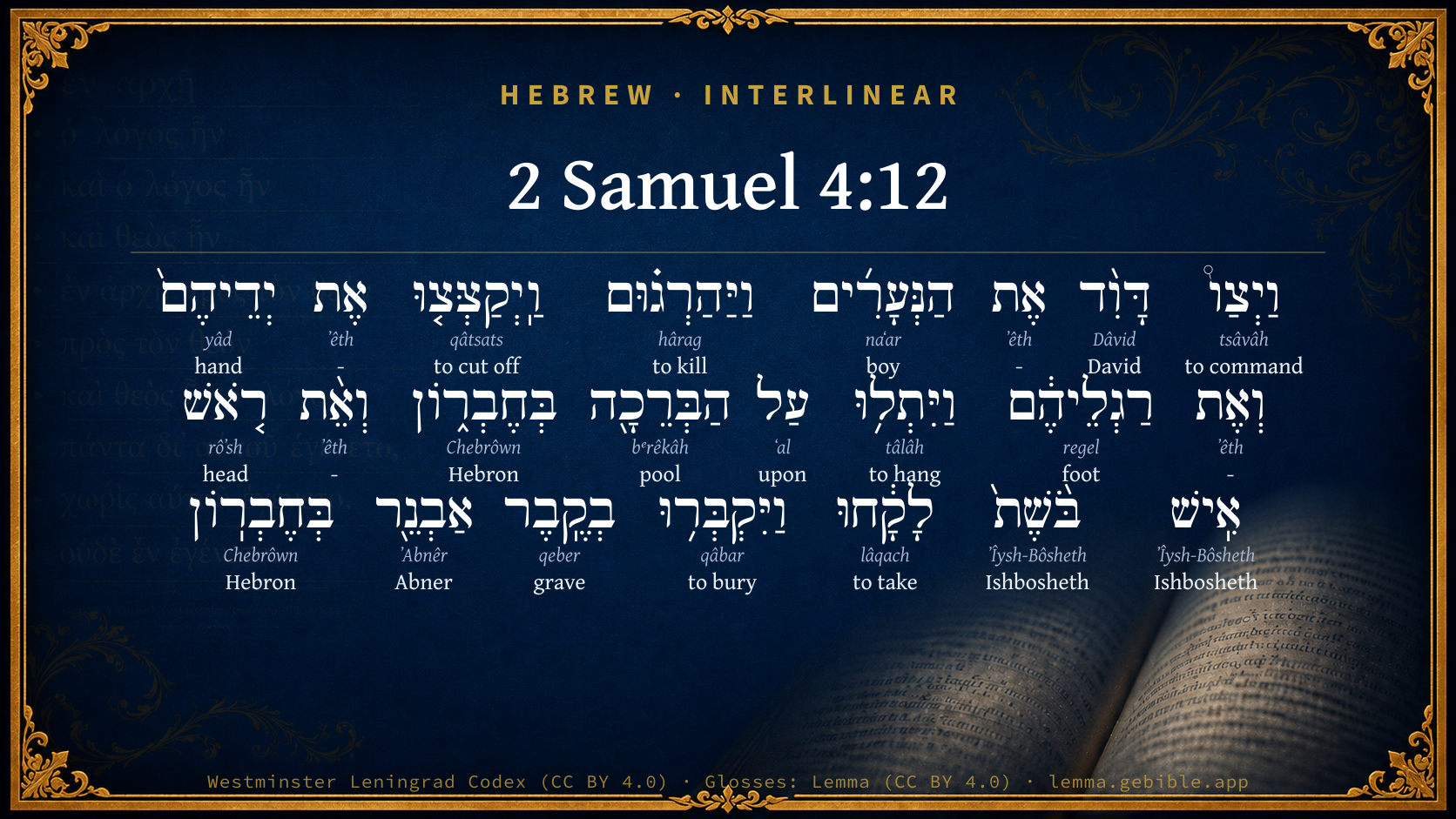
2 Samuel 4:12

Hebrew (Westminster Leningrad Codex) 2 Samuel 4:12 appears in the Hebrew Old Testament. The text above is from the Westminster Leningrad Codex. Each word links to its Strong’s number, a concise gloss, and parsing drawn from the Open Scriptures Hebrew Bible morphology. Click any word for its full Brown-Driver-Briggs (BDB) entry.
Download image
Cite this verse

2 Samuel 4:12 (World English Bible). Public Domain. Lemma interlinear Bible study tool, https://lemma.gebible.app/v/2-samuel/4/12.

Show BibTeX & RIS
BibTeX
RIS
English Translation
David commanded his young men, and they killed them, and cut off their hands and their feet, and hanged them up beside the pool in Hebron. But they took the head of Ish-bosheth, and buried it in the grave of Abner in Hebron.
World English Bible · Public Domain
Download a study sheet

One document with this verse’s original text, its word-by-word gloss line, the meaning frame, cross-references with their text, attributed commentary, and full source and license credits — printable, and it pastes into notes with its structure intact.

This verse Autodidact and up

Study sheet (.html) Plain text (.txt)

A passage Seminary Student

Up to 50 verses in one chapter. A passage sheet keeps up to 6 commentary sources and 12 cross-references per verse, in the order this page ranks them, and says so on the sheet whenever that leaves anything out. Ask for a single verse and you get the Autodidact verse sheet above.

Everything on this page stays free to read, with no account — the sheet is a download of what is already on screen, not access to it.

Want to remove ads? Support Godless Engineer
Compare translations 3

The same verse in 3 English versions, stacked beneath the original-language interlinear above. Click any original word for its lexicon entry.

Each is an independent rendering of the whole verse — the interlinear is not word-aligned to these translations.

Highlighted words mark where these versions differ — a whole-verse word diff, not a word-by-word alignment.

  • World English Bible Public Domain
    David commanded his young men, and they killed them, and cut off their hands and their feet, and hanged them up beside the pool in Hebron. But they took the head of Ish-bosheth, and buried it in the grave of Abner in Hebron.
  • King James Version Public Domain
    And David commanded his young men, and they slew them, and cut off their hands and their feet, and hanged them up over the pool in Hebron. But they took the head of Ishbosheth, and buried it in the sepulchre of Abner in Hebron.
  • unfoldingWord Literal Text CC BY-SA 4.0
    And David commanded the young men, and they killed them, and they cut off their hands and their feet, and they hung beside the pool in Hebron. But the head of Ish Bosheth, they took and buried in the grave of Abner in Hebron.

unfoldingWord Literal Text — © unfoldingWord, licensed CC BY-SA 4.0. Word-aligned USFM3 via Door43 (git.door43.org/unfoldingWord/en_ult).

Versions to compare (up to 4)

3 of 4 selected

Show all 18 translations

Every available English version of this verse, each an independent rendering of the whole verse.

  • World English Bible Public Domain
    David commanded his young men, and they killed them, and cut off their hands and their feet, and hanged them up beside the pool in Hebron. But they took the head of Ish-bosheth, and buried it in the grave of Abner in Hebron.
  • Berean Standard Bible Public Domain
    So David commanded his young men, and they killed Rechab and Baanah. They cut off their hands and feet and hung their bodies by the pool in Hebron, but they took the head of Ish-bosheth and buried it in Abner’s tomb in Hebron.
  • Majority Standard Bible Public Domain
    So David commanded his young men, and they killed Rechab and Baanah. They cut off their hands and feet and hung their bodies by the pool in Hebron, but they took the head of Ish-bosheth and buried it in Abner’s tomb in Hebron.
  • King James Version Public Domain
    And David commanded his young men, and they slew them, and cut off their hands and their feet, and hanged them up over the pool in Hebron. But they took the head of Ishbosheth, and buried it in the sepulchre of Abner in Hebron.
  • American Standard Version (1901) Public Domain
    And David commanded his young men, and they slew them, and cut off their hands and their feet, and hanged them up beside the pool in Hebron. But they took the head of Ish-bosheth, and buried it in the grave of Abner in Hebron.
  • Revised Version (1885) Public Domain
    And David commanded his young men, and they slew them, and cut off their hands and their feet, and hanged them up beside the pool in Hebron. But they took the head of Ish-bosheth, and buried it in the grave of Abner in Hebron.
  • Geneva Bible (1599) Public Domain
    Then Dauid commanded his yong men, and they slew them, and cut off their hands and their feete, and hanged them vp ouer the poole in Hebron: but they tooke the head of Ishbosheth, and buried it in the sepulchre of Abner in Hebron.
  • Douay-Rheims (1899) Public Domain
    And David commanded his servants and they slew them: and cutting off their hands and feet, hanged them up over the pool in Hebron: but the head of Isboseth they took and buried in the sepulchre of Abner in Hebron.
  • Young's Literal Translation Public Domain
    And David commandeth the young men, and they slay them, and cut off their hands and their feet, and hang `them' over the pool in Hebron, and the head of Ish-Bosheth they have taken, and bury `it' in the burying-place of Abner in Hebron.
  • Literal Standard Version CC BY-SA 4.0
    And David commands the young men, and they slay them, and cut off their hands and their feet, and hang [them] over the pool in Hebron, and they have taken the head of Ish-Bosheth, and bury [it] in the burying-place of Abner in Hebron.
  • Unlocked Literal Bible CC BY-SA 4.0
    Then David gave orders to the young men, and they killed them and cut off their hands and feet and hung them up beside the pool at Hebron. But they took the head of Ishbosheth and buried it in the grave of Abner in Hebron.
  • unfoldingWord Literal Text CC BY-SA 4.0
    And David commanded the young men, and they killed them, and they cut off their hands and their feet, and they hung beside the pool in Hebron. But the head of Ish Bosheth, they took and buried in the grave of Abner in Hebron.
  • Darby Bible Public Domain
    And David commanded his young men, and they slew them, and cut off their hands and their feet, and hanged [them] up over the pool in Hebron. But they took the head of Ishbosheth, and buried it in the sepulchre of Abner in Hebron.
  • World Messianic Bible Public Domain
    David commanded his young men, and they killed them, cut off their hands and their feet, and hanged them up beside the pool in Hebron. But they took the head of Ishbosheth and buried it in Abner’s grave in Hebron.
  • Webster's Bible Public Domain
    And David commanded his young men, and they slew them, and cut off their hands and their feet, and hanged them over the pool in Hebron. But they took the head of Ish-bosheth, and buried it in the sepulcher of Abner in Hebron.
  • Free Bible Version CC BY-SA 4.0
    David gave the order to his men, and they killed Rechab and Baanah. They chopped off their hands and feet, and hung their bodies by the pool in Hebron. Then they took Ishbosheth's head and buried it in Abner's grave in Hebron.
  • Bible in Basic English Public Domain
    And David gave orders to his young men and they put them to death, cutting off their hands and their feet and hanging them up by the side of the pool in Hebron. But they took the head of Ish-bosheth and put it in its last resting-place with Abner's body in Hebron.
  • JPS Tanakh (1917) Public Domain
    And David commanded his young men, and they slew them, and cut off their hands and their feet, and hanged them up beside the pool in Hebron. But they took the head of Ish-bosheth, and buried it in the grave of Abner in Hebron.

Literal Standard Version (2020), Covenant Press — licensed CC BY-SA 4.0. Text via the HelloAO Bible API (eBible.org). Unlocked Literal Bible (unfoldingWord) — licensed CC BY-SA 4.0. Text via the HelloAO Bible API (eBible.org). unfoldingWord Literal Text — © unfoldingWord, licensed CC BY-SA 4.0. Word-aligned USFM3 via Door43 (git.door43.org/unfoldingWord/en_ult). Free Bible Version, Dr. Jonathan Gallagher — licensed CC BY-SA 4.0. Text via the HelloAO Bible API (eBible.org).

Word by word

More ways to search: Search by grammar → Find every occurrence → Compare this word →

Practice this passage: Drill this verse → Learn its vocabulary →

וַֽיְקַצְּצ֤וּ
qâtsats
H7112
“and · to cut off”
Conjunction + Verb, Piel, Sequential Imperfect, 3rd Person, Masculine, Plural
Part of Speech
Conjunction + Verb
Stem
Piel
Form
Sequential Imperfect
Person
3rd Person
Gender
Masculine
Number
Plural
Full BDB Definition

Origin: a primitive root

TWOT: 2060

to cut off - (Qal) to cut off - (Piel) to cut or hew off, cut in two, cut in pieces - (Pual) to be cut or hewn off
  1. וַיְצַו֩ tsâvâh H6680 “and · to command” Conjunction + Verb, Piel, Sequential Imperfect, 3rd Person, Masculine, Singular
  2. דָּוִ֨ד Dâvid H1732 “David” Noun, Proper
  3. אֶת ʼêth H853 “-” Particle, Direct Object
  4. הַנְּעָרִ֜ים naʻar H5288 “the · boys” Particle, Definite Article + Noun, Common, Masculine, Plural, Absolute
  5. וַיַּהַרְג֗וּם hârag H2026 “and · to kill · them” Conjunction + Verb, Qal, Sequential Imperfect, 3rd Person, Masculine, Plural + Suffix, Personal, 3rd Person, Masculine, Plural
  6. אֶת ʼêth H853 “-” Particle, Direct Object
  7. יְדֵיהֶם֙ yâd H3027 “hands · their” Noun, Common, Both, Dual, Construct + Suffix, Personal, 3rd Person, Masculine, Plural
  8. וְאֶת ʼêth H853 “and · -” Conjunction + Particle, Direct Object
  9. רַגְלֵיהֶ֔ם regel H7272 “feet · their” Noun, Common, Feminine, Dual, Construct + Suffix, Personal, 3rd Person, Masculine, Plural
  10. וַיִּתְל֥וּ tâlâh H8518 “and · to hang” Conjunction + Verb, Qal, Sequential Imperfect, 3rd Person, Masculine, Plural
  11. עַל ʻal H5921 “upon” Preposition
  12. הַבְּרֵכָ֖ה bᵉrêkâh H1295 “the · pool” Particle, Definite Article + Noun, Common, Feminine, Singular, Absolute
  13. בְּחֶבְר֑וֹן Chebrôwn H2275 “in/at · Hebron” Preposition + Noun, Proper
  14. וְאֵ֨ת ʼêth H853 “and · -” Conjunction + Particle, Direct Object
  15. רֹ֤אשׁ rôʼsh H7218 “head of” Noun, Common, Masculine, Singular, Construct
  16. אִֽישׁ ʼÎysh-Bôsheth H378 “Ishbosheth” Noun, Proper
  17. בֹּ֨שֶׁת֙ ʼÎysh-Bôsheth H378 “Ishbosheth” Noun, Proper
  18. לָקָ֔חוּ lâqach H3947 “to take” Verb, Qal, Perfect, 3rd Person, Common, Plural
  19. וַיִּקְבְּר֥וּ qâbar H6912 “and · to bury” Conjunction + Verb, Qal, Sequential Imperfect, 3rd Person, Masculine, Plural
  20. בְקֶֽבֶר qeber H6913 “in/at · grave of” Preposition + Noun, Common, Masculine, Singular, Construct
  21. אַבְנֵ֖ר ʼAbnêr H74 “Abner” Noun, Proper
  22. בְּחֶבְרֽוֹן Chebrôwn H2275 “in/at · Hebron” Preposition + Noun, Proper

About this verse

These counts appear in no published source. They are computed here, from the morphology-tagged text and Lemma’s own curated glosses. What Lemma adds →

23
words
18
distinct lemmas
Historical
section

Notable vocabulary

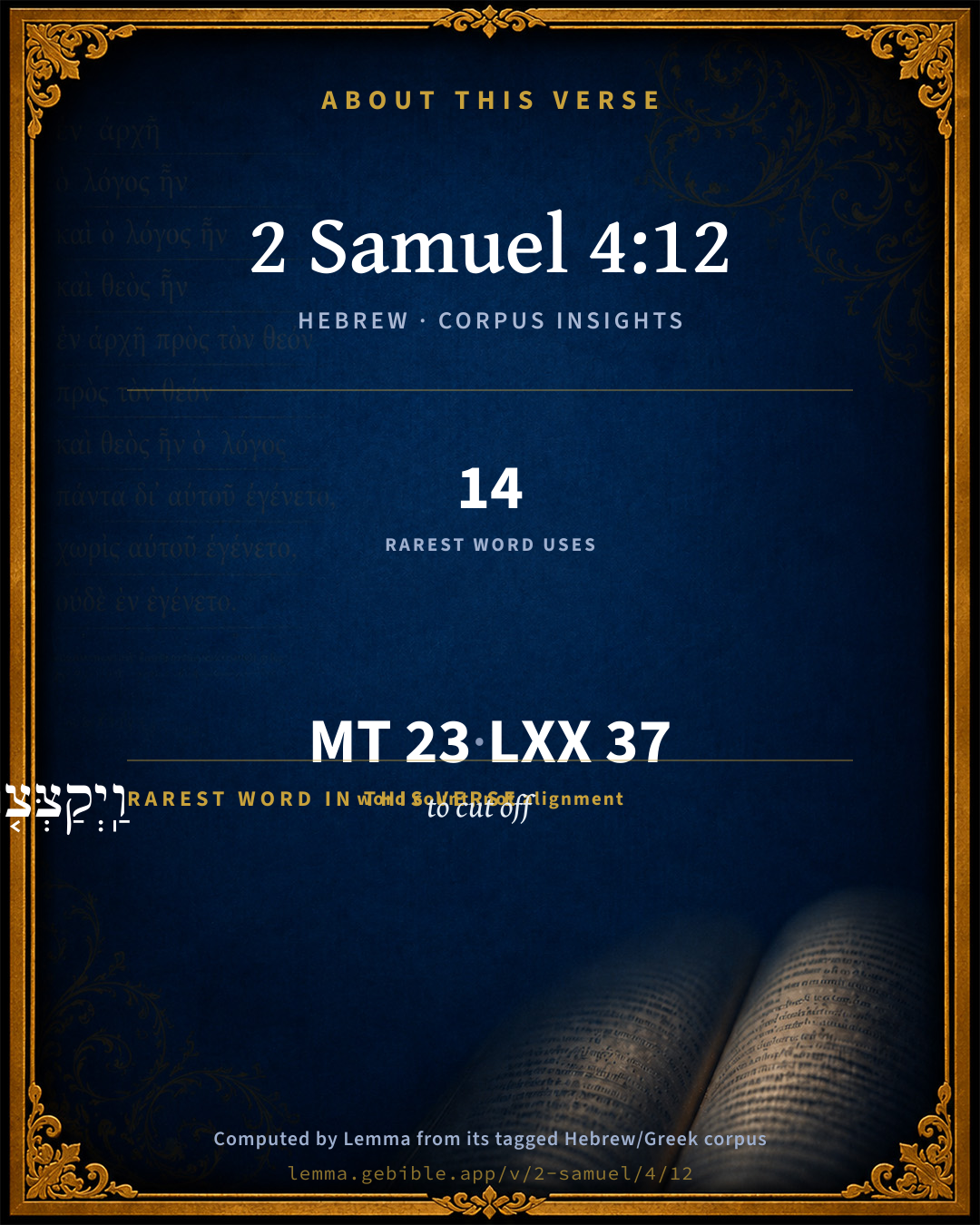
The rarest word here is וַֽיְקַצְּצ֤וּ to cut off H7112 — appearing just 14 times in the whole Hebrew Bible.

Shared distinctive vocabulary

וַֽיְקַצְּצ֤וּ to cut off H7112 occurs in 14 verses of the Hebrew Bible. Also found in:

Grammatical profile

  • 6 verbs
  • 12 nouns
  • 1 preposition
  • 4 particles

Verb forms

  • וַיְצַו֩ Piel · Sequential Imperfect
  • וַיַּהַרְג֗וּם Qal · Sequential Imperfect
  • וַֽיְקַצְּצ֤וּ Piel · Sequential Imperfect
  • וַיִּתְל֥וּ Qal · Sequential Imperfect
  • לָקָ֔חוּ Qal · Perfect
  • וַיִּקְבְּר֥וּ Qal · Sequential Imperfect

Repetition

Words recur within this verse — often emphatic in Hebrew:

  • בְּחֶבְר֑וֹן Hebron H2275 ×2
  • אִֽישׁ Ishbosheth H378 ×2

Hebrew & Septuagint length

In English translation the verse runs 43 words from the Hebrew and 44 from the Septuagint (LXX English) — closely comparable.

A rough comparison of the two English renderings, which tokenize alike — not a word-level alignment.

Word counts can differ between the Hebrew and the Greek without any difference in meaning — e.g. the Hebrew direct-object marker אֵת has no separate Greek word, and Greek often adds the article ὁ.

In the original languages it is 23 Hebrew tokens and 37 Greek tokens — but the two are counted differently (Hebrew bundles its prefixes and suffixes into one token; the Greek is in lemma form), so that isn’t a like-for-like length.

Cross-references

6

Topical passages linked to 2 Samuel 4:12 in the Treasury of Scripture Knowledge — connected by theme and wording, ordered by reader-vote popularity; previews shown in the World English Bible.

  • 2 Samuel 1:15 David called one of the young men, and said, Go near, and fall on him. He struck him, so that he died.
  • 2 Samuel 3:32 They buried Abner in Hebron: and the king lifted up his voice, and wept at the grave of Abner; and all the people wept.
  • Deuteronomy 21:22–23 If a man have committed a sin worthy of death, and he be put to death, and you hang him on a tree;
  • 2 Samuel 21:9 He delivered them into the hands of the Gibeonites, and they hanged them in the mountain before Yahweh, and they fell [all] seven together. They were put to death in the days of harvest, in the first days, at the beginning of barley harvest.
  • Psalms 55:23 But you, God, will bring them down into the pit of destruction. Bloodthirsty and deceitful men shall not live out half their days, But I will trust in you.
  • Matthew 7:2 For with whatever judgment you judge, you will be judged; and with whatever measure you measure, it will be measured to you.

Cross-references courtesy of OpenBible.info (CC BY 4.0).

Hebrew and Greek witnesses Masoretic Hebrew ↔ Greek Septuagint

The same verse in the two great witnesses to the Old Testament, shown verse-for-verse.

These are two independent witnesses, not word-aligned to each other, and the Septuagint is shown in lemma (dictionary) form.

Hebrew 2 Samuel 4:12 Masoretic · Westminster Leningrad Codex

וַיְצַו֩ דָּוִ֨ד אֶת הַנְּעָרִ֜ים וַיַּהַרְג֗וּם וַֽיְקַצְּצ֤וּ אֶת יְדֵיהֶם֙ וְאֶת רַגְלֵיהֶ֔ם וַיִּתְל֥וּ עַל הַבְּרֵכָ֖ה בְּחֶבְר֑וֹן וְאֵ֨ת רֹ֤אשׁ אִֽישׁ בֹּ֨שֶׁת֙ לָקָ֔חוּ וַיִּקְבְּר֥וּ בְקֶֽבֶר אַבְנֵ֖ר בְּחֶבְרֽוֹן

David commanded his young men, and they killed them, and cut off their hands and their feet, and hanged them up beside the pool in Hebron. But they took the head of Ish-bosheth, and buried it in the grave of Abner in Hebron.

World English Bible · Public Domain

Greek LXX 2 Samuel 4:12 Septuagint · lemma form

καί ἐντέλλω δαυίδ ὁ παιδάριον αὐτός καί ἀποκτείνω αὐτός καί κολοβόω ὁ χείρ αὐτός καί ὁ πούς αὐτός καί κρεμάζω αὐτός ἐπί ὁ κρήνη ἐν χεβρων καί ὁ κεφαλή μεμφιβοσθε θάπτω ἐν ὁ τάφος αβεννηρ υἱός νηρ

And David commanded his young men, and they kill them, and cut off their hands and their feet; and they hung them up at the fountain in Chebron: and they buried the head of Jebosthe in the tomb of Abenezer the son of Ner.

LXX2012 (modern English Septuagint) · Public Domain

Hebrew: Westminster Leningrad Codex (CC BY 4.0). Greek: Septuagint (public domain); English from LXX2012 (modern English Septuagint) (Public Domain). How the Septuagint differs from the Hebrew →

Targum (Aramaic paraphrase)

1

The Targum is the ancient Jewish Aramaic paraphrase of the Hebrew Scriptures — an interpretive translation, not the Hebrew text itself. Onkelos (literal) and Pseudo-Jonathan (expansive) render the Torah, and Jonathan the Prophets. Coverage is partial: where no permissively-licensed English translation exists for a verse, only the Aramaic is shown. This is verse-level text, not a word-by-word alignment to the Hebrew.

  1. Targum Jonathan Prophets (Joshua–Malachi)
    וּפַקֵיד דָוִד יַת עוּלֵמַיָא וְקַטְלִינוּן וּקְצִיצוּ יַת יְדֵיהוֹן וְיַת רַגְלֵיהוֹן וּצְלָבוּ עַל בְּרֵכָתָא בְּחֶבְרוֹן וְיַת רֵישׁ אִישׁ בּוֹשֶׁת נְסִיבוּ וּקְבָרוּ בְּקִבְרָא דְאַבְנֵר בְּחֶבְרוֹן:

    (no public-domain English translation for this verse)

    Targum Jonathan — Aramaic: “Mikraot Gedolot” (public domain). English: “Sefaria Community Translation” (CC0 1.0 (public-domain dedication)); “London "Chaldee Paraphrase," 1871” (public domain). Text via Sefaria.

Commentary

Notes on 2 Samuel 4:12 from classic Christian and Jewish commentators (each source and its license shown beneath its notes). The classic Christian expositions comment on the surrounding passage and are grouped to its opening verse, so a note may address several verses; the Jewish commentaries on the Tanakh (Rashi and others) are per-verse, so they appear only where the commentator wrote on this verse.

Lemma curates 59 commentaries, every one of them public domain or Creative Commons licensed, each selected and text-cleaned for this edition rather than reprinted as found. About our sources →

Trapp's Complete Commentary

John Trapp

2Sa 4:12 And David commanded his young men, and they slew them, and cut off their hands and their feet, and hanged [them] up over the pool in Hebron. But they took the head of Ishbosheth, and buried [it] in the sepulchre of Abner in Hebron.

Ver. 12. And they slew them.] Not without exquisite torments, saith Josephus; he crucified them, saith Theodoret.

And cut off their hands and their feet.] Those weapons of wickedness. God taketh notice of the offending members.

And hanged them up.] For a perpetual monument and punishment of their wickedness: and to declare David’s innocence.

John Trapp, A Commentary or Exposition upon All the Books of the Old and New Testament (1647–1656) — public domain. Text from a community e-Sword module.

Joseph Benson's Commentary

2Sa 4:12. David commanded, and they slew them — But what a disappointment to Baanah and Rechab was the sentence which David passed upon them! And such they will meet with who think to serve the Son of David by cruelty or injustice: who, under colour of religion, outrage or murder their brethren, and think they do God service. However men may now canonize such methods of serving the church and the catholic cause, Christ will let them know another day that Christianity was not designed to destroy humanity, And they who thus think to merit heaven, shall not escape the damnation of hell.

Joseph Benson's Commentary on the Old and New Testaments (1811–1818) — public domain. Text from a community e-Sword module.

Tyndale Open Study Notes

Tyndale Open Resources

4:12 cut off their hands and feet: Displaying the dismembered bodies of Ishbosheth’s killers shamed them by denying them proper burial (cp. 1 Sam 31:8-13); it was also a public testimony of David’s innocence in Ishbosheth’s death.

Tyndale Open Study Notes — © Tyndale Open Resources, licensed CC BY-SA 4.0. Text via the HelloAO Bible API.

Jamieson, Fausset & Brown

Robert Jamieson, A. R. Fausset & David Brown

DAVID CAUSES THEM TO BE PUT TO DEATH. (Sa2 4:10-12)

slew them, and cut off their hands and their feet--as the instruments in perpetrating their crime. The exposure of the mutilated remains was intended as not only a punishment of their crime, but also the attestation of David's abhorrence.

Next: 2 Samuel Chapter 5

Jamieson, Fausset & Brown — Commentary Critical and Explanatory on the Whole Bible (1871) — public domain (CC PDM 1.0). Text via the HelloAO Bible API.

Adam Clarke's Commentary

Verse 12. And they slew them] None ever more richly deserved death; and by this act of justice, David showed to all Israel that he was a decided enemy to the destruction of Saul's family; and that none could lift up their hands against any of them without meeting with condign punishment. In all these cases I know not that it was possible for David to show more sincerity, or a stricter regard for justice.

Adam Clarke's Commentary on the Bible (1810–1826) — public domain. Text from a community e-Sword/MySword module.

Ellicott's Commentary for English Readers

(12) Over the pool in Hebron.—The mutilation of the bodies of the criminals was itself a disgrace, and the hanging them up near the pool, to which all the people resorted, made this as public as possible and a terrible warning against the commission of such crimes by others. On the other hand, the head of Ish-bosheth was honourably buried in the sepulchre of his chief friend and supporter, Abner.

A Bible Commentary for English Readers, edited by Charles John Ellicott (1878–1897) — public domain. Text from a community e-Sword module.

The Cambridge Bible for Schools and Colleges

gen. ed. J. J. S. Perowne

12. And David commanded, &c.] Kitto compares the conduct of David towards the murderers of his rival with that of Alexander the Great towards Bessus, who murdered Darius, and of Caesar towards the murderers of Pompey. It may be questioned whether they were actuated by higher motives than “the traditional policy of rulers, who thus provide that they shall be protected for the present, and afterwards avenged” (Tac. Hist. I. 44), but David’s indignation was doubtless sincere.

cut off their hands and their feet] The hands which had been stretched out against their master, the feet which had been “swift to shed blood” and to seek reward, were exposed to view in the most public and frequented spot in Hebron, for a spectacle and a warning. Cp. Deu_21:22. We may compare the practice, formerly in vogue in this country, of exposing the heads and limbs of traitors on the city gates.

over the pool] Possibly one of the two great reservoirs, “doubtless of high antiquity,” which are still to be seen at Hebron. See Robinson’s Bibl. Res. II. 74.

The Cambridge Bible for Schools and Colleges (gen. ed. J. J. S. Perowne; Cambridge University Press, 1878–1918) — public domain. Text from a community e-Sword module.

Albert Barnes' Notes on the Bible

Cut off their hands ... - After they were dead. Their hands and feet were hung up in a place of public resort, both to deter others and also to let all Israel know that David was not privy to the murder of Ish-bosheth.

Albert Barnes' Notes on the Bible (1834–1885) — public domain. Text from a community e-Sword/MySword module.

Haydock's Catholic Bible Commentary

Feet, while they were alive, (Theodoret; Menochius) almost as Adonibezec had treated many; (Judges i. 6,) or they were first put to death, and the parts cut off were fastened to a cross; as the head and right hand of Cyrus were by his brother Artaxerxes. (Xenophon, Anab. iii.) (Calmet) --- Josephus seems to be of the former opinion, saying, "he ordered them to be executed in the most excruciating torments," "while the head of Jebosthe (Isboseth) was buried with all honour." (Antiquities vii. 2.) --- Thus David convinced the people that he would punish crimes, when it was in his power, and that he would give no encouragement to the treason or perfidy of any one. (Haydock)

George Leo Haydock (1774–1849), Haydock's Catholic Family Bible and Commentary, 1859 edition — public domain. Excludes Psalms (Douay-Rheims chapter numbering differs from Protestant) and Deuterocanonical books (Catholic canon only).

Matthew Poole's English Annotations

His young men; those of his guard, who used to execute justice upon malefactors at the king’s command.

Their hands and their feet; which had been most instrumental in this villany; their hands to cut off his head, and their feet to carry them away, and his head with them.

Hanged them up over the pool in Hebron; as monuments of their villany, and of David’s abhorrency of it.

Matthew Poole's English Annotations on the Holy Bible (1683–1685) — public domain. Text from a community e-Sword/MySword module.

Whedon's Commentary on the Bible

Daniel D. Whedon

12. Cut off their hands and their feet — The hands that wrought the bloody deed, and the feet that brought the horrid tidings. This punishment was executed in the spirit, but not in the letter, of the Mosaic law of retaliation — hand for hand, foot for foot. Exo_21:24.

The pool — Probably one of the large reservoirs still seen at Hebron.

Daniel D. Whedon (gen. ed.), Commentary on the Old and New Testaments (1874–1909) — public domain. Text from a community e-Sword module.

The Pulpit Commentary

They out off their hands and their feet. This was not intended for the purpose of mutilation, but to carry out an Eastern idea of retaliation. The hands were cut off because they had committed the murder; the feet, because they had brought the head to Hebron. Still, David was violating the spirit of the Mosaic Law. It ordered that the body of a man who had been put to death should be buried the same day. (Deu_21:23) In the face of this humane enactment, it is wonderful that the laws of Christian countries should have allowed the mutilation of the bodies of traitors, and the hanging on gibbets of criminals convicted of smaller crimes. Remembering, therefore, the customs of our fathers, we must not blame David much for suspending the bands and feet of these murderers at the pool of Hebron, that all, when coming for water, might know of their punishment. The head of Ishbosheth was honourably buried in Abner"s grave. (see 2Sa_3:32)

Ver. 12. (HEBRON.)

The reward of the wicked.

This book contains an account of many sudden and violent deaths (in addition to those that took place in battle) by assassination, suicide, (2Sa_17:23) the direct judgment of God, (2Sa_6:7) the judicial sentence of man. Capital punishment for murder was of old deemed right and necessary and divinely sanctioned. (see 2Sa_1:13-16) In this execution, we see that:

1. The agents by whom the purposes of God are effected (ver. 8) without his commission and from selfish motives are not entitled to the reward of faithful service, although they sometimes expect to obtain it, being turned aside by "a deceived heart.

2. The reward which wicked men obtain for their wickedness is the opposite of that which they expect (ver. 10). Even if they gain their immediate object, they fail to find therein the happiness they anticipated, and sooner or later suffer loss and woe.

3. The guilt of the crime which such men commit against a fellow man is aggravated by his innocence and the circumstances under which the crime is committed. "A righteous person in his own house upon his bed.

4. The authority to which they vainly appeal in justification of their conduct surely requires their condemnation. "He will by no means clear the guilty". (Exo_34:7) What they did as private persons to Ishbosheth without Divine commission, David, as king and "minister of God," was commissioned to do to them, and "take them away from the land" which the Lord had given, but which they had polluted and were unworthy to enjoy. "Gather not my soul with sinners, nor my life with bloody men". (Psa_26:9)

5. The example afforded by a severe and signal punishment is sometimes necessary to maintain public justice; to manifest the evil of sin and the certainty of retribution; to deter others from wrong doing. The hands that did the deed and the feet that "ran eagerly for reward" were cut off, and their bodies exposed to open shame.

He that"s merciful Unto the bad is cruel to the good.

1. The termination of strife in a land is usually attended with melancholy circumstances. "And they took the head of Ishbosheth," etc.

2. The saddest events are often succeeded by a season of gladness (1Ch_12:40) and prosperity, and even directly conducive to it. With the death of Ishbosheth "the whole resistance to David"s power collapses;" and "thus at last, not by his own act, but through circumstances over which he had no control allowed by him who gives liberty to each man, though he overrules the darkest deeds of the wicked for the evolving of good David was left undisputed claimant to the throne of Israel. Faith, patience, and integrity were vindicated; the Divine promise to David had come true in the course of natural events; and all this was better far than even if Saul had voluntarily resigned his place or Abner succeeded in his plans" (Edersheim). "Thus God will make all the sins of evil men to be one day ministerial to the extension and final settlement of the universal dominion of Christ" (Wordsworth). D.

The Pulpit Commentary (1880–1919), ed. H.D.M. Spence-Jones & Joseph S. Exell — public domain. Text from a community e-Sword module.

John Wesley's Explanatory Notes

David commanded. &c.But what a disappointment to Baanah and Rechab, was the sentence which David passed upon them! And such they will meet with, who think to serve the Son of David, by cruelty or injustice: who under colour of religion, outrage or murder of their brethren, think they do God service. However men may now canonize such methods of serving the church and the catholic cause, Christ will let them know another day, that Christianity was not designed to destroy humanity. And they who thus think to merit heaven, shall not escape the damnation of hell.

John Wesley, Explanatory Notes Upon the Whole Bible (1754–1765) — public domain. Text via the GEBible commentary corpus.

Keil & Delitzsch

C. F. Keil & F. Delitzsch

David then commanded his servant to slay the murderers, and also to make the punishment more severe than usual. "They cut off their hands and feet," - the hands with which they had committed the murder, and the feet which had run for the reward, - "and hanged the bodies by the pool at Hebron" for a spectacle and warning, that others might be deterred from committing similar crimes (cf. Deu 21:22; J. H. Michaelis). In illustration of the fact itself, we may compare the similar course pursued by Alexander towards the murderer of king Darius, as described in Justin's history (Sa2 12:6) and Curtius (Sa2 7:5). They buried Ishbosheth's head in Abner's grave at Hebron. Thus David acted with strict justice in this case also, not only to prove to the people that he had neither commanded nor approved of the murder, but from heartfelt abhorrence of such crimes, and to keep his conscience void of offence towards God and towards man.

Keil & Delitzsch — Biblical Commentary on the Old Testament (1861–1891) — public domain (CC PDM 1.0). Text via the HelloAO Bible API. (Old Testament only.)

Lesson kit

Teaching starters — assembled from the data on this page, not authored interpretation. Every prompt links to the verse data it draws on. Edit before teaching.

2 Samuel, in the Historical, opens this verse with 23 words (18 distinct Hebrew lemmas). Its most distinctive word is qâtsats (“to cut off”). A historical commentator’s framing appears above. Read the whole chapter for the surrounding context.

Discussion questions

  1. The word qâtsats carries the sense “to cut off.” How does it shape the verse?
  2. Exodus 39:3 shares the word «to cut off» with this verse. How do the two illuminate each other?
  3. “Hebron” occurs 2× in this one verse. What is the effect of the repetition?
  4. These translations render this verse differently; the difference is in the English rendering, not the original. What questions does that raise?
  5. The verb «וַיְצַו֩» is Piel Sequential Imperfect. How does its form color the action?
  6. Reading how Trapp's Complete Commentary and Joseph Benson's Commentary read this verse, where do the two commentators agree and where do they part?

Things to notice

Reading settings

Reading text

Shown beneath each verse's original-language words.

Old Testament
Old Testament edition

Read the OT as the Masoretic Hebrew (MT) or the Greek Septuagint (LXX).

English shown for the Greek Septuagint (in the Hebrew ↔ Greek comparison).

Comparing translations? Open the Compare panel on any verse page to stack up to four side by side.