
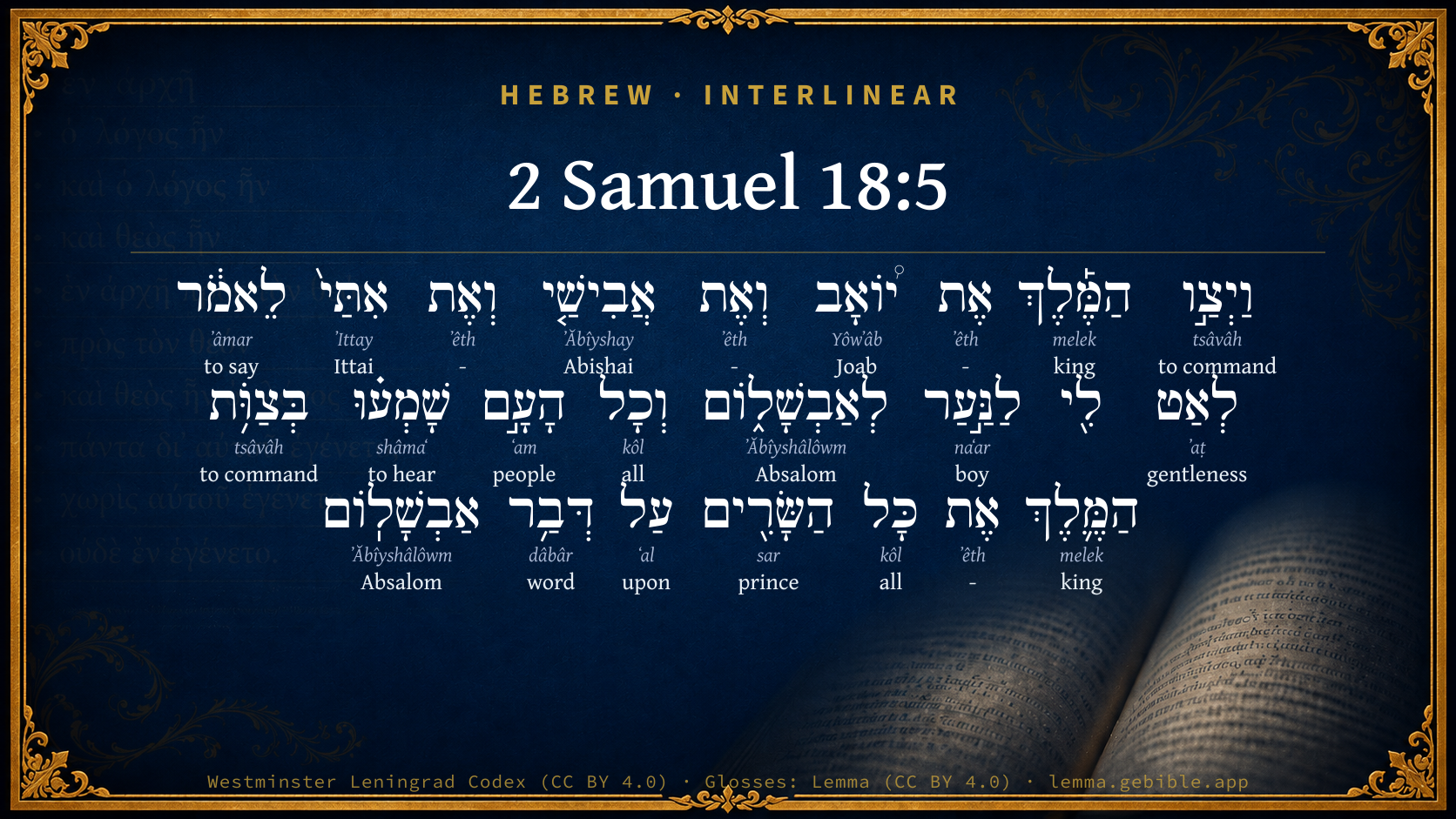
2 Samuel 18:5

Hebrew (Westminster Leningrad Codex) 2 Samuel 18:5 appears in the Hebrew Old Testament. The text above is from the Westminster Leningrad Codex. Each word links to its Strong’s number, a concise gloss, and parsing drawn from the Open Scriptures Hebrew Bible morphology. Click any word for its full Brown-Driver-Briggs (BDB) entry.
Download image
Cite this verse

2 Samuel 18:5 (World English Bible). Public Domain. Lemma interlinear Bible study tool, https://lemma.gebible.app/v/2-samuel/18/5.

Show BibTeX & RIS
BibTeX
RIS
English Translation
The king commanded Joab and Abishai and Ittai, saying, Deal gently for my sake with the young man, even with Absalom. All the people heard when the king gave all the captains charge concerning Absalom.
World English Bible · Public Domain
Download a study sheet

One document with this verse’s original text, its word-by-word gloss line, the meaning frame, cross-references with their text, attributed commentary, and full source and license credits — printable, and it pastes into notes with its structure intact.

This verse Autodidact and up

Study sheet (.html) Plain text (.txt)

A passage Seminary Student

Up to 50 verses in one chapter. A passage sheet keeps up to 6 commentary sources and 12 cross-references per verse, in the order this page ranks them, and says so on the sheet whenever that leaves anything out. Ask for a single verse and you get the Autodidact verse sheet above.

Everything on this page stays free to read, with no account — the sheet is a download of what is already on screen, not access to it.

Want to remove ads? Support Godless Engineer
Compare translations 3

The same verse in 3 English versions, stacked beneath the original-language interlinear above. Click any original word for its lexicon entry.

Each is an independent rendering of the whole verse — the interlinear is not word-aligned to these translations.

Highlighted words mark where these versions differ — a whole-verse word diff, not a word-by-word alignment.

  • World English Bible Public Domain
    The king commanded Joab and Abishai and Ittai, saying, Deal gently for my sake with the young man, even with Absalom. All the people heard when the king gave all the captains charge concerning Absalom.
  • King James Version Public Domain
    And the king commanded Joab and Abishai and Ittai, saying, Deal gently for my sake with the young man, even with Absalom. And all the people heard when the king gave all the captains charge concerning Absalom.
  • unfoldingWord Literal Text CC BY-SA 4.0
    And the king commanded Joab and Abishai and Ittai, saying, “Gently for me with the young man, with Absalom.” And all of the people heard when the king commanded all of the commanders about the matter of Absalom.

unfoldingWord Literal Text — © unfoldingWord, licensed CC BY-SA 4.0. Word-aligned USFM3 via Door43 (git.door43.org/unfoldingWord/en_ult).

Versions to compare (up to 4)

3 of 4 selected

Show all 18 translations

Every available English version of this verse, each an independent rendering of the whole verse.

  • World English Bible Public Domain
    The king commanded Joab and Abishai and Ittai, saying, Deal gently for my sake with the young man, even with Absalom. All the people heard when the king gave all the captains charge concerning Absalom.
  • Berean Standard Bible Public Domain
    Now the king had commanded Joab, Abishai, and Ittai, “Treat the young man Absalom gently for my sake.” And all the people heard the king’s orders to each of the commanders regarding Absalom.
  • Majority Standard Bible Public Domain
    Now the king had commanded Joab, Abishai, and Ittai, “Treat the young man Absalom gently for my sake.” And all the people heard the king’s orders to each of the commanders regarding Absalom.
  • King James Version Public Domain
    And the king commanded Joab and Abishai and Ittai, saying, Deal gently for my sake with the young man, even with Absalom. And all the people heard when the king gave all the captains charge concerning Absalom.
  • American Standard Version (1901) Public Domain
    And the king commanded Joab and Abishai and Ittai, saying, Deal gently for my sake with the young man, even with Absalom. And all the people heard when the king gave all the captains charge concerning Absalom.
  • Revised Version (1885) Public Domain
    And the king commanded Joab and Abishai and Ittai, saying, Deal gently for my sake with the young man, even with Absalom. And all the people heard when the king gave all the captains charge concerning Absalom.
  • Geneva Bible (1599) Public Domain
    And the King commanded Ioab and Abishai, and Ittai, saying, Entreate the yong man Absalom gently for my sake. and all the people heard whe the King gaue al the captaines charge concerning Absalom.
  • Douay-Rheims (1899) Public Domain
    And the king commanded Joab, and Abisai, and Ethai, saying: Save me the boy Absalom. And all the people heard the king giving charge to all the princes concerning Absalom.
  • Young's Literal Translation Public Domain
    and the king chargeth Joab, and Abishai, and Ittai, saying, `Gently -- for me, for the youth, for Absalom;' and all the people heard in the king's charging all the heads concerning Absalom.
  • Literal Standard Version CC BY-SA 4.0
    and the king charges Joab, and Abishai, and Ittai, saying, “[Deal] gently—for me, for the youth, for Absalom”; and all the people heard in the king’s charging all the heads concerning Absalom.
  • Unlocked Literal Bible CC BY-SA 4.0
    The king commanded Joab, Abishai, and Ittai saying, “Deal gently for my sake with the young man, with Absalom.” All the people heard that the king had given the captains this command about Absalom.
  • unfoldingWord Literal Text CC BY-SA 4.0
    And the king commanded Joab and Abishai and Ittai, saying, “Gently for me with the young man, with Absalom.” And all of the people heard when the king commanded all of the commanders about the matter of Absalom.
  • Darby Bible Public Domain
    And the king commanded Joab and Abishai and Ittai, saying, [Deal] gently for my sake with the young man Absalom. And all the people heard when the king gave all the captains charge concerning Absalom.
  • World Messianic Bible Public Domain
    The king commanded Joab and Abishai and Ittai, saying, “Deal gently for my sake with the young man Absalom.” All the people heard when the king commanded all the captains concerning Absalom.
  • Webster's Bible Public Domain
    And the king commanded Joab and Abishai and Ittai, saying, Deal gently for my sake with the young man, even with Absalom. And all the people heard when the king gave all the captains charge concerning Absalom.
  • Free Bible Version CC BY-SA 4.0
    The king ordered Joab, Abishai and Ittai, “Treat young Absalom gently for me.” All the men heard the king giving orders to each of his commanders about Absalom.
  • Bible in Basic English Public Domain
    And the king gave orders to Joab and Abishai and Ittai, saying, Because of me, be gentle to the young man Absalom. And this order about Absalom was given in the hearing of all the people.
  • JPS Tanakh (1917) Public Domain
    And the king commanded Joab and Abishai and Ittai, saying: 'Deal gently for my sake with the young man, even with Absalom.' And all the people heard when the king gave all the captains charge concerning Absalom.

Literal Standard Version (2020), Covenant Press — licensed CC BY-SA 4.0. Text via the HelloAO Bible API (eBible.org). Unlocked Literal Bible (unfoldingWord) — licensed CC BY-SA 4.0. Text via the HelloAO Bible API (eBible.org). unfoldingWord Literal Text — © unfoldingWord, licensed CC BY-SA 4.0. Word-aligned USFM3 via Door43 (git.door43.org/unfoldingWord/en_ult). Free Bible Version, Dr. Jonathan Gallagher — licensed CC BY-SA 4.0. Text via the HelloAO Bible API (eBible.org).

Word by word

More ways to search: Search by grammar → Find every occurrence → Compare this word →

Practice this passage: Drill this verse → Learn its vocabulary →

לְאַט
ʼaṭ
H328
“to/for · gentleness”
Preposition + Adverb
Part of Speech
Preposition + Adverb
Full BDB Definition

Origin: from an unused root perhaps meaning to move softly

TWOT: 72b

gentleness, softness - gently - flowing - softly - enchanter, necromancer (substantive)
  1. וַיְצַ֣ו tsâvâh H6680 “and · to command” Conjunction + Verb, Piel, Sequential Imperfect, 3rd Person, Masculine, Singular
  2. הַמֶּ֡לֶךְ melek H4428 “the · king” Particle, Definite Article + Noun, Common, Masculine, Singular, Absolute
  3. אֶת ʼêth H853 “-” Particle, Direct Object
  4. י֠וֹאָב Yôwʼâb H3097 “Joab” Noun, Proper
  5. וְאֶת ʼêth H853 “and · -” Conjunction + Particle, Direct Object
  6. אֲבִישַׁ֤י ʼĂbîyshay H52 “Abishai” Noun, Proper
  7. וְאֶת ʼêth H853 “and · -” Conjunction + Particle, Direct Object
  8. אִתַּי֙ ʼIttay H863 “Ittai” Noun, Proper
  9. לֵאמֹ֔ר ʼâmar H559 “to say” Preposition + Verb, Qal, Infinitive Construct
  10. לַנַּ֣עַר naʻar H5288 “to/for the · boy” Preposition, Determined + Noun, Common, Masculine, Singular, Absolute
  11. לְאַבְשָׁל֑וֹם ʼĂbîyshâlôwm H53 “to/for · Absalom” Preposition + Noun, Proper
  12. וְכָל kôl H3605 “and · all of” Conjunction + Noun, Common, Masculine, Singular, Construct
  13. הָעָ֣ם ʻam H5971 “the · people” Particle, Definite Article + Noun, Common, Masculine, Singular, Absolute
  14. שָׁמְע֗וּ shâmaʻ H8085 “to hear” Verb, Qal, Perfect, 3rd Person, Common, Plural
  15. בְּצַוֺּ֥ת tsâvâh H6680 “in/at · to command” Preposition + Verb, Piel, Infinitive Construct
  16. הַמֶּ֛לֶךְ melek H4428 “the · king” Particle, Definite Article + Noun, Common, Masculine, Singular, Absolute
  17. אֶת ʼêth H853 “-” Particle, Direct Object
  18. כָּל kôl H3605 “all of” Noun, Common, Masculine, Singular, Construct
  19. הַשָּׂרִ֖ים sar H8269 “the · princes” Particle, Definite Article + Noun, Common, Masculine, Plural, Absolute
  20. עַל ʻal H5921 “upon” Preposition
  21. דְּבַ֥ר dâbâr H1697 “word of” Noun, Common, Masculine, Singular, Construct
  22. אַבְשָׁלֽוֹם ʼĂbîyshâlôwm H53 “Absalom” Noun, Proper

About this verse

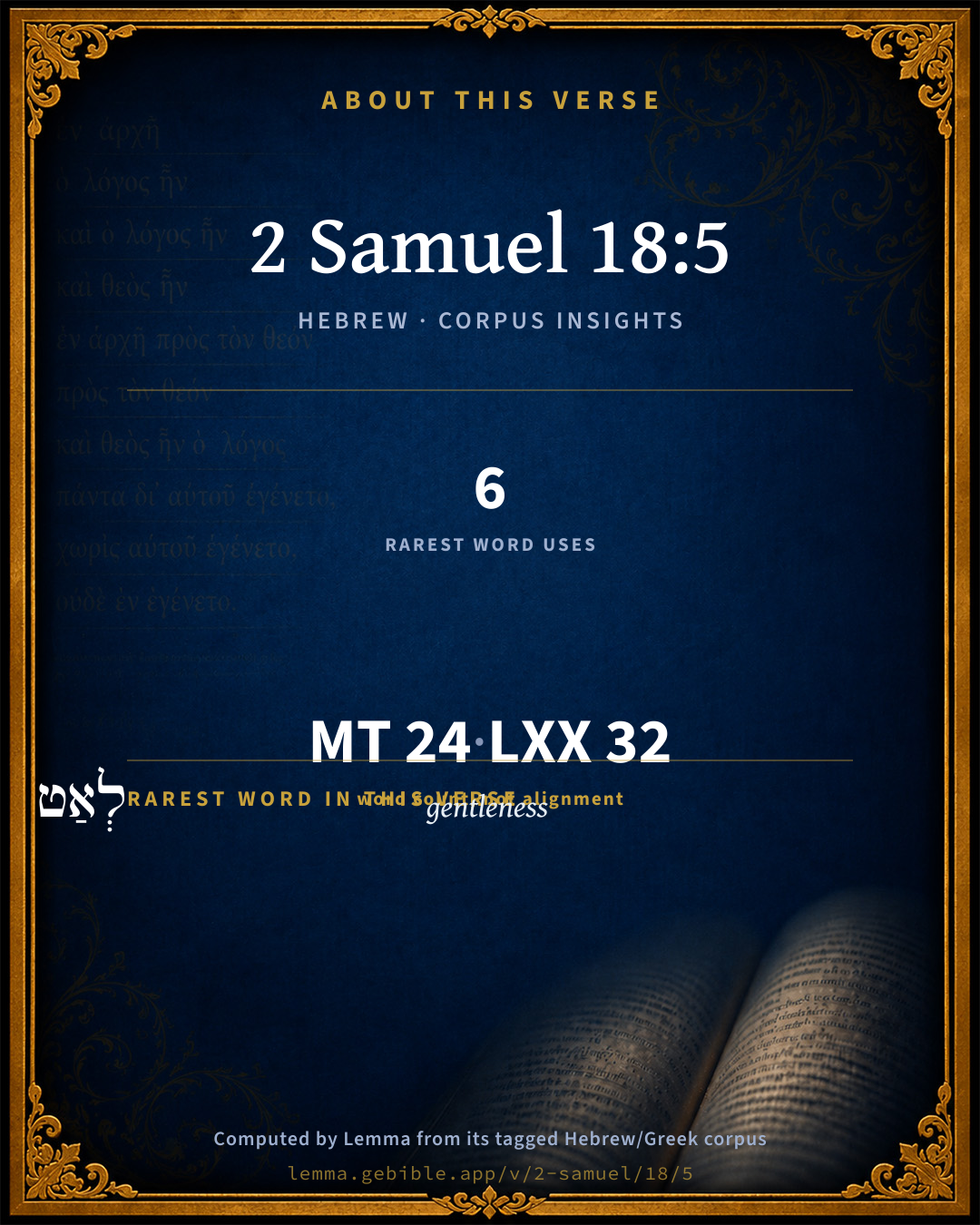
These counts appear in no published source. They are computed here, from the morphology-tagged text and Lemma’s own curated glosses. What Lemma adds →

24
words
16
distinct lemmas
Historical
section

Notable vocabulary

The rarest word here is לְאַט gentleness H328 — appearing just 6 times in the whole Hebrew Bible.

Shared distinctive vocabulary

לְאַט gentleness H328 occurs in 6 verses of the Hebrew Bible. Also found in:

Grammatical profile

  • 4 verbs
  • 13 nouns
  • 2 prepositions
  • 1 adverb
  • 4 particles

Verb forms

  • וַיְצַ֣ו Piel · Sequential Imperfect
  • לֵאמֹ֔ר Qal · Infinitive Construct
  • שָׁמְע֗וּ Qal · Perfect
  • בְּצַוֺּ֥ת Piel · Infinitive Construct

Repetition

Words recur within this verse — often emphatic in Hebrew:

  • וַיְצַ֣ו to command H6680 ×2
  • הַמֶּ֡לֶךְ king H4428 ×2
  • לְאַבְשָׁל֑וֹם Absalom H53 ×2
  • וְכָל all H3605 ×2

Hebrew & Septuagint length

In English translation the verse runs 35 words from the Hebrew and 31 from the Septuagint (LXX English) — closely comparable.

A rough comparison of the two English renderings, which tokenize alike — not a word-level alignment.

Word counts can differ between the Hebrew and the Greek without any difference in meaning — e.g. the Hebrew direct-object marker אֵת has no separate Greek word, and Greek often adds the article ὁ.

In the original languages it is 24 Hebrew tokens and 32 Greek tokens — but the two are counted differently (Hebrew bundles its prefixes and suffixes into one token; the Greek is in lemma form), so that isn’t a like-for-like length.

Cross-references

7

Topical passages linked to 2 Samuel 18:5 in the Treasury of Scripture Knowledge — connected by theme and wording, ordered by reader-vote popularity; previews shown in the World English Bible.

  • Deuteronomy 21:18–21 If a man have a stubborn and rebellious son, who will not obey the voice of his father, or the voice of his mother, and, though they chasten him, will not listen to them;
  • 2 Samuel 16:11 David said to Abishai, and to all his servants, Behold, my son, who came forth from my bowels, seeks my life: how much more [may] this Benjamite now [do it]? let him alone, and let him curse; for Yahweh has invited him.
  • 2 Samuel 17:1–4 Moreover Ahithophel said to Absalom, Let me now choose out twelve thousand men, and I will arise and pursue after David this night:
  • 2 Samuel 17:14 Absalom and all the men of Israel said, The counsel of Hushai the Archite is better than the counsel of Ahithophel. For Yahweh had ordained to defeat the good counsel of Ahithophel, to the intent that Yahweh might bring evil on Absalom.
  • 2 Samuel 18:12 The man said to Joab, Though I should receive a thousand [pieces of] silver in my hand, I still wouldn't put forth my hand against the king's son; for in our hearing the king charged you and Abishai and Ittai, saying, Beware that none touch the young man Absalom.
  • Psalms 103:13 Like a father has compassion on his children, So Yahweh has compassion on those who fear him.
  • Luke 23:34 Jesus said, "Father, forgive them, for they don't know what they are doing." Dividing his garments among them, they cast lots.

Cross-references courtesy of OpenBible.info (CC BY 4.0).

Hebrew and Greek witnesses Masoretic Hebrew ↔ Greek Septuagint

The same verse in the two great witnesses to the Old Testament, shown verse-for-verse.

These are two independent witnesses, not word-aligned to each other, and the Septuagint is shown in lemma (dictionary) form.

Hebrew 2 Samuel 18:5 Masoretic · Westminster Leningrad Codex

וַיְצַ֣ו הַמֶּ֡לֶךְ אֶת י֠וֹאָב וְאֶת אֲבִישַׁ֤י וְאֶת אִתַּי֙ לֵאמֹ֔ר לְאַט לִ֖י לַנַּ֣עַר לְאַבְשָׁל֑וֹם וְכָל הָעָ֣ם שָׁמְע֗וּ בְּצַוֺּ֥ת הַמֶּ֛לֶךְ אֶת כָּל הַשָּׂרִ֖ים עַל דְּבַ֥ר אַבְשָׁלֽוֹם

The king commanded Joab and Abishai and Ittai, saying, Deal gently for my sake with the young man, even with Absalom. All the people heard when the king gave all the captains charge concerning Absalom.

World English Bible · Public Domain

Greek LXX 2 Samuel 18:5 Septuagint · lemma form

καί ἐντέλλω ὁ βασιλεύς ὁ ιωαβ καί ὁ αβεσσα καί ὁ εθθι λέγω φείδομαι ἐγώ ὁ παιδάριον ὁ αβεσσαλωμ καί πᾶς ὁ λαός ἀκούω ἐντέλλω ὁ βασιλεύς πᾶς ὁ ἄρχων ὑπέρ αβεσσαλωμ

And the king commanded Joab and Abessa and Ethi, saying, Spare for my sake the young man Abessalom. And all the people heard the king charging all the commanders concerning Abessalom.

LXX2012 (modern English Septuagint) · Public Domain

Hebrew: Westminster Leningrad Codex (CC BY 4.0). Greek: Septuagint (public domain); English from LXX2012 (modern English Septuagint) (Public Domain). How the Septuagint differs from the Hebrew →

Targum (Aramaic paraphrase)

1

The Targum is the ancient Jewish Aramaic paraphrase of the Hebrew Scriptures — an interpretive translation, not the Hebrew text itself. Onkelos (literal) and Pseudo-Jonathan (expansive) render the Torah, and Jonathan the Prophets. Coverage is partial: where no permissively-licensed English translation exists for a verse, only the Aramaic is shown. This is verse-level text, not a word-by-word alignment to the Hebrew.

  1. Targum Jonathan Prophets (Joshua–Malachi)
    וּפַקֵיד מַלְכָּא יַת יוֹאָב וְיַת אֲבִישַׁי וְיַת אִתַּי לְמֵימַר אִסְתַּמָרוּ לִי בְּעוּלֵימָא בְאַבְשָׁלוֹם וְכָל עַמָא שְׁמָעוּ כַּד פַּקֵיד מַלְכָּא יַת כָּל רַבְרְבַיָא עַל עֵיסַק אַבְשָׁלוֹם:

    (no public-domain English translation for this verse)

    Targum Jonathan — Aramaic: “Mikraot Gedolot” (public domain). English: “Sefaria Community Translation” (CC0 1.0 (public-domain dedication)); “London "Chaldee Paraphrase," 1871” (public domain). Text via Sefaria.

Commentary

Notes on 2 Samuel 18:5 from classic Christian and Jewish commentators (each source and its license shown beneath its notes). The classic Christian expositions comment on the surrounding passage and are grouped to its opening verse, so a note may address several verses; the Jewish commentaries on the Tanakh (Rashi and others) are per-verse, so they appear only where the commentator wrote on this verse.

Lemma curates 59 commentaries, every one of them public domain or Creative Commons licensed, each selected and text-cleaned for this edition rather than reprinted as found. About our sources →

Jamieson, Fausset & Brown

Robert Jamieson, A. R. Fausset & David Brown

GIVES THEM CHARGE OF ABSALOM. (Sa2 18:5-13)

Deal gently for my sake with the young man, even with Absalom--This affecting charge, which the king gave to his generals, proceeded not only from his overwhelming affection for his children, but from his consciousness that this rebellion was the chastisement of his own crimes, Absalom being merely an instrument in the hand of retributive Providence;--and also from his piety, lest the unhappy prince should die with his sins unrepented of.

Jamieson, Fausset & Brown — Commentary Critical and Explanatory on the Whole Bible (1871) — public domain (CC PDM 1.0). Text via the HelloAO Bible API.

Trapp's Complete Commentary

John Trapp

2Sa 18:5 And the king commanded Joab and Abishai and Ittai, saying, [Deal] gently for my sake with the young man, [even] with Absalom. And all the people heard when the king gave all the captains charge concerning Absalom.

Ver. 5. Deal gently for my sake.] Heb., Leniter propter me, sc., agite. Though he hath deserved no favour, yet do something for me, who cannot grow out of kind, though he doth, who cannot choose but love him after all the unkindness, and am much afraid lest he should die in his sins. This is said to be the best line in all Terence,

“ Pro peccato magno paulum supplicii satis est patri. ”

A little punishment for a great offence seemeth to a father to be enough. It doth so surely to our heavenly Father. Laudent alii pietatem Dei, ego misericordiam. {a}

And all the people heard.] But no man ever heard David threaten, that if they slew Absalom, he would slay himself, as Josephus falsely saith that he did.

{a} August.

John Trapp, A Commentary or Exposition upon All the Books of the Old and New Testament (1647–1656) — public domain. Text from a community e-Sword module.

The Biblical Illustrator

Joseph S. Exell

2Sa_18:5

Deal gently for my sake with the young man, even with Absalom.

Grace for the graceless

Bishop Hall thus descants on this--What means this ill-placed love? This unjust mercy. Deal gently with a traitor. Of all traitors, with a son? Of all sons with an Absalom? that graceless darling of so good a father? And all this, for thy sake, whose crown, whose blood, he hunts after? For whose sake must he be pursued, if forborne for thine? Must the cause of the quarrel be the motive of the mercy? Even in the holiest parents nature may be guilty of an injurious tenderness, of a bloody indulgence. But was not this done in type of that immeasurable mercy of the true King and Redeemer of Israel, who prayed for his persecutors. Father, forgive them. Deal gently with them for my sake. When God sends an affliction to correct his children it is with this charge, Deal gently with them for my sake; for He knows our frame.

The Biblical Illustrator, edited by Joseph S. Exell (c. 1880s–1900s) — public domain. Text from a community e-Sword module.

Joseph Benson's Commentary

2Sa 18:5. Deal gently for my sake, &c. — If you conquer, (which he expected they would, from God’s gracious answer to his prayer, in turning Ahithophel’s counsel into foolishness,) take him prisoner, but do not kill him. Which desire proceeded from his great indulgence toward his children; from his consciousness that he himself was the meritorious cause of this rebellion, Absalom being given up to it for the punishment of David’s sins; from the consideration of Absalom’s youth, which commonly makes men foolish, and subject to ill counsels; and from David’s own piety, being loath that his son should be cut off in the act of his sin without any space for repentance. But “what means,” says Bishop Hall, “this ill-placed mercy? Deal gently with a traitor? Of all traitors, with a son? And all this for my sake, whose crown, whose blood he hunts after? Even in the holiest parents, nature may be guilty of an injurious tenderness. But was not this done in type of that unmeasurable mercy of the true King of Israel, who prayed for his murderers, Father, forgive them! Deal gently with them for my sake!” Yea, when God sends an affliction to correct his children, it is with this charge, Deal gently with them for my sake: for he knows our frame.

Joseph Benson's Commentary on the Old and New Testaments (1811–1818) — public domain. Text from a community e-Sword module.

Tyndale Open Study Notes

Tyndale Open Resources

18:5 Joab violated David’s order to deal gently with young Absalom (18:11-15). This was the second time Joab killed someone against David’s wishes (see 3:22-37).

Tyndale Open Study Notes — © Tyndale Open Resources, licensed CC BY-SA 4.0. Text via the HelloAO Bible API.

Adam Clarke's Commentary

Verse 5. Deal gently - with the young man] David was the father of this worthless young man; and is it to be wondered at that he feels as a father? Who in his circumstances, that had such feelings as every man should have, would have felt, or acted otherwise?

Adam Clarke's Commentary on the Bible (1810–1826) — public domain. Text from a community e-Sword/MySword module.

The Cambridge Bible for Schools and Colleges

gen. ed. J. J. S. Perowne

5. all the people heard] Cp. “in our hearing” in 2Sa_18:12.

The Cambridge Bible for Schools and Colleges (gen. ed. J. J. S. Perowne; Cambridge University Press, 1878–1918) — public domain. Text from a community e-Sword module.

John Gill's Exposition

And the king commanded Joab, and Abishai, and Ittai,.... His three generals, to whom he had committed his army divided into three parts:

saying, deal gently for my sake with the young man, even with Absalom; he does not call him his son, being in rebellion against him, but the young man, who was young, and rash, and foolish, and so to be pitied; his request is, that they would spare him, and not take away his life, when in their power; that they would not aim at him, and push him hard, and fall upon him with wrath and fury; but if he fell into their hands, to take him alive, and bring him away, and not put him to death. This flowed from a natural affection to him, and a concern for the welfare of his soul, that he might not die in this sin; and also from a consciousness that it was for his own sins that he was raised up to rebel against him; and he seems to speak as if he was certain that the battle would go for him, and against Absalom; and which he might conclude from the answer of prayer he had in defeating the counsel of Ahithophel:

and all the people heard when he gave all the captains charge concerning Absalom; not only the three generals, but all the captains of hundreds and thousands, and this was heard by the common soldiers as well as by the people of the city that were spectators on this occasion, see Sa2 18:12.

John Gill's Exposition of the Whole Bible (1746–1763) — public domain (CC PDM 1.0). Text via the HelloAO Bible API.

Haydock's Catholic Bible Commentary

Save us: do not hurt, ver. 12. St. Augustine (Doct. iii. 23.) concludes, that David wished to allow his son time for repentance. (Menochius) --- He seems to have been sure of victory. (Abulensis)

George Leo Haydock (1774–1849), Haydock's Catholic Family Bible and Commentary, 1859 edition — public domain. Excludes Psalms (Douay-Rheims chapter numbering differs from Protestant) and Deuterocanonical books (Catholic canon only).

Matthew Poole's English Annotations

Deal gently with Absalom; if you conquer, (which he presaged they would by God’s gracious answer to his prayer for the turning of Ahithophel’s counsel into foolishness,) take him prisoner, but do not kill him. Which desire proceeded, partly, from his great indulgence towards his children; partly, from David’s consciousness that he himself was the meritorious and procuring cause of this rebellion, Absalom being given up to it for the punishment of David’s sins, and therefore did indeed deserve some pity from him; partly, from the consideration of his youth, which commonly makes men foolish, and heady, and violent, and subject to ill counsels; and partly, from his piety, being loth that he should be cut off in the act of his sin without any space or means for repentance, whereby both his soul and body would be in danger to perish for ever. All the people, to wit, the citizens and others who stood with the king in the gate when the army marched forth.

Matthew Poole's English Annotations on the Holy Bible (1683–1685) — public domain. Text from a community e-Sword/MySword module.

Whedon's Commentary on the Bible

Daniel D. Whedon

5. Call now Hushai — Perhaps he was known to have met David in his flight, and therefore supposed to know the strength of his forces. His age also (compare note on 2Sa_15:33) entitled him to be heard.

5. Gently for my sake with the young man — Josephus says that he was afraid some mischief might befall himself if Absalom were slain. But it was David’s deep affection for the beautiful youth, which, notwithstanding all his errors, still yearned for him. The tenderness of the father exceeded the justice of the king.

Daniel D. Whedon (gen. ed.), Commentary on the Old and New Testaments (1874–1909) — public domain. Text from a community e-Sword module.

The Pulpit Commentary

All the people heard. The king spake so earnestly and strongly to the generals that the words ran from rank to rank as they marched forward. So in ver. 12 the man says to Joab, "In our hearing the king charged thee and Abishai," etc. It does not follow that each one heard the sound of the king"s voice, but only that the command was given publicly again and again, and in the presence of the army.

The Pulpit Commentary (1880–1919), ed. H.D.M. Spence-Jones & Joseph S. Exell — public domain. Text from a community e-Sword module.

John Wesley's Explanatory Notes

Deal gently - If you conquer (which be presaged they would by God's gracious answer to his prayer for the turning of Ahithophel's counsel into foolishness,) take him prisoner, but do not kill him. Which desire proceeded, from his great indulgence towards his children: from his consciousness that he himself was the meritorious cause of this rebellion, Absalom being given up to it for the punishment of David's sins; from the consideration of his youth, which commonly makes men foolish, and subject to ill counsels: and from his piety, being loth that he should be cut off in the act of his sin without any space for repentance. But "what means, says Bp. Hall, this ill-placed mercy? Deal gently with a traitor? Of all traitors with a son? And all this for thy sake, whose crown, whose blood he hunts after? Even in the holiest parents nature may be guilty of an injurious tenderness. But was not this done in type of that unmeasurable mercy, of the true King of Israel, who prayed for his murderers, Father, forgive them! Deal gently with them for my sake!" Yea, when God sends an affliction to correct his children, it is with this charge, deal gently with them for my sake: for he knows our frame.

John Wesley, Explanatory Notes Upon the Whole Bible (1754–1765) — public domain. Text via the GEBible commentary corpus.

unfoldingWord translationNotes

Door43 World Missions Community

Abishai

See how you translated this man's name in 2 Samuel 2:18. (See: How to Translate Names)

Ittai

See how you translated this man's name in 2 Samuel 15:19. (See: How to Translate Names)

Deal gently for my sake with the young man, with Absalom

"For my sake, do not harm the young man, Absalom." The phrase "Deal gently" means to be kind to someone and not to harm them.

my sake

"my well-being" or "my account"

translationWords

Absalom

unfoldingWord translationNotes — © Distant Shores Media and the Door43 World Missions Community, licensed CC BY-SA 4.0. Source: git.door43.org/Door43/en_tn.

Rashi

Rabbi Shlomo Yitzchaki (Rashi)

Be gentle to the young man. If he presents himself before you in battle have pity on him.

Rashi on the Tanakh — English translations: “The Judaica Press complete Tanach with Rashi, translated by A. J. Rosenberg” (CC BY 4.0); “Pentateuch with Rashi's commentary by M. Rosenbaum and A.M. Silbermann, 1929-1934” (public domain); “The Metsudah Tanach series, Lakewood, N.J” (CC BY 4.0); and “The Book of Joshua, Metsudah Publications, 1997” (CC BY 4.0). Text via Sefaria.

Lesson kit

Teaching starters — assembled from the data on this page, not authored interpretation. Every prompt links to the verse data it draws on. Edit before teaching.

2 Samuel, in the Historical, opens this verse with 24 words (16 distinct Hebrew lemmas). Its most distinctive word is ʼaṭ (“gentleness”). A historical commentator’s framing appears above. Read the whole chapter for the surrounding context.

Discussion questions

  1. How does “gentleness” (ʼaṭ) shape what this verse is saying?
  2. How does Genesis 33:14, which shares the word «gentleness», read alongside this verse?
  3. What does the repetition of “to command” (2× in this one verse) do in this verse?
  4. The translations on this page render this verse differently — a whole-verse word diff, not a word-by-word alignment. What might account for the different wordings?
  5. «וַיְצַ֣ו» is a Piel Sequential Imperfect verb. How does that grammatical form shape the action described?
  6. Compare how Jamieson, Fausset & Brown and Trapp's Complete Commentary read this verse. Where do they agree or differ?

Things to notice

Reading settings

Reading text

Shown beneath each verse's original-language words.

Old Testament
Old Testament edition

Read the OT as the Masoretic Hebrew (MT) or the Greek Septuagint (LXX).

English shown for the Greek Septuagint (in the Hebrew ↔ Greek comparison).

Comparing translations? Open the Compare panel on any verse page to stack up to four side by side.