

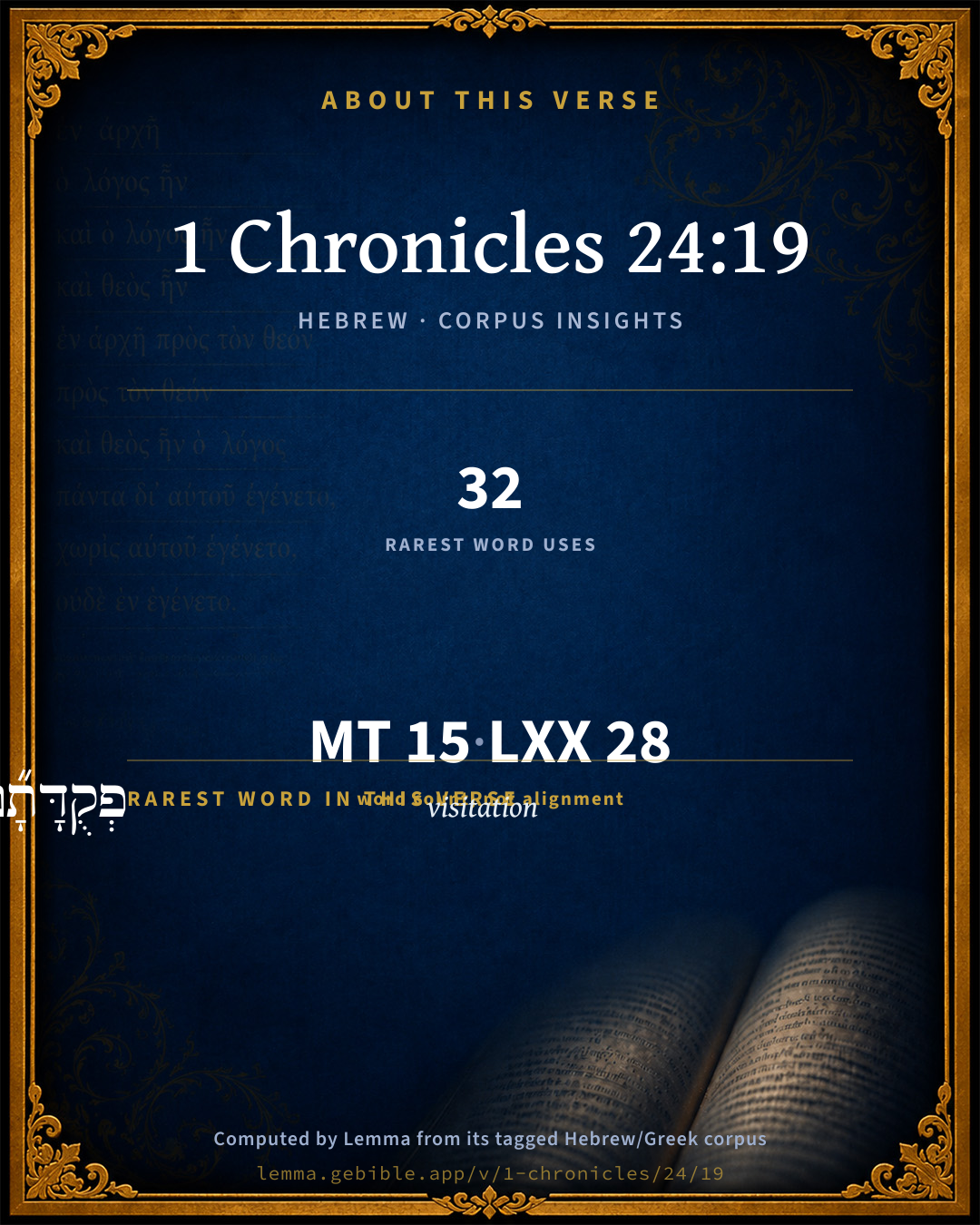
1 Chronicles 24:19

Hebrew (Westminster Leningrad Codex) 1 Chronicles 24:19 appears in the Hebrew Old Testament. The text above is from the Westminster Leningrad Codex. Each word links to its Strong’s number, a concise gloss, and parsing drawn from the Open Scriptures Hebrew Bible morphology. Click any word for its full Brown-Driver-Briggs (BDB) entry.
Download image
Cite this verse

1 Chronicles 24:19 (World English Bible). Public Domain. Lemma interlinear Bible study tool, https://lemma.gebible.app/v/1-chronicles/24/19.

Show BibTeX & RIS
BibTeX
RIS
English Translation
This was the ordering of them in their service, to come into the house of Yahweh according to the ordinance [given] to them by Aaron their father, as Yahweh, the God of Israel, had commanded him.
World English Bible · Public Domain
Download a study sheet

One document with this verse’s original text, its word-by-word gloss line, the meaning frame, cross-references with their text, attributed commentary, and full source and license credits — printable, and it pastes into notes with its structure intact.

This verse Autodidact and up

Study sheet (.html) Plain text (.txt)

A passage Seminary Student

Up to 50 verses in one chapter. A passage sheet keeps up to 6 commentary sources and 12 cross-references per verse, in the order this page ranks them, and says so on the sheet whenever that leaves anything out. Ask for a single verse and you get the Autodidact verse sheet above.

Everything on this page stays free to read, with no account — the sheet is a download of what is already on screen, not access to it.

Want to remove ads? Support Godless Engineer
Compare translations 3

The same verse in 3 English versions, stacked beneath the original-language interlinear above. Click any original word for its lexicon entry.

Each is an independent rendering of the whole verse — the interlinear is not word-aligned to these translations.

Highlighted words mark where these versions differ — a whole-verse word diff, not a word-by-word alignment.

  • World English Bible Public Domain
    This was the ordering of them in their service, to come into the house of Yahweh according to the ordinance [given] to them by Aaron their father, as Yahweh, the God of Israel, had commanded him.
  • King James Version Public Domain
    These were the orderings of them in their service to come into the house of the LORD, according to their manner, under Aaron their father, as the LORD God of Israel had commanded him.
  • unfoldingWord Literal Text CC BY-SA 4.0
    These the appointment for their service to come into the house of Yahweh according to their ordinance by the hand of Aaron their father, as Yahweh, the God of Israel, had commanded him.

unfoldingWord Literal Text — © unfoldingWord, licensed CC BY-SA 4.0. Word-aligned USFM3 via Door43 (git.door43.org/unfoldingWord/en_ult).

Versions to compare (up to 4)

3 of 4 selected

Show all 18 translations

Every available English version of this verse, each an independent rendering of the whole verse.

  • World English Bible Public Domain
    This was the ordering of them in their service, to come into the house of Yahweh according to the ordinance [given] to them by Aaron their father, as Yahweh, the God of Israel, had commanded him.
  • Berean Standard Bible Public Domain
    This was their appointed order for service when they entered the house of the LORD, according to the regulations prescribed for them by their forefather Aaron, as the LORD, the God of Israel, had commanded him.
  • Majority Standard Bible Public Domain
    This was their appointed order for service when they entered the house of the LORD, according to the regulations prescribed for them by their forefather Aaron, as the LORD, the God of Israel, had commanded him.
  • King James Version Public Domain
    These were the orderings of them in their service to come into the house of the LORD, according to their manner, under Aaron their father, as the LORD God of Israel had commanded him.
  • American Standard Version (1901) Public Domain
    This was the ordering of them in their service, to come into the house of Jehovah according to the ordinance `given' unto them by Aaron their father, as Jehovah, the God of Israel, had commanded him.
  • Revised Version (1885) Public Domain
    This was the ordering of them in their service, to come into the house of the LORD according to the ordinance given unto them by the hand of Aaron their father, as the LORD, the God of Israel, had commanded him.
  • Geneva Bible (1599) Public Domain
    These were their orders according to their offices, when they entred into the house of the Lord according to their custome vnder the hande of Aaron their father, as the Lord God of Israel had commanded him.
  • Douay-Rheims (1899) Public Domain
    These are their courses according to their ministries, to come into the house of the Lord, and according to their manner under the hand of Aaron their father: as the Lord the God of Israel had commanded.
  • Young's Literal Translation Public Domain
    These `are' their appointments for their service, to come in to the house of Jehovah, according to their ordinance by the hand of Aaron their father, as Jehovah God of Israel, commanded them.
  • Literal Standard Version CC BY-SA 4.0
    These [are] their appointments for their service, to come into the house of YHWH, according to their ordinance by the hand of their father Aaron, as YHWH God of Israel commanded them.
  • Unlocked Literal Bible CC BY-SA 4.0
    This was the order of their service, when they came into Yahweh's house, following the procedure given to them by Aaron their ancestor, as Yahweh, the God of Israel, had instructed him.
  • unfoldingWord Literal Text CC BY-SA 4.0
    These the appointment for their service to come into the house of Yahweh according to their ordinance by the hand of Aaron their father, as Yahweh, the God of Israel, had commanded him.
  • Darby Bible Public Domain
    This is their ordering in their service to come into the house of Jehovah, according to their ordinance, through Aaron their father, as Jehovah the God of Israel had commanded him.
  • World Messianic Bible Public Domain
    This was their ordering in their service, to come into the LORD’s house according to the ordinance given to them by Aaron their father, as the LORD, the God of Israel, had commanded him.
  • Webster's Bible Public Domain
    These were the orderings of them in their service to come into the house of the LORD, according to their manner, under Aaron their father, as the LORD God of Israel had commanded him.
  • Free Bible Version CC BY-SA 4.0
    This was the order in which each group were to serve when they came into the house of the Lord, following the procedure defined for them by their forefather Aaron, as instructed by the Lord, the God of Israel.
  • Bible in Basic English Public Domain
    So they were put into their different groups, to take their places in the house of the Lord, in agreement with the rules made by Aaron their father, as the Lord, the God of Israel, had given him orders.
  • JPS Tanakh (1917) Public Domain
    These were the orderings of them in their service, to come into the house of the LORD according to the ordinance given unto them by the hand of Aaron their father, as the LORD, the God of Israel, had commanded him.

Literal Standard Version (2020), Covenant Press — licensed CC BY-SA 4.0. Text via the HelloAO Bible API (eBible.org). Unlocked Literal Bible (unfoldingWord) — licensed CC BY-SA 4.0. Text via the HelloAO Bible API (eBible.org). unfoldingWord Literal Text — © unfoldingWord, licensed CC BY-SA 4.0. Word-aligned USFM3 via Door43 (git.door43.org/unfoldingWord/en_ult). Free Bible Version, Dr. Jonathan Gallagher — licensed CC BY-SA 4.0. Text via the HelloAO Bible API (eBible.org).

Word by word

More ways to search: Search by grammar → Find every occurrence → Compare this word →

Practice this passage: Drill this verse → Learn its vocabulary →

פְקֻדָּתָ֞ם
pᵉquddâh
H6486
“visitation · their”
Noun, Common, Feminine, Singular, Construct + Suffix, Personal, 3rd Person, Masculine, Plural
Part of Speech
Noun
Type
Common
Gender
Feminine
Number
Singular
State
Construct
Full BDB Definition

Origin: pass part of H6485

TWOT: 1802a

oversight, care, custody, mustering, visitation, store - visitation, punishment - oversight, charge, office, overseer, class of officers - mustering - store
  1. אֵ֣לֶּה ʼêl-leh H428 “these” Pronoun, Demonstrative, Common, Plural
  2. לַעֲבֹדָתָ֗ם ʻăbôdâh H5656 “to/for · service · their” Preposition + Noun, Common, Feminine, Singular, Construct + Suffix, Personal, 3rd Person, Masculine, Plural
  3. לָב֤וֹא bôwʼ H935 “to enter” Preposition + Verb, Qal, Infinitive Construct
  4. לְבֵית bayith H1004 “to/for · house of” Preposition + Noun, Common, Masculine, Singular, Construct
  5. יְהוָה֙ Yᵉhôvâh H3068 “LORD” Noun, Proper
  6. כְּמִשְׁפָּטָ֔ם mishpâṭ H4941 “like/as · judgment · their” Preposition + Noun, Common, Masculine, Singular, Construct + Suffix, Personal, 3rd Person, Masculine, Plural
  7. בְּיַ֖ד yâd H3027 “in/at · hand of” Preposition + Noun, Common, Both, Singular, Construct
  8. אַהֲרֹ֣ן ʼAhărôwn H175 “Aaron” Noun, Proper
  9. אֲבִיהֶ֑ם ʼâb H1 “father · their” Noun, Common, Masculine, Singular, Construct + Suffix, Personal, 3rd Person, Masculine, Plural
  10. כַּאֲשֶׁ֣ר ʼăsher H834 “like/as · which” Preposition + Particle, Relative
  11. צִוָּ֔הוּ tsâvâh H6680 “to command · him” Verb, Piel, Perfect, 3rd Person, Masculine, Singular + Suffix, Personal, 3rd Person, Masculine, Singular
  12. יְהוָ֖ה Yᵉhôvâh H3068 “LORD” Noun, Proper
  13. אֱלֹהֵ֥י ʼĕlôhîym H430 “God(s) of” Noun, Common, Masculine, Plural, Construct
  14. יִשְׂרָאֵֽל Yisrâʼêl H3478 “Israel” Noun, Proper

About this verse

These counts appear in no published source. They are computed here, from the morphology-tagged text and Lemma’s own curated glosses. What Lemma adds →

15
words
14
distinct lemmas
Historical
section

Shared distinctive vocabulary

פְקֻדָּתָ֞ם visitation H6486 occurs in 31 verses of the Hebrew Bible. Also found in:

Grammatical profile

  • 2 verbs
  • 11 nouns
  • 1 pronoun
  • 1 particle

Verb forms

  • לָב֤וֹא Qal · Infinitive Construct
  • צִוָּ֔הוּ Piel · Perfect

Repetition

A word recurs within this verse — often emphatic in Hebrew:

  • יְהוָה֙ LORD H3068 ×2

Hebrew & Septuagint length

In English translation the verse runs 36 words from the Hebrew and 34 from the Septuagint (LXX English) — closely comparable.

A rough comparison of the two English renderings, which tokenize alike — not a word-level alignment.

Word counts can differ between the Hebrew and the Greek without any difference in meaning — e.g. the Hebrew direct-object marker אֵת has no separate Greek word, and Greek often adds the article ὁ.

In the original languages it is 15 Hebrew tokens and 28 Greek tokens — but the two are counted differently (Hebrew bundles its prefixes and suffixes into one token; the Greek is in lemma form), so that isn’t a like-for-like length.

Cross-references

6

Topical passages linked to 1 Chronicles 24:19 in the Treasury of Scripture Knowledge — connected by theme and wording, ordered by reader-vote popularity; previews shown in the World English Bible.

  • 1 Chronicles 9:25 Their brothers, in their villages, were to come in every seven days from time to time to be with them:
  • 1 Corinthians 14:40 Let all things be done decently and in order.
  • Hebrews 7:11 Now if there was perfection through the Levitical priesthood (for under it the people have received the law), what further need was there for another priest to arise after the order of Melchizedek, and not be called after the order of Aaron?
  • 1 Chronicles 24:1 Thes were the divisions of the sons of Aaron. The sons of Aaron: Nadab and Abihu, Eleazar and Ithamar.
  • 2 Chronicles 23:4 This is the thing that you shall do: a third part of you, who come in on the Sabbath, of the priests and of the Levites, shall be porters of the thresholds;
  • 2 Chronicles 23:8 So the Levites and all Judah did according to all that Jehoiada the priest commanded: and they took every man his men, those who were to come in on the Sabbath; with those who were to go out on the Sabbath; for Jehoiada the priest didn't dismiss the shift.

Cross-references courtesy of OpenBible.info (CC BY 4.0).

Hebrew and Greek witnesses Masoretic Hebrew ↔ Greek Septuagint

The same verse in the two great witnesses to the Old Testament, shown verse-for-verse.

These are two independent witnesses, not word-aligned to each other, and the Septuagint is shown in lemma (dictionary) form.

Hebrew 1 Chronicles 24:19 Masoretic · Westminster Leningrad Codex

אֵ֣לֶּה פְקֻדָּתָ֞ם לַעֲבֹדָתָ֗ם לָב֤וֹא לְבֵית יְהוָה֙ כְּמִשְׁפָּטָ֔ם בְּיַ֖ד אַהֲרֹ֣ן אֲבִיהֶ֑ם כַּאֲשֶׁ֣ר צִוָּ֔הוּ יְהוָ֖ה אֱלֹהֵ֥י יִשְׂרָאֵֽל

This was the ordering of them in their service, to come into the house of Yahweh according to the ordinance [given] to them by Aaron their father, as Yahweh, the God of Israel, had commanded him.

World English Bible · Public Domain

Greek LXX 1 Chronicles 24:19 Septuagint · lemma form

οὗτος ὁ ἐπίσκεψις αὐτός κατά ὁ λειτουργία αὐτός ὁ εἰςπορεύομαι εἰς οἶκος κύριος κατά ὁ κρίσις αὐτός διά χείρ ἀαρών πατήρ αὐτός ὡς ἐντέλλομαι κύριος ὁ θεός ἰσραήλ

This is their numbering according to their service to go into the house of the Lord, according to their appointment by the hand of Aaron their father, as the Lord God of Israel commanded.

LXX2012 (modern English Septuagint) · Public Domain

Hebrew: Westminster Leningrad Codex (CC BY 4.0). Greek: Septuagint (public domain); English from LXX2012 (modern English Septuagint) (Public Domain). How the Septuagint differs from the Hebrew →

Commentary

Notes on 1 Chronicles 24:19 from classic Christian and Jewish commentators (each source and its license shown beneath its notes). The classic Christian expositions comment on the surrounding passage and are grouped to its opening verse, so a note may address several verses; the Jewish commentaries on the Tanakh (Rashi and others) are per-verse, so they appear only where the commentator wrote on this verse.

Lemma curates 59 commentaries, every one of them public domain or Creative Commons licensed, each selected and text-cleaned for this edition rather than reprinted as found. About our sources →

Trapp's Complete Commentary

John Trapp

1Ch 24:19 These [were] the orderings of them in their service to come into the house of the LORD, according to their manner, under Aaron their father, as the LORD God of Israel had commanded him.

Ver. 19. Under Aaron their father.] That is, Under the high priest, whoever he was.

John Trapp, A Commentary or Exposition upon All the Books of the Old and New Testament (1647–1656) — public domain. Text from a community e-Sword module.

Joseph Benson's Commentary

1Ch 24:19. These were the orderings of them — In this order and method they were to come to perform the offices of the temple. To come into the house — To come into the temple every sabbath day, and to continue there till the next sabbath, when they were relieved by others. Under Aaron — Under the direction of the high-priest, whom he calls Aaron, because he represented Aaron’s person, and executed his office; and their father — Because of the authority which, by God’s appointment, he had over them.

Joseph Benson's Commentary on the Old and New Testaments (1811–1818) — public domain. Text from a community e-Sword module.

Geneva Bible (1599)

Geneva Bible translators

By the dignity that God gave to Aaron.

Geneva Bible (1599) marginal notes — public domain. Text via Bolls.life.

Adam Clarke's Commentary

Verse 19. Under Aaron their father] That is, they followed the order and plans laid down by Aaron during his lifetime.

Adam Clarke's Commentary on the Bible (1810–1826) — public domain. Text from a community e-Sword/MySword module.

Ellicott's Commentary for English Readers

(19) These were the orderings of them in their service.—Better, These were their classes for their service.

According to their manner, under Aaron.—Better, according to their rule (or order; Vulg., ritum), ordained through Aaron, &c. (See Num_2:1; Num_4:1; Num_4:17.) All the sacerdotal functions were fixed, and each of the twenty-four classes undertook the weekly discharge of them in rotation with the rest, beginning on the Sabbath (2Ki_11:9; 2Ch_23:8). Josephus (Ant. vii. 14, 7) declares that the arrangements of David lasted down to his own day.

2. Recapitulation of the Levitical classes (1Ch_24:20-31). (Comp. 1Ch_23:12-23.)

A Bible Commentary for English Readers, edited by Charles John Ellicott (1878–1897) — public domain. Text from a community e-Sword module.

The Cambridge Bible for Schools and Colleges

gen. ed. J. J. S. Perowne

19. These were the orderings] R.V. This was the ordering.

their manner, under Aaron] R.V. the ordinance given unto them by the hand of Aaron.

the Lord God of Israel] R.V. the Lord the God of Israel.

The Cambridge Bible for Schools and Colleges (gen. ed. J. J. S. Perowne; Cambridge University Press, 1878–1918) — public domain. Text from a community e-Sword module.

John Gill's Exposition

These were the orderings of them,.... Their classes or courses into which they were divided:

in their service to come into the house of the Lord; to perform their service in the temple, according to their turns, and in course as fixed by lot; one class or course served one week, and then went out, and another came in, each consisting of 1000 men, see Ch1 23:4.

according to their manner; law, right, custom, here prescribed for them: under Aaron their father; that is, him who was high priest for the time being; who bore this name because his successor and representative, under whose inspection, direction, and authority, all the rest of the priests were, and whom they were to obey in all things:

as the Lord God of Israel had commanded him; to take care they should be done.

John Gill's Exposition of the Whole Bible (1746–1763) — public domain (CC PDM 1.0). Text via the HelloAO Bible API.

Albert Barnes' Notes on the Bible

These were the orderings ... - i. e., “this was the numerical order fixed for their ministerial attendance in the house of the Lord - an attendance which was after the manner determined for them by their forefather Aaron, according to instructions which he received from God.”

Albert Barnes' Notes on the Bible (1834–1885) — public domain. Text from a community e-Sword/MySword module.

Haydock's Catholic Bible Commentary

Aaron, and his successors. The former might have given some directions, which tradition had preserved. (Calmet)

George Leo Haydock (1774–1849), Haydock's Catholic Family Bible and Commentary, 1859 edition — public domain. Excludes Psalms (Douay-Rheims chapter numbering differs from Protestant) and Deuterocanonical books (Catholic canon only).

Matthew Poole's English Annotations

These were the orderings of them in their service; in this order and method they were to come to perform the offices of the temple. To come into the house of the Lord, according to their manner, i.e. to come into the temple every sabbath day, and to continue there all the week long until the next sabbath, when they were relieved by others, as the manner was: see 2Ki 11:5; 1Ch 9:25.

Under Aaron their father, i.e. under the inspection and direction of the high priest, whom he calls Aaron, because he represented his person, and executed his office, and also came out of his loins, and

their father, because of the authority which by God’s appointment he had over them, and that love, reverence, and obedience which they owed to him.

Matthew Poole's English Annotations on the Holy Bible (1683–1685) — public domain. Text from a community e-Sword/MySword module.

The Pulpit Commentary

The order has been thus given of the twenty-four classes or courses of the priests. Each course served a week from the seventh day to the seventh (2Ki_11:9; 2Ch_23:8) An interesting allusion to this order of courses is tacitly made in Eze_8:16-18, where the twenty-fifth idolater may be supposed to be the high priest.

Some have, on very insufficient grounds, supposed that this "ordering" of courses was not really the institution of David, but attributed to him after the Exile for the sake of the authority of his name. In Neh_12:1-7, moreover, the names do not appear as even twenty-four, but twenty-two deficient by two! a thing most easily to be accounted for. In additionto the direct scriptural witness on this subject, Josephus"s ("Ant.," 7:14) testimony confirms the account of our present chapter, while Movers (in "Chronik.," 279) and Dehler (in Herzog"s "R.E.," 12:185) effectively combat the positions of De Wette and Gramberg, and of Herzberg, in his "History of the People of Israel." The will of the Lord.

the Lord God of Israel had commanded him." These words may be said to constitute the key-note of the whole Law (Exo_39:42; Lev_27:34; Num_36:13; Deu_34:9) Just as Israel should pay heed to this commandment of Jehovah, so it would flourish and rejoice; in proportion as it should depart from these commandments, so it would fail and be distressed. Everything hung on a loyal obedience to the Divine will. There were three forms of obedience then, and there is the same number now. We look at both.

I THE THREE FORMS OF OBEDIENCE WHICH ISRAEL WAS TO RENDER.

1. Minute conformity to positive precept. Everything, to the smallestparticular, was to be "after the pattern" (Exo_25:9, Exo_25:40; Num_8:4) In the celebration of the sacrifices, the priests were to be studious to follow the exact directions given in the "command-merit of the Lord," and any deviation, though but slight and apparently immaterial in itself, would vitiate everything that was done.

2. Application of broad principles. It was hopeless to anticipate everypossible breach of such laws as, "Thou shall not defraud thy neighbour;" "Thou shall love thy neighbour as thyself." An interpretation and application of such commandments as these must have been left largely to the individual conscience.

3. Inquiry of the Lord to know his will, and so to do it. This was the case,like that recorded in this chapter, whenever the mind of God was taken by means of the lot (vers. 5, 6). A direct appeal was then made to him for his direction, and, thus gained, it was followed.

II THE FORMS OF OBEDIENCE TO WHICH OUR LORD IS SUMMONING US. They correspond to the preceding, yet differ ha some respects from them.

1. Christ has left us but few positive enactments. We seldom meet with any minute prescriptions regulating behaviour in our New Testament. Days, forms, and methods of devotion and service are left to our conscience and judgment. But there are some interdictions and requirements which still exist, and which bind us to the obedience of conformity to statute.

2. Christ requires of us that we make constant application of the broadprinciples he has taught us. He has said to us, "Love me: Follow me: Care for my friends and little ones: Walk in love, in humility, in purity: Do good and communicate," etc.; and he leaves it to those who bear his Name to apply and illustrate these his general commandments, in all the details of their individual, family, Church, national life. The man or the Church that does not try to find out the will of Christ from his life and his words, and to do that will when thus discovered, is "not worthy of him," is no true friend of his. (Joh_15:14)

3. Christ desires us to be continually seeking his will from his own DivineSpirit. He has promised to come to us, to dwell with us and within us, to instruct and inspire us by the communications of the Spirit of God. We are thus to learn his will, and, when thus directed, are to do what is right and pleasing in his sight. So far is the life of Christian obedience from being one that is merely formal and mechanical. In Christ Jesus the statutes are few; the application of heavenly principles is our daily duty; the inquiry of the Lord to know what he would have us do is our high privilege and our abiding obligation. C.

Ancient Divine rules preserved in modern adjustments.

David found it necessary to make alterations and adaptations when he reconstituted the worship for the new tabernacle and the anticipated temple, but in all his adaptations he anxiously preserved the Mosaic principles and the Mosaic order; thereby giving an important example of the spirit and the manner in which modern adjustments of permanent principles should be made. We must accept the fact of the changeableness of human life, thought, and forms of relationship and society. Age differs from age. A succeeding age will often strive to realize a contrast with the age preceding; it will prefer what it disliked, and put in the front what it had set in the background. We must take care that the changes are set under wise limitations, and the first of these is the fair and adequate representation, in the new scenes, of the old and permanent social, or moral, or religious principles. Some persons love change for change"s sake; and such persons often put the best things in peril, and prevent the noblest schemes for human well-being from gaining an adequate trial. Others resist change as if it were wholly wrong and injurious; and such persons help to keep the yokes pressing on men"s necks long after it is manifest how the neck has become galled and painful. And many persons fail to take "change" at the hopeful time, and so they lose all the finest opportunities that life brings. These diversities of relation to necessary change may be illustrated in relation to human customs, to political history, to ecclesiastical order, and to Church doctrine. We are instructed not to "meddle with those who are given to change;" but we have a very proper admiration for such a man as the Apostle St. Paul, who, with far-seeing wisdom, discerned how Judaism was passing into the broader spiritual Christianity, and put himself forward as a leader in the change. Another fact requires attention. All forms for the expression of principles tend to exhaust their capacity for expressing truth. Like vessels, or pipes, that get encrusted with use, they have to be taken away, and replaced by other and larger forms. All we have to care for, from the most conservative standpoint, is that the old life shall flow into and through the new forms, and that the new form shall be fully adequate to convey the great flow of the old life. We may even plead that, in view of the ever-varying wants of men, we should be ready to adopt new forms and modes in the religious life and service. Illustration may be taken from the attitude advisable towards such schemes as that of the Salvation Army, or modern mission halls and revivals. David lived in one of the so-called "periods of transition," and it is very interesting to mark how he led the change that was demanded, but carefully toned it with due reference to the rules and order which had been divinely given. We may more fully illustrate from practices and order of worship, customs of religious life, and Church doctrine, one necessary condition of change that may be regarded as wise and healthy the old rule, or principle, must find adequate expression in the new form. The form is bad if it dwarfs, or hides, or misrepresents, or attenuates the principle. The body must worthily and sufficiently express the man. If it be so that men ever gain a larger and fuller grasp of any principle or truth, they are following a genuine inspiration when they seek a larger form in which to give it expression. And this condition, duly observed, guarantees the safety of what is called "modern religious thought." This subject may be used to quiet the minds of those who fear the many and apparently extensive changes in the expression of religious truth in our times. We may be sure that God will watch jealously over his truth; and will have, in every age, godly men who will "earnestly contend for the faith once delivered to the saints. R.T.

The Pulpit Commentary (1880–1919), ed. H.D.M. Spence-Jones & Joseph S. Exell — public domain. Text from a community e-Sword module.

John Wesley's Explanatory Notes

These, &c. - In this order and method they were to come to perform the offices of the temple. To come - To come into the temple every sabbath-day, and to continue there 'till the next sabbath, when they were relieved by others. Aaron - Under the direction of the high-priests, whom he calls Aaron, because he represented his person and executed his office, and their father, because of the authority which by God's appointment he had over them.

John Wesley, Explanatory Notes Upon the Whole Bible (1754–1765) — public domain. Text via the GEBible commentary corpus.

Keil & Delitzsch

C. F. Keil & F. Delitzsch

These were the orderings of them,.... Their classes or courses into which they were divided:

in their service to come into the house of the Lord; to perform their service in the temple, according to their turns, and in course as fixed by lot; one class or course served one week, and then went out, and another came in, each consisting of 1000 men, see Ch1 23:4.

according to their manner; law, right, custom, here prescribed for them: under Aaron their father; that is, him who was high priest for the time being; who bore this name because his successor and representative, under whose inspection, direction, and authority, all the rest of the priests were, and whom they were to obey in all things:

as the Lord God of Israel had commanded him; to take care they should be done.

Keil & Delitzsch — Biblical Commentary on the Old Testament (1861–1891) — public domain (CC PDM 1.0). Text via the HelloAO Bible API. (Old Testament only.)

unfoldingWord translationNotes

Door43 World Missions Community

following the procedure given to them by Aaron their ancestor

This can be stated in active form. AT: "following the rules that Aaron their ancestor gave them" (See: Active or Passive)

translationWords

servant

house of God

Aaron

Yahweh

God

Israel

unfoldingWord translationNotes — © Distant Shores Media and the Door43 World Missions Community, licensed CC BY-SA 4.0. Source: git.door43.org/Door43/en_tn.

Rashi

Rabbi Shlomo Yitzchaki (Rashi)

These are their appointment[s] to their service Those who are written here are the heads of the watches. Their appointments were over the watches.

Rashi on the Tanakh — English translations: “The Judaica Press complete Tanach with Rashi, translated by A. J. Rosenberg” (CC BY 4.0); “Pentateuch with Rashi's commentary by M. Rosenbaum and A.M. Silbermann, 1929-1934” (public domain); “The Metsudah Tanach series, Lakewood, N.J” (CC BY 4.0); and “The Book of Joshua, Metsudah Publications, 1997” (CC BY 4.0). Text via Sefaria.

Lesson kit

Teaching starters — assembled from the data on this page, not authored interpretation. Every prompt links to the verse data it draws on. Edit before teaching.

1 Chronicles, in the Historical, opens this verse with 15 words (14 distinct Hebrew lemmas). Its most distinctive word is pᵉquddâh (“visitation”). A historical commentator’s framing appears above. Read the whole chapter for the surrounding context.

Discussion questions

  1. How does “visitation” (pᵉquddâh) shape what this verse is saying?
  2. How does Numbers 3:32, which shares the word «visitation», read alongside this verse?
  3. What does the repetition of “LORD” (2× in this one verse) do in this verse?
  4. These translations render this verse differently. What is at stake in choosing one wording over another?
  5. «לָב֤וֹא» is a Qal Infinitive Construct verb. How does that grammatical form shape the action described?
  6. Compare how Trapp's Complete Commentary and Joseph Benson's Commentary read this verse. Where do they agree or differ?

Things to notice

Reading settings

Reading text

Shown beneath each verse's original-language words.

Old Testament
Old Testament edition

Read the OT as the Masoretic Hebrew (MT) or the Greek Septuagint (LXX).

English shown for the Greek Septuagint (in the Hebrew ↔ Greek comparison).

Comparing translations? Open the Compare panel on any verse page to stack up to four side by side.