
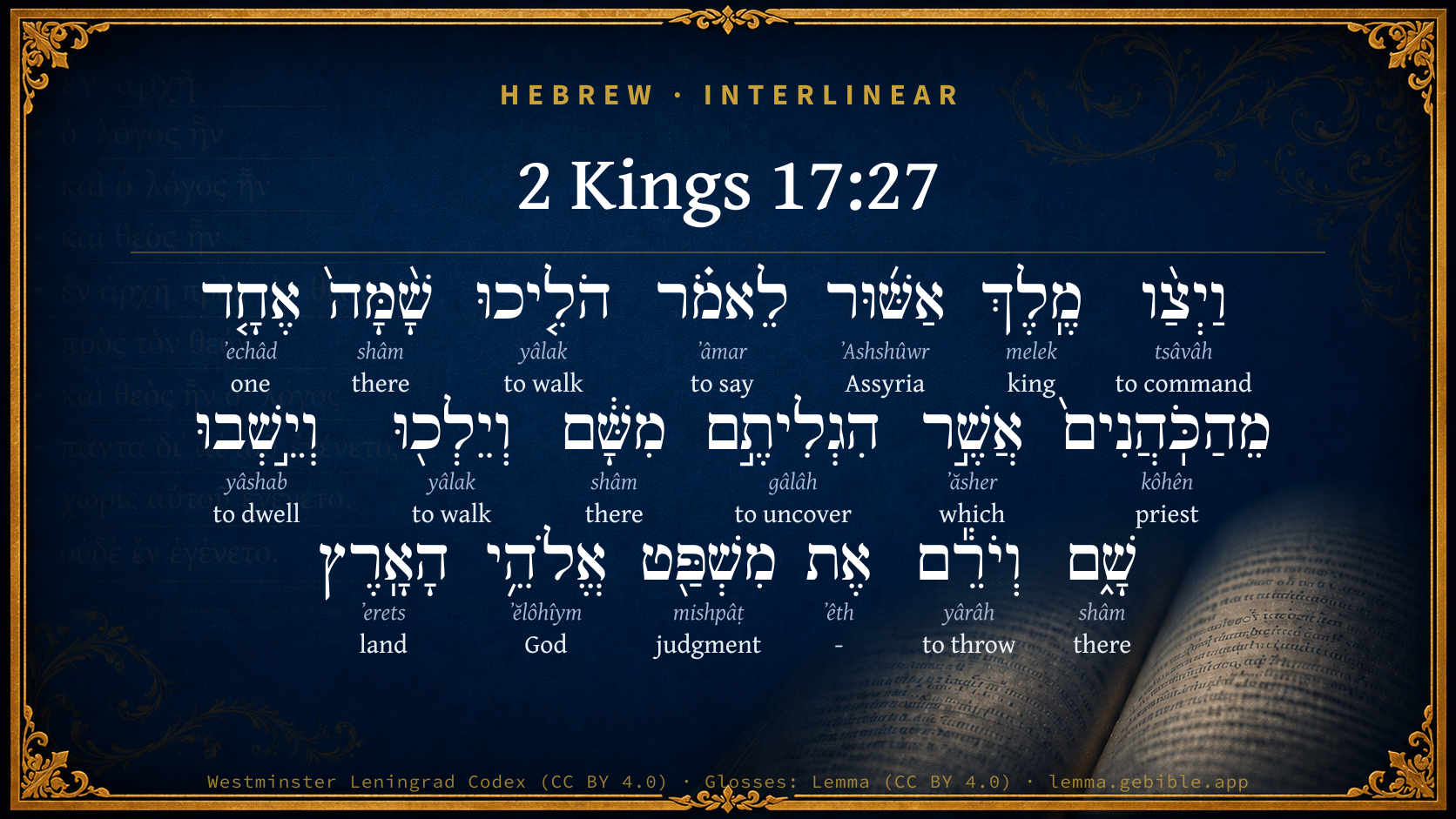
2 Kings 17:27

Hebrew (Westminster Leningrad Codex) 2 Kings 17:27 appears in the Hebrew Old Testament. The text above is from the Westminster Leningrad Codex. Each word links to its Strong’s number, a concise gloss, and parsing drawn from the Open Scriptures Hebrew Bible morphology. Click any word for its full Brown-Driver-Briggs (BDB) entry.
Download image
Cite this verse

2 Kings 17:27 (World English Bible). Public Domain. Lemma interlinear Bible study tool, https://lemma.gebible.app/v/2-kings/17/27.

Show BibTeX & RIS
BibTeX
RIS
English Translation
Then the king of Assyria commanded, saying, Carry there one of the priests whom you brought from there; and let them go and dwell there, and let him teach them the law of the god of the land.
World English Bible · Public Domain
Download a study sheet

One document with this verse’s original text, its word-by-word gloss line, the meaning frame, cross-references with their text, attributed commentary, and full source and license credits — printable, and it pastes into notes with its structure intact.

This verse Autodidact and up

Study sheet (.html) Plain text (.txt)

A passage Seminary Student

Up to 50 verses in one chapter. A passage sheet keeps up to 6 commentary sources and 12 cross-references per verse, in the order this page ranks them, and says so on the sheet whenever that leaves anything out. Ask for a single verse and you get the Autodidact verse sheet above.

Everything on this page stays free to read, with no account — the sheet is a download of what is already on screen, not access to it.

Want to remove ads? Support Godless Engineer
Compare translations 3

The same verse in 3 English versions, stacked beneath the original-language interlinear above. Click any original word for its lexicon entry.

Each is an independent rendering of the whole verse — the interlinear is not word-aligned to these translations.

Highlighted words mark where these versions differ — a whole-verse word diff, not a word-by-word alignment.

  • World English Bible Public Domain
    Then the king of Assyria commanded, saying, Carry there one of the priests whom you brought from there; and let them go and dwell there, and let him teach them the law of the god of the land.
  • King James Version Public Domain
    Then the king of Assyria commanded, saying, Carry thither one of the priests whom ye brought from thence; and let them go and dwell there, and let him teach them the manner of the God of the land.
  • unfoldingWord Literal Text CC BY-SA 4.0
    And the king of Assyria commanded, saying, “Make go there one from the priests whom you exiled from there. And let them go and settle there, and let him teach them the custom of the God of the land.”

unfoldingWord Literal Text — © unfoldingWord, licensed CC BY-SA 4.0. Word-aligned USFM3 via Door43 (git.door43.org/unfoldingWord/en_ult).

Versions to compare (up to 4)

3 of 4 selected

Show all 18 translations

Every available English version of this verse, each an independent rendering of the whole verse.

  • World English Bible Public Domain
    Then the king of Assyria commanded, saying, Carry there one of the priests whom you brought from there; and let them go and dwell there, and let him teach them the law of the god of the land.
  • Berean Standard Bible Public Domain
    Then the king of Assyria commanded: “Send back one of the priests you carried off from Samaria, and have him go back to live there and teach the requirements of the God of the land.”
  • Majority Standard Bible Public Domain
    Then the king of Assyria commanded: “Send back one of the priests you carried off from Samaria, and have him go back to live there and teach the requirements of the God of the land.”
  • King James Version Public Domain
    Then the king of Assyria commanded, saying, Carry thither one of the priests whom ye brought from thence; and let them go and dwell there, and let him teach them the manner of the God of the land.
  • American Standard Version (1901) Public Domain
    Then the king of Assyria commanded, saying, Carry thither one of the priests whom ye brought from thence; and let them go and dwell there, and let him teach them the law of the god of the land.
  • Revised Version (1885) Public Domain
    Then the king of Assyria commanded, saying, Carry thither one of the priests whom ye brought from thence; and let them go and dwell there, and let him teach them the manner of the God of the land.
  • Geneva Bible (1599) Public Domain
    Then the King of Asshur commanded, saying, Carie thither one of the Priestes whome ye brought thence, and let him goe and dwell there, and teache them the maner of the God of the countrey.
  • Douay-Rheims (1899) Public Domain
    And the king of the Assyrians commanded, saying: Carry thither one of the priests whom you brought from thence captive, and let him go, and dwell with them: and let him teach them the ordinances of the God of the land.
  • Young's Literal Translation Public Domain
    And the king of Asshur commandeth, saying, `Cause to go thither one of the priests whom ye removed thence, and they go and dwell there, and he doth teach them the custom of the God of the land.'
  • Literal Standard Version CC BY-SA 4.0
    And the king of Asshur commands, saying, “Cause one of the priests to go there whom you removed from there, and they go and dwell there, and he teaches them the custom of the God of the land.”
  • Unlocked Literal Bible CC BY-SA 4.0
    Then the king of Assyria commanded, saying, “Take one of the priests there whom you brought from there, and let him go and live there, and let him teach them the practices required by the god of the land.”
  • unfoldingWord Literal Text CC BY-SA 4.0
    And the king of Assyria commanded, saying, “Make go there one from the priests whom you exiled from there. And let them go and settle there, and let him teach them the custom of the God of the land.”
  • Darby Bible Public Domain
    And the king of Assyria commanded saying, Carry thither one of the priests whom ye have brought away from thence; and let them go and abide there, and let him teach them the manner of the god of the land.
  • World Messianic Bible Public Domain
    Then the king of Assyria commanded, saying, “Carry there one of the priests whom you brought from there; and let him go and dwell there, and let him teach them the law of the god of the land.”
  • Webster's Bible Public Domain
    Then the king of Assyria commanded, saying, Carry thither one of the priests whom ye brought from thence; and let them go and dwell there, and let him teach them the manner of the God of the land.
  • Free Bible Version CC BY-SA 4.0
    The king of Assyria gave the order: “Send back one of the priests you deported from Samaria, and let him go back and live there and teach the rules of the God of the land.”
  • Bible in Basic English Public Domain
    Then the king of Assyria gave orders, saying, Send there one of the priests whom you took away, and let him be living there and teaching the people the way of the god of the land.
  • JPS Tanakh (1917) Public Domain
    Then the king of Assyria commanded, saying: 'Carry thither one of the priests whom ye brought from thence; and let them go and dwell there, and let him teach them the manner of the God of the land.'

Literal Standard Version (2020), Covenant Press — licensed CC BY-SA 4.0. Text via the HelloAO Bible API (eBible.org). Unlocked Literal Bible (unfoldingWord) — licensed CC BY-SA 4.0. Text via the HelloAO Bible API (eBible.org). unfoldingWord Literal Text — © unfoldingWord, licensed CC BY-SA 4.0. Word-aligned USFM3 via Door43 (git.door43.org/unfoldingWord/en_ult). Free Bible Version, Dr. Jonathan Gallagher — licensed CC BY-SA 4.0. Text via the HelloAO Bible API (eBible.org).

Word by word

More ways to search: Search by grammar → Find every occurrence → Compare this word →

Practice this passage: Drill this verse → Learn its vocabulary →

וְיֹרֵ֕ם
yârâh
H3384
“and · to throw · them”
Conjunction + Verb, Hiphil, Imperfect, 3rd Person, Masculine, Singular + Suffix, Personal, 3rd Person, Masculine, Plural
Part of Speech
Conjunction + Verb
Stem
Hiphil
Form
Imperfect
Person
3rd Person
Gender
Masculine
Number
Singular
Full BDB Definition

Origin: a primitive root

TWOT: 910

to throw, shoot, cast, pour - (Qal) - to throw, cast - to cast, lay, set - to shoot arrows - to throw water, rain - (Niphal) to be shot - (Hiphil) - to throw, cast - to shoot - to point out, show - to direct, teach, instruct - to throw water, rain
  1. וַיְצַ֨ו tsâvâh H6680 “and · to command” Conjunction + Verb, Piel, Sequential Imperfect, 3rd Person, Masculine, Singular
  2. מֶֽלֶךְ melek H4428 “king of” Noun, Common, Masculine, Singular, Construct
  3. אַשּׁ֜וּר ʼAshshûwr H804 “Assyria” Noun, Proper
  4. לֵאמֹ֗ר ʼâmar H559 “to say” Preposition + Verb, Qal, Infinitive Construct
  5. הֹלִ֤יכוּ yâlak H3212 “walk” Verb, Hiphil, Imperative, 2nd Person, Masculine, Plural
  6. שָׁ֨מָּה֙ shâm H8033 “there · toward” Adverb + Suffix, Demonstrative
  7. אֶחָ֤ד ʼechâd H259 “one” Adjective, Cardinal number, Masculine, Singular, Absolute
  8. מֵהַכֹּֽהֲנִים֙ kôhên H3548 “from · the · priests” Preposition + Particle, Definite Article + Noun, Common, Masculine, Plural, Absolute
  9. אֲשֶׁ֣ר ʼăsher H834 “which” Particle, Relative
  10. הִגְלִיתֶ֣ם gâlâh H1540 “to uncover” Verb, Hiphil, Perfect, 2nd Person, Masculine, Plural
  11. מִשָּׁ֔ם shâm H8033 “from · there” Preposition + Adverb
  12. וְיֵלְכ֖וּ yâlak H3212 “and · to walk” Conjunction + Verb, Qal, Imperfect, 3rd Person, Masculine, Plural
  13. וְיֵ֣שְׁבוּ yâshab H3427 “and · to dwell” Conjunction + Verb, Qal, Imperfect, 3rd Person, Masculine, Plural
  14. שָׁ֑ם shâm H8033 “there” Adverb
  15. אֶת ʼêth H853 “-” Particle, Direct Object
  16. מִשְׁפַּ֖ט mishpâṭ H4941 “judgment of” Noun, Common, Masculine, Singular, Construct
  17. אֱלֹהֵ֥י ʼĕlôhîym H430 “God(s) of” Noun, Common, Masculine, Plural, Construct
  18. הָאָֽרֶץ ʼerets H776 “the · land” Particle, Definite Article + Noun, Common, Both, Singular, Absolute

About this verse

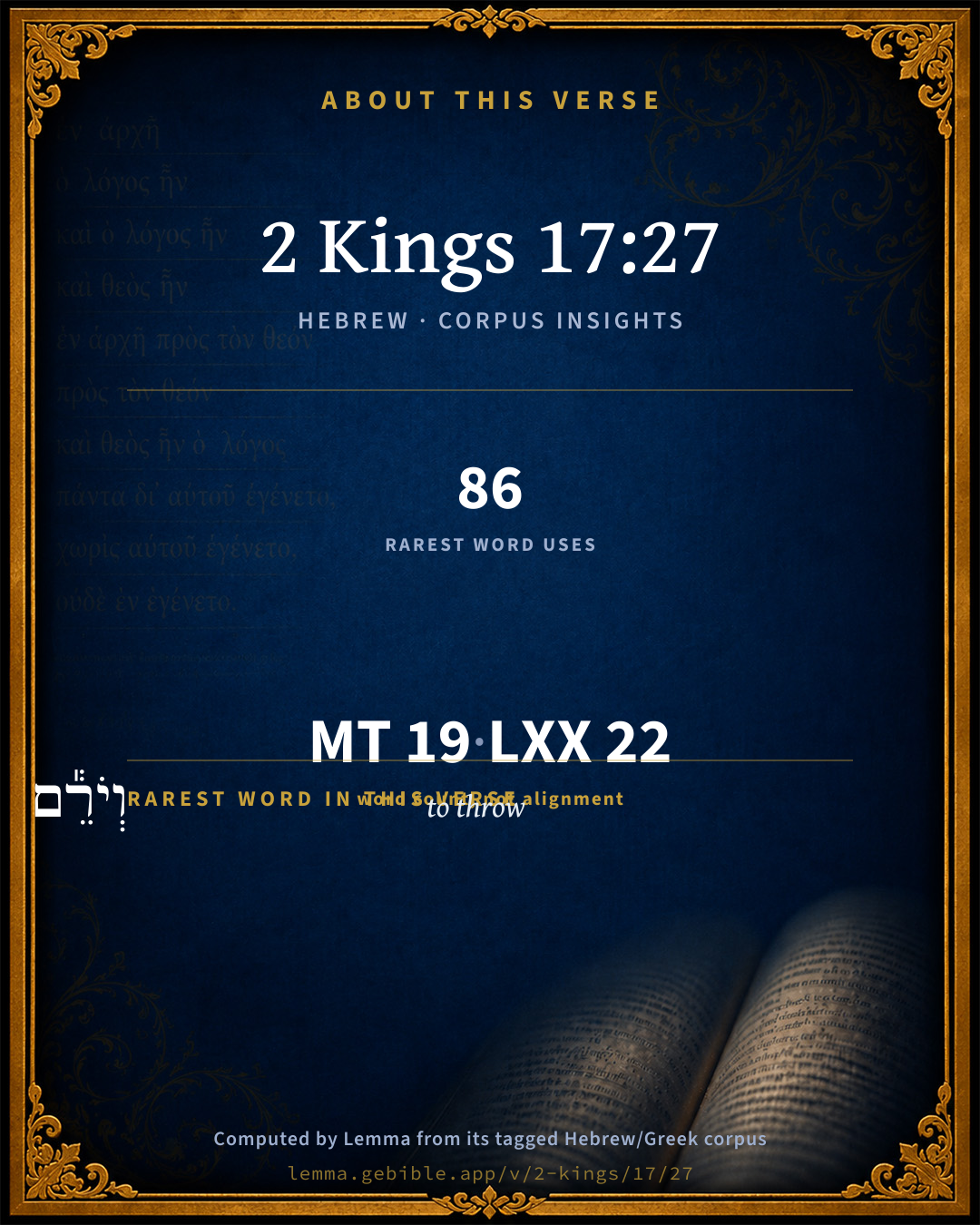
These counts appear in no published source. They are computed here, from the morphology-tagged text and Lemma’s own curated glosses. What Lemma adds →

19
words
16
distinct lemmas
Historical
section

Grammatical profile

  • 7 verbs
  • 6 nouns
  • 1 adjective
  • 3 adverbs
  • 2 particles

Verb forms

  • וַיְצַ֨ו Piel · Sequential Imperfect
  • לֵאמֹ֗ר Qal · Infinitive Construct
  • הֹלִ֤יכוּ Hiphil · Imperative
  • הִגְלִיתֶ֣ם Hiphil · Perfect
  • וְיֵלְכ֖וּ Qal · Imperfect
  • וְיֵ֣שְׁבוּ Qal · Imperfect
  • וְיֹרֵ֕ם Hiphil · Imperfect

Repetition

Words recur within this verse — often emphatic in Hebrew:

  • שָׁ֨מָּה֙ there H8033 ×3
  • הֹלִ֤יכוּ to walk H3212 ×2

Hebrew & Septuagint length

In English translation the verse runs 38 words from the Hebrew and 32 from the Septuagint (LXX English) — closely comparable.

A rough comparison of the two English renderings, which tokenize alike — not a word-level alignment.

Word counts can differ between the Hebrew and the Greek without any difference in meaning — e.g. the Hebrew direct-object marker אֵת has no separate Greek word, and Greek often adds the article ὁ.

In the original languages it is 19 Hebrew tokens and 22 Greek tokens — but the two are counted differently (Hebrew bundles its prefixes and suffixes into one token; the Greek is in lemma form), so that isn’t a like-for-like length.

Cross-references

4

Topical passages linked to 2 Kings 17:27 in the Treasury of Scripture Knowledge — connected by theme and wording, ordered by reader-vote popularity; previews shown in the World English Bible.

  • Judges 17:13 Then said Micah, Now know I that Yahweh will do me good, seeing I have a Levite to my priest.
  • 1 Kings 12:31 He made houses of high places, and made priests from among all the people, who were not of the sons of Levi.
  • 1 Kings 13:2 He cried against the altar by the word of Yahweh, and said, altar, altar, thus says Yahweh: Behold, a son shall be born to the house of David, Josiah by name; and on you shall he sacrifice the priests of the high places who burn incense on you, and men's bones shall they burn on you.
  • 2 Chronicles 11:15 and he appointed him priests for the high places, and for the male goats, and for the calves which he had made.

Cross-references courtesy of OpenBible.info (CC BY 4.0).

Hebrew and Greek witnesses Masoretic Hebrew ↔ Greek Septuagint

The same verse in the two great witnesses to the Old Testament, shown verse-for-verse.

These are two independent witnesses, not word-aligned to each other, and the Septuagint is shown in lemma (dictionary) form.

Hebrew 2 Kings 17:27 Masoretic · Westminster Leningrad Codex

וַיְצַ֨ו מֶֽלֶךְ אַשּׁ֜וּר לֵאמֹ֗ר הֹלִ֤יכוּ שָׁ֨מָּה֙ אֶחָ֤ד מֵהַכֹּֽהֲנִים֙ אֲשֶׁ֣ר הִגְלִיתֶ֣ם מִשָּׁ֔ם וְיֵלְכ֖וּ וְיֵ֣שְׁבוּ שָׁ֑ם וְיֹרֵ֕ם אֶת מִשְׁפַּ֖ט אֱלֹהֵ֥י הָאָֽרֶץ

Then the king of Assyria commanded, saying, Carry there one of the priests whom you brought from there; and let them go and dwell there, and let him teach them the law of the god of the land.

World English Bible · Public Domain

Greek LXX 2 Kings 17:27 Septuagint · lemma form

καί ἐντέλλομαι ὁ βασιλεύς ἀσσύριος λέγω ἀποἄγω ἐκεῖθεν καί πορεύομαι καί καταοἰκέω ἐκεῖ καί φωτίζω αὐτός ὁ κρίμα ὁ θεός ὁ γῆ

And the king of the Assyrians commanded, saying, Bring some Israelites thence, and let them go and dwell there, and they shall teach them the manner of the God of the land.

LXX2012 (modern English Septuagint) · Public Domain

On this verse, The Cambridge Bible for Schools and Colleges discusses the Septuagint’s reading. Read the note in Commentary ↓

Hebrew: Westminster Leningrad Codex (CC BY 4.0). Greek: Septuagint (public domain); English from LXX2012 (modern English Septuagint) (Public Domain). How the Septuagint differs from the Hebrew →

Targum (Aramaic paraphrase)

1

The Targum is the ancient Jewish Aramaic paraphrase of the Hebrew Scriptures — an interpretive translation, not the Hebrew text itself. Onkelos (literal) and Pseudo-Jonathan (expansive) render the Torah, and Jonathan the Prophets. Coverage is partial: where no permissively-licensed English translation exists for a verse, only the Aramaic is shown. This is verse-level text, not a word-by-word alignment to the Hebrew.

  1. Targum Jonathan Prophets (Joshua–Malachi)
    וּפַקֵיד מַלְכָּא דְאַתּוּר לְמֵימָר אוֹבִילוּ לְתַמָן חַד מִכַּהֲנַיָא דְאַגְלְתִינוּן מִתַּמָן וְיֵזְלוּן וְיַתְבוּן תַּמָן וְיַלְפוּן יַת דִי אֱלָהָא דְאַרְעָא:

    (no public-domain English translation for this verse)

    Targum Jonathan — Aramaic: “Mikraot Gedolot” (public domain). English: “Sefaria Community Translation” (CC0 1.0 (public-domain dedication)); “London "Chaldee Paraphrase," 1871” (public domain). Text via Sefaria.

Commentary

Notes on 2 Kings 17:27 from classic Christian and Jewish commentators (each source and its license shown beneath its notes). The classic Christian expositions comment on the surrounding passage and are grouped to its opening verse, so a note may address several verses; the Jewish commentaries on the Tanakh (Rashi and others) are per-verse, so they appear only where the commentator wrote on this verse.

Lemma curates 59 commentaries, every one of them public domain or Creative Commons licensed, each selected and text-cleaned for this edition rather than reprinted as found. About our sources →

Trapp's Complete Commentary

John Trapp

2Ki 17:27 Then the king of Assyria commanded, saying, Carry thither one of the priests whom ye brought from thence; and let them go and dwell there, and let him teach them the manner of the God of the land.

Ver. 27. Carry thither one of the priests.] One of Jeroboam’s priests, for want of a better. Docendi munus suscipit quisquis ad sacerdotium accedit. An unteaching priest is a monster. {2Ch 15:3}

John Trapp, A Commentary or Exposition upon All the Books of the Old and New Testament (1647–1656) — public domain. Text from a community e-Sword module.

Joseph Benson's Commentary

2Ki 17:27. Then the king of Assyria commanded, Carry thither one of the priests — That is, one of the chief priests, with others under his inspection and direction, as may be gathered from the following words, where it is said of the same person or persons, Let them go, &c, and then, Let him teach, &c. — Nor is it probable that one priest could suffice for the instruction of the inhabitants of so many and distant districts.

Joseph Benson's Commentary on the Old and New Testaments (1811–1818) — public domain. Text from a community e-Sword module.

Geneva Bible (1599)

Geneva Bible translators

That is, how to worship him: thus the wicked rather than to lose their commodities will change to all religions.

Geneva Bible (1599) marginal notes — public domain. Text via Bolls.life.

Adam Clarke's Commentary

Verse 27. Carry thither one of the priests] Imperfect as this teaching was, it, in the end, overthrew the idolatry of these people, so that soon after the Babylonish captivity they were found to be as free from idolatry as the Jews themselves, and continue so to the present day. But they are now nearly annihilated: the small remains of them is found at Naplouse and Jaffa; they are about thirty families; and men, women, and children, amount to about two hundred persons! They have a synagogue, which they regularly attend every Sabbath; and they go thither clothed in white robes. The reader may find much curious information relative to this people, in a Memoire sur L'Etat actuel des Samaritains, by Baron Sylvestre de Sacy, 8vo., Paris, 1812.

Adam Clarke's Commentary on the Bible (1810–1826) — public domain. Text from a community e-Sword/MySword module.

Ellicott's Commentary for English Readers

(27) Carry.—Cause to go.

Let them go and dwell.—To be corrected after the Syriac and Vulg.: let him go and dwell.

Ye brought.—Ye carried away.

A Bible Commentary for English Readers, edited by Charles John Ellicott (1878–1897) — public domain. Text from a community e-Sword module.

The Cambridge Bible for Schools and Colleges

gen. ed. J. J. S. Perowne

27. one of the priests whom ye brought from thence] The Assyrian king takes what he would believe to be the best step towards remedying the mischief. A priest of the Israelitish worship was clearly the right person to be sent. No doubt all the priests were among the population that had been carried away. Hence the few Israelites left behind would not be regarded as capable of instructing the new colonists. For among the heathen, ‘the manner’, i.e. the ceremonial and particular observances in performing worship, was the matter of highest import. The less spiritual the worship, the more it tends to lay weight on the ‘manner’ and mode of the worship. Hence the magnificence so usual in idolatrous countries. The LXX. does not represent the words ‘one of the priests’.

let them go] The priest would not be expected to go alone. For such services as the king of Assyria had in his thoughts the person ministering must be attended by a body of minor people to add grandeur to the ceremonies.

and let him teach] The priest would naturally be the teacher. Hence we can see the reason of the change of number in the pronouns in this clause and the last.

The Cambridge Bible for Schools and Colleges (gen. ed. J. J. S. Perowne; Cambridge University Press, 1878–1918) — public domain. Text from a community e-Sword module.

John Gill's Exposition

Then the king of Assyria commanded, saying,.... Gave the following orders and directions:

carry thither one of the priests whom ye brought from thence; for they carried away all the people of every class, civil and religious:

and let him go and dwell there, and let him teach them the manner of the God of the land; it is in the plural number, "let them go", &c. (o); there might be more priests than one ordered, or, however, others, to attend and assist him in his work; the Jews say (p), two were sent to circumcise them, and teach them the book of the law; and they give their names, Dosthai, or Dosithaeus, and Zachariah; and Josephus (q) says, the people desired that priests might be sent to them of the captives.

(o) "eant et sedeant", Montanus. (p) Pirke Eliezer, c. 38. (q) Antiqu. l. 9. c. 14. sect. 3.

John Gill's Exposition of the Whole Bible (1746–1763) — public domain (CC PDM 1.0). Text via the HelloAO Bible API.

Albert Barnes' Notes on the Bible

Carry one of the priests ...; let them go and dwell there, and let him teach - The double change of number is curious; but rise text needs no emendation. The priest would require to be accompanied by assistants, who would “go and dwell,” but would not be qualified to “teach.” The arcana of the worship would be known to none excepting the priests who had ministered at the two national sanctuaries of Dan and Bethel.

Albert Barnes' Notes on the Bible (1834–1885) — public domain. Text from a community e-Sword/MySword module.

Haydock's Catholic Bible Commentary

Let him. Hebrew, Chaldean, Septuagint, "them go." Probably more went; but one was of superior dignity. He might have been priest of the golden calves, as none of the priests of Jerusalem had yet been taken. Hence he taught the Cutheans to join the worship of God with that of idols. Some think that no part of the Scripture was used among them, till the building of the temple by Sanballat, on Mount Garizim: (Le Quien, Antiquite. v. 13.) but this is extremely improbable. How should he pretend to teach the law without the books of Moses? (Haydock) --- The Samaritans have retained the Pentateuch in the Phœnician character, while the Jews have insensibly adopted the Chaldee, during their captivity. On some occasions, these people have boasted of their descent from the patriarchs, John iv. 12., and 20. But in times of danger, they have confessed their true origin. (Josephus, [Antiquities?] ix. fin., and xii. 5.

George Leo Haydock (1774–1849), Haydock's Catholic Family Bible and Commentary, 1859 edition — public domain. Excludes Psalms (Douay-Rheims chapter numbering differs from Protestant) and Deuterocanonical books (Catholic canon only).

Matthew Poole's English Annotations

One of the priests, i.e. one of the chief of the priests, with others, to be under his inspection and direction, as may be gathered from the following words; where it is said of the same person, or persons,

let them go, & c., and then,

let him teach, & c. Nor is it probable that one priest could suffice for the instruction of the inhabitants of so many and distant parts.

Matthew Poole's English Annotations on the Holy Bible (1683–1685) — public domain. Text from a community e-Sword/MySword module.

The Pulpit Commentary

Then the King of Assyria commanded, saying, Carry thither one of the priests whom ye brought from thence. It does not appear that this was a suggestion of the colonists. Either it was the king"s own idea, or that of one of his advisers. The priests, who ministered at the two national sanctuaries those of Dan and Bethel had, as important personages, been all carried off. Though a "remnant" of Israel was left in the land, (2Ch_34:9) they were probably of the baser sort, (2Ki_25:12) or at any rate could not be trusted to know the details and intricacies of the Samaritan ritual. Thus it was necessary to send back a priest. And let them go and dwell there. We should have expected, "Let him go;" but the writer assumes that the priest would have an entourage, assistant-ministers and servants, and so says, "Let them go;" but immediately afterwards, And let him teach since he alone would be competentthem the manner of the God of the land.

The Pulpit Commentary (1880–1919), ed. H.D.M. Spence-Jones & Joseph S. Exell — public domain. Text from a community e-Sword module.

unfoldingWord translationNotes

Door43 World Missions Community

Take one of the priests there whom you brought from there

"Take a priest who came from Samaria back there"

let him teach them

"let the Samaritan priest teach the people who are living there now"

translationWords

priest

Bethel

unfoldingWord translationNotes — © Distant Shores Media and the Door43 World Missions Community, licensed CC BY-SA 4.0. Source: git.door43.org/Door43/en_tn.

Lesson kit

Teaching starters — assembled from the data on this page, not authored interpretation. Every prompt links to the verse data it draws on. Edit before teaching.

2 Kings, in the Historical, opens this verse with 19 words (16 distinct Hebrew lemmas). Its most distinctive word is yârâh (“to throw”). A historical commentator’s framing appears above. Read the whole chapter for the surrounding context.

Discussion questions

  1. What does “to throw” (yârâh) contribute to the verse as a whole?
  2. How does Judges 17:13, which shares this passage’s theme, read alongside this verse?
  3. What does the repetition of “there” (3× in this one verse) do in this verse?
  4. These translations render this verse differently; the difference is in the English rendering, not the original. What questions does that raise?
  5. «וַיְצַ֨ו» is a Piel Sequential Imperfect verb. How does that grammatical form shape the action described?
  6. Compare how Trapp's Complete Commentary and Joseph Benson's Commentary read this verse. Where do they agree or differ?

Things to notice

Reading settings

Reading text

Shown beneath each verse's original-language words.

Old Testament
Old Testament edition

Read the OT as the Masoretic Hebrew (MT) or the Greek Septuagint (LXX).

English shown for the Greek Septuagint (in the Hebrew ↔ Greek comparison).

Comparing translations? Open the Compare panel on any verse page to stack up to four side by side.