
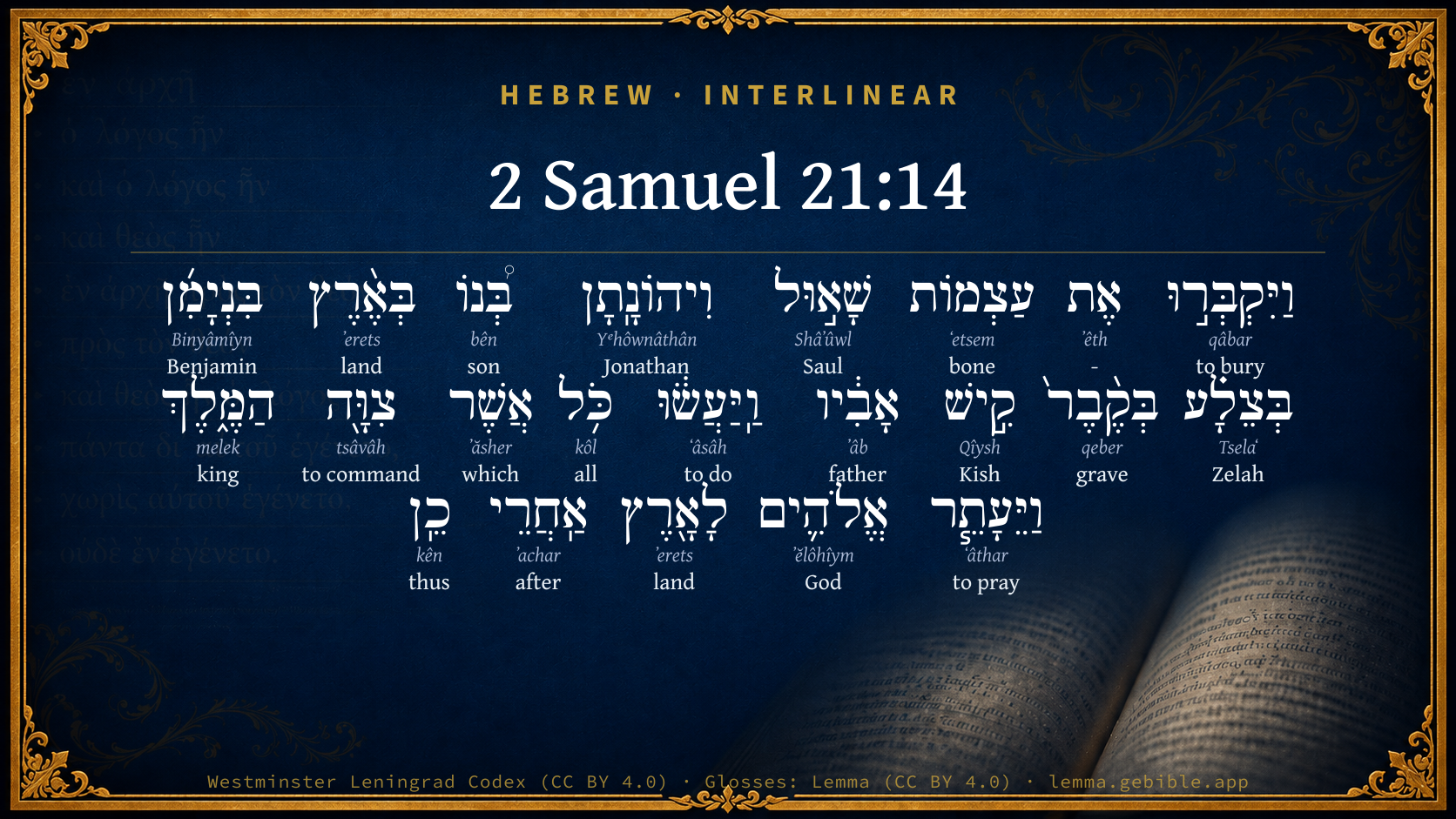
2 Samuel 21:14

Hebrew (Westminster Leningrad Codex) 2 Samuel 21:14 appears in the Hebrew Old Testament. The text above is from the Westminster Leningrad Codex. Each word links to its Strong’s number, a concise gloss, and parsing drawn from the Open Scriptures Hebrew Bible morphology. Click any word for its full Brown-Driver-Briggs (BDB) entry.
Download image
Cite this verse

2 Samuel 21:14 (World English Bible). Public Domain. Lemma interlinear Bible study tool, https://lemma.gebible.app/v/2-samuel/21/14.

Show BibTeX & RIS
BibTeX
RIS
English Translation
They buried the bones of Saul and Jonathan his son in the country of Benjamin in Zela, in the tomb of Kish his father: and they performed all that the king commanded. After that God was entreated for the land.
World English Bible · Public Domain
Download a study sheet

One document with this verse’s original text, its word-by-word gloss line, the meaning frame, cross-references with their text, attributed commentary, and full source and license credits — printable, and it pastes into notes with its structure intact.

This verse Autodidact and up

Study sheet (.html) Plain text (.txt)

A passage Seminary Student

Up to 50 verses in one chapter. A passage sheet keeps up to 6 commentary sources and 12 cross-references per verse, in the order this page ranks them, and says so on the sheet whenever that leaves anything out. Ask for a single verse and you get the Autodidact verse sheet above.

Everything on this page stays free to read, with no account — the sheet is a download of what is already on screen, not access to it.

Want to remove ads? Support Godless Engineer
Compare translations 3

The same verse in 3 English versions, stacked beneath the original-language interlinear above. Click any original word for its lexicon entry.

Each is an independent rendering of the whole verse — the interlinear is not word-aligned to these translations.

Highlighted words mark where these versions differ — a whole-verse word diff, not a word-by-word alignment.

  • World English Bible Public Domain
    They buried the bones of Saul and Jonathan his son in the country of Benjamin in Zela, in the tomb of Kish his father: and they performed all that the king commanded. After that God was entreated for the land.
  • King James Version Public Domain
    And the bones of Saul and Jonathan his son buried they in the country of Benjamin in Zelah, in the sepulchre of Kish his father: and they performed all that the king commanded. And after that God was intreated for the land.
  • unfoldingWord Literal Text CC BY-SA 4.0
    And they buried the bones of Saul and Jonathan his son in the land of Benjamin, in Zela, in the tomb of Kish his father. And they did all that the king commanded. And God was entreated for the land after this.

unfoldingWord Literal Text — © unfoldingWord, licensed CC BY-SA 4.0. Word-aligned USFM3 via Door43 (git.door43.org/unfoldingWord/en_ult).

Versions to compare (up to 4)

3 of 4 selected

Show all 18 translations

Every available English version of this verse, each an independent rendering of the whole verse.

  • World English Bible Public Domain
    They buried the bones of Saul and Jonathan his son in the country of Benjamin in Zela, in the tomb of Kish his father: and they performed all that the king commanded. After that God was entreated for the land.
  • Berean Standard Bible Public Domain
    And they buried the bones of Saul and his son Jonathan in Zela in the land of Benjamin, in the tomb of Saul’s father Kish. After they had done everything the king had commanded, God answered their prayers for the land.
  • Majority Standard Bible Public Domain
    And they buried the bones of Saul and his son Jonathan in Zela in the land of Benjamin, in the tomb of Saul’s father Kish. After they had done everything the king had commanded, God answered their prayers for the land.
  • King James Version Public Domain
    And the bones of Saul and Jonathan his son buried they in the country of Benjamin in Zelah, in the sepulchre of Kish his father: and they performed all that the king commanded. And after that God was intreated for the land.
  • American Standard Version (1901) Public Domain
    And they buried the bones of Saul and Jonathan his son in the country of Benjamin in Zela, in the sepulchre of Kish his father: and they performed all that the king commanded. And after that God was entreated for the land.
  • Revised Version (1885) Public Domain
    And they buried the bones of Saul and Jonathan his son in the country of Benjamin in Zela, in the sepulchre of Kish his father: and they performed all that the king commanded. And after that God was entreated for the land.
  • Geneva Bible (1599) Public Domain
    And the bones of Saul and of Ionathan his sonne buried they in the coutrey of Beniamin in Zelah, in the graue of Kish his father: and when they had perfourmed all that the King had commanded, God was then appeased with the land.
  • Douay-Rheims (1899) Public Domain
    And they buried them with the bones of Saul, and of Jonathan his son in the land of Benjamin, in the side, in the sepulchre of Cis his father: and they did all that the king had commanded, and God shewed mercy again to the land after these things.
  • Young's Literal Translation Public Domain
    and bury the bones of Saul and of Jonathan his son in the land of Benjamin, in Zelah, in the burying-place of Kish his father, and do all that the king commanded, and God is entreated for the land afterwards.
  • Literal Standard Version CC BY-SA 4.0
    and bury the bones of Saul and of his son Jonathan in the land of Benjamin, in Zelah, in the burying-place of his father Kish, and do all that the king commanded, and God accepts the plea for the land afterward.
  • Unlocked Literal Bible CC BY-SA 4.0
    They buried the bones of Saul and Jonathan his son in the country of Benjamin in Zela, in the tomb of Kish his father. They performed all that the king commanded. After that God answered their prayers for the land.
  • unfoldingWord Literal Text CC BY-SA 4.0
    And they buried the bones of Saul and Jonathan his son in the land of Benjamin, in Zela, in the tomb of Kish his father. And they did all that the king commanded. And God was entreated for the land after this.
  • Darby Bible Public Domain
    And they buried [them] with the bones of Saul and Jonathan his son in the country of Benjamin in Zela, in the sepulchre of Kish his father; and they did all that the king had commanded. And afterwards God was propitious to the land.
  • World Messianic Bible Public Domain
    They buried the bones of Saul and Jonathan his son in the country of Benjamin in Zela, in the tomb of Kish his father; and they performed all that the king commanded. After that, God answered prayer for the land.
  • Webster's Bible Public Domain
    And the bones of Saul and Jonathan his son they buried in the country of Benjamin in Zelah, in the sepulcher of Kish his father: and they performed all that the king commanded. And after that God was entreated for the land.
  • Free Bible Version CC BY-SA 4.0
    They buried the bones of Saul and his son Jonathan at Zela in the land of Benjamin, in the tomb of Saul's father Kish. Once they finished doing everything the king had ordered, God answered their prayers to end the famine in the land.
  • Bible in Basic English Public Domain
    And they put them with the bones of Saul and his son Jonathan in the resting-place of Kish, his father, in Zela in the country of Benjamin; they did all the king had given them orders to do. And after that, God gave ear to their prayers for the land.
  • JPS Tanakh (1917) Public Domain
    And they buried the bones of Saul and Jonathan his son in the country of Benjamin in Zela, in the sepulchre of Kish his father; and they performed all that the king commanded. And after that God was entreated for the land.

Literal Standard Version (2020), Covenant Press — licensed CC BY-SA 4.0. Text via the HelloAO Bible API (eBible.org). Unlocked Literal Bible (unfoldingWord) — licensed CC BY-SA 4.0. Text via the HelloAO Bible API (eBible.org). unfoldingWord Literal Text — © unfoldingWord, licensed CC BY-SA 4.0. Word-aligned USFM3 via Door43 (git.door43.org/unfoldingWord/en_ult). Free Bible Version, Dr. Jonathan Gallagher — licensed CC BY-SA 4.0. Text via the HelloAO Bible API (eBible.org).

Word by word

More ways to search: Search by grammar → Find every occurrence → Compare this word →

Practice this passage: Drill this verse → Learn its vocabulary →

בְּצֵלָ֗ע
Tselaʻ
H6762
“in/at · Zelah”
Preposition + Noun, Proper
Part of Speech
Preposition + Noun
Type
Proper
Full BDB Definition

Origin: the same as H6761

TWOT: None

Zelah = "a rib" - a city in Benjamin containing the family burial place of Saul
  1. וַיִּקְבְּר֣וּ qâbar H6912 “and · to bury” Conjunction + Verb, Qal, Sequential Imperfect, 3rd Person, Masculine, Plural
  2. אֶת ʼêth H853 “-” Particle, Direct Object
  3. עַצְמוֹת ʻetsem H6106 “bones of” Noun, Common, Feminine, Plural, Construct
  4. שָׁא֣וּל Shâʼûwl H7586 “Saul” Noun, Proper
  5. וִיהוֹנָֽתָן Yᵉhôwnâthân H3083 “and · Jonathan” Conjunction + Noun, Proper
  6. בְּ֠נוֹ bên H1121 “son · his” Noun, Common, Masculine, Singular, Construct + Suffix, Personal, 3rd Person, Masculine, Singular
  7. בְּאֶ֨רֶץ ʼerets H776 “in/at · land of” Preposition + Noun, Common, Both, Singular, Construct
  8. בִּנְיָמִ֜ן Binyâmîyn H1144 “Benjamin” Noun, Proper
  9. בְּקֶ֨בֶר֙ qeber H6913 “in/at · grave of” Preposition + Noun, Common, Masculine, Singular, Construct
  10. קִ֣ישׁ Qîysh H7027 “Kish” Noun, Proper
  11. אָבִ֔יו ʼâb H1 “father · his” Noun, Common, Masculine, Singular, Construct + Suffix, Personal, 3rd Person, Masculine, Singular
  12. וַֽיַּעֲשׂ֔וּ ʻâsâh H6213 “and · to do” Conjunction + Verb, Qal, Sequential Imperfect, 3rd Person, Masculine, Plural
  13. כֹּ֥ל kôl H3605 “all” Noun, Common, Masculine, Singular, Absolute
  14. אֲשֶׁר ʼăsher H834 “which” Particle, Relative
  15. צִוָּ֖ה tsâvâh H6680 “to command” Verb, Piel, Perfect, 3rd Person, Masculine, Singular
  16. הַמֶּ֑לֶךְ melek H4428 “the · king” Particle, Definite Article + Noun, Common, Masculine, Singular, Absolute
  17. וַיֵּעָתֵ֧ר ʻâthar H6279 “and · to pray” Conjunction + Verb, Niphal, Sequential Imperfect, 3rd Person, Masculine, Singular
  18. אֱלֹהִ֛ים ʼĕlôhîym H430 “God(s)” Noun, Common, Masculine, Plural, Absolute
  19. לָאָ֖רֶץ ʼerets H776 “to/for the · land” Preposition, Determined + Noun, Common, Both, Singular, Absolute
  20. אַֽחֲרֵי ʼachar H310 “after” Preposition
  21. כֵֽן kên H3651 “thus” Adverb

About this verse

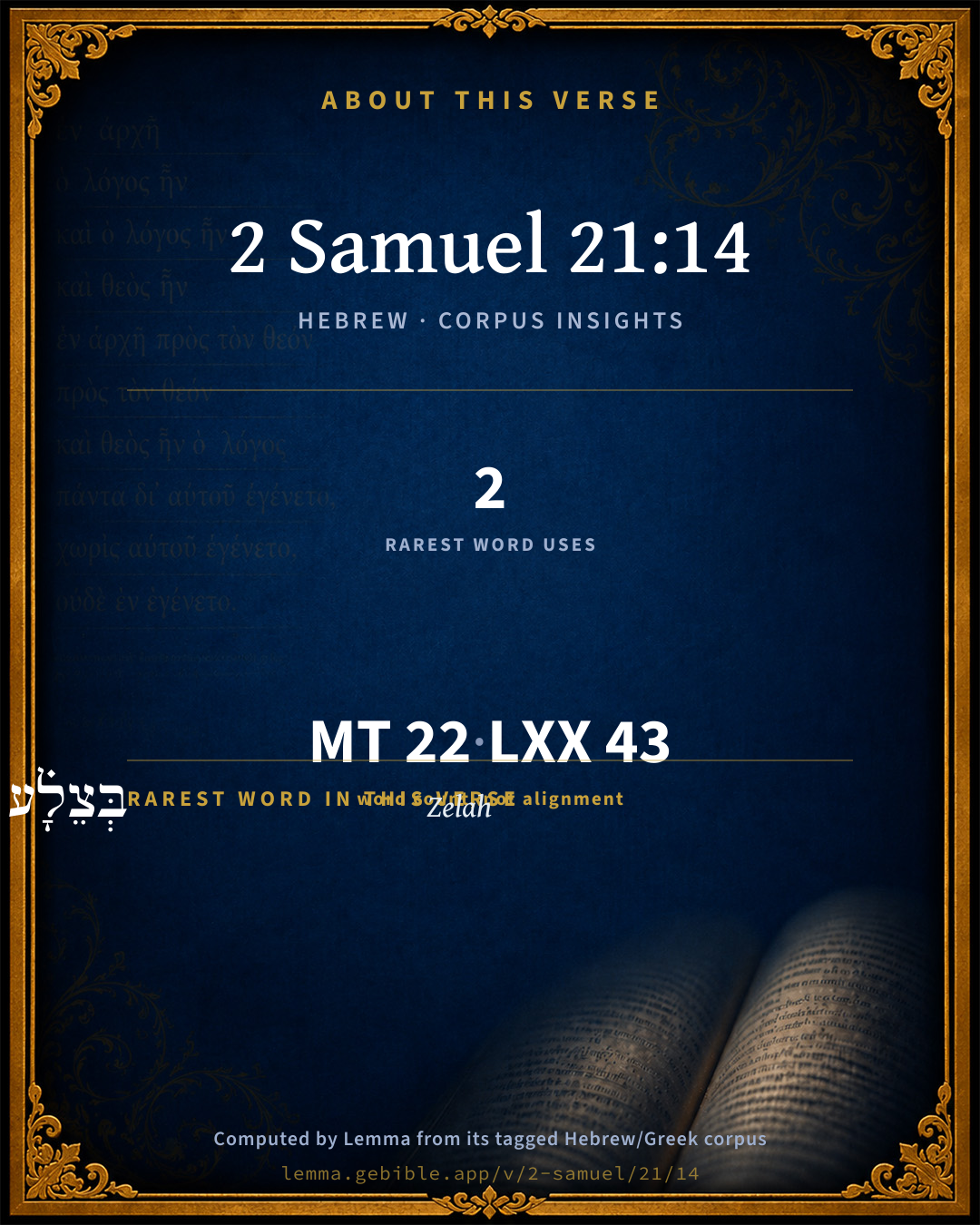
These counts appear in no published source. They are computed here, from the morphology-tagged text and Lemma’s own curated glosses. What Lemma adds →

22
words
21
distinct lemmas
Historical
section

Notable vocabulary

The rarest word here is בְּצֵלָ֗ע Zelah H6762 — appearing just 2 times in the whole Hebrew Bible.

Shared distinctive vocabulary

בְּצֵלָ֗ע Zelah H6762 occurs in 2 verses of the Hebrew Bible. Also found in:

Grammatical profile

  • 4 verbs
  • 14 nouns
  • 1 preposition
  • 1 adverb
  • 2 particles

Verb forms

  • וַיִּקְבְּר֣וּ Qal · Sequential Imperfect
  • וַֽיַּעֲשׂ֔וּ Qal · Sequential Imperfect
  • צִוָּ֖ה Piel · Perfect
  • וַיֵּעָתֵ֧ר Niphal · Sequential Imperfect

Repetition

A word recurs within this verse — often emphatic in Hebrew:

  • בְּאֶ֨רֶץ land H776 ×2

Hebrew & Septuagint length

In English translation the verse runs 40 words from the Hebrew and 58 from the Septuagint (LXX English) — the Septuagint runs noticeably longer here. See the side-by-side →

A rough comparison of the two English renderings, which tokenize alike — not a word-level alignment.

Word counts can differ between the Hebrew and the Greek without any difference in meaning — e.g. the Hebrew direct-object marker אֵת has no separate Greek word, and Greek often adds the article ὁ.

In the original languages it is 22 Hebrew tokens and 43 Greek tokens — but the two are counted differently (Hebrew bundles its prefixes and suffixes into one token; the Greek is in lemma form), so that isn’t a like-for-like length.

Cross-references

14

Topical passages linked to 2 Samuel 21:14 in the Treasury of Scripture Knowledge — connected by theme and wording, ordered by reader-vote popularity; previews shown in the World English Bible.

  • Joshua 18:28 and Zelah, Eleph, and the Jebusite (the same is Jerusalem), Gibeath, [and] Kiriath; fourteen cities with their villages. This is the inheritance of the children of Benjamin according to their families.
  • Joshua 7:26 They raised over him a great heap of stones, to this day; and Yahweh turned from the fierceness of his anger. Therefore the name of that place was called "The valley of Achor" to this day.
  • 2 Samuel 24:25 David built there an altar to Yahweh, and offered burnt offerings and peace-offerings. So Yahweh was entreated for the land, and the plague was stayed from Israel.
  • Exodus 32:27–29 He said to them, "Thus says Yahweh, the God of Israel, 'Every man put his sword on his thigh, and go back and forth from gate to gate throughout the camp, and every man kill his brother, and every man his companion, and every man his neighbor."
  • Numbers 25:13 and it shall be to him, and to his seed after him, the covenant of an everlasting priesthood; because he was jealous for his God, and made atonement for the children of Israel.
  • 1 Samuel 10:2 When you are departed from me today, then you shall find two men by Rachel's tomb, in the border of Benjamin at Zelzah; and they will tell you, The donkeys which you went to seek are found; and, behold, your father has left off caring for the donkeys, and is anxious for you, saying, What shall I do for my son?
  • 2 Samuel 3:32 They buried Abner in Hebron: and the king lifted up his voice, and wept at the grave of Abner; and all the people wept.
  • 2 Samuel 4:12 David commanded his young men, and they killed them, and cut off their hands and their feet, and hanged them up beside the pool in Hebron. But they took the head of Ish-bosheth, and buried it in the grave of Abner in Hebron.
  • 1 Kings 18:40–41 and Elijah said to them, Take the prophets of Baal; don't let one of them escape. They took them; and Elijah brought them down to the brook Kishon, and killed them there.
  • Jeremiah 14:1–7 The word of Yahweh that came to Jeremiah concerning the drought.
  • Joel 2:18–19 Then Yahweh was jealous for his land, And had pity on his people.
  • Amos 7:1–6 Thus the Lord Yahweh showed me: and, behold, he formed locusts in the beginning of the shooting up of the latter growth; and, behold, it was the latter growth after the king's harvest.
  • Jonah 1:15 So they took up Jonah, and threw him into the sea; and the sea ceased its raging.
  • Zechariah 6:8 Then he called to me, and spoke to me, saying, "Behold, those who go toward the north country have quieted my spirit in the north country."

Cross-references courtesy of OpenBible.info (CC BY 4.0).

Hebrew and Greek witnesses Masoretic Hebrew ↔ Greek Septuagint

The same verse in the two great witnesses to the Old Testament, shown verse-for-verse.

Here the Septuagint runs noticeably longer than the Hebrew — LXX2012 (modern English Septuagint) 58 words vs World English Bible 40. A rough length comparison of the two English translations, not a word-level alignment — read both below.

These are two independent witnesses, not word-aligned to each other, and the Septuagint is shown in lemma (dictionary) form.

Hebrew 2 Samuel 21:14 Masoretic · Westminster Leningrad Codex

וַיִּקְבְּר֣וּ אֶת עַצְמוֹת שָׁא֣וּל וִיהוֹנָֽתָן בְּ֠נוֹ בְּאֶ֨רֶץ בִּנְיָמִ֜ן בְּצֵלָ֗ע בְּקֶ֨בֶר֙ קִ֣ישׁ אָבִ֔יו וַֽיַּעֲשׂ֔וּ כֹּ֥ל אֲשֶׁר צִוָּ֖ה הַמֶּ֑לֶךְ וַיֵּעָתֵ֧ר אֱלֹהִ֛ים לָאָ֖רֶץ אַֽחֲרֵי כֵֽן

They buried the bones of Saul and Jonathan his son in the country of Benjamin in Zela, in the tomb of Kish his father: and they performed all that the king commanded. After that God was entreated for the land.

World English Bible · Public Domain

Greek LXX 2 Samuel 21:14 Septuagint · lemma form

καί θάπτω ὁ ὀστέον σαούλ καί ὁ ὀστέον ιωναθαν ὁ υἱός αὐτός καί ὁ ἡλιάζομαι ἐν γῆ βενιαμίν ἐν ὁ πλευρά ἐν ὁ τάφος κις ὁ πατήρ αὐτός καί ποιέω πᾶς ὅσος ἐντέλλω ὁ βασιλεύς καί ἐπιἀκούω ὁ θεός ὁ γῆ μετά οὗτος

And they buried the bones of Saul and the bones of Jonathan his son, and the bones of them that had been hanged, in the land of Benjamin in the hill, in the sepulchre of Cis his father; and they did all things that the king commanded: and after this God listened to the prayers of the land.

LXX2012 (modern English Septuagint) · Public Domain

On this verse, The Pulpit Commentary discusses the Septuagint’s reading. Read the note in Commentary ↓

Hebrew: Westminster Leningrad Codex (CC BY 4.0). Greek: Septuagint (public domain); English from LXX2012 (modern English Septuagint) (Public Domain). How the Septuagint differs from the Hebrew →

Targum (Aramaic paraphrase)

1

The Targum is the ancient Jewish Aramaic paraphrase of the Hebrew Scriptures — an interpretive translation, not the Hebrew text itself. Onkelos (literal) and Pseudo-Jonathan (expansive) render the Torah, and Jonathan the Prophets. Coverage is partial: where no permissively-licensed English translation exists for a verse, only the Aramaic is shown. This is verse-level text, not a word-by-word alignment to the Hebrew.

  1. Targum Jonathan Prophets (Joshua–Malachi)
    וּקְבַרוּ יַת גַרְמֵי שָׁאוּל וִיהוֹנָתָן בְּרֵיהּ בְּאַרַע שֵׁבֶט בִּנְיָמִין בְּצֵלַע בְּקִבְרָא דְקִישׁ אֲבוּהִי וַעֲבַדוּ כָּל דְפַקֵיד מַלְכָּא וְקַבֵּיל יְיָ צְלוֹתָא דְדַיָרֵי אַרְעָא בָּתַר כֵּן:

    (no public-domain English translation for this verse)

    Targum Jonathan — Aramaic: “Mikraot Gedolot” (public domain). English: “Sefaria Community Translation” (CC0 1.0 (public-domain dedication)); “London "Chaldee Paraphrase," 1871” (public domain). Text via Sefaria.

Commentary

Notes on 2 Samuel 21:14 from classic Christian and Jewish commentators (each source and its license shown beneath its notes). The classic Christian expositions comment on the surrounding passage and are grouped to its opening verse, so a note may address several verses; the Jewish commentaries on the Tanakh (Rashi and others) are per-verse, so they appear only where the commentator wrote on this verse.

Lemma curates 59 commentaries, every one of them public domain or Creative Commons licensed, each selected and text-cleaned for this edition rather than reprinted as found. About our sources →

Trapp's Complete Commentary

John Trapp

2Sa 21:14 And the bones of Saul and Jonathan his son buried they in the country of Benjamin in Zelah, in the sepulchre of Kish his father: and they performed all that the king commanded. And after that God was intreated for the land.

Ver. 14. And after that God was entreated for the land.] So pleasing to God is the due execution of justice, that thereby the wickednesses of the wicked are expiated, as to temporal punishment.

John Trapp, A Commentary or Exposition upon All the Books of the Old and New Testament (1647–1656) — public domain. Text from a community e-Sword module.

Tyndale Open Study Notes

Tyndale Open Resources

21:14 The precise location of Zela is unknown. • the famine: See 21:1-2.

Tyndale Open Study Notes — © Tyndale Open Resources, licensed CC BY-SA 4.0. Text via the HelloAO Bible API.

Geneva Bible (1599)

Geneva Bible translators

For where the magistrate suffereth faults unpunished, there the plague of God lieth upon the land.

Geneva Bible (1599) marginal notes — public domain. Text via Bolls.life.

Ellicott's Commentary for English Readers

(14) In Zelah.—According to Jos_18:28 a town of Benjamin. It has not been identified, but was probably near Gibeah.

A Bible Commentary for English Readers, edited by Charles John Ellicott (1878–1897) — public domain. Text from a community e-Sword module.

The Cambridge Bible for Schools and Colleges

gen. ed. J. J. S. Perowne

14. Jonathan his son] The Sept. adds, “and the bones of them that were hanged.”

Zelah] Enumerated among the towns of Benjamin in Jos_18:28, but not yet identified. Beit Jala near Bethlehem, which has been suggested, is not in the tribe of Benjamin.

God was intreated] Accepted the intreaty or intercession thus made on behalf of the land. Cp. ch. 2Sa_24:25; Gen_25:21; 2Ch_33:13.

The Cambridge Bible for Schools and Colleges (gen. ed. J. J. S. Perowne; Cambridge University Press, 1878–1918) — public domain. Text from a community e-Sword module.

John Gill's Exposition

Moreover the Philistines had yet war again with Israel,.... Besides what is before recorded in this and the preceding book; being animated to it partly by the number of giants among them, and partly by the decline of David's life, and it may be chiefly by the insurrections and rebellions in Israel; though some think that these battles were not after the rebellions of Absalom and Sheba, and the affair of the Gibeonites, though here recorded; but before, and quickly after the war with the Ammonites, next to which they are placed in Ch1 20:1; but they seem to be placed here in their proper order:

and David went down, and his servants with him; to the borders of the Philistines, perceiving they were preparing to make war against him:

and fought against the Philistines; engaged in a battle with them:

and David waxed faint; in the battle, not able to bear the fatigues of war, and wield his armour as he had used, being in the decline of life; after he had been engaged a while, his spirits began to fail, not through fear, but through feebleness; but, according to Josephus, it was through weariness in pursuing the enemy put to flight, which the following person perceived, and turned upon him (y).

(y) Antiqu. l. 7. c. 12. sect. 1.

John Gill's Exposition of the Whole Bible (1746–1763) — public domain (CC PDM 1.0). Text via the HelloAO Bible API.

Haydock's Catholic Bible Commentary

Side of the mountain, or in distinct cavities. (Calmet) --- Many suppose that Tsela, or Sela, is the name of a place (Menochius) not far from Gabaa, Josue xviii. 28. (Calmet) --- Many proper names are thus translated. (Du Hamel)

George Leo Haydock (1774–1849), Haydock's Catholic Family Bible and Commentary, 1859 edition — public domain. Excludes Psalms (Douay-Rheims chapter numbering differs from Protestant) and Deuterocanonical books (Catholic canon only).

Matthew Poole's English Annotations

Zelah; a place in Benjamin, mentioned Jos 18:28.

After that; after those things were done which were before related, i.e. after they were hanged up; for by that God was pacified, and not by their burial. So the relative belongs to the remoter antecedent. Or if this relate to what was last mentioned, the meaning is, that God was pleased to restore the blessing of plenty to the land.

Matthew Poole's English Annotations on the Holy Bible (1683–1685) — public domain. Text from a community e-Sword/MySword module.

Whedon's Commentary on the Bible

Daniel D. Whedon

14. Zelah — This town, in the tribe of Benjamin, (Jos_18:28,) was probably the native place of the family of Kish, and Saul’s early home. Its site is now unknown.

After that — After the execution of Saul’s sons, and the decent burial of their bones.

God was entreated for the land — He removed the plague of famine. But did God require the execution of Saul’s sons? Undoubtedly; otherwise he would not have scourged the land because of their and their father’s sins, (2Sa_21:1,) and removed the plague as soon as they were executed. And did he not the same in the case of Achan (Joshua vii;) and in his holy law declare that he would by no means clear the guilty, but visit the iniquity of the fathers upon the children unto the third and fourth generation of them that hate him? Exo_20:5; Exo_34:7.

Daniel D. Whedon (gen. ed.), Commentary on the Old and New Testaments (1874–1909) — public domain. Text from a community e-Sword module.

The Pulpit Commentary

The bones of Saul and Jonathan. The Septuagint adds, "and the bones of them that were hanged." As it is expressly said in ver. 13 that these bones were collected, we cannot doubt but that the remains of the seven grandsons were interred with those of Saul and Jonathan, in the tomb of Kish, their common ancestor. But whether the Septuagint has preserved words that have dropped out of the Hebrew text, or has added them to make the fact plain, is more than we can answer. Zelah. Nothing more is known of this place than that it was in the tribe of Benjamin.

The Pulpit Commentary (1880–1919), ed. H.D.M. Spence-Jones & Joseph S. Exell — public domain. Text from a community e-Sword module.

John Wesley's Explanatory Notes

After that - After those things were done which were before related; that is, after they were hanged up: for by that God was pacified, and not by their burial.

John Wesley, Explanatory Notes Upon the Whole Bible (1754–1765) — public domain. Text via the GEBible commentary corpus.

unfoldingWord translationNotes

Door43 World Missions Community

Zela

This is the name of a town in Benjamin. (See: How to Translate Names)

Kish

This is the name of a man. (See: How to Translate Names)

his father

"Saul's father"

translationWords

bury

Benjamin

grave

ancestor

king

command

God

pray

unfoldingWord translationNotes — © Distant Shores Media and the Door43 World Missions Community, licensed CC BY-SA 4.0. Source: git.door43.org/Door43/en_tn.

Rashi

Rabbi Shlomo Yitzchaki (Rashi)

Everything that the king had commanded. To eulogize them in all of the cities of Yisroel.

Rashi on the Tanakh — English translations: “The Judaica Press complete Tanach with Rashi, translated by A. J. Rosenberg” (CC BY 4.0); “Pentateuch with Rashi's commentary by M. Rosenbaum and A.M. Silbermann, 1929-1934” (public domain); “The Metsudah Tanach series, Lakewood, N.J” (CC BY 4.0); and “The Book of Joshua, Metsudah Publications, 1997” (CC BY 4.0). Text via Sefaria.

Lesson kit

Teaching starters — assembled from the data on this page, not authored interpretation. Every prompt links to the verse data it draws on. Edit before teaching.

2 Samuel, in the Historical, opens this verse with 22 words (21 distinct Hebrew lemmas). Its most distinctive word is Tselaʻ (“Zelah”). The Greek Septuagint runs longer here. A historical commentator’s framing appears above. Read the whole chapter for the surrounding context.

Discussion questions

  1. How does “Zelah” (Tselaʻ) shape what this verse is saying?
  2. How does Joshua 18:28, which shares the word «Zelah», read alongside this verse?
  3. What does the repetition of “land” (2× in this one verse) do in this verse?
  4. The Septuagint runs longer here than the Hebrew. What might account for the difference?
  5. These translations render this verse differently; the difference is in the English rendering, not the original. What questions does that raise?
  6. «וַיִּקְבְּר֣וּ» is a Qal Sequential Imperfect verb. How does that grammatical form shape the action described?
  7. Compare how Trapp's Complete Commentary and Tyndale Open Study Notes read this verse. Where do they agree or differ?

Things to notice

Reading settings

Reading text

Shown beneath each verse's original-language words.

Old Testament
Old Testament edition

Read the OT as the Masoretic Hebrew (MT) or the Greek Septuagint (LXX).

English shown for the Greek Septuagint (in the Hebrew ↔ Greek comparison).

Comparing translations? Open the Compare panel on any verse page to stack up to four side by side.