
Deuteronomy 4:40

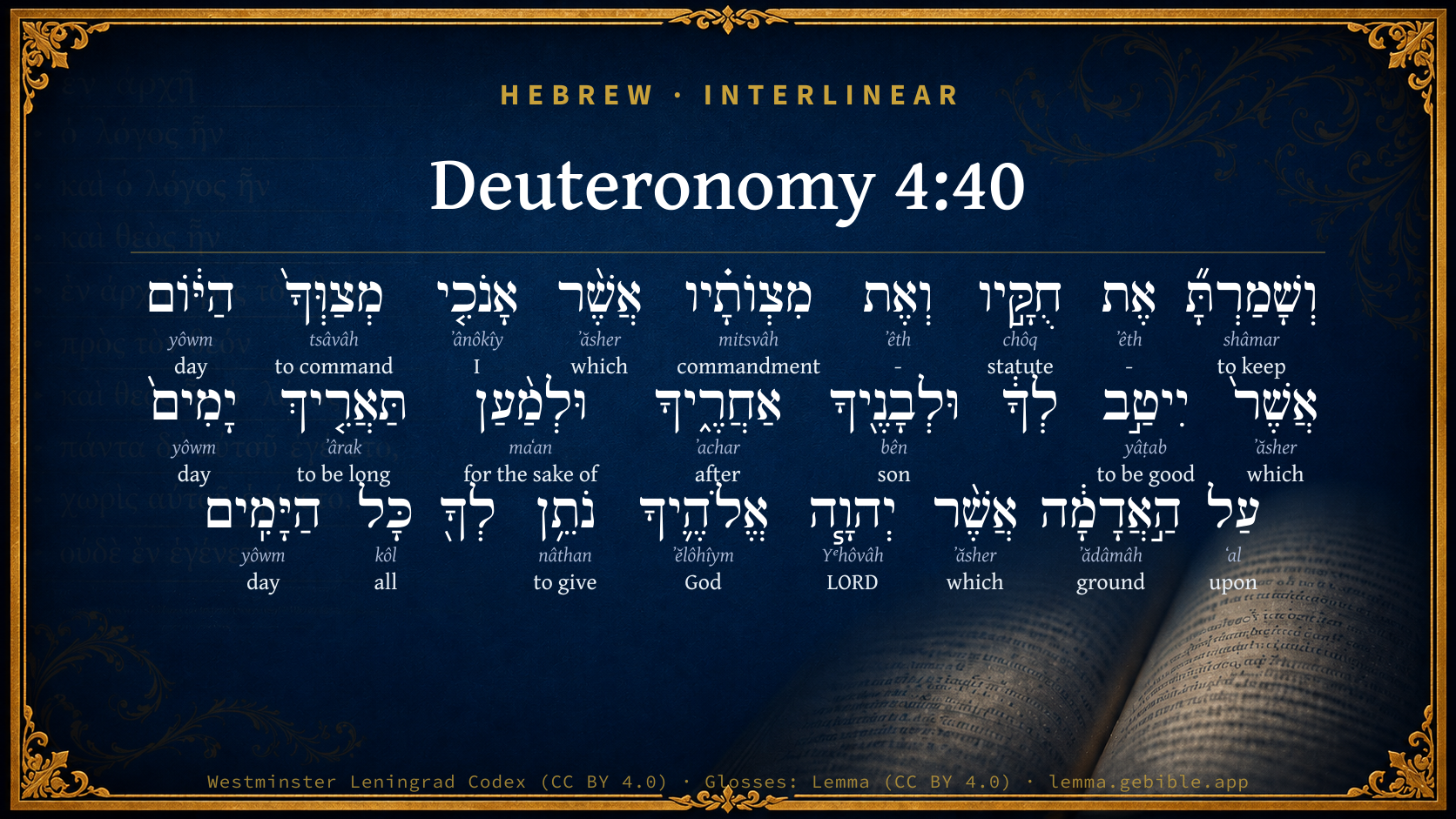
Hebrew (Westminster Leningrad Codex) Deuteronomy 4:40 appears in the Hebrew Old Testament. The text above is from the Westminster Leningrad Codex. Each word links to its Strong’s number, a concise gloss, and parsing drawn from the Open Scriptures Hebrew Bible morphology. Click any word for its full Brown-Driver-Briggs (BDB) entry.
Download image
Cite this verse

Deuteronomy 4:40 (World English Bible). Public Domain. Lemma interlinear Bible study tool, https://lemma.gebible.app/v/deuteronomy/4/40.

Show BibTeX & RIS
BibTeX
RIS
English Translation
You shall keep his statutes, and his commandments, which I command you this day, that it may go well with you, and with your children after you, and that you may prolong your days in the land, which Yahweh your God gives you, forever.
World English Bible · Public Domain
Download a study sheet

One document with this verse’s original text, its word-by-word gloss line, the meaning frame, cross-references with their text, attributed commentary, and full source and license credits — printable, and it pastes into notes with its structure intact.

This verse Autodidact and up

Study sheet (.html) Plain text (.txt)

A passage Seminary Student

Up to 50 verses in one chapter. A passage sheet keeps up to 6 commentary sources and 12 cross-references per verse, in the order this page ranks them, and says so on the sheet whenever that leaves anything out. Ask for a single verse and you get the Autodidact verse sheet above.

Everything on this page stays free to read, with no account — the sheet is a download of what is already on screen, not access to it.

Want to remove ads? Support Godless Engineer
Compare translations 3

The same verse in 3 English versions, stacked beneath the original-language interlinear above. Click any original word for its lexicon entry.

Each is an independent rendering of the whole verse — the interlinear is not word-aligned to these translations.

Highlighted words mark where these versions differ — a whole-verse word diff, not a word-by-word alignment.

  • World English Bible Public Domain
    You shall keep his statutes, and his commandments, which I command you this day, that it may go well with you, and with your children after you, and that you may prolong your days in the land, which Yahweh your God gives you, forever.
  • King James Version Public Domain
    Thou shalt keep therefore his statutes, and his commandments, which I command thee this day, that it may go well with thee, and with thy children after thee, and that thou mayest prolong thy days upon the earth, which the LORD thy God giveth thee, for ever.
  • unfoldingWord Literal Text CC BY-SA 4.0
    And you shall keep his statutes and his commandments that I command you today, that it will go well for you and for your sons after you, and so that you may prolong days in the land that Yahweh your God is giving to you all of the days.”

unfoldingWord Literal Text — © unfoldingWord, licensed CC BY-SA 4.0. Word-aligned USFM3 via Door43 (git.door43.org/unfoldingWord/en_ult).

Versions to compare (up to 4)

3 of 4 selected

Show all 18 translations

Every available English version of this verse, each an independent rendering of the whole verse.

  • World English Bible Public Domain
    You shall keep his statutes, and his commandments, which I command you this day, that it may go well with you, and with your children after you, and that you may prolong your days in the land, which Yahweh your God gives you, forever.
  • Berean Standard Bible Public Domain
    Keep His statutes and commandments, which I am giving you today, so that you and your children after you may prosper, and that you may live long in the land that the LORD your God is giving you for all time.
  • Majority Standard Bible Public Domain
    Keep His statutes and commandments, which I am giving you today, so that you and your children after you may prosper, and that you may live long in the land that the LORD your God is giving you for all time.
  • King James Version Public Domain
    Thou shalt keep therefore his statutes, and his commandments, which I command thee this day, that it may go well with thee, and with thy children after thee, and that thou mayest prolong thy days upon the earth, which the LORD thy God giveth thee, for ever.
  • American Standard Version (1901) Public Domain
    And thou shalt keep his statutes, and his commandments, which I command thee this day, that it may go well with thee, and with thy children after thee, and that thou mayest prolong thy days in the land, which Jehovah thy God giveth thee, for ever.
  • Revised Version (1885) Public Domain
    And thou shalt keep his statutes, and his commandments, which I command thee this day, that it may go well with thee, and with thy children after thee, and that thou mayest prolong thy days upon the land, which the LORD thy God giveth thee, for ever.
  • Geneva Bible (1599) Public Domain
    Thou shalt keepe therefore his ordinances, and his commandements which I commaund thee this day, that it may goe well with thee, and with thy children after thee, and that thou mayst prolong thy dayes vpon the earth, which the Lord thy God giueth thee for euer.
  • Douay-Rheims (1899) Public Domain
    Keep his precepts and commandments, which I command thee: that it may be well with thee, and thy children after thee, and thou mayst remain a long time upon the land, which the Lord thy God will give thee.
  • Young's Literal Translation Public Domain
    and thou hast kept His statutes and His commands which I am commanding thee to-day, so that it is well to thee, and to thy sons after thee, and so that thou prolongest days on the ground which Jehovah thy God is giving to thee -- all the days.'
  • Literal Standard Version CC BY-SA 4.0
    and you have kept His statutes and His commands which I am commanding you today, so that it is well for you, and for your sons after you, and so that you prolong days on the ground which your God YHWH is giving to you—all the days.”
  • Unlocked Literal Bible CC BY-SA 4.0
    You will keep his statutes and his commandments that I command you today, that it may go well with you and with your children after you, and that you may prolong your days in the land that Yahweh your God is giving you forever.”
  • unfoldingWord Literal Text CC BY-SA 4.0
    And you shall keep his statutes and his commandments that I command you today, that it will go well for you and for your sons after you, and so that you may prolong days in the land that Yahweh your God is giving to you all of the days.”
  • Darby Bible Public Domain
    And thou shalt keep his statutes, and his commandments, which I command thee this day, that it may be well with thee and with thy sons after thee, and that thou mayest prolong thy days on the land which Jehovah thy God giveth thee, for ever.
  • World Messianic Bible Public Domain
    You shall keep his statutes and his commandments which I command you today, that it may go well with you and with your children after you, and that you may prolong your days in the land which the LORD your God gives you for all time.
  • Webster's Bible Public Domain
    Thou shalt keep therefore his statutes and his commandments which I command thee this day, that it may be well with thee, and with thy children after thee, and that thou mayest prolong thy days upon the earth, which the LORD thy God giveth thee, for ever.
  • Free Bible Version CC BY-SA 4.0
    Observe his rules and regulations that I'm giving you right now, so that you and your children will do well, and that you may have long lives in the country that the Lord your God is giving you for all time.
  • Bible in Basic English Public Domain
    Then keep his laws and his orders which I give you today, so that it may be well for you and for your children after you, and that your lives may be long in the land which the Lord your God is giving you for ever.
  • JPS Tanakh (1917) Public Domain
    And thou shalt keep His statutes, and His commandments, which I command thee this day, that it may go well with thee, and with thy children after thee, and that thou mayest prolong thy days upon the land, which the LORD thy God giveth thee, for ever.

Literal Standard Version (2020), Covenant Press — licensed CC BY-SA 4.0. Text via the HelloAO Bible API (eBible.org). Unlocked Literal Bible (unfoldingWord) — licensed CC BY-SA 4.0. Text via the HelloAO Bible API (eBible.org). unfoldingWord Literal Text — © unfoldingWord, licensed CC BY-SA 4.0. Word-aligned USFM3 via Door43 (git.door43.org/unfoldingWord/en_ult). Free Bible Version, Dr. Jonathan Gallagher — licensed CC BY-SA 4.0. Text via the HelloAO Bible API (eBible.org).

Word by word

More ways to search: Search by grammar → Find every occurrence → Compare this word →

Practice this passage: Drill this verse → Learn its vocabulary →

תַּאֲרִ֤יךְ
ʼârak
H748
“to be long”
Verb, Hiphil, Imperfect, 2nd Person, Masculine, Singular
Part of Speech
Verb
Stem
Hiphil
Form
Imperfect
Person
2nd Person
Gender
Masculine
Number
Singular
Full BDB Definition

Origin: a primitive root

TWOT: 162

to be long, prolong - (Qal) to be long - (Hiphil) - to prolong (days) - to make long (tent cords) - to grow long, continue long
  1. וְשָׁמַרְתָּ֞ shâmar H8104 “and · to keep” Conjunction + Verb, Qal, Sequential Perfect, 2nd Person, Masculine, Singular
  2. אֶת ʼêth H853 “-” Particle, Direct Object
  3. חֻקָּ֣יו chôq H2706 “statutes · his” Noun, Common, Masculine, Plural, Construct + Suffix, Personal, 3rd Person, Masculine, Singular
  4. וְאֶת ʼêth H853 “and · -” Conjunction + Particle, Direct Object
  5. מִצְוֺתָ֗יו mitsvâh H4687 “commandments · his” Noun, Common, Feminine, Plural, Construct + Suffix, Personal, 3rd Person, Masculine, Singular
  6. אֲשֶׁ֨ר ʼăsher H834 “which” Particle, Relative
  7. אָנֹכִ֤י ʼânôkîy H595 “I” Pronoun, Personal, 1st Person, Common, Singular
  8. מְצַוְּךָ֙ tsâvâh H6680 “commanding · you” Verb, Piel, Participle Active, Masculine, Singular, Construct + Suffix, Personal, 2nd Person, Masculine, Singular
  9. הַיּ֔וֹם yôwm H3117 “the · day” Particle, Definite Article + Noun, Common, Masculine, Singular, Absolute
  10. אֲשֶׁר֙ ʼăsher H834 “which” Particle, Relative
  11. יִיטַ֣ב yâṭab H3190 “to be good” Verb, Qal, Imperfect, 3rd Person, Masculine, Singular
  12. וּלְבָנֶ֖יךָ bên H1121 “and · to/for · sons · your” Conjunction + Preposition + Noun, Common, Masculine, Plural, Construct + Suffix, Personal, 2nd Person, Masculine, Singular
  13. אַחֲרֶ֑יךָ ʼachar H310 “after · you” Preposition + Suffix, Personal, 2nd Person, Masculine, Singular
  14. וּלְמַ֨עַן maʻan H4616 “and · for the sake of” Conjunction + Preposition
  15. יָמִים֙ yôwm H3117 “days” Noun, Common, Masculine, Plural, Absolute
  16. עַל ʻal H5921 “upon” Preposition
  17. הַ֣אֲדָמָ֔ה ʼădâmâh H127 “the · ground” Particle, Definite Article + Noun, Common, Feminine, Singular, Absolute
  18. אֲשֶׁ֨ר ʼăsher H834 “which” Particle, Relative
  19. יְהוָ֧ה Yᵉhôvâh H3068 “LORD” Noun, Proper
  20. אֱלֹהֶ֛יךָ ʼĕlôhîym H430 “God(s) · your” Noun, Common, Masculine, Plural, Construct + Suffix, Personal, 2nd Person, Masculine, Singular
  21. נֹתֵ֥ן nâthan H5414 “giving” Verb, Qal, Participle Active, Masculine, Singular, Absolute
  22. כָּל kôl H3605 “all of” Noun, Common, Masculine, Singular, Construct
  23. הַיָּמִֽים yôwm H3117 “the · days” Particle, Definite Article + Noun, Common, Masculine, Plural, Absolute

About this verse

These counts appear in no published source. They are computed here, from the morphology-tagged text and Lemma’s own curated glosses. What Lemma adds →

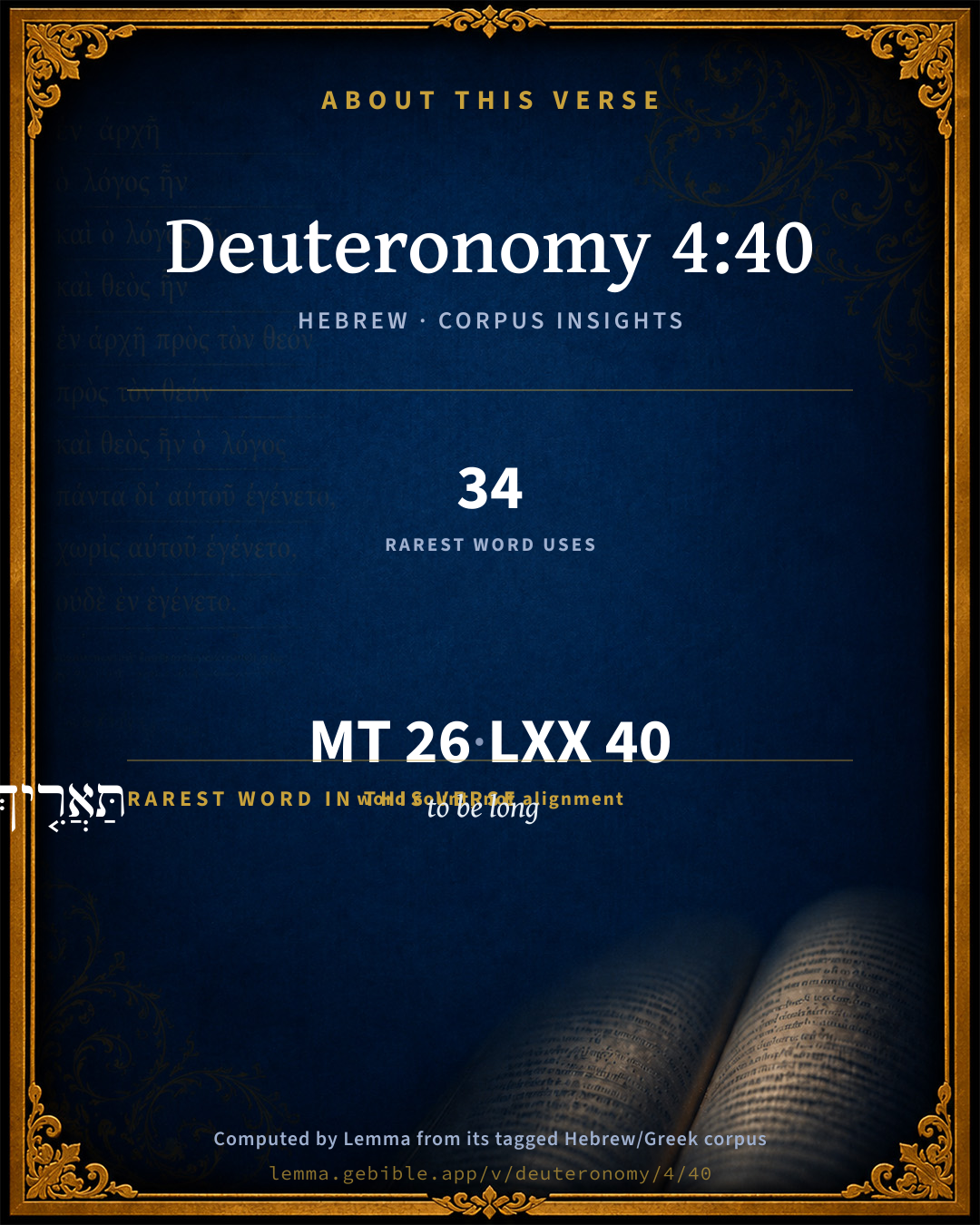
26
words
19
distinct lemmas
Pentateuch
section

Shared distinctive vocabulary

תַּאֲרִ֤יךְ to be long H748 occurs in 34 verses of the Hebrew Bible. Also found in:

Grammatical profile

  • 5 verbs
  • 10 nouns
  • 1 pronoun
  • 5 prepositions
  • 5 particles

Verb forms

  • וְשָׁמַרְתָּ֞ Qal · Sequential Perfect
  • מְצַוְּךָ֙ Piel · Participle Active
  • יִיטַ֣ב Qal · Imperfect
  • תַּאֲרִ֤יךְ Hiphil · Imperfect
  • נֹתֵ֥ן Qal · Participle Active

Repetition

Words recur within this verse — often emphatic in Hebrew:

  • הַיּ֔וֹם day H3117 ×3
  • אֲשֶׁ֨ר which H834 ×3

Hebrew & Septuagint length

In English translation the verse runs 44 words from the Hebrew and 45 from the Septuagint (LXX English) — closely comparable.

A rough comparison of the two English renderings, which tokenize alike — not a word-level alignment.

Word counts can differ between the Hebrew and the Greek without any difference in meaning — e.g. the Hebrew direct-object marker אֵת has no separate Greek word, and Greek often adds the article ὁ.

In the original languages it is 26 Hebrew tokens and 40 Greek tokens — but the two are counted differently (Hebrew bundles its prefixes and suffixes into one token; the Greek is in lemma form), so that isn’t a like-for-like length.

Cross-references

17

Topical passages linked to Deuteronomy 4:40 in the Treasury of Scripture Knowledge — connected by theme and wording, ordered by reader-vote popularity; previews shown in the World English Bible.

  • Deuteronomy 6:3 Hear therefore, Israel, and observe to do it; that it may be well with you, and that you may increase mightily, as Yahweh, the God of your fathers, has promised to you, in a land flowing with milk and honey.
  • Ephesians 6:3 "that it may be well with you, and you may live long on the earth."
  • Leviticus 22:31 "Therefore you shall keep my commandments, and do them. I am Yahweh.
  • Deuteronomy 5:16 "Honor your father and your mother, as Yahweh your God commanded you; that your days may be long, and that it may go well with you, in the land which Yahweh your God gives you.
  • Deuteronomy 12:25 You shall not eat it; that it may go well with you, and with your children after you, when you shall do that which is right in the eyes of Yahweh.
  • Deuteronomy 12:28 Observe and hear all these words which I command you, that it may go well with you, and with your children after you forever, when you do that which is good and right in the eyes of Yahweh your God.
  • Deuteronomy 6:18 You shall do that which is right and good in the sight of Yahweh; that it may be well with you, and that you may go in and possess the good land which Yahweh swore to your fathers,
  • Deuteronomy 22:7 you shall surely let the hen go, but the young you may take to yourself; that it may be well with you, and that you may prolong your days.
  • Deuteronomy 4:1 Now, Israel, listen to the statutes and to the ordinances, which I teach you, to do them; that you may live, and go in and possess the land which Yahweh, the God of your fathers, gives you.
  • Deuteronomy 4:6 Keep therefore and do them; for this is your wisdom and your understanding in the sight of the peoples, who shall hear all these statutes, and say, Surely this great nation is a wise and understanding people.
  • Jeremiah 11:4 which I commanded your fathers in the day that I brought them forth out of the land of Egypt, out of the iron furnace, saying, Obey my voice, and do them, according to all which I command you: so shall you be my people, and I will be your God;
  • Deuteronomy 5:33 You shall walk in all the way which Yahweh your God has commanded you, that you may live, and that it may be well with you, and that you may prolong your days in the land which you shall possess.
  • Deuteronomy 28:1–14 It shall happen, if you shall listen diligently to the voice of Yahweh your God, to observe to do all his commandments which I command you this day, who Yahweh your God will set you on high above all the nations of the earth:
  • John 14:21–24 One who has my commandments, and keeps them, that person is one who loves me. One who loves me will be loved by my Father, and I will love him, and will reveal myself to him."
  • Leviticus 26:1–13 "'You shall make for yourselves no idols, neither shall you raise up an engraved image or a pillar, neither shall you place any figured stone in your land, to bow down to it: for I am Yahweh your God.
  • John 14:15 If you love me, keep my commandments.
  • 1 Timothy 4:8 For bodily exercise has some value, but godliness has value for all things, having the promise of the life which is now, and of that which is to come.

Cross-references courtesy of OpenBible.info (CC BY 4.0).

Hebrew and Greek witnesses Masoretic Hebrew ↔ Greek Septuagint

The same verse in the two great witnesses to the Old Testament, shown verse-for-verse.

These are two independent witnesses, not word-aligned to each other, and the Septuagint is shown in lemma (dictionary) form.

Hebrew Deuteronomy 4:40 Masoretic · Westminster Leningrad Codex

וְשָׁמַרְתָּ֞ אֶת חֻקָּ֣יו וְאֶת מִצְוֺתָ֗יו אֲשֶׁ֨ר אָנֹכִ֤י מְצַוְּךָ֙ הַיּ֔וֹם אֲשֶׁר֙ יִיטַ֣ב לְךָ֔ וּלְבָנֶ֖יךָ אַחֲרֶ֑יךָ וּלְמַ֨עַן תַּאֲרִ֤יךְ יָמִים֙ עַל הַ֣אֲדָמָ֔ה אֲשֶׁ֨ר יְהוָ֧ה אֱלֹהֶ֛יךָ נֹתֵ֥ן לְךָ֖ כָּל הַיָּמִֽים

You shall keep his statutes, and his commandments, which I command you this day, that it may go well with you, and with your children after you, and that you may prolong your days in the land, which Yahweh your God gives you, forever.

World English Bible · Public Domain

Greek LXX Deuteronomy 4:40 Septuagint · lemma form

καί φυλάσσω ὁ δικαίωμα αὐτός καί ὁ ἐντολή αὐτός ὅσος ἐγώ ἐντέλλομαι σύ σήμερον ἵνα εὖ σύ γίγνομαι καί ὁ υἱός σύ μετά σύ ὅπως μακροήμερος γίγνομαι ἐπί ὁ γῆ ὅς κύριος ὁ θεός σύ δίδωμι σύ πᾶς ὁ ἡμέρα

And keep you⌃ his commandments, and his ordinances, all that I command you this day; that it may be well with you, and with your sons after you, that you⌃ may be long-lived upon the earth, which the Lord your God gives you for ever.

LXX2012 (modern English Septuagint) · Public Domain

Hebrew: Westminster Leningrad Codex (CC BY 4.0). Greek: Septuagint (public domain); English from LXX2012 (modern English Septuagint) (Public Domain). How the Septuagint differs from the Hebrew →

Targum (Aramaic paraphrase)

2

The Targum is the ancient Jewish Aramaic paraphrase of the Hebrew Scriptures — an interpretive translation, not the Hebrew text itself. Onkelos (literal) and Pseudo-Jonathan (expansive) render the Torah, and Jonathan the Prophets. Coverage is partial: where no permissively-licensed English translation exists for a verse, only the Aramaic is shown. This is verse-level text, not a word-by-word alignment to the Hebrew.

  1. Targum Onkelos Torah (Genesis–Deuteronomy)
    וְתִטַר יָת קְיָמוֹהִי וְיָת פִּקוּדוֹהִי דִי אֲנָא מְפַקְדָךְ יוֹמָא דֵין דִי יֵיטַב לָךְ וְלִבְנָיךְ בַּתְרָךְ וּבְדִיל דְתוֹרִיךְ יוֹמִין עַל אַרְעָא דִי יְיָ אֱלָהָךְ יָהֵב לָךְ כָּל יוֹמַיָא

    (no public-domain English translation for this verse)

    Targum Onkelos — Aramaic: “Onkelos Genesis” (public domain); “Onkelos Exodus” (public domain); “Onkelos Leviticus” (public domain); “Onkelos Numbers” (public domain); “Onkelos Deuteronomy” (public domain). English: “Sefaria Community Translation” (CC0 1.0 (public-domain dedication)); “J.W. Etheridge. The Targums of Onkelos and Jonathan Ben Uzziel on the Pentateuch. London: Longmans, Green, 1862” (public domain). Text via Sefaria.

  2. Targum Pseudo-Jonathan Torah (Genesis–Deuteronomy)
    וְתִנְטְרוּן יַת קְיָימוֹי וְיַת פִּקּוּדוֹי דַּאֲנָא מְפַקֵיד לְכוֹן יוֹמָא דֵין דְּיוֹטִיב לְכוֹן וְלִבְנֵיכוֹן בַּתְרֵיכוֹן וּמִן בִּגְלַל דְּתִינְגְּדוּן יוֹמָא דֵין עַל אַרְעָא דַיְיָ אֱלָהָכוֹן יָהֵיב לְכוֹן כָּל יוֹמַיָא

    Therefore observe His covenant, and the commandments which I command you this day, that He may do good to you and to your children after you, and that you may have continuance upon the land which the Lord your God giveth you for all days.

    Targum Pseudo-Jonathan — Aramaic: “Targum Jonathan on Genesis” (public domain); “Targum Jonathan on Exodus” (public domain); “Targum Jonathan on Leviticus” (public domain); “Targum Jonathan on Numbers” (public domain); “Targum Jonathan on Deuteronomy” (public domain). English: “The Targum of Jonathan ben Uzziel, trans. J. W. Etheridge, London, 1862” (public domain). Text via Sefaria.

Commentary

Notes on Deuteronomy 4:40 from classic Christian and Jewish commentators (each source and its license shown beneath its notes). The classic Christian expositions comment on the surrounding passage and are grouped to its opening verse, so a note may address several verses; the Jewish commentaries on the Tanakh (Rashi and others) are per-verse, so they appear only where the commentator wrote on this verse.

Lemma curates 59 commentaries, every one of them public domain or Creative Commons licensed, each selected and text-cleaned for this edition rather than reprinted as found. About our sources →

The Biblical Illustrator

Joseph S. Exell

Deu_4:40

Thou shalt keep therefore His statutes, and His commandments, . . . that it may go well with thee.

A command and a promise

I. Moses enjoins an obligation, which is really the highest privilege.

1. Israels relation to God.

(1) In contrast with Gentile beliefs--polytheistic--each nation its own God; mostly debased forms of human passion.

(2) Jehovah proclaims Himself only God, others His subjects (Jer_10:7; Psa_22:28); but they, His one people (chap. 32:9).

(3) Moses bids them realise that they are the prerogative nation of the world (Exo_19:6).

(a) By His presence among them.

(b) By keeping commandments.

(c) Of this, love of God must be the root.

2. The grounds of this relation.

(1) Not thy righteousness.

(2) Love for thy fathers.

II. Moses holds out a promise. Each Israelite had--

1. A full life--long share of temporal blessings.

2. Then partly realised by--

(1) Rescue from Egypt (Deu_4:20); and

(2) Then their recent first victory, taking possession of the land (Num_21:33-35).

3. But partly in store.

(1) Jordan to be crossed, and

(2) Canaan won.

4. Thus, in spite of their dastardly unworthiness, promise ripened to performance. (H. Hayman, D. D.)

Penalty of disregarding commands

On the bridge of a good steamer was the captain giving the right course, N-by-W. 67°. He bad taken account of eddies and currents. The second officer, leaving, perhaps, the currents out of consideration, came and directed the helmsman to make it N-by-W. 57°, but to bring the ship round so gently that the captain would not notice it. The result was a disastrous wreck. If we refuse to hearken to Gods voice, and we disobey His commands, our lives will be wrecked, and all our hopes of happiness shattered.

Obedience indispensable

Suppose I have a son, say ten years old, and I want him to go to school until he is fifteen or twenty years, but he has just set his will against mine. He says, I refuse to go to school for another day. I tell you that that child will be unable to do one thing to please me until he goes to school. He may make all the sacrifices he may have a mind to, he may go out and earn two or three shillings a day, and bring every penny to me; but I do not want his money, I want his obedience. What God wants is obedience. (D. L. Moody.)

Obedience to God is conducive to our welfare

Another peculiar excellency of our religion is, that it prescribes an accurate rule of life,--most agreeable to reason and to our nature; most conducive to our welfare and content, tending to procure each mans private good, and to promote the public benefit of all, by the strict observance whereof we bring our human nature to a resemblance of the Divine; and we shall also thereby obtain Gods favour, oblige and benefit men, and procure to ourselves the conveniences of a sober life and the pleasure of a good conscience. For if we examine the precepts which respect our duty to God, what can be more just, pleasant, or beneficial to us than are those duties of piety which our religion enjoins? What is more fit and reasonable than that we should most highly esteem and honour Him who is most excellent; that we should bear the sincerest affection for Him who is perfect goodness Himself, and most beneficial to us; that we should have the most awful dread of Him that is infinitely powerful, holy, and just; that we should be very grateful to Him from whom we received our being, with all the comforts and conveniences of it; that we should entirely trust and hope in Him who can and will do whatever we may in reason expect from His goodness--nor can He ever fail to perform His promises; that we should render all due obedience to Him whose children, servants, and subjects we are? The practice of such a piety, of a service so reasonable, cannot but be of vast advantage to us, as it procures peace of conscience, a comfortable hope, a freedom from all terrors and scruples of mind, from all tormenting cares and anxieties. (I. Barrow.)

The Biblical Illustrator, edited by Joseph S. Exell (c. 1880s–1900s) — public domain. Text from a community e-Sword module.

Tyndale Open Study Notes

Tyndale Open Resources

4:40 More than a promise of individual longevity, long life described Israel’s tenure in the land of promise.

Tyndale Open Study Notes — © Tyndale Open Resources, licensed CC BY-SA 4.0. Text via the HelloAO Bible API.

Geneva Bible (1599)

Geneva Bible translators

God promiseth reward not for our merits, but to encourage us, and to assure us that our labor shall not be lost.

Geneva Bible (1599) marginal notes — public domain. Text via Bolls.life.

The Cambridge Bible for Schools and Colleges

gen. ed. J. J. S. Perowne

40. thou shalt keep his statutes and his commandments] Return to the keynote in Deu_4:1.

prolong thy days] See on Deu_4:26.

The Cambridge Bible for Schools and Colleges (gen. ed. J. J. S. Perowne; Cambridge University Press, 1878–1918) — public domain. Text from a community e-Sword module.

John Gill's Exposition

Thou shall keep therefore his statutes, and his commandments,.... All his laws, moral, ceremonial, and judicial, partly being under obligation to him for all the great and good things done by him for them before enumerated, and partly and chiefly because he is the Lord God in heaven and in earth, and has a right to command and ought to be obeyed:

which I command thee this day; in the name of the Lord, and which he repeated, opened, and explained, and charged them afresh to observe; otherwise they were such that had been given long ago:

that it may go well with thee, and with thy children after thee; that they and theirs might enjoy temporal mercies, and continue in the land of Canaan, and partake of all the blessings in it, as follows, and of the sanctuary of the Lord, and the privileges of it:

and that thou mayest prolong thy days upon the earth, which the Lord thy God giveth thee for ever; that is, that they and theirs might live long in the land of Canaan, which the Lord gave for an inheritance for ever, provided they kept his law, and were obedient to his commands; see Deu 6:25, and though they have had several interruptions by their captivities, and especially by their present very long one, yet when they shall return and seek the Lord their God, and David their king, they shall have their land restored to them again, and shall never more be dispossessed of it.

John Gill's Exposition of the Whole Bible (1746–1763) — public domain (CC PDM 1.0). Text via the HelloAO Bible API.

The Pulpit Commentary

Upon the earth, rather upon the land (hmda) the Lord thy God giveth thee forever. The comma after "thee" in the Authorized Version should be deleted. "The sum of this whole exhortation is

(1) to acknowledge and lay to heart that God is the alone God of the universe, in heaven and on earth; hence

(2) to be obedient to his laws; and so

(3) to have, as a recompense, a happy continuance in the beloved land" (Herxheimer). The conclusion of the exhortation reverts to its beginning. (Deu_5:4; ver. 1)

The Pulpit Commentary (1880–1919), ed. H.D.M. Spence-Jones & Joseph S. Exell — public domain. Text from a community e-Sword module.

Lesson kit

Teaching starters — assembled from the data on this page, not authored interpretation. Every prompt links to the verse data it draws on. Edit before teaching.

Deuteronomy, in the Pentateuch, opens this verse with 26 words (19 distinct Hebrew lemmas). Its most distinctive word is ʼârak (“to be long”). A historical commentator’s framing appears above. Read the whole chapter for the surrounding context.

Discussion questions

  1. What does “to be long” (ʼârak) contribute to the verse as a whole?
  2. How does Genesis 26:8, which shares the word «to be long», read alongside this verse?
  3. What does the repetition of “day” (3× in this one verse) do in this verse?
  4. These translations render this verse differently; the difference is in the English rendering, not the original. What questions does that raise?
  5. «וְשָׁמַרְתָּ֞» is a Qal Sequential Perfect verb. How does that grammatical form shape the action described?
  6. Compare how The Biblical Illustrator and Tyndale Open Study Notes read this verse. Where do they agree or differ?

Things to notice

Reading settings

Reading text

Shown beneath each verse's original-language words.

Old Testament
Old Testament edition

Read the OT as the Masoretic Hebrew (MT) or the Greek Septuagint (LXX).

English shown for the Greek Septuagint (in the Hebrew ↔ Greek comparison).

Comparing translations? Open the Compare panel on any verse page to stack up to four side by side.