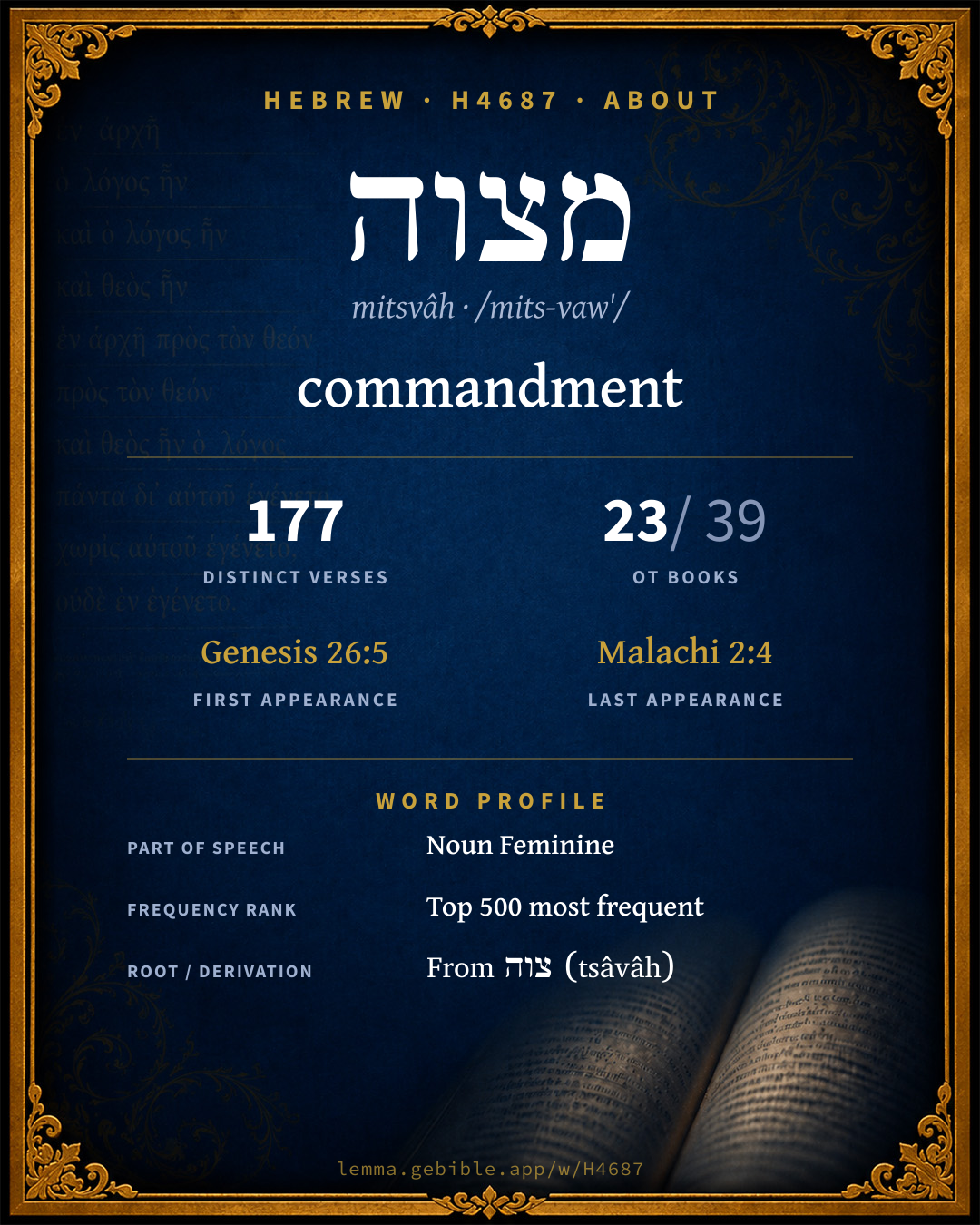
מִצְוָה
commandment
‘commandment’ is one of 4 main senses fuller range ↓
Full lexicon entry — Brown-Driver-Briggs (BDB)
From Brown-Driver-Briggs (BDB)
Where this word appears
See every Construct-state word in the Hebrew Bible →
Grammar key — what these labels mean
Part of speech
- Noun
- A naming word — a person, place, thing, or idea.
Noun type
- Common
- A common noun — a general class of person, place, or thing (“king,” “city,” “water”), not a specific name.
State
- Construct
- A noun bound to a following noun in a possessive / “of” relationship (the construct chain).
- Absolute
- The independent form of a noun, not bound to a following word.
Gender
- Feminine
- Grammatically feminine.
Number
- Plural
- More than one (in Hebrew, generally three or more).
- Singular
- One.
Grammatical forms
- Noun, Common, Feminine, Plural, Construct 114 times (62%)
- Noun, Common, Feminine, Singular, Construct 31 times (17%)
- Noun, Common, Feminine, Singular, Absolute 30 times (16%)
- Noun, Common, Feminine, Plural, Absolute 9 times (5%)
Parsed forms decoded from the imported morphology (morphhb / Westminster Leningrad Codex — WLC text public domain, morphhb tagging CC BY 4.0), counted across 184 parsed occurrences — not distinct verses.
Every verse where H4687 appears — 177 distinct verses across 23 books. Click any verse to open its interlinear word-by-word view. Verse text shown in the World English Bible for context — . Each verse’s Hebrew form is shown with its reference; the English is not keyword-highlighted, since the data carries no word-level English alignment. Use “Compare translations” on any verse to read it across multiple English versions. This concordance covers the Hebrew Bible; Septuagint (Greek Old Testament) occurrences are not indexed here.
Genesis 1 verse
Exodus 4 verses
- Exodus 15:26 לְ/מִצְוֺתָ֔י/ו prep + n c fp cs + sfx pers 3ms and he said, "If you will diligently listen to the voice of Yahweh your God, and will do that which is right in his eyes, and will pay attention to his commandments, and keep all his statutes, I will put none of the diseases on you, which I have put on the Egyptians; for I am Yahweh who heals you."
- Exodus 16:28 מִצְוֺתַ֖/י n c fp cs + sfx pers 1cs Yahweh said to Moses, "How long do you refuse to keep my commandments and my laws?
- Exodus 20:6 מִצְוֺתָֽ/י n c fp cs + sfx pers 1cs and showing loving kindness to thousands of those who love me and keep my commandments.
- Exodus 24:12 וְ/הַ/מִּצְוָ֔ה conj + ptcl def.art + n c fs Yahweh said to Moses, "Come up to me on the mountain, and stay here, and I will give you the tables of stone with the law and the commands that I have written, that you may teach them."
Leviticus 10 verses
- Leviticus 4:2 מִצְוֺ֣ת n c fp cs "Speak to the children of Israel, saying, 'If anyone sins unintentionally, in any of the things which Yahweh has commanded not to be done, and does any one of them:
- Leviticus 4:13 מִצְוֺ֧ת n c fp cs "'If the whole congregation of Israel sins, and the thing is hidden from the eyes of the assembly, and they have done any of the things which Yahweh has commanded not to be done, and are guilty;
- Leviticus 4:22 מִצְוֺת֩ n c fp cs "'When a ruler sins, and unwittingly does any one of all the things which Yahweh his God has commanded not to be done, and is guilty;
- Leviticus 4:27 מִ/מִּצְוֺ֧ת prep + n c fp cs "'If anyone of the common people sins unwittingly, in doing any of the things which Yahweh has commanded not to be done, and is guilty;
- Leviticus 5:17 מִצְוֺ֣ת n c fp cs "If anyone sins, and does any of the things which Yahweh has commanded not to be done; though he didn't know it, yet he is guilty, and shall bear his iniquity.
- Leviticus 22:31 מִצְוֺתַ֔/י n c fp cs + sfx pers 1cs "Therefore you shall keep my commandments, and do them. I am Yahweh.
- Leviticus 26:3 מִצְוֺתַ֣/י n c fp cs + sfx pers 1cs "'If you walk in my statutes, and keep my commandments, and do them;
- Leviticus 26:14 הַ/מִּצְוֺ֖ת ptcl def.art + n c fp "'But if you will not listen to me, and will not do all these commandments;
- Leviticus 26:15 מִצְוֺתַ֔/י n c fp cs + sfx pers 1cs and if you shall reject my statutes, and if your soul abhors my ordinances, so that you will not do all my commandments, but break my covenant;
- Leviticus 27:34 הַ/מִּצְוֺ֗ת ptcl def.art + n c fp These are the commandments which Yahweh commanded Moses for the children of Israel on Mount Sinai.
Numbers 5 verses
- Numbers 15:22 הַ/מִּצְוֺ֖ת ptcl def.art + n c fp When you shall err, and not observe all these commandments, which Yahweh has spoken to Moses,
- Numbers 15:31 מִצְוָת֖/וֹ n c fs cs + sfx pers 3ms Because he has despised the word of Yahweh, and has broken his commandment, that soul shall utterly be cut off; his iniquity shall be on him.
- Numbers 15:39 מִצְוֺ֣ת n c fp cs and it shall be to you for a fringe, that you may look on it, and remember all the commandments of Yahweh, and do them; and that you not follow after your own heart and your own eyes, after which you use to play the prostitute;
- Numbers 15:40 מִצְוֺתָ֑/י n c fp cs + sfx pers 1cs that you may remember and do all my commandments, and be holy to your God.
- Numbers 36:13 הַ/מִּצְוֺ֞ת ptcl def.art + n c fp These are the commandments and the ordinances which Yahweh commanded by Moses to the children of Israel in the plains of Moab by the Jordan at Jericho.
Deuteronomy 42 verses
- Deuteronomy 4:2 מִצְוֺת֙ n c fp cs You shall not add to the word which I command you, neither shall you diminish from it, that you may keep the commandments of Yahweh your God which I command you.
- Deuteronomy 4:40 מִצְוֺתָ֗י/ו n c fp cs + sfx pers 3ms You shall keep his statutes, and his commandments, which I command you this day, that it may go well with you, and with your children after you, and that you may prolong your days in the land, which Yahweh your God gives you, forever.
- Deuteronomy 5:10 מצות/ו מִצְוֺתָֽ/י n c fp cs + sfx pers 3ms n c fp cs + sfx pers 1cs and showing loving kindness to thousands of those who love me and keep my commandments.
- Deuteronomy 5:29 מִצְוֺתַ֖/י n c fp cs + sfx pers 1cs Oh that there were such a heart in them, that they would fear me, and keep all my commandments always, that it might be well with them, and with their children forever!
- Deuteronomy 5:31 הַ/מִּצְוָ֛ה ptcl def.art + n c fs But as for you, stand you here by me, and I will speak to you all the commandment, and the statutes, and the ordinances, which you shall teach them, that they may do them in the land which I give them to possess it.
- Deuteronomy 6:1 הַ/מִּצְוָ֗ה ptcl def.art + n c fs Now this is the commandment, the statutes, and the ordinances, which Yahweh your God commanded to teach you, that you might do them in the land where you go over to possess it;
- Deuteronomy 6:2 וּ/מִצְוֺתָי/ו֮ conj + n c fp cs + sfx pers 3ms that you might fear Yahweh your God, to keep all his statutes and his commandments, which I command you, you, and your son, and your son's son, all the days of your life; and that your days may be prolonged.
- Deuteronomy 6:17 מִצְוֺ֖ת n c fp cs You shall diligently keep the commandments of Yahweh your God, and his testimonies, and his statutes, which he has commanded you.
- Deuteronomy 6:25 הַ/מִּצְוָ֣ה ptcl def.art + n c fs It shall be righteousness to us, if we observe to do all this commandment before Yahweh our God, as he has commanded us.
- Deuteronomy 7:9 מצות/ו מִצְוֺתָ֖י/ו n c fp cs + sfx pers 3ms n c fp cs + sfx pers 3ms Know therefore that Yahweh your God, he is God, the faithful God, who keeps covenant and loving kindness with them who love him and keep his commandments to a thousand generations,
- Deuteronomy 7:11 הַ/מִּצְוָ֜ה ptcl def.art + n c fs You shall therefore keep the commandment, and the statutes, and the ordinances, which I command you this day, to do them.
- Deuteronomy 8:1 הַ/מִּצְוָ֗ה ptcl def.art + n c fs All the commandment which I command you this day shall you observe to do, that you may live, and multiply, and go in and possess the land which Yahweh swore to your fathers.
- Deuteronomy 8:2 מצות/ו מִצְוֺתָ֖י/ו n c fp cs + sfx pers 3ms n c fp cs + sfx pers 3ms You shall remember all the way which Yahweh your God has led you these forty years in the wilderness, that he might humble you, to prove you, to know what was in your heart, whether you would keep his commandments, or not.
- Deuteronomy 8:6 מִצְוֺ֖ת n c fp cs You shall keep the commandments of Yahweh your God, to walk in his ways, and to fear him.
- Deuteronomy 8:11 מִצְוֺתָי/ו֙ n c fp cs + sfx pers 3ms Beware lest you forget Yahweh your God, in not keeping his commandments, and his ordinances, and his statutes, which I command you this day:
- Deuteronomy 10:13 מִצְוֺ֤ת n c fp cs to keep the commandments of Yahweh, and his statutes, which I command you this day for your good?
- Deuteronomy 11:1 וּ/מִצְוֺתָ֖י/ו conj + n c fp cs + sfx pers 3ms Therefore you shall love Yahweh your God, and keep his charge, and his statutes, and his ordinances, and his commandments, always.
- Deuteronomy 11:8 הַ/מִּצְוָ֔ה ptcl def.art + n c fs Therefore shall you keep all the commandment which I command you this day, that you may be strong, and go in and possess the land, where you go over to possess it;
- Deuteronomy 11:13 מִצְוֺתַ֔/י n c fp cs + sfx pers 1cs It shall happen, if you shall listen diligently to my commandments which I command you this day, to love Yahweh your God, and to serve him with all your heart and with all your soul,
- Deuteronomy 11:22 הַ/מִּצְוָ֣ה ptcl def.art + n c fs For if you shall diligently keep all this commandment which I command you, to do it, to love Yahweh your God, to walk in all his ways, and to cleave to him;
- Deuteronomy 11:27 מִצְוֺת֙ n c fp cs the blessing, if you shall listen to the commandments of Yahweh your God, which I command you this day;
- Deuteronomy 11:28 מִצְוֺת֙ n c fp cs and the curse, if you shall not listen to the commandments of Yahweh your God, but turn aside out of the way which I command you this day, to go after other gods, which you have not known.
- Deuteronomy 13:4 מִצְוֺתָ֤י/ו n c fp cs + sfx pers 3ms You shall walk after Yahweh your God, and fear him, and keep his commandments, and obey his voice, and you shall serve him, and cleave to him.
- Deuteronomy 13:18 מִצְוֺתָ֔י/ו n c fp cs + sfx pers 3ms when you shall listen to the voice of Yahweh your God, to keep all his commandments which I command you this day, to do that which is right in the eyes of Yahweh your God.
- Deuteronomy 15:5 הַ/מִּצְוָ֣ה ptcl def.art + n c fs if only you diligently listen to the voice of Yahweh your God, to observe to do all this commandment which I command you this day.
- Deuteronomy 17:20 הַ/מִּצְוָ֖ה ptcl def.art + n c fs that his heart not be lifted up above his brothers, and that he not turn aside from the commandment, to the right hand, or to the left: to the end that he may prolong his days in his kingdom, he and his children, in the midst of Israel.
- Deuteronomy 19:9 הַ/מִּצְוָ֨ה ptcl def.art + n c fs if you shall keep all this commandment to do it, which I command you this day, to love Yahweh your God, and to walk ever in his ways; then shall you add three cities more for you, besides these three:
- Deuteronomy 26:13 מִצְוָתְ/ךָ֖ מִ/מִּצְוֺתֶ֖י/ךָ n c fs cs + sfx pers 2ms prep + n c fp cs + sfx pers 2ms You shall say before Yahweh your God, I have put away the holy things out of my house, and also have given them to the Levite, and to the foreigner, to the fatherless, and to the widow, according to all your commandment which you have commanded me: I have not transgressed any of your commandments, neither have I forgotten them:
- Deuteronomy 26:17 וּ/מִצְוֺתָ֛י/ו conj + n c fp cs + sfx pers 3ms You have declared Yahweh this day to be your God, and that you would walk in his ways, and keep his statutes, and his commandments, and his ordinances, and listen to his voice:
- Deuteronomy 26:18 מִצְוֺתָֽי/ו n c fp cs + sfx pers 3ms and Yahweh has declared you this day to be a people for his own possession, as he has promised you, and that you should keep all his commandments;
- Deuteronomy 27:1 הַ/מִּצְוָ֔ה ptcl def.art + n c fs Moses and the elders of Israel commanded the people, saying, Keep all the commandment which I command you this day.
- Deuteronomy 27:10 מִצְוֺתָ/ו֙ n c fp cs + sfx pers 3ms You shall therefore obey the voice of Yahweh your God, and do his commandments and his statutes, which I command you this day.
- Deuteronomy 28:1 מִצְוֺתָ֔י/ו n c fp cs + sfx pers 3ms It shall happen, if you shall listen diligently to the voice of Yahweh your God, to observe to do all his commandments which I command you this day, who Yahweh your God will set you on high above all the nations of the earth:
- Deuteronomy 28:9 מִצְוֺת֙ n c fp cs Yahweh will establish you for a holy people to himself, as he has sworn to you; if you shall keep the commandments of Yahweh your God, and walk in his ways.
- Deuteronomy 28:13 מִצְוֺ֣ת n c fp cs Yahweh will make you the head, and not the tail; and you shall be above only, and you shall not be beneath; if you shall listen to the commandments of Yahweh your God, which I command you this day, to observe and to do [them],
- Deuteronomy 28:15 מִצְוֺתָ֣י/ו n c fp cs + sfx pers 3ms But it shall come to pass, if you will not listen to the voice of Yahweh your God, to observe to do all his commandments and his statutes which I command you this day, that all these curses shall come on you, and overtake you.
- Deuteronomy 28:45 מִצְוֺתָ֥י/ו n c fp cs + sfx pers 3ms All these curses shall come on you, and shall pursue you, and overtake you, until you are destroyed; because you didn't listen to the voice of Yahweh your God, to keep his commandments and his statutes which he commanded you:
- Deuteronomy 30:8 מִצְוֺתָ֔י/ו n c fp cs + sfx pers 3ms You shall return and obey the voice of Yahweh, and do all his commandments which I command you this day.
- Deuteronomy 30:10 מִצְוֺתָי/ו֙ n c fp cs + sfx pers 3ms if you shall obey the voice of Yahweh your God, to keep his commandments and his statutes which are written in this book of the law; if you turn to Yahweh your God with all your heart, and with all your soul.
- Deuteronomy 30:11 הַ/מִּצְוָ֣ה ptcl def.art + n c fs For this commandment which I command you this day, it is not too hard for you, neither is it far off.
- Deuteronomy 30:16 מִצְוֺתָ֥י/ו n c fp cs + sfx pers 3ms in that I command you this day to love Yahweh your God, to walk in his ways, and to keep his commandments and his statutes and his ordinances, that you may live and multiply, and that Yahweh your God may bless you in the land where you go in to possess it.
- Deuteronomy 31:5 הַ/מִּצְוָ֔ה ptcl def.art + n c fs Yahweh will deliver them up before you, and you shall do to them according to all the commandment which I have commanded you.
Joshua 2 verses
- Joshua 22:3 מִצְוַ֖ת n c fs cs you have not left your brothers these many days to this day, but have kept the charge of the commandment of Yahweh your God.
- Joshua 22:5 הַ/מִּצְוָ֣ה מִצְוֺתָ֖י/ו ptcl def.art + n c fs n c fp cs + sfx pers 3ms Only take diligent heed to do the commandment and the law which Moses the servant of Yahweh commanded you, to love Yahweh your God, and to walk in all his ways, and to keep his commandments, and to cleave to him, and to serve him with all your heart and with all your soul.
Judges 2 verses
- Judges 2:17 מִצְוֺת n c fp cs Yet they didn't listen to their judges; for they played the prostitute after other gods, and bowed themselves down to them: they turned aside quickly out of the way in which their fathers walked, obeying the commandments of Yahweh; [but] they didn't do so.
- Judges 3:4 מִצְוֺ֣ת n c fp cs They were [left], to prove Israel by them, to know whether they would listen to the commandments of Yahweh, which he commanded their fathers by Moses.
1 Samuel 1 verse
1 Kings 12 verses
- 1 Kings 2:3 מִצְוֺתָי/ו֙ n c fp cs + sfx pers 3ms and keep the charge of Yahweh your God, to walk in his ways, to keep his statutes, [and] his commandments, and his ordinances, and his testimonies, according to that which is written in the law of Moses, that you may prosper in all that you do, and wherever you turn yourself.
- 1 Kings 2:43 הַ/מִּצְוָ֖ה ptcl def.art + n c fs Why then have you not kept the oath of Yahweh, and the commandment that I have charged you with?
- 1 Kings 3:14 וּ/מִצְוֺתַ֔/י conj + n c fp cs + sfx pers 1cs If you will walk in my ways, to keep my statutes and my commandments, as your father David did walk, then I will lengthen your days.
- 1 Kings 6:12 מִצְוֺתַ֖/י n c fp cs + sfx pers 1cs Concerning this house which you are building, if you will walk in my statutes, and execute my ordinances, and keep all my commandments to walk in them; then will I establish my word with you, which I spoke to David your father.
- 1 Kings 8:58 מִצְוֺתָ֤י/ו n c fp cs + sfx pers 3ms that he may incline our hearts to him, to walk in all his ways, and to keep his commandments, and his statutes, and his ordinances, which he commanded our fathers.
- 1 Kings 8:61 מִצְוֺתָ֖י/ו n c fp cs + sfx pers 3ms Let your heart therefore be perfect with Yahweh our God, to walk in his statutes, and to keep his commandments, as at this day.
- 1 Kings 9:6 מִצְוֺתַ֣/י n c fp cs + sfx pers 1cs But if you shall turn away from following me, you or your children, and not keep my commandments and my statutes which I have set before you, but shall go and serve other gods, and worship them;
- 1 Kings 11:34 מִצְוֺתַ֥/י n c fp cs + sfx pers 1cs However I will not take the whole kingdom out of his hand; but I will make him prince all the days of his life, for David my servant's sake whom I chose, who kept my commandments and my statutes;
- 1 Kings 11:38 וּ/מִצְוֺתַ֔/י conj + n c fp cs + sfx pers 1cs It shall be, if you will listen to all that I command you, and will walk in my ways, and do that which is right in my eyes, to keep my statutes and my commandments, as David my servant did; that I will be with you, and will build you a sure house, as I built for David, and will give Israel to you.
- 1 Kings 13:21 הַ/מִּצְוָ֔ה ptcl def.art + n c fs and he cried to the man of God who came from Judah, saying, Thus says Yahweh, Because you have been disobedient to the mouth of Yahweh, and have not kept the commandment which Yahweh your God commanded you,
- 1 Kings 14:8 מִצְוֺתַ֜/י n c fp cs + sfx pers 1cs and tore the kingdom away from the house of David, and gave it you; and yet you have not been as my servant David, who kept my commandments, and who followed me with all his heart, to do that only which was right in my eyes,
- 1 Kings 18:18 מִצְוֺ֣ת n c fp cs He answered, I have not troubled Israel; but you, and your father's house, in that you have forsaken the commandments of Yahweh, and you have followed the Baals.
2 Kings 8 verses
- 2 Kings 17:13 מִצְוֺתַ֣/י n c fp cs + sfx pers 1cs Yet Yahweh testified to Israel, and to Judah, by every prophet, and every seer, saying, Turn you from your evil ways, and keep my commandments and my statutes, according to all the law which I commanded your fathers, and which I sent to you by my servants the prophets.
- 2 Kings 17:16 מִצְוֺת֙ n c fp cs They forsook all the commandments of Yahweh their God, and made them molten images, even two calves, and made an Asherah, and worshiped all the host of the sky, and served Baal.
- 2 Kings 17:19 מִצְוֺ֖ת n c fp cs Also Judah didn't keep the commandments of Yahweh their God, but walked in the statutes of Israel which they made.
- 2 Kings 17:34 וְ/כַ/מִּצְוָ֗ה conj + prep det + n c fs To this day they do after the former manner: they don't fear Yahweh, neither do they after their statutes, or after their ordinances, or after the law or after the commandment which Yahweh commanded the children of Jacob, whom he named Israel;
- 2 Kings 17:37 וְ/הַ/מִּצְוָה֙ conj + ptcl def.art + n c fs and the statutes and the ordinances, and the law and the commandment, which he wrote for you, you shall observe to do forevermore; and you shall not fear other gods:
- 2 Kings 18:6 מִצְוֺתָ֔י/ו n c fp cs + sfx pers 3ms For he joined with Yahweh; he didn't depart from following him, but kept his commandments, which Yahweh commanded Moses.
- 2 Kings 18:36 מִצְוַ֨ת n c fs cs But the people held their peace, and answered him not a word; for the king's commandment was, saying, Don't answer him.
- 2 Kings 23:3 מִצְוֺתָ֜י/ו n c fp cs + sfx pers 3ms The king stood by the pillar, and made a covenant before Yahweh, to walk after Yahweh, and to keep his commandments, and his testimonies, and his statutes, with all [his] heart, and all [his] soul, to confirm the words of this covenant that were written in this book: and all the people stood to the covenant.
1 Chronicles 3 verses
- 1 Chronicles 28:7 מִצְוֺתַ֥/י n c fp cs + sfx pers 1cs I will establish his kingdom forever, if he be constant to do my commandments and my ordinances, as at this day.
- 1 Chronicles 28:8 מִצְוֺ֖ת n c fp cs Now therefore, in the sight of all Israel, the assembly of Yahweh, and in the audience of our God, observe and seek out all the commandments of Yahweh your God; that you may possess this good land, and leave it for an inheritance to your children after you forever.
- 1 Chronicles 29:19 מִצְוֺתֶ֔י/ךָ n c fp cs + sfx pers 2ms and give to Solomon my son a perfect heart, to keep your commandments, your testimonies, and your statutes, and to do all these things, and to build the palace, for which I have made provision.
2 Chronicles 18 verses
- 2 Chronicles 7:19 וּ/מִצְוֺתַ֔/י conj + n c fp cs + sfx pers 1cs But if you turn away, and forsake my statutes and my commandments which I have set before you, and shall go and serve other gods, and worship them;
- 2 Chronicles 8:13 כְּ/מִצְוַ֣ת prep + n c fs cs even as the duty of every day required, offering according to the commandment of Moses, on the Sabbaths, and on the new moons, and on the set feasts, three times in the year, [even] in the feast of unleavened bread, and in the feast of weeks, and in the feast of tents.
- 2 Chronicles 8:14 מִצְוַ֖ת n c fs cs He appointed, according to the ordinance of David his father, the divisions of the priests to their service, and the Levites to their offices, to praise, and to minister before the priests, as the duty of every day required; the doorkeepers also by their divisions at every gate: for so had David the man of God commanded.
- 2 Chronicles 8:15 מִצְוַ֨ת n c fs cs They didn't depart from the commandment of the king to the priests and Levites concerning any matter, or concerning the treasures.
- 2 Chronicles 14:4 וְ/הַ/מִּצְוָֽה conj + ptcl def.art + n c fs and commanded Judah to seek Yahweh, the God of their fathers, and to do the law and the commandment.
- 2 Chronicles 17:4 וּ/בְ/מִצְוֺתָ֖י/ו conj + prep + n c fp cs + sfx pers 3ms but sought to the God of his father, and walked in his commandments, and not after the doings of Israel.
- 2 Chronicles 19:10 לְ/מִצְוָה֮ prep + n c fs Whenever any controversy shall come to you from your brothers who dwell in their cities, between blood and blood, between law and commandment, statutes and ordinances, you shall warn them, that they not be guilty towards Yahweh, and so wrath come on you and on your brothers: this do, and you shall not be guilty.
- 2 Chronicles 24:20 מִצְוֺ֤ת n c fp cs The Spirit of God came on Zechariah the son of Jehoiada the priest; and he stood above the people, and said to them, Thus says God, Why disobey you the commandments of Yahweh, so that you can't prosper? because you have forsaken Yahweh, he has also forsaken you.
- 2 Chronicles 24:21 בְּ/מִצְוַ֣ת prep + n c fs cs They conspired against him, and stoned him with stones at the commandment of the king in the court of the house of Yahweh.
- 2 Chronicles 29:15 כְ/מִצְוַת prep + n c fs cs They gathered their brothers, and sanctified themselves, and went in, according to the commandment of the king by the words of Yahweh, to cleanse the house of Yahweh.
- 2 Chronicles 29:25 בְּ/מִצְוַ֥ת הַ/מִּצְוָ֖ה prep + n c fs cs ptcl def.art + n c fs He set the Levites in the house of Yahweh with cymbals, with psalteries, and with harps, according to the commandment of David, and of Gad the king's seer, and Nathan the prophet; for the commandment was of Yahweh by his prophets.
- 2 Chronicles 30:6 וּ/כְ/מִצְוַ֥ת conj + prep + n c fs cs So the posts went with the letters from the king and his princes throughout all Israel and Judah, and according to the commandment of the king, saying, You children of Israel, turn again to Yahweh, the God of Abraham, Isaac, and Israel, that he may return to the remnant that have escaped of you out of the hand of the kings of Assyria.
- 2 Chronicles 30:12 מִצְוַ֥ת n c fs cs Also on Judah came the hand of God to give them one heart, to do the commandment of the king and of the princes by the word of Yahweh.
- 2 Chronicles 31:21 וּ/בַ/מִּצְוָ֔ה conj + prep det + n c fs In every work that he began in the service of the house of God, and in the law, and in the commandments, to seek his God, he did it with all his heart, and prospered.
- 2 Chronicles 34:31 מִצְוֺתָי/ו֙ n c fp cs + sfx pers 3ms The king stood in his place, and made a covenant before Yahweh, to walk after Yahweh, and to keep his commandments, and his testimonies, and his statutes, with all his heart, and with all his soul, to perform the words of the covenant that were written in this book.
- 2 Chronicles 35:10 כְּ/מִצְוַ֥ת prep + n c fs cs So the service was prepared, and the priests stood in their place, and the Levites by their divisions, according to the king's commandment.
- 2 Chronicles 35:15 כְּ/מִצְוַ֤ת prep + n c fs cs The singers the sons of Asaph were in their place, according to the commandment of David, and Asaph, and Heman, and Jeduthun the king's seer; and the porters were at every gate: they didn't need to depart from their service; for their brothers the Levites prepared for them.
- 2 Chronicles 35:16 כְּ/מִצְוַ֖ת prep + n c fs cs So all the service of Yahweh was prepared the same day, to keep the Passover, and to offer burnt-offerings on the altar of Yahweh, according to the commandment of king Josiah.
Ezra 4 verses
- Ezra 7:11 מִצְוֺת n c fp cs Now this is the copy of the letter that the king Artaxerxes gave to Ezra the priest, the scribe, even the scribe of the words of the commandments of Yahweh, and of his statutes to Israel:
- Ezra 9:10 מִצְוֺתֶֽי/ךָ n c fp cs + sfx pers 2ms Now, our God, what shall we say after this? for we have forsaken your commandments,
- Ezra 9:14 מִצְוֺתֶ֔י/ךָ n c fp cs + sfx pers 2ms shall we again break your commandments, and join in affinity with the peoples that do these abominations? would not you be angry with us until you had consumed us, so that there should be no remnant, nor any to escape?
- Ezra 10:3 בְּ/מִצְוַ֣ת prep + n c fs cs Now therefore let us make a covenant with our God to put away all the wives, and such as are born of them, according to the counsel of my lord, and of those who tremble at the commandment of our God; and let it be done according to the law.
Nehemiah 14 verses
- Nehemiah 1:5 מִצְוֺתָֽי/ו n c fp cs + sfx pers 3ms and said, I beg you, Yahweh, the God of heaven, the great and awesome God, who keeps covenant and loving kindness with those who love him and keep his commandments:
- Nehemiah 1:7 הַ/מִּצְוֺ֗ת ptcl def.art + n c fp we have dealt very corruptly against you, and have not kept the commandments, nor the statutes, nor the ordinances, which you commanded your servant Moses.
- Nehemiah 1:9 מִצְוֺתַ֔/י n c fp cs + sfx pers 1cs but if you return to me, and keep my commandments and do them, though your outcasts were in the uttermost part of the heavens, yet will I gather them from there, and will bring them to the place that I have chosen, to cause my name to dwell there.
- Nehemiah 9:13 וּ/מִצְוֺ֖ת conj + n c fp You came down also on Mount Sinai, and spoke with them from heaven, and gave them right ordinances and true laws, good statutes and commandments,
- Nehemiah 9:14 וּ/מִצְו֤וֹת conj + n c fp and made known to them your holy Sabbath, and commanded them commandments, and statutes, and a law, by Moses your servant,
- Nehemiah 9:16 מִצְוֺתֶֽי/ךָ n c fp cs + sfx pers 2ms But they and our fathers dealt proudly and hardened their neck, and didn't listen to your commandments,
- Nehemiah 9:29 לְ/מִצְוֺתֶ֨י/ךָ֙ prep + n c fp cs + sfx pers 2ms and testified against them, that you might bring them again to your law. Yet they dealt proudly, and didn't listen to your commandments, but sinned against your ordinances, (which if a man do, he shall live in them), and withdrew the shoulder, and hardened their neck, and would not hear.
- Nehemiah 9:34 מִצְוֺתֶ֔י/ךָ n c fp cs + sfx pers 2ms neither have our kings, our princes, our priests, nor our fathers, kept your law, nor listened to your commandments and your testimonies with which you did testify against them.
- Nehemiah 10:29 מִצְוֺת֙ n c fp cs They joined with their brothers, their nobles, and entered into a curse, and into an oath, to walk in God's law, which was given by Moses the servant of God, and to observe and do all the commandments of Yahweh our Lord, and his ordinances and his statutes;
- Nehemiah 10:32 מִצְוֺ֔ת n c fp Also we made ordinances for us, to charge ourselves yearly with the third part of a shekel for the service of the house of our God;
- Nehemiah 11:23 מִצְוַ֥ת n c fs cs For there was a commandment from the king concerning them, and a settled provision for the singers, as every day required.
- Nehemiah 12:24 בְּ/מִצְוַ֖ת prep + n c fs cs The chiefs of the Levites: Hashabiah, Sherebiah, and Jeshua the son of Kadmiel, with their brothers over against them, to praise and give thanks, according to the commandment of David the man of God, watch next to watch.
- Nehemiah 12:45 כְּ/מִצְוַ֥ת prep + n c fs cs They kept the charge of their God, and the charge of the purification, and [so did] the singers and the porters, according to the commandment of David, and of Solomon his son.
- Nehemiah 13:5 מִצְוַת֙ n c fs cs had prepared for him a great chamber, where before they laid the meal-offerings, the frankincense, and the vessels, and the tithes of the grain, the new wine, and the oil, which were given by commandment to the Levites, and the singers, and the porters; and the heave-offerings for the priests.
Esther 1 verse
Job 1 verse
Psalms 26 verses
- Psalms 19:8 מִצְוַ֥ת n c fs cs Yahweh's precepts are right, rejoicing the heart. Yahweh's commandment is pure, enlightening the eyes.
- Psalms 78:7 וּ/מִצְוֺתָ֥י/ו conj + n c fp cs + sfx pers 3ms That they might set their hope in God, And not forget the works of God, But keep his commandments,
- Psalms 89:31 וּ֝/מִצְוֺתַ֗/י conj + n c fp cs + sfx pers 1cs If they break my statutes, And don't keep my commandments;
- Psalms 112:1 בְּ֝/מִצְוֺתָ֗י/ו prep + n c fp cs + sfx pers 3ms Praise Yah! Blessed is the man who fears Yahweh, Who delights greatly in his commandments.
- Psalms 119:6 מִצְוֺתֶֽי/ךָ n c fp cs + sfx pers 2ms Then I wouldn't be disappointed, When I consider all of your commandments.
- Psalms 119:10 מִ/מִּצְוֺתֶֽי/ךָ prep + n c fp cs + sfx pers 2ms With my whole heart, I have sought you. Don't let me wander from your commandments.
- Psalms 119:19 מִצְוֺתֶֽי/ךָ n c fp cs + sfx pers 2ms I am a stranger on the earth. Don't hide your commandments from me.
- Psalms 119:21 מִ/מִּצְוֺתֶֽי/ךָ prep + n c fp cs + sfx pers 2ms You have rebuked the proud who are cursed, Who wander from your commandments.
- Psalms 119:32 מִצְוֺתֶ֥י/ךָ n c fp cs + sfx pers 2ms I run in the path of your commandments, For you have set my heart free.
- Psalms 119:35 מִצְוֺתֶ֑י/ךָ n c fp cs + sfx pers 2ms Direct me in the path of your commandments, For I delight in them.
- Psalms 119:47 בְּ/מִצְוֺתֶ֗י/ךָ prep + n c fp cs + sfx pers 2ms I will delight myself in your commandments, Because I love them.
- Psalms 119:48 מִ֭צְוֺתֶי/ךָ n c fp cs + sfx pers 2ms I reach out my hands for your commandments, which I love. I will meditate on your statutes.
- Psalms 119:60 מִצְוֺתֶֽי/ךָ n c fp cs + sfx pers 2ms I will hurry, and not delay, To obey your commandments.
- Psalms 119:66 בְ/מִצְוֺתֶ֣י/ךָ prep + n c fp cs + sfx pers 2ms Teach me good judgment and knowledge, For I believe in your commandments.
- Psalms 119:73 מִצְוֺתֶֽי/ךָ n c fp cs + sfx pers 2ms Your hands have made me and formed me. Give me understanding, that I may learn your commandments.
- Psalms 119:86 מִצְוֺתֶ֥י/ךָ n c fp cs + sfx pers 2ms All of your commandments are faithful. They persecute me wrongfully. Help me!
- Psalms 119:96 מִצְוָתְ/ךָ֣ n c fs cs + sfx pers 2ms I have seen a limit to all perfection, But your commands are boundless.
- Psalms 119:98 מִצְוֺתֶ֑/ךָ n c fp cs + sfx pers 2ms Your commandments make me wiser than my enemies, For your commandments are always with me.
- Psalms 119:115 מִצְוֺ֥ת n c fp cs Depart from me, you evildoers, That I may keep the commandments of my God.
- Psalms 119:127 מִצְוֺתֶ֑י/ךָ n c fp cs + sfx pers 2ms Therefore I love your commandments more than gold, Yes, more than pure gold.
- Psalms 119:131 לְ/מִצְוֺתֶ֣י/ךָ prep + n c fp cs + sfx pers 2ms I opened my mouth wide and panted, For I longed for your commandments.
- Psalms 119:143 מִ֝צְוֺתֶ֗י/ךָ n c fp cs + sfx pers 2ms Trouble and anguish have taken hold of me. Your commandments are my delight.
- Psalms 119:151 מִצְוֺתֶ֥י/ךָ n c fp cs + sfx pers 2ms You are near, Yahweh. All your commandments are truth.
- Psalms 119:166 וּֽ/מִצְוֺתֶ֥י/ךָ conj + n c fp cs + sfx pers 2ms I have hoped for your salvation, Yahweh. I have done your commandments.
- Psalms 119:172 מִצְוֺתֶ֣י/ךָ n c fp cs + sfx pers 2ms Let my tongue sing of your word, For all your commandments are righteousness.
- Psalms 119:176 מִ֝צְוֺתֶ֗י/ךָ n c fp cs + sfx pers 2ms I have gone astray like a lost sheep. Seek your servant, for I don't forget your commandments.
Proverbs 10 verses
- Proverbs 2:1 וּ֝/מִצְוֺתַ֗/י conj + n c fp cs + sfx pers 1cs My son, if you will receive my words, And store up my commandments within you;
- Proverbs 3:1 וּ֝/מִצְוֺתַ֗/י conj + n c fp cs + sfx pers 1cs My son, don't forget my teaching; But let your heart keep my commandments:
- Proverbs 4:4 מִצְוֺתַ֣/י n c fp cs + sfx pers 1cs He taught me, and said to me: "Let your heart retain my words. Keep my commandments, and live.
- Proverbs 6:20 מִצְוַ֣ת n c fs cs My son, keep your father's commandment, And don't forsake your mother's teaching.
- Proverbs 6:23 מִ֭צְוָה n c fs For the commandment is a lamp, And the law is light. Reproofs of instruction are the way of life,
- Proverbs 7:1 וּ֝/מִצְוֺתַ֗/י conj + n c fp cs + sfx pers 1cs My son, keep my words. Lay up my commandments within you.
- Proverbs 7:2 מִצְוֺתַ֣/י n c fp cs + sfx pers 1cs Keep my commandments and live; Guard my teaching as the apple of your eye.
- Proverbs 10:8 מִצְוֺ֑ת n c fp The wise in heart accept commandments, But a chattering fool will fall.
- Proverbs 13:13 מִ֝צְוָ֗ה n c fs Whoever despises instruction will pay for it, But he who respects a command will be rewarded.
- Proverbs 19:16 מִ֭צְוָה n c fs He who keeps the commandment keeps his soul, But he who is contemptuous in his ways shall die.
Ecclesiastes 2 verses
- Ecclesiastes 8:5 מִצְוָ֔ה n c fs Whoever keeps the commandment shall not come to harm, and his wise heart will know the time and procedure.
- Ecclesiastes 12:13 מִצְוֺתָ֣י/ו n c fp cs + sfx pers 3ms This is the end of the matter. All has been heard. Fear God, and keep his commandments; for this is the whole duty of man.
Isaiah 3 verses
- Isaiah 29:13 מִצְוַ֥ת n c fs cs The Lord said, Because this people draw near [to me], and with their mouth and with their lips to honor me, but have removed their heart far from me, and their fear of me is a commandment of men which has been taught [them];
- Isaiah 36:21 מִצְוַ֨ת n c fs cs But they held their peace, and answered him not a word; for the king's commandment was, saying, Don't answer him.
- Isaiah 48:18 לְ/מִצְוֺתָ֑/י prep + n c fp cs + sfx pers 1cs Oh that you had listened to my commandments! then had your peace been as a river, and your righteousness as the waves of the sea:
Jeremiah 4 verses
- Jeremiah 32:11 הַ/מִּצְוָ֥ה ptcl def.art + n c fs So I took the deed of the purchase, both that which was sealed, containing the terms and conditions, and that which was open;
- Jeremiah 35:14 מִצְוַ֣ת n c fs cs The words of Jonadab the son of Rechab, that he commanded his sons, not to drink wine, are performed; and to this day they drink none, for they obey their father's commandment: but I have spoken to you, rising up early and speaking; and you have not listened to me.
- Jeremiah 35:16 מִצְוַ֥ת n c fs cs Because the sons of Jonadab the son of Rechab have performed the commandment of their father which he commanded them, but this people has not listened to me;
- Jeremiah 35:18 מִצְוַ֖ת מִצְוֺתָ֔י/ו n c fs cs n c fp cs + sfx pers 3ms Jeremiah said to the house of the Rechabites, Thus says Yahweh of Hosts, the God of Israel: Because you have obeyed the commandment of Jonadab your father, and kept all his precepts, and done according to all that he commanded you;
Daniel 2 verses
- Daniel 9:4 מִצְוֺתָֽי/ו n c fp cs + sfx pers 3ms I prayed to Yahweh my God, and made confession, and said, Oh, Lord, the great and dreadful God, who keeps covenant and loving kindness with those who love him and keep his commandments,
- Daniel 9:5 מִ/מִּצְוֺתֶ֖/ךָ prep + n c fp cs + sfx pers 2ms we have sinned, and have dealt perversely, and have done wickedly, and have rebelled, even turning aside from your precepts and from your ordinances;
Malachi 2 verses
About this entry
At a glance — auto-summarized from this page’s data, not written by a person. Every figure links to its source below. This summary describes the numbers; it doesn’t interpret them.
At its core, מצוה (mitsvâh) means “commandment.” Not a single-sense word: explore its full sense range. It appears 177 verses across 23 books of the Hebrew Bible, among its common vocabulary. Scripture first uses it in Genesis 26:5. It clusters with צוה, צו and צי under a shared root. Dig into 177-verse concordance and the renderings breakdown below.
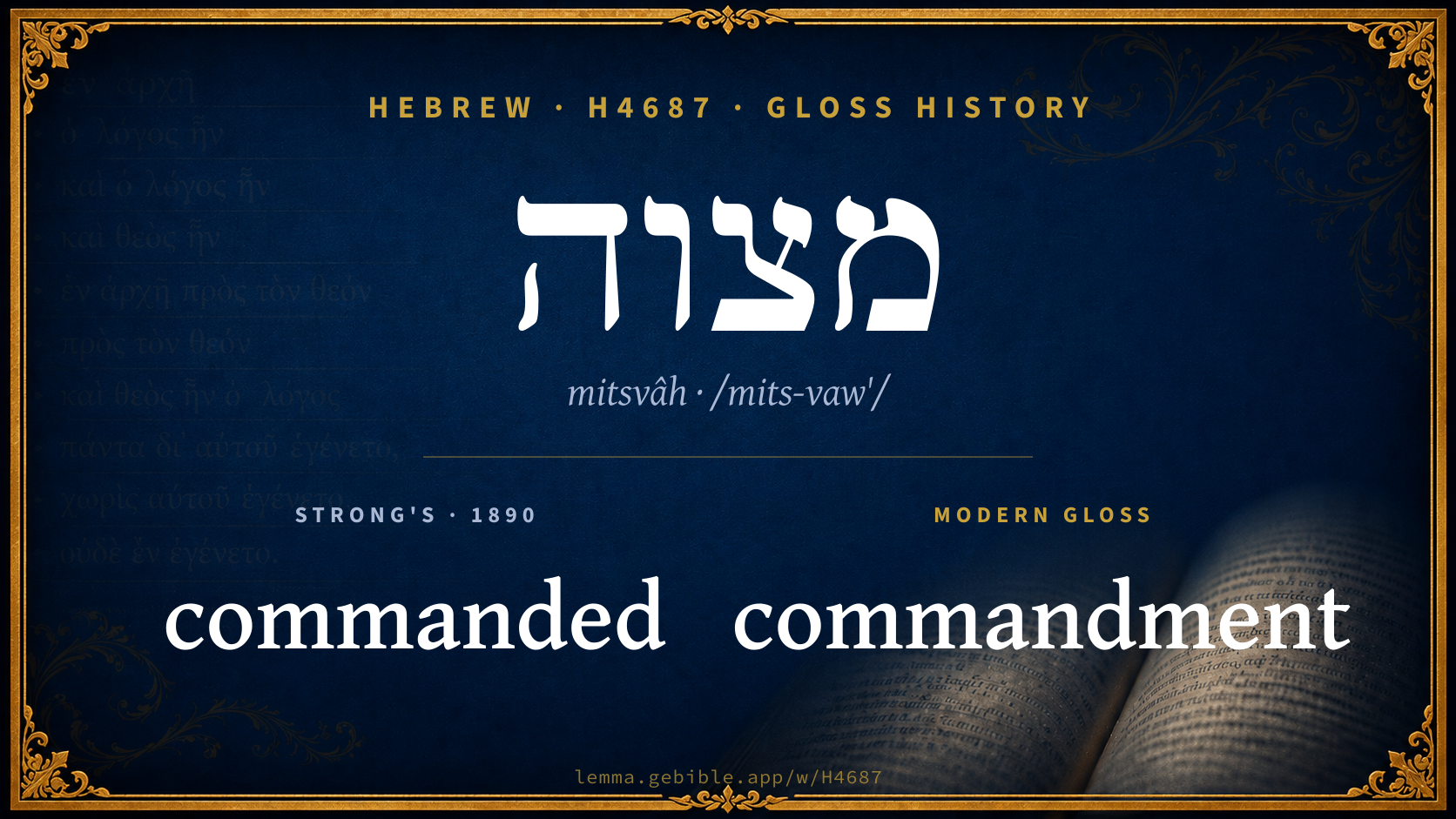
Gloss history
Strong's 1890 vs modern scholarship
About this word
Strong's H4687 catalogs a Hebrew word from the Hebrew Old Testament.
These counts are not copied from any lexicon or concordance. They are computed here, from the morphology-tagged Hebrew Old Testament. What Lemma adds →
- 177
- distinct verses
- The word appears in 177 distinct verses.
- 23 / 39
- OT books
- The word appears in 23 of 39 Old Testament books.
- #254
- by frequency
- Top 500 most frequent Hebrew words (rank 254 of 8,640 Hebrew words by occurrence).
View all 177 occurrences in the concordance →
Most concentrated in
- Deuteronomy 42 verses 24%
- Psalms 26 verses 15%
- 2 Chronicles 18 verses 10%
By section of the Old Testament
By traditional corpus
Conventional, traditional groupings — biblical authorship is debated, so this is a traditional corpus grouping, not an authorship claim. Each share is this word’s portion of its verses in that division of the Hebrew canon. Each figure is a share of the word’s 177 distinct verses.
- Writings (Ketuvim) 81 verses · 46%
- Torah (Pentateuch) 62 verses · 35%
- Prophets (Nevi'im) 34 verses · 19%
How translations render this word
Counts come from each version’s own published word-to-Strong’s tagging or interlinear alignment — an approximate guide to how each version renders this word, not a word-level alignment the data otherwise carries. Because each total is that version’s own tagged count, the per-version totals vary from one another and need not match the appearance or distinct-verse counts above. These counts may also differ from a printed concordance because Lemma counts each distinctly tagged rendering and does not collapse phrase taggings into a single head-word total. This is a fixed set of word-tagged versions (KJV, ASV, BSB, ULT) and does not change with the reading translation you choose elsewhere. Each version’s license is shown beside its name below (and on Sources).
- King James Version: Commandments 95×, Commandment 34×, According to the commandment 8×
- American Standard Version: Commandments 75×, Commandment 29×, According to the commandment 6×
- Berean Standard Bible: Commandments 131×, Command 16×, Commandment 12×
- unfoldingWord Literal Text: Commandments 100×, Commandments of 18×, Commandment 13×
King James Version Public Domain
Renders H4687 across 181 tagged occurrences — most commonly:
Plus 15 renderings that appear only once — usually multi-word phrases or single function words the recovered tagging swept in, not distinct renderings.
American Standard Version Public Domain
Renders H4687 across 180 tagged occurrences — most commonly:
Plus 38 renderings that appear only once — usually multi-word phrases or single function words the recovered tagging swept in, not distinct renderings.
Berean Standard Bible Public Domain
Renders H4687 across 180 tagged occurrences — most commonly:
Plus 9 renderings that appear only once — usually multi-word phrases or single function words the recovered tagging swept in, not distinct renderings. Not rendered by a distinct English word in 1 further occurrence.
unfoldingWord Literal Text CC BY-SA 4.0
Renders H4687 across 183 tagged occurrences — most commonly:
Plus 12 renderings that appear only once — usually multi-word phrases or single function words the recovered tagging swept in, not distinct renderings.
Senses in the full BDB
What do BDB’s symbols mean?
BDB uses these scholarly abbreviations:
| Symbol | Meaning |
|---|---|
| 𝔊 | the Septuagint (the ancient Greek translation, LXX) |
| 𝔙 | the Vulgate (the Latin translation) |
| 𝔖 | the Syriac version (the Peshitta) |
| 𝔗 | the Targum (the Aramaic translation) |
| ψ | the Psalms |
| √ | root (the underlying root or stem) |
| ‖ | parallel passage (a synonymous or contrasted parallel) |
| † | the dagger: every passage where the word occurs is cited |
The 6 senses and sub-senses the full Brown-Driver-Briggs lexicon distinguishes for this word, in lexicon order (not ranked by frequency), with BDB’s own verbatim wording and sub-sense lettering. Shown in Hebrew script with BDB’s own scholarly abbreviations. The condensed entry is in the Lexicon Entry tab. See also the Forms in the corpus table below.
- 1. commandment, of man: king, 1 K 2:43; 2 K 18:36 = Is 36:21; 2 Ch 8:15 + 14 times; מ׳ אב Je 35:14, 16, 18; Pr 6:20; מ׳ אנשׁים Is 29:13; pl. only Je 35:18; Pr 10:8; Ne 10:33; המצוה, the order (title of property) Je 32:11. e.g. 1 Kings 2:43
- 2. of God:
- a. sg. the commandment, code of law: 2 Ch 8:13 Ezr 10:3 ψ 19:9; especially of D שׁמר המ׳ Dt 8:1, 2 + 5 times D; עשׂח המ׳ Dt 6:25; 15:5; (ה)מ׳ אשׁר צוּה Dt 26:13; 30:11; 31:5; סוּר מִן המ׳ Dt 17:20; מ׳ הֵפַר Nu 15:31 (P); ‖ תּוֹרָה Ex 24:12 (RD) Jos 22:5 (D) 2 Ch 14:3; 31:21; + חֻקִּים, מִשְׁפָּטִים Dt 5:28; 6:1 +. e.g. 2 Chronicles 8:13
- b. pl. of commands of D and later codes (exc. Ju 3:4) c. 2 pl. (ye shall, shall not; BrHex 197, 246 ff.), Lv 4:2 + 5 times (P), Is 48:18 + 25 times (late; especially ψ 119, 20 times); שׁמר מ׳ Ex 20:6 (R) Lv 22:31 (H) Dt 4:2 + 10 times D, 1 K 14:8; 2 K 18:6 + 5 times; עשׂה מ׳ Lv 26:14 (H) + 5 times; שׁמע מ׳ Dt 11:13 + 4 times; המ׳ אשׁר צוּה Lv 27:34 (H); עבר מ׳ Dt 26:13; 2 Ch 24:20; עזב מ׳ 1 K 18:18; 2 K 17:16; Ezr 9:10; הפר מ׳ Ezr 9:14; in combinations, especially by Redactors and late writers; order various: (1) with חֻקִּים Ex 15:26 (RD) Dt 4:40; Ezr 7:11 +; ח׳ + משׁפטים Dt 26:17; 1 K 8:58; Ne 1:7; 10:30; + משׁפטים, תורות Ne 9:13; + תורה Ne 9:14; + עדוֹת Dt 6:17; 1 Ch 29:19; 2 Ch 34:31. (2) with חֻקּוֹת Lv 26:3 (H) Dt 6:2; 10:13 + 9 times; ח׳ + משׁפטים Lv 26:15; Dt 8:11; 11:1; 30:16; 1 K 6:12 + תורה, משׁפטים ψ 89:32, + משׁפטים, עֵדְוֹת 1 K 2:3; + תּוֹרוֹת Gn 26:5 (RD); + עדוֹת 2 K 23:3. (3) with משׁפטים Nu 36:13 (P) 1 Ch 28:7; Ne 9:29; Dn 9:5; with תורות Ex 16:28 (R), with ערות Ne 9:34. e.g. Judges 3:4
- c. of special commands of God 1 S 13:13; 1 K 13:21; 2 Ch 29:25; Ne 13:5; Mal 2:1, 4; Jb 23:12. e.g. 1 Samuel 13:13
- 3. commandment, sg., of code of wisdom Pr 19:16, ‖ תורה 6:23, ‖ דבר 13:13; pl. of special commands 2:1; 3:1; 4:4; 7:1, 2. e.g. Proverbs 19:16
Senses from the full Brown-Driver-Briggs lexicon (Brown, Driver, Briggs; Oxford 1906 — public domain), digitized via Sefaria, supplemented by the OpenScriptures HebrewLexicon (CC BY 4.0). Full attribution on Sources.
Word origin
n.f. commandment;—מ׳ Pr 6:23 +; cstr. מִצְוַת Jos 22:3 +; sf. מִצְוָֽתְךָ Dt 26:13 ψ 119:96; מִצְוָתוֹ Nu 15:31; pl. מִצְוֹת abs. Lv 26:14 + (מִצְווֹת Ne 9:14); cstr. 4:2 +; sf. מִצְוֹתַי Gn 26:5 +, etc.;—not used before D and Je; in Je only of man’s commands; not Ez nor Minor Proph., except Mal;—
— Brown-Driver-Briggs (Oxford 1906, public domain), digitized via Sefaria, supplemented by the OpenScriptures HebrewLexicon (CC BY 4.0). See Sources.
Derived from צוה (tsâvâh) (H6680) — to command.
Jastrow Dictionary
A second Hebrew/Aramaic lexicon for comparison, covering Aramaic and post-biblical (Talmudic, Targumic, Midrashic) usage that the biblical-Hebrew BDB does not. Matched by lemma rather than by Strong’s number, so a lemma may carry more than one Jastrow headword (shown separately below), and the entries cover usage well beyond the Bible.
מִצְוָה
- command, esp. religious act, meritorious deed. Ḥull. 141ᵃ, a. fr. לדבר מ׳ for a religious purpose, opp. לדבר הרשות for a secular or religiously indifferent purpose.—מלחמת מ׳ v. מִלְחָמָה.—Ab. IV, 11 מ׳ אחת one good deed, opp. עֲבֵרָה sin. Ib. שכר מ׳ מ׳ the reward of a good deed is another good deed, v. גָּרַר. Ib. II, 1 מ׳ קלה a light command (obeyed with little sacrifice); Ned. 39ᵇ; a. fr.—מ׳ הבאה בעבירה a religious act achieved through a wrong deed, e. g. using an illegitimately obtained object for a religious ceremony. Succ. 30ᵃ; a. fr.—Y. Sabb. XIII, 14ᵃ bot.; Y. Ḥall. I, end, 58ᵃ אין עבירה מ׳ no-sin is virtue; אין מ׳ עבירה no-virtue is sin.—Zeb. 52ᵃ, a. fr. מ׳ (sub. קרבן) an offering dependent on certain occasions as ordained in the Law, opp. חובה an obligatory offering (at regular seasons).—איסור מ׳, v. אִיסּוּר.—Y. Sot. I, beg. 16ᵇ איתמרת למ׳ (או) לעיכוב is this said only as a recommendation or as an indispensable act?; Y. Pes. II, 29ᵇ bot., a. fr., v. עִיכּוּב.—Ḥull. 106ᵃ משום מ׳ because it is meritorious; מאי מ׳ מ׳ לשמוע וכ׳ what is the merit of it? It is meritorious to obey &c. Ib. לא חובה ולא מ׳ אלא רשות neither an obligatory, nor a meritorious, but a religiously indifferent act; Sabb. 25ᵇ.—מִצְוַת עֲשֵׁה (abbr. מ"ע) a positive command; מ׳ לא תעשה a prohibition. Kidd. I, 7; a. v. fr., v. גְּרָמָא, a. לֹא, לַאו.—מת מ׳ the corpse of a person whose relatives are unknown and whose burial is obligatory on everybody. Hor. 13ᵃ פגע בהם מת מ׳ they struck upon a corpse; a. fr.—M. Kat. 20ᵃ חמשה מתי מ׳ the five relations (besides father and mother) whom one is obliged to bury (Lev. XXI, 2, sq.).—Lev. R. s. 34 תן לי מ׳ give me what thou art commanded to, i.e. alms, v. next w.—Pl. מִצְוֹת, מִצְווֹת. Macc. 23ᵇ שש מאות … מ׳ six hundred and thirteen commands (positive and prohibitive). Y. Sabb. l. c.; Y. Ḥall. l. c. (ref. to אלה המצות, Lev. XXVII, 34) אם עשיתן כְּמִצְוָותָן מ׳ וכ׳ if thou doest them as they are commanded, they are deeds of merit &c. R. Hash. 28ᵇ מ׳ אינו עובר עליהן אלא בזמנן one violates the law by adding to the prescribed form of ceremonies only when executed in their due season (e. g. one does not violate the law by dwelling in the Succah on the eighth day). Ib. מ׳ אין צריכות כונה; Ber. 13ᵃ מ׳ צריכות כ׳, v. כַּוָּנָה. Succ. 39ᵃ, a. e. כל המ׳ כולן מברך וכ׳ the benediction at the performance of religious ceremonies must precede the act. Nidd. 61ᵇ מ׳ בטלות לע"ל ceremonial laws find no application in the hereafter (e. g. a dead body may be wrapped in Kilayim). Ib. חפשי מן המ׳, v. חָפְשִׁי; a. v. fr.—Ker. 17ᵇ (ref. to Lev. V, 17) מצוות קרינן the traditional reading (v. אֵם) is acts (therefore a doubt between two pieces, one permitted and one prohibited, is required for a sacrifice (אשם תלוי). Ib. ליכא מ׳ the requirement of two pieces is not complied with. e.g. Leviticus 21:2
מִצְוָה ²
- Targ. Y. I Num. XII, 16.—Targ. Y. II, Deut. XXV, 10.—[Y. Kidd. I, 61ᵇ bot. אתא מ׳ לטחוניא, v. צוּמּוּת.]—Esp. charity. Lev. R. s. 34 כל עמא יפלגון מצוה let every one distribute charity; a. e.—Pl. מִצְוָון, מִצְוָותָא, מִצְוָותַיָּה. Targ. Y. II, Deut. VII, 10. Targ. Y. II, Num. l. c.; a. e.—Lev. R. l. c. אנא שמיע דהוא עביד מ׳ I hear that he is charitable. Lev. R. s. 3 רעותיה דמתקרי בר מ׳ he desires to be called a charitable man. Y. Ber. IX, 14ᵇ bot. פרוש שכמי מחזי טעין מ׳ וכ׳ ed. Lehm. (oth. ed. omit מחזי) ‘a carrier Pharisee’, he looks as if carrying religion on his shoulder; Y. Sot. V, 20ᶜ bot. טעין מִצְוָתַיָּה, Num. R. s. 9 (prov.) תרעא … למצותיה פתיח לאסיא a gate which opens not for good deeds, will open for the physician; a. fr.
A Dictionary of the Targumim, the Talmud Babli and Yerushalmi, and the Midrashic Literature (Marcus Jastrow; London, Luzac, 1903) — Public Domain. Digitized via Sefaria. Digitized via Sefaria. Full attribution on Sources.
Forms in the corpus
The 95 distinct written forms H4687 takes in the Hebrew Bible, most frequent first — each parse links to that state’s occurrences in the concordance. Hebrew forms include their vowel points and cantillation, so a single lemma takes many written forms.
The 60 most common forms are shown; 35 rarer forms follow in the full concordance.
Same root — word family
Other BDB entries built from the same root as H4687, grouped by Strong’s listed origin. These share a root / origin per the lexicon — not necessarily a shared meaning. Each links to that word’s own entry.
Derives from
Shares the same root
Compare all same-root words → They share a root, not necessarily a meaning.
Septuagint verse parallels
This word appears in 139 verses that also exist in the Greek Old Testament (Septuagint), out of the 177 Hebrew verses it occurs in. You can read those verses in Greek by switching the Old Testament edition to the Septuagint.
Read these verses in the Septuagint
- Genesis 26:5
- Exodus 15:26
- Leviticus 4:2
- Numbers 15:22
- Deuteronomy 4:2
- Joshua 22:3
- Judges 2:17
- 1 Samuel 13:13
- 1 Kings 2:3
- 2 Kings 17:13
- 1 Chronicles 28:7
- 2 Chronicles 7:19
This is a verse-level parallel only — the same verses exist in both the Hebrew and Greek Old Testaments. No word-level Hebrew↔Greek correspondence is claimed: the data carries no such alignment, so no Greek word is shown as this Hebrew word’s translation. Coverage is not total — the Septuagint omits the deuterocanon and renumbers the Psalms, so some Hebrew verses have no direct Greek parallel.