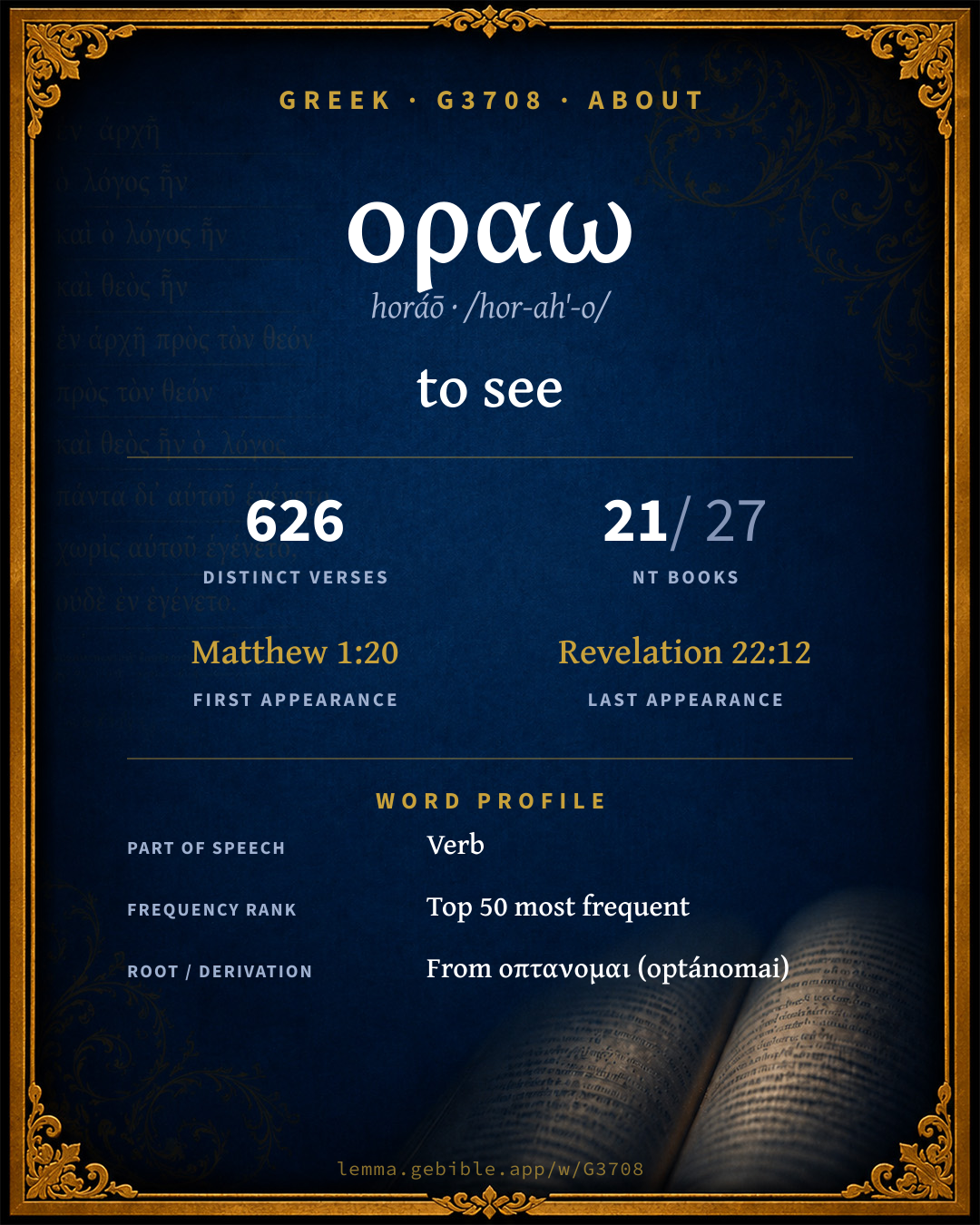
ὁράω
to see
‘to see’ is one of 6 main senses fuller range ↓
Full lexicon entry — Thayer's Greek Lexicon
From Thayer's Greek Lexicon
Where this word appears
See every Aorist-tense verb in the Greek New Testament →
Grammar key — what these labels mean
Part of speech
- Verb
- An action or state-of-being word.
Tense
- Aorist
- Action viewed as a simple whole, without regard to duration — often past (perfective aspect).
- Future
- Action expected in future time.
- Perfect
- A completed past action with continuing present results.
- Present
- Ongoing or general action in present time (imperfective aspect).
- Imperfect
- Continuous or repeated action in past time (“was writing”).
- Pluperfect
- A past action completed before another past point (“had written”).
Voice
- Middle
- The subject acts on or for itself, or with special interest in the action.
- Active
- The subject performs the action.
- Passive
- The subject receives the action.
- Middle deponent
- Middle in form but active in meaning.
Mood
- Imperative
- Expresses a command or request.
- Participle
- A verbal adjective (“writing,” “having written”).
- Indicative
- States a fact or asks a factual question (the mood of reality).
- Infinitive
- A verbal noun (“to write”), unmarked for person or number.
- Subjunctive
- Expresses probability, purpose, or possibility (the mood of contingency).
Case
- Nominative
- The case of the subject (and the predicate nominative).
- Genitive
- The case of source, possession, or “of” — answers “whose / from what.”
Person
- 2nd person
- The one addressed (“you”).
- 1st person
- The speaker (“I / we”).
- 3rd person
- The one spoken about (“he / she / it / they”).
Gender
- Masculine
- Grammatically masculine.
- Feminine
- Grammatically feminine.
Number
- Singular
- One.
- Plural
- More than one.
Grammatical forms 56 distinct
- Verb, Aorist, Middle, Imperative, 2nd person, Singular 199 times (29%)
- Verb, Aorist, Active, Participle, Nominative, Singular, Masculine 62 times (9%)
- Verb, Aorist, Active, Indicative, 1st person, Singular 54 times (8%)
- Verb, Aorist, Active, Indicative, 3rd person, Singular 42 times (6%)
- Verb, Aorist, Active, Participle, Nominative, Plural, Masculine 41 times (6%)
- Verb, Aorist, Active, Infinitive 37 times (5%)
- Verb, Aorist, Active, Imperative, 2nd person, Singular 34 times (5%)
- Verb, Aorist, Active, Indicative, 3rd person, Plural 28 times (4%)
+48 more forms (186 occurrences)
Parsed forms decoded from the imported morphology (Robinson–Tischendorf, public domain), counted across 683 parsed occurrences — not distinct verses.
Page 1 of 4 — showing verses 1–200 of 626 distinct verses where G3708 appears, across 21 books. Click any verse to open its interlinear word-by-word view. Verse text shown in the World English Bible for context — . Each verse’s Greek form is shown with its reference; the English is not keyword-highlighted, since the data carries no word-level English alignment. Use “Compare translations” on any verse to read it across multiple English versions. This concordance covers the Greek New Testament; Septuagint (Greek Old Testament) occurrences of this word are not indexed here.
Matthew 125 verses
- Matthew 1:20 ἰδοὺ aor mid impv 2sg But when he thought about these things, behold, an angel of the Lord appeared to him in a dream, saying, "Joseph, son of David, don't be afraid to take to yourself Mary, your wife, for that which is conceived in her is of the Holy Spirit.
- Matthew 1:23 ἰδοὺ aor mid impv 2sg "Behold, the virgin shall be with child, And shall bring forth a son. They shall call his name Immanuel;" Which is, being interpreted, "God with us."
- Matthew 2:1 ἰδοὺ aor mid impv 2sg Now when Jesus was born in Bethlehem of Judea in the days of Herod the king, behold, wise men from the east came to Jerusalem, saying,
- Matthew 2:2 εἴδομεν aor act ind 1pl "Where is he who is born King of the Jews? For we saw his star in the east, and have come to worship him."
- Matthew 2:9 ἰδοὺ εἶδον aor mid impv 2sg aor act ind 3pl They, having heard the king, went their way; and behold, the star, which they saw in the east, went before them, until it came and stood over where the young child was.
- Matthew 2:10 ἰδόντες aor act ptcp nom pl masc When they saw the star, they rejoiced with exceedingly great joy.
- Matthew 2:11 εἶδον aor act ind 3pl They came into the house and saw the young child with Mary, his mother, and they fell down and worshiped him. Opening their treasures, they offered to him gifts: gold, frankincense, and myrrh.
- Matthew 2:13 ἰδοὺ aor mid impv 2sg Now when they had departed, behold, an angel of the Lord appeared to Joseph in a dream, saying, "Arise and take the young child and his mother, and flee into Egypt, and stay there until I tell you, for Herod will seek the young child to destroy him."
- Matthew 2:16 ἰδὼν aor act ptcp nom sg masc Then Herod, when he saw that he was mocked by the wise men, was exceedingly angry, and sent out, and killed all the male children who were in Bethlehem and in all the surrounding countryside, from two years old and under, according to the exact time which he had learned from the wise men.
- Matthew 2:19 ἰδοὺ aor mid impv 2sg But when Herod was dead, behold, an angel of the Lord appeared in a dream to Joseph in Egypt, saying,
- Matthew 3:7 ἰδὼν aor act ptcp nom sg masc But when he saw many of the Pharisees and Sadducees coming for his baptism, he said to them, "You offspring of vipers, who warned you to flee from the wrath to come?
- Matthew 3:16 ἰδοὺ εἶδεν aor mid impv 2sg aor act ind 3sg Jesus, when he was baptized, went up directly from the water: and behold, the heavens were opened to him. He saw the Spirit of God descending as a dove, and coming on him.
- Matthew 3:17 ἰδοὺ aor mid impv 2sg Behold, a voice out of the heavens said, "This is my beloved Son, with whom I am well pleased."
- Matthew 4:11 ἰδοὺ aor mid impv 2sg Then the devil left him, and behold, angels came and ministered to him.
- Matthew 4:16 εἶδεν aor act ind 3sg The people who sat in darkness saw a great light, To those who sat in the region and shadow of death, To them light has dawned."
- Matthew 4:18 εἶδεν aor act ind 3sg Walking by the sea of Galilee, he saw two brothers: Simon, who is called Peter, and Andrew, his brother, casting a net into the sea; for they were fishermen.
- Matthew 4:21 εἶδεν aor act ind 3sg Going on from there, he saw two other brothers, James the son of Zebedee, and John his brother, in the boat with Zebedee their father, mending their nets. He called them.
- Matthew 5:1 Ἰδὼν aor act ptcp nom sg masc Seeing the multitudes, he went up onto the mountain. When he had sat down, his disciples came to him.
- Matthew 5:8 ὄψονται fut mid.dep ind 3pl Blessed are the pure in heart, For they shall see God.
- Matthew 5:16 ἴδωσιν aor act subj 3pl Even so, let your light shine before men; that they may see your good works, and glorify your Father who is in heaven.
- Matthew 7:4 ἰδοὺ aor mid impv 2sg Or how will you tell your brother, 'Let me remove the speck from your eye;' and behold, the beam is in your own eye?
- Matthew 8:2 ἰδοὺ aor mid impv 2sg Behold, a leper came to him and worshiped him, saying, "Lord, if you want to, you can make me clean."
- Matthew 8:4 ὅρα pres act impv 2sg Jesus said to him, "See that you tell nobody, but go, show yourself to the priest, and offer the gift that Moses commanded, as a testimony to them."
- Matthew 8:14 εἶδεν aor act ind 3sg When Jesus came into Peter's house, he saw his wife's mother lying sick with a fever.
- Matthew 8:18 Ἰδὼν aor act ptcp nom sg masc Now when Jesus saw great multitudes around him, he gave the order to depart to the other side.
- Matthew 8:24 ἰδοὺ aor mid impv 2sg Behold, a great tempest arose in the sea, so much that the boat was covered with the waves, but he was asleep.
- Matthew 8:29 ἰδοὺ aor mid impv 2sg Behold, they cried out, saying, "What do we have to do with you, Jesus, Son of God? Have you come here to torment us before the time?"
- Matthew 8:32 ἰδοὺ aor mid impv 2sg He said to them, "Go!" They came out, and went into the herd of pigs: and behold, the whole herd of pigs rushed down the cliff into the sea, and died in the water.
- Matthew 8:34 ἰδοὺ ἰδόντες aor mid impv 2sg aor act ptcp nom pl masc Behold, all the city came out to meet Jesus. When they saw him, they begged that he would depart from their borders.
- Matthew 9:2 ἰδοὺ ἰδὼν aor mid impv 2sg aor act ptcp nom sg masc Behold, they brought to him a man who was paralyzed, lying on a bed. Jesus, seeing their faith, said to the paralytic, "Son, cheer up! Your sins are forgiven you."
- Matthew 9:3 ἰδού aor mid impv 2sg Behold, some of the scribes said to themselves, "This man blasphemes."
- Matthew 9:4 ἰδὼν aor act ptcp nom sg masc Jesus, knowing their thoughts, said, "Why do you think evil in your hearts?
- Matthew 9:8 ἰδόντες aor act ptcp nom pl masc But when the multitudes saw it, they marveled and glorified God, who had given such authority to men.
- Matthew 9:9 εἶδεν aor act ind 3sg As Jesus passed by from there, he saw a man called Matthew sitting at the tax collection office. He said to him, "Follow me." He got up and followed him.
- Matthew 9:10 ἰδοὺ aor mid impv 2sg It happened as he sat in the house, behold, many tax collectors and sinners came and sat down with Jesus and his disciples.
- Matthew 9:11 ἰδόντες aor act ptcp nom pl masc When the Pharisees saw it, they said to his disciples, "Why does your teacher eat with tax collectors and sinners?"
- Matthew 9:18 ἰδοὺ aor mid impv 2sg While he told these things to them, behold, a ruler came and worshiped him, saying, "My daughter has just died, but come and lay your hand on her, and she will live."
- Matthew 9:20 ἰδοὺ aor mid impv 2sg Behold, a woman who had an issue of blood for twelve years came behind him, and touched the tassels of his garment;
- Matthew 9:22 ἰδὼν aor act ptcp nom sg masc But Jesus, turning around and seeing her, said, "Daughter, cheer up! Your faith has made you well." And the woman was made well from that hour.
- Matthew 9:23 ἰδὼν aor act ptcp nom sg masc When Jesus came into the ruler's house, and saw the flute players, and the crowd in noisy disorder,
- Matthew 9:30 ὁρᾶτε pres act impv 2pl Their eyes were opened. Jesus strictly charged them, saying, "See that no one knows about this."
- Matthew 9:32 ἰδοὺ aor mid impv 2sg As they went out, behold, a mute man who was demon possessed was brought to him.
- Matthew 9:36 ἰδὼν aor act ptcp nom sg masc But when he saw the multitudes, he was moved with compassion for them, because they were harassed and scattered, like sheep without a shepherd.
- Matthew 10:16 Ἰδοὺ aor mid impv 2sg "Behold, I send you out as sheep in the midst of wolves. Therefore be wise as serpents, and harmless as doves.
- Matthew 11:8 ἰδεῖν ἰδοὺ aor act inf aor mid impv 2sg But what did you go out to see? A man in soft clothing? Behold, those who wear soft clothing are in king's houses.
- Matthew 11:9 ἰδεῖν aor act inf But why did you go out? To see a prophet? Yes, I tell you, and much more than a prophet.
- Matthew 11:10 ἰδοὺ aor mid impv 2sg For this is he, of whom it is written, 'Behold, I send my messenger before your face, who will prepare your way before you.'
- Matthew 11:19 ἰδοὺ aor mid impv 2sg The Son of Man came eating and drinking, and they say, 'Behold, a gluttonous man and a drunkard, a friend of tax collectors and sinners!' But wisdom is justified by her children."
- Matthew 12:2 ἰδόντες ἰδοὺ aor act ptcp nom pl masc aor mid impv 2sg But the Pharisees, when they saw it, said to him, "Behold, your disciples do what is not lawful to do on the Sabbath."
- Matthew 12:10 ἰδοὺ aor mid impv 2sg And behold there was a man with a withered hand. They asked him, "Is it lawful to heal on the Sabbath day?" that they might accuse him.
- Matthew 12:18 ἰδοὺ aor mid impv 2sg "Behold, my servant whom I have chosen; My beloved in whom my soul is well pleased: I will put my Spirit on him. He will proclaim justice to the Gentiles.
- Matthew 12:38 ἰδεῖν aor act inf Then certain of the scribes and Pharisees answered, "Teacher, we want to see a sign from you."
- Matthew 12:41 ἰδοὺ aor mid impv 2sg The men of Nineveh will stand up in the judgment with this generation, and will condemn it, for they repented at the preaching of Jonah; and behold, someone greater than Jonah is here.
- Matthew 12:42 ἰδοὺ aor mid impv 2sg The queen of the south will rise up in the judgment with this generation, and will condemn it, for she came from the ends of the earth to hear the wisdom of Solomon; and behold, someone greater than Solomon is here.
- Matthew 12:46 ἰδοὺ aor mid impv 2sg While he was yet speaking to the multitudes, behold, his mother and his brothers stood outside, seeking to speak to him.
- Matthew 12:47 ἰδοὺ aor mid impv 2sg One said to him, "Behold, your mother and your brothers stand outside, seeking to speak to you."
- Matthew 12:49 ἰδοὺ aor mid impv 2sg He stretched out his hand towards his disciples, and said, "Behold, my mother and my brothers!
- Matthew 13:3 ἰδοὺ aor mid impv 2sg He spoke to them many things in parables, saying, "Behold, a farmer went out to sow.
- Matthew 13:14 ἴδητε aor act subj 2pl In them the prophecy of Isaiah is fulfilled, which says, 'By hearing you will hear, And will in no way understand; Seeing you will see, And will in no way perceive:
- Matthew 13:15 ἴδωσιν aor act subj 3pl For this people's heart has grown callous, Their ears are dull of hearing, They have closed their eyes; Or else perhaps they might perceive with their eyes, Hear with their ears, Understand with their heart, And should turn again; And I would heal them.'
- Matthew 13:17 ἰδεῖν ἴδαν aor act inf aor act ind 3pl For most assuredly I tell you that many prophets and righteous men desired to see the things which you see, and didn't see them; and to hear the things which you hear, and didn't hear them.
- Matthew 14:14 εἶδεν aor act ind 3sg Jesus went out, and he saw a great multitude. He had compassion on them, and healed their sick.
- Matthew 14:26 ἰδόντες aor act ptcp nom pl masc When the disciples saw him walking on the sea, they were troubled, saying, "It's a ghost!" and they cried out for fear.
- Matthew 15:22 ἰδοὺ aor mid impv 2sg Behold, a Canaanite woman came out from those borders, and cried, saying, "Have mercy on me, Lord, you son of David! My daughter is severely demonized!"
- Matthew 16:6 ὁρᾶτε pres act impv 2pl Jesus said to them, "Take heed and beware of the yeast of the Pharisees and Sadducees."
- Matthew 16:28 ἴδωσιν aor act subj 3pl Most assuredly I tell you, there are some standing here who will in no way taste of death, until they see the Son of Man coming in his Kingdom."
- Matthew 17:3 ἰδοὺ ὤφθη aor mid impv 2sg aor pass ind 3sg Behold, Moses and Elijah appeared to them talking with him.
- Matthew 17:5 ἰδοὺ ἰδοὺ aor mid impv 2sg aor mid impv 2sg While he was still speaking, behold, a bright cloud overshadowed them. Behold, a voice came out of the cloud, saying, "This is my beloved Son, in whom I am well pleased. Listen to him."
- Matthew 17:8 εἶδον aor act ind 3pl Lifting up their eyes, they saw no one, except Jesus alone.
- Matthew 18:10 Ὁρᾶτε pres act impv 2pl See that you don't despise one of these little ones, for I tell you that in heaven their angels always see the face of my Father who is in heaven.
- Matthew 18:31 ἰδόντες aor act ptcp nom pl masc So when his fellow servants saw what was done, they were exceedingly sorry, and came and told to their lord all that was done.
- Matthew 19:16 ἰδοὺ aor mid impv 2sg Behold, one came to him and said, "Good teacher, what good thing shall I do, that I may have eternal life?"
- Matthew 19:27 ἰδοὺ aor mid impv 2sg Then Peter answered, "Behold, we have left everything, and followed you. What then will we have?"
- Matthew 20:3 εἶδεν aor act ind 3sg He went out about the third hour, and saw others standing idle in the marketplace.
- Matthew 20:18 ἰδοὺ aor mid impv 2sg "Behold, we are going up to Jerusalem, and the Son of Man will be delivered to the chief priests and scribes, and they will condemn him to death,
- Matthew 20:30 ἰδοὺ aor mid impv 2sg Behold, two blind men sitting by the road, when they heard that Jesus was passing by, cried out, "Lord, have mercy on us, you son of David!"
- Matthew 21:5 ἰδοὺ aor mid impv 2sg "Tell the daughter of Zion, Behold, your King comes to you, Humble, and riding on a donkey, On a colt, the foal of a donkey."
- Matthew 21:15 ἰδόντες aor act ptcp nom pl masc But when the chief priests and the scribes saw the wonderful things that he did, and the children who were crying in the temple and saying, "Hosanna to the son of David!" they were indignant,
- Matthew 21:19 ἰδὼν aor act ptcp nom sg masc Seeing a fig tree by the road, he came to it, and found nothing on it but leaves. He said to it, "Let there be no fruit from you forever!" Immediately the fig tree withered away.
- Matthew 21:20 ἰδόντες aor act ptcp nom pl masc When the disciples saw it, they marveled, saying, "How did the fig tree immediately wither away?"
- Matthew 21:32 ἰδόντες aor act ptcp nom pl masc For John came to you in the way of righteousness, and you didn't believe him, but the tax collectors and the prostitutes believed him. When you saw it, you didn't even repent afterward, that you might believe him.
- Matthew 21:38 ἰδόντες aor act ptcp nom pl masc But the farmers, when they saw the son, said among themselves, 'This is the heir. Come, let's kill him, and seize his inheritance.'
- Matthew 22:4 ἰδοὺ aor mid impv 2sg Again he sent out other servants, saying, 'Tell those who are invited, "Behold, I have made ready my dinner. My oxen and my fatlings are killed, and all things are ready. Come to the marriage feast!"'
- Matthew 22:11 εἶδεν aor act ind 3sg But when the king came in to see the guests, he saw there a man who didn't have on wedding clothing,
- Matthew 23:34 ἰδοὺ aor mid impv 2sg Therefore, behold, I send to you prophets, wise men, and scribes. Some of them you will kill and crucify; and some of them you will scourge in your synagogues, and persecute from city to city;
- Matthew 23:38 ἰδοὺ aor mid impv 2sg Behold, your house is left to you desolate.
- Matthew 23:39 ἴδητε aor act subj 2pl For I tell you, you will not see me from now on, until you say, 'Blessed is he who comes in the name of the Lord!'"
- Matthew 24:6 ὁρᾶτε pres act impv 2pl You will hear of wars and rumors of wars. See that you aren't troubled, for all this must happen, but the end is not yet.
- Matthew 24:15 ἴδητε aor act subj 2pl "When, therefore, you see the abomination of desolation, which was spoken of through Daniel the prophet, standing in the holy place (let the reader understand),
- Matthew 24:23 ἰδοὺ aor mid impv 2sg "Then if any man tells you, 'Behold, here is the Christ,' or, 'There,' don't believe it.
- Matthew 24:25 ἰδοὺ aor mid impv 2sg "Behold, I have told you beforehand.
- Matthew 24:26 ἰδοὺ ἰδοὺ aor mid impv 2sg aor mid impv 2sg If therefore they tell you, 'Behold, he is in the wilderness,' don't go out; 'Behold, he is in the inner chambers,' don't believe it.
- Matthew 24:30 ὄψονται fut mid.dep ind 3pl and then the sign of the Son of Man will appear in the sky. Then all the tribes of the earth will mourn, and they will see the Son of Man coming on the clouds of the sky with power and great glory.
- Matthew 24:33 ἴδητε aor act subj 2pl Even so you also, when you see all these things, know that it is near, even at the doors.
- Matthew 25:6 ἰδοὺ aor mid impv 2sg But at midnight there was a cry, 'Behold! The bridegroom is coming! Come out to meet him!'
- Matthew 25:20 ἴδε aor act impv 2sg He who received the five talents came and brought another five talents, saying, 'Lord, you delivered to me five talents. Behold, I have gained another five talents besides them.'
- Matthew 25:22 ἴδε aor act impv 2sg "He also who got the two talents came and said, 'Lord, you delivered to me two talents. Behold, I have gained another two talents besides them.'
- Matthew 25:25 ἴδε aor act impv 2sg I was afraid, and went away and hid your talent in the earth. Behold, you have what is yours.'
- Matthew 25:37 εἴδομεν aor act ind 1pl "Then the righteous will answer him, saying, 'Lord, when did we see you hungry, and feed you; or thirsty, and give you a drink?
- Matthew 25:38 εἴδομεν aor act ind 1pl When did we see you as a stranger, and take you in; or naked, and clothe you?
- Matthew 25:39 εἴδομεν aor act ind 1pl When did we see you sick, or in prison, and come to you?'
- Matthew 25:44 εἴδομεν aor act ind 1pl "Then they will also answer, saying, 'Lord, when did we see you hungry, or thirsty, or a stranger, or naked, or sick, or in prison, and didn't help you?'
- Matthew 26:8 ἰδόντες aor act ptcp nom pl masc But when his disciples saw this, they were indignant, saying, "Why this waste?
- Matthew 26:45 ἰδοὺ aor mid impv 2sg Then he came to his disciples, and said to them, "Sleep on now, and take your rest. Behold, the hour is at hand, and the Son of Man is betrayed into the hands of sinners.
- Matthew 26:46 ἰδοὺ aor mid impv 2sg Arise, let's be going. Behold, he who betrays me is at hand."
- Matthew 26:47 ἰδοὺ aor mid impv 2sg While he was still speaking, behold, Judas, one of the twelve, came, and with him a great multitude with swords and clubs, from the chief priest and elders of the people.
- Matthew 26:51 ἰδοὺ aor mid impv 2sg Behold, one of those who were with Jesus stretched out his hand, and drew his sword, and struck the servant of the high priest, and struck off his ear.
- Matthew 26:58 ἰδεῖν aor act inf But Peter followed him from a distance, to the court of the high priest, and entered in and sat with the officers, to see the end.
- Matthew 26:64 ὄψεσθε fut mid.dep ind 2pl Jesus said to him, "You have said it. Nevertheless, I tell you, henceforth you will see the Son of Man sitting at the right hand of Power, and coming on the clouds of the sky."
- Matthew 26:65 ἴδε aor act impv 2sg Then the high priest tore his clothing, saying, "He has spoken blasphemy! Why do we need any more witnesses? Behold, now you have heard his blasphemy.
- Matthew 26:71 εἶδεν aor act ind 3sg When he had gone out onto the porch, someone else saw him, and said to those who were there, "This man also was with Jesus of Nazareth."
- Matthew 27:3 ἰδὼν aor act ptcp nom sg masc Then Judas, who betrayed him, when he saw that Jesus was condemned, felt remorse, and brought back the thirty pieces of silver to the chief priests and elders,
- Matthew 27:4 ὄψῃ fut mid.dep ind 2sg saying, "I have sinned in that I betrayed innocent blood." But they said, "What is that to us? You see to it."
- Matthew 27:24 ἰδὼν ὄψεσθε aor act ptcp nom sg masc fut mid.dep ind 2pl So when Pilate saw that nothing was being gained, but rather that a disturbance was starting, he took water, and washed his hands before the multitude, saying, "I am innocent of the blood of this righteous person. You see to it."
- Matthew 27:49 ἴδωμεν aor act subj 1pl The rest said, "Let him be. Let's see whether Elijah comes to save him."
- Matthew 27:51 ἰδοὺ aor mid impv 2sg Behold, the veil of the temple was torn in two from the top to the bottom. The earth quaked and the rocks were split.
- Matthew 27:54 ἰδόντες aor act ptcp nom pl masc Now the centurion, and those who were with him watching Jesus, when they saw the earthquake, and the things that were done, feared exceedingly, saying, "Truly this was the Son of God."
- Matthew 28:2 ἰδοὺ aor mid impv 2sg Behold, there was a great earthquake, for an angel of the Lord descended from the sky, and came and rolled away the stone from the door, and sat on it.
- Matthew 28:6 ἴδετε aor act impv 2pl He is not here, for he has risen, just like he said. Come, see the place where the Lord was lying.
- Matthew 28:7 ἰδοὺ ὄψεσθε ἰδοὺ aor mid impv 2sg fut mid.dep ind 2pl aor mid impv 2sg Go quickly and tell his disciples, 'He has risen from the dead, and behold, he goes before you into Galilee; there you will see him.' Behold, I have told you."
- Matthew 28:9 ἰδοὺ aor mid impv 2sg As they went to tell his disciples, behold, Jesus met them, saying, "Rejoice!" They came and took hold of his feet, and worshiped him.
- Matthew 28:10 ὄψονται fut mid.dep ind 3pl Then Jesus said to them, "Don't be afraid. Go tell my brothers that they should go into Galilee, and there they will see me."
- Matthew 28:11 ἰδού aor mid impv 2sg Now while they were going, behold, some of the guards came into the city, and told the chief priests all the things that had happened.
- Matthew 28:17 ἰδόντες aor act ptcp nom pl masc When they saw him, they bowed down to him, but some doubted.
- Matthew 28:20 ἰδοὺ aor mid impv 2sg teaching them to observe all things that I commanded you. Behold, I am with you always, even to the end of the age." Amen.
Mark 65 verses
- Mark 1:2 ἰδοὺ aor mid impv 2sg As it is written in the prophets, "Behold, I send my messenger before your face, Who will prepare your way before you.
- Mark 1:10 εἶδεν aor act ind 3sg Immediately coming up from the water, he saw the heavens parting, and the Spirit descending on him like a dove.
- Mark 1:16 εἶδεν aor act ind 3sg Passing along by the sea of Galilee, he saw Simon and Andrew the brother of Simon casting a net in the sea, for they were fishermen.
- Mark 1:19 εἶδεν aor act ind 3sg Going on a little further from there, he saw James the son of Zebedee, and John, his brother, who were also in the boat mending the nets.
- Mark 1:44 ὅρα pres act impv 2sg and said to him, "See you say nothing to anybody, but go show yourself to the priest, and offer for your cleansing the things which Moses commanded, for a testimony to them."
- Mark 2:5 ἰδὼν aor act ptcp nom sg masc Jesus, seeing their faith, said to the paralytic, "Son, your sins are forgiven you."
- Mark 2:12 εἴδαμεν aor act ind 1pl He arose, and immediately took up the mat, and went out in front of them all; so that they were all amazed, and glorified God, saying, "We never saw anything like this!"
- Mark 2:14 εἶδεν aor act ind 3sg As he passed by, he saw Levi, the son of Alphaeus, sitting at the tax office, and he said to him, "Follow me." And he arose and followed him.
- Mark 2:16 ἰδόντες aor act ptcp nom pl masc The scribes and the Pharisees, when they saw that he was eating with the sinners and tax collectors, said to his disciples, "Why is it that he eats and drinks with tax collectors and sinners?"
- Mark 2:24 ἴδε aor act impv 2sg The Pharisees said to him, "Behold, why do they do that which is not lawful on the Sabbath day?"
- Mark 3:32 ἰδοὺ aor mid impv 2sg A multitude was sitting around him, and they told him, "Behold, your mother, your brothers, and your sisters are outside looking for you."
- Mark 3:34 ἴδε aor act impv 2sg Looking around at those who sat around him, he said, "Behold, my mother and my brothers!
- Mark 4:3 ἰδοὺ aor mid impv 2sg "Listen! Behold, the farmer went out to sow,
- Mark 4:12 ἴδωσιν aor act subj 3pl that 'seeing they may see, and not perceive; and hearing they may hear, and not understand; lest perhaps they should turn again, and their sins should be forgiven them.'"
- Mark 5:6 ἰδὼν aor act ptcp nom sg masc When he saw Jesus from afar, he ran and bowed down to him,
- Mark 5:14 ἰδεῖν aor act inf Those who fed them fled, and told it in the city and in the country. The people came to see what it was that had happened.
- Mark 5:16 ἰδόντες aor act ptcp nom pl masc Those who saw it declared to them how it happened to him who was possessed by demons, and about the pigs.
- Mark 5:22 ἰδὼν aor act ptcp nom sg masc Behold, one of the rulers of the synagogue, Jairus by name, came; and seeing him, he fell at his feet,
- Mark 5:32 ἰδεῖν aor act inf He looked around to see her who had done this thing.
- Mark 6:33 εἶδον aor act ind 3pl They saw them going, and many recognized him and ran there on foot from all the cities. They arrived before them and came together to him.
- Mark 6:34 εἶδεν aor act ind 3sg Jesus came out, saw a great multitude, and he had compassion on them, because they were like sheep without a shepherd, and he began to teach them many things.
- Mark 6:38 ἴδετε aor act impv 2pl He said to them, "How many loaves do you have? Go see." When they knew, they said, "Five, and two fish."
- Mark 6:48 ἰδὼν aor act ptcp nom sg masc Seeing them distressed in rowing, for the wind was contrary to them, about the fourth watch of the night he came to them, walking on the sea, and he would have passed by them,
- Mark 6:49 ἰδόντες aor act ptcp nom pl masc but they, when they saw him walking on the sea, supposed that it was a ghost, and cried out;
- Mark 6:50 εἶδαν aor act ind 3pl for they all saw him, and were troubled. But he immediately spoke with them, and said to them, "Cheer up! It is I! Don't be afraid."
- Mark 7:2 ἰδόντες aor act ptcp nom pl masc Now when they saw some of his disciples eating bread with defiled, that is, unwashed, hands, they found fault.
- Mark 8:15 ὁρᾶτε pres act impv 2pl He charged them, saying, "Take heed: beware of the yeast of the Pharisees and the yeast of Herod."
- Mark 8:24 ὁρῶ pres act ind 1sg He looked up, and said, "I see men; for I see them like trees walking."
- Mark 8:33 ἰδὼν aor act ptcp nom sg masc But he, turning around, and seeing his disciples, rebuked Peter, and said, "Get behind me, Satan! For you have in mind not the things of God, but the things of men."
- Mark 9:1 ἴδωσιν aor act subj 3pl He said to them, "Most assuredly I tell you, there are some standing here who will in no way taste death until they see the Kingdom of God come with power."
- Mark 9:4 ὤφθη aor pass ind 3sg Elijah and Moses appeared to them, and they were talking with Jesus.
- Mark 9:8 εἶδον aor act ind 3pl Suddenly looking around, they saw no one with them any more, except Jesus only.
- Mark 9:9 εἶδον aor act ind 3pl As they were coming down from the mountain, he charged them that they should tell no one what things they had seen, until after the Son of Man had risen from the dead.
- Mark 9:14 εἶδον aor act ind 3pl Coming to the disciples, he saw a great multitude around them, and scribes questioning them.
- Mark 9:15 ἰδόντες aor act ptcp nom pl masc Immediately all the multitude, when they saw him, were greatly amazed, and running to him greeted him.
- Mark 9:20 ἰδὼν aor act ptcp nom sg masc They brought him to him, and when he saw him, immediately the spirit convulsed him, and he fell on the ground, wallowing and foaming at the mouth.
- Mark 9:25 ἰδὼν aor act ptcp nom sg masc When Jesus saw that a multitude came running together, he rebuked the unclean spirit, saying to him, "You mute and deaf spirit, I command you, come out of him, and never enter him again!"
- Mark 9:38 εἴδομέν aor act ind 1pl John said to him, "Teacher, we saw someone who doesn't follow us casting out demons in your name; and we forbade him, because he doesn't follow us."
- Mark 10:14 ἰδὼν aor act ptcp nom sg masc But when Jesus saw it, he was moved with indignation, and said to them, "Allow the little children to come to me! Don't forbid them, for the Kingdom of God belongs to such as these.
- Mark 10:28 ἰδοὺ aor mid impv 2sg Peter began to tell him, "Behold, we have left all, and have followed you."
- Mark 10:33 ἰδοὺ aor mid impv 2sg "Behold, we are going up to Jerusalem. The Son of Man will be delivered to the chief priests and the scribes. They will condemn him to death, and will deliver him to the Gentiles.
- Mark 11:13 ἰδὼν aor act ptcp nom sg masc Seeing a fig tree afar off having leaves, he came to see if perhaps he might find anything on it. When he came to it, he found nothing but leaves, for it was not the season for figs.
- Mark 11:20 εἶδον aor act ind 3pl As they passed by in the morning, they saw the fig tree withered away from the roots.
- Mark 11:21 ἴδε aor act impv 2sg Peter, remembering, said to him, "Rabbi, look! The fig tree which you cursed has withered away."
- Mark 12:15 ἰδὼν ἴδω aor act ptcp nom sg masc aor act subj 1sg Shall we give, or shall we not give?" But he, knowing their hypocrisy, said to them, "Why do you test me? Bring me a denarius, that I may see it."
- Mark 12:28 ἰδὼν aor act ptcp nom sg masc One of the scribes came, and heard them questioning together. Knowing that he had answered them well, asked him, "Which commandment is the greatest of all?"
- Mark 12:34 ἰδὼν aor act ptcp nom sg masc When Jesus saw that he answered wisely, he said to him, "You are not far from the Kingdom of God." No one dared ask him any question after that.
- Mark 13:1 ἴδε aor act impv 2sg As he went out of the temple, one of his disciples said to him, "Teacher, see what kind of stones and what kind of buildings!"
- Mark 13:14 ἴδητε aor act subj 2pl But when you see the abomination of desolation, spoken of by Daniel the prophet, standing where it ought not (let the reader understand), then let those who are in Judea flee to the mountains,
- Mark 13:21 ἴδε ἴδε aor act impv 2sg aor act impv 2sg Then if anyone tells you, 'Look, here is the Christ!' or, 'Look, there!' don't believe it.
- Mark 13:26 ὄψονται fut mid.dep ind 3pl Then they will see the Son of Man coming in clouds with great power and glory.
- Mark 13:29 ἴδητε aor act subj 2pl even so you also, when you see these things coming to pass, know that it is near, at the doors.
- Mark 14:41 ἰδοὺ aor mid impv 2sg He came the third time, and said to them, "Sleep on now, and take your rest. It is enough. The hour has come. Behold, the Son of Man is betrayed into the hands of sinners.
- Mark 14:42 ἰδοὺ aor mid impv 2sg Arise, let us be going. Behold, he who betrays me is at hand."
- Mark 14:62 ὄψεσθε fut mid.dep ind 2pl Jesus said, "I AM. You will see the Son of Man sitting at the right hand of Power, and coming with the clouds of the sky."
- Mark 14:67 ἰδοῦσα aor act ptcp nom sg fem and seeing Peter warming himself, she looked at him, and said, "You were also with the Nazarene, Jesus!"
- Mark 14:69 ἰδοῦσα aor act ptcp nom sg fem The maid saw him, and began again to tell those who stood by, "This is one of them."
- Mark 15:4 ἴδε aor act impv 2sg Pilate again asked him, "Have you no answer? See how many things they testify against you!"
- Mark 15:32 ἴδωμεν aor act subj 1pl Let the Christ, the King of Israel, now come down from the cross, that we may see and believe him." Those who were crucified with him insulted him.
- Mark 15:35 ἴδε aor act impv 2sg Some of those who stood by, when they heard it, said, "Behold, he is calling Elijah."
- Mark 15:36 ἴδωμεν aor act subj 1pl One ran, and filling a sponge full of vinegar, put it on a reed, and gave it to him to drink, saying, "Let him be. Let's see whether Elijah comes to take him down."
- Mark 15:39 ἰδὼν aor act ptcp nom sg masc When the centurion, who stood by opposite him, saw that he cried out like this and breathed his last, he said, "Truly this man was the Son of God!"
- Mark 16:5 εἶδον aor act ind 3pl Entering into the tomb, they saw a young man sitting on the right side, dressed in a white robe, and they were amazed.
- Mark 16:6 ἴδε aor act impv 2sg He said to them, "Don't be amazed. You seek Jesus, the Nazarene, who has been crucified. He has risen. He is not here. Behold, the place where they laid him!
- Mark 16:7 ὄψεσθε fut mid.dep ind 2pl But go, tell his disciples and Peter, 'He goes before you into Galilee. There you will see him, as he said to you.'"
Luke 125 verses
- Luke 1:11 ὤφθη aor pass ind 3sg An angel of the Lord appeared to him, standing on the right side of the altar of incense.
- Luke 1:12 ἰδών aor act ptcp nom sg masc Zacharias was troubled when he saw him, and fear fell upon him.
- Luke 1:20 ἰδοὺ aor mid impv 2sg Behold, you will be silent and not able to speak, until the day that these things will happen, because you didn't believe my words, which will be fulfilled in their proper time."
- Luke 1:22 ἑώρακεν perf act ind 3sg attic When he came out, he could not speak to them, and they perceived that he had seen a vision in the temple. He continued making signs to them, and remained mute.
- Luke 1:31 ἰδοὺ aor mid impv 2sg Behold, you will conceive in your womb, and bring forth a son, and will call his name 'Jesus.'
- Luke 1:36 ἰδοὺ aor mid impv 2sg Behold, Elizabeth, your relative, also has conceived a son in her old age; and this is the sixth month with her who was called barren.
- Luke 1:38 ἰδοὺ aor mid impv 2sg Mary said, "Behold, the handmaid of the Lord; be it to me according to your word." The angel departed from her.
- Luke 1:44 ἰδοὺ aor mid impv 2sg For behold, when the voice of your greeting came into my ears, the baby leaped in my womb for joy!
- Luke 1:48 ἰδοὺ aor mid impv 2sg For he has looked at the humble state of his handmaid. For behold, from now on, all generations will call me blessed.
- Luke 2:10 ἰδοὺ aor mid impv 2sg The angel said to them, "Don't be afraid, for behold, I bring you good news of great joy which will be to all the people.
About this entry
At a glance — auto-summarized from this page’s data, not written by a person. Every figure links to its source below. This summary describes the numbers; it doesn’t interpret them.
“to see” is the headline sense of the Greek verb οραω (horáō). Where the King James Version says “seen,” newer translations reach for “saw” (Berean Standard Bible) and “behold” (unfoldingWord Literal Text); the renderings breakdown has the detail. The Greek New Testament uses it across 626 verses — among the most common. First canonically at Matthew 1:20, it enters the text early. Catalogued under 6 senses, its meaning is not single-sense. The sections below give every sense, occurrence, and version rendering.
Gloss history
Strong's 1890 vs modern scholarship

About this word
Strong's G3708 catalogs a Greek word from the Greek New Testament.
These counts are not copied from any lexicon or concordance. They are computed here, from the morphology-tagged Greek New Testament. What Lemma adds →
- 626
- distinct verses
- The word appears in 626 distinct verses.
- 21 / 27
- NT books
- The word appears in 21 of 27 New Testament books.
- #27
- by frequency
- Top 50 most frequent Greek words (rank 27 of 5,347 Greek words by occurrence).
View all 626 occurrences in the concordance →
By section of the New Testament
By traditional corpus
Conventional, traditional groupings — biblical authorship is debated, so this is a traditional corpus grouping, not an authorship claim. Some books belong to more than one corpus (Luke is in both the Gospels and the Lukan corpus, and so on), so these shares overlap and need not total 100%. Each figure is a share of the word’s 626 distinct verses.
- Gospels 393 verses · 63%
- Lukan (Luke–Acts) 209 verses · 33%
- Johannine 165 verses · 26%
- Revelation 77 verses · 12%
- Pauline corpus 37 verses · 6%
- General (Catholic) Epistles 21 verses · 3%
- Hebrews 14 verses · 2%
How translations render this word
Counts come from each version’s own published word-to-Strong’s tagging or interlinear alignment — an approximate guide to how each version renders this word, not a word-level alignment the data otherwise carries. Because each total is that version’s own tagged count, the per-version totals vary from one another and need not match the appearance or distinct-verse counts above. These counts may also differ from a printed concordance because Lemma counts each distinctly tagged rendering and does not collapse phrase taggings into a single head-word total. This is a fixed set of word-tagged versions (KJV, ASV, BSB, ULT) and does not change with the reading translation you choose elsewhere. Each version’s license is shown beside its name below (and on Sources).
- King James Version: Seen 10×, See 8×, Take heed 5×
- American Standard Version: Seen 10×, See 7×, Hath seen 6×
- Berean Standard Bible: Saw 87×, See 51×, I saw 36×
- unfoldingWord Literal Text: Behold 224×, Having seen 76×, See 73×
King James Version Public Domain
Renders G3708 across 67 tagged occurrences — most commonly:
Plus other, less common renderings. Plus 19 renderings that appear only once — usually multi-word phrases or single function words the recovered tagging swept in, not distinct renderings. Not rendered by a distinct English word in 1 further occurrence.
American Standard Version Public Domain
Renders G3708 across 66 tagged occurrences — most commonly:
Plus other, less common renderings. Plus 19 renderings that appear only once — usually multi-word phrases or single function words the recovered tagging swept in, not distinct renderings.
Berean Standard Bible Public Domain
Renders G3708 across 445 tagged occurrences — most commonly:
Plus other, less common renderings. Plus 63 renderings that appear only once — usually multi-word phrases or single function words the recovered tagging swept in, not distinct renderings. Not rendered by a distinct English word in 3 further occurrences.
unfoldingWord Literal Text CC BY-SA 4.0
Renders G3708 across 730 tagged occurrences — most commonly:
Plus other, less common renderings. Plus 38 renderings that appear only once — usually multi-word phrases or single function words the recovered tagging swept in, not distinct renderings.
Senses in Thayer's
The 6 senses Thayer's distinguishes for this word, in lexicon order (not ranked by frequency or importance). The full entry — with sub-senses — is in the Lexicon Entry tab.
- to see with the eyes
- to see with the mind, to perceive, know
- to see, i.e. become acquainted with by experience, to experience
- to take heed, beware
- to care for, pay heed to
- I was seen, showed myself, appeared
Word origin
Derived from οπτανομαι (optánomai) (G3700) — to look at.
Properly to stare at (compare G3700 ) that is (by implication) to discern clearly (physically or mentally); by extension to attend to; by hebraism to experience ; passively to appear : - behold perceive see take heed.
— Strong’s Exhaustive Concordance (1890), public domain.
Forms in the corpus
The 76 distinct written forms G3708 takes in the Greek New Testament, most frequent first — each parse links to that tense’s occurrences in the concordance.
The 60 most common forms are shown; 16 rarer forms follow in the full concordance.
Same root — word family
Other Thayer's entries built from the same root as G3708, grouped by Strong’s listed origin. These share a root / origin per the lexicon — not necessarily a shared meaning. Each links to that word’s own entry.
Derives from
Shares the same root
- ομμα ómma G3659 eye
- οπη opḗ G3692 opening
- οπισθεν ópisthen G3693 behind
- οπτασια optasía G3701 vision
- οφθαλμος ophthalmós G3788 eye
- οφις óphis G3789 serpent
- οφρυς ophrŷs G3790 eyebrow
- οψις ópsis G3799 face
- σκυθρωπος skythrōpós G4659 sad-faced
Derived from this word
- οπτανομαι optánomai G3700 to look at
- οραμα hórama G3705 vision
- ορασις hórasis G3706 sight
- ορατος horatós G3707 visible
Proper names from this root
People and places named from this root — a name, not an additional meaning of the word.
Compare all same-root words → Showing 4 of 15 — not the complete family. 1 of the same-root words is a proper name (a person or place). They share a root, not necessarily a meaning.
Septuagint usage
The same Greek word οραω appears 1,200 times in the Greek Old Testament (Septuagint), across 1,119 verses in 37 books.
- 1,200
- LXX occurrences
- Tagged occurrences of this Greek word in the Septuagint.
- 1,119
- verses
- Distinct Septuagint verses containing this word.
- 37 / 39
- OT books
- The word appears in 37 of the 39 Old Testament books.
Sample Septuagint occurrences
- Genesis 1:4 ὁράω
- Exodus 2:2 ὁράω
- Leviticus 5:1 ὁράω
- Numbers 1:49 ὁράω
- Deuteronomy 1:8 ὁράω
- Joshua 2:1 ὁράω
- Judges 1:24 ὁράω
- Ruth 1:18 ὁράω
- 1 Samuel 1:22 ὁράω
- 2 Samuel 1:7 ὁράω
- 1 Kings 3:5 ὁράω
- 2 Kings 2:10 ὁράω
Septuagint occurrences (same lexeme)
Every verse where the same Strong’s number (G3708) appears in the Greek Septuagint — showing the first 50 of 1,119. Verse text shown in the World English Bible for context; the Greek form is the matched word — the English is not keyword-highlighted.
- Genesis 1:4 ὁράω God saw the light, and saw that it was good. God divided the light from the darkness.
- Genesis 1:8 ὁράω God called the expanse sky. There was evening and there was morning, a second day.
- Genesis 1:9 ὁράω God said, "Let the waters under the sky be gathered together to one place, and let the dry land appear," and it was so.
- Genesis 1:10 ὁράω God called the dry land Earth, and the gathering together of the waters he called Seas. God saw that it was good.
- Genesis 1:12 ὁράω The earth brought forth grass, herbs yielding seed after their kind, and trees bearing fruit, with its seed in it, after their kind: and God saw that it was good.
- Genesis 1:18 ὁράω and to rule over the day and over the night, and to divide the light from the darkness. God saw that it was good.
- Genesis 1:21 ὁράω God created the large sea creatures, and every living creature that moves, with which the waters swarmed, after their kind, and every winged bird after its kind. God saw that it was good.
- Genesis 1:25 ὁράω God made the animals of the earth after their kind, and the cattle after their kind, and everything that creeps on the ground after its kind. God saw that it was good.
- Genesis 1:31 ὁράω God saw everything that he had made, and, behold, it was very good. There was evening and there was morning, the sixth day.
- Genesis 2:19 ὁράω Out of the ground Yahweh God formed every animal of the field, and every bird of the sky, and brought them to the man to see what he would call them. Whatever the man called every living creature, that was its name.
- Genesis 3:6 ὁράω When the woman saw that the tree was good for food, and that it was a delight to the eyes, and that the tree was to be desired to make one wise, she took of the fruit of it, and ate; and she gave some to her husband with her, and he ate.
- Genesis 6:2 ὁράω that God's sons saw that men's daughters were beautiful, and they took for themselves wives of all that they chose.
- Genesis 6:5 ὁράω Yahweh saw that the wickedness of man was great in the earth, and that every imagination of the thoughts of his heart was only evil continually.
- Genesis 6:12 ὁράω God saw the earth, and saw that it was corrupt, for all flesh had corrupted their way on the earth.
- Genesis 7:1 ὁράω Yahweh said to Noah, "Come with all of your household into the ark, for I have seen your righteousness before me in this generation.
- Genesis 8:5 ὁράω The waters receded continually until the tenth month. In the tenth month, on the first day of the month, the tops of the mountains were seen.
- Genesis 8:7 ὁράω and he sent forth a raven. It went back and forth, until the waters were dried up from off the earth.
- Genesis 8:8 ὁράω He sent forth a dove from him, to see if the waters were abated from off the surface of the ground,
- Genesis 8:13 ὁράω It happened in the six hundred first year, in the first month, the first day of the month, the waters were dried up from off the earth. Noah removed the covering of the ark, and looked. He saw that the surface of the ground was dried.
- Genesis 9:14 ὁράω It will happen, when I bring a cloud over the earth, that the rainbow will be seen in the cloud,
- Genesis 9:16 ὁράω The rainbow will be in the cloud. I will look at it, that I may remember the everlasting covenant between God and every living creature of all flesh that is on the earth."
- Genesis 9:22 ὁράω Ham, the father of Canaan, saw the nakedness of his father, and told his two brothers outside.
- Genesis 9:23 ὁράω Shem and Japheth took a garment, and laid it on both their shoulders, went in backwards, and covered the nakedness of their father. Their faces were backwards, and they didn't see their father's nakedness.
- Genesis 11:5 ὁράω Yahweh came down to see the city and the tower, which the children of men built.
- Genesis 12:7 ὁράω Yahweh appeared to Abram, and said, "I will give this land to your seed." He built an altar there to Yahweh, who appeared to him.
- Genesis 12:12 ὁράω It will happen, when the Egyptians will see you, that they will say, 'This is his wife.' They will kill me, but they will save you alive.
- Genesis 12:14 ὁράω It happened that when Abram had come into Egypt, the Egyptians saw that the woman was very beautiful.
- Genesis 12:15 ὁράω The princes of Pharaoh saw her, and praised her to Pharaoh; and the woman was taken into Pharaoh's house.
- Genesis 13:10 ὁράω Lot lifted up his eyes, and saw all the plain of the Jordan, that it was well watered every where, before Yahweh destroyed Sodom and Gomorrah, like the garden of Yahweh, like the land of Egypt, as you go to Zoar.
- Genesis 13:14 ὁράω Yahweh said to Abram, after Lot was separated from him, "Now, lift up your eyes, and look from the place where you are, northward and southward and eastward and westward,
- Genesis 13:15 ὁράω for all the land which you see, I will give to you, and to your offspring forever.
- Genesis 16:4 ὁράω He went in to Hagar, and she conceived. When she saw that she had conceived, her mistress was despised in her eyes.
- Genesis 16:5 ὁράω Sarai said to Abram, "This wrong is your fault. I gave my handmaid into your bosom, and when she saw that she had conceived, I was despised in her eyes. Yahweh judge between me and you."
- Genesis 16:13 ὁράω She called the name of Yahweh who spoke to her, "You are a God who sees," for she said, "Have I even stayed alive after seeing him?"
- Genesis 16:14 ὁράω Therefore the well was called Beer Lahai Roi. Behold, it is between Kadesh and Bered.
- Genesis 17:1 ὁράω When Abram was ninety-nine years old, Yahweh appeared to Abram, and said to him, "I am God Almighty. Walk before me, and be blameless.
- Genesis 18:1 ὁράω Yahweh appeared to him by the oaks of Mamre, as he sat in the tent door in the heat of the day.
- Genesis 18:2 ὁράω He lifted up his eyes and looked, and saw that three men stood opposite him. When he saw them, he ran to meet them from the tent door, and bowed himself to the earth,
- Genesis 18:21 ὁράω I will go down now, and see whether they have done altogether according to the cry of it, which is come to me. If not, I will know."
- Genesis 19:1 ὁράω The two angels came to Sodom at evening. Lot sat in the gate of Sodom. Lot saw them, and rose up to meet them. He bowed himself with his face to the earth,
- Genesis 19:28 ὁράω He looked toward Sodom and Gomorrah, and toward all the land of the plain, and looked, and saw that the smoke of the land went up as the smoke of a furnace.
- Genesis 21:9 ὁράω Sarah saw the son of Hagar the Egyptian, whom she had borne to Abraham, mocking.
- Genesis 21:16 ὁράω She went and sat down opposite him, a good way off, about a bow shot away. For she said, "Don't let me see the death of the child." She sat over against him, and lifted up her voice, and wept.
- Genesis 21:19 ὁράω God opened her eyes, and she saw a well of water. She went, filled the bottle with water, and gave the boy drink.
- Genesis 22:4 ὁράω On the third day Abraham lifted up his eyes, and saw the place far off.
- Genesis 22:8 ὁράω Abraham said, "God will provide himself the lamb for a burnt offering, my son." So they both went together.
- Genesis 22:13 ὁράω Abraham lifted up his eyes, and looked, and saw that behind him was a ram caught in the thicket by his horns. Abraham went and took the ram, and offered him up for a burnt offering instead of his son.
- Genesis 22:14 ὁράω Abraham called the name of that place Yahweh-Jireh. As it is said to this day, "In Yahweh's mountain it will be provided.
- Genesis 24:30 ὁράω It happened, when he saw the ring, and the bracelets on his sister's hands, and when he heard the words of Rebekah his sister, saying, "This is what the man said to me," that he came to the man. Behold, he was standing by the camels at the spring.
- Genesis 24:63 ὁράω Isaac went out to meditate in the field at the evening. He lifted up his eyes, and saw, and, behold, there were camels coming.
These are occurrences of the same Greek lexeme (G3708) in the Septuagint — not a translation of any one Hebrew word. The store carries no word-level Hebrew↔Greek alignment, so no Hebrew original is asserted here. Counts come from the recovered LXX Strong's tagging — high-frequency vocabulary is well covered, while rare or late forms may be untagged — so they reflect tagged occurrences and may slightly undercount.