
Matthew 21:5

Greek (Tischendorf 8th ed.) Matthew 21:5 appears in the Greek New Testament. The text above is from the Tischendorf 8th edition. Each word links to its Strong’s number and a concise gloss. Click any word for its full Thayer’s Greek Lexicon entry.
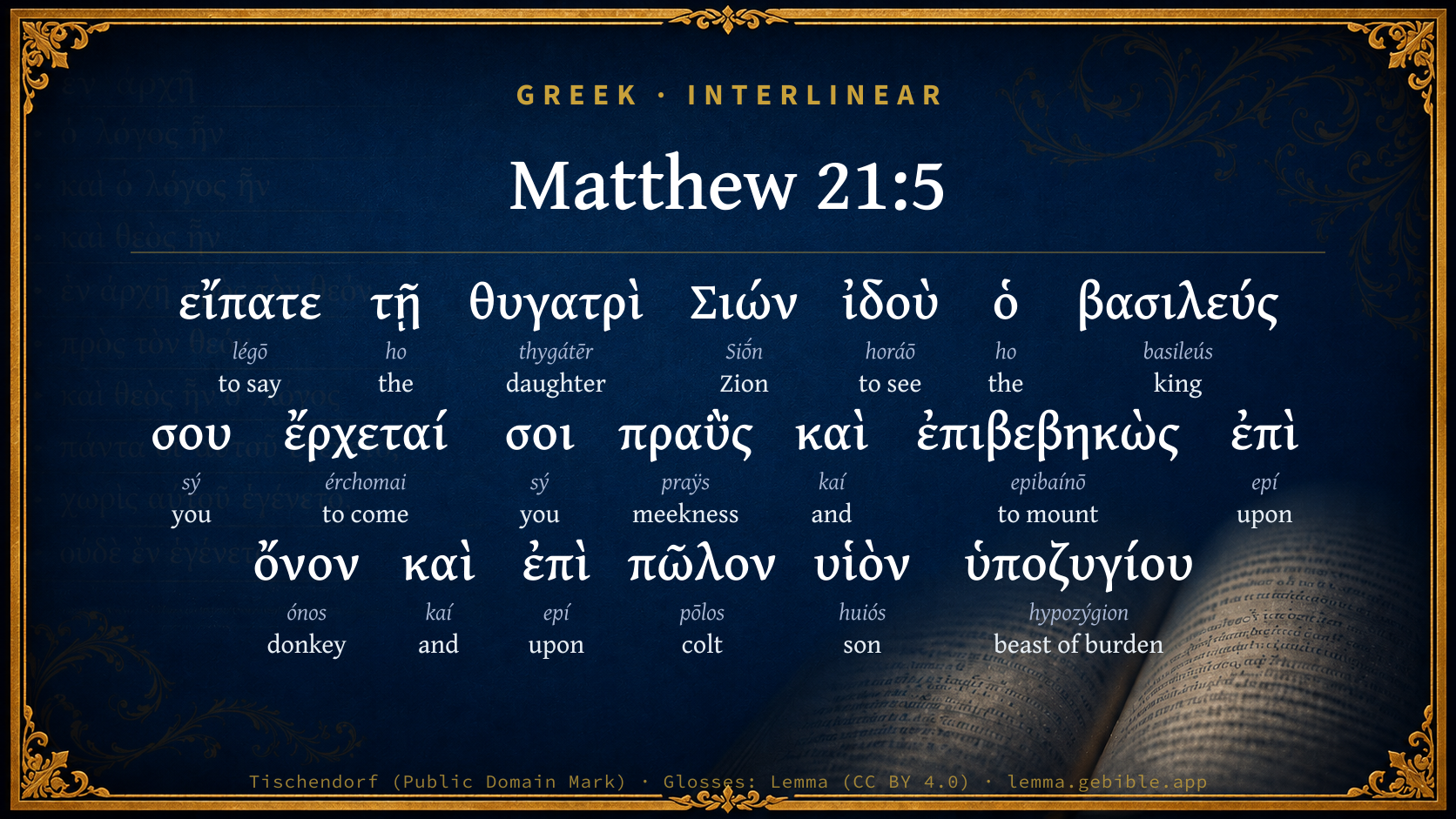
Download image
Cite this verse

Matthew 21:5 (World English Bible). Public Domain. Lemma interlinear Bible study tool, https://lemma.gebible.app/v/matthew/21/5.

Show BibTeX & RIS
BibTeX
RIS
English Translation
"Tell the daughter of Zion, Behold, your King comes to you, Humble, and riding on a donkey, On a colt, the foal of a donkey."
World English Bible · Public Domain
Highlights
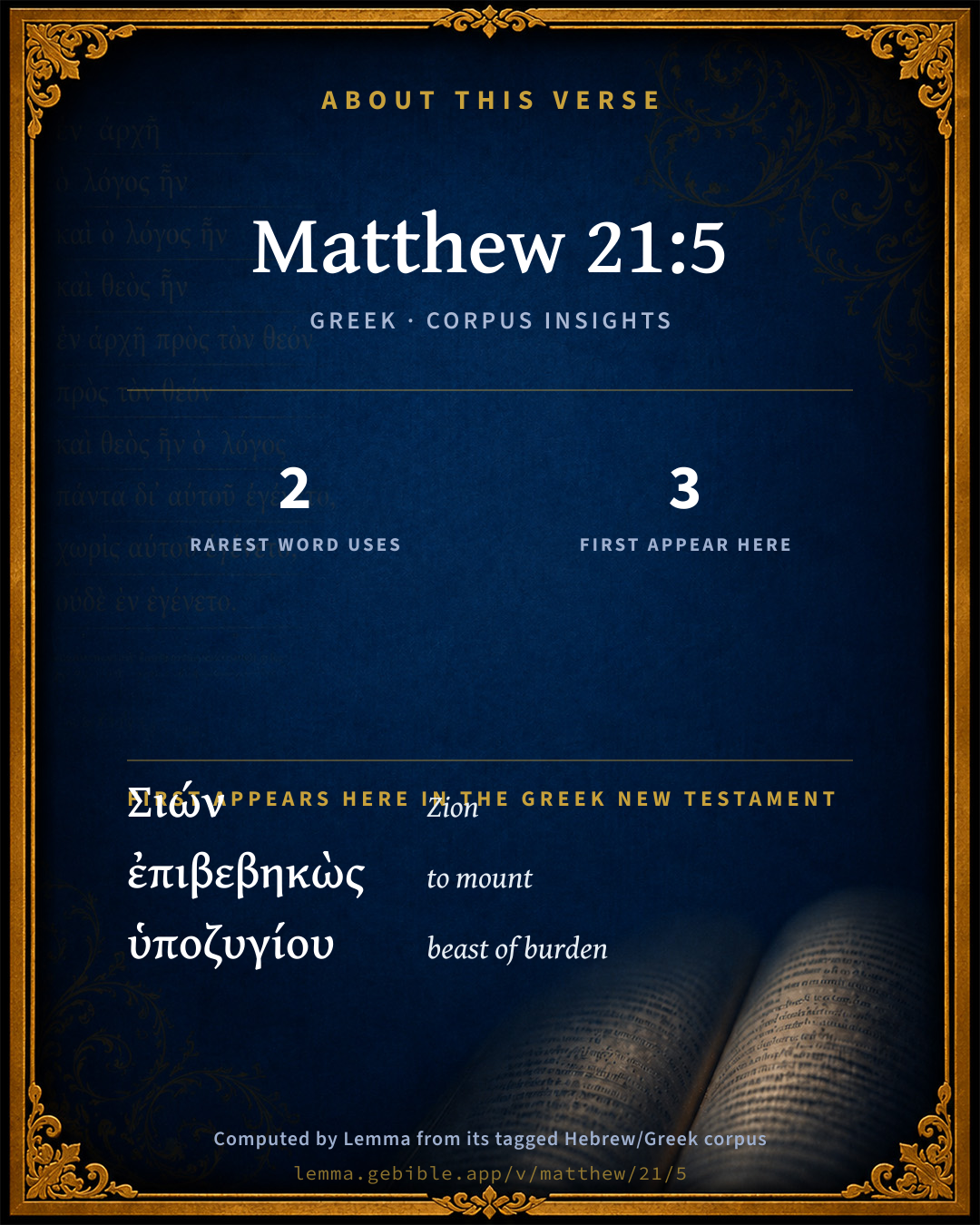
  • 3 first appearances in the Greek New Testament
Full analysis ↓
Download a study sheet

One document with this verse’s original text, its word-by-word gloss line, the meaning frame, cross-references with their text, attributed commentary, and full source and license credits — printable, and it pastes into notes with its structure intact.

This verse Autodidact and up

Study sheet (.html) Plain text (.txt)

A passage Seminary Student

Up to 50 verses in one chapter. A passage sheet keeps up to 6 commentary sources and 12 cross-references per verse, in the order this page ranks them, and says so on the sheet whenever that leaves anything out. Ask for a single verse and you get the Autodidact verse sheet above.

Everything on this page stays free to read, with no account — the sheet is a download of what is already on screen, not access to it.

Want to remove ads? Support Godless Engineer
Compare translations 3

The same verse in 3 English versions, stacked beneath the original-language interlinear above. Click any original word for its lexicon entry.

Each is an independent rendering of the whole verse — the interlinear is not word-aligned to these translations.

Highlighted words mark where these versions differ — a whole-verse word diff, not a word-by-word alignment.

  • World English Bible Public Domain
    "Tell the daughter of Zion, Behold, your King comes to you, Humble, and riding on a donkey, On a colt, the foal of a donkey."
  • King James Version Public Domain
    Tell ye the daughter of Sion, Behold, thy King cometh unto thee, meek, and sitting upon an ass, and a colt the foal of an ass.
  • unfoldingWord Literal Text CC BY-SA 4.0
    “Tell the daughter of Zion, ‘Behold, your King is coming to you, humble and riding on a donkey, and on a colt, a son of a beast of burden.’”

unfoldingWord Literal Text — © unfoldingWord, licensed CC BY-SA 4.0. Word-aligned USFM3 via Door43 (git.door43.org/unfoldingWord/en_ult).

Versions to compare (up to 4)

3 of 4 selected

Show all 19 translations

Every available English version of this verse, each an independent rendering of the whole verse.

  • World English Bible Public Domain
    "Tell the daughter of Zion, Behold, your King comes to you, Humble, and riding on a donkey, On a colt, the foal of a donkey."
  • Berean Standard Bible Public Domain
    “Say to the Daughter of Zion, ‘See, your King comes to you, gentle and riding on a donkey, on a colt, the foal of a donkey.’”
  • Majority Standard Bible Public Domain
    “Say to the Daughter of Zion, ‘See, your King comes to you, gentle and riding on a donkey, on a colt, the foal of a donkey.’”
  • King James Version Public Domain
    Tell ye the daughter of Sion, Behold, thy King cometh unto thee, meek, and sitting upon an ass, and a colt the foal of an ass.
  • American Standard Version (1901) Public Domain
    Tell ye the daughter of Zion, Behold, thy King cometh unto thee, Meek, and riding upon an ass, And upon a colt the foal of an ass.
  • Revised Version (1885) Public Domain
    Tell ye the daughter of Zion, Behold, thy King cometh unto thee, Meek, and riding upon an ass, And upon a colt the foal of an ass.
  • Geneva Bible (1599) Public Domain
    Tell ye the daughter of Sion, Beholde, thy King commeth vnto thee, meeke and sitting vpon an asse, and a colte, the foale of an asse vsed to the yoke.
  • Douay-Rheims (1899) Public Domain
    Tell ye the daughter of Sion: Behold thy king cometh to thee, meek, and sitting upon an ass, and a colt the foal of her that is used to the yoke.
  • Young's Literal Translation Public Domain
    `Tell ye the daughter of Zion, Lo, thy king doth come to thee, meek, and mounted on an ass, and a colt, a foal of a beast of burden.'
  • Literal Standard Version CC BY-SA 4.0
    “Tell the daughter of Zion, Behold, your King comes to you, meek, and mounted on a donkey, and a colt, a foal of a beast of burden.”
  • Unlocked Literal Bible CC BY-SA 4.0
    “Tell the daughter of Zion, 'See, your King is coming to you, Humble and riding on a donkey— on a colt, the foal of a donkey.'”
  • unfoldingWord Literal Text CC BY-SA 4.0
    “Tell the daughter of Zion, ‘Behold, your King is coming to you, humble and riding on a donkey, and on a colt, a son of a beast of burden.’”
  • Darby Bible Public Domain
    Say to the daughter of Zion, Behold thy King cometh to thee, meek, and mounted upon an ass, and upon a colt the foal of an ass.
  • World Messianic Bible Public Domain
    “Tell the daughter of Zion, behold, your King comes to you, humble, and riding on a donkey, on a colt, the foal of a donkey.”
  • Webster's Bible Public Domain
    Tell ye the daughter of Sion, Behold, thy King cometh to thee, meek, and sitting upon an ass, and a colt the foal of an ass.
  • Free Bible Version CC BY-SA 4.0
    “Tell the daughter of Zion, ‘Look, your King is coming to you. He is humble, and rides a donkey, and a colt, the offspring of a donkey.’”
  • Bible in Basic English Public Domain
    Say to the daughter of Zion, See, your King comes to you, gentle and seated on an ass, and on a young ass.
  • Text-Critical English NT CC BY 4.0
    “Say to the daughter of Zion, ‘Behold, yoʋr king is coming to yoʋ, humble and mounted on a donkey, and a colt, the foal of a beast of burden.’ ”
  • Tyndale New Testament (1534) Public Domain
    Tell ye the doughter of Sion: beholde thy kynge cometh vnto the meke and sittinge vpon an asse and a colte the fole of an asse vsed to the yooke.

Literal Standard Version (2020), Covenant Press — licensed CC BY-SA 4.0. Text via the HelloAO Bible API (eBible.org). Unlocked Literal Bible (unfoldingWord) — licensed CC BY-SA 4.0. Text via the HelloAO Bible API (eBible.org). unfoldingWord Literal Text — © unfoldingWord, licensed CC BY-SA 4.0. Word-aligned USFM3 via Door43 (git.door43.org/unfoldingWord/en_ult). Free Bible Version, Dr. Jonathan Gallagher — licensed CC BY-SA 4.0. Text via the HelloAO Bible API (eBible.org).

Word by word

More ways to search: Search by grammar → Find every occurrence → Compare this word →

Practice this passage: Drill this verse → Learn its vocabulary →

ὑποζυγίου
hypozýgion
G5268
“beast of burden”
Noun, Genitive, Singular, Neuter
Part of Speech
Noun
Case
Genitive
Number
Singular
Gender
Neuter
Full Thayer's Definition

Origin: neuter of a compound of G5259 and G2218

TDNT: None

1. under the yoke 2. a beast of burden, an ass a. the ass was the common animal used by the Orientals on journey and for carrying burdens
  1. εἴπατε légō G3004 “to say” Verb, Aorist, Active, Imperative, 2nd person, Plural
  2. τῇ ho G3588 “the” Article, Dative, Singular, Feminine
  3. θυγατρὶ thygátēr G2364 “daughter” Noun, Dative, Singular, Feminine
  4. Σιών Siṓn G4622 “Zion” Noun, Proper, indeclinable
  5. ἰδοὺ horáō G3708 “to see” Verb, Aorist, Middle, Imperative, 2nd person, Singular
  6. ὁ ho G3588 “the” Article, Nominative, Singular, Masculine
  7. βασιλεύς basileús G935 “king” Noun, Nominative, Singular, Masculine
  8. σου sý G4771 “you” Personal pronoun, 2nd person, Genitive, Singular
  9. ἔρχεταί érchomai G2064 “to come” Verb, Present, Middle or Passive deponent, Indicative, 3rd person, Singular
  10. σοι sý G4771 “you” Personal pronoun, 2nd person, Dative, Singular
  11. πραῢς praÿs G4239 “meekness” Adjective, Nominative, Singular, Masculine
  12. καὶ kaí G2532 “and” Conjunction
  13. ἐπιβεβηκὼς epibaínō G1910 “to mount” Verb, Perfect, Active, Participle, Nominative, Singular, Masculine
  14. ἐπὶ epí G1909 “upon” Preposition
  15. ὄνον ónos G3688 “donkey” Noun, Accusative, Singular, Feminine
  16. καὶ kaí G2532 “and” Conjunction
  17. ἐπὶ epí G1909 “upon” Preposition
  18. πῶλον pōlos G4454 “colt” Noun, Accusative, Singular, Masculine
  19. υἱὸν huiós G5207 “son” Noun, Accusative, Singular, Masculine

About this verse

These counts appear in no published source. They are computed here, from the morphology-tagged text and Lemma’s own curated glosses. What Lemma adds →

20
words
16
distinct lemmas
Gospels
section

Notable vocabulary

The rarest word here is ὑποζυγίου beast of burden G5268 — appearing just 2 times in the whole Greek New Testament.

First appearance in Scripture

These words make their first canonical appearance in the Greek New Testament here:

  • Σιών Zion G4622
  • ἐπιβεβηκὼς to mount G1910
  • ὑποζυγίου beast of burden G5268

Shared distinctive vocabulary

ὑποζυγίου beast of burden G5268 occurs in 2 verses of the Greek New Testament. Also found in:
Repetition

Words recur within this verse:

Cross-references

37

Topical passages linked to Matthew 21:5 in the Treasury of Scripture Knowledge — connected by theme and wording, ordered by reader-vote popularity; previews shown in the World English Bible.

  • Zechariah 9:9–10 Rejoice greatly, daughter of Zion! Shout, daughter of Jerusalem! Behold, your king comes to you! He is righteous, and having salvation; Lowly, and riding on a donkey, Even on a colt, the foal of a donkey.
  • Isaiah 62:11 Behold, Yahweh has proclaimed to the end of the earth, Say you to the daughter of Zion, Behold, your salvation comes; behold, his reward is with him, and his recompense before him.
  • Isaiah 9:6–7 For to us a child is born, to us a son is given; and the government shall be on his shoulder: and his name shall be called Wonderful, Counselor, Mighty God, Everlasting Father, Prince of Peace.
  • Isaiah 12:6 Cry aloud and shout, you inhabitant of Zion; for great in the midst of you is the Holy One of Israel!"
  • Genesis 49:10 The scepter will not depart from Judah, Nor the ruler's staff from between his feet, Until he comes to whom it belongs. To him will the obedience of the peoples be.
  • Hosea 1:7 But I will have mercy on the house of Judah, and will save them by Yahweh their God, and will not save them by bow, nor by sword, nor by battle, by horses, nor by horsemen."
  • Zephaniah 3:14–15 Sing, daughter of Zion! Shout, Israel! Be glad and rejoice with all your heart, daughter of Jerusalem.
  • Isaiah 40:9 You who tell good news to Zion, go up on a high mountain; you who tell good news to Jerusalem, lift up your voice with strength; lift it up, don't be afraid; say to the cities of Judah, Behold, your God!
  • Jeremiah 23:5–6 Behold, the days come, says Yahweh, that I will raise to David a righteous Branch, and he shall reign as king and deal wisely, and shall execute justice and righteousness in the land.
  • Psalms 110:1–4 Yahweh says to my Lord, "Sit at my right hand, Until I make your enemies your footstool for your feet."
  • Daniel 2:44–45 In the days of those kings shall the God of heaven set up a kingdom which shall never be destroyed, nor shall the sovereignty of it be left to another people; but it shall break in pieces and consume all these kingdoms, and it shall stand forever.
  • Daniel 7:13–14 I saw in the night-visions, and, behold, there came with the clouds of the sky one like a son of man, and he came even to the ancient of days, and they brought him near before him.
  • Micah 5:2 But you, Bethlehem Ephrathah, Being small among the clans of Judah, Out of you one will come forth to me that is to be ruler in Israel; Whose goings forth are from of old, from everlasting.
  • Zechariah 6:12–13 and speak to him, saying, 'Thus says Yahweh of Hosts, "Behold, the man whose name is the Branch: and he shall grow up out of his place; and he shall build the temple of Yahweh;
  • Matthew 2:6 'You Bethlehem, land of Judah, Are in no way least among the princes of Judah: For out of you shall come forth a governor, Who shall shepherd my people, Israel.'"
  • Ezekiel 34:24 I, Yahweh, will be their God, and my servant David prince among them; I, Yahweh, have spoken it.
  • Ezekiel 37:24 My servant David shall be king over them; and they all shall have one shepherd: they shall also walk in my ordinances, and observe my statutes, and do them.
  • Matthew 11:29 Take my yoke upon you, and learn from me, for I am gentle and lowly in heart; and you will find rest for your souls.
  • Matthew 12:19–20 He will not strive, nor shout; Neither will anyone hear his voice in the streets.
  • Mark 11:4–11 They went away, and found a young donkey tied at the door outside in the open street, and they untied him.
  • Philippians 2:3–5 doing nothing through rivalry or through conceit, but in humility, each counting others better than himself;
  • Psalms 9:14 That I may show forth all your praise. In the gates of the daughter of Zion, I will rejoice in your salvation.
  • Psalms 72:1–20 God, give the king your justice; Your righteousness to the royal son.
  • Micah 5:10–11 "It will happen in that day," says Yahweh, "That I will cut off your horses out of the midst of you, And will destroy your chariots.
  • Matthew 2:2 "Where is he who is born King of the Jews? For we saw his star in the east, and have come to worship him."
  • John 19:15–22 They cried out, "Away with him! Away with him! Crucify him!" Pilate said to them, "Shall I crucify your King?" The chief priests answered, "We have no king but Caesar!"
  • Numbers 24:19 Out of Jacob shall one have dominion, Shall destroy the remnant from the city.
  • Deuteronomy 17:16 Only he shall not multiply horses to himself, nor cause the people to return to Egypt, to the end that he may multiply horses; because Yahweh has said to you, You shall henceforth return no more that way.
  • Judges 5:10 Tell [of it], you who ride on white donkeys, You who sit on rich carpets, You who walk by the way.
  • Judges 12:14 He had forty sons and thirty sons' sons, who rode on seventy donkey colts: and he judged Israel eight years.
  • 2 Samuel 16:2 The king said to Ziba, What do you mean by these? Ziba said, The donkeys are for the king's household to ride on; and the bread and summer fruit for the young men to eat; and the wine, that such as are faint in the wilderness may drink.
  • 1 Kings 1:33 The king said to them, Take with you the servants of your lord, and cause Solomon my son to ride on my own mule, and bring him down to Gihon:
  • 1 Kings 10:26 Solomon gathered together chariots and horsemen: and he had a thousand and four hundred chariots, and twelve thousand horsemen, that he bestowed in the chariot cities, and with the king at Jerusalem.
  • Psalms 2:6–12 "Yet I have set my king on my holy hill of Zion."
  • Psalms 45:1–17 My heart overflows with a noble theme. I recite my verses for the king. My tongue is like the pen of a skillful writer.
  • John 1:49 Nathanael answered him, "Rabbi, you are the Son of God! You are King of Israel!"
  • 2 Corinthians 10:1 Now I Paul, myself, entreat you by the humility and gentleness of Christ; I who in your presence am lowly among you, but being absent am of good courage toward you.

Cross-references courtesy of OpenBible.info (CC BY 4.0).

Commentary

Notes on Matthew 21:5 from classic Christian and Jewish commentators (each source and its license shown beneath its notes). The classic Christian expositions comment on the surrounding passage and are grouped to its opening verse, so a note may address several verses; the Jewish commentaries on the Tanakh (Rashi and others) are per-verse, so they appear only where the commentator wrote on this verse.

Lemma curates 59 commentaries, every one of them public domain or Creative Commons licensed, each selected and text-cleaned for this edition rather than reprinted as found. About our sources →

Bengel's Gnomon

Johann Albrecht Bengel

Mat 21:5. Εἴπατε, κ.τ.λ., tell ye, etc.) This passage is one of those which show that many things in the prophets ought to be received by us, not only as they were meant by them, but as they were destined to be meant by the apostles. This part occurs in Isa 62:11; the rest in Zechariah, whom St Matthew quotes, beginning at the more important part; for the word “rejoice” is thus supplied. At the time of its fulfilment it is to be told: joy then arises spontaneously.[904] In Zec 9:9, the LXX. have Χαῖρε σφόδρα θύγατερ Σιὼν, κήρυσσε θύγατερ Ἱερουσαλήμ· ἰδοὺ, ὁ Βασιλεὺς[905] ἔρχεταί σοι, δίκαιος καὶ σώζων Αὐτὸς·[906] πρᾳῢς καὶ ἐμβεβηκὼς ἐπὶ ὑποζύγιον καὶ πῶλον νέον,—Rejoice greatly, daughter of Sion; shout,[907] daughter of Jerusalem: behold the King cometh unto thee; He is just and having salvation:[908] meek, and riding on an ass, even a young colt.—τῇ θυγατρὶ Σιὼν, to the daughter of Sion) put synecdochically for Jerusalem.—Βασιλεύς σου, thy King) and also Bridegroom.—σαὶ, to, or for thee) sc. for thy sake or advantage.—πρᾳῢς καὶ, κ.τ.λ., meek and, etc.[909]) The same thing is frequently expressed in the same passage by literal and metaphorical words. The horse is a warlike steed, which the King of Peace did not make use of; see Zec 9:10. He will make use of it hereafter; see Rev 19:11.—ὄνον, an ass) not a she ass. In Hebrew, חמור.—υἱὸν ὑποζυγίου, the male foal of an ass[910]) who, though the offspring of one that had borne the yoke, had not himself yet borne it. Our Lord rode upon the foal, but employed also the mother as a companion to the foal.

[904] Beng. seems to mean, the introductory words in Zec 9:9, “Rejoice greatly,” etc., “Shout,” etc., are omitted here, on the occasion of the passage being quoted by St Matthew, because, at the time of the fulfilment of the prophecy, all that was needed was the telling (and therefore “Tell ye” is substituted from Isa 62:11, “Say ye”): the joy was sure to arise of its own accord.—ED.

[905] The Codex Alexandrinus reads βασιλεύς σου.—(I. B.)

[906] The Oxford Edition of 1848 has a comma after σώζων, and omits the colon after Αὐτὸς.—(I. B.)

[907] The word denotes, in the orig., the voice of a herald or a preacher.—(I. B.)

[908] Lit. “Himself saving.”—(I. B.)

[909] It is this very virtue that renders both her King, and the tidings as to the approach of her King, so delightful to the daughter of Sion.—V. g.

[910] Literally, the son of one who bears the yoke; rendered accurately by the Vulgate, which Bengel has followed here, filium subjugalis. He has not been equally exact in his German Version.—(I. B.)

Bengel's Gnomon of the New Testament — English translation (T&T Clark, Edinburgh, 1860) — public domain. Text from a community e-Sword module.

Expositor's Greek Testament

ed. W. Robertson Nicoll

Mat 21:5 . he prophetic quotation, from Zec 9:9 , prefaced by a phrase from Isa 62:11 , with some words omitted, and with some alteration in expression as compared with Sept [114]

[114] Septuagint.

The Expositor's Greek Testament, edited by W. Robertson Nicoll (1897–1910) — public domain. Text from a community e-Sword module.

Geneva Bible (1599)

Geneva Bible translators

The city of Zion. An Hebrew kind of speech, common in the lamentations of Jeremiah.

Geneva Bible (1599) marginal notes — public domain. Text via Bolls.life.

Adam Clarke's Commentary

Verse 5. Tell ye the daughter of Sion] The quotation is taken from Zec 9:9, but not in the precise words of the prophet.

This entry into Jerusalem has been termed the triumph of Christ. It was indeed the triumph of humility over pride and worldly grandeur; of poverty over affluence; and of meekness and gentleness over rage and malice.

He is coming now meek, full of kindness and compassion to those who were plotting his destruction! He comes to deliver up himself into their hands; their king comes to be murdered by his subjects, and to make his death a ransom price for their souls!

Adam Clarke's Commentary on the Bible (1810–1826) — public domain. Text from a community e-Sword/MySword module.

Ellicott's Commentary for English Readers

(5) Tell ye the daughter of Sion.—The words seem to have been cited from memory, the Hebrew text of Zec_9:9 beginning, “Rejoice greatly, O daughter of Sion; shout O daughter of Jerusalem,” and inserting “just, and having salvation” in the description of the King. As the words stand in Zechariah (we need not here discuss the question as to the authorship or composition of that book) they paint the ideal King coming, not with “chariot” and “horse” and “battle bow,” like the conquerors of earthly kingdoms, but as a prince of peace, reviving the lowlier pageantry of the days of the Judges (Jdg_5:10; Jdg_10:4; Jdg_12:14), and yet exercising a wider dominion than David or Solomon had done, “from sea to sea, and from the river (Euphrates) to the ends of the earth” (Zec_9:10). That ideal our Lord claimed to fulfil. Thus interpreted, His act was in part an apparent concession to the fevered expectations of His disciples and the multitude; in part also a protest, the meaning of which they would afterwards understand, against the character of those expectations and the self-seeking spirit which mingled with them. Here, as before, we trace the grave, sad accommodation to thoughts other than His own to which the Teacher of new truths must often have recourse when He finds Himself misinterpreted by those who stand altogether on a lower level. They wished Him to claim the kingdom, that they might sit on His right hand and on His left. Well, He would do so, but it would be a kingdom “not of this world” (Joh_18:36), utterly unlike all that they were looking for.

A colt the foal of an ass.—Literally, of a beast of burden, the word not being the same as that previously used. In the Hebrew of Zechariah the word reproduces the old poetic phraseology of Gen_49:11.

A Bible Commentary for English Readers, edited by Charles John Ellicott (1878–1897) — public domain. Text from a community e-Sword module.

The Cambridge Bible for Schools and Colleges

gen. ed. J. J. S. Perowne

5. Tell ye the daughter of Sion, &c.] Zec_9:9. The prophet is predicting the triumph of Israel and the fall of the neighbouring nations. The prophecy contains three distinct Hebrew words for an “ass.” “Sitting upon an ass (chamâr, from a root meaning red) and a colt (air, ‘a young male ass’) the foal (lit. ‘the son’) of an ass (athôn = ‘a she-ass,’ from a root meaning ‘slow’).”

meek] See ch. Mat_5:5.

The Cambridge Bible for Schools and Colleges (gen. ed. J. J. S. Perowne; Cambridge University Press, 1878–1918) — public domain. Text from a community e-Sword module.

John Gill's Exposition

Tell ye the daughter of Zion,.... These words seem to be taken out of Isa 62:11 where it is said, "say ye to the daughter of Zion, behold thy salvation cometh", or "thy Saviour cometh"; meaning, without doubt, the Messiah: by the daughter of Zion is meant, not the city of Jerusalem, but the inhabitants thereof, the Jewish synagogue; or as the Targum renders it, , "the congregation of Zion", the people of the Jews; particularly the elect of God among them, those that embraced the true Messiah, and believed in him:

behold, thy king cometh unto thee: this, and what follow, are cited from Zac 9:9 and to be understood of the king Messiah, who, in a little time after this prophecy was given out, was to come to Zion, and redeem Jacob from all his iniquities, and was now come. One of the Jewish commentators says (x), that interpreters are divided about the sense of this prophecy; but observes, that there are some that say this is the Messiah: and another (y) of them affirms, that it is impossible to explain it of any other than the king Messiah; and that it can be understood of no other, I have elsewhere (z) shown. "Meek"; in the prophecy of Zechariah it is, "poor", as the Messiah Jesus was, in a temporal sense; but the word, both by the Septuagint, and our evangelist, is rendered

meek; as it is by the Targum, Jarchi, and Kimchi, who all explain it by "lowly, humble, or meek": and a character it is, that well agrees with Jesus, who, in the whole of his deportment, both in life and in death, was a pattern of meekness and lowliness of mind: and

sitting upon an ass, and a colt, the foal of an ass. This is applied to the Messiah by the Jews, both ancient (a) and modern (v), who consider this as an instance and evidence of his humility: they suppose, this ass to be a very uncommon one, having an hundred spots on it; and say, that it was the foal of that which was created on the eve of the sabbath (w); and is the same that Abraham and Moses rode upon: and they own, as before observed, that Jesus of Nazareth rode on one to Jerusalem, as is here related. Their ancient governors, patriarchs, princes, and judges, used to ride on asses, before the introduction and multiplication of horses in Solomon's time, forbidden by the law of God: wherefore, though this might seem mean and despicable at this present time, yet was suitable enough to Christ's character as a king, and as the son of David, and king of Israel; strictly observing the law given to the kings of Israel, and riding in such manner as they formerly did.

(x) Aben Ezra in Zech. ix. 9. (y) Jarchi in ib. (z) Prophecies of the Messiah literally fulfilled in Jesus, c. 9. p. 151, &c. (a) T. Bab. Sanhedrim, fol. 98. 1. & 99. 1. Bereshit Rabba, fol. 66. 2. & 85. 3. Midrash Kohelet, fol. 63. 2. Zohar in Gen. fol. 127. 3. & in Num. fol. 83. 4. & in Deut. fol. 117. 1. & 118. 3. Raya Mehimna in Zohar. in Lev. fol. 38. 3. & in Num. fol. 97. 2. (v) Jarchi in Isa. xxvi 6. Baal Hatturim in Exod. fol. 88. 2. Abarbimel, Mashmia Jeshua, fol. 15. 4. (w) Pirke Eliezer, c. 31. Caphtor, fol. 81. 2.

John Gill's Exposition of the Whole Bible (1746–1763) — public domain (CC PDM 1.0). Text via the HelloAO Bible API.

Trapp's Complete Commentary

John Trapp

5 Tell ye the daughter of Sion, Behold, thy King cometh unto thee, meek, and sitting upon an ass, and a colt the foal of an ass.

Ver. 5. Tell ye the daughter of Sion] Here was that also of the Psalmist fulfilled, "God is my King of old, working salvation in the midst of the earth," Psa 74:12. For Jerusalem is by the Fathers observed to stand in the very centre and navel of the habitable earth, as if it were fatally founded to be the city of the great King.

Thy King cometh unto thee] All in Christ is for our behoof and benefit, 1Co 1:30, and Mic 4:8-9 "Unto thee shall it come, O daughter of Zion, even the first dominion; the kingdom shall come to the daughter of Jerusalem. Why then dost thou cry out aloud? Is there no King in thee? Is thy counsellor perished?" A mandamus {a} from this King will do it at any time, Psa 40:4.

Meek, and sitting upon an ass] Not upon a stately saddle horse, as Alexander, Julius Caesar, &c.; no such state here. Christ’s kingdom was of another world; "He came riding meekly;" and his word (the law of his kingdom) is both to be taught and received with meekness, 2Ti 2:25; Jas 1:21. At Genoa in Italy they show the tail of the ass our Saviour rode on for a holy relic; and bow before it with great devotion. On Palm Sunday, their priests bring forth an ass in state, and bow before him and worship him, as if Christ himself were there present; which when the Turkish ambassadors once beheld at Craeonia in Poland, they blessed themselves, and cried out, O terram impietatem! Siccine asinum brutam bestiam adorari? Oh detestable impiety! should an ass be so adored? Neither will these dull dizards be reclaimed from such fond fopperies; being herein like those Italian asses, which feeding upon the weed henbane, {a} are so stupefied, that they lie for dead, neither can they be awakened till half-skinned.

{a} A term ‘originally applied generically to a number of ancient writs, letters missive, or mandates, issued by the sovereign, directing the performance of certain acts’, but afterwards restricted to the judicial writ (called ‘the high prerogative writ of mandamus’) issued in the King’s name from the Court of King’s Bench (now, from the Crown side of the King’s Bench Division of the High Court of Justice) and directed to an inferior court, a corporation, an officer, etc., commanding some specified thing to be done. ‘Its general object is to enforce the performance of some public duty in respect of which there is no other specific legal remedy’ (G. H. B. Kenrick in Encycl. Laws Eng. s.v.). ŒD

{b} The common name of the annual plant Hyoscyamus niger, a native of Europe and northern Asia, growing on waste ground, having dull yellow flowers streaked with purple, viscid stem and leaves, unpleasant smell, and narcotic and poisonous properties; also extended to the genus as a whole. ŒD

John Trapp, A Commentary or Exposition upon All the Books of the Old and New Testament (1647–1656) — public domain. Text from a community e-Sword module.

Haydock's Catholic Bible Commentary

Some manuscripts read Isaias, others Zacharias: the text seems to be extracted from both, but particularly the latter, the sense of which is taken, though not verbatim, from the Septuagint version. See Isaias lxii. 2. and Zacharias ix. 9.

George Leo Haydock (1774–1849), Haydock's Catholic Family Bible and Commentary, 1859 edition — public domain. Excludes Psalms (Douay-Rheims chapter numbering differs from Protestant) and Deuterocanonical books (Catholic canon only).

Whedon's Commentary on the Bible

Daniel D. Whedon

5. Tell ye the daughter of Zion — This is a memorable prophecy of the Messiah in his humble and peaceful character. It is thus translated from the Hebrew by Hengstenberg: “Rejoice greatly, thou daughter of Zion! shout for joy, thou daughter of Jerusalem! Behold, thy king comes to thee; he is just and protected of God, afflicted and riding upon a foal the son of an ass.” The prophecy of the entire preceding part of the ninth chapter of Zechariah, Hengstenberg holds to be a clear prediction of the conquests of Alexander the Great. But with these words at the ninth verse commences, in contrast, the descriptive picture of Jesus the Prince of peace. It was applied by the ancient Jews to the Messiah.

Daughter of Zion — The pious part of the Jewish people. And a colt the foal of an ass — Strauss and ether objectors have maintained that this is simply a Hebrew parallelism, in which the last clause is but an echo of the former, both possessing the same meaning. Thereby the colt foal in the last clause would be the same as the ass in the first clause, both being terms for one and the same animal. But Hengstenberg justly denies that by the laws of Hebrew parallelism the two would necessarily mean the same individual animal. In the passage Gen_49:11 : “Binding his foal unto the vine, his ass’s colt unto the choice vine,” no one would claim that the foal and the colt were necessarily the same individual. In the present case it was our Lord’s purpose to make his procession with both animals into Jerusalem a sort of visible embodiment of the prophet’s words. Nor must this voluntary act upon the part of our Lord be looked upon as being a literal and final fulfilment of the prophecy. The prophet does not by these words intend to describe this or any particular scene. He only takes the riding upon the ass as the image to illustrate the meekness of the Messianic King. And our Lord, in thus acting the image of the prophet in visible form, does call the attention of the Jewish nation to his claim to be the King predicted by this prophetic image. This our Saviour performed at the passover, when the Jewish nation was, by representatives, present to behold; when perhaps millions of the nation were actually present to bear the news to all parts of the land.

Daniel D. Whedon (gen. ed.), Commentary on the Old and New Testaments (1874–1909) — public domain. Text from a community e-Sword module.

The Pulpit Commentary

Tell ye the daughter of Zion. This is from Isaiah. (comp. Zep_3:14) The passage in Zechariah begins, "Rejoice greatly, O daughter of Zion; shout, O daughter of Jerusalem." The "daughter of Zion" is Jerusalem herself, named from the chief of the hills on which the city was built. Of course, the term includes all the inhabitants. Behold; marking the suddenness and unexpected nature of the event. Thy King. A King of thine own race, no stranger, one predestined for thee, foretold by all the prophets, who was to occupy the throne of David and to reign forever. Unto thee. For thy special good, to make his abode with thee. (comp. Isa_9:6) Meek. As Christ himself says, "I am meek and lowly in heart", (Mat_11:29) far removed from pomp and warlike greatness; and yet, according to his own Beatitude, the meek shall inherit the earth, (Mat_5:5) win victories which material forces can never obtain, triumph through humiliation. The original in Zechariah gives other characteristics of Messiah: "He is just, and having salvation;" i.e. endowed with salvation, either as being protected by God, or victorious and so able to save his people. Sitting upon an ass. Coming as King, he could not walk undistinguished among the crowd; he must ride. But to mount a war horse would denote that he was leader of an army or a worldly potentate; so he rides upon an ass, an animal used by the judges of Israel, and chieftains on peaceful errands; (Jud_1:5:10 10:4) one, too, greatly valued, and often of stately appearance in Palestine. And (kai) a colt the foal of an ass; such as she asses bear, and one not trained. It is questioned whether the conjunction here expresses addition, implying that Christ mounted both animals in succession, or is merely explanatory, equivalent to videlicet, an ass, yea, even the foal of an ass. It seems unlikely that, in accomplishing the short distance between Bethphage and Jerusalem (only a mile or two), our Lord should have changed from one beast to the other; and the other three evangelists say expressly that Christ rode the colt, omitting all mention of the mother. The she ass doubtless kept close to its foal, so the prophecy was exactly fulfilled, but the animal that bore the Saviour was the colt. If the two animals represent respectively the Jews and Gentiles (see on ver. 2), it seems hardly necessary for typical reasons that Jesus should thus symbolize his triumph over the disciplined Jews, while it is obvious that the lesson of his supremacy over the untaught Gentiles needed exemplification. The prophet certainly contemplates the two animals in the procession. "The old theocracy runs idly and instinctively by the side of the young Church, which has become the true bearer of the Divinity of Christ" (Lange). No king had ever thus come to Jerusalem; such a circumstance was predicted of Messiah alone, and Christ alone fulfilled it to the letter, showing of what nature his kingdom was.

Vers. 5, 8. Signs of meekness and sifters of joy.

"Thy King cometh unto thee, meek;" "And a very great multitude spread their garments in the way." The word "meek" is used in Scripture for "not self-assertive," "not seeking one"s own." It is not to be confounded with "humility." The apostle puts "humbleness of mind" and "meekness" alongside each other in such a way that we cannot fail to observe the distinction between them. Moses was the "meekest of men," but certainly not the most humble. It is usual to associate our Lord"s "meekness" with his riding on so lowly an animal; but this is to transfer our Western ideas of asses to Eastern lands; and it also fails to observe that in ver. 5 there are two assertions, each distinct from the other. Our Lord was "meek;" and our Lord was "sitting upon an ass." If we take the word "meek" here in its usual meaning, "not self-assertive," we may find fresh suggestion in the passage. The signs of joy given in vers. 8, 9 are characteristically Eastern. Bishop Heber thus describes his march to Colombo: "The road was decorated the whole way as for a festival, with long strips of palm branches hung upon strings on either side; and whenever we stopped we found the ground spread with white cloth, and awnings erected, beautifully decorated with flowers and fruit, and festooned with palm branches. These remnants of the ancient custom mentioned in the Bible, of strewing the road with palm branches and garments, are curious and interesting.

I THE MEEKNESS OF JESUS. This is not the thing which first arrests attention. Indeed, on this one occasion Jesus seems to be asserting himself. Look deeper, and it will be found that he is not. He is not in any of the senses men put into that term. There, riding into Jerusalem as a King, he has no intention of setting up any such kingdom as men expect; he does not mean to use any force; you could never mistake him for a conqueror. There is submission, there is no self-assertion.

II THE JOY OF THE PEOPLE. In calling Jesus the "Son of David," the people recognized him as the long promised Messiah; and, without clear apprehensions of what his work was to be, they could rejoice in the realization of the national hope. Their joy made it clear to the Jerusalem officials that Jesus claimed to be the Messiah. There could be no mistake. They must accept or reject the claim. R.T.

The Pulpit Commentary (1880–1919), ed. H.D.M. Spence-Jones & Joseph S. Exell — public domain. Text from a community e-Sword module.

John Wesley's Explanatory Notes

The daughter of Sion - That is, the inhabitants of Jerusalem: the first words of the passage are cited from Isaiah lxii, 11; the rest from Zech. ix, 9. The ancient Jewish doctors were wont to apply these prophecies to the Messiah. On an ass - The Prince of Peace did not take a horse, a warlike animal. But he will ride on that by and by, Rev. xix, 11. In the patriarchal ages, illustrious persons thought it no disgrace to make use of this animal: but it by no means appears, that this opinion prevailed, or this custom continued, till the reign of Tiberias. Was it a mean attitude wherein our Lord then appeared? Mean even to contempt! I grant it: I glory in it: it is for the comfort of my soul for the honour of his humility, and for the utter confusion of all worldly pomp and grandeur.

John Wesley, Explanatory Notes Upon the Whole Bible (1754–1765) — public domain. Text via the GEBible commentary corpus.

Cambridge Greek Testament for Schools and Colleges

5. εἴπατε τῇ θυγατρὶ Σιών. The quotation is partly from Zechariah, partly from Isaiah. The first clause, εἴπατε τῇ θυγατρὶ Σιών, is the LXX. rendering of Isa 62:11. The remainder is an abbreviated citation from Zec 9:9, where the LXX. version is: [χαῖρε σφόδρα, θύγατερ Σιών, κήρυσσε, θύγατερ Ἱερουσαλήμ·] ἰδού, ὁ βασιλεὺς ἔρχεταί σοι [δίκαιος καὶ σώζων αὐτὸς] πρᾳῢς καὶ ἐπιβεβηκὼς ἐπὶ ὑποζύγιον καὶ πῶλον νέαν. The words in brackets, omitted in the citation, occur in the Hebrew text as well as in the LXX. In the last clause, where St Matthew differs from the LXX., he agrees with the Hebrew text. It is a proof of St Matthew’s feeling for poetical form that the parallelism does not suffer in the shortened form of quotation. The word σώζων which occurs in Zechariah, and ὁ σωτὴρ which follows the words quoted from Isaiah, omitted here but suggested by the quotation, would recall ‘hosanna’ and the name Jesus (σωτήρ). See below.

πραΰς. Cp. ch. Mat 11:29 and 2Co 10:1, παρακαλῶ ὑμᾶς διὰ τῆς πρᾳΰτητος καὶ ἐπιεικείας τοῦ Χριστοῦ.

Cambridge Greek Testament for Schools and Colleges (Cambridge University Press, 1896; 21 vols, various authors incl. Carr, Maclear, Plummer, Farrar, Lumby, Moule, M. R. James, Simcox) — public domain. Text from a community e-Sword module.

Vincent's Word Studies in the New Testament

Marvin R. Vincent

Daughter of Sion. Jerusalem. Compare daughter of Babylon for the city of Babylon (Psa 137:8; Isa 47:1); daughter of Tyre for the city or people of Tyre (Psa 45:12); daughter of my people (Isa 22:4).

Sitting [επιβεβηκως] . Lit., having gone upon, or mounted. Rev., riding.

Foal of an ass [υιον υποζυγιου] . Lit., son of a beast - of - burden. Upozugion, from uJpo, beneath, zugov, a yoke. Wyc., son of a beast - under - yoke. The phrase emphasized the humble state of Jesus. He is mounted, not on a stately charger with embroidered and jewelled housings, nor even on an ass for the saddle, the Eastern ass being often of great beauty and spirit, and in demand for this purpose. He rides on a common beast - of - burden, furnished with the everyday garments of his disciples.

Garments [ιματια] . Outer garments. See on Mt 5:40.

Marvin R. Vincent, Word Studies in the New Testament (1887–1900) — public domain. Text from a community e-Sword/MySword module.

Lesson kit

Teaching starters — assembled from the data on this page, not authored interpretation. Every prompt links to the verse data it draws on. Edit before teaching.

Matthew, in the Gospels, opens this verse with 20 words (16 distinct Greek lemmas). Its most distinctive word is hypozýgion (“beast of burden”). A historical commentator’s framing appears above. Read the whole chapter for the surrounding context.

Discussion questions

  1. How does “beast of burden” (hypozýgion) shape what this verse is saying?
  2. 3 words here appear for the first time in Scripture. What is being introduced at this debut?
  3. 2 Peter 2:16 shares the word «beast of burden» with this verse. How do the two illuminate each other?
  4. “upon” occurs 2× in this one verse. What is the effect of the repetition?
  5. The translations on this page render this verse differently — a whole-verse word diff, not a word-by-word alignment. What might account for the different wordings?
  6. Reading how Bengel's Gnomon and Expositor's Greek Testament read this verse, where do the two commentators agree and where do they part?

Things to notice

  • 3 words make their first canonical appearance in Scripture here.
  • These translations choose different wording for 17 words in this verse.
  • “upon” occurs 2× in this single verse.
  • 16 distinct Greek lemmas span 20 words in this verse.

Reading settings

Reading text

Shown beneath each verse's original-language words.

Old Testament
Old Testament edition

Read the OT as the Masoretic Hebrew (MT) or the Greek Septuagint (LXX).

English shown for the Greek Septuagint (in the Hebrew ↔ Greek comparison).

Comparing translations? Open the Compare panel on any verse page to stack up to four side by side.