Matthew 9:4

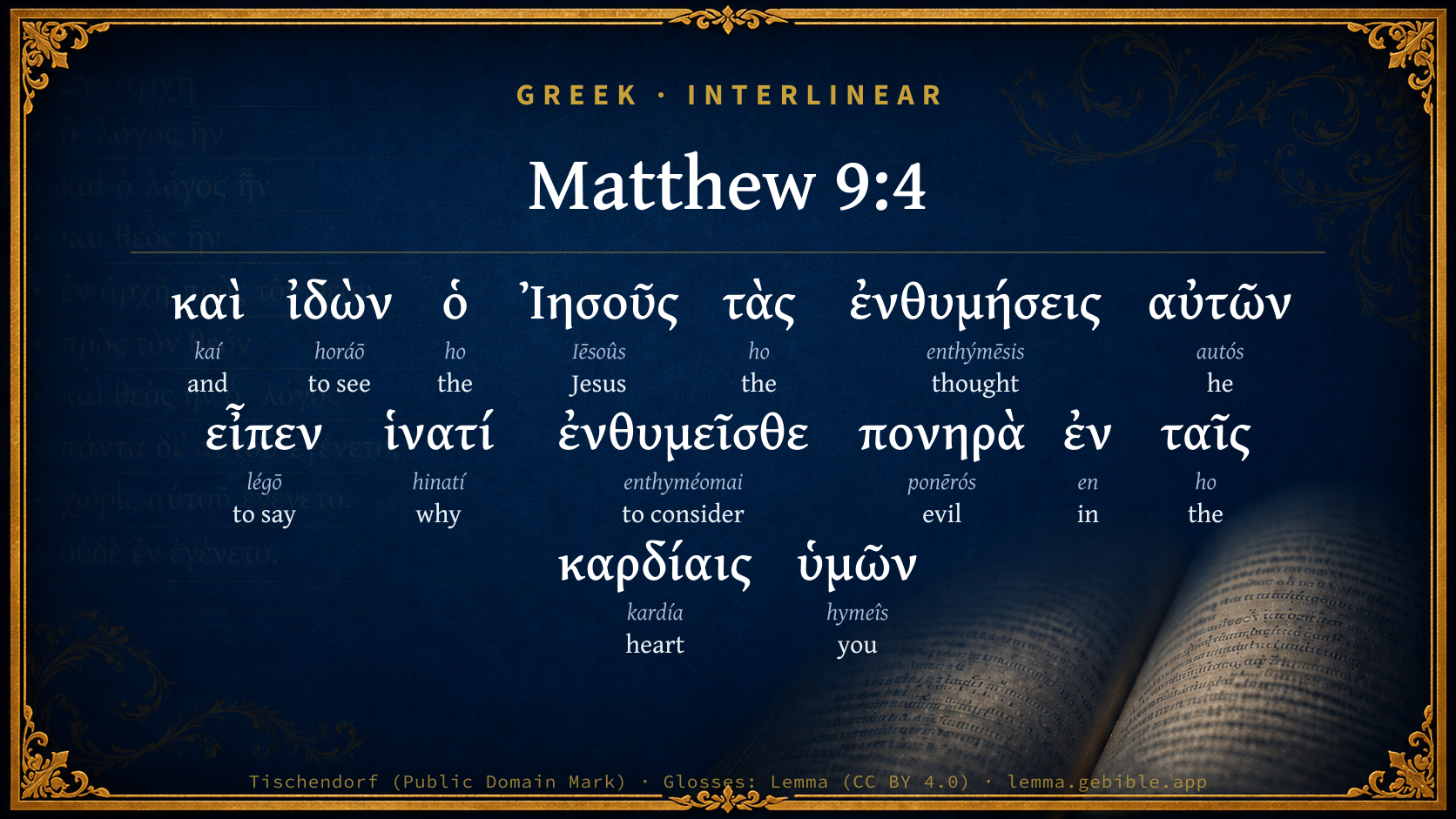
Greek (Tischendorf 8th ed.) Matthew 9:4 appears in the Greek New Testament. The text above is from the Tischendorf 8th edition. Each word links to its Strong’s number and a concise gloss. Click any word for its full Thayer’s Greek Lexicon entry.
Download image
Cite this verse

Matthew 9:4 (World English Bible). Public Domain. Lemma interlinear Bible study tool, https://lemma.gebible.app/v/matthew/9/4.

Show BibTeX & RIS
BibTeX
RIS
English Translation
Jesus, knowing their thoughts, said, "Why do you think evil in your hearts?
World English Bible · Public Domain
Highlights
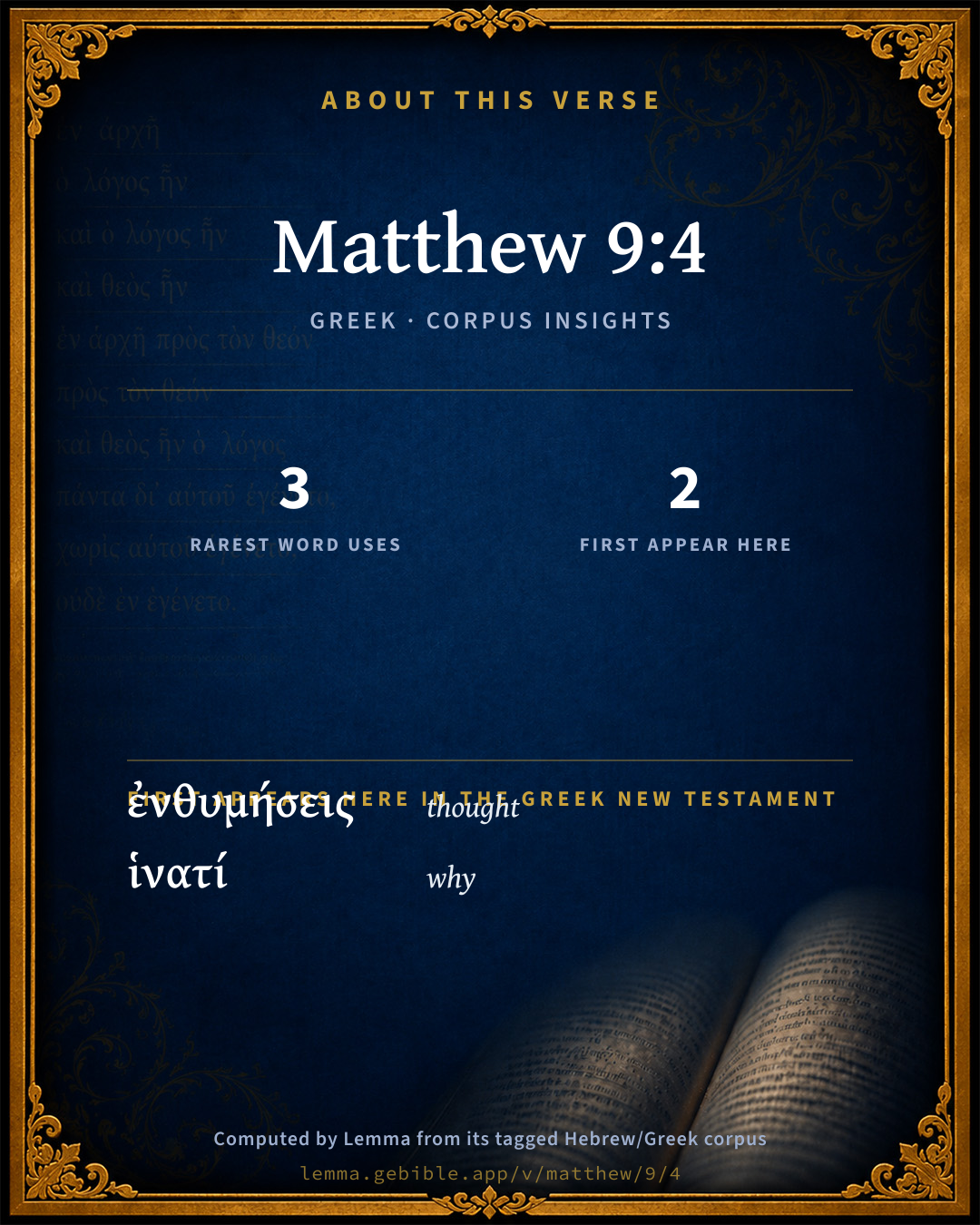
  • 2 first appearances in the Greek New Testament
Full analysis ↓
Download a study sheet

One document with this verse’s original text, its word-by-word gloss line, the meaning frame, cross-references with their text, attributed commentary, and full source and license credits — printable, and it pastes into notes with its structure intact.

This verse Autodidact and up

Study sheet (.html) Plain text (.txt)

A passage Seminary Student

Up to 50 verses in one chapter. A passage sheet keeps up to 6 commentary sources and 12 cross-references per verse, in the order this page ranks them, and says so on the sheet whenever that leaves anything out. Ask for a single verse and you get the Autodidact verse sheet above.

Everything on this page stays free to read, with no account — the sheet is a download of what is already on screen, not access to it.

Want to remove ads? Support Godless Engineer
Compare translations 3

The same verse in 3 English versions, stacked beneath the original-language interlinear above. Click any original word for its lexicon entry.

Each is an independent rendering of the whole verse — the interlinear is not word-aligned to these translations.

Highlighted words mark where these versions differ — a whole-verse word diff, not a word-by-word alignment.

  • World English Bible Public Domain
    Jesus, knowing their thoughts, said, "Why do you think evil in your hearts?
  • King James Version Public Domain
    And Jesus knowing their thoughts said, Wherefore think ye evil in your hearts?
  • unfoldingWord Literal Text CC BY-SA 4.0
    And Jesus, having seen their thoughts, said, “For what reason do you think evil in your hearts?

unfoldingWord Literal Text — © unfoldingWord, licensed CC BY-SA 4.0. Word-aligned USFM3 via Door43 (git.door43.org/unfoldingWord/en_ult).

Versions to compare (up to 4)

3 of 4 selected

Show all 19 translations

Every available English version of this verse, each an independent rendering of the whole verse.

  • World English Bible Public Domain
    Jesus, knowing their thoughts, said, "Why do you think evil in your hearts?
  • Berean Standard Bible Public Domain
    But Jesus knew what they were thinking and said, “Why do you harbor evil in your hearts?
  • Majority Standard Bible Public Domain
    But Jesus knew what they were thinking and said, “Why do you harbor evil in your hearts?
  • King James Version Public Domain
    And Jesus knowing their thoughts said, Wherefore think ye evil in your hearts?
  • American Standard Version (1901) Public Domain
    And Jesus knowing their thoughts said, Wherefore think ye evil in your hearts?
  • Revised Version (1885) Public Domain
    And Jesus knowing their thoughts said, Wherefore think ye evil in your hearts?
  • Geneva Bible (1599) Public Domain
    But when Iesus saw their thoughts, he said, Wherefore thinke yee euil things in your hearts?
  • Douay-Rheims (1899) Public Domain
    And Jesus seeing their thoughts, said: Why do you think evil in your hearts
  • Young's Literal Translation Public Domain
    And Jesus, having known their thoughts, said, `Why think ye evil in your hearts?
  • Literal Standard Version CC BY-SA 4.0
    And Jesus, having known their thoughts, said, “Why think evil in your hearts?
  • Unlocked Literal Bible CC BY-SA 4.0
    Jesus knew their thoughts and said, “Why are you thinking evil in your hearts?
  • unfoldingWord Literal Text CC BY-SA 4.0
    And Jesus, having seen their thoughts, said, “For what reason do you think evil in your hearts?
  • Darby Bible Public Domain
    And Jesus, seeing their thoughts, said, Why do *ye* think evil things in your hearts?
  • World Messianic Bible Public Domain
    Yeshua, knowing their thoughts, said, “Why do you think evil in your hearts?
  • Webster's Bible Public Domain
    And Jesus, knowing their thoughts, said, Why think ye evil in your hearts?
  • Free Bible Version CC BY-SA 4.0
    But Jesus knew what they were thinking. He asked them, “Why are you thinking evil thoughts in your minds?
  • Bible in Basic English Public Domain
    And Jesus, having knowledge of what was in their minds, said, Why are your thoughts evil?
  • Text-Critical English NT CC BY 4.0
    Perceiving their thoughts, Jesus said, “Why are you thinking evil things in your hearts?
  • Tyndale New Testament (1534) Public Domain
    And when Iesus sawe their thoughtes he sayd: wherfore thinke ye evill in youre hertes?

Literal Standard Version (2020), Covenant Press — licensed CC BY-SA 4.0. Text via the HelloAO Bible API (eBible.org). Unlocked Literal Bible (unfoldingWord) — licensed CC BY-SA 4.0. Text via the HelloAO Bible API (eBible.org). unfoldingWord Literal Text — © unfoldingWord, licensed CC BY-SA 4.0. Word-aligned USFM3 via Door43 (git.door43.org/unfoldingWord/en_ult). Free Bible Version, Dr. Jonathan Gallagher — licensed CC BY-SA 4.0. Text via the HelloAO Bible API (eBible.org).

Word by word

More ways to search: Search by grammar → Find every occurrence → Compare this word →

Practice this passage: Drill this verse → Learn its vocabulary →

ἐνθυμεῖσθε
enthyméomai
G1760
“to consider”
Verb, Present, Middle or Passive deponent, Indicative, 2nd person, Plural
Part of Speech
Verb
Tense
Present
Voice
Middle or Passive deponent
Mood
Indicative
Person
2nd person
Number
Plural
Full Thayer's Definition

Origin: from a compound of G1722 and G2372

TDNT: 05:52,3

1. to bring to mind, revolve in mind, ponder 2. to think, to deliberate
  1. καὶ kaí G2532 “and” Conjunction
  2. ἰδὼν horáō G3708 “to see” Verb, Aorist, Active, Participle, Nominative, Singular, Masculine
  3. ὁ ho G3588 “the” Article, Nominative, Singular, Masculine
  4. Ἰησοῦς Iēsoûs G2424 “Jesus” Noun, Nominative, Singular, Masculine
  5. τὰς ho G3588 “the” Article, Accusative, Plural, Feminine
  6. ἐνθυμήσεις enthýmēsis G1761 “thought” Noun, Accusative, Plural, Feminine
  7. αὐτῶν autós G846 “he” Personal pronoun, Genitive, Plural, Masculine
  8. εἶπεν légō G3004 “to say” Verb, Aorist, Active, Indicative, 3rd person, Singular
  9. ἱνατί hinatí G2444 “why” Adverb, Interrogative
  10. πονηρὰ ponērós G4190 “evil” Adjective, Accusative, Plural, Neuter
  11. ἐν en G1722 “in” Preposition
  12. ταῖς ho G3588 “the” Article, Dative, Plural, Feminine
  13. καρδίαις kardía G2588 “heart” Noun, Dative, Plural, Feminine
  14. ὑμῶν hymeîs G5210 “you” Personal pronoun, 2nd person, Genitive, Plural

About this verse

These counts appear in no published source. They are computed here, from the morphology-tagged text and Lemma’s own curated glosses. What Lemma adds →

15
words
13
distinct lemmas
Gospels
section

Notable vocabulary

The rarest word here is ἐνθυμεῖσθε to consider G1760 — appearing just 3 times in the whole Greek New Testament.

First appearance in Scripture

These words make their first canonical appearance in the Greek New Testament here:

  • ἐνθυμήσεις thought G1761
  • ἱνατί why G2444

Shared distinctive vocabulary

ἐνθυμεῖσθε to consider G1760 occurs in 3 verses of the Greek New Testament. Also found in:

Repetition

A word recurs within this verse:

Cross-references

24

Topical passages linked to Matthew 9:4 in the Treasury of Scripture Knowledge — connected by theme and wording, ordered by reader-vote popularity; previews shown in the World English Bible.

  • Luke 6:8 But he knew their thoughts; and he said to the man who had the withered hand, "Rise up, and stand in the middle." He arose and stood.
  • Matthew 12:25 Knowing their thoughts, Jesus said to them, "Every kingdom divided against itself is brought to desolation, and every city or house divided against itself will not stand.
  • Revelation 2:23 I will kill her children with Death, and all the assemblies will know that I am he who searches the minds and hearts. I will give to each one of you according to your deeds.
  • Psalms 44:21 Won't God search this out? For he knows the secrets of the heart.
  • Psalms 139:2 You know my sitting down and my rising up. You perceive my thoughts from afar.
  • Luke 9:46–47 There arose an argument among them about which of them was the greatest.
  • Luke 11:17 But he, knowing their thoughts, said to them, "Every kingdom divided against itself is brought to desolation. A house divided against itself falls.
  • John 16:30 Now we know that you know all things, and don't need for anyone to question you. By this we believe that you came forth from God."
  • John 2:24–25 But Jesus didn't trust himself to them, because he knew everyone,
  • Hebrews 4:12–13 For the word of God is living, and active, and sharper than any two-edged sword, and piercing even to the dividing of soul and spirit, of both joints and marrow, and is able to discern the thoughts and intentions of the heart.
  • John 6:61 But Jesus knowing in himself that his disciples murmured at this, said to them, "Does this cause you to stumble?
  • John 6:64 But there are some of you who don't believe." For Jesus knew from the beginning who they were who didn't believe, and who it was who would betray him.
  • John 16:19 Therefore Jesus perceived that they wanted to ask him, and he said to them, "Do you inquire among yourselves concerning this, that I said, 'A little while, and you won't see me, and again a little while, and you will see me?'
  • Acts 5:3–4 But Peter said, "Ananias, why has Satan filled your heart to lie to the Holy Spirit, and to keep back part of the price of the land?
  • Acts 5:9 But Peter asked her, "How is it that you have agreed together to tempt the Spirit of the Lord? Behold, the feet of those who have buried your husband are at the door, and they will carry you out."
  • Acts 8:20–22 But Peter said to him, "May your silver perish with you, because you thought you could obtain the gift of God with money!
  • Mark 2:8 Immediately Jesus, perceiving in his spirit that they so reasoned within themselves, said to them, "Why do you reason these things in your hearts?
  • Mark 12:15 Shall we give, or shall we not give?" But he, knowing their hypocrisy, said to them, "Why do you test me? Bring me a denarius, that I may see it."
  • Luke 5:22 But Jesus, perceiving their thoughts, answered them, "Why are you reasoning so in your hearts?
  • John 21:17 He said to him the third time, "Simon, son of Jonah, do you have affection for me?" Peter was grieved because he asked him the third time, "Do you have affection for me?" He said to him, "Lord, you know everything. You know that I have affection for you." Jesus said to him, "Feed my sheep.
  • Matthew 16:7–8 They reasoned among themselves, saying, "We brought no bread."
  • Mark 8:16–17 They reasoned with one another, saying, "It's because we have no bread."
  • Luke 7:40 Jesus answered him, "Simon, I have something to tell you." He said, "Teacher, say on."
  • Ezekiel 38:10 Thus says the Lord Yahweh: It shall happen in that day, that things shall come into your mind, and you shall devise an evil device:

Cross-references courtesy of OpenBible.info (CC BY 4.0).

Commentary

Notes on Matthew 9:4 from classic Christian and Jewish commentators (each source and its license shown beneath its notes). The classic Christian expositions comment on the surrounding passage and are grouped to its opening verse, so a note may address several verses; the Jewish commentaries on the Tanakh (Rashi and others) are per-verse, so they appear only where the commentator wrote on this verse.

Lemma curates 59 commentaries, every one of them public domain or Creative Commons licensed, each selected and text-cleaned for this edition rather than reprinted as found. About our sources →

Bengel's Gnomon

Johann Albrecht Bengel

Mat 9:4. Εἰδὼς, knowing) Besides many Greek codices, which Mill first began to notice on this passage, the Gothic version and the margin of Courcelles reads thus.—ἰδὼν[394] appears to have been introduced by some persons from Mat 9:2. St Mark and St Luke have ἐπιγνοὺς in the parallel passages. Thus too we find ΕἸΔῺς in ch. Mat 12:25.—ὙΜΕῖς, you) The pronoun is expressed for the sake of emphasis.[395]

[394] Lachmann reads εἰδῶς with B, Goth. Vers, and probably a. Dbc and Rec. Text read ἰδὼν. Vulg. “Cum vidisset.”—ED.

[395] Often one, whilst he is arraigning others for their sins, is sinning himself. And indeed the most heinous sins can be committed even in the heart alone.—V. g.

Bengel's Gnomon of the New Testament — English translation (T&T Clark, Edinburgh, 1860) — public domain. Text from a community e-Sword module.

Meyer's Critical & Exegetical Commentary

Heinrich August Wilhelm Meyer

Mat_9:4. The power to discern the thoughts and intentions of others (comp. on Mat_9:3) was a characteristic mark of the expected Messiah (Wetstein), was present in Jesus in virtue of His nature as the God-man, and analogous to His miraculous power.

ἱνατί] why? that is to say, ἵνα τί γένηται; Hermann, ad Vig. p. 849; Klotz, ad Devar. p. 631 f.

πονηρά] inasmuch, that is, as you regard me as a blasphemer, and that with a malicious intention; whereas the sick man, and those who carried him, were full of faith. In contrast to them is the emphatic ὑμεῖς (you people!), which, being ignored by important authorities, is deleted by Tischendorf 8.

Meyer — Critical and Exegetical Commentary on the New Testament — English translation by Peter Christie, edited by Frederick Crombie (T&T Clark, 1880) — public domain. Text from a community e-Sword module.

Expositor's Greek Testament

ed. W. Robertson Nicoll

Mat 9:4 . ἐνθυμήσεις : Jesus intuitively read their thoughts as He read the mental state of the sick man. ἵνα τί : elliptical for ἵνα τί γένηται understood = in order that what may happen, do you, etc. ( vide Bäumlein, Schul. Gram. , § 696, and Goodwin’s Syn. , § 331).

The Expositor's Greek Testament, edited by W. Robertson Nicoll (1897–1910) — public domain. Text from a community e-Sword module.

Adam Clarke's Commentary

Verse 4. Jesus knowing (ιδων seeing) their thoughts] In telling them what the thoughts of their hearts were, (for they had expressed nothing publicly,) he gave them the fullest proof of his power to forgive sins; because God only can forgive sins, and God only can search and know the heart. Jesus pronounced the man's sins forgiven; and gave the scribes the fullest proof of his power to do so, by telling them what, in the secret of their souls, they thought on the subject.

God sounds the secrets of all hearts-no sin escapes his notice; how senseless then is the sinner to think he sins securely when unseen by men! Let us take heed to our hearts, as well as to our conduct, for God searches out and condemns all that does not spring from, and leads not to himself.

Adam Clarke's Commentary on the Bible (1810–1826) — public domain. Text from a community e-Sword/MySword module.

Ellicott's Commentary for English Readers

(4) Knowing their thoughts.—The better MSS. give “seeing,” as with an immediate act of intuition. St. Mark adds his usual “immediately,” and both he and St. Luke use the word which implies fulness of knowledge.

Wherefore think ye evil?—Literally, evil things. The thoughts were evil because, in face of the mighty works and the divine wisdom of the Teacher, they were assuming that He had wantonly spoken words that involved the most extreme of all forms of sin against the God in whose name He taught.

A Bible Commentary for English Readers, edited by Charles John Ellicott (1878–1897) — public domain. Text from a community e-Sword module.

John Gill's Exposition

And Jesus knowing their thoughts,.... Which was a clear evidence, and full demonstration of his deity; for none knows the thoughts of the heart but God; and since he knew the thoughts of men's hearts, it could be no blasphemy in him to take that to himself which belonged to God, even to forgive sins. And this, one would think, would have been sufficient to have approved himself to them as the true Messiah; since this is one of the ways of knowing the Messiah, according to the Jews, and which they made use of to discover a false one.

"Bar Coziba, (they say (g),) reigned two years and a half: he said to the Rabbins, I am the Messiah; they replied to him, it is written of the Messiah, that he is "of quick understanding, and judges", (referring to Isa 11:3) let us see whether this man is of quick understanding, and can make judgment, i.e. whether a man is wicked, or not, without any external proof; and when they saw he was not of quick understanding, and could not judge in this manner, they slew him.''

But now Christ needed not any testimony of men; he knew what was in the hearts of men, of which this instance is a glaring proof: hence he said,

wherefore think ye evil in your hearts? it was no evil in them to think that God only could forgive sin; but the evil was, that they thought Christ was a mere man, and ought not to have took so much upon him; and that, for so doing, he was a wicked man, and a blasphemer.

(g) T. Bab. Sanhedrim, fol. 93. 2.

John Gill's Exposition of the Whole Bible (1746–1763) — public domain (CC PDM 1.0). Text via the HelloAO Bible API.

Trapp's Complete Commentary

John Trapp

4 And Jesus knowing their thoughts said, Wherefore think ye evil in your hearts?

Ver. 4. Wherefore think ye evil, &c.] Christ confutes their calumny, and proves himself to be God, and to have power to pardon sin, by discerning and condemning their evil thoughts. "I the Lord search the heart," Jer 17:10. Satan may give a shrewd guess; and so may men too; as Bartollus writes of Doctor Gabriel Nele, that by the only motion of the lips, without any utterance, he understood all men, perceived and read in every man’s countenance what he meant, &c. But none can certainly know the thoughts of man, but God alone. It is his royalty to "know what is in man," Joh 2:25.

John Trapp, A Commentary or Exposition upon All the Books of the Old and New Testament (1647–1656) — public domain. Text from a community e-Sword module.

Albert Barnes' Notes on the Bible

Jesus, knowing their thoughts - Mark says, “Jesus perceived “in his spirit” that they so reasoned.” The power of searching the heart, and of knowing the thoughts of people, belongs only to God, 1Ch 28:9; Rom 8:27; Rev 2:23; Jer 17:10. In claiming this, as Jesus did here, and often elsewhere, he gave clear proofs of his omniscience, Joh 2:24-25.

Albert Barnes' Notes on the Bible (1834–1885) — public domain. Text from a community e-Sword/MySword module.

Haydock's Catholic Bible Commentary

Jesus seeing their thoughts. By shewing that he knew their hidden thoughts, as well as by healing the man, to confirm his words and doctrine, he gave them a proof of his divine power. (Witham) --- Not because they betrayed them by any exterior sign, but, as St. Mark says, knowing in his spirit that they so thought within themselves, because he was God, in whose hands are our hearts, (Proverbs chap. xv. and chap. xxi,) and to whose eyes all things are naked and open. (Tostatus.) --- Had not our Saviour been truly God, and equal to his Father, he would have rebuked the scribes, for attributing that to God only which he exercised. But so far from denying their assertion, he immediately admits the truth of it, and answers them by another no less wonderful act of his almighty power. He tells them publicly the evil they had thought in their hearts, whilst the Scriptures repeatedly affirm that God alone can know the secrets of hearts. Thou alone knowest the hearts of the children of men, 3 Kings, chap. viii. and 2 Paralipomenon chap. vi ver. 30. And man seeth those things that appear, but the Lord beholdeth the heart. And 1st Kings, chap. xvi, ver. 7, The searcher of reins and hearts is God. Psalm vii, ver. 10, The heart is perverse above all things, and unsearchable. Who can know it? I am the Lord that search the heart and prove the reins. (Jeremias, chap. xvii, ver. 9. and 10.); and innumerable other texts of Scripture might be brought to prove that God only can know the minds and thoughts of men. Our Saviour, therefore, shews himself to be equal to his Father, by thus revealing to all, the malicious murmurs of his enemies, who for fear of the multitude, dared not to publish themselves what their wicked hearts devised. (St. John Chrysostom, hom. xxx.) --- Said: Why do you think, &c. Here St. Cyril exclaims, Oh! thou Pharisee, who sayest, who is able to forgive sins, except God alone! I will answer thee; who is able to search into the secrets of the heart but God alone, who calls himself, by his prophet, the searcher of the hearts and the reins of men! (St. Cyril) --- If thou art incredulous about my power of remitting sin, behold I exercise another, whilst I lay open thy interior. (St. John Chrysostom)

George Leo Haydock (1774–1849), Haydock's Catholic Family Bible and Commentary, 1859 edition — public domain. Excludes Psalms (Douay-Rheims chapter numbering differs from Protestant) and Deuterocanonical books (Catholic canon only).

Matthew Poole's English Annotations

Mark repeats almost the same words, Mar 2:8-10. So doth Luke, Luk 5:22-24. Christ here giveth the scribes and Pharisees a demonstration of his Deity, by letting them know that he knew their thoughts, Jesus knowing their thoughts said; a thing not compatible to angels, much less to one who is mere man; yet these blind scribes and Pharisees take no notice of it.

Wherefore think ye evil in your hearts; evil concerning me? I did this, saith he, on purpose to let you know, that I, who am indeed the Son of man, and whom you mistake in thinking to be no more than the Son of man, hath power, while he is upon the earth, and so conversing amongst you, to forgive sins, and you may make suitable applications to him for that end.

It had been as easy for me every whit to have said to this sick man, Arise and walk; and that I will demonstrate to you. Then saith he to the sick of the palsy,

Arise, take up thy bed, and go unto thine house. The same power is required to the one as to the other; God, by your confession, can forgive sins, and God alone can raise men from the grave. The end of my miraculous operations is to convince you that I am he who hath a power to forgive men their sins. I therefore chose first to pronounce this man’s sins forgiven, that I might have the advantage to confirm to you by a subsequent miracle this great truth, that I am the Son of God, though you think me no more than the Son of man, and that I have a power to forgive sins upon men’s exercise of their faith and coming unto me. Now therefore believe, not because of my word only, but because of the sign I show you confirmative of it.

Matthew Poole's English Annotations on the Holy Bible (1683–1685) — public domain. Text from a community e-Sword/MySword module.

Whedon's Commentary on the Bible

Daniel D. Whedon

4. Knowing their thoughts — To know the hearts of men was, with the Jews, a test of the true Messiah’s claims. When Bar Cocav declared himself Messiah, the rabbins quoted Isa_11:3, and examined him to see if he could reveal the secrets of their hearts. He failed, and they slew him.

Daniel D. Whedon (gen. ed.), Commentary on the Old and New Testaments (1874–1909) — public domain. Text from a community e-Sword module.

The Pulpit Commentary

And Jesus knowing; eidwv (but Textus Receptus, with margin of Westcott and Hort, and of Revised Version, idwn , "seeing"); parallel passages, epignouv . The difference of form with agreement in sense points to varying translations of dy (so Peshito, in each place). Perhaps the same cause may also account for the difference in the next words, enyumhseiv enyumeisye , but in the parallel passages, dialogizontai, dialogismouv dialogizesye (cf. also ver. 8). (For similar instances of our Lord"s knowledge, cf. Mat_12:25 Luk_6:8 Luk_9:47 Joh_2:25; cf. further, supra, Mat_8:10, note) Their thoughts, said, Wherefore think ye evil in your hearts? Evil (ponhra). Does the plural point to stages in their reasoning? or is it merely used because he was addressing more than one person?

The sin of thinking evil.

"Wherefore think ye evil in your hearts?" Thought-reading may be made a plaything, and it may be developed into a science. It is a commonplace faculty which every one possesses, in greater or less degree, and which every one more or less efficiently cultivates by the practice and experience of life. The mother reads the thought of her child; the wife the thought of her husband; and the friend often guesses, as we say, the thought of his friend. This ordinary power our Lord possessed, and the faces and movements of his disciples must often have suggested to him what was in their minds. This, however, may not be felt to explain all the instances that are recorded, and we may well assume that our Lord had a Divine power of thought-reading, and it included not only the thought, but also the tone and character and quality of the thought. Here our Lord reproves the spirit of the thought rather than the thought; the suspicious temper, which prefers to light upon an evil explanation rather than a good one, and assumes that every one must mean to do the bad thing. The apostle makes a special point of "charity" that it "thinketh no evil." And the sin is so common that a familiar proverb has been fashioned to warn us against it, "Honi sol qui real y pense be to him who evil thinks." The loving, trustful temper will ensure kindly thoughts, and the suggestion of good motives wherever possible.

I THINKING EVIL AS AN ACT. It is an act that Jesus here reproves. These scribes heard words which were strange to them, and found a claim made which they could not understand. What, then, should they have done? Plainly they should have taken the matter into quiet consideration; gathered up what might help to explain it, and formed a careful and wise judgment. What did they do? Thought too quickly; let bias and prejudice guide thought; encouraged the evil suggestion that came; allowed themselves to feel pleasure in the assumption of bad motives. When a judgment has to be made of persons or of motives, it should never be made hurriedly; because at first we seldom can get into consideration the entire circle of grounds on which a judgment should be based. It is the easiest thing to "think evil;" it may be the right thing to "think good." If these scribes had thought more, they might have thought good.

II THINKING EVIL AS A HABIT. This it readily grows to become. This involves distortion of the mental faculties. The soul sees through coloured glasses, and never sees the truth. Suspicion becomes a mood of mind; and with those who have fixed this habit, no man"s character is safe. R.T.

The Pulpit Commentary (1880–1919), ed. H.D.M. Spence-Jones & Joseph S. Exell — public domain. Text from a community e-Sword module.

Burkitt's Expository Notes on the New Testament

William Burkitt

Our Saviour here gives the Pharisees a twofold demonstration of his godhead: first, By letting them understand that he knew their thoughts; for to search the hearts, and to know the thoughts, of the children of men, is not in the power either of angels or men, but the prerogative of God only.

Secondly, By assuming to himself a power to forgive sins; the Son of man hath power to forgive sins. Our Saviour here, by forgiving sins in his own name, and his own authority, doth give the world an undeniable proof and convincing evidence of his godhead: for, Who can forgive sins, but God only?

William Burkitt's Expository Notes on the New Testament (1700–1703) — public domain. Text from a community e-Sword module.

The People's New Testament

B. W. Johnson

4. Wherefore think ye evil in your hearts? They had said nothing aloud, but he read their hearts.

B. W. Johnson's The People's New Testament with Notes (1889–1891) — public domain. Electronic text from the Christian Classics Ethereal Library (CCEL) ThML edition.

Alford’s Greek Testament

Henry Alford

4. ἰδών] By the spiritual power indwelling in Him. See Joh 2:24, Joh 2:25. No other interpretation of such passages is admissible. St. Mark’s expression, ἐπιγνοὺς τῷ πνεύματι αὐτοῦ, is more precise and conclusive. So we have ἐνεβριμήσατο τῷ πνεύματι, Joh 11:33, synonymous with ἐμβριμώμενος ἐν ἑαυτῷ, ibid. ver. 33.

ἴνα τί—supply γένηται: see Klotz on Devarius, pp. 631-2: so Plut. Apol. p. 26 c, ἵνα τί ταῦτα λέγεις; From τί γὰρ … οἶκόν σου is common (nearly verbatim) to the three Evangelists.

Henry Alford, The Greek Testament (1849–1861) — public domain. Text from a community e-Sword module.

International Critical Commentary

(M) 4. And Jesus, knowing their thoughts, said, Why do you think evil things in your hearts?] Mk. has: “And straightway Jesus, perceiving in His Spirit that they so reason within themselves, saith to them, Why do you reason these things in your hearts?” Mt. omits Mk.’s τῷ πνεύματι αὐτοῦ. Cf. the similar omission from Mar 8:12; and see Introduction, p. xxxi.

International Critical Commentary — older volumes (1896–1929), various authors — public domain. Text from a community e-Sword module.

Lesson kit

Teaching starters — assembled from the data on this page, not authored interpretation. Every prompt links to the verse data it draws on. Edit before teaching.

Matthew, in the Gospels, opens this verse with 15 words (13 distinct Greek lemmas). Its most distinctive word is enthyméomai (“to consider”). A historical commentator’s framing appears above. Read the whole chapter for the surrounding context.

Discussion questions

  1. What does “to consider” (enthyméomai) contribute to the verse as a whole?
  2. 2 words make their first appearance in Scripture here. What does this debut establish?
  3. How does Matthew 1:20, which shares the word «to consider», read alongside this verse?
  4. What does the repetition of “the” (3× in this one verse) do in this verse?
  5. The translations on this page render this verse differently — a whole-verse word diff, not a word-by-word alignment. What might account for the different wordings?
  6. Compare how Bengel's Gnomon and Meyer's Critical & Exegetical Commentary read this verse. Where do they agree or differ?

Things to notice

  • 2 words make their first canonical appearance in Scripture here.
  • These translations choose different wording for 9 words in this verse.
  • “the” occurs 3× in this single verse.
  • 13 distinct Greek lemmas span 15 words in this verse.

Reading settings

Reading text

Shown beneath each verse's original-language words.

Old Testament
Old Testament edition

Read the OT as the Masoretic Hebrew (MT) or the Greek Septuagint (LXX).

English shown for the Greek Septuagint (in the Hebrew ↔ Greek comparison).

Comparing translations? Open the Compare panel on any verse page to stack up to four side by side.