
Genesis 11:5

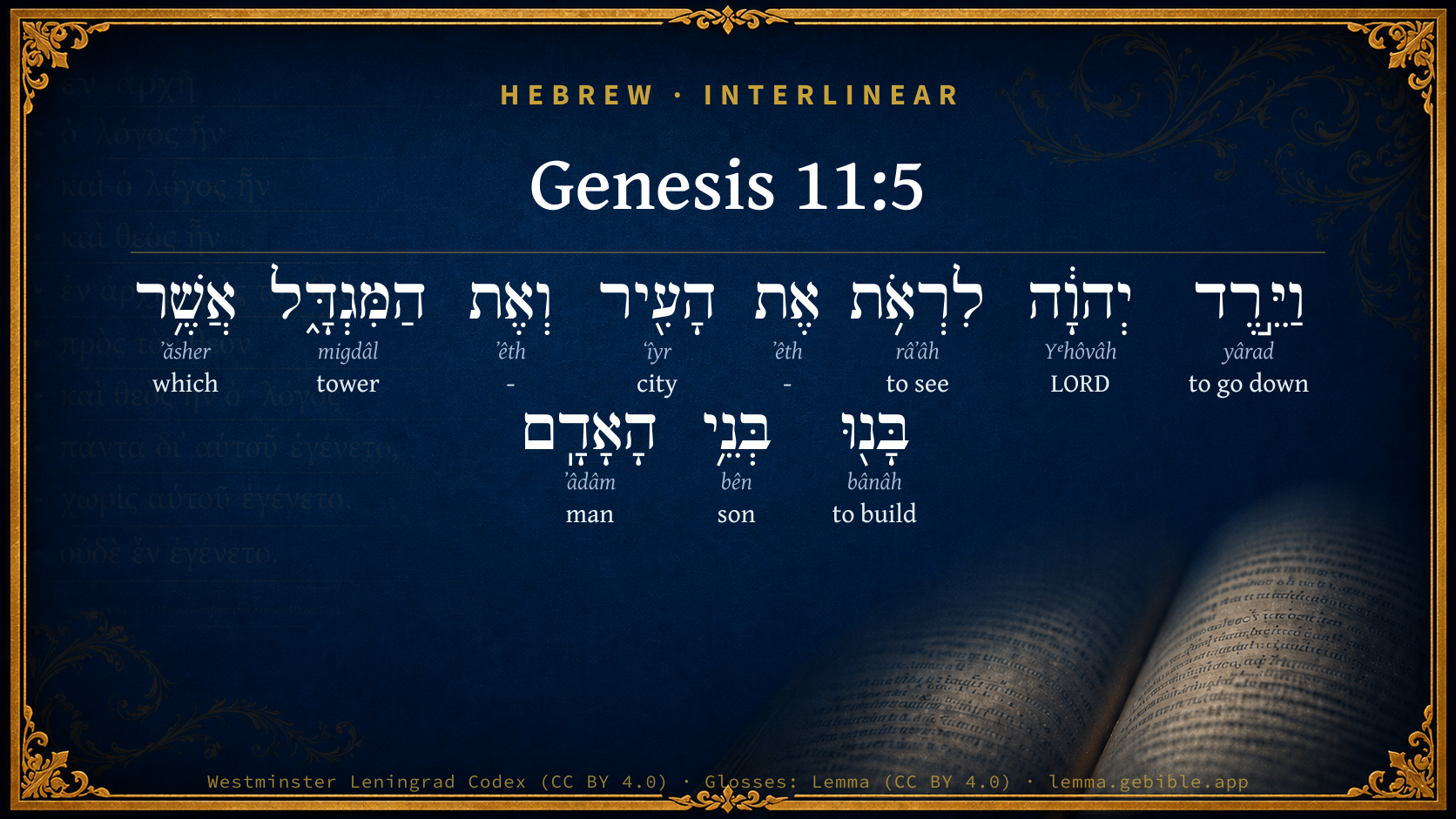
Hebrew (Westminster Leningrad Codex) Genesis 11:5 appears in the Hebrew Old Testament. The text above is from the Westminster Leningrad Codex. Each word links to its Strong’s number, a concise gloss, and parsing drawn from the Open Scriptures Hebrew Bible morphology. Click any word for its full Brown-Driver-Briggs (BDB) entry.
Download image
Cite this verse

Genesis 11:5 (World English Bible). Public Domain. Lemma interlinear Bible study tool, https://lemma.gebible.app/v/genesis/11/5.

Show BibTeX & RIS
BibTeX
RIS
English Translation
Yahweh came down to see the city and the tower, which the children of men built.
World English Bible · Public Domain
Highlights
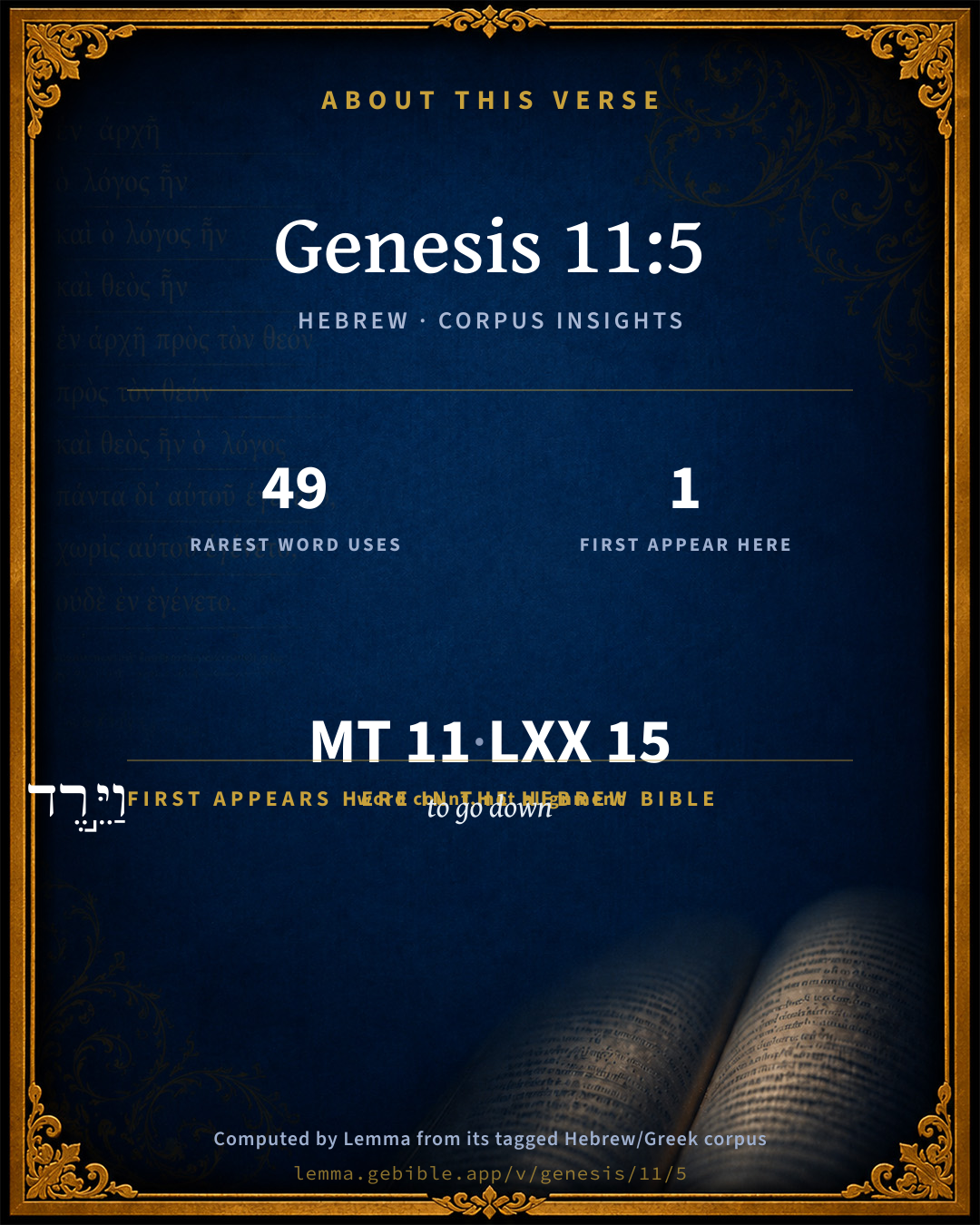
  • 1 first appearance in the Hebrew Bible
Full analysis ↓
Download a study sheet

One document with this verse’s original text, its word-by-word gloss line, the meaning frame, cross-references with their text, attributed commentary, and full source and license credits — printable, and it pastes into notes with its structure intact.

This verse Autodidact and up

Study sheet (.html) Plain text (.txt)

A passage Seminary Student

Up to 50 verses in one chapter. A passage sheet keeps up to 6 commentary sources and 12 cross-references per verse, in the order this page ranks them, and says so on the sheet whenever that leaves anything out. Ask for a single verse and you get the Autodidact verse sheet above.

Everything on this page stays free to read, with no account — the sheet is a download of what is already on screen, not access to it.

Want to remove ads? Support Godless Engineer
Compare translations 3

The same verse in 3 English versions, stacked beneath the original-language interlinear above. Click any original word for its lexicon entry.

Each is an independent rendering of the whole verse — the interlinear is not word-aligned to these translations.

Highlighted words mark where these versions differ — a whole-verse word diff, not a word-by-word alignment.

  • World English Bible Public Domain
    Yahweh came down to see the city and the tower, which the children of men built.
  • King James Version Public Domain
    And the LORD came down to see the city and the tower, which the children of men builded.
  • unfoldingWord Literal Text CC BY-SA 4.0
    Then Yahweh came down to see the city and the tower that the sons of mankind had built.

unfoldingWord Literal Text — © unfoldingWord, licensed CC BY-SA 4.0. Word-aligned USFM3 via Door43 (git.door43.org/unfoldingWord/en_ult).

Versions to compare (up to 4)

3 of 4 selected

Show all 18 translations

Every available English version of this verse, each an independent rendering of the whole verse.

  • World English Bible Public Domain
    Yahweh came down to see the city and the tower, which the children of men built.
  • Berean Standard Bible Public Domain
    Then the LORD came down to see the city and the tower that the sons of men were building.
  • Majority Standard Bible Public Domain
    Then the LORD came down to see the city and the tower that the sons of men were building.
  • King James Version Public Domain
    And the LORD came down to see the city and the tower, which the children of men builded.
  • American Standard Version (1901) Public Domain
    And Jehovah came down to see the city and the tower, which the children of men builded.
  • Revised Version (1885) Public Domain
    And the LORD came down to see the city and the tower, which the children of men builded.
  • Geneva Bible (1599) Public Domain
    But the Lord came downe, to see the citie and towre, which the sonnes of men builded.
  • Douay-Rheims (1899) Public Domain
    And the Lord came down to see the city and the tower, which the children of Adam were building.
  • Young's Literal Translation Public Domain
    And Jehovah cometh down to see the city and the tower which the sons of men have builded;
  • Literal Standard Version CC BY-SA 4.0
    And YHWH comes down to see the city and the tower which the sons of men have built;
  • Unlocked Literal Bible CC BY-SA 4.0
    So Yahweh came down to see the city and the tower which the descendants of Adam had built.
  • unfoldingWord Literal Text CC BY-SA 4.0
    Then Yahweh came down to see the city and the tower that the sons of mankind had built.
  • Darby Bible Public Domain
    And Jehovah came down to see the city and the tower which the children of men built.
  • World Messianic Bible Public Domain
    The LORD came down to see the city and the tower, which the children of men built.
  • Webster's Bible Public Domain
    And the LORD came down to see the city and the tower, which the children of men were building.
  • Free Bible Version CC BY-SA 4.0
    But the Lord came down to take a look at the city and the tower that the people were building.
  • Bible in Basic English Public Domain
    And the Lord came down to see the town and the tower which the children of men were building.
  • JPS Tanakh (1917) Public Domain
    And the LORD came down to see the city and the tower, which the children of men builded.

Literal Standard Version (2020), Covenant Press — licensed CC BY-SA 4.0. Text via the HelloAO Bible API (eBible.org). Unlocked Literal Bible (unfoldingWord) — licensed CC BY-SA 4.0. Text via the HelloAO Bible API (eBible.org). unfoldingWord Literal Text — © unfoldingWord, licensed CC BY-SA 4.0. Word-aligned USFM3 via Door43 (git.door43.org/unfoldingWord/en_ult). Free Bible Version, Dr. Jonathan Gallagher — licensed CC BY-SA 4.0. Text via the HelloAO Bible API (eBible.org).

Word by word

More ways to search: Search by grammar → Find every occurrence → Compare this word →

Practice this passage: Drill this verse → Learn its vocabulary →

הַמִּגְדָּ֑ל
migdâl
H4026
“the · tower”
Particle, Definite Article + Noun, Common, Both, Singular, Absolute
Part of Speech
Particle + Noun
Type
Common
Gender
Both
Number
Singular
State
Absolute
Full BDB Definition

Origin: from H1431

TWOT: 315f , 315g

tower - tower - elevated stage, pulpit - raised bed
  1. וַיֵּ֣רֶד yârad H3381 “and · to go down” Conjunction + Verb, Qal, Sequential Imperfect, 3rd Person, Masculine, Singular
  2. יְהוָ֔ה Yᵉhôvâh H3068 “LORD” Noun, Proper
  3. לִרְאֹ֥ת râʼâh H7200 “to see” Preposition + Verb, Qal, Infinitive Construct
  4. אֶת ʼêth H853 “-” Particle, Direct Object
  5. הָעִ֖יר ʻîyr H5892 “the · city” Particle, Definite Article + Noun, Common, Feminine, Singular, Absolute
  6. וְאֶת ʼêth H853 “and · -” Conjunction + Particle, Direct Object
  7. אֲשֶׁ֥ר ʼăsher H834 “which” Particle, Relative
  8. בָּנ֖וּ bânâh H1129 “to build” Verb, Qal, Perfect, 3rd Person, Common, Plural
  9. בְּנֵ֥י bên H1121 “sons of” Noun, Common, Masculine, Plural, Construct
  10. הָאָדָֽם ʼâdâm H120 “the · man” Particle, Definite Article + Noun, Common, Masculine, Singular, Absolute

About this verse

These counts appear in no published source. They are computed here, from the morphology-tagged text and Lemma’s own curated glosses. What Lemma adds →

11
words
10
distinct lemmas
Pentateuch
section

First appearance in Scripture

This word makes its first canonical appearance in the Hebrew Bible here:

  • וַיֵּ֣רֶד to go down H3381

Shared distinctive vocabulary

הַמִּגְדָּ֑ל tower H4026 occurs in 44 verses of the Hebrew Bible. Also found in:

Grammatical profile

  • 3 verbs
  • 5 nouns
  • 3 particles

Verb forms

  • וַיֵּ֣רֶד Qal · Sequential Imperfect
  • לִרְאֹ֥ת Qal · Infinitive Construct
  • בָּנ֖וּ Qal · Perfect

Hebrew & Septuagint length

In English translation the verse runs 16 words from the Hebrew and 18 from the Septuagint (LXX English) — closely comparable.

A rough comparison of the two English renderings, which tokenize alike — not a word-level alignment.

Word counts can differ between the Hebrew and the Greek without any difference in meaning — e.g. the Hebrew direct-object marker אֵת has no separate Greek word, and Greek often adds the article ὁ.

In the original languages it is 11 Hebrew tokens and 15 Greek tokens — but the two are counted differently (Hebrew bundles its prefixes and suffixes into one token; the Greek is in lemma form), so that isn’t a like-for-like length.

Cross-references

10

Topical passages linked to Genesis 11:5 in the Treasury of Scripture Knowledge — connected by theme and wording, ordered by reader-vote popularity; previews shown in the World English Bible.

  • Psalms 33:13–14 Yahweh looks from heaven. He sees all the sons of men.
  • Genesis 18:21 I will go down now, and see whether they have done altogether according to the cry of it, which is come to me. If not, I will know."
  • John 3:13 No one has ascended into heaven, but he who descended out of heaven, the Son of Man, who is in heaven.
  • Jeremiah 23:23–24 Am I a God at hand, says Yahweh, and not a God afar off?
  • Hebrews 4:13 There is no creature that is hidden from his sight, but all things are naked and laid open before the eyes of him with whom we have to do.
  • Exodus 19:11 and be ready against the third day; for on the third day Yahweh will come down in the sight of all the people on Mount Sinai.
  • Exodus 19:20 Yahweh came down on Mount Sinai, to the top of the mountain. Yahweh called Moses to the top of the mountain, and Moses went up.
  • Psalms 11:4 Yahweh is in his holy temple. Yahweh is on his throne in heaven. His eyes observe. His eyes examine the children of men.
  • Exodus 3:8 I have come down to deliver them out of the hand of the Egyptians, and to bring them up out of that land to a good and large land, to a land flowing with milk and honey; to the place of the Canaanite, the Hittite, the Amorite, the Perizzite, the Hivite, and the Jebusite.
  • Exodus 19:18 Mount Sinai, the whole of it, smoked, because Yahweh descended on it in fire; and its smoke ascended like the smoke of a furnace, and the whole mountain quaked greatly.

Cross-references courtesy of OpenBible.info (CC BY 4.0).

Hebrew and Greek witnesses Masoretic Hebrew ↔ Greek Septuagint

The same verse in the two great witnesses to the Old Testament, shown verse-for-verse.

These are two independent witnesses, not word-aligned to each other, and the Septuagint is shown in lemma (dictionary) form.

Hebrew Genesis 11:5 Masoretic · Westminster Leningrad Codex

וַיֵּ֣רֶד יְהוָ֔ה לִרְאֹ֥ת אֶת הָעִ֖יר וְאֶת הַמִּגְדָּ֑ל אֲשֶׁ֥ר בָּנ֖וּ בְּנֵ֥י הָאָדָֽם

Yahweh came down to see the city and the tower, which the children of men built.

World English Bible · Public Domain

Greek LXX Genesis 11:5 Septuagint · lemma form

καί καταβαίνω κύριος ὁράω ὁ πόλις καί ὁ πύργος ὅς οἰκοδομέω ὁ υἱός ὁ ἄνθρωπος

And the Lord came down to see the city and the tower, which the sons of men built.

LXX2012 (modern English Septuagint) · Public Domain

Hebrew: Westminster Leningrad Codex (CC BY 4.0). Greek: Septuagint (public domain); English from LXX2012 (modern English Septuagint) (Public Domain). How the Septuagint differs from the Hebrew →

Targum (Aramaic paraphrase)

2

The Targum is the ancient Jewish Aramaic paraphrase of the Hebrew Scriptures — an interpretive translation, not the Hebrew text itself. Onkelos (literal) and Pseudo-Jonathan (expansive) render the Torah, and Jonathan the Prophets. Coverage is partial: where no permissively-licensed English translation exists for a verse, only the Aramaic is shown. This is verse-level text, not a word-by-word alignment to the Hebrew.

  1. Targum Onkelos Torah (Genesis–Deuteronomy)
    וְאִתְגְּלֵי יְיָ לְאִתְפְּרָעָא עַל עוֹבָדֵי קַרְתָּא וּמַגְדְּלָא דִּי בְנוֹ בְּנֵי אֱנָשָׁא

    And the Lord was revealed to punish the work of the city and the tower which the sons of men had builded.

    Targum Onkelos — Aramaic: “Onkelos Genesis” (public domain); “Onkelos Exodus” (public domain); “Onkelos Leviticus” (public domain); “Onkelos Numbers” (public domain); “Onkelos Deuteronomy” (public domain). English: “Sefaria Community Translation” (CC0 1.0 (public-domain dedication)); “J.W. Etheridge. The Targums of Onkelos and Jonathan Ben Uzziel on the Pentateuch. London: Longmans, Green, 1862” (public domain). Text via Sefaria.

  2. Targum Pseudo-Jonathan Torah (Genesis–Deuteronomy)
    וְאִתְגְלֵי יְיָ לְאִיתְפַּרְעָא מִנְהוֹן עַל עוֹבַד קַרְתָּא וּמַגְדְלָא דְבָנוּ בְּנֵי נְשָׁא

    And the Lord was revealed to punish them for the work of the city and the tower which the sons of men builded.

    Targum Pseudo-Jonathan — Aramaic: “Targum Jonathan on Genesis” (public domain); “Targum Jonathan on Exodus” (public domain); “Targum Jonathan on Leviticus” (public domain); “Targum Jonathan on Numbers” (public domain); “Targum Jonathan on Deuteronomy” (public domain). English: “The Targum of Jonathan ben Uzziel, trans. J. W. Etheridge, London, 1862” (public domain). Text via Sefaria.

Commentary

Notes on Genesis 11:5 from classic Christian and Jewish commentators (each source and its license shown beneath its notes). The classic Christian expositions comment on the surrounding passage and are grouped to its opening verse, so a note may address several verses; the Jewish commentaries on the Tanakh (Rashi and others) are per-verse, so they appear only where the commentator wrote on this verse.

Lemma curates 59 commentaries, every one of them public domain or Creative Commons licensed, each selected and text-cleaned for this edition rather than reprinted as found. About our sources →

Matthew Henry's Commentary

We have here the quashing of the project of the Babel-builders, and the turning of the counsel of those froward men headlong, that God's counsel might stand in spite of them. Here is,

I. The cognizance God took of the design that was on foot: The Lord came down to see the city, Gen 11:5. It is an expression after the manner of men; he knew it as clearly and fully as men know that which they come to the place to view. Observe, 1. Before he gave judgment upon their cause, he enquired into it; for God is incontestably just and fair in all his proceedings against sin and sinners, and condemns none unheard. 2. It is spoken of an act of condescension in God to take notice even of this building, which the undertakers were so proud of ; for he humbles himself to behold the transactions, even the most considerable ones, of this lower world, Psa 113:6. 3. It is said to be the tower which the children of men built, which intimates, (1.) Their weakness and frailty as men. It was a very foolish thing for the children of men, worms of the earth, to defy Heaven, and to provoke the Lord to jealousy. Are they stronger than he? (2.) Their sinfulness and obnoxiousness. They were the sons of Adam, so it is in the Hebrew; nay, of that Adam, that sinful disobedient Adam, whose children are by nature children of disobedience, children that are corrupters. (3.) Their distinction from the children of God, the professors of religion, from whom these daring builders had separated themselves, and built this tower to support and perpetuate the separation. Pious Eber is not found among this ungodly crew; for he and his are called the children of God, and therefore their souls come not into the secret, nor unite themselves to the assembly, of these children of men.

II. The counsels and resolves of the Eternal God concerning this matter; he did not come down merely as a spectator, but as a judge, as a prince, to look upon these proud men, and abase them, Job 40:11-14. Observe,

1. He suffered them to proceed a good way in their enterprise before he put a stop to it, that they might have space to repent, and, if they had so much consideration left, might be ashamed of it and weary of it themselves; and if not that their disappointment might be the more shameful, and every one that passed by might laugh at them, saying, These men began to build, and were not able to finish, that so the works of their hands, from which they promised themselves immortal honour, might turn to their perpetual reproach. Note, God has wise and holy ends in permitting the enemies of his glory to carry on their impious projects a great way, and to prosper long in their enterprises.

2. When they had, with much care and toil, made some considerable progress in their building, then God determined to break their measures and disperse them. Observe,

(1.) The righteousness of God, which appears in the considerations upon which he proceeded in this resolution, Gen 11:6. Two things he considered: - [1.] Their oneness, as a reason why they must be scattered: "Behold, the people are one, and they have all one language. If they continue one, much of the earth will be left uninhabited; the power of their prince will soon be exorbitant; wickedness and profaneness will be insufferably rampant, for they will strengthen one another's hands in it; and, which is worst of all, there will be an overbalance to the church, and these children of men, if thus incorporated, will swallow up the little remnant of God's children." Therefore it is decreed that they must not be one. Note, Unity is a policy but it is not the infallible mark of a true church; yet, while the builders of Babel, though of different families, dispositions, and interests, were thus unanimous in opposing God, what a pity is it, and what a shame, that the builders of Sion, though united in one common head and Spirit, should be divided, as they are, in serving God! But marvel not at the matter. Christ came not to send peace. [2.] Their obstinacy: Now nothing will be restrained from them; and this is a reason why they must be crossed and thwarted in their design. God had tried, by his commands and admonitions, to bring them off from this project, but in vain; therefore he must take another course with them. See here, First, The sinfulness of sin, and the wilfulness of sinners; ever since Adam would not be restrained from the forbidden tree, his unsanctified seed have been impatient of restraint and ready to rebel against it. Secondly, See the necessity of God's judgments upon earth, to keep the world in some order and to tie the hands of those that will not be checked by law.

(2.) The wisdom and mercy of God in the methods that were taken for the defeating of this enterprise (Gen 11:7): Go to, let us go down, and there confound their language. This was not spoken to the angels, as if God needed either their advice or their assistance, but God speaks it to himself, or the Father to the Son and Holy Ghost. They said, Go to, let us make brick, and Go to, let us build a tower, animating one another to the attempt; and now God says, Go to, let us confound their language; for, if men stir up themselves to sin, God will stir up himself to take vengeance, Isa 59:17, Isa 59:18. Now observe here, [1.] The mercy of God, in moderating the penalty, and not making it proportionable to the offence; for he deals not with us according to our sins. He does not say, "Let us go down now in thunder and lightning, and consume those rebels in a moment;" or, "Let the earth open, and swallow up them and their building, and let those go down quickly into hell who are climbing to heaven the wrong way." No; only, "Let us go down, and scatter them." They deserved death, but are only banished or transported; for the patience of God is very great towards a provoking world. Punishments are chiefly reserved for the future state. God's judgments on sinners in this life, compared with those which are reserved, are little more than restraints. [2.] The wisdom of God, in pitching upon an effectual expedient to stay proceedings, which was the confounding of their language, that they might not understand one another's speech, nor could they well join hands when their tongues were divided; so that this would be a very proper method both for taking them off from their building (for, if they could not understand one another, they could not help one another) and also for disposing them to scatter; for, when they could not understand one another, they could not take pleasure in one another. Note, God has various means, and effectual ones, to baffle and defeat the projects of proud men that set themselves against him, and particularly to divide them among themselves, either by dividing their spirits (Jdg 9:23), or by dividing their tongues, as David prays, Psa 55:9.

III. The execution of these counsels of God, to the blasting and defeating of the counsels of men, Gen 11:8, Gen 11:9. God made them know whose word should stand, his or theirs, as the expression is, Jer 44:28. Notwithstanding their oneness and obstinacy, God was too hard for them, and wherein they dealt proudly he was above them; for who ever hardened his heart against him and prospered? Three things were done: -

1. Their language was confounded. God, who, when he made man, taught him to speak, and put words into his mouth fit to express the conceptions of his mind by, now caused these builders to forget their former language, and to speak and understand a new one, which yet was common to those of the same tribe or family, but not to others: those of one colony could converse together, but not with those of another. Now, (1.) This was a great miracle, and a proof of the power which God has upon the minds and tongues of men, which he turns as the rivers of water. (2.) This was a great judgment upon these builders; for, being thus deprived of the knowledge of the ancient and holy tongue, they had become incapable of communicating with the true church, in which it was retained, and probably it contributed much to their loss of the knowledge of the true God. (3.) We all suffer by it, to this day. In all the inconveniences we sustain by the diversity of languages, and all the pains and trouble we are at to learn the languages we have occasion for, we smart for the rebellion of our ancestors at Babel. Nay, and those unhappy controversies which are strifes of words, and arise from our misunderstanding one another's language, for aught I know are owing to this confusion of tongues. (4.) The project of some to frame a universal character, in order to a universal language, how desirable soever it may seem, is yet, I think, but a vain thing to attempt; for it is to strive against a divine sentence, by which the languages of the nations will be divided while the world stands. (5.) We may here lament the loss of the universal use of the Hebrew tongue, which from this time was the vulgar language of the Hebrews only, and continued so till the captivity in Babylon, where, even among them, it was exchanged for the Syriac. (6.) As the confounding of tongues divided the children of men and scattered them abroad, so the gift of tongues, bestowed upon the apostles (Acts 2), contributed greatly to the gathering together of the children of God, who were scattered abroad, and the uniting of them in Christ, that with one mind and one mouth they might glorify God, Rom 15:6.

2. Their building was stopped: They left off to build the city. This was the effect of the confusion of their tongues; for it not only incapacitated them for helping one another, but probably struck such a damp upon their spirits that they could not proceed, since they saw, in this, the hand of the Lord gone out against them. Note, (1.) It is wisdom to leave off that which we see God fights against. (2.) God is ale to blast and bring to nought all the devices and designs of Babel-builders. He sits in heaven, and laughs at the counsels of the kings of the earth against him and his anointed; and will force them to confess that there is no wisdom nor counsel against the Lord, Pro 21:30; Isa 8:9, Isa 8:10.

3. The builders were scattered abroad upon the face of the whole earth, Gen 11:8, Gen 11:9. They departed in companies, after their families, and after their tongues (Gen 10:5, Gen 10:30, Gen 10:31), to the several countries and places allotted to them in the division that had been made, which they knew before, but would not go to take possession of till now that they were forced to it. Observe here, (1.) The very thing which they feared came upon them. That dispersion which sought to evade by an act of rebellion they by this act brought upon themselves; for we are most likely to fall into that trouble which we seek to evade by indirect and sinful methods. (2.) It was God's work: The Lord scattered them. God's hand is to be acknowledged in all scattering providences; if the family be scattered, relations scattered, churches scattered, it is the Lord's doing. (3.) Though they were as firmly in league with one another as could be, yet the Lord scattered them; for no man can keep together what God will put asunder. (4.) Thus God justly took vengeance on them for their oneness in that presumptuous attempt to build their tower. Shameful dispersions are the just punishment of sinful unions. Simeon and Levi, who had been brethren in iniquity, were divided in Jacob, Gen 49:5, Gen 49:7; Psa 83:3-13. (5.) They left behind them a perpetual memorandum of their reproach, in the name given to the place. It was called Babel, confusion. Those that aim at a great name commonly come off with a bad name. (6.) The children of men were now finally scattered, and never did, nor ever will, come all together again, till the great day, when the Son of man shall sit upon the throne of his glory, and all nations shall be gathered before him, Mat 25:31, Mat 25:32.

Matthew Henry's Commentary on the Whole Bible (1708–1710) — public domain (CC PDM 1.0). Text via the HelloAO Bible API.

Trapp's Complete Commentary

John Trapp

Gen 11:5 And the LORD came down to see the city and the tower, which the children of men builded.

Ver. 5. And the Lord came down.] Non motu locali, sed actu iudiciali .

To see the city, & c.] That so his sentence, grounded not upon hearsay, or uncertain information, might be above all cavillation or exception. A fair precedent for judges. Caiaphas first sentenced our Saviour, and then asked the assessors what they thought of it. The chief captain first commanded Paul to be scourged, and then examined. {Act 22:24-25} This was preposterous. God, though he knew all before, is yet said to come down to see. Let his actions be our instructions. No man must be rashly pronounced a leper: and the judges must "make diligent inquisition," {Deu 19:18} as flints must carry fire but not easily express it. Potiphar was too hasty with Joseph, and David with Mephibosheth. Aeneas Sylvius {a} tells us of some places, where thieves taken but upon suspicion, are presently trussed up, and three days after they sit in judgment upon the party executed. If they find him guilty, they let him hang till he fall. And if not, they take down the body and bury it honourably at the public charge. This is not Godlike, nor a point of wisdom: for Nervus est sapientiae non temere credere .

Which the children of men builded.] Nimrod chiefly, with his fellow Hamites. But that some of Shem’s and Japheth’s posterity had a hand in it, is more than probable, by their common punishment, the confusion of tongues. Heber and his had nothing to do with them; and therefore retained the Hebrew tongue, called thenceforth "the Jews’ language," {Isa 36:11} until they were carried captive to Babylon, where grew a mixture among them of Hebrew and Chaldee, whence came up the Syriac tongue, common in our Saviour’s time, as appears by many Syriac words in the Gospels.

{a} Aene. Sylvius., Europ., cap. xx.

John Trapp, A Commentary or Exposition upon All the Books of the Old and New Testament (1647–1656) — public domain. Text from a community e-Sword module.

The Biblical Illustrator

Joseph S. Exell

Gen_11:5

The Lord came down to see

Gods visitation

1.

Mens apostasy and proud attempts are knit together with Gods visitation.

2. God is below when men think He hath forsaken the earth, and is near to visit the wickedness of man.

3. Gods descent is for vengeance sometimes upon sinners.

4. God doth visit the beauty and strength of wickedness.

5. The apostate sons of Adam may build their fabrics to prevent Gods judgments.

6. Jehovah will mark for vengeance the sons of wickedness and weakness in all their buildings against Him (Gen_11:5). (G. Hughes, B. D.)

Lessons

1. God speaks, as well as marks, the attempts of the ungodly to their reproach and confusion.

2. God points out the greatest advantages of violent workers of iniquity to scorn.

3. Unity of minds, resolutions, and communications, are the greatest props to wicked undertakers.

4. Violent workers of iniquity presume to finish as well as begin: that nothing shall be withheld from them.

5. Proud and presumptuous undertakings of men are a scorn and derision to God (Gen_11:6). (G. Hughes, B. D.)

Gods inspection

Almighty God Himself came down to see what the children of men were doing, and when He comes down (a phrase which is used to accommodate Himself to our methods of expression), nothing can escape the penetration of His eye. He looks at our day books, ledgers, and other memorandum books, to see how we are building the tower of our life; He visits our country residences and palatial buildings for the purpose of trying their foundations; He looks into all the building of our fortune, that He may see whether our gains have been honestly secured. Terrible is the day for the bad man on which Almighty God lays His great hand--the hand on which the winds are hidden, the great palm in which all the stars of the heaven are gathered--upon the tower which is being built. He will shake it, and, if the foundation is bad, the whole superstructure will be thrown down to the dust! When men build their towers under the conviction that every stone of them will be tried by Divine power--when they build their cities, and erect their towers, and extend their properties, under the assurance that not one thing of all the things that their hands are doing will escape the test of Gods Spirit--we may expect life to be built upon a true foundation, and according to a righteous plan. What we have to ponder is this most certain fact, that God will come down to see our work, and that there is no possibility of concealing from Him any incorrectness of plan or any deficiency of service. (J. Parker, D. D.)

The Biblical Illustrator, edited by Joseph S. Exell (c. 1880s–1900s) — public domain. Text from a community e-Sword module.

Joseph Benson's Commentary

Gen 11:5. And the Lord came down to see the city — This is an expression after the manner of men; he knew it as clearly as men know that which they come upon the place to view.

Gen 11:6-9. And the Lord said, Behold, the people is one, &c. — And if they continue one, much of the earth will be left uninhabited. Let us confound their language — This was not spoken to the angels, as if God needed either their advice or their assistance; but God speaks it to himself, or the Father to the Son. That they may not understand one another’s speech — Nor could they well continue to be united in any undertaking when their tongues were divided; so that this was a proper means, both to take them off from their building, and to dispose them to separate; for if they could not understand one another, they could neither help nor enjoy one another. Accordingly, 1st, Their language was confounded. God, who, when he made man, taught him to speak, now made those builders to forget their former language; and to speak a new one, which yet was the same to those of the same tribe or family, but not to others. We all suffer hereby to this day, in all the inconveniences we sustain by the diversity of languages, and all the trouble we are at to learn the languages we have occasion for; nay, and those unhappy controversies, which are strifes of words, and arise from our misunderstanding of one another’s language, are partly owing to this confusion of tongues. The project of some to frame a universal character, in order to a universal language, how desirable soever it may seem, yet is but a vain thing; for it is to strive against a divine sentence, by which the languages of the nations will be divided while the world stands. As the confounding of tongues divided the children of men, and scattered them abroad, so the gift of tongues bestowed upon the apostles, Acts 2., contributed greatly to the gathering together of the children of God which were scattered abroad, and the uniting of them in Christ, that with one mind and mouth they might glorify God, Rom 15:6. 2d, Their building was stopped. The confusion of their tongues not only disabled them from helping one another, but probably struck a damp upon their spirits, since they saw the hand of the Lord was gone out against them. 3d, The builders were scattered abroad from thence upon the face of the whole earth — They departed in companies, after their families and after their tongues, (Gen 10:5; Gen 10:20; Gen 10:31,) to the several countries and places allotted to them in the division that had been made, which, it seems, they knew before, but would not go to take possession of, till now they were forced to it. So that the very thing which they feared came upon them; that dispersion which they thought to avoid. And they left behind them a perpetual memorandum of their reproach in the name given to the place; it was called Babel, confusion. The children of men were now finally scattered, and never will come all together again till the great day when the Son of man shall sit upon the throne of his glory, and all nations shall be gathered before him, Mat 25:31-32. Reader, how wilt thou then appear?

Joseph Benson's Commentary on the Old and New Testaments (1811–1818) — public domain. Text from a community e-Sword module.

The Pulpit Commentary

And the Lord came down. Not in visible form, as in Exo_19:20 Exo_34:5 (Onkelos) but effectu ostendens se propin quiorem quem absentem esse judicabant" (Poole), an anthropomorphism (Gen_18:21; Psa_144:5) It is measure for measure (par pari). Let us build up, say they, and scale the heavens. Let us go down, says God, and defeat their impious thought" (Rabbi Schelomo, quoted by T. Lewis). To see (with a view to judicial action) the city and the tower which the children of mensons of Adam; neither the posterity of Cain, i.e. the Hamites exclusively, as the Sethites were called sons of God,, (Gen_6:2 (Augustine) nor wicked men in general (Junius, Piscator), imitators of Adam, i.e. rebellantes Dee (Mode, Lyre), since then the Shemites would not have been participators in the undertaking (Drusius), which some think, to have been their work exclusively (Inglis); but the members of the human race, or at least their leaders builded.

HOMILIES BY J.F. MONTGOMERY Ver. 5.

The cities of men and the city of God (Gen_11:5; Heb_11:16)

I THEIR BUILDERS. Of the first, men mostly wicked men; of the second, the Architect of the universe.

II THEIR ORIGIN. Of the first (Enoch, Gen_4:17; and Babel, Gen_11:5) hostility to God; of the second, love to man.

III THEIR DESIGN. Of the first, to be a bond of union among sinners; of the second, to be a residence for God"s children.

IV THEIR APPEARANCE. Of the first, that of slime, mud, bricks, or at best stones; of the second, that of gold and pearls.

V THEIR DURATION. Of the first, it is written that with all the other works of man, they shall be burnt up; of the second that it shall be everlasting. W.

The Pulpit Commentary (1880–1919), ed. H.D.M. Spence-Jones & Joseph S. Exell — public domain. Text from a community e-Sword module.

Tyndale Open Study Notes

Tyndale Open Resources

11:5 came down: The tower was a human attempt to ascend to God’s realm (see Deut 26:15; Pss 2:4; 103:19; 115:16). The folly of that attempt was exposed by God’s “coming down” to see their feeble efforts.

Tyndale Open Study Notes — © Tyndale Open Resources, licensed CC BY-SA 4.0. Text via the HelloAO Bible API.

Geneva Bible (1599)

Geneva Bible translators

Meaning, that he declared by effect, that he knew their wicked enterprise: for God’s power is everywhere, and doth neither ascend nor descend.

Geneva Bible (1599) marginal notes — public domain. Text via Bolls.life.

Adam Clarke's Commentary

Verse 5. And the Lord came down] A lesson, says an ancient Jewish commentator, to magistrates to examine every evidence before they decree judgment and execute justice.

Adam Clarke's Commentary on the Bible (1810–1826) — public domain. Text from a community e-Sword/MySword module.

John Calvin's Commentaries

5. And the Lord came down. The remaining part of the history now follows, in which Moses teaches us with what ease the Lord could overturn their insane attempts, and scatter abroad all their preparations. There is no doubt that they strenuously set about what they had presumptuously devised. But Moses first intimates that God, for a little while, seemed to take no notice of them, in order that suddenly breaking off their work at its commencement, by the confusion of their tongues, he might give the more decisive evidence of his judgment. For he frequently bears with the wicked, to such an extent, that he not only suffers them to contrive many nefarious things, as if he were unconcerned, or were taking repose; but even further, their impious and perverse designs with animating success, in order that he may at length cast them down to a lower depth. The descent of God, which Moses here records, is spoken of in reference to men rather than to God; who, as we know, does not move from place to place. But he intimates that God gradually and as with a tardy step, appeared in the character of an Avenger. The Lord therefore descended that he might see; that is, he evidently showed that he was not ignorant of the attempt which the Babylonians were making.

John Calvin's Commentaries (1540-1563) — public domain. Text from the Calvin Translation Society English edition (1840s-50s) via the Christian Classics Ethereal Library (ccel.org). Calvin's coverage is partial (roughly two-thirds of the Bible); uncommented books and verses are honest gaps, never fabricated. The 19th-century editor's footnotes and remarks are omitted so the notes are faithfully Calvin's own voice.

Ellicott's Commentary for English Readers

(5-7) The Lord came down.—The narrative is given in that simple anthropological manner usual in the Book of Genesis, which so clearly sets before us God’s loving care of man, and here and in Gen_18:21 the equity of Divine justice. For Jehovah is described as a mighty king, who, hearing in His upper and heavenly dwelling of man’s ambitious purpose, determines to go and inspect the work in person, that having seen, he may deal with the offenders justly. He views, therefore, “the city and the tower;” for the city was as important a portion of their purpose as the tower, or even more so. The tower, which, no doubt, was to be the citadel and protection of the city, was for the latter’s sake to give the people a sense of strength and security. Having, then, inspected the tower and the city nestling round it, the Deity affirms that this centralisation is injurious to man’s best interests, and must be counteracted by an opposite principle, namely, the tendency of mankind to make constant changes in language, and thereby to break up into different communities, kept permanently apart by the use of different tongues. At present “it is one people, and there is one lip to all of them, and this is what they begin to do,” &c. Already there are thoughts among them of universal empire, and if thus the spread of mankind be hindered, and its division into numerous nations, each contributing its share to the progress and welfare of the world, be stopped, man will remain a poor debased creature, and will fail utterly in accomplishing the purpose for which he was placed upon earth. “Go to,” therefore, He says, in irony of their twice repeated phrase, “we will go down, and make their speech unintelligible to one another.” Now, though there is no assertion of a miracle here, yet we may well believe that there was an extraordinary quickening of a natural law which existed from the first. This, however, is but a secondary question, and the main fact is the statement that the Divine means for counteracting man’s ambitious and ever-recurring dream of universal sovereignty is the law of diversity of speech. In ancient times there was little to counteract this tendency, and each city and petty district had its own dialect, and looked with animosity upon its neighbours who differed from it in pronunciation, if not in vocabulary. In the present day there are counteracting influences; and great communities, by the use of the same Bible and the possession of the same classical literature, may long continue to speak the same language. In days also when communication is so easy, not only do men travel much, but newspapers and serials published at the centre are dispersed to the most distant portions of the world. In old time it was not so, and probably Isaiah would not have been easily understood thirty miles from Jerusalem, nor Demosthenes a few leagues; from Athens. Without books or literature, a little-band of families wandering about with their cattle, with no communication with other tribes, would quickly modify both the grammar and the pronunciation of their language; and when, after a year or two, they revisited the tower, they would feel like foreigners in the new city, and quickly depart with the determination never to return. And to this day diversity of language is a powerful factor in keeping nations apart, or in preventing portions of the same kingdom from agreeing heartily together. And thus at Babel the first attempt to bind the human family into one whole came to an ignominious end.

A Bible Commentary for English Readers, edited by Charles John Ellicott (1878–1897) — public domain. Text from a community e-Sword module.

The Cambridge Bible for Schools and Colleges

gen. ed. J. J. S. Perowne

5. And the lord came down to see] Not a figurative, poetical expression, as in Isa_64:1, but a strong and naïve anthropomorphism. The early religious traditions of Israel represent the Almighty in terms which to our minds appear almost profane, but which in the infancy of religious thought presented ideas of the Deity in the simplest and most vivid manner. Here, as in Gen_18:21, God is described as descending to the earth, in order to see what was not wholly visible to Him in the heavens.

The Cambridge Bible for Schools and Colleges (gen. ed. J. J. S. Perowne; Cambridge University Press, 1878–1918) — public domain. Text from a community e-Sword module.

John Gill's Exposition

And the Lord came down to see the city and the tower,.... Not locally or visibly, being immense, omnipresent, and invisible; nor in order to see and take notice of what he otherwise could not see from heaven, for he is omniscient; but this is spoken after the manner of men, and is to be understood of some effects and displays of his power, which were manifest, and showed him to be present: the Targum is,"and the Lord was revealed to take vengeance on them on account of the business of the city and tower the children of men built.''This shows the patience and longsuffering of God, that he did not immediately proceed against them, and his wisdom and justice in taking cognizance of the affair, and inquiring into it; examining the truth and reality of things before he passed judgment and took measures to hinder them in the execution of their design; all which must be understood agreeably to the divine Majesty, and as accommodated to the capacities of men, and as an instruction to them in judging matters they have a concern in:

which the children of men builded; or were building, for they had not finished their building, at least not the city, as appears from Gen 11:8. These were either the whole body of the people, under the general appellation of "the children of men": or else a part of them, distinguished by this character from the "sons of God", who were truly religious; by which it seems that Noah, Shem, Arphaxad, Salah, and others, were not concerned in this affair, who though they might come with the rest unto Shinar, yet when they understood their design, refused to join with them in it; so that it was only the carnal and irreligious part of them, who very probably were by far the majority, and therefore there was no overruling their debates, and stopping them in their works, that were the builders; and these might be the posterity of Ham in general, with others of Shem and Japheth mixed with them. Josephus (g) makes Nimrod to be the head of them, which is not likely, as before observed.

(g) Antiqu. l. 1. c. 4. sect. 2, 3.

John Gill's Exposition of the Whole Bible (1746–1763) — public domain (CC PDM 1.0). Text via the HelloAO Bible API.

Matthew Poole's English Annotations

Not by local descent, for he is every where; but by the manifestation of his presence and the effects of his power in that place.

To see the city and the tower, i.e. to know the truth of the fact, thereby setting a pattern for judges to examine causes before they pass sentence; otherwise God saw this in heaven; but in these expressions he condescends to the capacity of men.

The children of men, so called emphatically,

1. For distinction of them from the sons of God, or the race of Shem, who were not guilty of the sin, and therefore did not partake in the curse, the confusion of their language, but retained their ancient tongue uncorrupted for a good while.

2. To note their rashness and folly, who being but weak and silly men, durst oppose themselves to the infinitely wise and powerful God, who did (as they might easily gather both from his words and works) intend to disperse and separate them, that so by degrees they might possess the whole earth, which God had made for that purpose.

Matthew Poole's English Annotations on the Holy Bible (1683–1685) — public domain. Text from a community e-Sword/MySword module.

Whedon's Commentary on the Bible

Daniel D. Whedon

5. The Lord came down — God had familiarly dwelt with man before his fall, but he is here represented as living above and afar, visiting the earth only on occasions of special judgment and mercy. The language here employed is “after the manner of men;” and it is to be noted that it is not only after the manner of men of a simple and primitive age, but of a modern and cultured age as well. All our language concerning God’s actions is, and must be, tropical or figurative. To say that in this case God perceived and judged man’s sin, would sound more appropriate to those who do not think precisely and profoundly; but those who do thus think see that perceive and judge are just as tropical, when applied to God, as come down, see, and say. The tropes are more remote, but equally real.

The inspired author would teach that God does not punish without examination.

Daniel D. Whedon (gen. ed.), Commentary on the Old and New Testaments (1874–1909) — public domain. Text from a community e-Sword module.

John Wesley's Explanatory Notes

And the Lord came down to see the city - 'Tis an expression after the manner of men, he knew it as clearly as men know that which they come upon the place to view. And the tower which the children of men builded - Which speaks, (1.) Their weakness and frailty, it was a foolish thing for the children of men, worms of the earth, to defy heaven. (2.) Their sinfulness, they were the sons of Adam, so it is in the Hebrew; nay, of that Adam, that sinful disobedient Adam, whose children are by nature children of disobedience. (3.) Their distinction from the children of God, from whom those daring builders had separated themselves, and built this tower to support and perpetuate the separation.

John Wesley, Explanatory Notes Upon the Whole Bible (1754–1765) — public domain. Text via the GEBible commentary corpus.

Keil & Delitzsch

C. F. Keil & F. Delitzsch

"Jehovah came down to see the city and the tower, which the children of men had built" (the perfect בּנוּ refers to the building as one finished up to a certain point). Jehovah's "coming down" is not the same here as in Exo 19:20; Exo 34:5; Num 11:25; Num 12:5, viz., the descent from heaven of some visible symbol of His presence, but is an anthropomorphic description of God's interposition in the actions of men, primarily a "judicial cognizance of the actual fact," and then, Gen 11:7, a judicial infliction of punishment. The reason for the judgment is given in the word, i.e., the sentence, which Jehovah pronounces upon the undertaking (Gen 11:6): "Behold one people (עם lit., union, connected whole, from עמם to bind) and one language have they all, and this (the building of this city and tower) is (only) the beginning of their deeds; and now (sc., when they have finished this) nothing will be impossible to them (מהם יבּצר לא lit., cut off from them, prevented) which they purpose to do" (יזמוּ for יזמּוּ from זמם, see Gen 9:19). By the firm establishment of an ungodly unity, the wickedness and audacity of men would have led to fearful enterprises. But God determined, by confusing their language, to prevent the heightening of sin through ungodly association, and to frustrate their design. "Up" (הבה "go to," an ironical imitation of the same expression in Gen 11:3 and Gen 11:4), "We will go down, and there confound their language (on the plural, see Gen 1:26; נבלה for נבלּה, Kal from בּלל, like יזמו in Gen 1:6), that they may not understand one another's speech." The execution of this divine purpose is given in Gen 11:8, in a description of its consequences: "Jehovah scattered them abroad from thence upon the face of all the earth, and they left off building the city." We must not conclude from this, however, that the differences in language were simply the result of the separation of the various tribes, and that the latter arose from discord and strife; in which case the confusion of tongues would be nothing more than "dissensio animorum, per quam factum sit, ut qui turrem struebant distracti sint in contraria studia et consilia" (Bitringa). Such a view not only does violence to the words "that one may not discern (understand) the lip (language) of the other," but is also at variance with the object of the narrative. When it is stated, first of all, that God resolved to destroy the unity of lips and words by a confusion of the lips, and then that He scattered the men abroad, this act of divine judgment cannot be understood in any other way, than that God deprived them of the ability to comprehend one another, and thus effected their dispersion. The event itself cannot have consisted merely in a change of the organs of speech, produced by the omnipotence of God, whereby speakers were turned into stammerers who were unintelligible to one another. This opinion, which is held by Bitringa and Hoffmann, is neither reconcilable with the text, nor tenable as a matter of fact. The differences, to which this event gave rise, consisted not merely in variations of sound, such as might be attributed to differences in the formation in the organs of speech (the lip or tongue), but had a much deeper foundation in the human mind. If language is the audible expression of emotions, conceptions, and thoughts of the mind, the cause of the confusion or division of the one human language into different national dialects must be sought in an effect produced upon the human mind, by which the original unity of emotion, conception, thought, and will was broken up. This inward unity had no doubt been already disturbed by sin, but the disturbance had not yet amounted to a perfect breach. This happened first of all in the event recorded here, through a direct manifestation of divine power, which caused the disturbance produced by sin in the unity of emotion, thought, and will to issue in a diversity of language, and thus by a miraculous suspension of mutual understanding frustrated the enterprise by which men hoped to render dispersion and estrangement impossible. More we cannot say in explanation of this miracle, which lies before us in the great multiplicity and variety of tongues, since even those languages which are genealogically related - for example, the Semitic and Indo-Germanic - were no longer intelligible to the same people even in the dim primeval age, whilst others are so fundamentally different from one another, that hardly a trace remains of their original unity. With the disappearance of unity the one original language was also lost, so that neither in the Hebrew nor in any other language of history has enough been preserved to enable us to form the least conception of its character.

(Note: The opinion of the Rabbins and earlier theologians, that the Hebrew was the primitive language, has been generally abandoned in consequence of modern philological researches. The fact that the biblical names handed down from the earliest times are of Hebrew extraction proves nothing. With the gradual development and change of language, the traditions with their names were cast into the mould of existing dialects, without thereby affecting the truth of the tradition. For as Drechster has said, "it makes no difference whether I say that Adam's eldest son had a name corresponding to the name Cain from קנה, or to the name Ctesias from κτᾶσθαι; the truth of the Thorah, which presents us with the tradition handed down from the sons of Noah through Shem to Abraham and Israel, is not a verbal, but a living tradition - is not in the letter, but in the spirit.")

The primitive language is extinct, buried in the materials of the languages of the nations, to rise again one day to eternal life in the glorified form of the καιναὶ γλῶσσαι intelligible to all the redeemed, when sin with its consequences is overcome and extinguished by the power of grace. A type of pledge of this hope was given in the gift of tongues on the outpouring of the Holy Spirit upon the Church on the first Christian day of Pentecost, when the apostles, filled with the Holy Ghost, spoke with other or new tongues of "the wonderful works of God," so that the people of every nation under heaven understood in their own language (Act 2:1-11).

From the confusion of tongues the city received the name Babel (בּבל i.e., confusion, contracted from בּלבּל from בּלל to confuse), according to divine direction, though without any such intention on the part of those who first gave the name, as a standing memorial of the judgment of God which follows all the ungodly enterprises of the power of the world.

(Note: Such explanations of the name as "gate, or house, or fortress of Bel," are all the less worthy of notice, because the derivation ἀπὸ τοῦ Βήλου in the Etymol. magn., and in Persian and Nabatean works, is founded upon the myth, that Bel was the founder of the city. And as this myth is destitute of historical worth, so is also the legend that the city was built by Semiramis, which may possibly have so much of history as its basis, that this half-mythical queen extended and beautified the city, just as Nebuchadnezzar added a new quarter, and a second fortress, and strongly fortified it.)

Of this city considerable ruins still remain, including the remains of an enormous tower, Birs Nimrud, which is regarded by the Arabs as the tower of Babel that was destroyed by fire from heaven. Whether these ruins have any historical connection with the tower of the confusion of tongues, must remain, at least for the present, a matter of uncertainty. With regard to the date of the event, we find from Gen 11:10 that the division of the human race occurred in the days of Peleg, who was born 100 years after the flood. In 150 or 180 years, with a rapid succession of births, the descendants of the three sons of Noah, who were already 100 years old and married at the time of the flood, might have become quite numerous enough to proceed to the erection of such a building. If we reckon, for example, only four male and four female births as the average number to each marriage, since it is evident from Gen 11:12. that children were born as early as the 30th or 35th year of their parent's age, the sixth generation would be born by 150 years after the flood, and the human race would number 12,288 males and as many females. Consequently there would be at least about 30,000 people in the world at this time.

Keil & Delitzsch — Biblical Commentary on the Old Testament (1861–1891) — public domain (CC PDM 1.0). Text via the HelloAO Bible API. (Old Testament only.)

Kretzmann's Popular Commentary

Paul E. Kretzmann

The Beginning of the Various Languages

v. 5. And the Lord came down to see the city and the tower which the children of men builded. God could not let this challenge to His almighty government of the world go unanswered. He made arrangements to interfere. For though it was a mighty city which the children of men were building, a city whose dimensions astonish the explorer even today, the foundations of whose tower and of the many other architectural adornments are a source of constant surprise, it was but as a grain of dust in the hands of the almighty God.

v. 6. And the Lord said, Behold, the people is one, and they have all one language; and this they begin to do; and now nothing will be restrained from them which they have imagined to do.

v. 7. Go to, let us go down and there confound their language, that they may not understand one another’s speech. The Lord first sets forth the situation as He found it: Behold, one people they are, one connection, one association, one community, and one speech they all have. These two factors made the people strong in the pursuit of a common interest. What they had begun to do they would work for with all possible energy; and nothing would be restrained, held back, from them. The result would be the eventual destruction of true freedom, of personal life, and of the plans which God had concerning the Messiah. So God confounded their language, confused their speech, the miracle consisting in an inward process by which the old association of ideas connected with words was taken away, and new and utterly different modes of expression were immediately implanted. The confusion was so complete that the people could no longer understand one another, and all working together was excluded.

v. 8. So the Lord scattered them abroad from thence upon the face of all the earth; and they left off to build the city. That was the consequence of the miracle. A great migration of families and tribes over the whole earth began, by which men were scattered to the four winds. The great project as planned naturally had to be abandoned. Even if some few people, whom we may now term Babylonians, remained in the city, to be conquered afterward by Nimrod, the purpose of the human race in its blasphemous pride was not realized.

v. 9. Therefore is the name of it called Babel, because the Lord did there confound the language of all the earth; and from thence did the Lord scatter them abroad upon the face of all the earth. Babel means confusion, and the result of the confusion of tongues is before our eyes to this day. The human race is divided, one nation separated from the other by the difference of speech. Even today, however, the blasphemous arrogance of mankind is apparent. In the erection of many great buildings, in the invention of many new arts, man is not seeking the welfare of his neighbor and the honor of God, but his own glory. It is necessary, time and again, for the Lord to interfere with a mighty hand, even as the day of the Lord will finally be upon every one that is proud and lofty, and he shall be brought low, Isa 2:12.

Paul E. Kretzmann, Popular Commentary of the Bible (1921–1924) — public domain. Text from a community e-Sword module.

unfoldingWord translationNotes

Door43 World Missions Community

the descendants of Adam

"the people"

came down

The information about where he came down from can be made explicit: "came down from heaven." This does not tell how he came down. Use a general word meaning "came down." (See: Assumed Knowledge and Implicit Information)

to see

"to observe" or "to look more closely"

one people with the same language

All the people were one big group and they all spoke the same language.

they are beginning to do this

Possible meanings are 1) "they have begun to do this," meaning that they have begun to build the tower but it is not finished, or 2) "this is just the first thing they have done," meaning that in future they will do greater things.

nothing that they intend to do will be impossible for them

This can be stated in positive form. AT: "anything they intend to do will be possible for them" (See: Double Negatives)

Come

If your language has a way of urging or commanding people to begin work, like the English "Come on!" you might use it here. See how this is translated in Genesis 11:3.

let us go down

The word "us" is plural even though it refers to God. Some translate it as "let me go down" or "I will go down." If you do this, consider adding a footnote to say that the pronoun is plural. See the note on "Let us make" in Genesis 1:26. (See: Pronouns)

confuse their language

This means that Yahweh would cause the people all over the earth to stop speaking the same language. AT: "mix up their language" (See: Assumed Knowledge and Implicit Information)

so that they may not understand each other

This was the purpose of confusing their language. AT: "so that they will not be able to understand what each other is saying" (See: Assumed Knowledge and Implicit Information)

translationWords

Yahweh

descend

Adam

unfoldingWord translationNotes — © Distant Shores Media and the Door43 World Missions Community, licensed CC BY-SA 4.0. Source: git.door43.org/Door43/en_tn.

Rashi

Rabbi Shlomo Yitzchaki (Rashi)

'וירד ה לראות AND THE LORD CAME DOWN TO SEE — He really did not need to do this, but Scripture intends to teach the judges that they should not proclaim a defendant guilty before they have seen the case and thoroughly understand the matter in question. This is to be found in Midrash of R. Tanchuma.

בני האדם THE CHILDREN OF MAN (ADAM) — But whose children could they have been (except the children of man, i.e. human beings) — perhaps the children of donkeys or camels? But it means the children of Adam Harishon who proved himself ungrateful when he said, (Genesis 3:12) “The woman whom Thou gavest to be with me, [she gave me of the tree etc.]”. These people, also, were ungrateful, rebelling against the One who had showered kindness upon them and had rescued them from the Flood (Genesis Rabbah 38:9).

Rashi on the Tanakh — English translations: “The Judaica Press complete Tanach with Rashi, translated by A. J. Rosenberg” (CC BY 4.0); “Pentateuch with Rashi's commentary by M. Rosenbaum and A.M. Silbermann, 1929-1934” (public domain); “The Metsudah Tanach series, Lakewood, N.J” (CC BY 4.0); and “The Book of Joshua, Metsudah Publications, 1997” (CC BY 4.0). Text via Sefaria.

Radak

Rabbi David Kimhi (Radak)

'וירד ה, When G’d, from time to time, takes a closer look at what His creatures on earth are doing, such an activity is generally introduced by the expression וירד ה', “G’d descended.” Relative to G’d’s stature, His involving Himself with the problems of sinful men is below what His dignity could command. [a venerable Torah sage is exempt from involving himself with the taking home of lost property and looking for its owner. If this is so out of consideration for the scholar’s dignity, how much more could we expect that G’d does not bother with us? Ed. (compare Deut. 22,4)]

לראות, we encounter the same term when G’d “descended to see” if the reports which had reached Him about the wickedness of the people of Sodom were as serious as He had heard. (Genesis 18,21) Onkelos distinguishes between the meaning of the words here and in Genesis 18, describing His action here as לאיתפרעא, “retribution,” and the action of G’d vis a vis the Sodomites as דין, “justice.”

אשר בנו, which they had commenced building; [they never got to finish it. Ed.]

בני האדם, they are appropriately referred to as בני האדם, “children of Adam,” having followed their own instincts and inclinations instead of heeding G’d’s instructions, just as their forefather Adam had done. G’d had wanted them to populate the earth, and they had chosen to concentrate in a miniscule part of the earth. It is interesting that before G’d brought on the deluge, the Torah did not describe Him as “descending” as it did here or in connection with the Sodomites. Instead, the Torah there spoke about what G’d had seen, i.e. ראיה, instead of ירידה. (Genesis 6,5) The reason is that the deluge was something everybody knew about, seeing it was experienced by everybody. The whole point of G’d “descending,” is in order to examine a state of affairs which is not so widely known, so that it needs investigation. Something known to everybody does not require examination to determine if it is true. Concerning all these expressions, the bottom line is that the Torah uses a syntax familiar to people on earth, even if it does not accurately reflect G’d’s thoughts and feelings.

Radak on the Tanakh — English translations: “Sefaria Community Translation” (CC0 1.0 (public-domain dedication)); “Eliyahu Munk, HaChut Hameshulash” (CC BY 4.0); “Rabbi Mike Feuer, Jerusalem Anthology” (CC BY 4.0); and “R. David Kimhi on the first book of Psalms, Translated by R.G. Finch, London, 1919” (public domain). Text via Sefaria.

Lesson kit

Teaching starters — assembled from the data on this page, not authored interpretation. Every prompt links to the verse data it draws on. Edit before teaching.

Genesis, in the Pentateuch, opens this verse with 11 words (10 distinct Hebrew lemmas). Its most distinctive word is migdâl (“tower”). A historical commentator’s framing appears above. Read the whole chapter for the surrounding context.

Discussion questions

  1. How does “tower” (migdâl) shape what this verse is saying?
  2. This is the first place “to go down” appears in Scripture (first appears here). What does its debut here establish?
  3. How does Genesis 11:4, which shares the word «tower», read alongside this verse?
  4. The translations on this page render this verse differently — a whole-verse word diff, not a word-by-word alignment. What might account for the different wordings?
  5. «וַיֵּ֣רֶד» is a Qal Sequential Imperfect verb. How does that grammatical form shape the action described?
  6. Compare how Matthew Henry's Commentary and Trapp's Complete Commentary read this verse. Where do they agree or differ?

Things to notice

Reading settings

Reading text

Shown beneath each verse's original-language words.

Old Testament
Old Testament edition

Read the OT as the Masoretic Hebrew (MT) or the Greek Septuagint (LXX).

English shown for the Greek Septuagint (in the Hebrew ↔ Greek comparison).

Comparing translations? Open the Compare panel on any verse page to stack up to four side by side.