Matthew 28:9

Greek (Tischendorf 8th ed.) Matthew 28:9 appears in the Greek New Testament. The text above is from the Tischendorf 8th edition. Each word links to its Strong’s number and a concise gloss. Click any word for its full Thayer’s Greek Lexicon entry.
Download image
Cite this verse

Matthew 28:9 (World English Bible). Public Domain. Lemma interlinear Bible study tool, https://lemma.gebible.app/v/matthew/28/9.

Show BibTeX & RIS
BibTeX
RIS
English Translation
As they went to tell his disciples, behold, Jesus met them, saying, "Rejoice!" They came and took hold of his feet, and worshiped him.
World English Bible · Public Domain
Download a study sheet

One document with this verse’s original text, its word-by-word gloss line, the meaning frame, cross-references with their text, attributed commentary, and full source and license credits — printable, and it pastes into notes with its structure intact.

This verse Autodidact and up

Study sheet (.html) Plain text (.txt)

A passage Seminary Student

Up to 50 verses in one chapter. A passage sheet keeps up to 6 commentary sources and 12 cross-references per verse, in the order this page ranks them, and says so on the sheet whenever that leaves anything out. Ask for a single verse and you get the Autodidact verse sheet above.

Everything on this page stays free to read, with no account — the sheet is a download of what is already on screen, not access to it.

Want to remove ads? Support Godless Engineer
Compare translations 3

The same verse in 3 English versions, stacked beneath the original-language interlinear above. Click any original word for its lexicon entry.

Each is an independent rendering of the whole verse — the interlinear is not word-aligned to these translations.

Highlighted words mark where these versions differ — a whole-verse word diff, not a word-by-word alignment.

  • World English Bible Public Domain
    As they went to tell his disciples, behold, Jesus met them, saying, "Rejoice!" They came and took hold of his feet, and worshiped him.
  • King James Version Public Domain
    And as they went to tell his disciples, behold, Jesus met them, saying, All hail. And they came and held him by the feet, and worshipped him.
  • unfoldingWord Literal Text CC BY-SA 4.0
    And behold, Jesus met them, saying, “Rejoice!” But they, having approached, seized his feet and worshiped him.

unfoldingWord Literal Text — © unfoldingWord, licensed CC BY-SA 4.0. Word-aligned USFM3 via Door43 (git.door43.org/unfoldingWord/en_ult).

Versions to compare (up to 4)

3 of 4 selected

Show all 19 translations

Every available English version of this verse, each an independent rendering of the whole verse.

  • World English Bible Public Domain
    As they went to tell his disciples, behold, Jesus met them, saying, "Rejoice!" They came and took hold of his feet, and worshiped him.
  • Berean Standard Bible Public Domain
    Suddenly Jesus met them and said, “Greetings!” They came to Him, grasped His feet, and worshiped Him.
  • Majority Standard Bible Public Domain
    And as they were going to tell His disciples, suddenly Jesus met them and said, “Greetings!” They came to Him, grasped His feet, and worshiped Him.
  • King James Version Public Domain
    And as they went to tell his disciples, behold, Jesus met them, saying, All hail. And they came and held him by the feet, and worshipped him.
  • American Standard Version (1901) Public Domain
    And behold, Jesus met them, saying, All hail. And they came and took hold of his feet, and worshipped him.
  • Revised Version (1885) Public Domain
    And behold, Jesus met them, saying, All hail. And they came and took hold of his feet, and worshipped him.
  • Geneva Bible (1599) Public Domain
    And as they wet to tel his disciples, behold, Iesus also met the, saying, God saue you. And they came, and tooke him by the feete, and worshipped him.
  • Douay-Rheims (1899) Public Domain
    And behold Jesus met them, saying: All hail. But they came up and took hold of his feet, and adored him.
  • Young's Literal Translation Public Domain
    and as they were going to tell to his disciples, then lo, Jesus met them, saying, `Hail!' and they having come near, laid hold of his feet, and did bow to him.
  • Literal Standard Version CC BY-SA 4.0
    and as they were going to tell His disciples, then behold, Jesus met them, saying, “Greetings!” And having come near, they laid hold of His feet, and worshiped Him.
  • Unlocked Literal Bible CC BY-SA 4.0
    Behold, Jesus met them and said, “Greetings!” The women came, took hold of his feet and worshiped him.
  • unfoldingWord Literal Text CC BY-SA 4.0
    And behold, Jesus met them, saying, “Rejoice!” But they, having approached, seized his feet and worshiped him.
  • Darby Bible Public Domain
    And as they went to bring his disciples word, behold also, Jesus met them, saying, Hail! And they coming up took him by the feet, and did him homage.
  • World Messianic Bible Public Domain
    As they went to tell his disciples, behold, Yeshua met them, saying, “Rejoice!” They came and took hold of his feet, and worshiped him.
  • Webster's Bible Public Domain
    And as they were going to tell his disciples, behold, Jesus met them, saying, All hail. And they came, and held him by the feet, and worshiped him.
  • Free Bible Version CC BY-SA 4.0
    Suddenly Jesus came to meet them, and greeted them. They went over to him, held on to his feet and worshiped him.
  • Bible in Basic English Public Domain
    And on the way, Jesus came to them, saying, Be glad. And they came and put their hands on his feet, and gave him worship.
  • Text-Critical English NT CC BY 4.0
    As they went on their way to tell his disciples, behold, Jesus met them and said, “Greetings!” So they came to him, took hold of his feet, and worshiped him.
  • Tyndale New Testament (1534) Public Domain
    And as they went to tell his disciples: beholde Iesus met them sayinge: All hayle. And they came and held him by the fete and worshipped him.

Literal Standard Version (2020), Covenant Press — licensed CC BY-SA 4.0. Text via the HelloAO Bible API (eBible.org). Unlocked Literal Bible (unfoldingWord) — licensed CC BY-SA 4.0. Text via the HelloAO Bible API (eBible.org). unfoldingWord Literal Text — © unfoldingWord, licensed CC BY-SA 4.0. Word-aligned USFM3 via Door43 (git.door43.org/unfoldingWord/en_ult). Free Bible Version, Dr. Jonathan Gallagher — licensed CC BY-SA 4.0. Text via the HelloAO Bible API (eBible.org).

Word by word

More ways to search: Search by grammar → Find every occurrence → Compare this word →

Practice this passage: Drill this verse → Learn its vocabulary →

ὑπήντησεν
hypantáō
G5221
“to meet”
Verb, Aorist, Active, Indicative, 3rd person, Singular
Part of Speech
Verb
Tense
Aorist
Voice
Active
Mood
Indicative
Person
3rd person
Number
Singular
Full Thayer's Definition

Origin: from G5259 and a derivative of G473

TDNT: 13:25,4

1. to go to meet, to meet 2. in military reference a. of a hostile meeting
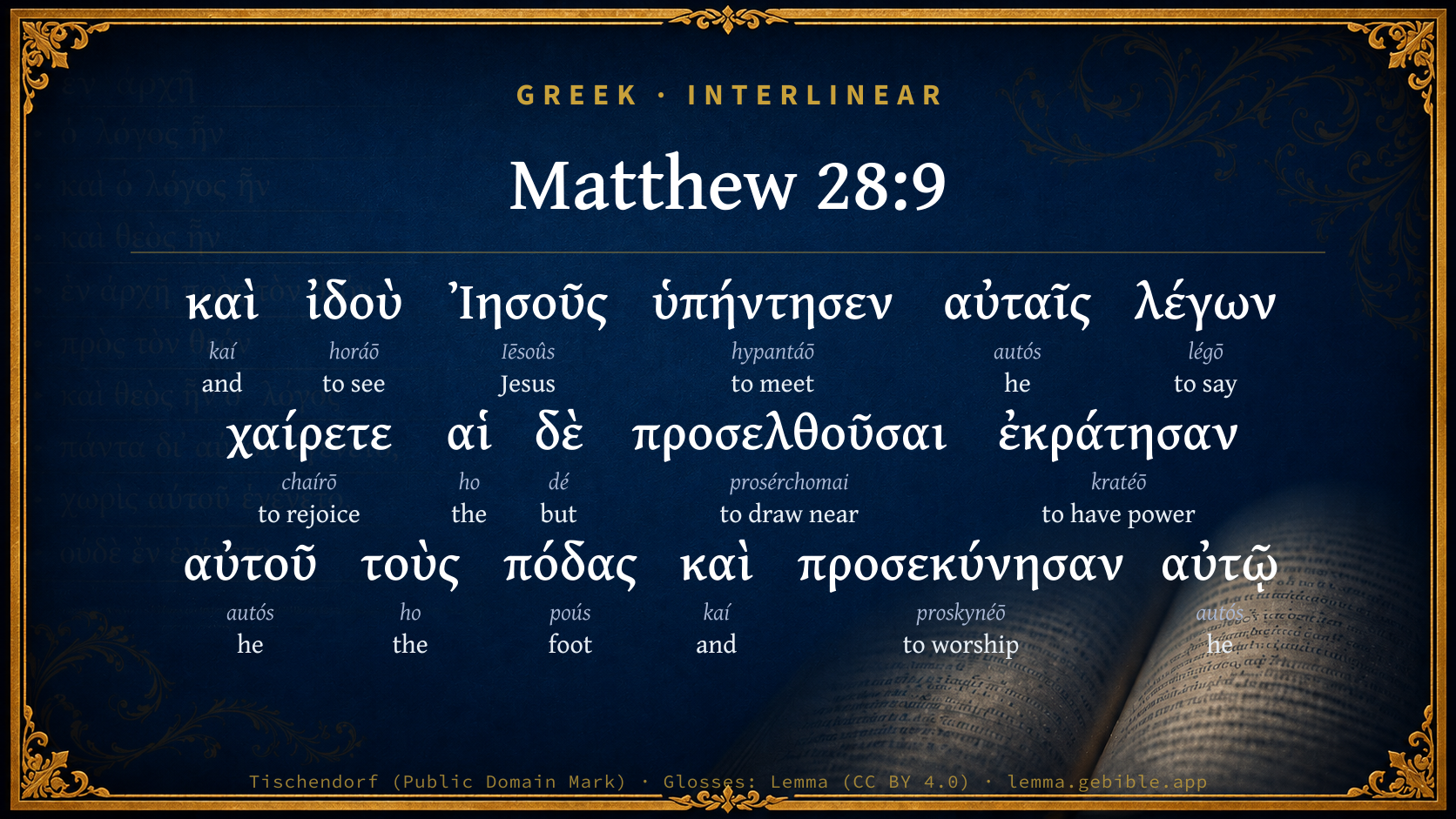
  1. καὶ kaí G2532 “and” Conjunction
  2. ἰδοὺ horáō G3708 “to see” Verb, Aorist, Middle, Imperative, 2nd person, Singular
  3. Ἰησοῦς Iēsoûs G2424 “Jesus” Noun, Nominative, Singular, Masculine
  4. αὐταῖς autós G846 “he” Personal pronoun, Dative, Plural, Feminine
  5. λέγων légō G3004 “to say” Verb, Present, Active, Participle, Nominative, Singular, Masculine
  6. χαίρετε chaírō G5463 “to rejoice” Verb, Present, Active, Imperative, 2nd person, Plural
  7. αἱ ho G3588 “the” Article, Nominative, Plural, Feminine
  8. δὲ dé G1161 “but” Conjunction
  9. προσελθοῦσαι prosérchomai G4334 “to draw near” Verb, Aorist, Active, Participle, Nominative, Plural, Feminine
  10. ἐκράτησαν kratéō G2902 “to have power” Verb, Aorist, Active, Indicative, 3rd person, Plural
  11. αὐτοῦ autós G846 “he” Personal pronoun, Genitive, Singular, Masculine
  12. τοὺς ho G3588 “the” Article, Accusative, Plural, Masculine
  13. πόδας poús G4228 “foot” Noun, Accusative, Plural, Masculine
  14. καὶ kaí G2532 “and” Conjunction
  15. προσεκύνησαν proskynéō G4352 “to worship” Verb, Aorist, Active, Indicative, 3rd person, Plural
  16. αὐτῷ autós G846 “he” Personal pronoun, Dative, Singular, Masculine

About this verse

These counts appear in no published source. They are computed here, from the morphology-tagged text and Lemma’s own curated glosses. What Lemma adds →

17
words
13
distinct lemmas
Gospels
section

Notable vocabulary

The rarest word here is ὑπήντησεν to meet G5221 — appearing just 11 times in the whole Greek New Testament.

Shared distinctive vocabulary

ὑπήντησεν to meet G5221 occurs in 11 verses of the Greek New Testament. Also found in:

Repetition

Words recur within this verse:

  • αὐταῖς he G846 ×3
  • καὶ and G2532 ×2
  • αἱ the G3588 ×2

Cross-references

15

Topical passages linked to Matthew 28:9 in the Treasury of Scripture Knowledge — connected by theme and wording, ordered by reader-vote popularity; previews shown in the World English Bible.

  • Matthew 28:17 When they saw him, they bowed down to him, but some doubted.
  • Matthew 14:33 Those who were in the boat came and worshiped him, saying, "You are truly the Son of God!"
  • John 20:14–17 When she had said this, she turned around and saw Jesus standing, and didn't know that it was Jesus.
  • John 20:28 Thomas answered him, "My Lord and my God!"
  • Luke 24:52 They worshiped him, and returned to Jerusalem with great joy,
  • John 12:3 Mary, therefore, took a pound of ointment of pure nard, very precious, and anointed the feet of Jesus, and wiped his feet with her hair. The house was filled with the fragrance of the ointment.
  • Revelation 5:11–14 I saw, and I heard something like a voice of many angels around the throne, the living creatures, and the elders; and the number of them was ten thousands of ten thousands, and thousands of thousands;
  • Mark 16:9–10 Now when he had risen early on the first day of the week, he appeared first to Mary Magdalene, from whom he had cast out seven demons.
  • Luke 1:28 Having come in, the angel said to her, "Rejoice, you highly favored one! The Lord is with you. Blessed are you among women!"
  • Luke 7:38 Standing behind at his feet weeping, she began to wet his feet with her tears, and she wiped them with the hair of her head, kissed his feet, and anointed them with the ointment.
  • Revelation 3:9 Behold, I give of the synagogue of Satan, of those who say they are Jews, and they are not, but lie. Behold, I will make them to come and worship before your feet, and to know that I have loved you.
  • Song of Solomon 3:3–4 The watchmen who go about the city found me; "Have you seen him whom my soul loves?"
  • Isaiah 64:5 You meet him who rejoices and works righteousness, those who remember you in your ways: behold, you were angry, and we sinned: in them [have we been] of long time; and shall we be saved?
  • John 20:19 When therefore it was evening, on that day, the first day of the week, and when the doors were locked where the disciples were assembled, for fear of the Jews, Jesus came and stood in the midst, and said to them, "Peace be to you."
  • 2 Corinthians 13:11 Finally, brothers, rejoice. Be perfected, be comforted, be of the same mind, live in peace, and the God of love and peace will be with you.

Cross-references courtesy of OpenBible.info (CC BY 4.0).

Where the printed editions differ

1 variant

Places in this verse where the major printed Greek editions disagree on the wording in a way that affects the translation — a comparison of editions, not a manuscript-by-manuscript collation. The editions are the modern critical texts (Nestlé-Aland 28/27, SBL, Westcott-Hort, Tregelles, Tyndale House) and the traditional texts behind the KJV (the Textus Receptus and the Byzantine/Majority text). It is not a claim about which reading is original.

  1. Extra text
    Ὡς δὲ ἐπορεύοντο ἀπαγγεῖλαι τοῖς μαθηταῖς αὐτοῦ

    “about now were going to report to the disciples of him”

    In TR Not in NA28NA27TynSBLWHTregByz

    Ὡς δὲ ἐπορεύοντο ἀπαγγεῖλαι τοῖς μαθηταῖς αὐτοῦ (Hōs de eporeuonto apangeilai tois mathētais autou) 'about now were going to report to the disciples of him' is only in traditional manuscripts (TR)

Textual data: Translators Amalgamated Greek New Testament (STEPBible TAGNT) · CC BY 4.0.

Commentary

Notes on Matthew 28:9 from classic Christian and Jewish commentators (each source and its license shown beneath its notes). The classic Christian expositions comment on the surrounding passage and are grouped to its opening verse, so a note may address several verses; the Jewish commentaries on the Tanakh (Rashi and others) are per-verse, so they appear only where the commentator wrote on this verse.

Lemma curates 59 commentaries, every one of them public domain or Creative Commons licensed, each selected and text-cleaned for this edition rather than reprinted as found. About our sources →

The Cambridge Bible for Schools and Colleges

gen. ed. J. J. S. Perowne

9. as they went to tell his disciples] These words are omitted in the best MSS.

All hail] Literally, Rejoice; the Greek salutation, both on meeting and on parting.

9, 10. The Appearance of Jesus to Mary. Magdalene and the other Mary

Recorded by St Matthew only

Jesus had already appeared to Mary Magdalene alone. We must suppose that she was now joined by the other Mary, and perhaps by Salome, Joanna, and others; and while these were going to announce the great news to the rest of the disciples [Peter and John already knew] the Lord Jesus met them.

The following is a list of the different appearances of Jesus during the forty days:—(1) To Mary Magdalene alone (Joh_20:14 foll.; Mar_16:9). (2) To Mary Magdalene, the other Mary, and perhaps other women (Mat_28:9-10). (3) To Peter (Luk_24:34; 1Co_15:5). (4) To Cleophas and another on the way to Emmaus (Luk_24:13-35). (5) To the apostles, in the absence of Thomas, at Jerusalem (Mar_16:14; Luk_24:36; Joh_20:19). (6) To the eleven apostles at Jerusalem (Joh_20:26). (7) To seven disciples at the Sea of Tiberias (Joh_21:1-24). (8) To the eleven on the highland of Galilee (Mat_28:16). (9) To five hundred brethren at once—possibly the same appearance as 8 (1Co_15:6). (10) To James, the Lord’s brother (1Co_15:7). (11) To the eleven in the neighbourhood of the Holy City (Mar_16:19-20; Luk_24:50; Act_1:3-12; 1Co_15:7).

The Cambridge Bible for Schools and Colleges (gen. ed. J. J. S. Perowne; Cambridge University Press, 1878–1918) — public domain. Text from a community e-Sword module.

The Biblical Illustrator

Joseph S. Exell

Mat_28:9-10

And as they went to tell His disciples, behold, Jesus met them, saying, All hail.

How the risen Christ is seen

It is not supposed that the impartial Christ, or the Christianity of His gospel, literally prefers one sex to the other. But He respects the nature of each, and does not abrogate the laws of that nature. To that one, therefore, that has the clearer spiritual eyesight, Christ will disclose the first radiancy of His glory. In that sex that loves most, and therefore, suffers most, and is perhaps capable of sinning most, He finds the faith-faculty most ready to recognize Him, and on that, therefore-as if in a kind of compensation for the first sin, and the tender sensitiveness to all injury-He bestows the blessing of the earliest benediction of His resurrection voice. The general distinction thus drawn between the sexes reappears, in its measure, between individuals of each of the two; and there is thus a similar advance of clearness in the other succeeding manifestations. The circle gradually enlarges from the solitary Mary to a great company of men as they are gradually prepared to see and believe.

I. This is the certification afforded by our Saviours resurrection to the fact of his divinity. They came and held Him by the feet and worshipped Him. They worshipped, and He did not check it. Was He not the one that teaches of what their worship is? The resurrection had transfigured, and as it were had divinized all his mortal signs. It had never been heard before that a man lifted himself, by his own will, out of the grave, and asserted his superiority to all the forces of destruction. Surely here must be nothing less than the Creators majesty. In the glorified form the Son of God stood revealed not less than the Son of Man. They worshipped Him. Place beside this truth another. These faithful believers were not believers in a one-sided or ultra-spiritualism-They held Him by the feet, and worshipped Him. Here were two signs of a living faith, the touch and the bended knees. Both were welcome to Him who knows every secret spring of the souls strength, and who replaces the dead formalism of the Law with the vital forms of a spiritual kingdom. Again, a supreme value is set here, for the Christian life, on the Saviours personal presence. To the Church for eighteen hundred years it has been spiritual, not corporeal, yet literal and real. Men of action and thought, if you do not feel anything real about this I know not how to reason with you about it. We can only tell you what we have seen or felt. Those institutions and movements in the world, however active and religious, seem to have no permanent life in them, which are without this living conscious connection with the person and presence of Christ, so as to draw their constant supplies of power from Him. They seem like streams, however full, which run from a cistern and not from the fountain in the hills. He does not say to them All hail. I am sure that Christ is with me and has for me all the power and love I need; He lives greatly in me and for me. As it was then, so now; they who are spiritually best prepared by affliction, earnestness, sympathy, with the spirit of His life and laws, and by love for Him, have the clearest and earliest disclosures of His Deified presence. (Bishop Huntingdon)

Meeting with Jesus

All that concerns our Lord after His resurrection is calm and happy. A French writer calls the forty days on earth, The life of Jesus Christ in glory; truly it was glory as full as earth could then bear. His tomb was empty, and consequently the disciples griefs would have been over, had they fully understood what that vacant grave meant. Then was their choicest time for living fellowship with their risen Lord, and He did not fail to grant them the privilege on many memorable occasions. Since our Lord is risen, we also may have happy communion with Him. These are days in which we may expect Him to manifest Himself to us spiritually, as He did for forty days to the disciples coporeally. Let us not be satisfied unless it is often said of us, Jesus met them.

I. Is the way of service Jesus meets us As they went to tell, etc.

1. He may come at other times, as He did to those who visited the sepulchre, to those walking out to Emmaus to others fishing, and to the eleven assembled for mutual consolation.

2. He is likeliest to come when we are doing His work, since

(a) we are then most awake, and most able to see Him;

(b) we are then in special need of Him;

(c) we are then most in accord with Him.

3. But, come when Jesus may, it will be a blessed visitation, worthy to be prefaced by a Behold! Oh, that he would come now!

II. When Jesus meets us he has ever a good word for us. The fittest motto for resurrection fellowship is All hail!

1. A word of salutation.

2. A word of benediction.

3. A word of gratulation.

4. A word of pacification.

III. When Jesus meets us it becomes us to arouse ourselves. We ought at such times to be like the disciples, who were-

1. All alive with hopeful energy. They came. In eager haste they drew near to Him. What life it would put into preachers and hearers if the Lord Jesus would manifestly appear unto them! Dulness flees when Jesus is seen.

2. All aglow with happy excitement. They held Him by the feet, hardly knowing what they did, but enraptured with the sight of Him.

3. All ardent with reverent love. They worshipped Him. What heartiness they threw into that lowly adoration!

4. All amazed at His glory. They were prostrate, and began to fear.

5. All afraid lest they should lose their bliss. They grasped Him, and held Him by the feet.

IV. From such a meeting we should go on a further errand.

1. We must not plead spiritual absorption as an excuse for inactivity, but must go at our Lords bidding.

2. We must seek the good of others, because of their relation to our Lord. He says, Tell My brethren.

3. We must communicate what our Lord has imparted-Go, tell.

4. We must encourage our brethren by the assurance that joy, similar to ours, awaits them-There shall they see him. Thus shall we best realize and retain the choice benefits of intercourse with the Lord. Not only for ourselves, but mainly for the benefit of others, are we to behold our Lord. Then let us go to holy work hoping to meet Jesus as we go. Let us go to more holy work when we have met Him. Let us labour to abide in Him, looking for His promised appearing, and exhorting others to do the same. (C. H. Spurgeon.)

The Biblical Illustrator, edited by Joseph S. Exell (c. 1880s–1900s) — public domain. Text from a community e-Sword module.

Joseph Benson's Commentary

Mat 28:9-10. And as they went — Or, as they were going, on their way, Jesus met them — These zealous, good women not only heard the first tidings of their Lord, but had the first sight of him after his resurrection. The angel directed those that would see him to go to Galilee; and gave none any hopes of seeing him till they came thither. But Jesus is often better to his people than his word; but never worse; he often anticipates, but never frustrates their believing expectations: saying, All hail! — The old English form of salutation is here used, wishing all health, as the expression signifies. The Greek word here used, χαιρετε, is literally, Rejoice; and answers to the form used by the Hebrews, Peace be unto you. They came and held him by the feet — As soon as they saw that it was Jesus, beginning to recover from their fear, they drew near to him, and in the most respectful manner, and with the greatest reverence, prostrated themselves before him, and embraced his feet, thus manifesting as well the affection they had to him as the greatness of the joy with which they were transported. This favour of embracing his knees Jesus granted to these women, because the angel’s words having strongly impressed their minds with the notion of his resurrection, they might have taken his appearing for an illusion of their own imagination, had he not permitted them to handle him, and convince themselves by the united report of their senses. Then said Jesus, Be not afraid — Fear not being imposed upon by these repeated notices of my resurrection; nor fear any hurt, either by the appearance of a messenger from heaven, or of one coming from the dead; for the news brought you, though strange, is both true and replete with comfort. Go tell my brethren — For I still own them as such, though they so lately disowned and forsook me. John (Joh 20:17) records our Lord’s using similar language to Mary Magdalene alone, when he sent her to them with the same message. Doubtless these affectionate friends of Christ were exact in reporting this circumstance, that their injured Lord called them his brethren still: and both Matthew and John, to whom the glad tidings were immediately brought, felt it strike so powerfully on their hearts, that they could not but record it. He, no doubt, saw it needful to give it them now to encourage them, knowing how much ashamed and distressed they were for having deserted him in his sufferings. And the appellation was now peculiarly consolatory, not only in that it assured them that they were freely forgiven for their past cowardice, but also in that it opened before them a prospect of such glory and felicity as, it appears, they had before no conception of. For as Jesus was now, by his resurrection, declared with power to be the Son of God and heir of all things, by styling his disciples his brethren, he assures them that they were children of God too, and joint heirs with him of all his joys and glories. By this appellation he also pointed out their duty to each other; for, being all his brethren, they were, of consequence, brethren one to another, and must love as brethren. And as his owning them for his brethren put a great honour upon them, so it also gave them an example of humility in the midst of that honour.

Joseph Benson's Commentary on the Old and New Testaments (1811–1818) — public domain. Text from a community e-Sword module.

Whedon's Commentary on the Bible

Daniel D. Whedon

§ 148. — SECOND APPEARANCE OF JESUS, Mat_28:9-10.

9. Jesus met them — According to John, Mary Magdalene left the company of women and brought John and Peter to the sepulchre, and then she saw the Lord. But this appearance to the women must apparently have taken place before she could have performed such a walk and returned, and therefore must have been the first of all. But if these women saw Jesus first, how says Mark (Mar_16:9) that Mary Magdalene saw the Lord first? See note on that passage.

Daniel D. Whedon (gen. ed.), Commentary on the Old and New Testaments (1874–1909) — public domain. Text from a community e-Sword module.

The People's New Testament

B. W. Johnson

9. Jesus met them, saying, All hail! This was the second appearance of the Risen Savior. The appearances were: 1. To Mary Magdalene alone (Mark 16:9; John 20:11–18), near Jerusalem—Sunday, April 9. 2. To the women returning from the sepulcher (Matt. 28:9, 10). 3. To Simon Peter alone (Luke 24:34). 4. To the two disciples going to Emmaus (Luke 24:13), etc. 5. To the apostles at Jerusalem, excepting Thomas, who was absent (John 20:19). These are all the same day. 6. To the apostles at Jerusalem a second time, when Thomas was present (John 20:26, 29)—Sunday, one week later. 7. At the Sea of Tiberias, when seven disciples were fishing (John 21:1). 8. To the eleven disciples on a mountain in Galilee (Matt. 28:16). 9. To above five hundred brethren at once (1 Cor. 15:6), in Galilee, near the time of the last. It is possible these two are identical. 10. To James only (1 Cor. 15:7). 11. To all the apostles on Mt. Olivet at his ascension (Luke 24:51)—Thursday, May 18. 12. We may add to these that he was seen by Saul of Tarsus (Acts 9:3) and by John on Patmos (Rev. 1:13).

B. W. Johnson's The People's New Testament with Notes (1889–1891) — public domain. Electronic text from the Christian Classics Ethereal Library (CCEL) ThML edition.

Bengel's Gnomon

Johann Albrecht Bengel

Mat 28:9.[1228] Καὶ ἰδοὺ, and behold) An elegant expression, denoting something sudden and unforeseen.—ὁ Ἰησοῦς, κ.τ.λ., Jesus, etc.) The obedient receive a further revelation.—χαίρετε, all hail) A formula of frequent occurrence, which is employed by our Lord in a high and peculiar sense.—προσεκύνησαν Αὐτῷ, they worshipped Him) Before His passion, Jesus had been worshipped by strangers, rather than by His disciples.

[1228] The words immediately preceding, ὡς—μαθηταῖς αὐτού, are no doubt expressed in the Germ. Vers., but the margin of both the Greek Editions prefers their omission.—E. B.

A supports the Rec. Text, in reading at the beginning of Mat 28:4. ὡς δὲ ἐπορεύοντο ἀπαγγεῖλαι τοῖς μὰθηταῖς αὐτοῦ. But BD Vulg. abc Memph. Syr. reject the words, which seem to me to have originated from a transcriber’s accidental error in repeating the closing words of Mat 28:8—a class of errors of frequent occurrence.—ED.

Bengel's Gnomon of the New Testament — English translation (T&T Clark, Edinburgh, 1860) — public domain. Text from a community e-Sword module.

Meyer's Critical & Exegetical Commentary

Heinrich August Wilhelm Meyer

Mat_28:9. On seeing the strange and superhuman appearance presented by the risen Lord, the women are so filled with consternation (μὴ φοβεῖσθε, Mat_28:10) that they take hold of His feet in a suppliant attitude (ἐκράτ. αὐτοῦ τ. πόδας), and testify their submission and reverence by the act of προσκύνησις. Bengel says correctly: Jesum ante passionem alii potius alieniores adorarunt quam discipuli.

Meyer — Critical and Exegetical Commentary on the New Testament — English translation by Peter Christie, edited by Frederick Crombie (T&T Clark, 1880) — public domain. Text from a community e-Sword module.

Expositor's Greek Testament

ed. W. Robertson Nicoll

Mat 28:9 . καὶ ἰδοὺ , and behold, another surprise (Mat 28:2 ). They are on the way to tell the disciples that they are to be favoured with a meeting in Galilee, and lo! they are themselves privileged to meet the risen One. ὑπήντησεν , cf. chap. Mat 8:34 , Mat 25:1 ; Mat 25:6 . ἐκράτησαν , etc., they took hold of His feet and cast themselves before Him; the gesture befitting the circumstances, an unlooked-for meeting with one who has been crucified and whose aspect is greatly changed. Impossible to resume the old familiar relations as if nothing had happened.

The Expositor's Greek Testament, edited by W. Robertson Nicoll (1897–1910) — public domain. Text from a community e-Sword module.

Cambridge Greek Testament for Schools and Colleges

9, 10. THE APPEARANCE OF JESUS TO MARY MAGDALENE AND THE OTHER MARY

Recorded by St Matthew only

Jesus had already appeared to Mary Magdalene alone. We must suppose that she was now joined by the other Mary, and perhaps by Salome, Joanna, and others; and while these were going to announce the great news to the rest of the disciples [Peter and John already knew] the Lord Jesus met them.

The following is a list of the different recorded appearances of Jesus during the forty days:—(1) To Mary Magdalene alone (Joh 20:14 foll.; Mar 16:9). (2) To Mary Magdalene, the other Mary, and perhaps other women (Mat 28:9-10). (3) To Peter (Luk 24:34; 1Co 15:5). (4) To Cleophas and another on the way to Emmaus (Luk 24:13-35). (5) To the apostles, in the absence of Thomas, at Jerusalem (Mar 16:14; Luk 24:36; Joh 20:19). (6) To the eleven apostles at Jerusalem (Joh 20:26). (7) To seven disciples at the Sea of Tiberias (Joh 21:1-24). (8) To the eleven on the highland of Galilee (Mat 28:16). (9) To five hundred brethren at once—possibly the same appearance as 8 (1Co 15:6). (10) To James, the Lord’s brother (1Co 15:7). (11) To the eleven in the neighbourhood of the Holy City (Mar 16:19-20; Luk 24:50; Act 1:3-12; 1Co 15:7).

9. In textus receptus the verse begins: ὡς δὲ ἐπορεύοντο ἀπαγγεῖλαι τοῖς μαθηταῖς αὐτοῦ. The clause is omitted in אBD, many versions and Fathers; appears in AC and some versions. The leading editors reject the words.

9. ὑπήντησεν. See note, ch. Mat 8:28.

Χαίρετε. The Greek salutation, both on meeting and on parting.

ἐκράτησαν αὐτοῦ τοὺς πόδας κ.τ.λ. The immemorial usage in the East in obeisance to a sovereign prince.

In the interesting clay cylinder of Cyrus he says of the subject kings: ‘they brought me their full tribute and kissed my feet.’ (Canon Rawlinson, Cont. Rev. Jan. 1880).

Cambridge Greek Testament for Schools and Colleges (Cambridge University Press, 1896; 21 vols, various authors incl. Carr, Maclear, Plummer, Farrar, Lumby, Moule, M. R. James, Simcox) — public domain. Text from a community e-Sword module.

Geneva Bible (1599)

Geneva Bible translators

Christ appeareth himself after his resurrection, and sending the women to his disciples, showeth that he hath not forgotten them.

Geneva Bible (1599) marginal notes — public domain. Text via Bolls.life.

Jamieson, Fausset & Brown

Robert Jamieson, A. R. Fausset & David Brown

And as they went to tell his disciples, behold, Jesus met them, saying, All hail!--the usual salute, but from the lips of Jesus bearing a higher signification.

And they came and held him by the feet--How truly womanly!

Jamieson, Fausset & Brown — Commentary Critical and Explanatory on the Whole Bible (1871) — public domain (CC PDM 1.0). Text via the HelloAO Bible API.

Adam Clarke's Commentary

Verse 9. And as they went to tell his disciples] This clause is wanting in the Codex Vatican, and Codex Bezae, and in twenty others, and in most of the versions. The omission is approved by Mill, Bengel, and Schmid. Griesbach leaves it in the text with a note of doubtfulness. It appears to be superfluous. To connect this with the next clause, the particle και, and, is obliged to be suppressed in all the translations. I think the verse should begin with, And behold he goeth, c., and the former clause be suppressed. Probabiliter delenda, says Professor White, in his Crisews Griesbachianae, speaking of the preceding words.

Jesus met them] Christ bestows his graces and consolations by degrees, first by his angels, and then by himself. He does not reveal himself to incredulous and disobedient souls he appears not even to these women till he has tried their faith and obedience by his ministering angels.

All hail.] Anglo-Saxon, [Anglo-Saxon], Health be to you! χαιρετε, Be ye safe, rejoice.

And they held him by the feet, and worshipped him.] This kind of reverence is in daily use among the Hindoos: when a disciple meets his religious guide in the public streets, he prostrates himself before him, and, taking the dust from his teacher's feet, rubs it on his forehead, breast, &c. See WARD'S CUSTOMS.

Adam Clarke's Commentary on the Bible (1810–1826) — public domain. Text from a community e-Sword/MySword module.

Ellicott's Commentary for English Readers

(9) All hail.—Literally, rejoice. The word was probably our Lord’s wonted greeting to the company of devout women, and though used in homage, real or derisive, as in Mat_27:29, Joh_19:3, had not necessarily the solemnity which modern usage has attached to “hail.” It was, we may believe, by that familiar word and tone that the other women at first recognised their Lord, as Mary Magdalene had done by His utterance of her own name.

Held him by the feet.—Better, clasped His feet. Mary Magdalene had, we must remember, already heard the words “Touch Me not” (Joh_20:17), but, if we suppose her to have rejoined the other women, passionate and rejoicing love carried her, as it carried the others, beyond the limits of reverential obedience.

Worshipped him.—The word does not necessarily imply a new form of homage. The prostration which it indicates had been practised before (Mat_8:2; Mat_9:18); though (it is right to add) by many persons not connected with the apostolic company, who came with definite petitions. It was the natural attitude of a suppliant servant before his master (Mat_18:26). It was, perhaps, not till later that the disciples were led to feel that the attitude was one that was due to God and to the Man Christ Jesus, and to no other of the sons of men (Act_10:26) or angels (Rev_22:9). (See Note on Mat_28:17.)

A Bible Commentary for English Readers, edited by Charles John Ellicott (1878–1897) — public domain. Text from a community e-Sword module.

John Gill's Exposition

And as they went to tell his disciples,.... This clause is wanting in the Vulgate Latin, Syriac, Arabic, and Persic versions, and in Beza's most ancient copy; but it stands in the Ethiopic version, and in Munster's Hebrew Gospel,

behold, Jesus met them: that they might be confirmed in what the angel had told them, and their fear might be removed, and their joy increased; and also be capable of reporting to the disciples not only what they had heard from the angel, but what they had seen themselves; they being now eyewitnesses, as well as earwitnesses of his resurrection: so souls in the way of their duty, as these women were, oftentimes meet with Jesus, and he with them, as they may expect, and indeed not otherwise:

saying, all hail; all health of soul and body, all happiness and prosperity, both temporal, spiritual, and eternal, attend you. The Syriac and Persic versions, and Munster's Hebrew Gospel render it, "peace be to you"; which, it is highly probable, was the phrase used by Christ, since it was the common form of salutation among the Jews, and what Christ made use of at other times; see Joh 20:19,

and they came; near unto him, being encouraged by the above salutation, and knowing who he was by his voice, habit, and gesture:

and held him by the feet; they threw themselves prostrate at his feet, in token of reverence and humility; and they laid hold on his feet, that they might know, and be assured that he was really risen, and that it was not a spirit, or a mere phantom and appearance; and they held him in affection to him, and as desirous of his continuance with them:

and worshipped him: with divine adoration, expressing their love to him; their faith and hope in him, owning him to be their Lord and God; he being, by his resurrection from the dead, declared to be the Son of God, with power; and so the proper object of religious worship.

John Gill's Exposition of the Whole Bible (1746–1763) — public domain (CC PDM 1.0). Text via the HelloAO Bible API.

Trapp's Complete Commentary

John Trapp

9 And as they went to tell his disciples, behold, Jesus met them, saying, All hail. And they came and held him by the feet, and worshipped him.

Ver. 9. Jesus met them] En obedientiae praemium, timoris remedium, saith Pareus. God still meets his people in the use of his ordinances, showing them great and mighty things that they knew not before, Jer 33:3.

Held him by the feet] As those that would lose him no more: the saints do still the same by faith; clasping about Christ aud cleaving unto him, as it were by corporal contact.

John Trapp, A Commentary or Exposition upon All the Books of the Old and New Testament (1647–1656) — public domain. Text from a community e-Sword module.

Albert Barnes' Notes on the Bible

And as they went ... Jesus met them - This was when they left the sepulchre the “second” time. Jesus first appeared to Mary Magdalene when alone, Joh 20:14. “Afterward” he appeared to the other women, as related by Matthew. See the accounts of the resurrection harmonized at the end of this chapter.

All hail - This is a term of salutation. The word all has been supplied by the translators. It is not in the original. The meaning of the word “hail,” here, is rejoice;” a term of salutation connected with the idea of joy at his resurrection, and at meeting them again.

Held him by the feet - Or threw themselves prostrate before him. This was the usual posture of supplication. See 2Ki 4:37. It does not mean that they took hold of his feet, but only that they cast themselves down before him.

And worshipped him - See the notes at Mat 8:2. In this place the word “worship” seems to denote the homage due to the Messiah risen from the dead; regarded by them now in a proper light, and entitled to the honor which was due to God, agreeably to Joh 5:23.

Albert Barnes' Notes on the Bible (1834–1885) — public domain. Text from a community e-Sword/MySword module.

Haydock's Catholic Bible Commentary

Jesus met them. According to St. Mark, Christ appeared first to Mary Magdalene; and the particulars are related by St. John. She at first did not know him, but took him for the gardener: then he called her by her name Mary, and she knew him: he said to her, touch me not, for I have not yet ascended to my Father; i.e. according to the common exposition, I have not ascended, nor am yet going to ascend; thou mayest see me again before I ascend: this is not the last time. --- We also read here, (ver. 9,) that he appeared to some of the other women, as they were returning to Jerusalem from the sepulchre, and that they laid hold on his feet, and adored him; nor is it said that he hindered them. (Witham) --- They were then returning to carry the news to the disciples, when they laid hold of his feet. To touch the feet, was in the Scripture a species of veneration; (see Exodus iv. 25; 4 Kings iv. 27.) as among the Greeks, the touching of the knees. Thus Homer’s Illiad, b. i., Greek: Kai ra paroith autoio Kathezeto, Kai labe gounon. (ver. 500.)

And again, ver. 512, Greek: os epsato gounon.

George Leo Haydock (1774–1849), Haydock's Catholic Family Bible and Commentary, 1859 edition — public domain. Excludes Psalms (Douay-Rheims chapter numbering differs from Protestant) and Deuterocanonical books (Catholic canon only).

Matthew Poole's English Annotations

Matthew repeateth this very shortly. Mark saith, Mar 16:9-11, Now when Jesus was risen early the first day of the week, he appeared first to Mary Magdalene, out of whom he had cast seven devils. And she went and told them that had been with him, as they mourned and wept. And they, when they had heard that he was alive, and had been seen of her, believed not.

Luke saith, Luk 24:12, Then (that is, when Mary Magdalene and the other Mary had come and told the disciples what they had seen and heard, though at first they gave no credit to it) arose Peter, and ran unto the sepulchre, and stooping down, he beheld the linen clothes laid by themselves, and departed, wondering in himself at that which was come to pass.

John relates this more distinctly, in Joh 20:3-18; Peter therefore went forth, and that other disciple, ( whom Jesus loved, as Mat 28:2, and that was John himself, who wrote that Gospel, Joh 13:23), and came to the sepulchre. So they ran both together: and the other disciple did outrun Peter, and came first to the sepulchre. And he stooping down, and looking in, saw the linen clothes lying; yet went he not in. Then cometh Simon Peter following him, and went into the sepulchre, and seeth the linen clothes lie, and the napkin, that was about his head, not lying with the linen clothes, but wrapped together in a place by itself. Then went in also that other disciple, which came first to the sepulchre, and he saw, and believed. For as yet they knew not the scripture, that he must rise again from the dead. Then the disciples went away again unto their own home. But Mary stood without at the sepulchre weeping: and as she wept, she stooped down, and looked into the sepulchre, and seeth two angels in white sitting, the one at the head, and the other at the feet, where the body of Jesus had lain. And they say unto her, woman, why weepest thou? She saith unto them, Because they have taken away my Lord, and I know not where they have laid him. And when she had thus said, she turned herself back, and saw Jesus standing, and knew not that it was Jesus. Jesus saith unto her, Woman, why weepest thou? whom seekest thou? She, supposing him to be the gardener, saith unto him, Sir, if thou have borne him hence, tell me where thou hast laid him, and I will take him away. Jesus saith unto her, Mary. She turned herself, and saith unto him, Rabboni; which is to say, Master. Jesus saith unto her, Touch me not; for I am not yet ascended to my Father: but go to my brethren, and say unto them, I ascend unto my Father, and your Father; and to my God, and your God. Mary Magdalene came and told the disciples that she had seen the Lord, and that he had spoken these things unto her. What there is particularly to be noted upon the several particulars in John’s relation, I shall observe when I come to that chapter of John; I have only at present transcribed it, that from the comparing it with the other evangelists we might understand the order of this history.

And as they went to tell his disciples. This seemeth to be their second going, and the order to be thus: When Mary and the rest came to the disciples, and told them they had been at the sepulchre, and what they had there seen and heard, they believed it not. But yet, it being close by the city, and not knowing what to think, Peter resolves to go and see, and so doth John. They both run, but John comes there first, but goes not into the sepulchre, but only looks in, and sees the linen clothes lying. Peter comes (for it was very near the gates of the city); he goeth in, seeth the linen clothes, and the napkin. Then John also adventures to go in, and saw and believed; he is the first is said to have believed. Then they went home. But Mary stayed weeping; and now and then looking into the sepulchre, she seeth not the clothes only, but two angels sitting, the one at the head, the other at the feet of the place where the body of Christ did lie. They ask her why she wept. She tells them, Because they had taken away her Lord, and she did not know where they had laid him. Now, saith John, when she had said thus, ἐστράφη εἰς τὰ ὀπίσω, we translate it, She turned herself back, and saw Jesus standing, Joh 20:14; which seemeth to contradict our evangelist Matthew, who saith,

As they went to tell his disciples, behold, Jesus met them, saying, All hail. Our translation now would make one think that Mary was still at the sepulchre, and there looking back she saw Jesus; and this seemeth either to assert that Mary saw Christ twice, once at the sepulchre, once in her return to the city, or else to contradict Matthew; but the Greek words may be translated, ‘She was turned backward’, that is, was going back to tell his disciples, and met Christ, who saluted her, saying, All hail.

Though Mary Magdalene be only named, and possibly all the women who were with her at first did not come back with her the second time, yet it is plain she was not alone, for Matthew saith, They came and held him by the feet, and worshipped him. He bids her be not afraid, but go and tell his disciples they should meet him in Galilee. For the other discourse betwixt him and Mary, we shall meet with it when we come to that chapter in St. John’s Gospel where it is mentioned. Mark saith, that when they had heard he was alive, and had been seen of her, they believed not. We do not read that the angels appeared either to Peter or John, much less that Christ as yet showed himself to them; so they had only the testimony of Mary as to these things, and their own view of the empty sepulchre, and the clothes lying by. How hard a thing it is to believe spiritual mysteries, above the reach of our reason! So hard, that no revelation of flesh and blood is sufficient to beget such a faith.

Matthew Poole's English Annotations on the Holy Bible (1683–1685) — public domain. Text from a community e-Sword/MySword module.

The Pulpit Commentary

As they went to tell his disciples. This clause is omitted by the best manuscripts, and the Vulgate and other versions, and is rejected by modern editors. It is not quite in St. Matthew"s style, and seems to be rightly regarded as a gloss There is. one advantage in its omission, in that the actual moment of this appearance of our Lord is left undecided, and we are at liberty to harmonize it, if so minded, with other details. Now the women, according to our history, receive the reward of their faith and love. Behold, Jesus met them, saying, All hail! Cairete : literally, Rejoice ye! This is not the usual Eastern salutation, "Peace be unto you!" but one that came with peculiar significance on their lately sorrow-stricken hearts. So he had said to his apostles, "Your sorrow shall be turned into joy", (Joh_16:20) and now he made good his word. This is the only one of Christ"s appearances in Jerusalem or its neighbourhood. that St. Matthew relates. They came and held him by the feet (took hold of his feet). As soon as they saw him, they went to him with glad surprise, and yet with such awe, that they could only fall down before him and tenderly clasp his feet. He had appeared before this to Mary Magdalene, (Mar_16:9) but had not permitted her to touch him because he had not yet ascended to the Father, (Joh_20:17) implying thereby either that she would have other opportunities of holding converse with him, as he was not going to leave the earth immediately, and she must not detain him now; or, more probably, that the spiritual body demanded, not the touch of earthly affection, but the attitude of awe and reverence, and that all future contact would be supernatural and spiritual, realizing his presence after a heavenly and supersensuous manner by faith. But these women clung to Christ with something higher than natural, earthly affection, acknowledging his superhumanity, and he allowed them, like Thomas, to assure themselves of his corporeity by touch as well as sight. Worshipped him. They remained at his feet in profound adoration.

Surprise worship.

Canon Liddon, in an impressive sermon on this text, asks, "How did these women receive Jesus when thus (suddenly) he met them? The fear and great joy with which they had come out of the sepulchre must surely now have been intensified: fear, for here, beyond all question, was he who was so lately a tenant of the tomb, who had traversed the unseen world, the world of the dead; and great joy, for here was indisputable proof of the truth of the angel"s message, "He is risen." He was here himself, the same figure, the same form, the same gracious countenance, lately marred and bruised, now lighted up with an unearthly radiance, the pierced hands, the pierced feet. What did they do? They came and held him by the feet, and worshipped him. There are three features in this action of these humble and deeply religious women that are especially deserving of our attention.

1. Their forgetfulness of themselves.

2. Their reverence.

3. Their tenacity of purpose; this is taken as being suggested by their act of holding him by the feet. Attention may also be fixed on the fact that the women were taken by surprise, and that revealed much concerning them.

I THEIR ACT UNDER SURPRISE SHOWED THAT THEIR FEELINGS TOWARDS CHRIST WERE GENUINE. Men are constantly found out by being "taken at unawares." But a man who is thoroughly genuine never minds being "taken at unawares." These women were sincere. In an instant genuine feeling worthily responded to the Christ revelation.

II THEIR ACT UNDER SURPRISE SHOWED THEIR EMOTIONAL CHARACTERISTICS. Notice particularly what they did under impulse. It was what women would do under such circumstances, not what men would do. Women get round to Jesus by the heart rather than by the head; but he accepts the worship of emotion as freely as the worship of intellect. Let woman serve Christ woman"s way.

III THEIR ACT UNDER SURPRISE NEEDED DIVINE CORRECTION. It was dangerously impulsive; it was unspiritual; it was a satisfaction in material presence; it lacked thought. R.T.

The Pulpit Commentary (1880–1919), ed. H.D.M. Spence-Jones & Joseph S. Exell — public domain. Text from a community e-Sword module.

John Wesley's Explanatory Notes

Hail - The word in its primary sense means, "Rejoice:" in its secondary and more usual meaning, "Happiness attend you."

John Wesley, Explanatory Notes Upon the Whole Bible (1754–1765) — public domain. Text via the GEBible commentary corpus.

Scofield Reference Notes

C. I. Scofield

Jesus

The order of our Lord’s appearances would seem to be: On the day of his resurrection:

(1) To Mary Magdalene Joh 10:14-18.

(2) To the women returning from the tomb with angelic message Mat 28:8-10.

(3) To Peter, probably in the afternoon Luk 24:34; 1Co 15:5.

(4) To the Emmaus disciples toward evening Luk 24:13-31.

(5) To the apostles, except Thomas Luk 24:36-43; Joh 20:19-24. Eight days afterward:

(1) to the apostles, Thomas being present Joh 20:24-29. In Galilee: (1a) To the seven by the Lake of Tiberias Joh 21:1-23.

(2) On a mountain, to the apostles and five hundred brethren 1Co 15:6. At Jerusalem and Bethany again:

(1) To James 1Co 15:7.

(2) To the eleven Mat 28:16-20; Mar 16:14-20; Luk 24:33-53; Act 1:3-12.

To Paul:

(1) Near Damascus Act 9:3-6; 1Co 15:8

(2) In the temple Act 22:17-21; Act 23:11.

To Stephen outside Jerusalem Act 7:55.

To John on Patmos Rev 1:10-19.

The Scofield Reference Bible (1917 edition), notes by C. I. Scofield — public domain. Text from a community e-Sword module.

Kretzmann's Popular Commentary

Paul E. Kretzmann

The appearance of Jesus:

v. 9. And as they went to tell His disciples, behold, Jesus met them, saying, All hail! And they came and held Him by the feet, and worshiped Him.

v. 10. Then said Jesus unto them, Be not afraid; go tell My brethren that they go into Galilee, and there shall they see Me.

This was undoubtedly the first appearance of the risen Christ. As they were hurrying cityward, and probably before they had left the boundaries of the garden, Jesus came to meet them, giving them the wonderful greeting. All hail! Rejoice! There is only joy and peace and lasting happiness in the kingdom of the resurrected Lord. The women, recognizing Him, fell down at His feet in the fullness of their joy and adoration. At the same time, the exuberance and the excitement caused them to cling to Him, as though in fear of losing Him once more. And therefore Jesus again calms them. No fear should live in their hearts henceforth and forever, but only the desire to bring the joyful news to the apostles, whom He here lovingly calls His brethren. They were now nearer to Him than ever before. In spite of their defection, He knew that their faith was not lost forever, but only hidden by fear. This message was intended as cheering, consoling tidings, to renew faith and hope and trust in their hearts. In the same way, all believers in Christ and His resurrection are now the brothers and sisters of Christ in the fullest and best meaning of the term. For by and through their faith they have become partakers of all the glorious fruits of Christ’s resurrection. And thus they have been placed by God the Father on the same level with His own Son Jesus Christ, being coheirs of the eternal joy and blessedness with Him.

Paul E. Kretzmann, Popular Commentary of the Bible (1921–1924) — public domain. Text from a community e-Sword module.

McGarvey & Pendleton's Commentaries

J. W. McGarvey

J. W. McGarvey's The Fourfold Gospel [CXXXV. First and Second Appearances].

CXXXV. FIRST AND SECOND APPEARANCES OF THE RISEN CHRIST. THE RESURRECTION REPORTED TO THE APOSTLES. (Jerusalem. Sunday morning.) aMATT. XXVIII. 9, 10; bMARK XVI. 9-11; cLUKE XXIV. 9-11; dJOHN XX. 11-18.

[The women, having received the message of the angels, and remembering that the message accorded with the words [742] of Jesus himself, made haste.] c9 and returned from the tomb, b9 Now when he was risen early on the first day of the week, he appeared first to Mary Magdalene, from whom he had cast out seven demons. [Mark here agrees with John that Mary separated from the other women. As to Mary Magdalene, see Luk_24:16), lest the shock of his sudden appearance might be too much for her, as it was for even his male disciples [743] ( Luk_24:37). Conversation with him assured her that he was not a disembodied spirit.] 15 Jesus saith unto her, Woman, why weepest thou? whom seekest thou? She, supposing him to be the gardener, saith unto him, Sir, if thou hast borne him hence, tell me where thou hast laid him, and I will take him away. [Christ's first question expressed kindly sympathy; the second suggested that he knew the cause of her grief, and might be able to help her find what she sought. Thus encouraged, Mary at once assumes that the gardener himself had removed the body, probably under instructions from Joseph, and hope lightens her heart. In her effort to remove the body, she doubtless counts upon the help of her fellow-disciples.] 16 Jesus saith unto her, Mary. [Her eyes and ears were no longer held; she knew him. It was the same way he used to speak, the same name by which he used to call her. The grave had glorified and exalted him, but had not changed his love.] She turneth herself, and saith unto him in Hebrew, Rabboni; which is to say, Teacher. [Seasons of greatest joy are marked by little speech. Jesus and Mary each expressed themselves in a single word.] 17 Jesus saith to her, Touch me not; for I am not yet ascended unto the Father: but go unto my brethren, and say to them, I ascend unto my Father and your Father, and my God and your God. [This passage is one of well-known difficulty, and Meyer or Ryle may be consulted by those wishing to see how various commentators have interpreted it. We would explain it by the following paraphrase: "Do not lay hold on me and detain yourself and me; I have not yet ascended; this is no brief, passing vision; I am yet in the world, and will be for some time, and there will be other opportunities to see me; the duty of the moment is to go and tell my sorrowing disciples that I have risen, and shall ascend to my Father." Jesus does not say "our Father." Our relation to God is not the same as his. While, however, our Lord's language recognizes the difference between his divine and our human relationship to the Father, his words are intended to [744] show us our exaltation. We have reason to believe that next to our Lord's title as Son our title as sons of God by adoption is as high in honor as any in the universe.] 18 Mary Magdalene cometh and telleth { bwent and told dthe disciples, bthem that had been with him, as they mourned and wept. [The poignancy of the disciples' grief, even after the intervention of the Sabbath day, explains why the Lord and his angels were so eager to bring them word of the resurrection.] dI have seen the Lord; and that he had said these things unto her. b11 And they, when they heard that he was alive, and had been seen of her, disbelieved. [It is likely that Mary brought the first word, for we shall see below that Luke places her first in the catalogue of witnesses. The narrative now turns back to take up the account of the other women.] a9 And behold, Jesus met them, saying, All hail. [This was a customary salutation. But the old formula took on new significance, for it means "rejoice."] And they came and took hold of his feet, and worshipped him. [This delay, permitted to them, and denied to Mary, probably explains why she became the first messenger, though the other women were first to leave the tomb.] 10 Then saith Jesus unto them, Fear not: go tell my brethren that they depart into Galilee, and there shall they see me. [The repetition may be due to the reticence of the women remarked by Mark in the last section by the key words "and they said nothing to any one." The women may have been hesitating whether they should tell the disciples. Thus Jesus reiterates the instruction already given by the angel. This is the first time the word "brethren" is applied by our Lord to his disciples.] cand [they] told all these things to the eleven, and to all the rest. 10 Now they were Mary Magdalene, and Joanna, and Mary the i mother of James: and the other women with them told these things unto the apostles. 11 And these words appeared in their sight as idle talk; and they disbelieved them. [Lamar well says that this very incredulity on the part of the apostles "enhances the value of their [745] testimony to the fact of the resurrection. They were not expecting it; they were no visionary enthusiasts, prepared to welcome and credit any story that might be told them; nor would they be satisfied with any proof short of palpable and ocular demonstrations."]

[FFG 742-746]

J. W. McGarvey (with Philip Y. Pendleton), Commentaries on the New Testament (The Fourfold Gospel, 1914; Acts; and the epistles) — public domain. Text from a community e-Sword/MySword module.

Alford’s Greek Testament

Henry Alford

9.] Neither Mark nor Luke recounts, or seems to have been aware of, this appearance. Mark even says οὐδενὶ οὐδὲν εἶπον· ἐφοβοῦντο γάρ. But (see above) it does not therefore follow that the narratives are inconsistent. Mark’s account (see note there) is evidently broken off suddenly; and Luke’s (see also note there) appears to have been derived from one of those who went to Emmaus, who had evidently but an imperfect knowledge of what happened before they left the city. This being taken into account, we may fairly require that the judgment should be suspended in lack of further means of solving the difficulty.

ἐκρ. τ. π.] partly in fear and as suppliants, for the Lord says μὴ φοβεῖσθε,—but shewing also the χαρά with which that fear was mixed (ver. 8),—joy at having recovered Him whom they loved.

προσεκ. αὐτ.] ‘Jesum ante passionem alii potius alieniores adorarunt quam discipuli.’ Bengel.

Henry Alford, The Greek Testament (1849–1861) — public domain. Text from a community e-Sword module.

International Critical Commentary

9. And, behold, Jesus met them, sayin, Hail. And they came and held His feet, and worshipped Him.]—For καὶ ἰδού, see on 1:20.—προσελθοῦσαι] See on 4:3.—ἐκράτησαν] See on v. 8. In Mk. κρατεῖν is used with “hand” in the genitive as the object three times, 1:31, 5:41, 9:27, and so Mat 9:25. Elsewhere it takes the accusative; so 12:11 of an animal in a pit, 14:3, 21:46, 26:4, 48, 50, 55, 57 of the seizure of arrest, and 18:28 of a creditor seizing hold of his debtor.—προσκυνεῖν] See on 2:2.

(M?)

International Critical Commentary — older volumes (1896–1929), various authors — public domain. Text from a community e-Sword module.

Vincent's Word Studies in the New Testament

Marvin R. Vincent

All hail [χαιρετε] . The ordinary Greek form of salutation.

Marvin R. Vincent, Word Studies in the New Testament (1887–1900) — public domain. Text from a community e-Sword/MySword module.

Lesson kit

Teaching starters — assembled from the data on this page, not authored interpretation. Every prompt links to the verse data it draws on. Edit before teaching.

Matthew, in the Gospels, opens this verse with 17 words (13 distinct Greek lemmas). Its most distinctive word is hypantáō (“to meet”). A historical commentator’s framing appears above. Read the whole chapter for the surrounding context.

Discussion questions

  1. What does “to meet” (hypantáō) contribute to the verse as a whole?
  2. How does Matthew 8:28, which shares the word «to meet», read alongside this verse?
  3. What does the repetition of “he” (3× in this one verse) do in this verse?
  4. These translations render this verse differently; the difference is in the English rendering, not the original. What questions does that raise?
  5. Compare how The Cambridge Bible for Schools and Colleges and The Biblical Illustrator read this verse. Where do they agree or differ?

Things to notice

Reading settings

Reading text

Shown beneath each verse's original-language words.

Old Testament
Old Testament edition

Read the OT as the Masoretic Hebrew (MT) or the Greek Septuagint (LXX).

English shown for the Greek Septuagint (in the Hebrew ↔ Greek comparison).

Comparing translations? Open the Compare panel on any verse page to stack up to four side by side.