Genesis 8:5

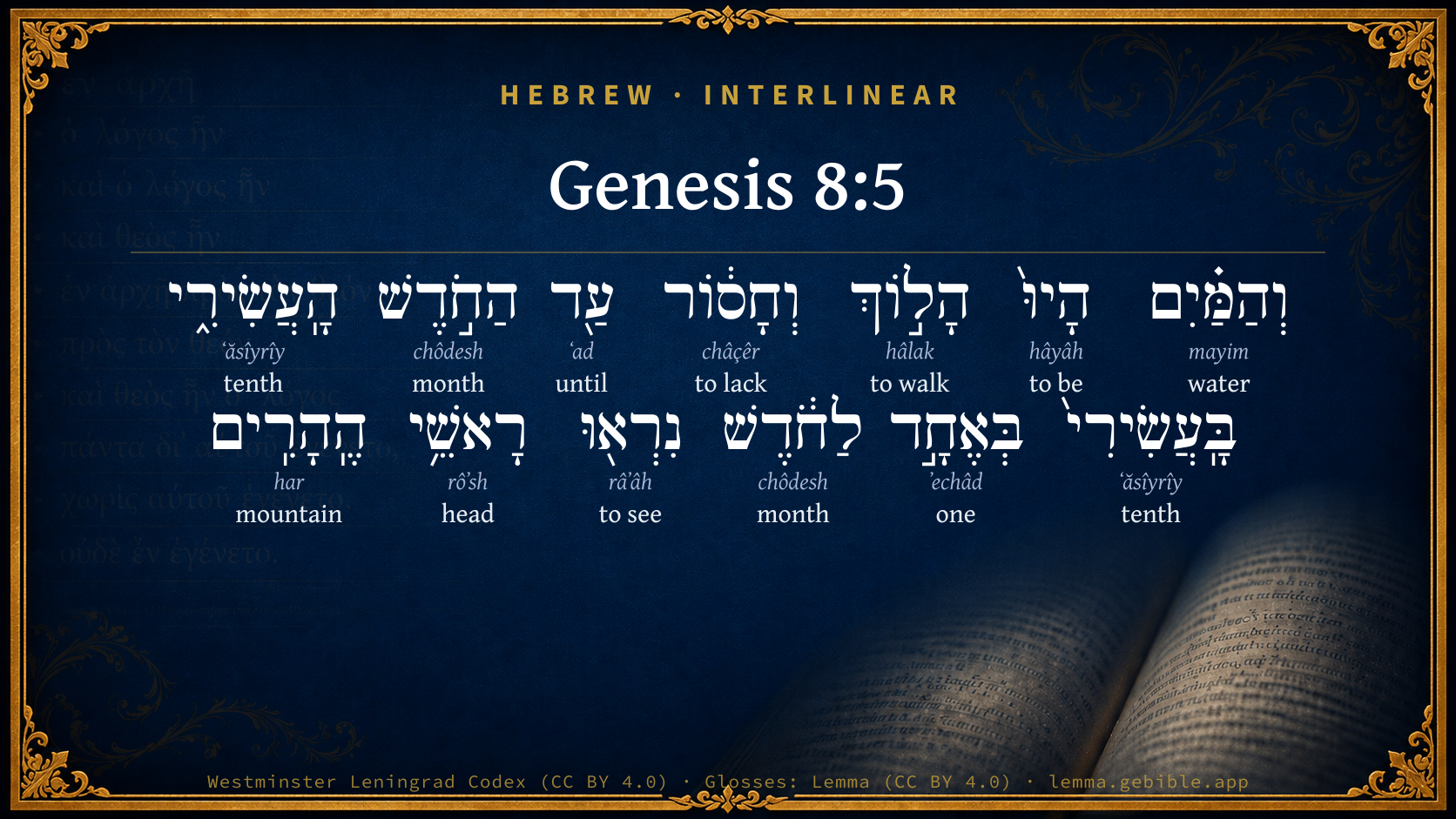
Hebrew (Westminster Leningrad Codex) Genesis 8:5 appears in the Hebrew Old Testament. The text above is from the Westminster Leningrad Codex. Each word links to its Strong’s number, a concise gloss, and parsing drawn from the Open Scriptures Hebrew Bible morphology. Click any word for its full Brown-Driver-Briggs (BDB) entry.
Download image
Cite this verse

Genesis 8:5 (World English Bible). Public Domain. Lemma interlinear Bible study tool, https://lemma.gebible.app/v/genesis/8/5.

Show BibTeX & RIS
BibTeX
RIS
English Translation
The waters receded continually until the tenth month. In the tenth month, on the first day of the month, the tops of the mountains were seen.
World English Bible · Public Domain
Highlights
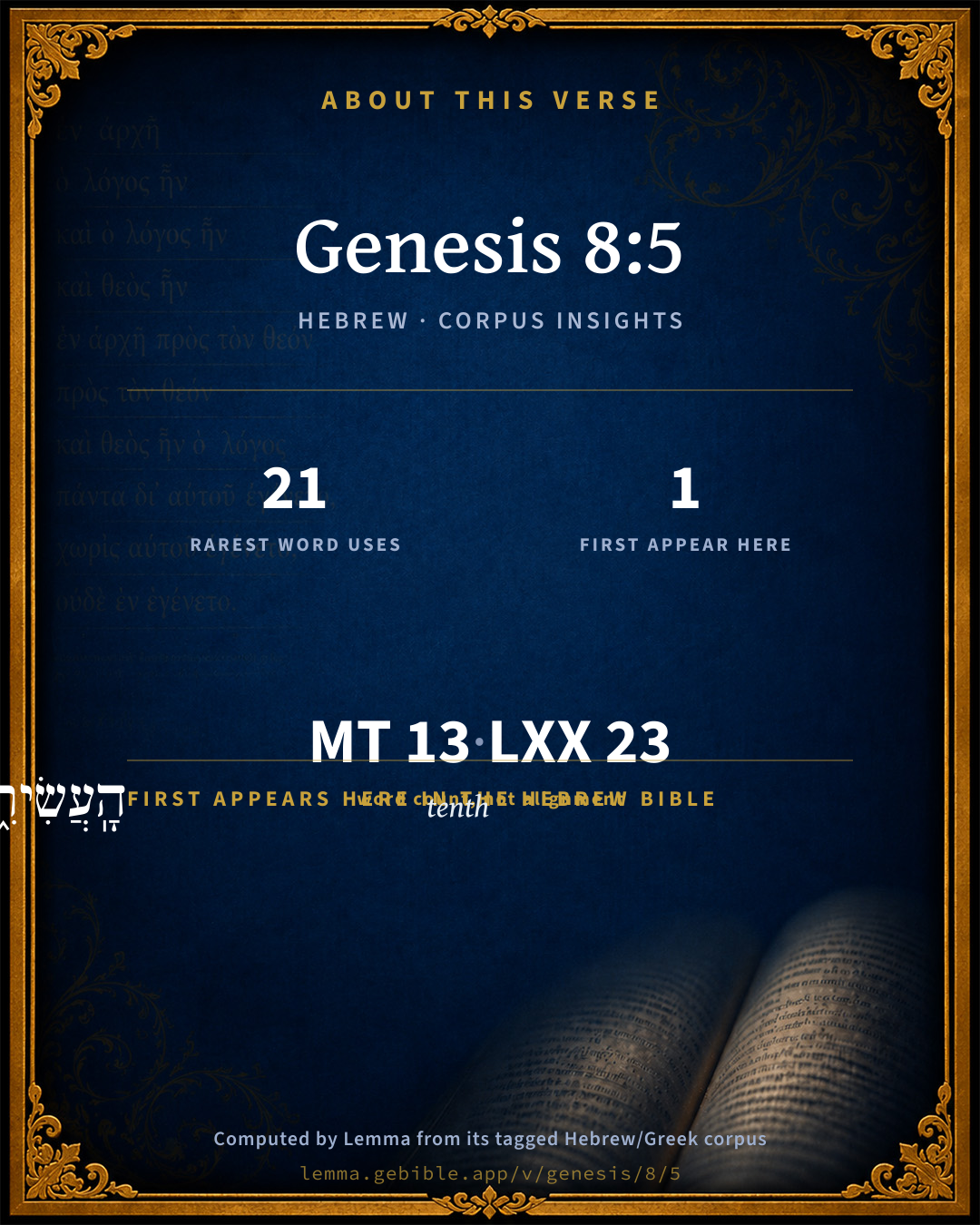
  • 1 first appearance in the Hebrew Bible
Full analysis ↓
Download a study sheet

One document with this verse’s original text, its word-by-word gloss line, the meaning frame, cross-references with their text, attributed commentary, and full source and license credits — printable, and it pastes into notes with its structure intact.

This verse Autodidact and up

Study sheet (.html) Plain text (.txt)

A passage Seminary Student

Up to 50 verses in one chapter. A passage sheet keeps up to 6 commentary sources and 12 cross-references per verse, in the order this page ranks them, and says so on the sheet whenever that leaves anything out. Ask for a single verse and you get the Autodidact verse sheet above.

Everything on this page stays free to read, with no account — the sheet is a download of what is already on screen, not access to it.

Want to remove ads? Support Godless Engineer
Compare translations 3

The same verse in 3 English versions, stacked beneath the original-language interlinear above. Click any original word for its lexicon entry.

Each is an independent rendering of the whole verse — the interlinear is not word-aligned to these translations.

Highlighted words mark where these versions differ — a whole-verse word diff, not a word-by-word alignment.

  • World English Bible Public Domain
    The waters receded continually until the tenth month. In the tenth month, on the first day of the month, the tops of the mountains were seen.
  • King James Version Public Domain
    And the waters decreased continually until the tenth month: in the tenth month, on the first day of the month, were the tops of the mountains seen.
  • unfoldingWord Literal Text CC BY-SA 4.0
    And the waters continued to decrease until the tenth month. In the tenth month, on the first of the month, the tops of the mountains could be seen.

unfoldingWord Literal Text — © unfoldingWord, licensed CC BY-SA 4.0. Word-aligned USFM3 via Door43 (git.door43.org/unfoldingWord/en_ult).

Versions to compare (up to 4)

3 of 4 selected

Show all 18 translations

Every available English version of this verse, each an independent rendering of the whole verse.

  • World English Bible Public Domain
    The waters receded continually until the tenth month. In the tenth month, on the first day of the month, the tops of the mountains were seen.
  • Berean Standard Bible Public Domain
    And the waters continued to recede until the tenth month, and on the first day of the tenth month the tops of the mountains became visible.
  • Majority Standard Bible Public Domain
    And the waters continued to recede until the tenth month, and on the first day of the tenth month the tops of the mountains became visible.
  • King James Version Public Domain
    And the waters decreased continually until the tenth month: in the tenth month, on the first day of the month, were the tops of the mountains seen.
  • American Standard Version (1901) Public Domain
    And the waters decreased continually until the tenth month: in the tenth month, on the first day of the month, were the tops of the mountains seen.
  • Revised Version (1885) Public Domain
    And the waters decreased continually until the tenth month: in the tenth month, on the first day of the month, were the tops of the mountains seen.
  • Geneva Bible (1599) Public Domain
    And the waters were going and decreasing vntill the tenth moneth: in the tenth moneth, and in the first day of the moneth were the toppes of the mountaines seene.
  • Douay-Rheims (1899) Public Domain
    And the waters were going and decreasing until the tenth month: for in the tenth month, the first day of the month, the tops of the mountains appeared.
  • Young's Literal Translation Public Domain
    and the waters have been going and becoming lacking till the tenth month; in the tenth `month', on the first of the month, appeared the heads of the mountains.
  • Literal Standard Version CC BY-SA 4.0
    and the waters have been going and decreasing until the tenth month; in the tenth [month], on the first of the month, the heads of the mountains appeared.
  • Unlocked Literal Bible CC BY-SA 4.0
    The waters continued to go down until the tenth month. On the first day of the month, the tops of the mountains appeared.
  • unfoldingWord Literal Text CC BY-SA 4.0
    And the waters continued to decrease until the tenth month. In the tenth month, on the first of the month, the tops of the mountains could be seen.
  • Darby Bible Public Domain
    And the waters abated continually until the tenth month: in the tenth [month], on the first of the month, the tops of the mountains were seen.
  • World Messianic Bible Public Domain
    The waters receded continually until the tenth month. In the tenth month, on the first day of the month, the tops of the mountains were visible.
  • Webster's Bible Public Domain
    And the waters decreased continually, till the tenth month: in the tenth month, on the first day of the month, were the tops of the mountains seen.
  • Free Bible Version CC BY-SA 4.0
    The waters continued to drop so that by the first day of the tenth month the tops of mountains could be seen.
  • Bible in Basic English Public Domain
    And still the waters went on falling, till on the first day of the tenth month the tops of the mountains were seen.
  • JPS Tanakh (1917) Public Domain
    And the waters decreased continually until the tenth month; in the tenth month, on the first day of the month, were the tops of the mountains seen.

Literal Standard Version (2020), Covenant Press — licensed CC BY-SA 4.0. Text via the HelloAO Bible API (eBible.org). Unlocked Literal Bible (unfoldingWord) — licensed CC BY-SA 4.0. Text via the HelloAO Bible API (eBible.org). unfoldingWord Literal Text — © unfoldingWord, licensed CC BY-SA 4.0. Word-aligned USFM3 via Door43 (git.door43.org/unfoldingWord/en_ult). Free Bible Version, Dr. Jonathan Gallagher — licensed CC BY-SA 4.0. Text via the HelloAO Bible API (eBible.org).

Word by word

More ways to search: Search by grammar → Find every occurrence → Compare this word →

Practice this passage: Drill this verse → Learn its vocabulary →

וְחָס֔וֹר
châçêr
H2637
“and · to lack”
Conjunction + Verb, Qal, Infinitive Absolute
Part of Speech
Conjunction + Verb
Stem
Qal
Form
Infinitive Absolute
Full BDB Definition

Origin: a primitive root

TWOT: 705

to lack, be without, decrease, be lacking, have a need - (Qal) - to lack - to be lacking - to diminish, decrease - (Piel) to cause to lack - (Hiphil) to cause to be lacking
  1. וְהַמַּ֗יִם mayim H4325 “and · the · water(s)” Conjunction + Particle, Definite Article + Noun, Common, Masculine, Plural, Absolute
  2. הָיוּ֙ hâyâh H1961 “to be” Verb, Qal, Perfect, 3rd Person, Common, Plural
  3. הָל֣וֹךְ hâlak H1980 “to walk” Verb, Qal, Infinitive Absolute
  4. עַ֖ד ʻad H5704 “until” Preposition
  5. הַחֹ֣דֶשׁ chôdesh H2320 “the · month” Particle, Definite Article + Noun, Common, Masculine, Singular, Absolute
  6. הָֽעֲשִׂירִ֑י ʻăsîyrîy H6224 “the · tenth” Particle, Definite Article + Adjective, Ordinal number, Masculine, Singular, Absolute
  7. בָּֽעֲשִׂירִי֙ ʻăsîyrîy H6224 “in/at the · tenth” Preposition, Determined + Adjective, Ordinal number, Masculine, Singular, Absolute
  8. בְּאֶחָ֣ד ʼechâd H259 “in/at · one” Preposition + Adjective, Cardinal number, Masculine, Singular, Absolute
  9. לַחֹ֔דֶשׁ chôdesh H2320 “to/for the · month” Preposition, Determined + Noun, Common, Masculine, Singular, Absolute
  10. נִרְא֖וּ râʼâh H7200 “to see” Verb, Niphal, Perfect, 3rd Person, Common, Plural
  11. רָאשֵׁ֥י rôʼsh H7218 “heads of” Noun, Common, Masculine, Plural, Construct
  12. הֶֽהָרִֽים har H2022 “the · mountains” Particle, Definite Article + Noun, Common, Masculine, Plural, Absolute

About this verse

These counts appear in no published source. They are computed here, from the morphology-tagged text and Lemma’s own curated glosses. What Lemma adds →

13
words
11
distinct lemmas
Pentateuch
section

Notable vocabulary

The rarest word here is וְחָס֔וֹר to lack H2637 — appearing just 21 times in the whole Hebrew Bible.

First appearance in Scripture

This word makes its first canonical appearance in the Hebrew Bible here:

  • הָֽעֲשִׂירִ֑י tenth H6224

Shared distinctive vocabulary

וְחָס֔וֹר to lack H2637 occurs in 21 verses of the Hebrew Bible. Also found in:

Grammatical profile

  • 4 verbs
  • 5 nouns
  • 3 adjectives
  • 1 preposition

Verb forms

  • הָיוּ֙ Qal · Perfect
  • הָל֣וֹךְ Qal · Infinitive Absolute
  • וְחָס֔וֹר Qal · Infinitive Absolute
  • נִרְא֖וּ Niphal · Perfect

Repetition

Words recur within this verse — often emphatic in Hebrew:

  • הַחֹ֣דֶשׁ month H2320 ×2
  • הָֽעֲשִׂירִ֑י tenth H6224 ×2

Hebrew & Septuagint length

In English translation the verse runs 26 words from the Hebrew and 19 from the Septuagint (LXX English) — closely comparable.

A rough comparison of the two English renderings, which tokenize alike — not a word-level alignment.

Word counts can differ between the Hebrew and the Greek without any difference in meaning — e.g. the Hebrew direct-object marker אֵת has no separate Greek word, and Greek often adds the article ὁ.

In the original languages it is 13 Hebrew tokens and 23 Greek tokens — but the two are counted differently (Hebrew bundles its prefixes and suffixes into one token; the Greek is in lemma form), so that isn’t a like-for-like length.

Hebrew and Greek witnesses Masoretic Hebrew ↔ Greek Septuagint

The same verse in the two great witnesses to the Old Testament, shown verse-for-verse.

These are two independent witnesses, not word-aligned to each other, and the Septuagint is shown in lemma (dictionary) form.

Hebrew Genesis 8:5 Masoretic · Westminster Leningrad Codex

וְהַמַּ֗יִם הָיוּ֙ הָל֣וֹךְ וְחָס֔וֹר עַ֖ד הַחֹ֣דֶשׁ הָֽעֲשִׂירִ֑י בָּֽעֲשִׂירִי֙ בְּאֶחָ֣ד לַחֹ֔דֶשׁ נִרְא֖וּ רָאשֵׁ֥י הֶֽהָרִֽים

The waters receded continually until the tenth month. In the tenth month, on the first day of the month, the tops of the mountains were seen.

World English Bible · Public Domain

Greek LXX Genesis 8:5 Septuagint · lemma form

ὁ δέ ὕδωρ πορεύομαι ἐλαττονέω ἕως ὁ δέκατος μήν ἐν δέ ὁ ἑνδέκατος μήν ὁ πρῶτος ὁ μήν ὁράω ὁ κεφαλή ὁ ὄρος

And in the tenth month, on the first day of the month, the heads of the mountains were seen.

LXX2012 (modern English Septuagint) · Public Domain

On this verse, The Pulpit Commentary discusses the Septuagint’s reading. Read the note in Commentary ↓

Hebrew: Westminster Leningrad Codex (CC BY 4.0). Greek: Septuagint (public domain); English from LXX2012 (modern English Septuagint) (Public Domain). How the Septuagint differs from the Hebrew →

Targum (Aramaic paraphrase)

2

The Targum is the ancient Jewish Aramaic paraphrase of the Hebrew Scriptures — an interpretive translation, not the Hebrew text itself. Onkelos (literal) and Pseudo-Jonathan (expansive) render the Torah, and Jonathan the Prophets. Coverage is partial: where no permissively-licensed English translation exists for a verse, only the Aramaic is shown. This is verse-level text, not a word-by-word alignment to the Hebrew.

  1. Targum Onkelos Torah (Genesis–Deuteronomy)
    וּמַיָּא הֲווֹ אָזְלִין וְחָסְרִין עַד יַרְחָא עֲשִׂירָאָה בַּעֲשִׂירָאָה בְּחַד לְיַרְחָא אִתְחֲזִיאוּ רֵישֵׁי טוּרַיָּא

    And the waters went and diminished until the tenth month: in the tenth, on the first of the month, the heads of the mountains appeared.

    Targum Onkelos — Aramaic: “Onkelos Genesis” (public domain); “Onkelos Exodus” (public domain); “Onkelos Leviticus” (public domain); “Onkelos Numbers” (public domain); “Onkelos Deuteronomy” (public domain). English: “Sefaria Community Translation” (CC0 1.0 (public-domain dedication)); “J.W. Etheridge. The Targums of Onkelos and Jonathan Ben Uzziel on the Pentateuch. London: Longmans, Green, 1862” (public domain). Text via Sefaria.

  2. Targum Pseudo-Jonathan Torah (Genesis–Deuteronomy)
    וּמַיָא הֲווֹ אָזְלִין וְחַסְרִין עַד יָרַח עֲשִירִיִי יֶרַח תַּמוּז בְּתַמוּז בְּחַד לְיַרְחָא אִתְחֲמִיאוּ רֵישֵׁי טוּרַיָא

    And the waters went and diminished until the tenth month, the month Tammuz. In Tammuz, in the first of the month, the heads of the mountains were seen.

    Targum Pseudo-Jonathan — Aramaic: “Targum Jonathan on Genesis” (public domain); “Targum Jonathan on Exodus” (public domain); “Targum Jonathan on Leviticus” (public domain); “Targum Jonathan on Numbers” (public domain); “Targum Jonathan on Deuteronomy” (public domain). English: “The Targum of Jonathan ben Uzziel, trans. J. W. Etheridge, London, 1862” (public domain). Text via Sefaria.

Commentary

Notes on Genesis 8:5 from classic Christian and Jewish commentators (each source and its license shown beneath its notes). The classic Christian expositions comment on the surrounding passage and are grouped to its opening verse, so a note may address several verses; the Jewish commentaries on the Tanakh (Rashi and others) are per-verse, so they appear only where the commentator wrote on this verse.

Lemma curates 59 commentaries, every one of them public domain or Creative Commons licensed, each selected and text-cleaned for this edition rather than reprinted as found. About our sources →

Trapp's Complete Commentary

John Trapp

Gen 8:5 And the waters decreased continually until the tenth month: in the tenth [month], on the first [day] of the month, were the tops of the mountains seen.

Ver. 5. The waters decreased.] Not all on the sudden, but by little and little, for exercise of Noah’s faith. "He that believeth maketh not haste". {Isa 28:16} God limiteth our sufferings for time, manner, and measure. Joseph was a prisoner till the time came. Smyrna was in tribulation for ten days. Physic must have a time to work; and gold must lie some while in the fire. "In the opportunity of time," saith Peter, "God will exalt you." {εν καιρω, 1Pe 5:6} Prescribe not to him, with those Bethulians in Judith; but wait his leisure, and let him do what is good in his own eyes. He waits a fit season to show us mercy, {Isa 30:18} and thinks as long of the time as we do.

John Trapp, A Commentary or Exposition upon All the Books of the Old and New Testament (1647–1656) — public domain. Text from a community e-Sword module.

Tyndale Open Study Notes

Tyndale Open Resources

8:5 the waters continued to go down: Another parallel with the creation week (see 1:9) suggests that the earth’s restoration was effectively a new creation (see study note on 8:1).

Tyndale Open Study Notes — © Tyndale Open Resources, licensed CC BY-SA 4.0. Text via the HelloAO Bible API.

Geneva Bible (1599)

Geneva Bible translators

Which was the month of December.

Geneva Bible (1599) marginal notes — public domain. Text via Bolls.life.

Jamieson, Fausset & Brown

Robert Jamieson, A. R. Fausset & David Brown

And the waters decreased continually--The decrease of the waters was for wise reasons exceedingly slow and gradual--the period of their return being nearly twice as long as that of their rise.

Jamieson, Fausset & Brown — Commentary Critical and Explanatory on the Whole Bible (1871) — public domain (CC PDM 1.0). Text via the HelloAO Bible API.

Ellicott's Commentary for English Readers

(5) Seen.—See Note on Gen_8:4.

A Bible Commentary for English Readers, edited by Charles John Ellicott (1878–1897) — public domain. Text from a community e-Sword module.

The Cambridge Bible for Schools and Colleges

gen. ed. J. J. S. Perowne

5 (P). the tenth month] Another date is here given. The tops of other mountains were visible on the 1st day of the 10th month. Reckoning 30 days for a month, we thus have an interval of 73 days between the grounding of the ark upon the mountains of Ararat and the visibility of the other mountains.

tops of the mountains] This detail in the narrative suggests that Ararat was thought to be a lonely peak towering above all the neighbouring mountains.

The Cambridge Bible for Schools and Colleges (gen. ed. J. J. S. Perowne; Cambridge University Press, 1878–1918) — public domain. Text from a community e-Sword module.

John Gill's Exposition

And the waters decreased continually until the tenth month,.... That is, from the seventeenth of the seventh month, to the first of the tenth month, a space of two months and thirteen days, and being summer time, through the heat of the sun, they decreased apace:

in the tenth month, on the first day of the month, were the tops of the mountains seen; not the tenth month of the flood, but of the year; the month Tammuz, as the Targum of Jonathan, and answers to part of June, and part of July; and the first day of this month, according to Bishop Usher (h), was Sunday the nineteenth of July: but according to Jarchi, whom Dr. Lightfoot (i) follows, this was the month Ab, which answers to July and August, the tenth from Marchesvan, when the rain began.

(h) Ut supra. (Annales Vet. Test. p. 4.) (i) Ut supra. (Works, vol 1. p. 6.)

John Gill's Exposition of the Whole Bible (1746–1763) — public domain (CC PDM 1.0). Text via the HelloAO Bible API.

Whedon's Commentary on the Bible

Daniel D. Whedon

5. Waters decreased — Hebrews, the waters were going and decreasing (steadily decreasing) until the tenth month. The waters slowly settled for two months and thirteen days after the ark rested, until, on the first day of the tenth month, (of the six hundredth year of Noah’s life,) the mountain tops were seen. The various epochs of the narrative are given in the years, months, and days of the life of Noah. It commenced (Gen_7:11) in his six hundredth year, second month, and seventeenth day, and ended (Gen_8:13) in his six hundred and first year, first month, and first day.

Daniel D. Whedon (gen. ed.), Commentary on the Old and New Testaments (1874–1909) — public domain. Text from a community e-Sword module.

The Pulpit Commentary

And the waters decreased continually literally, were going and decreasinguntil the tenth month: in the tenth month, on the first day of the month, chodesh, a lunar month, beginning at the new moon, from chadash, to be new; neomhnia, LXX. (of Exo_13:5) Chodesh yamim, the period of a month (cf. Gen_29:14; Num_11:20, Num_11:21) were the tops of the mountains seen. "Became distinctly visible" (Tayler Lewis, who thinks they may have previously projected above the waters). Apparuerunt cacumina montium (Vulgate). The waters had now been subsiding ten weeks, and as the height of the water above the highest hills was probably determined by the draught of the ark, we may naturally reason that the subsidence which had taken place since the seventeenth day of the seventh month was not less than three hundred and fifteen inches, at twenty-one inches to the cubit, or about four and one-third inches a day.

The Pulpit Commentary (1880–1919), ed. H.D.M. Spence-Jones & Joseph S. Exell — public domain. Text from a community e-Sword module.

John Wesley's Explanatory Notes

The tops of the mountains were seen - Like little islands appearing above water. They felt ground above forty days before they saw it, according to Dr. Lightfoots's computation, whence he infers that if the waters decreased proportionably, the ark drew eleven cubits in water.

John Wesley, Explanatory Notes Upon the Whole Bible (1754–1765) — public domain. Text via the GEBible commentary corpus.

Scofield Reference Notes

C. I. Scofield

tenth month

i.e. January.

The Scofield Reference Bible (1917 edition), notes by C. I. Scofield — public domain. Text from a community e-Sword module.

Rashi

Rabbi Shlomo Yitzchaki (Rashi)

בעשירי וגו' נראו ראשי ההרים IN THE TENTH MONTH … WERE THE TOPS OF THE MOUNTAINS SEEN —This was Ab which is the tenth from Marcheshvan when the rain began. If, however, you say that it means Elul, the tenth month from Kislev in which the rain stopped, just as you said (see Rashi on verse 4) that “in the seventh month” means Sivan which was the seventh month after the rain stopped, then I reply that it is impossible to argue so. For you must needs admit that the “seventh” month when the Ark rested can only be counted from the time when the rain stopped, since the 40 days during which the rain fell and the 150 days during which the waters prevailed did not terminate until the first day of Sivan, and if you say that it means the seventh after the rain began to fall, this would not be Sivan. The “tenth month”, however, when the tops of the mountains became visible cannot possibly be counted except from the time the rain began to fall, for if you say that it must be calculated from the time when it stopped, which would be Elul, you would not then find that “in the first month, on the first day of the month the waters dried up from off the earth” (Genesis 8:13). For it was only at the end of 40 days after the tops of the mountains were visible that he sent forth the raven (Genesis 8:6), and he waited periods amounting altogether to 21 days during which he was sending forth the dove, making altogether 60 days from when the tops of the mountains became visible until when the face of the earth became dry; if, therefore, you say that it was in Elul that they were seen, it would follow that the earth became dry in Marcheshvan (60 days after Elul). But it (Scripture) calls it (the month when the waters were dried up; Genesis 8:13) the first month, and that can only be Tishri which is the first month reckoning according to the creation of the world — or according to R. Joshua, it would be Nisan (Genesis Rabbah 30:6).

Rashi on the Tanakh — English translations: “The Judaica Press complete Tanach with Rashi, translated by A. J. Rosenberg” (CC BY 4.0); “Pentateuch with Rashi's commentary by M. Rosenbaum and A.M. Silbermann, 1929-1934” (public domain); “The Metsudah Tanach series, Lakewood, N.J” (CC BY 4.0); and “The Book of Joshua, Metsudah Publications, 1997” (CC BY 4.0). Text via Sefaria.

Ramban (Nachmanides)

Rabbi Moshe ben Nachman (Ramban / Nachmanides)

AND THE WATERS DECREASED CONTINUALLY UNTIL THE TENTH MONTH. This verse is to be interpreted by transposition: the waters decreased continually until the tops of the mountains were seen in the tenth month, which is the month of Tammuz. Scripture thus informs us that during seventy-three days the waters decreased fifteen cubits. But we do not know the amount of the original decrease which enabled the ark to rest since Scripture did not find it necessary to inform us either of the number of cubits that the ark was submerged in the waters or of the amount of the decrease.In the matter of the floating of the ark, it appears to me that because the waters flowed from the deeps and were hot, as our Rabbis have said, the ark therefore floated upon the face of the waters. Were it not for that, it would have sunk on account of its weight for there were many living things in it, as well as a great deal of food and drink. But as soon as the waters subsided from their flowing or from their heat and they decreased on account of the wind, the ark at once entered into the midst of the waters due to the weight of its load, and it rested on the mountain.In the opinion of the commentators, the Scriptural accounts concerning the total of one hundred and fifty days during which the waters prevailed, the resting of the ark, the visibility of the tops of the mountains and the succeeding forty days — all these events we know by way of prophecy for Scripture so informs us, but Noah knew only that he felt that the ark had rested, and he waited a period of time which, in his opinion, was sufficient for the waters to abate.Now according to our words, as well as those of our Rabbis and all commentators, the mountains of Ararat, which are among the highest mountains under the heavens, had fifteen cubits of water above their summit. Therefore this difficulty is to be posed: it is known that the Greek mountain Olympus is very much higher than they, and the land of Ararat, which is near Babylon, lies in the lower part of the globe! Perhaps we should then say that the decrease of waters which took place on the seventeenth day of the seventh month was very much more than fifteen cubits, and at first the tops of the high mountains were seen, not the mountains of Ararat, and it just happened that the ark was in the land of Ararat during the seventh month and it rested on the tops of those mountains.Now Noah, from the time the rains ceased, would open and close the window at his will. Seventy-three days after the resting of the ark he looked forth from the window and the tops of the mountains of Ararat were visible to him, and he again closed the window. Scripture then relates that forty days later he sent forth the raven. Scripture does not say, “and it was in such-a-month and on such-a-day that Noah opened the window,” but instead it says, And it came to pass at the end of forty days, in order to declare that from the time the tops of the mountains were seen by Noah, he waited forty days for he thought that by then the towers would be seen and the trees would become visible and the fowls would thus find in them a place to nest, and so he opened the window in order to send forth the raven. In the first month, which is the month of Tishri, the waters were dried up, and in the second month, which is the month of Marcheshvan, on the twenty-seventh day thereof, was the earth dry, and on that day they went out of the ark. Thus all calculations of the section are in accordance with the simple explanation of Scripture and its usual sense.Know that after the Sages agreed that it was in the month of Tishri that the world was created, 27 a). This is the intent of Ramban’s saying here: “Know that after the sages agreed, etc.” See also Ramban further, 17:26. — as [is evidenced by the text of the prayer for the New Year which] they formulated, i.e., “This day, on which was the beginning of Thy work, is a memorial of the first day,” and by the fact that the Scriptural order of the seasons is seedtime and harvest, and cold and heat — that the beginning of the year is reckoned from Tishri. And so also were the months reckoned from Tishri until we reached the exodus from Egypt. Then the Holy One, blessed be He, commanded us to reckon the months according to another count, [namely, from the going forth from Egypt, which occurred in the month of Nisan], as it is said, This month shall be unto you the beginning of months; it shall be the first month of the year to you. Thenceforth in all of Scripture, Tishri is reckoned as the seventh month. But as far as the years are concerned, the reckoning from Tishri was still retained, as it is written, And the feast of ingathering at the turn of the year., 34:22. And so did Jonathan the son of Uziel or Aramaic version of the books of the Prophets. It is similar in scope to that of Onkelos on the Five Books of Moses. translate the verse, In the month of Eithanim which is the seventh month, saying, “in the month which the ancients called the first month and which is now the seventh month.” And in the Mechilta we also find: “This month [Nisan] shall be unto you. But the first man did not reckon by it; [he reckoned Tishri as the first month].”

Ramban (Nachmanides) on the Tanakh — English translation: “Commentary on the Torah by Ramban (Nachmanides). Translated and annotated by Charles B. Chavel. New York, Shilo Pub. House, 1971-1976” (CC BY 4.0). Text via Sefaria.

Radak

Rabbi David Kimhi (Radak)

והמים היו הלוך וחסור, the waters kept receding. This construction is not unique, as we encounter it in Ezekiel 1,34 והחיות רצוא ושוב.

עד החודש העשירי, this does not mean that during this month the waters had already receded completely; what happened was that the waters receded progressively until relatively low mountain tops became visible. The process continued further. The “tenth” month described was the month of Av, seeing it was the tenth, counting from the month of Marcheshvan when the rains had started falling.

Radak on the Tanakh — English translations: “Sefaria Community Translation” (CC0 1.0 (public-domain dedication)); “Eliyahu Munk, HaChut Hameshulash” (CC BY 4.0); “Rabbi Mike Feuer, Jerusalem Anthology” (CC BY 4.0); and “R. David Kimhi on the first book of Psalms, Translated by R.G. Finch, London, 1919” (public domain). Text via Sefaria.

Lesson kit

Teaching starters — assembled from the data on this page, not authored interpretation. Every prompt links to the verse data it draws on. Edit before teaching.

Genesis, in the Pentateuch, opens this verse with 13 words (11 distinct Hebrew lemmas). Its most distinctive word is châçêr (“to lack”). A historical commentator’s framing appears above. Read the whole chapter for the surrounding context.

Discussion questions

  1. How does “to lack” (châçêr) shape what this verse is saying?
  2. This is the first place “tenth” appears in Scripture (first appears here). What does its debut here establish?
  3. How does Genesis 8:3, which shares the word «to lack», read alongside this verse?
  4. What does the repetition of “month” (2× in this one verse) do in this verse?
  5. These translations render this verse differently; the difference is in the English rendering, not the original. What questions does that raise?
  6. «הָיוּ֙» is a Qal Perfect verb. How does that grammatical form shape the action described?
  7. Compare how Trapp's Complete Commentary and Tyndale Open Study Notes read this verse. Where do they agree or differ?

Things to notice

Reading settings

Reading text

Shown beneath each verse's original-language words.

Old Testament
Old Testament edition

Read the OT as the Masoretic Hebrew (MT) or the Greek Septuagint (LXX).

English shown for the Greek Septuagint (in the Hebrew ↔ Greek comparison).

Comparing translations? Open the Compare panel on any verse page to stack up to four side by side.