
Matthew 8:32

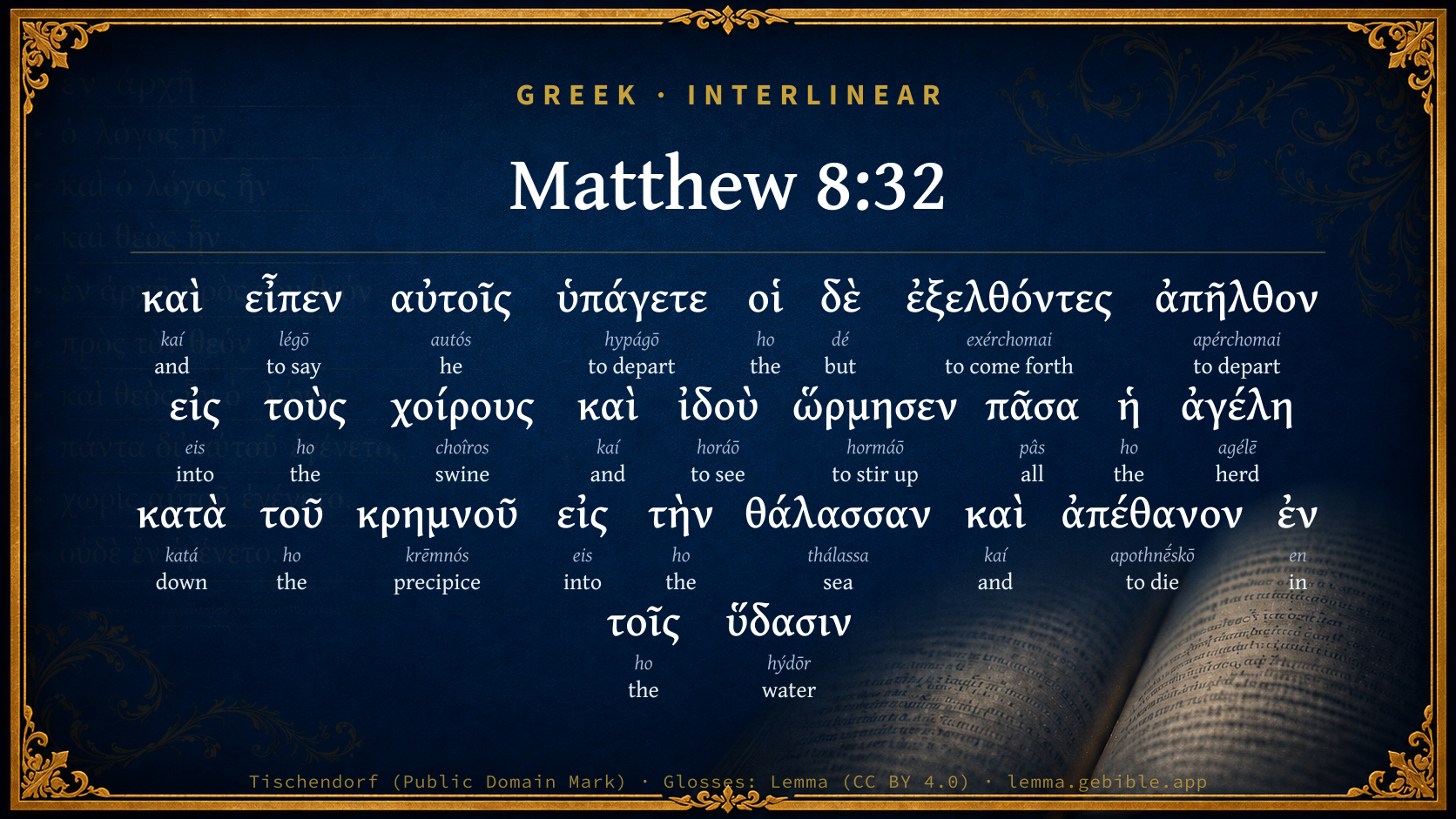
Greek (Tischendorf 8th ed.) Matthew 8:32 appears in the Greek New Testament. The text above is from the Tischendorf 8th edition. Each word links to its Strong’s number and a concise gloss. Click any word for its full Thayer’s Greek Lexicon entry.
Download image
Cite this verse

Matthew 8:32 (World English Bible). Public Domain. Lemma interlinear Bible study tool, https://lemma.gebible.app/v/matthew/8/32.

Show BibTeX & RIS
BibTeX
RIS
English Translation
He said to them, "Go!" They came out, and went into the herd of pigs: and behold, the whole herd of pigs rushed down the cliff into the sea, and died in the water.
World English Bible · Public Domain
Highlights
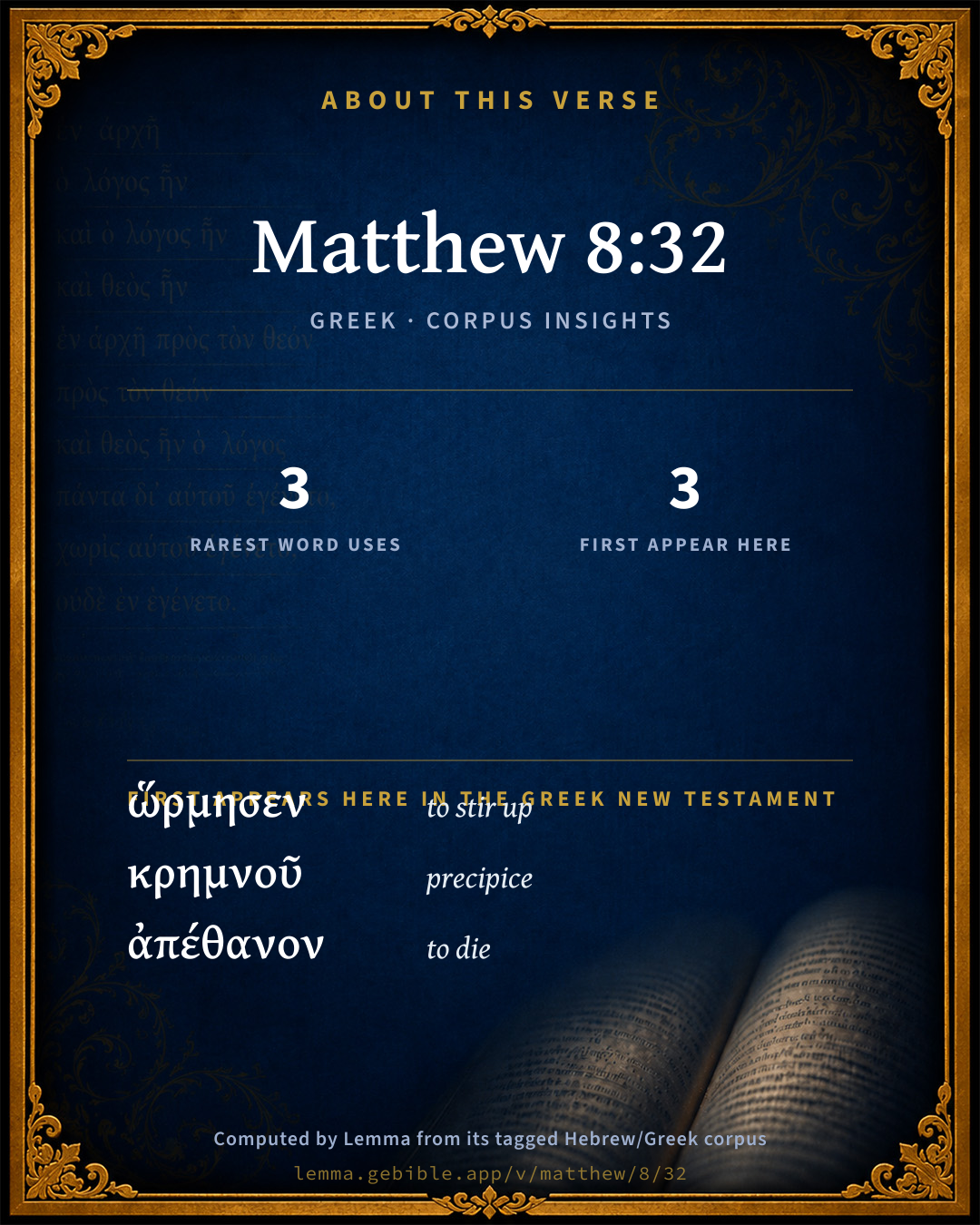
  • 3 first appearances in the Greek New Testament
Full analysis ↓
Download a study sheet

One document with this verse’s original text, its word-by-word gloss line, the meaning frame, cross-references with their text, attributed commentary, and full source and license credits — printable, and it pastes into notes with its structure intact.

This verse Autodidact and up

Study sheet (.html) Plain text (.txt)

A passage Seminary Student

Up to 50 verses in one chapter. A passage sheet keeps up to 6 commentary sources and 12 cross-references per verse, in the order this page ranks them, and says so on the sheet whenever that leaves anything out. Ask for a single verse and you get the Autodidact verse sheet above.

Everything on this page stays free to read, with no account — the sheet is a download of what is already on screen, not access to it.

Want to remove ads? Support Godless Engineer
Compare translations 3

The same verse in 3 English versions, stacked beneath the original-language interlinear above. Click any original word for its lexicon entry.

Each is an independent rendering of the whole verse — the interlinear is not word-aligned to these translations.

Highlighted words mark where these versions differ — a whole-verse word diff, not a word-by-word alignment.

  • World English Bible Public Domain
    He said to them, "Go!" They came out, and went into the herd of pigs: and behold, the whole herd of pigs rushed down the cliff into the sea, and died in the water.
  • King James Version Public Domain
    And he said unto them, Go. And when they were come out, they went into the herd of swine: and, behold, the whole herd of swine ran violently down a steep place into the sea, and perished in the waters.
  • unfoldingWord Literal Text CC BY-SA 4.0
    And he said to them, “Go!” And they, having come out, went away into the pigs; and behold, the whole herd rushed down the steep slope into the sea, and they died in the water.

unfoldingWord Literal Text — © unfoldingWord, licensed CC BY-SA 4.0. Word-aligned USFM3 via Door43 (git.door43.org/unfoldingWord/en_ult).

Versions to compare (up to 4)

3 of 4 selected

Show all 19 translations

Every available English version of this verse, each an independent rendering of the whole verse.

  • World English Bible Public Domain
    He said to them, "Go!" They came out, and went into the herd of pigs: and behold, the whole herd of pigs rushed down the cliff into the sea, and died in the water.
  • Berean Standard Bible Public Domain
    “Go!” He told them. So they came out and went into the pigs, and the whole herd rushed down the steep bank into the sea and died in the waters.
  • Majority Standard Bible Public Domain
    “Go!” He told them. So they came out and went into the herd of pigs, and the whole herd of pigs rushed down the steep bank into the sea and died in the waters.
  • King James Version Public Domain
    And he said unto them, Go. And when they were come out, they went into the herd of swine: and, behold, the whole herd of swine ran violently down a steep place into the sea, and perished in the waters.
  • American Standard Version (1901) Public Domain
    And he said unto them, Go. And they came out, and went into the swine: and behold, the whole herd rushed down the steep into the sea, and perished in the waters.
  • Revised Version (1885) Public Domain
    And he said unto them, Go. And they came out, and went into the swine: and behold, the whole herd rushed down the steep into the sea, and perished in the waters.
  • Geneva Bible (1599) Public Domain
    And he said vnto them, Go. So they went out and departed into the heard of swine: and beholde, the whole heard of swine ranne headlong into the sea, and died in the water.
  • Douay-Rheims (1899) Public Domain
    And he said to them: Go. But they going out went into the swine, and behold the whole herd ran violently down a steep place into the sea: and they perished in the waters.
  • Young's Literal Translation Public Domain
    and he saith to them, `Go.' And having come forth, they went to the herd of the swine, and lo, the whole herd of the swine rushed down the steep, to the sea, and died in the waters,
  • Literal Standard Version CC BY-SA 4.0
    and He says to them, “Go.” And having come forth, they went into the herd of the pigs, and behold, the whole herd of the pigs rushed down the steep, into the sea, and died in the waters,
  • Unlocked Literal Bible CC BY-SA 4.0
    Jesus said to them, “Go!” The demons came out and went into the pigs; and behold, the whole herd rushed down the steep hill into the sea and they died in the water.
  • unfoldingWord Literal Text CC BY-SA 4.0
    And he said to them, “Go!” And they, having come out, went away into the pigs; and behold, the whole herd rushed down the steep slope into the sea, and they died in the water.
  • Darby Bible Public Domain
    And he said to them, Go. And they, going out, departed into the herd of swine; and lo, the whole herd [of swine] rushed down the steep slope into the sea, and died in the waters.
  • World Messianic Bible Public Domain
    He said to them, “Go!” They came out and went into the herd of pigs; and behold, the whole herd of pigs rushed down the cliff into the sea and died in the water.
  • Webster's Bible Public Domain
    And he said to them, Go. And when they had come out, they went into the herd of swine: and behold, the whole herd of swine ran violently down a steep place into the sea, and perished in the waters.
  • Free Bible Version CC BY-SA 4.0
    “Go!” said Jesus. The demons left the men and went into the pigs. The whole herd ran down the steep hillside into the sea and drowned.
  • Bible in Basic English Public Domain
    And he said to them, Go. And they came out, and went into the pigs; and the herd went rushing down a sharp slope into the sea and came to their end in the water.
  • Text-Critical English NT CC BY 4.0
    He said to them, “Go.” So they came out and went into the herd of pigs, and behold, the whole herd of pigs rushed down the steep bank into the sea and died in the water.
  • Tyndale New Testament (1534) Public Domain
    And he sayd vnto the: go youre wayes. Then wet they out and departed into the heerd of swyne And beholde the whoale heerd of swyne was caryed with violence hedlinge in to the see and perisshed in the water.

Literal Standard Version (2020), Covenant Press — licensed CC BY-SA 4.0. Text via the HelloAO Bible API (eBible.org). Unlocked Literal Bible (unfoldingWord) — licensed CC BY-SA 4.0. Text via the HelloAO Bible API (eBible.org). unfoldingWord Literal Text — © unfoldingWord, licensed CC BY-SA 4.0. Word-aligned USFM3 via Door43 (git.door43.org/unfoldingWord/en_ult). Free Bible Version, Dr. Jonathan Gallagher — licensed CC BY-SA 4.0. Text via the HelloAO Bible API (eBible.org).

Word by word

More ways to search: Search by grammar → Find every occurrence → Compare this word →

Practice this passage: Drill this verse → Learn its vocabulary →

κρημνοῦ
krēmnós
G2911
“precipice”
Noun, Genitive, Singular, Masculine
Part of Speech
Noun
Case
Genitive
Number
Singular
Gender
Masculine
Full Thayer's Definition

Origin: from G2910

TDNT: None

1. a steep place, a precipice
  1. καὶ kaí G2532 “and” Conjunction
  2. εἶπεν légō G3004 “to say” Verb, Aorist, Active, Indicative, 3rd person, Singular
  3. αὐτοῖς autós G846 “he” Personal pronoun, Dative, Plural, Masculine
  4. ὑπάγετε hypágō G5217 “to depart” Verb, Present, Active, Imperative, 2nd person, Plural
  5. οἱ ho G3588 “the” Article, Nominative, Plural, Masculine
  6. δὲ dé G1161 “but” Conjunction
  7. ἐξελθόντες exérchomai G1831 “to come forth” Verb, Aorist, Active, Participle, Nominative, Plural, Masculine
  8. ἀπῆλθον apérchomai G565 “to depart” Verb, Aorist, Active, Indicative, 3rd person, Plural
  9. εἰς eis G1519 “into” Preposition
  10. τοὺς ho G3588 “the” Article, Accusative, Plural, Masculine
  11. χοίρους choîros G5519 “swine” Noun, Accusative, Plural, Masculine
  12. καὶ kaí G2532 “and” Conjunction
  13. ἰδοὺ horáō G3708 “to see” Verb, Aorist, Middle, Imperative, 2nd person, Singular
  14. ὥρμησεν hormáō G3729 “to stir up” Verb, Aorist, Active, Indicative, 3rd person, Singular
  15. πᾶσα pâs G3956 “all” Adjective, Nominative, Singular, Feminine
  16. ἡ ho G3588 “the” Article, Nominative, Singular, Feminine
  17. ἀγέλη agélē G34 “herd” Noun, Nominative, Singular, Feminine
  18. κατὰ katá G2596 “down” Preposition
  19. τοῦ ho G3588 “the” Article, Genitive, Singular, Masculine
  20. εἰς eis G1519 “into” Preposition
  21. τὴν ho G3588 “the” Article, Accusative, Singular, Feminine
  22. θάλασσαν thálassa G2281 “sea” Noun, Accusative, Singular, Feminine
  23. καὶ kaí G2532 “and” Conjunction
  24. ἀπέθανον apothnḗskō G599 “to die” Verb, Aorist, Active, Indicative, 3rd person, Plural
  25. ἐν en G1722 “in” Preposition
  26. τοῖς ho G3588 “the” Article, Dative, Plural, Neuter
  27. ὕδασιν hýdōr G5204 “water” Noun, Dative, Plural, Neuter

About this verse

These counts appear in no published source. They are computed here, from the morphology-tagged text and Lemma’s own curated glosses. What Lemma adds →

28
words
20
distinct lemmas
Gospels
section

Notable vocabulary

The rarest word here is κρημνοῦ precipice G2911 — appearing just 3 times in the whole Greek New Testament.

First appearance in Scripture

These words make their first canonical appearance in the Greek New Testament here:

  • ὥρμησεν to stir up G3729
  • κρημνοῦ precipice G2911
  • ἀπέθανον to die G599

Shared distinctive vocabulary

κρημνοῦ precipice G2911 occurs in 3 verses of the Greek New Testament. Also found in:
Repetition

Words recur within this verse:

Cross-references

8

Topical passages linked to Matthew 8:32 in the Treasury of Scripture Knowledge — connected by theme and wording, ordered by reader-vote popularity; previews shown in the World English Bible.

  • Mark 5:13 At once Jesus gave them permission. The unclean spirits came out and entered into the pigs. The herd of about two thousand rushed down the steep bank into the sea, and they were drowned in the sea.
  • Revelation 20:7 And after the thousand years, Satan will be released from his prison,
  • 1 Kings 22:22 Yahweh said to him, 'How?' He said, 'I will go forth, and will be a lying spirit in the mouth of all his prophets.' He said, 'You shall entice him, and shall prevail also: go forth, and do so.'
  • Luke 8:33 The demons came out from the man, and entered into the pigs, and the herd rushed down the steep bank into the lake, and were drowned.
  • Acts 2:23 him, being delivered up by the determined counsel and foreknowledge of God, you have taken by the hand of lawless men, crucified and killed;
  • Acts 4:28 to do whatever your hand and your council foreordained to happen.
  • Job 1:10–19 Haven't you made a hedge around him, and around his house, and around all that he has, on every side? You have blessed the work of his hands, and his substance is increased in the land.
  • Job 2:3–8 Yahweh said to Satan, "Have you considered my servant Job? For there is none like him in the earth, a blameless and an upright man, one who fears God, and turns away from evil. He still maintains his integrity, although you incited me against him, to ruin him without cause."

Cross-references courtesy of OpenBible.info (CC BY 4.0).

Commentary

Notes on Matthew 8:32 from classic Christian and Jewish commentators (each source and its license shown beneath its notes). The classic Christian expositions comment on the surrounding passage and are grouped to its opening verse, so a note may address several verses; the Jewish commentaries on the Tanakh (Rashi and others) are per-verse, so they appear only where the commentator wrote on this verse.

Lemma curates 59 commentaries, every one of them public domain or Creative Commons licensed, each selected and text-cleaned for this edition rather than reprinted as found. About our sources →

Tyndale Open Study Notes

Tyndale Open Resources

8:32 Jesus’ word had sufficient authority to expel demons. • drowned: Jesus had begun to defeat the enemy (12:28; Luke 10:17-20; Rom 16:20; Col 2:15).

Tyndale Open Study Notes — © Tyndale Open Resources, licensed CC BY-SA 4.0. Text via the HelloAO Bible API.

Bengel's Gnomon

Johann Albrecht Bengel

Mat 8:32. Ἀπῆλθον, they were come out) Our Lord performed one miracle by which He inflicted punishment on a tree, namely, a fig tree; another on swine; another on men buying and selling in the temple. A specimen of future vengeance. His other miracles were full of grace; and even in these benefit was produced, as, for example, in the present case, a road rendered safe, a region freed from spirits to which it was liable, by their being driven into the sea, the possessed liberated, an excessive quantity of animal existence removed which was forbidden to be eaten, and in this case liable to be possessed by devils. And the Gergesenes were guilty, and deserved to lose the herd. The circumstance shows indisputably the right and the authority of Jesus.—ἀπέθανον, died) It seems that a possessed brute cannot live long. That men who are possessed do not thus perish immediately, is an especial mercy of God.

Bengel's Gnomon of the New Testament — English translation (T&T Clark, Edinburgh, 1860) — public domain. Text from a community e-Sword module.

Meyer's Critical & Exegetical Commentary

Heinrich August Wilhelm Meyer

Mat_8:32. Ἐξελθόντες ἀπῆλθον, κ.τ.λ.] therefore the demons who, quitting those who were possessed, enter the bodies of the swine. The idea that the demoniacs ran away among the swine is opposed to the narrative.

καὶ ἰδοὺ, ὥρμησε, κ.τ.λ.] in consequence of the demons taking possession of the animals, and thereby producing in them a state of fury corresponding to that which had been excited in the men.

Meyer — Critical and Exegetical Commentary on the New Testament — English translation by Peter Christie, edited by Frederick Crombie (T&T Clark, 1880) — public domain. Text from a community e-Sword module.

Expositor's Greek Testament

ed. W. Robertson Nicoll

Mat 8:32 . ὑπάγετε : Christ’s laconic reply, usually taken to mean: go into the swine, but not necessarily meaning more than “begone”. So Weiss, who holds that Jesus had no intention of expressing acquiescence in the demoniac’s request. ( Matt. Evan. and Weiss-Meyer, “Hinweg mit euch”.) οἱ δὲ … χοίρους : the entrance of the demons into the swine could not, of course, be a matter of observation, but only of inference from what followed. ἰδοὺ , introducing a sudden, startling event ὥρμησεν πᾶσα ἡ ἀγέλη the mad downrush of the herd over the precipice into the lake. Assuming the full responsibility of Jesus for the catastrophe, expositors have busied themselves in inventing apologies. Euthy gives four reasons for the transaction, the fourth being that only thereby could it be conclusively shown that the devils had left the demoniacs. Rosenmüller suggests that two men are worth more than ever so many swine. The lowest depth of bathos in this line was touched by Wetstein when he suggested that, by cutting up the drowned swine, salting the meat or making smoke-dried hams ( fumosas pernas ), and selling them to Gentiles who did not object to eat suffocated animals, the owners would escape loss. But the learned commentator might be jesting, for he throws out the suggestion for the benefit of men whom he describes as neither Jews, Gentiles, nor Christians.

The Expositor's Greek Testament, edited by W. Robertson Nicoll (1897–1910) — public domain. Text from a community e-Sword module.

Adam Clarke's Commentary

Verse 32. They went into the herd of swine] Instead of την αγελην των χοιρων, the herd of swine, Griesbach reads τους χοιρους, the swine, on the authority of many MSS. and versions.

The whole herd of swine] των χοιρων, of swine, is omitted by many MSS. and versions. See Griesbach, and See Clarke on Lu 8:20, c.

Ran violently down a steep place, c.] The prayer of these demons is heard and answered! Strange! But let it be noted, that God only hears demons and certain sinners when their prayer is the echo of his own justice. Here is an emblem of the final impenitence and ruin into which the swinish sinners, the habitually unpure, more commonly fall than other sinners. Christ permits the demons to do that in the swine which he did not permit them to do in the possessed, on purpose to show us what rage they would exercise on us if left to their liberty and malice. Many are the Divine favours which we do not consider, or know only in general. "But the owners of the swine lost their property." Yes and learn from this of how small value temporal riches, are in the estimation of God. He suffers them to be lost, sometimes to disengage us from them through mercy sometimes out of justice, to punish us for having acquired or preserved them either by covetousness or injustice.

Adam Clarke's Commentary on the Bible (1810–1826) — public domain. Text from a community e-Sword/MySword module.

Ellicott's Commentary for English Readers

(32) He said unto them, Go.—Men have asked sometimes, in scorn, why the word was spoken; why permission was given for a destructive work which seemed alike needless and fruitless. The so-called rationalistic explanation, that the demoniacs drove the swine down the cliff in a last paroxysm of frenzy, is no solution of the difficulty, for, even if that hypothesis were on other grounds tenable, it is clear that our Lord’s words sanctioned what they did. We are at least on the right track in suggesting that only in some such way could the man be delivered from the inextricable confusion between himself and the unclean spirits in which he had been involved. Not till he saw the demoniac forces that had oppressed him transferred to the bodies of other creatures, and working on them the effects which they had wrought on him, could he believe in his own deliverance. Those who measure rightly the worth of a human spirit thus restored to itself, to its fellow-men, and to God, will not think that the destruction of brute life was too dear a price to pay for its restoration. Other subordinate ends—such, e.g., as that it was a penalty on those who kept the unclean beasts for their violation of the Law, or that it taught men that it was through their indulgence of the swinish nature in themselves that they became subject to the darker and more demoniac passions—have been suggested with more or less plausibility.

Down a steep place.—Literally, down the cliff.

A Bible Commentary for English Readers, edited by Charles John Ellicott (1878–1897) — public domain. Text from a community e-Sword module.

The Cambridge Bible for Schools and Colleges

gen. ed. J. J. S. Perowne

32. a steep place] Translate, the steep place. The slope of Gergesa, familiar to Matthew and to the readers of his Gospel.

The Cambridge Bible for Schools and Colleges (gen. ed. J. J. S. Perowne; Cambridge University Press, 1878–1918) — public domain. Text from a community e-Sword module.

John Gill's Exposition

And they that kept them fled,.... The hog herds, men of very low life, and whose employment was very infamous and reproachful, as has been observed. These, amazed at what they had seen, distressed with the loss of the swine, and so of their employment, and frightened also lest they should incur the blame and displeasure of their masters, ran away in great haste, fear, and astonishment;

and went their way into the city; either of Gergesa, or Gadara. Mark and Luke say, they "went and told it in the city, and in the country": in their fright and distress, some ran one way, and some another; some went into the city, others into the country, and so spread the affair far and near, and the fame of Christ, which was designed by this miracle;

and told everything they saw and heard; how the devils entered into the swine, and they ran headlong into the sea, and were drowned: this they told first, as being done last, and with which they were most affected, and what chiefly concerned their employers; and after they had told every circumstance of the affair, next they gave a narrative of

what was befallen to the possessed of the devils, and which was the occasion of the loss of their swine; how subject the devils, that were in them, were to Christ; how easily he dispossessed them by a word of command; how they entreated they might have leave to go into the herd of swine, which was granted; and how perfectly whole, and in health, both in body and mind, the men were.

John Gill's Exposition of the Whole Bible (1746–1763) — public domain (CC PDM 1.0). Text via the HelloAO Bible API.

Trapp's Complete Commentary

John Trapp

32 And he said unto them, Go. And when they were come out, they went into the herd of swine: and, behold, the whole herd of swine ran violently down a steep place into the sea, and perished in the waters.

Ver. 32. And he said unto them, Go] 1. To show his sovereignty over the creatures. He is the great proprietary of all, and may do with his own as he wisheth. 2. To punish their sensuality in feeding upon swine’s flesh, against the express letter of the law. Ex uno sue quinquaginta prope sapores excogitantur, saith Pliny. And there was a jolly pope (some kin, belike, to Pope Sergius, surnamed Os porci, the mouth of a pig) that being, for his gout, forbidden swine’s flesh by his physician, cried out to his steward, Bring me my pork, al dispito di dio, in despite of God. 3. To try whether was dearer to these filthy Gergesites, their swine, or their souls. They showed themselves to be of Cardinal Bourbon’s mind, who would not part with his part in Paris, for his part in Paradise.

They went into the herd of swine] That thereby Satan might win upon the souls of the citizens (wedded and wedged to their worldly substance), and he failed not in his purpose. A cunning fetch of an old quadruplator. Be not ignorant of his wiles. Divorce the world from the devil, and he can do us no hurt.

Ran violently down a steep place into the sea] Cornelius Agrippa, the magician, being at point of death, called unto him a dog (a familiar devil) that went about with him, and said, Abi a me perdita bestia quae me perdidisti, Get thee gone, thou cursed creature, thou hast undone me. Whereupon the dog presently departed, and cast himself headlong into the water.

And perished in the waters] So will detestable drunkards in the bottomless pit; those that, as swine their bellies, so they break their heads with filthy quaffing. These shall have a cup of fire and brimstone poured down their throats, Psa 11:6, and not obtain one drop of water to cool their flaming tongues. For what reason? Drunkenness, saith one, is a vice so vile, so base, so beastly, as that it transforms the soul, deforms the body, bereaves the brain, betrays the strength, defiles the affection, and metamorphoseth the whole man; making the understanding ignorant, the strong staggering, the trusty trothless, the virtuous vicious, and the precisest person a panderer to the profanest sin. (Huge de Sancto Vict.)

John Trapp, A Commentary or Exposition upon All the Books of the Old and New Testament (1647–1656) — public domain. Text from a community e-Sword module.

Haydock's Catholic Bible Commentary

Many reasons might be brought why our Saviour suffered the devils to enter into the swine: 1. To shew that the devils had no power even over swine without his permission. 2. That such as were freed from their power, might acknowledge the greatness of the favour done them, by seeing from how great a multitude they were liberated. 3. To punish those Jewish citizens, who fed upon swine’s flesh contrary to their law. And, 4. To shew how willingly the devils dwell in the hearts of those who are addicted to the voluptuous and carnal life, aptly designated by the swine. (Menochius) --- St. John Chrysostom says that our Saviour permitted the devils to enter the swine, not for their own sakes, but for our instruction. 1. That we might know how very desirous the enemy of our salvation is to bring upon us the greatest evils. 2. That the devil has not any power, even over swine, without the permission of God. And, 3. That these cruel fiends would, if the Almighty allowed them, inflict still more grievous torments on their unhappy slaves. (Hom. xxix.) Jesus Christ here confutes the Sadducean doctrine, which denies the existence of spirits, good or bad. (Haydock)

George Leo Haydock (1774–1849), Haydock's Catholic Family Bible and Commentary, 1859 edition — public domain. Excludes Psalms (Douay-Rheims chapter numbering differs from Protestant) and Deuterocanonical books (Catholic canon only).

Matthew Poole's English Annotations

Mark gives us much the same account, Mar 5:13, only adding, they were about two thousand. Luke differeth not, only what Matthew calls a sea Luke calls a lake; but the Jews called all great gatherings together of waters seas. The devil is naturally so fond of doing mischief, that he will rather play at a small game than stand out. This way of executing his malice, upon the beasts, we have often had experience of in the practice of witchcraft. And it may teach husbandmen, and those that trade in much cattle, to whom they are beholden for the preservation of their cattle, and how rightly God is styled, he that preserveth both man and beast; and what need they have to keep up daily prayer in their families, and to live so as they may not make God their enemy, who hath legions of devils, as well as many legions of less hurtful creatures, to revenge his quarrels.

Matthew Poole's English Annotations on the Holy Bible (1683–1685) — public domain. Text from a community e-Sword/MySword module.

The Pulpit Commentary

Vers. 32, 33. And he said unto them, Go. As they asked; for he was not yet come to send them to their final home. He would not employ his inherent Divine power even against the kingdom of Satan, or forcibly disturb the conditions under which evil existed in the world. Notice further:

(1) That as regards the right to destroy the swine when they were the property of others, our Lord in no way destroyed them himself, but only did not interfere with the powers of the evil spirits in giving them permission to work out their own purposes. It is possible, too, though far from certain, that the owners of the swine were acting illegally in owning them; (though even then our Lord was not constituted as judge, Luk_12:14) but this supposes first that they were Jews, and secondly that it was illegal for Jews to keep swine, of which suppositions not even the latter can be clearly proved either by Scripture or by early forms of tradition.

(2) The destruction of the swine might well be beneficial to the complete recovery of the men.

(3) It would fully arouse the Gerasenes, and bring home to them the holiness of the Lord from whom evil spirits fled, and the call to personal holiness that such a Presence demanded. The result of their being thus amused lay with themselves. (Joh_3:19 2Co_2:16)

(4) It would also prove an important element in attracting the attention both of the neighbouring district (e.g. Gadam, ver. 28; cf. parallel passage, Mar_5:20) and of all places to which the news would come. And when they were come out, they (Revised Version, and they came out and) went into the herd of (Revised Version omits "herd of") swine: and, behold, the whole herd of swine (Revised Version omits "of swine") ran violently (Revised Version, rushed; emphatic; in the Greek it follows "behold") down a steep place (Revised Version, down the steep, kata tou krhmnou); tide supra, ver. 28, note. Into the sea, and perished in the waters. And they that kept them (fed them, revised version; oi de boskontev . Those whose duty it was to drive the swine from place to place, that they might find food. Observe that the swine were "far" (ver. 30) from Jesus and the demoniacs, so that the swineherds need not have passed near the demoniacs" dwelling. Also they were on the mountain, and the demoniacs dwelt, as it seems, near the road at the bottom (ver. 28, end). Fled. Doubtless in terror. And went their ways; and went away (Revised Version); apelyontev . "Ways" is in this passage probably the old genitive singular (cf. "Bible Word Book," s.v.). Into the city. Khersa (ver. 28, note). The addition in the parallel passages of "and in the country (aphggeilan eiv thn, polin kai eiv touv) " seems to primarily refer to the news being carried also to those men of the city who were at their daily labour outside it. And told everything, and what was befallen to the possessed of the devils; Revised Version, them that were possessed with devils. Matthew repeats the plural (ver. 28, note). Observe: business first, philanthropy second.

The Pulpit Commentary (1880–1919), ed. H.D.M. Spence-Jones & Joseph S. Exell — public domain. Text from a community e-Sword module.

Burkitt's Expository Notes on the New Testament

William Burkitt

Although Christ seldom wrought any destructive miracle, and although he certainly foresaw that the swine would perish in the waters; yet that the people might see how great the power and malice of the devil would be, if not restrained by Christ, he permitted him to ever into the swine: Christ said unto them, Go; and how glad was Satan of this permission to enter into the swine, in order to their destruction.

Let it teach us our duty, by prayer to commit ourselves, and all that we have, morning and evening, into the hands of God’s care; all that we have in the house, and all that we have in the field, that it may be preserved from the power and malice of evil spirits.

William Burkitt's Expository Notes on the New Testament (1700–1703) — public domain. Text from a community e-Sword module.

The People's New Testament

B. W. Johnson

32. Go. A permission, not a command. Rushed … into the sea. Maddened, the swine rushed down the steep declivity into the sea. If we knew all the facts we would see more fully the righteousness of the Lord's permission. Perhaps the loss of the swine was a punishment. Perhaps it was to show that evil works its own destruction.

B. W. Johnson's The People's New Testament with Notes (1889–1891) — public domain. Electronic text from the Christian Classics Ethereal Library (CCEL) ThML edition.

Cambridge Greek Testament for Schools and Colleges

32. εἰς τοὺς χοίρους (א B C*) for εἰς τὴν ἀγέλην τῶν χοίρων.

32. τοῦ κρημνοῦ. Translate, the steep place. The slope of Gergesa, familiar to Matthew and to the readers of his Gospel.

Cambridge Greek Testament for Schools and Colleges (Cambridge University Press, 1896; 21 vols, various authors incl. Carr, Maclear, Plummer, Farrar, Lumby, Moule, M. R. James, Simcox) — public domain. Text from a community e-Sword module.

Alford’s Greek Testament

Henry Alford

32.] This remarkable narrative brings before us the whole question of dæmoniacal possessions in the Gospels, which I shall treat here once for all, and refer to this note hereafter.

I would then remark in general, (I. 1) that the Gospel narratives are distinctly pledged to the historic truth of these occurrences. Either they are true, or the Gospels are false. For they do not stand in the same, or a similar position, with the discrepancies in detail, so frequent between the Evangelists: but they form part of that general groundwork in which all agree. (2) Nor can it be said that they represent the opinion of the time, and use words in accordance with it. This might have been difficult to answer, but that they not only give such expressions as δαιμονιζὀμενος, δαιμονισθείς (Mar 5:16: Luk 8:36), and other like ones, but relate to us words spoken by the Lord Jesus, in which the personality and presence of the dæmons is distinctly implied. See especially Luk 11:17-26. Now either our Lord spoke these words, or He did not. If He did not, then we must at once set aside the concurrent testimony of the Evangelists to a plain matter of fact; in other words establish a principle which will overthrow equally every fact related in the Gospels. If He did, it is wholly at variance with any Christian idea of the perfection of truthfulness in Him who was Truth itself, to suppose Him to have used such plain and solemn words repeatedly, before His disciples and the Jews, in encouragement of, and connivance at, a lying superstition. (3) After these remarks it will be unnecessary to refute that view of dæmoniacal possession which makes it identical with mere bodily disease,—as it is included above; but we may observe, that it is every where in the Gospels distinguished from disease, and in such a way as to shew that, at all events, the two were not in that day confounded. (See ch. 9:32, 33, and compare Mar 7:32.) (4) The question then arises, Granted the plain historical truth of dæmoniacal possession, what was it? This question, in the suspension, or withdrawal, of the gift of ‘discerning of spirits’ in the modern Church, is not easy to answer. But we may gather from the Gospel narratives some important ingredients for our description. The dæmoniac was one whose being was strangely interpenetrated (‘possessed’ is the most exact word that could be found) by one or more of those fallen spirits, who are constantly asserted in Scripture (under the name of δαίμονες, δαιμόνια, πνεύματα πονηρά, πνεύματα ἀκάθαρτα, their chief being ὁ διάβολος or σατανᾶς) to be the enemies and tempters of the souls of men. (See Act 5:3: Joh 13:2 and passim.) He stood in a totally different position from the abandoned wicked man, who morally is given over to the devil. This latter would be a subject for punishment; but the dæmoniac for deepest compassion. There appears to have been in him a double will and double consciousness—sometimes the cruel spirit thinking and speaking in him, sometimes his poor crushed self crying out to the Saviour of men for mercy: a terrible advantage taken, and a personal realization, by the malignant powers of evil, of the fierce struggle between sense and conscience in the man of morally divided life. Hence it has been not improbably supposed, that some of these dæmoniacs may have arrived at their dreadful state through various progressive degrees of guilt and sensual abandonment. ‘Lavish sin, and especially indulgence in sensual lusts, superinducing, as it would often, a weakness in the nervous system, which is the especial band between body and soul, may have laid open these unhappy ones to the fearful incursions of the powers of darkness.’ (Trench on the Miracles, p. 160.) (5) The frequently urged objection, How comes it that this malady is not now among us? admits of an easy answer, even if the assumption be granted. The period of our Lord’s being on earth was certainly more than any other in the history of the world under the dominion of evil. The foundations of man’s moral being were broken up, and the ‘hour and power of darkness’ prevailing. Trench excellently remarks, ‘It was exactly the crisis for such soulmaladies as these, in which the spiritual and bodily should be thus strangely interlinked, and it is nothing wonderful that they should have abounded at that time; for the predominance of certain spiritual maladies at certain epochs of the world’s history, which were specially fitted for their generation, with their gradual decline and disappearance in others less congenial to them, is a fact itself admitting no manner of question.’ (pp. 162, 163.) Besides, as the same writer goes on to observe, there can be no doubt that the coming of the Son of God in the flesh, and the continual testimony of Jesus borne by the Church in her preaching and ordinances, have broken and kept down, in some measure, the grosser manifestations of the power of Satan. (See Luk 10:18.) But (6) the assumption contained in the objection above must not be thus unreservedly granted. We cannot tell in how many cases of insanity the malady may not even now be traced to direct dæmoniacal possession. And, finally, (7) the above view, which I am persuaded is the only one honestly consistent with any kind of belief in the truth of the Gospel narratives, will offend none but those who deny the existence of the world of spirits altogether, and who are continually striving to narrow the limits of our belief in that which is invisible; a view which at every step involves difficulties far more serious than those from which it attempts to escape. But (II.) a fresh difficulty is here found in the latter part of the narrative, in which the devils enter into the swine, and their destruction follows. (1) Of the reason of this permission, we surely are not competent judges. Of this however we are sure, that ‘if this granting of the request of the evil spirits helped in any way the cure of the man, caused them to resign their hold on him more easily, mitigated the paroxysm of their going forth (see Mar 9:26), this would have been motive enough. Or still more probably, it may have been necessary, for the permanent healing of the man, that he should have an outward evidence and testimony that the hellish powers which held him in bondage had quitted him.’ (Trench, p. 172.) (2) The destruction of the swine is not for a moment to be thought of in the matter, as if that were an act repugnant to the merciful character of our Lord’s miracles. It finds its parallel in the cursing of the fig-tree (ch. 21:18-22); and we may well think that, if God has appointed so many animals daily to be slaughtered for the sustenance of men’s bodies, He may also be pleased to destroy animal life when He sees fit for the liberation or instruction of their souls. Besides, if the confessedly far greater evil of the possession of men by evil spirits, and all the misery thereupon attendant, was permitted in God’s inscrutable purposes, surely much more this lesser one. Whether there may have been special reasons in this case, such as the contempt of the Mosaic law by the keepers of the swine, we have no means of judging: but it is at least possible. (3) The fact itself related raises a question in our minds, which, though we cannot wholly answer, we may yet approximate to the solution of. How can we imagine the bestial nature capable of the reception of dæmoniac influence? If what has been cited above be true, and the unchecked indulgence of sensual appetite afforded an inlet for the powers of evil to possess the human dæmoniac, then we have their influence joined to that part of man’s nature which he has in common with the brutes that perish, the animal and sensual soul (ψυχή). We may thus conceive that the same animal and sensual soul in the brute may be receptive of similar dæmoniacal influence. But with this weighty difference: that whereas in man there is an individual, immortal spirit, to which alone belongs his personality and deliberative will and reason,—and there was ever in him, as we have seen, a struggle and a protest against this tyrant power; the oppressed soul, the real ‘I,’ calling out against the usurper—this would not be the case with the brute, in whom this personality and reflective consciousness is wanting. And the result in the text confirms our view; for as soon as the dæmons enter into the swine, their ferocity, having no self-conserving balance as in the case of man, impels them headlong to their own destruction.

Henry Alford, The Greek Testament (1849–1861) — public domain. Text from a community e-Sword module.

International Critical Commentary

32. And He said to them, Go. And they went out, and went away into the swine: and, behold, all the herd ran down the declivity into the sea, and perished in the waters.] Mk. has: “And He suffered them. And the unclean spirits went out, and entered into the swine. And the herd ran down the declivity into the sea, and were choked in the sea.”—οἱ δὲ ὲξελθόντες] For Mk.’s καὶ ἐξελθόντα, cf. Introduction, p. xx.—καὶ ἰδού] see on 2:1. For the omission of Mk.’s ὡς δισχίλιοι, cf. Introduction, p. xviii.—ἐν τοῖς ὕδασιν] Mt. avoids the repeated θάλασσα of Mk. See note on 8:16.

(M)

International Critical Commentary — older volumes (1896–1929), various authors — public domain. Text from a community e-Sword module.

Vincent's Word Studies in the New Testament

Marvin R. Vincent

A steep place [του κρημνου] . Much better the steep (Rev.). Not an overhanding precipice, but a steep, almost perpendicular declivity, between the base of which and the water was a narrow margin of ground, in which there was not room for the swine to recover from their headlong rush. Dr. Thomson (" Land and Book ") says : "Farther south the plain becomes so broad that the herd might have recovered and recoiled from the lake." The article localizes the steep as in the vicinity of the pasture.

Marvin R. Vincent, Word Studies in the New Testament (1887–1900) — public domain. Text from a community e-Sword/MySword module.

Lesson kit

Teaching starters — assembled from the data on this page, not authored interpretation. Every prompt links to the verse data it draws on. Edit before teaching.

Matthew, in the Gospels, opens this verse with 28 words (20 distinct Greek lemmas). Its most distinctive word is krēmnós (“precipice”). A historical commentator’s framing appears above. Read the whole chapter for the surrounding context.

Discussion questions

  1. How does “precipice” (krēmnós) shape what this verse is saying?
  2. 3 words make their first appearance in Scripture here. What does this debut establish?
  3. How does Mark 5:13, which shares the word «precipice», read alongside this verse?
  4. What does the repetition of “into” (2× in this one verse) do in this verse?
  5. These translations render this verse differently; the difference is in the English rendering, not the original. What questions does that raise?
  6. Compare how Tyndale Open Study Notes and Bengel's Gnomon read this verse. Where do they agree or differ?

Things to notice

  • 3 words make their first canonical appearance in Scripture here.
  • These translations choose different wording for 18 words in this verse.
  • “into” occurs 2× in this single verse.
  • 20 distinct Greek lemmas span 28 words in this verse.

Reading settings

Reading text

Shown beneath each verse's original-language words.

Old Testament
Old Testament edition

Read the OT as the Masoretic Hebrew (MT) or the Greek Septuagint (LXX).

English shown for the Greek Septuagint (in the Hebrew ↔ Greek comparison).

Comparing translations? Open the Compare panel on any verse page to stack up to four side by side.