
Matthew 4:16

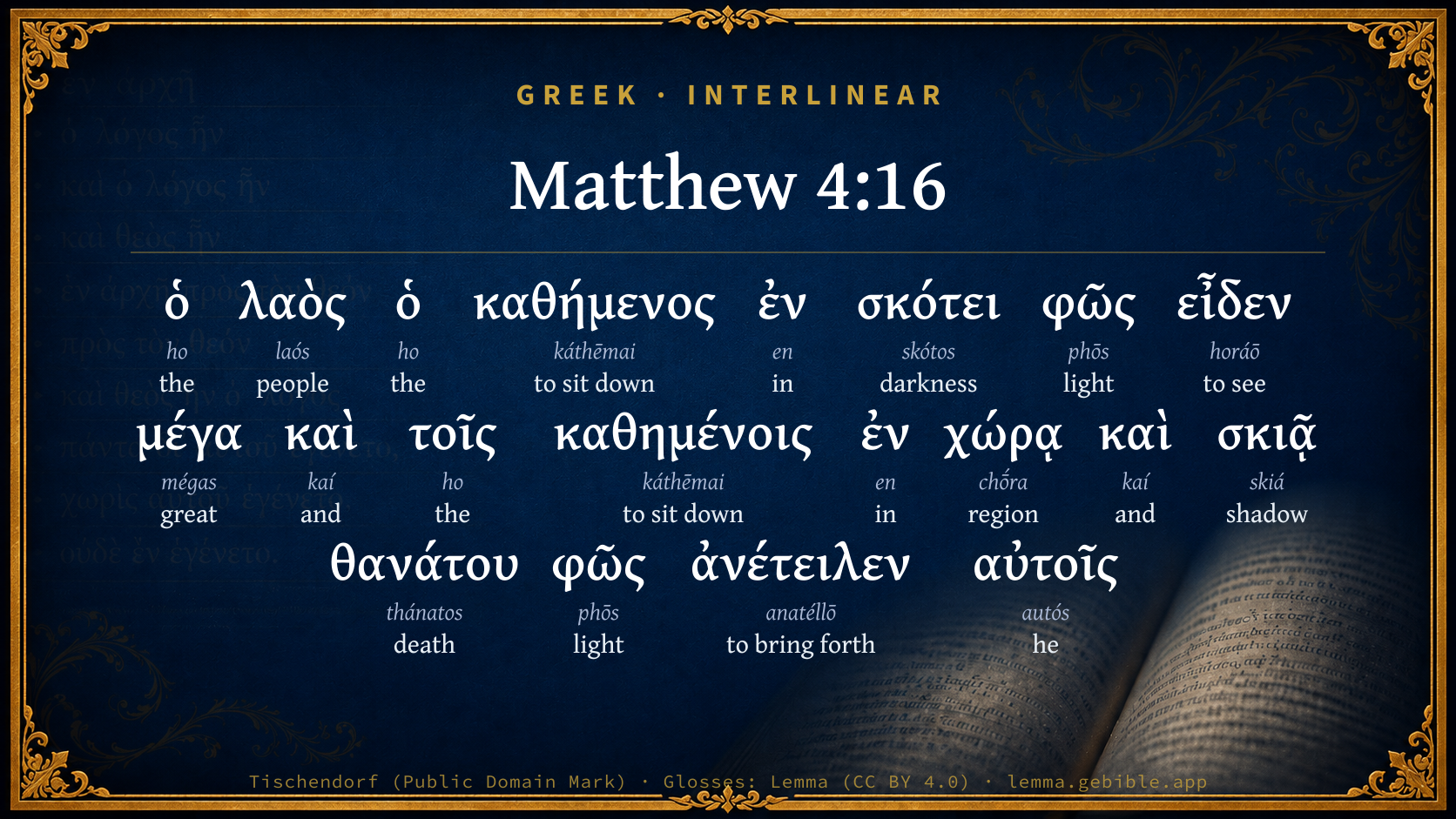
Greek (Tischendorf 8th ed.) Matthew 4:16 appears in the Greek New Testament. The text above is from the Tischendorf 8th edition. Each word links to its Strong’s number and a concise gloss. Click any word for its full Thayer’s Greek Lexicon entry.
Download image
Cite this verse

Matthew 4:16 (World English Bible). Public Domain. Lemma interlinear Bible study tool, https://lemma.gebible.app/v/matthew/4/16.

Show BibTeX & RIS
BibTeX
RIS
English Translation
The people who sat in darkness saw a great light, To those who sat in the region and shadow of death, To them light has dawned."
World English Bible · Public Domain
Highlights
  • 6 first appearances in the Greek New Testament
Full analysis ↓
Download a study sheet

One document with this verse’s original text, its word-by-word gloss line, the meaning frame, cross-references with their text, attributed commentary, and full source and license credits — printable, and it pastes into notes with its structure intact.

This verse Autodidact and up

Study sheet (.html) Plain text (.txt)

A passage Seminary Student

Up to 50 verses in one chapter. A passage sheet keeps up to 6 commentary sources and 12 cross-references per verse, in the order this page ranks them, and says so on the sheet whenever that leaves anything out. Ask for a single verse and you get the Autodidact verse sheet above.

Everything on this page stays free to read, with no account — the sheet is a download of what is already on screen, not access to it.

Want to remove ads? Support Godless Engineer
Compare translations 3

The same verse in 3 English versions, stacked beneath the original-language interlinear above. Click any original word for its lexicon entry.

Each is an independent rendering of the whole verse — the interlinear is not word-aligned to these translations.

Highlighted words mark where these versions differ — a whole-verse word diff, not a word-by-word alignment.

  • World English Bible Public Domain
    The people who sat in darkness saw a great light, To those who sat in the region and shadow of death, To them light has dawned."
  • King James Version Public Domain
    The people which sat in darkness saw great light; and to them which sat in the region and shadow of death light is sprung up.
  • unfoldingWord Literal Text CC BY-SA 4.0
    the people sitting in darkness have seen a great light, and to the ones sitting in the region and shadow of death, upon them has a light arisen.”

unfoldingWord Literal Text — © unfoldingWord, licensed CC BY-SA 4.0. Word-aligned USFM3 via Door43 (git.door43.org/unfoldingWord/en_ult).

Versions to compare (up to 4)

3 of 4 selected

Show all 19 translations

Every available English version of this verse, each an independent rendering of the whole verse.

  • World English Bible Public Domain
    The people who sat in darkness saw a great light, To those who sat in the region and shadow of death, To them light has dawned."
  • Berean Standard Bible Public Domain
    the people living in darkness have seen a great light; on those living in the land of the shadow of death, a light has dawned.”
  • Majority Standard Bible Public Domain
    the people living in darkness have seen a great light; on those living in the land of the shadow of death, a light has dawned.”
  • King James Version Public Domain
    The people which sat in darkness saw great light; and to them which sat in the region and shadow of death light is sprung up.
  • American Standard Version (1901) Public Domain
    The people that sat in darkness Saw a great light, And to them that sat in the region and shadow of death, To them did light spring up.
  • Revised Version (1885) Public Domain
    The people which sat in darkness Saw a great light, And to them which sat in the region and shadow of death, To them did light spring up.
  • Geneva Bible (1599) Public Domain
    The people which sate in darkenes, sawe great light: and to them which sate in the region, and shadowe of death, light is risen vp.
  • Douay-Rheims (1899) Public Domain
    The people that sat in darkness, hath seen great light: and to them that sat in the region of the shadow of death, light is sprung up.
  • Young's Literal Translation Public Domain
    the people that is sitting in darkness saw a great light, and to those sitting in a region and shadow of death -- light arose to them.'
  • Literal Standard Version CC BY-SA 4.0
    The people that is sitting in darkness saw a great light, and to those sitting in a region and shadow of death—light arose to them.”
  • Unlocked Literal Bible CC BY-SA 4.0
    The people who sat in darkness have seen a great light, and to those who sat in the region and shadow of death, upon them has a light arisen.”
  • unfoldingWord Literal Text CC BY-SA 4.0
    the people sitting in darkness have seen a great light, and to the ones sitting in the region and shadow of death, upon them has a light arisen.”
  • Darby Bible Public Domain
    -- the people sitting in darkness has seen a great light, and to those sitting in [the] country and shadow of death, to them has light sprung up.
  • World Messianic Bible Public Domain
    the people who sat in darkness saw a great light; to those who sat in the region and shadow of death, to them light has dawned.”
  • Webster's Bible Public Domain
    The people who sat in darkness, saw great light; and to them who sat in the region and shades of death, light hath arisen.
  • Free Bible Version CC BY-SA 4.0
    The people living in darkness saw a great light; the light of dawn has shined on those living in the land of the shadow of death.”
  • Bible in Basic English Public Domain
    The people who were in the dark saw a great light, and to those in the land of the shade of death did the dawn come up.
  • Text-Critical English NT CC BY 4.0
    the people sitting in darkness have seen a great light, and on those sitting in the region and shadow of death light has dawned.”
  • Tyndale New Testament (1534) Public Domain
    the people which sat in darknes sawe greate lyght and to them which sate in the region and shadowe of deeth lyght is begone to shyne.

Literal Standard Version (2020), Covenant Press — licensed CC BY-SA 4.0. Text via the HelloAO Bible API (eBible.org). Unlocked Literal Bible (unfoldingWord) — licensed CC BY-SA 4.0. Text via the HelloAO Bible API (eBible.org). unfoldingWord Literal Text — © unfoldingWord, licensed CC BY-SA 4.0. Word-aligned USFM3 via Door43 (git.door43.org/unfoldingWord/en_ult). Free Bible Version, Dr. Jonathan Gallagher — licensed CC BY-SA 4.0. Text via the HelloAO Bible API (eBible.org).

Word by word

More ways to search: Search by grammar → Find every occurrence → Compare this word →

Practice this passage: Drill this verse → Learn its vocabulary →

σκιᾷ
skiá
G4639
“shadow”
Noun, Dative, Singular, Feminine
Part of Speech
Noun
Case
Dative
Number
Singular
Gender
Feminine
Full Thayer's Definition

Origin: apparently a primary word

TDNT: 13:34,1

1. shadow a. shade caused by the interception of light b. an image cast by an object and representing the form of that object c. a sketch, outline, adumbration
  1. ὁ ho G3588 “the” Article, Nominative, Singular, Masculine
  2. λαὸς laós G2992 “people” Noun, Nominative, Singular, Masculine
  3. ὁ ho G3588 “the” Article, Nominative, Singular, Masculine
  4. καθήμενος káthēmai G2521 “to sit down” Verb, Present, Middle or Passive deponent, Participle, Nominative, Singular, Masculine
  5. ἐν en G1722 “in” Preposition
  6. σκότει skótos G4655 “darkness” Noun, Dative, Singular, Neuter
  7. φῶς phōs G5457 “light” Noun, Accusative, Singular, Neuter
  8. εἶδεν horáō G3708 “to see” Verb, Aorist, Active, Indicative, 3rd person, Singular
  9. μέγα mégas G3173 “great” Adjective, Accusative, Singular, Neuter
  10. καὶ kaí G2532 “and” Conjunction
  11. τοῖς ho G3588 “the” Article, Dative, Plural, Masculine
  12. καθημένοις káthēmai G2521 “to sit down” Verb, Present, Middle or Passive deponent, Participle, Dative, Plural, Masculine
  13. ἐν en G1722 “in” Preposition
  14. χώρᾳ chṓra G5561 “region” Noun, Dative, Singular, Feminine
  15. καὶ kaí G2532 “and” Conjunction
  16. θανάτου thánatos G2288 “death” Noun, Genitive, Singular, Masculine
  17. φῶς phōs G5457 “light” Noun, Nominative, Singular, Neuter
  18. ἀνέτειλεν anatéllō G393 “to bring forth” Verb, Aorist, Active, Indicative, 3rd person, Singular
  19. αὐτοῖς autós G846 “he” Personal pronoun, Dative, Plural, Masculine

About this verse

These counts appear in no published source. They are computed here, from the morphology-tagged text and Lemma’s own curated glosses. What Lemma adds →

20
words
14
distinct lemmas
Gospels
section

Notable vocabulary

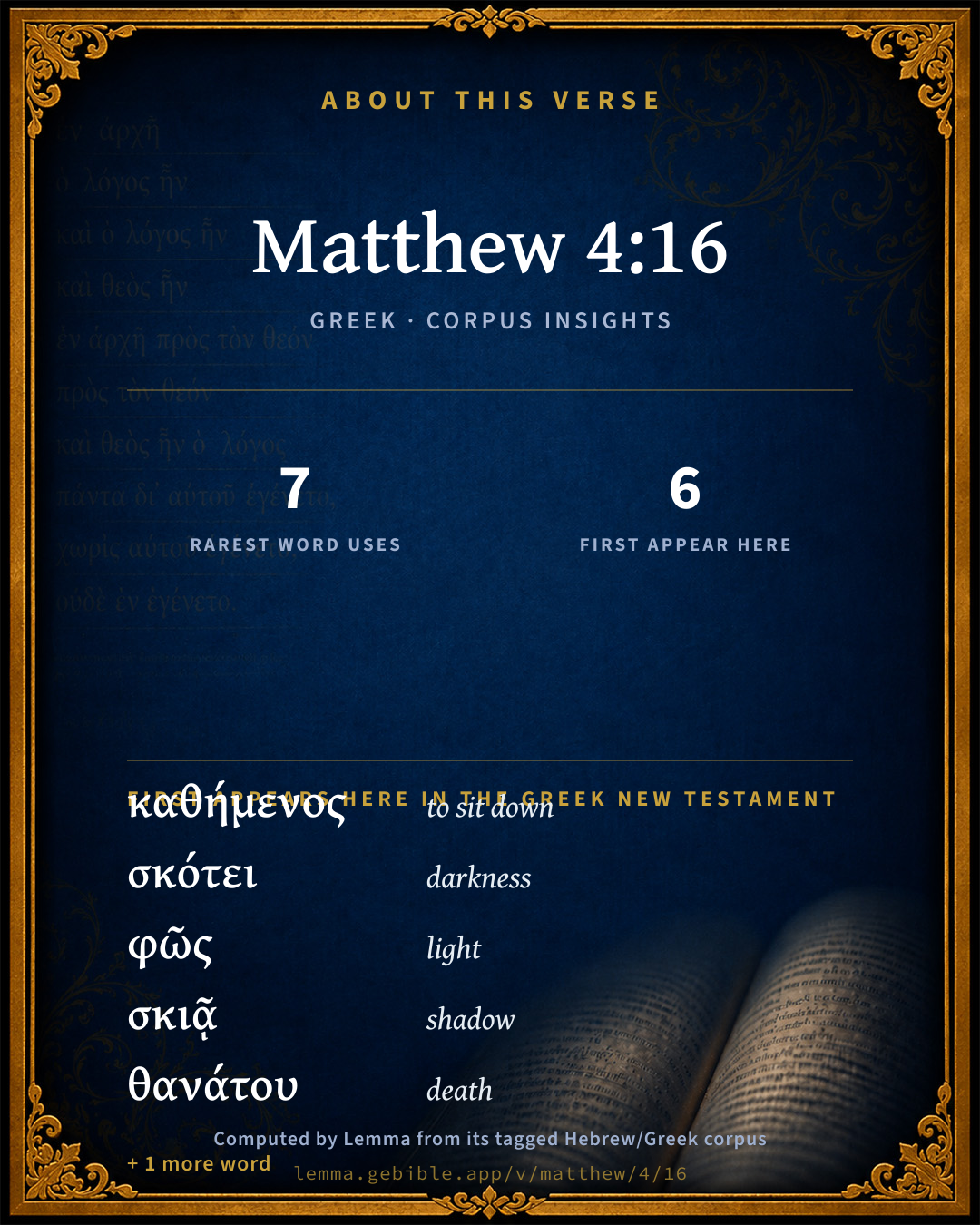
The rarest word here is σκιᾷ shadow G4639 — appearing just 7 times in the whole Greek New Testament.

First appearance in Scripture

These words make their first canonical appearance in the Greek New Testament here:

  • καθήμενος to sit down G2521
  • σκότει darkness G4655
  • φῶς light G5457
  • σκιᾷ shadow G4639
  • θανάτου death G2288
  • ἀνέτειλεν to bring forth G393

Shared distinctive vocabulary

σκιᾷ shadow G4639 occurs in 7 verses of the Greek New Testament. Also found in:
Repetition

Words recur within this verse:

  • καθήμενος to sit down G2521 ×2
  • φῶς light G5457 ×2
  • ὁ the G3588 ×3
  • ἐν in G1722 ×2
  • καὶ and G2532 ×2

Cross-references

13

Topical passages linked to Matthew 4:16 in the Treasury of Scripture Knowledge — connected by theme and wording, ordered by reader-vote popularity; previews shown in the World English Bible.

  • Isaiah 9:2 The people who walked in darkness have seen a great light: those who lived in the land of the shadow of death, on them has the light shined.
  • Isaiah 42:6–7 I, Yahweh, have called you in righteousness, and will hold your hand, and will keep you, and give you for a covenant of the people, for a light of the Gentiles;
  • Luke 1:78–79 Because of the tender mercy of our God, Whereby the dawn from on high will visit us,
  • Isaiah 60:1–3 Arise, shine; for your light is come, and the glory of Yahweh is risen on you.
  • Micah 7:8 Don't rejoice against me, my enemy. When I fall, I will arise. When I sit in darkness, Yahweh will be a light to me.
  • Psalms 107:10–14 Some sat in darkness and in the shadow of death, Being bound in affliction and iron,
  • Luke 2:32 A light for revelation to the Gentiles, And the glory of your people Israel."
  • Amos 5:8 Seek him who made the Pleiades and Orion, And turns the shadow of death into the morning, And makes the day dark with night; Who calls for the waters of the sea, And pours them out on the surface of the earth, Yahweh is his name,
  • Job 34:22 There is no darkness, nor thick gloom, Where the workers of iniquity may hide themselves.
  • Job 3:5 Let darkness and the shadow of death claim it for their own. Let a cloud dwell on it. Let all that makes black the day terrify it.
  • Job 10:22 The land dark as midnight, Of the shadow of death, without any order, Where the light is as midnight.'"
  • Jeremiah 13:16 Give glory to Yahweh your God, before he cause darkness, and before your feet stumble on the dark mountains, and, while you look for light, he turn it into the shadow of death, and make it gross darkness.
  • Psalms 44:19 Though you have crushed us in the haunt of jackals, And covered us with the shadow of death.

Cross-references courtesy of OpenBible.info (CC BY 4.0).

Commentary

Notes on Matthew 4:16 from classic Christian and Jewish commentators (each source and its license shown beneath its notes). The classic Christian expositions comment on the surrounding passage and are grouped to its opening verse, so a note may address several verses; the Jewish commentaries on the Tanakh (Rashi and others) are per-verse, so they appear only where the commentator wrote on this verse.

Lemma curates 59 commentaries, every one of them public domain or Creative Commons licensed, each selected and text-cleaned for this edition rather than reprinted as found. About our sources →

John Gill's Exposition

From that time Jesus began to preach and to say,.... Not from the time he dwelt in Capernaum; for he had preached in Nazareth before he came there, Luk 4:16 nor from the time of John's being cast into prison; for he had preached, and made disciples, who were baptized by his orders, before John's imprisonment, Joh 3:22 Joh 4:1 but from the time that Satan left tempting him; as soon as that combat was over, immediately he went into Galilee, began to preach, and called his disciples. The words with which he began his ministry are the same with which John begun his; which shows the entire agreement between them, in that they not only preached the same doctrine, but in the same words; See Gill on Mat 3:2

Matthew 4:18

mat 4:18

mat 4:18

mat 4:18And Jesus walking by the sea of Galilee,.... Not for his recreation and diversion, or by accident: but on purpose to look out for, and call some, whom he had chosen to be his disciples. And as he was walking about, to and fro, he "saw two" persons; and as soon as he saw them, he knew them to be those he had determined to make his apostles: and these are described by their relation to each other, "brethren"; not merely because they were of the same nation, or of the same religion, or of the same employ and business of life, but because they were of the same blood; and by their names, "Simon called Peter, and Andrew his brother". Simon is the same name with "Simeon"; and so he is called, Act 15:14 and which, in the Jerusalem dialect, is read "Simon". His surname "Peter", which was afterwards given him by Christ, Mat 16:18 is Greek, and answers to "Cephas", signifying a "rock": though this name is to be met with in the Talmudic (d) writings, where we read of R. Jose, , "bar Petros". This his surname is added here, to distinguish him from Simon, the Canaanite. The name of his brother Andrew is generally thought to be Greek; though some have derived it from "to vow", and is also to be observed in the writings of the Jews (e); where mention is made of R. Chanina, bar Andrei. They are further described by the work they were at, or business they were employed in,

casting a net into the sea; either in order to catch fish in it, or to wash it, Luk 5:2 and the reason of their so doing is added; "for they were fishers". Of this mean employment were the very first persons Christ was pleased to call to the work of the ministry; men of no education, who made no figure in life, but were despicable and contemptible: this he did, to make it appear, that they were not qualified for such service of themselves; that all their gifts and qualifications were from him; to show his own power; to confound the wisdom of the wise; and to let men see, that none ought to glory in themselves, but in him. The Jews have a notion of the word of God and prophecy being received and embraced only by such sort of persons: says R. Isaac Arama (f),

"his word came to heal all, but some particular persons only receive it; and who of all men are of a dull under standing, , "fishermen, who do business in the sea": this is what is written; "they that go down to the sea in ships, that do business in great waters, these see the works of the Lord": these seem not indeed fit to receive anything that belongs to the understanding, because of their dulness; and yet these receive the truth of prophecy and vision, because they believe his word.''

I cannot but think, that some respect is had to these fishers, in Eze 47:10 "it shall come to pass that fishers shall stand upon it": that is, upon, or by the river of waters, said in Eze 47:8 to "issue out toward the east country, and go down into the desert": which both R. Jarchi and Kimchi understand of the sea of Tiberias; the same with the sea of Galilee, by which Christ walked; and where he found these fishers at work, and called them. See also Jer 16:16

(d) T. Hieros. Moed Katon, fol 82. 4. Avoda Zara, fol 42. 3. (e) T. Hieros. Megilla, fol. 75. 2. & Geracot, fol. 2. 3. (f) Apud Galatin. de Arcan. Cathol. ver. l. 3. c. 5. p. 119. & Crocium de Messia Thes. 213. p. 62, 63.

John Gill's Exposition of the Whole Bible (1746–1763) — public domain (CC PDM 1.0). Text via the HelloAO Bible API.

The Biblical Illustrator

Joseph S. Exell

Mat_4:16

Sat in darkness.

Darkness and light

I. The deep darkness which envelops the world without the gospel. Darkness and the region of the shadow of death, striking emblems of error, ignorance, sin, guilt, misery, danger.

1. The heathen world is in this darkness (Rom_1:18-32).

2. In the very midst of Christendom there is this darkness. Home heathenism, etc. The condition of all unregenerate men.

II. The uprising of a glorious light for the transformation of the darkness. There is no redeeming principle in mans apostate nature. But for the prospects opened by the gospel, there must be the darkness of final and absolute despair. Materialism, etc., are as powerless as the ancient systems to reach the conscience and renew the heart (Isa_38:17; Isa_45:8, and others). But glorious is the view in the text, etc. Concerning this light, observe-

1. Its source. The gospel is light, and this marks its divinity. God who commanded, etc.

2. Its adaptation: To every stage of human society; to the common wants of man-instruction, comfort, etc.; to every order of mind; to every possible condition, etc. The gospel offers pardon for the guilty, etc.

3. Its diffusiveness. A great light-penetrating. Progress of the gospel in apostolic times, etc. In how many dark places has light sprung up, etc.

4. Its efficacy. Not a dead letter, but the power of God, etc.

It will finally prevail-All the ends of the earth shall see, etc.

1. Has the Sight arisen upon your soul?

2. Are you manifesting it in your life, etc.?

3. Are you doing what you can to communicate it to others? (A. Tucker.)

Light for those who sit in darkness

I. Some souls are in greater darkness than others.

1. The darkness of ignorance.

2. The darkness of error.

3. The gloom of discomfort and sorrow, attended with fear.

4. Hopelessness, sat in darkness.

5. In the region of death.

II. For those who are in a worse condition than others there is hope and light.

1. In barbarous nations Christ has won great victories.

2. In the worst hearts Christ has dawned.

3. When these have beheld the light, they frequently become eminently useful to others.

4. The conversion of the deplorably dark brings the highest degree of glory to God.

III. The true light for a soul in darkness is all in Christ.

1. There is light in Christs name for a troubled sinner.

2. In His person and nature.

3. In His offices.

4. In His character.

IV. The poor soul in darkness need not despair, for light is all around you. It has already sprung up. (C. H. Spurgeon.)

The Biblical Illustrator, edited by Joseph S. Exell (c. 1880s–1900s) — public domain. Text from a community e-Sword module.

Joseph Benson's Commentary

Mat 4:16. The people who sat in darkness — They whose predecessors were afflicted by the Assyrians, and who, before Christ visited them, were captives of Satan, and had lived in gross ignorance of God and religion, being far from Jerusalem, the place of worship, and intermixed with the Tyrians, Sidonians, and other wicked heathen: saw a great light — This is spoken by Isaiah in the prophetic style, which represents things future as already accomplished, because certainly to be accomplished. This whole country had been overspread with spiritual darkness, but, by the example and preaching of Christ, the day-spring from on high visited it, diffusing among its inhabitants knowledge and holiness, and guiding their feet into the way of peace. “There were several reasons,” says Dr. Macknight, “which might determine Jesus to be so much about the sea of Galilee. 1st, The countries which surrounded this sea were large, fertile, and populous, especially the two Galilees. For, according to Josephus, Bell., Mat 3:2, they alone had many towns, and a multitude of villages, the least of which contained above 15,000 souls. On the east side of the lake were Chorazin, Gadara, and Hippon; on the west, Capernaum, Tiberias, Bethsaida, and Tarrichea, with other places of inferior note. Wherefore, as it was agreeable to the end of Christ’s coming that his doctrine should be spread extensively, and his miracles wrought publicly, no country could be a fitter scene for his ministry than this. Besides its numerous inhabitants, there were at all times many strangers resorting to the trading towns on the lake, who, after hearing Jesus preach, could carry home with them the glad tidings of salvation which were the subjects of his sermons. Capernaum, chosen by Christ as the place of his residence, was a town of this kind, and much frequented. 2d, The countries round the lake were remote from Jerusalem, the seat of the scribes and Pharisees, who would not have borne with patience the presence of a teacher held in such estimation as Jesus deservedly was. We know this by what happened in the beginning of his ministry, when he made and baptized many disciples in Judea. They took such offence at it, that he was obliged to leave the country. Wherefore, as it was necessary that he should spend a considerable time in preaching and working miracles, both for the confirmation of his mission, and for the instruction of his disciples in the doctrines they were afterward to preach, these countries were, of all others, the most proper for him to reside in, or rather, they were the only places where he could be with safety for any time.”

Joseph Benson's Commentary on the Old and New Testaments (1811–1818) — public domain. Text from a community e-Sword module.

The Pulpit Commentary

The people which sat; "who walk" (Hebrew). Saw great light; saw a great light (Revised Version); unnecessarily except as a matter of English, for it can hardly mean a definite light, Messiah. Fwv both here and in the next clause means light as such. And to them which sat. So the Hebrew, but the LXX generally oi katoikountev . In the region and shadow of death. The region where death abides, and where it casts its thickest shade. The Hebrew is simply "in the land of the shadow of death" (twmlx xrab, according to the traditional interpretation), which the present LXX (Vatican) probably represents (en cwra skia yanatou), the v of skiav having been misread before q. But copyists, not understanding this, inserted kai between cwra and skia (as in A), and this reading became popularly known, and was used by the evangelist. That the reading of A was derived from the evangelist is unlikely, for the reading skia must, at all events, have been before his time. Light is sprung up; to them, did light spring up (Revised Version); aneteilen . The tense emphasizes not the abiding effect (e.g. in the fact that so many of the disciples were Galilaeans), but the moment of his appearance. The father of the Baptist also remembered this passage of Isaiah. (Luk_1:78, Luk_1:79, where cf. Godet)

The extremes of light and darkness.

The interval between the place of this verse and the close of the three temptations is considerable, and is not evident from the passage before us. It is also even obscured by the order of the verses here. Much history belongs to the gap between vers. 11 and 12. The seventeenth verse, as regards the matter of it, follows the twelfth. That, again, begs the fuller explanations of Mat_14:3-5; and lastly, after all the history of Jesus visiting the synagogue of that Nazareth "where he had been brought up," given us in Luk_4:16-31, the proper chronological place of our vers. 13-16 is found. The one chief fact of history revealed by these verses is to the intent that Jesus, for whatsoever reason, takes up his abode in Capernaum; and certainly one chief moral significance is exhibited as attaching to that fact, namely, that so far from being an enlightened place, or a little more enlightened haply than some others, it was in and of itself, as also of the announcement of signal prophecy, the head-quarters and metropolis of darkness. The place wan dark, the district was dark, the people were dark they even "sat in darkness." This spot was the principal residence of Jesus, this district the principal scene of his ministry, and "mighty works" and "gracious words." Notice in this prophetic announcement, now reduced to fact

I A SPLENDID ILLUSTRATION OF ONE LEADING METHOD FOLLOWED BY CHRISTIANITY FOR THE REGENERATION OF MANKIND. The Light comes to the darkness, though it take the darkness a long time to "comprehend" it.

II A CONVINCING ILLUSTRATION OF THE GENUINELY CONDESCENDING CHARACTER OF THE FOUNDER AND EXEMPLAR OF CHRISTIANITY. The personal Light comes to those thick-covered and sunk in the very degradation of darkness, and endures patiently all the consequence.

III A CONSUMMATE ILLUSTRATION OF THE THRILLING RESPONSIBILITY THAT GATHERS UPON MEN ON WHOM CHRISTIAN GIFT IS BESTOWED. Light itself is offered them the light of

(1) correct information about themselves;

(2) correct instruction about their Help and Deliverer;

(3) perfect holiness and goodness;

(4) a perfect Example and Model;

(5) the unseen future and eternal. These are the things that make responsibility. B.

The Pulpit Commentary (1880–1919), ed. H.D.M. Spence-Jones & Joseph S. Exell — public domain. Text from a community e-Sword module.

Bengel's Gnomon

Johann Albrecht Bengel

Mat 4:16. Ὁ πορευόμενος, that walketh) There is here a threefold ascending climax.[153]

[153] i.e. The three experssions used in the latter clause of this sentence are respectively stronger than those used in the former clause.—(I. B)

First Clause.

Second Clause.

The people that Walketh

And on those sitting

In Darkness

In the Region and Shadow of Death,

Hath seen a Great Light.

A Light hath arisen.

It is worse to sit, detained, in darkness, than to walk in it.[154]—εἶδε, hath seen—φῶς, a Light[155]) No one is saved except he be illuminated [by that Light]. See Act 13:47.—καὶ τοῖς κυθημένοις, κ.τ.λ., and to those sitting, etc.) The LXX. in Psalms 107(106):10, have καθημένους ἐν σκότει καὶ σκιᾷ θανάτου, sitting in darkness and the shadow of death. The verb to sit aptly denotes a sluggish solitude.—χώρᾳ καὶ σκιᾷ, region and shadow) one thing expressed by two words.[156] The natural situation of the country was low, and such was also its spiritual condition.—ἈΝΈΤΕΙΛΕΝ ΑὐΤΟῖς, hath risen upon them) In the original Hebrew it is נגה, shines, upon them. This increased force of expression corresponds with the epithet μέγα, great, in the preceding clause.

[154] Unfortunately for this remark, there is no very ancient authority for πορευόμενος. All the oldest MSS. and versions, Vulg., etc., read καθήμενος. Lachm. and Tischend. do not even notice the former reading.—ED.

[155] “Which illumines the whole world.”—B. G. V.

[156] In the original, ἕν διὰ δυοῖν. See Explanation of Technical Terms.—(I. B.)

Bengel's Gnomon of the New Testament — English translation (T&T Clark, Edinburgh, 1860) — public domain. Text from a community e-Sword module.

Meyer's Critical & Exegetical Commentary

Heinrich August Wilhelm Meyer

Mat_4:16. Ὁ λαὸς ὁ καθήμενος, κ.τ.λ.] In opposition to Γαλιλαία τῶν ἐθνῶν, whose inhabitants are characterized as darkened, that is, devoid of divine truth, and sunk in ignorance and sin. The great light, however, which these darkened ones saw is Jesus.

καὶ τοῖς καθημένοις, κ.τ.λ.] repeats the same thought, with the climactic designation of darkness: ἐν χώρᾳ κ. σκιᾷ θανάτου, in the land and darkness, which belong to death. Death, that is, spiritual death (Mat_8:22, see on Luk_15:24), the negation of that living activity which recognises the truth and is morally determined, is personified; the land, whose inhabitants are spiritually dead, belongs to it as the realm of its government, and darkness surrounds it. The common interpretation of it as ἓν διὰ δυοῖν: in regione et in spissis quidem tenebris = in regione spissis tenebris obducta (Fritzsche), is, indeed, admissible (see Fritzsche, Exc. IV. p. 856; Nägelsbach on Hom. Il. iii. 100), but unnecessary, and takes away from the poetic description, which is certainly stronger and more vivid if θανάτου is connected not merely with σκιᾷ (צַלְמָוֶת, infernalis obscuritas, i.e. crassissima), but also with χώρᾳ. On the significant καθήμενος, comp. Lam. l.c. Pind. Ol. i. 133: ἐν σκότῳ καθήμενος. Sedendi verbum aptum notandae solitudini inerti (Bengel). Comp. especially, Jacobs, ad Anthol. VI. p. 397; Bremi, ad Dem. Phil. I. p. 119. Nägelsbach on Hom. Il. i. 134.

αὐτοῖς] see Winer, p. 139 f. [E. T. 265]; Buttmann, p. 125 [E. T. 381].

Meyer — Critical and Exegetical Commentary on the New Testament — English translation by Peter Christie, edited by Frederick Crombie (T&T Clark, 1880) — public domain. Text from a community e-Sword module.

Expositor's Greek Testament

ed. W. Robertson Nicoll

Mat 4:16 . ἐν σκοτίᾳ : the darkness referred to, in the view of the evangelist, is possibly that caused by the imprisonment of the Baptist (Fritzsche). The consolation comes in the form of a greater light, φῶς μέγα , great, even the greatest. The thought is emphasised by repetition and by enhanced description of the benighted situation of those on whom the light arises: “in the very home and shadow of death”; highly graphic and poetic, not applicable, however, to the land of Galilee more than to other parts of the land; descriptive of misery rather than of sin.

The Expositor's Greek Testament, edited by W. Robertson Nicoll (1897–1910) — public domain. Text from a community e-Sword module.

Jamieson, Fausset & Brown

Robert Jamieson, A. R. Fausset & David Brown

The people which sat in darkness saw great light; and to them which sat in the region and shadow of death light is sprung up--The prophetic strain to which these words belong commences with the seventh chapter of Isaiah, to which the sixth chapter is introductory, and goes down to the end of the twelfth chapter, which hymns the spirit of that whole strain of prophecy. It belongs to the reign of Ahaz and turns upon the combined efforts of the two neighboring kingdoms of Syria and Israel to crush Judah. In these critical circumstances Judah and her king were, by their ungodliness, provoking the Lord to sell them into the hands of their enemies. What, then, is the burden of this prophetic strain, on to the passage here quoted? First, Judah shall not, cannot perish, because IMMANUEL, the Virgin's Son, is to come forth from his loins. Next, one of the invaders shall soon perish, and the kingdoms of neither be enlarged. Further, while the Lord will be the Sanctuary of such as confide in these promises and await their fulfilment, He will drive to confusion, darkness, and despair the vast multitude of the nation who despised His oracles, and, in their anxiety and distress, betook themselves to the lying oracles of the heathen. This carries us down to the end of the eighth chapter. At the opening of the ninth chapter a sudden light is seen breaking in upon one particular part of the country, the part which was to suffer most in these wars and devastations--"the land of Zebulun, and the land of Naphtali, the way of the sea, beyond Jordan, Galilee and the Gentiles." The rest of the prophecy stretches over both the Assyrian and the Chaldean captivities and terminates in the glorious Messianic prophecy of the eleventh chapter and the choral hymn of the twelfth chapter. Well, this is the point seized on by our Evangelist. By Messiah's taking up His abode in those very regions of Galilee, and shedding His glorious light upon them, this prediction, He says, of the Evangelical prophet was now fulfilled; and if it was not thus fulfilled, we may confidently affirm it was not fulfilled in any age of the Jewish ceremony, and has received no fulfilment at all. Even the most rationalistic critics have difficulty in explaining it in any other way.

Jamieson, Fausset & Brown — Commentary Critical and Explanatory on the Whole Bible (1871) — public domain (CC PDM 1.0). Text via the HelloAO Bible API.

Adam Clarke's Commentary

Verse 16. The people which sat in darkness] This is quoted from Isa 9:2, where, instead of sitting, the prophet used the word walked. The evangelist might on purpose change the term, to point out the increased misery of the state of these persons. Sitting in darkness expresses a greater degree of intellectual blindness, than walking in darkness does. In the time of Christ's appearing, the people were in a much worse state than in the time of the prophet, which was nearly 700 years before; as, during all this period, they were growing more ignorant and sinful.

The region and shadow of death] These words are amazingly descriptive. A region of death - DEATH'S country, where, in a peculiar manner, Death lived, reigned, and triumphed, subjecting all the people to his sway.

Shadow of death] σκια θανατου, used only here and in Lu 1:79, but often in the Old Covenant, where the Hebrew is צל מות tsal maveth, It is not easy to enter fully into the ideal meaning of this term. As in the former clause, death is personified, so here. A shadow is that darkness cast upon a place by a body raised between it and the light or sun. Death is here represented as standing between the land above mentioned, and the light of life, or Sun of righteousness; in consequence of which, all the inhabitants were, involved in a continual cloud of intellectual darkness, misery, and sin. The heavenly sun was continually eclipsed to them, till this glorious time, when Jesus Christ, the true light, shone forth in the beauty of holiness and truth. Christ began his ministry in Galilee, and frequented this uncultivated place more than he did Jerusalem and other parts of Judea: here his preaching was peculiarly needful; and by this was the prophecy fulfilled.

Adam Clarke's Commentary on the Bible (1810–1826) — public domain. Text from a community e-Sword/MySword module.

The Cambridge Bible for Schools and Colleges

gen. ed. J. J. S. Perowne

16. the people which sat in darkness] The invasion of Tiglathpileser, whom Ahaz called in to assist him against Rezin and Pekah, fell with great severity on the Northern tribes (2Ki_15:29). Yet even they are promised a great deliverance [“there shall not hereafter be darkness in the land that was distressed,” Isa_9:1], in the first instance, by the destruction of Sennacherib, from temporal distress (cp. Is. chs. 10 and 11 with ch. Mat_9:1-6); secondly, by the advent of the Messiah, from spiritual darkness.

The Cambridge Bible for Schools and Colleges (gen. ed. J. J. S. Perowne; Cambridge University Press, 1878–1918) — public domain. Text from a community e-Sword module.

Trapp's Complete Commentary

John Trapp

16 The people which sat in darkness saw great light; and to them which sat in the region and shadow of death light is sprung up.

Ver. 16. The people which sat in darkness saw a great light] For the day-spring from on high visited them, the bright Sun of righteousness (which had all Palestine for his zodiac, the twelve tribes for his signs) stayed longest in Zabulon and Nephthalim, Luk 1:2; Mal 4:2; and (St Jerome observeth) as these two tribes were first carried into captivity, and seemed farthest from heaven, as bordering on the Gentiles, and in many things symbolizing with them, having learned their manners; so redemption was first preached in these countries. Physicians are of most use where diseases abound. The prophets in Elisha’s days planted at Bethel. There was at once the golden calf of Jeroboam and the school of God.

Sat in darkness, and in the region and shadow of death] Note here that a state of darkness is a state of death. This is condemnation, this is hell above ground and beforehand, that "light is come into the world, and men love darkness better than light," Joh 3:36. Ut liberius peccent libenter ignorant. (Bernard.) Now surely they shall one day have enough of their so much desired darkness, Pro 14:14. They know not the light, saith Job. {Job 24:13} They hate it, saith our Saviour, Joh 3:20. They spurn and scorn at it, saith Solomon, Pro 1:22; therefore shall they be filled in their own ways, while they are cast into utter darkness, a darkness beyond a darkness (σκοτος εξωτερον), as it were a dungeon beyond a prison, where they shall never see light again, till they be enlightened with that universal fire of the last day to their everlasting amazement, 2Th 1:8.

Light is sprung up] He brought them "out of darkness into his marvellous light." So he did the Samaritans by Philip’s preaching and miracles, whereupon there was great joy in that city, 1Pe 2:9; Act 8:8. So by the ministry of Farel, Viret, Calvin, and others, he drew the Genevans out of the dark midnight of damned Popery; in a thankful remembrance whereof they coined new money, with this inscription on the one side, Post tenebras lux, After darkness light. (Their posy then had been, Post tenebras spero lucem, taken out of Job.) And on the other side, Deus noster pugnat pro nobis, Our God fighteth for us. (Scultet. Annal.)

John Trapp, A Commentary or Exposition upon All the Books of the Old and New Testament (1647–1656) — public domain. Text from a community e-Sword module.

Haydock's Catholic Bible Commentary

And a light is risen, &c. This light, foretold by the prophet Isaias, (chap. ix, ver. 1,) was our Saviour Jesus Christ, the light of the world, who now enlightened them by his instructions, and by his grace. (Witham) --- Thus when the morning star has gone by and disappeared, the sun rises and diffuses its light to mortals, who rejoice that the darkness of night is removed from the earth. (Jansenius)

George Leo Haydock (1774–1849), Haydock's Catholic Family Bible and Commentary, 1859 edition — public domain. Excludes Psalms (Douay-Rheims chapter numbering differs from Protestant) and Deuterocanonical books (Catholic canon only).

Whedon's Commentary on the Bible

Daniel D. Whedon

16. The people — That is, the people of the land of Zebulun and Naphthali.

Sat in darkness — The prophet says, “Walked in darkness.” Sat in darkness embraces the same idea, but an intenser meaning. He who walks in darkness may be looking for light; but he who sits in darkness is settled in his condition. Saw great light — The prophet describes the future as past. Before his eye the scene transpires. The people are described as sitting in hopeless midnight, when a sudden noonday breaks upon them.

Shadow of death — Physically we conceive there to be a darkness of night, and also a deeper darkness of death. Spiritually, too, as here, there is to the souls of men a darkness of moral night; and when this becomes hopeless it deepens to the shades of spiritual and eternal death. In this condition of hopeless spiritual darkness of death, were these Galileans when the Messianic light, Jesus, the Redeemer, sprung up upon them.

Daniel D. Whedon (gen. ed.), Commentary on the Old and New Testaments (1874–1909) — public domain. Text from a community e-Sword module.

John Wesley's Explanatory Notes

Here is a beautiful gradation, first, they walked, then they sat in darkness, and lastly, in the region of the shadow of death.

John Wesley, Explanatory Notes Upon the Whole Bible (1754–1765) — public domain. Text via the GEBible commentary corpus.

The People's New Testament

B. W. Johnson

16. The people. Those of the region just described. Sitting in darkness. In religious ignorance. Saw great light. Christ, the Light of the world. In the teaching of Jesus in the region described by the prophet there was a remarkable fulfillment of the prediction.

B. W. Johnson's The People's New Testament with Notes (1889–1891) — public domain. Electronic text from the Christian Classics Ethereal Library (CCEL) ThML edition.

Cambridge Greek Testament for Schools and Colleges

16. σκότει, the reading of textus receptus retained in preference to σκοτίᾳ. The question of reading is interesting, the great MSS. being divided. א*CEL and the majority of uncials are in favour of σκότει. אbBD read σκοτίᾳ. Of the leading editors Lachmann and Tregelles (neither of whom had seen א) read σκοτίᾳ, Tischendorf reads σκότει.

16. ὁ λαὸς ὁ καθήμενος, κ.τ.λ. The quotation nearly follows the Hebrew of Isa 9:1-2 (two lines of the original being omitted). The LXX. presents a wide difference in form.

The repeated καθήμενος … καθημένοις of the text represents two distinct Hebrew words, the first signifying literally ‘walking.’ The parallelism suffers by the Greek translation, ‘to sit’ being an advance on ‘to walk,’ as implying a more settled condition. Cp. Psa 1:1, ‘walked … stood … sat.’ In like manner σκιὰ θανάτου is an advance on σκότος, and φῶς ἀνέτειλεν αὐτοῖς implies a great deal more than φῶς εἶδεν μέγα.

Cambridge Greek Testament for Schools and Colleges (Cambridge University Press, 1896; 21 vols, various authors incl. Carr, Maclear, Plummer, Farrar, Lumby, Moule, M. R. James, Simcox) — public domain. Text from a community e-Sword module.

International Critical Commentary

16. The people which (was) sitting in darkness saw a great light. And for those sitting in a region and shadow of death, light rose for them.] The editor seems to be quoting a Greek version, otherwise he would hardly have rendered דרך by the accusative ὁδόν. In the original it is the object of a verb; but Mt., who wrests the words from the context and omits the verbs, would, if translating from the Hebrew, have rendered ὁδός just as he has given us γῆ, not γῆν. ὁδόν can only be due to careless copying from a version before him. This version was not the LXX., which differs a good deal from Mt.’s rendering. B of the LXX. has not ὁδὸν θαλάσσης but these words stand in LXX. אo a A Q, and were found in Aquila and Theodotion. Mt. presumably had before him a Greek version which was either different from the LXX., or was an early form of the LXX., containing ὁδὸν θαλάσσης In the latter case he has adapted the verbs to suit his context. We need not inquire as to the exact signification of the geographical terms in the original. The editor tears the words from their context, because he saw in them a prophecy of the fact that Christ went to Galilee to begin His ministry, and settled for that purpose at Capharnaum, which became from henceforth His headquarters. Isaiah had spoken of Galilee (Γαλιλαία τῶν ἐθνῶν). He had also spoken of ὁδὸν θαλάσσης, and Capharnaum was παραθαλασσία. Isaiah had spoken also of Zebulon and Naphtali, and Capharnaum was in the territory of these tribes. The prophet had said of these places that their inhabitants should see a great light. When Christ began His work amongst them this was fulfilled. Whatever, therefore, may have been the original signification of דרך הים, or of its Greek equivalent ὁδὸν θαλάσσης, it is hardly possible to doubt that Mt. had in mind when he copied the words the lake of Galilee, and described Capharnaum as τὴν παραθαλασσίαν to make his meaning clear.

Γῆ Ζαβουλὼν καὶ γῆ Νεφθαλείμ] LXX. has χώρα Ζαβουλὼν ἡ γῆ Νεφθαλείμ.—ὁδὸν θαλάσσης] See above.—πέραν τοῦ Ἰορδάνου] So LXX., the usual equivalent of עבר הירדן.—Γαλιλαία τῶν ἐθνῶν] So LXX.—ὁ λαὸς ὁ καθήμενος ἐν σκότει] LXX. B has πορευόμενος after the Heb., but A καθήμενος—εἰδε φῶς μέγα] LXX. ἴδετε B, εἴδετε א* Γ, εἶδε א c.—καὶ τοῖς καθημένοις] LXX. οἱ κατοικοῦντες.—ἐν χώρᾳ καὶ σκιᾷ θανάτου] So LXX. (om. καί B א*).—φῶς ἀνέτειλεν αὐτο͂ις] LXX.: φῶς λάμψει ἐφʼ ὑμᾶς

(M)

16. ἐν χώρᾳ καὶ σκιᾷ] S1 has: “in sorrow and in the shadow of death”; S2 “in the shadows of death.”

International Critical Commentary — older volumes (1896–1929), various authors — public domain. Text from a community e-Sword module.

Vincent's Word Studies in the New Testament

Marvin R. Vincent

The people which sat [ο καθλημενος] ; Wyc., dwelt. The article with the participle (lit., the people, the one sitting) signifying something characteristic or habitual : the people whose characteristic it was to sit in darkness. This thought is emphasized by repetition in a stronger form; sitting in the region and shadow of Death. Death is personified. This land, whose inhabitants are spiritually dead, belongs to Death as the realm of his government.

Marvin R. Vincent, Word Studies in the New Testament (1887–1900) — public domain. Text from a community e-Sword/MySword module.

Lesson kit

Teaching starters — assembled from the data on this page, not authored interpretation. Every prompt links to the verse data it draws on. Edit before teaching.

Matthew, in the Gospels, opens this verse with 20 words (14 distinct Greek lemmas). Its most distinctive word is skiá (“shadow”). A historical commentator’s framing appears above. Read the whole chapter for the surrounding context.

Discussion questions

  1. What does “shadow” (skiá) contribute to the verse as a whole?
  2. 6 words make their first appearance in Scripture here. What does this debut establish?
  3. How does Mark 4:32, which shares the word «shadow», read alongside this verse?
  4. What does the repetition of “to sit down” (2× in this one verse) do in this verse?
  5. These translations render this verse differently. What is at stake in choosing one wording over another?
  6. Compare how John Gill's Exposition and The Biblical Illustrator read this verse. Where do they agree or differ?

Things to notice

  • 6 words make their first canonical appearance in Scripture here.
  • These translations choose different wording for 14 words in this verse.
  • “to sit down” occurs 2× in this single verse.
  • 14 distinct Greek lemmas span 20 words in this verse.

Reading settings

Reading text

Shown beneath each verse's original-language words.

Old Testament
Old Testament edition

Read the OT as the Masoretic Hebrew (MT) or the Greek Septuagint (LXX).

English shown for the Greek Septuagint (in the Hebrew ↔ Greek comparison).

Comparing translations? Open the Compare panel on any verse page to stack up to four side by side.