Matthew 28:20

Greek (Tischendorf 8th ed.) Matthew 28:20 appears in the Greek New Testament. The text above is from the Tischendorf 8th edition. Each word links to its Strong’s number and a concise gloss. Click any word for its full Thayer’s Greek Lexicon entry.
Download image
Cite this verse

Matthew 28:20 (World English Bible). Public Domain. Lemma interlinear Bible study tool, https://lemma.gebible.app/v/matthew/28/20.

Show BibTeX & RIS
BibTeX
RIS
English Translation
teaching them to observe all things that I commanded you. Behold, I am with you always, even to the end of the age." Amen.
World English Bible · Public Domain
Download a study sheet

One document with this verse’s original text, its word-by-word gloss line, the meaning frame, cross-references with their text, attributed commentary, and full source and license credits — printable, and it pastes into notes with its structure intact.

This verse Autodidact and up

Study sheet (.html) Plain text (.txt)

A passage Seminary Student

Up to 50 verses in one chapter. A passage sheet keeps up to 6 commentary sources and 12 cross-references per verse, in the order this page ranks them, and says so on the sheet whenever that leaves anything out. Ask for a single verse and you get the Autodidact verse sheet above.

Everything on this page stays free to read, with no account — the sheet is a download of what is already on screen, not access to it.

Want to remove ads? Support Godless Engineer
Compare translations 3

The same verse in 3 English versions, stacked beneath the original-language interlinear above. Click any original word for its lexicon entry.

Each is an independent rendering of the whole verse — the interlinear is not word-aligned to these translations.

Highlighted words mark where these versions differ — a whole-verse word diff, not a word-by-word alignment.

  • World English Bible Public Domain
    teaching them to observe all things that I commanded you. Behold, I am with you always, even to the end of the age." Amen.
  • King James Version Public Domain
    Teaching them to observe all things whatsoever I have commanded you: and, lo, I am with you alway, even unto the end of the world. Amen.
  • unfoldingWord Literal Text CC BY-SA 4.0
    teaching them to keep everything, as much as I commanded you. And behold, I am with you all the days, until the end of the age.”

unfoldingWord Literal Text — © unfoldingWord, licensed CC BY-SA 4.0. Word-aligned USFM3 via Door43 (git.door43.org/unfoldingWord/en_ult).

Versions to compare (up to 4)

3 of 4 selected

Show all 19 translations

Every available English version of this verse, each an independent rendering of the whole verse.

  • World English Bible Public Domain
    teaching them to observe all things that I commanded you. Behold, I am with you always, even to the end of the age." Amen.
  • Berean Standard Bible Public Domain
    and teaching them to obey all that I have commanded you. And surely I am with you always, even to the end of the age.”
  • Majority Standard Bible Public Domain
    and teaching them to obey all that I have commanded you. And surely I am with you always, even to the end of the age. Amen.”
  • King James Version Public Domain
    Teaching them to observe all things whatsoever I have commanded you: and, lo, I am with you alway, even unto the end of the world. Amen.
  • American Standard Version (1901) Public Domain
    teaching them to observe all things whatsoever I commanded you: and lo, I am with you always, even unto the end of the world.
  • Revised Version (1885) Public Domain
    teaching them to observe all things whatsoever I commanded you: and lo, I am with you alway, even unto the end of the world.
  • Geneva Bible (1599) Public Domain
    Teaching them to obserue all things, whatsoeuer I haue commanded you: and lo, I am with you alway, vntill the ende of the worlde, Amen.
  • Douay-Rheims (1899) Public Domain
    Teaching them to observe all things whatsoever I have commanded you: and behold I am with you all days, even to the consummation of the world.
  • Young's Literal Translation Public Domain
    teaching them to observe all, whatever I did command you,) and lo, I am with you all the days -- till the full end of the age.'
  • Literal Standard Version CC BY-SA 4.0
    teaching them to observe all, whatever I commanded you, and behold, I am with you all the days—until the full end of the age.”
  • Unlocked Literal Bible CC BY-SA 4.0
    Teach them to obey all the things that I have commanded you. See, I am with you always, even to the end of the age.”
  • unfoldingWord Literal Text CC BY-SA 4.0
    teaching them to keep everything, as much as I commanded you. And behold, I am with you all the days, until the end of the age.”
  • Darby Bible Public Domain
    teaching them to observe all things whatsoever I have enjoined you. And behold, *I* am with you all the days, until the completion of the age.
  • World Messianic Bible Public Domain
    teaching them to observe all things that I commanded you. Behold, I am with you always, even to the end of the age.” Amen.
  • Webster's Bible Public Domain
    Teaching them to observe all things whatever I have commanded you: and lo, I am with you always, even to the end of the world. Amen.
  • Free Bible Version CC BY-SA 4.0
    Teach them to follow all the commands I have given you. Remember, I am always with you, to the very end of the world.”
  • Bible in Basic English Public Domain
    Teaching them to keep all the rules which I have given you: and see, I am ever with you, even to the end of the world.
  • Text-Critical English NT CC BY 4.0
    and teaching them to obey everything I have commanded you. And behold, I am with you always, even to the end of the age.” Amen.
  • Tyndale New Testament (1534) Public Domain
    Teachinge them to observe all thynges what soever I comcommaunded you. And lo I am with you all waye even vntyll the ende of the worlde.

Literal Standard Version (2020), Covenant Press — licensed CC BY-SA 4.0. Text via the HelloAO Bible API (eBible.org). Unlocked Literal Bible (unfoldingWord) — licensed CC BY-SA 4.0. Text via the HelloAO Bible API (eBible.org). unfoldingWord Literal Text — © unfoldingWord, licensed CC BY-SA 4.0. Word-aligned USFM3 via Door43 (git.door43.org/unfoldingWord/en_ult). Free Bible Version, Dr. Jonathan Gallagher — licensed CC BY-SA 4.0. Text via the HelloAO Bible API (eBible.org).

Word by word

More ways to search: Search by grammar → Find every occurrence → Compare this word →

Practice this passage: Drill this verse → Learn its vocabulary →

συντελείας
syntéleia
G4930
“completion”
Noun, Genitive, Singular, Feminine
Part of Speech
Noun
Case
Genitive
Number
Singular
Gender
Feminine
Full Thayer's Definition

Origin: from G4931

TDNT: 09:04,1

1. completion, consummation, end
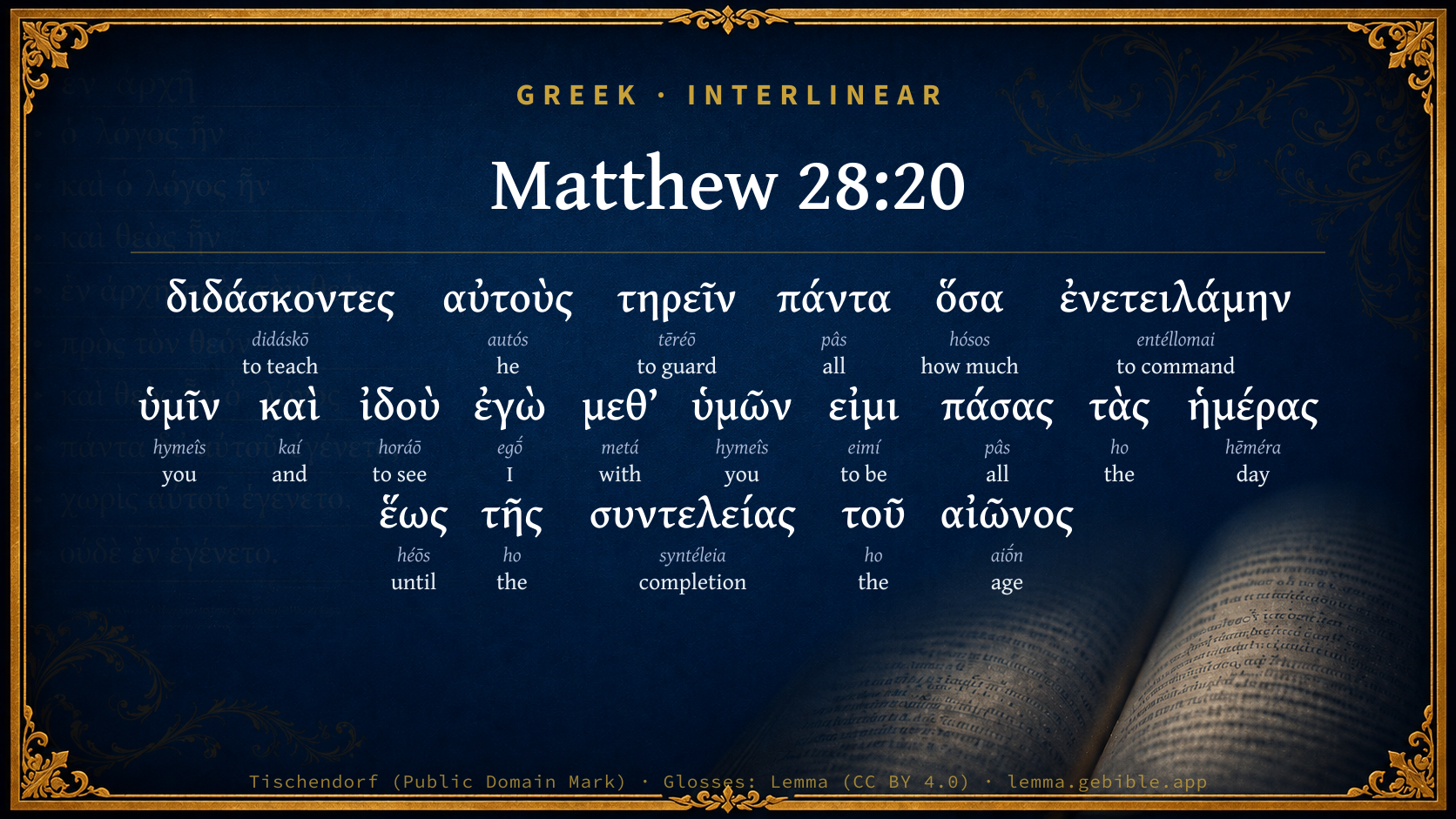
  1. διδάσκοντες didáskō G1321 “to teach” Verb, Present, Active, Participle, Nominative, Plural, Masculine
  2. αὐτοὺς autós G846 “he” Personal pronoun, Accusative, Plural, Masculine
  3. τηρεῖν tēréō G5083 “to guard” Verb, Present, Active, Infinitive
  4. πάντα pâs G3956 “all” Adjective, Accusative, Plural, Neuter
  5. ὅσα hósos G3745 “how much” Correlative pronoun, Accusative, Plural, Neuter
  6. ἐνετειλάμην entéllomai G1781 “to command” Verb, Aorist, Middle deponent, Indicative, 1st person, Singular
  7. ὑμῖν hymeîs G5210 “you” Personal pronoun, 2nd person, Dative, Plural
  8. καὶ kaí G2532 “and” Conjunction
  9. ἰδοὺ horáō G3708 “to see” Verb, Aorist, Middle, Imperative, 2nd person, Singular
  10. ἐγὼ egṓ G1473 “I” Personal pronoun, 1st person, Nominative, Singular
  11. μεθ’ metá G3326 “with” Preposition
  12. ὑμῶν hymeîs G5210 “you” Personal pronoun, 2nd person, Genitive, Plural
  13. εἰμι eimí G1510 “to be” Verb, Present, Active, Indicative, 1st person, Singular
  14. πάσας pâs G3956 “all” Adjective, Accusative, Plural, Feminine
  15. τὰς ho G3588 “the” Article, Accusative, Plural, Feminine
  16. ἡμέρας hēméra G2250 “day” Noun, Accusative, Plural, Feminine
  17. ἕως héōs G2193 “until” Adverb
  18. τῆς ho G3588 “the” Article, Genitive, Singular, Feminine
  19. τοῦ ho G3588 “the” Article, Genitive, Singular, Masculine
  20. αἰῶνος aiṓn G165 “age” Noun, Genitive, Singular, Masculine

About this verse

These counts appear in no published source. They are computed here, from the morphology-tagged text and Lemma’s own curated glosses. What Lemma adds →

21
words
17
distinct lemmas
Gospels
section

Notable vocabulary

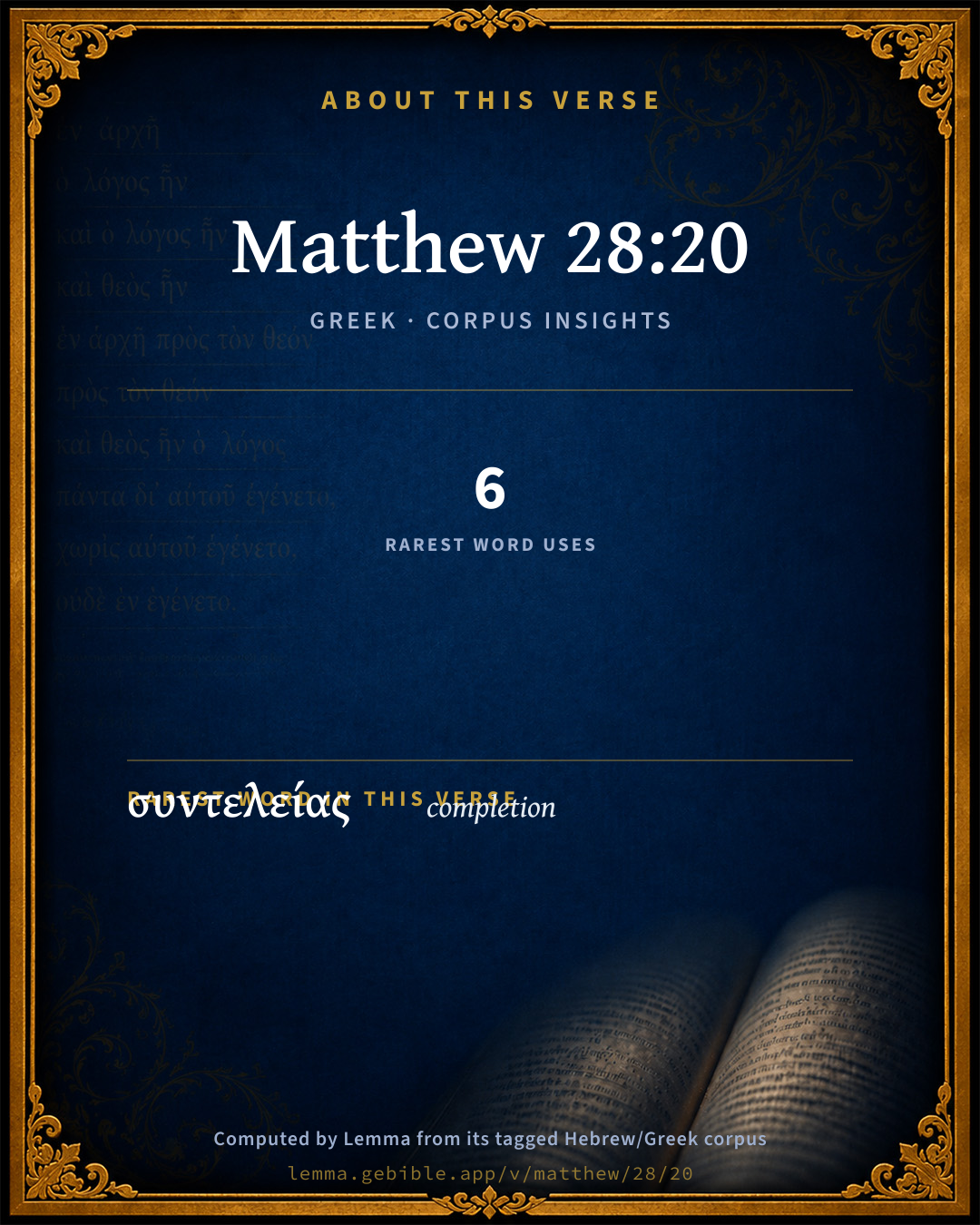
The rarest word here is συντελείας completion G4930 — appearing just 6 times in the whole Greek New Testament.

Shared distinctive vocabulary

συντελείας completion G4930 occurs in 6 verses of the Greek New Testament. Also found in:

Repetition

Words recur within this verse:

Cross-references

45

Topical passages linked to Matthew 28:20 in the Treasury of Scripture Knowledge — connected by theme and wording, ordered by reader-vote popularity; previews shown in the World English Bible.

  • Isaiah 41:10 Don't you be afraid, for I am with you; don't be dismayed, for I am your God; I will strengthen you; yes, I will help you; yes, I will uphold you with the right hand of my righteousness.
  • Joshua 1:5 There shall not any man be able to stand before you all the days of your life. As I was with Moses, so I will be with you; I will not fail you, nor forsake you.
  • Acts 18:9–10 The Lord said to Paul in the night by a vision, "Don't be afraid, but speak and don't be silent;
  • John 14:18–23 I will not leave you orphans. I will come to you.
  • Psalms 46:7 Yahweh of Hosts is with us. The God of Jacob is our refuge. Selah.
  • 1 John 2:3–4 This is how we know that we know him: if we keep his commandments.
  • Genesis 39:2–3 Yahweh was with Joseph, and he was a prosperous man. He was in the house of his master the Egyptian.
  • Genesis 39:21 But Yahweh was with Joseph, and showed kindness to him, and gave him favor in the sight of the keeper of the prison.
  • Matthew 1:23 "Behold, the virgin shall be with child, And shall bring forth a son. They shall call his name Immanuel;" Which is, being interpreted, "God with us."
  • Matthew 18:20 For where two or three are gathered together in my name, there I am in the midst of them."
  • Psalms 46:11 Yahweh of Hosts is with us. The God of Jacob is our refuge. Selah.
  • 1 Thessalonians 4:1–2 Finally then, brothers, we beg and exhort you in the Lord Jesus, that as you received from us how you ought to walk and to please God, that you abound more and more.
  • Ephesians 4:20–32 But you did not learn Christ that way;
  • Revelation 22:20–21 He who testifies these things says, "Yes, I come quickly." Amen! Yes, come, Lord Jesus.
  • Mark 16:20 They went out, and preached everywhere, the Lord working with them, and confirming the word by the signs that followed. Amen.
  • 1 John 3:19–24 And by this we know that we are of the truth, and persuade our hearts before him,
  • Exodus 3:12 He said, "Certainly I will be with you. This will be the token to you, that I have sent you: when you have brought forth the people out of Egypt, you shall serve God on this mountain."
  • Isaiah 8:8–10 and it shall sweep onward into Judah; it shall overflow and pass through; it shall reach even to the neck; and the stretching out of its wings shall fill the breadth of your land, Immanuel.
  • Ephesians 4:11–17 He gave some to be apostles; and some, prophets; and some, evangelists; and some, shepherds and teachers;
  • 2 Timothy 4:17 But the Lord stood by me, and strengthened me, that through me the message might be fully proclaimed, and that all the Gentiles might hear; and I was delivered out of the mouth of the lion.
  • Colossians 1:28 whom we proclaim, admonishing every man and teaching every man in all wisdom, that we may present every man perfect in Christ Jesus;
  • Acts 2:42 They continued steadfastly in the apostles' teaching and fellowship, in the breaking of bread, and prayer.
  • 1 Corinthians 14:37 If any man thinks himself to be a prophet, or spiritual, let him recognize the things which I write to you, that they are the commandment of the Lord.
  • 2 Peter 1:5–11 Yes, and for this very cause adding on your part all diligence, in your faith supply moral excellence; and in moral excellence, knowledge;
  • Revelation 22:14 Blessed are those who do his commandments, that they may have the right to the tree of life, and may enter in by the gates into the city.
  • Deuteronomy 12:32 Whatever thing I command you, that shall you observe to do: you shall not add thereto, nor diminish from it.
  • 1 Kings 1:36 Benaiah the son of Jehoiada answered the king, and said, Amen: Yahweh, the God of my lord the king, say so [too].
  • Psalms 72:19 Blessed be his glorious name forever! Let the whole earth be filled with his glory! Amen and amen.
  • Matthew 6:13 Bring us not into temptation, but deliver us from the evil one. For yours is the Kingdom, the power, and the glory forever. Amen.'
  • Matthew 7:24–27 "Everyone therefore who hears these words of mine, and does them, I will liken him to a wise man, who built his house on a rock.
  • Matthew 13:49 So will it be in the end of the world. The angels will come forth, and separate the wicked from among the righteous,
  • 1 Corinthians 11:2 Now I praise you, brothers, that you remember me in all things, and hold firm the traditions, even as I delivered them to you.
  • Titus 2:1–10 But say the things which fit sound doctrine,
  • 1 Peter 2:10–19 who in time past were no people, but now are God's people, who had not obtained mercy, but now have obtained mercy.
  • Deuteronomy 5:32 You shall observe to do therefore as Yahweh your God has commanded you: you shall not turn aside to the right hand or to the left.
  • Matthew 13:39–40 The enemy who sowed them is the devil. The harvest is the end of the age, and the reapers are angels.
  • Acts 20:20–21 how I didn't shrink from declaring to you anything that was profitable, teaching you publicly and from house to house,
  • Acts 20:27 for I didn't shrink from declaring to you the whole counsel of God.
  • 2 Peter 3:2 that you should remember the words which were spoken before by the holy prophets, and the commandments of us, the apostles of the Lord and Savior:
  • 1 Chronicles 16:36 Blessed be Yahweh, the God of Israel, From everlasting even to everlasting. All the people said, Amen, and praised Yahweh.
  • 1 Timothy 6:1–4 Let as many as are bondservants under the yoke count their own masters worthy of all honor, that the name of God and the doctrine not be blasphemed.
  • Revelation 1:18 and the Living one. I was dead, and behold, I am alive forevermore. Amen. I have the keys of Death and of Hades.
  • Matthew 24:3 As he sat on the Mount of Olives, the disciples came to him privately, saying, "Tell us, when will these things be? What is the sign of your coming, and of the end of the age?"
  • 1 Corinthians 11:23 For I received from the Lord that which also I delivered to you, that the Lord Jesus on the night in which he was betrayed took bread.
  • 2 Thessalonians 3:6–12 Now we command you, brothers, in the name of our Lord Jesus Christ, that you withdraw yourselves from every brother who walks in rebellion, and not after the tradition which they received from us.

Cross-references courtesy of OpenBible.info (CC BY 4.0).

Where the printed editions differ

1 variant

Places in this verse where the major printed Greek editions disagree on the wording in a way that affects the translation — a comparison of editions, not a manuscript-by-manuscript collation. The editions are the modern critical texts (Nestlé-Aland 28/27, SBL, Westcott-Hort, Tregelles, Tyndale House) and the traditional texts behind the KJV (the Textus Receptus and the Byzantine/Majority text). It is not a claim about which reading is original.

  1. Extra text
    ἀμήν

    “Amen”

    In TRByz Not in NA28NA27TynSBLWHTreg

    ἀμήν¶ (amēn) 'Amen' is only in traditional manuscripts (TR+Byz)

Textual data: Translators Amalgamated Greek New Testament (STEPBible TAGNT) · CC BY 4.0.

Commentary

Notes on Matthew 28:20 from classic Christian and Jewish commentators (each source and its license shown beneath its notes). The classic Christian expositions comment on the surrounding passage and are grouped to its opening verse, so a note may address several verses; the Jewish commentaries on the Tanakh (Rashi and others) are per-verse, so they appear only where the commentator wrote on this verse.

Lemma curates 59 commentaries, every one of them public domain or Creative Commons licensed, each selected and text-cleaned for this edition rather than reprinted as found. About our sources →

Jamieson, Fausset & Brown

Robert Jamieson, A. R. Fausset & David Brown

Teaching them--This is teaching in the more usual sense of the term; or instructing the converted and baptized disciples.

to observe all things whatsoever I have commanded you: and, lo, I--The "I" here is emphatic. It is enough that I

am with you alway--"all the days"; that is, till making converts, baptizing, and building them up by Christian instruction, shall be no more.

even unto the end of the world. Amen--This glorious Commission embraces two primary departments, the Missionary and the Pastoral, with two sublime and comprehensive Encouragements to undertake and go through with them.

First, The MISSIONARY department (Mat 28:18): "Go, make disciples of all nations." In the corresponding passage of Mark (Mar 16:15) it is, "Go ye into all the world, and preach the Gospel to every creature." The only difference is, that in this passage the sphere, in its world-wide compass and its universality of objects, is more fully and definitely expressed; while in the former the great aim and certain result is delightfully expressed in the command to "make disciples of all nations." "Go, conquer the world for Me; carry the glad tidings into all lands and to every ear, and deem not this work at an end till all nations shall have embraced the Gospel and enrolled themselves My disciples." Now, Was all this meant to be done by the Eleven men nearest to Him of the multitude then crowding around the risen Redeemer? Impossible. Was it to be done even in their lifetime? Surely not. In that little band Jesus virtually addressed Himself to all who, in every age, should take up from them the same work. Before the eyes of the Church's risen Head were spread out, in those Eleven men, all His servants of every age; and one and all of them received His commission at that moment. Well, what next? Set the seal of visible discipleship upon the converts, by "baptizing them into the name," that is, into the whole fulness of the grace "of the Father, and of the Son, and of the Holy Ghost," as belonging to them who believe. (See on Co2 13:14). This done, the Missionary department of your work, which in its own nature is temporary, must merge in another, which is permanent. This is

Second, The PASTORAL department (Mat 28:20): "Teach them"--teach these baptized members of the Church visible--"to observe all things whatsoever I have commanded you," My apostles, during the three years ye have been with Me.

What must have been the feelings which such a Commission awakened? "WE who have scarce conquered our own misgivings--we, fishermen of Galilee, with no letters, no means, no influence over the humblest creature, conquer the world for Thee, Lord? Nay, Lord, do not mock us." "I mock you not, nor send you a warfare on your own charges. For"--Here we are brought to

Third, The ENCOURAGEMENTS to undertake and go through with this work. These are two; one in the van, the other in the rear of the Commission itself.

First Encouragement: "All power in heaven"--the whole power of Heaven's love and wisdom and strength, "and all power in earth"--power over all persons, all passions, all principles, all movements--to bend them to this one high object, the evangelization of the world: All this "is given unto Me." as the risen Lord of all, to be by Me placed at your command--"Go ye therefore." But there remains a

Second Encouragement: "And lo! I am with you all the days"--not only to perpetuity, but without one day's interruption, "even to the end of the world," The "Amen" is of doubtful genuineness in this place. If, however, it belongs to the text, it is the Evangelist's own closing word.

Next: Mark Introduction

Jamieson, Fausset & Brown — Commentary Critical and Explanatory on the Whole Bible (1871) — public domain (CC PDM 1.0). Text via the HelloAO Bible API.

The Biblical Illustrator

Joseph S. Exell

Mat_28:20

And, lo, I am with you alway.

Christ continually present with His Church

I. That the Saviour is speaking of more than that presence, which is inseparable from the nature of his own essential and eternal godhead. In the case of our Lord the Godhead is so modified by its alliance with the Humanity-modified not in itself, for there no modification would be possible-but in its action upon the Church,-that what is brought into contact with us, is the human sympathy of the Saviour, glorified by its connection with the Deity of His person.

II. The fact that communion with the Saviour is made possible by the advent of the comforter; that the coming of the Spirit is, to all intents and purposes, a coming of the Saviour to the people who love Him. The personality that is in Him whom we address, must vibrate to the touch of the personality that is in us,-or else communion will not have taken place. This has been made possible, though Christ is absent in the body, by the advent of the Holy Ghost. No one will be disposed to question that the personality of God can reveal itself to the personality of man without the intervention of a visible form, and without the employment of articulate language. There are modes of fellowship between spirit and spirit with which we are unacquainted, yet real and efficacious. He is said to dwell in the believer. We speak not of grace but of living communication. And where the Spirit comes Christ comes; and where the Spirit and Christ come the Father comes.

III. This coming of Christ to His people, precious as it is, is suited to a state of imperfection and discipline. We look forward to something beyond that which we enjoy now. There was the coming of Christ in the flesh. That passed away. It gave way to the coming by the Spirit. That is better, more spiritual, but insufficient. We look forward to the final, exhaustive coming. (G. Calthrop, M. A.)

The present Saviour

Some benefits of Christs perpetual presence with His people, especially when that presence is realized.

1. It is sanctifying.

2. Sustaining.

3. Comforting. (J. Hamilton, D. D.)

Christs parting promise

I. The promise-I am with you alway. What did Christ mean by this.

1. Can we attach to the words a meaning similar to that conveyed when speaking of the dead. We say that they still live in the hearts of those who knew and loved them. After the lapse of years we can often recall with vividness the features of one departed.

2. Men may live in their works. Is Christ only present as other good men are? We who believe in Christ as a supernatural revelation regard this parting promise as implying infinitely more than this. It meant the indwelling of a Personal energy distinct from any memory of Him. Is it replied that this is incomprehensible; life is incomprehensible. Christ is not a power generated in nature.

II. The fulfilment of the promise. (C. M. Short.)

The presence of Christ

1. That presence is spiritual. Not the consecrated host. The believers in the upper room had nothing to appeal to their senses.

2. This presence of Christ consists in something more than there is in His word. Caesar, Plato are still with us in their words; but there is infinitely more in the presence of Christ. Behind the written word there is the living word, the invisible Saviour who manifests Himself to the heart.

3. This presence is especially promised to the Church, and is the secret of its triumph over infidelity and persecution.

4. But what makes men doubt the presence of Christ in the Church is the sight of the inward state of the Church itself.

5. But what Christ announces to the Church He announces to the individual soul.

6. Affliction may be a proof of the Lords presence.

7. Is there anything on earth grander than faithful love? I am with you alway. (E. Bersier, D. D.)

Christ present, though appearances may seem to the contrary

In gloomy winters day no tree moves its verdant top in our fields; no flower casts its perfume to the winds; everything appears dead in nature. Will you tell me that the sun has not risen? No, although he has disappeared behind a curtain of clouds, he makes his powerful action everywhere felt; and without the sun, which you do not see, there would remain for you only an icy shroud, and the darkness of night. The soul has its winter also, when the Sun of Righteousness no longer sheds on it more than a pale glimmer, when obedience is performed without joy. (E. Bersier, D. D.)

Desirableness of Christs presence

I. Christs presence is exceedingly desirable to the saints.

1. The presence of Christ is an evidence of His love.

2. Christs presence is attended with the most desirable effects; none can enjoy it without deriving the greatest advantages from it.

3. Present communion with Christ is an earnest of everlasting fruition.

II. A seemingly departing Christ may be constrained, as it were, to abide with His people.

1. By the exercise of a lively faith.

2. By fervent prayer.

3. By a suitable conduct towards him. (B. Beddome.)

Christs presence essential

Nothing could supply the room of Christ to His Church; not the gospels, though they record His eventful life and death; not the epistles, though they contain the full revelation of His own truth; not ministers, though they are His ambassadors; not ordinances, though they are the channels of grace, and so many meeting places between our souls and Him whom our souls love. None of these, nor all of these together, can be to the Church, in the stead of its own Divine Redeemer and Head. Without His continued presence and aid, the Church would speedily come to an end. People may talk as they please about the omnipotence of truth, and the adaptation of Christianity to man, but in a world like this, hostile to the truth, and alienated from God, no security short of that presented in the actual indwelling of Christ in His Church, His own kingdom and house, will be sufficient. To this we owe it, that there has been a Church in the world up to this hour; to this we owe it, that there shall be a Church in it to the end of time. (A. L. R. Foote.)

The ever-present Saviour

1. This is the language of One who had been through the passage of death and known the bitterness of separation.

2. It is difficult to realize this invisible presence; it is more real when realized. It is spiritual, always with us.

3. It conveys the idea that before the mind of the speaker all the days lay ranged in their order to the last.

4. It is an inner presence.

5. Most minds, whatever they be, do best in fellowship. (J. Vaughan, M. A.)

The charm of the Divine presence

Suppose a friend who combines everything which goes to make your idea of friendship-intellectual, wise, modest, fond, true, good. Suppose such a person just set to your particular taste-in harmony with every thought; his society like a continual strain of music. You lean on his judgment-you are happy in his love. What a bloom on life-what a sunlight-what a charm-what a necessity that person would become to you! But what is that compared to Christ-to a man who has once learned the secret of finding His presence a reality? who knows and loves Him as his own near, dear, loving Saviour-the Brother of his soul-much more than another self. The very fact that He is there-though He did nothing, though there were no actual intercourse, though He were not seen-has an untold spell upon you. Did you never feel what the presence of a very little child would be, though there were not another man in the world? Think of what even a silent presence can be! But it is not silent. (J. Vaughan, M. A.)

Christs perpetual presence

I. What an insight we have here into the essential nature of Christianity itself, and what a guarantee for its permanence and power. It is something more than an outward revelation of facts, more than a community of brethren: it is a life.

II. May we not see in this promise the designed preventative against or remedy for certain evils sure to infest and corrode the life of His kingdom.

III. It is of the guarantee of the permanence and power of Christianity in Christs constant presence that I would now speak. The higher the principle of life the longer it is in coming to maturity; but also the surer when maturity is reached. This explains the slow progress of Christianity. (J. T. Stannard.)

Christs presence our stimulus

There is a touching fact related in the history of a Highland chief of the noble house of McGregor, who fell wounded by two balls at the battle of Prestonpans. Seeing their chief fall, the clan wavered, and gave the enemy an advantage. The old chieftain, beholding the effects of his disaster, raised himself up on his elbow, while the blood gushed in streams from his wounds, and cried aloud, I am not dead, my children; I am looking at you, to see you do your duty. These words revived the sinking courage of his brave Highlanders. There was a charm in the fact that they still fought under the eye of their chief. It roused them to put forth their mightiest energies, and they did all that human strength could do to turn and stem the dreadful tide of battle. And is there not a charm to you, O believer, in the fact that you contend in the battle-field of life under the eye of your Saviour? Wherever you are, however you are oppressed by foes, however exhausted by the stern strife with evil, the eye of Christ is fixed most lovingly upon you. (D. Wise,)

Christs presence all-sufficient

When Christ saith, I am with you alway, you may add what you will: to protect you, to direct you, to comfort you, to carry on the work of grace in you, and in the end to crown you with immortality and glory. All this and more is included in this precious promise. (John Trapp.)

Presence superior to memory

He promises His presence. How different the case would be if He had only said, The memory of My life and work shall be with you always. What a difference there is between a mere memory and a presence. At first, indeed, when we have just lost a relation or a friend, memory, in its importunity and anguish, seems to be and to do all that a presence could do, perhaps even more. It gathers up the past and heaps it on the present; it crowds into the thoughts of a few minutes the incidents of a lifetime; it has about it a greatness and a vividness which was wanting while its object was still with us. But even a memory decays. That it should do so seems impossible at first. We protest to ourselves and to the world, that it will be as fresh as ever to the last day of our lives. But memory is only an effort of the human mind, while a presence is independent of it; and the human mind has limited powers which are easily exhausted; it cannot always continue on the strain; and so a time comes when the first freshness passes away, and then other thoughts, interests, and occupations crowd in upon us and claim their share of the little all that we have to give. And so, what seems to us to be so fresh and imperishable is already indistinct and faded. Oh!, think of any private friend, think of any of the celebrated men whose names were on the lips of every one, and who had died within the last two or three years! At first it seemed as if you might predict with confidence that the world would go on thinking and talking about them for at least a generation; but already, the sure and fatal action of time upon a living memory, however great and striking, is making itself felt; and even in our thoughts about them they are passing rapidly into that world of shadows, where shadows soon die away into the undistinguishable haze and gloom beyond them. It is otherwise with a presence; whether we see the presence or not, we know that it is here. If our friend is in the next room, busily occupied and unable to give us his time just now, still, the knowledge that he is close at hand, and can be applied to if necessary, is itself a comfort and a strength to us; we can go to him if we like. His being here places us in a very different position from that which we should occupy if he had left us; if we could only think of him as having been with us in times past, though really absent now. A presence, I say, is a fact independent of our moods of mind, a fact whether we recognize it or not; and in our Divine Saviours presence there is indeed a fulness of joy which means hope, work, power, eventual victory. (Canon Liddon.)

Christs presence secures the Churchs victory

This is a factor in the life and work of Christs Church with which persons do not reckon who look at her only from the outside, and judge of her strength and prospects as they would judge of any human society. They say that she will die out because this or that force, which has, no doubt, weight in the affairs of men, is for the time being telling heavily against her. If large sections of public feeling, or literature, or the public policy of some great country, or the influence of a new and enterprising philosophy, or the bias of a group of powerful minds are against her, forthwith we hear the cry, The mission of the apostles is coming to an end; the Church of Christ will presently fail! Do not be in too great a haste, my friends, about this. You have yet to reckon with a force invisible, and perhaps, as far as you are concerned, unsuspected, but never more real, never more operative than it is at this moment. You have forgotten the Presence of Christ. He did not retreat to heaven when His first apostles died; He promised to be with them to the end of time; He spoke not merely to the eleven men before Him, but to the vast multitude of successors who defiled before His eyes down to the utmost limits of the Christian ages: Lo, I am with you alway, even to the end of the world! With us by His Spirit; with us in the great sacrament of His love; with us amid weaknesses, divisions, failures, disappointments. He is with us still, and it is His Presence which alone sustains His envoys, and which gives to their work whatever it has had, or has, or has to have, of.

The Biblical Illustrator, edited by Joseph S. Exell (c. 1880s–1900s) — public domain. Text from a community e-Sword module.

Joseph Benson's Commentary

Mat 28:20. Teaching them to observe all things, &c. — Here we have, 1st, The duty of the apostles and ministers of Christ, which is, to teach his disciples to observe all things that he has commanded; that is, they must instruct them in all the doctrines and precepts taught by Christ, and inculcate upon them the necessity of understanding and believing the former, and obeying the latter; and must assist them in applying Christ’s general commands to particular cases. They must teach them, not their own or any man’s fancies and inventions, but the truths and institutions of Christ; to them they must religiously adhere, and in the knowledge of them must train up his followers. As Christ does not here command any thing to be taught which he himself had not taught, we may infer that every thing fundamental and essential to salvation may be found in the gospels, and that even the apostles themselves had not a right to teach any thing as necessary to salvation which Christ himself had not asserted to be Song of Solomon 2 d, The duty of Christ’s disciples, of all that are dedicated to him in baptism; they must observe all things whatsoever that he has commanded, and in order thereto, must submit to the teaching of those whom he sends. Our admission into the visible church is in order to something further; namely, our being prepared for and employed in his service. By our baptism we are obliged, 1st, To make the doctrines of Christ the rule of our faith, and his commands the directory of our practice. We are under the law to Christ, and must obey, and in all our obedience must have an eye to the command, and do what we do as unto the Lord. 2d, To observe all things that he hath commanded without exception; all the moral duties, and all the instituted ordinances. Our obedience to the laws of Christ is not sincere if it be not universal; we must stand complete in his whole will. And, lo, I am with you alway — Here our Lord gives his apostles, and all the ministers of his gospel, truly sent by him, an assurance of his spiritual presence with them in the execution of this commission unto the end of time; and this exceeding great and precious promise he ushers in with ιδου, Lo! or behold! to strengthen their faith and engage their regard to it. As if he had said, Take notice of this; it is what you may assure yourselves of and rely upon. “I am with you; I, the eternal Son of God; I, who have the angels at my command, and make the devils tremble by my frown; I, who in your sight have caused the storms to cease, the blind to see, the lame to walk, the dead to rise, only with the word of my mouth; I, who have all power in heaven and earth committed to me — am with you; not, I will be with you, but, I am with you, and that alway, Gr. πασας τας ημερας, all the days, or every day: Wheresoever you are, and whensoever you do any thing toward the executing of the commission which I have given you, I am with you in the doing of it, and that too to the very end of the world: that is, so long as I have a church upon earth, which shall be till my coming again to judge the world, all this while I promise to be with you, and consequently as long as the world shall last.” — Bishop Beveridge, On Christ’s Presence with his Ministers. Some would translate εως της σοντελειας του αιωνος, until the conclusion of the age; understanding by the expression the dissolution of the Jewish state. But as Christ’s presence with his surviving apostles and other ministers was as necessary after the destruction of Jerusalem, and the overthrow of the Jewish commonwealth, as before these events, nothing can be more unreasonable than to limit these words by such an interpretation. Nor indeed can they with any propriety be interpreted in any other than the most extensive sense; the influence of Christ’s Spirit being essentially necessary to the success of the gospel in every age and nation; and our Lord, in the last discourse which he delivered to his disciples before his passion, having graciously promised it, saying, I will pray the Father, and he shall give you another Comforter to abide with you; εος τον αιωνα, for ever. Our Lord could not mean that this other Comforter should abide merely with the persons to whom he then spoke, they being to die quickly: but that he should abide with them during their lives, and with their successors afterward; or with them and all the ministers of the gospel in the several ages of the church; with all to whom this commission extends; with all, that, being duly called and sent, thus baptize and thus teach. When the end of the world is come, and the kingdom is delivered up to God even the Father, there will then be no further need of ministers and their ministration; but till then they shall continue, and the great intentions of the institution shall be answered. This is a most encouraging word to all the faithful ministers of Christ; that what was said to the apostles was, and is, said to them all. I will never leave thee nor forsake thee. May this gracious promise cause us to gird up the loins of our minds, and increase our zeal, fervour, and diligence; inducing us to account no labour too great, no service too much, no suffering too severe, so that we may but finish our course with joy, and fulfil the ministry we are engaged in!

Two solemn farewells we find our Lord Jesus giving to his church; and his parting word at both of them is very encouraging; one was here, when he closed up his personal converse with them, and then his parting word was, Lo, I am with you alway; I leave you, yet still I am with you. The other was, when he closed up the canon of the Scripture by the pen of his beloved disciple, and then his parting word was, Surely I come quickly. I leave you for awhile, but I will be with you again shortly, Rev 22:20. By this it appears that his love to his church continues the same, though she is deprived of his visible and bodily presence; and that it is his will we should maintain both our communion with him, and our expectation of him. The word amen, with which this gospel concludes, is wanting in four MSS., and in the Vulgate, Coptic, and Armenian versions. It is probable, however, that it was inserted by the evangelist, not only as an intimation of the conclusion of his book, but as an asseveration of the certain truth of the things contained in it. And, considering the connection of the word with the preceding promise, which was undoubtedly the greatest strength and joy of St. Matthew’s heart: “it is very natural,” says Dr. Doddridge, “to suppose that it has some such reference as this to that promise: ‘Amen! blessed Jesus, — so may it indeed be; and may this important promise be fulfilled to us and to our successors to the remotest ages, in its full extent!’ St. John uses the like term in more express language, in the last verse but one of the Revelation: Surely I come quickly, Amen! Even so come, Lord Jesus.”

Joseph Benson's Commentary on the Old and New Testaments (1811–1818) — public domain. Text from a community e-Sword module.

Tyndale Open Study Notes

Tyndale Open Resources

28:20 Teach: The disciples’ curriculum is comprised of all the commands of Jesus (e.g., the Sermon on the Mount, chs 5–7). The church is to be marked by its obedience to Jesus’ commands (5:17-20; 7:13-27). Jesus’ authority and presence are the basis for the disciples’ mission (see also 1:23; 18:20).

Tyndale Open Study Notes — © Tyndale Open Resources, licensed CC BY-SA 4.0. Text via the HelloAO Bible API.

Bengel's Gnomon

Johann Albrecht Bengel

Mat 28:20. Αὐτοὺς, them) The disciples had been instructed in order that they might instruct others.—τηρεῖν, to observe, to keep) as it becomes the baptized to do by virtue of faith, not merely as a legal performance. John often speaks thus. This verb deserves especial attention, from its occurrence in this solemn place.—ἐνετειλάμηυ, I have commanded) These commandments are to be found in Matthew 5; John 15 etc.—μεθʼ ὑμῶν, with you) even when you shall be scattered apart through the whole world. This promise belongs also to the whole Church, for our Lord adds, “even to the end of the world.”—πάσας τὰς ἡμέρας, always) literally, all the days, i.e., every single day. A continual presence, and one most actually present; see Mar 16:17; Mar 16:19-20.[1236]—ἝΩς Τῆς ΣΥΝΤΕΛΕΊΑς ΤΟῦ ΑἸῶΝΟς, unto the end of the world) For then we shall be with the Lord [as He is even now with us]. [To Him, therefore, Reader, commit thyself, and remain in Him; so will it be best for thee in time and in eternity.—B. G. V.]1237]

[1236] Therefore the Christian Church will never entirely expire.—B. G. V.

[1237] Bengel, J. A. (1860). Vol. 1: Gnomon of the New Testament (M. E. Bengel & J. C. F. Steudel, Ed.) (J. Bandinel & A. R. Fausset, Trans.) (403–490). Edinburgh: T&T Clark.

Bengel's Gnomon of the New Testament — English translation (T&T Clark, Edinburgh, 1860) — public domain. Text from a community e-Sword module.

Meyer's Critical & Exegetical Commentary

Heinrich August Wilhelm Meyer

Mat_28:20 Διδάσκοντες αὐτούς, κ.τ.λ.] without being conjoined by καί, therefore not co-ordinate with, but subordinate to the βαπτίζοντες, intimating that a certain ethical teaching must necessarily accompany in every case the administration of baptism: while ye teach them to observe everything, etc. This moral instruction must not be omittedFN[44] when you baptize, but it must be regarded as an essential part of the ordinance. That being the case, infant baptism cannot possibly have been contemplated in βαπτίζ, nor, of course, in πάντα τ. ἔθνη either.

καὶ ἰδοὺ, κ.τ.λ.] Encouragement to execute the commission entrusted to them, Mat_28:19.

ἐγώ] with strong emphasis: I who am invested with that high ἐξουσία to which I have just referred.

μεθʼ ὑμῶν εἰμι] namely, through the working of that power which has been committed to me, Mat_28:18, and with which I will continue to protect, support, strengthen you, etc. Comp. Act_18:10; 2Co_12:9-10. The ὑμεῖς are the disciples to whom the Lord is speaking, not the church; the present tense (not ἔσομαι) points to the fact of His having now entered, and that permanently, into His estate of exaltation. The promised help itself, however, is that vouchsafed by the glorified Redeemer in order to the carrying out of His own work (Php_3:21; Php_4:13; Col_1:29; 2Co_12:9), imparted through the medium of the Spirit (John 14-16), which is regarded as the Spirit of Christ (see on Rom_8:9), and sometimes manifesting itself also in signs and wonders (Mar_16:20; Rom_15:19; 2Co_12:12; Heb_2:14), in visions and revelations (2Co_12:1; Act_12:17). But in connection with this matter (comp. on Mat_18:20) we must discard entirely the unscriptural idea of a substantial ubiquity (in opposition to Luther, Calovius, Philippi). Beza well observes: Ut qui corpore est absens, virtute tamen sit totus praesentissimus.

πάσας τ. ἡμέρ.] all the days that were still to elapse ἕως τ. συντελ. τοῦ αἰῶνος, i.e. until the close of the current age (see on Mat_24:3), which would be coincident with the second advent, and after the gospel had been proclaimed throughout the whole world (Mat_24:14); continua praesentia, Bengel.

[44] N1 Οὐκ ἀρκεῖ υὰρ τὸ βάπτισμα καὶ τὰ δόυματα πρὸς σωτηρίαν, εἰ μὴ καὶ πολιτεία προσείη, Euthymius Zigabenus, who thus admirably points out that what is meant by διδάσκοντες, κ.τ.λ., is not the teaching of the gospel with a view to conversion. The ἀκοὴ πίστεως (Gal_3:2) and the πίστις ἐξ ἀκοῆς (Rom_10:17) are understood, as a matter of course, to have preceded the baptism. Comp. Theodor Schott, who, however, without being justified by anything in the text, is disposed to restrict the ὅσα ἰνεσειλάμ. ὑμῖν, on the one hand, to the instructions contained in the farewell addresses (from the night before the crucifixion on to the ascension), and τηρεῖν, on the other, to a faithful observance on the part of the convert of what he already knew. Comp., on the contrary, Mat_19:17; Joh_14:15; Joh_14:21; Joh_15:10; 1Ti_6:14; 1Jn_2:3 f., 1Jn_3:22 f., 1Jn_5:2 f.; Rev_12:17; Rev_14:12; Sir_29:1, in all which passages τηρεῖν τὰς ἐντολάς means observe, i.e. to obey, the commandments. Admirable, however, is the comment of Bengel: Ut baptizatis convenit, fidei virtute.

REMARK 1.

According to Joh_21:14, the Lords appearance at the sea of Tiberias, John 21, which Matthew not only omits, but which he does not seem to have been aware of (see on Mat_28:10), must have preceded that referred to in our passage.

REMARK 2.

Matthew makes no mention of the return of Jesus and His disciples to Judaea, or of the ascension from the Mount of Olives; he follows a tradition in which those two facts had not yet found a place, just as they appear to have been likewise omitted in the lost conclusion of Mark; then it so happened that the apostolic λόγια terminated with our Lord's parting address, Mat_28:19 f. We must beware of imputing to the evangelist any subjective motive for making no mention of any other appearance but that which took place on the mountain in Galilee; for had he omitted and recorded events in this arbitrary fashion, and merely as he thought fit, and that, too, when dealing with the sublimest and most marvellous portion of the gospel narrative, he would have been acting a most unjustifiable part, and only ruining his own credit for historical fidelity. By the apostles the ascension, the actual bodily mounting up into heaven, was regarded as a fact about which there could not be any possible doubt, and without- which they would have felt the second advent to be simply inconceivable (Php_2:9; Php_3:20; Eph_4:10; 1Pe_3:22; Joh_20:17), and accordingly it is presupposed in the concluding words of our Gospel; but the embodying of it in an outward incident, supposed to have occurred in presence of the apostles, is to be attributed to a tradition which Luke, it is true, has adopted (as regards the author of the appendix to Mark, see on Mar_16:19 f.), but which has been rejected by our evangelist and John, notwithstanding that in any case this latter would have been an eyewitness. But yet the fact itself that the Lord, shortly after His resurrection, ascended into heaven, and that not merely in spirit (which, and that in entire opposition to Scripture, would either exclude the resurrection of the actual body, or presuppose a second death), but in the body as perfectly transformed and glorified at the moment of the ascension, is one of the truths of which we are also fully convinced, confirmed as it is by the whole New Testament, and furnishing, as it does, an indispensable basis for anything like certainty in regard to Christian eschatology. On the ascension, see Luk_24:51, Rem.

Meyer — Critical and Exegetical Commentary on the New Testament — English translation by Peter Christie, edited by Frederick Crombie (T&T Clark, 1880) — public domain. Text from a community e-Sword module.

Expositor's Greek Testament

ed. W. Robertson Nicoll

Mat 28:20 . διδάσκοντες α ., teaching them, present participle, implying that Christian instruction is to be a continuous process, not subordinate to and preparing for baptism, but continuing after baptism with a view to enabling disciples to walk worthily of their vocation. τηρεῖν : the teaching is with a view not to gnosis but to practice; the aim not orthodox opinion but right living. πάντα ὅσα ἐνετειλάμην ὑμῖν : the materials of instruction are to be Christ’s own teaching. This points to the desirableness for the Church’s use of an oral or written tradition of Christ’s words: these to be the rule of faith and practice. καὶ ἰδοὺ , introducing an important promise to the missionaries of the new universal religion to keep them in courage and good hope amid all difficulties. ἐγὼ μεθʼ ὑμῶν , I the Risen, Exalted, All-powerful One, with you my apostles and representatives engaged in the heroic task of propagating the faith. εἰμὶ , am , not will be, conveying the feeling of certainty, but also spoken from the eternal point of view, sub specie aeternitatis , for which distinctions of here and there, now and then, do not exist. Cf. Joh 8:58 , “before Abraham was I am”. In the Fourth Gospel the categories of the Absolute and the Eternal dominate throughout. πάσας τὰς ἡμέρας , all the days, of which, it is implied, there may be many; the vista of the future is lengthening. ἕως τῆς συντελείας τοῦ αἰῶνος , until the close of the current age, when He is to come again; an event, however, not indispensable for the comfort of men who are to enjoy an uninterrupted spiritual presence.

This great final word of Jesus is worthy of the Speaker and of the situation. Perhaps it is not to be taken as an exact report of what Jesus said to His disciples at a certain time and place. In it the real and the ideal seem to be blended; what Jesus said there and then with what the Church of the apostolic age had gradually come to regard as the will of their Risen Lord, with growing clearness as the years advanced, with perfect clearness after Israel’s crisis bad come. We find here (1) a cosmic significance assigned to Christ (all power in heaven and on earth); (2) an absolutely universal destination of the Gospel; (3) baptism as the rite of admission to discipleship; (4) a rudimentary baptismal Trinity; (5) a spiritual presence of Christ similar to that spoken of in the Fourth Gospel. To this measure of Christian enlightenment the Apostolic Church, as represented by our evangelist, had attained when he wrote his Gospel, probably after the destruction of Jerusalem. Therein is summed up the Church’s confession of faith conceived as uttered by the lips of the Risen One. “Expressly not as words of Jesus walking on the earth, but as words of Him who appeared from heaven, the evangelist here presents in summary form what the Christian community had come to recognise as the will and the promise of their exalted Lord” (Weiss-Meyer).

The Expositor's Greek Testament, edited by W. Robertson Nicoll (1897–1910) — public domain. Text from a community e-Sword module.

Geneva Bible (1599)

Geneva Bible translators

Forever: and this place is meant of the manner of the presence of his spirit, by means whereof he maketh us partakers both of himself and of all his benefits, but is absent from us in body.

Geneva Bible (1599) marginal notes — public domain. Text via Bolls.life.

Adam Clarke's Commentary

Verse 20. Teaching them to observe all things] Men are ignorant of Divine things, and must be taught. Only those can be considered as proper teachers of the ignorant who are thoroughly instructed in whatsoever Christ has commanded. Persons who are entrusted with the public ministry of the word should take care that they teach not human creeds and confessions of faith, in place of the Sacred Writings; but those things, and those only, which Jesus has commanded.

And, lo, I am with you alway] και ιδου εγω μεθ' ὑμων ειμι πασας τας ἡμερας - literally, Behold, I am with you every day. A minister of Christ should consider, that while his soul simply and uniformly follows Jesus, he shall be made a constant instrument of bringing many sons and daughters to glory. The dark, it is true, must be enlightened, the ignorant instructed, the profligate reclaimed, the guilty justified, and the unholy sanctified; and who is sufficient for this work? HE with whom the Son of God is EVERY DAY, and none other.

Unto the end of the world.] Some translate, ἑως της συντελειας του αιωνος, to the end of this age; meaning the apostolic age, or Jewish dispensation; and then they refer the promise of Christ's presence to the working of miracles, and explain this by Mr 16:17-19. By my name they shall cast out demons, c., c. But though the words are used in this sense in several places, see Mt 13:39-40 Mt 13:49; Mt 24:3, yet it is certain they were repeatedly used among the primitive ecclesiastical writers to denote the consummation of all things; and it is likely that this is the sense in which they are used here, which the Anglo-Saxon has happily expressed: [Anglo-Saxon] - And I, be with you all days, until world ending; and this is indispensably necessary, because the presence and influence of Jesus Christ are essentially requisite in every age of the world, to enlighten, instruct, and save the lost. The promise takes in not only the primitive apostles, but also all their successors in the Christian ministry, as long as the earth shall endure.

Amen.] This word is omitted by some of the oldest and most authentic MSS., and by some versions and fathers. When it is considered that the word amen simply means so be it! we may at once perceive that it could not be added by our Lord. For our Lord could not pray that his own will might be done, or his own promise fulfilled. The word is, therefore, utterly impertinent as a part of the sacred text, and could neither have been added by our Lord, nor by the evangelist. The amens at the end of the sacred books have no other authority than what they derive from the transcribers of copies; and, at best, are only to be considered as the pious wish of the writer, or of the Church, that the promises contained in the sacred volume may be accomplished. Indeed, it seems often to have no other meaning than our finis at the end of our books.

In the MSS. and versions there are various subscriptions, or epigraphs, to this Gospel: the following are the principal: -

"The Gospel according to Matthew - written by him in Jerusalem - in Palestine - in the east - in the Hebrew dialect - in Hebrew - eight years after the ascension of Christ-interpreted by John - by James the brother of the Lord."

The subscription in some copies of the Arabic version is very full: "The end of the copy of the Gospel of Matthew the Apostle. He wrote it in the land of Palestine, by inspiration of the Holy Spirit, in the Hebrew tongue, eight years after the bodily ascension of Jesus the Messiah into heaven, in the first year of the reign of Claudius Caesar, king of Rome."

These are sufficient to show how little credit should be attached to the subscriptions found at the end of the sacred books, either in the MSS., or in the versions.

1. IN concluding my notes on this evangelist, I cannot express myself better than in the words of the late Mr. Wakefield, to whom this commentary has been in many instances indebted. "I have now finished my observations on the Gospel of Matthew: a piece of history, it must be acknowledged, the most singular in its composition, the most wonderful in its contents, and the most important in its object, that was ever exhibited to the notice of mankind. For simplicity of narrative, and an artless relation of facts, without any applause or censure, or digressive remarks, on the part of the historian, upon the characters introduced in it; without any intermixture of his own opinion, upon any subject whatsoever; and for a multiplicity of internal marks of credibility, this Gospel certainly has no parallel among human productions."

2. One thing the pious and intelligent reader has, no doubt, already noticed: there is not one truth, or doctrine, in the whole oracles of God, which is not taught in this evangelist. The outlines of the whole spiritual system are here correctly laid down: even Paul himself has added nothing; he has amplified and illustrated the truths contained in this Gospel; but, even under the direct inspiration of the Holy Ghost, neither he nor any other of the apostles have brought to light any one truth, the prototype of which has not been found in the words or acts of our blessed Lord, as related by Matthew, in the work which has already passed under review. The Gospel by St. Matthew is the grand text-book of Christianity; the other Gospels are collateral evidences of its truth, and the apostolic epistles are comments on the text. In the commencement of this work, I stated my wish, "to assist my fellow labourers in the vineyard to lead men to HIM who is the fountain of all excellence, goodness, truth, and happiness; - to magnify his LAW, and make it honourable; - to show the wonderful provision made in his GOSPEL for the recovery and salvation of a sinful world; - to prove that God's great design is to make his creatures HAPPY; and that such a salvation as it becomes God to give, and such as man needs to receive, is within the grasp of every human soul." -- General Preface, before Genesis. And having thus far done what I could, in reference to these great and important purposes, here I register my thanks to the ever-blessed God, Father, Word, and Holy Spirit, that he has permitted me to cast my mite into this sacred treasury, to add my feeble testimony to his Eternal Truth; and has spared me, in the midst of many infirmities and oppressive labours, to see the conclusion of this Gospel, a consummation which I had long devoutly wished, but which I had scarcely hoped ever to see realized.

May the Divine Author of this sacred book give the reader a heart-felt experience of all the truths it contains; make and keep him wise unto salvation; build him up in this most holy faith; and give him an inheritance among the blessed, through Christ Jesus, the Friend of mankind, and the Saviour of sinners, who is the object and end of this glorious system of truth! And to Him, with the Father and Eternal Spirit, be glory and dominion, thanksgiving and obedience, for ever and ever, Amen and amen!

Adam Clarke's Commentary on the Bible (1810–1826) — public domain. Text from a community e-Sword/MySword module.

Ellicott's Commentary for English Readers

(20) All things whatsoever I have commanded you.—The words obviously point, in the first instance, to the teaching of our Lord recorded in the Gospels—the new laws of life, exceeding broad and deep, of the Sermon on the Mount, the new commandment of Love for the inner life (Joh_13:34), the new outward ordinances of Baptism and the Supper of the Lord. But we may well believe that they went further than this, and that the words may cover much unrecorded teaching which they had heard in the darkness, and were to reproduce in light (Mat_10:27).

I am with you alway.—Literally, all the days, or, at all times; the words emphasising continuity more than the English adverb. The “days” that were coming might seem long and dark and dreary, but He, their Lord, would be with them, in each of those days, even to the far-off end.

Even unto the end of the world.—Literally, of the age. The phrase is the same as that in Mat_13:39-40; Mat_13:49; Mat_24:13. In Heb_9:26 it is used of the time of the appearance of Christ in the flesh, as the beginning of the last age of the world. Like all such words, its meaning widens or contracts according to our point of view. Here the context determines its significance as stretching forward to the end of the age, or aeon, which began with the first Advent of the Christ and shall last until the second.

We ask, as we close the Gospel, why it ends thus? why there should be no record of a fact so momentous as the Ascension? The question is one which we cannot fully answer. There is an obvious abruptness in the close of the book as a book. It may be that it was left unfinished. It may be that the fact of the Ascension entered into the elementary instruction of every catechumen, and was therefore taken for granted; or that it was thought of as implied in the promise of Christ’s perpetual presence; or, lastly, that that promise seemed, in its grandeur and its blessedness, to be the consummation of all that Christ had come to accomplish, and therefore as the fitting close of the record of His life and work.

A Bible Commentary for English Readers, edited by Charles John Ellicott (1878–1897) — public domain. Text from a community e-Sword module.

The Cambridge Bible for Schools and Colleges

gen. ed. J. J. S. Perowne

20. I am with you alway] The Lord Jesus had already taught His disciples during the forty days how He could be present with them and yet be unseen by them. They could then the more easily believe this promise.

the end of the world] See note ch. Mat_13:39.

Amen] Omitted in the leading MSS. The last words of St Matthew’s Gospel fall solemnly on the ear, the sense of the continual presence of Christ is not broken even by an account of the Ascension. No true subject can doubt that the King is enthroned in Heaven.

The Cambridge Bible for Schools and Colleges (gen. ed. J. J. S. Perowne; Cambridge University Press, 1878–1918) — public domain. Text from a community e-Sword module.

John Gill's Exposition

Teaching them to observe all things,.... All ordinances, not only baptism, but the Lord's supper; all positive institutions, and moral duties; all obligations, both to God and men; all relative duties that respect the world, or one another, those that are without, and those that are within; and these are to be taught them, and therefore to be insisted on in the ministry of the word; and not merely in order that they may know them, and have the theory of them, but that the may put them into practice:

whatsoever I have commanded you; every thing that Christ has commanded, be it what it will, and nothing else; for Christ's ministers are not to teach for doctrines the commandments of men; or enjoin that on the churches, which is of their own, or other men's devising, and was never ordered by Christ; and for their encouragement he adds,

and lo! I am with you always, even unto the end of the world: meaning, not merely to the end of their lives, which would be the end of the world to them; nor to the end of the Jewish world, or state, which was not a great way off, though this is sometimes the sense of this phrase; but to the end of the world to come, the Gospel church state, which now took place; or to the end of the present world, the universe: not that the apostles should live to the end of it; but that whereas Christ would have a church and people to the end of the world, and the Gospel and the ordinances of it should be administered so long, and there should be Gospel ministers till that time; Christ's sense is, that he would grant his presence to them, his immediate disciples, and to all that should succeed them in future generations, to the end of time: and which is to be understood not of his corporeal presence, which they should not have till then, but of his spiritual presence; and that he would be with them, in a spiritual sense, to assist them in their work, to comfort them under all discouragements, to supply them with his grace, and to protect them from all enemies, and preserve from all evils; which is a great encouragement both to administer the word and ordinances, and attend on them.

Next: Mark Introduction

John Gill's Exposition of the Whole Bible (1746–1763) — public domain (CC PDM 1.0). Text via the HelloAO Bible API.

Trapp's Complete Commentary

John Trapp

20 Teaching them to observe all things whatsoever I have commanded you: and, lo, I am with you alway, even unto the end of the world. Amen.

Ver. 20. To observe all things] Our obedience must be entire; as for subject, the whole man; so for object, the whole law, that perfect law of liberty. The gospel requireth, that in our judgments we approve, and in our practices prove, what that good and holy and acceptable will of God is. Those are good Catholics, saith Austin, qui et fidem integram sequuntur, et bones mores. But let carnal gospellers either add practice, or leave their profession; renounce the devil and all his works, or else renounce their baptism. As Alexander the Great bade one Alexander, a coward in his army, change his name, or be a soldier.

I am with you alway] viz. To preserve you from your enemies, prosper you in your enterprises, and to do for you whatsoever heart can wish or need require. When Christ saith, "I will be with you," you may add what you will; to protect you, to direct you, to comfort you, to carry on the work of grace in you, and in the end to crown you with immortality and glory. All this and more is included in this precious promise.

John Trapp, A Commentary or Exposition upon All the Books of the Old and New Testament (1647–1656) — public domain. Text from a community e-Sword module.

Albert Barnes' Notes on the Bible

Lo, I am with you - That is, by my Spirit, my providence, my attending counsel and guidance. I will strengthen, assist, and direct you. This also proves that Christ is divine. If he is a mere man, or a creature, though of the highest order, how could he promise to be “with” his disciples “always,” or at all? They would be scattered far and wide. His disciples would greatly increase. If he was “with them” always, he was God; for no finite creature could thus be present with many people scattered in different parts of the world.

Unto the end of the world - The word rendered “world,” here, sometimes means “age or state” and by some it has been supposed to mean, I will be with you until the end of this “age,” or during the continuance of the Jewish state, to the destruction of Jerusalem. But as the presence of Christ was no less necessary after that than before, there seems to be no propriety in limiting the promise to his own age. It may therefore be considered as a gracious assurance that he would aid, strengthen, guide, and defend all his disciples, but more especially his ministers, to the end of time.

Albert Barnes' Notes on the Bible (1834–1885) — public domain. Text from a community e-Sword/MySword module.

Haydock's Catholic Bible Commentary

Behold I am with you all days, even to the end of the world, embraces two points necessary for the Church; viz. integrity of doctrine, and sanctity of life; for, if either of these should be wanting to the Church, it might then be justly said, that she had been left and abandoned by Christ, her Spouse. (Estius) --- Jesus Christ will make good his promise: 1. by always dwelling in the hearts of the faithful; 2. by his sacramental presence in the holy Eucharist; 3. by his providential care, and constant protection to his holy Catholic Church. These last six lines of St. Matthew’s gospel, says the bright luminary of France, Bossuet, most clearly demonstrate the infallibility and indefectibility of the one, holy, Catholic Church, which all are commanded to hear and obey.

George Leo Haydock (1774–1849), Haydock's Catholic Family Bible and Commentary, 1859 edition — public domain. Excludes Psalms (Douay-Rheims chapter numbering differs from Protestant) and Deuterocanonical books (Catholic canon only).

Whedon's Commentary on the Bible

Daniel D. Whedon

20. Lo, I am with you — That is, with the ministry he commissions. From which we infer three things: 1. That there is an order of men commissioned by Christ to continue, by some sort of succession, to the end of the world.

2. We have a test by which the Church and the world can estimate a true ministry. Christ is with them. If Christ be not with them they are not in the true succession, however well signed their ministerial diploma or well traced their ordination pedigree. Ordaining hands cannot convey by a mechanical or muscular conductor the presence of Christ. To test whether the presence of Christ be with them, our Saviour gives a new rule: “By their fruits ye shall know them.” A wicked minister can never, therefore, be in Christ’s true succession. 3. We have a blessed promise for the truly commissioned minister. Christ’s presence is with him! And for a holy ministry collectively, whose duty is to convert the world, Christ’s presence is with them in the length and breadth of that great enterprise.

Unto the end of the world — The word here is αιων and not κοσμος. The latter signifies the world more properly as a material fabric; the former refers more to the living world. It is often equivalent to age, or dispensation. It here signifies the present human system, the living world. It is equivalent, then, in duration, to the sacramental promise: “Ye do show forth the Lord’s death until he come.” 1Co_11:26.

Daniel D. Whedon (gen. ed.), Commentary on the Old and New Testaments (1874–1909) — public domain. Text from a community e-Sword module.

The Pulpit Commentary

Teaching (didaskontev) them (i.e. all the nations) to observe all things, etc. The word for "teaching" is quite different from that used in ver. 19, and there wrongly translated. Instruction is the second necessary condition for discipleship. In the case of adults, as was said above, some teaching must precede the initiation; but this has to be supplemented subsequently in order to build up the convert in the faith and make him perfect; while infants must be taught "as soon as they are able to learn, what a solemn vow, promise, and profession they have here made." All must be taught the Christian faith and duty, and how to obtain God"s help to enable them to please him, and to continue in the way of salvation, so that they may "die from sin, and rise again unto righteousness; continually mortifying all their evil and corrupt affections, and daily proceeding in all virtue and godliness of living" ("Public Baptism of Infants"). "He gives," says St. Chrysostom, "the one charge with a view to doctrine i.e. the form of baptism, the other concerning commandments" ("Horn.," 90.). All that Christ commanded, both in doctrine and morals, all that he had taught and enjoined during the three past years, they were henceforward to take as their textbook, and enforce on all who were admitted into the Church by baptism. As the Greek is, "I commanded," being aorist and not perfect, it may be rightly opined that Christ here alludes also to various details which he set forth and enjoined during these great forty days, between his resurrection and ascension, when he gave commandments unto the apostles whom he had chosen, and spake to them of the things pertaining to the kingdom of God. (Act_1:2, Act_1:3) And, lo. "After that, because he had enjoined on them great things, to raise their courage, he says. Lo! "etc. (Chrysostom). I am with you alway (egw mey umwn eimi pasav tarav). Every word is emphatic. The Ascension was at hand; this implied an absence of his visible presence, to be replaced by a spiritual presence, more perfect, potent, effectual, infinite. It is I myself, I, God and Man, who am (not "will be") henceforward ever present among you, with you as Companion, Friend, Guide, Saviour, God. I am with you in all your ministrations, prayers public and private, baptisms, communions, exhortations, doctrine, discipline And this, not now and then, not at certain times only, but "all the days" of your pilgrimage, all the dark days of trial and persecution and affliction; all the days when you, my apostles, are gathered to your rest, and have committed your work to other hands; my presence shall never be withdrawn for a single moment. Often had God made an analogous promise to his servants under the old dispensation to Moses, (Exo_3:12) to Joshua, (Deu_31:23) to Jeremiah; (Jer_1:8) but this spiritual presence of Christ is something unknown to previous history, a nearness unspeakable, in the Church at large and in the Christian"s heart. Even unto the end of the world; the consummation of the age, as Mat_24:3 (where see note). When the new era is ushered in, evangelizing work will cease; God shall be all in all; all shall know him from the least unto the greatest. And they shall ever be with the Lord; "wherefore comfort one another with these words". (1Th_4:18) Amen. The word is here an interpolation, but it expresses what every pious reader must say in his heart, "So be it, O Lord; be with us unto the end; guide and strengthen us in life, and bring us safely through the valley of the shadow of death, to thy blessed presence, where is the fulness of joy forevermore!

The vision of the abiding Christ.

Christ ever with us must be, in some way, effectively apprehended by us, or it will be but vague, helpless sentiment. We must be able to see him who is thus "with us always." What, then, is seeing the living Christ?

I THE WORLD"S WAY OF SEEING CHRIST. The "world" is our Lord"s term for men who are outside his special renewal, who are left to the guidance of the senses and the mind in their "feeling after God, if haply they might find him." The man in Christ is the man to whom God is the inspiration and the life. The man of the world is the man who is satisfied to be his own inspiration and his own life. The "world" represents such a seeing of Christ as is possible to the senses; and even to the senses God "manifest in the flesh" has been shown. The "world," on its own terms, and in its own ways, has seen the Christ. He has been looked upon, handled, and listened to. He has made his impressions on lawyer and Pharisee, Sadducee and scribe, priest and princely governor, as well as on the common people. The senses could see Christ, but they could not see much. And so to the "world," Christ is really lost, gone away. "He is not," says the world; "for I cannot see him." And with this it thinks to settle the question. But exactly what we have to contend with is the world"s incapacity to see the unseen. It is not best to have our Lord in the sphere of our senses. Once having had, for a while, the sense manifestation of Christ, it is better, every way better, that the sense limits should be removed. Want we want now, and what we have, is an "unlocalized, invisible, spiritually present, everywhere-present Saviour.

II THE DISCIPLES" WAY OF SEEING CHRIST. For their good, their Master often puzzled those disciples. As they sat at table with him in the upper room, they were in a most bewildered state of mind. They could not get at their Lord"s meaning. He was going away. He was coming again. He was going away in order that he might come again. Others would not be able to see him, but they would be able. Perhaps they lighted on this explanation. He means that the memory of his life and character, and the influence of his wise teachings, will abide with us, and that will be, in some sense, like having him present with us. And that would be a wonderful advance on the "world"s" way of seeing Christ. And yet even that way is too limited. For those first disciples it put Christ into the limits of their personal knowledge and experience of him, and that could not have been his meaning when he said, "But ye see me." For us it limits the apprehension of Christ to the Gospel records. He would have us reach something altogether higher than that. He himself is "with us all the days.

III CHRIST"S WAY OF SHOWING HIMSELF TO US. Jesus, in the upper room, talked much to his disciples about the Spirit. They could not at first think of their Lord as Spirit, because they had him with them in the flesh. But he tried to make them feel that this Spirit would do for them permanently just what he had done for them temporarily. He would comfort them, watch over them, teach them, sanctify them. And at last he ventured to say, "When your eyes are fully opened, you will see that the Comforter, who "abides with you alway," will really be me come back to you again." "I will not leave you comfortless: I will come to you." It is as if he had said," I pass from the region of bodily senses. I shall not be only a mental memory. To the opened, trusting, loving heart I shall come, to be the spirit and life of his spirit; to be a new and nobler self in him." In their measure the great apostles seem to have caught their Lord"s meaning. St. Peter, standing beside the sick Aeneas, spoke as if he actually saw the Lord there present, and said, "AEneas, Jesus Christ maketh thee whole." St. John seems to be always with Christ. You never see him but you seem to see also his Master. You never listen to a word from his lips, or read a word from his pen, but you feel that, behind the words, is the inspiration of the Master himself. St. Paul seems to gain a twofold sight of the ever-present Christ. Sometimes he sees himself, as it were, ensphered in Christ: "I knew a man in Christ. " Sometimes he realizes Christ as a mysterious other One, Divine One, who dwells within us. He speaks of "Christ in us," and says, with the most surprising spiritual insight, "I live: yet not I; Christ liveth in me." Christ is with us all the days, and we may know that he is; we may even see him. R.T.

The Pulpit Commentary (1880–1919), ed. H.D.M. Spence-Jones & Joseph S. Exell — public domain. Text from a community e-Sword module.

Scofield Reference Notes

C. I. Scofield

end of the world

consummation of the age.

The Scofield Reference Bible (1917 edition), notes by C. I. Scofield — public domain. Text from a community e-Sword module.

The People's New Testament

B. W. Johnson

20. Teaching them. The second part of the commission is next given. The first part commands the making of disciples, and tells how they must be made. The second part provides for the instruction of the disciples in righteousness. This is to be done by “teaching them.” To observe all things whatsoever I have commanded you. What must be taught by the faithful Christian teacher is prescribed. It will at once be seen that this cuts off much that is often taught. We are not to teach “untaught questions,” “oppositions of science, so called,” dogmatic speculations, isms or human creeds. Christ has never commanded these. On the other hand, we are to teach all things he has commanded. Some of these things we have recorded in the Gospels; others we have in the Acts and in the Epistles. They embrace the various duties of Christian life. I am with you alway. It was an arduous work he had commanded his disciples to undertake; a few uninfluential and unlettered laboring men to undertake the moral and religious conquest of a world that had just crucified their Master. There was, however, an assurance that they should be equal to the task, for, (1) All power, or authority, in heaven and earth was in the hands of their crucified Lord. (2) He now declares, I am with you always. He who has all power will be present with them, a help in time of need. He is a mighty, present and helping Savior. Even unto the end of the world. Until the close of the Christian dispensation, coming of the Lord, and the day of judgment.

B. W. Johnson's The People's New Testament with Notes (1889–1891) — public domain. Electronic text from the Christian Classics Ethereal Library (CCEL) ThML edition.

unfoldingWord translationNotes

Door43 World Missions Community

See

"Look" or "Listen" or "Pay attention to what I am about to tell you"

even to the end of the age

"until the end of this age" or "until the end of the world"

translationWords

teach

obey

command

world

unfoldingWord translationNotes — © Distant Shores Media and the Door43 World Missions Community, licensed CC BY-SA 4.0. Source: git.door43.org/Door43/en_tn.

Cambridge Greek Testament for Schools and Colleges

20. The evidence against the final ἀμὴν is very strong: אABD, many versions and Fathers.

20. μεθʼ ὑμῶν εἰμί. The Lord Jesus had already taught His disciples during the forty days how He could be present with them and yet be unseen by them. They could then the more easily believe this promise.

πάσας τὰς ἡμέρας. ‘All the days,’ not at intervals during the days (διʼ ἡμερῶν τεσσεράκοντα ὀπτανόμενος, Act 1:3), but continuously on each and all the days between now and the completion of the Æon.

ἕως τής κ.τ.λ. See note ch. Mat 13:39. The last words of St Matthew’s Gospel fall solemnly on the ear, the sense of the continual presence of Christ is not broken even by an account of the Ascension. No true subject can doubt that the King is enthroned in Heaven.

Cambridge Greek Testament for Schools and Colleges (Cambridge University Press, 1896; 21 vols, various authors incl. Carr, Maclear, Plummer, Farrar, Lumby, Moule, M. R. James, Simcox) — public domain. Text from a community e-Sword module.

Alford’s Greek Testament

Henry Alford

20.] Even in the case of the adult, this teaching must, in greater part, follow his baptism; though as we have seen (on ver. 19), in his exceptional case, some of it must go before. For this teaching is nothing less than the building up of the whole man into the obedience of Christ. In these words, inasmuch as the then living disciples could not teach all nations, does the Lord found the office of Preachers in his Church, with all that belongs to it,—the duties of the minister, the school-teacher, the scripture reader. This ‘teaching’ is not merely the κήρυγμα of the gospel—not mere proclamation of the good news—but the whole catechetical office of the Church upon and in the baptized.

καὶ ἰδοὺ …] These words imply and set forth the Ascension, the manner of which is not related by our Evangelist.

ἐγώ, I, in the fullest sense: not the Divine Presence, as distinguished from the Humanity of Christ. His Humanity is with us likewise. The vine lives in the branches. Stier remarks (vii. 277) the contrast between this ‘I am with you,’ and the view of Nicodemus (Joh 3:2) ‘no man can do these miracles—except God be with him.’

μεθʼ ὑμ.] mainly, by the promise of the Father (Luk 24:49) which he has poured out on His Church. But the presence of the Spirit is the effect of the presence of Christ—and the presence of Christ is part of the ἐδόθη above—the effect of the well-pleasing of the Father. So that the mystery of His name Ἐμμανουήλ (with which, as Stier remarks, this Gospel begins and ends) is fulfilled—God is with us. And πάσας τὰς ἡμέρας—all the (appointed) days—for they are numbered by the Father, though by none but Him.

ἕως τῆς συντ. τ. αἰ.] that time of which they had heard in so many parables, and about which they had asked, ch. 24:3—the completion of the state of time. After that, He will be no more properly speaking with us, but we with Him (Joh 17:24) where He is.

To understand μεθʼ ὑμῶν only of the Apostles and their (?) successors, is to destroy the whole force of these most weighty words. Descending even into literal exactness, we may see that διδάσκοντες αὐτοὺς τηρεῖν πάντα ὅσα ἐνετειλάμην ὑμῖν, makes αὐτούς into ὑμεῖς, as soon as they are μεμαθητευμένοι. The command is to the Universal Church—to be performed, in the nature of things, by her ministers and teachers, the manner of appointing which is not here prescribed, but to be learnt in the unfoldings of Providence recorded in the Acts of the Apostles, who by His special ordinance were the founders and first builders of that Church—but whose office, on that very account, precluded the idea of succession or renewal.

That Matthew does not record the fact or manner of the Ascension, is not to be used as a ground for any presumptions regarding the authenticity of the records of it which we possess. The narrative here is suddenly brought to a termination; that in John ends with an express declaration of its incompleteness. What reasons there may have been for the omission, either subjective, in the mind of the author of the Gospel, or objective, in the fragmentary character of the apostolic reports which are here put together, it is wholly out of our power, in this age of the world, to determine. As before remarked, the fact itself is here and elsewhere in this Gospel (see ch. 22:44; 24:30; 25:14, 31; 26:64) clearly implied.

Henry Alford, The Greek Testament (1849–1861) — public domain. Text from a community e-Sword module.

International Critical Commentary

20. Teaching them to observe all things whatsoever I commanded them: and, behold, I am with you all the days, unto the consummation of the age.]—τηρεῖν] cf. 19:17, 23:3.—καὶ ἰδού] cf. on 1:20.—συντελείας τοῦ αἰῶνος] If Mt. has been recasting in this section a portion of Mk.’s lost ending, this phrase is no doubt due to him; see on 13:39.

M the Second Gospel.

Dalm. Dalman.

E editorial passages.

1 Cf. also Mar 9:2 A D gr al latt. S1, Secrets of Enoch 1:3 “Their hands whiter than snow,” Enoch 1062, 10 “his body was whiter than snow.”

Th. Theodotion.

S Syriac version: Curetonian.

latt. Manuscripts of the Old Latin Version.

DCG. Dictionary of Christ and the Gospels.

S Syriac version: Sinaitic MS.

al i.e. with other uncial MSS.

1 πορεύεσθαι for Mk’s ὑπάγειν. See on 21:1.

2 Cf. especially Torkild Skat Rördam (The lost end of Mark’s Gospel, Hibbert Jourmal, July 1905), to whom I am indebted for much that follows.

P Palestinian traditions.

Tert. Tertullian.

1 Cf Heitmüller, Im Namen Jesu.

International Critical Commentary — older volumes (1896–1929), various authors — public domain. Text from a community e-Sword module.

Vincent's Word Studies in the New Testament

Marvin R. Vincent

End of the word [συντελειας του αιωνος] . Rev., in margin, and lit., consummation of the age. The current age is meant; and the consummation is coincident with the second coming of Christ, after the Gospel shall be been proclaimed throughout the world. "The Savior 's mind goes not farther; for after that, evangelizing work will cease. No man, after that will need to teach his neighbor, saying 'Know the Lord '" (Jer 31:34) (Morison " On Matthew ").

Marvin R. Vincent, Word Studies in the New Testament (1887–1900) — public domain. Text from a community e-Sword/MySword module.

Lesson kit

Teaching starters — assembled from the data on this page, not authored interpretation. Every prompt links to the verse data it draws on. Edit before teaching.

Matthew, in the Gospels, opens this verse with 21 words (17 distinct Greek lemmas). Its most distinctive word is syntéleia (“completion”). A historical commentator’s framing appears above. Read the whole chapter for the surrounding context.

Discussion questions

  1. What does “completion” (syntéleia) contribute to the verse as a whole?
  2. Matthew 13:39 shares the word «completion» with this verse. How do the two illuminate each other?
  3. “all” occurs 2× in this one verse. What is the effect of the repetition?
  4. The translations on this page render this verse differently — a whole-verse word diff, not a word-by-word alignment. What might account for the different wordings?
  5. Reading how Jamieson, Fausset & Brown and The Biblical Illustrator read this verse, where do the two commentators agree and where do they part?

Things to notice

Reading settings

Reading text

Shown beneath each verse's original-language words.

Old Testament
Old Testament edition

Read the OT as the Masoretic Hebrew (MT) or the Greek Septuagint (LXX).

English shown for the Greek Septuagint (in the Hebrew ↔ Greek comparison).

Comparing translations? Open the Compare panel on any verse page to stack up to four side by side.