
Genesis 9:14

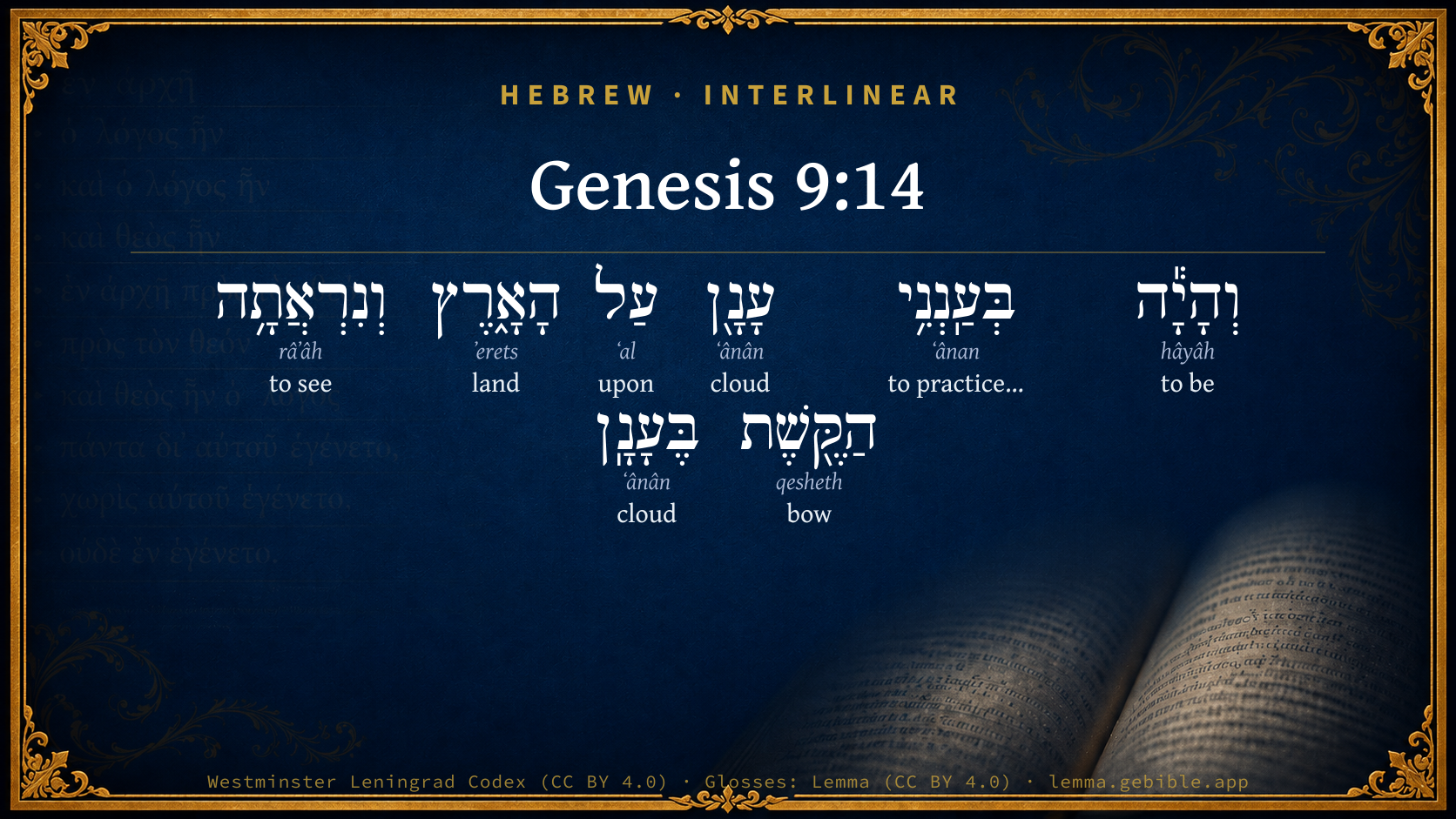
Hebrew (Westminster Leningrad Codex) Genesis 9:14 appears in the Hebrew Old Testament. The text above is from the Westminster Leningrad Codex. Each word links to its Strong’s number, a concise gloss, and parsing drawn from the Open Scriptures Hebrew Bible morphology. Click any word for its full Brown-Driver-Briggs (BDB) entry.
Download image
Cite this verse

Genesis 9:14 (World English Bible). Public Domain. Lemma interlinear Bible study tool, https://lemma.gebible.app/v/genesis/9/14.

Show BibTeX & RIS
BibTeX
RIS
English Translation
It will happen, when I bring a cloud over the earth, that the rainbow will be seen in the cloud,
World English Bible · Public Domain
Highlights
  • 1 first appearance in the Hebrew Bible
Full analysis ↓
Download a study sheet

One document with this verse’s original text, its word-by-word gloss line, the meaning frame, cross-references with their text, attributed commentary, and full source and license credits — printable, and it pastes into notes with its structure intact.

This verse Autodidact and up

Study sheet (.html) Plain text (.txt)

A passage Seminary Student

Up to 50 verses in one chapter. A passage sheet keeps up to 6 commentary sources and 12 cross-references per verse, in the order this page ranks them, and says so on the sheet whenever that leaves anything out. Ask for a single verse and you get the Autodidact verse sheet above.

Everything on this page stays free to read, with no account — the sheet is a download of what is already on screen, not access to it.

Want to remove ads? Support Godless Engineer
Compare translations 3

The same verse in 3 English versions, stacked beneath the original-language interlinear above. Click any original word for its lexicon entry.

Each is an independent rendering of the whole verse — the interlinear is not word-aligned to these translations.

Highlighted words mark where these versions differ — a whole-verse word diff, not a word-by-word alignment.

  • World English Bible Public Domain
    It will happen, when I bring a cloud over the earth, that the rainbow will be seen in the cloud,
  • King James Version Public Domain
    And it shall come to pass, when I bring a cloud over the earth, that the bow shall be seen in the cloud:
  • unfoldingWord Literal Text CC BY-SA 4.0
    And it will be when I bring clouds over the earth and the rainbow is seen in the clouds,

unfoldingWord Literal Text — © unfoldingWord, licensed CC BY-SA 4.0. Word-aligned USFM3 via Door43 (git.door43.org/unfoldingWord/en_ult).

Versions to compare (up to 4)

3 of 4 selected

Show all 18 translations

Every available English version of this verse, each an independent rendering of the whole verse.

  • World English Bible Public Domain
    It will happen, when I bring a cloud over the earth, that the rainbow will be seen in the cloud,
  • Berean Standard Bible Public Domain
    Whenever I form clouds over the earth and the rainbow appears in the clouds,
  • Majority Standard Bible Public Domain
    Whenever I form clouds over the earth and the rainbow appears in the clouds,
  • King James Version Public Domain
    And it shall come to pass, when I bring a cloud over the earth, that the bow shall be seen in the cloud:
  • American Standard Version (1901) Public Domain
    And it shall come to pass, when I bring a cloud over the earth, that the bow shall be seen in the cloud,
  • Revised Version (1885) Public Domain
    And it shall come to pass, when I bring a cloud over the earth, that the bow shall be seen in the cloud,
  • Geneva Bible (1599) Public Domain
    And when I shall couer the earth with a cloud, and the bowe shall be seene in the cloude,
  • Douay-Rheims (1899) Public Domain
    And when I shall cover the sky with clouds, my bow shall appear in the clouds:
  • Young's Literal Translation Public Domain
    and it hath come to pass (in My sending a cloud over the earth) that the bow hath been seen in the cloud,
  • Literal Standard Version CC BY-SA 4.0
    and it has come to pass (in My sending a cloud over the earth) that the bow has been seen in the cloud,
  • Unlocked Literal Bible CC BY-SA 4.0
    It will come about when I bring a cloud over the earth and the rainbow is seen in the cloud,
  • unfoldingWord Literal Text CC BY-SA 4.0
    And it will be when I bring clouds over the earth and the rainbow is seen in the clouds,
  • Darby Bible Public Domain
    And it shall come to pass when I bring clouds over the earth, that the bow shall be seen in the cloud,
  • World Messianic Bible Public Domain
    When I bring a cloud over the earth, that the rainbow will be seen in the cloud,
  • Webster's Bible Public Domain
    And it shall come to pass, when I bring a cloud over the earth, that the bow shall be seen in the cloud:
  • Free Bible Version CC BY-SA 4.0
    Whenever I make clouds form over the earth and the rainbow appears,
  • Bible in Basic English Public Domain
    And whenever I make a cloud come over the earth, the bow will be seen in the cloud,
  • JPS Tanakh (1917) Public Domain
    And it shall come to pass, when I bring clouds over the earth, and the bow is seen in the cloud,

Literal Standard Version (2020), Covenant Press — licensed CC BY-SA 4.0. Text via the HelloAO Bible API (eBible.org). Unlocked Literal Bible (unfoldingWord) — licensed CC BY-SA 4.0. Text via the HelloAO Bible API (eBible.org). unfoldingWord Literal Text — © unfoldingWord, licensed CC BY-SA 4.0. Word-aligned USFM3 via Door43 (git.door43.org/unfoldingWord/en_ult). Free Bible Version, Dr. Jonathan Gallagher — licensed CC BY-SA 4.0. Text via the HelloAO Bible API (eBible.org).

Word by word

More ways to search: Search by grammar → Find every occurrence → Compare this word →

Practice this passage: Drill this verse → Learn its vocabulary →

בְּעַֽנְנִ֥י
ʻânan
H6049
“in/at · to practice sorcery · me”
Preposition + Verb, Piel, Infinitive Construct + Suffix, Personal, 1st Person, Common, Singular
Part of Speech
Preposition + Verb
Stem
Piel
Form
Infinitive Construct
Full BDB Definition

Origin: a primitive root

TWOT: 1655 , 1656

(Piel) to make appear, produce, bring (clouds) - (Poel) to practise soothsaying, conjure - to observe times, practice soothsaying or spiritism or magic or augury or witchcraft - soothsayer, enchanter, sorceress, diviner, fortuneteller, barbarian, Meonenim (participle)
  1. וְהָיָ֕ה hâyâh H1961 “and · to be” Conjunction + Verb, Qal, Sequential Perfect, 3rd Person, Masculine, Singular
  2. עָנָ֖ן ʻânân H6051 “cloud” Noun, Common, Masculine, Singular, Absolute
  3. עַל ʻal H5921 “upon” Preposition
  4. הָאָ֑רֶץ ʼerets H776 “the · land” Particle, Definite Article + Noun, Common, Both, Singular, Absolute
  5. וְנִרְאֲתָ֥ה râʼâh H7200 “and · to see” Conjunction + Verb, Niphal, Sequential Perfect, 3rd Person, Feminine, Singular
  6. הַקֶּ֖שֶׁת qesheth H7198 “the · bow” Particle, Definite Article + Noun, Common, Feminine, Singular, Absolute
  7. בֶּעָנָֽן ʻânân H6051 “in/at the · cloud” Preposition, Determined + Noun, Common, Masculine, Singular, Absolute

About this verse

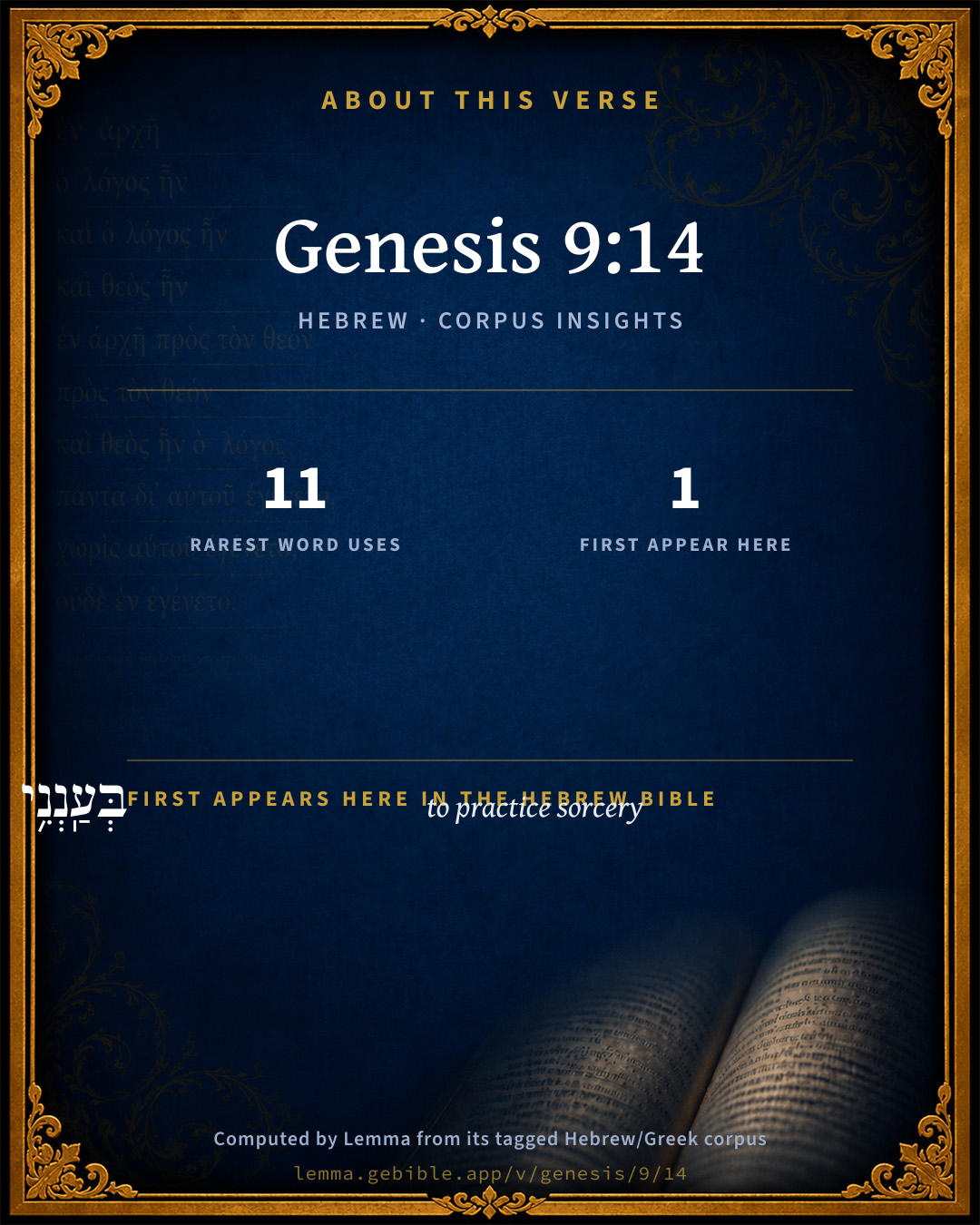
These counts appear in no published source. They are computed here, from the morphology-tagged text and Lemma’s own curated glosses. What Lemma adds →

8
words
7
distinct lemmas
Pentateuch
section

Notable vocabulary

The rarest word here is בְּעַֽנְנִ֥י to practice sorcery H6049 — appearing just 11 times in the whole Hebrew Bible.

First appearance in Scripture

This word makes its first canonical appearance in the Hebrew Bible here:

  • בְּעַֽנְנִ֥י to practice sorcery H6049

Shared distinctive vocabulary

בְּעַֽנְנִ֥י to practice sorcery H6049 occurs in 11 verses of the Hebrew Bible. Also found in:

Grammatical profile

  • 3 verbs
  • 4 nouns
  • 1 preposition

Verb forms

  • וְהָיָ֕ה Qal · Sequential Perfect
  • בְּעַֽנְנִ֥י Piel · Infinitive Construct
  • וְנִרְאֲתָ֥ה Niphal · Sequential Perfect

Repetition

A word recurs within this verse — often emphatic in Hebrew:

  • עָנָ֖ן cloud H6051 ×2

Hebrew & Septuagint length

In English translation the verse runs 20 words from the Hebrew and 20 from the Septuagint (LXX English) — the same length.

A rough comparison of the two English renderings, which tokenize alike — not a word-level alignment.

Word counts can differ between the Hebrew and the Greek without any difference in meaning — e.g. the Hebrew direct-object marker אֵת has no separate Greek word, and Greek often adds the article ὁ.

Hebrew and Greek witnesses Masoretic Hebrew ↔ Greek Septuagint

The same verse in the two great witnesses to the Old Testament, shown verse-for-verse.

These are two independent witnesses, not word-aligned to each other, and the Septuagint is shown in lemma (dictionary) form.

Hebrew Genesis 9:14 Masoretic · Westminster Leningrad Codex

וְהָיָ֕ה בְּעַֽנְנִ֥י עָנָ֖ן עַל הָאָ֑רֶץ וְנִרְאֲתָ֥ה הַקֶּ֖שֶׁת בֶּעָנָֽן

It will happen, when I bring a cloud over the earth, that the rainbow will be seen in the cloud,

World English Bible · Public Domain

Greek LXX Genesis 9:14 Septuagint · lemma form

καί εἰμί ἐν ὁ συννεφέω ἐγώ νεφέλη ἐπί ὁ γῆ ὁράω ὁ τόξον ἐγώ ἐν ὁ νεφέλη

And it shall be when I gather clouds upon the earth, that my bow shall be seen in the cloud.

LXX2012 (modern English Septuagint) · Public Domain

Hebrew: Westminster Leningrad Codex (CC BY 4.0). Greek: Septuagint (public domain); English from LXX2012 (modern English Septuagint) (Public Domain). How the Septuagint differs from the Hebrew →

Targum (Aramaic paraphrase)

2

The Targum is the ancient Jewish Aramaic paraphrase of the Hebrew Scriptures — an interpretive translation, not the Hebrew text itself. Onkelos (literal) and Pseudo-Jonathan (expansive) render the Torah, and Jonathan the Prophets. Coverage is partial: where no permissively-licensed English translation exists for a verse, only the Aramaic is shown. This is verse-level text, not a word-by-word alignment to the Hebrew.

  1. Targum Onkelos Torah (Genesis–Deuteronomy)
    וִיהִי בַּעֲנָנוּתִי עֲנָנָא עַל אַרְעָא וְתִתְחֲזֵי קַשְׁתָּא בַּעֲנָנָא

    And it shall be that when clouding I becloud the earth, the bow shall be seen in the cloud,...

    Targum Onkelos — Aramaic: “Onkelos Genesis” (public domain); “Onkelos Exodus” (public domain); “Onkelos Leviticus” (public domain); “Onkelos Numbers” (public domain); “Onkelos Deuteronomy” (public domain). English: “Sefaria Community Translation” (CC0 1.0 (public-domain dedication)); “J.W. Etheridge. The Targums of Onkelos and Jonathan Ben Uzziel on the Pentateuch. London: Longmans, Green, 1862” (public domain). Text via Sefaria.

  2. Targum Pseudo-Jonathan Torah (Genesis–Deuteronomy)
    וִיהֵי כַּד אֶפְרוֹס עֲנָנֵי יְקָרָא עֲלוֹי אַרְעָא וְתִתְחַמֵי קַשְׁתָּא בִּימָמָא עַד לָא יִטְמַע שִׁמְשָׁא בַּעֲנָנָא

    And it shall be that when I spread forth My glorious cloud over the earth, the bow shall be seen in the day (time), while the sun is not sunk (or hidden) in a cloud.

    Targum Pseudo-Jonathan — Aramaic: “Targum Jonathan on Genesis” (public domain); “Targum Jonathan on Exodus” (public domain); “Targum Jonathan on Leviticus” (public domain); “Targum Jonathan on Numbers” (public domain); “Targum Jonathan on Deuteronomy” (public domain). English: “The Targum of Jonathan ben Uzziel, trans. J. W. Etheridge, London, 1862” (public domain). Text via Sefaria.

Commentary

Notes on Genesis 9:14 from classic Christian and Jewish commentators (each source and its license shown beneath its notes). The classic Christian expositions comment on the surrounding passage and are grouped to its opening verse, so a note may address several verses; the Jewish commentaries on the Tanakh (Rashi and others) are per-verse, so they appear only where the commentator wrote on this verse.

Lemma curates 59 commentaries, every one of them public domain or Creative Commons licensed, each selected and text-cleaned for this edition rather than reprinted as found. About our sources →

Trapp's Complete Commentary

John Trapp

Gen 9:14 And it shall come to pass, when I bring a cloud over the earth, that the bow shall be seen in the cloud:

Ver. 14. The bow shall be seen in the cloud.] In this heaven-bow, there are many wonders: first, the beautiful shape and various colours; in which respect Plato thinks the poets feign Iris, or the rainbow, to be the daughter of Thaumas, or admiration. The waterish colours therein signify (say some) the former overthrow of the world by water. The fiery colours, the future judgment of the world by fire. The green, that present grace of freedom from both, by virtue of God’s covenant, whereof this bow is a sign. Next, the rainbow hath in it two contrary significations, viz., of rain, and fair weather; of this in the evening, of that in the morning, saith Scaliger. Add hereunto, that whereas naturally it is a sign of rain (and is therefore feigned by the poets to be the messenger of Juno, and called imbrifera , or showery), yet it is turned by God into a sure sign of dry weather, and of restraint of waters. Let us learn to look upon it, not only in the natural causes, as it is an effect of the sun in a thick cloud; but as a sacramental sign of the covenant of grace; a monument of God’s both justice in drowning the world, and mercy in conserving it from the like calamity. {Isa 54:9-10} The Jews have an odd conceit, {a} that the name Jehovah is written on the rainbow. And therefore, as oft as it appeareth unto them, they go forth of doors, hide their eyes, confess their sins (that deserved a second deluge), and celebrate God’s goodness, in sparing the wicked world, and remembering his covenant. Set aside their superstition, and their practice invites our imitation. Tam Dei meminisse opus est quam respirare .{ b}

{a} Maimon.

{b} Bern.

John Trapp, A Commentary or Exposition upon All the Books of the Old and New Testament (1647–1656) — public domain. Text from a community e-Sword module.

The Cambridge Bible for Schools and Colleges

gen. ed. J. J. S. Perowne

14. that the bow shall be seen] This should be rendered “and the bow is seen.” The promise is not that the bow shall be seen whenever God sends clouds over the earth, but that, whenever He sends clouds and His bow is visible, then He will remember the covenant.

It is possible that this beautiful employment of the rainbow symbol may be the adaptation of a still earlier semi-mythological conception, according to which the God of Israel is represented in poetry as a warrior armed with bow and arrow (the lightnings are His arrows, cf. Psa_7:12-13; Hab_3:9-11); when His anger had passed, He hung His bow in the clouds. The rainbow does not, however, appear frequently in the imagery of Jewish poetry. In Eze_1:28, and in Rev_4:3; Rev_10:1, it is mentioned in connexion with the appearances of Divine glory. As a feature in nature, it is referred to in Sir_43:12; Sir_50:7.

The Cambridge Bible for Schools and Colleges (gen. ed. J. J. S. Perowne; Cambridge University Press, 1878–1918) — public domain. Text from a community e-Sword module.

John Gill's Exposition

And it shall come to pass, when I bring a cloud over the earth,.... Or "cloud a cloud" (u), cause the clouds to gather thick in the heavens, and to hang over the earth ready to pour down great quantities of water; by reason of which the inhabitants might dread another flood coming upon them: wherefore, in order to dissipate such fears, it shall be so ordered:

that the bow shall be seen in the cloud; after it has pretty much discharged itself; for the rainbow is always in a thin, not a thick cloud; after the heavy showers are fallen from the thick clouds, and a small thin one remains, then the rainbow is seen in it; not always, but very frequently, and when the sun and clouds are in a proper position: and this is often so ordered, to put men in mind of this covenant, and to divest them of, or prevent their fears of the world being drowned by a flood; for when they see this, it is a sure sign the rain is going off, since the cloud is thinned, or otherwise the rainbow could not appear: and a most glorious and beautiful sight it is, having such a variety of colours in it, and in such a position and form. Some think that it serves both to put in mind of the destruction of the old world by water, through its watery colours, and of the present world by fire, through its fiery ones. Others make the three predominant colours to denote the three dispensations before the law, under the law, and under the Gospel: rather they may signify the various providences of God, which all work together for the good of his people; however, whenever this bow is seen, it puts in mind of the covenant of preservation made with all the creatures, and the firmness, stability, and duration of it; and is by some considered as an emblem of the covenant of grace, from Isa 54:9 which is of God's making, as this bow is; is a reverberation of Christ the sun of righteousness, the sum and substance of the covenant; consists of various blessings and promises of grace; is expressive of mercy and peace, and is a security from everlasting destruction: or rather it may be thought to be an emblem of Christ himself, who was seen by John clothed with a cloud, and a rainbow on his head, Rev 10:1 this being a wonderful thing, as Christ is wonderful in his person, office, and grace; and as it has in it a variety of beautiful colours, it may represent Christ, who is full of grace and truth, and fairer than the children of men; and may be considered as a symbol of peace and reconciliation by him, whom God looks unto, and remembers the covenant of his grace he has made with him and his chosen ones in him; and who is the rainbow round about the throne of God, and the way of access unto it; Rev 4:3 the Jews have a saying,"till ye see the bow in its luminous colours, do not look for the feet of the Messiah, or his coming (w).''

(u) "cum obnubilavero nubem", Pagninus, Montanus, Vatablus, Schmidt. (w) Tikkune Zohar, correct. 18. fol. 32. 2. correct. 37. fol. 81. 1.

John Gill's Exposition of the Whole Bible (1746–1763) — public domain (CC PDM 1.0). Text via the HelloAO Bible API.

Matthew Poole's English Annotations

Not always, but very frequently, which is sufficient for this purpose.

Matthew Poole's English Annotations on the Holy Bible (1683–1685) — public domain. Text from a community e-Sword/MySword module.

The Pulpit Commentary

And it shall come to pan, when I bring a cloud over the earth. Literally, in my clouding a cloud, i.e. gathering clouds, which naturally signify store of rain. (1Ki_18:44, 1Ki_18:45) Clouds are often used to denote afflictions and dangers (cf. Eze_30:3, 18 32:7; Joe_2:2) That the bow shall be seen in the cloud. Literally, and the bow is seen, which it always is when the sun"s rays fall upon it, if the spectator"s back is towards the light, and his face towards the cloud. Thus at the moment when danger seems to threaten most, the many-colored arch arrests the gaze.

The Pulpit Commentary (1880–1919), ed. H.D.M. Spence-Jones & Joseph S. Exell — public domain. Text from a community e-Sword module.

unfoldingWord translationNotes

Door43 World Missions Community

General Information:

God continues speaking to Noah and his sons.

It will come about when

"Whenever." It is something that would happen many times.

the rainbow is seen

It is not clear who will see the rainbow, but because the covenant is between Yahweh and people, if you need to say who it is who will see the rainbow, it would be best to name both Yahweh and people. This can be translated in active form. AT: "people and I see the rainbow" (See: Active or Passive)

rainbow

the colorful strip of light that appears in the rain when the sun shines from behind the viewer

I will call to mind my covenant

This does not mean that God would first forget. AT: "I will think about my covenant"

me and you

The word "you" is plural. God was speaking to Noah and Noah's sons.

every living creature of all flesh

"every kind of living being"

all flesh

Possible meanings for what "all flesh" represents are 1) all human beings or 2) all physical beings, including humans and animal. See how this is translated in Genesis 6:12. (See: Synecdoche)

translationWords

covenant

flesh

flood

unfoldingWord translationNotes — © Distant Shores Media and the Door43 World Missions Community, licensed CC BY-SA 4.0. Source: git.door43.org/Door43/en_tn.

Rashi

Rabbi Shlomo Yitzchaki (Rashi)

בענני ענן WHEN I BRING A CLOUD — When I have it in mind to bring darkness and destruction upon the world.

Rashi on the Tanakh — English translations: “The Judaica Press complete Tanach with Rashi, translated by A. J. Rosenberg” (CC BY 4.0); “Pentateuch with Rashi's commentary by M. Rosenbaum and A.M. Silbermann, 1929-1934” (public domain); “The Metsudah Tanach series, Lakewood, N.J” (CC BY 4.0); and “The Book of Joshua, Metsudah Publications, 1997” (CC BY 4.0). Text via Sefaria.

Radak

Rabbi David Kimhi (Radak)

והיה בענני ענן, I will place clouds for a variety of reasons.

בענני, this word, though without the dagesh in the letter נ is in the conjugation kal. It is not at all unusual that it appears without the dagesh. The reason why G’d repeats the word ענןhaving already said that He speaks of having provided clouds, is to underline the importance of that activity, just as the line מרקר קיר, “tumult and din” in Isaiah 22,5 or ותשרש שרשיה in Psalms 80,10 “and uprooted its roots.”

ונראתה, it will be seen by people.

Radak on the Tanakh — English translations: “Sefaria Community Translation” (CC0 1.0 (public-domain dedication)); “Eliyahu Munk, HaChut Hameshulash” (CC BY 4.0); “Rabbi Mike Feuer, Jerusalem Anthology” (CC BY 4.0); and “R. David Kimhi on the first book of Psalms, Translated by R.G. Finch, London, 1919” (public domain). Text via Sefaria.

Lesson kit

Teaching starters — assembled from the data on this page, not authored interpretation. Every prompt links to the verse data it draws on. Edit before teaching.

Genesis, in the Pentateuch, opens this verse with 8 words (7 distinct Hebrew lemmas). Its most distinctive word is ʻânan (“to practice sorcery”). A historical commentator’s framing appears above. Read the whole chapter for the surrounding context.

Discussion questions

  1. What does “to practice sorcery” (ʻânan) contribute to the verse as a whole?
  2. The word “to practice sorcery” first appears here in Scripture. What is being introduced at this debut?
  3. Leviticus 19:26 shares the word «to practice sorcery» with this verse. How do the two illuminate each other?
  4. “cloud” occurs 2× in this one verse. What is the effect of the repetition?
  5. These translations render this verse differently; the difference is in the English rendering, not the original. What questions does that raise?
  6. The verb «וְהָיָ֕ה» is Qal Sequential Perfect. How does its form color the action?
  7. Reading how Trapp's Complete Commentary and The Cambridge Bible for Schools and Colleges read this verse, where do the two commentators agree and where do they part?

Things to notice

  • 1 word makes its first canonical appearance in Scripture here.
  • These translations choose different wording for 9 words in this verse.
  • “cloud” occurs 2× in this single verse.
  • 7 distinct Hebrew lemmas span 8 words in this verse.

Reading settings

Reading text

Shown beneath each verse's original-language words.

Old Testament
Old Testament edition

Read the OT as the Masoretic Hebrew (MT) or the Greek Septuagint (LXX).

English shown for the Greek Septuagint (in the Hebrew ↔ Greek comparison).

Comparing translations? Open the Compare panel on any verse page to stack up to four side by side.