
Matthew 8:4

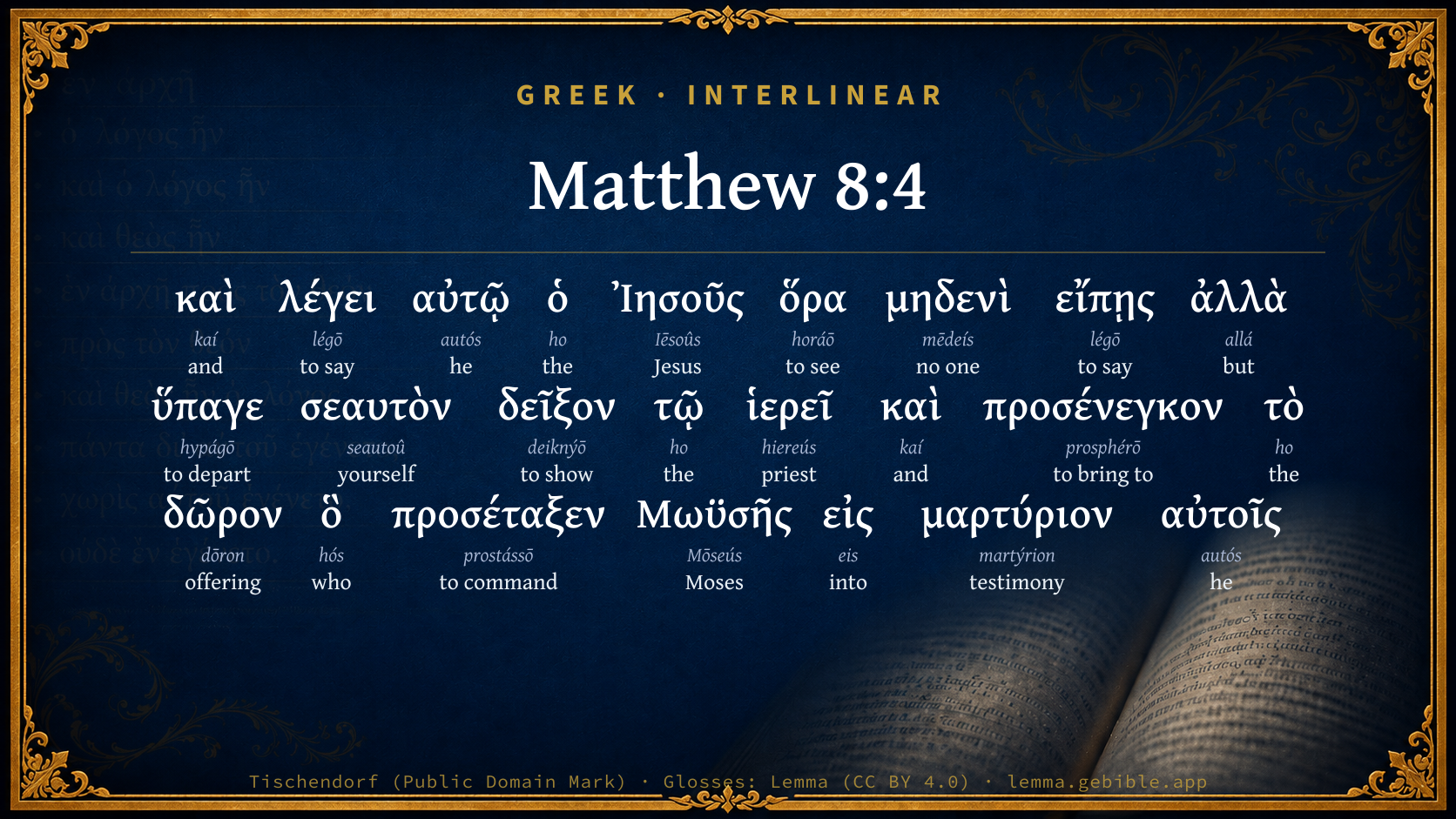
Greek (Tischendorf 8th ed.) Matthew 8:4 appears in the Greek New Testament. The text above is from the Tischendorf 8th edition. Each word links to its Strong’s number and a concise gloss. Click any word for its full Thayer’s Greek Lexicon entry.
Download image
Cite this verse

Matthew 8:4 (World English Bible). Public Domain. Lemma interlinear Bible study tool, https://lemma.gebible.app/v/matthew/8/4.

Show BibTeX & RIS
BibTeX
RIS
English Translation
Jesus said to him, "See that you tell nobody, but go, show yourself to the priest, and offer the gift that Moses commanded, as a testimony to them."
World English Bible · Public Domain
Highlights
  • 4 first appearances in the Greek New Testament
Full analysis ↓
Download a study sheet

One document with this verse’s original text, its word-by-word gloss line, the meaning frame, cross-references with their text, attributed commentary, and full source and license credits — printable, and it pastes into notes with its structure intact.

This verse Autodidact and up

Study sheet (.html) Plain text (.txt)

A passage Seminary Student

Up to 50 verses in one chapter. A passage sheet keeps up to 6 commentary sources and 12 cross-references per verse, in the order this page ranks them, and says so on the sheet whenever that leaves anything out. Ask for a single verse and you get the Autodidact verse sheet above.

Everything on this page stays free to read, with no account — the sheet is a download of what is already on screen, not access to it.

Want to remove ads? Support Godless Engineer
Compare translations 3

The same verse in 3 English versions, stacked beneath the original-language interlinear above. Click any original word for its lexicon entry.

Each is an independent rendering of the whole verse — the interlinear is not word-aligned to these translations.

Highlighted words mark where these versions differ — a whole-verse word diff, not a word-by-word alignment.

  • World English Bible Public Domain
    Jesus said to him, "See that you tell nobody, but go, show yourself to the priest, and offer the gift that Moses commanded, as a testimony to them."
  • King James Version Public Domain
    And Jesus saith unto him, See thou tell no man; but go thy way, shew thyself to the priest, and offer the gift that Moses commanded, for a testimony unto them.
  • unfoldingWord Literal Text CC BY-SA 4.0
    And Jesus says to him, “See that you tell no one, but go, show yourself to the priest and offer the gift that Moses commanded, for a testimony to them.”

unfoldingWord Literal Text — © unfoldingWord, licensed CC BY-SA 4.0. Word-aligned USFM3 via Door43 (git.door43.org/unfoldingWord/en_ult).

Versions to compare (up to 4)

3 of 4 selected

Show all 19 translations

Every available English version of this verse, each an independent rendering of the whole verse.

  • World English Bible Public Domain
    Jesus said to him, "See that you tell nobody, but go, show yourself to the priest, and offer the gift that Moses commanded, as a testimony to them."
  • Berean Standard Bible Public Domain
    Then Jesus instructed him, “See that you don’t tell anyone. But go, show yourself to the priest and offer the gift prescribed by Moses, as a testimony to them.”
  • Majority Standard Bible Public Domain
    Then Jesus instructed him, “See that you don’t tell anyone. But go, show yourself to the priest and offer the gift prescribed by Moses, as a testimony to them.”
  • King James Version Public Domain
    And Jesus saith unto him, See thou tell no man; but go thy way, shew thyself to the priest, and offer the gift that Moses commanded, for a testimony unto them.
  • American Standard Version (1901) Public Domain
    And Jesus saith unto him, See thou tell no man; but go, show thyself to the priest, and offer the gift that Moses commanded, for a testimony unto them.
  • Revised Version (1885) Public Domain
    And Jesus saith unto him, See thou tell no man; but go thy way, shew thyself to the priest, and offer the gift that Moses commanded, for a testimony unto them.
  • Geneva Bible (1599) Public Domain
    Then Iesus saide vnto him, See thou tell no man, but goe, and shewe thy selfe vnto the Priest, and offer the gift that Moses commanded, for a witnesse to them.
  • Douay-Rheims (1899) Public Domain
    And Jesus saith to him: See thou tell no man: but go, shew thyself to the priest, and offer the gift which Moses commanded for a testimony unto them.
  • Young's Literal Translation Public Domain
    And Jesus saith to him, `See, thou mayest tell no one, but go, thyself shew to the priest, and bring the gift that Moses commanded for a testimony to them.'
  • Literal Standard Version CC BY-SA 4.0
    And Jesus says to him, “See, you may tell no one, but go, show yourself to the priest, and bring the gift that Moses commanded for a testimony to them.”
  • Unlocked Literal Bible CC BY-SA 4.0
    Jesus said to him, “See that you say nothing to any man. Go on your way, and show yourself to the priest and offer the gift that Moses commanded, for a testimony to them.”
  • unfoldingWord Literal Text CC BY-SA 4.0
    And Jesus says to him, “See that you tell no one, but go, show yourself to the priest and offer the gift that Moses commanded, for a testimony to them.”
  • Darby Bible Public Domain
    And Jesus says to him, See thou tell no man, but go, shew thyself to the priest, and offer the gift which Moses ordained, for a testimony to them.
  • World Messianic Bible Public Domain
    Yeshua said to him, “See that you tell nobody; but go, show yourself to the priest, and offer the gift that Moses commanded, as a testimony to them.”
  • Webster's Bible Public Domain
    And Jesus saith to him, See thou tell no man; but go, show thyself to the priest, and offer the gift that Moses commanded, for a testimony to them.
  • Free Bible Version CC BY-SA 4.0
    “Make sure you don't tell anyone,” Jesus told him. “Go and show yourself to the priest and give the offering which Moses required as public proof.”
  • Bible in Basic English Public Domain
    And Jesus said to him, See that you say nothing about this to anyone; but go and let the priest see you and make the offering which was ordered by Moses, for a witness to them.
  • Text-Critical English NT CC BY 4.0
    Then Jesus said to him, “Be sure not to tell anyone about this, but go show yoʋrself to the priest, and offer the gift that Moses commanded, as a testimony to them.”
  • Tyndale New Testament (1534) Public Domain
    And Iesus sayde vnto him. Se thou tell no man but go and shewe thy selfe to the preste and offer the gyfte that Moses commaunded in witnes to them.

Literal Standard Version (2020), Covenant Press — licensed CC BY-SA 4.0. Text via the HelloAO Bible API (eBible.org). Unlocked Literal Bible (unfoldingWord) — licensed CC BY-SA 4.0. Text via the HelloAO Bible API (eBible.org). unfoldingWord Literal Text — © unfoldingWord, licensed CC BY-SA 4.0. Word-aligned USFM3 via Door43 (git.door43.org/unfoldingWord/en_ult). Free Bible Version, Dr. Jonathan Gallagher — licensed CC BY-SA 4.0. Text via the HelloAO Bible API (eBible.org).

Word by word

More ways to search: Search by grammar → Find every occurrence → Compare this word →

Practice this passage: Drill this verse → Learn its vocabulary →

προσέταξεν
prostássō
G4367
“to command”
Verb, Aorist, Active, Indicative, 3rd person, Singular
Part of Speech
Verb
Tense
Aorist
Voice
Active
Mood
Indicative
Person
3rd person
Number
Singular
Full Thayer's Definition

Origin: from G4314 and G5021

TDNT: 08:37,1

1. to assign or ascribe to, join to 2. to enjoin, order, prescribe, command a. to appoint, to define
  1. καὶ kaí G2532 “and” Conjunction
  2. λέγει légō G3004 “to say” Verb, Present, Active, Indicative, 3rd person, Singular
  3. αὐτῷ autós G846 “he” Personal pronoun, Dative, Singular, Masculine
  4. ὁ ho G3588 “the” Article, Nominative, Singular, Masculine
  5. Ἰησοῦς Iēsoûs G2424 “Jesus” Noun, Nominative, Singular, Masculine
  6. ὅρα horáō G3708 “to see” Verb, Present, Active, Imperative, 2nd person, Singular
  7. μηδενὶ mēdeís G3367 “no one” Adjective, Dative, Singular, Masculine, Negative
  8. εἴπῃς légō G3004 “to say” Verb, Aorist, Active, Subjunctive, 2nd person, Singular
  9. ἀλλὰ allá G235 “but” Conjunction
  10. ὕπαγε hypágō G5217 “to depart” Verb, Present, Active, Imperative, 2nd person, Singular
  11. σεαυτὸν seautoû G4572 “yourself” Reflexive pronoun, 2nd person, Accusative, Singular, Masculine
  12. δεῖξον deiknýō G1166 “to show” Verb, Aorist, Active, Imperative, 2nd person, Singular
  13. τῷ ho G3588 “the” Article, Dative, Singular, Masculine
  14. ἱερεῖ hiereús G2409 “priest” Noun, Dative, Singular, Masculine
  15. καὶ kaí G2532 “and” Conjunction
  16. προσένεγκον prosphérō G4374 “to bring to” Verb, Aorist, Active, Imperative, 2nd person, Singular
  17. τὸ ho G3588 “the” Article, Accusative, Singular, Neuter
  18. δῶρον dōron G1435 “offering” Noun, Accusative, Singular, Neuter
  19. ὃ hós G3739 “who” Relative pronoun, Accusative, Singular, Neuter
  20. Μωϋσῆς Mōseús G3475 “Moses” Noun, Nominative, Singular, Masculine
  21. εἰς eis G1519 “into” Preposition
  22. μαρτύριον martýrion G3142 “testimony” Noun, Accusative, Singular, Neuter
  23. αὐτοῖς autós G846 “he” Personal pronoun, Dative, Plural, Masculine

About this verse

These counts appear in no published source. They are computed here, from the morphology-tagged text and Lemma’s own curated glosses. What Lemma adds →

24
words
19
distinct lemmas
Gospels
section

Notable vocabulary

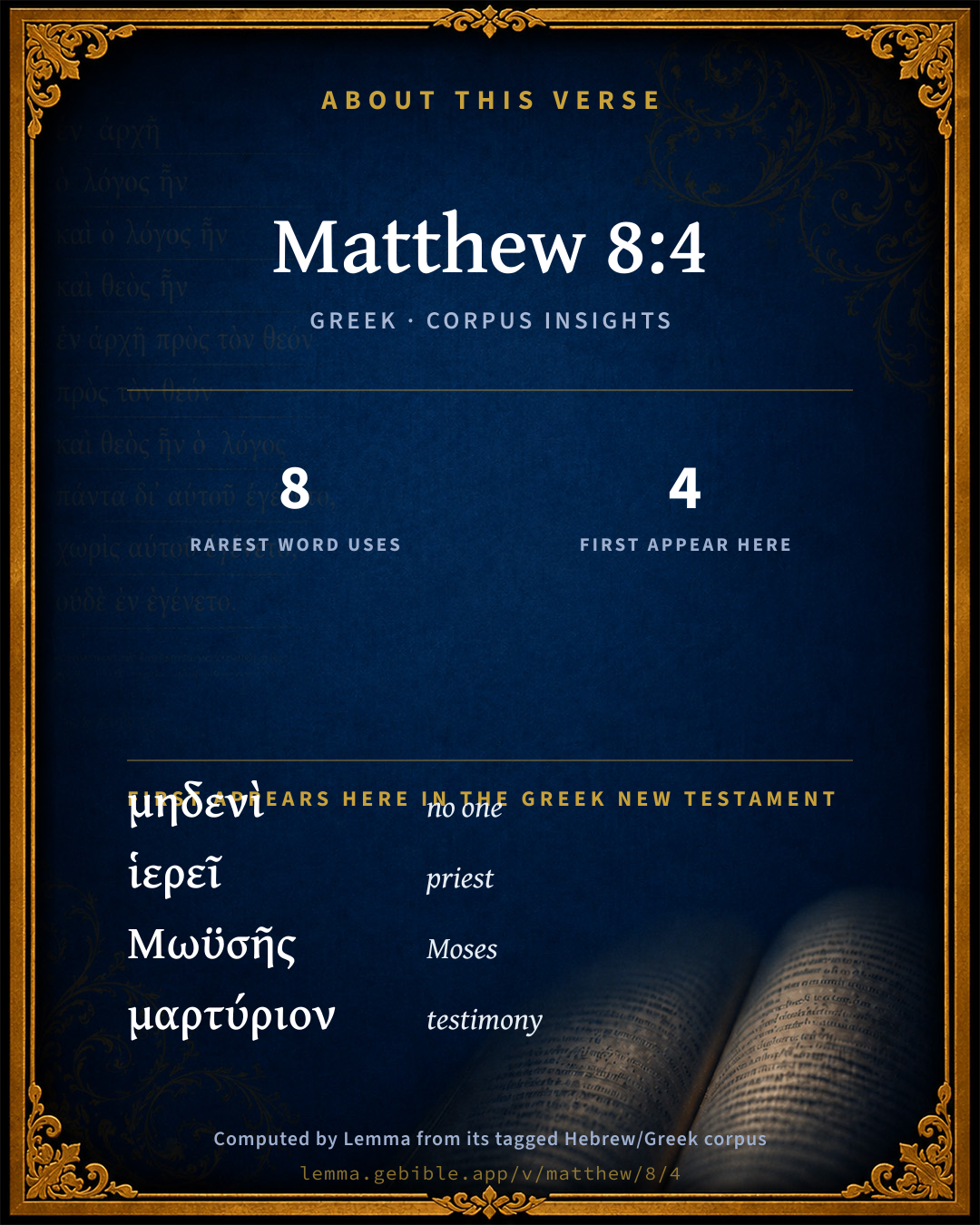
The rarest word here is προσέταξεν to command G4367 — appearing just 8 times in the whole Greek New Testament.

First appearance in Scripture

These words make their first canonical appearance in the Greek New Testament here:

  • μηδενὶ no one G3367
  • ἱερεῖ priest G2409
  • Μωϋσῆς Moses G3475
  • μαρτύριον testimony G3142

Shared distinctive vocabulary

προσέταξεν to command G4367 occurs in 8 verses of the Greek New Testament. Also found in:
Repetition

Words recur within this verse:

Cross-references

25

Topical passages linked to Matthew 8:4 in the Treasury of Scripture Knowledge — connected by theme and wording, ordered by reader-vote popularity; previews shown in the World English Bible.

  • Leviticus 14:2–32 "This shall be the law of the leper in the day of his cleansing. He shall be brought to the priest,
  • Luke 5:14 He charged him to tell no one, "But go your way, and show yourself to the priest, and offer for your cleansing according to what Moses commanded, for a testimony to them."
  • Luke 17:14 When he saw them, he said to them, "Go and show yourselves to the priests." It happened that as they went, they were cleansed.
  • Leviticus 13:2–46 "When a man shall have a rising in his body's skin, or a scab, or a bright spot, and it becomes in the skin of his body the plague of leprosy, then he shall be brought to Aaron the priest, or to one of his sons the priests:
  • Mark 7:36 He commanded them that they should tell no one, but the more he commanded them, so much the more widely they proclaimed it.
  • Matthew 9:30 Their eyes were opened. Jesus strictly charged them, saying, "See that no one knows about this."
  • Mark 6:11 Whoever will not receive you nor hear you, as you depart from there, shake off the dust that is under your feet for a testimony against them. Assuredly, I tell you, it will be more tolerable for Sodom and Gomorrah in the day of judgment than for that city!"
  • Matthew 12:16–19 and charged them that they should not make him known:
  • Mark 1:43–44 He strictly warned him, and immediately sent him out,
  • John 10:37–38 If I don't do the works of my Father, don't believe me.
  • 2 Kings 5:7–8 It happened, when the king of Israel had read the letter, that he tore his clothes, and said, Am I God, to kill and to make alive, that this man does send to me to recover a man of his leprosy? but consider, I pray you, and see how he seeks a quarrel against me.
  • Isaiah 42:21 It pleased Yahweh, for his righteousness' sake, to magnify the law, and make it honorable.
  • Matthew 5:17 "Don't think that I came to destroy the law or the prophets. I didn't come to destroy, but to fulfill.
  • Matthew 6:1 "Be careful that you don't do your charitable giving before men, to be seen by them, or else you have no reward from your Father who is in heaven.
  • Matthew 10:18 Yes, and you will be brought before governors and kings for my sake, for a testimony to them and to the Gentiles.
  • Matthew 17:9 As they were coming down from the mountain, Jesus commanded them, saying, "Don't tell anyone what you saw, until the Son of Man has risen from the dead."
  • Mark 5:43 He strictly ordered them that no one should know this, and commanded that something should be given to her to eat.
  • Matthew 3:15 But Jesus, answering, said to him, "Allow it now, for this is the fitting way for us to fulfill all righteousness." Then he allowed him.
  • Matthew 16:20 Then he charged the disciples that they should tell no one that he is Jesus the Christ.
  • Mark 8:30 He charged them that they should tell no one about him.
  • Luke 21:13 It will turn out as a testimony for you.
  • John 5:41 I don't receive glory from men.
  • John 7:18 He who speaks from himself seeks his own glory, but he who seeks the glory of him who sent him, the same is true, and no unrighteousness is in him.
  • John 8:50 But I don't seek my own glory. There is one who seeks and judges.
  • Mark 13:9 But watch yourselves, for they will deliver you up to councils. You will be beaten in synagogues. You will stand before rulers and kings for my sake, for a testimony to them.

Cross-references courtesy of OpenBible.info (CC BY 4.0).

Commentary

Notes on Matthew 8:4 from classic Christian and Jewish commentators (each source and its license shown beneath its notes). The classic Christian expositions comment on the surrounding passage and are grouped to its opening verse, so a note may address several verses; the Jewish commentaries on the Tanakh (Rashi and others) are per-verse, so they appear only where the commentator wrote on this verse.

Lemma curates 59 commentaries, every one of them public domain or Creative Commons licensed, each selected and text-cleaned for this edition rather than reprinted as found. About our sources →

Joseph Benson's Commentary

Mat 8:4. Jesus saith, See thou tell no man — Although our Lord was now followed by a great multitude of people, yet it seems not many of them were witnesses of this miracle, Jesus, probably, taking the person aside from the people before he wrought it, otherwise, as Doddridge observes, it does not appear that there could have been room for this charge of secrecy; the meaning of which undoubtedly was, Tell no man that thou wast healed by me; that is, as some suppose, till thou hast offered thy gift to the priest; and he, by receiving it, hath owned thee to be clean from thy leprosy; lest they, hearing that thou wast cleansed by me, should, out of envy to me, refuse to acknowledge thy being cleansed. It must be observed, however, that he commanded many others absolutely to tell none of the miracles he had wrought upon them. And this he seems to have done, chiefly for one or more of these reasons: 1st, to prevent the multitudes from thronging him, in the manner related Mar 1:45; Mark 2 d, to fulfil the prophecy, (Isa 42:1, &c.,) that he would not be vain or ostentatious: this reason St. Matthew assigns, Mat 12:17, &c.; 3d, to avoid being taken by force and made a king, Joh 6:15; John , , 4 th, that he might not enrage the chief priests, scribes, and Pharisees, who were the most bitter against him, any more than was unavoidable, Mat 16:20-21. But show thyself to the priest — That is, to any one of the priests to whom the rest have committed the office of examining cases of leprosy. Here it is well observed by Dr. Lightfoot, that, though the priesthood was much degenerated from its primitive institution, and many human inventions were added to God’s law, touching the priest’s examination of the lepers who pretended to be cleansed; yet Christ sends this leper to submit to all these human inventions, as knowing that, though they indeed corrupted, yet they did not destroy the divine institution, and annihilate the office. For a testimony to them — That is, offer thy gift for a testimony that thou art cleansed from thy leprosy. Dr. Campbell, by the them here mentioned, understands, the people, and therefore translates the clause, Make the oblation prescribed by Moses for notifying [the cure] to the people. The them here, says he, “could not be the priests, for it was only one priest, (namely, the priest then intrusted with that business,) to whom he [the man cleansed] was commanded to go. Besides, the oblation could not serve as an evidence to the priest. On the contrary, it was necessary that he should have ocular evidence, by an accurate inspection in private, before the man was admitted into the temple, and allowed to make the oblation; but his obtaining this permission, and the solemn ceremony consequent upon it, was the public testimony of the priest, the only legal judge, to the people, that the man’s uncleanness was removed. This was a matter of the utmost consequence to the man, and of some consequence to them. Till such testimony was given, he lived in a most uncomfortable seclusion from society. No man durst, under pain of being also secluded, admit him into his house, eat with him, or so much as touch him. The antecedent, therefore, to the pronoun them, though not expressed, is easily supplied by the sense. To me it is equally clear: that the only thing meant to be attested by the oblation was, the cure. The suppositions of some commentators on this subject are quite extravagant. Nothing can be more evident, than that the person now cleansed was not permitted to give any testimony to the priest, or to any other, concerning the manner of his cure, or the person by whom it had been performed. ‘Ορα μηδενι ειπης, See thou tell nobody. The prohibition is expressed by the Evangelist Mark in still stronger terms. Prohibitions of this kind were often transgressed by those who received them; but that is not a good reason for representing our Lord as giving contradicting orders.”

Joseph Benson's Commentary on the Old and New Testaments (1811–1818) — public domain. Text from a community e-Sword module.

Tyndale Open Study Notes

Tyndale Open Resources

8:4 The leper’s healing would be a public testimony—either that the religious leaders were wrong not to trust in the Messiah (10:18) or that Jesus was not against the law of Moses (5:17).

Tyndale Open Study Notes — © Tyndale Open Resources, licensed CC BY-SA 4.0. Text via the HelloAO Bible API.

Bengel's Gnomon

Johann Albrecht Bengel

Mat 8:4. Μηδενὶ, to no one) sc. before you have gone to the priest, lest the priests, if they had heard of it before, should deny that the leprosy had been really cleansed; sc. to no one of those who had not witnessed the miracle.—σεαυτὸν, thyself) not by means of another.—εἰς μαρτύριον, for a testimony) See Joh 5:36. Thus the LXX. use the word μαρτύριον in Rth 4:7.[356] The priests did not follow our Lord: He sends the leper to them from Galilee to Jerusalem: He was much in Galilee at that time.—αὐτοῖς, to them) that a testimony might he exhibited to them of the Messiah’s presence, and of His not derogating from the law, and that they too might thus be enabled to give testimony to these facts.

[356] Sc. καὶ τοῦτο—ἦν μαρτύριον ἐν Ἰσραήλ.—E. V. And this was a testimony in Israel.—(I. B.)

Bengel's Gnomon of the New Testament — English translation (T&T Clark, Edinburgh, 1860) — public domain. Text from a community e-Sword module.

Meyer's Critical & Exegetical Commentary

Heinrich August Wilhelm Meyer

Mat_8:4. The injunction, not to mention the matter to any one, cannot be regarded as an evidence of Matthews dependence on Mark (Holtzman; comp. Mat_12:15 with Mar_1:43; Mar_3:7 ff.), because the connection in Mark is supposed to be somewhat more appropriate, but is only to be taken as expressing a desire on the part of Jesus to prevent any commotion among the people with their fanatical Messianic hopes, at least as far as, by discouraging publicity, it was in His own power to do so (Chrysostom)to prevent what, according to Mar_1:45 (Luk_5:15), actually took place through a disregard of this injunction. Comp. Mat_9:30, Mat_12:16; Mar_3:12; Mar_5:43; Mar_7:36; Mar_8:26; Mar_8:30; Mat_16:20; Mat_17:9. The miracle was no doubt performed (Mat_8:1) before the people (in answer to Schenkel), and in the open air; but, in the first place, only those standing near would be in a position to hear or see the course of the miracle with sufficient minuteness; and, secondly, in giving this injunction, Jesus was also keeping in view the fact of the lepers being about to visit Jerusalem, and to sojourn there. Consequently we must reject the view of Maldonatus, Grotius, Bengel, Wetstein, Kuinoel, Paulus, Glöckler, to the effect that He wished to provide against any refusal on the part of the priests to pronounce the man clean. Equally inadmissible is that of Fritzsche, Baumgarten-Crusius, and Keim, that at present, above all, He insisted on the more important duty,that, namely, of the mans subjecting himself to the inspection of the priests, which is not in accordance with the occasional ὅρα (comp. Mat_9:31); nor can we accept Olshausens view, that the motive for the injunction is to be sought in the man himself. Baur holds that the injunction is not to be regarded as historical, but only as the product of tradition, arising out of the application to Jesus of Isa_42:1 ff. But the truth is, that prohibition is not once mentioned in Isaiah 42, which contains only a general description of the Messiahs humility. Moreover, it would not be apparent why the passage from Isaiah is not quoted here, when the injunction in question occurs for the first time, but afterwards in Mat_12:17.

σεαντόν] thyself. Instead of making a talk about the matter, go and present yourself in person before the proper authorities.

τῷ ἱερεῖ] Lev_14:2.

τὸ δῶρον] the offering prescribed in Lev_14:10; Lev_14:21. See Ewald, Alterth. p. 210 f.; Keil, Archäol. § 59.

εἰς μαρτύριον αὐτοῖς] as an evidence to them, i.e. to the people, that thou hast been healed. This reference of αὐτοῖς follows contextually from ὅρα, μηδενὶ εἴπῃς, and that of μαρτύριον (evidence that thou art cleansed) from a consideration of the object of the legal prescription in question; see Lev_14:57. It is importing a foreign element, to suppose that the testimony was further meant to show that I am not abrogating the law (Chrysostom, Theophylact; see what follows); comp. also Fritzsche, who looks upon the words as containing a remark by Matthew himself: Haec autem dixit, ut turbae testaretur, se magni facere Mosis instituta. As decisive against the latter view, we have the fact that both Mark and Luke record the words εἰς μαρτύριον αὐτοῖς, and that, too, in such a way as to make it evident that they formed part of what was spoken by Jesus (Luk_5:14). Chrysostom and Fathers understand αὐτοῖς as referring to the priests, in which case the testimony is regarded as intended to show either (what is in itself correct) Jesus respect for the law (Euth. Zigabenus, Bengel, Keim),to which the person cleansed was expected to bear witness before the priests (Chrysostom: εἰς ἔλεγχον, εἰς ἀπόδειξιν, εἰς κατηγορίαν, ἐὰν ἀγνωμονῶσιν,or the reality of the cure, si sc. vellent in posterum negare, me tibi sanitatem restituisse (Kuinoel, Erasmus, Maldonatus, Grotius), and at the same time the Messiahship of Jesus (Calovius). According to Olshausen, it is a testimony borne by the priests themselves that is meant; inasmuch as, by pronouncing the man clean, they become witnesses to the genuineness of the miracle, and at the same time condemn their own unbelief (a confusion of two things that are no less erroneous than foreign to the purpose). If αὐτοῖς referred to the priests, then of course μαρτύριον could only be understood as meaning an evidence or proof that the cleansing had taken place (Grotius). However, the offering was not meant to furnish such evidence to the priests, but to the people, who were now at liberty to resume their intercourse with the person who had been healed.

REMARK.

Attempts of various kinds have been made to divest the miracles of Jesus[430] of their special character, and to reduce them to the order of natural events (Paulus), partly by accounting for them on physiological or psychological grounds, and partly by explaining them on certain exegetical, allegorical, or mythical principles of interpretation. Some, again, have sought to remove them entirely from the sphere of actual fact, and to ascribe their origin to legends elaborated out of Old Testament types and prophecies (Strauss); to the influence of religious feeling in the church (B. Bauer); to narratives of an allegorical character (Volkmar); to the desire to embody certain ideas and tendencies of thought in historical incidents (Baur); as well as to mistakes of every sort in the understanding of similitudes and parables (Weisse). To admit the supernatural origin of Christianity is not inconsistent with the idea of its historical continuity (Baur); but the denial of miracles involves both an avowed and a covert impugning of the evangelic narrative,which, as such, is in its substance conditioned by miracles (Holtzmann, p. 510),and consequently does away almost entirely with its historical character. As a further result, Christianity itself is endangered, in so far as it is matter of history and not the product of the independent development of the human mind, and inasmuch as its entrance into the world through the incarnation of the Son of God is analogous to the miracle of creation (Philippi, Glaubensl. I. p. 25 ff., ed. 2). The miracles of Jesus, which should always be viewed in connection with His whole redeeming work (Köstlin, 1860, p. 14 ff.), are outward manifestations of the power of Gods Spirit, dwelling in Him in virtue of His Sonship, and corresponding to His peculiar relation to the world (Hirzel), as well as to His no less peculiar relation to the living God; their design was to authenticate His Messianic mission, and in this lay their telic necessity,a necessity, however, that is always to be regarded as only relative (Schott, de consilio, quo Jesus mirac. ediderit, Opusc. I. p. 111 ff.). And this according to Joh_2:11. In exercising His supernatural power of healing, the usual though not always (Mat_8:5 ff.; Joh_4:47 ff.; Mat_9:23 ff.; Luk_22:51) indispensable condition on which He imparted the blessing was faith in that power on the part of the person to be healed; nothing, however, but positive unbelief prevented this power from taking effect (Mat_13:58; Mar_6:5 f.; comp. Julius Müller, II. p. 17); but Christs heart-searching look (Joh_2:25) enabled Him to detect those cases where the attempt would be fruitless. Moreover, the miracles of Jesus are not to be regarded as things that contradict or violate the laws of nature, but rather as comprehended within the great system of natural law, the harmonious connection of which in all its parts it is not for us to fathom. In this respect the phenomena of magnetism furnish an analogy, though a poor and imperfect one; and the more that is known of the laws of nature, the idea of any annulling or suspension of these laws only appears the more absurd. See Köstlin, 1860, p. 59 ff., 1864, p. 259 ff.; Rothe, p. 34 ff. The miracles, therefore, are reflections in nature of Gods revelation of Himself (Beyschlag), something strictly in accordance with law (Nitzsch), which, in the sphere of nature, appears as the necessary and natural correlative of the highest miracle in the spiritual worldviz. the accomplishment of the work of redemption by the incarnate Son of God. As this work has its necessary conditions in the higher order of the moral world established and ruled by the holy God in accordance with His love, so the miracles have theirs in the laws of a higher order of nature corresponding to the loving purposes of the Creator, inasmuch as this latter order, in virtue of the connection between nature and spirit, is upheld by that Being whose spiritual power determines all its movements. Comp. Liebner, Christologie, I. p. 351: The miracles of Christ are occasional manifestations of the complete introduction, through the God-man, of that relation between nature and spirit which is to be perfected in the end of the worldmeans by which the λόγος reveals Himself in His human impersonation and work, so that they are always of a moral nature, and have always a moral aim in view, unfolding, in their essential connection with His preaching, the miracle of the incarnation on which His whole work was based (Martensen, Dogm. § 155 [E. T. p. 301]). Observe, moreover, how the power to work miracles was a gift and σημεῖον of the apostles (Rom_15:19; 2Co_12:12; Heb_2:4), and a χάρισμα of the apostolic church (1Co_12:9 f.), a fact which warrants us in assuming, indeed in inferring a minori ad majus, the reality of the miracles of Jesus Himselfin general, we mean, and without prejudice to the criticism of the narratives in detail. At the same time, in the application of such criticism, the hypothesis of legendary embellishments should be treated with great caution by a modest exegesis, and all the more that, in the fourth Gospel, we have a series of miracles bearing the attestation of one who was an eye-witness, and which, in their various features, correspond to many of those recorded by the Synoptists.

[430] See Schleiermacher, L. J. p. 206 ff.; Julius Müller, de miraculor. J. Ch. natura et necessitate, I. II. 1839, 1841; Köstlin, de miraculor. quae Chr. et primi ej. discip. fecerunt, natura et ratione, 1860; Rothe in d. Stud. u. Krit. 1858, p. 21 ff., and zur Dogmat. p. 104 ff.; Beyschlag, ub. d. Bedeut. d. Wunders im Christenth. 1862; Dorner, Jesu süindlose Vollkommenh. 1862, p. 51 ff.; Hirzel, üb. d. Wunder, 1863; Güder, üb d. Wunder, 1868; Steinmeyer, Apolog. Beitr. I. 1866; Baxmann in d. Jahrb. f. D. Th. 1863, p. 749 ff.; Köstlin, ibid. 1864, p. 205 ff.; Bender, d. Wunderbeg. d. N. T. 1871. On the synoptic accounts of the miracles, see Holtzmann, p. 497; and on the various kinds of miracles, Keim, II. 125 ff.; on the miracles of healing, see Weizsäcker, p. 360 ff.

Meyer — Critical and Exegetical Commentary on the New Testament — English translation by Peter Christie, edited by Frederick Crombie (T&T Clark, 1880) — public domain. Text from a community e-Sword module.

Expositor's Greek Testament

ed. W. Robertson Nicoll

Mat 8:4 . ὅρα , see to it! Look you! imperative in mood and tone ( vide Mark’s graphic account). Christ feared the man would be content with being well without being officially pronounced clean physically healed, though not socially restored. Hence μηδενὶ εἴπῃς , ἀλλʼ ὕπαγε , etc.: speak of it to nobody, but go at once and show thyself ( δεῖξον ), τῷ ἱερεῖ , to the priest who has charge of such matters. What was the purpose of this order? Many good commentators, including Grot., Beng. and Wetstein, say it was to prevent the priests hearing of the cure before the man came (lingering on the road to tell his tale), and, in spite, declaring that he was not clean. The truth is, Jesus desired the benefit to be complete, socially, which depended on the priest, as well as physically. If the man did not go at once, he would not go at all. τὸ δῶρον : vide Lev 14:10 ; Lev 14:21 ; all things to be done according to the law; no laxity encouraged, though the official religion was little worthy of respect ( cf. Mat 5:19 ). εἰς μαρτύριον , as a certificate to the public ( αὐτοῖς ) from the constituted authority that the leper was clean. The direction shows Christ’s confidence in the reality of the cure. The whole story is a picture of character. The touch reveals sympathy ; the accompanying word, “I will, be clean,” prompt, cordial, laconic, immense energy and vitality; the final order, reverence for existing institutions, fearlessness, humane solicitude for the sufferer’s future well-being in every sense ( vide on Mk.).

The Expositor's Greek Testament, edited by W. Robertson Nicoll (1897–1910) — public domain. Text from a community e-Sword module.

Jamieson, Fausset & Brown

Robert Jamieson, A. R. Fausset & David Brown

And Jesus--"straitly charged him, and forthwith sent him away" (Mar 1:43), and

saith unto him, See thou tell no man--A hard condition this would seem to a grateful heart, whose natural language, in such a case, is "Come, hear, all ye that fear God, and I will declare what He hath done for my soul" (Psa 66:16). We shall presently see the reason for it.

but go thy way, show thyself to the priest, and offer the gift that Moses commanded-- (Lev. 14:1-57).

for a testimony unto them--a palpable witness that the Great Healer had indeed come, and that "God had visited His people." What the sequel was, our Evangelist Matthew does not say; but Mark thus gives it (Mar 1:45): "But he went out, and began to publish it much, and to blaze abroad the matter, insomuch that Jesus could no more openly enter into the city, but was without in desert places: and they came to Him from every quarter." Thus--by an over-zealous, though most natural and not very culpable, infringement of the injunction to keep the matter quiet--was our Lord, to some extent, thwarted in His movements. As His whole course was sublimely noiseless (Mat 12:19), so we find Him repeatedly taking steps to prevent matters prematurely coming to a crisis with Him. (But see on Mar 5:19-20). "And He withdrew Himself," adds Luke (Luk 5:16), "into the wilderness, and prayed"; retreating from the popular excitement into the secret place of the Most High, and thus coming forth as dew upon the mown grass, and as showers that water the earth (Psa 72:6). And this is the secret both of strength and of sweetness in the servants and followers of Christ in every age.

Jamieson, Fausset & Brown — Commentary Critical and Explanatory on the Whole Bible (1871) — public domain (CC PDM 1.0). Text via the HelloAO Bible API.

Adam Clarke's Commentary

Verse 4. Jesus saith - See thou tell no man] Had our Lord, at this early period, fully manifested himself as the Messiah, the people in all likelihood would have proclaimed him King; this, however, refused by him, must have excited the hatred of the Jewish rulers, and the jealousy of the Roman government; and, speaking after the manner of men, his farther preachings and miracles must have been impeded. This alone seems to be the reason why he said to the leper, See thou tell no man.

Show thyself to the priest] This was to conform to the law instituted in this case, Le 14:1, c.

Offer the gift] This gift was two living, clean birds, some cedar wood, with scarlet and hyssop, Le 14:4, which were to be brought for his cleansing and, when clean, two he lambs, one ewe lamb, three tenth deals of flour, and one log of oil, Le 14:10; but if the person was poor, then he was to bring one lamb, one tenth deal of flour, one log of oil and two turtle doves, or young pigeons, Le 14:21-22. See the notes on Lev. 14.

Now all this was to be done for a testimony to them; to prove that this leper, who was doubtless well known in the land, had been thoroughly cleansed; and thus, in this private way, to give full proof to the priesthood that Jesus was the true Messiah. The Jewish rabbins allowed that curing the lepers should be a characteristic of the Messiah; (see Bishop Chandler's Vindication;) therefore the obstinacy of the priests, &c., in rejecting Christ, was utterly inexcusable.

Adam Clarke's Commentary on the Bible (1810–1826) — public domain. Text from a community e-Sword/MySword module.

Ellicott's Commentary for English Readers

(4) See thou tell no man.—St. Mark adds, with his usual vividness, “straitly charged,” or vehemently urged him, and “forthwith sent him away.” The reasons of the command are not given, but are not far to seek. (1.) The offering of the gift was an act of obedience to the Law (Lev_14:10; Lev_14:21-22), and was therefore the right thing for the man to do. In this way also our Lord showed that He had not come to destroy the Law, but to fulfil. (2.) It was the appointed test of the reality and completeness of the cleansing work. (3.) It was better for the man’s own spiritual life to cherish his gratitude than to waste it in many words.

So much lies on the surface. But as the treatment of leprosy in the Mosaic code was clearly symbolical rather than sanitary, and dealt with the disease as the special type of sin in its most malignant form, so in the healing of the leper we may fairly see the symbol of our Lord’s power to purify and save from sin, and in His touching the leper, the close fellowship into which He entered with our unclean nature, that through His touch it might be made clean. The miracle, like most other miracles, was also a parable in act.

A Bible Commentary for English Readers, edited by Charles John Ellicott (1878–1897) — public domain. Text from a community e-Sword module.

The Cambridge Bible for Schools and Colleges

gen. ed. J. J. S. Perowne

4. the gift that Moses commanded] “two birds alive and clean, and cedar wood, and scarlet and hyssop.” And on the eighth day “two he lambs without blemish, and one ewe lamb of the first year without blemish, and three tenth deals of fine flour for a meat offering, mingled with oil, and one log of oil.” Lev_14:4; Lev_14:10.

for a testimony unto them] Either (1) to the priests, or (2) to the people who were following Jesus; in either case to shew that Jesus came to fulfil the law. Christ enjoins the cleansed leper to tell no one, thus instructing us that He would not have people converted by His miracles. Christ addresses Himself to men’s hearts not to their eyes or ears. He will not fling Himself from the height of the temple to persuade men.

The Cambridge Bible for Schools and Colleges (gen. ed. J. J. S. Perowne; Cambridge University Press, 1878–1918) — public domain. Text from a community e-Sword module.

John Gill's Exposition

And Jesus saith unto him, see thou tell no man, &c. Not that this fact could be concealed, if it was done publicly, before the multitude; nor was it Christ's design that it should be; only it was his counsel to this man, that whilst he was on the road to Jerusalem, and when he was come there, that he would speak of it to no man, before he came to the priest, or priests: lest out of ill will to Christ, they should refuse to pronounce him clean:

but go thy way, show thyself to the priest, and offer the gift that Moses commanded, for a testimony unto them. The man was now in one of the cities of Galilee; from hence Christ orders him to make the best of his way, directly to Jerusalem; and present himself to one of the priests, by him to be examined, whether he was free of his leprosy; and then offer what was ordered by the law of Moses in such cases: for as yet the ceremonial law was not abolished: and therefore, as Christ was subject to it himself, so he enjoins others the observance of it. There was a two fold offering, according to the law of Moses, on account of the cleansing of the leper; Lev 14:1 the one was on the first day of his cleansing, when he first showed himself to the priest, and consisted of two birds, alive and clean, cedar wood, scarlet, and hyssop; the other, and which was properly the offering on the eighth day, was, if the man was able, two he lambs and one ewe lamb, with a meat offering; but if poor, one lamb, with a meat offering, and two turtle doves, or two young pigeons. The Jewish canons, concerning this matter, are as follow (f):

"when a leper is healed of his leprosy, after they have cleansed him with cedarwood, and hyssop, and scarlet, and the two birds, and have shaved all his flesh, and bathed him; after all this he enters into Jerusalem, and numbers seven days; and on the seventh day he shaves a second time, as he shaved at first, and bathes--and on the morrow, or eighth day, he bathes a second time, and after that they offer his offerings--he bathes on the eighth day in the court of the women, in the chamber of the lepers, which is there--if it is delayed, and he shaves not on the seventh day, but he shaves on the eighth, or some days after, on the day that he shaves, he bathes, and his sun sets; and on the morrow he brings his offerings, after he hath bathed a second time, as we have declared: how do they do unto him? The leper stands without the court of Israel, over against the eastern gate, in the gate of Nicanor and his face to the west: and there stand all they that want atonement; and there they give the bitter waters to the suspected women: and the priest takes the leper's trespass offering, while it is alive, and waves it with the log of oil, towards the east, according to the way of all wave offerings; and if he waves this by itself, and this by itself, it is right: after that he brings the leper's trespass offering to the door, and he brings it in both his hands into the court, and layeth them upon it; they slay it immediately, and two priests receive its blood: the one receives it in a vessel, and sprinkles it upon the top of the altar; and the other, in his right hand, and pours it into his left hand, and sprinkles with his finger the right hand; and if he repeats it, and receives it in his left hand first, it is unlawful. The priest that receives some of the blood in a vessel, carries it, and sprinkles it upon the altar first; and after that comes the priest, who receives the blood in the palm of his hand, to the leper, the priest being within, and the leper without; and the leper puts in his head, and the priest puts of the blood that is in the palm of his hand, upon the tip of his right ear; after that he puts in his right hand, and he puts of it on the thumb of his hand; and after that he putteth in his right foot, and he puts of it upon the toe of his foot, and if he puts of it upon the left, it is not right; and after that he offers his sin offering, and his burnt offering: and after that he hath put the blood upon his thumb and toe, the priest takes of the log of oil, and pours it into the left hand of his fellow priest; and if he pours it into his own hand, it will do: and he dips the finger of his right hand into the oil, which is in his hand, and sprinkles it seven times towards the most holy place: at every sprinkling there is a dipping of the finger in the oil; and if he sprinkles, and does not intend it, over against the holy place, it is right; and after that, he comes to the leper, and puts of the oil upon the place of the blood of the trespass offering, on the tip of the ear, and on the thumb of his hand, and toe of his foot; and that which is left of the oil, that is in his hand, he puts it on the head of him that is to be cleansed; and if he puts it not, atonement is not made; and the rest of the log is divided among the priests; and what remains of the log is not eaten, but in the Court, by the males of the priests, as the rest of the holy things; and it is forbidden to eat of the log of oil, until he has sprinkled it seven times, and has put of it upon the thumb and toe; and if he eats, he is to be beaten, as he that eats holy things before sprinkling.''

Now these were the things which, as the other evangelists say, this leper was ordered to offer for his cleansing, "for a testimony unto them"; meaning either to the priests; for the Syriac and Persic versions read the former clause, "show thyself to the priests", in Luk 17:14 that they being satisfied of the healing and cleansing of this man, and accordingly pronouncing him clean, and accepting his offerings, this might be either a convincing testimony to them, that Jesus was the Son of God, and true Messiah, and that he did not deny or oppose the law given by Moses; or might be a standing testimony against them, should they continue in unbelief; or else to the Jews, who saw the miracle, and heard the orders Christ gave to the man after he had healed him; or to the lepers that they were cleansed; or this law of Moses was for a testimony or statute to be always observed by them in such cases.

(f) Maimon. Hilchot Mechosre Capporah, c. 14. per totum.

John Gill's Exposition of the Whole Bible (1746–1763) — public domain (CC PDM 1.0). Text via the HelloAO Bible API.

Trapp's Complete Commentary

John Trapp

4 And Jesus saith unto him, See thou tell no man; but go thy way, shew thyself to the priest, and offer the gift that Moses commanded, for a testimony unto them.

Ver. 4. See thou tell no man] Christ despised popular applause, accounting it no other than a little stinking breath. Some do all for a name. But we have not so learned Christ. His treasures were hidden, Col 2:3. He sought not himself, but to set up him that sent him, Joh 8:50.

Show thyself to the priest] That they may see that I am He that should come, that Jehovah the physician, that "Sun of righteousness with health under his wings," &c.; that I came not to destroy the law, as they slanderously give out, but to fulfil it, that God may be glorified and the mouth of malice stopped.

Offer the gift, &c.] This is that peppercorn {a} we pay to God, who is content that we have the benefit of his favours, so he may have the glory of them. Not lepers only, but all sorts, after sickness, were bound to offer to God the ransom of their lives, Exo 30:11-16. Hezekiah made a song and left it to posterity, for a seal of his thankfulness. Heathens in this case would consecrate something to their gods, to their Teraphim. The very word in Greek that signifies to heal (framed from Teraphim) signifies first to worship and serve God (θεραπευειν), so showing us what they were wont to do in case of cure. But today sciopato il morbo, fraudato il santo, as the Italian proverb hath it. Sick men recovered, deal as shipwrecked men escaped; they promise God, as he in Erasmus’ Naufragium did the Virgin, a picture of wax as big as St Christopher, but when he came to shore would not give a tallow candle. This is a cursed kind of deception, Mal 1:14.

{a} The dried berry of Black Pepper. Formerly often, and still sometimes, stipulated for as a quit-rent or nominal rent ŒD

John Trapp, A Commentary or Exposition upon All the Books of the Old and New Testament (1647–1656) — public domain. Text from a community e-Sword module.

Albert Barnes' Notes on the Bible

See thou tell no man - This command is to be understood as extending only to the time until he had made the proper representation to the priest. It was his duty to hasten to him immediately Lev 14:2; not to delay by talking about it, but, as the first thing, to obey the laws of God, and make proper acknowledgments to him by an offering. The place where this cure was performed was in Galilee, a distance of 40 or 50 miles from Jerusalem; and it was his duty to make haste to the residence of the priest, and obtain his sanction to the reality of the cure. Perhaps, also, Christ was apprehensive that the report would go “before” the man if he delayed, and the priest, through opposition to Jesus, might pronounce it an imposition.

And offer the gift that Moses commanded - That Moses directed to be offered by a leper when he was cured. That gift consisted of “two birds alive and clean, cedar-wood, scarlet, and hyssop,” Lev 14:4.

For a testimony unto them - Not to the priest, but to the people. Show thyself to the priest, and get his testimony to the reality of the cure, as a proof to the people that the healing is genuine. It was necessary that he should have that testimony before he could be received to the congregation or allowed to mingle with the people. Having this, he would be, of course, restored to the privileges of social and religious life, and the proof of the miracle, to the people, would be put beyond a doubt.

Albert Barnes' Notes on the Bible (1834–1885) — public domain. Text from a community e-Sword/MySword module.

Haydock's Catholic Bible Commentary

For a testimony to them. That is, when the priest finds thee truly cured, make that offering which is ordained in the law. (Witham) --- He did this to give us an example of humility, and that the priests, by approving of his miracle, and being made witnesses to it, might be inexcusable, if they can still call him a transgressor of the law, and prevaricator. He moreover gives this public testimony to them of his divine origin. (St. John Chrysostom, hom. xxvi.) St. John Chrysostom, in his third book on the priesthood, says: "the priests of the old law had authority and privilege only to discern who were healed of leprosy, and to denounce the same to the people; but the priests of the new law have power to purify, in very deed, the filth of the soul. Therefore, whoever despiseth them, is more worthy to be punished than the rebel Dathan and his accomplices." Our Saviour willeth him to go and offer his gift or sacrifice, according as Moses prescribed in that case, because the other sacrifice, being the holiest of all holies, viz. his body, was not yet begun. (St. Augustine, lib. ii. & Evang. ii. 3. & cont. adver. leg. & Proph. lib. i. chap. 19, 20.)

George Leo Haydock (1774–1849), Haydock's Catholic Family Bible and Commentary, 1859 edition — public domain. Excludes Psalms (Douay-Rheims chapter numbering differs from Protestant) and Deuterocanonical books (Catholic canon only).

Matthew Poole's English Annotations

Some think that our Saviour only commanded him silence until he had showed himself unto the priest, and he, according to the law, Lev 13:1-59, should have pronounced him clean, lest their envy upon hearing of it should have caused them to have obscured the miracle, by delaying to pronounce him clean; but it is observable that this was not the only time when Christ commanded those upon whom he had wrought miracles to say nothing of it: see Mat 9:30; 12:16; 17:9. It is therefore more probable, that this precept was not to be understood with that limitation, but that Christ did it, either that he might not be thought to seek his own glory, or rather, because Christ judged it not yet time by his miracles to be publicly made known: but he sends him to the priest, both to teach him obedience to the law, and that the truth of the miracle might by a public record be confirmed. He also commands him to

offer the gift appointed by the law, Lev 14:1-57, thereby both acknowledging his cure to be from God, and testifying his thankfulness.

That Moses commanded; to show that he came not to oppose Moses.

For a testimony unto them; that hereafter it may be a testimony unto them, that I am more than the Son of man, Joh 5:36.

Matthew Poole's English Annotations on the Holy Bible (1683–1685) — public domain. Text from a community e-Sword/MySword module.

Whedon's Commentary on the Bible

Daniel D. Whedon

4. Tell no man — Our Lord on many occasions forbade the subjects of his beneficent miracles to speak of them; and on others he directed them to be proclaimed abroad.

Readers are puzzled to know the reasons from which he acted. Perhaps the following views will make this clear:

1. Our Lord did not wish to avoid the full confession of his deeds of mercy on the part of their objects. This is fully illustrated in the case of the woman healed of the issue. See on Mar_5:33.

2. Why, in this case of the leper, and similar cases, he commanded silence, is fully and conclusively explained by Mark in his account of this miracle. The man cured of this leprosy did not obey our Lord; and the inconvenient consequences show what the evils were which our Lord wished to avoid. (Mar_1:45.) He went out and began to publish it loudly, and to blaze abroad the matter, insomuch that Jesus could no more enter into the city, but was without in desert places. How our Lord was incommoded by crowds, will appear from many passages. See Mar_3:9; Mar_3:20. The thoughtless populace were, moreover, liable, in some fit of enthusiasm, to attempt to make him a temporal king, and so embroil him with the government. See notes on Mat_12:16-21.

3. Our Lord most wisely desired to be the selecter of his own preachers and proclaimers. He justly esteemed it not according to a divine order, that devils should be the free testifiers to his divinity. Nor was every man who was the object of his mercy well qualified by dignity, prudence, understanding, or accuracy, to give a correct impress of his divine power and mission. His own apostles even, after long training and more than one trial, did he find scarce fit to utter his truth or proclaim his deeds and character. His only proper expositor, except in peculiar cases, was himself.

4. Why he bade the demoniac of Gadara publish his deliverance abroad is explained in our comment on the place. (See on Mar_5:19.) Our Lord was about leaving that country, and so was not liable to the inconveniences mentioned above; he was leaving many traducers, and so needed one outspoken defender and preacher.

But… show thyself to the priest — Some commentators suppose that the Saviour silenced him until he had seen the priest, in order that the priest might pronounce him clean, uninfluenced by any rumour of his miracles.

But our Lord utters no until. He gives the man no permission to proclaim it after he has seen the priest. A testimony unto them — That they may know that a mighty cleanser is here. It was a most suitable case to present to the priesthood, because it came by law under their notice, (Lev_14:2; Lev_14:10; Lev_14:21,) because of its peculiar symbolical significance, and because of its demonstrative character. It was a problem which they would be at a loss how to solve, but by admitting his divine mission.

Daniel D. Whedon (gen. ed.), Commentary on the Old and New Testaments (1874–1909) — public domain. Text from a community e-Sword module.

The Pulpit Commentary

And Jesus saith unto him, See thou tell no man; i.e. of those who were not present (Bengel). The command may have been given

(1) to save the man from temptation to self-importance; or

(2) to prevent any rumour of the miracle coming to the ears of the recognized authorities, and thus prejudicing them in their verdict upon his case; or, and more probably,

(3) for the Lord"s sake, for this seems to be the reason for the command in all the other occasions when it is given. (Mat_9:30 Mat_12:16 Mat_17:9 Mar_5:43 7:36 8:26; cf. Mar_1:34 3:12) The Lord did not desire to be thronged with multitudes who came only to see his miracles; he would work in quiet. (cf. the quotation from Isaiah in Mat_12:18-21) But go thy way, show thyself to the priest. The latter clause belongs verbally to Lev_13:49, but the thought is that of Lev_14:2, sqq. Without the official verdict, the man could not be restored to communal privileges. (so also Luk_17:14) And offer the gift that Moses commanded. Including

(1) "two living clean birds, and cedar wood, and scarlet, and hyssop"; (Lev_14:4)

(2) "two he-lambs without blemish, and one ewe lamb of the first year without blemish, and three tenth parts of an epbah of fine flour for a meal offering, mingled with oil, and one log of oil", (Lev_14:10) unless he he poor, in which case lesser sacrifices may be substituted (vers. 21, 22; cf. Keil, "Arch.," and for details of the traditional ceremonial, Edersheim, "Temple," pp. 315-318). For a testimony unto them (eiv marturion autoiv). Although a fair sense might be extracted by connecting this clause with. the words, "Moses commanded," it would, especially in the parallel passages, be a very awkward addition to them. Rather it must represent the man"s "offering" in its ultimate purpose, and this not necessarily in the man"s own mind. So more clearly the "Western" reading in the parallel passage in Luke, ina eiv marturion h umin touto . Whether "them" refers to the priests or to the nation generally is not of grave importance, for the priests themselves, in act and feeling, represented the nation. (cf. Mat_7:29, note) Of more interest is the question What is that which is here testified of?

(1) Prima facie the man"s own state. The performance of the rites would be legal evidence that he was clean.

(2) Yet this interpretation is hardly borne out by the usage of the phrase. Eiv marturion in the LXX (never closely with the dative as here) seems to always refer to that which is both permanent and important. (cf. Gen_21:30 Gen_31:44 Deu_31:26 Jos_24:27 Hos_2:12) And in the New Testament with the dative it elsewhere refers either to work for the Lord (Mat_10:18 Mat_24:14 Mar_6:11) or to a solemn judgment. (Jam_5:3) So probably here. The man"s offering is to be a permanent testimony to the nation of our Lord"s relation to the Law. His miracles confirmed his profession. (Mat_5:17)

(3) Some, however, accepting the above view in the main, translate, "for a testimony against them"; (as Mar_6:11; cf. Luk_9:5, and as perhaps Jam_5:3, but vide Plumptre there) but it is unlikely that so harsh a thought towards the nation would be expressed by our Lord at this early stage of his ministry. In Mar_6:11 there is a definite reason for its use.

Our Lord"s avoidance of public excitement.

"See thou tell no man." There may have been some precise reason for this injunction in this particular case; but it is only one instance among many of our Lord"s desire to work quietly, and keep free from the pressure of mere crowds, and the rush of popular excitement. To understand our Lord"s objection to crowds, we must realize how excitable Eastern people are, and how entirely it is animal excitement, with very little intellectual or moral character. It therefore was an altogether hopeless seed-bed into which to cast seeds of truth. Dean Stanley describes the crowding of the people, in the Lebanon district, when the news spread abroad that there was a doctor in the company. "The stairs and corridors of the castle of the Maronite chief, Sheikh Joseph, were lined with a crowd of eager applicants." Travellers notice that, because so excited, Eastern crowds are rough and unmannerly, every one pressing to secure his own interest at once. We can see some reasons why Jesus avoided excitements.

I HE DID NOT WISH TO MAKE MIRACLES HIS CHIEF WORK. But this they would soon have become if he had not put a check on them. Very soon he might have had every moment of his life filled up with doctoring work, and the Saviour of souls might have become a mere Eastern hakim. We cannot too constantly set before ourselves the truth that our Lord"s miracles were not his life-work, but the illustration of his lifework. Illustration must always be kept in due place and proportion.

II HE DID WISH TO DO HIS WORK IN MEN"S THOUGHTS. It cannot be too clearly seen that our Lord"s mission was largely intellectual, and that the emotional had to be kept within strict limitation, because the emotional is sure to push out the intellectual. Christians brought in at revival-times seldom or ever show any interest in intelligent religion. The teaching of the day had put ritual, religious routine, in the place of personal thinking. It is not sufficiently considered that one first and most valuable result of Christ"s teaching was this it made men think for themselves. Now, crowds do not think. Intelligence is not characteristic of the crowds that now follow after revivalists.

III HE DID WISH TO DO HIS WORK IN MEN"S CHARACTERS. And so he proposed to work as leaven works. He dealt with individuals. The adhesion of a number was of little interest to him. He admitted to the kingdom one by one, after a direct and personal dealing with each one. So the individual was of primary importance to Christ. To him character was power, and it would prove powerful, influential, a redemptive force. R.T.

The Pulpit Commentary (1880–1919), ed. H.D.M. Spence-Jones & Joseph S. Exell — public domain. Text from a community e-Sword module.

John Wesley's Explanatory Notes

See thou tell no man - Perhaps our Lord only meant here, Not till thou hast showed thyself to the priest-who was appointed to inquire into the case of leprosy. But many others he commanded, absolutely, to tell none of the miracles he had wrought upon them. And this he seems to have done, chiefly for one or more of these reasons:

1. To prevent the multitude from thronging him, in the manner related Mark i, 45.

2. To fulfil the prophecy, Isaiah xlii, 1, that he would not be vain or ostentatious. This reason St. Matthew assigns, chap. xii, 17, &c.

3. To avoid the being taken by force and made a king, John vi, 15. And,

4. That he might not enrage the chief priests, scribes, and Pharisees, who were the most bitter against him, any more than was unavoidable, Matt. xvi, 20, 21. For a testimony - That I am the Messiah; to them - The priests, who otherwise might have pleaded want of evidence. Lev. xiv, 2.

John Wesley, Explanatory Notes Upon the Whole Bible (1754–1765) — public domain. Text via the GEBible commentary corpus.

The People's New Testament

B. W. Johnson

4. Tell no man. This was forbidden until the man was officially declared to be healed. He could not enter society until the priest had so declared. To blaze the story abroad as a miracle of Jesus might prevent such a declaration on account of prejudice. Besides, the Lord often forbade noising abroad his cures, for various reasons, chiefly because the multitude so thronged him. Offer the gift Moses commanded. See Lev. 14:10, 22, 30, 31. For a testimony. An official proof of the miracle.

B. W. Johnson's The People's New Testament with Notes (1889–1891) — public domain. Electronic text from the Christian Classics Ethereal Library (CCEL) ThML edition.

unfoldingWord translationNotes

Door43 World Missions Community

to him

This refers to the man that Jesus just healed.

say nothing to any man

"do not say anything to anyone" or "do not tell anyone I healed you"

show yourself to the priest

Jewish law required that the person show his healed skin to the priest, who would then allow him or her to return to the community, to be with other people. (See: Assumed Knowledge and Implicit Information)

offer the gift that Moses commanded, for a testimony to them

The law of Moses required that someone healed of leprosy give a thanksgiving offering to the priest. When the priest accepted the gift, people would know that the man had been healed. Lepers were ostracized, banned from the community, until they had proof of their healing. (See: Assumed Knowledge and Implicit Information)

to them

This can possibly refer to 1) the priests or 2) all the people or 3) the critics of Jesus. If possible, use a pronoun that could refer to any of these groups. (See: Pronouns)

translationWords

priest

gift

Moses

command

testimony

unfoldingWord translationNotes — © Distant Shores Media and the Door43 World Missions Community, licensed CC BY-SA 4.0. Source: git.door43.org/Door43/en_tn.

Cambridge Greek Testament for Schools and Colleges

4. λέγει αὐτῷ. St Mark has ἐμβριμησάμενος ἐξέβαλεν αὐτὸν καὶ εἶπεν.

ὅρα μηδενὶ εἴπῃς. Christ enjoins the cleansed leper to tell no one, thus instructing us that He would not have people converted by His miracles. Christ addresses Himself to men’s hearts, not to their eyes or ears. He will not fling Himself from the height of the temple to persuade men. But the injunction was doubtless also for the sake of the cured leper. It was not for his soul’s health to publish to others the work that Christ had done on him.

προσένεγκον 1 aor. προσένεγκε 2 aor. (Mark and Luke). For the classical use of these two aorists see Veitch sub voc. φέρω.

ὃ προσέταξεν Μωϋσῆς. ‘Two birds alive and clean, and cedar wood, and scarlet and hyssop.’ And on the eighth day ‘two he lambs without blemish, and one ewe lamb of the first year without blemish, and three tenth deals of fine flour for a meat offering, mingled with oil, and one log of oil;’ or if poor, ‘he shall take one lamb for a trespass offering to be waved, and one tenth deal of flour mingled with oil for a meat offering, and a log of oil and two turtle doves or two young pigeons such as he is able to get.’ Lev 14:4; Lev 14:10; Lev 14:21-22.

Dr Edersheim says of this twofold rite that the first was to restore the leper to fellowship with the congregation, the second to introduce him anew into communion with God.

αὐτοῖς. Either (1) to the priests, or (2) to the people who were following Jesus; in either case to shew that Jesus came to fulfil the law, and as an evidence that the cure was real and complete.

Cambridge Greek Testament for Schools and Colleges (Cambridge University Press, 1896; 21 vols, various authors incl. Carr, Maclear, Plummer, Farrar, Lumby, Moule, M. R. James, Simcox) — public domain. Text from a community e-Sword module.

Alford’s Greek Testament

Henry Alford

4. ὅρα μηδενὶ εἴπῃς] Either (1) these words were a moral admonition, having respect to the state of the man (διδάσκων τὸ ἀκόμπαστον καὶ ἀφιλότιμον, Chrysost.), for the injunction to silence was not our Lord’s uniform practice (see Mar 5:19, Luke), and in this case they were of lasting obligation, that the cleansed leper was not to make his healing a matter of boast hereafter; or (2) they were a cautionary admonition, only binding till he should have shewn himself to the priest, in order to avoid delay in this necessary duty, or any hindrance which might, if the matter should first be blazed abroad, arise to his being pronounced clean, through the malice of the priests; or (3), which I believe to be the true view, our Lord almost uniformly repressed the fame of His miracles, for the reason given in ch. 12:15-21, that, in accordance with prophetic truth, He might be known as the Messiah not by wonder-working power, but by the great result of his work upon earth: οὐκ ἐρίσει, οὐδὲ κραυγάσει, οὐδὲ ἀκούσει τις ἐν ταῖς πλατείαις τὴν φωνὴν αὐτοῦ …, ἕως ἂν ἐκβάλῃ εἰς νῖκος τὴν κρίσιν. Thus the Apostles always refer primarily to the Resurrection, and only incidentally, if at all, to the wonders and signs. (Act 2:22-24; Act 3:13-16.) These latter were tokens of power common to our Lord and his followers; but in His great conflict, ending in His victory, He trod the winepress alone.

σεαυτὸν δεῖξ. κ.τ.λ.] Read Lev 14:1-32. This command has been used in support of the theory of satisfaction by priestly confession and penance. But even then (Trench on the Miracles, p. 221) the advocates of it are constrained to acknowledge that Christ alone is the cleanser. ‘Ut Dominus ostenderet, quod non sacerdotali judicio, sed largitate divinæ gratiæ peccato emundatur, leprosum tangendo mundavit, et postea sacerdoti sacrificium ex lege offerre præcepit.’ (Gratian de Pœnitentia, Dist. 1, c. 34, p. 1529 Migne.) ‘Dominus leprosum sanitati prius per se restituit, deinde ad sacerdotes misit quorum judicio ostenderetur mundatus … quia etsi aliquis apud Deum sit solutus, non tamen in facie Ecclesiæ solutus habetur, nisi per judicium sacerdotis. In solvendis ergo culpis vel retinendis ita operatur sacerdos evangelicus et judicat, sicut olim legalis in illis qui contaminati erant lepra quæ peccatum signat.’ (Peter Lombard. Sent. iv. dist. 18. 6, p. 887 Migne.) It is satisfactory to observe this drawing of parallels between the Levitical and (popularly so called) Christian priesthood, thus completely shewing the fallacy and untenableness of the whole system; all those priests being types, not of future human priests, but of Him, who abideth a Priest for ever in an unchangeable priesthood, and in Whom not a class of Christians, but all Christians, are priests unto God.

μαρτύριον αὐτοῖς] A testimony both to, and against them: the dativus both commodi and incommodi.

The man disobeyed the injunction, so that our Lord could no more enter the city openly: see Mar 1:45.

Henry Alford, The Greek Testament (1849–1861) — public domain. Text from a community e-Sword module.

International Critical Commentary

4. And Jesus saith to him, See that thou tell no man; but go show thyself to the priest, and offer the gift which Moses commanded, for a testimony to them.] Mk. has: “And he urgently charged (ἐμβριμησάμενος) him, and immediately sent him out (ἐξέβαλεν); and saith to him, See that thou tell no man: but go show thyself to the priest, and offer for thy cleansing the things which Moses commanded, for a testimony to them.” Mt. omits Mk.’s first clause as unnecessarily strongly worded. For the omission of ἐμβριμησάμενος, cf. Introduction, p. xxxi. Mt. inserts ὁ Ἰησοῦς, and omits one of Mk.’s negatives; cf. Introduction, p. xxv. He also substitutes τὸ δῶρον for περὶ τοῦ καθαρισμοῦ σοῦ. For the offerings made by a leper, cf. Lev_14.—εἰς μαρτύριον αὐτοῖς] i.e. to the priests, but not to assure them that he was healed. The priests would exercise their own judgment as to this before the customary offerings were made at Jerusalem. The clause can only refer to the supposed hostility of Jesus to the law already implied in 5:17-20. The fact that Christ bade His patient present himself to the priests and offer the usual sacrifices, should convince them that He did not seek to undermine the Mosaic ritual. The illustration here given of Christ’s attitude towards legal ceremonies may be one reason why the editor places this incident immediately after the Sermon on the Mount. Mk. adds here: “But he went out and began to publish (it) much, and to spread abroad the matter, so that He could no longer openly enter into a city, but was without in desert places: and they came to Him from every quarter.” The words are ambiguous. The first “he” is probably the healed leper, the second “he” Jesus. But the subject in both cases may be Jesus. “He went forth from the place where He healed the leper, and began to preach much, and to spread abroad the word of the good news of the kingdom, so that in consequence of the thronging multitudes He was obliged to avoid the towns with their narrow streets, and to receive the people in the open country.” For τὸν λόγον = the Gospel message, cf. Mar 2:2, Mar 4:14ff, Mar 8:32. Mt. omits the verse partly because it does not suit the connection in which he has placed the incident. In his narrative, Christ, so far from being unable to enter into a city, is immediately to enter into Capharnaum, partly perhaps on account of the ambiguity in the words, partly also from a feeling of dislike to recording an act of direct disobedience to Christ’s expressed command, and of hesitation at the μὴ δύνασθαι as applied to Christ. He elsewhere omits clauses attributing failure or inability to Christ; cf. Mar 6:5 οὐκ ἐδύνατο—ποιῆσαι=Mat 13:58 οὐκ ἐποίησεν; Mar 6:48 καὶ ἤθελεν παρελθεῖν αὐτούς, Mt. omits; Mar 9:30 καὶ οὐκ ἤθελεν ἴνα τις γνοῖ, Mt. omits. Cf. also Mar 8:3 and 11:13 with Mt.’s parallels, and see Introduction, p. xxxi.

In one or two small points Mt. and Lk. agree in their account of this incident against Mk. Both have καὶ ἰδού and κύριε at the beginning, and ἤψατο—λέγων for ἥψατο καὶ λέγει. Both omit σπλαγχνισθείς and Mk 43a. Lk. paraphrases Mk 45 in such a way as to avoid the disobedience of the man, and the “could not” of Christ. Mt. omits the verse. This partial agreement in treatment and the omissions may be due to the same tendency operating independently in two writers. The other agreements may be due to the influence of one Gospel upon the other in respect of the original writers, or of later copyists assimilating one passage to another; to oral tradition independently influencing the original writers; or to some unknown cause. They are not sufficient to make it probable that Mt. and Lk. had any other written account of this incident before them in addition to Mk.

International Critical Commentary — older volumes (1896–1929), various authors — public domain. Text from a community e-Sword module.

Lesson kit

Teaching starters — assembled from the data on this page, not authored interpretation. Every prompt links to the verse data it draws on. Edit before teaching.

Matthew, in the Gospels, opens this verse with 24 words (19 distinct Greek lemmas). Its most distinctive word is prostássō (“to command”). A historical commentator’s framing appears above. Read the whole chapter for the surrounding context.

Discussion questions

  1. How does “to command” (prostássō) shape what this verse is saying?
  2. 4 words here appear for the first time in Scripture. What is being introduced at this debut?
  3. Matthew 1:24 shares the word «to command» with this verse. How do the two illuminate each other?
  4. “to say” occurs 2× in this one verse. What is the effect of the repetition?
  5. The translations on this page render this verse differently — a whole-verse word diff, not a word-by-word alignment. What might account for the different wordings?
  6. Reading how Joseph Benson's Commentary and Tyndale Open Study Notes read this verse, where do the two commentators agree and where do they part?

Things to notice

  • 4 words make their first canonical appearance in Scripture here.
  • These translations choose different wording for 11 words in this verse.
  • “to say” occurs 2× in this single verse.
  • 19 distinct Greek lemmas span 24 words in this verse.

Reading settings

Reading text

Shown beneath each verse's original-language words.

Old Testament
Old Testament edition

Read the OT as the Masoretic Hebrew (MT) or the Greek Septuagint (LXX).

English shown for the Greek Septuagint (in the Hebrew ↔ Greek comparison).

Comparing translations? Open the Compare panel on any verse page to stack up to four side by side.