
Luke 1:36

Greek (Tischendorf 8th ed.) Luke 1:36 appears in the Greek New Testament. The text above is from the Tischendorf 8th edition. Each word links to its Strong’s number and a concise gloss. Click any word for its full Thayer’s Greek Lexicon entry.
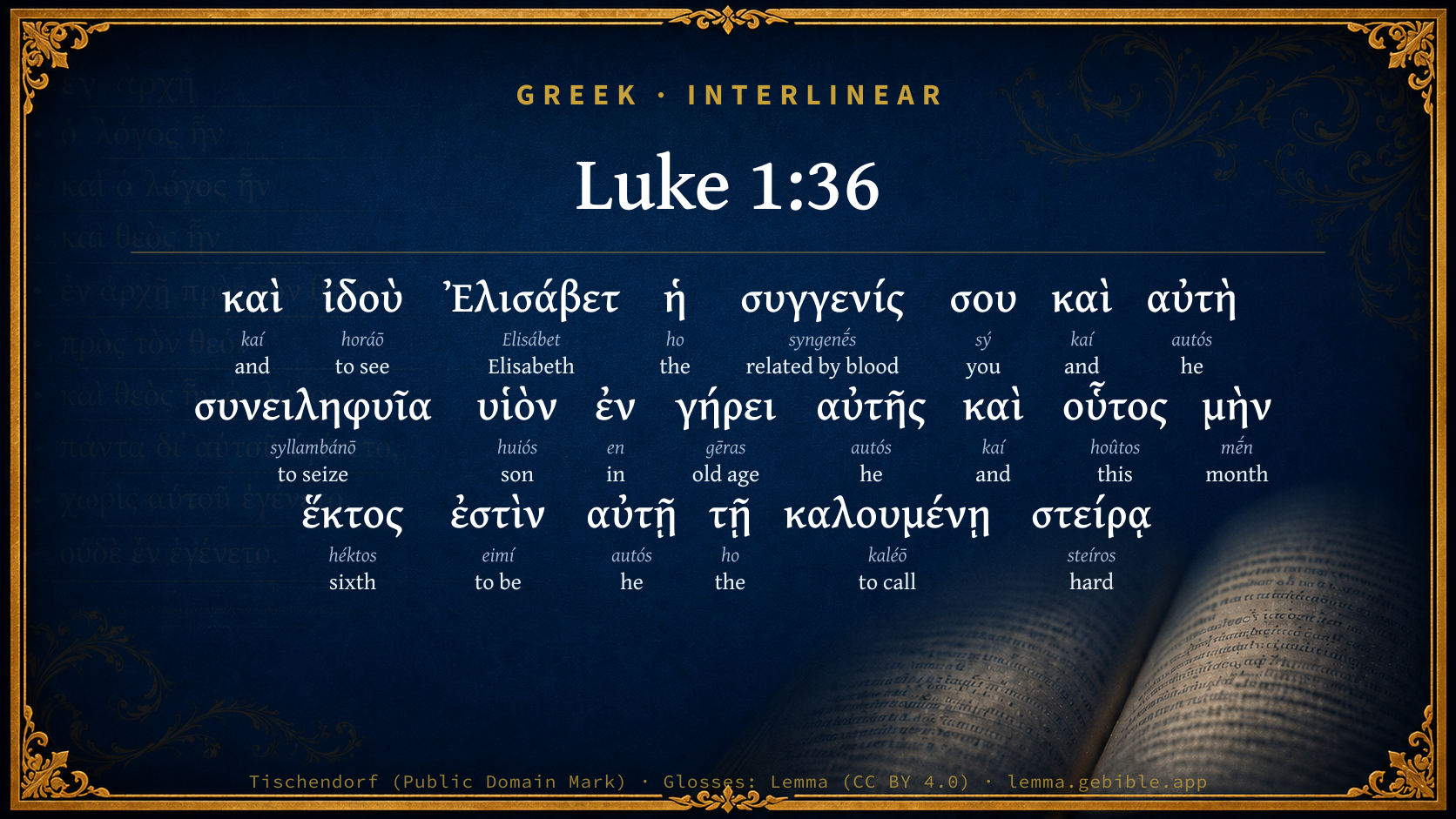
Download image
Cite this verse

Luke 1:36 (World English Bible). Public Domain. Lemma interlinear Bible study tool, https://lemma.gebible.app/v/luke/1/36.

Show BibTeX & RIS
BibTeX
RIS
English Translation
Behold, Elizabeth, your relative, also has conceived a son in her old age; and this is the sixth month with her who was called barren.
World English Bible · Public Domain
Highlights
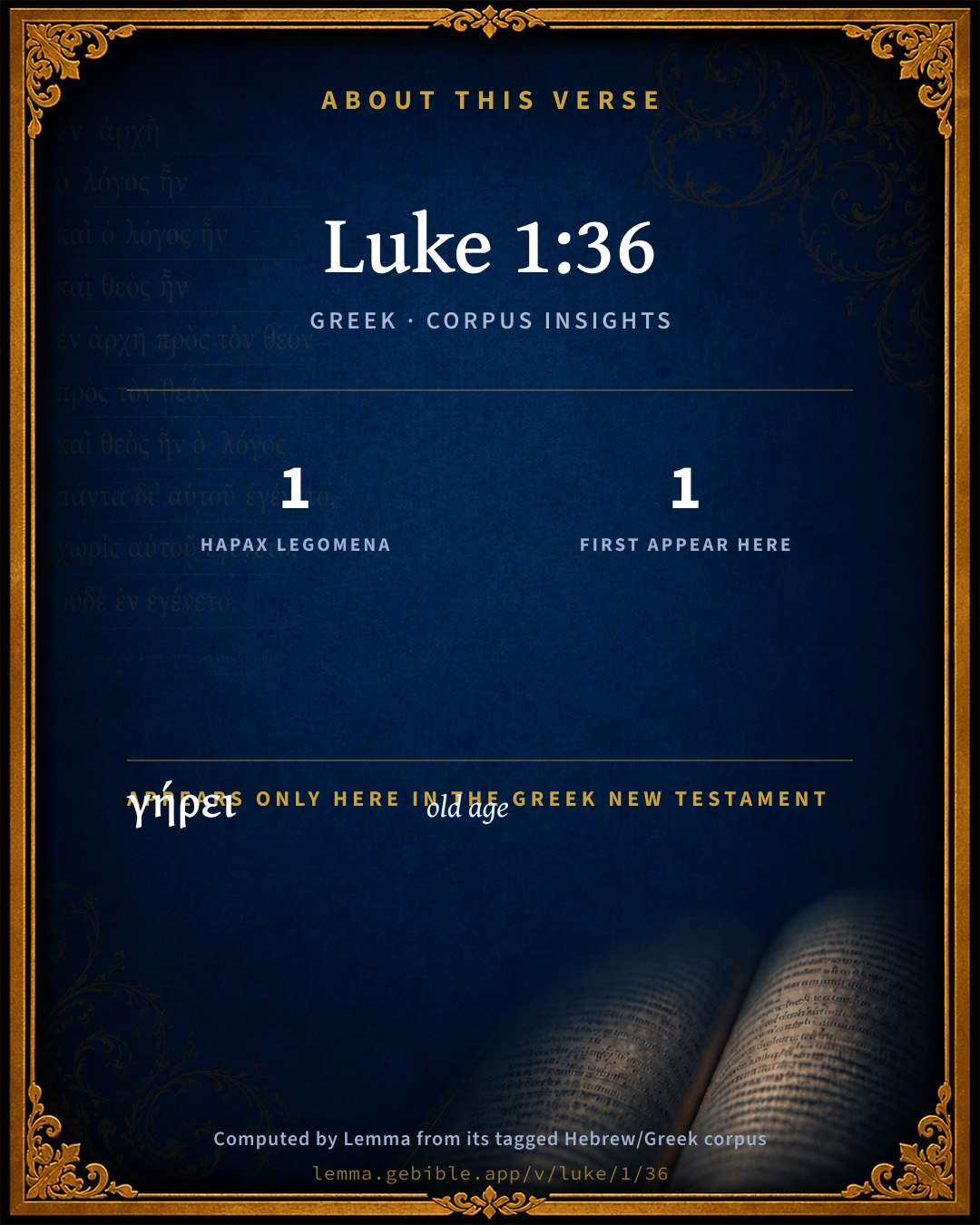
  • 1 hapax legomenon — only here in the Greek New Testament
  • 1 first appearance in the Greek New Testament
Full analysis ↓
Download a study sheet

One document with this verse’s original text, its word-by-word gloss line, the meaning frame, cross-references with their text, attributed commentary, and full source and license credits — printable, and it pastes into notes with its structure intact.

This verse Autodidact and up

Study sheet (.html) Plain text (.txt)

A passage Seminary Student

Up to 50 verses in one chapter. A passage sheet keeps up to 6 commentary sources and 12 cross-references per verse, in the order this page ranks them, and says so on the sheet whenever that leaves anything out. Ask for a single verse and you get the Autodidact verse sheet above.

Everything on this page stays free to read, with no account — the sheet is a download of what is already on screen, not access to it.

Want to remove ads? Support Godless Engineer
Compare translations 3

The same verse in 3 English versions, stacked beneath the original-language interlinear above. Click any original word for its lexicon entry.

Each is an independent rendering of the whole verse — the interlinear is not word-aligned to these translations.

Highlighted words mark where these versions differ — a whole-verse word diff, not a word-by-word alignment.

  • World English Bible Public Domain
    Behold, Elizabeth, your relative, also has conceived a son in her old age; and this is the sixth month with her who was called barren.
  • King James Version Public Domain
    And, behold, thy cousin Elisabeth, she hath also conceived a son in her old age: and this is the sixth month with her, who was called barren.
  • unfoldingWord Literal Text CC BY-SA 4.0
    And behold, your relative Elizabeth—she also has conceived a son in her old age, and this is the sixth month for her, the one called barren.

unfoldingWord Literal Text — © unfoldingWord, licensed CC BY-SA 4.0. Word-aligned USFM3 via Door43 (git.door43.org/unfoldingWord/en_ult).

Versions to compare (up to 4)

3 of 4 selected

Show all 19 translations

Every available English version of this verse, each an independent rendering of the whole verse.

  • World English Bible Public Domain
    Behold, Elizabeth, your relative, also has conceived a son in her old age; and this is the sixth month with her who was called barren.
  • Berean Standard Bible Public Domain
    Look, even Elizabeth your relative has conceived a son in her old age, and she who was called barren is in her sixth month.
  • Majority Standard Bible Public Domain
    Look, even Elizabeth your relative has conceived a son in her old age, and she who was called barren is in her sixth month.
  • King James Version Public Domain
    And, behold, thy cousin Elisabeth, she hath also conceived a son in her old age: and this is the sixth month with her, who was called barren.
  • American Standard Version (1901) Public Domain
    And behold, Elisabeth thy kinswoman, she also hath conceived a son in her old age; and this is the sixth month with her that was called barren.
  • Revised Version (1885) Public Domain
    And behold, Elisabeth thy kinswoman, she also hath conceived a son in her old age: and this is the sixth month with her that was called barren.
  • Geneva Bible (1599) Public Domain
    And behold, thy cousin Elisabet, she hath also conceiued a sonne in her olde age: and this is her sixt moneth, which was called barren.
  • Douay-Rheims (1899) Public Domain
    And behold thy cousin Elizabeth, she also hath conceived a son in her old age; and this is the sixth month with her that is called barren:
  • Young's Literal Translation Public Domain
    and lo, Elisabeth, thy kinswoman, she also hath conceived a son in her old age, and this is the sixth month to her who was called barren;
  • Literal Standard Version CC BY-SA 4.0
    and behold, Elizabeth, your relative, she also has conceived a son in her old age, and this is the sixth month to her who was called barren;
  • Unlocked Literal Bible CC BY-SA 4.0
    See, your relative Elizabeth has also conceived a son in her old age. This is the sixth month for her, she who was called barren.
  • unfoldingWord Literal Text CC BY-SA 4.0
    And behold, your relative Elizabeth—she also has conceived a son in her old age, and this is the sixth month for her, the one called barren.
  • Darby Bible Public Domain
    And behold, Elizabeth, thy kinswoman, she also has conceived a son in her old age, and this is the sixth month to her that was called barren:
  • World Messianic Bible Public Domain
    Behold, Elisheva your relative also has conceived a son in her old age; and this is the sixth month with her who was called barren.
  • Webster's Bible Public Domain
    And behold, thy cousin Elisabeth, she hath also conceived a son in her old age; and this is the sixth month with her who was called barren:
  • Free Bible Version CC BY-SA 4.0
    And Elizabeth, your relative, even she is pregnant in her old age. The woman that people said couldn't have children is already six months pregnant.
  • Bible in Basic English Public Domain
    Even now Elisabeth, who is of your family, is to be a mother, though she is old: and this is the sixth month with her who was without children.
  • Text-Critical English NT CC BY 4.0
    And behold, yoʋr relative Elizabeth has also conceived a son in her old age, and this is the sixth month for her who was called barren.
  • Tyndale New Testament (1534) Public Domain
    And beholde thy cosen Elizabeth she hath also conceaved a sonne in her age. And this is hyr sixte moneth though she be called barren:

Literal Standard Version (2020), Covenant Press — licensed CC BY-SA 4.0. Text via the HelloAO Bible API (eBible.org). Unlocked Literal Bible (unfoldingWord) — licensed CC BY-SA 4.0. Text via the HelloAO Bible API (eBible.org). unfoldingWord Literal Text — © unfoldingWord, licensed CC BY-SA 4.0. Word-aligned USFM3 via Door43 (git.door43.org/unfoldingWord/en_ult). Free Bible Version, Dr. Jonathan Gallagher — licensed CC BY-SA 4.0. Text via the HelloAO Bible API (eBible.org).

Word by word

More ways to search: Search by grammar → Find every occurrence → Compare this word →

Practice this passage: Drill this verse → Learn its vocabulary →

γήρει
gēras
G1094
“old age”
Noun, Dative, Singular, Neuter
Part of Speech
Noun
Case
Dative
Number
Singular
Gender
Neuter
Full Thayer's Definition

Origin: akin to G1088

TDNT: None

1. old age
  1. καὶ kaí G2532 “and” Conjunction
  2. ἰδοὺ horáō G3708 “to see” Verb, Aorist, Middle, Imperative, 2nd person, Singular
  3. Ἐλισάβετ Elisábet G1665 “Elisabeth” Noun, Proper, indeclinable
  4. ἡ ho G3588 “the” Article, Nominative, Singular, Feminine
  5. συγγενίς syngenḗs G4773 “related by blood” Noun, Nominative, Singular, Feminine
  6. σου sý G4771 “you” Personal pronoun, 2nd person, Genitive, Singular
  7. καὶ kaí G2532 “and” Conjunction
  8. αὐτὴ autós G846 “he” Personal pronoun, Nominative, Singular, Feminine
  9. συνειληφυῖα syllambánō G4815 “to seize” Verb, Perfect, Active, Indicative, 3rd person, Singular
  10. υἱὸν huiós G5207 “son” Noun, Accusative, Singular, Masculine
  11. ἐν en G1722 “in” Preposition
  12. αὐτῆς autós G846 “he” Personal pronoun, Genitive, Singular, Feminine
  13. καὶ kaí G2532 “and” Conjunction
  14. οὗτος hoûtos G3778 “this” Demonstrative pronoun, Nominative, Singular, Masculine
  15. μὴν mḗn G3376 “month” Noun, Nominative, Singular, Masculine
  16. ἕκτος héktos G1623 “sixth” Adjective, Nominative, Singular, Masculine
  17. ἐστὶν eimí G1510 “to be” Verb, Present, Active, Indicative, 3rd person, Singular
  18. αὐτῇ autós G846 “he” Personal pronoun, Dative, Singular, Feminine
  19. τῇ ho G3588 “the” Article, Dative, Singular, Feminine
  20. καλουμένῃ kaléō G2564 “to call” Verb, Present, Passive, Participle, Dative, Singular, Feminine
  21. στείρᾳ steíros G4723 “hard” Noun, Dative, Singular, Feminine

About this verse

These counts appear in no published source. They are computed here, from the morphology-tagged text and Lemma’s own curated glosses. What Lemma adds →

22
words
17
distinct lemmas
Gospels
section

Notable vocabulary

1 hapax legomenon — a word that appears only here in the entire Greek New Testament:

  • γήρει old age G1094

First appearance in Scripture

This word makes its first canonical appearance in the Greek New Testament here:

  • γήρει old age G1094

Shared distinctive vocabulary

στείρᾳ hard G4723 occurs in 4 verses of the Greek New Testament. Also found in:
Repetition

Words recur within this verse:

Commentary

Notes on Luke 1:36 from classic Christian and Jewish commentators (each source and its license shown beneath its notes). The classic Christian expositions comment on the surrounding passage and are grouped to its opening verse, so a note may address several verses; the Jewish commentaries on the Tanakh (Rashi and others) are per-verse, so they appear only where the commentator wrote on this verse.

Lemma curates 59 commentaries, every one of them public domain or Creative Commons licensed, each selected and text-cleaned for this edition rather than reprinted as found. About our sources →

Tyndale Open Study Notes

Tyndale Open Resources

1:36 your relative Elizabeth: The King James Version identifies Elizabeth as Mary’s cousin, but the Greek term is more general.

Tyndale Open Study Notes — © Tyndale Open Resources, licensed CC BY-SA 4.0. Text via the HelloAO Bible API.

Bengel's Gnomon

Johann Albrecht Bengel

Luk 1:36. Καὶ ἰδοὺ, and, behold) To Mary, inasmuch as she believed, a more favourable [pleasant] sign is without solicitation given, than had been given to Zacharias, who did not believe.—συγγενὴς, thy [cousin] kinswoman) Therefore John and Jesus also were kinsmen [cousins].—υἱὸν, a son) Elisabeth’s pregnancy was unknown among men, excepting the members of her own family; but here we find even the time and the sex of the offspring indicated to Mary by Divine information, with a view to strengthen the faith of Mary. But of the office of the Forerunner nothing is said; for Mary was about to hear that from his mother.

Bengel's Gnomon of the New Testament — English translation (T&T Clark, Edinburgh, 1860) — public domain. Text from a community e-Sword module.

Meyer's Critical & Exegetical Commentary

Heinrich August Wilhelm Meyer

Luk_1:36 f. Confirmation of the promise by the disclosure of Elizabeths pregnancy, which, in fact, was also a deviation from the order of nature (ἐν γήρει), and so far presented an analogy, although only in an inferior sense. En domesticum tibi exemplum! Grotius. After ἰδοὺ κ.τ.λ. an ἐστί was as little needed as an εἰμί at Luk_1:38.

συγγενίς] The nature of this relationship, which is not at variance with Joh_1:36, although questioned by Schleiermacher and others, is wholly unknown. It is, however, possible that Mary was of the stock of Levi (so Faustus the Manichean in Augustine, c. Faust. xxiii. 9; and recently, Schleiermacher, Schr. d. Luk. p. 26; Hilgenfeld, Ewald, Gesch. Chr. p. 177, and others), as the Test. XII. Patr. p. 542 makes the Messiah proceed from the stock of Judah (Joseph) and (comp. p. 546) from the stock of Levi.[25]

On the late form συγγενίς, see Lobeck, ad Phryn. p. 451 f.; and on the Ionic form of dative γήρει, Winer, p. 60 [E. T. 73 f.].

ΟὟΤΟς] subject: and this is the sixth month.

ὅτι οὐκ ἀδυνατ. κ.τ.λ.] Confirmation of that which has just been said of Elizabeth by the omnipotence of God. It is to be observed (1) that ΟὐΚ … ΠᾶΝ do not belong to one another, but of ΠᾶΝ ῬῆΜΑ it is said: ΟὐΚ ἈΔΥΝΑΤΉΣΕΙ (Fritzsche, Diss. II. in 2 Cor. p. 24 f.); further, (2) that the proposition is a general one; hence the future, which, however, is purposely chosen with a view to what was announced to Mary; see Dissen, ad Dem. de Cor. p. 369; (3) that there exists no reason for abandoning the purely Greek meaning of ἀδυνατεῖν, to be unable (Rettig in the Stud. u. Krit. 1838, p. 210), any more than of ῥῆμα, utterance (Luk_1:38), especially with the reading παρὰ τοῦ Θεοῦ (see the critical remarks). Hence the meaning is not: With God nothing is impossible; but rather: not powerless (but of success and efficacy) shall any utterance on the part of God be. So also Gen_18:14. Comp. Beza: ῥῆμα, i.e. quicquid Deus semel futurum dixerit.

[25] Thus the descent from the Davidic and priestly race might have been used for the glorification of Jesus. But from the height of the history of Jesus so little importance was attached to things of this nature that only the Davidic descent, as it was necessary in the case of the Messiah, had stress laid on it, and the family of Mary was not expressly specified at all. Comp. Ewald, Gesch. Chr. p. 177 f.

Meyer — Critical and Exegetical Commentary on the New Testament — English translation by Peter Christie, edited by Frederick Crombie (T&T Clark, 1880) — public domain. Text from a community e-Sword module.

Expositor's Greek Testament

ed. W. Robertson Nicoll

Luk 1:36 . καὶ ἰδού , introducing a reference to Elizabeth’s case to help Mary’s faith. συγγενίς , late form for συγγενής (T.R.), a blood relation, but of what degree not indicated, suggesting that Mary perhaps belonged to the tribe of Levi . γήρει : Ionic form of dative for γήρᾳ (T.R.). Hellenistic Greek was an eclectic language, drawing from all dialects as from the poets, turning their poetic expressions to the uses of prose. καλουμένη : Elizabeth is described as one who is still being called barren, though six months gone in pregnancy, because people have had no means of knowing her state.

The Expositor's Greek Testament, edited by W. Robertson Nicoll (1897–1910) — public domain. Text from a community e-Sword module.

Geneva Bible (1599)

Geneva Bible translators

This is now the sixth month from the time when she conceived.

Though Elizabeth were of the tribe of Levi, yet she might be Mary’s cousin: for whereas it was forbidden by the Law, for maidens to be married to men of other tribes, this could not let, but that the Levites might take them wives out of any tribe: for the Levites had no portion allotted them, when the land was divided among the people.

Geneva Bible (1599) marginal notes — public domain. Text via Bolls.life.

Jamieson, Fausset & Brown

Robert Jamieson, A. R. Fausset & David Brown

thy cousin--"relative," but how near the word says not.

conceived, &c.--This was to Mary an unsought sign, in reward of her faith.

Jamieson, Fausset & Brown — Commentary Critical and Explanatory on the Whole Bible (1871) — public domain (CC PDM 1.0). Text via the HelloAO Bible API.

Adam Clarke's Commentary

Verse 36. Thy cousin Elisabeth] Thy kinswoman, συγγενης. As Elisabeth was of the tribe of Levi, Lu 1:5, and Mary of the tribe of Judah, they could not be relatives but by the mother's side.

She hath also conceived] And this is wrought by the same power and energy through which thou shalt conceive. Thus God has given thee a proof and pledge, in what he has done for Elisabeth, of what he will do for thyself; therefore, have faith in God.

Who was called barren.] It is probable that Elisabeth got this appellative by way of reproach; or to distinguish her from some other Elisabeth also well known, who had been blessed with children. Perhaps this is the reproach which Elisabeth speaks of, Lu 1:25, her common name among men, among the people who knew her, being Elisabeth the barren.

Adam Clarke's Commentary on the Bible (1810–1826) — public domain. Text from a community e-Sword/MySword module.

Ellicott's Commentary for English Readers

(36) Thy cousin Elisabeth.—See Notes on Luk_1:27; Luk_1:32. Taking the word in its usual sense, it would imply that either the father or the mother of Mary had been of the house of Aaron, or that the mother of Elizabeth had been of the house of David.

A Bible Commentary for English Readers, edited by Charles John Ellicott (1878–1897) — public domain. Text from a community e-Sword module.

The Cambridge Bible for Schools and Colleges

gen. ed. J. J. S. Perowne

36. thy cousin] Rather, “thy kinswoman.” What the actual relationship was we do not know. It is a mistake to infer from this, as Ewald does, that Mary too was of the tribe of Levi, for except in the case of heiresses there was free intermarriage between the tribes (Exo_6:23; Jdg_17:7; Philo De Monach. ii. 11; Jos. Vit. i).

The Cambridge Bible for Schools and Colleges (gen. ed. J. J. S. Perowne; Cambridge University Press, 1878–1918) — public domain. Text from a community e-Sword module.

John Gill's Exposition

And behold thy cousin Elisabeth,.... For though Elisabeth was of the daughters of Aaron, or of the tribe of Levi by her father's side, yet might be of the tribe of Judah by her mother's side, and so akin to Mary. The Persic version calls her "aunt by the mother's side": intermarriages between the two tribes of Levi and Judah were frequent; nor were they at all contrary to the intention of that law, that forbid the tribes to intermarry, which was to preserve the inheritance in each tribe, since the tribe of Levi had none at all. Though she might be called her cousin in a more general sense; it being usual with the Jews to call all of their own nation their kinsmen and kinswomen, according to the flesh: but the former sense seems more agreeable; and so Mary is directed to her own family, and to her own relations, and known friends, for a sign, by which her faith might be confirmed, in what the angel had said unto her; for if she found the one to be true, she might conclude the other was also; which is as follows:

she hath also conceived a son in her old age: though Mary asked no sign, yet one is given her, whereby she might know the truth of what was spoken: for if it should appear that Elisabeth had received strength to conceive, as was declared by the angel; and that a son, too, which he could not have known without a divine revelation; and that in her old age, which, was extraordinary and supernatural, she might assure herself, that the message brought to her was from God; and that she likewise, though a virgin, might conceive, and bear a son: the angel adds, as a further testimony of the truth of things,

and this is the sixth month with her who was called barren. Elisabeth, was generally known to be barren, and was, by way of reproach, usually called so, but was now six months gone with child; so that it was a plain case, and out of question; the signs of her pregnancy were very apparent.

John Gill's Exposition of the Whole Bible (1746–1763) — public domain (CC PDM 1.0). Text via the HelloAO Bible API.

Trapp's Complete Commentary

John Trapp

36 And, behold, thy cousin Elisabeth, she hath also conceived a son in her old age: and this is the sixth month with her, who was called barren.

Ver. 36. Who was called barren] It is observed that the barren women (so called in both Testaments) had the best children, as Sarah, Rebecca, Rachel, Elisabeth, &c., because long held off, and much humbled. Some also have observed that the New Testament affords more store of good women than the Old. (Dr Hall’s Contemplation on the New Testament.)

John Trapp, A Commentary or Exposition upon All the Books of the Old and New Testament (1647–1656) — public domain. Text from a community e-Sword module.

Albert Barnes' Notes on the Bible

Thy cousin Elizabeth ... - The case of Elizabeth is mentioned to inspire Mary with confidence, and to assure her that what was now promised would be fulfilled. It was almost as improbable that Elizabeth should have a child at her time of life, as it was that Mary should under the circumstances promised.

Albert Barnes' Notes on the Bible (1834–1885) — public domain. Text from a community e-Sword/MySword module.

Haydock's Catholic Bible Commentary

We find that Aaron, who was of the tribe of Levi, took a wife of the tribe of Juda, viz. Elizabeth, the sister of Naasson. In the successors of David we find that Joiada, the chief priest, took a wife of the family of David, viz. the daughter of Joram; from which it appears that both the royal and sacerdotal tribes were united, and that Mary and Elizabeth were relatives. It was certainly proper that Christ should be born of both these tribes, because he was in himself both king and priest. (Ven. Bede)

George Leo Haydock (1774–1849), Haydock's Catholic Family Bible and Commentary, 1859 edition — public domain. Excludes Psalms (Douay-Rheims chapter numbering differs from Protestant) and Deuterocanonical books (Catholic canon only).

Matthew Poole's English Annotations

What a particular notice doth God take of the children of men! he knoweth our relations:

thy cousin Elisabeth. Here some make a question how Elisabeth, who was one of the daughters of Aaron, Luk 1:5, and consequently of the tribe of Levi, could be cousin to Mary, who was of the house of David, and consequently of the tribe of Judah, (as our evangelist proveth, Luk 1:3), because of the law, Num 36:6,7. But cousin may be taken in a large sense, as Paul calleth all the Jews his kinsmen, Rom 9:3; or they might be cousins in a strict sense, for the daughters of the tribe of Levi might marry into any other tribes, having no inheritance to carry away, to prevent which was the law, Num 36:1-13.

And this is the sixth month from her conception, by which time women use to be at some certainly about their quickening; you must not therefore think this impossible, for you know Elisabeth was counted barren, and was old, yet she hath conceived.

For with God nothing shall be impossible. I bring you a message from God, to whom all things are possible. This was an ordinary saying amongst them, Nothing is impossible with God. Our Saviour useth it several times, Mat 19:26; Mar 10:27. Nor needed we any Scripture to prove that nothing could be impossible to him who is the first Being, the first Cause, and the Fountain of all power, and to whom all things are subject. No considerate man will from hence conclude that things are possible to God which would derogate from the perfection of the Divine Being, and are imperfections in us; nor yet that any thing is possible to God the contrary to which he hath willed, but God can do whatsoever he can will.

Matthew Poole's English Annotations on the Holy Bible (1683–1685) — public domain. Text from a community e-Sword/MySword module.

Whedon's Commentary on the Bible

Daniel D. Whedon

36. Thy cousin E1isabeth—Mary was of the tribe of Judah, and Elisabeth of the tribe of Levi. That is, their fathers probably were; for it was the father’s descent which assigned any family to its tribeship. The two women, therefore, may have been cousins by the mother’s side, by their mothers having been sisters. But the word rendered cousin may signify kindred of any degree.

Daniel D. Whedon (gen. ed.), Commentary on the Old and New Testaments (1874–1909) — public domain. Text from a community e-Sword module.

John Wesley's Explanatory Notes

And behold, thy cousin Elisabeth - Though Elisabeth was of the house of Aaron, and Mary of the house of David, by the fathers side, they might be related by their mothers. For the law only forbad heiresses marrying into another tribe. And so other persons continually intermarried; particularly the families of David and of Levi.

John Wesley, Explanatory Notes Upon the Whole Bible (1754–1765) — public domain. Text via the GEBible commentary corpus.

unfoldingWord translationNotes

Door43 World Missions Community

See, your relative

"Pay attention, because what I am about to say is both true and important: your relative"

your relative Elizabeth

If you need to state a specific relationship, Elizabeth was probably Mary's aunt or great-aunt.

has also conceived a son in her old age

"Elizabeth has also become pregnant with a son, even though she is already very old" or "Elizabeth, even though she is old, has also become pregnant and will bear a son." Make sure it does not sound as though both Mary and Elizabeth were old when they conceived.

the sixth month for her

"the sixth month of her pregnancy"

For nothing

"Because nothing" or "This shows that nothing"

nothing will be impossible for God

Elizabeth's pregnancy was proof that God was able to do anything—even enable Mary to become pregnant without her sleeping with a man. The double negatives in this statement can be stated with positive terms. AT: "God can do anything" (See: Double Negatives)

See, I am the female servant

"Here I am, the female servant" or "I am glad to be the female servant." She is responding humbly and willingly.

I am the female servant of the Lord

Choose an expression that shows her humility and obedience to the Lord. She was not boasting about being the Lord's servant.

Let it be for me

"Let this happen to me." Mary was expressing her willingness for the things to happen that the angel had told her were about to happen.

translationWords

Elizabeth

conceive

barren

God

Mary

lord

servant

angel

unfoldingWord translationNotes — © Distant Shores Media and the Door43 World Missions Community, licensed CC BY-SA 4.0. Source: git.door43.org/Door43/en_tn.

Cambridge Greek Testament for Schools and Colleges

36. ἡ συγγενής σου. “thy kinswoman.” What the actual relationship was we do not know. It is a mistake to infer positively from this, as Ewald does, that Mary too was of the tribe of Levi, for except in the case of heiresses there was free intermarriage between the tribes (Exo 6:23; Jdg 17:7; Philo De Monarch. II. 11; Jos. Vit. 1). At the same time the tradition of the Aaronic descent of Mary is as old as the “Testament of the Twelve Patriarchs” in the second century. The reading συγγενὶς is a later form of the word. Γήρει is the Ionic form of the dative of γῆρας. Hellenistic Greek contained forms drawn from various dialects. See Winer, p. 73.

Cambridge Greek Testament for Schools and Colleges (Cambridge University Press, 1896; 21 vols, various authors incl. Carr, Maclear, Plummer, Farrar, Lumby, Moule, M. R. James, Simcox) — public domain. Text from a community e-Sword module.

Alford’s Greek Testament

Henry Alford

36. συγγενής] On the συγγενίς in the var. readd., we may remark, that these fem. terminations of common adjectives belong to later Greek. συγγενίς, ἐσχάτως βάρβαρον, Pollux iii. 50. It is found in Plutarch, Quæst Rom. (vi. 314), &c. See Lobeck on Phrynichus, p. 452†. Cf. μοιχαλίς, Mat 12:39 reff.

What relation, no where appears in Scripture: and traditions are not worth recounting. But we must take the word in the narrower sense, not in the wider reference of Rom 9:3. Elisabeth was of the tribe of Levi: but this need not hinder connexion by marriage with other tribes. Aaron himself married into Judah, Exo 6:23. We find in Jdg 17:7 a young man of the family of Judah who was a Levite. Philo de Monarch. ii. 11 (vol. ii. p. 229), says, προσέταξε τῷ μὲν ἀρχιερεῖ μνᾶσθαι μὴ μόνον γυναῖκα παρθένον, ἀλλὰ καὶ ἱέρειαν ἐξ ἱερέων … ἐπετράπη δὲ τοῖς ἄλλοις καὶ μὴ ἱερέων γαμεῖν θυγατέρας.

Henry Alford, The Greek Testament (1849–1861) — public domain. Text from a community e-Sword module.

International Critical Commentary

36. καὶ ἰδοὺ ἐλεισάβετ ἡ συγγενίς σου. Comp. ver. 20. Mary, who did not ask for one, receives a more gracious sign than Zacharias, who demanded it. The relationship between her and Elisabeth is unknown.

“Cousin,” started by Wiclif, and continued until RV. substituted “kinswoman,” has now become too definite in meaning. The kinship has led artius to represent the two children as being playmates; but Joh 1:31 seems to be against such Companionship. It has also led to the conjecture that Jesus was descended from both Levi and Judah (see on ver. 27). But Levites might marry with other tribes; and therefore Elisabeth, who was descended from Aaron, might easily be related to one who was descended from David. This verse is not evidence that Mary was not of the house of David.

The late form συγγενίς (comp. εὐγενίς), and the Ion. dat. γήρει for γήρᾳ (Gen 15:15, Gen 21:7, Gen 25:8), should be noticed; also that οὗτος being the subject, the noun has no article. Comp. 21:22. The combination καὶ οὗτος is peculiar to Lk. (8:41 ?, 16:1, 20:28). The relative ages of Jesus and of John are fixed by this statement.

We may take καλουμένῃ as imperf. part., “Used to be called.” This reproach would cease when she reappeared at the end of the five months (ver. 24). καλούμενος with appellations is freq. in Lk.

International Critical Commentary — older volumes (1896–1929), various authors — public domain. Text from a community e-Sword module.

Vincent's Word Studies in the New Testament

Marvin R. Vincent

Cousin [συγγενης] . The nature of the relationship, however, is unknown. The word is a general term, meaning of the same family. The best texts substitute for it a feminine form, suggeniv, which is condemned by the grammarians as unclassical, but rightly rendered by Rev., kinswoman. Wyc., cosyness, i. e., cousiness.

Marvin R. Vincent, Word Studies in the New Testament (1887–1900) — public domain. Text from a community e-Sword/MySword module.

Lesson kit

Teaching starters — assembled from the data on this page, not authored interpretation. Every prompt links to the verse data it draws on. Edit before teaching.

Luke, in the Gospels, opens this verse with 22 words (17 distinct Greek lemmas). Its most distinctive word is gēras (“old age”). A historical commentator’s framing appears above. Read the whole chapter for the surrounding context.

Discussion questions

  1. How does “old age” (gēras) shape what this verse is saying?
  2. 1 word here appears nowhere else in the Greek New Testament. Why might the author reach for such rare wording?
  3. This is the first place “old age” appears in Scripture (first appears here). What does its debut here establish?
  4. How does Luke 1:7, which shares the word «hard», read alongside this verse?
  5. What does the repetition of “and” (3× in this one verse) do in this verse?
  6. These translations render this verse differently; the difference is in the English rendering, not the original. What questions does that raise?
  7. Compare how Tyndale Open Study Notes and Bengel's Gnomon read this verse. Where do they agree or differ?

Things to notice

  • 1 word in this verse appears nowhere else in the Greek New Testament.
  • 1 word makes its first canonical appearance in Scripture here.
  • These translations choose different wording for 8 words in this verse.
  • “and” occurs 3× in this single verse.
  • 17 distinct Greek lemmas span 22 words in this verse.

Reading settings

Reading text

Shown beneath each verse's original-language words.

Old Testament
Old Testament edition

Read the OT as the Masoretic Hebrew (MT) or the Greek Septuagint (LXX).

English shown for the Greek Septuagint (in the Hebrew ↔ Greek comparison).

Comparing translations? Open the Compare panel on any verse page to stack up to four side by side.