

Mark 8:15
Greek (Tischendorf 8th ed.) Mark 8:15 appears in the Greek New Testament. The text above is from the Tischendorf 8th edition. Each word links to its Strong’s number and a concise gloss. Click any word for its full Thayer’s Greek Lexicon entry.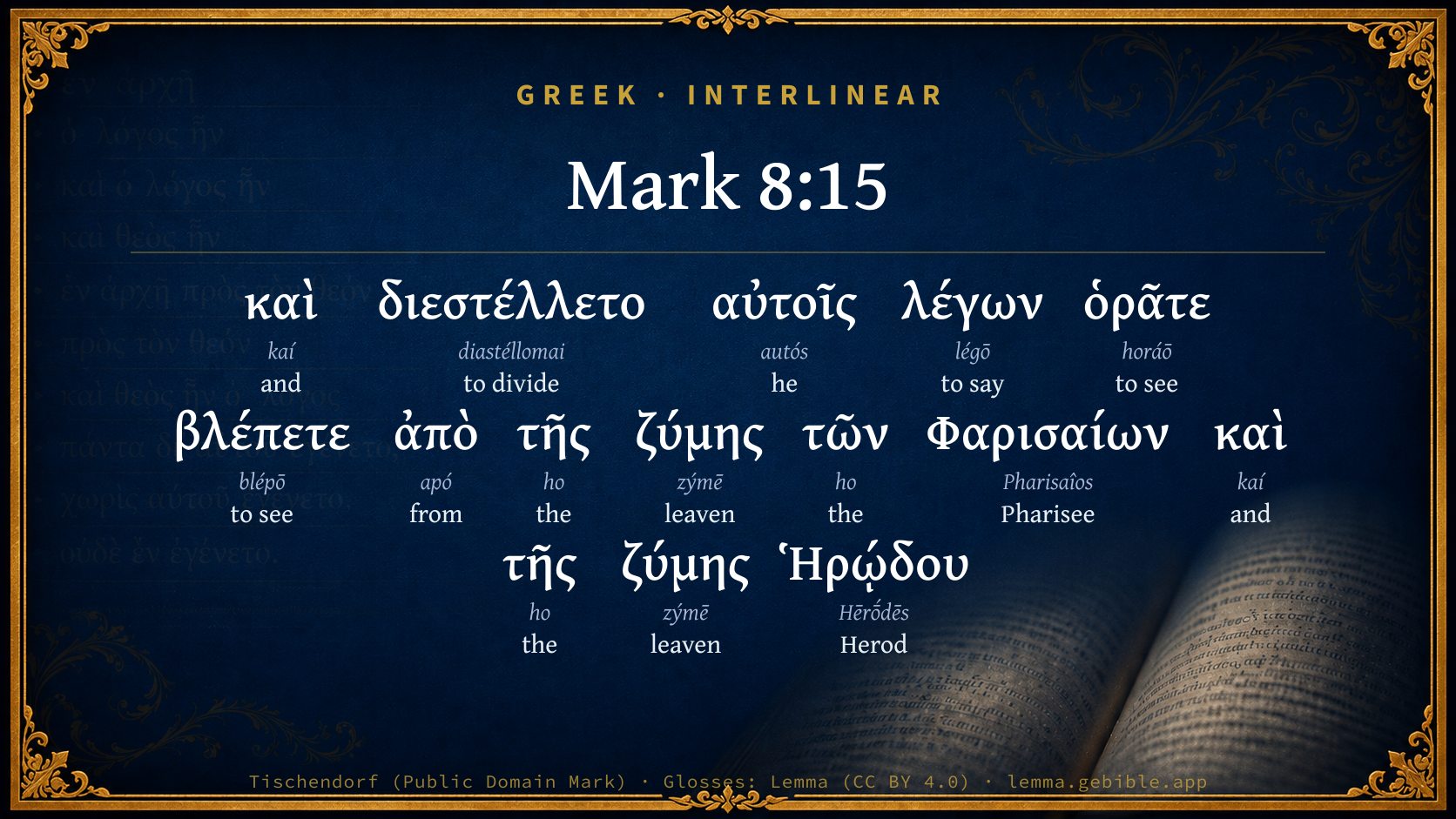
He charged them, saying, "Take heed: beware of the yeast of the Pharisees and the yeast of Herod."
Download a study sheet
One document with this verse’s original text, its word-by-word gloss line, the meaning frame, cross-references with their text, attributed commentary, and full source and license credits — printable, and it pastes into notes with its structure intact.
This verse Autodidact and up
A passage Seminary Student
Up to 50 verses in one chapter. A passage sheet keeps up to 6 commentary sources and 12 cross-references per verse, in the order this page ranks them, and says so on the sheet whenever that leaves anything out. Ask for a single verse and you get the Autodidact verse sheet above.
Everything on this page stays free to read, with no account — the sheet is a download of what is already on screen, not access to it.
Compare translations 3
The same verse in 3 English versions, stacked beneath the original-language interlinear above. Click any original word for its lexicon entry.
Each is an independent rendering of the whole verse — the interlinear is not word-aligned to these translations.
Highlighted words mark where these versions differ — a whole-verse word diff, not a word-by-word alignment.
-
World English Bible Public Domain
He charged them, saying, "Take heed: beware of the yeast of the Pharisees and the yeast of Herod."
-
King James Version Public Domain
And he charged them, saying, Take heed, beware of the leaven of the Pharisees, and of the leaven of Herod.
-
unfoldingWord Literal Text CC BY-SA 4.0
And he was commanding them, saying, “See, watch out for the yeast of the Pharisees and the yeast of Herod.”
unfoldingWord Literal Text — © unfoldingWord, licensed CC BY-SA 4.0. Word-aligned USFM3 via Door43 (git.door43.org/unfoldingWord/en_ult).
Show all 19 translations
Every available English version of this verse, each an independent rendering of the whole verse.
-
World English Bible Public Domain
He charged them, saying, "Take heed: beware of the yeast of the Pharisees and the yeast of Herod."
-
Berean Standard Bible Public Domain
“Watch out!” He cautioned them. “Beware of the leaven of the Pharisees and of Herod.”
-
Majority Standard Bible Public Domain
“Watch out!” He cautioned them. “Beware of the leaven of the Pharisees and of Herod.”
-
King James Version Public Domain
And he charged them, saying, Take heed, beware of the leaven of the Pharisees, and of the leaven of Herod.
-
American Standard Version (1901) Public Domain
And he charged them, saying, Take heed, beware of the leaven of the Pharisees and the leaven of Herod.
-
Revised Version (1885) Public Domain
And he charged them, saying, Take heed, beware of the leaven of the Pharisees and the leaven of Herod.
-
Geneva Bible (1599) Public Domain
And he charged them, saying, Take heede, and beware of the leauen of the Pharises, and of the leauen of Herod.
-
Douay-Rheims (1899) Public Domain
And he charged them, saying: Take heed and beware of the leaven of the Pharisees, and of the leaven of Herod.
-
Young's Literal Translation Public Domain
and he was charging them, saying, `Take heed, beware of the leaven of the Pharisees, and of the leaven of Herod,'
-
Literal Standard Version CC BY-SA 4.0
and He was charging them, saying, “Take heed, beware of the leaven of the Pharisees, and of the leaven of Herod,”
-
Unlocked Literal Bible CC BY-SA 4.0
He warned them and said, “Keep watch and be on guard against the yeast of the Pharisees and the yeast of Herod.”
-
unfoldingWord Literal Text CC BY-SA 4.0
And he was commanding them, saying, “See, watch out for the yeast of the Pharisees and the yeast of Herod.”
-
Darby Bible Public Domain
And he charged them, saying, Take heed, beware of the leaven of the Pharisees and [of] the leaven of Herod.
-
World Messianic Bible Public Domain
He warned them, saying, “Take heed: beware of the yeast of the Pharisees and the yeast of Herod.”
-
Webster's Bible Public Domain
And he charged them saying, Take heed, beware of the leaven of the Pharisees, and of the leaven of Herod.
-
Free Bible Version CC BY-SA 4.0
“Watch out—beware of the yeast of the Pharisees and of Herod!” he warned them.
-
Bible in Basic English Public Domain
And he said to them, Take care to be on the watch against the leaven of the Pharisees and the leaven of Herod.
-
Text-Critical English NT CC BY 4.0
Then Jesus gave them strict orders, saying, “Watch out! Beware of the leaven of the Pharisees and the leaven of Herod.”
-
Tyndale New Testament (1534) Public Domain
And he charged the sayinge. Take hede and beware of the leven of the pharises and of the leve of Herode.
Literal Standard Version (2020), Covenant Press — licensed CC BY-SA 4.0. Text via the HelloAO Bible API (eBible.org). Unlocked Literal Bible (unfoldingWord) — licensed CC BY-SA 4.0. Text via the HelloAO Bible API (eBible.org). unfoldingWord Literal Text — © unfoldingWord, licensed CC BY-SA 4.0. Word-aligned USFM3 via Door43 (git.door43.org/unfoldingWord/en_ult). Free Bible Version, Dr. Jonathan Gallagher — licensed CC BY-SA 4.0. Text via the HelloAO Bible API (eBible.org).
Word by word
More ways to search: Search by grammar → Find every occurrence → Compare this word →
Practice this passage: Drill this verse → Learn its vocabulary →
- Appears 8× in the Greek New Testament
- First appears at Matthew 16:20
- Part of Speech
- Verb
- Tense
- Imperfect
- Voice
- Middle
- Mood
- Indicative
- Person
- 3rd person
- Number
- Singular
Full Thayer's Definition
- καὶ kaí G2532 “and” Conjunction
- διεστέλλετο diastéllomai G1291 “to divide” Verb, Imperfect, Middle, Indicative, 3rd person, Singular
- αὐτοῖς autós G846 “he” Personal pronoun, Dative, Plural, Masculine
- λέγων légō G3004 “to say” Verb, Present, Active, Participle, Nominative, Singular, Masculine
- ὁρᾶτε horáō G3708 “to see” Verb, Present, Active, Imperative, 2nd person, Plural
- βλέπετε blépō G991 “to see” Verb, Present, Active, Imperative, 2nd person, Plural
- ἀπὸ apó G575 “from” Preposition
- τῆς ho G3588 “the” Article, Genitive, Singular, Feminine
- ζύμης zýmē G2219 “leaven” Noun, Genitive, Singular, Feminine
- τῶν ho G3588 “the” Article, Genitive, Plural, Masculine
- Φαρισαίων Pharisaîos G5330 “Pharisee” Noun, Genitive, Plural, Masculine
- καὶ kaí G2532 “and” Conjunction
- τῆς ho G3588 “the” Article, Genitive, Singular, Feminine
- ζύμης zýmē G2219 “leaven” Noun, Genitive, Singular, Feminine
- Ἡρῴδου Hērṓdēs G2264 “Herod” Noun, Genitive, Singular, Masculine
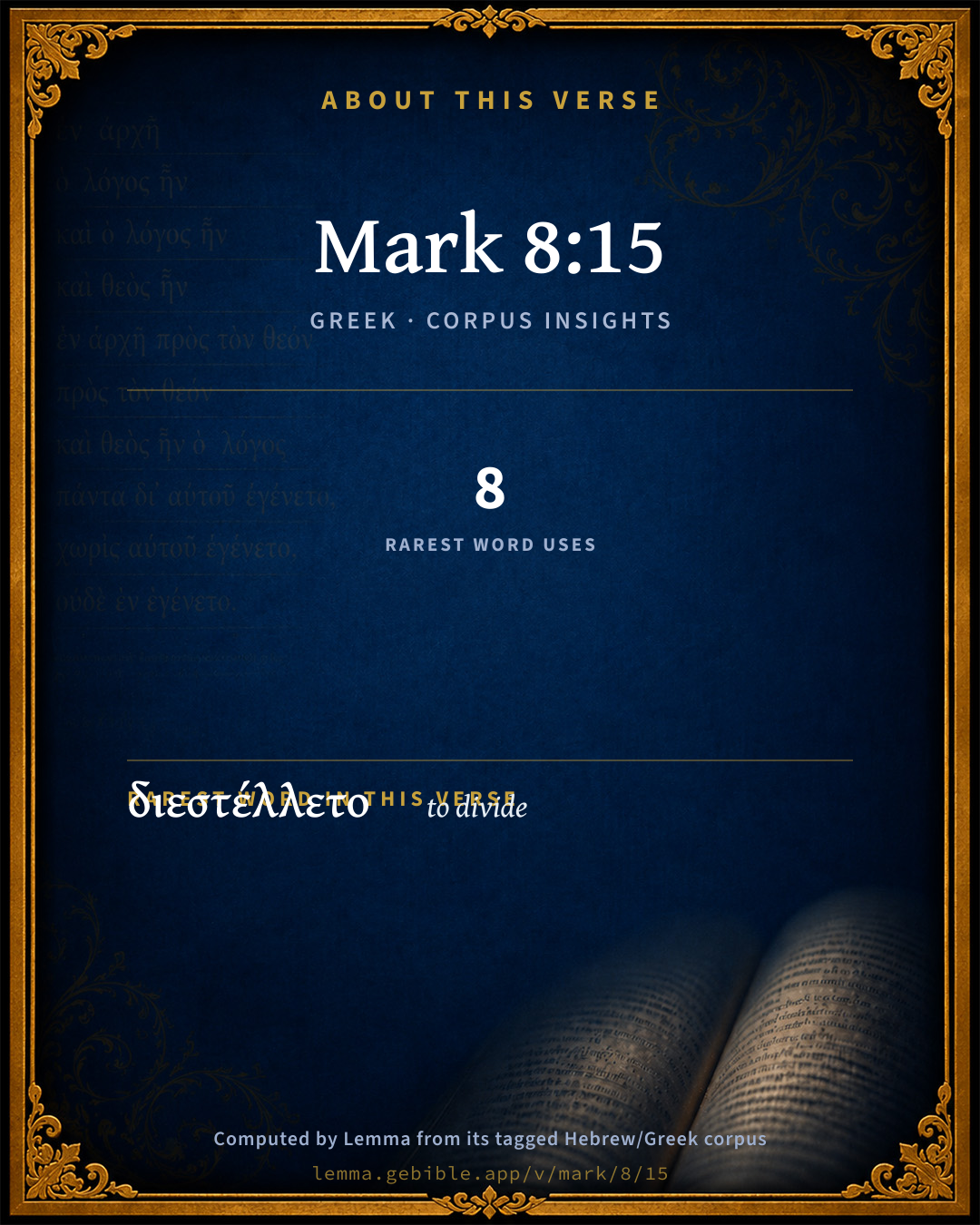
About this verse
These counts appear in no published source. They are computed here, from the morphology-tagged text and Lemma’s own curated glosses. What Lemma adds →
- 15
- words
- 11
- distinct lemmas
- Gospels
- section
Cross-references
16Topical passages linked to Mark 8:15 in the Treasury of Scripture Knowledge — connected by theme and wording, ordered by reader-vote popularity; previews shown in the World English Bible.
- 1 Corinthians 5:6–8 Your boasting is not good. Don't you know that a little yeast leavens the whole lump?
- Matthew 16:6 Jesus said to them, "Take heed and beware of the yeast of the Pharisees and Sadducees."
- Matthew 16:11–12 How is it that you don't perceive that I didn't speak to you concerning bread? But beware of the yeast of the Pharisees and Sadducees."
- Mark 12:13 They sent some of the Pharisees and of the Herodians to him, that they might trap him with words.
- Luke 12:1–2 Meanwhile, when a multitude of many thousands had gathered together, so much so that they trampled on each other, he began to tell his disciples first of all, "Beware of the yeast of the Pharisees, which is hypocrisy.
- Exodus 12:18–20 In the first month, on the fourteenth day of the month at evening, you shall eat unleavened bread, until the twenty first day of the month at evening.
- Leviticus 2:11 "'No meal offering, which you shall offer to Yahweh, shall be made with yeast; for you shall burn no yeast, nor any honey, as an offering made by fire to Yahweh.
- Proverbs 19:27 If you stop listening to instruction, my son, You will stray from the words of knowledge.
- Matthew 14:1 At that time, Herod the tetrarch heard the report concerning Jesus,
- 1 Timothy 6:13 I charge you before God, who gives life to all things, and before Christ Jesus, who before Pontius Pilate testified the good confession,
- 1 Chronicles 28:9–10 You, Solomon my son, know the God of your father, and serve him with a perfect heart and with a willing mind; for Yahweh searches all hearts, and understands all the imaginations of the thoughts: if you seek him, he will be found of you; but if you forsake him, he will cast you off forever.
- 1 Timothy 5:21 I charge you in the sight of God, and Christ Jesus, and the chosen angels, that you observe these things without prejudice, doing nothing by partiality.
- Matthew 22:15–18 Then the Pharisees went and took counsel how they might entrap him in his talk.
- Luke 12:15 He said to them, "Beware! Keep yourselves from covetousness, for a man's life doesn't consist of the abundance of the things which he possesses."
- 2 Timothy 2:14 Remind them of these things, charging them in the sight of the Lord, that they don't argue about words, to no profit, to the subverting of those who hear.
- 1 Chronicles 28:20 David said to Solomon his son, Be strong and of good courage, and do it: don't be afraid, nor be dismayed; for Yahweh God, even my God, is with you; he will not fail you, nor forsake you, until all the work for the service of the house of Yahweh is finished.
Cross-references courtesy of OpenBible.info (CC BY 4.0).
Lesson kit
Teaching starters — assembled from the data on this page, not authored interpretation. Every prompt links to the verse data it draws on. Edit before teaching.
Mark, in the Gospels, opens this verse with 15 words (11 distinct Greek lemmas). Its most distinctive word is diastéllomai (“to divide”). A historical commentator’s framing appears above. Read the whole chapter for the surrounding context.
Discussion questions
- The word diastéllomai carries the sense “to divide.” How does it shape the verse?
- How does Matthew 16:20, which shares the word «to divide», read alongside this verse?
- What does the repetition of “leaven” (2× in this one verse) do in this verse?
- The translations on this page render this verse differently — a whole-verse word diff, not a word-by-word alignment. What might account for the different wordings?
- Compare how Tyndale Open Study Notes and Bengel's Gnomon read this verse. Where do they agree or differ?
Things to notice
- These translations choose different wording for 10 words in this verse.
- “leaven” occurs 2× in this single verse.
- 11 distinct Greek lemmas span 15 words in this verse.
Commentary
Notes on Mark 8:15 from classic Christian and Jewish commentators (each source and its license shown beneath its notes). The classic Christian expositions comment on the surrounding passage and are grouped to its opening verse, so a note may address several verses; the Jewish commentaries on the Tanakh (Rashi and others) are per-verse, so they appear only where the commentator wrote on this verse.
Lemma curates 59 commentaries, every one of them public domain or Creative Commons licensed, each selected and text-cleaned for this edition rather than reprinted as found. About our sources →
Tyndale Open Study Notes
Tyndale Open Resources
Tyndale Open Study Notes — © Tyndale Open Resources, licensed CC BY-SA 4.0. Text via the HelloAO Bible API.
Bengel's Gnomon
Johann Albrecht Bengel
Bengel's Gnomon of the New Testament — English translation (T&T Clark, Edinburgh, 1860) — public domain. Text from a community e-Sword module.
Expositor's Greek Testament
ed. W. Robertson Nicoll
The Expositor's Greek Testament, edited by W. Robertson Nicoll (1897–1910) — public domain. Text from a community e-Sword module.
Geneva Bible (1599)
Geneva Bible translators
Geneva Bible (1599) marginal notes — public domain. Text via Bolls.life.
Ellicott's Commentary for English Readers
A Bible Commentary for English Readers, edited by Charles John Ellicott (1878–1897) — public domain. Text from a community e-Sword module.
The Cambridge Bible for Schools and Colleges
gen. ed. J. J. S. Perowne
The Cambridge Bible for Schools and Colleges (gen. ed. J. J. S. Perowne; Cambridge University Press, 1878–1918) — public domain. Text from a community e-Sword module.
John Gill's Exposition
John Gill's Exposition of the Whole Bible (1746–1763) — public domain (CC PDM 1.0). Text via the HelloAO Bible API.
Trapp's Complete Commentary
John Trapp
John Trapp, A Commentary or Exposition upon All the Books of the Old and New Testament (1647–1656) — public domain. Text from a community e-Sword module.
Haydock's Catholic Bible Commentary
George Leo Haydock (1774–1849), Haydock's Catholic Family Bible and Commentary, 1859 edition — public domain. Excludes Psalms (Douay-Rheims chapter numbering differs from Protestant) and Deuterocanonical books (Catholic canon only).
The Pulpit Commentary
The Pulpit Commentary (1880–1919), ed. H.D.M. Spence-Jones & Joseph S. Exell — public domain. Text from a community e-Sword module.
John Wesley's Explanatory Notes
John Wesley, Explanatory Notes Upon the Whole Bible (1754–1765) — public domain. Text via the GEBible commentary corpus.
Scofield Reference Notes
C. I. Scofield
The Scofield Reference Bible (1917 edition), notes by C. I. Scofield — public domain. Text from a community e-Sword module.
Cambridge Greek Testament for Schools and Colleges
Cambridge Greek Testament for Schools and Colleges (Cambridge University Press, 1896; 21 vols, various authors incl. Carr, Maclear, Plummer, Farrar, Lumby, Moule, M. R. James, Simcox) — public domain. Text from a community e-Sword module.
Alford’s Greek Testament
Henry Alford
Henry Alford, The Greek Testament (1849–1861) — public domain. Text from a community e-Sword module.