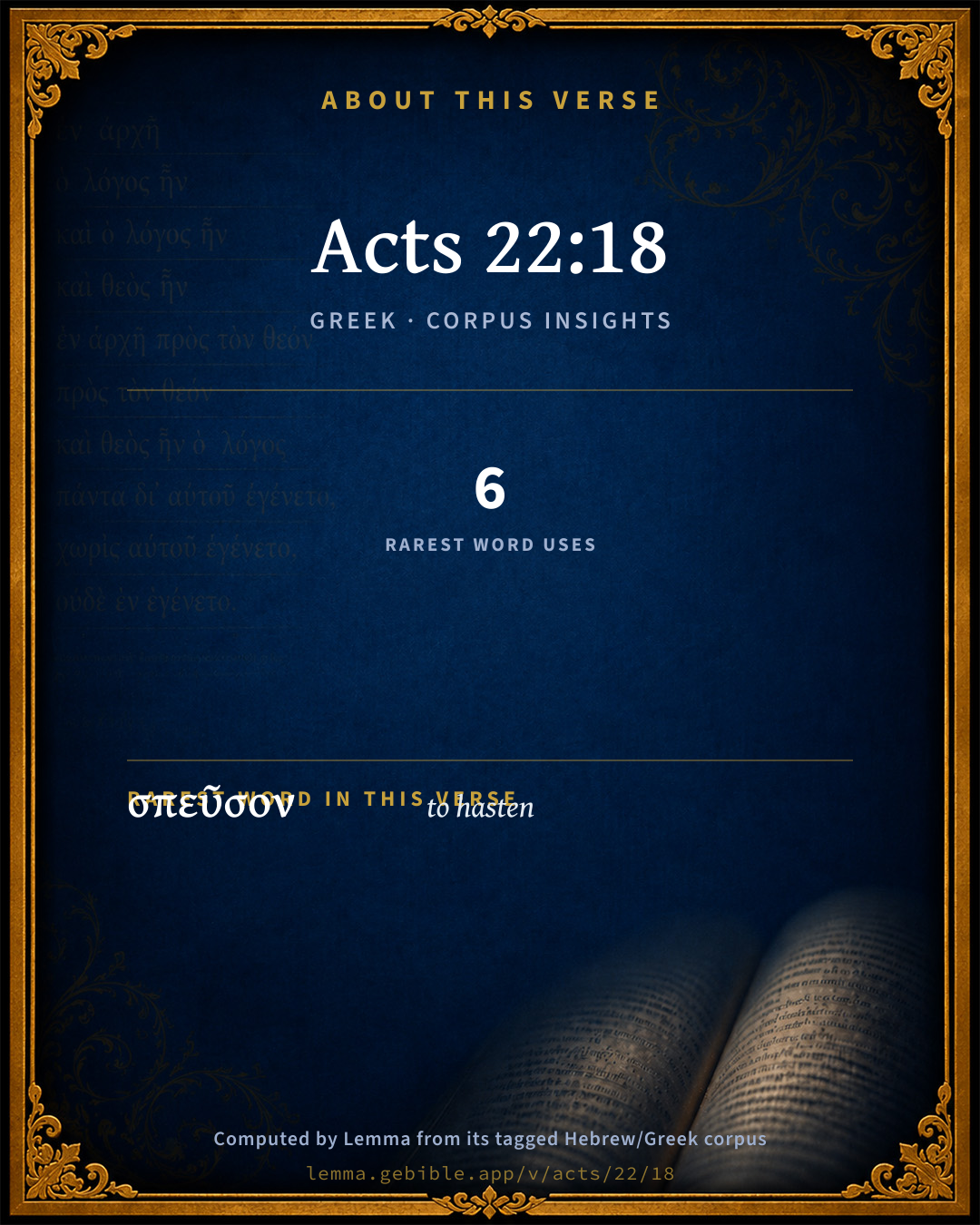
Acts 22:18

Greek (Tischendorf 8th ed.) Acts 22:18 appears in the Greek New Testament. The text above is from the Tischendorf 8th edition. Each word links to its Strong’s number and a concise gloss. Click any word for its full Thayer’s Greek Lexicon entry.

Download image
Cite this verse

Acts 22:18 (World English Bible). Public Domain. Lemma interlinear Bible study tool, https://lemma.gebible.app/v/acts/22/18.

Show BibTeX & RIS
BibTeX
RIS
English Translation
and saw him saying to me, 'Hurry and get out of Jerusalem quickly, because they will not receive testimony concerning me from you.'
World English Bible · Public Domain
Download a study sheet

One document with this verse’s original text, its word-by-word gloss line, the meaning frame, cross-references with their text, attributed commentary, and full source and license credits — printable, and it pastes into notes with its structure intact.

This verse Autodidact and up

Study sheet (.html) Plain text (.txt)

A passage Seminary Student

Up to 50 verses in one chapter. A passage sheet keeps up to 6 commentary sources and 12 cross-references per verse, in the order this page ranks them, and says so on the sheet whenever that leaves anything out. Ask for a single verse and you get the Autodidact verse sheet above.

Everything on this page stays free to read, with no account — the sheet is a download of what is already on screen, not access to it.

Want to remove ads? Support Godless Engineer
Compare translations 3

The same verse in 3 English versions, stacked beneath the original-language interlinear above. Click any original word for its lexicon entry.

Each is an independent rendering of the whole verse — the interlinear is not word-aligned to these translations.

Highlighted words mark where these versions differ — a whole-verse word diff, not a word-by-word alignment.

  • World English Bible Public Domain
    and saw him saying to me, 'Hurry and get out of Jerusalem quickly, because they will not receive testimony concerning me from you.'
  • King James Version Public Domain
    And saw him saying unto me, Make haste, and get thee quickly out of Jerusalem: for they will not receive thy testimony concerning me.
  • unfoldingWord Literal Text CC BY-SA 4.0
    And I saw him saying to me, ‘Hurry and go away in haste from Jerusalem, because they will not accept your testimony about me.’

unfoldingWord Literal Text — © unfoldingWord, licensed CC BY-SA 4.0. Word-aligned USFM3 via Door43 (git.door43.org/unfoldingWord/en_ult).

Versions to compare (up to 4)

3 of 4 selected

Show all 19 translations

Every available English version of this verse, each an independent rendering of the whole verse.

  • World English Bible Public Domain
    and saw him saying to me, 'Hurry and get out of Jerusalem quickly, because they will not receive testimony concerning me from you.'
  • Berean Standard Bible Public Domain
    and saw the Lord saying to me, ‘Hurry! Leave Jerusalem quickly, because the people here will not accept your testimony about Me.’
  • Majority Standard Bible Public Domain
    and saw the Lord saying to me, ‘Hurry! Leave Jerusalem quickly, because the people here will not accept your testimony about Me.’
  • King James Version Public Domain
    And saw him saying unto me, Make haste, and get thee quickly out of Jerusalem: for they will not receive thy testimony concerning me.
  • American Standard Version (1901) Public Domain
    and saw him saying unto me, Make haste, and get thee quickly out of Jerusalem; because they will not receive of thee testimony concerning me.
  • Revised Version (1885) Public Domain
    and saw him saying unto me, Make haste, and get thee quickly out of Jerusalem: because they will not receive of thee testimony concerning me.
  • Geneva Bible (1599) Public Domain
    And saw him saying vnto me, Make haste, and get thee quickly out of Hierusalem: for they will not receiue thy witnes concerning me.
  • Douay-Rheims (1899) Public Domain
    And saw him saying unto me: Make haste, and get thee quickly out of Jerusalem; because they will not receive thy testimony concerning me.
  • Young's Literal Translation Public Domain
    and I saw him saying to me, Haste and go forth in haste out of Jerusalem, because they will not receive thy testimony concerning me;
  • Literal Standard Version CC BY-SA 4.0
    and I saw Him saying to me, Hurry and go forth in haste out of Jerusalem, because they will not receive your testimony concerning Me;
  • Unlocked Literal Bible CC BY-SA 4.0
    I saw him say to me, 'Hurry and leave Jerusalem quickly, because they will not accept your testimony about me.'
  • unfoldingWord Literal Text CC BY-SA 4.0
    And I saw him saying to me, ‘Hurry and go away in haste from Jerusalem, because they will not accept your testimony about me.’
  • Darby Bible Public Domain
    and saw him saying to me, Make haste and go quickly out of Jerusalem, for they will not receive thy testimony concerning me.
  • World Messianic Bible Public Domain
    and saw him saying to me, ‘Hurry and get out of Jerusalem quickly, because they will not receive testimony concerning me from you.’
  • Webster's Bible Public Domain
    And saw him saying to me, Make haste, and depart quickly from Jerusalem; for they will not receive thy testimony concerning me.
  • Free Bible Version CC BY-SA 4.0
    I saw a vision of the Lord telling me, ‘Hurry! You need to leave Jerusalem quickly, because they will not accept what you are telling them about me.’
  • Bible in Basic English Public Domain
    And I saw him saying to me, Go out of Jerusalem straight away because they will not give hearing to your witness about me.
  • Text-Critical English NT CC BY 4.0
    and saw the Lord saying to me, ‘Make haste and get out of Jerusalem quickly, for they will not accept yoʋr testimony about me.’
  • Tyndale New Testament (1534) Public Domain
    and sawe him sayinge vnto me. Make haste and get the quickly out of Ierusalem: for they will not receave thy witnes that thou bearest of me.

Literal Standard Version (2020), Covenant Press — licensed CC BY-SA 4.0. Text via the HelloAO Bible API (eBible.org). Unlocked Literal Bible (unfoldingWord) — licensed CC BY-SA 4.0. Text via the HelloAO Bible API (eBible.org). unfoldingWord Literal Text — © unfoldingWord, licensed CC BY-SA 4.0. Word-aligned USFM3 via Door43 (git.door43.org/unfoldingWord/en_ult). Free Bible Version, Dr. Jonathan Gallagher — licensed CC BY-SA 4.0. Text via the HelloAO Bible API (eBible.org).

Word by word

More ways to search: Search by grammar → Find every occurrence → Compare this word →

Practice this passage: Drill this verse → Learn its vocabulary →

σπεῦσον
speúdō
G4692
“to hasten”
Verb, Aorist, Active, Imperative, 2nd person, Singular
Part of Speech
Verb
Tense
Aorist
Voice
Active
Mood
Imperative
Person
2nd person
Number
Singular
Full Thayer's Definition

Origin: probably strengthened from G4228

TDNT: None

1. to haste, make haste 2. to desire earnestly
  1. καὶ kaí G2532 “and” Conjunction
  2. ἴδον horáō G3708 “to see” Verb, Aorist, Active, Indicative, 1st person, Singular
  3. αὐτὸν autós G846 “he” Personal pronoun, Accusative, Singular, Masculine
  4. λέγοντά légō G3004 “to say” Verb, Present, Active, Participle, Accusative, Singular, Masculine
  5. μοι egṓ G1473 “I” Personal pronoun, 1st person, Dative, Singular
  6. καὶ kaí G2532 “and” Conjunction
  7. ἔξελθε exérchomai G1831 “to come forth” Verb, Aorist, Active, Imperative, 2nd person, Singular
  8. ἐν en G1722 “in” Preposition
  9. τάχει táchos G5034 “quickness” Noun, Dative, Singular, Neuter
  10. ἐξ ek G1537 “from” Preposition
  11. Ἱερουσαλήμ Hierousalḗm G2419 “Jerusalem” Noun, Proper, indeclinable
  12. διότι dióti G1360 “because” Conjunction
  13. οὐ ou G3756 “not” Particle, Negative
  14. παραδέξονταί paradéchomai G3858 “to receive” Verb, Future, Middle or Passive deponent, Indicative, 3rd person, Plural
  15. σου sý G4771 “you” Personal pronoun, 2nd person, Genitive, Singular
  16. μαρτυρίαν martyría G3141 “testimony” Noun, Accusative, Singular, Feminine
  17. περὶ perí G4012 “about” Preposition
  18. ἐμοῦ egṓ G1473 “I” Personal pronoun, 1st person, Genitive, Singular

About this verse

These counts appear in no published source. They are computed here, from the morphology-tagged text and Lemma’s own curated glosses. What Lemma adds →

19
words
17
distinct lemmas
Acts
section

Notable vocabulary

The rarest word here is σπεῦσον to hasten G4692 — appearing just 6 times in the whole Greek New Testament.

Shared distinctive vocabulary

σπεῦσον to hasten G4692 occurs in 6 verses of the Greek New Testament. Also found in:

Repetition

Words recur within this verse:

Cross-references

6

Topical passages linked to Acts 22:18 in the Treasury of Scripture Knowledge — connected by theme and wording, ordered by reader-vote popularity; previews shown in the World English Bible.

  • Acts 9:29 preaching boldly in the name of the Lord. He spoke and disputed against the Grecian Jews, but they were seeking to kill him.
  • Ezekiel 3:6–7 not to many peoples of a strange speech and of a hard language, whose words you can not understand. Surely, if I sent you to them, they would listen to you.
  • Matthew 10:14 Whoever doesn't receive you, nor hear your words, as you go out of that house or that city, shake off the dust from your feet.
  • Luke 21:21 Then let those who are in Judea flee to the mountains. Let those who are in the midst of her depart. Let those who are in the country not enter therein.
  • Matthew 10:23 But when they persecute you in this city, flee into the next, for most assuredly I tell you, you will not have gone through the cities of Israel, until the Son of Man has come.
  • Acts 3:19 "Repent therefore, and turn again, that your sins may be blotted out, so that there may come times of refreshing from the presence of the Lord,

Cross-references courtesy of OpenBible.info (CC BY 4.0).

Commentary

Notes on Acts 22:18 from classic Christian and Jewish commentators (each source and its license shown beneath its notes). The classic Christian expositions comment on the surrounding passage and are grouped to its opening verse, so a note may address several verses; the Jewish commentaries on the Tanakh (Rashi and others) are per-verse, so they appear only where the commentator wrote on this verse.

Lemma curates 59 commentaries, every one of them public domain or Creative Commons licensed, each selected and text-cleaned for this edition rather than reprinted as found. About our sources →

Bengel's Gnomon

Johann Albrecht Bengel

Act 22:18. Αὐτὸν, Him) Jesus, Act 22:8.—σπεῦσον, make haste) on account of the plot laid for thee, and in order that the sooner thou mayest preach elsewhere.—οὐ παραδέξονται, they will not receive) Tapeinosis [see Append.]: i.e. they will fight against thy testimony.

Bengel's Gnomon of the New Testament — English translation (T&T Clark, Edinburgh, 1860) — public domain. Text from a community e-Sword module.

Expositor's Greek Testament

ed. W. Robertson Nicoll

Act 22:18 . σπεῦσον καὶ ἔξ .: implying danger, cf. Act 9:29 . σου μαρτ .: grounded upon the occurrence before Damascus, and so a striking testimony.

The Expositor's Greek Testament, edited by W. Robertson Nicoll (1897–1910) — public domain. Text from a community e-Sword module.

Jamieson, Fausset & Brown

Robert Jamieson, A. R. Fausset & David Brown

get . . . quickly out of Jerusalem--compare Act 9:29.

for they will not receive thy testimony . . . And I said, Lord, they know, &c.--"Can it be, Lord, that they will resist the testimony of one whom they knew so well as among the bitterest of all against Thy disciples, and whom nothing short of resistless evidence could have turned to Thee?"

Jamieson, Fausset & Brown — Commentary Critical and Explanatory on the Whole Bible (1871) — public domain (CC PDM 1.0). Text via the HelloAO Bible API.

John Calvin's Commentaries

18. Because they will not. Though the commandment of God alone ought to be sufficient enough to bind us to obey, yet to the end Paul might be the more willing to follow, Christ showeth him a reason why he will have him depart out of Jerusalem; to wit, because he should lose his labor there; but he was not chosen to that end that he might be idle, or do no good by teaching; though this were a sore trial, and such as we may think did sore shake him. Not long before the function of preaching the gospel was enjoined him, that his voice might sound throughout the whole world; now even at the first entrance he is inhibited; yea, his labor seemeth to be condemned of peculiar reproach when his witness [testimony] is rejected, because his person is hated. But it was meet that the holy servant of the Lord should be thus humbled, that all the preachers of the gospel might learn to give over themselves wholly to obey Christ, that when they be excluded from one place, they may be ready immediately to go to another, and that they may not be discouraged, nor cease off from doing their duty, though they be undeservedly loathed.

John Calvin's Commentaries (1540-1563) — public domain. Text from the Calvin Translation Society English edition (1840s-50s) via the Christian Classics Ethereal Library (ccel.org). Calvin's coverage is partial (roughly two-thirds of the Bible); uncommented books and verses are honest gaps, never fabricated. The 19th-century editor's footnotes and remarks are omitted so the notes are faithfully Calvin's own voice.

Ellicott's Commentary for English Readers

(18)Get thee quickly out of Jerusalem.—It is obvious that this fits in better with the first hurried visit after St. Paul’s conversion than with the second, when he came with Barnabas with alms for the sufferers from the famine. (See Note on Act_11:30.)

A Bible Commentary for English Readers, edited by Charles John Ellicott (1878–1897) — public domain. Text from a community e-Sword module.

The Cambridge Bible for Schools and Colleges

gen. ed. J. J. S. Perowne

18. and saw him saying unto me] In Act_9:29-30 no mention is made that a vision had appeared to Saul commanding him to depart from Jerusalem. It is only said that “the disciples” sent him away. But these two statements are not inconsistent with each other. Saul might be warned to go, and the disciples at the same time prompted to send him. In the same way two different causes, one natural, the other supernatural, are mentioned Act_13:2-4, viz. the prompting of the Holy Spirit, and the act of the Church of Antioch. And still more like is the statement of St Paul (Gal_2:2), that he went up to Jerusalem “by revelation,” when it is placed side by side with Act_15:2 where we are told that the Christians of Antioch determined that Paul and Barnabas should go up to consult the church in Jerusalem.

get thee quickly out of Jerusalem] We know from Gal_1:18 that the duration of the Apostle’s stay was but fifteen days.

receive thy testimony concerning me] Better (with Rev. Ver.), “receive of thee testimony, &c.” The Apostle, as is clear from what follows in the next verse, considered that he would be specially a messenger likely to persuade and convince men of the truths of the Christian faith. God, in the vision, points out that this will not be so.

The Cambridge Bible for Schools and Colleges (gen. ed. J. J. S. Perowne; Cambridge University Press, 1878–1918) — public domain. Text from a community e-Sword module.

John Gill's Exposition

And when the blood of thy martyr Stephen was shed,.... Stephen was a martyr for Christ, both by confession with his mouth, and by the effusion of his blood; he was the proto-martyr, or "the first martyr" that suffered for Christ; and there are copies, as one of Stephens's, and the Complutensian edition, which so read in this place; his blood was shed by stoning:

I also was standing by; to see the inhuman action performed; nor was he an idle and indifferent spectator:

and consenting unto his death; being pleased and delighted with it, and rejoicing at it; see Act 8:1.

and kept the raiment of them that slew him; the accusers of him, and witnesses against him, whose hands were first on him, and cast the first stones at him, and continued to stone him, until they killed him: these laid their garments at the feet of Saul, who looked after them, that nobody stole them, and run away with them, whilst they were stoning Stephen; which shows how disposed he was to that fact, and how much he approved of it: and these things he mentions to suggest that surely the Jews would receive his testimony, since they knew what a bitter enemy he had been to this way: and therefore might conclude, that he must have some very good and strong reasons, which had prevailed upon him to embrace this religion against all his prejudices, and so might be willing to hear them; and it also shows what an affection the apostle had for the Jews, and how much he desired their spiritual welfare, for which reason he chose to have stayed, and preached among them.

John Gill's Exposition of the Whole Bible (1746–1763) — public domain (CC PDM 1.0). Text via the HelloAO Bible API.

Trapp's Complete Commentary

John Trapp

18 And saw him saying unto me, Make haste, and get thee quickly out of Jerusalem: for they will not receive thy testimony concerning me.

Ver. 18. They will not receive] And I have ordained thee for a better purpose than to lie idle He therefore that heareth, let him hear, and he that forebeareth, let him forbear. God will not always be with men in the opportunities of grace but make them know the worth by the want. Eze 3:27.

John Trapp, A Commentary or Exposition upon All the Books of the Old and New Testament (1647–1656) — public domain. Text from a community e-Sword module.

Albert Barnes' Notes on the Bible

And saw him - Evidently, the Lord Jesus, Act 22:14. He had received his commission from him, and he now received a distinct command to go to the Gentiles.

For they will not receive - The inhabitants of Jerusalem, probably including both Jews and Christians. The Jews would not listen to him because he had become, in their view, an apostate, and they would hate and persecute him. The Christians would not be likely to receive him, for they would remember his former persecutions, and would be suspicious of him because he had been so long in Arabia, and had not sooner connected himself with them. See the notes on Act 9:26, “And when Saul was come to Jerusalem, he assayed to join himself to the disciples; but they were all afraid of him, and believed not that he was a disciple.”

Albert Barnes' Notes on the Bible (1834–1885) — public domain. Text from a community e-Sword/MySword module.

Matthew Poole's English Annotations

Get thee quickly out of Jerusalem; this St. Paul takes notice of, that it might appear unto the Jews that he did not out of choice, or because he bare a grudge against them, decline them, and preach to the Gentiles.

For they will not receive thy testimony concerning me; as if Christ had said, They who were appointed unto life, and were curable, are already cured; but the rest who are hardened, nothing remains for them but utter destruction.

Matthew Poole's English Annotations on the Holy Bible (1683–1685) — public domain. Text from a community e-Sword/MySword module.

The Pulpit Commentary

Because for for, A.V.; of thee testimony for thy testimony, A.V. and T.R. Get thee quickly, etc. The narrative in Act_9:28-30 does not mention the vision, but gives the murderous opposition of the Hellenist Jews as the reason of Saul"s departure from Jerusalem to Tarsus. Possibly, if it had not been for the Divine warning, the apostle would have braved the danger and lost his life.

Vers. 18-21. Men"s past sins often the unknown determiners of their future life, its opportunities, and its disqualifications.

It is possible to take different views of the drift and the intended tenor of this passage. The language of Saul (which Paul now quotes), as found in vers. 19, 20, will be very far from powerless, whether read as a view humbly offered in harmony with the command just laid upon him, or as perhaps is the more probable, in deprecation of it. The passage, however, reminds us, amid high associations of great truths, of solemn far-reaching principles in human life. The retribution which it enwraps is not that of the severity of judgment to the sinner, but of the inevitableness of that cause and effect which speak a Creator-God of infinite wisdom, and a creature-man of reason, of moral capabilities, and of a certain freedom of action, that lies at the root of moral responsibility and final accountability. Notice, then

I A CAREER OF UNTOLD POSSIBILITIES OF USEFULNESS AND HONOR IN THE MOTHER CITY JERUSALEM CUT SHOUT FOR PAUL.

1. We could imagine reasons why Paul would have felt his highest ambition fired by testifying, working, suffering, and dying for Jesus in Jerusalem, as;

(1) The mother city of the land and of God"s favored people, renowned with ancient and special renown,

(2) The place at the very heart of Jewish life, where he would have longed to recant most publicly his one-time errors of creed, and retrieve whatever it were possible to retrieve of the effects of those errors. This would have been of what was most noble among the characteristics of Paul.

(3) The place which held the same relation to the religious world that Rome did to the heathen world.

(4) The place where the Master bore the grandest testimony of all his course, and suffered and died.

2. It needs little imagination to see that, let alone any sense of a noble ambition, Paul would feel that it would be one of the grandest opportunities of usefulness, at the very center of typical and peculiar risk and danger. From all this Paul is interdicted by a voice of sovereign authority, and on the plain ground of his own past of error.

II A REMEDY IN CHRIST AGAINST ABJECT HOPELESSNESS, AGAINST SETTLED DESPAIR, AGAINST REMORSEFUL THROWING UP OF ENDEAVOR, IN THE PRESENCE OF THE RETRIBUTIVE ASPECTS OF HUMAN LIFE. The veto of Jesus Christ, spoken with authority to Paul, is nothing else than linked with a summons to other work and another sphere, that may turn into all equal usefulness and probably usefulness far greater. Notice the method of that summons.

1. Though to state the ground of it might be pain and might give pain, it is not wrapt in vague mystery and unsatisfying innuendo. It is, on the other hand, a grand instance of "Faithful are the wounds of a friend.

2. The summons exhibits a very distinct and emphatic value set upon the life and the useful employment of the servant somewhere or other. Twice, nay, thrice repeated is the direction to depart with "haste," "quickly," and unquestioningly. Men may depart like Jonah. But also they may depart for

(1) Christ"s own command, announced in the individual conscience or by the living Spirit; and

(2) for greater toil and exposure, instead of for ease and hiding from work.

3. The summons announces, by a most gracious anticipation, a highly important substitute career. The man who has incapacitated himself by follies, by errors, even by sins, for some of the noblest of Christian service shall still not be cast away as useless. He is still good to do something; yes, to do much. The Master does not refuse the love or the service of the fallen, when they return, nor does he consent to treat with them only through others. First he saves them and protects them, and suggests his care and love of them. Then he gives them their work, though "far hence." And lastly, he does not withhold from their car to hear his own voice, "I will send thee." What trust, what love, what forgivingness, and what streams of hope Jesus has to give and gives to his own! B.

The Pulpit Commentary (1880–1919), ed. H.D.M. Spence-Jones & Joseph S. Exell — public domain. Text from a community e-Sword module.

John Wesley's Explanatory Notes

And I saw him - Jesus, saying to me, Depart quickly out of Jerusalem - Because of the snares laid for thee: and in order to preach where they will hear.

John Wesley, Explanatory Notes Upon the Whole Bible (1754–1765) — public domain. Text via the GEBible commentary corpus.

Godbey's Commentary on the New Testament

William B. Godbey

18. “And I saw him, saying, Hasten and depart quickly out of Jerusalem, because they will not receive thy testimony concerning me.” This second appearing of Jesus unto Paul took place in Jerusalem after he had returned out of Arabia by way of Damascus and came up to the metropolis, introduced to the apostles and vindicated by Barnabas. Here he states that the same glorified Savior who had shone on him as he journeyed to Damascus appeared to him in the temple while praying “in an ecstacy,” i. e., a rapture, in which his whole being was flooded with heavenly glory.

18-21. Here Paul rehearses his testimony to Jesus of his leadership in his martyrdom, alleging that the Jews will certainly not receive his testimony. “And he said unto me, Go, for I will send you far away unto the Gentiles.” The Jews listened patiently to him till he thus testified to his commission to the Gentiles. Then they broke out into an awful rage, tearing their garments and throwing dust into the air, exclaiming vociferously, “Kill him! kill him!”

William B. Godbey, Commentary on the New Testament (1896–1900) — public domain. Text from a community e-Sword module.

McGarvey & Pendleton's Commentaries

J. W. McGarvey

See notes on verse 17

J. W. McGarvey (with Philip Y. Pendleton), Commentaries on the New Testament (The Fourfold Gospel, 1914; Acts; and the epistles) — public domain. Text from a community e-Sword/MySword module.

Cambridge Greek Testament for Schools and Colleges

18. καὶ ἰδεῖν αὐτὸν λέγοντά μοι, and saw Him saying unto me. In Act 9:29-30 no mention is made that a vision had appeared to Saul commanding him to depart from Jerusalem. It is only said that ‘the disciples’ sent him away. But these two statements are not inconsistent with each other. Saul might be warned to go, and the disciples at the same time prompted to send him. In the same way two different causes, one natural, the other supernatural, are mentioned Act 13:2-4, viz. the prompting of the Holy Spirit, and the act of the Church of Antioch. And still more like is the statement of St Paul (Gal 2:2), that he went up to Jerusalem ‘by revelation,’ when it is placed side by side with Act 15:2, where we are told that the Christians of Antioch determined that Paul and Barnabas should go up to consult the Church in Jerusalem.

ἔξελθε ἐν τάχει ἐξ Ἱερουσαλήμ, get thee quickly out of Jerusalem. We know from Gal 1:18 that the duration of the Apostle’s stay was only fifteen days.

ἐν τάχει used adverbially is common both in classical Greek and in the LXX.

οὐ παραδέξονταί σου μαρτυρίαν περὶ ἐμοῦ, they will not accept from thee testimony concerning me. The Apostle, as is clear from what follows in the next verse, considered that he would be specially a messenger likely to persuade and convince men in Jerusalem of the truths of the Christian faith. God, in the vision, points out that this will not be so.

Cambridge Greek Testament for Schools and Colleges (Cambridge University Press, 1896; 21 vols, various authors incl. Carr, Maclear, Plummer, Farrar, Lumby, Moule, M. R. James, Simcox) — public domain. Text from a community e-Sword module.

Alford’s Greek Testament

Henry Alford

18.] περὶ ἐμοῦ is to be taken with μαρτυρίαν, not with the verb, as Meyer and Winer maintain. Their objection, that then it must be τὴν μαρτ. τὴν περὶ ἐμοῦ is answered by remarking, (1) that Paul does not always observe accuracy in this usage of the article: e.g. Eph 6:5, ὑπακούετε τοῖς κυρίοις κατὰ σάρκα, for τ. κυρ. τοῖς κατα σάρκα, or τοῖς κατὰ σάρκα κυρίοις, which he has written in the , Col 3:22,-1Th 4:16, οἱ νεκροὶ ἐν χριστῷ ἀναστήσονται πρῶτον. See also Rom 6:4; Col 2:14, and notes:—and (2) that there may have been a reason for the irregularity here, inasmuch as, if either the article had been expressed after μαρτ., or τὴν π. ἐμ. μαρτ. had been used, σου would have appeared to be governed by παραδέξονται—‘they will not receive from thee thy testimony concerning me,’—which is not precisely the meaning intended to be conveyed. (See Mr. Green’s Gram. of N. T. p. 163.)

Henry Alford, The Greek Testament (1849–1861) — public domain. Text from a community e-Sword module.

Lesson kit

Teaching starters — assembled from the data on this page, not authored interpretation. Every prompt links to the verse data it draws on. Edit before teaching.

Acts, in the Acts, opens this verse with 19 words (17 distinct Greek lemmas). Its most distinctive word is speúdō (“to hasten”). A historical commentator’s framing appears above. Read the whole chapter for the surrounding context.

Discussion questions

  1. How does “to hasten” (speúdō) shape what this verse is saying?
  2. Luke 2:16 shares the word «to hasten» with this verse. How do the two illuminate each other?
  3. “and” occurs 2× in this one verse. What is the effect of the repetition?
  4. These translations render this verse differently. What is at stake in choosing one wording over another?
  5. Reading how Bengel's Gnomon and Expositor's Greek Testament read this verse, where do the two commentators agree and where do they part?

Things to notice

Reading settings

Reading text

Shown beneath each verse's original-language words.

Old Testament
Old Testament edition

Read the OT as the Masoretic Hebrew (MT) or the Greek Septuagint (LXX).

English shown for the Greek Septuagint (in the Hebrew ↔ Greek comparison).

Comparing translations? Open the Compare panel on any verse page to stack up to four side by side.