Matthew 27:54

Greek (Tischendorf 8th ed.) Matthew 27:54 appears in the Greek New Testament. The text above is from the Tischendorf 8th edition. Each word links to its Strong’s number and a concise gloss. Click any word for its full Thayer’s Greek Lexicon entry.
Download image
Cite this verse

Matthew 27:54 (World English Bible). Public Domain. Lemma interlinear Bible study tool, https://lemma.gebible.app/v/matthew/27/54.

Show BibTeX & RIS
BibTeX
RIS
English Translation
Now the centurion, and those who were with him watching Jesus, when they saw the earthquake, and the things that were done, feared exceedingly, saying, "Truly this was the Son of God."
World English Bible · Public Domain
Download a study sheet

One document with this verse’s original text, its word-by-word gloss line, the meaning frame, cross-references with their text, attributed commentary, and full source and license credits — printable, and it pastes into notes with its structure intact.

This verse Autodidact and up

Study sheet (.html) Plain text (.txt)

A passage Seminary Student

Up to 50 verses in one chapter. A passage sheet keeps up to 6 commentary sources and 12 cross-references per verse, in the order this page ranks them, and says so on the sheet whenever that leaves anything out. Ask for a single verse and you get the Autodidact verse sheet above.

Everything on this page stays free to read, with no account — the sheet is a download of what is already on screen, not access to it.

Want to remove ads? Support Godless Engineer
Compare translations 3

The same verse in 3 English versions, stacked beneath the original-language interlinear above. Click any original word for its lexicon entry.

Each is an independent rendering of the whole verse — the interlinear is not word-aligned to these translations.

Highlighted words mark where these versions differ — a whole-verse word diff, not a word-by-word alignment.

  • World English Bible Public Domain
    Now the centurion, and those who were with him watching Jesus, when they saw the earthquake, and the things that were done, feared exceedingly, saying, "Truly this was the Son of God."
  • King James Version Public Domain
    Now when the centurion, and they that were with him, watching Jesus, saw the earthquake, and those things that were done, they feared greatly, saying, Truly this was the Son of God.
  • unfoldingWord Literal Text CC BY-SA 4.0
    Now the centurion and the ones with him guarding Jesus, having seen the earthquake and the things having happened, were very afraid, saying, “Truly this was a Son of God.”

unfoldingWord Literal Text — © unfoldingWord, licensed CC BY-SA 4.0. Word-aligned USFM3 via Door43 (git.door43.org/unfoldingWord/en_ult).

Versions to compare (up to 4)

3 of 4 selected

Show all 19 translations

Every available English version of this verse, each an independent rendering of the whole verse.

  • World English Bible Public Domain
    Now the centurion, and those who were with him watching Jesus, when they saw the earthquake, and the things that were done, feared exceedingly, saying, "Truly this was the Son of God."
  • Berean Standard Bible Public Domain
    When the centurion and those with him who were guarding Jesus saw the earthquake and all that had happened, they were terrified and said, “Truly this was the Son of God.”
  • Majority Standard Bible Public Domain
    When the centurion and those with him who were guarding Jesus saw the earthquake and all that had happened, they were terrified and said, “Truly this was the Son of God.”
  • King James Version Public Domain
    Now when the centurion, and they that were with him, watching Jesus, saw the earthquake, and those things that were done, they feared greatly, saying, Truly this was the Son of God.
  • American Standard Version (1901) Public Domain
    Now the centurion, and they that were with him watching Jesus, when they saw the earthquake, and the things that were done, feared exceedingly, saying, Truly this was the Son of God.
  • Revised Version (1885) Public Domain
    Now the centurion, and they that were with him watching Jesus, when they saw the earthquake, and the things that were done, feared exceedingly, saying, Truly this was the Son of God.
  • Geneva Bible (1599) Public Domain
    When the Centurion, and they that were with him watching Iesus, saw the earthquake, and the thinges that were done, they feared greatly, saying, Truely this was the Sonne of God.
  • Douay-Rheims (1899) Public Domain
    Now the centurion and they that were with him watching Jesus, having seen the earthquake, and the things that were done, were sore afraid, saying: Indeed this was the Son of God.
  • Young's Literal Translation Public Domain
    And the centurion, and those with him watching Jesus, having seen the earthquake, and the things that were done, were exceedingly afraid, saying, `Truly this was God's Son.'
  • Literal Standard Version CC BY-SA 4.0
    And the centurion, and those with him watching Jesus, having seen the earthquake, and the things that were done, were exceedingly afraid, saying, “Truly this was God’s Son.”
  • Unlocked Literal Bible CC BY-SA 4.0
    Now when the centurion and those who were watching Jesus saw the earthquake and the things that had happened, they became very afraid and said, “Truly this was the Son of God.”
  • unfoldingWord Literal Text CC BY-SA 4.0
    Now the centurion and the ones with him guarding Jesus, having seen the earthquake and the things having happened, were very afraid, saying, “Truly this was a Son of God.”
  • Darby Bible Public Domain
    But the centurion, and they who were with him on guard over Jesus, seeing the earthquake and the things that took place, feared greatly, saying, Truly this [man] was Son of God.
  • World Messianic Bible Public Domain
    Now the centurion and those who were with him watching Yeshua, when they saw the earthquake and the things that were done, were terrified, saying, “Truly this was the Son of God!”
  • Webster's Bible Public Domain
    Now when the centurion, and they that were with him, watching Jesus, saw the earthquake, and those things that were done, they feared greatly, saying, Truly this was the Son of God.
  • Free Bible Version CC BY-SA 4.0
    When the centurion and those with him who were guarding Jesus saw the earthquake and what happened, they were terrified, and said, “This really was the Son of God!”
  • Bible in Basic English Public Domain
    Now the captain and those who were with him watching Jesus, when they saw the earth-shock and the things which were done, were in great fear and said, Truly this was a son of God.
  • Text-Critical English NT CC BY 4.0
    Now when the centurion and those who were keeping watch with him over Jesus saw the earthquake and the things that had happened, they became very frightened and said, “Truly this man was the Son of God.”
  • Tyndale New Testament (1534) Public Domain
    When the Centurion and they that were with him watchinge Iesus sawe the erth quake and those thinges which hapened they feared greatly sayinge. Of a surete this was the sonne of God.

Literal Standard Version (2020), Covenant Press — licensed CC BY-SA 4.0. Text via the HelloAO Bible API (eBible.org). Unlocked Literal Bible (unfoldingWord) — licensed CC BY-SA 4.0. Text via the HelloAO Bible API (eBible.org). unfoldingWord Literal Text — © unfoldingWord, licensed CC BY-SA 4.0. Word-aligned USFM3 via Door43 (git.door43.org/unfoldingWord/en_ult). Free Bible Version, Dr. Jonathan Gallagher — licensed CC BY-SA 4.0. Text via the HelloAO Bible API (eBible.org).

Word by word

More ways to search: Search by grammar → Find every occurrence → Compare this word →

Practice this passage: Drill this verse → Learn its vocabulary →

σφόδρα
sphódra
G4970
“exceedingly”
Adverb
Part of Speech
Adverb
Full Thayer's Definition

Origin: neuter plural of sphodros (violent, of uncertain derivation) as adverb

TDNT: None

1. exceedingly, greatly
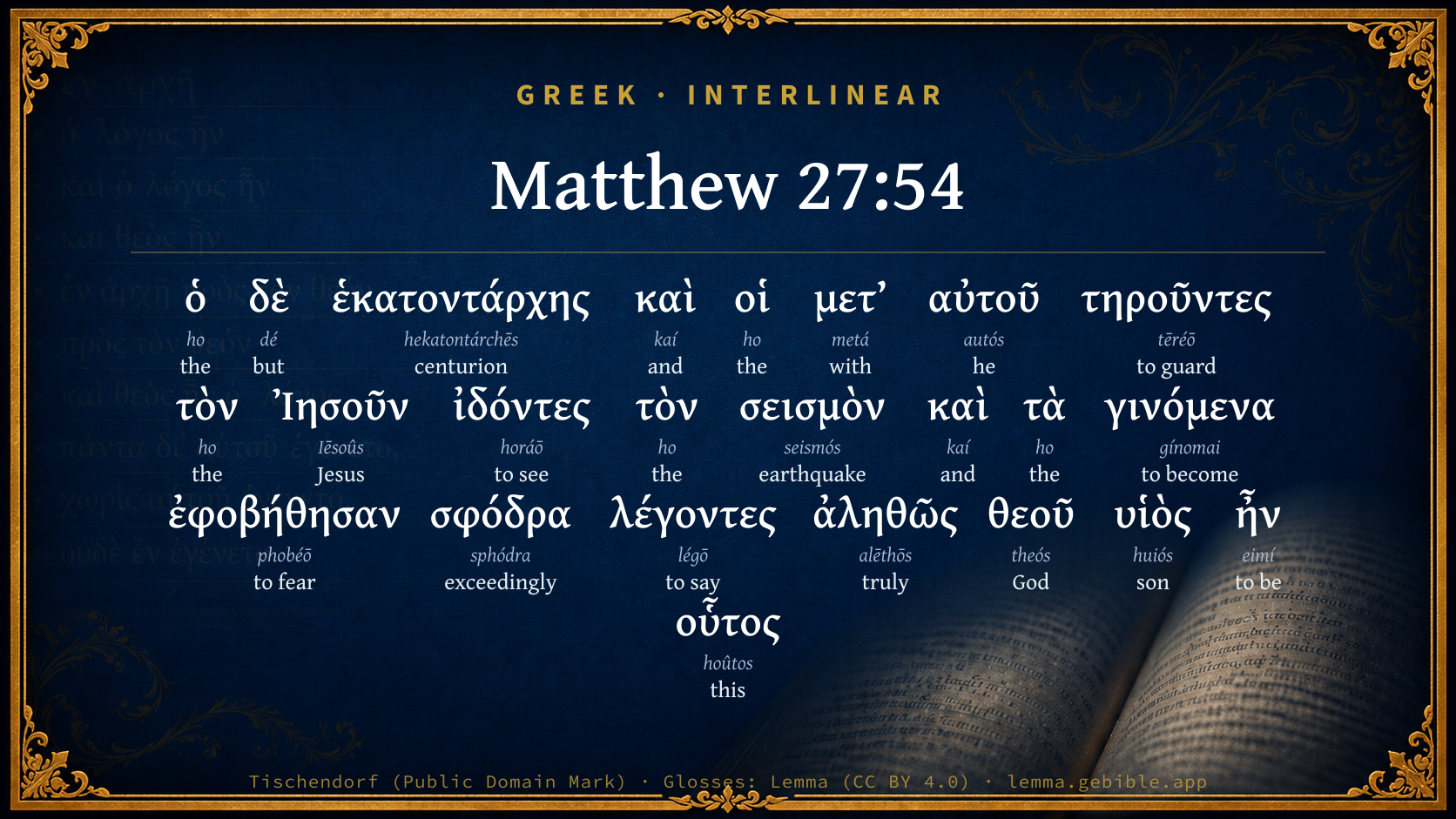
  1. ὁ ho G3588 “the” Article, Nominative, Singular, Masculine
  2. δὲ dé G1161 “but” Conjunction
  3. ἑκατοντάρχης hekatontárchēs G1543 “centurion” Noun, Nominative, Singular, Masculine
  4. καὶ kaí G2532 “and” Conjunction
  5. οἱ ho G3588 “the” Article, Nominative, Plural, Masculine
  6. μετ’ metá G3326 “with” Preposition
  7. αὐτοῦ autós G846 “he” Personal pronoun, Genitive, Singular, Masculine
  8. τηροῦντες tēréō G5083 “to guard” Verb, Present, Active, Participle, Nominative, Plural, Masculine
  9. τὸν ho G3588 “the” Article, Accusative, Singular, Masculine
  10. Ἰησοῦν Iēsoûs G2424 “Jesus” Noun, Accusative, Singular, Masculine
  11. ἰδόντες horáō G3708 “to see” Verb, Aorist, Active, Participle, Nominative, Plural, Masculine
  12. τὸν ho G3588 “the” Article, Accusative, Singular, Masculine
  13. σεισμὸν seismós G4578 “earthquake” Noun, Accusative, Singular, Masculine
  14. καὶ kaí G2532 “and” Conjunction
  15. τὰ ho G3588 “the” Article, Accusative, Plural, Neuter
  16. γινόμενα gínomai G1096 “to become” Verb, Present, Middle or Passive deponent, Participle, Accusative, Plural, Neuter
  17. ἐφοβήθησαν phobéō G5399 “to fear” Verb, Aorist, Passive deponent, Indicative, 3rd person, Plural
  18. λέγοντες légō G3004 “to say” Verb, Present, Active, Participle, Nominative, Plural, Masculine
  19. ἀληθῶς alēthōs G230 “truly” Adverb
  20. θεοῦ theós G2316 “God” Noun, Genitive, Singular, Masculine
  21. υἱὸς huiós G5207 “son” Noun, Nominative, Singular, Masculine
  22. ἦν eimí G1510 “to be” Verb, Imperfect, Active, Indicative, 3rd person, Singular
  23. οὗτος hoûtos G3778 “this” Demonstrative pronoun, Nominative, Singular, Masculine

About this verse

These counts appear in no published source. They are computed here, from the morphology-tagged text and Lemma’s own curated glosses. What Lemma adds →

24
words
19
distinct lemmas
Gospels
section

Notable vocabulary

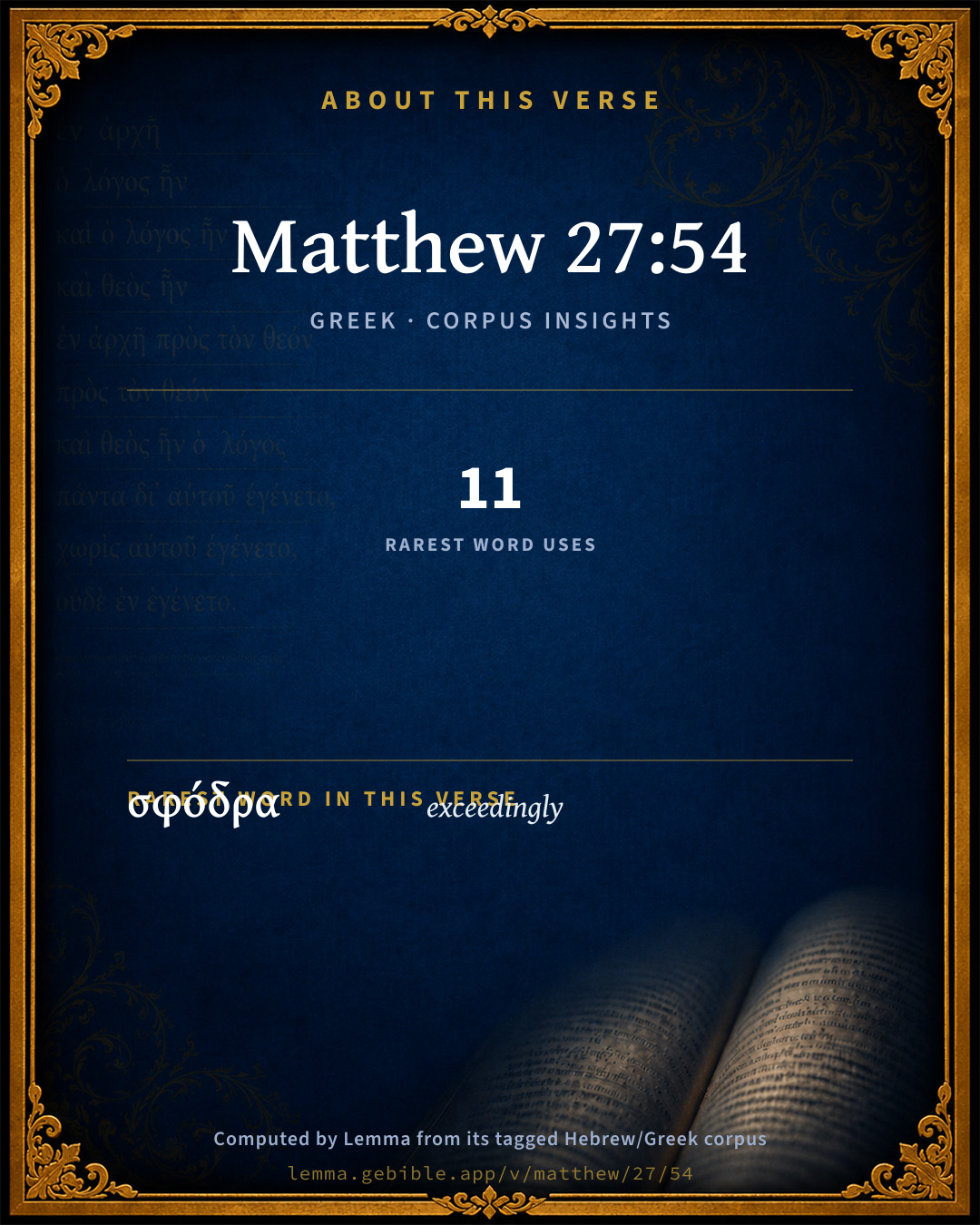
The rarest word here is σφόδρα exceedingly G4970 — appearing just 11 times in the whole Greek New Testament.

Shared distinctive vocabulary

σφόδρα exceedingly G4970 occurs in 11 verses of the Greek New Testament. Also found in:

Repetition

Words recur within this verse:

Cross-references

21

Topical passages linked to Matthew 27:54 in the Treasury of Scripture Knowledge — connected by theme and wording, ordered by reader-vote popularity; previews shown in the World English Bible.

  • Matthew 27:36 and they sat and watched him there.
  • Mark 15:39 When the centurion, who stood by opposite him, saw that he cried out like this and breathed his last, he said, "Truly this man was the Son of God!"
  • Matthew 27:43 He trusts in God. Let God deliver him now, if he wants him; for he said, 'I am the Son of God.'"
  • Luke 23:47–49 When the centurion saw what was done, he glorified God, saying, "Certainly this was a righteous man."
  • Romans 1:4 who was declared to be the Son of God with power, according to the Spirit of holiness, by the resurrection from the dead, Jesus Christ our Lord,
  • Matthew 4:3 The tempter came and said to him, "If you are the Son of God, command that these stones become bread."
  • Matthew 8:5 When he came into Capernaum, a centurion came to him, asking him,
  • Acts 21:32 Immediately he took soldiers and centurions, and ran down to them. They, when they saw the chief captain and the soldiers, stopped beating Paul.
  • Acts 23:23 He called to himself two of the centurions, and said, "Prepare two hundred soldiers to go as far as Caesarea, with seventy horsemen, and two hundred men armed with spears, at the third hour of the night."
  • Acts 27:1 When it was determined that we should sail for Italy, they delivered Paul and certain other prisoners to a centurion named Julius, of the Augustan band.
  • Acts 27:43 But the centurion, desiring to save Paul, stopped them from their purpose, and commanded that those who could swim should throw themselves overboard first to go toward the land;
  • Revelation 11:13 In that day there was a great earthquake, and a tenth of the city fell. Seven thousand people were killed in the earthquake, and the rest were terrified, and gave glory to the God of heaven.
  • Acts 23:17 Paul summoned one of the centurions, and said, "Bring this young man to the commanding officer, for he has something to tell him."
  • 2 Kings 1:13–14 Again he sent the captain of a third fifty with his fifty. The third captain of fifty went up, and came and fell on his knees before Elijah, and begged him, and said to him, man of God, please let my life, and the life of these fifty your servants, be precious in your sight.
  • Matthew 26:63 But Jesus held his peace. The high priest answered him, "I adjure you by the living God, that you tell us whether you are the Christ, the Son of God."
  • Matthew 27:40 and saying, "You who destroy the temple, and build it in three days, save yourself! If you are the Son of God, come down from the cross!"
  • Luke 22:70 They all said, "Are you then the Son of God?" He said to them, "You say it, because I AM."
  • John 19:7 The Jews answered him, "We have a law, and by our law he ought to die, because he made himself the Son of God."
  • Acts 2:37 Now when they heard this, they were cut to the heart, and said to Peter and the rest of the apostles, "Brothers, what shall we do?"
  • Acts 10:1 Now there was a certain man in Caesarea, Cornelius by name, a centurion of what was called the Italian Regiment,
  • Acts 16:29–30 He called for lights and sprang in, and, fell down trembling before Paul and Silas,

Cross-references courtesy of OpenBible.info (CC BY 4.0).

Commentary

Notes on Matthew 27:54 from classic Christian and Jewish commentators (each source and its license shown beneath its notes). The classic Christian expositions comment on the surrounding passage and are grouped to its opening verse, so a note may address several verses; the Jewish commentaries on the Tanakh (Rashi and others) are per-verse, so they appear only where the commentator wrote on this verse.

Lemma curates 59 commentaries, every one of them public domain or Creative Commons licensed, each selected and text-cleaned for this edition rather than reprinted as found. About our sources →

The Biblical Illustrator

Joseph S. Exell

Mat_27:54

Truly this was the Son of God.

Homage of reason and conscience to the facts of the Christian religion

Mens hearts often harden in proportion to the privileges they enjoy. Hence heathens look on the affecting scene in a different state of mind than the Jews. They were nearer the kingdom of heaven.

I. We have in this declaration A testimony to the impressive character of those great historical facts which were connected with the foundation of Christianity. These facts are the basis of Christianity. Familiarity with them may tend to rob them of their greatness. It is so with the wonders of nature; the sun ceases to astonish us. It is with the first impression produced by these events that we have to do. The centurion and his band were not predisposed to attach any peculiar sanctity to these events. They had no previous knowledge as to the meaning of them. They had been educated in the paganism of the Romans; they worshipped many gods. They may have seen that the Jews adored no images, that they paid respect to the Temple as the house of their one God. This knowledge of Judaism may have prepared this centurion to use language different from that of the pagan idolatry. This Roman officer would appear to have had every opportunity of becoming acquainted with the things which happened at this time at Jerusalem. Natural and civil history are full of remarkable events. They are to be viewed in general relation to the sinfulness of man; they may at the same time he traced to natural causes. But the events which attracted the attention of the centurion were of a different order. It was a solitary occurrence in the history of the world. The like had never happened before. There was a remarkable response and sympathy between the natural and moral world of human life. The course of nature is generally indifferent to the facts of human life; the moon shines on the wreck. But here nature seems roused from her general apathy to human affairs. Well might such extraordinary events convince men that more was going on than met the eye-that the sufferer was no ordinary Person. The prelude of events to the cross might deepen the impression.

II. Practical improvement from their testimony. I regard their testimony as the homage of reason and conscience to the general truth of the Christian religion. All they had seen manifested that Jesus was the Son of God. What a depth of meaning in these words to us.

1. The glory of the Son of God was more illustrious by the very humiliation which attended His course.

2. In what light does this was the Son of God exhibit mans moral view and the evil of sin.

3. If the Son of God must thus become a public spectacle of suffering and death, in order to exhibit the method by which it seems good to the Sovereign Will of God that sinners should approach Him; let us rejoice in the Fathers love, and in the Saviours love, Who became obedient unto the death of the cross.

4. How solid is the ground on which the guilty may apply for pardon.

5. The Saviour justly claims the hearts and obedience of all. (J. Hoppus, LL. D.)

The Biblical Illustrator, edited by Joseph S. Exell (c. 1880s–1900s) — public domain. Text from a community e-Sword module.

Joseph Benson's Commentary

Mat 27:54. When the centurion — The officer who commanded the guard, called centurio, from centum, a hundred, because he had the command of a hundred men; and those that were with him — The soldiers that attended him; watching Jesus — And standing over against him; saw the earthquake, and the things that were done — The other wonders wrought at his crucifixion, together with his meek and patient behaviour under his sufferings, and the composure and confidence with which he committed his departing soul into the hands of his heavenly Father; they feared greatly — Were greatly alarmed and influenced by a religious fear of that Being who had given such awful proofs of his displeasure at what had just taken place. Luke says, The centurion glorified God, and that not only by acknowledging his hand in the prodigies they had witnessed, but by confessing the innocence of Jesus, saying, Certainly this was a righteous man — Gr. δικαιος, the character which Pilate’s wife had given of him before he was condemned, Mat 27:19. According to Mark, chap. Mat 15:39, he said likewise, Truly this man was the Son of God. It is true, because the article is here wanting in the original, and the words, both in Matthew and. Mark, are only υιος θεου, and not ο υιος του θεου, some would render the expression, a son of God; a phraseology which they think perfectly suitable in the mouth of a polytheist and an idolater, such as they take it for granted this Roman centurion was. But it is evident that no argument can be brought in justification of such a sense of the words from the absence of the Greek article, because it is often wanting when the true God is evidently meant, as Mat 27:43, and Joh 19:7. It is probable this centurion was not now an idolater, but a proselyte to the Jewish religion, and therefore a worshipper of the true God. At least he must have been acquainted with the opinions of the Jews, and have known that Jesus was put to death by them for averring himself to be, not the son of a heathen god, but the son of the God whom the Jews worshipped: and therefore, when he made his confession, he doubtless referred to that circumstance, or to the words of the chief priests and scribes, recorded in Mat 27:43, He trusted in God, &c., for he said, I am the Son of God. Matthew says, They that were with the centurion joined in the same confession. It maybe questioned, indeed, as they seem to have been the same soldiers that crowned Jesus with thorns and mocked him, whether they understood the proper meaning of the expression, The Son of God. They probably, however, were convinced that he was a person approved of, and beloved by, the God of the Jews; and that his heavenly Father would certainly avenge his quarrel very terribly on them, and on the Jewish nation, who had delivered him into their hands to be crucified. In the mean time, though the Roman centurion, and his heathen soldiers, were thus alarmed by the prodigies which they had beheld, these wonders appear to have had no influence on the minds of the Jewish priests, scribes, and elders: their minds, it seems, continued impenetrable and obstinate, and full of unbelief and invincible prejudice against Christ, so that neither the miracles done by him in his life, nor those wrought at his death, could convince them that he was any other than an impostor and deceiver. This, however, was not the case with the common people. From Luk 23:48, we learn that not only the centurion and his soldiers, but all the people that came together to that sight, beholding the things which were done, smote their breasts, for sorrow and remorse; in terrible expectation that some sad calamity would speedily befall them and their country, for the indignities and cruelties they had offered to a person for whom God had expressed so high a regard, even in his greatest distress. “They had, indeed, been instant with loud voices to have him crucified, but now that they saw the face of the creation darkened with a sullen gloom during his crucifixion, and found his death accompanied with an earthquake, as if nature had been in an agony when he died, they rightly interpreted these prodigies to be so many testimonies of his innocence; and their passions, which had been inflamed and exasperated against him, became quite calm, or moved in his behalf. Some could not forgive themselves for neglecting to accept his life when the governor offered to release him; others were stung with remorse for having had an active hand both in his death, and in the insults that were offered to him; others felt the deepest grief at the thought of his lot, which was undeservedly severe; and these various passions appeared in their countenances, for they came away from the cruel execution pensive and silent, with downcast eyes, and hearts ready to burst: or groaning deeply within themselves, they wept, smote their breasts, and wailed greatly. The grief which they now felt for Jesus, was distinguished from their former rage against him by this remarkable character, that their rage was entirely produced by the craft of the priests, who had wickedly incensed them; whereas their grief was the genuine feeling of their own hearts, greatly affected with the truth and innocence of him that was the object of their commiseration. Nor was this the temper only of a few, who may be thought to have been Christ’s particular friends. It was the general condition of the people, who had come in such numbers to look on, that when they parted, after the execution, they covered the roads, and, as it were, darkened the whole fields around.” — Macknight.

Joseph Benson's Commentary on the Old and New Testaments (1811–1818) — public domain. Text from a community e-Sword module.

Tyndale Open Study Notes

Tyndale Open Resources

27:54 The Roman officer and the other soldiers were Gentiles. • the Son of God: This may be an unqualified affirmation that Jesus is the unique Son of God (see 14:33; 16:16) or possibly a more general affirmation of Jesus’ innocence (see Luke 23:47). They are responding to the earthquake and all that had happened as evidence of divine interest in this occasion.

Tyndale Open Study Notes — © Tyndale Open Resources, licensed CC BY-SA 4.0. Text via the HelloAO Bible API.

Bengel's Gnomon

Johann Albrecht Bengel

Mat 27:54. Τηροῦντες, watching) In their turn.—ἀληθῶς, truly) This refers antithetically to Mat 27:40; Mat 27:43.—Θεοῦ Υἱὸς, Son of God) He had said that He was so, and they acknowledge the truth of His assertion from the signs.[1214]

[1214] Mat 27:55. ἀπὸ τῆς Γαλιλαίας, from Galilee) The journey (of Jesus and His followers) from Galilee towards Jerusalem [His last journey], recorded in Luk 9:51, is the one here meant. What great things these women, equally with the apostles, saw and heard in so short a space of time! These women already make up for His being deserted by the apostles.—Harm., p. 578. They were the steady attendants of Jesus in His life and death. Therefore no part of the Gospel history is destitute of eye-witnesses.—V. g.

Bengel's Gnomon of the New Testament — English translation (T&T Clark, Edinburgh, 1860) — public domain. Text from a community e-Sword module.

Meyer's Critical & Exegetical Commentary

Heinrich August Wilhelm Meyer

Mat_27:54 Ὁ δὲ ἑκατόνταρχος] Centurio supplicio praepositus, Seneca, de ira, i. 16. He belonged to the σπεῖρα, Mat_27:27.

οἱ μετʼ αὐτοῦ τηροῦντες τ. Ἰης.] is to be taken as one expression; see Mat_27:35 f.

καὶ τὰ γινόμενα] καί, as in Mat_26:59, and numerous instances besides, serves to conjoin the general with the particular: and what was taking place (generally, that is), viz. the various incidents accompanying the death of Jesus (Mat_27:46 ff.). The present participle (see the critical remarks) is used with reference to things they have been witnessing up till the present moment; see Kühner, II. 1, pp. 117, 163.

ἐφοβήθησαν] they were seized with terror, under the impression that all that was happening was a manifestation of the wrath of the gods.

θεοῦ υἱός] in the mouth of heathens can only denote a son of God in the heathen sense of the words (hero, demi-god), the sense in which they certainly understood them to be used when they heard Jesus accused and mocked.

ἦν] during His life.

Meyer — Critical and Exegetical Commentary on the New Testament — English translation by Peter Christie, edited by Frederick Crombie (T&T Clark, 1880) — public domain. Text from a community e-Sword module.

Expositor's Greek Testament

ed. W. Robertson Nicoll

Mat 27:54 . ἑκατόνταρχος = κεντυρίων in Mk., the officer in charge of the detachment entrusted with the execution, not hitherto mentioned. οἱ μετʼ αὐτοῦ , etc.: the whole military party make pious reflections in Mt.; in Mk., with more probability, the centurion only. καὶ τὰ γινόμενα , and (generally) the things happening, the earthquake included. For a similar use of καὶ vide Mat 26:59 . υἱὸς θεοῦ : Lk. substitutes for this “a just man”. In the centurion’s mouth the words would mean more than that and less than the sense they bear for a Christian = a hero, an extraordinary man. Yet Lk.’s rendering is to the point, because the Roman soldier is conceived as seeing in the events the anger of the gods at the treatment of an innocent man.

The Expositor's Greek Testament, edited by W. Robertson Nicoll (1897–1910) — public domain. Text from a community e-Sword module.

Jamieson, Fausset & Brown

Robert Jamieson, A. R. Fausset & David Brown

Now when the centurion--the military superintendent of the execution.

and they that were with him watching Jesus, saw the earthquake--or felt it and witnessed its effects.

and those things that were done--reflecting upon the entire transaction.

they feared greatly--convinced of the presence of a Divine Hand.

saying, Truly this was the Son of God--There cannot be a reasonable doubt that this expression was used in the Jewish sense, and that it points to the claim which Jesus made to be the Son of God, and on which His condemnation expressly turned. The meaning, then, clearly is that He must have been what He professed to be; in other words, that He was no impostor. There was no medium between those two. See, the similar testimony of the penitent thief--"This man hath done nothing amiss"--on Luk 23:41.

The Galilean Women (Mat 27:55-56).

Jamieson, Fausset & Brown — Commentary Critical and Explanatory on the Whole Bible (1871) — public domain (CC PDM 1.0). Text via the HelloAO Bible API.

Adam Clarke's Commentary

Verse 54. The centurion] The Roman officer who superintended the execution, called centurio, from centum, a hundred, because he had the command of one hundred men.

Truly this was the Son of God.] An innocent, holy, and Divine person; and God thus shows his disapprobation of this bloody tragedy. It is not likely that this centurion had any knowledge of the expectation of the Jews relative to the Messiah, and did not use the words in this sense. A son of God, as the Romans used the term, would signify no more than a very eminent or Divine person; a hero.

Adam Clarke's Commentary on the Bible (1810–1826) — public domain. Text from a community e-Sword/MySword module.

Ellicott's Commentary for English Readers

(54) Truly this was the Son of God.—St. Luke’s report softens down the witness thus borne into “Truly this Man was righteous.” As reported by St. Matthew and St. Mark (Mar_15:39), the words probably meant little more than that. We must interpret them from the stand-point of the centurion’s knowledge, not from that of Christian faith, and to him the words “Son of God” would convey the idea of one who was God-like in those elements of character which are most divine—righteousness, and holiness, and love. The form of expression was naturally determined by the words which he had heard bandied to and fro as a taunt (Mat_27:43); and the centurion felt that the words, as he understood them, were true, and not false, of the Sufferer whose death he had witnessed. That the words might have such a sense in the lips even of a devout Jew, we find in the language of a book probably contemporary, and possibly written with some remote reference to our Lord’s death—the so-called Wisdom of Solomon (Wisd. ii. 13, 16-18). In the last of these verses, it will be noted, the terms “just man” and “son of God” appear as interchangeable.

A Bible Commentary for English Readers, edited by Charles John Ellicott (1878–1897) — public domain. Text from a community e-Sword module.

The Cambridge Bible for Schools and Colleges

gen. ed. J. J. S. Perowne

54. the centurion] in command of the guard of four soldiers who watched the crucifixion.

Truly this was the Son of God] “Certainly this was a righteous man” (Luke).

The Cambridge Bible for Schools and Colleges (gen. ed. J. J. S. Perowne; Cambridge University Press, 1878–1918) — public domain. Text from a community e-Sword module.

John Gill's Exposition

And many women were there,.... At the cross of Christ, at some little distance from it; but where was Peter, who had declared he would never be offended, though all men were; and would die with Christ, rather than deny him? and where were the rest of the disciples, who said the same things? None were present excepting John, as can be learnt from the evangelists; but many women, those of the weaker sex, were there, which was a rebuke of the former vanity and confidence of the disciples, and of their present pusillanimity and cowardice:

beholding afar off; Christ upon the cross, in all his agonies, the chief priests and people mocking him, the darkness upon the earth, the quaking of it, and the rending of the rocks: they were witnesses of all this, being at some little distance, by reason of the crowd of people and soldiers about the cross; and they beheld with an eye of faith, their bleeding, dying Lord, as crucified for them, and as bearing and taking away their sins: a sight which at once stirred up their affection and love to Christ, their concern for him, and sorrow for sin; and yet joy and peace, in believing in him:

which followed Jesus from Galilee: where they had seen his miracles, heard his doctrines, and had been savingly converted by him; and therefore followed him wherever he went, though an hundred miles or more, and through many difficulties and discouragements: they attended him in his triumphant entry into Jerusalem, and now at his cross; nor did they leave him when dead, and in his grave:

ministering unto him: not now, for he stood in no need of their assistance, nor could they give him any; but this respects what they had done heretofore, in their journey with him from Galilee to Jerusalem; when they ministered to him of their worldly substance, as a token of their affection for him; and which expresses the low estate and mean condition he was in, and is an instruction to his followers, how to behave towards the faithful preachers of his Gospel; see Luk 8:3.

John Gill's Exposition of the Whole Bible (1746–1763) — public domain (CC PDM 1.0). Text via the HelloAO Bible API.

Trapp's Complete Commentary

John Trapp

54 Now when the centurion, and they that were with him, watching Jesus, saw the earthquake, and those things that were done, they feared greatly, saying, Truly this was the Son of God.

Ver. 54. Truly this was the Son of God] i.e. A divine man, a demigod, as these heathens reputed those in whom they beheld and admired anything above the ordinary nature of men, and their expectation, {a} Natural conscience cannot but stoop and do homage to the image of God stamped upon his people; as being "afraid of that name of God whereby they are called," Deu 28:10. There are those who think that these soldiers, our Saviour’s executioners, were truly converted by the miracles they had seen, according to what Christ had prayed for them, Luk 23:34. And it may very well be; like as Paul was converted upon St Stephen’s prayer; as Justin Martyr and others were, by beholding the piety and patience of the primitive Christians, and as James Silvester, executioner at the martyrdom of Simon Laloe, at Dijon. He seeing the great faith and constancy of that heavenly martyr, was so compuncted with repentance (saith Mr Fox), and fell into such despair of himself, that they had much ado to fasten any comfort on him, with all the promises of the Gospel; till at length he recovered, repented, and with all his family moved to the Church of Geneva. Christians have showed as glorious power (and have as good success) in the faith of martyrdom, as in the faith of miracles; working wonders thereby upon those that have sought and sucked their blood.

{a} υιος sine articulo, id est iustus heros. Beza.

John Trapp, A Commentary or Exposition upon All the Books of the Old and New Testament (1647–1656) — public domain. Text from a community e-Sword module.

Albert Barnes' Notes on the Bible

Now when the centurion ... - Centurion, a captain of a hundred soldiers. He was here placed over the band that attended the crucifixion.

They feared greatly - They regarded these things as proof that God was angry, and they were terrified at the prospect that vengeance was coming on them.

Truly this was the Son of God - They had heard, probably, that Jesus professed to be the Son of God. Seeing these wonders, they believed that God was now attesting the truth of his professions. The centurion was a pagan, and had probably no very distinct notions of the phrase “the Son of God” - perhaps understanding by it only that he was like the pagan heroes who had been deified; but he certainly regarded these wonders as proof that he was “what he professed to be.” In the original it is “a son of a god;” an expression perfectly suitable to a polytheist, who believed in the existence of many gods. Mark Mar 15:39 says that they affirmed that “this man was the Son of God.” Luke Luk 23:47, that they said, “Certainly this was a righteous man.’ These things were said by “different persons,” or at different periods of his sufferings - one evangelist having recorded one saying, and another another.

Albert Barnes' Notes on the Bible (1834–1885) — public domain. Text from a community e-Sword/MySword module.

Haydock's Catholic Bible Commentary

Indeed this was the Son of God. St. Mark says, that when they saw Jesus die in that manner, crying out with a loud voice, which could not be natural, and when they saw the other miracles, they were struck with fear. St. Luke says, (xxiii. 47.) that the centurion glorified God, &c. (Witham) --- It is said that this centurion, being afterwards confirmed in the faith, was honoured with the crown of martyrdom. (St. John Chrysostom, hom. lxxxix.)

George Leo Haydock (1774–1849), Haydock's Catholic Family Bible and Commentary, 1859 edition — public domain. Excludes Psalms (Douay-Rheims chapter numbering differs from Protestant) and Deuterocanonical books (Catholic canon only).

Matthew Poole's English Annotations

Mark saith, Mar 15:39-41, And when the centurion, which stood over against him, saw that he so cried out, and gave up the ghost, he said, Truly this man was the Son of God. There were also women looking on afar off: among whom was Mary Magdalene, and Mary the mother of James the less and of Joses, and Salome; (who also when he was in Galilee, followed him, and ministered unto him); and many other women which came up with him to Jerusalem.

Luke saith, Luk 23:47-49, Now when the centurion saw what was done, he glorified God, saying, Certainly this was a righteous man. And all the people that came together to that sight, beholding the things which were done, smote their breasts, and returned. And all his acquaintance, and the women that followed him from Galilee, stood afar off, beholding these things.

We heard before, Mat 27:36, that the soldiers sat down and watched Christ. The centurion here mentioned was the captain of this watch; he seeing the earthquake, and all the other things that were done, saith Matthew. Mark saith, When he saw that he so cried out, and gave up the ghost. He glorified God, saith Luke. Matthew and Mark tell us how he said. Truly this man was the Son of God. Luke saith he said, Certainly this was a righteous man: he glorified God by a confession of the truth, to the glory of God, saying, he was a righteous man, and such a righteous man as was also the Son of God. It seems very probable that this captain, living amongst the Jews, had learned from them their expectation of a Messiah, and speaketh this with reference to that, and acknowledgeth that Christ was he. Luke addeth, that all the people that came to see that sight returned, smiting their breasts, being convinced of the great wickedness committed by their high priests, and chief priests and elders, and fearing that vengeance which followed in less than forty years.

And many women were there: these women had followed Christ out of Galilee: two only are named here,

Mary Magdalene, who probably had her name from Magdala a city in Galilee,

and Mary the mother of James and Joses, ( James the less, saith Mark, to distinguish him from James the son of Zebedee),

and the mother of Zebedee’s children: these stood afar off, these three evangelists say. John told us, Joh 19:25, that two of these were so near the cross, with the mother of our Lord, that he spake to them. Here we read nothing of the mother of our Lord, probably she was gone with John, to whom Christ had commended her, and the rest withdrew and stood farther off from the cross at this time. Matthew goeth on now, describing the coming of Joseph of Arimathea to beg the dead body of Christ; so doth Mark and Luke.

John interposes something tending to complete the history, Joh 19:31-37; The Jews therefore, because it was the preparation, that the bodies should not remain upon the cross on the sabbath day, (for that sabbath day was an high day), besought Pilate that their legs might be broken, and that they might be taken away. Then came the soldiers, and brake the legs of the first, and of the other which was crucified with him. But when they came to Jesus, and saw that he was dead already, they brake not his legs: but one of the soldiers with a spear pierced his side, and forthwith came thereout blood and water. And he that saw it bare record, and his record is true: and he knoweth that he saith true, that ye might believe. For these things were done, that the scripture should be fulfilled, A bone of him shall not be broken. And again another scripture saith, They shall look on him whom they pierced.

The day upon which he was crucified was the fifteenth day of the month Nisan, upon the Friday, as we call it; this appeareth from this text, which saith it was the preparation to the Jewish sabbath; and that sabbath, the evangelist saith, was a high day, not because, as some think, the Jews put off their passover to that day, but because it was the second day of the feast of unleavened bread. It is true, Joh 19:14, it is called the preparation of the passover; but we must remember, that all the seven days of unleavened bread were so called, as I before noted. This day was indeed the preparation to the sabbath in the paschal week, for otherwise we must say that Christ did not eat the passover the same day that the Jews did, which involves us in many inextricable difficulties, and could not be if the paschal lamb was to be killed by the priests, for they would not have killed it the day before. It is therefore most probable, that Joh 19:14 must be expounded by Joh 19:31, and the preparation of the passover, Joh 19:14; was the preparation to the sabbath, which falling within the compass of the seven days of unleavened bread, was a great day with them, especially being the day following the eating of the paschal lamb. By the law, Deu 21:23, the body of none that was hanged was to abide all night upon the tree. It was between three and four of the clock in the afternoon before that Christ died; they used to set some hours apart for preparation to the sabbath, which that night began as soon as the sun was set; this therefore makes them go to Pilate, and desire that the legs of them that suffered might be broken. Pilate grants their request. The soldiers brake the legs of the two thieves, but when they came to Christ, they found him dead, and brake not his legs, but a soldier with a spear pierced his side. The evangelist takes notice of these minute things, (and assures us he saw them, that we might believe), that he might show us how in every point the things of old spoken of Christ were fulfilled in him. Christ was the true paschal Lamb, as to which the law was, That a bone of it should not be broken, Exo 12:46; Num 9:12; or else the evangelist refers to Psa 34:20, where it is said of a righteous man, He keepeth all his bones; not one of them is broken. Our Saviour’s side was pierced, and that also is recorded, to let us know the fulfilling of that scripture, Zec 12:10, They shall look upon me whom they have pierced.

Matthew Poole's English Annotations on the Holy Bible (1683–1685) — public domain. Text from a community e-Sword/MySword module.

Whedon's Commentary on the Bible

Daniel D. Whedon

54. The centurion — The captain of a hundred men. He was doubtless the commander of the quaternion of soldiers who watched Jesus’s death. Pilate departed after having fixed the superscription. The chief priests had left after they had done mocking; perhaps during the supernatural darkness.

And they that were with him — The soldiers under his command. They feared greatly — A deep feeling came over them that they were engaged in a great crime against a good, nay, a divine being. Luke adds: “All the people that came down to that sight, beholding the things which were done, smote their breasts and returned.” This was the Son of God — No doubt the centurion heard that the prisoner had during his trial laid claim to this title. It is possible that he was present at the trial of Jesus, and heard that announcement by the Jews, that they required his death for making “himself the Son of God.” Joh_19:7. There was something in this announcement which, as appears from the following verses in John, startled the pagan Pilate, and could very easily impress the memory of Pilate’s centurion. The centurion knew that he was executed for claiming to be Son of God; he now recognizes that, whatever that title meant, (and probably his conceptions in regard to it were very indefinite,) it was divinely attested by these supernatural phenomena. Jesus was the Son of God because he so claimed, and God has affirmed his claim. And this strikingly harmonizes with the centurion’s expression, as reported by Luke: “Certainly this was a righteous man.” He was righteous in that his claim, for which he was executed, was sustained by God. So then the innocence of Jesus is admitted by Pilate, by Judas, by Peter, by even the soldiers that slay him, and by all but the Jewish hierarchy who brought the charges against him.

Daniel D. Whedon (gen. ed.), Commentary on the Old and New Testaments (1874–1909) — public domain. Text from a community e-Sword module.

The Pulpit Commentary

The centurion, and they that were with him. The officer with the small body of soldiers appointed to perform and take charge of the Crucifixion. St. Matthew relates the impression which these events made upon the soldiers" minds. Saw those things that were done. Instead of this reading, which has high authority, Alford, Tischendorf, Westcott and Hort read, "that were being done," as the Vulgate, quae fiebant. This would point especially to the loud cry, in accordance with the words of St. Mark, "saw that he so cried out, and gave up the ghost." But there is no sufficient reason for altering the Received Text; and plainly it was not merely the closing incident that affected the soldiers, but the whole course of events which they witnessed. They saw the darkness, the earthquake, the rending of the rocks, the Divine meekness of the Sufferer; they heard his last words, his loud cry, and marked his patient death. All these things contributed to their awe and fear. They feared greatly. This crucified Man must be something more than human, for all these wonders to accompany his death: will he not visit upon us our part in his crucifixion? Have we nothing to fear from his vengeance? Some such course their apprehensions may have taken. But they learned something beyond selfish dread of possible danger. Truly this was the Son (Uiov , anarthrous, Son) of God; or, according to St. Luke, "Certainly this was a righteous Man." They recognized his innocence, and acknowledged that he suffered unjustly. What the centurion meant (for the words appear to have been his) by calling him "Son of God" is more doubtful. It may have been on his lips merely an affirmation that Jesus was holy and beloved by God; but more probably it meant much more than this. He knew that Christ claimed to be the Son of God, and in this hour of overwhelming awe he felt that the claim was just, whatever it might mean. This crucified Person was at least a hero or a demigod, or that which the words would imply in a Jewish sense, though he knew only imperfectly what was signified thereby. Tradition affirms that the centurion"s name was Longinus, that he became a devoted follower of Christ, preached the faith, and died a martyr"s death.

The natural impression of the Crucifixion.

We may call it the natural impression, because it was made on an outsider, who had come into no relations with Christ, and is not likely to have had any prejudices either for or against him. It was made on a Roman officer, who would be calm and self-restrained, inclined indeed to be cynical, familiar with death scenes, and hardened by the familiarity, and not at all susceptible of emotional influences. We can easily see what the Crucifixion was to the Marys, who stood watching it through the telescope of their tears from afar off; but it surprises us to find what a power it had on that cold and self-restrained Roman. The man appears before us but for a moment, and then vanishes forever away. But the vision of him reminds us that the crucified Christ has been a larger, wider power in the world than we have reckoned who did but count the number of his professed adherents. The truth is larger than we have ever thought it to be, which Jesus uttered when he said, "And I, if I be lifted up from the earth, will draw all men unto me.

I WHAT IMPRESSED THE CENTURION AS SO STRANGE? Remember he had seen criminals die before that day. Watching Jesus, he was smitten with the conviction, "That Man is not a criminal.

1. He contrasted him with the two thieves who were being crucified with him. There was a calm dignity about Jesus which the other sufferers did not and could not show. Compare the things spoken. Thieves reviled; Jesus reviled not again.

2. He could compare Jesus with other victims he had crucified. And the comparison had to be a contrast, a most striking and impressive contrast. Account must be taken too of the influence on the Roman of the darkened sky and the quaking ground.

II WHAT WAS THE IMPRESSION PRODUCED ON THE CENTURION? St. Luke reports him as saying, "Truly this was a righteous Man." He felt his innocence. A Roman would not put our high meaning into the term "Son of God." What he felt was that the man was a victim, a sacrifice; he was suffering no just reward of his deeds. The natural impression of the Crucifixion confirms our view of Jesus as "holy, harmless, undefiled, separate from sinners," and fit to be, what he was, the world"s Sacrifice for sin. R.T.

The Pulpit Commentary (1880–1919), ed. H.D.M. Spence-Jones & Joseph S. Exell — public domain. Text from a community e-Sword module.

John Wesley's Explanatory Notes

The centurion - The officer who commanded the guard; and they that were with him feared, saying, Truly this was the Son of God - Referring to the words of the chief priests and scribes, chap. xxvii, xliii, He said, I am the Son of God.

John Wesley, Explanatory Notes Upon the Whole Bible (1754–1765) — public domain. Text via the GEBible commentary corpus.

Kretzmann's Popular Commentary

Paul E. Kretzmann

The effect of Christ’s death on the bystanders:

v. 54. Now when the centurion, and they that were with him, watching Jesus, saw the earthquake, and those things that were done, they feared greatly, saying, Truly, this was the Son of God!

v. 55. And many women were there beholding afar off, which followed Jesus from Galilee, ministering unto Him;

v. 56. among which was Mary Magdalene, and Mary, the mother of James and Joses, and the mother of Zebedee’s children.

The centurion and the soldiers of his band that had been detailed to watch the cross were deeply impressed by the remarkable evidences in nature that accompanied the death of this man whom they had mocked with the rest. A great fear fell upon them, not of superstition, but of supernatural influence. They felt that it was God speaking to them in these phenomena. And the captain voiced, not only the impression, but the conviction of all: Truly, the Son of God was this man! The happenings of that morning, together with the knowledge that the Jews were expecting a Messiah with divine attributes, which every intelligent person living in Judea was bound to learn in the course of time, had opened his eyes and given him that understanding which is necessary for salvation. In this hour of trial also, as often since, the women proved themselves more courageous than the men. They did not come forward to the very foot of the cross, as did Mary, the mother of Jesus, but they were witnesses of all that transpired there from some little distance. Some of these women had held positions of wealth and influence, but had readily and gladly left their homes, where their presence was not required, and devoted themselves to the ministry of Christ. The names of a few of them have been recorded, in lasting remembrance of this occasion, namely, Mary Magdalene, Mary, the mother of James and Joseph, and Salome, the mother of James and John, the sons of Zebedee. It is a laudable thing when women that have the time, the ability, and the means to serve their Lord freely give of these talents and place themselves in the service of Christ.

Paul E. Kretzmann, Popular Commentary of the Bible (1921–1924) — public domain. Text from a community e-Sword module.

The People's New Testament

B. W. Johnson

54. The centurion. The Roman officer in charge of the execution. Truly this was the Son of God. Rather, “a son of a god.” He was a heathen soldier, believing in many gods, and the scenes of the cross had convinced him that Jesus was more than man.

B. W. Johnson's The People's New Testament with Notes (1889–1891) — public domain. Electronic text from the Christian Classics Ethereal Library (CCEL) ThML edition.

unfoldingWord translationNotes

Door43 World Missions Community

Now

This word is used here to mark a break in the main story line. Here Matthew starts to tell a new part of the story.

those who were watching Jesus

"those who were guarding Jesus." This refers to the other soldiers who were guarding Jesus with the centurion. AT: "the other soldiers with him who were guarding Jesus" (See: Assumed Knowledge and Implicit Information)

Son of God

This is an important title for Jesus that describes his relationship to God. (See: Translating Son and Father)

the mother of the sons of Zebedee

"the mother of James and John" or "the wife of Zebedee"

translationWords

centurion

fear

amen

Son of God

Jesus

Galilee

Mary Magdalene

Zebedee

unfoldingWord translationNotes — © Distant Shores Media and the Door43 World Missions Community, licensed CC BY-SA 4.0. Source: git.door43.org/Door43/en_tn.

Cambridge Greek Testament for Schools and Colleges

54. γινόμενα, BD, some cursives and Origen; for γενόμενα אACL and many other uncials.

54. ἑκατόνταρχος. The centurion in command of the guard of four soldiers who watched the execution. It is interesting to think that this officer would in all probability generally be quartered in the garrison town of Cæsarea, where the centurion Cornelius (Act 10:1) was also stationed.

As the Roman centurions were not chosen so much for impetuous courage as for judgment, firmness and presence of mind, there were doubtless many noble and thoughtful characters among them; cp. (especially the last phrase): βούλονται δὲ εἶναι τοὺς ταξιάρχους (centurions) οὐχ οὕτω θρασεῖς καὶ φιλοκινδύνους ὡς ἡγεμονικοὺς καὶ στασίμους καὶ βαθεῖς μᾶλλον ταῖς ψυχαῖς κ.τ.λ. Polyb. VI. 24. 9.

ἀληθῶς θεοῦ υἱὸς ἦν οὗτος. In Luk 23:47, ὄντως ὁ ἄνθρωπος οὗτος δίκαιος ἦν—a translation of St Matthew’s phrase for Gentile readers.

διακονοῦσαι. The beginning of the ministry of women—the female diaconate—in the Christian Church. The loving tendance of these women is a relief to the dark picture of the ‘afflictions of Christ,’ a relief recognised and feelingly expressed by all the great mediæval painters.

Cambridge Greek Testament for Schools and Colleges (Cambridge University Press, 1896; 21 vols, various authors incl. Carr, Maclear, Plummer, Farrar, Lumby, Moule, M. R. James, Simcox) — public domain. Text from a community e-Sword module.

Alford’s Greek Testament

Henry Alford

54.] τὸν σεισμὸν καὶ τὰ γιν. = ὅτι οὕτως ἐξέπνευσεν Mark. Does the latter of these look as if compiled from the former? The circumstances of our vv. 51-53, except the rending of the veil, are not in the possession of Mark, of the minute accuracy of whose account I have no doubt. His report is that of one man—and that man, more than probably, a convert. Matthew’s is of many, and represents their general impression. Luke’s is also general.

τὰ γινόμενα points to the crying out, as indeed does the οὕτως in Mark:—but see notes there.

υἱὸς θεοῦ ἦν—which the Centurion had heard that He gave Himself out for, Joh 19:7, and our ver. 43. It cannot be doubtful, I think, that he used these words in the Jewish sense—and with some idea of that which they implied. When Meyer says that he must have used them in a heathen sense, meaning a hero or demigod, we must first be shewn that υἱὸς θεοῦ was ever so used. I believe Luke’s to be a different report: see notes there.

55,

Henry Alford, The Greek Testament (1849–1861) — public domain. Text from a community e-Sword module.

International Critical Commentary

(M) 54. And the centurion, and they who were guarding Jesus with him, when they saw the earthquake, and the things which happened, feared exceedingly, saying, Truly this was a Son of God.] Mk. has: “And the centurion, who stood by over against Him, seeing that He so expired, said, Truly this man was a Son of God.”—ἐκατόνταρχος] Mk. has κεντυρίων (also vv. 44, 45), which does not occur elsewhere in the N.T. ἑκατόνταρχος (ης) occurs some twenty-two times in the LXX. Lk. also has ἐκατοντάρχης, and τὸ γενόμενον = Mt.’s τὰ γινόμενα.—καὶ οἱ μετʼ αὐτοῦ, κ.τ.λ.] Mt. seems to have regarded Mk.’s ὁ παρεστηκὼς ἐξ ἐναντίας αὐτοῦ as an unnecessary tautology, and to have substituted “and those who,” etc.—ἰδόντες τὸν σεισμόν, Mk. has: ὄτι οὔτως ἐξέπνευσεν (D: οὕτως αὐτὸν κράξαντα, referring the οὔτως to the “loud cry”). Mt. links on to his interpolated verses by substituting τὸν σεισμὸν καὶ τὰ γινόμενα —θεοῦ υἰὸς] The centurion, who may well have known that Jesus was popularly understood to claim to be the Son of God, expresses his conviction that the circumstance of His death pointed to the reality of the claim.

International Critical Commentary — older volumes (1896–1929), various authors — public domain. Text from a community e-Sword module.

Vincent's Word Studies in the New Testament

Marvin R. Vincent

The Son of God. But there is no article. The words must not be construed as a recognition of Christ 's divine sonship. They were uttered by a pagan soldier in his own sense of a demigod or hero. Yet they may have taken color from the fact that the soldiers had heard from the chief priests and others that Christ had claimed to be God 's son.

Marvin R. Vincent, Word Studies in the New Testament (1887–1900) — public domain. Text from a community e-Sword/MySword module.

Lesson kit

Teaching starters — assembled from the data on this page, not authored interpretation. Every prompt links to the verse data it draws on. Edit before teaching.

Matthew, in the Gospels, opens this verse with 24 words (19 distinct Greek lemmas). Its most distinctive word is sphódra (“exceedingly”). A historical commentator’s framing appears above. Read the whole chapter for the surrounding context.

Discussion questions

  1. How does “exceedingly” (sphódra) shape what this verse is saying?
  2. Matthew 2:10 shares the word «exceedingly» with this verse. How do the two illuminate each other?
  3. “the” occurs 5× in this one verse. What is the effect of the repetition?
  4. These translations render this verse differently; the difference is in the English rendering, not the original. What questions does that raise?
  5. Reading how The Biblical Illustrator and Joseph Benson's Commentary read this verse, where do the two commentators agree and where do they part?

Things to notice

Reading settings

Reading text

Shown beneath each verse's original-language words.

Old Testament
Old Testament edition

Read the OT as the Masoretic Hebrew (MT) or the Greek Septuagint (LXX).

English shown for the Greek Septuagint (in the Hebrew ↔ Greek comparison).

Comparing translations? Open the Compare panel on any verse page to stack up to four side by side.