John 16:22

Greek (Tischendorf 8th ed.) John 16:22 appears in the Greek New Testament. The text above is from the Tischendorf 8th edition. Each word links to its Strong’s number and a concise gloss. Click any word for its full Thayer’s Greek Lexicon entry.
Download image
Cite this verse

John 16:22 (World English Bible). Public Domain. Lemma interlinear Bible study tool, https://lemma.gebible.app/v/john/16/22.

Show BibTeX & RIS
BibTeX
RIS
English Translation
Therefore you now have sorrow, but I will see you again, and your heart will rejoice, and no one will take your joy away from you.
World English Bible · Public Domain
Download a study sheet

One document with this verse’s original text, its word-by-word gloss line, the meaning frame, cross-references with their text, attributed commentary, and full source and license credits — printable, and it pastes into notes with its structure intact.

This verse Autodidact and up

Study sheet (.html) Plain text (.txt)

A passage Seminary Student

Up to 50 verses in one chapter. A passage sheet keeps up to 6 commentary sources and 12 cross-references per verse, in the order this page ranks them, and says so on the sheet whenever that leaves anything out. Ask for a single verse and you get the Autodidact verse sheet above.

Everything on this page stays free to read, with no account — the sheet is a download of what is already on screen, not access to it.

Want to remove ads? Support Godless Engineer
Compare translations 3

The same verse in 3 English versions, stacked beneath the original-language interlinear above. Click any original word for its lexicon entry.

Each is an independent rendering of the whole verse — the interlinear is not word-aligned to these translations.

Highlighted words mark where these versions differ — a whole-verse word diff, not a word-by-word alignment.

  • World English Bible Public Domain
    Therefore you now have sorrow, but I will see you again, and your heart will rejoice, and no one will take your joy away from you.
  • King James Version Public Domain
    And ye now therefore have sorrow: but I will see you again, and your heart shall rejoice, and your joy no man taketh from you.
  • unfoldingWord Literal Text CC BY-SA 4.0
    And so you have sorrow now, but I will see you again, and your heart will be glad, and no one takes away your joy from you.

unfoldingWord Literal Text — © unfoldingWord, licensed CC BY-SA 4.0. Word-aligned USFM3 via Door43 (git.door43.org/unfoldingWord/en_ult).

Versions to compare (up to 4)

3 of 4 selected

Show all 19 translations

Every available English version of this verse, each an independent rendering of the whole verse.

  • World English Bible Public Domain
    Therefore you now have sorrow, but I will see you again, and your heart will rejoice, and no one will take your joy away from you.
  • Berean Standard Bible Public Domain
    So also you have sorrow now, but I will see you again and your hearts will rejoice, and no one will take away your joy.
  • Majority Standard Bible Public Domain
    So also you have sorrow now, but I will see you again and your hearts will rejoice, and no one will take away your joy.
  • King James Version Public Domain
    And ye now therefore have sorrow: but I will see you again, and your heart shall rejoice, and your joy no man taketh from you.
  • American Standard Version (1901) Public Domain
    And ye therefore now have sorrow: but I will see you again, and your heart shall rejoice, and your joy no one taketh away from you.
  • Revised Version (1885) Public Domain
    And ye therefore now have sorrow: but I will see you again, and your heart shall rejoice, and your joy no one taketh away from you.
  • Geneva Bible (1599) Public Domain
    And ye nowe therefore are in sorowe: but I will see you againe, and your hearts shall reioyce, and your ioy shall no man take from you.
  • Douay-Rheims (1899) Public Domain
    So also you now indeed have sorrow; but I will see you again, and your heart shall rejoice; and your joy no man shall take from you.
  • Young's Literal Translation Public Domain
    `And ye, therefore, now, indeed, have sorrow; and again I will see you, and your heart shall rejoice, and your joy no one doth take from you,
  • Literal Standard Version CC BY-SA 4.0
    And you, therefore, now indeed have sorrow; and again I will see you, and your heart will rejoice, and no one takes your joy from you,
  • Unlocked Literal Bible CC BY-SA 4.0
    So you have sadness now, but I will see you again, and your heart will be glad, and no one will be able to take away your joy from you.
  • unfoldingWord Literal Text CC BY-SA 4.0
    And so you have sorrow now, but I will see you again, and your heart will be glad, and no one takes away your joy from you.
  • Darby Bible Public Domain
    And ye now therefore have grief; but I will see you again, and your heart shall rejoice, and your joy no one takes from you.
  • World Messianic Bible Public Domain
    Therefore you now have sorrow, but I will see you again, and your heart will rejoice, and no one will take your joy away from you.
  • Webster's Bible Public Domain
    And ye now therefore have sorrow: but I will see you again, and your heart shall rejoice, and your joy no man taketh from you.
  • Free Bible Version CC BY-SA 4.0
    Yes, you're grieving now, but I will see you again; and you will rejoice, and no one can take away your joy.
  • Bible in Basic English Public Domain
    So you have sorrow now: but I will see you again, and your hearts will be glad, and no one will take away your joy.
  • Text-Critical English NT CC BY 4.0
    So you also have sorrow now, but I will see you again, and your hearts will rejoice, and no one will take your joy away from you.
  • Tyndale New Testament (1534) Public Domain
    And ye now are in sorowe: but I will se you agayne and youre hertes shall reioyce and youre ioye shall no man take from you.

Literal Standard Version (2020), Covenant Press — licensed CC BY-SA 4.0. Text via the HelloAO Bible API (eBible.org). Unlocked Literal Bible (unfoldingWord) — licensed CC BY-SA 4.0. Text via the HelloAO Bible API (eBible.org). unfoldingWord Literal Text — © unfoldingWord, licensed CC BY-SA 4.0. Word-aligned USFM3 via Door43 (git.door43.org/unfoldingWord/en_ult). Free Bible Version, Dr. Jonathan Gallagher — licensed CC BY-SA 4.0. Text via the HelloAO Bible API (eBible.org).

Word by word

More ways to search: Search by grammar → Find every occurrence → Compare this word →

Practice this passage: Drill this verse → Learn its vocabulary →

λύπην
lýpē
G3077
“grief”
Noun, Accusative, Singular, Feminine
Part of Speech
Noun
Case
Accusative
Number
Singular
Gender
Feminine
Full Thayer's Definition

Origin: apparently a root word

TDNT: 09:13,5

1. sorrow, pain, grief, annoyance, affliction a. of persons mourning
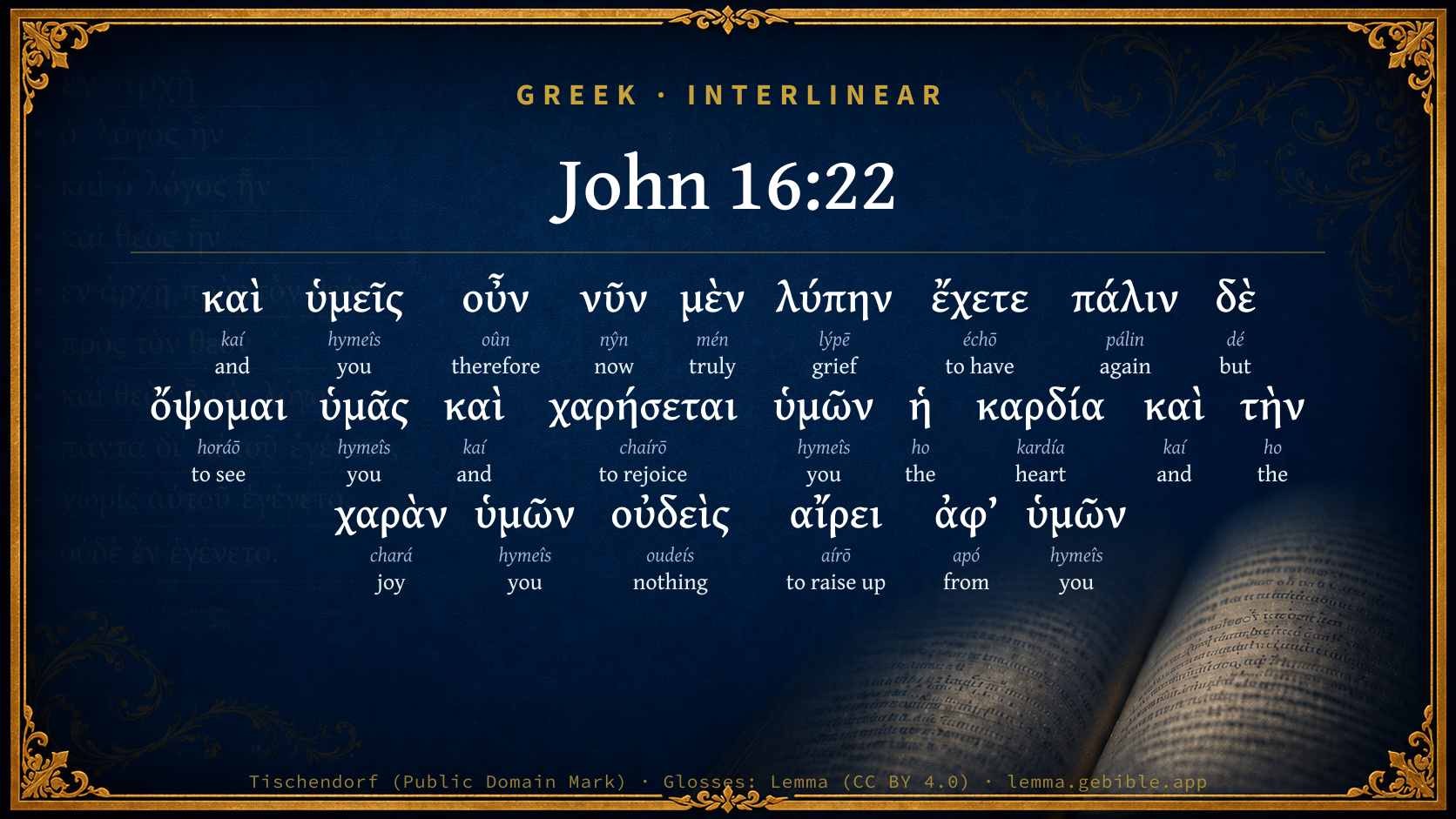
  1. καὶ kaí G2532 “and” Conjunction
  2. ὑμεῖς hymeîs G5210 “you” Personal pronoun, 2nd person, Nominative, Plural
  3. οὖν oûn G3767 “therefore” Conjunction
  4. νῦν nŷn G3568 “now” Adverb
  5. μὲν mén G3303 “truly” Particle
  6. ἔχετε échō G2192 “to have” Verb, Present, Active, Indicative, 2nd person, Plural
  7. πάλιν pálin G3825 “again” Adverb
  8. δὲ dé G1161 “but” Conjunction
  9. ὄψομαι horáō G3708 “to see” Verb, Future, Middle deponent, Indicative, 1st person, Singular
  10. ὑμᾶς hymeîs G5210 “you” Personal pronoun, 2nd person, Accusative, Plural
  11. καὶ kaí G2532 “and” Conjunction
  12. χαρήσεται chaírō G5463 “to rejoice” Verb, Future, Passive deponent, Indicative, 3rd person, Singular
  13. ὑμῶν hymeîs G5210 “you” Personal pronoun, 2nd person, Genitive, Plural
  14. ἡ ho G3588 “the” Article, Nominative, Singular, Feminine
  15. καρδία kardía G2588 “heart” Noun, Nominative, Singular, Feminine
  16. καὶ kaí G2532 “and” Conjunction
  17. τὴν ho G3588 “the” Article, Accusative, Singular, Feminine
  18. χαρὰν chará G5479 “joy” Noun, Accusative, Singular, Feminine
  19. ὑμῶν hymeîs G5210 “you” Personal pronoun, 2nd person, Genitive, Plural
  20. οὐδεὶς oudeís G3762 “nothing” Adjective, Nominative, Singular, Masculine, Negative
  21. αἴρει aírō G142 “to raise up” Verb, Present, Active, Indicative, 3rd person, Singular
  22. ἀφ’ apó G575 “from” Preposition
  23. ὑμῶν hymeîs G5210 “you” Personal pronoun, 2nd person, Genitive, Plural

About this verse

These counts appear in no published source. They are computed here, from the morphology-tagged text and Lemma’s own curated glosses. What Lemma adds →

24
words
17
distinct lemmas
Gospels
section

Notable vocabulary

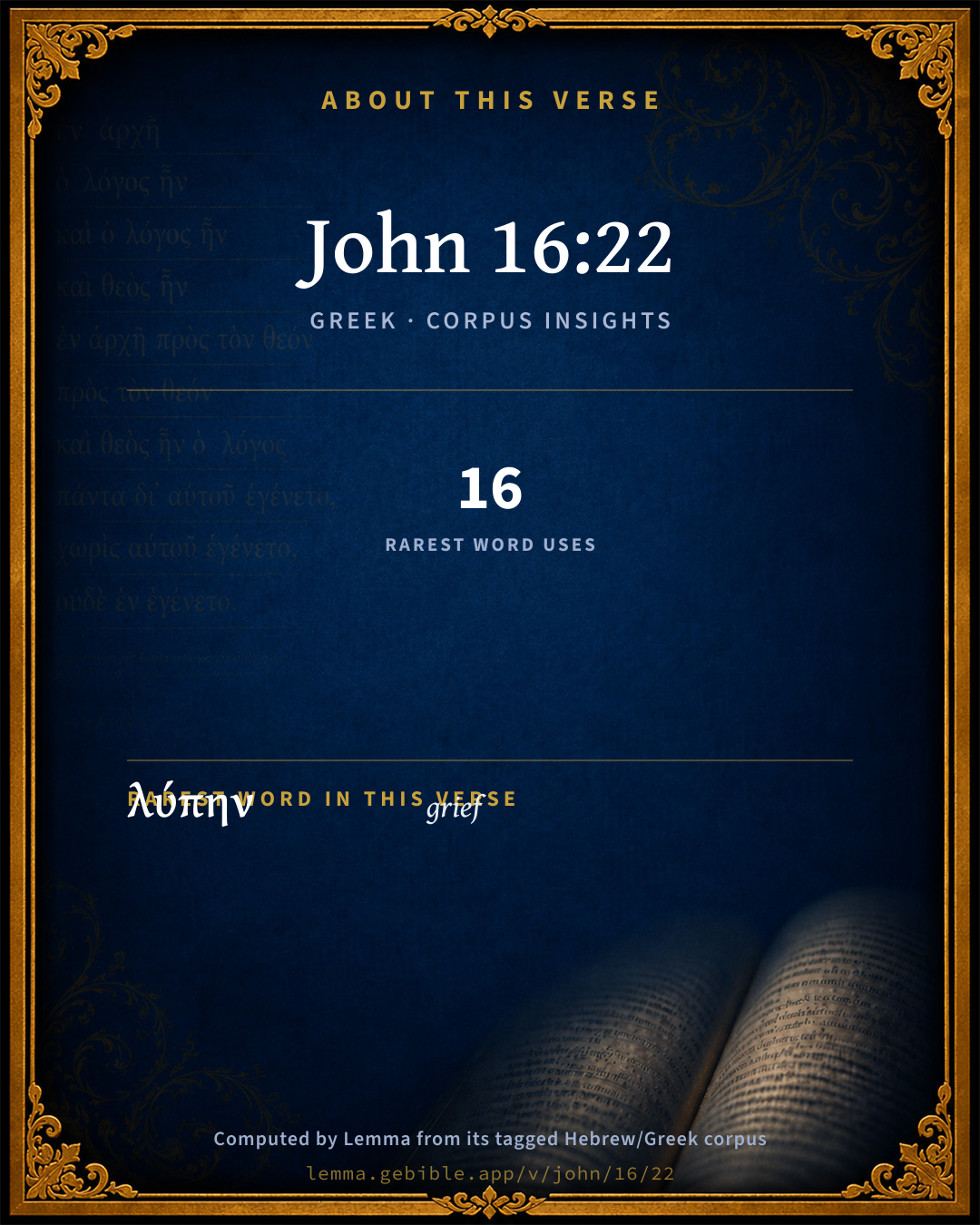
The rarest word here is λύπην grief G3077 — appearing just 16 times in the whole Greek New Testament.

Shared distinctive vocabulary

λύπην grief G3077 occurs in 14 verses of the Greek New Testament. Also found in:

Repetition

Words recur within this verse:

Cross-references

36

Topical passages linked to John 16:22 in the Treasury of Scripture Knowledge — connected by theme and wording, ordered by reader-vote popularity; previews shown in the World English Bible.

  • 1 Peter 1:8 whom not having known you love; in whom, though now you don't see him, yet believing, you rejoice greatly with joy unspeakable and full of glory--
  • Acts 13:52 The disciples were filled with joy with the Holy Spirit.
  • John 16:6 But because I have told you these things, sorrow has filled your heart.
  • 2 Thessalonians 2:16 Now our Lord Jesus Christ himself, and God our Father, who loved us and gave us eternal comfort and good hope through grace,
  • Psalms 146:2 While I live, I will praise Yahweh. I will sing praises to my God as long as I exist.
  • Isaiah 25:9 It shall be said in that day, Behold, this is our God; we have waited for him, and he will save us: this is Yahweh; we have waited for him, we will be glad and rejoice in his salvation.
  • Acts 16:25 But about midnight Paul and Silas were praying and singing hymns to God, and the prisoners were listening to them.
  • 1 Peter 4:13–14 But because you are partakers of Christ's sufferings, rejoice; that at the revelation of his glory also you may rejoice with exceeding joy.
  • Isaiah 12:2–4 Behold, God is my salvation. I will trust, and will not be afraid; for Yah, Yahweh, is my strength and song; and he has become my salvation."
  • Habakkuk 3:17–18 For though the fig tree doesn't flourish, Nor fruit be in the vines; The labor of the olive fails, The fields yield no food; The flocks are cut off from the fold, And there is no herd in the stalls:
  • Acts 2:46 Day by day, continuing steadfastly with one accord in the temple, and breaking bread at home, they took their food with gladness and singleness of heart,
  • Isaiah 51:11–12 The ransomed of Yahweh shall return, and come with singing to Zion; and everlasting joy shall be on their heads: they shall obtain gladness and joy; [and] sorrow and sighing shall flee away.
  • Isaiah 54:7–8 For a small moment have I forsaken you; but with great mercies will I gather you.
  • Isaiah 65:13–14 Therefore thus says the Lord Yahweh, Behold, my servants shall eat, but you shall be hungry; behold, my servants shall drink, but you shall be thirsty; behold, my servants shall rejoice, but you shall be disappointed;
  • Isaiah 65:18–19 But be you glad and rejoice forever in that which I create; for, behold, I create Jerusalem a rejoicing, and her people a joy.
  • Isaiah 66:9–14 Shall I bring to the birth, and not cause to bring forth? says Yahweh: shall I who cause to bring forth shut [the womb]? says your God.
  • Matthew 28:8 They departed quickly from the tomb with fear and great joy, and ran to bring his disciples word.
  • Luke 10:42 but one thing is needed. Mary has chosen the good part, which will not be taken away from her."
  • Luke 16:25 "But Abraham said, 'Son, remember that you, in your lifetime, received your good things, and Lazarus, in like manner, bad things. But now here he is comforted and you are in anguish.
  • Luke 24:41 While they still didn't believe for joy, and wondered, he said to them, "Do you have anything here to eat?"
  • Luke 24:51–53 It happened, while he blessed them, that he withdrew from them, and was carried up into heaven.
  • John 4:14 but whoever drinks of the water that I will give him will never thirst again; but the water that I will give him will become in him a well of water springing up to eternal life."
  • John 14:1 "Don't let your heart be troubled. Believe in God. Believe also in me.
  • John 14:27 Peace I leave with you. My peace I give to you; not as the world gives, give I to you. Don't let your heart be troubled, neither let it be fearful.
  • John 20:19–20 When therefore it was evening, on that day, the first day of the week, and when the doors were locked where the disciples were assembled, for fear of the Jews, Jesus came and stood in the midst, and said to them, "Peace be to you."
  • John 21:7 That disciple therefore whom Jesus loved said to Peter, "It's the Lord!" So when Simon Peter heard that it was the Lord, he wrapped his coat around him (for he was naked), and threw himself into the sea.
  • Acts 5:41 They therefore departed from the presence of the council, rejoicing that they were counted worthy to suffer dishonor for Jesus' name.
  • Romans 8:35–39 Who shall separate us from the love of Christ? Could oppression, or anguish, or persecution, or famine, or nakedness, or peril, or sword?
  • 1 Thessalonians 3:7–9 for this cause, brothers, we were comforted over you in all our distress and affliction through your faith.
  • Hebrews 6:18 that by two immutable things, in which it is impossible for God to lie, we may have a strong encouragement, who have fled for refuge to take hold of the hope set before us.
  • Hebrews 10:34 For you both had compassion on me in my chains, and joyfully accepted the plundering of your possessions, knowing that you have for yourselves a better possession and an enduring one in the heavens.
  • Job 34:29 When he gives quietness, who then can condemn? When he hides his face, who then can see him? Alike whether to a nation, or to a man:
  • Luke 19:26 'For I tell you that to everyone who has, will more be given; but from him who doesn't have, even that which he has will be taken away from him.
  • John 16:20 Most assuredly I tell you, that you will weep and lament, but the world will rejoice. You will be sorrowful, but your sorrow will be turned into joy.
  • Acts 20:23–24 except that the Holy Spirit testifies in every city, saying that bonds and afflictions wait for me.
  • John 16:16 A little while, and you will not see me. Again a little while, and you will see me."

Cross-references courtesy of OpenBible.info (CC BY 4.0).

Commentary

Notes on John 16:22 from classic Christian and Jewish commentators (each source and its license shown beneath its notes). The classic Christian expositions comment on the surrounding passage and are grouped to its opening verse, so a note may address several verses; the Jewish commentaries on the Tanakh (Rashi and others) are per-verse, so they appear only where the commentator wrote on this verse.

Lemma curates 59 commentaries, every one of them public domain or Creative Commons licensed, each selected and text-cleaned for this edition rather than reprinted as found. About our sources →

Bengel's Gnomon

Johann Albrecht Bengel

Joh 16:22. Ὄψομαι, I will see) Joh 16:16, ye shall see Me. The two are correlative.—χαρήσεται ὑμῶν ἡ καρδιά) Isa 66:14, καὶ ὄψεσθε καὶ χαρήσεται ἡ καρδιά ὑμῶν.—οὐδεὶς αἴρει, no man taketh away) The Present, by which it is signified that the joy is sure, a joy which can be thwarted by no enemy, whatever may be now for the present impending: Joh 16:32.

Bengel's Gnomon of the New Testament — English translation (T&T Clark, Edinburgh, 1860) — public domain. Text from a community e-Sword module.

Expositor's Greek Testament

ed. W. Robertson Nicoll

Joh 16:22 . καὶ ὑμεῖς … ὑμῶν , “and you accordingly,” in keeping with this natural arrangement conspicuous in the woman’s case, “have at present sorrow”. This is the time when the results are hidden and only the pain felt: “but I will see you again and your heart shall rejoice and your joy no one takes from you”. This joy was felt in the renewed vision of their Lord at the Resurrection. “All turns on the Resurrection; and without the experiences of that time there would have been no beholding Christ in the Spirit.” Bernard.

The Expositor's Greek Testament, edited by W. Robertson Nicoll (1897–1910) — public domain. Text from a community e-Sword module.

Adam Clarke's Commentary

Verse 22. Your joy no man taketh from you.] Or, shall take away. Some excellent MSS. and versions read the verb in the future tense. Our Lord's meaning appears to have been this: that his resurrection should be so completely demonstrated to them, that they should never have a doubt concerning it; and consequently that their joy should be great and permanent, knowing that the atonement was made, the victory gained, and the kingdom of heaven opened to all believers. Therefore it is said, Ac 4:33, that with great power did the apostles give witness of the resurrection of the Lord Jesus.

Adam Clarke's Commentary on the Bible (1810–1826) — public domain. Text from a community e-Sword/MySword module.

John Calvin's Commentaries

22. Your joy no man shall take from you. The value of the joy is greatly enhanced by its perpetuity; for it follows that the afflictions are light, and ought to be patiently endured, because they are of short duration. By these words Christ reminds us what is the nature of true joy The world must unavoidably be soon deprived of its joys, which it seeks only in fading things; and, therefore, we must come to the resurrection of Christ, in which there is eternal solidity.

But I will see you again. When he says that he will see his disciples, he means that he will visit them again by the grace of his Spirit, that they may continually enjoy his presence.

John Calvin's Commentaries (1540-1563) — public domain. Text from the Calvin Translation Society English edition (1840s-50s) via the Christian Classics Ethereal Library (ccel.org). Calvin's coverage is partial (roughly two-thirds of the Bible); uncommented books and verses are honest gaps, never fabricated. The 19th-century editor's footnotes and remarks are omitted so the notes are faithfully Calvin's own voice.

Ellicott's Commentary for English Readers

(22) And ye now therefore have sorrow.—The same word is used. The hour of their travail-pangs was at hand; but it would pass away, and the fulness of joy would come in the constant presence of their Lord. Their sorrow would be but temporary; their joy would be abiding. The point of comparison between their state, and the familiar illustration of a woman in travail, is the passage from extreme suffering to extreme joy. We are not justified in taking the illustration as a parable, and interpreting it of the death of Christ as the birth-pang of a perfect humanity. This is the general interpretation of the more mystical expositors, and has been unfolded with great truth and beauty; but it is not an exposition of the present text.

But I will see you again, and your heart shall rejoice.—In Joh_16:19 He had said “Ye shall see.” This is the obverse of the same truth. He will again. be with them, and see them as they will see Him. The words include too the thought of His deep sympathy with them. He sees them now in the depth of their sorrow, and feels with them in that. He will see them again in the time of their joy, and will rejoice with them in that.

And your joy no man taketh from you.—The reading is doubtful. Some of the better MSS. have the future “. . . shall take from you.” “No man” is better rendered indefinitely, no one, as, e.g., in Joh_10:18; Joh_10:29. (Comp. Mat_28:20, and Rom_8:38-39, and Notes there.)

A Bible Commentary for English Readers, edited by Charles John Ellicott (1878–1897) — public domain. Text from a community e-Sword module.

The Cambridge Bible for Schools and Colleges

gen. ed. J. J. S. Perowne

22. And ye now therefore] Or, Ye also therefore now. As in the case of childbirth, the suffering of the disciples was the necessary condition of the joy. This suffering was to repeat itself in a new form in the work of converting souls (Gal_4:19).

I will see you] In Joh_16:16-17; Joh_16:19 we had ‘ye shall see Me:’ here we have the other side of the same truth; and the same verb for ‘see’ is used in all four cases. In Gal_4:9 we have both sides of the truth stated (see on 1Co_8:3).

no man taketh] Or, according to some good authorities, no one shall take. Their sorrow shall depart, their joy shall remain.

The Cambridge Bible for Schools and Colleges (gen. ed. J. J. S. Perowne; Cambridge University Press, 1878–1918) — public domain. Text from a community e-Sword module.

John Gill's Exposition

Hitherto have ye asked nothing in my name,.... Not that they had never prayed as yet; for they had desired him to teach them to pray, which he did: they had prayed to him particularly for an increase of faith, and for many other things; but either they had only asked him, he being present with them, and not the Father; or if they had asked the Father anything, yet not in the name of Christ: they had made no mention of his blood, righteousness, and sacrifice, nor any use of his mediation; things they had not as yet such clear knowledge of; or they had not asked as yet any extraordinary thing, as they afterwards did; see Act 4:29;

ask, and ye shall receive; that is, in my name, and whatever ye ask for, ye shall have it, to fit you for your work, to carry you through it, and to give you success in it: see Mat 7:7;

that your joy may be full; go cheerfully through your work, find much pleasure in it, and with great satisfaction see the Gospel spread, souls converted, Satan's kingdom weakened, and the interest of your Redeemer thrive and flourish; than which nothing can more contribute to complete the joy of the ministers of Christ.

John Gill's Exposition of the Whole Bible (1746–1763) — public domain (CC PDM 1.0). Text via the HelloAO Bible API.

Trapp's Complete Commentary

John Trapp

22 And ye now therefore have sorrow: but I will see you again, and your heart shall rejoice, and your joy no man taketh from you.

Ver. 22. And ye now therefore have sorrow] No sorrow like to that, when we see not Christ in his favour. He hides his love often, as Joseph did, out of increasement of love; and then we cannot see him for crying; as Mary Magdalene could not, she was so bleared. But when he seemeth farthest from us, his heart is with us; and he must needs look through the chinks, as in the Canticles, to see how we do, as that martyr expresseth it. (Saunders, in a letter to his wife and friends.) There is a presence of Christ that is secret, when he seems to draw us one way, and to drive us another, Son 5:6.

John Trapp, A Commentary or Exposition upon All the Books of the Old and New Testament (1647–1656) — public domain. Text from a community e-Sword module.

Albert Barnes' Notes on the Bible

I will see you again - After my resurrection.

Your joy no man taketh from you - You shall be so firmly persuaded that I have risen and that I am the Messiah, that neither the threats nor persecutions of men shall ever be able to shake your faith and produce doubt or unbelief, and thus take away your joy. This prediction was remarkably fulfilled. It is evident that after his ascension not one of the apostles ever doubted for a moment that he had risen from the dead. No persecution or trial was able to shake their faith; and thus, amid all their afflictions, they had an unshaken source of joy.

Albert Barnes' Notes on the Bible (1834–1885) — public domain. Text from a community e-Sword/MySword module.

Haydock's Catholic Bible Commentary

The joy you will feel at my resurrection, shall ever be unalterable, and unremitting, because there I shall give you assurances and proofs of you future resurrection, and immortality. As you have been partakers in my labours, in my ignominies, and in my sorrows, so also shall you have a share in my glory, in my resurrection, and immortal bliss. Behold, these will rise to your ever unalterable and permanent joy. This is the opinion of St. John Chrysostom, St. Cyril, Theophylactus, and others.

George Leo Haydock (1774–1849), Haydock's Catholic Family Bible and Commentary, 1859 edition — public domain. Excludes Psalms (Douay-Rheims chapter numbering differs from Protestant) and Deuterocanonical books (Catholic canon only).

Matthew Poole's English Annotations

The whole church, Rev 12:1,2, is compared to a woman with child, crying, travailing in birth, and pained to be delivered. During this time of your travail you must have sorrow. All those

that will live godly in Christ Jesus must suffer persecution, 2Ti 3:12. It is appointed for all men once to die, Heb 9:27. It is appointed for God’s people (especially under some periods of time) to be dying daily, killed all the day long, as the apostle expresses the state of Christians in his time, Rom 8:36, quoting Psa 44:22, which showeth the state of the church in the Old Testament to have been the same. But (saith our Saviour) it is but as the hour of the woman’s travail; it will be sharp, very sharp, but it shall be short; for I will see you again, and then your heart shall rejoice; which cannot be understood of Christ’s seeing them again after his resurrection; for before that time we read of few or no sufferings of the apostles or other disciples. It must therefore be understood, either of the visitation of his Spirit, filling their hearts with joy and peace, or the visitation of his providence: or rather, of Christ’s coming to the last judgment, when all that have believed in Christ shall see him with joy unspeakable; and then all tears shall be wiped away from their eyes, and they shall enter into the joy of their Lord, and sigh and sorrow no more, nor shall it be in the power of all their enemies to deprive them of their joy.

Matthew Poole's English Annotations on the Holy Bible (1683–1685) — public domain. Text from a community e-Sword/MySword module.

Whedon's Commentary on the Bible

Daniel D. Whedon

22. Your joy no man taketh—Your sorrow shall depart, but never your joy. Hostile as is the world, no man can wrest it from you.

Daniel D. Whedon (gen. ed.), Commentary on the Old and New Testaments (1874–1909) — public domain. Text from a community e-Sword module.

The Pulpit Commentary

And, so he continues, ye therefore indeed now have sorrow your hearts are troubled, you weep and lament to-night, your desolation for "a little while" will be utter collapse and dismaybut I shall see you again. He does not repeat, "Ye shall behold me", (yewreite me , cf. Joh_14:19) but "I shall see you (uqomai umav)." The same word, however, is used repeatedly in the record of the resurrection, and in Ver. 19 he had said oqesye me . The point of the vision is his own consciousness of their human need filling all the forty days with its glory. The occasional manifestations of his Person during that interval helped them in a wonderful way to recognize the fact that he was ever watching them, and was at their side under all the circumstances of human life. And your heart shall rejoice, and this joy of yours no one taketh (present in the full sense of a realized future) from you. The oqomai umav lends itself to the larger conception which, by the gift of the Holy Ghost, they at length fully apprehended, that he was with them always, even to the end of the world. That conviction was forced upon them before Pentecost, (see Mat_28:19, Mat_28:20, and the account in this Gospel of the inspiration and communication of the Holy Ghost, Joh_20:22) before he came as the sound of a rushing mighty wind, or sat in tongues of flame on their heads. Your joy in the sense of my constant presence no one, neither man nor devil, taketh away from you. That presence will not be any further exposed to Jewish malice or treachery, nor darkened by persecution, nor destroyed by death; though with bodily eyes ye see me not, yet, fully realizing that my eye is on you, "you will rejoice with joy unspeakable and full of glory". (1Pe_1:8)

"I will see you again.

The sympathy and the wisdom alike of our Lord"s declarations and promises to his disciples upon the eve of his departure, command our warmest admiration. He both felt for those who were about to pass through a trial so severe, and he knew how to minister to their heart"s necessities. What a knowledge of human nature is apparent in this simple bat most significant promise!

I THE OCCASIONS UPON WHICH THIS PROMISE WAS FULFILLED.

1. Upon our Lord"s resurrection. Had he not taken this very early opportunity of again seeing his own, it is not obvious how their faith and courage could have been sustained. They were depressed almost to despondency by their Lord"s Passion and burial. Had he not appeared when he did, it would seem that their confidence in him must have been shaken, and their mutual unity must have been dissolved. But when he saw them, gladness took the place of sorrow, attachment was strengthened, and hope banished despair.

2. The descent of the Spirit was a richer and fuller accomplishment of our Lord"s designs of grace towards his Church. He had promised the Comforter, whose coming should keep them from being orphans, abandoned, and friendless in the world. And in the Spirit he himself came again to his own, visiting them in showers of spiritual blessing.

3. The return at the second advent must also have been in the Master"s mind when he uttered these gracious words of friendly assurance. His parables and his direct discourses alike animated the breasts of the disciples with this blessed hope. All the more did they rejoice in this prospect, because they were taught that he who had come the first time in humiliation and obedience would come the second time to judge and to reign.

II THE FULLNESS OF IMPORT AND BLESSING WHICH THIS PROMISE CONTAINS.

1. The assurance that Christ will see his people is even more precious and welcome than the assurance given (in previous verses) that they shall see him. Our religion teaches us to look away from ourselves to God, to rest on his declarations, his faithfulness, his love. Unless we are in a morbid, self-conscious state, it will give us strength and comfort to forget ourselves in order to concentrate our thoughts and desires upon him who holds us dear, and who will never forget and never forsake his own.

2. That Christ will see his people, involves an accession to their happiness. To know that the eye of our dearest friend is resting upon us, and that with interest and approbation, what so fitted as this to send a thrill of joy through all our nature? We are encouraged by the language of the text to think of Christ thus affectionately and (so to speak) in a manner so truly human.

3. That Christ will see his people, assures them of the supply of all their wants. Can our dearest and mightiest Friend see us in danger, and not deliver us? in temptation, and not succor us? in sorrow, and not console us? in need, and not minister to us? For a Being so sympathizing, to see is to pity; for a Being so mighty, to pity is to aid. T.

The Pulpit Commentary (1880–1919), ed. H.D.M. Spence-Jones & Joseph S. Exell — public domain. Text from a community e-Sword module.

John Wesley's Explanatory Notes

Ye now therefore have sorrow - This gives us no manner of authority to assert all believers must come into a state of darkness. They never need lose either their peace, or love, or the witness that they are the children of God. They never can lose these, but either through sin, or ignorance, or vehement temptation, or bodily disorder.

John Wesley, Explanatory Notes Upon the Whole Bible (1754–1765) — public domain. Text via the GEBible commentary corpus.

The People's New Testament

B. W. Johnson

22. Ye now therefore have sorrow. Are in travail, but soon there shall be a birth, “the First Born of the new creation” from the tomb.

B. W. Johnson's The People's New Testament with Notes (1889–1891) — public domain. Electronic text from the Christian Classics Ethereal Library (CCEL) ThML edition.

unfoldingWord translationNotes

Door43 World Missions Community

your heart will be glad

Here "heart" is a metonym for a person's inner being. AT: "you will be very happy" or "you will be very joyful" (See: Metonymy)

Truly, truly, I say to you

Translate this the way your language emphasizes that what follows is important and true. See how you translated this in John 1:51.

if you ask anything of the Father in my name, he will give it to you

Here the word "name" is a metonym that refers to the person and authority of Jesus. AT: "if you ask anything of the Father, he will give it to you because you belong to me" (See: Metonymy)

Father

This is an important title for God. (See: Translating Son and Father)

in my name

Here "name" is a metonym that refers to the person and authority of Jesus. The Father will honor the requests of the believers because of their relationship with Jesus. AT: "because you are my followers" or "on my authority" (See: Metonymy)

your joy will be fulfilled

You can translate this in an active form. AT: "God will give you great joy" (See: Active or Passive)

translationWords

joy

God the Father

unfoldingWord translationNotes — © Distant Shores Media and the Door43 World Missions Community, licensed CC BY-SA 4.0. Source: git.door43.org/Door43/en_tn.

Cambridge Greek Testament for Schools and Colleges

22. ἀρεῖ for αἴρει: both are strongly supported.

22. καὶ ὑμεῖς. And ye therefore now, or Ye also therefore now. As in childbirth, the disciples’ suffering was the necessary condition of their joy. This suffering took a new form in the work of converting souls (Gal 4:19). In Joh 16:16-17; Joh 16:19 we had ὄψεσθέ με: here we have the other side of the same truth, ὄψομαι ὕμας. In Gal 4:9 we have both sides.

Cambridge Greek Testament for Schools and Colleges (Cambridge University Press, 1896; 21 vols, various authors incl. Carr, Maclear, Plummer, Farrar, Lumby, Moule, M. R. James, Simcox) — public domain. Text from a community e-Sword module.

Alford’s Greek Testament

Henry Alford

22.] ὄψομαι—in the same manifold meaning as before noticed—will see you—at My Resurrection—by My Spirit—at My second Advent.

Henry Alford, The Greek Testament (1849–1861) — public domain. Text from a community e-Sword module.

International Critical Commentary

22. καὶ ὑμεῖς οὖν. For the constr. see 8:38. This is the application of the image of the joy which follows the pain of childbirth. “You now, indeed (for μέν, see on v. 9), have grief,” but presently you will rejoice. ἔχετε (א*BCΔ) is to be preferred to ἔξετε of אcADLΘ.

πάλιν δὲ ὄψομαι ὑμᾶς. Here is even a greater promise than ὄψεσθέ με of v. 16: it is better to be seen of God than to see Him (cf. Gal 4:9). This was the promise of Jesus, that He would see His disciples after He was risen.

καὶ χαρήσεται ὑμῶν ἡ καρδία The phrase is identical with that of Isa 66:14 (ὄψεσθε, καὶ χαρήσεται ἡ καρδία ὑμῶν: cf. also Psa 33:21) Cf. 20:14-16, when the promise was fulfilled in the first instance. Such joy is inalienable, οὐδεὶς αἴρει ἀφʼ ὑμῶν, the future which is certain being represented by a present tense. Nevertheless BD*N Pap. Oxy. 1781 have ἀρεῖ, which Westcott adopts. But אACD2LΔΘ and Pap. Oxy. 1228 give αἴρει. W has ἀφέρει.

International Critical Commentary — older volumes (1896–1929), various authors — public domain. Text from a community e-Sword module.

Vincent's Word Studies in the New Testament

Marvin R. Vincent

Have sorrow [λυπην εχετε] . This form of expression occurs frequently in the New Testament, to denote the possession or experience of virtues, sensations, desires, emotions, intellectual or spiritual faculties, faults, or defects. It is stronger than the verb which expresses any one of these. For instance, to have faith is stronger than to believe : to have life, than the act of living. It expresses a distinct, personal realization of the virtue or fault or sentiment in question. Hence, to have sorrow is more than to be sorrowful. In Mt 17:20, Christ does not say if ye believe, but if ye have faith; if faith, in ever so small a degree, is possessed by you as a conscious, living principle and motive. Compare have love (xiii. 35; 1Jo 4:16); have peace (xvi. 33); have trust (2Co 3:4); have boldness (Heb 10:19; 1Jo 2:28).

Marvin R. Vincent, Word Studies in the New Testament (1887–1900) — public domain. Text from a community e-Sword/MySword module.

Godet's Commentaries

Frédéric Louis Godet

Vv. 22 makes the application of the comparison. The term: I will see you, cannot be synonymous with: you shall see me (Joh 16:16-17; Joh 16:19). The fact of the spiritual seeing again is presented here from the point of view of Jesus, not of the disciples. The death of Jesus not only separated the disciples from Him, but also Him from the disciples. He Himself, when transporting Himself to this moment, said in Joh 16:4 : “When I was with you;” and after His resurrection, in Luk 24:44 : “When I was yet with you.” It is for this reason that, not being able at that time to keep them Himself, He prays the Father to keep them in His stead (Joh 17:12-13).

There is no longer between Him and them the bond of sensible communion, and there is not yet that of spiritual communion. For this reason, when He shall return to them spiritually, it will be a seeing again for Him as well as for them. After this interval, in which He no longer Himself held the reins of their life, will come the day of Pentecost, when He will again have the flock under His own hand, and will sovereignly govern them from the midst of His divine state. The resurrection in itself alone could not yet form this new bond. Weiss has therefore no good foundation for finding in this expression: I will see you again, a proof in favor of his explanation (comp. Joh 16:25). The last words: and no one, are to be explained according to him in the sense that, even when the Risen One had once departed, the joy of the resurrection nevertheless continued in the hearts of the disciples; but see on Joh 16:24.

The present αἴρει, takes away, is the true reading. Jesus transports Himself in thought to that day.

Frédéric Louis Godet — Commentaries on Luke, John, Romans, and 1 Corinthians — English translation (T&T Clark, Edinburgh, 1870s–1890s) — public domain. Text from a community e-Sword module.

Lesson kit

Teaching starters — assembled from the data on this page, not authored interpretation. Every prompt links to the verse data it draws on. Edit before teaching.

John, in the Gospels, opens this verse with 24 words (17 distinct Greek lemmas). Its most distinctive word is lýpē (“grief”). A historical commentator’s framing appears above. Read the whole chapter for the surrounding context.

Discussion questions

  1. What does “grief” (lýpē) contribute to the verse as a whole?
  2. Luke 22:45 shares the word «grief» with this verse. How do the two illuminate each other?
  3. “you” occurs 5× in this one verse. What is the effect of the repetition?
  4. The translations on this page render this verse differently — a whole-verse word diff, not a word-by-word alignment. What might account for the different wordings?
  5. Reading how Bengel's Gnomon and Expositor's Greek Testament read this verse, where do the two commentators agree and where do they part?

Things to notice

Reading settings

Reading text

Shown beneath each verse's original-language words.

Old Testament
Old Testament edition

Read the OT as the Masoretic Hebrew (MT) or the Greek Septuagint (LXX).

English shown for the Greek Septuagint (in the Hebrew ↔ Greek comparison).

Comparing translations? Open the Compare panel on any verse page to stack up to four side by side.